EP0723285A2 - Masque de diffusion et procédé de fabrication des jonctions PN dans un substrat semi-conducteur composé - Google Patents
Masque de diffusion et procédé de fabrication des jonctions PN dans un substrat semi-conducteur composé Download PDFInfo
- Publication number
- EP0723285A2 EP0723285A2 EP95309079A EP95309079A EP0723285A2 EP 0723285 A2 EP0723285 A2 EP 0723285A2 EP 95309079 A EP95309079 A EP 95309079A EP 95309079 A EP95309079 A EP 95309079A EP 0723285 A2 EP0723285 A2 EP 0723285A2
- Authority
- EP
- European Patent Office
- Prior art keywords
- diffusion
- film
- compound semiconductor
- mask
- semiconductor substrate
- Prior art date
- Legal status (The legal status is an assumption and is not a legal conclusion. Google has not performed a legal analysis and makes no representation as to the accuracy of the status listed.)
- Granted
Links
Images


Classifications
-
- H—ELECTRICITY
- H10—SEMICONDUCTOR DEVICES; ELECTRIC SOLID-STATE DEVICES NOT OTHERWISE PROVIDED FOR
- H10H—INORGANIC LIGHT-EMITTING SEMICONDUCTOR DEVICES HAVING POTENTIAL BARRIERS
- H10H20/00—Individual inorganic light-emitting semiconductor devices having potential barriers, e.g. light-emitting diodes [LED]
- H10H20/80—Constructional details
-
- H—ELECTRICITY
- H10—SEMICONDUCTOR DEVICES; ELECTRIC SOLID-STATE DEVICES NOT OTHERWISE PROVIDED FOR
- H10H—INORGANIC LIGHT-EMITTING SEMICONDUCTOR DEVICES HAVING POTENTIAL BARRIERS
- H10H20/00—Individual inorganic light-emitting semiconductor devices having potential barriers, e.g. light-emitting diodes [LED]
- H10H20/80—Constructional details
- H10H20/81—Bodies
-
- H—ELECTRICITY
- H10—SEMICONDUCTOR DEVICES; ELECTRIC SOLID-STATE DEVICES NOT OTHERWISE PROVIDED FOR
- H10P—GENERIC PROCESSES OR APPARATUS FOR THE MANUFACTURE OR TREATMENT OF DEVICES COVERED BY CLASS H10
- H10P32/00—Diffusion of dopants within, into or out of wafers, substrates or parts of devices
- H10P32/10—Diffusion of dopants within, into or out of semiconductor bodies or layers
- H10P32/14—Diffusion of dopants within, into or out of semiconductor bodies or layers within a single semiconductor body or layer in a solid phase; between different semiconductor bodies or layers, both in a solid phase
-
- H—ELECTRICITY
- H10—SEMICONDUCTOR DEVICES; ELECTRIC SOLID-STATE DEVICES NOT OTHERWISE PROVIDED FOR
- H10P—GENERIC PROCESSES OR APPARATUS FOR THE MANUFACTURE OR TREATMENT OF DEVICES COVERED BY CLASS H10
- H10P32/00—Diffusion of dopants within, into or out of wafers, substrates or parts of devices
- H10P32/10—Diffusion of dopants within, into or out of semiconductor bodies or layers
- H10P32/17—Diffusion of dopants within, into or out of semiconductor bodies or layers characterised by the semiconductor material
- H10P32/174—Diffusion of dopants within, into or out of semiconductor bodies or layers characterised by the semiconductor material being Group III-V material
Definitions
- the present invention relates to a diffusion mask and fabrication method for forming pn-junction elements in a compound semiconductor substrate.
- Light-emitting diodes are one common example of a pn-junction element formed in a compound semiconductor substrate. These elements are often formed by diffusing zinc through windows in a diffusion mask into a III-V compound semiconductor (e.g. gallium-arsenide) substrate. Diffusion masks of aluminum oxide (Al 2 O 3 , also referred to as alumina) or silicon nitride have often been employed.
- Al 2 O 3 also referred to as alumina
- silicon nitride have often been employed.
- One known diffusion method sputters a zinc-doped oxide film onto the diffusion mask, sputters a silicon-dioxide cap onto the zinc-doped oxide film, then applies heat to diffuse zinc from the zinc-doped oxide film through windows in the diffusion mask into the substrate.
- this method preferably employs a diffusion mask having a coefficient of thermal expansion matching that of the substrate.
- such diffusion masks are obtained by mixing aluminum oxide in a suitable ratio with silicon dioxide (SiO 2 ), silicon nitride (Si 3 N 4 ), or aluminum nitride (AlN).
- the zinc-doped oxide is removed by etching with hydrofluoric acid (HF) buffered with ammonium fluoride (NH 4 F).
- HF hydrofluoric acid
- NH 4 F ammonium fluoride
- Another possible approach would be to cover the diffusion mask with an additional insulating film, after the zinc-doped oxide had been removed, but that would also require an additional photolithography step, to pattern the additional insulating film.
- Another object of the invention is to avoid etching damage to the diffusion mask when overlying layers are etched, without employing an etching mask.
- a further object is to provide an efficient method of fabricating pn-junction elements in a compound semiconductor substrate, while insulating the surface of the substrate in a manner that avoids current leakage and short circuits.
- the invented diffusion mask comprises an aluminum-nitride film.
- Aluminum nitride is not etched by buffered HF.
- the invented diffusion method comprises the steps of: depositing an aluminum-nitride film on the surface of a compound semiconductor substrate; patterning the aluminum-nitride film to form a diffusion mask; depositing a diffusion source film on the diffusion mask; diffusing an impurity from the diffusion source film into the compound semiconductor substrate; and removing the diffusion source film by etching with buffered HF.
- the invented diffusion method preferably also comprises the steps of: depositing an anneal cap on the diffusion source film, prior to diffusion; and removing the anneal cap after diffusion.
- FIG. 1 is a sectional view of part of a compound semiconductor wafer, illustrating a first step in the invented fabrication method.
- FIG. 2 illustrates a second step in the invented fabrication method.
- FIG. 3 illustrates a third step in the invented fabrication method.
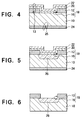
- FIG. 4 illustrates a fourth step in the invented fabrication method.
- FIG. 5 illustrates a fifth step in the invented fabrication method.
- FIG. 6 illustrates a sixth step in the invented fabrication method.
- FIG. 7 illustrates a seventh step in the invented fabrication method.
- the fabrication process starts from a III-V compound semiconductor substrate, for example, an n-type gallium-arsenide-phosphide compound semiconductor substrate 10 such as a GaAs 0.8 P 0.2 wafer.
- a III-V compound semiconductor substrate for example, an n-type gallium-arsenide-phosphide compound semiconductor substrate 10 such as a GaAs 0.8 P 0.2 wafer.
- the word 'wafer' will denote the substrate 10 together with various films deposited on the substrate.
- an aluminum-nitride (AlN) film 12 is deposited on the entire upper surface 13 of the compound semiconductor substrate 10.
- An aluminum-nitride film 12 with a c-axis crystal orientation can be deposited by a reactive sputtering method, using an aluminum target, with nitrogen (N 2 ) as the sputtering gas.
- nitrogen N 2
- a mixture of nitrogen and argon (Ar) can be used as the sputtering gas.
- Either dc or rf sputtering may be employed as the reactive sputtering method.
- the aluminum-nitride film 12 is patterned by well-known photolithography techniques to define regions 14 into which an impurity will be diffused.
- the aluminum-nitride film 12 is removed from these regions 14 by wet etching with hot phosphoric acid, leaving diffusion windows 16 that expose the surface 13 of the substrate 10. With the formation of these diffusion windows 16, the aluminum-nitride film 12 becomes a diffusion mask 18.
- a diffusion source film 20 and a first anneal cap 22 are formed sequentially on the diffusion mask 18, covering both the aluminum-nitride film 12 and diffusion windows 16.
- the diffusion source film 20 may comprise any substance that includes the impurity to be diffused and can be etched by buffered HF.
- the impurity is zinc and the diffusion source film 20 is a zinc-doped oxide film comprising zinc oxide mixed with silicon dioxide (ZnO/SiO 2 ).
- a diffusion source film consisting entirely of zinc oxide (ZnO) could also be used.
- the first anneal cap 22 must consist of a substance that blocks the passage of the impurity (which here is zinc), so that the impurity will diffuse into the substrate 10 and not escape into ambient space inside the diffusion chamber. This property is essential for achieving a high diffusion concentration under favorable diffusion conditions. Another desirable property of the first anneal cap 22 is that it block the passage of atoms of the compound semiconductor substrate 10, in this case atoms of gallium (Ga), arsenic (As), and phosphorus (P), because the escape of these atoms leads to substrate defects.
- Aluminum nitride has both of these properties, so here the first anneal cap film 22 is an aluminum-nitride film.
- the diffusion source film 20 and anneal cap 22 are formed in a continuous sputtering operation by placing the wafer in a sputtering chamber containing both a ZnO/SiO 2 target and an aluminum target.
- the two targets are disposed behind separate shutters.
- the shutter of the ZnO/SiO 2 target is opened, the shutter of the aluminum target is closed, and ZnO/SiO 2 is sputtered onto the wafer, using a mixture of argon and oxygen (O 2 ) as the sputtering gas.
- O 2 argon and oxygen
- the shutter of the ZnO/SiO 2 target is closed and the sputtering gas is replaced with a mixture of argon and nitrogen.
- the shutter of the aluminum target is opened and the aluminum-nitride anneal cap 22 is deposited by reactive sputtering.
- Continuous sputtering has the advantage of saving labor, but the invention can of course be practiced with separate sputtering steps for the diffusion source film 20 and anneal cap 22, these separate steps being carried out in different sputtering chambers.
- the invention can also be practiced with other anneal cap materials, including nitride films such as silicon nitride, or oxide films such as SiO 2 or Al 2 O 3 .
- nitride films such as silicon nitride
- oxide films such as SiO 2 or Al 2 O 3 .
- any film that blocks diffusion of the impurity can be used.
- a ZnO/SiO 2 diffusion source film and an SiO 2 anneal cap can be formed in a continuous operation by the same procedure as described above, except that the second target consists of SiO 2 instead of aluminum, the second sputtering gas is argon, and the second sputtering operation is not reactive.
- a second anneal cap 24 is formed on the bottom surface 25 of the compound semiconductor substrate 10.
- the purpose of the second anneal cap 24 is to prevent the escape of constituent elements of the compound semiconductor substrate 10 during diffusion, so the second anneal cap 24 may consist of any material that blocks the passage of these elements.
- the second anneal cap 24 is another aluminum-nitride film.
- the invention can be practiced without forming a second anneal cap 24. If, for example, the bottom surface 25 is polished afterwards, prior to deposition of an electrode layer as described below, then the second anneal cap 24 does not necessarily have to be formed.
- the wafer is annealed (heated), causing zinc to diffuse from the diffusion source film 20 through the diffusion windows 16 and into the compound semiconductor substrate 10, forming p-type diffusion regions 26.
- a pn junction is created at the boundary between each p-type diffusion region 26 and the n-type compound semiconductor substrate 10.
- the junction depth can be controlled by controlling the annealing temperature and annealing time.
- the diffusion source film 20 is removed by wet etching with buffered HF.
- buffered HF does not etch aluminum nitride
- the diffusion mask 18 is left substantially intact.
- the diffusion windows 16 are not widened, and no new holes are opened in the diffusion mask 18, even if pinholes were present in the diffusion source film 20.
- the etchant employed for removing the anneal caps 22 and 24 can be varied as required according to the composition of the anneal caps.
- silicon nitride is employed for the anneal caps 22 and 24, then the anneal caps 22 and 24 and diffusion source film 20 can all be removed in a single wet etching step, using buffered HF as the etchant, thereby simplifying the fabrication process.
- an aluminum (Al) film is deposited on the upper surface of the wafer and patterned to form a set of electrode lines 28.
- One electrode line 28 makes contact with each p-type diffusion region 26 through the corresponding diffusion window 16.
- An ohmic contact is created between the electrode lines 28 and impurity diffusion regions 26 by sintering.
- a gold alloy film is deposited on the bottom surface 25 of the wafer as an electrode film 30, and is sintered to create an ohmic contact with the compound semiconductor substrate 10. This completes the process of light-emitting-diode formation.
- current is fed from the electrode film 30 to an electrode line 28, light will be emitted from the pn junction between the corresponding p-type diffusion region 26 and the n-type substrate 10.
- the diffusion regions 26 are somewhat wider than the diffusion windows 16, due to lateral diffusion of the zinc impurity. Since the diffusion windows 16 are not widened during the wet etching step that removes the diffusion source film 20, the electrode lines 28 make contact only with the p-type diffusion regions 26, and not with the surrounding n-type substrate 10. Similarly, since no new holes are opened in the diffusion mask 18, no short circuits are created through the aluminum-nitride film 12 between the electrode lines 28 and compound semiconductor substrate 10. All current is therefore constrained to flow through the pn junction between the substrate 10 and diffusion region 26, as desired.
- the invented diffusion mask 18 itself provides reliable insulation between the electrode lines 28 and compound semiconductor substrate 10, no additional insulating film is required.
- the insulation thus provided is moreover self-aligned with the diffusion regions, and does not require a separate photolithography step, so the fabrication process is simple and low in cost.
- the invented fabrication method is not restricted to the embodiment described above.
- impurities other than zinc can be employed. These include n-type impurities, which may be diffused into a p-type compound semiconductor substrate, instead of diffusing a p-type impurity into an n-type substrate, to form pn junctions.
- the compound semiconductor substrate need not be GaAsP; other compound semiconductors (other III-V compound semiconductors, for example) can be employed.
- GaAsP is employed, moreover, the composition ratio need not be GaAs 0.8 P 0.2 . In general it may be GaAs 1-x P x , where x has any desired value. GaAs 0.8 P 0.2 has the advantage, however, of a coefficient of thermal expansion closely matching that of aluminum oxide.
- the aluminum-nitride film used as the diffusion mask was described as having a c-axis orientation, but this is not a restriction. Other crystal orientations are also possible.
Landscapes
- Led Devices (AREA)
- Drying Of Semiconductors (AREA)
Applications Claiming Priority (3)
| Application Number | Priority Date | Filing Date | Title |
|---|---|---|---|
| JP6139/95 | 1995-01-19 | ||
| JP613995A JP3157690B2 (ja) | 1995-01-19 | 1995-01-19 | pn接合素子の製造方法 |
| JP613995 | 1995-01-19 |
Publications (3)
| Publication Number | Publication Date |
|---|---|
| EP0723285A2 true EP0723285A2 (fr) | 1996-07-24 |
| EP0723285A3 EP0723285A3 (fr) | 1997-04-02 |
| EP0723285B1 EP0723285B1 (fr) | 2002-03-20 |
Family
ID=11630184
Family Applications (1)
| Application Number | Title | Priority Date | Filing Date |
|---|---|---|---|
| EP95309079A Expired - Lifetime EP0723285B1 (fr) | 1995-01-19 | 1995-12-13 | Fabrication d'un dispositif électrique |
Country Status (5)
| Country | Link |
|---|---|
| US (1) | US5700714A (fr) |
| EP (1) | EP0723285B1 (fr) |
| JP (1) | JP3157690B2 (fr) |
| KR (1) | KR100417988B1 (fr) |
| DE (1) | DE69525922T2 (fr) |
Cited By (5)
| Publication number | Priority date | Publication date | Assignee | Title |
|---|---|---|---|---|
| EP0836235A3 (fr) * | 1996-10-09 | 1999-10-06 | Oki Electric Industry Co., Ltd. | Diode électroluminescente, matrice de diodes électroluminescentes et méthode de fabrication |
| EP0821416A3 (fr) * | 1996-07-25 | 1999-11-17 | Oki Electric Industry Company, Limited | Matrice de diodes photoémettrices et méthode de fabrication |
| EP0872898A3 (fr) * | 1997-04-15 | 1999-12-08 | Oki Electric Industry Co., Ltd. | Matrice de diodes électroluminescentes |
| WO2002017370A1 (fr) * | 2000-08-24 | 2002-02-28 | Osram Opto Semiconductors Gmbh & Co. Ohg | Procede de fabrication de matiere semi-conductrice dopee |
| WO2005117147A1 (fr) | 2004-05-28 | 2005-12-08 | Osram Opto Semiconductors Gmbh | Procede de realisation d'une region presentant une conductivite elecrique reduite a l'interieur d'une couche de semi-conducteur, et composant semi-conducteur opto-electronique |
Families Citing this family (35)
| Publication number | Priority date | Publication date | Assignee | Title |
|---|---|---|---|---|
| US5821567A (en) * | 1995-12-13 | 1998-10-13 | Oki Electric Industry Co., Ltd. | High-resolution light-sensing and light-emitting diode array |
| JP3181262B2 (ja) * | 1998-06-04 | 2001-07-03 | スタンレー電気株式会社 | 平面実装型led素子およびその製造方法 |
| JP2000332248A (ja) * | 1999-05-14 | 2000-11-30 | Internatl Business Mach Corp <Ibm> | 薄膜トランジスタおよびその製造方法 |
| JP4221818B2 (ja) * | 1999-05-28 | 2009-02-12 | 沖電気工業株式会社 | 光半導体素子の製造方法 |
| US7001057B2 (en) * | 2001-05-23 | 2006-02-21 | Ivoclar Vivadent A.G. | Lighting apparatus for guiding light onto a light polymerizable piece to effect hardening thereof |
| US7030428B2 (en) * | 2001-12-03 | 2006-04-18 | Cree, Inc. | Strain balanced nitride heterojunction transistors |
| US6982204B2 (en) * | 2002-07-16 | 2006-01-03 | Cree, Inc. | Nitride-based transistors and methods of fabrication thereof using non-etched contact recesses |
| US7901994B2 (en) * | 2004-01-16 | 2011-03-08 | Cree, Inc. | Methods of manufacturing group III nitride semiconductor devices with silicon nitride layers |
| US7045404B2 (en) * | 2004-01-16 | 2006-05-16 | Cree, Inc. | Nitride-based transistors with a protective layer and a low-damage recess and methods of fabrication thereof |
| US7170111B2 (en) * | 2004-02-05 | 2007-01-30 | Cree, Inc. | Nitride heterojunction transistors having charge-transfer induced energy barriers and methods of fabricating the same |
| US7612390B2 (en) | 2004-02-05 | 2009-11-03 | Cree, Inc. | Heterojunction transistors including energy barriers |
| US7439609B2 (en) * | 2004-03-29 | 2008-10-21 | Cree, Inc. | Doping of gallium nitride by solid source diffusion and resulting gallium nitride structures |
| US7432142B2 (en) * | 2004-05-20 | 2008-10-07 | Cree, Inc. | Methods of fabricating nitride-based transistors having regrown ohmic contact regions |
| US7084441B2 (en) | 2004-05-20 | 2006-08-01 | Cree, Inc. | Semiconductor devices having a hybrid channel layer, current aperture transistors and methods of fabricating same |
| US7238560B2 (en) * | 2004-07-23 | 2007-07-03 | Cree, Inc. | Methods of fabricating nitride-based transistors with a cap layer and a recessed gate |
| US20060017064A1 (en) * | 2004-07-26 | 2006-01-26 | Saxler Adam W | Nitride-based transistors having laterally grown active region and methods of fabricating same |
| US7709859B2 (en) * | 2004-11-23 | 2010-05-04 | Cree, Inc. | Cap layers including aluminum nitride for nitride-based transistors |
| US7456443B2 (en) * | 2004-11-23 | 2008-11-25 | Cree, Inc. | Transistors having buried n-type and p-type regions beneath the source region |
| US7161194B2 (en) * | 2004-12-06 | 2007-01-09 | Cree, Inc. | High power density and/or linearity transistors |
| US7355215B2 (en) * | 2004-12-06 | 2008-04-08 | Cree, Inc. | Field effect transistors (FETs) having multi-watt output power at millimeter-wave frequencies |
| US7465967B2 (en) | 2005-03-15 | 2008-12-16 | Cree, Inc. | Group III nitride field effect transistors (FETS) capable of withstanding high temperature reverse bias test conditions |
| US8575651B2 (en) | 2005-04-11 | 2013-11-05 | Cree, Inc. | Devices having thick semi-insulating epitaxial gallium nitride layer |
| US7626217B2 (en) * | 2005-04-11 | 2009-12-01 | Cree, Inc. | Composite substrates of conductive and insulating or semi-insulating group III-nitrides for group III-nitride devices |
| US7615774B2 (en) * | 2005-04-29 | 2009-11-10 | Cree.Inc. | Aluminum free group III-nitride based high electron mobility transistors |
| US7544963B2 (en) * | 2005-04-29 | 2009-06-09 | Cree, Inc. | Binary group III-nitride based high electron mobility transistors |
| US9331192B2 (en) | 2005-06-29 | 2016-05-03 | Cree, Inc. | Low dislocation density group III nitride layers on silicon carbide substrates and methods of making the same |
| US20070018198A1 (en) * | 2005-07-20 | 2007-01-25 | Brandes George R | High electron mobility electronic device structures comprising native substrates and methods for making the same |
| US7709269B2 (en) | 2006-01-17 | 2010-05-04 | Cree, Inc. | Methods of fabricating transistors including dielectrically-supported gate electrodes |
| US7592211B2 (en) | 2006-01-17 | 2009-09-22 | Cree, Inc. | Methods of fabricating transistors including supported gate electrodes |
| DE102007020888A1 (de) * | 2007-05-04 | 2008-11-06 | Micro Systems Engineering Gmbh & Co. Kg | Keramisches Substratmaterial, Verfahren zur Herstellung und Verwendung desselben sowie Antenne oder Antennenarray |
| US8030188B2 (en) * | 2008-12-05 | 2011-10-04 | Electronics And Telecommunications Research Institute | Methods of forming a compound semiconductor device including a diffusion region |
| US8969912B2 (en) | 2011-08-04 | 2015-03-03 | Avogy, Inc. | Method and system for a GaN vertical JFET utilizing a regrown channel |
| JP6477396B2 (ja) * | 2015-09-30 | 2019-03-06 | 豊田合成株式会社 | 窒化物半導体装置の製造方法 |
| WO2019010488A1 (fr) * | 2017-07-07 | 2019-01-10 | Thin Film Electronics Asa | Processus d'activation de dopant à basse température au moyen d'une couche de couverture, et dispositifs mos incluant la couche de couverture |
| CN113053736B (zh) * | 2021-03-11 | 2024-05-03 | 捷捷半导体有限公司 | 一种半导体器件制作方法 |
Family Cites Families (12)
| Publication number | Priority date | Publication date | Assignee | Title |
|---|---|---|---|---|
| US3907616A (en) * | 1972-11-15 | 1975-09-23 | Texas Instruments Inc | Method of forming doped dielectric layers utilizing reactive plasma deposition |
| US3909119A (en) * | 1974-02-06 | 1975-09-30 | Westinghouse Electric Corp | Guarded planar PN junction semiconductor device |
| US4058413A (en) * | 1976-05-13 | 1977-11-15 | The United States Of America As Represented By The Secretary Of The Air Force | Ion implantation method for the fabrication of gallium arsenide semiconductor devices utilizing an aluminum nitride protective capping layer |
| US4149307A (en) * | 1977-12-28 | 1979-04-17 | Hughes Aircraft Company | Process for fabricating insulated-gate field-effect transistors with self-aligned contacts |
| JPS54145486A (en) * | 1978-05-08 | 1979-11-13 | Handotai Kenkyu Shinkokai | Gaas semiconductor device |
| JPS5999717A (ja) * | 1982-11-29 | 1984-06-08 | Fujitsu Ltd | 半導体装置の製造方法 |
| JPS6216573A (ja) * | 1985-07-15 | 1987-01-24 | Matsushita Electric Ind Co Ltd | 半導体装置の製造方法 |
| JPS6298721A (ja) * | 1985-10-25 | 1987-05-08 | Furukawa Electric Co Ltd:The | 3−V族化合物半導体へのZn固相拡散方法 |
| JPS62139320A (ja) * | 1985-12-13 | 1987-06-23 | Furukawa Electric Co Ltd:The | 化合物半導体への選択固相拡散方法 |
| JP2857305B2 (ja) * | 1993-10-20 | 1999-02-17 | 沖電気工業株式会社 | Ledアレイおよびその製造方法 |
| US5523590A (en) * | 1993-10-20 | 1996-06-04 | Oki Electric Industry Co., Ltd. | LED array with insulating films |
| JP3241929B2 (ja) * | 1994-05-27 | 2001-12-25 | 沖電気工業株式会社 | 受発光ダイオード |
-
1995
- 1995-01-19 JP JP613995A patent/JP3157690B2/ja not_active Expired - Fee Related
- 1995-12-13 DE DE69525922T patent/DE69525922T2/de not_active Expired - Lifetime
- 1995-12-13 EP EP95309079A patent/EP0723285B1/fr not_active Expired - Lifetime
-
1996
- 1996-01-05 KR KR1019960000117A patent/KR100417988B1/ko not_active Expired - Fee Related
- 1996-01-19 US US08/588,890 patent/US5700714A/en not_active Expired - Lifetime
Non-Patent Citations (1)
| Title |
|---|
| None |
Cited By (11)
| Publication number | Priority date | Publication date | Assignee | Title |
|---|---|---|---|---|
| EP0821416A3 (fr) * | 1996-07-25 | 1999-11-17 | Oki Electric Industry Company, Limited | Matrice de diodes photoémettrices et méthode de fabrication |
| US6190935B1 (en) | 1996-07-25 | 2001-02-20 | Oki Electric Industry Co., Ltd. | Low-cost, high-density light-emitting-diode array and fabrication method thereof |
| US6563138B2 (en) | 1996-07-25 | 2003-05-13 | Oki Electric Industry Co., Ltd. | Low-cost, high-density light-emitting-diode array and fabrication method thereof |
| EP0836235A3 (fr) * | 1996-10-09 | 1999-10-06 | Oki Electric Industry Co., Ltd. | Diode électroluminescente, matrice de diodes électroluminescentes et méthode de fabrication |
| US6054724A (en) * | 1996-10-09 | 2000-04-25 | Oki Electric Industry Co., Ltd. | Light-emitting diode, light-emitting diode array |
| US6271051B1 (en) * | 1996-10-09 | 2001-08-07 | Oki Data Corporation | Light-emitting diode, light-emitting diode array, and method of their fabrication |
| EP0872898A3 (fr) * | 1997-04-15 | 1999-12-08 | Oki Electric Industry Co., Ltd. | Matrice de diodes électroluminescentes |
| US6211537B1 (en) | 1997-04-15 | 2001-04-03 | Oki Electric Industry Co., Ltd. | LED array |
| WO2002017370A1 (fr) * | 2000-08-24 | 2002-02-28 | Osram Opto Semiconductors Gmbh & Co. Ohg | Procede de fabrication de matiere semi-conductrice dopee |
| WO2005117147A1 (fr) | 2004-05-28 | 2005-12-08 | Osram Opto Semiconductors Gmbh | Procede de realisation d'une region presentant une conductivite elecrique reduite a l'interieur d'une couche de semi-conducteur, et composant semi-conducteur opto-electronique |
| US8293553B2 (en) | 2004-05-28 | 2012-10-23 | Osram Opto Semiconductors Gmbh | Method for producing an area having reduced electrical conductivity within a semiconductor layer and optoelectronic semiconductor element |
Also Published As
| Publication number | Publication date |
|---|---|
| DE69525922D1 (de) | 2002-04-25 |
| KR100417988B1 (ko) | 2004-05-20 |
| US5700714A (en) | 1997-12-23 |
| EP0723285B1 (fr) | 2002-03-20 |
| JPH08195506A (ja) | 1996-07-30 |
| JP3157690B2 (ja) | 2001-04-16 |
| KR960030451A (ko) | 1996-08-17 |
| EP0723285A3 (fr) | 1997-04-02 |
| DE69525922T2 (de) | 2002-11-07 |
Similar Documents
| Publication | Publication Date | Title |
|---|---|---|
| US5700714A (en) | Diffusion mask and fabrication method for forming pn-junction elements in a compound semiconductor substrate | |
| US5272108A (en) | Method of manufacturing gallium nitride semiconductor light-emitting device | |
| US5242858A (en) | Process for preparing semiconductor device by use of a flattening agent and diffusion | |
| US3966577A (en) | Dielectrically isolated semiconductor devices | |
| US4585517A (en) | Reactive sputter cleaning of semiconductor wafer | |
| US4472729A (en) | Recrystallized three dimensional integrated circuit | |
| CA1250055A (fr) | Enrobage de semiconducteurs composes iii-v et ii-vi | |
| EP0322244A2 (fr) | Procédé autolimité de sous-gravure d'un masque | |
| EP0480409B1 (fr) | Méthode de fabrication d'un contact Ti/TiN/Al comprenant une étape de pulvérisation réactive | |
| US4662956A (en) | Method for prevention of autodoping of epitaxial layers | |
| US4597167A (en) | Method of forming a metal film on a selectively diffused layer | |
| EP0322243B1 (fr) | Procédé pour fabriquer un transistor à effet de champ en gallium arséniure | |
| US6150220A (en) | Insulation layer structure and method for making the same | |
| US4351677A (en) | Method of manufacturing semiconductor device having aluminum diffused semiconductor substrate | |
| US5087322A (en) | Selective metallization for high temperature semiconductors | |
| EP0461807B1 (fr) | MESFET et sa méthode de fabrication | |
| US6818521B2 (en) | Method of manufacturing a hetero-junction bipolar transistor with epitaxially grown multi-layer films and annealing at or below 600° C. | |
| US4587709A (en) | Method of making short channel IGFET | |
| US4224636A (en) | Semiconductor device with thermally compensating SiO2 -silicate glass-SiC passivation layer | |
| JP2816684B2 (ja) | 複数のダイオードの製造方法 | |
| EP0155311B1 (fr) | Procede de reparation de contacts noyes dans des dispositifs mosfet | |
| US3969165A (en) | Simplified method of transistor manufacture | |
| JPH04368125A (ja) | 半導体装置及びその製造方法 | |
| JP3222344B2 (ja) | 発光ダイオードアレイの製造方法 | |
| KR0167239B1 (ko) | 반도체 소자의 격리막 제조방법 |
Legal Events
| Date | Code | Title | Description |
|---|---|---|---|
| PUAI | Public reference made under article 153(3) epc to a published international application that has entered the european phase |
Free format text: ORIGINAL CODE: 0009012 |
|
| AK | Designated contracting states |
Kind code of ref document: A2 Designated state(s): DE FR GB NL |
|
| PUAL | Search report despatched |
Free format text: ORIGINAL CODE: 0009013 |
|
| AK | Designated contracting states |
Kind code of ref document: A3 Designated state(s): DE FR GB NL |
|
| 17P | Request for examination filed |
Effective date: 19970718 |
|
| 17Q | First examination report despatched |
Effective date: 19990305 |
|
| RAP1 | Party data changed (applicant data changed or rights of an application transferred) |
Owner name: OKI DATA CORPORATION |
|
| RTI1 | Title (correction) |
Free format text: FABRICATION OF AN ELECTRICAL ELEMENT |
|
| GRAG | Despatch of communication of intention to grant |
Free format text: ORIGINAL CODE: EPIDOS AGRA |
|
| GRAG | Despatch of communication of intention to grant |
Free format text: ORIGINAL CODE: EPIDOS AGRA |
|
| GRAH | Despatch of communication of intention to grant a patent |
Free format text: ORIGINAL CODE: EPIDOS IGRA |
|
| GRAH | Despatch of communication of intention to grant a patent |
Free format text: ORIGINAL CODE: EPIDOS IGRA |
|
| REG | Reference to a national code |
Ref country code: GB Ref legal event code: IF02 |
|
| GRAA | (expected) grant |
Free format text: ORIGINAL CODE: 0009210 |
|
| AK | Designated contracting states |
Kind code of ref document: B1 Designated state(s): DE FR GB NL |
|
| PG25 | Lapsed in a contracting state [announced via postgrant information from national office to epo] |
Ref country code: NL Free format text: LAPSE BECAUSE OF FAILURE TO SUBMIT A TRANSLATION OF THE DESCRIPTION OR TO PAY THE FEE WITHIN THE PRESCRIBED TIME-LIMIT Effective date: 20020320 |
|
| REF | Corresponds to: |
Ref document number: 69525922 Country of ref document: DE Date of ref document: 20020425 |
|
| ET | Fr: translation filed | ||
| NLV1 | Nl: lapsed or annulled due to failure to fulfill the requirements of art. 29p and 29m of the patents act | ||
| PLBE | No opposition filed within time limit |
Free format text: ORIGINAL CODE: 0009261 |
|
| STAA | Information on the status of an ep patent application or granted ep patent |
Free format text: STATUS: NO OPPOSITION FILED WITHIN TIME LIMIT |
|
| 26N | No opposition filed |
Effective date: 20021223 |
|
| PGFP | Annual fee paid to national office [announced via postgrant information from national office to epo] |
Ref country code: FR Payment date: 20101224 Year of fee payment: 16 |
|
| PGFP | Annual fee paid to national office [announced via postgrant information from national office to epo] |
Ref country code: GB Payment date: 20101208 Year of fee payment: 16 |
|
| PGFP | Annual fee paid to national office [announced via postgrant information from national office to epo] |
Ref country code: DE Payment date: 20101208 Year of fee payment: 16 |
|
| GBPC | Gb: european patent ceased through non-payment of renewal fee |
Effective date: 20111213 |
|
| REG | Reference to a national code |
Ref country code: FR Ref legal event code: ST Effective date: 20120831 |
|
| REG | Reference to a national code |
Ref country code: DE Ref legal event code: R119 Ref document number: 69525922 Country of ref document: DE Effective date: 20120703 |
|
| PG25 | Lapsed in a contracting state [announced via postgrant information from national office to epo] |
Ref country code: DE Free format text: LAPSE BECAUSE OF NON-PAYMENT OF DUE FEES Effective date: 20120703 Ref country code: GB Free format text: LAPSE BECAUSE OF NON-PAYMENT OF DUE FEES Effective date: 20111213 |
|
| PG25 | Lapsed in a contracting state [announced via postgrant information from national office to epo] |
Ref country code: FR Free format text: LAPSE BECAUSE OF NON-PAYMENT OF DUE FEES Effective date: 20120102 |