EP0731478A2 - Electrode de contact pour interrupteur à vide - Google Patents
Electrode de contact pour interrupteur à vide Download PDFInfo
- Publication number
- EP0731478A2 EP0731478A2 EP96301525A EP96301525A EP0731478A2 EP 0731478 A2 EP0731478 A2 EP 0731478A2 EP 96301525 A EP96301525 A EP 96301525A EP 96301525 A EP96301525 A EP 96301525A EP 0731478 A2 EP0731478 A2 EP 0731478A2
- Authority
- EP
- European Patent Office
- Prior art keywords
- contact electrode
- volume
- point
- component
- gradient
- Prior art date
- Legal status (The legal status is an assumption and is not a legal conclusion. Google has not performed a legal analysis and makes no representation as to the accuracy of the status listed.)
- Withdrawn
Links
- 239000010949 copper Substances 0.000 claims abstract description 117
- 239000000203 mixture Substances 0.000 claims abstract description 70
- 229910052709 silver Inorganic materials 0.000 claims abstract description 26
- 230000008018 melting Effects 0.000 claims abstract description 14
- 238000002844 melting Methods 0.000 claims abstract description 14
- 229910052802 copper Inorganic materials 0.000 claims abstract description 9
- RYGMFSIKBFXOCR-UHFFFAOYSA-N Copper Chemical compound [Cu] RYGMFSIKBFXOCR-UHFFFAOYSA-N 0.000 claims abstract description 7
- 239000004332 silver Substances 0.000 claims abstract description 5
- 229910052804 chromium Inorganic materials 0.000 claims description 4
- 239000000758 substrate Substances 0.000 claims description 3
- 229910052719 titanium Inorganic materials 0.000 claims description 3
- 229910052742 iron Inorganic materials 0.000 claims description 2
- 229910052759 nickel Inorganic materials 0.000 claims description 2
- VYZAMTAEIAYCRO-UHFFFAOYSA-N Chromium Chemical compound [Cr] VYZAMTAEIAYCRO-UHFFFAOYSA-N 0.000 claims 2
- XEEYBQQBJWHFJM-UHFFFAOYSA-N Iron Chemical compound [Fe] XEEYBQQBJWHFJM-UHFFFAOYSA-N 0.000 claims 2
- ZOKXTWBITQBERF-UHFFFAOYSA-N Molybdenum Chemical compound [Mo] ZOKXTWBITQBERF-UHFFFAOYSA-N 0.000 claims 2
- PXHVJJICTQNCMI-UHFFFAOYSA-N Nickel Chemical compound [Ni] PXHVJJICTQNCMI-UHFFFAOYSA-N 0.000 claims 2
- RTAQQCXQSZGOHL-UHFFFAOYSA-N Titanium Chemical compound [Ti] RTAQQCXQSZGOHL-UHFFFAOYSA-N 0.000 claims 2
- QCWXUUIWCKQGHC-UHFFFAOYSA-N Zirconium Chemical compound [Zr] QCWXUUIWCKQGHC-UHFFFAOYSA-N 0.000 claims 2
- 239000011651 chromium Substances 0.000 claims 2
- 229910052750 molybdenum Inorganic materials 0.000 claims 2
- 239000011733 molybdenum Substances 0.000 claims 2
- 229910052758 niobium Inorganic materials 0.000 claims 2
- 239000010955 niobium Substances 0.000 claims 2
- GUCVJGMIXFAOAE-UHFFFAOYSA-N niobium atom Chemical compound [Nb] GUCVJGMIXFAOAE-UHFFFAOYSA-N 0.000 claims 2
- 230000002093 peripheral effect Effects 0.000 claims 2
- 229910052715 tantalum Inorganic materials 0.000 claims 2
- GUVRBAGPIYLISA-UHFFFAOYSA-N tantalum atom Chemical compound [Ta] GUVRBAGPIYLISA-UHFFFAOYSA-N 0.000 claims 2
- 239000010936 titanium Substances 0.000 claims 2
- WFKWXMTUELFFGS-UHFFFAOYSA-N tungsten Chemical compound [W] WFKWXMTUELFFGS-UHFFFAOYSA-N 0.000 claims 2
- 229910052721 tungsten Inorganic materials 0.000 claims 2
- 239000010937 tungsten Substances 0.000 claims 2
- 229910052720 vanadium Inorganic materials 0.000 claims 2
- LEONUFNNVUYDNQ-UHFFFAOYSA-N vanadium atom Chemical compound [V] LEONUFNNVUYDNQ-UHFFFAOYSA-N 0.000 claims 2
- 229910052726 zirconium Inorganic materials 0.000 claims 2
- 229910052787 antimony Inorganic materials 0.000 claims 1
- WATWJIUSRGPENY-UHFFFAOYSA-N antimony atom Chemical compound [Sb] WATWJIUSRGPENY-UHFFFAOYSA-N 0.000 claims 1
- 229910052797 bismuth Inorganic materials 0.000 claims 1
- JCXGWMGPZLAOME-UHFFFAOYSA-N bismuth atom Chemical compound [Bi] JCXGWMGPZLAOME-UHFFFAOYSA-N 0.000 claims 1
- 239000010941 cobalt Substances 0.000 claims 1
- 229910017052 cobalt Inorganic materials 0.000 claims 1
- GUTLYIVDDKVIGB-UHFFFAOYSA-N cobalt atom Chemical compound [Co] GUTLYIVDDKVIGB-UHFFFAOYSA-N 0.000 claims 1
- 150000001247 metal acetylides Chemical class 0.000 claims 1
- 229910052714 tellurium Inorganic materials 0.000 claims 1
- PORWMNRCUJJQNO-UHFFFAOYSA-N tellurium atom Chemical compound [Te] PORWMNRCUJJQNO-UHFFFAOYSA-N 0.000 claims 1
- 239000000843 powder Substances 0.000 description 124
- 239000000463 material Substances 0.000 description 120
- 239000007772 electrode material Substances 0.000 description 68
- 230000000052 comparative effect Effects 0.000 description 20
- 238000012360 testing method Methods 0.000 description 19
- 238000000034 method Methods 0.000 description 17
- 230000014759 maintenance of location Effects 0.000 description 11
- 239000000523 sample Substances 0.000 description 11
- 230000003068 static effect Effects 0.000 description 11
- 230000006872 improvement Effects 0.000 description 8
- 238000011156 evaluation Methods 0.000 description 7
- 239000011812 mixed powder Substances 0.000 description 6
- 230000009467 reduction Effects 0.000 description 6
- 230000002159 abnormal effect Effects 0.000 description 5
- 238000005245 sintering Methods 0.000 description 4
- BPJYAXCTOHRFDQ-UHFFFAOYSA-L tetracopper;2,4,6-trioxido-1,3,5,2,4,6-trioxatriarsinane;diacetate Chemical compound [Cu+2].[Cu+2].[Cu+2].[Cu+2].CC([O-])=O.CC([O-])=O.[O-][As]1O[As]([O-])O[As]([O-])O1.[O-][As]1O[As]([O-])O[As]([O-])O1 BPJYAXCTOHRFDQ-UHFFFAOYSA-L 0.000 description 4
- 229910003178 Mo2C Inorganic materials 0.000 description 3
- 238000010438 heat treatment Methods 0.000 description 3
- 238000000465 moulding Methods 0.000 description 3
- 229910003470 tongbaite Inorganic materials 0.000 description 3
- 238000003483 aging Methods 0.000 description 2
- 230000032683 aging Effects 0.000 description 2
- 238000009835 boiling Methods 0.000 description 2
- 238000000151 deposition Methods 0.000 description 2
- 230000000694 effects Effects 0.000 description 2
- 238000002156 mixing Methods 0.000 description 2
- 239000011148 porous material Substances 0.000 description 2
- 230000000717 retained effect Effects 0.000 description 2
- UFHFLCQGNIYNRP-UHFFFAOYSA-N Hydrogen Chemical compound [H][H] UFHFLCQGNIYNRP-UHFFFAOYSA-N 0.000 description 1
- 229910004353 Ti-Cu Inorganic materials 0.000 description 1
- 239000012141 concentrate Substances 0.000 description 1
- 230000006866 deterioration Effects 0.000 description 1
- 238000009792 diffusion process Methods 0.000 description 1
- 238000009826 distribution Methods 0.000 description 1
- 238000001704 evaporation Methods 0.000 description 1
- 230000008020 evaporation Effects 0.000 description 1
- 238000002474 experimental method Methods 0.000 description 1
- 239000002360 explosive Substances 0.000 description 1
- 229910052739 hydrogen Inorganic materials 0.000 description 1
- 239000001257 hydrogen Substances 0.000 description 1
- 238000009413 insulation Methods 0.000 description 1
- 238000004519 manufacturing process Methods 0.000 description 1
- 230000007246 mechanism Effects 0.000 description 1
- 239000002184 metal Substances 0.000 description 1
- 229910052751 metal Inorganic materials 0.000 description 1
- 238000012986 modification Methods 0.000 description 1
- 230000004048 modification Effects 0.000 description 1
- 239000002245 particle Substances 0.000 description 1
- 230000002265 prevention Effects 0.000 description 1
- 230000008569 process Effects 0.000 description 1
- 238000011084 recovery Methods 0.000 description 1
- 238000007788 roughening Methods 0.000 description 1
- 238000007789 sealing Methods 0.000 description 1
- 238000009834 vaporization Methods 0.000 description 1
- 230000008016 vaporization Effects 0.000 description 1
- 238000003466 welding Methods 0.000 description 1
Images
Classifications
-
- H—ELECTRICITY
- H01—ELECTRIC ELEMENTS
- H01H—ELECTRIC SWITCHES; RELAYS; SELECTORS; EMERGENCY PROTECTIVE DEVICES
- H01H1/00—Contacts
- H01H1/02—Contacts characterised by the material thereof
- H01H1/0203—Contacts characterised by the material thereof specially adapted for vacuum switches
-
- H—ELECTRICITY
- H01—ELECTRIC ELEMENTS
- H01H—ELECTRIC SWITCHES; RELAYS; SELECTORS; EMERGENCY PROTECTIVE DEVICES
- H01H1/00—Contacts
- H01H1/64—Protective enclosures, baffle plates, or screens for contacts
- H01H1/66—Contacts sealed in an evacuated or gas-filled envelope, e.g. magnetic dry-reed contacts
-
- H—ELECTRICITY
- H01—ELECTRIC ELEMENTS
- H01H—ELECTRIC SWITCHES; RELAYS; SELECTORS; EMERGENCY PROTECTIVE DEVICES
- H01H33/00—High-tension or heavy-current switches with arc-extinguishing or arc-preventing means
- H01H33/60—Switches wherein the means for extinguishing or preventing the arc do not include separate means for obtaining or increasing flow of arc-extinguishing fluid
- H01H33/66—Vacuum switches
- H01H33/662—Housings or protective screens
- H01H33/66261—Specific screen details, e.g. mounting, materials, multiple screens or specific electrical field considerations
-
- H—ELECTRICITY
- H01—ELECTRIC ELEMENTS
- H01H—ELECTRIC SWITCHES; RELAYS; SELECTORS; EMERGENCY PROTECTIVE DEVICES
- H01H33/00—High-tension or heavy-current switches with arc-extinguishing or arc-preventing means
- H01H33/60—Switches wherein the means for extinguishing or preventing the arc do not include separate means for obtaining or increasing flow of arc-extinguishing fluid
- H01H33/66—Vacuum switches
- H01H33/664—Contacts; Arc-extinguishing means, e.g. arcing rings
Definitions
- This invention relates to a contact electrode for a vacuum interrupter used in a vacuum circuit breaker, and more particularly to a contact electrode for a vacuum interrupter used in a vacuum circuit breaker with both excellent large current interrupting characteristics and withstanding voltage characteristics.
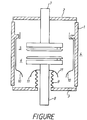
- a vacuum interrupter is generally composed as follows.
- a vacuum vessel 4 is constructed by hermetically sealing end plates 2 and 3 to the openings at both ends of an insulating cylinder 1.
- a pair of contact electrodes 5 and 6, which are free to make contact and separate, are provided inside vacuum vessel 4.
- a fixed stem 7 for contact electrode 5 is hermetically mounted on end plate 2, while a movable conducting stem 8 for contact electrode 6 is hermetically mounted on end plate 3 via bellows 9 so that it is free to move.
- contact electrodes 5 and 6 are enveloped by an arc shield 10.
- a bellows cover 11 for bellows 9 is mounted on mobile conducting stem 8.
- Contact electrodes 5 and 6 for this type of vacuum interrupter are composed of various materials in order to maintain and improve their anti-welding characteristics, withstanding voltage characteristics, interrupting characteristics, current chopping characteristics, anti-wear characteristics, contact resistance characteristics, temperature rise characteristics, etc.
- contact electrodes which assist arc travel by providing multiple contact domains having different boiling temperatures on the contact electrodes is proposed in Japanese Laid-Open Patent No. Showa 62-64012 Gazette.
- contact electrodes which assist arc travel by providing multiple contact domains having different boiling temperatures on the contact electrodes is proposed in Japanese Laid-Open Patent No. Showa 63-266720 Gazette, with the same aim of improving the current chopping characteristics as in the above described Gagette.
- contact electrodes which are the combinations of AgWC and CuCr, the combinations of AgWC and CuTi and combinations of AgMo 2 C and CuCr as described above.
- contact electrodes which are the combinations of AgWC and CuCr, the combinations of AgWC and CuTi and combinations of AgMo 2 C and CuCr as described above.
- one object of this invention is to provide a contact electrode for a vacuum interrupter used in a vacuum circuit breaker which can improve the large current interrupting characteristics of the vacuum circuit breaker.
- Another object of this invention is to provide a contact electrode for a vacuum interrupter used in a vacuum circuit breaker which can maintain an excellent withstanding voltage characteristics of the vacuum circuit breaker.
- a contact electrode for a vacuum interrupter including a conductive component having at least one selected from the group consisting of copper and silver, and an arc-proof component with a melting temperature of more than 1500 °C.
- a gradient A/X of a quantity of a composition component of the contact electrode on a surface of the contact electrode is 0.2 - 12 volume %/mm.
- X1 is one point on the line of any radius R1 on the surface of the contact electrode
- X2 is another point on the line of the radius R1 on the surface of the contact electrode
- X is a gap between the one point X1 and the another point X2 measured by mm
- A1 is a quantity of the composition component measured by volume % in the contact electrode at the one point X1
- A2 is a quantity of the composition component measured by volume % in the contact electrode at the another point X2
- a contact electrode for a vacuum interrupter in which the gradient of the composition component quantity of the contact electrode is restricted to the desired values for improving the large current interrupting characteristics.
- the retention of the arcs generated by interrupting the large current in the parts of contact electrode where the arc voltages are low is reduced, and thereby the arcs ignite evenly on the whole of the surfaces of the contact electrodes. That is to say, the arcs travel readily on contact electrodes which have the gradient of composition component of specified values. Therefore, diffusion of the arcs is accelerated, with the result that the contact electrode surface areas which substantially handle to interrupt current., are increased, thereby to contribute to the improvement of the interrupting current characteristics.
- contact electrodes are made with an entirely uniform composition. Even in the contact electrodes with this type of normal composition distribution, when an external magnetic field (for instance a longitudinal magnetic field) is applied to contact electrodes, the arcs generated by interrupting the current spread evenly on the contact electrodes and travel and diffuse. Thus, the current interrupting characteristics is, to some extent, improved.
- an external magnetic field for instance a longitudinal magnetic field
- the giving of this specified composition component gradient in the radial direction may be through the whole thickness of the contact electrodes in the case of contact electrodes which take the anti-wear property into consideration.
- the vacuum circuit breakers designed for fewer interruptions or in the contact electrodes which take account of contact resistivity there is not always a requirement for a specified composition component quantity gradient throughout their entire thickness. The function will be exhibited even if there is a specific depth domain of, for example 0.01mm, in the thickness direction (the inward direction) from the uppermost layer of the contact electrodes in which the specified composition component gradient is arranged.
- a material for instance, pure copper having a larger electrical conductivity than this composition is arranged under the layer of this composition, in deeper position from the surface by more than 0.01mm, so as to improve the electrical conductivity of the entire contact electrodes, leading to the further improvement of the current interrupting characteristics.
- Figure is a cross-section showing an example of a vacuum interrupter to which this invention is applied.
- the contact electrode test samples are produced by, for instance, suitably selecting one of the following First to Third Methods.
- the First Method is a method of producing a test sample by mixing specified proportions of conductive component powder, arc-proof component powder and, it required, auxiliary component powder, and then heating and sintering the mixed powder at less than their melting points.
- the Second Method is a method of producing a test sample as follows. First, by heating and sintering arc-proof component powder and, if required, auxiliary component powder at less than their melting points, an arc-proof component skeleton having a specified porosity is obtained. Then, the remaining component is heated and infiltrated at more than its melting temperature into the pores of the heated skeleton to obtain a test sample.
- the Third Method is a method of producing a test sample by spray-depositing or melt-spray-depositing the mixed powder of specified proportions of conductive component powder, arc-proof powder and, if required, auxiliary component powder, in a specified location on a substrate, such as a copper plate or a contact electrode sample. Heat treatment is then applied to this to obtain a test sample.
- test pieces having the specified component composition quantity gradients are produced by such methods as follows.
- mixed powder green compacts composed of different components are produced, respectively. For instance, in the case of two types, one is made ring-shaped and the other is made disc-shaped. These two mixed powder green compacts are combined and arranged so as to give a specified composition component quantity A/X. Then, these two mixed powder green compacts are heated and sintered in an incorporated state at below their melting points.
- test-pieces with specified composition component quantity gradients A/X are produced by the following methods.
- Arc-proof component powders having multiple components are sintered beforehand below their melting points, for instance, in the case of two types, one is ring-shaped while the other is disc-shaped, when there are three types, there are two ring-shaped pieces and one disc-shaped piece.
- arc-proof component skeletons having specified porosities are obtained. These two or three skeletons are aranged so as to give gradient A/X and the remaining powder is heated at more than its melting temperature and infiltrated into the pores of the skeletons to obtain a test sample.
- the contact electrodes are given gradient A/X throughout their entire thickness.
- other test samples composed of multiple layers can be provided, in which contact electrode materials with specified composition component quantity gradient are arranged on a Cu plate or a CuAg Plate of thickness 1 - 5 mm.
- test samples manufactured as described above were fitted in a demountable-type vacuum circuit breaker. Then, the baking of the contact electrode surfaces, their current and voltage agings were made for test samples under the same and constant conditions. Then the following three evaluations were made for each of test samples.
- Opening speed conditions for contact electrodes were made constant and identical.
- the areas of the arcing portions after the current 12kA was interrupted 4 times at 7.2kV, 50Hz were measured with a planimeter. Taking the measured areas for arc spread for respective contact electrode materials, these were judged by their values relative to the arc spread value of the reference contact electrode.
- Example 1 is taken as the reference contact electrode.
- Opening speed condition for contact electrodes were made constant and identical.
- the interrupting current value were gradually increased from 5kA at 7.2kV, 50Hz.
- the marginal interruption current values of respective contact electrode materials were obtained. These were judged by their values relative to the marginal interruption current value of the reference contact electrode.
- the contact electrodes which had been evaluated for arc spread as above were returned to the demountable vacuum circuit breaker.
- the baking of the contact electrode surfaces, their current and voltage ageing were made for test samples under the constant and identical conditions. After the inter-electrode distance had been adjusted to a specified value, the voltages were increased by 1kv at a time, and the voltages when sparks occurred were obtained as respective static withstanding-voltage values. These were judged by their values relative to the static withstanding voltage of the reference contact electrode.
- composition component quantity gradient A/X given on the contact electrode surface which is less than 0.2 (volume %/mm) is taken as Domain I
- a gradient of 0.2 - 12 (volume %/mm) is taken as Domain II
- a gradient of more than 12 (volume %/mm) is taken as Domain III.
- A is the difference between a composition component quantity A1 at any point X1 and a composition component quantity A2 at any other point X2 on a radial line R1 of the contact electrode sample.
- X is the distance between points X1 and X2.
- A/X is a gradient of the composition component quantities A1 and A2 between points X1 and X2.
- Example 1 powder consisting of a mixture of Cr powder of mean grain size 100 ⁇ m and Cu powder of mean grain size 44 ⁇ m mixed at a ratio so as to form 30 volume % Cr-Cu was molded at a molding pressure of 7 Ton/cm 2 . It was then sintered under conditions of 1060 °C x 1 Hr. in a hydrogen atmosphere to obtain a 30Cr-Cu material. It was then mechanically processed to form a disc shaped body of a diameter of 25mm. Powder consisting of a mixture of the above-described powders mixed at a ratio so as to form 33 volume % Cr-Cu was molded at a molding pressure of 7 Ton/cm 2 .
- Example 5 a disc shaped body of a diameter of 15mm composed of a 30Cr-Cu material was obtained in the same manner as in Example 1. Similarly, a first ring shaped body of an inside diameter of 15mm and an outside diameter of 35mm composed of a 32.4Cr-Cu material and a second ring shaped body of an inside diameter of 35mm and an outside diameter of 45mm composed of a 45Cr-Cu material were obtained in the same manner as in Example 1. A contact electrode material was then obtained by combining these three bodies in which an inner portion is composed of the 30Cr-Cu material, an intermediate portion is composed of the 32.4Cr-Cu material, and an outer portion is composed of the 45Cr-Cu material.
- Example 6 a disc shaped body of a diameter of 15mm composed of a 25Cr-Cu material was obtained in the same manner as in Example 1. Similarly, a first ring shaped body of an inside diameter of 15mm and an outside diameter of 35mm composed of a 37.5Cr-Cu material and a second ring shaped body of an inside diameter of 35mm and an outside diameter of 45mm composed of a 60Cr-Cu material were obtained in the same manner as in Example 1. A contact electrode material was then obtained by combining these three bodies in which an inner portion is composed of the 25Cr-Cu material, an intermediate portion is composed of the 37.5Cr-Cu material, and an outer portion is composed of the 60Cr-Cu material.
- Example 7 a disc shaped body of a diameter of 15mm composed of a 5Cr-Cu material was obtained in the same manner as in Example 1. Similarly, a first ring shaped body of an inside diameter of 15mm and an outside diameter of 35mm composed of a 17.5Cr-Cu material and a second ring shaped body of an inside diameter of 35mm and an outside diameter of 45mm composed of a 87.5Cr-Cu material were obtained in the same manner as in Example 1. A contact electrode material was then obtained by combining these three bodies in which an inner portion is composed of the 5Cr-Cu material, an intermediate portion is composed of the 17.5Cr-Cu material, and an outer portion is composed of the 87.5Cr-Cu material.
- Example 8 a disc shaped body of a diameter of 10mm composed of a 0Cr-Cu material was obtained in the same manner as in Example 1. Similarly, a first ring shaped body of an inside diameter of 10mm and an outside diameter of 20mm composed of a 2.4Cr-Cu material, a second ring shaped body of an inside diameter of 20mm and an outside diameter of 30mm composed of a 15Cr-Cu material and a third ring shaped body of an inside diameter of 30mm and an outside diameter of 45mm composed of a 85Cr-Cu material were obtained in the same manner as in Example 1.
- a contact electrode material was then obtained by combining these four bodies in which an inner portion is composed of the 0Cr-Cu material, a next inner portion is composed of the 2.4Cr-Cu material, a next inner portion is composed of the 15Cr-Cu material and an outer portion is composed of the 85Cr-Cu material.
- Example 5 Cu was used for the conductive component and Cr was used for the arc-proof component in the test samples. Moreover, gradients A/X of arc-proof component Cr were given in the test samples, as shown in Table 1. Here, Example 4 was deleted.
- Example 5 - 8 The evaluation results, of Examples 5 - 8 are shown in Table 1. As is clear from Table 1, it is observed that, if any domain having gradient value A/X of 0.2 - 12 exists, even in a part of the contact electrode surface, both the arc spread property and the interrupting performance are significantly improved when compared with Example 1 having gradient value A/X of 0.2.
- Examples 1 - 8 and Comparative Examples 1 - 3 examples were given in which CuCr was taken as the contact electrode material, as shown in Table 1. However, this invention is not limited to these examples.
- the contact electrode material can be selected as in the following Examples 9-15.
- Example 16 powder consisting of a mixture of Cr powder, Nb powder and Cu powder of above-described mean grain sizes mixed at a ratio so as to form 10 volume % Cr-10 volume % Nb-Cu was molded, sintered and mechanically processed in the same manner as in Example 1 to obtain a disc shaped body of a diameter of 25mm composed of a 10Cr-10Nb-Cu material. Similarly, a ring shaped body of an inside diameter of 25mm and an outside diameter of 45mm composed of a 22.5Cr-10Nb-Cu material was obtained in the same manner as in Example 1.
- a contact electrode material was then obtained by combining these two bodies in which an inner portion is composed of the 10Cr-10Nb-Cu material and an outer portion is composed of the 22.5Cr-10Nb-Cu material.
- Example 18 a disc shaped body of a diameter of 15mm composed of a 0Cr-5Nb-Cu material was obtained in the same manner as in Example 1. Similarly, a first ring shaped body of an inside diameter of 15mm and an outside diameter of 35mm composed of a 12.5Cr-5Nb-Cu material and a second ring shaped body of an inside diameter of 35mm and an outside diameter of 45mm composed of a 82.5Cr-5Nb-Cu material were obtained in the same manner as in Example 1.
- a contact electrode material was then obtained by combining these three bodies in which an inner portion is composed of the 0Cr-5Nb-Cu material, an intermediate portion is composed of the 12.5Cr-5Nb-Cu material, and an outer portion is composed of the 82.5Cr-5Nb-Cu material.
- Example 19 in addition to Cr powder and Cu powder used in Example 1, Bi powder was added as an auxiliary component.
- Powder consisting of a mixture of Cr powder and Cu powder of above-described mean grain sizes and Bi powder of mean grain size 40 ⁇ m mixed at a ratio so as to form 30 volume % Cr-0.1 volume % Bi-Cu was molded, sintered and mechanically processed in the same manner as in Example 1 to obtain a disc shaped body of a diameter of 25mm composed of a 30Cr-0.1Bi-Cu material.
- a ring shaped body of an inside diameter of 25mm and an outside diameter of 45mm composed of a 42.5Cr-0.1Bi-Cu material was obtained in the same manner as in Example 1.
- a contact electrode material was then obtained by combining these two bodies in which an inner portion is composed of the 30Cr-0.1Bi-Cu material and an outer portion is composed of the 42.5Cr-0.1Bi-Cu material.
- Example 20 in addition to Cr powder and Cu powder used in Example 1, Pb powder was added as an auxiliary component.
- powder consisting of a mixture of Cr powder and Cu powder of above-described mean grain sizes and Pb powder of mean grain size 40 ⁇ m a disc shaped body of a diameter of 25mm composed of a 30Cr-0.05Pb-Cu material was obtained in the same manner as in Example 1.
- a ring shaped body of an inside diameter of 25mm and an outside diameter of 45mm composed of a 42.5Cr-0.05Pb-Cu material was obtained in the same manner as in Example 1.
- Example 21 in addition to Cr powder and Cu powder used in Example 1, Te powder was added as an auxiliary component.
- powder consisting of a mixture of Cr powder and Cu powder of above-described mean grain sizes and Te powder of mean grain size 40 ⁇ m By using powder consisting of a mixture of Cr powder and Cu powder of above-described mean grain sizes and Te powder of mean grain size 40 ⁇ m, a disc shaped body of a diameter of 25mm composed of a 30Cr-4.5Te-Cu material was obtained in the same manner as in Example 1. Similarly, a ring shaped body of an inside diameter of 25mm and an outside diameter of 45mm composed of a 42.5Cr-4.5Te-Cu material was obtained in the same manner as in Example 1.
- Example 22 in addition to Cr powder and Cu powder used in Example 1, Sb powder was added as an auxiliary component.
- powder consisting of a mixture of Cr powder and Cu powder of above-described mean grain sizes and Sb powder of mean grain size 40 ⁇ m a disc shaped body of a diameter of 25mm composed of a 30Cr-0.5Sb-Cu material was obtained in the same manner as in Example 1.
- a ring shaped body of an inside diameter of 25mm and an outside diameter of 45mm composed of a 42.5Cr-0.5Sb-Cu material was obtained in the same manner as in Example 1.
- Examples 1 - 22 and Comparative Examples 1 - 3 Examples were given in which metal components such as Cr and Ti and so on were given as the arc-proof component in the contact electrode material.
- this invention is not limited to these Examples.
- Other arc-proof components in the contact electrode material can be selected.
- Example 23 powder consisting of a mixture of WC powder of mean grain size 3 ⁇ m, Co powder of mean grain size 10 ⁇ m and Ag powder of mean grain size 40 ⁇ m mixed at a ratio so as to form 30 volume % WC-1 volume % Co-Ag was molded, sintered and mechanically processed in the same manner as in Example 1 to obtain a disc shaped body of a diameter of 25mm composed of a 30WC-1Co-Ag material. Similarly, a ring shaped body of an inside diameter of 25mm and an outside diameter of 45mm composed of a 42.5WC-1Co-Ag material was obtained in the same manner as in Example 1.
- a contact electrode material was then obtained by combining these two bodies in which an inner portion is composed of the 30WC-1Co-Ag material and an outer portion is composed of the 42.5WC-1Co-Ag material.
- Example 24 in addition to the powders used in Example 23, Cu powder of above-described mean grain size was added.
- powder consisting of a mixture of WC, Co, Ag and Cu powders of above-described mean grain sizes a disc shaped body of a diameter of 25mm composed of a 30WC-1Co-14Cu-Ag material was obtained in the same manner as in Example 1.
- a ring shaped body of an inside diameter of 25mm and an outside diameter of 45mm composed of a 42.5WC-1Co-11Cu-Ag material was obtained in the same manner as in Example 1.
- Example 25 in addition to WC and Ag powders used in Example 23, Ni powder of mean grain size 10 ⁇ m was added.
- powder consisting of a mixture of WC, Ag and Ni powders of above-described mean grain sizes a disc shaped body of a diameter of 25mm composed of a 30WC-3Ni-Ag material was obtained in the same manner as in Example 1.
- a ring shaped body of an inside diameter of 25mm and an outside diameter of 45mm composed of a 42.5WC-3Ni-Ag material was obtained in the same manner as in Example 1.
- Example 26 in addition to WC and Ag powders used in Example 23, Fe powder of mean grain size 10 ⁇ m was added.
- powder consisting of a mixture of WC, Ag and Fe powders of above-described mean grain sizes a disc shaped body of a diameter of 25mm composed of a 30WC-10Fe-Ag material was obtained in the same manner as in Example 1.
- a ring shaped body of an inside diameter of 25mm and an outside diameter of 45mm composed of a 42.5WC-10Fe-Ag material was obtained in the same manner as in Example 1.
- Example 27 in addition to Co and Ag powders used in Example 23, TiC powder of mean grain size 5 ⁇ m was added.
- powder consisting of a mixture of Co, Ag and TiC powders of above-described mean grain sizes a disc shaped body of a diameter of 25mm composed of a 30TiC-1Co-Ag material was obtained in the same manner as in Example 1.
- a ring shaped body of an inside diameter of 25mm and an outside diameter of 45mm composed of a 42.5TiC-1Co-Ag material was obtained in the same manner as in Example 1.
- Example 28 in addition to Co and Ag powders used in Example 23, ZrC powder of mean grain size 5 ⁇ m was added.
- powder consisting of a mixture of Co, Ag and ZrC powders of above-described mean grain sizes a disc shaped body of a diameter of 25mm composed of a 30ZrC-1Co-Ag material was obtained in the same manner as in Example 1.
- a ring shaped body of an inside diameter of 25mm and an outside diameter of 45mm composed of a 42.5ZrC-1Co-Ag material was obtained in the same manner as in Example 1.
- Example 29 in addition to Co and Ag powders used in Example 23, VC powder of mean grain size 5 ⁇ m was added.
- powder consisting of a mixture of Co, Ag and VC powders of above-described mean grain sizes a disc shaped body of a diameter of 25mm composed of a 30VC-1Co-Ag material was obtained in the same manner as in Example 1.
- a ring shaped body of an inside diameter of 25mm and an outside diameter of 45mm composed of a 42.5VC-1Co-Ag material was obtained in the same manner as in Example 1.
- Example 30 in addition to Co and Ag powders used in Example 23, NbC powder of mean grain size 10 ⁇ m was added.
- powder consisting of a mixture of Co, Ag and NbC powders of above-described mean grain sizes a disc shaped body of a diameter of 25mm composed of a 30NbC-1Co-Ag material was obtained in the same manner as in Example 1.
- a ring shaped body of an inside diameter of 25mm and an outside diameter of 45mm composed of a 42.5NbC-1Co-Ag material was obtained in the same manner as in Example 1.
- Example 31 in addition to Co and Ag powders used in Example 23, TaC powder of mean grain size 10 ⁇ m was added.
- powder consisting of a mixture of Co, Ag and TaC powders of above-described mean grain sizes a disc shaped body of a diameter of 25mm composed of a 30TaC-1Co-Ag material was obtained in the same manner as in Example 1.
- a ring shaped body of an inside diameter of 25mm and an outside diameter of 45mm composed of a 42.5TaC-1Co-Ag material was obtained in the same manner as in Example 1.
- Example 32 in addition to Co and Ag powders used in Example 23, Cr 3 C 2 powder of mean grain size 10 ⁇ m was added.
- a disc shaped body of a diameter of 25mm composed of a 30Cr 3 C 2 -1Co-Ag material was obtained in the same manner as in Example 1.
- a ring shaped body of an inside diameter of 25mm and an outside diameter of 45mm composed of a 42.5Cr 3 C 2 -1Co-Ag material was obtained in the same manner as in Example 1.
- Example 33 in addition to Co and Ag powders used in Example 23, Mo 2 C powder of mean grain size 10 ⁇ m was added.
- powder consisting of a mixture of Co, Ag and Mo 2 C powders of above-described mean grain sizes a disc shaped body of a diameter of 25mm composed of a 30Mo 2 C-1Co-Ag material was obtained in the same manner as in Example 1.
- a ring shaped body of an inside diameter of 25mm and an outside diameter of 45mm composed of a 42.5Mo 2 C-1Co-Ag material was obtained in the same manner as in Example 1.
- Example 34 in addition to Co and Ag powders used in Example 23, TiB powder of mean grain size 5 ⁇ m was added.
- powder consisting of a mixture of Co, Ag and Tib powders of above-described mean grain sizes a disc shaped body of a diameter of 25mm composed of a 30TiB-1Co-Ag material was obtained in the same manner as in Example 1.
- a ring shaped body of an inside diameter of 25mm and an outside diameter of 45mm composed of a 42.5TiB-1Co-Ag material was obtained in the same manner as in Example 1.
- Example 35 in addition to Co and Ag powders used in Example 23, Cr 2 B powder of mean grain size 5 ⁇ m was added.
- powder consisting of a mixture of Co, Ag and Cr 2 B powders of above-described mean grain sizes a disc shaped body of a diameter of 25mm composed of a 30Cr 2 B-1Co-Ag material was obtained in the same manner as in Example 1.
- a ring shaped body of an inside diameter of 25mm and an outside diameter of 45mm composed of a 42.5Cr 2 B-1Co-Ag material was obtained in the same manner as in Example 1.
- composition component which gives concentration gradient A/X an arc-proof component was taken.
- This invention is, however, not limited to these Examples. It was proved that in other Examples, instead of the arc-proof component, a conductive component can be taken as the composition component which gives concentration gradient A/X of 0.2 - 12 (volume %/mm) on the contact electrode surface.
- the arc-proof components used in the above-described Examples have melting points of more than 1500°C, respectively.
- this invention can be applied to the contact electrode including arc-proof component of 5 - 75 volume %.
- a contact electrode for a vacuum interrupter can be provided which can improve large current interrupting characteristics by optimising the composition component quantity gradient of the contact electrode surface, while maintaining the excellent withstanding voltage property.
Landscapes
- High-Tension Arc-Extinguishing Switches Without Spraying Means (AREA)
- Contacts (AREA)
- Manufacture Of Switches (AREA)
Applications Claiming Priority (3)
| Application Number | Priority Date | Filing Date | Title |
|---|---|---|---|
| JP5110295 | 1995-03-10 | ||
| JP51102/95 | 1995-03-10 | ||
| JP7051102A JPH08249991A (ja) | 1995-03-10 | 1995-03-10 | 真空バルブ用接点電極 |
Publications (2)
| Publication Number | Publication Date |
|---|---|
| EP0731478A2 true EP0731478A2 (fr) | 1996-09-11 |
| EP0731478A3 EP0731478A3 (fr) | 1999-12-01 |
Family
ID=12877456
Family Applications (1)
| Application Number | Title | Priority Date | Filing Date |
|---|---|---|---|
| EP96301525A Withdrawn EP0731478A3 (fr) | 1995-03-10 | 1996-03-06 | Electrode de contact pour interrupteur à vide |
Country Status (6)
| Country | Link |
|---|---|
| US (1) | US5726407A (fr) |
| EP (1) | EP0731478A3 (fr) |
| JP (1) | JPH08249991A (fr) |
| KR (1) | KR0185509B1 (fr) |
| CN (1) | CN1065068C (fr) |
| TW (1) | TW366507B (fr) |
Cited By (3)
| Publication number | Priority date | Publication date | Assignee | Title |
|---|---|---|---|---|
| WO2014202390A1 (fr) * | 2013-06-20 | 2014-12-24 | Siemens Aktiengesellschaft | Procédé et dispositif de fabrication d'éléments de contacts de commutation électrique |
| WO2014202389A1 (fr) * | 2013-06-20 | 2014-12-24 | Siemens Aktiengesellschaft | Procédé et dispositif permettant de produire des éléments de contact pour des contacts de commutation électriques |
| DE102021210839A1 (de) | 2021-09-28 | 2023-03-30 | Siemens Aktiengesellschaft | Herstellungsverfahren für einen Kontaktkörper einer Vakuumschaltröhre, Kontaktkörper für eine Vakuumschaltröhre und Vakuumschaltröhre mit einem solchen Kontaktkörper |
Families Citing this family (8)
| Publication number | Priority date | Publication date | Assignee | Title |
|---|---|---|---|---|
| JP3176308B2 (ja) * | 1997-03-07 | 2001-06-18 | 芝府エンジニアリング株式会社 | 真空バルブ |
| JP4404980B2 (ja) * | 1999-02-02 | 2010-01-27 | 芝府エンジニアリング株式会社 | 真空バルブ |
| KR100400356B1 (ko) * | 2000-12-06 | 2003-10-04 | 한국과학기술연구원 | 진공개폐기용 구리-크롬계 접점 소재의 조직 제어 방법 |
| CN100375210C (zh) * | 2005-01-31 | 2008-03-12 | 北京京东方真空电器有限责任公司 | 耐弧件结构及真空开关触头 |
| CN100428386C (zh) * | 2005-01-31 | 2008-10-22 | 北京京东方真空电器有限责任公司 | 耐弧件结构及真空开关触头 |
| US9455104B1 (en) * | 2015-04-13 | 2016-09-27 | Eaton Corporation | Vacuum interrupter, retaining clip therefor and associated method |
| JP6090388B2 (ja) * | 2015-08-11 | 2017-03-08 | 株式会社明電舎 | 電極材料及び電極材料の製造方法 |
| CN110852028A (zh) * | 2019-11-22 | 2020-02-28 | 重庆邮电大学 | 计及参数正态分布的真空断路器电磁暂态模型获取方法 |
Family Cites Families (13)
| Publication number | Priority date | Publication date | Assignee | Title |
|---|---|---|---|---|
| US3551622A (en) * | 1963-03-22 | 1970-12-29 | Hitachi Ltd | Alloy materials for electrodes of vacuum circuit breakers |
| DE2014638A1 (de) * | 1970-03-26 | 1971-10-14 | Siemens Ag | Verfahren zur Herstellung eines Zweischichten Kontaktstuckes |
| US3634736A (en) * | 1970-09-14 | 1972-01-11 | Standard Oil Co Ohio | Electrolytic capacitor employing paste electrodes |
| GB1517702A (en) * | 1974-09-19 | 1978-07-12 | Fujitsu Ltd | Electrical contact |
| JPS59163726A (ja) * | 1983-03-04 | 1984-09-14 | 株式会社日立製作所 | 真空しや断器 |
| JPH0760623B2 (ja) * | 1986-01-21 | 1995-06-28 | 株式会社東芝 | 真空バルブ用接点合金 |
| JPH0777101B2 (ja) * | 1987-04-24 | 1995-08-16 | 株式会社東芝 | 真空開閉器用接点 |
| JP2653486B2 (ja) * | 1988-08-19 | 1997-09-17 | 株式会社東芝 | 真空バルブ用接点材料 |
| JP2768721B2 (ja) * | 1989-03-01 | 1998-06-25 | 株式会社東芝 | 真空バルブ用接点材料 |
| JP2778826B2 (ja) * | 1990-11-28 | 1998-07-23 | 株式会社東芝 | 真空バルブ用接点材料 |
| JP3101329B2 (ja) * | 1991-01-10 | 2000-10-23 | 株式会社東芝 | 真空バルブ |
| JP2766441B2 (ja) * | 1993-02-02 | 1998-06-18 | 株式会社東芝 | 真空バルブ用接点材料 |
| JP2874522B2 (ja) * | 1993-07-14 | 1999-03-24 | 株式会社日立製作所 | 真空遮断器及びそれに用いる真空バルブと真空バルブ用電極並びにその製造法 |
-
1995
- 1995-03-10 JP JP7051102A patent/JPH08249991A/ja active Pending
-
1996
- 1996-03-06 EP EP96301525A patent/EP0731478A3/fr not_active Withdrawn
- 1996-03-07 US US08/611,000 patent/US5726407A/en not_active Expired - Fee Related
- 1996-03-08 TW TW085102856A patent/TW366507B/zh active
- 1996-03-11 KR KR1019960006369A patent/KR0185509B1/ko not_active Expired - Fee Related
- 1996-03-11 CN CN961030798A patent/CN1065068C/zh not_active Expired - Fee Related
Cited By (7)
| Publication number | Priority date | Publication date | Assignee | Title |
|---|---|---|---|---|
| WO2014202390A1 (fr) * | 2013-06-20 | 2014-12-24 | Siemens Aktiengesellschaft | Procédé et dispositif de fabrication d'éléments de contacts de commutation électrique |
| WO2014202389A1 (fr) * | 2013-06-20 | 2014-12-24 | Siemens Aktiengesellschaft | Procédé et dispositif permettant de produire des éléments de contact pour des contacts de commutation électriques |
| US20160141124A1 (en) * | 2013-06-20 | 2016-05-19 | Siemens Aktiengesellschaft | Method and device for producing contact elements for electrical switching contacts |
| US10256054B2 (en) | 2013-06-20 | 2019-04-09 | Siemens Aktiengesellschaft | Method and device for producing contact elements for electrical switch contacts |
| US10573472B2 (en) | 2013-06-20 | 2020-02-25 | Siemens Aktiengesellschaft | Method and device for producing contact elements for electrical switching contacts |
| DE102021210839A1 (de) | 2021-09-28 | 2023-03-30 | Siemens Aktiengesellschaft | Herstellungsverfahren für einen Kontaktkörper einer Vakuumschaltröhre, Kontaktkörper für eine Vakuumschaltröhre und Vakuumschaltröhre mit einem solchen Kontaktkörper |
| WO2023052034A1 (fr) | 2021-09-28 | 2023-04-06 | Siemens Aktiengesellschaft | Procédé de fabrication d'un élément de contact d'un interrupteur à vide, élément de contact pour un interrupteur à vide et interrupteur à vide comportant un tel élément de contact |
Also Published As
| Publication number | Publication date |
|---|---|
| EP0731478A3 (fr) | 1999-12-01 |
| TW366507B (en) | 1999-08-11 |
| KR0185509B1 (ko) | 1999-05-15 |
| KR960035691A (ko) | 1996-10-24 |
| CN1135088A (zh) | 1996-11-06 |
| CN1065068C (zh) | 2001-04-25 |
| JPH08249991A (ja) | 1996-09-27 |
| US5726407A (en) | 1998-03-10 |
Similar Documents
| Publication | Publication Date | Title |
|---|---|---|
| EP0488083B1 (fr) | Matériau de contact pour interrupteur à vide | |
| US9281136B2 (en) | Method for producing electrode material for vacuum circuit breaker, electrode material for vacuum circuit breaker and electrode for vacuum circuit breaker | |
| EP0385380B1 (fr) | Matériau pour réaliser un contact d'interrupteur à vide | |
| EP0863521B1 (fr) | Matériaux de contact | |
| US5726407A (en) | Contact electrode for vacuum interrupter | |
| EP0924729B1 (fr) | Disposition de contacts pour interrupteur à vide avec élément magnétique pour la magnétisation longitudinale | |
| US4372783A (en) | Electrical contact composition for a vacuum type circuit interrupter | |
| JP3663038B2 (ja) | 真空バルブ | |
| US6210809B1 (en) | Contact material | |
| KR0145245B1 (ko) | 진공밸브용 접점재 | |
| KR0170052B1 (ko) | 진공밸브 접점재료 및 그의 제조방법 | |
| JP2006032036A (ja) | 真空バルブ用接点材料 | |
| JP3810955B2 (ja) | 真空バルブ用接点材料の製造方法 | |
| JP2003331698A (ja) | 真空遮断器用電極およびその製造方法 | |
| KR0171607B1 (ko) | 진공회로 차단기용 전극 및 진공회로 차단기 | |
| JP3790055B2 (ja) | 真空バルブ用接点材料 | |
| JP4619821B2 (ja) | 接点材料および真空バルブ | |
| JPH09198975A (ja) | 真空バルブ及び真空バルブ用接点 | |
| JPH09312120A (ja) | 真空バルブ用接点材料 | |
| JPH0982185A (ja) | 真空バルブ | |
| JP2001222934A (ja) | 真空バルブ用接点材料 | |
| JPH0973846A (ja) | 真空バルブ用接点材料およびその製造方法 | |
| JPH0850838A (ja) | 真空バルブ用接点材料 | |
| JPH08293233A (ja) | 真空バルブ用接点材料 | |
| JPH10255604A (ja) | 真空バルブ |
Legal Events
| Date | Code | Title | Description |
|---|---|---|---|
| PUAI | Public reference made under article 153(3) epc to a published international application that has entered the european phase |
Free format text: ORIGINAL CODE: 0009012 |
|
| 17P | Request for examination filed |
Effective date: 19960403 |
|
| AK | Designated contracting states |
Kind code of ref document: A2 Designated state(s): DE FR |
|
| PUAL | Search report despatched |
Free format text: ORIGINAL CODE: 0009013 |
|
| AK | Designated contracting states |
Kind code of ref document: A3 Designated state(s): DE FR |
|
| 17Q | First examination report despatched |
Effective date: 20011214 |
|
| STAA | Information on the status of an ep patent application or granted ep patent |
Free format text: STATUS: THE APPLICATION IS DEEMED TO BE WITHDRAWN |
|
| 18D | Application deemed to be withdrawn |
Effective date: 20020425 |