EP0740245A2 - Méthode d'entrée de données manuscrites et de commandes de geste et appareil - Google Patents
Méthode d'entrée de données manuscrites et de commandes de geste et appareil Download PDFInfo
- Publication number
- EP0740245A2 EP0740245A2 EP96106667A EP96106667A EP0740245A2 EP 0740245 A2 EP0740245 A2 EP 0740245A2 EP 96106667 A EP96106667 A EP 96106667A EP 96106667 A EP96106667 A EP 96106667A EP 0740245 A2 EP0740245 A2 EP 0740245A2
- Authority
- EP
- European Patent Office
- Prior art keywords
- strokes
- input
- stroke
- character
- predetermined
- Prior art date
- Legal status (The legal status is an assumption and is not a legal conclusion. Google has not performed a legal analysis and makes no representation as to the accuracy of the status listed.)
- Granted
Links
Images



Classifications
-
- G—PHYSICS
- G06—COMPUTING OR CALCULATING; COUNTING
- G06T—IMAGE DATA PROCESSING OR GENERATION, IN GENERAL
- G06T1/00—General purpose image data processing
-
- G—PHYSICS
- G06—COMPUTING OR CALCULATING; COUNTING
- G06F—ELECTRIC DIGITAL DATA PROCESSING
- G06F3/00—Input arrangements for transferring data to be processed into a form capable of being handled by the computer; Output arrangements for transferring data from processing unit to output unit, e.g. interface arrangements
- G06F3/01—Input arrangements or combined input and output arrangements for interaction between user and computer
- G06F3/048—Interaction techniques based on graphical user interfaces [GUI]
- G06F3/0487—Interaction techniques based on graphical user interfaces [GUI] using specific features provided by the input device, e.g. functions controlled by the rotation of a mouse with dual sensing arrangements, or of the nature of the input device, e.g. tap gestures based on pressure sensed by a digitiser
- G06F3/0488—Interaction techniques based on graphical user interfaces [GUI] using specific features provided by the input device, e.g. functions controlled by the rotation of a mouse with dual sensing arrangements, or of the nature of the input device, e.g. tap gestures based on pressure sensed by a digitiser using a touch-screen or digitiser, e.g. input of commands through traced gestures
- G06F3/04883—Interaction techniques based on graphical user interfaces [GUI] using specific features provided by the input device, e.g. functions controlled by the rotation of a mouse with dual sensing arrangements, or of the nature of the input device, e.g. tap gestures based on pressure sensed by a digitiser using a touch-screen or digitiser, e.g. input of commands through traced gestures for inputting data by handwriting, e.g. gesture or text
Definitions
- This invention relates to information processing method and apparatus in which different kinds of data included in data input as locus information are divided so that a respective process adapted for each divided data can be executed.
- an input locus is recognized as an operation command with pen and digitizer used as coordinate pointing means, or character recognition is executed by recognizing the input locus.
- one character of stroke data is extracted so that character recognition is executed for the one character by using the stroke data as data to be input in the recognition process.
- Such handwriting-character recognition can be executed on the assumption that the stroke data to be input here are only stroke data constituting a character to be recognized.
- the character-recognition process is a process for executing character recognition only.
- gesture command input means which can input, in an input mode, not only characters or locus information, but also operation commands using a pen.
- each of such gesture commands has an input locus predetermined for each command, so that the corresponding command is executed when the predetermined input locus is recognized.
- the gesture commands can be executed in a different mode, or formats of gesture input and character input can be defined separately.
- the conventional apparatus is designed to perform the character input and the command input in a different manner that only characters are input in the character input process, and various types of commands are input as gesture commands after end operation of character recognition.
- control of the character-recognition process or execution of other command often need executing during character input such as to specify the type of an input character during character input or to learn a recognition pattern.
- the conventional apparatus nevertheless require an operator or user to intentionally perform the character input for character recognition and the gesture input for command execution, separately, and this gives the user trouble.
- control means depend on the type of a character-recognition engine used for character recognition and, if the recognition processing engine can be rearranged in each system like a conventional front-end processor for Kana-Kanji conversion, it is impossible to previously incorporate all the recognition control means into the system.
- the present invention has been accomplished under the circumstances as aforementioned, and an object thereof is to provide data processing method and apparatus which can recognize data and a given command for the data individually even when inputting the data and command together so that a process corresponding to the given command is executed for the data.
- an image inputting method include: a first-stroke input step for inputting a first stroke; a second-stroke input step for inputting a second stroke; and a second-stroke processing step, when the first stroke and a given stroke match with each other, for executing a given process for the second stroke.
- Another aspect of the present invention is to provide an image inputting apparatus including: first-stroke input means for inputting a first stroke; second-stroke input means for inputting a second stroke; and second-stroke processing means, when the first stroke and a given stroke match with each other, for executing a given process for the second stroke, wherein the first and second strokes are input to the same input location by the first-stroke input means and the second-stroke input means, respectively.
- Still another aspect of the present invention is to provide an information processing apparatus including: input means for inputting strokes; extraction means for extracting a given stroke from all the input strokes; selection means for selecting a corresponding symbol based on all the strokes but the one extracted in the extraction means; and symbol processing means for executing, for the symbol, a given process corresponding to the given stroke.
- a data processing apparatus features a structure including a specific-stroke discriminating portion for determining whether a specific stroke is included in the input strokes, a specific-stroke extracting portion for extracting the specific stroke from the input strokes, and a specific-process executing portion for executing a process based on the type of the specific stroke, so that character recognition is executed by writing the specific stroke in the input character, while various processes are executed for the input character.
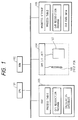
- Fig. 1 shows a basic structure of a handwriting-character recognizing apparatus according to the embodiment of the present invention.
- a CPU 101 is a central processing unit for executing system control and operation; a ROM 102 is operative to store an initial program needed at system operating time.
- a RAM 103 is a storage capable of input and output, and operative to temporarily store a process table and a character recognition program stored in a magnetic storage, data generated at each processing time and such.
- a character input/output unit 104 controls data input and output on a data input/output panel 107.
- the data input is performed by writing a character by hand on the data input/output panel 107 using an input pen 105.
- a coordinate input means such as a digitizer or a touch panel can be used for the character input, whereas a display on which image data and patterned character data can be displayed, such as a liquid crystal display, can be used for the character output.
- the magnetic storage 106 stores the process table for executing a specific process corresponding to a specific stroke, the character recognition program, a control program to be used in processing steps described later, data of a character-code table. These data or programs are transferred to the RAM 103 and executed by the CPU 101 reading out them from the RAM 103, respectively.
- the magnetic storage 106 may be removable from and attachable to the apparatus body, or may be replaced with a storage of other type than magnetic. Furthermore, all kinds of control programs to be stored in the RAM 103 may be read out from other apparatus through a communication means such as a public network or a LAN.
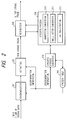
- Fig. 2 shows a structure of the process according to the embodiment of the present invention, expressing the characteristics of the present invention best.
- the process shown in Fig. 2 is a recognition process using a pen input device such as a pen computer, in which one character of strokes written in a character input frame is used as input data to be executed.
- Various methods can be used to determine that the one character of stroke data has been input completely, for example, such as to determine that the one character of stroke data has been input completely at the time when the pen has not been put down in the character input frame during a predetermined period of time (e.g., 1 second) since the pen was moved away from the frame, or when the pen input was started in the next character input frame.
- a predetermined period of time e.g., 1 second
- Fig. 2 Portions in Fig. 2 are software components each loaded from the storage 106 as a control program, stored as a character recognition program in RAM 103 and read out to the CPU 101 for executing the process.
- a specific-stroke discriminating portion 201 determines whether a single or plural specific-strokes exist in one character of stroke data. As a result of determination, if no specific stroke, a recognition program 206 is executed in the same manner as a normal one-character recognition process, so that the recognition process is ended here.
- the discrimination of the specific strokes is executed through a matching process of the input strokes with predetermined specific-strokes, taking stroke shapes and sizes into consideration.
- the matching process is carried out with a well-known technique such as a vectorization matching technique or a characteristic-point matching technique generally used for on-line character recognition. Since the input stroke data are time series data arranged in input order, the discriminating portion also output, to the next processing portion, information as to how many strokes there were before the specific stroke, together with discrimination information.
- the specific stroke is discriminated based upon the type of the specific stroke stored in a process table 204.
- a specific-stroke extracting portion 202 extracts the specific stroke discriminated in the specific-stroke discriminating portion 201 from all the input strokes. Since a stroke sequence number corresponding to the specific stroke is found from the output of the specific-stroke discriminating portion 201, the specific stroke can be extracted from a string of input strokes, so that the input strokes can reconstitute a string of character-only input stroke data excluding the specific stroke.
- a specific-process executing portion 203 executes, based on information stored in the process table 204, a specific process corresponding to the specific stroke discriminated in the specific-stroke discriminating portion 201.
- the process table 204 stores predetermined specific-stroke types and respective processes to be executed according to respective ones of the specific strokes.
- a specific processing portion 205 is executed by the specific-process executing portion 203, and the contents of this process depend on the discriminated specific-stroke type, so that various processes are executed according to the respective specific strokes.
- various calling processes are possible such as to execute a suitable program after obtaining the result of recognition by calling the recognition program 206, to control calling or end of the recognition process by setting, e.g., flags for the recognition process so that operation of the recognition process 206 can be controlled, and to control calling or end of an associated application, e.g., for recognizing registration.
- the specific process 205 includes a handwriting-conversion process 210 for converting an input character into a handwriting one, a small-letter conversion process 211 for converting the input character into a small-letter pattern, and a character-registration process 212 for registering the input strokes as they are.
- the character-recognition process 206 then recognizes a character from the input strokes.
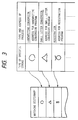
- Fig. 3 shows the contents of the process table 104 as easily understood.
- the left items are types of specific strokes; the right items include the contents of specific processes to be executed based on the left items and calling addresses of respective processing programs.
- means for matching strokes based on the types of the specific strokes is stored in the specific-stroke discriminating portion in Fig. 2.
- the contents of the specific process 205 to be executed include calling addresses for process execution. Setting of the calling addresses for respective specific processes is shown at 903 in Fig. 9 described later.
- Such a process table is written in a memory, so that, if the contents of the table are rewritten, extension of predetermined specific-strokes and the contents of respective processes is possible.
- a character is recognized from all the character strokes but the extracted specific stroke and converted into a code so as to be output as a handwriting pattern. If the input character can not be converted, the character is output as it is.
- the handwriting-conversion process 210 for converting the character into such a handwriting pattern is included in the specific process 205 described above in Fig. 2.
- the handwriting-conversion process 210 is selectively executed by the specific-process executing portion 203, in which the recognition process 206 is called so as to receive a possible character code obtained from the result of recognition. The received character code is then converted into a code of a handwriting pattern.
- the small-letter conversion process is executed in the same manner as mentioned in the handwriting conversion process.
- a character code obtained as a result of recognition is converted into a code of a small-letter pattern.
- the recognition process can be executed without code conversion by using the resulting data as an input to the recognition process.
- the character-registration process is executed in the same manner as aforementioned.
- the input character strokes are used as inputs for character registration, so that data such as characteristic-point data is generated according to a character code input with a keyboard, and registered into the matching dictionary.
- the specific process 205 can include any other contents of processes as long as they can be realized by conventional programming techniques.
- the specific process 205 may include a conversion process for converting a character input as a Hiragana in Japanese into a Kana.
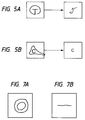
- Figs. 5A and 5B are illustrations each showing a character input pattern with a specific stroke written by an operator in the character input process and the result of the character recognition.
- the left side shows a path of the character pattern with a specific stroke written within the character frame; the right side shows an example of a resulting pattern to be displayed which is recognized through a specific process directed by the specific stroke.
- a stroke like " ⁇ " is written together with a character, and the handwriting-conversion process is executed.
- the discrimination of the specific strokes is made in consideration of stroke shapes and sizes, so that the stroke " ⁇ " and a character element such as "°” used for " ⁇ ", for example, can be prevented from getting mixed.
- all the strokes are discriminated, so that the stroke " ⁇ " can be written anytime in the input process.
- Fig. 4 is a flowchart partially showing the handwriting-conversion process 210 and the recognition process 206 to ease the understanding of the handwriting-conversion process described above.
- Fig. 5B shows a case of the small-letter conversion, in which, after a specific stroke is extracted and recognized in the same manner as described in the handwriting-conversion process in Fig. 5A, small-letter code conversion is executed for a possible character "C", and a small letter "c" is output.
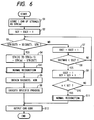
- Fig. 6 shows processing steps of executing the character-recognition process according to the embodiment discussed above. Referring to the drawing, operation of the process will be described below.
- step S2 a control variable "sct” indicating sequence numbers of respective strokes and an index variable “ssct” pointing a position of a specific stroke array "stk” stored in the process table 104 (hereinbelow, the table may be simply referred as to "ss”) are both initialized to "1".
- step S3 matching of one input stroke "stk (sct)" with a specific stroke “ss(ssct).stk” stored in the process table 104 is performed and, if matching is made, the process goes to step S4. If no matching occurs, it goes to step S7.
- the exemplary stroke data stored in the specific stroke "ss(ssct).stk” are shown at 902 in Fig. 2.
- step S7 and subsequent steps are described below.
- step S10 a check is made on whether the "sct" exceeds n strokes in number and, if more than n, all the strokes are regarded as having been checked and the process goes to step S11. In this case, it is considered that no specific stroke exists in all the input strokes. On the contrary, if not more than n, the process returns to step S3 so that operation from steps S3 to S10 are repeated by using a new stroke as a matching object.
- Fig. 9 shows a state that respective strokes for one character to be recognized are stored in the stroke array "stk" after extracting a specific stroke or strokes as a result of matching.
- step S11 normal character recognition is executed in one character unit and the whole process of the character recognition is ended.
- step S3 if a specific stroke exists here, the process goes to step S4.
- step S4 the specific stroke "stk(sct)" is extracted from the input stroke array "stk(n)” and the data stk(1) to stk(n-1) are generated.
- the character recognition is executed for the data stk(1) to stk(n-1) in step S41.
- a processing address "ss(ssct).adr" to the process table "ss(ssct)" is extracted in step S5 in order to execute a specific process corresponding to the specific stroke.
- Fig. 9 shows examples of the process address "ss(ssct).adr" set for calling the respective processes in the specific process 205, in which XXXX, YYYY and ZZZ indicate the addresses to the respective processes.
- step S6 the specific process pointed by the address is called.
- the recognition process is thus ended here.
- a character code obtained as a result of the recognition is output in step S12 and the whole process is ended.
- a stroke of new type can be registered in the matching dictionary by generating characteristic points from the data stk(1) to stk(n-1).
- the character recognizing method according to the first embodiment of the present invention uses symbols capable of one-stroke writing and capable of discriminating it from character elements in shape and size, such as " ⁇ " or " ⁇ ", as examples of specific strokes, the second embodiment shows an exemplary process for which such limitation is unnecessary.
- Figs. 7A and 7B show exemplary specific strokes used in the second embodiment.
- the stroke in Fig. 7A is a double circle written with two strokes each of which corresponds to a single circle.
- the stroke in Fig. 7B is a cross bar which is drawn from the right to the left so as to be regarded as a specific stroke.
- the cross bar can be discriminated from a character element such as a hyphen using such a characteristic since the cross bar "-" as a character element is normally drawn from the left to the right.
- the specific strokes which involve difficulties in shape discrimination can be discriminated using information such as on an input direction of the stroke.
- well-known matching methods for on-line character recognition can be used in the present invention and, if only the characteristic-point matching method is used, matching can be performed independently of the stroke direction.
- the stroke direction can be used as a matching object, so that even the stroke having such shapes as mentioned in Fig. 7B can be discriminated from character elements based on the input direction.
- the stroke matching method itself may be the same as aforementioned, but different in stroke specifying and stroke extracting method.
- a description will be made to processing steps in such a case of Fig. 7A with reference to Fig. 8.
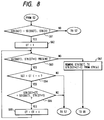
- Fig. 8 is a flowchart partially showing processing steps in a character recognition process according to the second embodiment, the processing steps corresponding to steps S3 and S4 described above in Fig. 6. The remaining processing steps are the same as those in Fig. 6 and, therefore, the description thereof is omitted.
- Step S61 in Fig. 8 is incorporated instead of step S3 in Fig. 6, in which the contents of the process table (104) are different from those in the first embodiment.
- the process table (104) stores specific strokes each composed of plural strokes as shown in Fig. 7A, so that each stroke data stored in the process table is arranged in an array.
- the data is described as follows: ss(ssct).stk(1),ss(ssct).stk(2) Consequently, the stroke data "stk(sct)" describing the input stroke is compared in step S61 with the first stroke data "ss(ssct).stk(1)" stored in the process table (104).
- This stroke comparison means is the same as that used in the specific-stroke discriminating portion 201 of the first embodiment. If no matching occurs as a result of the comparison, the process goes to step S7 in Fig. 6. If matching is made, the process goes to step S62 in Fig. 8 and a stroke counter "ct" is initialized to "1".
- step S63 determination is made in step S63 as to whether a stroke subsequent to the specific stroke data exists in the process table, that is, whether "ss(ssct).stk(ct+1)" exists. If present, the process goes to step S64 and a check is made on whether any other input stroke exists, that is, whether "sct+ct" is more than n input strokes in number.
- step S7 If more than n, it is regarded as no matching and the process moves to step S7. If not more than n, the process goes to step S65, where the next input stroke "stk(sct+ct)" is compared with stroke data "ss(ssct).stk(ct+1)" subsequent to the processed specific stroke data in the process table. If no matching occurs as a result of the comparison, the process moves to step S7 in Fig. 6. If matching is made, it goes to the next step S66.
- step S66 the stroke counter "ct" is counted up by an increment and the process returns to step S63.
- processing steps S63 to S66 are repeatedly executed until all the strokes constituting a specific stroke are completely compared, the specific stroke directing a process stored in the process table 104. After end operation of comparing all the strokes, the process moves to step S67.
- step S67 When all the input strokes have been compared, if no matching occurs in the comparison loop of steps S63 to S66, it is regarded as no specific stroke matched with a predetermined specific stroke data, and the process moves to step S7 in Fig. 6 as aforementioned.
- a plurality of input strokes "stk(sct) to stk(n-ct-1)" constituting the specific stroke are extracted from the input stroke array "stk(n)" in step S67, and the process goes to step S5 in Fig. 6.
- the number of specific strokes to be discriminated can be freely set by slightly alternating the specific-stroke discriminating portion and the process table.
- Fig. 10 shows internal data in the character recognition process according to the second embodiment, in which numerals 1001, 1002, 1003 and 1004 indicate data arrays corresponding to the input stroke array 901, the specific stroke data array 902 constituting a template, the address pointers 903 operative to point an address to a respective process, and the stroke array 904 arranging all the strokes but a specific stroke or strokes, respectively shown in the first embodiment in Fig. 9.
- Kana-Kanji conversion can be executed instead of the handwriting conversion so as to convert an input Kana character into a corresponding Kanji pattern.
- the present invention can be applied to a system constituted of plural devices, or to an apparatus having a single device. Also, the present invention may be applied to a case that the system or the apparatus is implemented by loading desired programs thereto.
- a character recognizing apparatus is constituted such that, when inputting at least one specific stroke additionally in the input process, a process is executed for the specific stroke at the time of input-character recognition, so that a user can input a command for the input character at the same time in the character input process without taking notice of input scenes on which the command and the character are input individually.
- This differs from the conventional apparatus or system where a gesture command needs entering after end operation of the character recognition. Accordingly, an efficient and comfortable operating environment can be obtained.
- the present invention allows a pen input system to set any command freely without getting mixed with gesture commands previously incorporated in the pen input system itself.
- This makes it possible to provide an identical operating environment in the character input process regardless of which computer incorporates the handwriting-character recognizing apparatus of the present invention when it used as a front-end processor in the same manner as a Kana-Kanji converting apparatus. Accordingly, the user can operate it without operational confusion between different computer systems, and freely incorporate commands unsupported due to a difference between the computer systems or recognition commands unique to the user, thus obtaining a high-performance recognizing apparatus.
- the present invention is to discriminate and extract a gesture stroke from a group of input strokes when inputting, in a batch processing, both a character or symbol of strokes to be processed and a gesture of strokes selecting a process to be executed for the character or symbol, and execute a process selected by the gesture stroke for all the strokes but the extracted gesture stroke, so that the character or symbol and the gesture do not need inputting individually at time intervals, thus improving the operability.
Landscapes
- Engineering & Computer Science (AREA)
- Theoretical Computer Science (AREA)
- General Engineering & Computer Science (AREA)
- Physics & Mathematics (AREA)
- General Physics & Mathematics (AREA)
- Human Computer Interaction (AREA)
- Character Discrimination (AREA)
- Image Input (AREA)
Applications Claiming Priority (3)
| Application Number | Priority Date | Filing Date | Title |
|---|---|---|---|
| JP10619495 | 1995-04-28 | ||
| JP7106194A JPH08305821A (ja) | 1995-04-28 | 1995-04-28 | データ処理方法とその装置 |
| JP106194/95 | 1995-04-28 |
Publications (3)
| Publication Number | Publication Date |
|---|---|
| EP0740245A2 true EP0740245A2 (fr) | 1996-10-30 |
| EP0740245A3 EP0740245A3 (fr) | 1998-01-28 |
| EP0740245B1 EP0740245B1 (fr) | 2000-10-04 |
Family
ID=14427380
Family Applications (1)
| Application Number | Title | Priority Date | Filing Date |
|---|---|---|---|
| EP96106667A Expired - Lifetime EP0740245B1 (fr) | 1995-04-28 | 1996-04-26 | Méthode d'entrée de données manuscrites et de commandes de geste et appareil |
Country Status (6)
| Country | Link |
|---|---|
| US (1) | US6408091B1 (fr) |
| EP (1) | EP0740245B1 (fr) |
| JP (1) | JPH08305821A (fr) |
| KR (1) | KR100242785B1 (fr) |
| CN (1) | CN1110759C (fr) |
| DE (1) | DE69610520T2 (fr) |
Cited By (5)
| Publication number | Priority date | Publication date | Assignee | Title |
|---|---|---|---|---|
| GB2438524A (en) * | 2006-05-26 | 2007-11-28 | Uniwill Comp Corp | Input analysis for executing selected predetermined function |
| EP1967944A1 (fr) * | 2007-03-08 | 2008-09-10 | SRS-Management GmbH | Procédé de correction de notes manuscrites saisies électroniquement |
| US7583819B2 (en) | 2004-11-05 | 2009-09-01 | Kyprianos Papademetriou | Digital signal processing methods, systems and computer program products that identify threshold positions and values |
| EP2530574A1 (fr) * | 2011-05-31 | 2012-12-05 | Lg Electronics Inc. | Dispositif mobile et procédé de commande pour un dispositif mobile |
| EP2713245A4 (fr) * | 2011-08-22 | 2014-04-30 | Rakuten Inc | Dispositif, procédé ainsi que programme de traitement de données, et support d'enregistrement lisible par ordinateur sur lequel est enregistré ce programme |
Families Citing this family (13)
| Publication number | Priority date | Publication date | Assignee | Title |
|---|---|---|---|---|
| US7158675B2 (en) | 2002-05-14 | 2007-01-02 | Microsoft Corporation | Interfacing with ink |
| US20030214531A1 (en) * | 2002-05-14 | 2003-11-20 | Microsoft Corporation | Ink input mechanisms |
| US7925987B2 (en) * | 2002-05-14 | 2011-04-12 | Microsoft Corporation | Entry and editing of electronic ink |
| US20030214553A1 (en) * | 2002-05-14 | 2003-11-20 | Microsoft Corporation | Ink regions in an overlay control |
| US8166388B2 (en) | 2002-05-14 | 2012-04-24 | Microsoft Corporation | Overlaying electronic ink |
| US8610672B2 (en) * | 2008-04-10 | 2013-12-17 | Nokia Corporation | Device and method for stroke based graphic input |
| CN101593270B (zh) * | 2008-05-29 | 2012-01-25 | 汉王科技股份有限公司 | 一种手绘形状识别的方法及装置 |
| JP5455364B2 (ja) | 2008-12-26 | 2014-03-26 | キヤノン株式会社 | 情報処理装置及び軌跡データ認識方法 |
| US8669995B2 (en) * | 2010-10-08 | 2014-03-11 | Adobe Systems Incorporated | Methods and apparatus for stroke grouping for high-level sketch editing |
| KR102063103B1 (ko) * | 2013-08-23 | 2020-01-07 | 엘지전자 주식회사 | 이동 단말기 |
| CN105765502B (zh) * | 2013-11-19 | 2019-10-08 | 株式会社和冠 | 用于墨水数据生成、墨水数据呈现、墨水数据操纵以及墨水数据通信的方法和系统 |
| US9391774B1 (en) * | 2014-02-27 | 2016-07-12 | Strausskey Partners, Llc | Strauss greenmail system and method |
| CN104978048A (zh) * | 2015-07-21 | 2015-10-14 | 小米科技有限责任公司 | 字符输入方法和装置 |
Family Cites Families (7)
| Publication number | Priority date | Publication date | Assignee | Title |
|---|---|---|---|---|
| JPS60217477A (ja) * | 1984-04-12 | 1985-10-31 | Toshiba Corp | 手書き文字認識装置 |
| US4953225A (en) * | 1987-10-16 | 1990-08-28 | Sharp Kabushiki Kaisha | Handwritten character-recognizing apparatus for automatically generating and displaying character frames |
| US5267327A (en) * | 1990-03-30 | 1993-11-30 | Sony Corporation | Apparatus and method for registering the handwriting of a user so it can be translated into block characters |
| JPH0684006A (ja) | 1992-04-09 | 1994-03-25 | Internatl Business Mach Corp <Ibm> | オンライン手書き文字認識方法 |
| US5500937A (en) * | 1993-09-08 | 1996-03-19 | Apple Computer, Inc. | Method and apparatus for editing an inked object while simultaneously displaying its recognized object |
| US5659639A (en) * | 1993-11-24 | 1997-08-19 | Xerox Corporation | Analyzing an image showing editing marks to obtain category of editing operation |
| JP3357760B2 (ja) * | 1995-03-16 | 2002-12-16 | 株式会社東芝 | 文字図形入力編集装置 |
-
1995
- 1995-04-28 JP JP7106194A patent/JPH08305821A/ja active Pending
-
1996
- 1996-04-24 US US08/637,156 patent/US6408091B1/en not_active Expired - Fee Related
- 1996-04-26 EP EP96106667A patent/EP0740245B1/fr not_active Expired - Lifetime
- 1996-04-26 DE DE69610520T patent/DE69610520T2/de not_active Expired - Lifetime
- 1996-04-27 KR KR1019960013349A patent/KR100242785B1/ko not_active Expired - Fee Related
- 1996-04-29 CN CN96105664A patent/CN1110759C/zh not_active Expired - Fee Related
Non-Patent Citations (2)
| Title |
|---|
| "Newton, MessagePad 110 Handbook" 1994 , APPLE COMPUTER, INC. , CUPERTINO, CA, USA XP002047153 * page 83 - page 113 * * |
| KURTENBACH G ET AL: "ISSUES IN COMBINING MARKING AND DIRECT MANIPULATION TECHNIQUES" PROCEEDINGS OF THE SYMPOSIUM ON USER INTERFACE SOFTWARE AND TECHNOL ( UIST ), HILTON HEAD, S. CAROLINA, NOV. 11 - 13, 1991, no. SYMP. 4, 11 November 1991, ASSOCIATION FOR COMPUTING MACHINERY, pages 137-144, XP000315074 * |
Cited By (8)
| Publication number | Priority date | Publication date | Assignee | Title |
|---|---|---|---|---|
| US7583819B2 (en) | 2004-11-05 | 2009-09-01 | Kyprianos Papademetriou | Digital signal processing methods, systems and computer program products that identify threshold positions and values |
| GB2438524A (en) * | 2006-05-26 | 2007-11-28 | Uniwill Comp Corp | Input analysis for executing selected predetermined function |
| GB2438524B (en) * | 2006-05-26 | 2009-01-07 | Uniwill Comp Corp | Input apparatus and input method thereof |
| EP1967944A1 (fr) * | 2007-03-08 | 2008-09-10 | SRS-Management GmbH | Procédé de correction de notes manuscrites saisies électroniquement |
| EP2530574A1 (fr) * | 2011-05-31 | 2012-12-05 | Lg Electronics Inc. | Dispositif mobile et procédé de commande pour un dispositif mobile |
| US9035890B2 (en) | 2011-05-31 | 2015-05-19 | Lg Electronics Inc. | Mobile device and control method for a mobile device |
| EP2713245A4 (fr) * | 2011-08-22 | 2014-04-30 | Rakuten Inc | Dispositif, procédé ainsi que programme de traitement de données, et support d'enregistrement lisible par ordinateur sur lequel est enregistré ce programme |
| US8963873B2 (en) | 2011-08-22 | 2015-02-24 | Rakuten, Inc. | Data processing device, data processing method, data processing program, and computer-readable recording medium which records program |
Also Published As
| Publication number | Publication date |
|---|---|
| DE69610520D1 (de) | 2000-11-09 |
| EP0740245A3 (fr) | 1998-01-28 |
| HK1011770A1 (en) | 1999-07-16 |
| KR960038650A (ko) | 1996-11-21 |
| CN1110759C (zh) | 2003-06-04 |
| KR100242785B1 (ko) | 2000-02-01 |
| JPH08305821A (ja) | 1996-11-22 |
| DE69610520T2 (de) | 2001-05-17 |
| EP0740245B1 (fr) | 2000-10-04 |
| US6408091B1 (en) | 2002-06-18 |
| CN1140282A (zh) | 1997-01-15 |
Similar Documents
| Publication | Publication Date | Title |
|---|---|---|
| EP0740245B1 (fr) | Méthode d'entrée de données manuscrites et de commandes de geste et appareil | |
| KR100197037B1 (ko) | 정보 처리 장치 및 정보 처리 방법 | |
| US5481278A (en) | Information processing apparatus | |
| US5513278A (en) | Handwritten character size determination apparatus based on character entry area | |
| US6938220B1 (en) | Information processing apparatus | |
| EP0542566B1 (fr) | Procédé et appareil de reconnaissance de caractères | |
| EP0738950A1 (fr) | Méthode et dispositif de traitement de données utilisant un instrument d'écriture | |
| EP0603669A1 (fr) | Procédé et dispositif d'entrée de caractères | |
| US6282316B1 (en) | Image processing method and apparatus that use handwritten gestures for editing | |
| EP0584776A2 (fr) | Méthode et dispositif de traitement d'information | |
| JP3319203B2 (ja) | 文書ファイリング方法及び装置 | |
| US7133556B1 (en) | Character recognition device and method for detecting erroneously read characters, and computer readable medium to implement character recognition | |
| EP0519713A2 (fr) | Procédé et appareil d'entrée de caractères | |
| HK1011770B (en) | Handwritten data and command gesture input method and apparatus | |
| JP3418053B2 (ja) | 手書き文字入力表示装置 | |
| EP1978471B1 (fr) | Présentation de symboles écrits reconnus | |
| JPH0567988B2 (fr) | ||
| JPH06215197A (ja) | 文字認識方法および装置 | |
| JPS61153787A (ja) | 情報処理装置 | |
| JPH0756666B2 (ja) | 情報認識方法 | |
| JPH09305698A (ja) | 文字入力表示装置 | |
| JPH05120489A (ja) | 手書文字処理装置 | |
| JPH0298795A (ja) | 文字認識装置 | |
| JPH0778262A (ja) | 罫線入力装置 | |
| JPH05307637A (ja) | 文書作成装置及び方法 |
Legal Events
| Date | Code | Title | Description |
|---|---|---|---|
| PUAI | Public reference made under article 153(3) epc to a published international application that has entered the european phase |
Free format text: ORIGINAL CODE: 0009012 |
|
| AK | Designated contracting states |
Kind code of ref document: A2 Designated state(s): DE FR GB IT NL |
|
| PUAL | Search report despatched |
Free format text: ORIGINAL CODE: 0009013 |
|
| AK | Designated contracting states |
Kind code of ref document: A3 Designated state(s): DE FR GB IT NL |
|
| 17P | Request for examination filed |
Effective date: 19980615 |
|
| 17Q | First examination report despatched |
Effective date: 19980918 |
|
| GRAG | Despatch of communication of intention to grant |
Free format text: ORIGINAL CODE: EPIDOS AGRA |
|
| GRAG | Despatch of communication of intention to grant |
Free format text: ORIGINAL CODE: EPIDOS AGRA |
|
| GRAH | Despatch of communication of intention to grant a patent |
Free format text: ORIGINAL CODE: EPIDOS IGRA |
|
| GRAH | Despatch of communication of intention to grant a patent |
Free format text: ORIGINAL CODE: EPIDOS IGRA |
|
| GRAA | (expected) grant |
Free format text: ORIGINAL CODE: 0009210 |
|
| AK | Designated contracting states |
Kind code of ref document: B1 Designated state(s): DE FR GB IT NL |
|
| PG25 | Lapsed in a contracting state [announced via postgrant information from national office to epo] |
Ref country code: NL Free format text: LAPSE BECAUSE OF FAILURE TO SUBMIT A TRANSLATION OF THE DESCRIPTION OR TO PAY THE FEE WITHIN THE PRESCRIBED TIME-LIMIT Effective date: 20001004 Ref country code: IT Free format text: LAPSE BECAUSE OF FAILURE TO SUBMIT A TRANSLATION OF THE DESCRIPTION OR TO PAY THE FEE WITHIN THE PRE;WARNING: LAPSES OF ITALIAN PATENTS WITH EFFECTIVE DATE BEFORE 2007 MAY HAVE OCCURRED AT ANY TIME BEFORE 2007. THE CORRECT EFFECTIVE DATE MAY BE DIFFERENT FROM THE ONE RECORDED.SCRIBED TIME-LIMIT Effective date: 20001004 Ref country code: FR Free format text: LAPSE BECAUSE OF FAILURE TO SUBMIT A TRANSLATION OF THE DESCRIPTION OR TO PAY THE FEE WITHIN THE PRESCRIBED TIME-LIMIT Effective date: 20001004 |
|
| REF | Corresponds to: |
Ref document number: 69610520 Country of ref document: DE Date of ref document: 20001109 |
|
| NLV1 | Nl: lapsed or annulled due to failure to fulfill the requirements of art. 29p and 29m of the patents act | ||
| EN | Fr: translation not filed | ||
| PLBE | No opposition filed within time limit |
Free format text: ORIGINAL CODE: 0009261 |
|
| STAA | Information on the status of an ep patent application or granted ep patent |
Free format text: STATUS: NO OPPOSITION FILED WITHIN TIME LIMIT |
|
| 26N | No opposition filed | ||
| REG | Reference to a national code |
Ref country code: GB Ref legal event code: IF02 |
|
| PGFP | Annual fee paid to national office [announced via postgrant information from national office to epo] |
Ref country code: GB Payment date: 20130418 Year of fee payment: 18 Ref country code: DE Payment date: 20130430 Year of fee payment: 18 |
|
| REG | Reference to a national code |
Ref country code: DE Ref legal event code: R119 Ref document number: 69610520 Country of ref document: DE |
|
| GBPC | Gb: european patent ceased through non-payment of renewal fee |
Effective date: 20140426 |
|
| REG | Reference to a national code |
Ref country code: DE Ref legal event code: R119 Ref document number: 69610520 Country of ref document: DE Effective date: 20141101 |
|
| PG25 | Lapsed in a contracting state [announced via postgrant information from national office to epo] |
Ref country code: GB Free format text: LAPSE BECAUSE OF NON-PAYMENT OF DUE FEES Effective date: 20140426 Ref country code: DE Free format text: LAPSE BECAUSE OF NON-PAYMENT OF DUE FEES Effective date: 20141101 |