EP0749854A1 - Radialreifen - Google Patents
Radialreifen Download PDFInfo
- Publication number
- EP0749854A1 EP0749854A1 EP96304561A EP96304561A EP0749854A1 EP 0749854 A1 EP0749854 A1 EP 0749854A1 EP 96304561 A EP96304561 A EP 96304561A EP 96304561 A EP96304561 A EP 96304561A EP 0749854 A1 EP0749854 A1 EP 0749854A1
- Authority
- EP
- European Patent Office
- Prior art keywords
- cords
- fiber cords
- load
- tire
- radial tire
- Prior art date
- Legal status (The legal status is an assumption and is not a legal conclusion. Google has not performed a legal analysis and makes no representation as to the accuracy of the status listed.)
- Granted
Links
Images

Classifications
-
- B—PERFORMING OPERATIONS; TRANSPORTING
- B60—VEHICLES IN GENERAL
- B60C—VEHICLE TYRES; TYRE INFLATION; TYRE CHANGING; CONNECTING VALVES TO INFLATABLE ELASTIC BODIES IN GENERAL; DEVICES OR ARRANGEMENTS RELATED TO TYRES
- B60C1/00—Tyres characterised by the chemical composition or the physical arrangement or mixture of the composition
- B60C1/0016—Compositions of the tread
-
- B—PERFORMING OPERATIONS; TRANSPORTING
- B60—VEHICLES IN GENERAL
- B60C—VEHICLE TYRES; TYRE INFLATION; TYRE CHANGING; CONNECTING VALVES TO INFLATABLE ELASTIC BODIES IN GENERAL; DEVICES OR ARRANGEMENTS RELATED TO TYRES
- B60C1/00—Tyres characterised by the chemical composition or the physical arrangement or mixture of the composition
- B60C1/0025—Compositions of the sidewalls
-
- B—PERFORMING OPERATIONS; TRANSPORTING
- B60—VEHICLES IN GENERAL
- B60C—VEHICLE TYRES; TYRE INFLATION; TYRE CHANGING; CONNECTING VALVES TO INFLATABLE ELASTIC BODIES IN GENERAL; DEVICES OR ARRANGEMENTS RELATED TO TYRES
- B60C9/00—Reinforcements or ply arrangement of pneumatic tyres
- B60C9/18—Structure or arrangement of belts or breakers, crown-reinforcing or cushioning layers
- B60C9/20—Structure or arrangement of belts or breakers, crown-reinforcing or cushioning layers built-up from rubberised plies each having all cords arranged substantially parallel
- B60C9/22—Structure or arrangement of belts or breakers, crown-reinforcing or cushioning layers built-up from rubberised plies each having all cords arranged substantially parallel the plies being arranged with all cords disposed along the circumference of the tyre
-
- B—PERFORMING OPERATIONS; TRANSPORTING
- B60—VEHICLES IN GENERAL
- B60C—VEHICLE TYRES; TYRE INFLATION; TYRE CHANGING; CONNECTING VALVES TO INFLATABLE ELASTIC BODIES IN GENERAL; DEVICES OR ARRANGEMENTS RELATED TO TYRES
- B60C9/00—Reinforcements or ply arrangement of pneumatic tyres
- B60C9/18—Structure or arrangement of belts or breakers, crown-reinforcing or cushioning layers
- B60C9/20—Structure or arrangement of belts or breakers, crown-reinforcing or cushioning layers built-up from rubberised plies each having all cords arranged substantially parallel
- B60C9/22—Structure or arrangement of belts or breakers, crown-reinforcing or cushioning layers built-up from rubberised plies each having all cords arranged substantially parallel the plies being arranged with all cords disposed along the circumference of the tyre
- B60C9/2204—Structure or arrangement of belts or breakers, crown-reinforcing or cushioning layers built-up from rubberised plies each having all cords arranged substantially parallel the plies being arranged with all cords disposed along the circumference of the tyre obtained by circumferentially narrow strip winding
-
- Y—GENERAL TAGGING OF NEW TECHNOLOGICAL DEVELOPMENTS; GENERAL TAGGING OF CROSS-SECTIONAL TECHNOLOGIES SPANNING OVER SEVERAL SECTIONS OF THE IPC; TECHNICAL SUBJECTS COVERED BY FORMER USPC CROSS-REFERENCE ART COLLECTIONS [XRACs] AND DIGESTS
- Y02—TECHNOLOGIES OR APPLICATIONS FOR MITIGATION OR ADAPTATION AGAINST CLIMATE CHANGE
- Y02T—CLIMATE CHANGE MITIGATION TECHNOLOGIES RELATED TO TRANSPORTATION
- Y02T10/00—Road transport of goods or passengers
- Y02T10/80—Technologies aiming to reduce greenhouse gasses emissions common to all road transportation technologies
- Y02T10/86—Optimisation of rolling resistance, e.g. weight reduction
-
- Y—GENERAL TAGGING OF NEW TECHNOLOGICAL DEVELOPMENTS; GENERAL TAGGING OF CROSS-SECTIONAL TECHNOLOGIES SPANNING OVER SEVERAL SECTIONS OF THE IPC; TECHNICAL SUBJECTS COVERED BY FORMER USPC CROSS-REFERENCE ART COLLECTIONS [XRACs] AND DIGESTS
- Y10—TECHNICAL SUBJECTS COVERED BY FORMER USPC
- Y10T—TECHNICAL SUBJECTS COVERED BY FORMER US CLASSIFICATION
- Y10T152/00—Resilient tires and wheels
- Y10T152/10—Tires, resilient
- Y10T152/10495—Pneumatic tire or inner tube
- Y10T152/10765—Characterized by belt or breaker structure
- Y10T152/10783—Reinforcing plies made up from wound narrow ribbons
Definitions
- the present invention relates to a radial tire which has decreased rolling resistance and increased durability at high speeds, and which excels in handling stability and leads to a marked reduction in road noise.
- a reduction in the noise which can be heard within the vehicle is desirable.
- An example of such noise is so-called road noise which is caused by the tires traveling over recesses and projections in the road surface while the vehicle is traveling, and the vibrations of the tires being transmitted such that the air within the vehicle vibrates.
- road noise which is caused by the tires traveling over recesses and projections in the road surface while the vehicle is traveling, and the vibrations of the tires being transmitted such that the air within the vehicle vibrates.
- the demand for a reduction in road noise has become stronger in recent years.
- the method to be used is selected in accordance with the purpose, and a combination of methods can be used.
- above method (3) is used as a method which improves durability at high speeds rather than a method which results in a reduction in road noise.
- This method (3) is currently and will most likely continue to be the main method used for high performance, high quality tires.
- Special methods are known such as (4) a new method of sandwiching circumferential direction cords and a high modulus rubber sheet between the carcass layer and the belt layers as disclosed in JP-A No. 5-238205, and (5) a method of reinforcing portions corresponding to a tire vibration mode as disclosed in JP-A No. 3-253406. Further, the following methods are examples of application of a tire formed by above method (3), in which nylon cords are wound in spirals on the outermost layer of the belt in order to improve durability at high speeds and the high speed level in particular: (6) a method of winding cords having a high modulus of elasticity (e.g., JP-A No. 2-147407, JP-A No.
- method (1) even if road noise can be reduced by softening the tread rubber, this method is not practical because the wear resistance markedly decreases and the handling stability deteriorates greatly.
- method (2) even though the tension of the belt layers of the tire can be increased, the transverse rigidity and the cornering performance of the tire deteriorate, and portions other than the tread portion contact the ground such that the external appearance of the tire is not satisfactory.
- method (3) although there is a slight improvement in durability at high speeds and a slight reduction in road noise, this improvement and this reduction are only slight and therefore are not satisfactory.
- Methods (4) and (5) which are applied examples of method (3), have the same aforementioned effects as or better effects than method (3), but the rate of improvement brought about by methods (4) and (5) is slight, and further, there is not sufficient durability at high speeds. It is difficult to manufacture tires by using method (6), and further, method (6) results in a deterioration in handling stability. Because there is a point of inflection in the stress-strain curve in methods using composite cords such as methods (7) and (8), the reduction in road noise in the large range of 100 to 500 Hz is insufficient because the performance of the cords differs at large inputs and small inputs.
- An object of the present invention is to provide a radial tire which has improved durability at high speeds, excels in handling stability, and markedly reduces road noise.
- the inventors of the present invention conducted thorough studies focusing on the relationships between the physical properties of the fiber cords used in the belt reinforcing layers and the temperature, tension, dynamic input and the like applied to the belt reinforcing layer cords at the time the tire is manufactured and the time the tire is used on a traveling vehicle.
- the studies of the present inventors clarified what physical properties of the belt reinforcing layers and the fiber cords are closely related to the respective required characteristics of the tire. More specifically, the inventors discovered, by means which will be described hereinafter, that all of the aforementioned required characteristics could be achieved simultaneously, and thus arrived at the present invention.
- the present invention is a radial tire having a pair of bead portions; a carcass which is toroidal and extends across the bead portions; a tread portion positioned at a crown portion of the carcass; and sidewall portions of the carcass, and at least one belt reinforcing layer is disposed at the entire tread portion and/or at both end portions of the tread portion at an outer peripheral side of at least two belt layers which are disposed at an inner side of the tread portion, the belt reinforcing layers being formed by narrow, rubber-coated strips, which include a plurality of fiber cords, being wound endlessly in spirals so that the fiber cords are substantially parallel in a circumferential direction of the tire, wherein the belt reinforcing layer cords comprise organic fiber cords, the elongation of the organic fiber cords under 1.4 g/d load at 50 ⁇ 5°C is less than or equal to 2.7%, and the elongation under 0.7 g/d load at 170 ⁇ 5°C is 1.5 to 6.0%.
- the material of the organic fiber cords used in the present invention is not particularly limited as long as it satisfies all of the above-described physical properties.
- polyethylene-2,6-naphthalate, polyethylene terephthalate, aromatic polyamide, nylon and the like can be used.
- polyethylene-2,6-naphthalate and polyethylene terephthalate are preferable, and polyethylene-2,6-naphthalate is more preferable.
- polyethylene-2,6-naphthalate a polymer which is 85 mol% or more polyethylene-2,6-naphthalate can be used.
- This polymer can be synthesized by known methods, such as the method disclosed in JP-A No. 5-163612, column 2, line 26 through column 3, line 21.
- the base filament can be manufactured in accordance with the description given in column 4, line 7 through column 5, line 35 of JP-A No. 5-163612.
- This polymer can be synthesized by either ordinary molten polymerization or solid phase polymerization.
- 30% or more of the total number of deniers of the belt reinforcing layer cords used in the present invention are polyethylene-2,6-naphthalate fibers. From the standpoint of the effects of the invention, it is preferable that 45% or more of the total number of deniers are polyethylene-2,6-naphthalate fibers. Accordingly, less than 70%, or preferably less than 55%, of the total number of deniers of the belt reinforcing layer cords are other organic fibers.
- the "total number of deniers of a cord" means the number of deniers of a yarn (an untwisted cord) which comprises a plurality of filaments.
- polyethylene-2,6-naphthalate fiber cords alone or polyethylene-2,6-naphthalate fiber cords together with other organic fiber cords can be used for the belt reinforcing layer cords of the present invention.
- the belt reinforcing layer cords may be, for example, cords formed by using other organic fibers together with polyethylene-2,6-naphthalate fibers.
- a polymer having 85 mol% or more polyethylene terephthalate can be used.
- Examples of a method of preparing the polyethylene terephthalate polymer and a method of manufacturing the base filament will be described later.
- polyethylene terephthalate fiber cords alone or polyethylene terephthalate fiber cords together with other organic fiber cords can be used for the belt reinforcing layer cords.
- the belt reinforcing layers are disposed at the entire tread portion or at both end portions of the tread portion, at the outer circumferential side of the belt layers.
- the belt reinforcing layer is formed by a narrow, rubber-coated strip, which includes a plurality of fiber cords, being wound endlessly in a spiral such that the cords are substantially parallel in the circumferential direction of the tire. Further, the cords of the belt reinforcing layer are formed from organic fiber cords.
- the elongation of the fiber cords is less than or equal to 2.7%, preferably less than or equal to 2.0%, and more preferably less than or equal to 1.8%, and at 170 ⁇ 5°C and under a 0.7 g/d load, the elongation of the fiber cords is 1.5 to 6.0%, preferably 1.5 to 3.5%, and more preferably 2.0 to 3.0%.
- the belt reinforcing layers are wound in spirals at the entire tread portion and/or at positions near the side portions of both ends of the tread portion. The modulus of the cords used in such a reinforcing layer increases.
- the barrier-shaped reinforcing layers which have high tension in the circumferential direction of the tire, at the entire tread portion and/or at positions near the side portions of both ends of the tread portion, the tensile rigidity of the tread portion in the circumferential direction increases, and the so-called retainer band effect of the belt improves. Therefore, it is difficult for vibrations caused when the tire travels over large and small protrusions and recesses in the road surface to be transmitted to the tread surface, and accordingly, vibrations transmitted from the tire side portions to the rim portion to the wheel to the vehicle interior are reduced, i.e., road noise is reduced.
- the belt reinforcing layers are not wound spirally, a joint portion of the layer in the circumferential direction of the tire will be formed.
- the circumferential direction tension will improve, but more importantly, there will be a deviation between the upper and lower portions of the belt reinforcing layer at the joint portion, such that even if the physical properties of the cord are limited as described above, the effects will not be achieved and the uniformity will markedly deteriorate due to the joints.
- the organic fiber cords of the belt reinforcing layers have an elongation of less than or equal to 2.7% under a 1.4 g/d load at the temperature the belt reinforcing layer receives during normal traveling on the tire, i.e., at 50 ⁇ 5°C .
- the vibrations of the belts caused by projections and recesses in the road surface can be reduced.
- the elongation exceeds 2.7%, vibrations of the belts cannot be completely suppressed, and it becomes difficult for the road noise reduction effect to be realized.
- a ratio N 1 /N 2 of the fiber cords of the belt reinforcing layers is 0.8 to 1.3, wherein N 1 is the slope of a tangent line at 1.4 g/d load of a stress-strain curve for 50 ⁇ 5°C, and N 2 is the slope of a tangent line at 0.25 g/d load of the stress-strain curve for 50 ⁇ 5°C .
- the barrier effect against large inputs deteriorates, and the vibration reducing effect deteriorates.
- N 1 /N 2 exceeds 1.3, the barrier effect against small inputs deteriorates, and the vibration reducing effect deteriorates.
- the barrier effect against large inputs and small inputs i.e., the road noise reducing effect, is influenced more by the ratio of the absolute value of the modulus of the reinforcing layer cords under a large load and the absolute value of the modulus of the reinforcing layer cords under a small load, than the barrier effect is influenced by the absolute values themselves.
- the elongation of the fiber cords of the belt reinforcing layer under 0.7 g/d load at the temperature received by the cords during vulcanization molding of the tire i.e., 170 ⁇ 5°C, must be 1.5 to 6.0%.
- the elongation of the cords of the belt reinforcing layers wound in spirals must be 1.5 to 6.0%, which allows the tread to conform to the vulcanization mold.
- the vulcanization moldability of the tire is satisfactory, the properties of the belt reinforcing layers are uniform, and the ground contactability is uniform. Therefore, the tire excels in low road noise, handling stability, and irregular wear resistance.
- the organic fiber cords At high temperatures such as temperatures of 150 to 180°C at the time of vulcanization, the organic fiber cords have sufficient elongation, and for the manufactured tire, the organic fiber cords have the properties of a high modulus of elasticity and the belt layers being maintained strong, and therefore, the manufactured tire exhibits the desirable effects listed above.
- an elongation at 0.7 g/d load is used because the average tension applied within the vulcanization mold to one fiber cord of the belt reinforcing layers wound spirally is generally about 0.7 g/d.
- a fiber cord of the belt reinforcing layer is obtained by ply-twisting base filaments and then cable-twisting the resultant twisted cord in the opposite direction with two or three fiber cords.
- the twist coefficient R is preferably 0.20 to 0.72, and more preferably 0.20 to 0.50.
- twist coefficient R is less than 0.20, the adhesion between the cord and the rubber deteriorates. If the twist coefficient R is greater than 0.72, the elongation increases and the initial modulus decreases, and as a result, the retainer band effect of the belt reinforcing layers deteriorates.
- the tan ⁇ of the tread base rubber of the tread portion is preferably 0.02 to 0.08, and optimally 0.03 to 0.05.
- the low rolling resistance of a radial tire using the above-described fiber cords in the belt reinforcing layer slightly deteriorates.
- the above-described tread rubber having low hysteresis loss the low rolling resistance of the tire improves and also, the road noise is reduced. Further, the durability at high speeds improves, and a high level of handling stability is obtained.
- the tan ⁇ of the side rubber of the sidewall portions is preferably 0.02 to 0.15, and more preferably 0.05 to 0.09. The low rolling resistance of the tire can thereby be improved even more.
- the belt reinforcing layer of the radial tire of the present invention is formed by a strip which includes organic fiber cords, e.g., polyethylene-2,6-naphthalate fiber cords, being wound in a spiral. Because these fiber cords have all of the above-described properties, even if an ordinary cord heat treatment and an ordinary tire manufacturing method are used, the moldability within the vulcanization mold is satisfactory. The handling stability and the irregular wear resistance of the tire are excellent, and road noise is greatly decreased. Conventionally, it has been difficult to reduce road noise in a wide frequency band, in particular, in a high frequency band such as 300 to 500 Hz.
- organic fiber cords e.g., polyethylene-2,6-naphthalate fiber cords
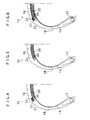
- Figs. 1 through 6 illustrate a radial tire 10 which includes a carcass 14, a tread portion 16, sidewall portions 18 of the carcass 14, at least two belt layers 20, and at least one belt reinforcing layer 22.
- the carcass 14 is folded over around a bead core 12 from the inner side of the tire to the outer side of the tire so as to engage the outer side.
- the tread portion 16 is positioned at the crown portion of the carcass 14.
- the belt layers 20 are disposed at the inner side of the tread portion 16.
- the belt reinforcing layers 22 are disposed at the outer peripheral side of the belt layers 20 at the entire tread portion and/or at both end portions of the tread portion.
- the belt reinforcing layer 22 is a narrow, rubber-coated strip including a plurality of fiber cords which is wound endlessly in a spiral so that the cords are substantially parallel (0° to 5°) in the circumferential direction of the tire. It is preferable that belt reinforcing layers 22 jut out at the radial direction outer side of the belt layers 20.
- fiber cords are disposed substantially orthogonally to the circumferential direction of the tire.
- the carcass 14 is formed of at least one layer.
- non-elongatable cords such as aromatic polyamide fiber cords and steel cords, are disposed at an angle of 10° to 30 with respect to the circumferential direction (or the equatorial plane of the tire). At least two belt layers 20 are provided such that the cords thereof intersect in different directions.
- Figs. 1 through 6 respectively illustrate examples of arrangements of the belt reinforcing layers 22.
- Fig. 1 is a sectional view of a tire in which one belt reinforcing layer 22 is wound uniformly at the entire tread portion 16 at the outer peripheral side of the belt layers 20, and another belt reinforcing layer 22 is wound at each of the side end portions at the outer peripheral side of the previous belt reinforcing layer 22.
- Fig. 2 is a sectional view of a tire in which one belt reinforcing layer 22 is wound at each end portion of the tread portion 16 (at the outer peripheral side of the belt layers 20).
- Fig. 3 is a sectional view of a tire in which two belt reinforcing layers 22 are wound at each end portion.
- Fig. 1 is a sectional view of a tire in which one belt reinforcing layer 22 is wound uniformly at the entire tread portion 16 at the outer peripheral side of the belt layers 20, and another belt reinforcing layer 22 is wound at each of the side end portions at the outer peripheral side of
- Fig. 4 is sectional view of a tire in which one belt reinforcing layer 22 is wound at the entire tread portion and two belt reinforcing layers 22 are wound at each end portion.
- Fig. 5 is a sectional view of a tire in which one belt reinforcing layer 22 is wound at the entire tread portion.
- Fig. 6 is a sectional view illustrating a tire in which two belt reinforcing layers 22 are wound at the entire tread portion and one is wound at each end portion.
- the arrangement of the belt reinforcing layers is not limited to the above-described examples. Structures such as those illustrated in, for example, Figs. 2 and 3 are used preferably, due their light weight, for ordinary passenger vehicles. Structures such as those illustrated in Figs.
- the tires used in Examples 1 through 15 and Comparative Examples 1 through 5, which will be described later, are as follows.
- the tire size is a 205/65R15 tubeless structure. In the manufacturing process, the tire is vulcanized at 170°C for 13 minutes, and then is inflated to a post-cure inflation internal pressure of 2.5 kg/cm 2 for 26 minutes.
- each carcass layer being formed by using polyethylene terephthalate cords of 1000D/2 (two cords, each of 1000 deniers) with a number of twists (ply-twists ⁇ cable-twists) of 47 ⁇ 47 (times/10 cm).
- the thread count is 55.0 cords per 5 cm.
- the belt layer has two steel cord belts of a 1 ⁇ 5 ⁇ 0.23 structure.
- the embedding angle of the two steel cords is 26° respectively to the left and right with respect to the circumferential direction, and the number of embedded cords is 40.0 cords per 5 cm.
- the belt reinforcing layers are wound spirally at the outer side of the belt layers at an angle of 0° to 5° with respect to the circumferential direction.
- the belt reinforcing layers are arranged as illustrated in Fig. 1.
- the single belt reinforcing layer which is wound at the entire tread portion is wound 5 mm wider at the radial direction outer side ends of the belt layer.
- each of the belt reinforcing layers at the outer side end portions is wound such that the width of each of these layers is 30 mm.
- the belt reinforcing layers are formed above the belt layers by the above-described method by using narrow strips of 5 to 20 mm.
- the polyethylene-2,6-naphthalate fiber cords used in the belt reinforcing layers are obtained in the following manner.
- Resin chips of the polyethylene-2,6-naphthalate (intrinsic viscosity 0.72) obtained by the previously-described method are substantially melt spun.
- the spinning speed is 600 m/minute.
- a 44 cm long heating tube having an ambient temperature of 340°C is set directly beneath the spinneret.
- the melt-spun non-stretched filament is wound around an oiling roller so that a lubricant is applied thereto.
- the filament is subject to shrinkage heat setting between a heat roller of 227°C and a non-heated roller at a relaxation rate of 2.2%.
- the filament is wound around the roller at 300 m/minute.
- the temperature of the spinning machine is optimally 300 to 315°C at the first half of the extruder which melts the polymer, and thereafter, is optimally 318°C until the filament is discharged from the spinneret. Further, cooling hardening at a relative humidity of 65% and a temperature of 25°C for a length of 35 cm may be carried out after the filament has passed through the heating tube. In this way, a polyethylene-2,6-naphthalate base filament is obtained.
- the base filament is adjusted so that the twist coefficient R becomes 0.20 to 0.72, and a twisted cord is obtained.
- This twisted cord is subjected to adhesive application and heat treatment as follows.
- the twisted cord is immersed in a resorcinol-formaldehyde resin latex type adhesive.
- the processing temperature is 170°C and the processing time is 60 to 160 seconds.
- the processing temperature is 250 to 270°C and the processing time is 60 to 160 seconds.
- the cord tension in the heat setting zone is set to 0.4 to 1.1 g/d and the cord tension in the normalizing zone is set to 0.03 to 0.50 g/d.
- the adhesive may be a reactive adhesive, e.g., an epoxy resin adhesive or the like, which is applied in two steps.
- the elongation (%) of the cord under a load of 2.25 g/d is adjusted to less than or equal to 3.5%.
- the polyethylene terephthalate fiber cords used in the belt reinforcing layers are obtained in the following manner.
- the resultant product was immediately cooled in ice water.
- the sample which had been immediately cooled in ice water was cut to a 2 mm to 3 mm pellet shape. 5 g of this sample was placed in a 100 ml round flask. After reducing the pressure (0.1 mm Hg), the round flask was placed in an oil bath, and crystallization and pre-drying were carried out for two hours at 160°C at a mixing speed of 30 rpm. Thereafter, solid state polymerization was carried out for a predetermined time at a mixing speed of 30 rpm at the temperature of the sample (melting point -18°C).
- the base filament was adjusted so that the twist coefficient R was 0.20 to 0.72, and a twisted cord was obtained.
- the twisted cord was subjected to adhesive application and heat processing in accordance with the following conditions.
- the adhesive was prepared as follows. Resorcinol-polysulfide and resorcinol excess resorcinol-formaldehyde condensation resin were mixed in a solid content ratio of 20:100. 18 parts of the solid content were removed therefrom, and 9 parts of 28% ammonia water were added to this removed solid content. Water was added and the solid content was completely dissolved such that the entire mixture became 50 parts. To this solution was added 50 parts of a resorcinol-formaldehyde condensation resin/latex (RFL). This RFL was prepared from the following compositions, and was aged for 48 hours or more. water 518.8 (wt. pts.) resorcinol 11.0 formaldehyde (37%) 16.2 ammonium hydroxide (28%) 10.0 vinylpyridine-styrene-butadiene copolymer latex (41%) 244.0
- the twisted cord was immersed in this adhesive.
- the processing temperature was set to 170°C and the processing time was set to 60 to 160 seconds.
- the processing temperature was set to 250 to 265°C and the processing time was set to 60 to 170 seconds.
- the tension in the heat setting zone was set to 0.4 to 1.1 g/d, and the tension in the normalizing zone was set to 0.03 to 0.50 g/d.
- the processing temperature was set to 150 to 180°C
- the processing time was set to 30 to 170 seconds
- the cord tension was set to 0.01 to 0.70 g/d. In this way, a cord which was subjected to a predetermined adhesive processing was obtained.
- the tread base rubber of the present invention having a tan ⁇ of 0.02 to 0.08 was formed by compounding 100 wt. pts. of natural rubber (NR), 15 to 40 wt. pts. of carbon black and 1 to 3 wt. pts. of sulfur in an optimal combination with optimal amounts of oil, antioxidants, vulcanizing accelerators, and processability improving agents.
- NR natural rubber
- NR natural rubber
- BR butadiene rubber
- a load of 0.0167 g/d was applied to a cord at 20 to 30°C (room temperature).
- the ambient temperature of the cord was raised at a speed of 80°C/min until the temperature reached 170 ⁇ 5°C, and the cord was left in this state for 10 minutes. Thereafter, the cord was pulled at a speed of 30 mm/min until the load acting thereon reached 0.7 g/d. In this state, the length of the cord after it crept for 10 minutes was measured. This length was compared with the length of the cord at room temperature when the 0.0167 g/d load was applied thereto.
- the difference in the length of the cord after creeping and the length of the cord when the load of 0.0167 g/d was applied thereto was divided by the length of the cord at room temperature when the 0.0167 g/d load was applied thereto, so as to obtain the elongation (%) under a load of 0.7 g/d at 170 ⁇ 5°C. Note that the length of the initial sample was 250 mm.
- a load of 0.0167 g/d was applied to a cord at 20 to 30°C (room temperature).
- the ambient temperature of the cord was raised at a speed of 5°C/min until the temperature reached 50 ⁇ 5°C, and the cord was left in this state for 5 minutes. Thereafter, the cord was pulled at a speed of 300 mm/min until it broke.
- a stress-strain curve was drawn, and the elongation at a stress of 1.4 g/d was read from the stress-strain curve. This value was the elongation under a load of 1.4 g/d at 50 ⁇ 5°C .
- N 1 is the slope of a tangent line at 1.4 g/d load of a stress-strain curve for 50 ⁇ 5°C
- N 2 is the slope of a tangent line at 0.25 g/d load of a stress-strain curve for 50 ⁇ 5°C
- tan ⁇ at a temperature of 60°C, a distortion of 1%, and a frequency of 50 Hz was measured by using a viscoelasticity measuring device (manufactured by Toyo Seiki Seisakusho).
- test tires having an internal pressure of 2.0 kgf/cm 2 and rim size 6J-15 were installed on a 2000 cc sedan-type automobile. Two passengers rode in the vehicle which traveled at a speed of 60 km/h along a test course for road noise evaluation.
- a sound-gathering microphone was installed at the center of the seat back of the driver's seat, and all sound pressures (decibels) of 100 to 500 Hz and 300 to 500 Hz were measured.
- These values for the control tire of Comparative Example 1 was given an index value of 100. A higher value here indicates a better road noise evaluation.
- test tires having an internal pressure of 2.0 kgf/cm 2 and rim size 6J-15 were installed on a 2000 cc sedan-type automobile, and the vehicle traveled over a test course for handling stability evaluation.
- a feeling test in an actual vehicle was performed at speeds of 60 to 200 km/hr.
- the following four aspects were evaluated and given grades from 1 to 10 points: (i) straight-traveling stability, (ii) turning stability, (iii) feeling of rigidity, (iv) handling.
- the points from these four aspects were averaged to determine the handling stability score. This evaluation was carried out by two specialist drivers. Their two scores were averaged, and this value for the control tire of Comparative Example 1 was given an index value of 100. A higher value here is more preferable.
- Evaluation of the durability at high speeds of the tire was carried out by using the step-speed method in accordance with test method No. 109 of the U.S. standards FMVSS. More specifically, the speed was increased each 30 minutes until trouble occurred. The speed (km/h) at the time the trouble occurred and how long (minutes) the tire had been running at that speed were measured. This value for the control tire of Comparative Example 1 was given an index value of 100. A higher value here is more preferable.
- a rotating drum having a smooth steel surface, an outer diameter of 1707.6 mm, and a width of 350 mm was used to measure and evaluate the rolling resistance by a coasting method by rotating the tire at speeds of 0 to 180 km/hr under a load of 300 kg. The speed was measured each 20 km/hr, and the rolling resistance was evaluated by the average value of the respective speeds.
- This value for the control tire of Comparative Example 1 was given an index value of 100. Higher values indicate better rolling resistance (lower rolling resistance).
- Polyethylene-2,6-naphthalate (PEN) cords were used as the belt reinforcing layer fiber cords.
- the denier structure was 1500D/2 (i.e., two ply-twisted cords, each cord having a total number of deniers of 1500 deniers).
- the cord had 39 times/10 cm ply-twists, 39 times/10 cm cable-twists (denoted by "39 ⁇ 39", which is the number of ply-twists (times/10 cm) ⁇ the number of cable-twists (times/10 cm)), and a twist coefficient of 0.68.
- the elongation under 1.4 g/d at 50 ⁇ 5°C was 2.0%, and the elongation under 0.7 g/d at 170 ⁇ 5°C was 3.0%.
- the ratio N 1 /N 2 (wherein N 1 is the slope of a tangent line at 1.4 g/d load of a stress-strain curve for 50 ⁇ 5°C, and N 2 is the slope of a tangent line at 0.25 g/d load of the stress-strain curve for 50 ⁇ 5°C) was 0.90.
- the tan ⁇ of the tread base rubber and the side rubber were 0.08 and 0.15, respectively.
- a radial tire having the above-described material was evaluated with respect to respective performances, such as road noise, rolling resistance, handling stability, durability at high speeds and the like. The results of the evaluation are shown in Table 1.
- the values of the respective elements of the PEN cords of Example 1 (the number of twists, the twist coefficient, elongation at 50 ⁇ 5°C under 1.4 g/d load, elongation at 170 ⁇ 5°C under 0.7 g/d load, N 1 /N 2 ) and the tan ⁇ values of the tread base rubber and the side rubber were changed as shown in Table 1.
- the performances of tires obtained in the same way as in Example 1 were evaluated, and the results are listed in Table 1.
- the belt reinforcing layer fiber cords of Example 10 were composite, hybrid cords of PEN cords and nylon 66 (NY) cords.
- the fiber cords of Example 11 were composite, hybrid cords of PEN cords and polyethylene terephthalate (PET) cords.
- a 1500 D PEN cord of 39 times/10 cm ply-twists and a 1500 D PET cord of 39 times/10 cm ply-twists formed the composite cord having 39 times/10 cm cable-twists.
- the fiber cords of Example 12 were composite, hybrid cords of PEN cords and rayon (RAY) cords.
- the fiber cords of Example 13 were doubling cords having PEN filaments and NY filaments in each yarn.
- the PEN filaments and NY filaments were used in a ratio of 2:1 (66.7% of the total number of deniers are PEN fibers) so as to obtain a 1500 D doubling cord having 39 times/10 cm ply-twists. Two of these doubling cords were cable-twisted at 39 times/10 cm so as to form the doubling cord of Example 13.
- the fiber cords of Example 14 were obtained in the same way as the fiber cords of Example 13, except that the PEN filaments and the NY filaments were used in a ratio of 1:1 (50% of the total number of deniers were PEN fibers).
- the fiber cords of Example 15 were PET cords which had 1500 D/2 deniers and whose twisting number was cable ⁇ ply (times/10 cm) 22 ⁇ 22.
- Example 10 For Examples 10 through 15, the values of the respective elements of the fiber cords of Example 1 (the twist coefficient, the elongation at 50 ⁇ 5°C under 1.4 g/d load, the elongation at 170 ⁇ 5°C under 0.7 g/d load, N 1 /N 2 ) were changed as shown in Table 2. The performances of tires obtained in the same way as in Example 1 were evaluated, and the results thereof are listed in Table 2.
- the fiber cords of Comparative Example 1 were NY cords which had 1260 D/2 deniers and whose twisting number was cable ⁇ ply (times/10 cm) 39 ⁇ 39.
- the fiber cords of Comparative Example 2 were PET cords which had 1500 D/2 deniers and whose twisting number was cable ⁇ ply (times/10 cm) 39 ⁇ 39.
- the fiber cords of Comparative Example 3 were aromatic polyamide (ARM) cords which had 1500 D/2 deniers and whose twisting number was cable ⁇ ply (times/10 cm) 39 ⁇ 39.
- ARM aromatic polyamide
- the fiber cords of Comparative Example 4 were composite, hybrid cords of ARM cords and NY cords.
- a 1500 D ARM cord having 22 times/10 cm ply-twists and a 1500 D NY cord having 11 times/10 cm ply-twists formed the composite cord having 22 times/10 cm cable-twists.
- the fiber cords of Comparative Example 5 were PEN cords which had 1500 D/2 deniers and whose twisting number was cable ⁇ ply (times/10 cm) 22 ⁇ 22.
- the radial tires of the present invention have high levels and a good balance of low rolling resistance, durability at high speeds and handling stability. Further, road noise was greatly reduced in a range extending from low frequencies to high frequencies.
- Comparative Examples 1 and 2 in Table 3 when the elongation under 1.4 g/d load at 50 ⁇ 5°C exceeds 2.7% (which does not fall within the scope of the present claims), the low rolling resistance property, durability at high speeds and handling stability are not high level, and the balance is not satisfactory. Further, road noise markedly deteriorates. As shown by Comparative Examples 3 through 5 in Table 3, when the elongation under 0.7 g/d load at 170 ⁇ 5°C is less than 1.5% or greater than 6.0% (which does not fall within the scope of the present claims), the respective performances of the tire deteriorate, and the effects of the present invention cannot be achieved.
Landscapes
- Engineering & Computer Science (AREA)
- Mechanical Engineering (AREA)
- Tires In General (AREA)
- Yarns And Mechanical Finishing Of Yarns Or Ropes (AREA)
Applications Claiming Priority (9)
| Application Number | Priority Date | Filing Date | Title |
|---|---|---|---|
| JP151617/95 | 1995-06-19 | ||
| JP15161895 | 1995-06-19 | ||
| JP15161795 | 1995-06-19 | ||
| JP15161795 | 1995-06-19 | ||
| JP151618/95 | 1995-06-19 | ||
| JP15161895 | 1995-06-19 | ||
| JP14933296A JP3555809B2 (ja) | 1995-06-19 | 1996-06-11 | ラジアルタイヤ |
| JP149332/96 | 1996-06-11 | ||
| JP14933296 | 1996-06-11 |
Publications (2)
| Publication Number | Publication Date |
|---|---|
| EP0749854A1 true EP0749854A1 (de) | 1996-12-27 |
| EP0749854B1 EP0749854B1 (de) | 1999-12-15 |
Family
ID=27319726
Family Applications (1)
| Application Number | Title | Priority Date | Filing Date |
|---|---|---|---|
| EP96304561A Expired - Lifetime EP0749854B1 (de) | 1995-06-19 | 1996-06-19 | Radialreifen |
Country Status (5)
| Country | Link |
|---|---|
| US (1) | US5931211A (de) |
| EP (1) | EP0749854B1 (de) |
| JP (1) | JP3555809B2 (de) |
| DE (1) | DE69605605T2 (de) |
| ES (1) | ES2140028T3 (de) |
Cited By (14)
| Publication number | Priority date | Publication date | Assignee | Title |
|---|---|---|---|---|
| EP0820882A3 (de) * | 1996-07-24 | 1998-05-13 | Bridgestone Corporation | Radialer Luftreifen |
| WO1998047726A1 (en) * | 1997-04-18 | 1998-10-29 | The Goodyear Tire & Rubber Company | Pen reinforcement in a tire overlay |
| WO1998056600A1 (en) * | 1997-06-09 | 1998-12-17 | The Goodyear Tire & Rubber Company | Light weight aramid belted radial tire |
| WO1998056601A1 (en) * | 1997-06-09 | 1998-12-17 | The Goodyear Tire & Rubber Company | Low cost light weight radial tire |
| WO1998056599A1 (en) * | 1997-06-09 | 1998-12-17 | The Goodyear Tire & Rubber Company | Light weight fiberglass belted radial tire |
| WO2003086783A1 (en) * | 2002-04-08 | 2003-10-23 | Societe De Technologie Michelin | Pneumatic tire crown reinforcement |
| EP1338440A3 (de) * | 2002-02-14 | 2003-10-29 | Sumitomo Rubber Industries Ltd. | Luftreifen |
| EP1798073A1 (de) * | 2005-12-13 | 2007-06-20 | Sumitomo Rubber Industries Ltd. | Notlaufreifen |
| EP1495880A4 (de) * | 2002-04-18 | 2007-07-11 | Bridgestone Corp | Luftreifen |
| US7299843B2 (en) | 2002-04-08 | 2007-11-27 | Michelin Recherche Et Technique S.A. | Pneumatic tire crown reinforcement |
| WO2010094357A1 (de) * | 2009-02-19 | 2010-08-26 | Continental Reifen Deutschland Gmbh | Fahrzeugluftreifen |
| EP2377695A3 (de) * | 2010-04-19 | 2012-08-01 | Sumitomo Rubber Industries, Ltd. | Luftreifen |
| WO2015097655A3 (en) * | 2013-12-25 | 2015-09-24 | Kordsa Global Endüstriyel Iplik Ve Kord Bezi Sanayi Ve Ticaret Anonim Sirketi | Pneumatic radial tire |
| CN111247009A (zh) * | 2017-10-20 | 2020-06-05 | 米其林集团总公司 | 包括层压条带形式的增强元件的轮胎 |
Families Citing this family (128)
| Publication number | Priority date | Publication date | Assignee | Title |
|---|---|---|---|---|
| DE60041550D1 (de) * | 1999-11-12 | 2009-03-26 | Bridgestone Corp | Modifizierte polymere hergestellt mit katalysator auf basys von lanthaniden |
| US6977281B1 (en) * | 1999-11-12 | 2005-12-20 | Bridgestone Corporation | Modified polymers prepared with lanthanide-based catalysts |
| JP2001139728A (ja) | 1999-11-17 | 2001-05-22 | Bridgestone Corp | ゴム組成物 |
| JP2001163005A (ja) * | 1999-12-09 | 2001-06-19 | Bridgestone Corp | ラジアルタイヤ |
| US6668889B1 (en) | 1999-12-21 | 2003-12-30 | The Goodyear Tire & Rubber Company | Reinforcement package for tires |
| JP4262849B2 (ja) * | 1999-12-24 | 2009-05-13 | 横浜ゴム株式会社 | 空気入りラジアルタイヤ |
| US6579929B1 (en) | 2000-01-19 | 2003-06-17 | Bridgestone Corporation | Stabilized silica and method of making and using the same |
| US6573412B1 (en) | 2000-05-12 | 2003-06-03 | Bridgestone Corporation | Chain-coupled polymeric alkoxide compounds having controlled viscosity |
| US6512035B1 (en) | 2000-05-15 | 2003-01-28 | Bridgestone Corporation | Processability of silica-reinforced rubber containing a monofunctional alkyl tin compound |
| US6590017B1 (en) | 2000-05-15 | 2003-07-08 | Bridgestone Corporation | Processability of silica-reinforced rubber containing an amide compound |
| US6313210B1 (en) | 2000-07-31 | 2001-11-06 | Bridgestone Coporation | Silica-reinforced rubber compounds containing moisture stabilized polymers |
| JP4589500B2 (ja) * | 2000-08-28 | 2010-12-01 | 株式会社ブリヂストン | タイヤ用補強材及び空気入りタイヤ |
| US6608145B1 (en) | 2000-10-13 | 2003-08-19 | Bridgestone Corporation | Silica-reinforced rubber compounded with an organosilane tetrasulfide silica coupling agent at high mixing temperature |
| US6433065B1 (en) | 2000-10-13 | 2002-08-13 | Bridgestone Corporation | Silica-reinforced rubber compounded with mercaptosilanes and alkyl alkoxysilanes |
| JP4965055B2 (ja) * | 2000-11-10 | 2012-07-04 | 株式会社ブリヂストン | 新規な官能化剤を用いて製造した官能化高シス−1,4−ポリブタジエン |
| US6774185B2 (en) | 2001-04-04 | 2004-08-10 | Bridgestone Corporation | Metal hydroxide filled rubber compositions and tire components |
| US20030111770A1 (en) * | 2001-12-13 | 2003-06-19 | Bridgestone Corp. | Method of improving carbon black dispersion in rubber compositions |
| WO2004111093A1 (en) * | 2003-06-09 | 2004-12-23 | Bridgestone Corporation | Improved hysteresis elastomeric compositions comprising polymers terminated with isocyanato alkoxysilanes |
| KR100499220B1 (ko) * | 2003-06-30 | 2005-07-01 | 주식회사 효성 | 방사성이 우수한 고강력 폴리에틸렌-2,6-나프탈레이트섬유 및 이의 제조방법 |
| JP3950088B2 (ja) * | 2003-07-24 | 2007-07-25 | 住友ゴム工業株式会社 | 空気入りラジアルタイヤ |
| JP4397207B2 (ja) | 2003-10-06 | 2010-01-13 | 株式会社ブリヂストン | 空気入りラジアルタイヤ |
| US7259204B2 (en) * | 2004-03-01 | 2007-08-21 | Bridgestone Corporation | Tire compositions comprising surface-modified silica |
| WO2005085304A1 (en) * | 2004-03-01 | 2005-09-15 | Bridgestone Corporation | Continuous polymerization reactor |
| JP2007534833A (ja) * | 2004-04-27 | 2007-11-29 | 株式会社ブリヂストン | 改善されたシリカ補強性能を有するタイヤ組成物の製造方法 |
| US7671139B1 (en) | 2004-06-18 | 2010-03-02 | Bridgestone Corporation | Functionalized polymers and tires made therefrom |
| EP2277939B1 (de) | 2005-03-24 | 2017-02-22 | Bridgestone Corporation | Kompoundierung einer silika-verstärkten Kautschukmischung mit niedriger Voc Emission |
| JP4908101B2 (ja) * | 2005-11-25 | 2012-04-04 | 株式会社ブリヂストン | 空気入りタイヤ |
| US7879952B2 (en) * | 2005-12-28 | 2011-02-01 | Bridgestone Corporation | Functionalized polymers |
| JP4961780B2 (ja) * | 2006-03-14 | 2012-06-27 | 横浜ゴム株式会社 | 空気入りタイヤ及びその製造方法 |
| US7671138B2 (en) * | 2006-05-26 | 2010-03-02 | Bridgestone Corporation | Polymers functionized with hydrobenzamides |
| US20080006833A1 (en) * | 2006-06-02 | 2008-01-10 | Semiconductor Energy Laboratory Co., Ltd. | Lighting device and liquid crystal display device |
| JP2007323544A (ja) * | 2006-06-05 | 2007-12-13 | Sony Corp | 情報処理システム、情報処理装置、および方法、並びにコンピュータ・プログラム |
| US7732534B2 (en) * | 2006-08-28 | 2010-06-08 | Bridgestone Corporation | Polymers functionalized with nitro compounds |
| JP4309466B2 (ja) * | 2006-09-22 | 2009-08-05 | 横浜ゴム株式会社 | 空気入りラジアルタイヤ |
| US8088868B2 (en) | 2006-12-19 | 2012-01-03 | Bridgestone Corporation | Polymers functionalized with protected oxime compounds |
| US8939184B2 (en) * | 2006-12-21 | 2015-01-27 | Bridgestone Americas Tire Operations, Llc | Rubber composition and pneumatic tire using same |
| ZA200711158B (en) | 2006-12-28 | 2009-03-25 | Bridgestone Corp | A method for producing functionalized cis-1,4-polydienes having high cis-1,4-linkage content and high functionality |
| ZA200711159B (en) | 2006-12-28 | 2009-03-25 | Bridgestone Corp | Amine-containing alkoxysilyl-functionalized polymers |
| BRPI0720648B1 (pt) * | 2006-12-29 | 2019-05-14 | Bridgestone Americas Tire Operations, Llc | Método para preparar um revestimento interno de pneu cru e pneu compreendendo um revestimento interno |
| US8136562B2 (en) | 2006-12-29 | 2012-03-20 | Bridgestone Firestone North American Tire, Llc | Tire bead insulation |
| US8372925B2 (en) | 2007-04-10 | 2013-02-12 | Bridgestone Corporation | Nickel-based catalyst composition |
| JP5162175B2 (ja) * | 2007-07-26 | 2013-03-13 | 株式会社ブリヂストン | 空気入りタイヤ |
| US7879958B2 (en) | 2007-08-07 | 2011-02-01 | Bridgestone Corporation | Polyhydroxy compounds as polymerization quenching agents |
| US8324329B2 (en) | 2007-08-07 | 2012-12-04 | Bridgestone Corporation | Process for producing functionalized polymers |
| US8314189B2 (en) | 2007-10-12 | 2012-11-20 | Bridgestone Corporation | Polymers functionalized with heterocyclic nitrile compounds |
| JP5213161B2 (ja) * | 2007-11-29 | 2013-06-19 | 株式会社ブリヂストン | 空気入りタイヤ |
| US8268933B2 (en) * | 2007-12-31 | 2012-09-18 | Bridgestone Corporation | Polymers functionalized with polyimine compounds |
| US8794282B2 (en) | 2007-12-31 | 2014-08-05 | Bridgestone Corporation | Amino alkoxy-modified silsesquioxane adhesives for improved metal adhesion and metal adhesion retention to cured rubber |
| RU2515980C2 (ru) * | 2007-12-31 | 2014-05-20 | Бриджстоун Корпорейшн | Способ получения полидиенов полимеризацией в объеме |
| JP2009173926A (ja) | 2007-12-31 | 2009-08-06 | Bridgestone Corp | ポリマーの耐コールドフロー性を向上させる方法 |
| US7906592B2 (en) | 2008-07-03 | 2011-03-15 | Bridgestone Corporation | Polymers functionalized with imide compounds containing a protected amino group |
| ATE510880T1 (de) | 2008-08-05 | 2011-06-15 | Bridgestone Corp | Verfahren zur verbesserung der kaltflussbeständigkeit von polymeren |
| US8188195B2 (en) | 2008-12-31 | 2012-05-29 | Bridgestone Corporation | Polymers functionalized with nitroso compounds |
| KR101692089B1 (ko) | 2009-01-23 | 2017-01-02 | 가부시키가이샤 브리지스톤 | 폴리시아노 화합물로 관능화된 중합체 |
| US8344066B2 (en) | 2009-01-23 | 2013-01-01 | Bridgestone Corporation | Polymers functionalized with nitrile compounds containing a protected amino group |
| US20110077325A1 (en) | 2009-09-30 | 2011-03-31 | Bridgestone Corporation | Functionalized polymers and methods for their manufacture |
| EP2488556B1 (de) | 2009-10-14 | 2013-09-11 | Bridgestone Corporation | Verfahren zur herstellung eines cyclischen acyclischen dien-copolymers und kautschukzusammensetzung |
| US8338544B2 (en) | 2009-12-21 | 2012-12-25 | Bridgestone Corporation | Polymers functionalized with polyoxime compounds and methods for their manufacture |
| ES2477228T3 (es) | 2009-12-22 | 2014-07-16 | Bridgestone Corporation | Composición mejorada de un modificador vin�lico y procedimientos para utilizarla |
| WO2011082098A1 (en) | 2009-12-30 | 2011-07-07 | The Rockefeller University | Lysine and arginine methyltransferase inhibitors for treating cancer |
| KR101909756B1 (ko) | 2009-12-31 | 2018-10-18 | 가부시키가이샤 브리지스톤 | 아미노실란 개시제 및 이로부터 제조된 관능화된 중합체 |
| ES2626141T3 (es) | 2010-01-22 | 2017-07-24 | Bridgestone Corporation | Polímeros funcionalizados con compuestos de nitrilo que contienen un grupo amino protegido |
| DE102010036760A1 (de) * | 2010-07-30 | 2012-02-02 | Continental Reifen Deutschland Gmbh | Fahrzeugluftreifen |
| WO2012031005A2 (en) | 2010-08-31 | 2012-03-08 | Bridgestone Corporation | Rubber compositions with filler and ketoxime or ketoximo silane |
| US9249244B2 (en) | 2010-09-23 | 2016-02-02 | Bridgestone Corporation | Process for producing polydienes |
| US8748531B2 (en) | 2010-12-10 | 2014-06-10 | Bridgestone Corporation | Polymers functionalized with oxime compounds containing an acyl group |
| WO2012091753A1 (en) | 2010-12-30 | 2012-07-05 | Bridgestone Corporation | Aminosilane initiators and functionalized polymers prepared therefrom |
| EP3181626B1 (de) | 2010-12-30 | 2018-10-03 | Bridgestone Corporation | Kautschukzusammensetzung mit verbesserter bis-silan-verstärkung |
| US8987395B2 (en) | 2010-12-31 | 2015-03-24 | Bridgestone Corporation | Bulk polymerization of conjugated dienes using a nickel-based catalyst system |
| WO2012092551A1 (en) | 2010-12-31 | 2012-07-05 | Bridgestone Corporation | Bulk polymerization of conjugated dienes using a nickel-based catalyst system |
| JP5956556B2 (ja) | 2011-03-29 | 2016-07-27 | 株式会社ブリヂストン | シリル化アミノ基を含有するカルボン酸またはチオカルボン酸エステルで官能化されたポリマー |
| KR101890975B1 (ko) | 2011-08-31 | 2018-08-22 | 가부시키가이샤 브리지스톤 | 보호된 아미노 그룹을 함유하는 락톤 또는 티오락톤으로 기능화된 폴리머 |
| US8962766B2 (en) | 2011-09-15 | 2015-02-24 | Bridgestone Corporation | Polymers functionalized with polyhydrazone compounds |
| EP2780381B1 (de) | 2011-11-17 | 2015-10-07 | Bridgestone Corporation | Verfahren zur herstellung von polydienen |
| CN104023996B (zh) | 2011-11-18 | 2017-10-24 | 株式会社普利司通 | 用于制备具有降低的冷流的聚二烯和聚二烯共聚物的方法 |
| WO2013086480A2 (en) | 2011-12-09 | 2013-06-13 | Bridgestone Corporation | Method for producing polydienes and polydiene copolymers with reduced cold flow |
| TWI585115B (zh) | 2011-12-15 | 2017-06-01 | 普利司通股份有限公司 | 經穩定之多價陰離子聚合反應引發劑及其製備方法 |
| EP2797759A2 (de) | 2011-12-29 | 2014-11-05 | Bridgestone Corporation | Luftreifen |
| US9309372B2 (en) | 2012-03-01 | 2016-04-12 | Bridgestone Corporation | Rubber compositions including a functionalized wax |
| KR101993024B1 (ko) | 2012-03-14 | 2019-06-25 | 가부시키가이샤 브리지스톤 | 폴리디엔을 생산하는 방법 |
| US9469706B2 (en) | 2012-06-08 | 2016-10-18 | Bridgestone Corporation | Polymers functionalized with unsaturated heterocycles containing a protected amino group |
| US9670341B2 (en) | 2012-11-02 | 2017-06-06 | Bridgestone Corporation | Rubber compositions comprising metal carboxylates and processes for making the same |
| JP6364421B2 (ja) | 2012-11-09 | 2018-07-25 | 株式会社ブリヂストン | 生物系スチレンの使用法 |
| JP2014108675A (ja) * | 2012-11-30 | 2014-06-12 | Toyo Tire & Rubber Co Ltd | 空気入りラジアルタイヤ |
| US9663637B2 (en) | 2012-12-31 | 2017-05-30 | Bridgestone Corporation | Polymers functionalized with unsaturated heterocycles containing an azolinyl group |
| US9127092B2 (en) | 2012-12-31 | 2015-09-08 | Bridgestone Corporation | Method for producing polydienes and polydiene copolymers with reduced cold flow |
| WO2014107447A1 (en) | 2013-01-02 | 2014-07-10 | Bridgestone Corporation | Functionalized polymers |
| KR102201542B1 (ko) | 2013-03-15 | 2021-01-12 | 가부시키가이샤 브리지스톤 | 헤테로사이클릭 이민으로 작용화된 중합체 |
| JP5486109B1 (ja) * | 2013-05-10 | 2014-05-07 | 株式会社ブリヂストン | タイヤおよびその製造方法 |
| CN105814087B (zh) | 2013-10-02 | 2017-07-11 | 株式会社普利司通 | 用含有氰基基团的亚胺化合物官能化的聚合物 |
| US10035908B1 (en) | 2013-12-03 | 2018-07-31 | Bridgestone Corporation | Process for preparing blends of trans-1,4-polybutadiene and syndiotactic 1,2-polybutadiene |
| WO2015084922A1 (en) | 2013-12-03 | 2015-06-11 | Bridgestone Corporation | Process for preparing blends of cis-1,4-polybutadiene and syndiotactic 1,2-polybutadiene |
| US10150869B2 (en) | 2013-12-12 | 2018-12-11 | Firestone Polymers, Llc | Method for producing polymeric compositions including functionalized polymers |
| JP6455442B2 (ja) * | 2013-12-16 | 2019-01-23 | 横浜ゴム株式会社 | 空気入りタイヤおよびその製造方法 |
| EP3086928B1 (de) | 2013-12-27 | 2019-09-11 | Bridgestone Corporation | Aus zusammensetzungen mit mercaptofunktionellen siloxanen hergestellte vulkanisate und reifenkomponenten |
| US10030083B2 (en) | 2014-05-15 | 2018-07-24 | Bridgestone Corporation | Polymers functionalized with protected oxime compounds containing a cyano group |
| US10364300B2 (en) | 2014-10-07 | 2019-07-30 | Bridgestone Corporation | Method for producing polydienes and polydiene copolymers with reduced cold flow |
| CN107207654A (zh) | 2014-11-17 | 2017-09-26 | 株式会社普利司通 | 具有预成形催化剂的聚异戊二烯的本体聚合 |
| JP6683710B2 (ja) | 2014-12-17 | 2020-04-22 | ブリヂストン アメリカズ タイヤ オペレーションズ、 エルエルシー | 高分子量ワックスを含むタイヤサイドウォール |
| WO2016105931A1 (en) | 2014-12-23 | 2016-06-30 | Bridgestone Americas Tire Operations, Llc | Oil-containing rubber compositions and related methods |
| US11401440B2 (en) | 2014-12-31 | 2022-08-02 | Bridgestone Corporation | Amino alkoxy-modified silsesquioxane adhesives for adhering steel alloy to rubber |
| CN107614553B (zh) | 2014-12-31 | 2020-12-08 | 株式会社普利司通 | 接枝到低分子量聚合物的卤化蜡和橡胶组合物 |
| WO2016123376A1 (en) | 2015-01-28 | 2016-08-04 | Bridgestone Corporation | End-functionalized polydienes |
| DE102015207931A1 (de) * | 2015-04-29 | 2016-11-03 | Continental Reifen Deutschland Gmbh | Fahrzeugluftreifen mit einem Laufstreifen |
| US10370460B1 (en) | 2015-05-20 | 2019-08-06 | Bridgestone Corporation | Process for producing functionalized polymers |
| US10077323B2 (en) | 2015-07-24 | 2018-09-18 | Bridgestone Corporation | Polymers functionalized with imine compounds containing a protected thiol group |
| WO2017201397A1 (en) | 2016-05-19 | 2017-11-23 | Bridgestone Corporation | Process for producing functionalized polymers |
| DE102016212943A1 (de) * | 2016-07-15 | 2018-01-18 | Continental Reifen Deutschland Gmbh | Verfahren zur Herstellung eines bandartigen, festigkeitsträgerverstärkten Kautschukstreifens |
| WO2018022994A1 (en) | 2016-07-29 | 2018-02-01 | Bridgestone Corporation | Process for producing high cis-1,4-polydiene with lanthanide-based catalyst compositions |
| US10975178B2 (en) | 2016-09-02 | 2021-04-13 | Bridgestone Corporation | Production of cis-1,4-polydienes with multiple silane functional groups prepared by in-situ hydrosilylation of polymer cement |
| RU2720010C1 (ru) | 2016-11-09 | 2020-04-23 | Бриджстоун Корпорейшн | Блок-сополимеры полибутадиена и полиизопрена с высоким содержанием цис-1,4-связей |
| EP3541640B1 (de) | 2016-11-17 | 2022-08-24 | Bridgestone Americas Tire Operations, LLC | Luftreifen mit an eine luftsperrschicht angehaftetes dämpfungselement |
| WO2019133365A1 (en) | 2017-12-26 | 2019-07-04 | Bridgestone Corporation | Synthesis of low molecular weight tapered styrene-butadiene copolymer and its use in tires |
| KR102678859B1 (ko) | 2018-10-12 | 2024-06-28 | 브리지스톤 어메리카스 타이어 오퍼레이션스, 엘엘씨 | 안정화된 목표 점도를 갖는 개질된 다이엔 공중합체 |
| JP6737349B2 (ja) * | 2019-01-10 | 2020-08-05 | 横浜ゴム株式会社 | 空気入りラジアルタイヤ |
| WO2020160000A1 (en) | 2019-01-29 | 2020-08-06 | Firestone Polymers, Llc | Method for producing polydienes with reduced cold flow |
| JP6809548B2 (ja) * | 2019-02-07 | 2021-01-06 | 横浜ゴム株式会社 | 空気入りラジアルタイヤ |
| JP7088402B2 (ja) * | 2019-02-26 | 2022-06-21 | 横浜ゴム株式会社 | 空気入りラジアルタイヤ |
| CN113728042B (zh) | 2019-04-26 | 2024-03-15 | 株式会社普利司通 | 橡胶组合物、由所述橡胶组合物获得的交联橡胶制品和所述橡胶组合物的制造方法 |
| JP2022531133A (ja) | 2019-04-29 | 2022-07-06 | 株式会社ブリヂストン | 空気入りタイヤの側壁支持体 |
| JP7103318B2 (ja) * | 2019-08-08 | 2022-07-20 | 横浜ゴム株式会社 | 空気入りタイヤ |
| JP7211376B2 (ja) * | 2020-01-27 | 2023-01-24 | 横浜ゴム株式会社 | 空気入りタイヤ |
| US12054573B2 (en) | 2020-02-05 | 2024-08-06 | Bridgestone Corporation | Functionalized polymers having thermoresponsive behavior |
| DE112021000296T5 (de) * | 2020-02-17 | 2022-10-27 | The Yokohama Rubber Co., Ltd. | Luftreifen |
| CN119872140A (zh) * | 2020-02-17 | 2025-04-25 | 横滨橡胶株式会社 | Rfid模块以及埋设有该rfid模块的充气轮胎 |
| JP7613056B2 (ja) * | 2020-11-10 | 2025-01-15 | 住友ゴム工業株式会社 | タイヤ |
| US11932759B1 (en) | 2020-12-28 | 2024-03-19 | Bridgestone Corporation | Polymer-filler composites with guayule rubber |
| JP2024014428A (ja) * | 2022-07-22 | 2024-02-01 | 旭化成株式会社 | 更生タイヤの製造方法 |
Citations (5)
| Publication number | Priority date | Publication date | Assignee | Title |
|---|---|---|---|---|
| FR2244634A1 (de) * | 1973-09-20 | 1975-04-18 | Teijin Ltd | |
| EP0335588A2 (de) * | 1988-03-28 | 1989-10-04 | Sumitomo Rubber Industries Limited | Radialer Luftreifen |
| EP0454432A2 (de) * | 1990-04-26 | 1991-10-30 | Sumitomo Rubber Industries Limited | Radialer Luftreifen |
| JPH05163612A (ja) * | 1991-12-11 | 1993-06-29 | Teijin Ltd | ポリエチレンナフタレート繊維 |
| JPH06184815A (ja) * | 1992-12-09 | 1994-07-05 | Teijin Ltd | 熱安定性に優れたポリエチレンナフタレート繊維およびその製造方法 |
Family Cites Families (7)
| Publication number | Priority date | Publication date | Assignee | Title |
|---|---|---|---|---|
| JPH01145203A (ja) * | 1987-11-30 | 1989-06-07 | Sumitomo Rubber Ind Ltd | ラジアルタイヤ |
| JPH02147407A (ja) * | 1988-11-30 | 1990-06-06 | Sumitomo Rubber Ind Ltd | 乗用車用ラジアルタイヤ |
| JPH03253406A (ja) * | 1990-03-01 | 1991-11-12 | Toyo Tire & Rubber Co Ltd | ラジアルタイヤ |
| JPH05238205A (ja) * | 1992-02-26 | 1993-09-17 | Bridgestone Corp | 空気入りタイヤ |
| JP3244778B2 (ja) * | 1992-07-06 | 2002-01-07 | 横浜ゴム株式会社 | 空気入りラジアルタイヤ |
| JPH06115312A (ja) * | 1992-10-08 | 1994-04-26 | Sumitomo Rubber Ind Ltd | 空気入りラジアルタイヤ |
| JPH06305304A (ja) * | 1993-04-23 | 1994-11-01 | Sumitomo Rubber Ind Ltd | 空気入りタイヤ |
-
1996
- 1996-06-11 JP JP14933296A patent/JP3555809B2/ja not_active Expired - Lifetime
- 1996-06-19 US US08/668,627 patent/US5931211A/en not_active Expired - Lifetime
- 1996-06-19 DE DE69605605T patent/DE69605605T2/de not_active Expired - Lifetime
- 1996-06-19 EP EP96304561A patent/EP0749854B1/de not_active Expired - Lifetime
- 1996-06-19 ES ES96304561T patent/ES2140028T3/es not_active Expired - Lifetime
Patent Citations (5)
| Publication number | Priority date | Publication date | Assignee | Title |
|---|---|---|---|---|
| FR2244634A1 (de) * | 1973-09-20 | 1975-04-18 | Teijin Ltd | |
| EP0335588A2 (de) * | 1988-03-28 | 1989-10-04 | Sumitomo Rubber Industries Limited | Radialer Luftreifen |
| EP0454432A2 (de) * | 1990-04-26 | 1991-10-30 | Sumitomo Rubber Industries Limited | Radialer Luftreifen |
| JPH05163612A (ja) * | 1991-12-11 | 1993-06-29 | Teijin Ltd | ポリエチレンナフタレート繊維 |
| JPH06184815A (ja) * | 1992-12-09 | 1994-07-05 | Teijin Ltd | 熱安定性に優れたポリエチレンナフタレート繊維およびその製造方法 |
Non-Patent Citations (2)
| Title |
|---|
| PATENT ABSTRACTS OF JAPAN vol. 017, no. 567 (C - 1120) 14 October 1993 (1993-10-14) * |
| PATENT ABSTRACTS OF JAPAN vol. 018, no. 533 (C - 1259) 11 October 1994 (1994-10-11) * |
Cited By (25)
| Publication number | Priority date | Publication date | Assignee | Title |
|---|---|---|---|---|
| US6253816B1 (en) | 1996-07-24 | 2001-07-03 | Bridgestone Corporation | Pneumatic radial tire with particular belt reinforcing layer fiber cord and particular bead filler height |
| EP0820882A3 (de) * | 1996-07-24 | 1998-05-13 | Bridgestone Corporation | Radialer Luftreifen |
| WO1998047726A1 (en) * | 1997-04-18 | 1998-10-29 | The Goodyear Tire & Rubber Company | Pen reinforcement in a tire overlay |
| WO1998056601A1 (en) * | 1997-06-09 | 1998-12-17 | The Goodyear Tire & Rubber Company | Low cost light weight radial tire |
| WO1998056599A1 (en) * | 1997-06-09 | 1998-12-17 | The Goodyear Tire & Rubber Company | Light weight fiberglass belted radial tire |
| US6016857A (en) * | 1997-06-09 | 2000-01-25 | The Goodyear Tire & Rubber Company | Light weight aramid radial tire |
| US6016858A (en) * | 1997-06-09 | 2000-01-25 | The Goodyear Tire & Rubber Company | Light weight fiberglass belted radial tire |
| US6082423A (en) * | 1997-06-09 | 2000-07-04 | The Goodyear Tire & Rubber Company | Low cost light weight radial tire |
| AU724139B2 (en) * | 1997-06-09 | 2000-09-14 | Goodyear Tire And Rubber Company, The | Light weight aramid belted radial tire |
| WO1998056600A1 (en) * | 1997-06-09 | 1998-12-17 | The Goodyear Tire & Rubber Company | Light weight aramid belted radial tire |
| EP1338440A3 (de) * | 2002-02-14 | 2003-10-29 | Sumitomo Rubber Industries Ltd. | Luftreifen |
| US7270164B2 (en) | 2002-02-14 | 2007-09-18 | Sumitomo Rubber Industries, Ltd. | Pneumatic tire |
| US7299843B2 (en) | 2002-04-08 | 2007-11-27 | Michelin Recherche Et Technique S.A. | Pneumatic tire crown reinforcement |
| WO2003086783A1 (en) * | 2002-04-08 | 2003-10-23 | Societe De Technologie Michelin | Pneumatic tire crown reinforcement |
| EP1495880A4 (de) * | 2002-04-18 | 2007-07-11 | Bridgestone Corp | Luftreifen |
| EP1798073A1 (de) * | 2005-12-13 | 2007-06-20 | Sumitomo Rubber Industries Ltd. | Notlaufreifen |
| US7900671B2 (en) | 2005-12-13 | 2011-03-08 | Sumitomo Rubber Industries, Ltd. | Runflat tire |
| WO2010094357A1 (de) * | 2009-02-19 | 2010-08-26 | Continental Reifen Deutschland Gmbh | Fahrzeugluftreifen |
| CN102317090A (zh) * | 2009-02-19 | 2012-01-11 | 大陆轮胎德国有限公司 | 用于车辆的充气轮胎 |
| RU2521159C2 (ru) * | 2009-02-19 | 2014-06-27 | Континенталь Райфен Дойчланд Гмбх | Пневматическая шина транспортного средства |
| EP2377695A3 (de) * | 2010-04-19 | 2012-08-01 | Sumitomo Rubber Industries, Ltd. | Luftreifen |
| WO2015097655A3 (en) * | 2013-12-25 | 2015-09-24 | Kordsa Global Endüstriyel Iplik Ve Kord Bezi Sanayi Ve Ticaret Anonim Sirketi | Pneumatic radial tire |
| RU2639829C1 (ru) * | 2013-12-25 | 2017-12-22 | Кордса Глобал Эндустриел Иплик Ве Корд Бези Санайи Ве Тиджарет Аноним Ширкети | Пневматическая радиальная шина |
| CN111247009A (zh) * | 2017-10-20 | 2020-06-05 | 米其林集团总公司 | 包括层压条带形式的增强元件的轮胎 |
| CN111247009B (zh) * | 2017-10-20 | 2022-04-22 | 米其林集团总公司 | 包括层压条带形式的增强元件的轮胎 |
Also Published As
| Publication number | Publication date |
|---|---|
| US5931211A (en) | 1999-08-03 |
| JP3555809B2 (ja) | 2004-08-18 |
| DE69605605T2 (de) | 2000-05-31 |
| DE69605605D1 (de) | 2000-01-20 |
| EP0749854B1 (de) | 1999-12-15 |
| ES2140028T3 (es) | 2000-02-16 |
| JPH0966705A (ja) | 1997-03-11 |
Similar Documents
| Publication | Publication Date | Title |
|---|---|---|
| EP0749854B1 (de) | Radialreifen | |
| US20070116951A1 (en) | High tenacity polyethylene-2, 6-naphthalate fibers | |
| JP2000203212A (ja) | ラジアルタイヤ | |
| JP4275210B2 (ja) | ラジアルタイヤ | |
| JP2005023505A (ja) | 紡糸性の優れた高強力ポリエチレン−2,6−ナフタレート繊維 | |
| KR102578622B1 (ko) | 셀룰로오스 인조섬유-폴리에스터 하이브리드 코드를 캡플라이에 적용한 친환경 고성능 래디얼 타이어 | |
| KR100630263B1 (ko) | 카카스 층에 하이브리드 코드를 이용한 고성능 래디얼 타이어 | |
| KR20120069340A (ko) | 폴리에스터 멀티필라멘트를 이용한 래디얼 공기입 타이어 | |
| KR20110078137A (ko) | 고성능 래디얼 타이어 | |
| JP4953643B2 (ja) | 空気入りタイヤ | |
| KR100894384B1 (ko) | 하이브리드 딥코드의 제조 방법 및 이를 이용한 래디얼타이어 | |
| KR100761518B1 (ko) | 하이브리드 딥코드의 제조 방법 및 이를 이용한 래디얼타이어 | |
| JP2021187211A (ja) | 空気入りタイヤ | |
| KR101031550B1 (ko) | 고성능 래디얼 타이어 | |
| JPH0659763B2 (ja) | ポリエステルカーカス補強層のタイヤ | |
| KR100687046B1 (ko) | 하이브리드 딥코드의 제조 방법 및 이를 이용한 래디얼타이어 | |
| KR100556034B1 (ko) | 고성능 래디얼 타이어 | |
| KR100674675B1 (ko) | 하이브리드 코드를 사용한 딥코드 및 이를 이용한 래디얼타이어 | |
| JP3105634B2 (ja) | 空気入りラジアルタイヤ | |
| CA2569255C (en) | Pneumatic radial tire | |
| KR100584695B1 (ko) | 폴리에틸렌-2,6-나프탈레이트 섬유를 이용한 고성능래디얼 타이어 | |
| KR20250084694A (ko) | 탄소저감형 친환경 구조보강재 및 이를 적용한 친환경 고성능 래디얼 타이어 | |
| KR100687045B1 (ko) | 하이브리드 딥 코드의 제조 방법 및 그에 의하여 제조된하이브리드 딥 코드 | |
| JPS6348722B2 (de) | ||
| KR100674674B1 (ko) | 하이브리드 코드를 사용한 고성능 래디얼 타이어 |
Legal Events
| Date | Code | Title | Description |
|---|---|---|---|
| PUAI | Public reference made under article 153(3) epc to a published international application that has entered the european phase |
Free format text: ORIGINAL CODE: 0009012 |
|
| AK | Designated contracting states |
Kind code of ref document: A1 Designated state(s): DE ES FR GB IT |
|
| 17P | Request for examination filed |
Effective date: 19970502 |
|
| GRAG | Despatch of communication of intention to grant |
Free format text: ORIGINAL CODE: EPIDOS AGRA |
|
| 17Q | First examination report despatched |
Effective date: 19990112 |
|
| GRAG | Despatch of communication of intention to grant |
Free format text: ORIGINAL CODE: EPIDOS AGRA |
|
| GRAH | Despatch of communication of intention to grant a patent |
Free format text: ORIGINAL CODE: EPIDOS IGRA |
|
| GRAH | Despatch of communication of intention to grant a patent |
Free format text: ORIGINAL CODE: EPIDOS IGRA |
|
| GRAA | (expected) grant |
Free format text: ORIGINAL CODE: 0009210 |
|
| AK | Designated contracting states |
Kind code of ref document: B1 Designated state(s): DE ES FR GB IT |
|
| REF | Corresponds to: |
Ref document number: 69605605 Country of ref document: DE Date of ref document: 20000120 |
|
| REG | Reference to a national code |
Ref country code: ES Ref legal event code: FG2A Ref document number: 2140028 Country of ref document: ES Kind code of ref document: T3 |
|
| ITF | It: translation for a ep patent filed | ||
| ET | Fr: translation filed | ||
| PLBE | No opposition filed within time limit |
Free format text: ORIGINAL CODE: 0009261 |
|
| STAA | Information on the status of an ep patent application or granted ep patent |
Free format text: STATUS: NO OPPOSITION FILED WITHIN TIME LIMIT |
|
| 26N | No opposition filed | ||
| REG | Reference to a national code |
Ref country code: GB Ref legal event code: IF02 |
|
| PGFP | Annual fee paid to national office [announced via postgrant information from national office to epo] |
Ref country code: GB Payment date: 20140618 Year of fee payment: 19 |
|
| REG | Reference to a national code |
Ref country code: DE Ref legal event code: R082 Ref document number: 69605605 Country of ref document: DE Representative=s name: HOFFMANN - EITLE, DE |
|
| PGFP | Annual fee paid to national office [announced via postgrant information from national office to epo] |
Ref country code: IT Payment date: 20140626 Year of fee payment: 19 Ref country code: ES Payment date: 20140627 Year of fee payment: 19 |
|
| REG | Reference to a national code |
Ref country code: FR Ref legal event code: CA Effective date: 20140812 |
|
| REG | Reference to a national code |
Ref country code: DE Ref legal event code: R082 Ref document number: 69605605 Country of ref document: DE Representative=s name: HOFFMANN - EITLE PATENT- UND RECHTSANWAELTE PA, DE Effective date: 20140828 Ref country code: DE Ref legal event code: R082 Ref document number: 69605605 Country of ref document: DE Representative=s name: HOFFMANN - EITLE, DE Effective date: 20140828 Ref country code: DE Ref legal event code: R081 Ref document number: 69605605 Country of ref document: DE Owner name: BRIDGESTONE CORPORATION, JP Free format text: FORMER OWNER: BRIDGESTONE CORP., TOKIO/TOKYO, JP Effective date: 20140828 |
|
| REG | Reference to a national code |
Ref country code: FR Ref legal event code: PLFP Year of fee payment: 20 |
|
| PGFP | Annual fee paid to national office [announced via postgrant information from national office to epo] |
Ref country code: DE Payment date: 20150619 Year of fee payment: 20 |
|
| PGFP | Annual fee paid to national office [announced via postgrant information from national office to epo] |
Ref country code: FR Payment date: 20150619 Year of fee payment: 20 |
|
| PG25 | Lapsed in a contracting state [announced via postgrant information from national office to epo] |
Ref country code: IT Free format text: LAPSE BECAUSE OF NON-PAYMENT OF DUE FEES Effective date: 20150619 |
|
| GBPC | Gb: european patent ceased through non-payment of renewal fee |
Effective date: 20150619 |
|
| PG25 | Lapsed in a contracting state [announced via postgrant information from national office to epo] |
Ref country code: GB Free format text: LAPSE BECAUSE OF NON-PAYMENT OF DUE FEES Effective date: 20150619 |
|
| REG | Reference to a national code |
Ref country code: DE Ref legal event code: R071 Ref document number: 69605605 Country of ref document: DE |
|
| REG | Reference to a national code |
Ref country code: ES Ref legal event code: FD2A Effective date: 20160729 |
|
| PG25 | Lapsed in a contracting state [announced via postgrant information from national office to epo] |
Ref country code: ES Free format text: LAPSE BECAUSE OF NON-PAYMENT OF DUE FEES Effective date: 20150620 |