EP0754685A2 - Derivate von alkoxyalkoxysubstituierten Stickstoff-Heterocyclen - Google Patents
Derivate von alkoxyalkoxysubstituierten Stickstoff-Heterocyclen Download PDFInfo
- Publication number
- EP0754685A2 EP0754685A2 EP96111077A EP96111077A EP0754685A2 EP 0754685 A2 EP0754685 A2 EP 0754685A2 EP 96111077 A EP96111077 A EP 96111077A EP 96111077 A EP96111077 A EP 96111077A EP 0754685 A2 EP0754685 A2 EP 0754685A2
- Authority
- EP
- European Patent Office
- Prior art keywords
- butyloxy
- phenyl
- pyrimidine
- propyloxy
- hexyloxy
- Prior art date
- Legal status (The legal status is an assumption and is not a legal conclusion. Google has not performed a legal analysis and makes no representation as to the accuracy of the status listed.)
- Withdrawn
Links
Classifications
-
- C—CHEMISTRY; METALLURGY
- C07—ORGANIC CHEMISTRY
- C07D—HETEROCYCLIC COMPOUNDS
- C07D239/00—Heterocyclic compounds containing 1,3-diazine or hydrogenated 1,3-diazine rings
- C07D239/02—Heterocyclic compounds containing 1,3-diazine or hydrogenated 1,3-diazine rings not condensed with other rings
- C07D239/24—Heterocyclic compounds containing 1,3-diazine or hydrogenated 1,3-diazine rings not condensed with other rings having three or more double bonds between ring members or between ring members and non-ring members
- C07D239/26—Heterocyclic compounds containing 1,3-diazine or hydrogenated 1,3-diazine rings not condensed with other rings having three or more double bonds between ring members or between ring members and non-ring members with only hydrogen atoms, hydrocarbon or substituted hydrocarbon radicals, directly attached to ring carbon atoms
-
- C—CHEMISTRY; METALLURGY
- C07—ORGANIC CHEMISTRY
- C07D—HETEROCYCLIC COMPOUNDS
- C07D213/00—Heterocyclic compounds containing six-membered rings, not condensed with other rings, with one nitrogen atom as the only ring hetero atom and three or more double bonds between ring members or between ring members and non-ring members
- C07D213/02—Heterocyclic compounds containing six-membered rings, not condensed with other rings, with one nitrogen atom as the only ring hetero atom and three or more double bonds between ring members or between ring members and non-ring members having three double bonds between ring members or between ring members and non-ring members
- C07D213/04—Heterocyclic compounds containing six-membered rings, not condensed with other rings, with one nitrogen atom as the only ring hetero atom and three or more double bonds between ring members or between ring members and non-ring members having three double bonds between ring members or between ring members and non-ring members having no bond between the ring nitrogen atom and a non-ring member or having only hydrogen or carbon atoms directly attached to the ring nitrogen atom
- C07D213/60—Heterocyclic compounds containing six-membered rings, not condensed with other rings, with one nitrogen atom as the only ring hetero atom and three or more double bonds between ring members or between ring members and non-ring members having three double bonds between ring members or between ring members and non-ring members having no bond between the ring nitrogen atom and a non-ring member or having only hydrogen or carbon atoms directly attached to the ring nitrogen atom with hetero atoms or with carbon atoms having three bonds to hetero atoms with at the most one bond to halogen, e.g. ester or nitrile radicals, directly attached to ring carbon atoms
- C07D213/62—Oxygen or sulfur atoms
- C07D213/63—One oxygen atom
-
- C—CHEMISTRY; METALLURGY
- C07—ORGANIC CHEMISTRY
- C07D—HETEROCYCLIC COMPOUNDS
- C07D213/00—Heterocyclic compounds containing six-membered rings, not condensed with other rings, with one nitrogen atom as the only ring hetero atom and three or more double bonds between ring members or between ring members and non-ring members
- C07D213/02—Heterocyclic compounds containing six-membered rings, not condensed with other rings, with one nitrogen atom as the only ring hetero atom and three or more double bonds between ring members or between ring members and non-ring members having three double bonds between ring members or between ring members and non-ring members
- C07D213/04—Heterocyclic compounds containing six-membered rings, not condensed with other rings, with one nitrogen atom as the only ring hetero atom and three or more double bonds between ring members or between ring members and non-ring members having three double bonds between ring members or between ring members and non-ring members having no bond between the ring nitrogen atom and a non-ring member or having only hydrogen or carbon atoms directly attached to the ring nitrogen atom
- C07D213/60—Heterocyclic compounds containing six-membered rings, not condensed with other rings, with one nitrogen atom as the only ring hetero atom and three or more double bonds between ring members or between ring members and non-ring members having three double bonds between ring members or between ring members and non-ring members having no bond between the ring nitrogen atom and a non-ring member or having only hydrogen or carbon atoms directly attached to the ring nitrogen atom with hetero atoms or with carbon atoms having three bonds to hetero atoms with at the most one bond to halogen, e.g. ester or nitrile radicals, directly attached to ring carbon atoms
- C07D213/62—Oxygen or sulfur atoms
- C07D213/63—One oxygen atom
- C07D213/65—One oxygen atom attached in position 3 or 5
-
- C—CHEMISTRY; METALLURGY
- C07—ORGANIC CHEMISTRY
- C07D—HETEROCYCLIC COMPOUNDS
- C07D239/00—Heterocyclic compounds containing 1,3-diazine or hydrogenated 1,3-diazine rings
- C07D239/02—Heterocyclic compounds containing 1,3-diazine or hydrogenated 1,3-diazine rings not condensed with other rings
- C07D239/24—Heterocyclic compounds containing 1,3-diazine or hydrogenated 1,3-diazine rings not condensed with other rings having three or more double bonds between ring members or between ring members and non-ring members
- C07D239/28—Heterocyclic compounds containing 1,3-diazine or hydrogenated 1,3-diazine rings not condensed with other rings having three or more double bonds between ring members or between ring members and non-ring members with hetero atoms or with carbon atoms having three bonds to hetero atoms with at the most one bond to halogen, directly attached to ring carbon atoms
- C07D239/32—One oxygen, sulfur or nitrogen atom
- C07D239/34—One oxygen atom
-
- C—CHEMISTRY; METALLURGY
- C09—DYES; PAINTS; POLISHES; NATURAL RESINS; ADHESIVES; COMPOSITIONS NOT OTHERWISE PROVIDED FOR; APPLICATIONS OF MATERIALS NOT OTHERWISE PROVIDED FOR
- C09K—MATERIALS FOR MISCELLANEOUS APPLICATIONS, NOT PROVIDED FOR ELSEWHERE
- C09K19/00—Liquid crystal materials
- C09K19/04—Liquid crystal materials characterised by the chemical structure of the liquid crystal components, e.g. by a specific unit
- C09K19/06—Non-steroidal liquid crystal compounds
- C09K19/34—Non-steroidal liquid crystal compounds containing at least one heterocyclic ring
- C09K19/3441—Non-steroidal liquid crystal compounds containing at least one heterocyclic ring having nitrogen as hetero atom
- C09K19/3444—Non-steroidal liquid crystal compounds containing at least one heterocyclic ring having nitrogen as hetero atom the heterocyclic ring being a six-membered aromatic ring containing one nitrogen atom, e.g. pyridine
-
- C—CHEMISTRY; METALLURGY
- C09—DYES; PAINTS; POLISHES; NATURAL RESINS; ADHESIVES; COMPOSITIONS NOT OTHERWISE PROVIDED FOR; APPLICATIONS OF MATERIALS NOT OTHERWISE PROVIDED FOR
- C09K—MATERIALS FOR MISCELLANEOUS APPLICATIONS, NOT PROVIDED FOR ELSEWHERE
- C09K19/00—Liquid crystal materials
- C09K19/04—Liquid crystal materials characterised by the chemical structure of the liquid crystal components, e.g. by a specific unit
- C09K19/06—Non-steroidal liquid crystal compounds
- C09K19/34—Non-steroidal liquid crystal compounds containing at least one heterocyclic ring
- C09K19/3441—Non-steroidal liquid crystal compounds containing at least one heterocyclic ring having nitrogen as hetero atom
- C09K19/345—Non-steroidal liquid crystal compounds containing at least one heterocyclic ring having nitrogen as hetero atom the heterocyclic ring being a six-membered aromatic ring containing two nitrogen atoms
- C09K19/3458—Uncondensed pyrimidines
- C09K19/3469—Pyrimidine with a specific end-group other than alkyl, alkoxy or -C*-
Definitions
- the present invention relates to derivatives of alkoxyalkoxy-substituted nitrogen heterocycles, liquid-crystalline mixtures which contain such compounds, and their use for electro-optical purposes.
- Liquid crystals are mainly used as dielectrics in display devices, since the optical properties of such substances can be influenced by an applied voltage.
- Electro-optical devices based on liquid crystals are well known to the person skilled in the art and can be based on various effects. Examples of such devices are cells with dynamic scattering, DAP cells (deformation of aligned phases), gas / host cells with a twisted nematic ("twisted nematic") structure, STN cells (“super twisted nematic”), SBE cells (“ super birefringence effect ”) and OMI cells (“ optical mode interference ").
- the most common display devices are based on the Schadt-Helfrich effect and have a twisted nematic structure.
- Another disadvantage of the previous ferroelectric devices are the so-called 'ghost effects', which occur due to static electrical charge and can lead to distortions of the information shown.
- DHF cells deformed helix ferroelectric
- DHF cells are characterized by an excellent viewing angle, fast switching times, grayscale, a planar look and good contrast.
- DHF cells are free of 'ghost effects'.
- ferroelectric mixtures with a very large switching angle and a low viscosity are required in order to produce sufficient optical contrast with very short switching times and low voltages. Analogous requirements are placed on electroclinical electro-optical devices.
- the liquid crystal materials must have good chemical and thermal stability and good stability against electric fields and electromagnetic radiation. Furthermore, the liquid crystal materials should have a low viscosity and give short response times and a high contrast in the cells. Furthermore, they should have a suitable mesophase at usual operating temperatures from about -30 ° C. to about + 80 ° C., in particular from about -20 ° C. to about + 60 ° C., for example a broad smectic mesophase for the above-mentioned cells. In addition, it is important that the components are readily miscible with one another, since liquid crystals are generally used as mixtures of several components.
- the invention is therefore based on the object of providing stable liquid-crystalline compounds for DHF applications with low viscosity, which bring about a large switching angle in mixtures.
- the compounds of the general formula I By admixing the compounds of the general formula I according to the invention, a significant increase in the S C -S A , S C -N or NI phase transition is brought about in liquid crystal mixtures and the melting point is significantly reduced, which leads to a broad smectic mesophase.
- the spontaneous polarization is increased.
- the compounds according to the invention often have broad smectic C mesophases with surprisingly low viscosity and a very large switching angle. That means that the switching times of basic mixtures can be reduced considerably and the spontaneous polarization and the switching angle can be increased.
- the two- and trinuclear compounds according to the invention prove to be excellent components for S C mixtures, since they generally do not lower the S C phase transition. This results in phases that can be optimally aligned and that are extremely well suited for DHF applications with DC-free control.
- the expression “straight-chain, unsubstituted or mono- or polysubstituted or halogen-substituted alkyl or alkenyl having 1 to 8 carbon atoms” includes groups such as methyl, ethyl, propyl, butyl, pentyl, hexyl, heptyl, octyl, fluoromethyl, Difluoromethyl, trifluoromethyl, chloro-difluoromethyl, 2-fluoroethyl, 2,2-difluoroethyl, 2,2,2-trifluoroethyl, perfluoroethyl, perfluoropropyl, 2-propenyl, 3-butenyl, 4-pentenyl, 5-hexenyl, 6-heptenyl, 7-octenyl, (E) -but-2-enyl, 2-E-chlorovinyl, 2-E-fluorovinyl, 2-E-fluorovinyl
- the expression “straight-chain, unsubstituted or mono- or polysubstituted by halogen with 2 to 8 carbon atoms” means groups such as, for example, 1,2-ethylene, 1,3-propylene, 1,4-butylene, 1, 5-pentylene, 1,6-hexylene, 1,7-heptylene, 1,8-octylene and the like. Particularly preferred groups have 2 to 4 carbon atoms.
- straight-chain, unsubstituted or mono- or polysubstituted with halogen-substituted alkyl, alkoxy, alkanoyloxy, alkenyl, alkenyloxy or alkenoyloxy with 4 to 12 carbon atoms, in which one or more non-adjacent methylene groups can be replaced by -O-" includes within the scope the present invention groups which can be substituted one or more times with halogen, in particular with fluorine, such as, for example, butyl, pentyl, hexyl, heptyl, octyl, nonyl, decyl, undecyl, dodecyl, butyloxy, pentyloxy, hexyloxy, heptyloxy, octyloxy , Nonyloxy, decyloxy, undecyloxy, dodecyloxy, hexanoyloxy, heptanoy
- unsubstituted or mono- or polysubstituted halogen 1,4-phenylene encompasses 1,4-phenylene, 2-fluoro- or 3-fluoro-1,4-phenylene, 2,3-difluoro - or 2,6-difluoro-1,4-phenylene and the like, but especially 1,4-phenylene or 2,3-difluoro-1,4-phenylene.
- halogen in the context of the present invention includes fluorine, chlorine, bromine and iodine, but especially fluorine.
- two-ring compounds are preferred, for example preferred compounds of the formula IA: and preferred compounds of formula IB: where m is an integer from 4 to 8 and the other symbols have the meanings given above.
- Very particularly preferred compounds of the formulas I, IA to IE, IA-1-11 and IB-1-10 are those in which the radical R 2 or R 21 denotes 1,4-butylene.
- the compounds of general formula I according to the invention are readily accessible synthetically and can be prepared in a manner known per se from appropriately substituted phenols or 5-hydroxypyridines or 5-hydroxypyrimidines and an alcohol, an alkyl halide or an acid.
- the Mitsunobu alkylation can be carried out, for example, in the presence of a diethyl azodicarboxylate in tetrahydrofuran or DMF.
- the Williams alkylation can be carried out, for example, in the presence of a base such as potassium carbonate in ethyl methyl ketone or DMF.
- the esterification can be carried out, for example, in the presence of N, N'-dicyclohexylcarbodiimide (DCC) and 4- (dimethylamino) pyridine (DMAP) in dichloromethane or another suitable solvent such as chloroform.
- DCC N, N'-dicyclohexylcarbodiimide
- DMAP 4- (dimethylamino) pyridine
- dichloromethane or another suitable solvent such as chloroform.
- the starting materials are known and some are commercially available, or they can be prepared as indicated, for example, in schemes 1 to 5 below. These reactions all take place in a manner known per se.
- the compounds of formula I can be used in the form of mixtures with one another and / or with other liquid crystal components.
- liquid-crystalline mixtures according to the invention contain at least 2 components, of which at least one component is a compound of the formula I.
- a second and possibly further components can be further compounds of the formula I or other known liquid-crystalline compounds.
- alkyl in connection with the compounds of the formulas II to XIII encompasses straight-chain or branched alkyl groups with 1 to 12 carbon atoms, preferably straight-chain alkyl groups with 6 to 12 carbon atoms, such as hexyl, heptyl, octyl, nonyl, decyl, undecyl, dodecyl.
- alkoxy includes ether groups in which the alkyl radical is as previously defined.
- alkenyl in connection with the compounds of the formulas II-XIII includes alkenyl groups having 3 to 15 carbon atoms, such as 2E-alkenyl, 3Z-alkenyl, 4E-alkenyl and alkenyl with a terminal double bond.
- 2E-alkenyl "preferably include straight-chain alkenyl groups having 3 to 9, 4 to 9 or 5 to 9 carbon atoms in which the double bond is in the 2, 3 or 4 position where E and Z denote the configuration of the double bond, such groups are, for example, 2E-butenyl, 2E-pentenyl, 2E-hexenyl, 2E-heptenyl, 2E-octenyl, 2E-nonenyl, 3-butenyl, 3Z-pentenyl, 3Z-hexenyl , 3Z-heptenyl, 3Z-octenyl, 3Z-nonenyl, 4-pentenyl, 4E-hexenyl, 4E-heptenyl, 4E-octenyl, 4E-nonenyl, 5-hexenyl, 6-heptenyl, 7-octenyl, 8
- the proportion of compounds of formula I in the mixtures according to the invention can be relative be high and be up to about 85% by weight.
- a proportion of about 1-50, in particular 5-30,% by weight of compounds of the formula I is generally preferred.
- liquid-crystalline mixtures and the electro-optical devices can be produced in a manner known per se.
- GM basic mixture
- T c crystallization temperature
Landscapes
- Chemical & Material Sciences (AREA)
- Organic Chemistry (AREA)
- Crystallography & Structural Chemistry (AREA)
- Engineering & Computer Science (AREA)
- Materials Engineering (AREA)
- Liquid Crystal Substances (AREA)
- Pyridine Compounds (AREA)
- Plural Heterocyclic Compounds (AREA)
Abstract
In der vorliegenden Erfindung werden Verbindungen der allgemeinen Formel

worin
- R1
- geradkettiges, unsubstituiertes oder ein- oder mehrfach mit Halogen substituiertes Alkyl oder Alkenyl mit 1 bis 8 Kohlenstoffatomen;
- R2
- geradkettiges, unsubstituiertes oder ein- oder mehrfach mit Halogen substituiertes Alkylen mit 2 bis 8 Kohlenstoffatomen;
- R3
- geradkettiges, unsubstituiertes oder ein- oder mehrfach mit Halogen substituiertes Alkyl, Alkoxy, Alkanoyloxy, Alkenyl, Alkenyloxy oder Alkenoyloxy mit 4 bis 12 Kohlenstoffatomen, in welchen eine oder mehrere nicht benachbarte Methylengruppen durch -O- ersetzt sein können;
- A1, A2 und A3
- unabhängig voneinander unsubstituiertes oder ein- oder mehrfach mit Halogen substituiertes 1,4-Phenylen, oder Pyridin-2,5-diyl oder Pyrimidin-2,5-diyl, und A3 auch trans-1,4-Cyclohexylen bedeuten;
und - n
- 0 oder 1 ist;
deren Herstellung und Verwendung in elektro-optischen Vorrichtungen beschrieben, sowie Mischungen, die solche Verbindungen enthalten.
Description
- Die vorliegende Erfindung betrifft Derivate von Alkoxyalkoxysubstituierten Stickstoff-Heterocyclen, flüssigkristalline Gemische, die solche Verbindungen enthalten, sowie deren Verwendung für elektrooptische Zwecke.
- Flüssige Eristalle werden vor allem als Dielektrika in Anzeigevorrichtungen eingesetzt, da die optischen Eigenschaften solcher Substanzen durch eine angelegte Spannung beeinflusst werden können. Elektro-optische Vorrichtungen auf der Basis von Flüssigkristallen sind dem Fachmann bestens bekannt und können auf verschiedenen Effekten beruhen. Beispiele solcher Vorrichtungen sind Zellen mit dynamischer Streuung, DAP-Zellen (Deformation aufgerichteter Phasen), Gas/Wirt-Zellen mit verdrillt nematischer ("twisted nematic") Struktur, STN-Zellen ("super twisted nematic"), SBE-Zellen ("super birefringence effect") und OMI-Zellen ("optical mode interference"). Die gebräuchlichsten Anzeigevorrichtungen beruhen auf dem Schadt-Helfrich-Effekt und besitzen eine verdrillt nematische Struktur.
- Elektro-optische Vorrichtungen, die nematische Flüssigkristalle benützen, wie zum Beispiel TN-, STN- und TN-TFT-Zellen ("twisted nematic thin film transistor), weisen eine Reihe von Nachteilen auf, wie zum Beispiel lange Schaltzeiten oder eine starke Blickwinkelabhängikeit des Kontrastes, was bewirkt, dass sie sich für komplizierte, hoch informative Anzeige-Vorrichtungen, wie zum Beispiel videokompatible Projektionssysteme für Fernsehbildschirme nicht eignen. Ferroelektrische elektrooptische Vorrichtungen, wie zum Beispiel SSF- (surface stabilized ferroelectric) oder SBF-Zellen (surface bistabilized ferroelectric), können zwar sehr schnelle Schaltzeiten aufweisen, es ist aber bisher nicht gelungen, die für einfache Erzeugung von Farben erforderlichen Graustufen zu erzeugen; ein weiterer Nachteil der bisherigen ferroelektrischen Vorrichtungen sind die sogenannten 'Ghost Effects', die wegen statischer elektrischer Ladung auftreten und zu Verzerrungen der gezeigten Information führen kann. Im Gegensatz dazu zeichnen sich DHF-Zellen (deformed helix ferroelectric) durch einen hervorragenden Blickwinkel, schnelle Schaltzeiten, Graustufen, eine planare Optik und einen guten Kontrast aus. Ausserdem sind DHF-Zellen dank dc-freier bipolarer Ansteuerung frei von 'Ghost Effects'. Damit diese Zellen optimal funktionieren, werden ferroelektrische Mischungen mit einem sehr grossen Schaltwinkel und einer niedrigen Viskosität benötigt, um einen ausreichenden optischen Kontrast bei sehr kurzen Schaltzeiten und niedrigen Spannungen zu erzeugen. Analoge Anforderungen werden an elektroklinische elektro-optische Vorrichtungen gestellt.
- Die Flüssigkristallmaterialien müssen eine gute chemische und thermische Stabilität und eine gute Stabilität gegenüber elektrischen Feldern und elektromagnetischer Strahlung besitzen. Ferner sollten die Flüssigkristallmaterialien niedere Viskosität aufweisen und in den Zellen kurze Ansprechzeiten und einen hohen Kontrast ergeben. Weiterhin sollten sie bei üblichen Betriebstemperaturen von etwa -30°C bis etwa +80°C, insbesondere von etwa -20°C bis etwa +60°C eine geeignete Mesophase besitzen, beispielsweise für die oben genannten Zellen eine breite smektische Mesophase. Ausserdem ist es wichtig, dass die Komponenten untereinander gut mischbar sind, da Flüssigkristalle in der Regel als Mischungen mehrerer Komponenten zur Anwendung gelangen.
- Der Erfindung liegt somit die Aufgabe zugrunde, stabile flüssigkristalline Verbindungen für DHF-Anwendungen mit niedriger Viskosität zur Verfügung zu stellen, welche in Mischungen einen grossen Schaltwinkel bewirken.
- Die vorliegende Erfindung betrifft Verbindungen der allgemeinen Formel

- R1
- geradkettiges, unsubstituiertes oder ein- oder mehrfach mit Halogen substituiertes Alkyl oder Alkenyl mit 1 bis 8 Kohlenstoffatomen;
- R2
- geradkettiges, unsubstituiertes oder ein- oder mehrfach mit Halogen substituiertes Alkylen mit 2 bis 8 Kohlenstoffatomen;
- R3
- geradkettiges, unsubstituiertes oder ein- oder mehrfach mit Halogen substituiertes Alkyl, Alkoxy, Alkanoyloxy, Alkenyl, Alkenyloxy oder Alkenoyloxy mit 4 bis 12 Kohlenstoffatomen, in welchen eine oder mehrere nicht benachbarte Methylengruppen durch -O- ersetzt sein können; und
- A1, A2 und A3
- unabhängig voneinander unsubstituiertes oder ein- oder mehrfach mit Halogen substituiertes 1,4-Phenylen, oder Pyridin-2,5-diyl oder Pyrimidin-2,5-diyl, und A3 auch trans-1,4-Cyclohexylen bedeuten;
und - n
- 0 oder 1 ist;
- Es wurde überraschenderweise gefunden, dass die erfindungsgemässen Verbindungen für ferroelektrische Anwendungen und besonders in DHF-Zellen mit dc-freier Ansteuerung ausgesprochen günstige Mesophasen, grosse Schaltwinkel und kurze Schaltzeiten aufweisen.
- Durch Beimischen der erfindungsgemässen Verbindungen der allgemeinen Formel I wird in Flüssigkristall-Mischungen eine bedeutende Erhöhung des SC-SA, SC-N oder N-I Phasenüberganges bewirkt und der Schmelzpunkt signifikant gesenkt, was zu einer breiten smektischen Mesophase führt. Zudem wird die spontane Polarisation erhöht. Die erfindungsgemässen Verbindungen weisen oft breite smektische C Mesophasen mit erstaunlich niedriger Viskosität und einem sehr grossen Schaltwinkel auf. Das heisst durch Zumischen solcher Verbindungen können die Schaltzeiten von Grundmischungen erheblich gesenkt und die spontane Polarisation und der Schaltwinkel erhöht werden. Die erfindungsgemässen zwei und dreikernigen Verbindungen erweisen sich trotz ihrer nematischen oder smektischen A Phase als ausgezeichnete Komponenten für SC-Mischungen, da sie den SC-Phasenübergang in der Regel nicht senken. Auf diese Weise ergeben sich Phasen, die sich optimal ausrichten lassen, und die sich so ausserordentlich gut für DHF-Anwendungen mit dc-freier Ansteuerung eignen.
- Der Ausdruck "geradkettiges, unsubstituiertes oder ein- oder mehrfach mit Halogen substituiertes Alkyl oder Alkenyl mit 1 bis 8 Kohlenstoffatomen" umfasst im Rahmen der vorliegenden Erfindung Gruppen wie beispielsweise Methyl, Ethyl, Propyl, Butyl, Pentyl, Hexyl, Heptyl, Octyl, Fluormethyl, Difluormethyl, Trifluormethyl, Chlor-difluormethyl, 2-Fluorethyl, 2,2-Difluorethyl, 2,2,2-Trifluorethyl, Perfluorethyl, Perfluorpropyl, 2-Propenyl, 3-Butenyl, 4-Pentenyl, 5-Hexenyl, 6-Heptenyl, 7-Octenyl, (E)-But-2-enyl, 2-E-Chlorvinyl, 2-E-Fluorvinyl, 2-E-Difluorvinyl, 2-E-Dichlorvinyl und dergleichen. Besonderes bevorzugte Gruppen haben 3 bis 6 Kohlenstoffatome und sind unsubstituiert.
- Der Ausdruck "geradkettiges, unsubstituiertes oder ein- oder mehrfach mit Halogen substituiertes Alkylen mit 2 bis 8 Kohlenstoffatomen" bedeutet im Rahmen der vorliegenden Erfindung Gruppen wie beispielsweise 1,2-Ethylen, 1,3-Propylen, 1,4-Butylen, 1,5-Pentylen, 1,6-Hexylen, 1,7-Heptylen, 1,8-Octylen und dergleichen. Besonderes bevorzugte Gruppen haben 2 bis 4 Kohlenstoffatome.
- Der Ausdruck "geradkettiges, unsubstituiertes oder ein- oder mehrfach mit Halogen substituiertes Alkyl, Alkoxy, Alkanoyloxy, Alkenyl, Alkenyloxy oder Alkenoyloxy mit 4 bis 12 Kohlenstoffatomen, in welchen eine oder mehrere nicht benachbarte Methylengruppen durch -O- ersetzt sein können" umfasst im Rahmen der vorliegenden Erfindung Gruppen, welche ein- oder mehrfach mit Halogen, insbesondere mit Fluor, substituiert sein können, wie beispielsweise Butyl, Pentyl, Hexyl, Heptyl, Octyl, Nonyl, Decyl, Undecyl, Dodecyl, Butyloxy, Pentyloxy, Hexyloxy, Heptyloxy, Octyloxy, Nonyloxy, Decyloxy, Undecyloxy, Dodecyloxy, Hexanoyloxy, Heptanoyloxy, Octanoyloxy, Nonanoyloxy, Decanoyloxy, Undecanoyloxy, Dodecanoyloxy, 3-Butenyl, 4-Pentenyl, 5-Hexenyl, 6-Heptenyl, 7-Octenyl, 8-Nonenyloxy, 9-Decenyl, 10-Undecenyl, 3-Butenyloxy, 4-Pentenyloxy, 5-Hexenyloxy, 6-Heptenyloxy, 7-Octenyloxy, 8-Nonenyloxy, 9-Decenyloxy, 10-Undecenyloxy, (E)-Hex-2-enyloxy, (E)-Hept-2-enyloxy, (E)-Oct-2-enyloxy, (E)-Non-2-enyloxy, (E)-Dec-2-enyloxy, (E)-Undec-2-enyloxy, (E)-Dodec-2-enyloxy, (E)-Hex-2-enoyloxy, (E)-Hept-2-enoyloxy, (E)-Oct-2-enoyloxy, (E)-Non-2-enoyloxy, (E)-Dec-2-enoyloxy, (E)-Undec-2-enoyloxy, (E)-Dodec-2-enoyloxy, (Z)-Hex-3-enoyloxy, (Z)-Hept-3-enoyloxy, (Z)-Oct-3-enoyloxy, (Z)-Non-3-enoyloxy, (Z)-Dec-3-enoyloxy, (Z)-Undec-3-enoyloxy, (Z)-Dodec-3-enoyloxy, 4-[Ethoxy]butyloxy, 4-[Propyloxy]butyloxy, 4-[Pentyloxy]butyloxy, 4-[Hexyloxy]butyloxy, 4-[3-Butenyloxy]butyloxy, 4-[4-Pentenyloxy]butyloxy, 4-[5-Hexenyloxy]butyloxy, 4-[(E)-But-2-enyloxy]butyloxy, und dergleichen. Besonderes bevorzugte Gruppen haben 2 bis 8 Kohlenstoffatome und sind unsubstituiert.
- Der Ausdruck "unsubstituiertes oder ein- oder mehrfach Halogen substituiertes 1,4-Phenylen" umfasst im Rahmen der vorliegenden Erfindung 1,4-Phenylen, 2-Fluor- bzw. 3-Fluor-1,4-phenylen, 2,3-Difluor- bzw. 2,6-Difluor-1,4-phenylen und dergleichen, insbesondere jedoch 1,4-Phenylen oder 2,3-Difluor-1,4-phenylen.
- Der Ausdruck "Halogen" umfasst im Rahmen der vorliegenden Erfindung Fluor, Chlor, Brom und Jod, insbesondere jedoch Fluor.
- Bevorzugte Verbindungen der Formel I sind Verbindungen der allgemeinen Formeln:

- R11
- geradkettiges, unsubstituiertes Alkyl oder Alkenyl mit 3 bis 6 Kohlenstoffatomen;
- R21
- geradkettiges, unsubstituiertes Alkylen mit 2 bis 4 Kohlenstoffatomen;
- A11, A21, A31
- Pyridin-2,5-diyl oder Pyrimidin-2,5-diyl; und
- R31
- geradkettiges, unsubstituiertes Alkyl, Alkenyl, Alkoxy, Alkenyloxy, Alkanoyloxy, Alkenoyloxy mit 6 bis 10 Kohlenstoffatomen bedeuten.
- Besonders bevorzugt sind diejenigen Verbindungen der Formeln I-A, I-B, IC und I-E, worin der Pyridin- bzw. der Pyrimidinring jeweils in 5-Stellung mit dem Rest R11OR21O- bzw. dem Rest R31 verknüpft ist.
- Insbesondere werden Zweiring-Verbindungen bevorzugt, so sind zum Beispiel bevorzugte Verbindungen der Formel I-A:


- Ganz besonders bevorzugte Verbindungen der Formeln I, I-A bis I-E, I-A-1-11 und I-B-1-10 sind diejenigen, worin der Rest R2 bzw. R21 1,4-Butylen bedeutet.
- Die erfindungsgemässen Verbindungen der allgemeinen Formel I sind synthetisch leicht zugänglich und können in an sich bekannter Weise aus entsprechend substituierten Phenolen bzw. 5-Hydroxypyridinen oder 5-Hydroxypyrimidinen und einem Alkohol, einem Alkylhalogenid oder einer Säure hergestellt werden. Die Mitsunobu-Alkylierung kann beispielsweise in Gegenwart von einer Azodicarbonsäurediethylester in Tetrahydrofuran oder DMF durchgeführt werden. Die Williams-Alkylierung kann beispielsweise in Gegenwart von einer Base wie Kaliumcarbonat in Ethylmethylketon oder DMF erfolgen. Die Veresterung kann beispielsweise in Gegenwart von N,N'-Dicyclohexylcarbodiimid (DCC) und 4-(Dimethylamino)pyridin (DMAP) in Dichlormethan oder einem anderen geeigneten Lösungsmittel wie z.B. Chloroform erfolgen. Die Ausgangsmaterialien sind bekannt und z.T. im Handel erhältlich, oder sie können wie z.B. in den nachfolgenden Schemata 1 bis 5 angegeben, hergestellt werden. Diese Reaktionen erfolgen alle in an sich bekannter Weise.


- Die in den Schemata 1 - 5 verwendeten Symbole haben die obengenannten Bedeutungen.
- Die Verbindungen der Formel I können in Form von Gemischen untereinander und/oder mit anderen Flüssigkristallkomponenten verwendet werden.
- Die erfindungsgemässen flüssigkristallinen Gemische enthalten mindestens 2 Komponenten, wovon mindestens eine Komponente eine Verbindung der Formel I ist. Eine zweite und gegebenenfalls weitere Komponenten können weitere Verbindungen der Formel I oder auch andere, bekannte flüssigkristalline Verbindungen sein.
- Derartige Flüssigkristallkomponenten sind vorzugsweise achirale Verbindungen der allgemeinen Formeln
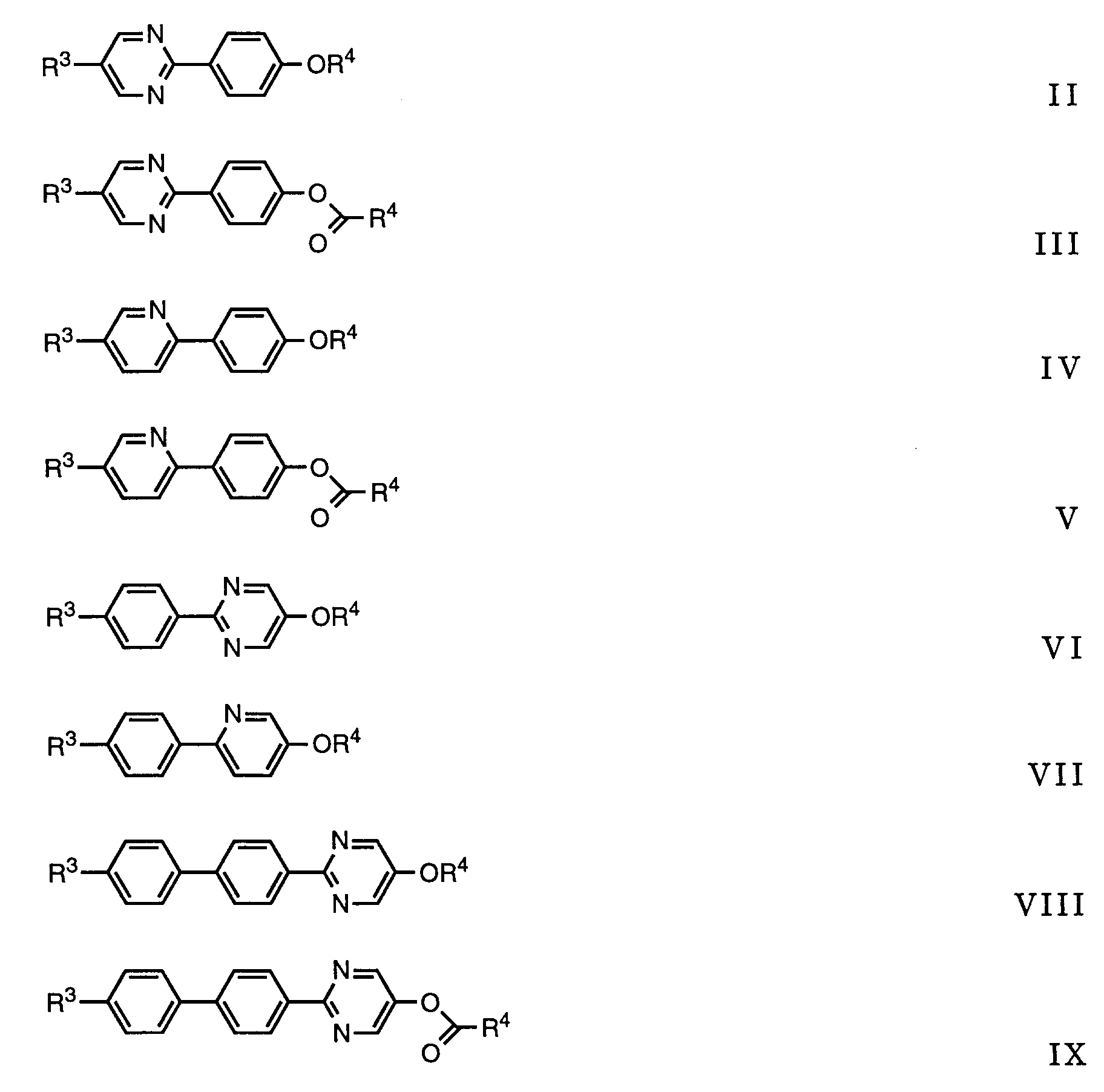
- R3
- Alkyl oder Alkoxy; und
- R4
- Alkyl oder Alkenyl bedeuten.
- Der Ausdruck "Alkyl" im Zusammenhang mit den Verbindungen der Formeln II bis XIII umfasst geradkettige oder verzweigte Alkylgruppen mit 1 bis 12 Kohlenstoffatomen, vorzugsweise geradkettige Alkylgruppen mit 6 bis 12 Kohlenstoffatomen, wie Hexyl, Heptyl, Octyl, Nonyl, Decyl, Undecyl, Dodecyl.
- Der Ausdruck "Alkoxy" umfasst Ethergruppen in denen der Alkylrest wie vorhergehend definiert ist.
- Der Ausdruck "Alkenyl" umfasst im Zusammenhang mit den Verbindungen der Formeln II-XIII Alkenylgruppen mit 3 bis 15 Kohlenstoffatomen, wie 2E-Alkenyl, 3Z-Alkenyl, 4E-Alkenyl und Alkenyl mit endständiger Doppelbindung. Die Ausdrücke "2E-Alkenyl", "3Z-Alkenyl" und 4E-Alkenyl" umfassen vorzugsweise geradkettige Alkenylgruppen mit 3 bis 9, 4 bis 9 bzw. 5 bis 9 Kohlenstoffatomen, in welchen die Doppelbindung in 2, 3 bzw. 4 Stellung steht, wobei E und Z die Konfiguration der Doppelbindung bezeichnen. Solche Gruppen sind beispielsweise 2E-Butenyl, 2E-Pentenyl, 2E-Hexenyl, 2E-Heptenyl, 2E-Octenyl, 2E-Nonenyl, 3-Butenyl, 3Z-Pentenyl, 3Z-Hexenyl, 3Z-Heptenyl, 3Z-Octenyl, 3Z-Nonenyl, 4-Pentenyl, 4E-Hexenyl, 4E-Heptenyl, 4E-Octenyl, 4E-Nonenyl, 5-Hexenyl, 6-Heptenyl, 7-Octenyl, 8-Nonenyl und dergleichen.
- Aufgrund der guten Löslichkeit der Verbindungen der Formel I und aufgrund ihrer guten Mischbarkeit untereinander kann der Anteil an Verbindungen der Formel I in den erfindungsgemässen Gemischen relativ hoch sein und bis etwa 85 Gew.-% betragen. Bevorzugt wird im allgemeinen ein Anteil von etwa 1-50, insbesondere 5-30 Gew.-% an Verbindungen der Formel I.
- Die Herstellung der flüssigkristallinen Gemische und der elektrooptischen Vorrichtungen kann in an sich bekannter Weise erfolgen.
- Die Erfindung wird durch die folgenden Beispiele weiter veranschaulicht. In den Beispielen bedeutet C eine kristalline, N eine nematische, Ch eine chiral nematische, S eine smektische und I die isotrope Phase; ausserdem werden folgende Abkürzungen verwendet:
- DME
- Dimethoxyethan
- TPP
- Triphenylphosphin.
- Eine Suspension von 0,40 g 5-(4-Hydroxybutyloxy)-2-(4-nonylphenyl)-pyrimidin und 0,76 g 4-Toluol-sulfonsäure-propylester in 25 ml 1,2-Dimethoxyethan (DME) wurde unter Stickstoffbegasung bei 0°C innert 5 Minuten mit 0,36 g Kalium-tert.-butylat versetzt. Das Reaktionsgemisch wurde über Nacht bei Raumtemperatur gerührt, auf 50 ml Wasser gegossen und dann dreimal mit je 50 ml Ethylacetat extrahiert. Die organischen Phasen wurden vereinigt, zweimal mit konzentrierter Kochsalz-Lösung gewaschen, über Magnesiumsulfat getrocknet, filtriert und das Filtrat eingeengt. Chromatographie des Rückstands an Kieselgel mit Hexan/Ethylacetat (Vol. 9:1) und Umkristallisation aus Ethylalkohol ergab 0,18 g reines 5-(4-[Propyloxy]butyloxy)-2-(4-nonylphenyl)pyrimidin; Smp. (C-SC) 37°C, Phasenübergang (SC-SA) 45°C, Klp. (SA-I) 58°C.
- Das als Ausgangsmaterial verwendete 5-(4-Hydroxybutyloxy)-2-(4-nonylphenyl)pyrimidin wurde wie folgt hergestellt:
- a) Eine Lösung von 1,5 g 5-Hydroxy-2-(4-nonylphenyl)pyrimidin und 2,7 g 4-Chlor-1-butanol in 25 ml Ethylmethylketon wurde mit 2,8 g fein pulverisiertem Kaliumcarbonat versetzt und das Gemisch über Nacht unter leichtem Rückfluss erwärmt. Die Suspension wurde filtriert, und das Filtrat im Vakuum eingeengt. Chromatographie des Rückstands an Kieselgel mit Hexan/Ethylacetat (Vol. 1:1) und Umkristallisation aus Ethylalkohol ergab 0,7 g 5-(4-Hydroxybutyloxy)-2-(4-nonylphenyl)pyrimidin mit Schmelzpunkt 99°C.
- In analoger Weise können folgende Verbindungen hergestellt werden:
5-(4-[Methoxy]butyloxy)-2-(4-hexylphenyl)pyrimidin;
5-(4-[Ethoxy]butyloxy)-2-(4-hexylphenyl)pyrimidin;
5-(4-[Propyloxy]butyloxy)-2-(4-hexylphenyl)pyrimidin;
5-(4-[Butyloxy]butyloxy)-2-(4-hexylphenyl)pyrimidin;
5-(4-[Pentyloxy]butyloxy)-2-(4-hexylphenyl)pyrimidin;
5-(4-[Hexyloxy]butyloxy)-2-(4-hexylphenyl)pyrimidin;
5-(4-[Methoxy]butyloxy)-2-(4-heptylphenyl)pyrimidin;
5-(4-[Ethoxy]butyloxy)-2-(4-heptylphenyl)pyrimidin;
5-(4-[Propyloxy]butyloxy)-2-(4-heptylphenyl)pyrimidin;
5-(4-[Butyloxy]butyloxy)-2-(4-heptylphenyl)pyrimidin;
5-(4-[Pentyloxy]butyloxy)-2-(4-heptylphenyl)pyrimidin;
5-(4-[Hexyloxy]butyloxy)-2-(4-heptylphenyl)pyrimidin;
5-(4-[Methoxy]butyloxy)-2-(4-octylphenyl)pyrimidin;
5-(4-[Ethoxy]butyloxy)-2-(4-octylphenyl)pyrimidin;
5-(4-[Propyloxy]butyloxy)-5-(4-octylphenyl)pyrimidin;
5-(4-[Butyloxy]butyloxy)-2-(4-octylphenyl)pyrimidin;
5-(4-[Pentyloxy]butyloxy)-2-(4-octylphenyl)pyrimidin;
5-(4-[Hexyloxy]butyloxy)-2-(4-octylphenyl)pyrimidin;
5-(4-[Methoxy]butyloxy)-2-(4-nonylphenyl)pyrimidin;
5-(4-[Ethoxy]butyloxy)-2-(4-nonylphenyl)pyrimidin;
5-(4-[Butyloxy]butyloxy)-2-(4-nonylphenyl)pyrimidin;
5-(4-[Pentyloxy]butyloxy)-2-(4-nonylphenyl)pyrimidin;
5-(4-[Hexyloxy]butyloxy)-2-(4-nonylphenyl)pyrimidin;
5-(2-[Pentyloxy]ethoxy)-2-(4-nonylphenyl)pyrimidin, Smp. (C-I) 52°C, Klp. (SC-I) 41°C;
5-(3-[Butyloxy]propyloxy)-2-(4-nonylphenyl)pyrimidin, Smp. (C-SA) 22°C, Klp. (SA-I) 32°C;
5-(5-[Ethoxy]pentyloxy)-2-(4-nonylphenyl)pyrimidin, Smp. (C-SA) 53°C, Klp. (SA-I) 59°C;
5-(6-[Methoxy]hexyloxy)-2-(4-nonylphenyl)pyrimidin, Smp. (C-SA) 55°C, Klp. (SA-I) 76°C;
2-(4-Hexylphenyl)-5-(2-[pentyloxy]ethoxy)pyridin;
2-(4-Hexylphenyl)-5-(3-[butyloxy]propyloxy)pyridin;
2-(4-Hexylphenyl)-5-(4-[propyloxy]butoxy)pyridin;
2-(4-Hexylphenyl)-5-(5-[ethoxy]pentyloxy)pyridin;
2-(4-Hexylphenyl)-5-(6-[methoxy]hexyloxy)pyridin;
2-(4-Heptylphenyl)-5-(2-[pentyloxy]ethoxy)pyridin;
2-(4-Heptylphenyl)-5-(3-[butyloxy]propyloxy)pyridin;
2-(4-Heptylphenyl)-5-(4-[propyloxy]butoxy)pyridin;
2-(4-Heptylphenyl)-5-(5-[ethoxy]pentyloxy)pyridin;
2-(4-Heptylphenyl)-5-(6-[methoxy]hexyloxy)pyridin;
2-(4-Octylphenyl)-5-(2-[pentyloxy]ethoxy)pyridin;
2-(4-Octylphenyl)-5-(3-[butyloxy]propyloxy)pyridin;
2-(4-Octylphenyl)-5-(4-[propyloxy]butoxy)pyridin;
2-(4-Octylphenyl)-5-(5-[ethoxy]pentyloxy)pyridin;
2-(4-Octylphenyl)-5-(6-[methoxy]hexyloxy)pyridin;
2-(4-Nonylphenyl)-5-(2-[pentyloxy]ethoxy)pyridin;
2-(4-Nonylphenyl)-5-(3-[butyloxy]propyloxy)pyridin;
2-(4-Nonylphenyl)-5-(4-[propyloxy]butoxy)pyridin;
2-(4-Nonylphenyl)-5-(5-[ethoxy]pentyloxy)pyridin;
2-(4-Nonylphenyl)-5-(6-[methoxy]hexyloxy)pyridin;
2-(4-Hexylphenyl)-5-(2-[hexyloxy]ethoxy)pyridin;
2-(4-Hexylphenyl)-5-(2-[heptyloxy]ethoxy)pyridin;
2-(4-Hexylphenyl)-5-(2-[octyloxy]ethoxy)pyridin;
2-(4-Heptylphenyl)-5-(2-[hexyloxy]ethoxy)pyridin;
2-(4-Heptylphenyl)-5-(2-[heptyloxy]ethoxy)pyridin;
2-(4-Heptylphenyl)-5-(2-[octyloxy]ethoxy)pyridin;
2-(4-Octylphenyl)-5-(2-[hexyloxy]ethoxy)pyridin;
2-(4-Octylphenyl)-5-(2-[heptyloxy]ethoxy)pyridin;
2-(4-Octylphenyl)-5-(2-[octyloxy]ethoxy)pyridin;
2-(4-Nonylphenyl)-5-(2-[hexyloxy]ethoxy)pyridin;
2-(4-Nonylphenyl)-5-(2-[heptyloxy]ethoxy)pyridin;
2-(4-Nonylphenyl)-5-(2-[octyloxy]ethoxy)pyridin;
2-(4-Hexylphenyl)-5-(4-[butyloxy]butyloxy)pyridin;
2-(4-Hexylphenyl)-5-(4-[pentyloxy]butyloxy)pyridin;
2-(4-Hexylphenyl)-5-(4-[hexyloxy]butyloxy)pyridin;
2-(4-Heptylphenyl)-5-(4-[butyloxy]butyloxy)pyridin;
2-(4-Heptylphenyl)-5-(4-[pentyloxy]butyloxy)pyridin;
2-(4-Heptylphenyl)-5-(4-[hexyloxy]butyloxy)pyridin;
2-(4-Octylphenyl)-5-(4-[butyloxy]butyloxy)pyridin;
2-(4-Octylphenyl)-5-(4-[pentyloxy]butyloxy)pyridin;
2-(4-Octylphenyl)-5-(4-[hexyloxy]butyloxy)pyridin;
2-(4-Nonylphenyl)-5-(4-[butyloxy]butyloxy)pyridin;
2-(4-Nonylphenyl)-5-(4-[pentyloxy]butyloxy)pyridin;
2-(4-Nonylphenyl)-5-(4-[hexyloxy]butyloxy)pyridin;
5-Hexyl-2-(4-[2-(pentyloxy)ethoxy]phenyl)pyridin;
5-Hexyl-2-(4-[3-(butyloxy)propyloxy]phenyl)pyridin;
5-Hexyl-2-(4-[4-(propyloxy)butoxy]phenyl)pyridin;
5-Hexyl-2-(4-[5-(ethoxy)pentyloxy]phenyl)pyridin;
5-Hexyl-2-(4-[6-(methoxy)hexyloxy]phenyl)pyridin;
5-Heptyl-2-(4-[2-(pentyloxy)ethoxy]phenyl)pyridin;
5-Heptyl-2-(4-[3-(butyloxy)propyloxy]phenyl)pyridin;
5-Heptyl-2-(4-[4-(propyloxy)butoxy]phenyl)pyridin;
5-Heptyl-2-(4-[5-(ethoxy)pentyloxy]phenyl)pyridin;
5-Heptyl-2-(4-[6-(methoxy)hexyloxy]phenyl)pyridin;
5-Octyl-2-(4-[2-(pentyloxy)ethoxy]phenyl)pyridin;
5-Octyl-2-(4-[3-(butyloxy)propyloxy]phenyl)pyridin;
5-Octyl-2-(4-[4-(propyloxy)butoxy]phenyl)pyridin, Smp. (C-S4) 9°C, S4-S3 12°C, S3-S2 16°C, S2-SC 53°C, Klp. (SC-I) 60°C;
5-Octyl-2-(4-[5-(ethoxy)pentyloxy]phenyl)pyridin;
5-Octyl-2-(4-[6-(methoxy)hexyloxy]phenyl)pyridin;
5-Nonyl-2-(4-[2-(pentyloxy)ethoxy]phenyl)pyridin;
5-Nonyl-2-(4-[3-(butyloxy)propyloxy]phenyl)pyridin;
5-Nonyl-2-(4-[5-(ethoxy)pentyloxy]phenyl)pyridin;
5-Nonyl-2-(4-[6-(methoxy)hexyloxy]phenyl)pyridin;
5-Hexyl-2-(4-[2-(butyloxy)ethoxy]phenyl)pyridin;
5-Hexyl-2-(4-[2-(pentyloxy)ethoxy]phenyl)pyridin;
5-Hexyl-2-(4-[2-(hexyloxy)ethoxy]phenyl)pyridin;
5-Hexyl-2-(4-[2-(heptyloxy)ethoxy]phenyl)pyridin;
5-Hexyl-2-(4-[2-(octyloxy)ethoxy]phenyl)pyridin;
5-Heptyl-2-(4-[2-(butyloxy)ethoxy]phenyl)pyridin;
5-Heptyl-2-(4-[2-(pentyloxy)ethoxy]phenyl)pyridin;
5-Heptyl-2-(4-[2-(hexyloxy)ethoxy]phenyl)pyridin;
5-Heptyl-2-(4-[2-(heptyloxy)ethoxy]phenyl)pyridin;
5-Heptyl-2-(4-[2-(octyloxy)ethoxy]phenyl)pyridin;
5-Octyl-2-(4-[2-(butyloxy)ethoxy]phenyl)pyridin;
5-Octyl-2-(4-[2-(pentyloxy)ethoxy]phenyl)pyridin;
5-Octyl-2-(4-[2-(hexyloxy)ethoxy]phenyl)pyridin;
5-Octyl-2-(4-[2-(heptyloxy)ethoxy]phenyl)pyridin;
5-Octyl-2-(4-[2-(octyloxy)ethoxy]phenyl)pyridin;
5-Nonyl-2-(4-[2-(butyloxy)ethoxy]phenyl)pyridin;
5-Nonyl-2-(4-[2-(pentyloxy)ethoxy]phenyl)pyridin;
5-Nonyl-2-(4-[2-(hexyloxy)ethoxy]phenyl)pyridin;
5-Nonyl-2-(4-[2-(heptyloxy)ethoxy]phenyl)pyridin;
5-Nonyl-2-(4-[2-(octyloxy)ethoxy]phenyl)pyridin;
5-Hexyl-2-(4-[4-(butyloxy)butoxy]phenyl)pyridin;
5-Hexyl-2-(4-[4-(pentyloxy)butoxy]phenyl)pyridin;
5-Hexyl-2-(4-[4-(hexyloxy)butoxy]phenyl)pyridin;
5-Heptyl-2-(4-[4-(butyloxy)butoxy]phenyl)pyridin;
5-Heptyl-2-(4-[4-(pentyloxy)butoxy]phenyl)pyridin;
5-Heptyl-2-(4-[4-(hexyloxy)butoxy]phenyl)pyridin;
5-Octyl-2-(4-[4-(butyloxy)butoxy]phenyl)pyridin;
5-Octyl-2-(4-[4-(pentyloxy)butoxy]phenyl)pyridin;
5-Octyl-2-(4-[4-(hexyloxy)butoxy]phenyl)pyridin;
5-Nonyl-2-(4-[4-(butyloxy)butoxy]phenyl)pyridin;
5-Nonyl-2-(4-[4-(pentyloxy)butoxy]phenyl)pyridin;
5-Nonyl-2-(4-[4-(hexyloxy)butoxy]phenyl)pyridin;
5-(4-[Methoxy]butyloxy)-2-(4-pentyl-4'-biphenyl)pyrimidin;
5-(4-[Ethoxy]butyloxy)-2-(4-pentyl-4'-biphenyl)pyrimidin;
5-(4-[Propoxy]butyloxy)-2-(4-pentyl-4'-biphenyl)pyrimidin;
5-(4-[Butyloxy]butyloxy)-2-(4-pentyl-4'-biphenyl)pyrimidin;
5-Pentyl-2-(4-(4-[Methoxy]butyloxy)-4'-biphenyl)pyrimidin;
5-Pentyl-2-(4-(4-[Ethoxy]butyloxy)-4'-biphenyl)pyrimidin;
5-Pentyl-2-(4-(4-[Propyloxy]butyloxy)-4'-biphenyl)pyrimidin;
5-Pentyl-2-(4-(4-[Butyloxy]butyloxy)-4'-biphenyl)pyrimidin;
5-(4-Pentylphenyl)-2-(4-[4-(methoxy)butyloxy]phenyl)pyrimidin;
5-(4-Pentylphenyl)-2-(4-[4-(ethoxy)butyloxy]phenyl)pyrimidin;
5-(4-Pentylphenyl)-2-(4-[4-(propyloxy)butyloxy]phenyl)pyrimidin;
5-(4-Pentylphenyl)-2-(4-[4-(butyloxy)butyloxy]phenyl)pyrimidin;
2-(4-Pentylphenyl)-5-(4-[4-(Methoxy)butyloxy]phenyl)pyrimidin;
2-(4-Pentylphenyl)-5-(4-[4-(ethoxy)butyloxy]phenyl)pyrimidin;
2-(4-Pentylphenyl)-5-(4-[4-(propyloxy)butyloxy]phenyl)pyrimidin;
2-(4-Pentylphenyl)-5-(4-[4-(butyloxy)butyloxy]phenyl)pyrimidin;
5-(4-Pentylphenyl)-2-(4-[4-(butyloxy)butyloxy]phenyl)pyridin;
2-(4-Pentylphenyl)-5-(4-[4-(butyloxy)butyloxy]phenyl)pyridin;
5-Pentyl-2-(4-(4-[Butyloxy]butyloxy)-4'-biphenyl)pyridin;
5-(4-[Butyloxy]butyloxy)-2-(4-pentyl-4'-biphenyl)pyridin. - Eine Lösung von 0,2 g 4-(5-[4-(Propyloxy)butyloxy]pyrimidin-2-yl)phenol und 0,15 g 1-Bromoctan in 25 ml Ethylmethylketon wurde mit 0,4 g fein pulverisiertem Kaliumcarbonat versetzt und das Gemisch über Nacht unter leichtem Rückfluss erwärmt. Die Suspension wurde filtriert, und das Filtrat im Vakuum eingeengt. Chromatographie des Rückstands an Kieselgel mit Hexan/Ethylacetat (Vol. 9:1) ergibt 0,14 g 2-(4-Octyloxyphenyl)-5-(4-[propyloxy]butyloxy)pyrimidin; Smp. (C-N) 76°C, Phasenübergang (SC-N) 70°C, Klp. (N-I) 77°C.
- Das als Ausgangsmaterial verwendete 4-(5-[4-(Propyloxy)butyloxy]-pyrimidin-2-yl)phenol wurde wie folgt hergestellt:
- a) Eine Lösung von 5,0 g 5-Hydroxy-2-(4-Benzyloxyphenyl)pyrimidin und 2,3 g 4-Chlor-1-butanol in 100 ml Ethylmethylketon wurde mit 9,9 g fein pulverisiertem Kaliumcarbonat versetzt und das Gemisch über Nacht unter leichtem Rückfluss erwärmt. Die Suspension wurde filtriert, und das Filtrat im Vakuum eingeengt. Chromatographie des Rückstands an Kieselgel mit Hexan/Ethylacetat (Vol. 1:1) ergab 1,6 g 2-(4-Benzyloxyphenyl)-5-(4-hydroxybutyloxy)pyrimidin mit Smp. 114°C.
- b) Eine Suspension von 1,2 g 2-(4-Benzyloxyphenyl)-5-(4-hydroxybutyloxy)-pyrimidin und 2,4 g 4-Toluol-sulfonsäure-propylester in 25 ml 1,2-Dimethoxyethan wurde unter Stickstoffbegasung bei 0°C innert 5 Minuten mit 1,2 g Kalium-tert.-butylat versetzt. Das Reaktionsgemisch wurde über Nacht bei Raumtemperatur gerührt, auf 50 ml Wasser gegossen und dann dreimal mit je 50 ml Ethylacetat extrahiert. Die organischen Phasen wurden vereinigt, zweimal mit konzentrierter Kochsalz-Lösung gewaschen, über Magnesiumsulfat getrocknet, filtriert und das Filtrat eingeengt. Chromatographie des Rückstands an Kieselgel mit Hexan/Ethylacetat (Vol. 1:1) und Umkristallisation aus Ethylacetat ergab 0,8 g reines 2-(4-Benzyloxyphenyl)-5-(4-[propyloxy]butyloxy)pyrimidin mit Smp. 115°C.
- c) Ein Gemisch aus 0,8 g 2-(4-Benzyloxyphenyl)-5-(4-propyloxybutyloxy)-pyrimidin, 2 Tropfen Essigsäure und 50 ml Ethylacetat wurde mit 0,3 g Palladium auf Aktivkohle (10%) versetzt und bei Normaldruck und Raumtemperatur bis zum Stillstand der Wasserstoffaufnahme hydriert. Das anorganische Material wurde über Sillit filtriert und das Filtrat eingeengt. Umkristallisation des Rohproduktes aus Hexan ergab 0,6 g reines 4-(5-[4-(Propyloxy)butyloxy]pyrimidin-2-yl)phenol mit Smp. 103°C.
- In analoger Weise können folgende Verbindungen hergestellt werden:
2-(4-[Hexyloxy]phenyl)-5-(4-propyloxybutyloxy)pyrimidin;
2-(4-[Heptyloxy]phenyl)-5-(4-propyloxybutyloxy)pyrimidin;
2-(4-[Nonyloxy]phenyl)-5-(4-propyloxybutyloxy)pyrimidin, Smp. (C-SC) 67°C, SC-N 70°C, Klp. (N-I) 77°C;
2-(4-[Decyloxy]phenyl)-5-(4-[propyloxy]butyloxy)pyrimidin, Smp. (C-N) 72°C, SC-N, 71°C, Klp. (N-I) 78°C;
2-(4-[Undecyloxy]phenyl)-5-(4-[propyloxy]butyloxy)pyrimidin, Smp. (C-SC) 64°C, SC-N, 72°C, Klp. (N-I) 76°C;
2-(4-[Dodecyloxy]phenyl)-5-(4-[propyloxy]butyloxy)pyrimidin, Smp. (C-SC) 70°C, SC-N, 72°C, Klp. (N-I) 77°C;
2-(4-[Hexyloxy]phenyl)-5-(4-[butyloxy]butyloxy)pyrimidin;
2-(4-[Heptyloxy]phenyl)-5-(4-[butyloxy]butyloxy)pyrimidin;
2-(4-[Nonyloxy]phenyl)-5-(4-[butyloxy]butyloxy)pyrimidin;
2-(4-[Decyloxy]phenyl)-5-(4-[butyloxy]butyloxy)pyrimidin;
2-(4-[Undecyloxy]phenyl)-5-(4-[butyloxy]butyloxy)pyrimidin;
2-(4-[Dodecyloxy]phenyl)-5-(4-[butyloxy]butyloxy)pyrimidin;
2-(4-[Hexyloxy]phenyl)-5-(4-[pentyloxy]butyloxy)pyrimidin;
2-(4-[Heptyloxy]phenyl)-5-(4-[pentyloxy]butyloxy)pyrimidin;
2-(4-[Nonyloxy]phenyl)-5-(4-[pentyloxy]butyloxy)pyrimidin;
2-(4-[Decyloxy]phenyl)-5-(4-[pentyloxy]butyloxy)pyrimidin;
2-(4-[Undecyloxy]phenyl)-5-(4-[pentyloxy]butyloxy)pyrimidin;
2-(4-[Dodecyloxy]phenyl)-5-(4-[pentyloxy]butyloxy)pyrimidin;
2-(4-[Hexyloxy]phenyl)-5-(4-[hexyloxy]butyloxy)pyrimidin;
2-(4-[Heptyloxy]phenyl)-5-(4-[hexyloxy]butyloxy)pyrimidin;
2-(4-[Nonyloxy]phenyl)-5-(4-[hexyloxy]butyloxy)pyrimidin;
2-(4-[Decyloxy]phenyl)-5-(4-[hexyloxy]butyloxy)pyrimidin;
2-(4-[Undecyloxy]phenyl)-5-(4-[hexyloxy]butyloxy)pyrimidin;
2-(4-[Dodecyloxy]phenyl)-5-(4-[hexyloxy]butyloxy)pyrimidin;
2-(4-[Hexyloxy]phenyl)-5-(2-[pentyloxy]ethoxy)pyrimidin;
2-(4-[Heptyloxy]phenyl)-5-(2-[pentyloxy]ethoxy)pyrimidin;
2-(4-[Octyloxy]phenyl)-5-(2-[pentyloxy]ethoxy)pyrimidin;
2-(4-[Nonyloxy]phenyl)-5-(2-[pentyloxy]ethoxy)pyrimidin;
2-(4-[Decyloxy]phenyl)-5-(2-[pentyloxy]ethoxy)pyrimidin;
2-(4-[Undecyloxy]phenyl)-5-(2-[pentyloxy]ethoxy)pyrimidin;
2-(4-[Dodecyloxy]phenyl)-5-(2-[pentyloxy]ethoxy)pyrimidin;
2-(4-[Hexyloxy]phenyl)-5-(2-[hexyloxy]ethoxy)pyrimidin;
2-(4-[Heptyloxy]phenyl)-5-(2-[hexyloxy]ethoxy)pyrimidin;
2-(4-[Octyloxy]phenyl)-5-(2-[hexyloxy]ethoxy)pyrimidin;
2-(4-[Nonyloxy]phenyl)-5-(2-[hexyloxy]ethoxy)pyrimidin;
2-(4-[Decyloxy]phenyl)-5-(2-[hexyloxy]ethoxy)pyrimidin;
2-(4-[Undecyloxy]phenyl)-5-(2-[hexyloxy]ethoxy)pyrimidin;
2-(4-[Dodecyloxy]phenyl)-5-(2-[hexyloxy]ethoxy)pyrimidin;
2-(4-[Hexyloxy]phenyl)-5-(2-[heptyloxy]ethoxy)pyrimidin;
2-(4-[Heptyloxy]phenyl)-5-(2-[heptyloxy]ethoxy)pyrimidin;
2-(4-[Octyloxy]phenyl)-5-(2-[heptyloxy]ethoxy)pyrimidin;
2-(4-[Nonyloxy]phenyl)-5-(2-[heptyloxy]ethoxy)pyrimidin;
2-(4-[Decyloxy]phenyl)-5-(2-[heptyloxy]ethoxy)pyrimidin;
2-(4-[Undecyloxy]phenyl)-5-(2-[heptyloxy]ethoxy)pyrimidin;
2-(4-[Dodecyloxy]phenyl)-5-(2-[heptyloxy]ethoxy)pyrimidin;
2-(4-[Hexyloxy]phenyl)-5-(6-[methoxy]hexyloxy)pyrimidin;
2-(4-[Heptyloxy]phenyl)-5-(6-[methoxy]hexyloxy)pyrimidin;
2-(4-[Octyloxy]phenyl)-5-(6-[methoxy]hexyloxy)pyrimidin;
2-(4-[Nonyloxy]phenyl)-5-(6-[methoxy]hexyloxy)pyrimidin;
2-(4-[Decyloxy]phenyl)-5-(6-[methoxy]hexyloxy)pyrimidin;
2-(4-[Undecyloxy]phenyl)-5-(6-[methoxy]hexyloxy)pyrimidin;
2-(4-[Dodecyloxy]phenyl)-5-(6-[methoxy]hexyloxy)pyrimidin;
2-(4-[Hexyloxy]phenyl)-5-(6-[ethoxy]hexyloxy)pyrimidin;
2-(4-[Heptyloxy]phenyl)-5-(6-[ethoxy]hexyloxy)pyrimidin;
2-(4-[Octyloxy]phenyl)-5-(6-[ethoxy]hexyloxy)pyrimidin;
2-(4-[Nonyloxy]phenyl)-5-(6-[ethoxy]hexyloxy)pyrimidin;
2-(4-[Decyloxy]phenyl)-5-(6-[ethoxy]hexyloxy)pyrimidin;
2-(4-[Undecyloxy]phenyl)-5-(6-[ethoxy]hexyloxy)pyrimidin;
2-(4-[Dodecyloxy]phenyl)-5-(6-[ethoxy]hexyloxy)pyrimidin;
2-(4-[Hexyloxy]phenyl)-5-(6-[propyloxy]hexyloxy)pyrimidin;
2-(4-[Heptyloxy]phenyl)-5-(6-[propyloxy]hexyloxy)pyrimidin;
2-(4-[Octyloxy]phenyl)-5-(6-[propyloxy]hexyloxy)pyrimidin;
2-(4-[Nonyloxy]phenyl)-5-(6-[propyloxy]hexyloxy)pyrimidin;
2-(4-[Decyloxy]phenyl)-5-(6-[propyloxy]hexyloxy)pyrimidin;
2-(4-[Undecyloxy]phenyl)-5-(6-[propyloxy]hexyloxy)pyrimidin;
2-(4-[Dodecyloxy]phenyl)-5-(6-[propyloxy]hexyloxy)pyrimidin;
2-(4-[Hexyloxy]phenyl)-5-(6-[butyloxy]hexyloxy)pyrimidin;
2-(4-[Heptyloxy]phenyl)-5-(6-[butyloxy]hexyloxy)pyrimidin;
2-(4-[Octyloxy]phenyl)-5-(6-[butyloxy]hexyloxy)pyrimidin;
2-(4-[Nonyloxy]phenyl)-5-(6-[butyloxy]hexyloxy)pyrimidin;
2-(4-[Decyloxylphenyl)-5-(6-[butyloxy]hexyloxy)pyrimidin;
2-(4-[Undecyloxy]phenyl)-5-(6-[butyloxy]hexyloxy)pyrimidin;
2-(4-[Dodecyloxy]phenyl)-5-(6-[butyloxy]hexyloxy)pyrimidin. - Eine Suspension von 0,1 g 2-(4-[4-Hydroxybutyloxy]phenyl)-5-(4-[propyloxy]butyloxy)pyrimidin und 0,19 g 4-Toluol-sulfonsäure-propylester in 25 ml 1, 2-Dimethoxyethan wurde unter Stickstoffbegasung bei 0°C innert 5 Minuten mit 0,09 g Kalium-tert.-butylat versetzt. Das Reaktionsgemisch wurde über Nacht bei Raumtemperatur gerührt, auf 50 ml Wasser gegossen und dann dreimal mit je 50 ml Ethylacetat extrahiert. Die organischen Phasen wurden vereinigt, zweimal mit konzentrierter Kochsalz-Lösung gewaschen, über Magnesiumsulfat getrocknet, filtriert und das Filtrat eingeengt. Chromatographie des Rückstands an Kieselgel mit Hexan/Ethylacetat (Vol. 9:1) und Umkristallisation aus Ethylalkohol ergab 0,04 g reines 2-(4-[(Propyloxy)butyloxy]phenyl)-5-(4-[propyloxy]butyloxy)pyrimidin; Smp. (C-I) 82°C.
- Das als Ausgangsmaterial verwendete 2-(4-[4-Hydroxybutyloxy]phenyl)-5-(4-[propyloxy]butyloxy)pyrimidin wurde wie folgt hergestellt:
- a) Eine Lösung von 0,2 g 4-(5-[4-(Propyloxy)butyloxy]pyrimidin-2-yl)phenol und 0,36 g 4-Chlor-1-butanol in 25 ml Ethylmethylketon wurde mit 0,37 g fein pulverisiertem Kaliumcarbonat versetzt und das Gemisch über Nacht unter leichtem Rückfluss erwärmt. Die Suspension wurde filtriert, und das Filtrat im Vakuum eingeengt. Chromatographie des Rückstands an Kieselgel mit Hexan/Ethylacetat (Vol. 1:1) und Umkristallisation aus Ethylalkohol ergab 0,1 g 2-(4-[4-Hydroxybutyloxy]phenyl)-5-(4-[propyloxy]butyloxy)pyrimidin.
- In analoger Weise können folgende Verbindungen hergestellt werden:
2-(4-[(Pentyloxy)butyloxy]phenyl)-5-(4-[propyloxy]butyloxy)pyrimidin;
2-(4-[(Heptyloxy)butyloxy]phenyl)-5-(4-[propyloxy]butyloxy)pyrimidin;
2-(4-[(Nonyloxy)butyloxy]phenyl)-5-(4-[propyloxy]butyloxy)pyrimidin;
2-(4-[(Propyloxy)butyloxy]phenyl)-5-(4-[pentyloxy]butyloxy)pyrimidin;
2-(4-[(Propyloxy)butyloxy]phenyl)-5-(4-[heptyloxy]butyloxy)pyrimidin;
2-(4-[(Propyloxy)butyloxy]phenyl)-5-(4-[nonyloxy]butyloxy)pyrimidin;
2-(6-[(Methoxy)hexyloxy]phenyl)-5-(4-[propyloxy]butyloxy)pyrimidin;
2-(6-[(Ethoxy)hexyloxy]phenyl)-5-(4-[propyloxy]butyloxy)pyrimidin;
2-(6-[(Propyloxy)hexyloxy]phenyl)-5-(4-[propyloxy]butyloxy)pyrimidin;
2-(6-[(Butyloxy)hexyloxy]phenyl)-5-(4-[propyloxy]butyloxy)pyrimidin;
2-(4-[(Propyloxy)butyloxy]phenyl)-5-(6-[methoxy]hexyloxy)pyrimidin;
2-(4-[(Propyloxy)butyloxy]phenyl)-5-(6-[ethoxy]hexyloxy)pyrimidin;
2-(4-[(Propyloxy)butyloxy]phenyl)-5-(6-[propyloxy]hexyloxy)pyrimidin;
2-(4-[(Propyloxy)butyloxy]phenyl)-5-(6-[butyloxy]hexyloxy)pyrimidin;
2-(2-[(Propyloxy)ethoxy]phenyl)-5-(2-[propyloxy]ethoxy)pyrimidin;
2-(2-[(Butyloxy)ethoxy]phenyl)-5-(2-[butyloxy]ethoxy)pyrimidin;
2-(2-[(Pentyloxy)ethoxy]phenyl)-5-(2-[pentyloxy]ethoxy)pyrimidin;
2-(2-[(Hexyloxy)ethoxy]phenyl)-5-(2-[hexyloxy]ethoxy)pyrimidin;
2-(2-[(Heptyloxy)ethoxy]phenyl)-5-(2-[heptyloxy]ethoxy)pyrimidin;
2-(2-[(Octyloxy)ethoxy]phenyl)-5-(2-[octyloxy]ethoxy)pyrimidin;
2-(6-[(Methoxy)hexyloxy]phenyl)-5-(6-[methoxy]hexyloxy)pyrimidin;
2-(6-[(Ethoxy)hexyloxy]phenyl)-5-(6-[ethoxy]hexyloxy)pyrimidin;
2-(6-[(Propyloxy)hexyloxy]phenyl)-5-(6-[propyloxy]hexyloxy)pyrimidin;
2-(6-[(Butyloxy)hexyloxy]phenyl)-5-(6-[butyloxy]hexyloxy)pyrimidin. - Zu einer Lösung von 0,2 g 4-(5-[4-(Propyloxy)butyloxy] pyrimidin-2-yl)phenol, 0,1 g Octansäure und 0,05 g 4-(Dimethylamino)pyridin in 25 ml Dichlormethan wurde unter Rühren innert 5 Minuten 0,16 g N,N'-Dicyclohexylcarbodiimid gegeben. Das Reaktionsgemisch wurde über Nacht weiter gerührt, filtriert und dann eingeengt. Chromatographie des Rückstandes an Kieselgel mit Hexan/Ethylacetat (Vol. 9:1) und Umkristallisation der gemäss Dünnschichtchromatographie reinen Fraktionen aus Ethylalkohol ergab 0,08 g 4-(5-[4-(Propyloxy)butyloxy]-pyrimidin-2-yl)phenyl-octanoat; Smp. (C-N) 62°C, Phasenübergang (SC-N) 61°C, Klp. (N-I) 63°C.
- In analoger Weise können folgende Verbindungen hergestellt werden:
4-(5-[4-(Propyloxy)butyloxy]pyrimidin-2-yl)phenyl-hexanoat;
4-(5-[4-(Propyloxy)butyloxy]pyrimidin-2-yl)phenyl-heptanoat;
4-(5-[4-(Propyloxy)butyloxy]pyrimidin-2-yl)phenyl-nonanoat;
4-(5-[4-(Propyloxy)butyloxy]pyrimidin-2-yl)phenyl-decanoat;
4-(5-[4-(Propyloxy)butyloxy]pyrimidin-2-yl)phenyl-undecanoat;
4-(5-[4-(Propyloxy)butyloxy]pyrimidin-2-yl)phenyl-dodecanoat;
4-(5-[4-(Butyloxy)butyloxy]pyrimidin-2-yl)phenyl-hexanoat;
4-(5-[4-(Butyloxy)butyloxy]pyrimidin-2-yl)phenyl-heptanoat;
4-(5-[4-(Butyloxy)butyloxy]pyrimidin-2-yl)phenyl-nonanoat;
4-(5-[4-(Butyloxy)butyloxy]pyrimidin-2-yl)phenyl-decanoat;
4-(5-[4-(Butyloxy)butyloxy]pyrimidin-2-yl)phenyl-undecanoat;
4-(5-[4-(Butyloxy)butyloxy]pyrimidin-2-yl)phenyl-dodecanoat;
4-(5-[4-(Pentyloxy)butyloxy]pyrimidin-2-yl)phenyl-hexanoat;
4-(5-[4-(Pentyloxy)butyloxy]pyrimidin-2-yl)phenyl-heptanoat;
4-(5-[4-(Pentyloxy)butyloxy]pyrimidin-2-yl)phenyl-nonanoat;
4-(5-[4-(Pentyloxy)butyloxy]pyrimidin-2-yl)phenyl-decanoat;
4-(5-[4-(Pentyloxy)butyloxy]pyrimidin-2-yl)phenyl-undecanoat;
4-(5-[4-(Pentyloxy)butyloxy]pyrimidin-2-yl)phenyl-dodecanoat;
4-(5-[4-(Hexyloxy)butyloxy]pyrimidin-2-yl)phenyl-hexanoat;
4-(5-[4-(Hexyloxy)butyloxy]pyrimidin-2-yl)phenyl-heptanoat;
4-(5-[4-(Hexyloxy)butyloxy]pyrimidin-2-yl)phenyl-nonanoat;
4-(5-[4-(Hexyloxy)butyloxy]pyrimidin-2-yl)phenyl-decanoat;
4-(5-[4-(Hexyloxy)butyloxy]pyrimidin-2-yl)phenyl-undecanoat;
4-(5-[4-(Hexyloxy)butyloxy]pyrimidin-2-yl)phenyl-dodecanoat;
4-(5-[4-(Propyloxy)butyloxy]pyrimidin-2-yl)phenyl-(E)-hex-2-enoat;
4-(5-[4-(Propyloxy)butyloxy]pyrimidin-2-yl)phenyl-(E)-hept-2-enoat;
4-(5-[4-(Propyloxy)butyloxy]pyrimidin-2-yl)phenyl-(E)-oct-2-enoat;
4-(5-[4-(Propyloxy)butyloxy]pyrimidin-2-yl)phenyl-(E)-non-2-enoat;
4-(5-[4-(Propyloxy)butyloxy]pyrimidin-2-yl)phenyl-(E)-dec-2-enoat;
4-(5-[4-(Propyloxy)butyloxy]pyrimidin-2-yl)phenyl-(E)-undec-2-enoat;
4-(5-[4-(Propyloxy)butyloxy]pyrimidin-2-yl)phenyl-(E)-dodec-2-enoat;
4-(5-[4-(Butyloxy)butyloxy]pyrimidin-2-yl)phenyl-(E)-hex-2-enoat;
4-(5-[4-(Butyloxy)butyloxy]pyrimidin-2-yl)phenyl-(E)-hept-2-enoat;
4-(5-[4-(Butyloxy)butyloxy]pyrimidin-2-yl)phenyl-(E)-oct-2-enoat;
4-(5-[4-(Butyloxy)butyloxy]pyrimidin-2-yl)phenyl-(E)-non-2-enoat;
4-(5-[4-(Butyloxy)butyloxy]pyrimidin-2-yl)phenyl-(E)-dec-2-enoat;
4-(5-[4-(Butyloxy)butyloxy]pyrimidin-2-yl)phenyl-(E)-undec-2-enoat;
4-(5-[4-(Butyloxy)butyloxy]pyrimidin-2-yl)phenyl-(E)-dodec-2-enoat;
4-(5-[4-(Pentyloxy)butyloxy]pyrimidin-2-yl)phenyl-(E)-hex-2-enoat;
4-(5-[4-(Pentyloxy)butyloxy]pyrimidin-2-yl)phenyl-(E)-hept-2-enoat;
4-(5-[4-(Pentyloxy)butyloxy]pyrimidin-2-yl)phenyl-(E)-oct-2-enoat;
4-(5-[4-(Pentyloxy)butyloxy]pyrimidin-2-yl)phenyl-(E)-non-2-enoat;
4-(5-[4-(Pentyloxy)butyloxy]pyrimidin-2-yl)phenyl-(E)-dec-2-enoat;
4-(5-[4-(Pentyloxy)butyloxy]pyrimidin-2-yl)phenyl-(E)-undec-2-enoat;
4-(5-[4-(Pentyloxy)butyloxy]pyrimidin-2-yl)phenyl-(E)-dodec-2-enoat;
4-(5-[4-(Hexyloxy)butyloxy]pyrimidin-2-yl)phenyl-(E)-hex-2-enoat;
4-(5-[4-(Hexyloxy)butyloxy]pyrimidin-2-yl)phenyl-(E)-hept-2-enoat;
4-(5-[4-(Hexyloxy)butyloxylpyrimidin-2-yl)phenyl-(E)-oct-2-enoat;
4-(5-[4-(Hexyloxy)butyloxy]pyrimidin-2-yl)phenyl-(E)-non-2-enoat;
4-(5-[4-(Hexyloxy)butyloxy]pyrimidin-2-yl)phenyl-(E)-dec-2-enoat;
4-(5-[4-(Hexyloxy)butyloxy]pyrimidin-2-yl)phenyl-(E)-undec-2-enoat;
4-(5-[4-(Hexyloxy)butyloxy]pyrimidin-2-yl)phenyl-(E)-dodec-2-enoat;
4-(5-[4-(Propyloxy)butyloxy]pyrimidin-2-yl)phenyl-(Z)-oct-3-enoat;
4-(5-[4-(Propyloxy)butyloxy]pyrimidin-2-yl)phenyl-(E)-oct-4-enoat;
4-(5-[4-(Propyloxy)butyloxy]pyrimidin-2-yl)phenyl-(Z)-oct-5-enoat;
4-(5-[4-(Propyloxy)butyloxy]pyrimidin-2-yl)phenyl-(E)-oct-6-enoat;
4-(5-[4-(Propyloxy)butyloxy]pyrimidin-2-yl)phenyl-oct-7-enoat. - Zu einer Lösung von 1,0 g 4-(5-[4-(Propyloxy)butyloxy]pyrimidin-2-yl)-phenol, 0,05 g (E)-Oct-2-en-1-ol und 0,05 g Triphenylphosphin in 25 ml Tetrahydrofuran wurde unter Rühren innert 5 Minuten 0,08 g Azodicarbonsäurediethylester gegeben. Das Reaktionsgemisch wurde über Nacht weiter gerührt, mit 1 g Kieselgel versetzt und dann eingeengt. Chromatographie des Rückstandes an Kieselgel mit Hexan/Ethylacetat (Vol. 9:1) und Umkristallisation der gemäss Dünnschichtchromatographie reinen Fraktionen aus Ethylalkohol ergab 0,05 g 2-(4-[(E)-Oct-2-enyloxy]phenyl)-5-(4-[propyloxy]butyloxy)pyrimidin; Smp. (C-SC) 75°C, Phasenübergang (SC-N) 77°C, Klp. (N-I) 79°C.
- In analoger Weise können folgende Verbindungen hergestellt werden:
2-(4-[(E)-Hex-2-enyloxy]phenyl)-5-(4-[propyloxy]butyloxy)pyrimidin;
2-(4-[(E)-Hept-2-enyloxy]phenyl)-5-(4-[propyloxy]butyloxy)pyrimidin;
2-(4-[(E)-Non-2-enyloxy]phenyl)-5-(4-[propyloxy]butyloxy)pyrimidin;
2-(4-[(E)-Dec-2-enyloxy]phenyl)-5-(4-[propyloxy]butyloxy)pyrimidin;
2-(4-[(E)-Undec-2-enyloxy]phenyl)-5-(4-[propyloxy]butyloxy)pyrimidin;
2-(4-[(E)-Dodec-2-enyloxy]phenyl)-5-(4-[propyloxy]butyloxy)pyrimidin;
2-(4-[(E)-Hex-2-enyloxy]phenyl)-5-(4-[butyloxy]butyloxy)pyrimidin;
2-(4-[(E)-Hept-2-enyloxy]phenyl)-5-(4-[butyloxy]butyloxy)pyrimidin;
2-(4-[(E)-Oct-2-enyloxy]phenyl)-5-(4-[butyloxy]butyloxy)pyrimidin;
2-(4-[(E)-Non-2-enyloxy]phenyl)-5-(4-[butyloxy]butyloxy)pyrimidin;
2-(4-[(E)-Dec-2-enyloxy]phenyl)-5-(4-[butyloxy]butyloxy)pyrimidin;
2-(4-[(E)-Undec-2-enyloxy]phenyl)-5-(4-[butyloxy]butyloxy)pyrimidin;
2-(4-[(E)-Dodec-2-enyloxy]phenyl)-5-(4-[butyloxy]butyloxy)pyrimidin;
2-(4-[(E)-Hex-2-enyloxy]phenyl)-5-(4-[pentyloxy]butyloxy)pyrimidin;
2-(4-[(E)-Hept-2-enyloxy]phenyl)-5-(4-[pentyloxy]butyloxy)pyrimidin;
2-(4-[(E)-Oct-2-enyloxy]phenyl)-5-(4-[pentyloxy]butyloxy)pyrimidin;
2-(4-[(E)-Non-2-enyloxy]phenyl)-5-(4-[pentyloxy]butyloxy)pyrimidin;
2-(4-[(E)-Dec-2-enyloxy]phenyl)-5-(4-[pentyloxy]butyloxy)pyrimidin;
2-(4-[(E)-Undec-2-enyloxy]phenyl)-5-(4-[pentyloxy]butyloxy)pyrimidin;
2-(4-[(E)-Dodec-2-enyloxy]phenyl)-5-(4-[pentyloxy]butyloxy)pyrimidin;
2-(4-[(E)-Hex-2-enyloxy]phenyl)-5-(4-[hexyloxy]butyloxy)pyrimidin;
2-(4-[(E)-Hept-2-enyloxy]phenyl)-5-(4-[hexyloxy]butyloxy)pyrimidin;
2-(4-[(E)-Oct-2-enyloxy]phenyl)-5-(4-[hexyloxy]butyloxy)pyrimidin;
2-(4-[(E)-Non-2-enyloxy]phenyl)-5-(4-[hexyloxy]butyloxy)pyrimidin;
2-(4-[(E)-Dec-2-enyloxy]phenyl)-5-(4-[hexyloxy]butyloxy)pyrimidin;
2-(4-[(E)-Undec-2-enyloxy]phenyl)-5-(4-[hexyloxy]butyloxy)pyrimidin;
2-(4-[(E)-Dodec-2-enyloxy]phenyl)-5-(4-[hexyloxy]butyloxy)pyrimidin;
2-(4-[(Z)-Oct-3-enyloxy]phenyl)-5-(4-[propyloxy]butyloxy)pyrimidin, Smp. (C-I) 71°C, Klp. (Sc-I) 59°C;
2-(4-[(E)-Oct-4-enyloxy]phenyl)-5-(4-[propyloxy]butyloxy)pyrimidin, Smp. (C-I) 88°C, SC-N, 72°C, Klp. (N-I) 75°C;
2-(4-[(Z)-Oct-5-enyloxy]phenyl)-5-(4-[propyloxy]butoxy)pyrimidin, Smp. (C-I) 76°C, SC-N, 64°C, Klp. (N-I) 65°C;
2-(4-[(E)-Oct-6-enyloxy]phenyl)-5-(4-[propyloxy]butoxy)pyrimidin, Smp. (C-I) 70°C, SC-N, 64°C, Klp. (N-I) 77°C;;
2-(4-[7-Octenyloxy]phenyl)-5-(4-[propyloxy]butyloxy)pyrimidin. - Zu einer Lösung von 1,0 g 5-Hydroxy-2-(4-[4-(propyloxy)butyloxy]phenyl)-pyrimidin, 0,05 g Octansäure und 0,05 g 4-(Dimethylamino)pyridin in 25 ml Dichlormethan wurde unter Rühren innert 5 Minuten 0,08 g N,N'-Dicyclohexylcarbodiimid gegeben. Das Reaktionsgemisch wurde über Nacht weiter gerührt, filtriert und das Filtrat eingeengt. Chromatographie des Rückstandes an Kieselgel mit Hexan/Ethylacetat (Vol. 9:1) und Umkristallisation der gemäss Dünnschichtchromatographie reinen Fraktionen ergab 0,05 g 2-(4-[4-(Propyloxy)butyloxy]phenyl)pyrimidin-5-yl-octanoat; Smp. (C-SC) 66°C, Phasenübergang (SC-N) 67°C, Klp. (N-I) 76°C.
- Das als Ausgangsmaterial verwendete 5-Hydroxy-2-(4-[4-(propyloxy)-butyloxy]phenyl)pyrimidin wird wie folgt hergestellt:
- a) Eine Lösung von 1,1 g 4-(5-Benzyloxypyrimidin-2-yl)phenol und 2,2 g 4-Chlor-1-butanol in 25 ml Ethylmethylketon wurde mit 2,2 g fein pulverisiertem Kaliumcarbonat versetzt und das Gemisch über Nacht unter leichtem Rückfluss erwärmt. Die Suspension wurde filtriert, und das Filtrat im Vakuum eingeengt. Chromatographie des Rückstands an Kieselgel mit Hexan/Ethylacetat (Vol. 1:1) ergab 0,5 g 5-Benzyloxy-2-(4-[4-hydroxybutyloxy]phenyl)pyrimidin mit Smp. 133°C.
- b) Eine Suspension von 0,5 g 5-Benzyloxy-2-(4-[4-hydroxybutyloxy]phenyl)-pyrimidin und 1,0 g 4-Toluol-sulfonsäure-propylester in 25 ml 1,2-Dimethoxyethan wurde unter Stickstoffbegasung bei 0°C innert 5 Minuten mit 0,5 g Kalium-tert.-butylat versetzt. Das Reaktionsgemisch wurde über Nacht bei Raumtemperatur gerührt, auf 50 ml Wasser gegossen und dann der Niederschlag filtriert. Umkristallisation des Rohproduktes aus Ethylalkohol ergab 0,3 g reines 5-Benzyloxy-2-(4-[4-(propyloxy)butyloxy]-phenyl)pyrimidin mit einem Smp. von 101-102°C.
- c) Ein Gemisch aus 0,3 g 5-Benzyloxy-2-(4-[4-(propyloxy)butyloxy]phenyl)-pyrimidin, 2 Tropfen Essigsäure und 25 ml Ethylacetat wurde mit 0,03 g Palladium auf Aktivkohle (10%) versetzt und bei Normaldruck und Raumtemperatur bis zum Stillstand der Wasserstoffaufnahme hydriert. Das anorganische Material wurde über Sillit filtriert und das Filtrat eingeengt. Umkristallisation des Rohproduktes aus Hexan ergab 0,22 g reines 5-Hydroxy-2-(4-[4-(propyloxy)butyloxy]phenyl)pyrimidin mit Smp. 79-80°C.
- In analoger Weise können folgende Verbindungen hergestellt werden:
2-(4-[4-(Propyloxy)butyloxy]phenyl)pyrimidin-5-yl-hexanoat;
2-(4-[4-(Propyloxy)butyloxy]phenyl)pyrimidin-5-yl-heptanoat;
2-(4-[4-(Propyloxy)butyloxy]phenyl)pyrimidin-5-yl-nonanoat;
2-(4-[4-(Propyloxy)butyloxy]phenyl)pyrimidin-5-yl-decanoat;
2-(4-[4-(Propyloxy)butyloxy]phenyl)pyrimidin-5-yl-undecanoat;
2-(4-[4-(Propyloxy)butyloxy]phenyl)pyrimidin-5-yl-dodecanoat;
2-(4-[2-(Pentyloxy)ethoxy]phenyl)pyrimidin-5-yl-hexanoat;
2-(4-[2-(Pentyloxy)ethoxy]phenyl)pyrimidin-5-yl-heptanoat;
2-(4-[2-(Pentyloxy)ethoxy]phenyl)pyrimidin-5-yl-octanoat;
2-(4-[2-(Pentyloxy)ethoxy]phenyl)pyrimidin-5-yl-nonanoat;
2-(4-[2-(Pentyloxy)ethoxy]phenyl)pyrimidin-5-yl-decanoat;
2-(4-[2-(Pentyloxy)ethoxy]phenyl)pyrimidin-5-yl-undecanoat;
2-(4-[2-(Pentyloxy)ethoxy]phenyl)pyrimidin-5-yl-dodecanoat;
2-(4-[6-(Methoxy)hexyloxy]phenyl)pyrimidin-5-yl-hexanoat;
2-(4-[6-(Methoxy)hexyloxy]phenyl)pyrimidin-5-yl-heptanoat;
2-(4-[6-(Methoxy)hexyloxy]phenyl)pyrimidin-5-yl-octanoat;
2-(4-[6-(Methoxy)hexyloxy]phenyl)pyrimidin-5-yl-nonanoat;
2-(4-[6-(Methoxy)hexyloxy]phenyl)pyrimidin-5-yl-decanoat;
2-(4-[6-(Methoxy)hexyloxy]phenyl)pyrimidin-5-yl-undecanoat;
2-(4-[6-(Methoxy)hexyloxy]phenyl)pyrimidin-5-yl-dodecanoat. - Zu einer Lösung von 1,0 g 5-Hydroxy-2-(4-[4-(propyloxy)butyloxy]phenyl)-pyrimidin, 0,05 g (E)-Oct-2-en-1-ol und 0,05 g Triphenylphosphin in 25 ml Tetrahydrofuran wird unter Rühren innert 5 Minuten 0,08 g Azodicarbonsäure-diethylester gegeben. Das Reaktionsgemisch wird über Nacht weiter gerührt, mit 1 g Kieselgel versetzt, filtriert und das Filtrat eingeengt. Chromatographie des Rückstandes an Kieselgel mit Hexan/Ethylacetat (Vol. 9:1) und Umkristallisation der gemäss Dünnschichtchromatographie reinen Fraktionen aus Ethylalkohol ergibt 5-[(E)-Oct-2-enyloxy]-2-(4-[4-(propyloxy)butyloxy]phenyl)pyrimidin.
- In analoger Weise können folgende Verbindungen hergestellt werden:
5-[(E)-Hex-2-enyloxy]-2-(4-[4-(propyloxy)butyloxy]phenyl)pyrimidin;
5-[(E)-Hept-2-enyloxy]-2-(4-[4-(propyloxy)butyloxy]phenyl)pyrimidin;
5-[(E)-Non-2-enyloxy]-2-(4-[4-(propyloxy)butyloxy]phenyl)pyrimidin;
5-[(E)-Dec-2-enyloxy]-2-(4-[4-(propyloxy)butyloxy]phenyl)pyrimidin;
5-[(E)-Undec-2-enyloxy]-2-(4-[4-(propyloxy)butyloxy]phenyl)pyrimidin;
5-[(E)-Dodec-2-enyloxy]-2-(4-[4-(propyloxy)butyloxy]phenyl)pyrimidin;
5-[(E)-Hex-2-enyloxy]-2-(4-[4-(butyloxy)butyloxy]phenyl)pyrimidin;
5-[(E)-Hept-2-enyloxy]-2-(4-[4-(butyloxy)butyloxy]phenyl)pyrimidin;
5-[(E)-Oct-2-enyloxy]-2-(4-[4-(butyloxy)butyloxy]phenyl)pyrimidin;
5-[(E)-Non-2-enyloxy]-2-(4-[4-(butyloxy)butyloxy]phenyl)pyrimidin;
5-[(E)-Dec-2-enyloxy]-2-(4-[4-(butyloxy)butyloxy]phenyl)pyrimidin;
5-[(E)-Undec-2-enyloxy]-2-(4-[4-(butyloxy)butyloxy]phenyl)pyrimidin;
5-[(E)-Dodec-2-enyloxy]-2-(4-[4-(butyloxy)butyloxy]phenyl)pyrimidin;
5-[(E)-Hex-2-enyloxy]-2-(4-[4-(pentyloxy)butyloxy]phenyl)pyrimidin;
5-[(E)-Hept-2-enyloxy]-2-(4-[4-(pentyloxy)butyloxy]phenyl)pyrimidin;
5-[(E)-Oct-2-enyloxy]-2-(4-[4-(pentyloxy)butyloxy]phenyl)pyrimidin;
5-[(E)-Non-2-enyloxy]-2-(4-[4-(pentyloxy)butyloxy]phenyl)pyrimidin;
5-[(E)-Dec-2-enyloxy]-2-(4-[4-(pentyloxy)butyloxy]phenyl)pyrimidin;
5-[(E)-Undec-2-enyloxy]-2-(4-[4-(pentyloxy)butyloxy]phenyl)pyrimidin;
5-[(E)-Dodec-2-enyloxy]-2-(4-[4-(pentyloxy)butyloxy]phenyl)pyrimidin;
5-[(E)-Hex-2-enyloxy]-2-(4-[4-(hexyloxy)butyloxy]phenyl)pyrimidin;
5-[(E)-Hept-2-enyloxy]-2-(4-[4-(hexyloxy)butyloxy]phenyl)pyrimidin;
5-[(E)-Oct-2-enyloxy]-2-(4-[4-(hexyloxy)butyloxy]phenyl)pyrimidin;
5-[(E)-Non-2-enyloxy]-2-(4-[4-(hexyloxy)butyloxy]phenyl)pyrimidin;
5-[(E)-Dec-2-enyloxy]-2-(4-[4-(hexyloxy)butyloxy]phenyl)pyrimidin;
5-[(E)-Undec-2-enyloxy]-2-(4-[4-(hexyloxy)butyloxy]phenyl)pyrimidin;
5-[(E)-Dodec-2-enyloxy]-2-(4-[4-(hexyloxy)butyloxy]phenyl)pyrimidin;
5-[(Z)-Hex-3-enyloxy]-2-(4-[4-(propyloxy)butyloxy]phenyl)pyrimidin;
5-[(Z)-Hept-3-enyloxy]-2-(4-[4-(propyloxy)butyloxy]phenyl)pyrimidin;
5-[(Z)-Oct-3-enyloxy]-2-(4-[4-(propyloxy)butyloxy]phenyl)pyrimidin;
5-[(Z)-Non-3-enyloxy]-2-(4-[4-(propyloxy)butyloxy]phenyl)pyrimidin;
5-[(Z)-Dec-3-enyloxy]-2-(4-[4-(propyloxy)butyloxy]phenyl)pyrimidin;
5-[(Z)-Undec-3-enyloxy]-2-(4-[4-(propyloxy)butyloxy]phenyl)pyrimidin;
5-[(Z)-Dodec-3-enyloxy]-2-(4-[4-(propyloxy)butyloxy]phenyl)pyrimidin;
5-[(E)-Oct-4-enyloxy]-2-(4-[4-(propyloxy)butyloxy]phenyl)pyrimidin;
5-[(Z)-Oct-5-enyloxy]-2-(4-[4-(propyloxy)butyloxy]phenyl)pyrimidin;
5-[(E)-Oct-6-enyloxy]-2-(4-[4-(propyloxy)butyloxy]phenyl)pyrimidin;
5-[7-Octenyloxy]-2-(4-[4-(propyloxy)butyloxy]phenyl)pyrimidin. - Zur Untersuchung der Eigenschaften der Verbindungen der Formel I wird eine Grundmischung (GM) hergestellt und jeweils 15% einer Verbindung der Formel I zugemischt. Die Phasenübergangstemperaturen dieser Mischungen werden bestimmt, die Kristallisationstemperatur Tc wird dabei aus Leitfähigkeitsdaten bestimmt. Die Schaltzeiten werden bei 25°C (10 Vpp/µ, Zeit vom Start des Pulses bis zum Maximum des Stromes) gemessen. Die Messwerte sind in der Tabelle 1 zusammengefasst.
-
- 16 Gew.-%
- 4-[trans-4-([(R)-2-Fluorhexanoyl]oxy)cyclohexyl]phenyl 2,3-difluor-4-(octyloxy)benzoat
- 24 Gew.-%
- 2-[4-(Hexyloxy)phenyl]-5-nonylpyrimidin
- 24 Gew.-%
- 2-[4-(Nonyloxy)phenyl]-5-nonylpyrimidin
- 12 Gew.-%
- 2-[4-(Nonyloxy)phenyl]-5-octylpyrimidin
- 12 Gew.-%
- 2-[4-(Heptyloxy)phenyl]-5-heptylpyrimidin
- 12 Gew.-%
- 2-[4-(Decyloxy)phenyl]-5-octylpyrimidin
-
Tabelle 1 C/S X -S C* °C S C* -S A /N* °C S A -N N * -I °C P S nC/cm2 τ µsec 2θ ° Grundmischung -7,6 60,6 67,7 74,6 19,0 120 52,5 GM +15 Gew.-% (A) -4,3 62,1 - 72,8 17,8 155 59,4 GM +15 Gew.-% (B) -5,9 57,2 64,5 69,8 16,2 128 49,6 GM +15 Gew.-% (C) -4,0 60,1 - 70,7 17,2 165 57,6 GM +15 Gew.-% (D) -9,9 43,6 55,6 59,9 12,8 102 39,7 GM +15 Gew.-% (E) -9,4 61,6 62,8 72,1 19,0 143 57,4 GM +15 Gew.-% (F) -11,0 61,8 - 73,0 17,3 152 58,9 GM +15 Gew.-% (G) - 54,0 70,9 73,7 13,0 100 46,6 GM +15 Gew.-% (H) - 53,7 66,1 69,2 14,1 106 45,3 GM +15 Gew.-% (I) - 52,7 60,2 66,5 16,9 119 49,1 GM +15 Gew.-% (K) - 56,1 60,2 67,0 15,7 132 53,0 A: 2-[4-(Octyloxy)phenyl]-5-[4-(propyloxy)butyloxy]pyrimidin B: 2-(4-Nonylphenyl)-5-[4-(propyloxy)butyloxy]pyrimidin C: 2-{4-[4-(Propyloxy)butyloxy]phenyl}-5-[4-(propyloxy)butyloxy]pyrimidin D: 2-{4-[5-(Propyloxy)pentyl]phenyl}-5-[4-(propyloxy)butyloxy]pyrimidin E: 2-[4-(Octanoyloxy)phenyl]-5-[4-(propyloxy)butyloxy]pyrimidin F: 2-{4-[4-(Propyloxy)butyloxy]phenyl}-5-(octanoyloxy)pyrimidin G: 2-(4-Nonylphenyl)-5-[6-(methoxy)hexyloxy]pyrimidin H: 2-(4-Nonylphenyl)-5-[5-(ethoxy)pentyloxy]pyrimidin I: 2-(4-Nonylphenyl)-5-[3-(butyloxy)propyloxy]pyrimidin K: 2-(4-Nonylphenyl)-5-[2-(pentyloxy)ethoxy]pyrimidin

Claims (10)
- Verbindungen der allgemeinen Formel
 R1 geradkettiges, unsubstituiertes oder ein- oder mehrfach mit Halogen substituiertes Alkyl oder Alkenyl mit 1 bis 8 Kohlenstoffatomen;R2 geradkettiges, unsubstituiertes oder ein- oder mehrfach mit Halogen substituiertes Alkylen mit 2 bis 8 Kohlenstoffatomen;R3 geradkettiges, unsubstituiertes oder ein- oder mehrfach mit Halogen substituiertes Alkyl, Alkoxy, Alkanoyloxy, Alkenyl, Alkenyloxy oder Alkenoyloxy mit 4 bis 12 Kohlenstoffatomen, in welchen eine oder mehrere nicht benachbarte Methylengruppen durch -O- ersetzt sein können; undA1, A2 und A3 unabhängig voneinander unsubstituiertes oder ein- oder mehrfach mit Halogen substituiertes 1,4-Phenylen, oder Pyridin-2,5-diyl oder Pyrimidin-2,5-diyl, und A3 auch trans-1,4-Cyclohexylen bedeuten;
undn 0 oder 1 ist;mit der Massgabe, dass mindestens einer der Ringe A1, A2 oder A3 Pyridin-2,5-diyl oder Pyrimidin-2,5-diyl bedeutet; und falls n = 0 und A2 Pyrimidin-2,5-diyl ist, R3 Alkenyl, Alkenyloxy, Alkanoyloxy oder Alkenoyloxy darstellt. - Verbindungen gemäss Anspruch 1 der allgemeinen Formeln:

 R11 geradkettiges, unsubstituiertes Alkyl oder Alkenyl mit 3 bis 6 Kohlenstoffatomen;R21 geradkettiges, unsubstituiertes Alkylen mit 2 bis 4 Kohlenstoffatomen;A11, A21, A31 Pyridin-2,5-diyl oder Pyrimidin-2,5-diyl; undR31 geradkettiges, unsubstituiertes Alkyl, Alkenyl, Alkoxy, Alkenyloxy, Alkanoyloxy, Alkenoyoxy mit 6 bis 10 Kohlenstoffatomen bedeuten.
 - Verbindungen gemäss Anspruch 2, dadurch gekennzeichnet, dass der Pyridin- bzw. der Pyrimidinring jeweils in 5-Stellung mit dem Rest R11OR21O- bzw. dem Rest R31 verknüpft ist.
- Verbindungen gemäss einem der Ansprüche 2 oder 3 der allgemeinen Formel

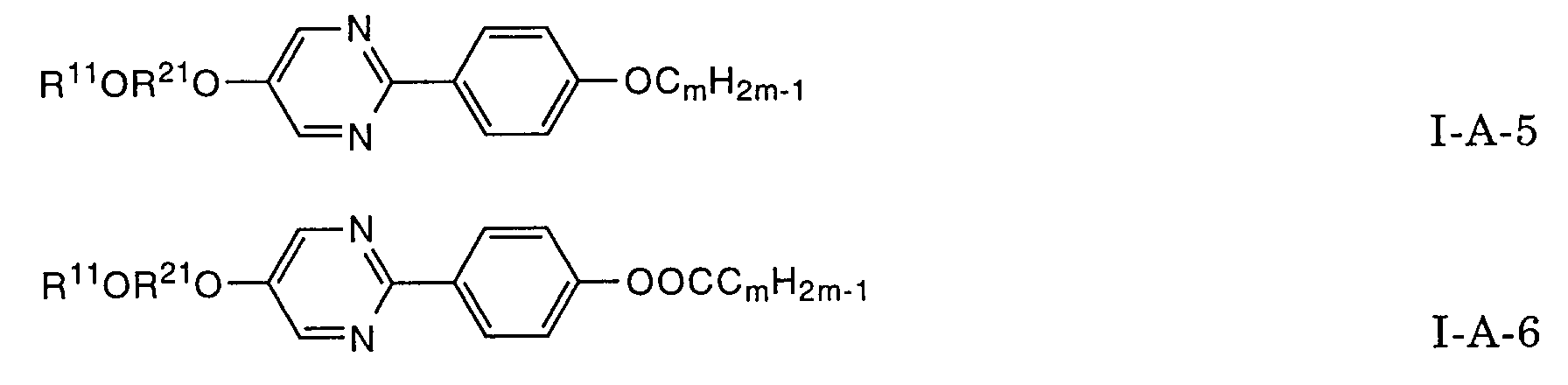
- Verbindungen gemäss einem der Ansprüche 2 oder 3 der allgemeinen Formel

- Verbindungen gemäss einem der Ansprüche 2 oder 3 der allgemeinen Formel


- Verbindungen gemäss einem der Ansprüche 2 oder 3 der allgemeinen Formel

- Verbindungen gemäss einem der Ansprüche 1 bis 7, dadurch gekennzeichnet, dass die Reste R2 bzw. R21 1,4-Butylen bedeuten.
- Flüssigkristalline Mischungen enthaltend mindestens zwei Komponenten, wovon mindestens eine Komponente eine Verbindung der in Anspruch 1 definierten allgemeinen Formel I ist.
- Verwendung der Verbindungen der in Anspruch 1 definierten Formel I für elektro-optische Vorrichtungen.
Applications Claiming Priority (2)
| Application Number | Priority Date | Filing Date | Title |
|---|---|---|---|
| CH209595 | 1995-07-17 | ||
| CH2095/95 | 1995-07-17 |
Publications (2)
| Publication Number | Publication Date |
|---|---|
| EP0754685A2 true EP0754685A2 (de) | 1997-01-22 |
| EP0754685A3 EP0754685A3 (de) | 1997-05-07 |
Family
ID=4225775
Family Applications (1)
| Application Number | Title | Priority Date | Filing Date |
|---|---|---|---|
| EP96111077A Withdrawn EP0754685A3 (de) | 1995-07-17 | 1996-07-10 | Derivate von alkoxyalkoxysubstituierten Stickstoff-Heterocyclen |
Country Status (5)
| Country | Link |
|---|---|
| EP (1) | EP0754685A3 (de) |
| JP (1) | JPH0931064A (de) |
| KR (1) | KR970006285A (de) |
| CN (1) | CN1143638A (de) |
| SG (1) | SG67955A1 (de) |
Families Citing this family (11)
| Publication number | Priority date | Publication date | Assignee | Title |
|---|---|---|---|---|
| TW445291B (en) | 1998-01-09 | 2001-07-11 | Chisso Corp | Ester compounds, liquid crystal compositions and liquid crystal display devices |
| CN109207168B (zh) | 2017-06-30 | 2021-08-06 | 江苏和成显示科技有限公司 | 一种液晶组合物及其应用 |
| CN109207167B (zh) * | 2017-06-30 | 2021-12-03 | 江苏和成显示科技有限公司 | 一种液晶组合物及其应用 |
| CN109207164B (zh) * | 2017-06-30 | 2021-08-06 | 江苏和成显示科技有限公司 | 一种液晶组合物及其应用 |
| CN109207169B (zh) | 2017-06-30 | 2022-02-22 | 江苏和成显示科技有限公司 | 一种液晶组合物及其应用 |
| CN109575949B (zh) * | 2017-09-28 | 2022-02-22 | 安庆飞凯新材料有限公司 | 液晶组合物及其液晶显示器件 |
| CN109575943B (zh) * | 2017-09-28 | 2022-01-07 | 江苏和成显示科技有限公司 | 液晶组合物及其液晶显示器件 |
| CN109575942B (zh) * | 2017-09-28 | 2022-01-07 | 江苏和成显示科技有限公司 | 液晶组合物及其液晶显示器件 |
| TWI697547B (zh) * | 2019-05-27 | 2020-07-01 | 大立顯華光電材料股份有限公司 | 負介電各向異性液晶化合物、其製備方法及其應用 |
| CN112457865B (zh) * | 2020-12-22 | 2022-10-18 | 重庆汉朗精工科技有限公司 | 液晶化合物及其组合物和应用 |
| CN115247067B (zh) * | 2021-04-27 | 2024-04-23 | 江苏和成显示科技有限公司 | 一种液晶化合物及其液晶组合物和液晶显示器件 |
Family Cites Families (8)
| Publication number | Priority date | Publication date | Assignee | Title |
|---|---|---|---|---|
| JPS6127972A (ja) * | 1984-07-17 | 1986-02-07 | Chisso Corp | 5−アルキル−2−〔4−(β−アルコキシエトキシ)−4′−ビフエニリル〕ピリミジン類 |
| JPH01503386A (ja) * | 1987-05-13 | 1989-11-16 | ザ ゼネラル エレクトリック カンパニー,ピー.エル.シー | 液晶物質 |
| CN1022409C (zh) * | 1987-11-25 | 1993-10-13 | 赫彻斯特股份公司 | 液晶环丙基烷基杂环化合物制备方法 |
| DE68918172T2 (de) * | 1988-06-24 | 1995-01-26 | Canon Kk | Ferroelektrische chirale smektische Flüssigkristallzusammensetzung und Vorrichtung mit dieser Zusammensetzung. |
| JPH02279648A (ja) * | 1989-04-18 | 1990-11-15 | Chisso Corp | フルオロアルコール誘導体 |
| JPH02311461A (ja) * | 1989-05-29 | 1990-12-27 | Dainippon Ink & Chem Inc | 3環式ピリジン系アルキレングリコール誘導体 |
| JPH03153670A (ja) * | 1989-11-09 | 1991-07-01 | Ajinomoto Co Inc | エーテル化合物及び強誘電性液晶組成物 |
| JPH0466577A (ja) * | 1990-07-04 | 1992-03-02 | Sumitomo Chem Co Ltd | ピリミジン誘導体およびその製造法 |
-
1996
- 1996-07-05 JP JP8176165A patent/JPH0931064A/ja not_active Withdrawn
- 1996-07-10 EP EP96111077A patent/EP0754685A3/de not_active Withdrawn
- 1996-07-16 KR KR1019960028764A patent/KR970006285A/ko not_active Withdrawn
- 1996-07-16 CN CN96109925A patent/CN1143638A/zh active Pending
- 1996-07-17 SG SG1996010287A patent/SG67955A1/en unknown
Also Published As
| Publication number | Publication date |
|---|---|
| JPH0931064A (ja) | 1997-02-04 |
| EP0754685A3 (de) | 1997-05-07 |
| SG67955A1 (en) | 1999-10-19 |
| KR970006285A (ko) | 1997-02-19 |
| CN1143638A (zh) | 1997-02-26 |
Similar Documents
| Publication | Publication Date | Title |
|---|---|---|
| DE69426358T2 (de) | Verbindungen zur verwendung in flüssigkristallzusammensetzungen | |
| DD253832A5 (de) | Ferroelektrische fluessigkristalline phase | |
| EP0268198B1 (de) | Ferroelektrische Flüssigkristalle | |
| EP0501268B1 (de) | Flüssigkristalline Verbindungen mit endständigem 1-Alkinylrest | |
| EP0754685A2 (de) | Derivate von alkoxyalkoxysubstituierten Stickstoff-Heterocyclen | |
| EP0541081A2 (de) | Verbindungen mit nur einer Seitenkette zur Verwendung in Flüssigkristallmischungen | |
| EP0344557B1 (de) | Flüssigkristallkomponenten mit einer Trimethylenoxygruppe | |
| EP0546298B1 (de) | Fettsäureester, welche einen Pyrimidinring enthalten als Komponenten flüssigkristalliner Gemische | |
| EP0464648B1 (de) | 4-Cyano-3-fluorophenylester | |
| EP0543244A1 (de) | Fluorsubstituierte Tolane und sie enthaltende flüssigkristalline Gemische | |
| EP0477901A2 (de) | Cyclohexylphenylpyrimidine, Verfahren zu ihrer Herstellung und ihre Verwendung in flüssigkristallinen Mischungen | |
| EP0552658A1 (de) | Derivate der 3-Cyclohexylpropionsäure und ihre Verwendung in ferroelektrischen Flüssigkristallmischungen | |
| EP0602596B1 (de) | Trifluorphenylen-Verbindungen, Verfahren zu ihrer Herstellung und ihre Verwendung in flüssigkristallinen Mischungen | |
| EP0361157A1 (de) | Phenylpyridine | |
| EP0428665B1 (de) | Fluorphenylpyrimidine | |
| EP0393501B1 (de) | Flüssigkristallkomponenten mit einer trans-3-Cyclohexylallyloxygruppe | |
| EP0821049B1 (de) | Cyclopentyl-Verbindungen | |
| EP0497176A2 (de) | Vierringverbindungen und sie enthaltende flüssigkristalline Gemische | |
| EP0428720B1 (de) | Optisch aktive verbindungen und flüssigkristalline phase | |
| EP0532916A1 (de) | 2-Fluorpyrazine, Verfahren zu ihrer Herstellung und ihre Verwendung in flüssigkristallinen Mischungen | |
| EP0595144A1 (de) | Cyclohexyl-alkenoate als Komponente flüssigkristalliner Gemische | |
| DE4030603C2 (de) | Pyridinpyrimidine | |
| EP0433835B1 (de) | Dioxanylpyridine | |
| DE4322905A1 (de) | Chirale 2,6-Difluorbenzol-Derivate | |
| WO1991011441A1 (de) | Geminale dimethylalkyl-verbindungen, verfahren zu ihrer herstellung und ihre verwendung in flüssigkristallinen mischungen |
Legal Events
| Date | Code | Title | Description |
|---|---|---|---|
| PUAI | Public reference made under article 153(3) epc to a published international application that has entered the european phase |
Free format text: ORIGINAL CODE: 0009012 |
|
| 17P | Request for examination filed |
Effective date: 19960710 |
|
| AK | Designated contracting states |
Kind code of ref document: A2 Designated state(s): CH DE FR GB IT LI NL |
|
| PUAL | Search report despatched |
Free format text: ORIGINAL CODE: 0009013 |
|
| AK | Designated contracting states |
Kind code of ref document: A3 Designated state(s): CH DE FR GB IT LI NL |
|
| STAA | Information on the status of an ep patent application or granted ep patent |
Free format text: STATUS: THE APPLICATION IS DEEMED TO BE WITHDRAWN |
|
| 18D | Application deemed to be withdrawn |
Effective date: 19971108 |