EP0754716A2 - Aromatisches Copolymer - Google Patents
Aromatisches Copolymer Download PDFInfo
- Publication number
- EP0754716A2 EP0754716A2 EP96305052A EP96305052A EP0754716A2 EP 0754716 A2 EP0754716 A2 EP 0754716A2 EP 96305052 A EP96305052 A EP 96305052A EP 96305052 A EP96305052 A EP 96305052A EP 0754716 A2 EP0754716 A2 EP 0754716A2
- Authority
- EP
- European Patent Office
- Prior art keywords
- copolymer
- aromatic heterocyclic
- aromatic
- compound
- precursor
- Prior art date
- Legal status (The legal status is an assumption and is not a legal conclusion. Google has not performed a legal analysis and makes no representation as to the accuracy of the status listed.)
- Withdrawn
Links
- IVSZLXZYQVIEFR-UHFFFAOYSA-N Cc1cccc(C)c1 Chemical compound Cc1cccc(C)c1 IVSZLXZYQVIEFR-UHFFFAOYSA-N 0.000 description 3
- 0 Cc(cc1)cc(C)c1C(*)=O Chemical compound Cc(cc1)cc(C)c1C(*)=O 0.000 description 2
- MWFZKJBTNHEOMR-UHFFFAOYSA-N C[O](c1ccccc1)=O Chemical compound C[O](c1ccccc1)=O MWFZKJBTNHEOMR-UHFFFAOYSA-N 0.000 description 1
- HLBLWEWZXPIGSM-UHFFFAOYSA-N Nc(cc1)ccc1Oc(cc1)ccc1N Chemical compound Nc(cc1)ccc1Oc(cc1)ccc1N HLBLWEWZXPIGSM-UHFFFAOYSA-N 0.000 description 1
Images













Classifications
-
- C—CHEMISTRY; METALLURGY
- C08—ORGANIC MACROMOLECULAR COMPOUNDS; THEIR PREPARATION OR CHEMICAL WORKING-UP; COMPOSITIONS BASED THEREON
- C08G—MACROMOLECULAR COMPOUNDS OBTAINED OTHERWISE THAN BY REACTIONS ONLY INVOLVING UNSATURATED CARBON-TO-CARBON BONDS
- C08G73/00—Macromolecular compounds obtained by reactions forming a linkage containing nitrogen with or without oxygen or carbon in the main chain of the macromolecule, not provided for in groups C08G12/00 - C08G71/00
- C08G73/06—Polycondensates having nitrogen-containing heterocyclic rings in the main chain of the macromolecule
- C08G73/22—Polybenzoxazoles
-
- C—CHEMISTRY; METALLURGY
- C08—ORGANIC MACROMOLECULAR COMPOUNDS; THEIR PREPARATION OR CHEMICAL WORKING-UP; COMPOSITIONS BASED THEREON
- C08G—MACROMOLECULAR COMPOUNDS OBTAINED OTHERWISE THAN BY REACTIONS ONLY INVOLVING UNSATURATED CARBON-TO-CARBON BONDS
- C08G69/00—Macromolecular compounds obtained by reactions forming a carboxylic amide link in the main chain of the macromolecule
- C08G69/02—Polyamides derived from amino-carboxylic acids or from polyamines and polycarboxylic acids
- C08G69/04—Preparatory processes
-
- C—CHEMISTRY; METALLURGY
- C08—ORGANIC MACROMOLECULAR COMPOUNDS; THEIR PREPARATION OR CHEMICAL WORKING-UP; COMPOSITIONS BASED THEREON
- C08G—MACROMOLECULAR COMPOUNDS OBTAINED OTHERWISE THAN BY REACTIONS ONLY INVOLVING UNSATURATED CARBON-TO-CARBON BONDS
- C08G69/00—Macromolecular compounds obtained by reactions forming a carboxylic amide link in the main chain of the macromolecule
- C08G69/02—Polyamides derived from amino-carboxylic acids or from polyamines and polycarboxylic acids
- C08G69/26—Polyamides derived from amino-carboxylic acids or from polyamines and polycarboxylic acids derived from polyamines and polycarboxylic acids
- C08G69/32—Polyamides derived from amino-carboxylic acids or from polyamines and polycarboxylic acids derived from polyamines and polycarboxylic acids from aromatic diamines and aromatic dicarboxylic acids with both amino and carboxylic groups aromatically bound
-
- C—CHEMISTRY; METALLURGY
- C08—ORGANIC MACROMOLECULAR COMPOUNDS; THEIR PREPARATION OR CHEMICAL WORKING-UP; COMPOSITIONS BASED THEREON
- C08G—MACROMOLECULAR COMPOUNDS OBTAINED OTHERWISE THAN BY REACTIONS ONLY INVOLVING UNSATURATED CARBON-TO-CARBON BONDS
- C08G73/00—Macromolecular compounds obtained by reactions forming a linkage containing nitrogen with or without oxygen or carbon in the main chain of the macromolecule, not provided for in groups C08G12/00 - C08G71/00
- C08G73/06—Polycondensates having nitrogen-containing heterocyclic rings in the main chain of the macromolecule
- C08G73/18—Polybenzimidazoles
-
- C—CHEMISTRY; METALLURGY
- C08—ORGANIC MACROMOLECULAR COMPOUNDS; THEIR PREPARATION OR CHEMICAL WORKING-UP; COMPOSITIONS BASED THEREON
- C08G—MACROMOLECULAR COMPOUNDS OBTAINED OTHERWISE THAN BY REACTIONS ONLY INVOLVING UNSATURATED CARBON-TO-CARBON BONDS
- C08G75/00—Macromolecular compounds obtained by reactions forming a linkage containing sulfur with or without nitrogen, oxygen, or carbon in the main chain of the macromolecule
- C08G75/32—Polythiazoles; Polythiadiazoles
-
- Y—GENERAL TAGGING OF NEW TECHNOLOGICAL DEVELOPMENTS; GENERAL TAGGING OF CROSS-SECTIONAL TECHNOLOGIES SPANNING OVER SEVERAL SECTIONS OF THE IPC; TECHNICAL SUBJECTS COVERED BY FORMER USPC CROSS-REFERENCE ART COLLECTIONS [XRACs] AND DIGESTS
- Y10—TECHNICAL SUBJECTS COVERED BY FORMER USPC
- Y10T—TECHNICAL SUBJECTS COVERED BY FORMER US CLASSIFICATION
- Y10T428/00—Stock material or miscellaneous articles
- Y10T428/31504—Composite [nonstructural laminate]
-
- Y—GENERAL TAGGING OF NEW TECHNOLOGICAL DEVELOPMENTS; GENERAL TAGGING OF CROSS-SECTIONAL TECHNOLOGIES SPANNING OVER SEVERAL SECTIONS OF THE IPC; TECHNICAL SUBJECTS COVERED BY FORMER USPC CROSS-REFERENCE ART COLLECTIONS [XRACs] AND DIGESTS
- Y10—TECHNICAL SUBJECTS COVERED BY FORMER USPC
- Y10T—TECHNICAL SUBJECTS COVERED BY FORMER US CLASSIFICATION
- Y10T428/00—Stock material or miscellaneous articles
- Y10T428/31504—Composite [nonstructural laminate]
- Y10T428/31721—Of polyimide
-
- Y—GENERAL TAGGING OF NEW TECHNOLOGICAL DEVELOPMENTS; GENERAL TAGGING OF CROSS-SECTIONAL TECHNOLOGIES SPANNING OVER SEVERAL SECTIONS OF THE IPC; TECHNICAL SUBJECTS COVERED BY FORMER USPC CROSS-REFERENCE ART COLLECTIONS [XRACs] AND DIGESTS
- Y10—TECHNICAL SUBJECTS COVERED BY FORMER USPC
- Y10T—TECHNICAL SUBJECTS COVERED BY FORMER US CLASSIFICATION
- Y10T428/00—Stock material or miscellaneous articles
- Y10T428/31504—Composite [nonstructural laminate]
- Y10T428/31725—Of polyamide
Definitions
- the present invention relates to aromatic heterocyclic copolymers which have excellent mechanical characteristics and are suitable for use as structural materials for aircraft, automotive vehicles and space equipment, to methods for producing the same, and to methods for producing formed articles of the same.
- the present invention further relates to molecular composite materials composed of matrix polymers and aromatic heterocyclic copolymers, methods for producing the same, and methods for producing formed articles of the same, and more particularly to molecular composite materials which have excellent mechanical characteristics and are suitable for use as structural materials for aircraft, automotive vehicles and space equipment.
- fibers having excellent mechanical characteristics
- high strength and high elasticity fibers have been widely used as reinforcing materials to be added to matrices, and examples of such fibers include glass fiber and carbon fiber.
- aromatic polyamide fibers aromatic polyamide fibers (aramid fibers) such as Kevlar ® (E. I. du Pont) have also been used.
- Carbon fibers show extremely high elasticity, but are inferior to aramid fibers such as Kevlar ® in terms of loop strength and knot strength.
- aramid fibers have high strength, they are inferior to carbon fibers in terms of elasticity. Accordingly, research effort has been directed to the development of new fibers having the high elasticity of carbon fibers and the high strength and easy handling of aramid fibers.
- heterocycle containing aromatic polymers such as poly-p-phenylenebenzobisthiazole (polybenzothiazole; PBZ-T) and poly-p-phenylenebenzobisoxazole (polybenzoxazole; PBZ-O) are noted.
- Heterocycles are introduced into these substances as a way of solving the problem of low elasticity, and the hygroscopicity which is a disadvantage of Kevlar ® is also overcome thereby.
- the main chains (the polymer backbones) of these substances exhibit rigidity, and these substances can provide fiber having higher strength and elasticity.
- Polymers having heterocycles such as thiazole, imidazole, oxazole and oxazinone rings in recurring units (polymer repeat units or simply repeat units) which polymers are hereinafter referred to as "polythiazoles, etc.”, and particularly polythiazoles containing thiazole rings, are high in rigidity, and have high strength, high elasticity and high thermal stability. They are therefore considered to be hopeful as plastic materials used as single bodies instead of metal materials, or as reinforcing materials for other engineering plastics.
- rigid polymers such as polythiazoles, etc. generally have poor solubilities because of their high rigidity, and only dissolve in a limited number of strong acids such as methanesulfonic acid and chlorosulfonic acid. Further, they have low elongation and poor bending properties, and are thermally infusible, and as a result melt molding using these materials is difficult. It is therefore difficult to use them as single bodies.
- aromatic heterocyclic polymers which have improved elongation and bending properties, which are soluble in organic solvents under mild conditions without use of strong acids, and which are miscible with other polymers and can therefore be used for general melt molding.
- the strength of the resulting composite materials is known to depend largely on the interfacial adhesion between the matrix resins and the fibers, as well as on the strength of the matrix resins and of the fibers used as the reinforcing material. In this situation, the use of matrix resins or fibers having high strength and elasticity does not necessarily produce composite materials having excellent strength.
- polymer blend composite materials molecular composite materials
- rigid polymers such as aromatic polyamides
- Japanese Unexamined Patent Publication No. 1-287167 discloses a method for producing a polymer composite, comprising introducing a polymer solution mainly containing a reinforcing polymer (A) substantially consisting of a polythiazole having a rod-like skeleton and a fusible matrix polymer (B) into a coagulation bath to form a film, wherein said polymer solution exhibits optical anisotropy, and is coagulated by way of an apparent optical isotropic phase after immersion in the coagulation bath.
- A reinforcing polymer
- B fusible matrix polymer
- Japanese Examined Patent Publication No. 2-7976 discloses a polymer composition containing a reinforcing polymer (A) substantially consisting of a polythiazole having a rod-like skeleton and a matrix polymer (B) composed of slightly crystallisable aromatic copolyamide having a glass transition temperature of 200°C or more, an incipient fluidization temperature of 500°C or less and an apparent crystal size of 25 ⁇ or less, crystals having said crystal size being formed when kept between the glass transition temperature and the incipient fluidization temperature for any time within 5 hours, in an (A)/[(A)+(B)] weight ratio of 0.15 to 0.70.
- A reinforcing polymer
- B matrix polymer
- a method which comprises homogeneously mixing a precursor of a rigid aromatic polymer with a matrix polymer or a precursor thereof in an organic solvent (rather than mixing the rigid aromatic polymer itself with the matrix polymer), and removing the organic solvent, followed by heating to convert the precursor to the rigid aromatic polymer (see Japanese Unexamined Patent Publication No. 64-1760 and Japanese Unexamined Patent Publication No. 64-1761).
- the use of the precursor improved the miscibility, it raised the problem that long-term stirring in an organic solvent is required in order to obtain the homogeneous mixture of the matrix polymer and the precursor.
- the aromatic polythiazole had poor interaction with the matrix polymer, for example, in terms of hydrogen bonding, so that the resulting molecular composite material had poor elongation. This is a defect if it is to be used as a structural material.
- a precursor copolymer which contains aromatic diamino repeat units and cyclizable repeat units (arranged in either random or block copolymer form), the cyclizable units being cyclizable, suitably after intimate admixture of the precursor copolymer and a matrix polymer, to produce aromatic heterocyclic (ie. rigidifying) repeat units.
- the precursor copolymer, the "cured" copolymer produced by the cyclization of the cyclizable units, and molecular composite materials comprising a matrix polymer and the cured copolymer thus all form aspects of the invention.
- the invention therefore provides an aromatic heterocyclic copolymer having aromatic heterocyclic repeat units and aromatic diamino repeat units.
- the invention provides an aromatic heterocyclic copolymer comprising aromatic heterocyclic repeat units, characterized in that it further comprises aromatic diamino repeat units.
- the invention provides a method for producing an aromatic heterocyclic copolymer comprising (i) separately reacting (a) an aromatic heterocyclic precursor compound and (b) an aromatic diamino compound with (c) a dicarboxylic acid derivative in an organic solvent whereby to synthesize two different oligomers, and reacting said different oligomers with each other in an organic solvent whereby to synthesize a block copolymer precursor, or reacting (a) an aromatic heterocyclic precursor compound, (b) an aromatic diamino compound and (c) a dicarboxylic acid derivative in an organic solvent whereby to synthesize a random copolymer precursor, and (ii) heating or ultrasound irradiating said block or random copolymer precursor to induce a ring-closing reaction in the polymer repeat units deriving from said precursor compound.
- the invention provides a molecular composite material comprising an aromatic heterocyclic copolymer according to the invention and a matrix polymer.
- the invention provides method for producing a molecular composite material according to the invention, said method comprising dissolving in an organic solvent a matrix polymer and an optionally substituted copolymer comprising aromatic repeat units and repeat units cyclizable to form aromatic heterocyclic repeat units, removing the solvent from the resulting solution, and causing a ring-closing reaction in said cyclizable repeat units in said copolymer.
- an aromatic heterocyclic copolymer precursor being a copolymer having aromatic diamino repeat units and cyclizable repeat units, said cyclizable repeat units being cyclizable to produce aromatic heterocyclic repeat units.
- the aromatic heterocyclic repeat units in the copolymers of the invention comprise a heterocyclic ring and, optionally fused thereto, a carbocyclic aromatic ring.
- they are conveniently of structure -het-Ar-, -het-Ar-het-, or -het-Ar-Ar-het- where het is a 5- to 7-membered heterocyclic ring (eg. containing ring heteroatoms selected from O, N and S) optionally and preferably condensed on the adjacent Ar group, and Ar is a carbocyclic aromatic group, eg. a phenyl ring. Where two Ar groups are linked, this need not be directly.
- aromatic diamino repeat units in the copolymers of the invention are conveniently of structure -N-Ar-N-, or -N-Ar-Ar-N-, with Ar preferably being a carbocyclic aromatic group (eg. a phenyl group) and where two Ar groups are linked this again need not be directly.
- Ar preferably being a carbocyclic aromatic group (eg. a phenyl group) and where two Ar groups are linked this again need not be directly.
- the present invention further provides a method for producing a formed article of an aromatic heterocyclic producing a formed article of an aromatic heterocyclic copolymer which comprises subjecting an uncyclized block copolymer precursor and/or random copolymer precursor to mold hot pressing, followed by internal mold heat treatment to induce a ring-closing reaction of aromatic heterocycles.
- the present invention provides a molecular composite material obtained by dissolving a matrix polymer and an unsubstituted or substituted, uncyclized aromatic heterocyclic copolymer precursor in an organic solvent, then removing the solvent from the resulting solution, and allowing the aromatic heterocyclic copolymer precursor to conduct a ring-closing reaction.
- a method for producing a formed article of a molecular composite material in which an aromatic heterocyclic copolymer is dispersed in a matrix polymer to form a fine particle dispersion type structure, a three-dimensional mesh fine particle dispersion type structure or a three-dimensional mesh type dispersion structure.
- the present invention provides a method for producing a formed article of a molecular composite material in which an aromatic heterocyclic copolymer forms a fine particle dispersion type structure or a three-dimensional mesh fine particle dispersion type structure, which comprises disolving a matrix polymer and an aromatic heterocyclic copolymer precursor in an organic solvent to form a solution, removing the solvent from the solution to form a coagulum, heat treating the coagulum to induce a ring-closing reaction of the aromatic heterocyclic copolymer precursor, and then subjecting the resulting product to mold hot pressing.
- a method for producing a formed article of a molecular composite material in which an aromatic heterocyclic copolymer forms a three-dimensional mesh type dispersion structure which comprises disolving a matrix polymer and an aromatic heterocyclic copolymer precursor in which at least one hydrogen atom of a functional group forming a heterocycle is substituted by another functional group in an organic solvent to form a mixed solution, removing the solvent from the mixed solution to form a coagulum in a powder, fiber or film form, subjecting the coagulum to mold hot pressing at a temperature at which a ring-closing reaction does not take place, and then inducing the ring-closing reaction of the aromatic heterocyclic copolymer precursor by internal mold heat treatment under pressure.
- methods of ring enclosure according to the present invention include application of ultrasonic waves, as well as heat treatment.
- the aromatic heterocyclic copolymers of the present invention are random or block copolymers having aromatic heterocyclic repeat units and aromatic diamino repeat units.
- the aromatic heterocyclic copolymers of the present invention are not conventional composite materials in which reinforcing polymers are mixed with matrix polymers, but composite materials having straight chain moieties forming reinforcing portions and flexible moieties forming matrix-like portions in molecular chains.
- the rigid chain moieties containing aromatic heterocycles derive from the aromatic heterocyclic precursor comonomer compounds and are dispersed in the matrix-like portions formed by the flexible chain moieties containing aromatic residues deriving from aromatic diamino comonomer compounds, very finely and homogeneously in the three-dimensional mesh form.
- heterocycles contained in the rigid chain moieties forming the reinforcing portions are preferred.
- Suitable condensed rings include thiazole, oxazole, imidazole and oxazinone rings. These rings may be used alone or in combination.
- the aromatic heterocyclic copolymer of the present invention is produced by (i) reacting (a) an aromatic heterocyclic precursor compound (ie. a comonomer containing a group cyclizable to provide an aromatic heterocyclic group) and (b) an aromatic diamino compound separately with (c) a dicarboxylic acid derivative in an organic solvent, thereby synthesizing two kinds of oligomers, and allowing these two kinds of oligomers to react with each other in an organic solvent to synthesize a block copolymer precursor, or reacting (a) an aromatic heterocyclic precursor compound, (b) an aromatic diamino compound and (c) a dicarboxylic acid derivative to react in an organic solvent, thereby synthesizing a random copolymer precursor, and (ii) heating or ultrasound irradiating said block copolymer precursor or random copolymer precursor to induce a ring-closing reaction.
- an aromatic heterocyclic precursor compound ie. a comon
- step (i) in which the aromatic heterocyclic copolymer precursors are produced and step (ii) in which the ring closure of the aromatic heterocyclic copolymer precursors is performed to produce the aromatic heterocyclic copolymers.
- polybenzothiazole (PBZ-T) copolymer precursors having thiazole rings as the condensed rings are illustrated.
- the PBZ-T copolymer precursors are represented by the following formula (1): wherein Ar and Ar' are aromatic residues, R is an unsubstituted or substituted alkyl group, X is a dicarboxylic acid derivative residue, m and n are both integers, and m:n is 0.01:99.99 to 99.99:0.01.
- the PBZ-T copolymer precursors are produced by copolymerizing (a) aromatic diaminodithiol compounds (hereinafter referred to as " compounds (a t ) ”) in which hydrogen atoms of thiol groups are substituted by unsubstituted or substituted alkyl groups, as the aromatic heterocyclic compounds, with (b) aromatic diamino compounds and (c) dicarboxylic acid derivatives.
- compounds (a t ) aromatic diaminodithiol compounds in which hydrogen atoms of thiol groups are substituted by unsubstituted or substituted alkyl groups, as the aromatic heterocyclic compounds, with (b) aromatic diamino compounds and (c) dicarboxylic acid derivatives.
- the aromatic residue Ar may be not only a benzene ring, but also an aromatic ring formed by condensation of two or more benzene rings, and may be a residue formed by binding of two or more benzene rings, such as biphenyl.
- the amino groups and the thioether groups on both sides may each be positioned in bilateral or point symmetry centered with respect to the aromatic residue.
- Examples of compounds (a t ) include the following compounds:
- Compound (a t ) can be synthesized from an aromatic diaminodithiol compound, a compound having an amino group and a thiol group, respectively, on both sides of an aromatic residue.
- aromatic diaminodithiol compound a compound obtained by substituting a hydrogen atom for the alkyl group R of each compound shown above can be used.
- this aromatic diaminodithiol compound is used in the form of salts such as a hydrochloride.
- the alkyl group R binding to the thiol group of the aromatic diaminodithiol compound is an unsubstituted or substituted alkyl group.
- the unsubstituted alkyl groups include isopropyl, ethyl, n-propyl, n-butyl, sec-butyl and tert-butyl groups.
- As the alkyl groups secondary or tertiary alkyl groups are particularly preferred.
- alkyl groups substituted by carboxyl, ester, cyano or benzene groups are preferably used.
- the alkyl groups have such substituent groups, they are not necessarily secondary alkyl groups.
- the alkyl groups having the substituent groups include the following groups: -CH 2 CH 2 -CN -CH(CH 3 )-CN
- alkyl groups bonding to oxygen atoms of the ester linkages may be alkyl groups each having 2 to 10 carbon atoms, as well as methyl groups.
- substitution of hydrogen atoms of the thiol groups of the aromatic diaminodithiol compounds with cyano group-containing alkyl groups or ester group-containing alkyl groups improves the solubility of the copolymer precursors [the above-mentioned polymers represented by general formula (1)] in organic solvents such as N-methyl-2-pyrrolidone.
- alkyl groups are used as alkyl halides, and compounds(a t ) are synthesized from the alkyl halides and the aromatic diaminodithiol compounds (salts thereof) previously described by the following method.
- the halides which can be used herein include bromides, chlorides and iodides of the above-mentioned alkyl groups.
- the above-mentioned salts of the aromatic diaminodithiol compounds are allowed to react with the alkyl halides in alkaline aqueous solutions.
- alkaline aqueous solution there can be used a solution comprising water or a mixed solvent of water and an alcohol(s) (ethanol and/or methanol), and a basic salt such as sodium hydroxide dissolved therein. Alkalifying of the solvents makes it possible to dissolve the salts of the aromatic diaminodithiol compounds. Further, it increases the nucleophilicity of the thiol groups to promote the substitution reaction.
- the alkaline aqueous solutions preferably contain 2 to 4 equal amounts of alkalis based on the monomers.
- This reaction is an equilibrium reaction. Accordingly, less than 2 equal amounts results in insufficient progress of reaction, whereas exceeding 4 equal amounts causes a troublesome operation for removing the alkaline aqueous solutions, resulting in inferior operability.
- This substitution reaction can be conducted at a temperature ranging from 0°C to 100 °C.
- a temperature of less than 0°C unfavorably results in a low rate of reaction, whereas exceeding 100 °C unfavorably results in occurrence of a side reaction.
- the reaction temperature is more preferably 0 °C to 95°C.
- reaction time it is generally about 2 hours to 24 hours.
- phase transfer catalyst Furthermore, addition of cetyltrimethylammonium chloride, n-butyltriphenylphosphonium bromide, tetraphenylphosphonium bromide or 18-crown-6 as a phase transfer catalyst can increase the rate of reaction.
- phase transfer catalysts accelerate the reaction of the salts of the aromatic diaminodithiol compounds with the alkyl halides.
- the monomer compounds (compounds (a t )) in which the hydrogen atoms of the thiol groups of the salts of the aromatic diaminodithiol compounds are substituted by the alkyl groups can be obtained by conducting the substitution reaction under the above-mentioned conditions.
- reaction of the salt of the aromatic diaminodithiol compound with the alkyl halide proceeds according to the following reaction equation (1): wherein X-R represents an alkyl halide, and 2,5-diamino-1,4-benzenedithiol dihydrochloride is used as an example of the salt of the aromatic diaminodithiol compound.
- aromatic diamino compounds (hereinafter also referred to as "compounds (b)" used in the present invention, aromatic diamino compounds having the flexible structure are preferred.
- the aromatic diamino compounds (b) are allowed to react with the dicarboxylic acid derivatives (c) to form flexible chain moieties in the aromatic heterocyclic copolymers.
- introduction of the flexible chain moieties into the copolymers increases the flexibility of the copolymers, making them moldable. If the flexibility of the aromatic diamino compounds is low, the fluidity of the block copolymers is lowered, resulting in deterioration of the moldability.
- aromatic diamino compounds there can be used diamines having aromatic residues such as diphenyl ketone, triphenyl ether, diphenyl ether, diphenyl sulfone, diphenylmethane and biphenyl.
- diamines having aromatic residues in which aromatic rings bind to the 3-, 3-positions are suitable.
- aromatic diamino compounds having the following aromatic residues can be used.
- aromatic residues diphenyl ether, diphenyl ketone and triphenyl ether groups are preferred.
- the use of such aromatic residues can provide sufficient flexibility to the resulting copolymer precursors.
- dicarboxylic acid derivatives (hereinafter also referred to as “compounds (c)") used in the present invention include derivatives in which carboxylic acid groups are substituted as shown below:
- residues of the above-mentioned compounds (c) include alkylene groups each having relatively short chains (2 to 10 carbon atoms) and aromatic residues as shown below.
- Preferred examples of dicarboxylic acids include aromatic dicarboxylic acids.
- halogen and/or a substituent group such as lower alkyl, lower alkoxyl or phenyl
- Introduction of such substituent groups can improve the reactivity and the solubility in solvents.
- aromatic dicarboxylic acid derivatives terephthaloyl dichloride or halogen-substituted products thereof and 2,5-dichloroterephtahlic acid dichloride are preferred. Specifically, 2-chloroterephthaloyl dichloride and 2,5-dichloroterephthaloyl dichloride can be suitably used. These aromatic dicarboxylic acid derivatives may be used alone or in combination.
- the aromatic heterocyclic copolymers of the present invention are obtained by heating the copolymer precursors obtained from the above-mentioned compounds (a, ), (b) and (c), and the copolymer precursors may be either block copolymer precursors or random copolymer precursors.
- the PBZ-T block copolymer precursor represented by the above-mentioned general formula (1) can be produced by allowing compound (a t ) and compound (b) separately to react with compound (c) in an organic solvent, thereby synthesizing two kinds of oligomers, and allowing the resulting two kinds of oligomers to react with each other in an organic solvent.
- the oligomer obtained by reaction of compound(a t ) with compound (c) forms an aromatic heterocyclic block acting as the rigid chain moiety in the aromatic heterocyclic copolymer.
- the oligomer obtained by reaction of compound (b) with compound (c) forms the flexible moiety in the aromatic heterocyclic copolymer.
- oligomer (I) the oligomer obtained by reaction of compound (a t ) with compound (c)
- oligomer (II) the oligomer obtained by reaction of compound (b) with compound (c) is referred to as “oligomer (II)".
- oligomer (I) First, synthesis of oligomer (I) is described. Compound (a t ) and compound (c) are dissolved in an organic solvent, and the resulting solution is stirred at a specified temperature to produce oligomer (I).
- the molar amount of compound(a, ) is basically the same as that of compound (c). However, in order to obtain oligomer (I) having a suitable molecular weight and to improve the reaction with oligomer (II) given later, the amount of compound (c) may be adjusted.
- the total concentration of compound (a t ) and compound (c) is preferably about 0.5 mol/liter to about 5 mol/liter. A concentration exceeding 5 mol/liter unfavorably results in difficulty of dissolving each component.
- organic solvents of the amide family can be suitably used.
- the organic solvents of the amide family include N-methyl-2-pyrrolidone (NMP), hexamethylphosphoric triamide and N,N-dimethylacetamide. They may be used alone or as a mixed solution.
- NMP N-methyl-2-pyrrolidone
- hexamethylphosphoric triamide N,N-dimethylacetamide. They may be used alone or as a mixed solution.
- a hydrochloride such as LiCl or CaCl 2 may be added in an amount of 3% to 20% by weight.
- the polymerization reaction temperature is preferably -20 °C to 200 °C.
- a reaction temperature of less than -20°C results in occurrence of an insufficient polymerization reaction.
- the upper limit of the polymerization reaction temperature is 200 °C because of the possibility that the thiazole ring-closing reaction takes place at a temperature of about 250°C. More preferably, the reaction temperature is -10°C to 50°C .
- reaction time is preferably about 1 minutes to about 120 minutes.
- oligomer (I1) The intrinsic viscosity ⁇ inh (NMP, 30°C) of the resulting oligomer (hereinafter referred to as "oligomer (I1)") is about 0.1 to about 0.7.
- Oligomer (II) can also be synthesized in a manner similar to the above-mentioned synthesis method of oligomer (I).
- the amount of the dicarboxylic acid derivative (c) is also basically the same as that of compound (b). However, it is preferred that the amount of compound (c) in the synthesis of oligomer (II) is also adjusted to the amount of compound (c) in the synthesis of compound (I).
- the total concentration of compound (b) and compound (c) is preferably about 0.5 mol/liter to about 5 mol/liter.
- the polymerization reaction temperature is preferably -20°C to 300 °C, and more preferably -20 °C to 200 °C. A reaction temperature of less than -20°C results in occurrence of an insufficient polymerization reaction.
- the upper limit of the polymerization reaction temperature is 300 °C because of occurrence of thermal decomposition at a temperature of about 400°C. More preferably, the reaction temperature is -10°C to 50°C.
- the organic solvents used in the synthesis of oligomer (II) include the same solvents as used in the above-mentioned synthesis of oligomer (I). Although there is no particular limitation on the reaction time, it is generally about 1 minute to about 120 minutes.
- oligomer (II 1 ) The intrinsic viscosity ⁇ inh (NMP, 30°C) of the resulting oligomer (hereinafter referred to as "oligomer (II 1 )" is about 0.1 to about 0.6.
- Oligomer (I) and oligomer (II) obtained by the above-mentioned methods are allowed to react with each other in an organic solvent to synthesize a PBZ-T block copolymer precursor.
- organic solvent there can be employed the solvent used in the above-mentioned synthesis of oligomer (I) or oligomer (II).
- the organic solvent in which oligomer (I) is dissolved is mixed with the organic solvent in which oligomer (II) is dissolved, and the resulting mixture is stirred at a temperature of -10 °C to 50°C to synthesize a block copolymer precursor.
- the polymerization reaction does not proceed at a temperature of less than -10 °C.
- Exceeding 250 °C results in progress of the thiazole ring-closing reaction, so that the above-mentioned temperature range is employed for safety.
- the polymerization reaction is conducted under the above-mentioned conditions, thereby obtaining the PBZ-T block copolymer precursor having a high degree of polymerization without occurrence of the thiazole ring- closing reaction.
- the intrinsic viscosity ⁇ inh (NMP, 30°C) of the PBZ-T block copolymer precursor obtained from oligomer (I1) and oligomer (II 1 ) described above is about 0.7 to about 2.0.
- the polymerization reaction of oligomer (I1) with oligomer (II 1 ) proceeds according to the following reaction equation (4) to obtain the block copolymer precursor: wherein oligomer (I1) obtained according to reaction equation (2) described above is used as oligomer(I), and oligomer (II 1 ) obtained according to reaction equation (3) described above is used as oligomer(II).
- reaction equation (4) to obtain the block copolymer precursor: wherein oligomer (I1) obtained according to reaction equation (2) described above is used as oligomer(I), and oligomer (II 1 ) obtained according to reaction equation (3) described above is used as oligomer(II).
- the present invention is not limited thereto.
- oligomer (II) when 4,4'-diaminodiphenyl ether (4-amino-p-phenoxyaniline) is used as compound (b), and 2-chloroterephthaloyl dichloride is used as compound (c), the reaction proceeds according to the following reaction equation (5) to obtain an oligomer (hereinafter referred to as "oligomer (II 2 )"):
- the intrinsic viscosity ⁇ inh (NMP, 30°C, 0.5 g/dl) of oligomer (II 2 ) is about 0.1 to about 0.4.
- oligomer (II 2 ) with oligomer (I1) described above proceeds according to the following reaction equation (6) to obtain a block copolymer precursor: wherein m and n represent the degree of polymerization.
- m:n ratio of the total of m in one copolymer (the total degree of polymerization of the moiety in the block copolymer precursor, combined by m in the above-mentioned formula) to the total of n (the total degree of polymerization of the moiety in the block copolymer precursor, combined by n in the above-mentioned formula), ranges from 0.01:99.99 to 99.99:0.01. If the ratio of the aromatic heterocyclic block which is a rigid chain is too high, the fluidity of the block copolymer is lost. On the other hand, if the ratio is too low, the reinforcing effect becomes insufficient.
- the resulting block copolymer precursor can be washed and dried by known methods.
- a method for producing a random copolymer precursor of the PBZ-T copolymer precursors is described.
- compound (a t ) , compound (b) and compound (c) are dissolved in a desired compounding ratio in an organic solvent, and these three components are copolymerized.
- a homogeneous solution of compound(a t ) and compound (b) is first prepared, and compound (c) is added thereto.
- the ratio of the amount of compound(a t ) to that of compound (b) in the solution using the organic solvent is the ratio of the portion converted to the rigid chain moiety to the portion forming the flexible chain moiety (namely, the ratio of m to n in the above-mentioned general formula (1)) in the PBZ-T random copolymer precursor.
- the amount of compound(a t ) and compound (b) is appropriately determined.
- compound (a t ) and compound (b) are compounded so as to give an m:n ratio of 0.01: 99.99 to 99.99:0.01.
- the amount of compound (c) is at least the same amount as the total molar amount of compound (a t ) and compound (b).
- the total concentration of compound (a t ), compound (b) and compound (c) in the organic solvent is preferably about 0.1 mol/liter to about 5 mol/liter. A concentration exceeding 5 mol/liter unfavorably results in difficulty of dissolving each component.
- organic solvents of the amide family can be suitably used.
- the organic solvents of the amide family include N-methyl-2-pyrrolidone (NMP), hexamethylphosphoric triamide and N,N-dimethylacetamide. They may be used alone or as a mixed solution.
- NMP N-methyl-2-pyrrolidone
- hexamethylphosphoric triamide N,N-dimethylacetamide. They may be used alone or as a mixed solution.
- a hydrochloride such as LiCl or CaCl2 may be added in an amount of 3% to 20% by weight.
- the polymerization reaction temperature is preferably -20°C to 50°C .
- a polymerization temperature of less than -20 °C results in occurrence of an insufficient polymerization reaction and in a reduction in the degree of polymerization of the resulting random copolymer precursor.
- the upper limit of the polymerization reaction temperature is 50°C because of the possibility that the thiazole ring-closing reaction takes place at a temperature of about 250oC. More preferably, the reaction temperature is -20 °C to 30°C.
- the solution is stirred to enhance the rate of reaction.
- reaction time it is generally about 1 hour to about 24 hours.
- the polymerization reaction is conducted under the above-mentioned conditions, thereby obtaining the random copolymer precursor having a high degree of polymerization without occurrence of the thiazole ring-closing reaction.
- the intrinsic viscosity ⁇ inh (NMP, 30°C, 0.5 g/dl) of the resulting random copolymer precursor is preferably 0.4 or more, and more preferably about 0.8 to about 1.6.
- This polymerization reaction is considered to proceed according to the following reaction equation (7): wherein m and n represent the degree of polymerization, an alkyl group-substituted product of 2,5-diamino-1,4-benzenedithiol dihydrochloride is used as an example of compound(a, ) 4,4'-diaminodiphenyl ether (4-amino-p-phenoxyaniline) is used as an example of compound (b), and 2-chloroterephthaloyl dichloride is used as an example of compound (c).
- reaction equation (7) wherein m and n represent the degree of polymerization, an alkyl group-substituted product of 2,5-diamino-1,4-benzenedithiol dihydrochloride is used as an example of compound(a, ) 4,4'-diaminodiphenyl ether (4-amino-p-phenoxyaniline) is used as an example of compound (b), and 2-chlor
- the resulting random copolymer precursor can be washed and dried by known methods.
- PBZ-0 block copolymer precursors are represented by the following formula (3): wherein Ar and Ar' are aromatic residues, m and n are both integers, and m:n is 0.01:99.99 to 99.99:0.01.
- the copolymer precursors are produced by copolymerizing (a) aromatic diaminohydroxy compounds (hereinafter referred to as "compounds(a o ) ”) in which hydrogen atoms of amino groups and/or hydroxyl groups are substituted or unsubstituted, used as aromatic heterocyclic compounds, with (b) aromatic diamino compounds and (c) dicarboxylic acid derivatives.
- compounds(a o ) aromatic diaminohydroxy compounds
- the aromatic diaminodihydroxy compound is a compound having amino groups and/or hydroxyl groups, and preferably a compound having amino groups and hydroxyl groups, respectively, on both sides.
- the aromatic residue may be not only a benzene ring, but also an aromatic ring formed by condensation of two or more benzene rings, and may be a residue formed by binding of two or more benzene rings, such as biphenyl.
- the amino groups and the hydroxyl groups on both sides may each be positioned in bilateral or point symmetry centered with respect to the aromatic residue. Examples of such aromatic diaminodihydroxy compounds include the following compounds:
- the aromatic diaminodihydroxy compounds (a o ) are preferably compounds in which hydrogen atoms of their amino groups and/or hydroxyl groups are substituted, and more preferably compounds in which hydrogen atoms of their amino groups and hydroxyl groups are substituted.
- Silylated compounds in which hydrogen atoms are substituted by silyl groups are preferably used for the production of the PBZ-O copolymer precursors, because copolymer precursors having a high molecular weight can be obtained in high yields.
- aromatic residues thereof may have substituent groups such as Cl.
- these aromatic diaminodihydroxy compounds are preferably used in the form of salts such as hydrochlorides.
- aromatic diaminodihydroxy compounds 4,6-diamino-1,3-dihydroxybenzene (or salts thereof) and silylates thereof are particularly preferably used.
- aromatic diamino compounds (hereinafter also referred to as "compounds (b)" used in the present invention, aromatic diamino compounds having the flexible structure are preferred. The reason for this is the same as that described above for the aromatic diamino compounds (b) used when the PBZ-T block copolymer precursors are synthesized, and compounds similar to these compounds (b) can be preferably used.
- compounds having the aromatic residues shown above with respect to the aromatic diamino compounds for the PBZ-T block copolymer precursors can be used.
- the hydrogen atoms of the amino groups of these aromatic diamino compounds may be substituted.
- silylated compounds are preferred.
- diphenyl ether, triphenyl ether and diphenyl ketone groups are preferred.
- the use of such aromatic residues can provide sufficient flexibility to the resulting PBZ-T copolymer precursors.
- the PBZ-0 block copolymer precursors are obtained from compounds(a o ) , compounds (b) and compounds (c), and it is preferred that the aromatic diaminodihydroxy compounds in which amino groups and hydroxyl groups thereof are silylated are used as compounds(a o ) , the aromatic diamino compounds in which amino groups are silylated are used as compounds (b), and these are allowed to react with compounds (c).
- the copolymer precursors are produced using the silylated compounds as compounds (a o ) and compounds (b) as described above, copolymer precursors having a high molecular weight can be obtained in high yields.
- the aromatic diaminodihydroxy compounds or salts thereof, particularly hydrochlorides are treated with nitrogen-containing silylating agents in organic solvents or without solvents at 80°C to 140 °C for 6 hours to 72 hours.
- the nitrogen-containing silylating agents effective for such silylation reaction include hexamethyldisilazane, N,N-diethylaminotrimethylsilane, N,O-bis(trimethylsilyl)carbamate and N-trimethylsilylimidazole.
- organic solvents for the silylation reaction
- the organic solvents can also be omitted.
- a silylation temperature of lower than 80 °C results in insufficient reactivity, whereas a temperature of higher than 140°C unfavorably results in decomposition of amine hydrochlorides.
- aromatic diamino compounds can also be silylated.
- the PBZ-O copolymer precursors which are obtained from the above-mentioned compounds (a o ), (b) and (c), may be either block copolymer precursors or random copolymer precursors.
- the PBZ-O block copolymer precursor can be produced by allowing compound (a o ) and compound (b) separately to react with compound (c) in an organic solvent, thereby synthesizing two kinds of oligomers, and allowing the resulting two kinds of oligomers to react with each other in an organic solvent.
- oligomer (III) the oligomer obtained by reaction of compound (a o ) with compound (c) is referred to as "oligomer (III)"
- oligomer (IV) the oligomer obtained by reaction of compound (b) with compound (c)
- Compound (a o ) silylated under the above-mentioned conditions is produced, and the resulting compound(a o ) is allowed to react with compound (c) to produce oligomer (III).
- the reaction of compound(a o ) with compound (c) is conducted in an organic solvent, under conditions substantially free from water and oxygen, in an atmosphere of dried nitrogen or argon gas, at a temperature of -10°C to 100 °C for 15 minutes to 120 minutes, although they vary according to the solvents used.
- a reaction temperature of less than -10°C results in insufficient reactivity, whereas exceeding 100°C results in the fear of oxidation of the above-mentioned reaction product.
- the reaction temperature is -10 °C to 40°C.
- the molar amount of compound (a o ) is basically the same as that of compound (c). However, it is preferred that the molar amount of compound (c) is properly varied to that of compound(a o ) . The adjustment of the amount of compound (c) is described later.
- the total concentration of compound (a o ) and compound (c) in the organic solvent is preferably about 0.1 mol/liter to about 5 mol/liter. A concentration exceeding 5 mol/liter unfavorably results in difficulty of dissolving each component.
- organic solvents examples include amide solvents such as N,N-dimethylformamide, N,N-dimethylacetamide and N-methyl-2-pyrrolidone (NMP), aromatic amine solvents such as pyridine, sulfur solvents such as dimethyl sulfoxide and tetramethyl sulfone, benzene solvents such as benzene, toluene, anisole, diphenyl ether, nitrobenzene and benzonitrile, ether solvents such as tetrahydrofuran and 1,4-dioxane, and aprotic solvents, for example, hydrocarbon halides such as chloroform, trichloroethane and carbon tetrachloride.
- amide solvents such as N,N-dimethylformamide, N,N-dimethylacetamide and N-methyl-2-pyrrolidone (NMP)
- aromatic amine solvents such as pyridine
- sulfur solvents such as dimethyl sul
- oligomer (III 1 ) an oligomer (hereinafter referred to as "oligomer (III 1 )"): wherein Ar represents an aromatic residue, X represents halogen, Me represents a methyl group, and silylated diaminodihydroxybenzene is used as the silylated aromatic diaminodihydroxy compound.
- oligomer (IV) can also be synthesized by using a silylated aromatic diamino compound as compound (b) to allow it to react with a dicarboxylic acid derivative.
- the amount of the dicarboxylic acid derivative (c) is also basically the same as that of compound (b). However, it is preferred that the amount of compound (c) in the synthesis of oligomer (IV) is also adjusted to the amount of compound (c) in the synthesis of compound (III). This is described later.
- the total concentration of compound (b) and compound (c) in the organic solvent is preferably about 0.1 mol/liter to about 5 mol/liter. A concentration exceeding 5 mol/liter unfavorably results in difficulty of dissolving each component.
- the polymerization reaction is conducted at a temperature of -10°C to 100 °C for 5 minutes to 120 minutes.
- a reaction temperature of less than -10 °C results in insufficient reactivity, whereas exceeding 100°C results in the fear of oxidation of the above-mentioned reaction product.
- the reaction temperature is -10 °C to 40°C.
- the organic solvents used in the synthesis of oligomer (IV) include the same solvents as used in the above-mentioned synthesis of oligomer (III).
- oligomer (IV 1 ) an oligomer (hereinafter referred to as "oligomer (IV 1 )"): wherein Ar represents an aromatic residue, X represents halogen, Me represents a methyl group, and silylated 3,3'-diaminodiphenyl ketone is used as the silylated aromatic diamino compound (b).
- the molar amount of the dicarboxylic acid derivative is basically the same as that of compound(a o ) or compound (b). However, it is preferred that the molar amount of compound (c) is properly varied to that of compound(a o ) or compound (b), for the following reasons:
- the amount of compound (c) in the synthesis of oligomer (III) is somewhat larger than the number of moles of compound(a o ) .
- the amount of oligomer (III) is smaller than that of oligomer (IV) in the production of the copolymer precursor, it is preferred that the amount of compound (c) in the synthesis of oligomer (III) is slightly smaller than the number of moles of compound (a o ).
- the amount of compound (c) is slightly decreased in the synthesis of one oligomer, the amount of compound (c) is increased by that decrease in the synthesis of the other oligomer.
- Oligomer (III) and oligomer (IV) obtained by the methods described above are allowed to react with each other in an organic solvent to synthesize a PBZ-O block copolymer precursor.
- organic solvent there can be employed the solvent used in the above-mentioned synthesis of oligomer (III) or oligomer (IV).
- the organic solvent in which oligomer (III) is dissolved is mixed with the organic solvent in which oligomer (IV) is dissolved, and the resulting mixture is stirred at a temperature of -20 °C to 250 °C for 2 hours to 24 hours to synthesize a block copolymer precursor.
- the polymerization reaction does not proceed at a temperature of less than -20 °C.
- exceeding 250 °C results in progress of the thiazole ring-closing reaction.
- the polymerization reaction is conducted under the above-mentioned conditions, thereby obtaining the PBZ-O block copolymer precursor having a high degree of polymerization without occurrence of the thiazole ring-closing reaction.
- the intrinsic viscosity ⁇ inh (in NMP, 30 °C, 0.5 g/dl) of the PBZ-O block copolymer precursor is about 0.3 to about 1.8.
- the polymerization reaction of oligomer (III 1 ) described above with oligomer (IV 1 ) proceeds according to the following reaction equation (10) to obtain the block copolymer precursor: wherein m and n represents the degree of polymerization, and m:n can be within the range from 0.01:99.99 to 99.99:0.01.
- the resulting block copolymer precursor can be washed and dried by known methods.
- oligomer (III 1 ) obtained according to reaction equation (8) described above is used as oligomer(III), and oligomer (IV 1 ) obtained according to reaction equation (9) described above is used as oligomer(IV).
- the present invention is not limited thereto.
- oligomer (IV) when silylated 3,4'-diaminodiphenyl ether is used as compound (b), and 2-chloroterephthaloyl dichloride is used as compound (c), the reaction proceeds according to the following reaction equation (11) to obtain an oligomer (hereinafter referred to as "oligomer (IV 2 )"): wherein Ar represents an aromatic residue, X represents halogen, and Me represents a methyl group.
- oligomer (IV 2 ) with oligomer (III 1 ) described above proceeds according to the following reaction equation (12) to obtain a block copolymer precursor: wherein m and n represents the degree of polymerization, and m:n can be within the range from 0.01:99.99 to 99.99:0.01.
- the intrinsic viscosity ⁇ inh (NMP, 30°C, 0.5 g/dl) of the resulting PBZ-0 block copolymer precursor is about 0.4 to about 1.5.
- compound (a o ) silylated is used as compound (a), and the aromatic diamino compound in which an amino group is silylated is used as compound (b), and these are allowed to react with compound (c).
- the copolymer precursor is produced using the silylated compounds as compound(a o ) and compound (b) as described above, a copolymer precursor having a high molecular weight can be obtained in high yield.
- Silylation of the amino and hydroxyl groups of the aromatic diaminodihydroxy compound can be performed in a manner similar to that of silylation in the production of the PBZ-0 random copolymer precursor described above.
- the aromatic diamino compound (b) can also be silylated.
- the silylated compounds are produced under the above-mentioned conditions, and then, the above-mentioned compounds (a o ), (b) and (c) are dissolved in a desired compounding ratio in an organic solvent.
- the resulting solution is stirred at a temperature of -10 °C to 40°C for 6 hours to 24 hours to copolymerize these three components.
- a homogeneous solution of compound(a o ) and compound (b) is first prepared, and compound (c) is added thereto.
- the polymerization reaction does not proceed at a temperature of less than -20°C. On the other hand, exceeding 250 °C results in progress of the thiazole ring-closing reaction.
- the polymerization reaction is conducted under the above-mentioned conditions, thereby obtaining the random copolymer precursor having a high degree of polymerization without occurrence of the thiazole ring-closing reaction.
- the intrinsic viscosity ⁇ inh (NMP, 30°C, 0.5 g/dl) of the resulting PBZ-O random copolymer precursor is about 0.4 to about 1.2.
- the ratio of the amount of compound(a o ) to that of compound (b) in the solution using the organic solvent is the ratio of the portion converted to the rigid chain moiety to the portion forming the flexible chain moiety (namely, the ratio of m to n in the above-mentioned general formula (2)) in the random copolymer finally obtained.
- the amount of compound (a o ) and compound (b) is appropriately determined.
- m:n can be within the range from 0.01: 99.99 to 99.99:0.01.
- the amount of compound (c) is at least the same amount as the total molar amount of compound (a o ) and compound (b).
- the total concentration of compound (a o ), compound (b) and compound (c) in the organic solvent is preferably about 0.5 mol/liter to about 5 mol/liter. A concentration of less than 0.5 mol/liter results in difficulty of progress of the polymerization reaction, whereas exceeding 5 mol/liter unfavorably results in difficulty of dissolving each component.
- the organic solvents include the same solvents as used in the production of the block polymer precursor.
- the resulting random copolymer precursor can be washed and dried by known methods.
- the resulting random copolymer precursor is subjected to desilylation treatment by stirring it in an alcohol such as methyl alcohol for several hours and repeating washing with the alcohol, similarly to the block copolymer.
- the blocks containing aromatic heterocycles having imidazole rings as condensed rings include a block containing polybenzimidazole represented by the following formula (4):
- This copolymer precursor can be obtained according to the following reaction equation (13):
- blocks containing aromatic heterocycles having oxazinone rings as condensed rings include a block containing polybibenzoxazinone represented by the following formula (5):
- This precursor polymer can be obtained according to the following reaction equation (14):
- the aromatic heterocyclic copolymers are obtained by ring closure of the block and/or random copolymer precursors obtained as described above.
- the ring-closing reaction of the aromatic heterocyclic copolymer precursors is performed by heating at 250 °C to 400°C.
- the formation of aromatic heterocycles is not observed on heating at a temperature of less than 250 °C.
- heating at a temperature exceeding 400°C unfavorably initiates thermal decomposition. Accordingly, the upper limit of the temperature is preferably 380°C.
- the heating may be conducted not only at a constant temperature, but also according to a heating program gradually changing the temperature.
- the formed articles of the aromatic heterocyclic copolymers of the present invention can be produced by subjecting the uncyclized block and/or random copolymer precursors to the mold hot pressing process, followed by internal mold heat treatment.
- the aromatic heterocyclic copolymer precursors produced by the method of the above-mentioned step (i) can be separated as coagulums by introducing reaction solutions thereof into poor solvents. At this time, it is preferred that the concentration of the reaction solutions is adjusted to about 15% to about 40% by weight and the resulting solutions are sprayed in the poor solvents to rapidly form coagulated powders.
- the poor solvents include alcohols such as methanol and ethanol and distilled water.
- the coagulums may be molded as they are. However, they may be dissolved again in organic solvents and recoagulated by the removal of the solvents, followed by molding of the resulting coagulums. Such recoagulation of the precursors after dissolution in the organic solvents results in complete removal of unreacted products from the products, thereby being able to measure the yield precisely and to obtain coagulated powders more suitable for molding.
- organic solvents preferably used herein include organic solvents of the amide family such as N-methyl-2-pyrrolidone (NMP) and N,N-dimethylacetamide, and dimethyl sulfoxide.
- Methods for removing the solvents include introduction of the crganic solvent solutions of the aromatic heterocyclic copolymer precursors into poor solvents, and drying of the solutions to form cast films.
- the poor solvents include alcohols such as methanol and ethanol and distilled water.
- Methods for introducing the organic solvent solutions of the precursors into the poor solvents may be any, including spraying, dropping, pouring in the fiber form and spreading in the tabular form of the solutions in the poor solvents for coagulation in the poor solvents.
- spraying and pouring in the fiber form are preferred.
- the concentration thereof is preferably 10% to 40% by weight, and more preferably 15% to 30% by weight.
- the dissolution time is preferably about 6 hours to about 30 days, although it somewhat varies depending on the solvents.
- the temperature is -15 °C to 150 °C, preferably room temperature to 80 °C, and more preferably room temperature to 60°C.
- the solutions of the copolymer precursors are preferably prepared in an atmosphere of an inert gas such as nitrogen or argon gas, or under vacuum.
- the precursor is stirred in an alcohol such as methyl alcohol for several hours to repeat washing with the alcohol, thereby subjecting the precursor to desilylation treatment as shown in the following reaction equation (16): wherein Ar is an aromatic residue.
- the fiber-like aromatic heterocyclic copolymer precursors may be drawn. When molded, they may be placed in molds as they are in the long fiber form, or as fiber cut to a length of about 2 mm to about 10 mm.
- the molding is conducted by the mold hot pressing process, as long as the ring-closing reaction of the aromatic heterocyclic copolymer precursors does not occur.
- the molding temperature is preferably 200 °C to 250 °C. Lower than 200 °C results in insufficient melt viscosity, whereas exceeding 250 °C unfavorably results in initiation of ring closure.
- the pressure is preferably 50 kgf/cm 2 to 500 kgf/cm 2 and more preferably 100 kgf/cm 2 to 300 kgf/cm 2 . Less than 50 kgf/cm 2 results in the fear of development of voids in the formed articles, whereas exceeding 500 kgf/cm 2 unfavorably results in remaining of residual stress.
- the molding is preferably performed in a glove box in an atmosphere of an inert gas such as argon.
- the temperature of the molds is elevated as such to heat treat the copolymer precursors in the molds under pressure, thereby allowing the ring-closing reaction to occur in the copolymer precursors.
- the formed articles of aromatic heterocyclic copolymers are produced.
- the temperature of heat treatment after the molding can be appropriately selected according to the aromatic heterocyclic copolymers. In general, however, it is 250°C to 400 °C. No formation of aromatic heterocycles such as thiazole and oxazole rings is observed at a temperature of lower than 250°C. In the case of PBZ-T, the temperature is most suitably elevated at a rate of 1 °C/minute to 350°C after the molding, followed by heating for 30 minutes. If the rate of temperature elevation and the heating time exceed these values, the materials are unfavorably decomposed. The heating may be conducted not only at a constant temperature, but also according to a heating program gradually changing the temperature.
- the heating is preferably conducted in an atmosphere of an inert gas or under vacuum.
- the pressure in heating is preferably 50 kgf/cm 2 to 300 kgf/cm 2 .
- an alkyl group R is eliminated for the PBZ-T copolymer precursor and hydrogen for the PBZ-O copolymer precursor, and a thiazole ring or an oxazole ring is formed at this site to form the aromatic heterocyclic copolymer.
- a gas is generated in the ring-closing reaction.
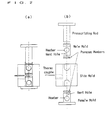
- the heating is performed with purging this gas because the ring-closing reaction is conducted in a mold. Accordingly, a mold provided with a vent hole and porous members at molding faces as shown in Fig. 2 is preferably used rather than a mold provided with no vent hole as shown in Fig. 1.
- the uncyclized aromatic heterocycles homogeneously dispersed in the matrix-like portions formed by the flexible chain moieties act as aromatic heterocycles forming rigid moieties as such, so that the aromatic heterocycles are dispersed finely and homogeneously in the matrixes, resulting in acquisition of polymer materials having good mechanical characteristics.
- rigid chain blocks have the homogeneous mesh structure without coagulation because of the restraint by the pressure of the mold in the ring-closing reaction.
- the formed articles obtained by mold hot pressing process of the aromatic heterocyclic copolymers of the present invention have the structure in which aromatic hetero-cycle-rich phases, rigid chains acting as reinforcing materials, homogeneously exist as continuous three-dimensional mesh phases in matrix-like phases rich in flexible chain moieties.
- the average size of the three-dimensional meshes is preferably 1 ⁇ m or less, and the size of the continuous phases of the aromatic heterocyclic copolymer blocks is preferably 200 nm or less.
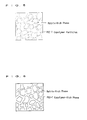
- Fig. 3 is a schematic view showing the state of the aromatic heterocyclic copolymer of the present invention.
- the rigid chain blocks namely, the aromatic heterocyclic polymer blocks form the three-dimensional mesh structure in the matrix-like portions containing the flexible chain moieties, and dispersed very finely and homogeneously.
- the copolymerization with the aromatic polyamide-containing chain moieties enhances the flexibility of the composite materials, so that general melt molding becomes possible.
- coagulation of the rigid chain polymers does not occur in molding, and large phase separation is not developed, different from compounding of two kinds of polymers. Accordingly, the polymer materials of the present invention have excellent mechanical characteristics.
- Such characteristics are caused by forming the copolymers acting as the matrixes in which fragments very high in bending properties are introduced into the rigid polymers, thereby improving the flexibility and combining two elements of the reinforcing polymers and the matrixes in molecules.
- the restraint by the pressure of the molds prevents coagulation of the rigid chain blocks, and allows the reinforcing materials or the rigid chain blocks, namely, the aromatic heterocyclic polymer blocks to form the three-dimensional mesh structure, thereby dispersing them finely and homogeneously in the matrixes.
- general melt molding becomes possible, large phase separation which is developed in the conventional molding of the composite materials is not developed, and coagulation of the aromatic heterocyclic polymers does not occur. Accordingly, the polymer materials excellent in mechanical characteristics can be obtained.
- Solutions of the aromatic heterocyclic copolymers of the present invention are high in liquid crystallinity, and the precursors thereof can be easily spun from solutions of the precursors in organic solvents. According to the method of the present invention, therefore, not only films of the aromatic heterocyclic copolymers, but also fiber thereof can be easily produced.
- Such fine compounding in the same molecule can substantially improve the rigidity, the hardness and characteristics at high temperatures, and can lower the coefficient of linear expansion to a level of light metals, even when a small amount of reinforcing component is added.
- the polymer materials of the present invention have high mechanical strength, and therefore, can be widely utilized as various materials including parts of aircraft, parts of automotive vehicles and space equipment.
- Another aspect of the present invention relates to molecular composite materials of matrix polymers and the above-mentioned aromatic heterocyclic copolymers.
- the molecular composite material is obtained by dissolving the matrix polymer and the unsubstituted or substituted, uncyclized aromatic heterocyclic copolymer precursor in an organic solvent, then coagulating the resulting composite material by removal of the solvent, and subjecting the aromatic heterocyclic copolymer precursor to the ring-closing reaction.
- the aromatic heterocyclic copolymers form a fine particle dispersion type structure, a three-dimensional mesh fine particle dispersion type structure or a three-dimensional mesh type dispersion structure in the matrix polymers.
- the matrix polymers used in the present invention include polyamides, polyimides, polyamideimides, aramid resins (aromatic polyamides), polyethersulfones, and polyetherimides. These matrix polymers are good in miscibility with the aromatic heterocyclic copolymers, and can provide molecular composite materials excellent in mechanical strength. As the matrix polymers, aromatic polyamides and/or aromatic polyamide copolymers are particularly preferred.
- the aromatic heterocyclic copolymer has fragments each containing at least a part of the matrix polymer in repeating units. Accordingly, when the aromatic heterocyclic copolymer precursor is produced, a compound having a structure identical to or similar to a part of the matrix polymer to be mixed therewith is preferably selected as compound (b) described above.
- the aromatic heterocyclic copolymer is preferably a polybenzothiazole copolymer.
- the above-mentioned matrix polymer and the aromatic heterocyclic copolymer precursor obtained as described above are dissolved in an organic solvent sufficiently dissolving both, and then, the solvent is removed for coagulation to obtain the molecular composite material composed of the matrix polymer and the aromatic heterocyclic copolymer precursor.
- organic solvents suitably used include organic solvents of the amide family such as N-methyl-2-pyrrolidone (NMP) and N,N-dimethylacetamide, and dimethyl sulfoxide.
- NMP N-methyl-2-pyrrolidone
- N,N-dimethylacetamide dimethyl sulfoxide.
- the ratio of the copolymer precursor to the matrix polymer is preferably established so that the final compounding ratio of the aromatic heterocyclic copolymer to the matrix polymer is within the range from 1:99 to 90:10. If the compounding ratio of the aromatic heterocyclic copolymer acting as a reinforcing polymer is too high, its existence becomes too dense. Accordingly, molecules of the aromatic heterocyclic copolymer aggregate, resulting in poor dispersion at the molecular level, which conceivably decreases the mechanical strength of the molecular composite material. More preferably, the compounding ratio is 3:97 to 80:20.
- the copolymer precursor and the matrix polymer may be dissolved by any methods, as long as a homogeneous solution is obtained.
- a solution of the copolymer precursor and a solution of the matrix polymer may each be prepared, followed by mixing them with each other to provide a homogeneous solution, or the matrix polymer may be added to a solution in which the copolymer precursor is dissolved to form a homogeneous solution. Further, both may be dissolved in one kind of solvent at the same time.
- the final concentration of the solutions is preferably 1 to 40% by weight, and more preferably 3 to 30% by weight. Less than 1% by weight is too thin to be practical, whereas exceeding 40% by weight results in a reduction in solubility.
- the mixing time is preferably about 6 hours to about 30 days, although it somewhat varies according to the matrix polymer used and the kind of solvent.
- the mixing temperature is -15°C to 150 °C, preferably room temperature to 80°C, and more preferably room temperature to 60°C.
- the solubility is low at a low temperature of less than -15 °C, whereas the decomposition unfavorably proceeds at a temperature exceeding 150 °C.
- the copolymer precursor solution and the matrix polymer solution are preferably prepared and mixed in an atmosphere of an inert gas such as nitrogen or argon gas, or under vacuum.
- the solvent is removed from the solution in which the matrix polymer and the aromatic heterocyclic copolymer precursor are dissolved, thereby coagulating the composite material to obtain a composite coagulum of the matrix polymer and the aromatic heterocyclic copolymer.
- Methods for removing the solvents include introduction of the solutions of the matrix polymers and the aromatic heterocyclic copolymer precursors into poor solvents, and methods for removing the solvents by heating or reduced pressure.
- the poor solvents used herein include alcohols such as methanol and ethanol and distilled water.
- Methods for introducing the solutions into the poor solvents may be any, including spraying, dropping, pouring in the fiber form and spreading in the tabular form of the solutions in the poor solvents.
- the solution When the solution is poured in the fiber form, it may be simply poured in the poor solvent. However, it is more preferred that the solution is ejected through a die having a diameter of 0.1 mm to 1 mm. In this case, the fiber coagulated in the poor solvent is preferably continuously taken up.
- silylated compounds are used as compounds (a) and (b) in the production of the aromatic heterocyclic copolymer precursor, desilylation thereof is conducted.
- the silylated aromatic heterocyclic copolymer precursor has high solubility in the organic solvent and good miscibility with the matrix polymer.
- the desilylation is therefore applied to a composite coagulum after the aromatic heterocyclic copolymer precursor and the matrix copolymer have been dissolved and the resulting product has been coagulated.
- the desilylation can be conducted by stirring the composite coagulum in an alcohol such as methyl alcohol for several hours to repeat washing with the alcohol in a manner similar to that of the aromatic heterocyclic copolymer.
- reaction equation (17) A reaction equation of desilylation treatment of the PBZ-O copolymer precursor obtained according to reaction equation (12) described above is shown below as reaction equation (17): wherein Ar is an aromatic residue.
- the composite coagulum of the copolymer precursor and the matrix copolymer obtained above is heated to allow the thiazole or oxazole ring-closing reaction to occur, thus obtaining the molecular composite material of the aromatic heterocyclic copolymer and the matrix copolymer.
- the alkyl group R is eliminated for the PBZ-T copolymer precursor, or hydrogen is eliminated for the PBZ-O copolymer precursor, and a thiazole or oxazole ring is formed at the eliminated site to form an aromatic heterocyclic copolymer.
- the use of the PBZ-O copolymer precursor as the copolymer precursor results in formation of an aromatic heterocyclic copolymer having the following structural formula (9) which is finely dispersed in the matrix polymer.
- the heating temperature is generally 250 °C to 400 °C, although it varies according to the kind of matrix polymer used.
- the formation of the thiazole or oxazole ring is not observed at a temperature of less than 250°C, whereas the decomposition of the polymers is unfavorably initiated at a temperature exceeding 400 °C.
- the heating is most suitably conducted at about 330°C for about 30 minutes.
- the heating is most suitably conducted at about 350°C for about 30 minutes.
- the heating may be conducted not only at a constant temperature, but also according to a heating program gradually changing the temperature.
- the heating is preferably conducted in vacuo.
- the composite coagulum of the copolymer precursor and the matrix copolymer is in the fiber form
- such heat treatment is preferably performed under tension or with drawing. Namely, the heat treatment is conducted while keeping the length of fibrous coagulum constant or while drawing the fibrous coagulum.
- a jig which can clamp both ends of the fibrous coagulum is preferably used.
- the draw ratios preferably about 1.1 to about 2.0.
- copolymer precursors used in the present invention contract in association with the ring-closing reaction. Contracting tension is therefore generated on heating, and keeping the length of the fibrous coagulum constant results in self drawing to bring about a state similar to drawing. Accordingly, heating under conditions under which such tension is generated can prevent aromatic heterocyclic copolymer molecules from being coagulated, and can uniaxially orient rigid polymers well.
- the fibrous coagulum When the fibrous coagulum is heated while keeping the length thereof constant, it is most suitable that the coagulum in which the aromatic heterocyclic copolymer precursor is the PBZ-T copolymer precursor is heated at 250 °C for 1 hour, and then, the temperature thereof is elevated to 275 °C, followed by heating for 1 hour and further elevated to 300 °C, followed by heating with drawing. Further, it is most suitable that the coagulum in which the aromatic heterocyclic copolymer precursor is the PBZ-0 copolymer precursor is heated at a temperature of 250°C to 400 °C for 30 minutes to 1 hour. Furthermore, when heated with drawing, it is preferred that the coagulum is heated at 250°C for 1 hour, and then, the temperature thereof is elevated to 275°C, followed by heating with drawing for 1 hour and further elevated to 300 °C, followed by heating for 1 hour.
- the heating may be performed in the atmosphere, it is preferably conducted in vacuo or in an inert atmosphere.
- the molecular composite materials of the matrix polymers and the aromatic heterocyclic copolymers thus obtained are molded by the mold hot pressing process, thereby being able to obtain formed articles of the molecular composite materials of the present invention.
- the molecular composite material When the molecular composite material is fibrous, it is preferably placed in a mold as staple fiber having a length of 1 to 30 mm, and a diameter of 0.3 mm to 1.0 mm in molding, followed by mold hot pressing.
- the molding temperature is preferably 200°C to 400 °C. Less than 200 °C results in insufficient molding fluidity to cause the fear of development of voids, whereas exceeding 400 °C unfavorably initiates the decomposition of the polymers.
- the pressure is preferably 60 kgf/cm 2 to 300 kgf/cm 2 , and more preferably 80 kgf/cm 2 to 150 kgf/cm 2 . Less than 60 kgf/cm 2 results in easy development of voids in the formed articles, whereas exceeding 300 kgf/cm 2 results in the tendency of the problem of residual stress to arise.
- the mold hot pressing process may be conducted in the atmosphere, it is preferably performed in an atmosphere of an inert gas, and more preferably in a glove box in an atmosphere of argon gas.
- the copolymer precursors homogeneously dispersed in the matrix polymers at the molecular level are converted to the aromatic heterocyclic copolymers as such by the ring-closing reaction.
- the molecular composite materials are therefore obtained in which the aromatic heterocyclic copolymers are dispersed finely and homogeneously in the matrix polymers.
- the aromatic heterocyclic copolymers do not coagulate, and large phase separation does not occur. Accordingly, in the formed articles of the aromatic heterocyclic copolymers molded from the powdery composite coagulums, the aromatic heterocyclic copolymers form the fine particle dispersion type structure.
- molecules of the reinforcing materials are finely dispersed without occurrence of granular coagulation, so that they form the three-dimensional mesh fine particle dispersion type structure having uniform meshes and composed of the finely divided molecules of the reinforcing materials.
- Fig. 4 is a schematic view showing the structure of a formed article molded from the powdery molecular composite material of the present invention.
- the formed article of the molecular composite material of the present invention has a structure in which a matrix-rich phase is an island component and the aromatic heterocyclic copolymer or the reinforcing material is a sea component, and the reinforcing polymer (aromatic heterocyclic copolymer) is homogeneously dispersed in the reinforcing material-rich phase as particles having a maximum size of 100 nm or less.
- Fig. 5 is a schematic view showing the structure of a formed article molded from the fibrous molecular composite material of the present invention.
- the formed article of the molecular composite material of the present invention has a structure in which a phase rich in the aromatic heterocyclic copolymer or the reinforcing polymer is distributed in the matrix polymer in the three-dimensional mesh form, and the reinforcing polymer is dispersed in the PBZ-T copolymer-rich phase as fine particles.
- the average size of the meshes is preferably 2 ⁇ m or less, and the average size of the aromatic heterocyclic copolymer particles is preferably 60 nm or less.
- the aromatic heterocyclic copolymers are used as the reinforcing materials for the matrix polymers, said aromatic heterocyclic copolymers being improved in miscibility with the matrix polymers by introducing fragments identical to or similar to the matrix polymers into the aromatic heterocyclic polymers to form copolymers.
- the aromatic heterocyclic copolymers can be dispersed homogeneously and finely at the nanometer level in the matrix polymers.
- the molecular composite materials of the present invention can be applied to the general melt molding, do not generate large phase separation, do not produce coagulation of the aromatic heterocyclic copolymers, and are excellent in mechanical characteristics.
- the above descriptions are directed to the formed articles of the molecular composite materials which are obtained by molding the composite coagulums of the aromatic heterocyclic copolymers and the matrix polymers after ring closure of aromatic heterocycles thereof.
- the composite coagulums can be molded without ring closure, and then cyclized, thereby obtaining the formed articles of the molecular composite materials.
- the composite coagulums used herein are obtained by dissolving the matrix polymers and the aromatic heterocyclic copolymer precursors in the organic solvents in which both can be sufficiently dissolved, and then removing the solvents to coagulate the composite materials, similarly to the composite coagulums used in molding after ring closure.
- the compounding ratio of the copolymer precursor to the matrix polymer is preferably established so that the final weight ratio is within the range from 1:99 to 70:30, and more preferably within the range from 1:99 to 60:40.
- the formed articles of the molecular composite materials are produced by molding the composite coagulums of the aromatic heterocyclic copolymer precursors and the matrix polymers by mold hot pressing, and then heating the composite coagulums in molds at a specified temperature to induce the ring-closing reaction.
- the fibrous composite coagulums When used in this case, they may be drawn for use.
- They may be placed in molds as they are in the long fiber form, or as fiber cut to a length of about 2 mm to about 10 mm.
- the mold hot pressing is conducted in such a manner that the ring-closing reaction of the aromatic heterocyclic copolymer precursors does not occur.
- the molding temperature is preferably 200 °C to 400 °C. Less than 200 °C results in insufficient molding fluidity to cause the fear of development of voids, whereas exceeding 400 °C unfavorably initiates the decomposition of the polymers.
- the pressure is preferably 10 kgf/cm 2 to 500 kgf/cm 2 , and more preferably 100 kgf/cm 2 to 300 kgf/cm 2 . Less than 10 kgf/cm 2 results in remaining of voids in the formed articles, whereas exceeding 500 kgf/cm 2 results in application of residual stress to the formed articles.
- the molding is preferably performed in a glove box in an atmosphere of an inert gas such as argon.
- the temperature of the molds is elevated as such to heat treat the copolymer precursors in the molds under pressure, thereby allowing the ring-closing reaction to occur in the aromatic heterocyclic copolymer precursors.
- the formed articles of the molecular composite materials of the aromatic heterocyclic copolymers and the matrix polymers are produced.
- the temperature of heat treatment is generally 250 °C to 350 °C although it varies depending on the kind of matrix polymer used.
- the formation of aromatic heterocycles such as thiazole and oxazole rings is not observed at a temperature of lower than 250 °C.
- the temperature is elevated to 320°C at a rate of temperature elevation of 1 °C/minute after molding, followed by heating for 5 minutes.
- the aromatic heterocyclic copolymer precursor is the PBZ-O copolymer precursor, it is most suitable that the temperature is elevated to 350 °C at a rate of temperature elevation of 1 °C/minute after molding, followed by heating for 5 minutes. If the rate of temperature elevation and the heating temperature exceed these value, the material is unfavorably decomposed.
- the heating may be conducted not only at a constant temperature, but also according to a heating program gradually changing the temperature.
- the heating is preferably conducted in an inert atmosphere.
- the pressure in heating is preferably 50 kgf/cm 2 to 300 kgf/cm 2 .
- the alkyl group R is eliminated for the PBZ-T copolymer precursor, or hydrogen is eliminated for the PBZ-O copolymer precursor, and a thiazole or oxazole ring is formed at the eliminated site to form an aromatic heterocyclic copolymer.
- a gas is generated in the ring-closing reaction.
- the heating is performed with purging this gas because the ring-closing reaction is conducted in a mold.
- a mold provided with a vent hole and porous members at molding faces as shown in Fig. 2 is preferably used, similarly to the mold used in the ring closing reaction of the aromatic heterocyclic copolymer precursors.
- the copolymer precursors homogeneously dispersed in the matrix polymers at the molecular level are converted to the aromatic heterocyclic copolymers as such, resulting in fine and homogeneous dispersion of the aromatic heterocyclic copolymers in the matrix polymers.
- the molecular composite materials having good mechanical characteristics are obtained.
- molecules of the reinforcing materials form the homogeneous mesh structure without occurrence of granular coagulation because of the restraint by the pressure of the molds in the ring-closing reaction.
- Fig. 6 is a schematic view showing the structure of the molecular composite material of the present invention.
- the formed article of the molecular composite material of the present invention has a structure in which a phase rich in the aromatic heterocyclic copolymer or the reinforcing polymer uniformly exists as a continuous three-dimensional mesh phase in a matrix polymer-rich phase.
- the average size of the meshes is preferably 1 ⁇ m or less, and the average size of the continuous phase of the aromatic heterocyclic copolymer is preferably 200 nm or less.
- the molecular composite materials of the present invention in which the aromatic heterocyclic copolymers or the reinforcing materials thus form the three-dimensional mesh structure and dispersed very finely and homogeneously in the matrix polymers, can be applied to the general melt molding, do not produce coagulation of the reinforcing material polymers in molding, and do not generate large phase separation, whereby the molecular composite materials of the present invention have excellent mechanical characteristics.
- the aromatic heterocyclic polymers which are generally poor in solubility, are only soluble in strong acids, do not melt by heat, are poor in miscibility, and are difficult of molding processing are combined with the matrix polymers to form the composite materials, the fragments identical to or similar to the matrix polymers are introduced into the aromatic heterocyclic polymers to form the copolymers, thereby improving the miscibility with the matrix polymers.
- the restraint by the pressure of the molds prevents coagulation of the molecules of the reinforcing materials, and allows the aromatic heterocyclic copolymers or the reinforcing materials to form the three-dimensional mesh structure, thereby dispersing them finely and homogeneously in the matrix polymers to form the composite materials.
- the molecular composite materials can be obtained which can be applied to the general melt molding, do not generate large phase separation in molding, do not produce coagulation of the aromatic heterocyclic copolymers, and are excellent in mechanical characteristics.
- ultrasonic vibrations can be applied to the composite coagulums of the aromatic heterocyclic copolymer precursors and the matrix polymers under pressure, thereby achieving molding and ring closure to obtain the formed articles of the molecular composite materials.
- the composite coagulums of the aromatic heterocyclic copolymer precursors and the matrix polymers can induce the chain-reacting ring-closing reaction from melting by heating.
- the fibrous coagulums may be drawn for use. Further, they may be placed in molds as they are in the long fiber form, or as fiber cut to a length of about 2 mm to about 10 mm.
- the molding by ultrasonic vibrations are performed according to the general methods usually employed.
- a cross sectional view of a mold is shown in Fig. 7.
- the ultrasonic vibrations are superimposed through a horn to which they are given.
- Materials of the horn include aluminum, titanium and ceramic-sprayed titanium, and titanium and ceramic-sprayed titanium poor in thermal conductivity are preferred.
- a female mold is preferably made of a resin which is poor in thermal conductivity and does not harm the horn. However, a mold having a clearance of about 0.5 mm may also be used. When the resin female mold is used, the clearance thereof may be selected to a degree that the horn moves without resistance.
- the output of an ultrasonic wave generator can be appropriately determined according to the size of the formed article, etc.
- the output is preferably 100 W to 5,000 W
- the frequency of ultrasonic vibrations is preferably 10 kHz to 20 kHz.
- the amplitude of the horn is preferably 10 ⁇ m to 200 ⁇ m.
- the pressure in application of ultrasonic vibrations is preferably 10 kgf/cm 2 to 500 kgf/cm 2 , and more preferably 50 kgf/cm 2 to 300 kgf/cm 2 . Less than 10 kgf/cm 2 results in the tendency of inferior molding to take place, whereas exceeding 500 kgf/cm 2 results in too much overflow.
- the application time of ultrasonic vibrations varies according to the kind of matrix polymer used, it is generally preferably 1 second to 60 seconds. Less than 1 second results in insufficient molding, whereas exceeding 60 seconds results in resin yellowing. After application for a specified period of time, the formed article is allowed to stand under pressure for 10 second to 360 seconds until it is cooled.
- such application of ultrasonic vibrations induces the chain-reacting ring-closing reaction of thiazole or oxazole in the copolymer precursor from melting by heating to form the composite material of the aromatic heterocyclic copolymer.
- the alkyl group R is eliminated for the PBZ-T copolymer precursor, or hydrogen is eliminated for the PBZ-O copolymer precursor, and an aromatic heterocycle such as a thiazole or oxazole ring is formed at the eliminated site to form the aromatic heterocyclic copolymer.
- the PBZ-T copolymer precursor obtained by reaction equation (6) described above is used as the copolymer precursor, the aromatic heterocyclic copolymer represented by formula (8) described above is formed.
- a gas is generated in the ring-closing reaction.
- the method of the present invention is very excellent in the mold gassing effect, so that voids do not remain in the formed article.
- the mold is heated from the periphery thereof, and therefore an outer portion of the formed article is first elevated in temperature, from which melting starts. Accordingly, the outer portion is melted in the capsule form, and a powder in a center portion remains as it is, in which the gas accumulates, resulting in very difficulty of degassing.
- the inside of the formed article is melted by use of the internal exothermic reaction, so that the method of the present invention has not such a problem.
- the copolymer precursors homogeneously dispersed in the matrix polymers at the molecular level are converted to the aromatic heterocyclic copolymers as such, resulting in fine and homogeneous dispersion of the aromatic heterocyclic copolymers in the matrix polymers.
- the molecular composite materials having good mechanical characteristics are obtained.
- molecules of the reinforcing materials form the structure that needle-like materials are homogeneously dispersed or homogeneously dispersed in the mesh form, without occurrence of granular coagulation because of the restraint by the pressure of the molds in the ring-closing reaction.
- the aromatic heterocyclic copolymer or the reinforcing material is thus dispersed very finely and homogeneously in the matrix polymer as the needle-like material or the mesh structure formed by the needle-like material.
- the reinforcing material polymer does not coagulate, and large phase separation does not occur, thereby the composite material of the present invention has excellent mechanical characteristics.
- NMP N-methyl-2-pyrrolidone
- monomer A obtained as described above was dissolved in a stream of argon.
- 2.28 g (9.6 mmoles) of chloroterephthaloyl dichloride represented by the following formula (15) was added under ice cooling, followed by stirring for 30 minutes to obtain oligomer (I).
- a solution of oligomer (II) was added to a solution of oligomer (I), followed by stirring at a temperature of 0°C to room temperature for 6 to 8 hours.
- the reaction solution was poured in ethanol to cause coagulation, and the resulting coagulum was dried under vacuum at 80 °C.
- the yield was 99%.
- the intrinsic viscosity ⁇ inh of this polymer was 0.42.
- the intrinsic viscosity was measured at a polymer concentration in NMP of 0.5 g/dl by the Ubbelohde method.
- the polymer was dissolved in NMP to give a concentration of 20% by weight, followed by stirring at room temperature for 1 week.
- the resulting solution was blown into ethanol with a spray to obtain a rapidly coagulated powder.
- This coagulated powder was stirred in a methanol/water (weight ratio: 1:1) mixed solution for 2 hours to conduct desilylation, followed by drying under vacuum at 100°C.
- the mold shown in Fig. 1 was filled with the resulting product, and molding was carried out at a pressure of 100 kgf/cm 2 by the mold hot pressing process to obtain a tabular formed article of 15 mm X 15 mm X 2t mm.
- the molding operation was conducted according to the heating program shown in Fig. 8.
- the bending elasticity of the resulting formed article was 655 kgf/mm 2 , and the strength thereof was 4.7 kgf/mm 2 .
- This polymer was molded at a pressure of 100 kgf/cm 2 by the mold hot pressing process according to the heating program shown in Fig. 9 to obtain a tabular formed article of 50 mm X 15 mm X 2t mm.
- the bending elasticity of the resulting formed article was 405 kgf/mm 2 , and the strength thereof was 11.2 kgf/mm 2 .
- the reaction solution was poured in ethanol to cause coagulation, and the resulting coagulum was refluxed in a methanol/water (weight ratio: 1:1) mixed solution for 2 hours to conduct desilylation.
- the resulting product was dried under vacuum at 100 °C.
- the intrinsic viscosity ⁇ inh of this polymer was 0.82.
- the intrinsic viscosity was measured at a polymer concentration in NMP of 0.5 g/dl by the Ubbelohde method.
- the above-mentioned copolymer precursor was dissolved in DMSO to give a concentration of 20% by weight, and the resulting solution was cast on a glass plate. This was placed on a hot plate heated at 80°C to evaporate the solvent, thereby obtaining an uniform film. This film was heat treated under vacuum at 350°C for 30 minutes to cyclize the polyoxazole.
- the tensile elasticity of the film thus obtained was 509 kgf/mm 2 , and the strength thereof was 3.6 kgf/mm 2 .
- the tensile elasticity of the film obtained from the copolymer precursor before ring closure of the polyoxazole, namely before heating was 219 kgf/mm 2 , and the strength thereof was 4.6 kgf/mm 2 .
- a PBZ-T block copolymer precursor represented by the following formula (18) was produced as show below.
- the solution of oligomer (II) in NMP was added to the solution of oligomer (I) in NMP obtained by the above-mentioned procedure, followed by stirring at a temperature under ice cooling to room temperature.
- the resulting solution was poured in a large amount of ethanol to coagulate the polymer. This procedure was conducted with stirring ethanol. After washing several times with ethanol, the resulting precipitate (polymer) was dried under vacuum at 120 °C.
- the intrinsic viscosity ⁇ inh of this polymer was 1.4.
- the intrinsic viscosity was measured at a polymer concentration in NMP of 0.5 g/dl at 30°C by the Ubbelohde method.
- the ratio of the degree of polymerization m of a moiety derived from oligomer (I) and exhibiting the rigidity to the degree of polymerization n of a moiety derived from oligomer (II), forming a matrix and exhibiting the flexibility in the entire molecule (m:n) was 4:6.
- the coagulated polymer powder obtained as described above was dissolved in NMP to give a concentration of 25% by weight, and the mixture was stirred at a temperature of room temperature to 80 °C for 1 week to obtain a homogeneous solution. This solution was blown into ethanol with a spray to obtain a rapidly coagulated powder. This was filtered, and the resulting coagulated powder was dried under vacuum at 120 °C.
- the mold shown in Fig. 2 was filled with the resulting coagulated polymer powder, and the mold hot pressing process was carried out at 230°C. Then, the temperature of the mold was elevated as such, and the PBZ-T block copolymer precursor was cyclized at 320 °C by internal mold heat treatment. Thus a test piece (T/P) of a tabular formed article of 15 mm X 50 mm X 2t mm was obtained. In this case, the mold was heated and pressurized according to a heating and pressurizing program shown in Fig. 10. Further, the heating was performed in a glove box in an argon atmosphere.
- FIG. 11 A transmission electron micrograph (ultrathin sectioning method, magnification: 14,000X) of the resulting formed article is shown in Fig. 11. This shows that a PBZ-T-rich phase uniformly exists as a continuous three-dimensional mesh phase in a base matrix. The average size of the meshes was 0.3 ⁇ m or less, and the average size of the PBZ-T continuous phase was about 60 nm.
- the resulting solution was poured in a large amount of ethanol to coagulate the polymer. This procedure was conducted with stirring ethanol. After washing several times with ethanol, the resulting precipitate (polymer) was dried under vacuum at 120 °C.
- the mold shown in Fig. 1 was filled with the resulting coagulated polymer powder, and the mold hot pressing process was carried out to obtain a test piece (T/P) of a tabular formed article of 15 mm X 50 mm X 2t mm.
- the mold was heated and pressurized according to a heating and pressurizing program shown in Fig. 13.
- a PBZ-T block copolymer precursor represented by the following formula (21) was synthesized in the same manner as with Example 3 with the exception that 3.5082 g of a diamine represented by formula (13) described above is used as compound (b) to synthesize oligomer (II).
- reaction solution was adjusted to give a concentration of 25% by weight, and this solution was blown into a large amount of ethanol with a spray to obtain a rapidly coagulated powder. This was filtered, and the resulting coagulated powder was dried under vacuum at 120 °C.
- the intrinsic viscosity ⁇ inh of this polymer was 1/2.
- the intrinsic viscosity was measured at a polymer concentration in NMP of 0.5 g/dl at 30°C by the Ubbelohde method.
- the ratio of the degree of polymerization m of a moiety derived from oligomer (I) and exhibiting the rigidity to the degree of polymerization n of a moiety derived from oligomer (II), forming a matrix and exhibiting the flexibility in the entire molecule (m:n) was 4:6.
- the mold was filled with the coagulated polymer powder thus obtained, and the powder was molded in the same manner as with Example 3 with the exception that the mold was heated and pressurized according to a program shown in Fig. 14.
- the properties of the formed article are shown in Table 2.
- the resulting solution was poured in a large amount of ethanol to coagulate the polymer. This procedure was conducted with stirring ethanol. After washing several times with ethanol, the resulting precipitate (polymer) was dried under vacuum at 120 °C.
- This solution was sprayed in a large amount of ethanol to obtain a coagulated composite powder composed of the random copolymer precursor and the aromatic polyamide. This was filtered, and the resulting coagulated powder was dried under vacuum at 100 °C.
- the powder dried under vacuum was heat treated under vacuum at 330 °C for 30 minutes to cyclize the random copolymer precursor, thus obtaining a PBZ-T copolymer.
- the content of PBZ-T was 30% by weight.
- the mold shown in Fig. 1 was filled with the composite material thus obtained, and the mold hot pressing process was carried out to obtain a test piece (T/P) of a formed article of 15 mm X 50 mm X 2t mm.
- a heating program of the mold used in this case is shown in Fig. 15. The pressure was 100 kgf/cm 2 .
- This micrograph shows that the formed article comprises two phases, island-like portions and a sea-like portion containing them, and that particles having a maximum size of 10 to 50 nm are homogeneously dispersed in the sea-like portion.
- Fig. 4 is a schematic view of this micrograph. EDX spectra of the sea-like and island-like portions of this drawing was taken, and are shown in Figs. 23 and 24, respectively.
- the sea-like portion contains S and C1, but the island-like portion does not contain them, which reveals that the sea-like portion is a polybenzothiazole-rich phase and the island-like portion is a matrix-rich phase.
- the composite material of the present invention is a two-phase composite material comprising the matrix-rich phase as an island component and the reinforcing polymer-rich phase as a sea component, and the reinforcing material is homogeneously dispersed as fine particles in the reinforcing polymer-rich phase.
- Example 5 Only the matrix polymer used in Example 5 was molded at 100 kgf/cm 2 by the mold hot pressing process to obtain a test piece (T/P) of a formed article of 50 mm X 15 mm X 2t mm. A heating program of the mold used in this case is shown in Fig. 19.
- the elasticity was 479 kgf/mm 2 , and the strength was 20.4 kgf/mm 2 .
- Example 5 The properties of the formed article obtained in Example 5 are shown in Table 3, in comparison with those of the formed article obtained in Comparative Example 4. TABLE 3 Example 5 Comparative Example 4 Bending Elasticity (JIS K7203) (kgf/mm 2 ) 644 479 Specific Gravity (JIS K7112) (g/cm 3 ) 1.37 1.29 Izod Impact Value (JIS K7113) (KJ/ m 2 ) 5.0 2.4 Rockwell Hardness (M Scale) 122.0 112.3 Thermal Decomposition Temperature (JIS K7120) in N 2 (°C) >400 >400 Coefficient of Linear Expansion (JIS K7197); 130 °C 3.89X10 -5 6.16X10 -5 170 °C 3.88X10 -5
- a formed article was obtained in the same manner as with Example 5 with the exception that the mixing ratio of the random copolymer precursor to the matrix polymer was changed to give final PBZ-T contents ranging from 6% to 50% by weight, and the bending elasticity of these formed articles was measured.
- the relationship between the PBZ-T content and the bending elasticity is shown in Fig. 21.
- a random copolymer precursor was obtained in the same manner as with Example 5 with the exception that m is changed to 6 and n is changed to 4.
- the intrinsic viscosity ⁇ inh of this polymer was 1.2.
- the intrinsic viscosity was measured at a polymer concentration in NMP of 0.5 g/dl at 30 °C by the Ubbelohde method.
- a block polymer precursor represented by the same structural formula as that of the copolymer precursor in Example 5 was produced in the following manner.
- NMP Five milliliters of NMP was placed in a well-dried 50-ml flask in a stream of dried argon, and 8 mmoles (2.227 g) of compound(a t ) represented by formula (19) described above was dissolved therein to prepare a homogeneous NMP solution.
- the solution of oligomer (I) in NMP obtained by the above-mentioned procedure was added to the solution of oligomer (II) in NMP. Thereafter, the flask used for the solution of oligomer (I) in NMP was further washed with 2 ml of NMP, and the washings were also added the solution of oligomer (II) in NMP.
- the mixed polymer solution was stirred for 1 hour under ice cooling, and the temperature thereof was elevated to room temperature with stirring. Then, stirring was further continued while maintaining the temperature of the solution at room temperature.
- the intrinsic viscosity ⁇ inh of this polymer was 1.2.
- the intrinsic viscosity was measured at a polymer concentration in NMP of 0.5 g/dl at 30°C by the Ubbelohde method.
- the ratio of the degree of polymerization m of a moiety derived from oligomer (I) and exhibiting the rigidity to the degree of polymerization n of a moiety derived from oligomer (II) and exhibiting the flexibility in the entire molecule (m:n) was 8:2.
- Example 13 Five grams of the block copolymer precursor obtained by the above-mentioned method and 5.71 g of the same matrix polymer as used in Example 5 were dissolved in amounts shown in Table 4 of NMP, and formed articles were obtained in the same manner as with Example 5. The PBZ-T content of all the formed articles was 30% by weight. TABLE 6 Example 13 14 15 16 17 Amount of NMP (ml) 214 107 72 54 43
- a random copolymer precursor was obtained in the same manner as with Example 5 with the exception that isophthaloyl dichloride was used as compound (c).
- the intrinsic viscosity ⁇ inh of this polymer was 1.4.
- the intrinsic viscosity was measured at a polymer concentration in NMP of 0.5 g/dl at 30°C by the Ubbelohde method.
- the structure of the resulting random copolymer precursor is deduced to be as the following formula (24):
- Example 8 The resulting random copolymer precursor and the same matrix polymer as used in Example 5 were dissolved in amounts shown in Table 8 in 400 ml of NMP, and formed articles were obtained in the same manner as with Example 5.
- the PBZ-T content of these formed articles is shown in Table 8.
- TABLE 8 Amount of Copolymer Precursor Amount of Matrix Amount of PBZ-T (g) (g) (wt%)
- Example 18 3.69 7.38 20
- Example 19 5.53 6.07 30
- a random copolymer precursor was obtained in the same manner as with Example 5 with the exception that the above-mentioned compound represented by formula (13) was used as compound (b).
- the intrinsic viscosity ⁇ inh of this polymer was 0.88.
- the intrinsic viscosity was measured at a polymer concentration in NMP of 0.5 g/dl at 30°C by the Ubbelohde method.
- the structure of the resulting random copolymer precursor is deduced to be as formula (21) described above. In this polymer, m:n is 8:2.
- the desilylated coagulated powder was heat treated under vacuum at 350 °C for 30 minutes to conduct the ring-closing reaction, thereby obtaining a PBZ-O copolymer.
- a formed article of 50 mm X 15 mm X 2t mm was obtained by the mold hot pressing process in the same manner as with Example 5.
- the elasticity was 604 kgf/mm 2
- the strength was 2.5 kgf/mm 2 .
- the solution of the random copolymer precursor and the matrix polymer obtained in Example 23 was poured in the fiber form in a large amount of ethanol to cause coagulation, thereby obtaining a fibrous composite coagulum composed of the random copolymer precursor and the matrix polymer.
- the resulting fibrous coagulum was dried under vacuum at 100°C.
- the fibrous coagulum dried under vacuum was heat treated while keeping the length thereof constant by clamping both ends thereof to cyclize the random copolymer precursor.
- a heating program used in this case is shown in Fig. 27.
- the heat-treated fibrous material was cut to 0.5 to 5 mm, and placed in the mold shown in Fig. 1. Then, molding was carried out by the mold hot pressing process to obtain a tabular formed article of 15 mm X 50 mm X 2t mm. A heating program of the mold used in this case is shown in Fig. 28. The molding was conducted in an argon atmosphere. The bending properties of the formed article are shown in Table 12.
- a transmission electron micrograph (ultrathin sectioning method) of the formed article is shown in Fig. 29.
- the micrograph shows that the formed article has a structure in which a PBZ-T copolymer-rich phase is distributed in the matrix polymer in the three-dimensional mesh form, and the PBT-Z copolymer is also dispersed in the PBZ-T copolymer-rich phase as fine particles.
- the average size of the meshes was 0.5 ⁇ m or less, and the average size of the PBZ-T copolymer particles is about 50 nm.
- a fibrous coagulum of the matrix polymer and the random copolymer precursor was obtained in the same manner as with Example 24, and dried under vacuum.
- the length of this fibrous coagulum was kept constant during temperature elevation to 250°C, and the fibrous material was drawn at a draw ratio of 1.5 during further temperature elevation to 330 °C, followed by heat treatment while keeping the length thereof constant at 330 °C for 30 minutes.
- a heating program used in this case is shown in Fig. 30.
- the heat-treated fibrous material was cut to 0.5 to 5 mm, and placed in the mold shown in Fig. 1. Then, molding was carried out by the mold hot pressing process to obtain a tabular formed article of 15 mm X 50 mm X 2t mm. A heating program of the mold used in this case is shown in Fig. 31. The molding was conducted in an argon atmosphere. The bending properties of the formed article are shown in Table 12.
- Example 24 Only the matrix polymer used in Example 24 was molded by the mold hot pressing process to obtain a formed article of 50 mm X 15 mm X 2t mm. A heating program is shown in Fig. 32. The bending properties of the formed article are shown in Table 12. TABLE 12 Bending Elasticity Bending Strength (kgf/mm 2 ) (kgf/mm 2 ) Example 24 633 5.9 Example 25 760 6.0 Comparative Example 6 479 20.4
- the mold shown in Fig. 1 was filled with the powder dried under vacuum, and the mold hot pressing process was performed at 230°C. Then, the temperature of the mold was elevated as such, and the random copolymer precursor was cyclized at 250 °C by internal mold heat treatment. Thus, a test piece (T/P) of a tabular formed article of 15 mm X 50 mm X 2t mm was obtained.
- a heating program of the mold used in this case is shown in Fig. 33. The pressure was 60 to 100 kgf/cm 2 .
- Example 26 Only the matrix polymer used in Example 26 was molded at a pressure of 100 kgf/cm 2 to 300 kgf/cm 2 by the mold hot pressing process to obtain a test piece (T/P) of a tabular formed article of 50 mm X 15 mm X 2t mm.
- a heating program is shown in Fig. 34.
- the elasticity was 479 kgf/mm 2 , and the strength was 20.4 kgf/mm 2 .
- a coagulated composite powder of the matrix polymer and the random copolymer precursor was obtained in the same manner as with Example 26, and dried under vacuum.
- the mold shown in Fig. 2 was filled with the coagulated composite powder, and the mold hot pressing process was performed at 230°C. Then, the temperature of the mold was elevated as such, and the random copolymer precursor was cyclized at 320 °C by internal mold heat treatment. Thus, a test piece (T/P) of a tabular formed article of 15 mm X 50 mm X 2t mm was obtained.
- a heating program of the mold used in this case is shown in Fig. 35. The pressure was 60 to 300 kgf/cm 2 .
- the molding was performed in a glove box in an argon atmosphere. Further, the heating was conducted in the mold with purging a gas produced by the ring-closing reaction.
- the elasticity was 1,215 kgf/mm 2 , and the strength was 6.0 kgf/mm 2 .
- the amount of PBZ-T produced by ring closure was 15.1% by weight.
- a transmission electron micrograph (ultrathin sectioning method, magnification: 8,500X) of the resulting formed article is shown in Fig. 36.
- the micrograph shows that the formed article comprises two phases of a portion having a three-dimensional mesh structure and the other portion.
- Fig. 6 is a schematic view of this micrograph.
- EDX spectra of the three-dimensional mesh portion (the portion high in contrast in the electron micrograph) and the other portion (the portion low in contrast in the electron micrograph) of this drawing was taken, and are shown in Figs. 44 and 45, respectively.
- the three-dimensional mesh portion high in contrast contains S and Cl, but the other portion does not contain them, which reveals that the three-dimensional mesh portion is a PBZ-T copolymer-rich phase and the other portion is a matrix-rich phase. Accordingly, this shows that the formed article has a structure in which the PBZ-T copolymer-rich phase homogeneously exists in the matrix polymer as the continuous three-dimensional mesh phase.
- the average size of the meshes was 0.5 ⁇ m or less, and the average size of the continuous phase of the PBZ-T copolymer particles is about 60 nm.
- Example 29 Results of Example 29 are shown in Table 14, in comparison with those of Comparative Example 7. TABLE 14 Example 29 Comparative Example 7 Bending Elasticity (JIS K7203) (kgf/mm 2 ) 1215 479 Specific Gravity (JIS K7112) (g/cm 3 ) 1.36 1.29 Izod Impact Value (JIS K7113) (KJ/ m 2 ) 5.1 2.4 Rockwell Hardness (JIS K7202) (HRL) 12.7 120 Thermal Decomposition Temperature (JIS K7120) in N 2 ( °C) >400 >400 Coefficient of Linear Expansion (JIS K7197); 2.15X10 -5 6.16X10 -5 130 °C 170 °C 1.98X10 -5 - 200 °C 1.83X10 -5 - 250 °C 1.94X10 -5 - 300 °C 2.17X10 -5 - Vicat Softening Point (JIS K7206) Not observed (No sinking was observed) 226°C
- a coagulated composite powder dried under vacuum of the matrix polymer and the random copolymer precursor was obtained in the same manner as with Example 29.
- the mold shown in Fig. 2 was filled with the powder, and the mold hot pressing process was performed at 230 °C . Then, the temperature of the mold was elevated as such, and the random copolymer precursor was cyclized at 275 °C by internal mold heat treatment.
- T/P test piece of a tabular formed article of 15 mm X 50 mm X 2t mm was obtained.
- a heating program of the mold used in this case is shown in Fig. 39.
- the pressure was 60 to 300 kgf/cm 2 .
- the molding was performed in a glove box in an argon atmosphere. Further, the heating was conducted in the mold with purging a gas produced by the ring-closing reaction.
- the elasticity was 1,055 kgf/mm 2 , and the strength was 4.6 kgf/mm 2 .
- the amount of PBZ-T produced by ring closure was 20.8% by weight.
- a coagulated composite powder dried under vacuum was obtained in the same manner as with Example 26 with the exception that 24.36 g of the matrix polymer and 15.65 g of the random copolymer precursor were used.
- the mold shown in Fig. 2 was filled with the powder, and the mold hot pressing process was performed at 230°C. Then, the temperature of the mold was elevated as such, and the random copolymer precursor was cyclized at 300 °C by internal mold heat treatment. Thus, a test piece (T/P) of a tabular formed article of 15 mm X 50 mm X 2t mm was obtained.
- a heating program of the mold used in this case is shown in Fig. 40.
- the pressure was 60 to 300 kgf/cm 2 .
- the molding was performed in a glove box in an argon atmosphere. Further, the heating was conducted in the mold with purging a gas produced by the ring-closing reaction.
- the elasticity was 952 kgf/mm 2 , and the strength was 4.6 kgf/mm 2 .
- the amount of PBZ-T produced by ring closure was 12.8% by weight.
- a coagulated composite powder dried under vacuum of the matrix polymer and the random copolymer precursor was obtained in the same manner as with Example 26.
- the mold shown in Fig. 2 was filled with the powder, and the mold hot pressing process was performed at 230 °C. Then, the temperature of the mold was elevated as such, and the random copolymer precursor was cyclized at 300 °C by internal mold heat treatment. Thus, a test piece (T/P) of a tabular formed article of 15 mm X 50 mm X 2t mm was obtained.
- the mold was heated according to the heating program shown in Fig. 40.
- the pressure was 60 to 300 kgf/cm 2 .
- the molding was performed in a glove box in an argon atmosphere. Further, the heating was conducted in the mold with purging a gas produced by the ring-closing reaction.
- the elasticity was 761 kgf/mm 2 , and the strength was 4.2 kgf/mm 2 .
- the amount of PBZ-T produced by ring closure was 11.2% by weight.
- a random copolymer precursor was obtained in the same manner as with Example 26 with the exception that m is changed to 6 and n is changed to 4.
- the intrinsic viscosity ⁇ inh of this polymer was 1.2.
- the intrinsic viscosity was measured at a polymer concentration in NMP of 0.5 g/dl at 30°C by the Ubbelohde method.
- Example 26 8.0 g of the random copolymer precursor thus obtained and 5.34 g of the matrix polymer used in Example 26 were dissolved in 266 ml of NMP to obtain a coagulated composite powder dried under vacuum of the matrix polymer and the random copolymer precursor was obtained in the same manner as with Example 26.
- the mold shown in Fig. 2 was filled with the powder, and the mold hot pressing process was performed at 230°C . Then, the temperature of the mold was elevated as such, and the random copolymer precursor was cyclized at 320°C by internal mold heat treatment. Thus, a test piece (T/P) of a formed article of 15 mm X 50 mm X 2t mm was obtained.
- a heating program of the mold used in this case is shown in Fig. 41.
- the pressure was 60 to 300 kgf/cm 2 .
- the molding was performed in a glove box in an argon atmosphere. Further, the heating was conducted in the mold with purging a gas produced by the ring-closing reaction.
- the elasticity was 861 kgf/mm 2 , and the strength was 4.8 kgf/mm 2 .
- the amount of PBZ-T produced by ring closure was 17.6% by weight.
- Example 26 In 265 ml of NMP, 6.2 g of the block copolymer precursor obtained in Example 13 and 7.08 g of the matrix polymer used in Example 26 were dissolved t obtain a coagulated composite powder dried under vacuum of the matrix polymer and the random copolymer precursor was obtained in the same manner as with Example 26.
- the mold shown in Fig. 2 was filled with the powder, and the mold hot pressing process was performed at 230°C. Then, the temperature of the mold was elevated as such, and the random copolymer precursor was cyclized at 300°C by internal mold heat treatment. Thus, a test piece (T/P) of a formed article of 15 mm X 50 mm X 2t mm was obtained.
- the mold was heated according to the heating program shown in Fig. 40.
- the pressure was 60 to 300 kgf/cm 2 .
- the molding was performed in a glove box in an argon atmosphere. Further, the heating was conducted in the mold with purging a gas produced by the ring-closing reaction.
- the elasticity was 982 kgf/mm 2 , and the strength was 5.1 kgf/mm 2 .
- the amount of PBZ-T produced by ring closure was 15.7% by weight.
- test piece (T/P) of a formed article of 15 mm X 50 mm X 2t mm was obtained in the same manner as with Example 34 with the exception that the mold was heated according to the heating program shown in Fig. 41 and heat treatment was conducted at 320°C.
- the pressure was 60 to 300 kgf/cm 2 .
- the elasticity was 1124 kgf/mm 2 , and the strength was 6.7 kgf/mm 2 .
- the amount of PBZ-T produced by ring closure was 14.3% by weight.
- a solution of 18.35 g of the random copolymer precursor and 21.64 g of the matrix polymer in NMP was prepared in the same manner as with Example 27, and the resulting solution was poured in a large amount of ethanol to obtain a fibrous composite coagulum of the random copolymer precursor and the matrix polymer. Then, the fibrous coagulum was dried under vacuum at 80°C. The resulting fibrous material was drawn at a draw ratio of 1.5 at 250°C, and pulverized to 2 to 10 mm.
- the mold shown in Fig. 2 was filled with the resulting powdery material, and the mold hot pressing process was performed at 230°C. Then, the temperature of the mold was elevated as such, and the random copolymer precursor was cyclized at 300 °C by internal mold heat treatment. Thus, a test piece (T/P) of a formed article of 15 mm X 50 mm X 2t mm was obtained.
- a heating program of the mold used in this case is shown in Fig. 42.
- the pressure was 100 to 300 kgf/cm 2 .
- the molding was performed in a glove box in an argon atmosphere. Further, the heating was conducted in the mold with purging a gas produced by the ring-closing reaction.
- the elasticity was 1263 kgf/mm 2 , and the strength was 4.7 kgf/mm 2 .
- the amount of PBZ-T produced by ring closure was 14.5% by weight.
- the mold shown in Fig. 2 was filled with the powder dried under vacuum, and the mold hot pressing process was performed. Then, the temperature of the mold was elevated as such, and the PBZ-O random copolymer precursor was cyclized by internal mold heat treatment. Thus, a test piece (T/P) of a tabular formed article of 15 mm X 50 mm X 2t mm was obtained.
- a heating program of the mold used in this case is shown in Fig. 43.
- the pressure was 30 to 100 kgf/cm 2 .
- the molding was performed in a glove box in an argon atmosphere. Further, the heating was conducted in the mold with purging a gas produced by the ring-closing reaction.
- the elasticity was 686 kgf/mm 2 , and the strength was 3.9 kgf/mm 2 .
- the amount of PBZ-O produced by ring closure was 2.8% by weight.
- test piece (T/P) of a formed article of 15 mm X 50 mm X 2t mm was obtained in the same manner as with Example 37 with the exception that the mold was heated according to a heating program shown in Fig. 44.
- the pressure was 30 to 100 kgf/cm 2 .
- the elasticity was 703 kgf/mm 2 , and the strength was 3.2 kgf/mm 2 .
- the amount of PBZ-O produced by ring closure was 2.9 by weight.
- Example 5 The solution of the aromatic heterocyclic copolymer and the matrix polymer obtained in Example 5 was sprayed in a large amount of ethanol to obtain a coagulated composite powder of the random copolymer precursor and the matrix polymer. This was filtered, and the resulting coagulated composite powder was dried under vacuum at 100°C.
- the mold shown in Fig. 7 was filled with the powder dried under vacuum, and ultrasonic vibrations were applied thereto for a specified period of time shown in Table 15 under the following conditions to conduct molding and ring closure of the random copolymer precursor.
- the horn was made of aluminum, and the female mold was made of a resin.
- Example 41 Pressure (kgf/cm 2 ) 120 120 120 Application Time (sec) 1.0 1.5 2.0 Hold Time (sec) 30 30 30 TABLE 16 Example 39 Example 40 Example 41 Color of Formed Article Green Green Dark brown Ring Closure Degree of PBZ-T 1.7 5.3 53.0
- Example 39 Only the matrix polymer used in Example 39 was molded in the same manner as with Example 39 using the apparatus used in Example 39. Ultrasonic vibrations were applied under the same conditions as with Example 39 with the exception that the application time is changed to 0.6 seconds. Thus, a good formed article having no void was obtained.
- the Vicat softening point of the formed article was measured. As a result, the formed article softened at 240°C.
- NMP Five milliliters of NMP was placed in a well-dried 50-ml flask in a stream of dried argon, and 1 mmoles (1.3920 g) of compound(a t ) represented by formula (19) described above was dissolved therein to prepare a homogeneous NMP solution.
- the resulting precursor polymer was dissolved in NMP to obtain a solution of the polymer having a concentration of 15% by weight. This solution was sprayed in ethanol to obtain a coagulated powder. This was filtered, and the resulting coagulated composite powder was dried under vacuum at 100°C.
- the mold shown in Fig. 7 was filled with the resulting coagulated powder, and ultrasonic vibrations were applied thereto under the following conditions:
- Apparatus 2100B Type Plastic Welder (manufactured by Seidensha Co.)
- Example 39 The same PBZ-T random copolymer precursor as used in Example 39 was dissolved in NMP to obtain a solution of the polymer having a concentration of 20% by weight. This solution was sprayed in ethanol to cause coagulation. This was filtered, and the resulting coagulated composite powder was dried under vacuum at 100 °C.
- a block copolymer precursor represented by the same structural formula as that of the copolymer precursor in Example 5 was produced in the following manner.
- NMP Five milliliters of NMP was placed in a well-dried 50-ml flask in a stream of dried argon, and 8 mmoles (2.227 g) of compound(a t ) represented by formula (19) described above was dissolved therein to prepare a homogeneous NMP solution.
- the solution of oligomer (I) in NMP obtained by the above-mentioned procedure was added to the solution of oligomer (II) in NMP. Thereafter, the flask used for the solution of oligomer (I) in NMP was further washed with 2 ml of NMP, and the washings were also added the solution of oligomer (II) in NMP.
- the mixed polymer solution was stirred for 1 hour under ice cooling, and the temperature thereof was elevated to room temperature with stirring. Then, stirring was further continued while maintaining the temperature of the solution at room temperature.
- the intrinsic viscosity ⁇ inh of this polymer was 1.7.
- the intrinsic viscosity was measured at a polymer concentration in NMP of 0.5 g/dl at 30°C by the Ubbelohde method.
- the ratio of the degree of polymerization m of a moiety derived from oligomer (I) and exhibiting the rigidity to the degree of polymerization n of a moiety derived from oligomer (II) and exhibiting the flexibility in the entire molecule (m:n) was 8:2.
- the resulting block copolymer precursor was dissolved in NMP to obtain a solution of the polymer having a concentration of 20% by weight. This solution was sprayed in ethanol to obtain a coagulated powder. This was filtered, and the resulting coagulated powder was dried under vacuum at 100 °C.
- Example 39 In 160 ml of NMP, 18.35 g of the PBZ-T random copolymer and 21.64 g of the matrix polymer used in Reference Example 2 were dissolved to prepare a 25% (by weight) solution, and a coagulated composite powder dried under vacuum of the matrix polymer and the block copolymer precursor was obtained in the same manner as with Example 39.
- the fibrous materials obtained in Reference Examples 1 to 4 had a diameter of 3 ⁇ m to 10 ⁇ m, and were partially in the spiral form.
- the spurted materials contained spherical and massive ones.
Landscapes
- Chemical & Material Sciences (AREA)
- Health & Medical Sciences (AREA)
- Chemical Kinetics & Catalysis (AREA)
- Medicinal Chemistry (AREA)
- Polymers & Plastics (AREA)
- Organic Chemistry (AREA)
- Macromolecular Compounds Obtained By Forming Nitrogen-Containing Linkages In General (AREA)
Applications Claiming Priority (4)
| Application Number | Priority Date | Filing Date | Title |
|---|---|---|---|
| JP19924295A JPH0931338A (ja) | 1995-07-13 | 1995-07-13 | 3次元網目状微粒子分散型分子複合材、その製造方法、およびその成形品 |
| JP199242/95 | 1995-07-13 | ||
| JP34615095A JP3821244B2 (ja) | 1995-12-12 | 1995-12-12 | 3次元網目型分子複合材の製造方法 |
| JP346150/95 | 1995-12-12 |
Publications (2)
| Publication Number | Publication Date |
|---|---|
| EP0754716A2 true EP0754716A2 (de) | 1997-01-22 |
| EP0754716A3 EP0754716A3 (de) | 1998-11-18 |
Family
ID=26511429
Family Applications (1)
| Application Number | Title | Priority Date | Filing Date |
|---|---|---|---|
| EP19960305052 Withdrawn EP0754716A3 (de) | 1995-07-13 | 1996-07-09 | Aromatisches Copolymer |
Country Status (2)
| Country | Link |
|---|---|
| US (1) | US5969091A (de) |
| EP (1) | EP0754716A3 (de) |
Families Citing this family (1)
| Publication number | Priority date | Publication date | Assignee | Title |
|---|---|---|---|---|
| US8030376B2 (en) | 2006-07-12 | 2011-10-04 | Minusnine Technologies, Inc. | Processes for dispersing substances and preparing composite materials |
Family Cites Families (17)
| Publication number | Priority date | Publication date | Assignee | Title |
|---|---|---|---|---|
| JPS6225158A (ja) * | 1985-07-25 | 1987-02-03 | Agency Of Ind Science & Technol | 高分子組成物 |
| US4749753A (en) * | 1985-07-03 | 1988-06-07 | Agency Of Industrial Science And Technology | Intimate mixture containing aromatic polyazole and aromatic copolyamide and process for its production |
| US4939235A (en) * | 1985-09-26 | 1990-07-03 | Foster-Miller, Inc. | Biaxially oriented ordered polybenzothiazole film |
| JPH086030B2 (ja) * | 1987-06-25 | 1996-01-24 | 本田技研工業株式会社 | 剛直芳香族ポリマ−の分子複合材の製造方法 |
| JPH0826219B2 (ja) * | 1987-06-25 | 1996-03-13 | 本田技研工業株式会社 | 剛直芳香族ポリマ−の分子複合材の製造方法 |
| US5011753A (en) * | 1987-11-24 | 1991-04-30 | Hoechst Celanese Corporation | Photoresist compositions containing polyamides polybenzoxa from bis((aminohydroxyphenyl)hexafluoroisopropyl)diphenyl ethers |
| JPH0678440B2 (ja) * | 1988-05-16 | 1994-10-05 | 工業技術院長 | 高分子複合体の製造法 |
| US5089568A (en) * | 1988-10-11 | 1992-02-18 | The Dow Chemical Company | Process of making thermoplastic copolymers containing polybenzoxazole, polybenzothiazole and polybenzimidazole moieties |
| US5098985A (en) * | 1988-10-11 | 1992-03-24 | The Dow Chemical Company | Copolymers containing polybenzoxazole, polybenzothiazole and polybenzimidazole moieties |
| US5114610A (en) * | 1988-12-29 | 1992-05-19 | Honeywell Inc. | Solubilizing polymers with an organic solvent system |
| US5194562A (en) * | 1989-02-22 | 1993-03-16 | The Dow Chemical Company | Nucleophilic displacement method for synthesis of non-rigid PBZ polymers |
| US5175242A (en) * | 1989-02-24 | 1992-12-29 | The University Of Akron | Phenylated polyimides prepared from 3,6-diarylpyromellitic dianhydride and aromatic diamines |
| JP2989235B2 (ja) * | 1990-09-03 | 1999-12-13 | 本田技研工業株式会社 | 芳香族ポリチアゾールの分子複合材の製造方法 |
| DE69229694T2 (de) * | 1991-05-13 | 1999-12-02 | Honda Giken Kogyo K.K., Tokio/Tokyo | Verbundwerkstoff |
| US5405661A (en) * | 1992-08-14 | 1995-04-11 | The Dow Chemical Company | Fire resistant panel |
| JPH07258411A (ja) * | 1993-03-17 | 1995-10-09 | Honda Motor Co Ltd | 芳香族ポリチアゾール分子複合材及びその製造方法 |
| JPH06271676A (ja) * | 1993-03-17 | 1994-09-27 | Honda Motor Co Ltd | 芳香族複素環コポリマーの成形方法 |
-
1996
- 1996-07-09 EP EP19960305052 patent/EP0754716A3/de not_active Withdrawn
- 1996-07-12 US US08/679,033 patent/US5969091A/en not_active Expired - Fee Related
Also Published As
| Publication number | Publication date |
|---|---|
| US5969091A (en) | 1999-10-19 |
| EP0754716A3 (de) | 1998-11-18 |
Similar Documents
| Publication | Publication Date | Title |
|---|---|---|
| EP1689805B1 (de) | Verfahren zur herstellung von dapbi enthaltendem aramidgranulat | |
| Wang et al. | Synthesis and properties of nylon 6 modified with various aromatic polyamides | |
| US5969091A (en) | Aromatic heterocyclic copolymers, molecular composite materials and their production | |
| Wang et al. | Modification of nylon‐6 with wholly rigid poly (m‐phenylene isophthalamide) | |
| JPH0236230A (ja) | 熱可塑的に加工できる芳香族ポリエーテルアミド、その製造方法およびそれを成形体の製造に用いる方法 | |
| US6770227B2 (en) | Carbon material | |
| EP0502953B1 (de) | Quaternäre ammoniumpolyarylamide | |
| US5248759A (en) | Method of producing aromatic heterocyclic copolymer and molecular composite material containing same | |
| US5089568A (en) | Process of making thermoplastic copolymers containing polybenzoxazole, polybenzothiazole and polybenzimidazole moieties | |
| JP2989235B2 (ja) | 芳香族ポリチアゾールの分子複合材の製造方法 | |
| EP0457419B1 (de) | Verfahren zur Herstellung von aromatischem Polythiazol | |
| JP3821244B2 (ja) | 3次元網目型分子複合材の製造方法 | |
| Chern | Synthesis of polyamides derived from 4, 9-bis (4-aminophenyl) diamantane | |
| JPH09165458A (ja) | マトリックスポリマーと芳香族複素環コポリマーとの3次元網目型分子複合材の製造方法 | |
| JP3152491B2 (ja) | 芳香族複素環ブロックコポリマーの製造方法 | |
| US5449739A (en) | Method of producing shaped article of aromatic heterocyclic copolymer | |
| JPH09157394A (ja) | 芳香族複素環ブロックコポリマーおよび芳香族複素環ブロックコポリマー成形体ならびにその製造方法 | |
| JP3130362B2 (ja) | 芳香族複素環コポリマーを用いた分子複合材及びその製造方法 | |
| JP4010853B2 (ja) | 芳香族ポリアミドウィスカーおよびその製造方法 | |
| Ding | Synthesis and characterization of novel polyimide-g-nylon 6 and 6-b-polyimide-b-nylon 6 copolymers | |
| JPH07150037A (ja) | 剛直芳香族ポリマーの分子複合材の製造方法 | |
| JP2649193B2 (ja) | 芳香族複素環ランダムコポリマーを用いた分子複合材 の製造方法 | |
| JPH08120073A (ja) | ポリエステルアミド共重合体及びその製造法 | |
| JPH0925342A (ja) | 芳香族複素環コポリマーの製造方法 | |
| Zhang | Synthesis and characterization of nylon 6-b-aramid-b-nylon 6 copolymers |
Legal Events
| Date | Code | Title | Description |
|---|---|---|---|
| PUAI | Public reference made under article 153(3) epc to a published international application that has entered the european phase |
Free format text: ORIGINAL CODE: 0009012 |
|
| AK | Designated contracting states |
Kind code of ref document: A2 Designated state(s): DE FR GB |
|
| PUAL | Search report despatched |
Free format text: ORIGINAL CODE: 0009013 |
|
| AK | Designated contracting states |
Kind code of ref document: A3 Designated state(s): DE FR GB |
|
| STAA | Information on the status of an ep patent application or granted ep patent |
Free format text: STATUS: THE APPLICATION IS DEEMED TO BE WITHDRAWN |
|
| 18D | Application deemed to be withdrawn |
Effective date: 19990519 |