EP0761833A1 - Wasserstoffeinlagerungslegierung und daraus hergestellte Elektrode - Google Patents
Wasserstoffeinlagerungslegierung und daraus hergestellte Elektrode Download PDFInfo
- Publication number
- EP0761833A1 EP0761833A1 EP96113226A EP96113226A EP0761833A1 EP 0761833 A1 EP0761833 A1 EP 0761833A1 EP 96113226 A EP96113226 A EP 96113226A EP 96113226 A EP96113226 A EP 96113226A EP 0761833 A1 EP0761833 A1 EP 0761833A1
- Authority
- EP
- European Patent Office
- Prior art keywords
- alloy
- bal
- hydrogen
- rare earth
- earth element
- Prior art date
- Legal status (The legal status is an assumption and is not a legal conclusion. Google has not performed a legal analysis and makes no representation as to the accuracy of the status listed.)
- Granted
Links
Images


Classifications
-
- H—ELECTRICITY
- H01—ELECTRIC ELEMENTS
- H01M—PROCESSES OR MEANS, e.g. BATTERIES, FOR THE DIRECT CONVERSION OF CHEMICAL ENERGY INTO ELECTRICAL ENERGY
- H01M4/00—Electrodes
- H01M4/02—Electrodes composed of, or comprising, active material
- H01M4/36—Selection of substances as active materials, active masses, active liquids
- H01M4/38—Selection of substances as active materials, active masses, active liquids of elements or alloys
- H01M4/383—Hydrogen absorbing alloys
-
- C—CHEMISTRY; METALLURGY
- C22—METALLURGY; FERROUS OR NON-FERROUS ALLOYS; TREATMENT OF ALLOYS OR NON-FERROUS METALS
- C22C—ALLOYS
- C22C19/00—Alloys based on nickel or cobalt
- C22C19/03—Alloys based on nickel or cobalt based on nickel
-
- Y—GENERAL TAGGING OF NEW TECHNOLOGICAL DEVELOPMENTS; GENERAL TAGGING OF CROSS-SECTIONAL TECHNOLOGIES SPANNING OVER SEVERAL SECTIONS OF THE IPC; TECHNICAL SUBJECTS COVERED BY FORMER USPC CROSS-REFERENCE ART COLLECTIONS [XRACs] AND DIGESTS
- Y02—TECHNOLOGIES OR APPLICATIONS FOR MITIGATION OR ADAPTATION AGAINST CLIMATE CHANGE
- Y02E—REDUCTION OF GREENHOUSE GAS [GHG] EMISSIONS, RELATED TO ENERGY GENERATION, TRANSMISSION OR DISTRIBUTION
- Y02E60/00—Enabling technologies; Technologies with a potential or indirect contribution to GHG emissions mitigation
- Y02E60/10—Energy storage using batteries
Definitions
- the present invention relates to a hydrogen occluding alloy exhibiting significantly high hydrogen absorption and desorption rates and excellent initial activation during practical use, for example, as electrodes of batteries.
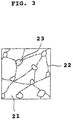
- Such alloys have a two-phase structure comprising a main phase made of a Zr-Ni-Mn based alloy and a phase made of a La-Ni type alloy which is dispersively distributed along the grain boundary of the main phase, as illustrated in an enlarged schematic view of the structure in Fig. 3.
- the phase made of the La-Ni type alloy dissociates atmospheric hydrogen molecules (H 2 ) to form hydrogen atoms (H) by its catalytic action, and absorbs the dissociated hydrogen atoms at a rate higher than that of the main phase made of the Zr-Ni-Mn based alloy; thus the absorption of the hydrogen atoms in the main phase made of the Zr-Ni-Mn based alloy is carried out mainly through the phase made of the La-Ni type alloy, and the hydrogen desorption is carried out by a function contrary to the foregoing function.
- the foregoing conventional hydrogen occluding alloy can be made by preparing a Ni-Zr based liquid alloy having the foregoing composition, casting it into an ingot, and annealing the ingot for homogenization at a predetermined temperature within the range from 950 to 1,050 °C for a predetermined time in a non-oxidizing atmosphere, such as vacuum or inert gas.
- the battery when the hydrogen occluding alloy is applied to an electrode of a battery, the battery can serve a practical use after an initial activation treatment in which charge/discharge cycles are repeated until the electrode including the hydrogen occluding alloy has a sufficient discharge capacity, in other words, until the discharge capacity caused by the hydrogen occluding alloy reaches near its maximum.
- the inventors of the present invention hereby provide hydrogen occluding alloys having improved hydrogen absorption/desorption rates and initial activation according to the following descriptions (a) and (b):
- the hydrogenation step can be conducted immediately after the homogenization step, with or without cooling.
- the hydrogenation step can be conducted any time after the homogenization step, i.e., with a time period between the two steps.
- the ingot can be cooled e.g., to room temperature between the two steps, or the ingot can be transferred directly from the homogenization step to the hydrogenation step without cooling.
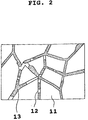
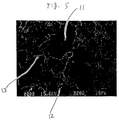
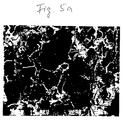
- the matrix phase of the alloys in accordance with the present invention as described above in (a) and (b) have numerous cracks. These cracks are generally of varying size, and the matrix phase has at least about 100 cracks having a major dimension which exceeds 0.1 micrometers per square millimeter.
- the present invention was achieved based on the results set forth above, and is characterized by a hydrogen occluding alloy exhibiting high hydrogen absorption and desorption rates and excellent initial activation.
- the hydrogen occluding alloy has a composition comprising:
- Zr-Ni-Mn based alloy refers to an alloy whose approximate formula is (Zr, Ti)(Ni, Mn, V) 2 .
- rare earth element(s)-Ni type alloy refers to an alloy which may include small amounts of materials other than rare earth and Ni.
- a suitable rare earth element(s)-Ni type alloy may consist of 71.0 - 78.6 % La, 21.2 - 28.8 % Ni, and ⁇ 0.4 % other materials.
- the Zr component forms the main phase in association with Ni and Mn to increase the amount of the hydrogen occluded as described above.
- the Zr content is determined to be 25% to 45%, preferably 25% to 40% and more preferably 30% to 37.
- the Ti component dissolved in the main phase set forth above, lowers the equilibrium pressure for dissociating hydrogen to a level lower than the atmospheric pressure at room temperature, for example, so that the component promotes the hydrogen absorption/desorption and increases the amount of hydrogen occluded. If the Ti content is less than 1%, the desired effect as set forth above cannot be achieved. On the other hand, when the content exceeds 12%, the equilibrium pressure for dissociating hydrogen is again raised to, for example, a level higher than the atmospheric pressure at room temperature. As a result, the hydrogen absorption/desorption decreases. Therefore, the Ti content is determined to be 1% to 12%, and preferably 4% to 12% and more preferably 5% to 10%.
- the Mn component forms the main phase made of the Zr-Ni-Mn based alloy which occludes hydrogen as set forth above.
- the Mn content is determined to be 10% to 20%, and preferably, 14% to 18%.
- the V component dissolved in the main phase stabilizes absorption/desorption of hydrogen by adjusting the equilibrium pressure for dissociating hydrogen and increases the quantity of occluded hydrogen. If the V content is less than 2%, the desired effect set forth abode cannot be achieved, whereas a content exceeding 12% does not bring about further improvement in such effects. Therefore, the content is determined to be 2% to 12%, and preferably 2% to 8% and more preferably 3% to 6%.
- This component(s) is/are essential for the formation of the regenerated phase made of the rare earth element-Ni type alloy which dissociates to absorb atmospheric hydrogen at a higher rate than that of the main phase and desorbs to recombine hydrogen to the atmosphere, as described above. If the content is less than 0.5%, the resulting amount of the regenerated phase made of the rare earth element-Ni type alloy is too small to maintain such functions. On the other hand, since a content exceeding 5% causes an excessive amount of the phase made of the regenerated rare earth element-Ni type alloy, the amount of hydrogen that can be occluded into the overall alloy decreases unsatisfactorily. Therefore, the content is determined to be 0.5% to 5% and preferably 2% to 4%.
- the rare earth element comprise La and/or Ce, preferably consist of 50% or more of La and/or Ce, and more preferably, consist essentially of La and/or Ce.
- the Hf content when present, which forms a main phase made of a Zr-Ni-Mn based alloy along with the Zr component, enhances the effects set forth above. If the Hf content is less than 0.1%, the desired effect cannot be obtained, whereas if the content exceeds 4%, the above function of the Zr content is impaired. Therefore, when Hf is present, the content is determined to be 0.1% to 4%, preferably 0.1% to 2% and more preferably 1% to 1.7%.
- the Ni content is less than 25%, rare earth element-Ni type alloy and the regenerated rare earth element-Ni type alloy cannot be sufficiently formed. Since such alloy does not exhibit a desired hydrogen discharge rate and initial activation, the content is determined to be at least 25%.
- the hydrogen occluding alloy in accordance with the present invention can be used as powder having a predetermined particle size by any conventional mechanical pulverization.
- the alloy can also be pulverized by a hydrogenation process in which hydrogen is absorbed at a given temperature ranging from 10 to 200 °C and desorbed by evacuation.
- Ni, Zr, Ti, Mn, V, La, Ce, Cr and Hf, as well as misch metal, each having a purity higher than 99.9%, are melted in an Ar atmosphere to prepare alloys having compositions as shown in Tables 1, 3, 5, 7, 9, 11, 13 and 15.
- Each alloy is cast in a water-cooled copper casting mold to be formed into an ingot.
- Each of the ingots is heated for homogenization under vacuum at a predetermined temperature within the range of from 900°C to 1100°C for 20 hours.
- the ingot After the ingot is maintained at room temperature for 1 hour in a hydrogen atmosphere of a pressure in the range of from 1 to 1.2 atm., it is heated to a predetermined temperature within a range of from 600°C to 700°C and subjected to a hydrogenation treatment at the predetermined temperature for 30 minutes, so that the phase made of the rare earth element-Ni type alloy, which distributes along the grain boundary of the main phase made of the Zr-Ni-Mn based alloy, is converted into the hydride product phase mainly including rare earth element hydride and the rare earth element-Ni type alloy, where numerous cracks start from the hydride product phase.
- alloys 1 to 92 in accordance with the present invention are prepared. Alloys 93-96 are prepared in a similar way, except that after the hydrogenation step, they are cooled.
- comparative hydrogen occluding alloys having compositions as shown in Tables 3, 5, 9 and 15 are prepared under the same conditions as those described above, except that the hydrogenation and dehydrogenation processes following the homogenizing heat treatment are omitted.
- the comparative alloy has a structure consisting of a matrix phase 21 made of a Zr-Ni-Mn based alloy and a dispersed phase 23 made of an La-Ni type alloy and discticited along the grain boundary 22 of the matrix phase, as shown in Fig. 3.
- alloys 1 to 96 of the present invention and the comparative alloys Prior to the measurement, alloys 1 to 96 of the present invention and the comparative alloys are respectively enclosed in a pressure container and subjected to hydrogenation pulverization including hydrogen absorption in a hydrogen atmosphere of 8 atm. at 200 °C for one hour, and the hydrogen desorption by evacuation to prepare powders having a particle size of 200 mesh or less.
- the hydrogen-absorption rate is, as illustrated in a schematic view in Fig. 4, measured as follows:
- the hydrogen desorption rate is determined by the following procedure:
- the bath is maintained at a temperature of, for example, 120°C, appropriate for hydrogen desorption within a range of from 100°C to 300°C in a state in which the measurement of the hydrogen absorption rate has been completed, that is, in a state in which the valves Va and Vb are closed, the valve Vc is opened, and the pressure in the system reaches a predetermined level (Usually around 20 atm.). Then, the valve Vb is opened and the valve Vc is closed, and in the foregoing state, the pressure in the system, except for the container 41, is evacuated to 10 -2 Torr.
- each alloy is used for an active material of a battery in the powder state, and the battery is subjected to repeat charge/discharge cycles until the battery shows a maximum discharge capacity as shown below in detail.
- the initial activation is taken as the number of charge/discharge cycles at which the discharge capacity corresponds to 95% of the maximum discharge capacity.
- the conventional alloy is roughly crushed to form coarse particles of 2 mm or less in diameter with a jaw crusher, and each of alloys 1 to 96 of the present invention and roughly crushed conventional alloy is finely ground to 200 mesh or less with a ball mill.
- PTFE polytetrafluoroethylene
- CMC carboxymethyl cellulose
- the paste is loaded on a commercial foamed nickel plate having a porosity of 95%.
- the foamed nickel plate is dried, pressed, and shaped into a cut plate of 30 by 40 mm having a thickness of 0.40 to 0.43 mm.
- the amount of the loaded active material is approximately 1.8 g.
- a nickel thin plate as a lead is welded at a side of the cut plate to form a negative electrode.
- a positive electrode is formed by preparing a paste from Ni(OH) 2 as an active material, water, polytetrafluoroethylene (PTFE) as a binder and carboxymethyl cellulose (CMC) as a thickener; loading the paste on the foamed nickel plate; drying, pressing and shaping the foamed nickel plate into a cut plate of 30 by 40 mm having a thickness of 0.71 to 0.73 mm; and welding the nickel thin plate at a side of the cut plate.
- PTFE polytetrafluoroethylene
- CMC carboxymethyl cellulose
- the positive electrodes are provided at both sides of the negative electrodes through separators made of a polypropylene/polyethylene copolymer, and, protecting plates made of polyvinyl chloride are integrated therewith at both sides of the positive electrodes to prevent the omission of the active material from the outside of the positive electrodes.
- the battery whose electrode has component composition shown in samples 1-13, is fabricated by inserting thus-obtained integrated electrodes into a cell made of polyvinyl chloride and pouring a 35% KOH aqueous solution, as an electrolyte solution, into the cell.
- the resultant battery is subjected to charge/discharge cycles under conditions of a charging rate of 0.20 C, a discharging rate of 0.20 C and a quantity of charged capacity corresponding to 135% of the negative electrode capacity.
- the charge/discharge cycles are repeated until the battery exhibits the maximum discharge capacity, in which one cycle of charge and discharge is counted as one charge/discharge.
- Tables 2 and 4 show the maximum discharge capacity obtained by the procedure set forth above, as well as the number of charge/discharge cycles as a measure evaluating the initial activation, at which the discharge capacity is 95% of the maximum discharge capacity.
- the resulting battery is subjected to charge/discharge cycles under conditions of a charging rate of 0.15 C, a discharging rate of 0.15 C, and a quantity of charged capacity corresponding to 135% of the negative electrode capacity.
- the charge/discharge cycles are repeated until the battery exhibits the maximum discharge capacity, in which one cycle of charge and discharge is counted as one charge/discharge
- Table 16 shows the maximum discharge capacity obtained by the procedure set forth above, as well as the number of charge/discharge cycles as a measure evaluating the initial activation, at which the discharge capacity is 95% of the maximum discharge capacity.
- Bal. Balance TABLE 13 Sample No. Component Composition (wt%) Zr Ti Mn V Rare Earth Elements Hf Ni+ impurity La Ce Pr Nd 73 34.3 6.2 16.0 4.9 -- 1.5 -- -- 1.3 Bal. 74 34.2 5.7 15.7 4.8 -- 4.8 -- -- 1.5 Bal. 75 34.1 6.1 15.8 5.0 3.2 -- -- -- 0.12 Bal. 76 34.6 6.0 16.1 5.3 -- 2.9 -- -- 0.63 Bal. 77 34.3 6.0 16.0 5.2 1.6 1.5 -- -- 0.59 Bal. 78 34.2 6.1 15.9 4.9 3.1 -- -- -- 1.9 Bal. 79 34.1 5.8 16.1 4.9 1.6 1.6 -- -- 2.6 Bal. 80 33.9 6.0 16.3 5.1 3.0 -- -- -- 3.9 Bal.
Landscapes
- Chemical & Material Sciences (AREA)
- Engineering & Computer Science (AREA)
- Materials Engineering (AREA)
- Mechanical Engineering (AREA)
- Metallurgy (AREA)
- Organic Chemistry (AREA)
- Chemical Kinetics & Catalysis (AREA)
- Electrochemistry (AREA)
- General Chemical & Material Sciences (AREA)
- Battery Electrode And Active Subsutance (AREA)
Applications Claiming Priority (12)
| Application Number | Priority Date | Filing Date | Title |
|---|---|---|---|
| JP23477195 | 1995-08-21 | ||
| JP234771/95 | 1995-08-21 | ||
| JP23477195 | 1995-08-21 | ||
| JP277544/95 | 1995-10-25 | ||
| JP27754495 | 1995-10-25 | ||
| JP27754495 | 1995-10-25 | ||
| JP10509296 | 1996-04-25 | ||
| JP8105096A JPH09176778A (ja) | 1995-10-25 | 1996-04-25 | 水素吸蔵合金 |
| JP105092/96 | 1996-04-25 | ||
| JP105096/96 | 1996-04-25 | ||
| JP10509296A JPH09118948A (ja) | 1995-08-21 | 1996-04-25 | 水素吸蔵合金 |
| JP10509696 | 1996-04-25 |
Publications (2)
| Publication Number | Publication Date |
|---|---|
| EP0761833A1 true EP0761833A1 (de) | 1997-03-12 |
| EP0761833B1 EP0761833B1 (de) | 2001-12-12 |
Family
ID=27469287
Family Applications (1)
| Application Number | Title | Priority Date | Filing Date |
|---|---|---|---|
| EP96113226A Expired - Lifetime EP0761833B1 (de) | 1995-08-21 | 1996-08-17 | Wasserstoffeinlagerungslegierung und daraus hergestellte Elektrode |
Country Status (4)
| Country | Link |
|---|---|
| EP (1) | EP0761833B1 (de) |
| KR (1) | KR970070220A (de) |
| CN (1) | CN1151616A (de) |
| DE (1) | DE69617837T2 (de) |
Cited By (1)
| Publication number | Priority date | Publication date | Assignee | Title |
|---|---|---|---|---|
| EP1315843A4 (de) * | 2000-08-16 | 2005-06-29 | Ovonic Battery Co | Hochleistungs-nickel-metall-hydridbatterien und in diese verwendete hochleistungs-legierungen/elektroden |
Families Citing this family (1)
| Publication number | Priority date | Publication date | Assignee | Title |
|---|---|---|---|---|
| CN105071857B (zh) * | 2015-06-30 | 2019-01-22 | 武汉光迅科技股份有限公司 | 级联多跨段塔上中继光传输系统 |
Citations (5)
| Publication number | Priority date | Publication date | Assignee | Title |
|---|---|---|---|---|
| JPS60241652A (ja) * | 1984-05-16 | 1985-11-30 | Matsushita Electric Ind Co Ltd | 金属水素化物を用いた電気化学用電極 |
| JPH04188805A (ja) * | 1990-11-22 | 1992-07-07 | Seiko Epson Corp | 希土類ボンド磁石の製造方法 |
| EP0503686A2 (de) * | 1987-05-15 | 1992-09-16 | Matsushita Electric Industrial Co., Ltd. | Verfahren zur Herstellung einer Wasserstoffspeichernden Elektrode |
| JPH06283169A (ja) * | 1993-03-29 | 1994-10-07 | Hitachi Chem Co Ltd | 密閉型二次電池 |
| JPH06306413A (ja) * | 1993-04-28 | 1994-11-01 | Daido Steel Co Ltd | 水素吸蔵合金粉末の製造法 |
-
1996
- 1996-08-17 EP EP96113226A patent/EP0761833B1/de not_active Expired - Lifetime
- 1996-08-17 DE DE69617837T patent/DE69617837T2/de not_active Expired - Fee Related
- 1996-08-20 KR KR1019960034503A patent/KR970070220A/ko not_active Ceased
- 1996-08-21 CN CN96113237A patent/CN1151616A/zh active Pending
Patent Citations (5)
| Publication number | Priority date | Publication date | Assignee | Title |
|---|---|---|---|---|
| JPS60241652A (ja) * | 1984-05-16 | 1985-11-30 | Matsushita Electric Ind Co Ltd | 金属水素化物を用いた電気化学用電極 |
| EP0503686A2 (de) * | 1987-05-15 | 1992-09-16 | Matsushita Electric Industrial Co., Ltd. | Verfahren zur Herstellung einer Wasserstoffspeichernden Elektrode |
| JPH04188805A (ja) * | 1990-11-22 | 1992-07-07 | Seiko Epson Corp | 希土類ボンド磁石の製造方法 |
| JPH06283169A (ja) * | 1993-03-29 | 1994-10-07 | Hitachi Chem Co Ltd | 密閉型二次電池 |
| JPH06306413A (ja) * | 1993-04-28 | 1994-11-01 | Daido Steel Co Ltd | 水素吸蔵合金粉末の製造法 |
Non-Patent Citations (5)
| Title |
|---|
| LIU F - J ET AL: "SURFACE AND METALLOGRAPHIC MICROSTRUCTURE OF THE LA-ADDED AB2 COMPOUND (TI, ZR)(MNN, CR, NI)2", JOURNAL OF ALLOYS AND COMPOUNDS, vol. 231, no. 1, 15 December 1995 (1995-12-15), pages 392 - 396, XP000548070 * |
| PATENT ABSTRACTS OF JAPAN vol. 010, no. 099 (E - 396) 16 April 1986 (1986-04-16) * |
| PATENT ABSTRACTS OF JAPAN vol. 016, no. 508 (E - 1282) 20 October 1992 (1992-10-20) * |
| PATENT ABSTRACTS OF JAPAN vol. 94, no. 010 * |
| PATENT ABSTRACTS OF JAPAN vol. 94, no. 011 * |
Cited By (1)
| Publication number | Priority date | Publication date | Assignee | Title |
|---|---|---|---|---|
| EP1315843A4 (de) * | 2000-08-16 | 2005-06-29 | Ovonic Battery Co | Hochleistungs-nickel-metall-hydridbatterien und in diese verwendete hochleistungs-legierungen/elektroden |
Also Published As
| Publication number | Publication date |
|---|---|
| EP0761833B1 (de) | 2001-12-12 |
| CN1151616A (zh) | 1997-06-11 |
| DE69617837T2 (de) | 2002-04-11 |
| DE69617837D1 (de) | 2002-01-24 |
| KR970070220A (ko) | 1997-11-07 |
Similar Documents
| Publication | Publication Date | Title |
|---|---|---|
| CN111636012A (zh) | 一种La-Mg-Ni系储氢材料及其制备方法 | |
| EP0806803B1 (de) | Wasserstoffabsorbierende Legierung, Verfahren zu ihrer Herstellung und Elektrode | |
| US5932369A (en) | Hydrogen occluding alloy and electrode made of the alloy | |
| JPWO1999034025A1 (ja) | 水素吸蔵合金、水素吸蔵合金の製造方法、水素吸蔵合金電極、水素吸蔵合金電極の製造方法、及び電池 | |
| EP0753590B1 (de) | Wasserstoffeinlagerungslegierung und daraus hergestellte Elektrode | |
| US6083327A (en) | Hydrogen occluding alloy | |
| EP0761833B1 (de) | Wasserstoffeinlagerungslegierung und daraus hergestellte Elektrode | |
| CN111411262A (zh) | A5b19型含钆储氢合金、负极及制备方法 | |
| JPH0641663A (ja) | 水素吸蔵合金とその製造方法および水素吸蔵合金電極 | |
| EP0749170A2 (de) | Wasserstoffabsorbierende Legierung und Elektode aus diesem Material | |
| US5810981A (en) | Three phase hydrogen occluding alloy and electrode made of the alloy | |
| JPH1025528A (ja) | 水素吸蔵合金 | |
| JPH09176777A (ja) | 水素吸蔵合金 | |
| JPH09176778A (ja) | 水素吸蔵合金 | |
| JPH0978176A (ja) | 水素吸蔵合金 | |
| JPH10152740A (ja) | 水素吸蔵合金 | |
| JPH0987784A (ja) | 水素吸蔵合金 | |
| JPH04318106A (ja) | 水素吸蔵合金粉末の製造法 | |
| JPH10195569A (ja) | 初期活性の良好な水素貯蔵合金 | |
| JPH0978167A (ja) | 水素吸蔵合金 | |
| JP2002075347A (ja) | 水素吸蔵合金 | |
| JPH10195575A (ja) | 初期活性の良好な水素貯蔵合金 | |
| JPH10195584A (ja) | 初期活性の良好な水素貯蔵合金 | |
| JPH09176775A (ja) | 水素吸蔵合金 | |
| JPH09176776A (ja) | 水素吸蔵合金 |
Legal Events
| Date | Code | Title | Description |
|---|---|---|---|
| PUAI | Public reference made under article 153(3) epc to a published international application that has entered the european phase |
Free format text: ORIGINAL CODE: 0009012 |
|
| AK | Designated contracting states |
Kind code of ref document: A1 Designated state(s): CH DE FR GB IT LI NL SE |
|
| 17P | Request for examination filed |
Effective date: 19970814 |
|
| 17Q | First examination report despatched |
Effective date: 19980819 |
|
| GRAG | Despatch of communication of intention to grant |
Free format text: ORIGINAL CODE: EPIDOS AGRA |
|
| GRAG | Despatch of communication of intention to grant |
Free format text: ORIGINAL CODE: EPIDOS AGRA |
|
| GRAG | Despatch of communication of intention to grant |
Free format text: ORIGINAL CODE: EPIDOS AGRA |
|
| GRAH | Despatch of communication of intention to grant a patent |
Free format text: ORIGINAL CODE: EPIDOS IGRA |
|
| GRAH | Despatch of communication of intention to grant a patent |
Free format text: ORIGINAL CODE: EPIDOS IGRA |
|
| GRAA | (expected) grant |
Free format text: ORIGINAL CODE: 0009210 |
|
| AK | Designated contracting states |
Kind code of ref document: B1 Designated state(s): CH DE FR GB IT LI NL SE |
|
| PG25 | Lapsed in a contracting state [announced via postgrant information from national office to epo] |
Ref country code: NL Free format text: LAPSE BECAUSE OF FAILURE TO SUBMIT A TRANSLATION OF THE DESCRIPTION OR TO PAY THE FEE WITHIN THE PRESCRIBED TIME-LIMIT Effective date: 20011212 Ref country code: LI Free format text: LAPSE BECAUSE OF FAILURE TO SUBMIT A TRANSLATION OF THE DESCRIPTION OR TO PAY THE FEE WITHIN THE PRESCRIBED TIME-LIMIT Effective date: 20011212 Ref country code: IT Free format text: LAPSE BECAUSE OF FAILURE TO SUBMIT A TRANSLATION OF THE DESCRIPTION OR TO PAY THE FEE WITHIN THE PRE;WARNING: LAPSES OF ITALIAN PATENTS WITH EFFECTIVE DATE BEFORE 2007 MAY HAVE OCCURRED AT ANY TIME BEFORE 2007. THE CORRECT EFFECTIVE DATE MAY BE DIFFERENT FROM THE ONE RECORDED.SCRIBED TIME-LIMIT Effective date: 20011212 Ref country code: CH Free format text: LAPSE BECAUSE OF FAILURE TO SUBMIT A TRANSLATION OF THE DESCRIPTION OR TO PAY THE FEE WITHIN THE PRESCRIBED TIME-LIMIT Effective date: 20011212 |
|
| REG | Reference to a national code |
Ref country code: CH Ref legal event code: EP |
|
| REG | Reference to a national code |
Ref country code: GB Ref legal event code: IF02 |
|
| REF | Corresponds to: |
Ref document number: 69617837 Country of ref document: DE Date of ref document: 20020124 |
|
| PG25 | Lapsed in a contracting state [announced via postgrant information from national office to epo] |
Ref country code: SE Free format text: LAPSE BECAUSE OF FAILURE TO SUBMIT A TRANSLATION OF THE DESCRIPTION OR TO PAY THE FEE WITHIN THE PRESCRIBED TIME-LIMIT Effective date: 20020312 |
|
| NLV1 | Nl: lapsed or annulled due to failure to fulfill the requirements of art. 29p and 29m of the patents act | ||
| REG | Reference to a national code |
Ref country code: CH Ref legal event code: PL |
|
| PGFP | Annual fee paid to national office [announced via postgrant information from national office to epo] |
Ref country code: DE Payment date: 20020809 Year of fee payment: 7 |
|
| PGFP | Annual fee paid to national office [announced via postgrant information from national office to epo] |
Ref country code: FR Payment date: 20020812 Year of fee payment: 7 |
|
| PG25 | Lapsed in a contracting state [announced via postgrant information from national office to epo] |
Ref country code: GB Free format text: LAPSE BECAUSE OF NON-PAYMENT OF DUE FEES Effective date: 20020817 |
|
| PLBE | No opposition filed within time limit |
Free format text: ORIGINAL CODE: 0009261 |
|
| STAA | Information on the status of an ep patent application or granted ep patent |
Free format text: STATUS: NO OPPOSITION FILED WITHIN TIME LIMIT |
|
| 26N | No opposition filed | ||
| GBPC | Gb: european patent ceased through non-payment of renewal fee |
Effective date: 20020817 |
|
| NLV1 | Nl: lapsed or annulled due to failure to fulfill the requirements of art. 29p and 29m of the patents act | ||
| PG25 | Lapsed in a contracting state [announced via postgrant information from national office to epo] |
Ref country code: DE Free format text: LAPSE BECAUSE OF NON-PAYMENT OF DUE FEES Effective date: 20040302 |
|
| PG25 | Lapsed in a contracting state [announced via postgrant information from national office to epo] |
Ref country code: FR Free format text: LAPSE BECAUSE OF NON-PAYMENT OF DUE FEES Effective date: 20040430 |
|
| REG | Reference to a national code |
Ref country code: FR Ref legal event code: ST |