EP0762339A2 - Agencement de tachygraphe - Google Patents
Agencement de tachygraphe Download PDFInfo
- Publication number
- EP0762339A2 EP0762339A2 EP96250185A EP96250185A EP0762339A2 EP 0762339 A2 EP0762339 A2 EP 0762339A2 EP 96250185 A EP96250185 A EP 96250185A EP 96250185 A EP96250185 A EP 96250185A EP 0762339 A2 EP0762339 A2 EP 0762339A2
- Authority
- EP
- European Patent Office
- Prior art keywords
- data
- driver
- memory
- card
- tachograph
- Prior art date
- Legal status (The legal status is an assumption and is not a legal conclusion. Google has not performed a legal analysis and makes no representation as to the accuracy of the status listed.)
- Withdrawn
Links
- 238000012545 processing Methods 0.000 claims abstract description 36
- 238000001514 detection method Methods 0.000 claims abstract 4
- 230000015654 memory Effects 0.000 claims description 95
- 238000013475 authorization Methods 0.000 claims description 27
- 230000006870 function Effects 0.000 claims description 13
- 238000000034 method Methods 0.000 claims description 6
- 230000008569 process Effects 0.000 claims description 6
- 230000001133 acceleration Effects 0.000 claims description 3
- 238000006073 displacement reaction Methods 0.000 claims description 3
- 230000000694 effects Effects 0.000 claims description 2
- 238000012360 testing method Methods 0.000 claims description 2
- 230000000052 comparative effect Effects 0.000 claims 2
- 238000012544 monitoring process Methods 0.000 abstract description 18
- 238000011156 evaluation Methods 0.000 description 15
- 230000003442 weekly effect Effects 0.000 description 6
- 238000004364 calculation method Methods 0.000 description 4
- 238000010586 diagram Methods 0.000 description 3
- 238000012797 qualification Methods 0.000 description 3
- 238000013500 data storage Methods 0.000 description 2
- 238000012217 deletion Methods 0.000 description 2
- 230000037430 deletion Effects 0.000 description 2
- 238000012423 maintenance Methods 0.000 description 2
- 230000008520 organization Effects 0.000 description 2
- 238000012546 transfer Methods 0.000 description 2
- 238000012795 verification Methods 0.000 description 2
- 230000000007 visual effect Effects 0.000 description 2
- 238000009825 accumulation Methods 0.000 description 1
- 230000009471 action Effects 0.000 description 1
- 230000000712 assembly Effects 0.000 description 1
- 238000000429 assembly Methods 0.000 description 1
- 230000005540 biological transmission Effects 0.000 description 1
- 238000010276 construction Methods 0.000 description 1
- 238000013075 data extraction Methods 0.000 description 1
- 230000006735 deficit Effects 0.000 description 1
- 238000011161 development Methods 0.000 description 1
- 230000018109 developmental process Effects 0.000 description 1
- 238000009826 distribution Methods 0.000 description 1
- 230000003993 interaction Effects 0.000 description 1
- 238000007726 management method Methods 0.000 description 1
- 239000011159 matrix material Substances 0.000 description 1
- 230000003340 mental effect Effects 0.000 description 1
- 238000004904 shortening Methods 0.000 description 1
- 238000012549 training Methods 0.000 description 1
- 230000003936 working memory Effects 0.000 description 1
Images




Classifications
-
- G—PHYSICS
- G07—CHECKING-DEVICES
- G07C—TIME OR ATTENDANCE REGISTERS; REGISTERING OR INDICATING THE WORKING OF MACHINES; GENERATING RANDOM NUMBERS; VOTING OR LOTTERY APPARATUS; ARRANGEMENTS, SYSTEMS OR APPARATUS FOR CHECKING NOT PROVIDED FOR ELSEWHERE
- G07C5/00—Registering or indicating the working of vehicles
- G07C5/08—Registering or indicating performance data other than driving, working, idle, or waiting time, with or without registering driving, working, idle or waiting time
- G07C5/0841—Registering performance data
- G07C5/085—Registering performance data using electronic data carriers
- G07C5/0858—Registering performance data using electronic data carriers wherein the data carrier is removable
Definitions
- the invention relates to a tachograph arrangement of the type specified in the preamble of claim 1.
- Tachographs have been widely used in commercial road haulage and intercity bus transportation for many years to monitor the operation of the here used vehicles and also the working hours of the drivers. According to applicable law, their use is mandatory for the carriage of goods over 3.5 t gross vehicle weight as well as for the carriage of passengers with more than 8 passenger seats in occasional traffic and in regular service over 50 km line length.
- the driving states are registered by a position sensor used on the differential, depending on the time on a (personal) record sheet on the driver's hand when the driver starts work and at the end of work or after the period of use for documentation and evaluation Polar coordinates are the speed of the vehicle as a function of time and the working hours of the driver are plotted.
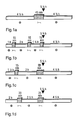
- the break of 45 minutes can, however, be replaced by partial breaks of at least 15 minutes, whereby the total of the partial steering times must not exceed 4.5 hours.
- 1b to 1d show three examples of distributions of the driving time that meet these conditions.
- the daily driving time i.e. The pure service at the wheel between two daily rest periods may not exceed 9 hours, but may be increased to 10 hours twice a week.
- the period from Monday, midnight to Sunday, midnight is considered a week.
- the daily rest period may be reduced to 9 hours up to three times a week, but compensation must be granted for this subject to certain conditions.
- FIGS. 2b to 2d A continuous daily rest period of 11 hours must be observed within each 24-hour period. However, this can also be divided into a maximum of 3 blocks, whereby a block must be at least 8 hours and then the daily rest value increases to 12 hours. Possible implementations are shown in FIGS. 2b to 2d. (Special regulations apply to a two-driver crew.)
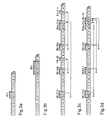
- a continuous weekly rest period of 45 hours must be taken (Fig. 3a).
- the weekly rest period can also be shortened to 24 or 36 hours - but then a certain condition-fulfilling compensation must be granted later (variants for this are shown in Fig. 3c and 3d.)
- this may be inserted after 12 days at the latest and must then can be combined with another weekly rest period (without shortening) (Fig. 3b).
- the conventional tachographs are unsuitable for monitoring compliance with such differentiated regulations because of the disadvantages mentioned above. Their working principle also makes the fulfillment of the extended verification obligations a burden that is hardly acceptable for the drivers and the operational organization of the companies.
- EP 0 389 593 A2 describes a system for networked monitoring of the vehicles in a fleet, in which functions of the conventional tachograph are carried out by a central computer. For this purpose, driving status data of the individual vehicles are transmitted via a radio link, and after their evaluation, control data are transmitted back to the vehicles.
- the registration of driver-related data is not provided, and on-site checks of registered driving status data on the vehicle are not readily possible.
- DE 35 09 966 A1 proposes a tachograph with extended data acquisition, the possibility of electronic storage of the data also being mentioned. Monitoring of the driver's working hours is not addressed here either.
- the invention is based on the object of specifying a tachograph arrangement of the type mentioned at the outset with which improved working time monitoring is possible, in particular with regard to differentiated working time regulations.
- the invention includes the basic idea that in a tachograph arrangement - which, in the understanding on which it is based here, does not necessarily carry out a "writing" in the actual sense - means for real-time monitoring of the recorded driving state data in association with the respective vehicle driver and under on-line comparison with relevant comparison data and To provide means for essentially displaying the comparison result thus obtained.
- the comparison results - together with associated time data - are referred to below as control data.
- the proposed arrangement makes it possible, on the one hand, for an immediate and very simple self-control of compliance with applicable normative regulations - for example the applicable working time regulations - when a driver can see the display.
- applicable normative regulations for example the applicable working time regulations -
- the driver does not even have to be familiar with the regulations in detail, since they are stored in a suitably prepared form in the comparison data memory and are automatically taken into account by the device.
- the device relieves largely of mental activities related to this, which would distract the driver from his actual job.
- an electronic recording unit enables simple operational evaluation and (retrospective) monitoring by control authorities, subjective errors and manipulations are largely excluded.
- the comparison data memory for storing standard data relating to driving, interruption, standby, other working and rest times and the display and / or recording device for separate display and / or recording of the relevant control data obtained from the time and driving status data as well as manual inputs.
- Driving status data here refers to the primary data relating to the driving process
- control data refers to the secondary data obtained through their further processing, in particular adding up over time or comparing the former with the standard data.
- the latter contain the relevant information on the working time regime, the however, the former may be of importance with regard to traffic regulations violations or in connection with accidents or technical damage.
- driver card in particular a chip or magnetic card in which a personal code is stored, serves as a data carrier for both simplifying the handling of the arrangement by the driver and increasing the security against manipulation driver data required in the arrangement.
- driver card electronically readable memory card
- the actual tachograph naturally has one device connected to the input of its processing device for reading the data stored on this memory card (for example a chip card reader known per se).
- the driver card can also record the or at least one of several control data memories, the tachograph then having means for writing control data into the driver card tachograph data memory (in particular before the driver card is removed from the tachograph) and for reading out the control data stored therein - when a driver card is inserted in the tachograph - for processing in the device and possibly also for direct display.
- the structure and function then differ significantly from those of a simple chip card in the form of a telephone card (see below).
- the - or one of several (same-content) - comparison data memory can also be implemented in the form of an electronically readable memory card or as a separate memory area on one, in particular as a chip card, the tachograph then having a device connected to the input of the processing device Reading the data stored thereon.
- This training enables a simple update of the comparison or. Standard data in all tachographs of a vehicle stock in the event of changes to the rules, by producing the appropriate new cards and either exchanging them for the old cards in the tachographs or by re-inserting the comparison data memory permanently installed in the tachographs.
- a realization on a service authorization card can also be expedient, with which service technicians have extended access to the device for maintenance and setting purposes.
- An advantageous operation of the vehicles of a fleet with the respective tachographs in the system with personal identification and memory cards for the driver (driver cards) looks like that first in the tachograph one with the device for reading out data from the driver card control data memory and on the output side with the device for writing into this connected temporary control data memory is provided.
- the tachograph also contains a control device which controls its operation in such a way that when a driver card is inserted into the tachograph, the personal working time data stored in the driver card is loaded into the temporary control data memory and then updated in the tachograph while the driver card remains in the tachograph. Finally, the (updated) data is reloaded into the control data memory before the driver card is removed and thus clearly assigned to the driver again. If the latter later takes over another vehicle, his working time data will also be updated in this, so that the driver card always contains the current working time balance, especially evaluated according to the applicable regulations.
- the tachograph has slots for the simultaneous reception of two Driver cards - the driver card and the passenger card - and is designed to read data from both and to save data in both.
- An acceleration sensor or (intelligent) displacement sensor attached to the vehicle is preferably provided as the means for detecting the driving state; in addition or possibly alternatively to this - which requires a very good spatial resolution - there may also be a receiving device for signals of a position determination system (GPS - "global positioning system") controlled outside the vehicle.
- GPS position determination system
- An input unit for - e.g. manual - input of data relating to the driving condition or the activity of the driver (or the passenger) is to be understood as such means in the broader sense.
- the comparison data memory for storing at least one standard data record in association with a position data record characterizing its territorial scope is the processing device for processing the driving state data with the standard data depending on the current position of the vehicle.
- access control means are provided for selectively granting access to the data in the travel data memory and / or in the recording device or in the monitoring result memory for reading it.
- An electronically readable card (authorization card) can also be used for this.
- a memory can be provided in the authorization card for storing control data and, optionally, driving state data taken from the tachograph of a controlled vehicle (or directly from a driver card).
- authorization cards with different access control functions can be provided, which in particular allow access to data that go back to different times in the past and exclusively to control data or additionally to driving status data.
- tachograph Internal and external controls are simplified by an implementation of the tachograph, in which the tachograph has an input to the processing device connected read-only memory for vehicle and device-related data. This data can then be noted together with the driving status data when the driver card is updated or during checks in the memory of the authorization card, so that additional notes are unnecessary.
- the tachograph can also have a slot for it.
- the driver card contains a memory or storage area for data for enabling the driver (for example for the transport of dangerous goods or for the transport of people).
- the vehicle data memory and the device for reading the driver's license card or the qualification data on the driver card are connected to inputs of a correlator unit which is connected on the output side to the display and / or recording device in such a way that, on the one hand, based on the vehicle data and the qualification data The authorization to drive the vehicle is checked and the test result can be displayed and / or recorded.
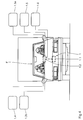
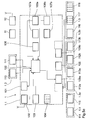
- the tachograph arrangement 1 shown in FIG. 4 in the overall view of a truck L comprises as the actual tachograph components a basic device 1.1 and an operating device 1.2 and also four different types of chip cards: a driver chip card 1.3a (as well as a passenger chip card 1.3b which is identical in construction), a service chip card 1.4 which enables access to the arrangement for maintenance and setting purposes , a control chip card 1.5, which enables data retrieval for control purposes and a business card 1.6 for data extraction and storage during operation.
- a driver chip card 1.3a (as well as a passenger chip card 1.3b which is identical in construction)
- a service chip card 1.4 which enables access to the arrangement for maintenance and setting purposes
- a control chip card 1.5 which enables data retrieval for control purposes
- a business card 1.6 for data extraction and storage during operation.
- a position sensor 11 and a GPS receiver 12 are provided for determining the position.
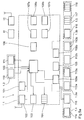
- the basic device 1.1 comprises a power supply 101, which supplies all components and groups of the system (the individual connections are omitted in the figures for the sake of clarity), a radio clock module 102 serving as a real-time clock, and a vehicle and device data EEPROM 103, a comparison data PROM 104 for storing at least one data record relating to comparison data valid when driving the vehicle, which reflect certain standards (in particular working time regulations), express a first comparator unit (authorization correlator) 105 for comparing the driver's qualifications or authorization certificates Data with the vehicle data, a driving data memory 106 for storing driving state data determined in the CPU 100 - inter alia from the input signals of the real-time clock 102 and the travel sensor 11 and manual inputs (see further below) - a second and third comparator and evaluation unit 107a and 107b for Comparison and evaluation of the driving status data and obtaining the control data for driver and front passenger, a first and second working memory (RAM) 108a and 108b for storing
- RAM working memory
- the operating device 1.2 comprises - as will be explained in more detail below - an operating keyboard 110 composed of function and numeric keys and a display field 111 designed as a backlit LCD graphic display.
- the driver and passenger cards 1.3a and 1.3b each contain an EEPROM 112a, 112b for personal and authorization data and a control data flash ROM 113a, 113b.
- the service card 1.4 contains a ROM 114 for storing the setting access authorization and a comparison data PROM 115 with the current comparison or standard data.
- the control card 1.5 and the business card 1.6 each have a ROM 116 for storing the specific ones Control or data access authorization and a multi-area direct access memory (flash memory) 117 or 118 for storing several control data records and associated vehicle data.
- ROM 116 for storing the specific ones Control or data access authorization
- flash memory multi-area direct access memory
- 5a shows the signal connections that exist during programming of the vehicle data and the comparison data with the aid of the service card 1.4 and the input keyboard 110.
- the access authorization ROM 114 and the comparison data PROM 115 - like (permanently) also the radio clock 102 and the keyboard 110 - are connected on the input side to the CPU 100.
- this is in signal connection with the internal vehicle and device data memory 103 and the internal comparison data memory 104, into which the relevant data from the service card or data entered manually by the service technician are loaded under transfer control by the CPU.
- Via the 128x128 matrix display 111 which is also (permanently) connected to the output of the CPU, a visual setting check can be carried out, in addition to monitoring using a service computer.
- 5b shows the signal connections that occur at the start of a journey of a two-driver crew when the Driver and passenger card can be produced.
- the card interface 109a and the keyboard 110 the second card interface 109b is now also connected to the input of the CPU 100.
- On the output side there are now connections to the internal control data memories 108a and 108b in addition to the display 111.
- the control data of the driver and front passenger stored in the memories 112a and 112b of the cards 1.3a and 1.3b are reloaded or copied into these under transfer control by the CPU and taking keyboard inputs into account (see further below).
- the driver card interface 109a is now still. parallel to the keyboard 100, directly connected to an input of the comparator unit 105 and its other input to the vehicle data memory 103.
- the output of the comparator unit is connected to the control and processing unit (CPU) 100 - and via this to the display unit 111 and the control data memory 108a.
- a comparison of the technical vehicle data and, if necessary, of manual entries (for example for specifying the load as dangerous goods or the like) with the driver's personal proof of authorization - for example for the transport of dangerous goods or for the transport of people - is carried out in the comparator unit 105 and a signal characterizing the comparison result is carried out generated, which leads to a corresponding display (for example, "RIGHTS. OK" or "RIGHTS. MISSING") on the display 111 and, in the case of no authorization, a note in the control data memory 108a.
- the passenger card can also be evaluated analogously, but this is not shown in the figure for the sake of simplicity.
- the tachograph can also be connected in the vehicle in such a way that the CPU can intervene in the engine management in the event of insufficient authorization, which prevents the vehicle from being started up. This also implements an immobilizer function.
- 5c shows the signal connections that exist during a journey of a two-driver crew.
- the path transmitter 11, the GPS receiver 12 and the standard data memory 104 as well as the comparator and evaluation units 107a, 107b are now connected to inputs of the CPU 100.
- the acquisition of the driving state data as such is not the subject of the invention and is therefore not described further here. It can essentially be done in the manner known from conventional tachographs. However, to determine working hours only, the time supplied by the radio clock and the inputs via the keyboard (see below) can also be evaluated. However, these data are preferably subjected to verification by means of the sensor signals reflecting the physical driving state. This can make manipulation more difficult or alert the vehicle crew to incorrect entries.
- the connection of the GPS receiver 12 which continuously provides position data of the vehicle, to the CPU 100 is used for automated access control to separate memory areas (indicated by dashed lines) of the comparison data ROM 104, in which different standard data records with different territorial data Scope can be filed. These norm data records are each stored together with a position data record that represents the boundaries of the territorial scope.
- a comparator unit to be understood in the figure as part of the CPU 100
- a comparison of the continuously determined position data with the stored position data records can be carried out and the retrieval of the respectively applicable standard data record can thus be controlled.
- the driving data memory 106 is connected on the output side to an input of the comparator and evaluation units 107a, 107b, the other input of which is connected to the CPU 100 and, in particular, to the CPU 100, the real-time clock 102, the input keyboard 110, the activated area of the comparison data memory 104 and the card readers 109a, 109b is connected.
- the functional units 107a, 107b implement differentiated processing functions - see below - and will therefore preferably be implemented in practice as separate processors or as - software-defined - functional areas of the CPU.
- This secondary processing includes, for example, to check compliance with the prescribed interruptions in the journey, adding up the times in which the vehicle is moved without an interruption of more than 15 minutes (driving time), resetting each interruption of more than 15 minutes while simultaneously recording the length of the Interruption, a summation of the interruption times in the 5.25-hour time block and, if necessary, the generation of a signal that prompts the driver to interrupt the journey.
- control data relating to compliance with the daily rest periods and the weekly rest periods is obtained in accordance with the processing algorithm determined by the respective regulation.
- the driving condition data for driver and front passenger must of course be evaluated according to different criteria, which is why two separate units are provided for secondary processing.
- the outputs of the assemblies 107a, 107b are connected to the internal control data memories 108a and 108b and in parallel to the display unit 111, so that the determined control data are continuously displayed (or made available for a selected display - see also below) and recorded .
- the control data store have an organization selected depending on the norm data structure in different memory areas with separate access, so that data in the different control data categories (driving, standby, working and rest time or similar) side by side and in the norm-relevant links (steering / Daily rest, driving / weekly rest etc.) can be saved and called up later.
- the comparator and evaluation units process the accumulated driving state data in principle in association with real-time data and the control data memory for storing data records from accumulated classified meter readings (steering -, standby and rest time blocks etc.) are each assigned to the absolute time of their acquisition (date, time). This is the only way to correctly evaluate the vehicle driver (or passenger) related accumulated driving status data.
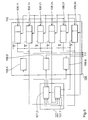
- a control data memory 108 can do this - as in FIG. 6 as a greatly simplified function block diagram for three Working time classes shown - expediently have a plurality of storage areas 108.11 to 108.1n, 108.21 to 108.2m and 108.31 to 108.3o for the storage of related time blocks in the individual working time classes together with the (end) time of their acquisition. These each have reset or delete inputs which are connected to the output of a logic unit 107.1 of the comparator and evaluation unit (second processing unit) 107.
- the outputs of the individual memory areas are in turn connected to inputs of logic unit 107.1 and to data inputs of an arithmetic processing unit 107.2.
- This also has a control input which is in control signal connection with the output of the logic unit 107.1, and an output which is connected to a time sum memory 108.4, 108.5 and 108.6 for the individual time classes in the control data memory 108.
- the time total memories are connected on the output side to the display unit 111.
- the counter readings in the individual memory areas and the acquisition time data assigned to them are processed with the respectively current time data and the comparison data (standard data), in the result of which control signals are output to the delete inputs and / or the arithmetic processing stage 107.2 in order to delete them certain meter readings or a calculation of total times in the individual working time classes, which are then stored and displayed separately.
- logic unit 107.1 and / or the arithmetic processing unit 107.2 and possibly the entire second processing unit can in practice also be implemented as functional areas (e) of the CPU 100 and in particular largely in software.
- the "working time account” accumulated at the end of his last journey, i.e.
- the data record consisting of the meter readings accumulated in the individual time categories in separate recording blocks and the associated recording times is loaded from its driver card into the respective memory areas of the internal control data memory of the basic device.
- the comparator and evaluation unit determines the time difference between the log-in time and the acquisition times for the individual memory contents and uses the relevant standard data in the comparison data memory to determine to what extent the time differences (taking into account the respective time classification) give rise to deletion of the individual memory contents .
- the time - for the driver in the "driving time” class, for the front passenger in the "standby time” class - is further counted by the real-time clock acting as a counter and is updated in a newly occupied memory area in the control data memory. Also while driving - preferably at predetermined time intervals - a calculation with the "old" data and possibly deletion of data records which have become inaccurate with the progress of the (absolute) time and the accumulation of new driving time are carried out. In any case, the current data records are evaluated and reloaded into the driver card control data memory at the end of the journey or when the driver tries to remove his card from the operating device.
- the signal connections at the end of a trip of the two-driver crew when the driver and co-driver card are removed are shown in Fig. 5d. These are automatically created when the account is "booked out” or an attempt is made to remove a card, the card remaining temporarily locked in the slot.
- the CPU is connected on the input side next to the radio clock 102 and the keyboard 110 to the data outputs of the vehicle and device data memory and the internal control data memory 108a, 108b and on the output side to the card interfaces 109a, 109b and reloads the internally stored, current control data into the Memory 113a, 113b of the driver or passenger card 1.3a or 1.3b. In association with this, a data record identifying the vehicle being driven is also copied. After the storage process has been completed, the cards are unlocked and can be removed.
- the controller has an authorization card 1.5, which he inserts into the card interface 109a.
- the control authorization ROM 116 (input side) and the control memory and vehicle data memory 117, 118 (output side) provided on the authorization card are connected to the CPU 100 via this.
- the input of the data representing the control authorization into the CPU causes the internal control data memories 108a, 108b and the internal vehicle data memory 103 to be connected to the corresponding inputs of the CPU.
- the radio clock 102 and the keyboard 110 are still connected on the input side to the CPU, so that the controller can call up the control data read out from the internal memories in categories using the input keyboard and check them on the display unit. If he detects violations of the standard or ambiguities, he can have the control data and the vehicle data from the internal memories 108a, 108b and 103 copied to memory areas of the memories 118 and 117 on his authorization card to save evidence. (It should be pointed out here that the assignment of the control buttons and the display areas on the control unit 1.2 described below can be expediently changed by software control by inserting the control authorization as well as the service authorization card.)
- FIGS. 5a to 5e The arrangement of functional units shown schematically in FIGS. 5a to 5e can be modified in a variety of ways. In particular, in practice the functions will largely be implemented in software in a microprocessor system known as such (with internal data bus and the usual interfaces, converters and monitoring circuits - which are not shown in the figures for the sake of clarity). The arrangement can of course also be used for one-driver operation or (simplified) can be constructed especially for one.
- Individual discrete elements can also be replaced by similarly functioning ones in the course of professional action - for example, the displacement sensor with an acceleration sensor or the radio clock with another real-time clock.
- the GPS receiver a manual pre-selection option for Various standard data records can be provided, or such a preselection can be omitted - especially for vehicles that are not used in cross-border traffic.
- Another display unit can be used, and in addition to the visual display, acoustic signal transmitters can be provided to warn of violations of standards.
- cards can also be provided in the system - for example different access authorization cards, among other things for purposes of business evaluation ("entrepreneur card”).
- the driver cards can also be evaluated if necessary.
- a microwave or infrared transmission and reception device can be provided in the arrangement, which receives and decrypts a correspondingly coded call during a road control and then the stored control data and - if this data via a Rule violation included - sends the vehicle data.
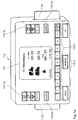
- FIG. 6a shows a view of the operating device 1.2 of the tachograph arrangement 1 according to FIG. 4 and FIG. 6b shows the keyboard and display symbols used here.
- the graphic display 111 enables various displays simultaneously: The figure shows that in addition to the driver's name (first line) and time and date (last line), the partial steering time after the last interruption (second line) and the current daily driving time (third line) and the the interruption time still to be inserted (fourth line) is displayed in the partial steering time block started.
- driver and front passenger working time category input keys 110.1a and 110.1b for driving time (only for driver), standby time, other working hours and rest time - from top to bottom; underneath there is a button 110.2a, 110.2b for unlocking the card.
- a number and charge type key block 110.3 and a function key block 110.4 are also provided.
- the driver's personal PIN can be entered via the keypad 110.3, which serves to additionally protect against unauthorized use.
- the transport of dangerous goods can be booked with the right button; alternatively, this button can be used to identify a passenger.
- the "MODE” button is used to select the operating mode or data to be displayed - for example, the control data for the front passenger -, the "YES" and “NO" buttons are used to confirm or correct entries.
- the embodiment of the invention is not limited to the preferred exemplary embodiment specified above. Rather, a number of variants are conceivable which make use of the solution shown, even in the case of fundamentally different types.
Landscapes
- Physics & Mathematics (AREA)
- General Physics & Mathematics (AREA)
- Time Recorders, Dirve Recorders, Access Control (AREA)
- Traffic Control Systems (AREA)
Applications Claiming Priority (2)
| Application Number | Priority Date | Filing Date | Title |
|---|---|---|---|
| DE19533515 | 1995-08-30 | ||
| DE1995133515 DE19533515A1 (de) | 1995-08-30 | 1995-08-30 | Fahrtschreiberanordnung |
Publications (2)
| Publication Number | Publication Date |
|---|---|
| EP0762339A2 true EP0762339A2 (fr) | 1997-03-12 |
| EP0762339A3 EP0762339A3 (fr) | 1999-06-09 |
Family
ID=7771806
Family Applications (1)
| Application Number | Title | Priority Date | Filing Date |
|---|---|---|---|
| EP96250185A Withdrawn EP0762339A3 (fr) | 1995-08-30 | 1996-08-29 | Agencement de tachygraphe |
Country Status (2)
| Country | Link |
|---|---|
| EP (1) | EP0762339A3 (fr) |
| DE (1) | DE19533515A1 (fr) |
Cited By (15)
| Publication number | Priority date | Publication date | Assignee | Title |
|---|---|---|---|---|
| ES2134157A1 (es) * | 1997-11-05 | 1999-09-16 | Cuartero Angel Mejuto | Sistema de tacografo electronico y su equipo fijo. |
| EP0898254A3 (fr) * | 1997-08-16 | 1999-12-29 | Robert Bosch Gmbh | Dispositif antivol pour un appareil |
| WO2000057009A1 (fr) * | 1999-03-22 | 2000-09-28 | Robert Bosch Gmbh | Dispositif et procede permettant de reproduire des informations dans un vehicule |
| WO2004034314A3 (fr) * | 2002-10-04 | 2004-06-03 | Siemens Ag | Dispositif pour la reception et la mise en contact de deux cartes a puce munies de contacts |
| EP1437690A1 (fr) * | 2003-01-10 | 2004-07-14 | Siemens Aktiengesellschaft | Système comprenant un tachygraphe numérique et une clé de téléchargement de données |
| WO2006000513A1 (fr) * | 2004-06-25 | 2006-01-05 | Siemens Aktiengesellschaft | Procede de calcul d'une interruption de temps de conduite cumulative |
| WO2006000507A1 (fr) * | 2004-06-25 | 2006-01-05 | Siemens Aktiengesellschaft | Transmission de donnees dans un ensemble comportant un tachygraphe |
| WO2006008527A3 (fr) * | 2004-07-20 | 2006-08-03 | Digy Holdings Ltd | Systeme de tachygraphe numerique perfectionne |
| GB2426363A (en) * | 2005-05-20 | 2006-11-22 | Digy Holdings Ltd | Digital tachograph system |
| WO2007058607A1 (fr) * | 2005-11-18 | 2007-05-24 | Scania Cv Ab (Publ) | Identification et connexion informatique d’un operateur de vehicule |
| US7905394B2 (en) | 2005-09-12 | 2011-03-15 | Continental Automotive Gmbh | Assembly comprising a tachograph |
| RU2419883C2 (ru) * | 2005-08-17 | 2011-05-27 | Сименс Фдо Аутомотиве Аг | Устройство обмена данными |
| EP2937840A3 (fr) * | 2014-04-25 | 2016-01-27 | MAN Truck & Bus AG | Affichage du temps de conduite dans un véhicule utilitaire, notamment dans une cabine conducteur d'un camion |
| WO2019018908A1 (fr) * | 2017-07-28 | 2019-01-31 | Silva Dalton Alexandre Da | Système de lecture, d'enregistrement et de mise à disposition de données et de paramètres de conduite d'un véhicule à moteur en association avec un système d'enregistrement de point électronique |
| EP4657400A1 (fr) * | 2024-05-31 | 2025-12-03 | ZF CV Systems Global GmbH | Appareil de commande pour un véhicule, en particulier un véhicule utilitaire, véhicule, procédé, programme informatique et/ou support lisible par ordinateur |
Families Citing this family (15)
| Publication number | Priority date | Publication date | Assignee | Title |
|---|---|---|---|---|
| DE29705570U1 (de) * | 1997-03-27 | 1997-08-14 | Westermann, Michael, 59071 Hamm | Elektronischer Fahrtenbuchschreiber |
| DE10004665A1 (de) * | 2000-02-03 | 2001-08-09 | Johannes Hagmann | Digitalisierung des Fahrtenschreibers |
| DE10210320B4 (de) * | 2001-04-24 | 2006-11-02 | International Business Machines Corp. | Duale Aufzeichnung zur Fahrtzeitenkontrolle bei Lastkraftwagen |
| DE10334461A1 (de) * | 2003-07-29 | 2005-03-03 | Franz Schefthaler | Fahrtenschreiber |
| DE102005022115A1 (de) * | 2005-05-12 | 2006-11-16 | Siemens Ag | Anzeigenansteuerung eines Tachographen |
| DE102005043624A1 (de) * | 2005-09-13 | 2007-03-22 | Siemens Ag | Anordnung mit einem mobilen Datenträger und einem Handgerät |
| US7616105B2 (en) * | 2006-03-07 | 2009-11-10 | Qualcomm Incorporated | Methods and apparatus for providing hours of service management |
| FR2919092B1 (fr) * | 2007-07-16 | 2010-05-21 | Tokheim Sofitam Applic | Procede permettant un echange securise de donnees de livraison entre un calculateur de gestion et un systeme de traitement informatique de ces donnees |
| EP2141662A3 (fr) * | 2007-10-25 | 2010-11-24 | Stoneridge Electronics AB | Tachygraphe numérique et son procédé |
| EP2169633A1 (fr) | 2008-09-19 | 2010-03-31 | Stoneridge Electronics AB | Tachygraphe numérique et son procédé |
| EP2169632A1 (fr) * | 2008-09-22 | 2010-03-31 | Stoneridge Electronics AB | Tachygraphe numérique et son procédé |
| EP2375385A1 (fr) * | 2010-04-06 | 2011-10-12 | Prozess Control GmbH | Procédé et système d'évaluation du comportement de conduite d'un conducteur de véhicule automobile |
| DE102013205011A1 (de) * | 2013-03-21 | 2014-09-25 | Continental Automotive Gmbh | Verfahren zum Betreiben eines Tachographensystems und Tachographensystem |
| DE102016224407A1 (de) * | 2016-12-07 | 2018-06-07 | Continental Automotive Gmbh | Verfahren zum Ausdrucken von auf einer Fahrtschreiberdatenkarte gespeicherten Daten |
| EP3462419B1 (fr) * | 2017-09-29 | 2023-08-02 | Continental Automotive Technologies GmbH | Procédé de lecture de deux cartes de données de tachygraphe |
Family Cites Families (6)
| Publication number | Priority date | Publication date | Assignee | Title |
|---|---|---|---|---|
| DE3505068C1 (de) * | 1985-02-14 | 1986-06-19 | Mannesmann Kienzle GmbH, 7730 Villingen-Schwenningen | Fahrtschreiber fuer Kraftfahrzeuge |
| JP2556501B2 (ja) * | 1987-02-09 | 1996-11-20 | 株式会社日立製作所 | 運転免許証カ−ドシステム |
| DE3736258A1 (de) * | 1987-10-27 | 1989-05-11 | Mannesmann Kienzle Gmbh | Datenkartenanordnung |
| DE3942009C2 (de) * | 1989-12-20 | 1994-03-03 | Deutsche Aerospace | System zur Kontrolle und Überwachung der Verteilung von Gütern |
| BE1003882A6 (fr) * | 1990-07-17 | 1992-07-07 | Sungur Naim | Tachographe. |
| GB9220875D0 (en) * | 1992-10-05 | 1992-11-18 | Matra Marconi Space Uk Ltd | A tachograph |
-
1995
- 1995-08-30 DE DE1995133515 patent/DE19533515A1/de not_active Withdrawn
-
1996
- 1996-08-29 EP EP96250185A patent/EP0762339A3/fr not_active Withdrawn
Cited By (21)
| Publication number | Priority date | Publication date | Assignee | Title |
|---|---|---|---|---|
| EP0898254A3 (fr) * | 1997-08-16 | 1999-12-29 | Robert Bosch Gmbh | Dispositif antivol pour un appareil |
| ES2134157A1 (es) * | 1997-11-05 | 1999-09-16 | Cuartero Angel Mejuto | Sistema de tacografo electronico y su equipo fijo. |
| WO2000057009A1 (fr) * | 1999-03-22 | 2000-09-28 | Robert Bosch Gmbh | Dispositif et procede permettant de reproduire des informations dans un vehicule |
| US6580972B1 (en) | 1999-03-22 | 2003-06-17 | Robert Bosch Gmbh | Device and method for reproducing information in a motor vehicle |
| WO2004034314A3 (fr) * | 2002-10-04 | 2004-06-03 | Siemens Ag | Dispositif pour la reception et la mise en contact de deux cartes a puce munies de contacts |
| EP1437690A1 (fr) * | 2003-01-10 | 2004-07-14 | Siemens Aktiengesellschaft | Système comprenant un tachygraphe numérique et une clé de téléchargement de données |
| WO2006000513A1 (fr) * | 2004-06-25 | 2006-01-05 | Siemens Aktiengesellschaft | Procede de calcul d'une interruption de temps de conduite cumulative |
| WO2006000507A1 (fr) * | 2004-06-25 | 2006-01-05 | Siemens Aktiengesellschaft | Transmission de donnees dans un ensemble comportant un tachygraphe |
| US8200984B2 (en) | 2004-06-25 | 2012-06-12 | Continental Automotive Gmbh | Data transmission in an arrangement comprising a tachograph |
| WO2006008527A3 (fr) * | 2004-07-20 | 2006-08-03 | Digy Holdings Ltd | Systeme de tachygraphe numerique perfectionne |
| GB2416421B (en) * | 2004-07-20 | 2008-09-10 | Francis John Steele | The universal satellite key (USK) |
| GB2426363A (en) * | 2005-05-20 | 2006-11-22 | Digy Holdings Ltd | Digital tachograph system |
| GB2426363B (en) * | 2005-05-20 | 2009-11-04 | Digy Holdings Ltd | Vehicle Usage Monitoring System |
| RU2419883C2 (ru) * | 2005-08-17 | 2011-05-27 | Сименс Фдо Аутомотиве Аг | Устройство обмена данными |
| US7905394B2 (en) | 2005-09-12 | 2011-03-15 | Continental Automotive Gmbh | Assembly comprising a tachograph |
| CN101310309B (zh) * | 2005-11-18 | 2010-05-19 | 斯堪尼亚有限公司 | 车辆操作者的身份识别和计算机登录 |
| WO2007058607A1 (fr) * | 2005-11-18 | 2007-05-24 | Scania Cv Ab (Publ) | Identification et connexion informatique d’un operateur de vehicule |
| US8255990B2 (en) | 2005-11-18 | 2012-08-28 | Scania Cv Ab (Publ) | Identification and computer login of an operator of a vehicle |
| EP2937840A3 (fr) * | 2014-04-25 | 2016-01-27 | MAN Truck & Bus AG | Affichage du temps de conduite dans un véhicule utilitaire, notamment dans une cabine conducteur d'un camion |
| WO2019018908A1 (fr) * | 2017-07-28 | 2019-01-31 | Silva Dalton Alexandre Da | Système de lecture, d'enregistrement et de mise à disposition de données et de paramètres de conduite d'un véhicule à moteur en association avec un système d'enregistrement de point électronique |
| EP4657400A1 (fr) * | 2024-05-31 | 2025-12-03 | ZF CV Systems Global GmbH | Appareil de commande pour un véhicule, en particulier un véhicule utilitaire, véhicule, procédé, programme informatique et/ou support lisible par ordinateur |
Also Published As
| Publication number | Publication date |
|---|---|
| DE19533515A1 (de) | 1997-03-06 |
| EP0762339A3 (fr) | 1999-06-09 |
Similar Documents
| Publication | Publication Date | Title |
|---|---|---|
| EP0762339A2 (fr) | Agencement de tachygraphe | |
| DE69629518T2 (de) | Mobilendgerät und Kontrollsystem für bewegte Körper | |
| EP0191413B1 (fr) | Tachygraphe pour véhicules | |
| DE2656848C2 (de) | Elektronischer Taxameter | |
| EP0730770B1 (fr) | Systeme d'enregistrement d'informations relatives a un itineraire parcouru par un vehicule | |
| DE4335316C2 (de) | Anordnung und Verfahren zur Kennzeichnung, Identifikation und Verifikation von Fahrzeugen | |
| EP0188429B1 (fr) | Appareil d'enregistrement de donnees pour vehicule | |
| DE19534139A1 (de) | Verfahren und Vorrichtung zur Vereinfachung von Verwaltungs- und Steuerungsaufgaben einer Vielzahl von Fahrzeugen | |
| EP2326959B1 (fr) | Procédé de déconnexion de fonctions d'un tachygraphe | |
| EP3109835A1 (fr) | Procede et systeme de saisie de donnees de vehicule et de conducteur | |
| DE69813612T2 (de) | Automatisches system zur erstellung und verwaltung von strafzetteln | |
| DE19710393A1 (de) | Verfahren und Gerät zur Dokumentation von Fahrzeugdaten | |
| DE10210320A1 (de) | Methode der dualen Aufzeichnung zur Fahrtzeitenkontrolle bei Lastkraftwagen | |
| DE10050984A1 (de) | System zur Erfassung und Überwachung des Betriebszustandes und der Verfügbarkeit von Mietfahrzeugen | |
| DE3911667C2 (de) | Bediengerät zum bargeldlosen Entrichten von Fahrgeld | |
| EP1257973B1 (fr) | Mise en activite a cout controle d'une automobile | |
| DE19711521A1 (de) | Vorrichtung zur Vereinfachung von Verwaltungs- und Steuerungsaufgaben im Zusammenhang mit wenigstens einem mobilen Objekt, insbesondere von Fahrzeugen, sowie Verfahren zum Betreiben der Vorrichtung | |
| DE19838329A1 (de) | Vorrichtung und Verfahren zur Erstellung eines Fahrtenbuchs für ein Kraftfahrzeug | |
| DE29808723U1 (de) | Fahrzeitenkontrolle mit Zwangsstillstand | |
| EP1880366A1 (fr) | Commande d'affichage d'un tachygraphe | |
| DE4331374A1 (de) | Einrichtung zur Erfassung, Speicherung und Auswertung der Daten wenigstens eines Arbeitsvorganges und Verfahren zur Gewinnung von Überwachungsdaten aus einem Arbeitsvorgang | |
| DE68905505T2 (de) | Personenkontrollsystem unter verwendung von ic-karten. | |
| DE102022200128A1 (de) | Verfahren zum Betreiben eines Parksystems für einen vorgegebenen Parkbereich für zumindest ein Kraftfahrzeug, Computerprogrammprodukt sowie Parksystem | |
| DE20112392U1 (de) | Verkehrsgebühren-Erhebungssystem | |
| DE19727395A1 (de) | Vorrichtung zur Aufzeichnung der Arbeitszeit von Kraftfahrern |
Legal Events
| Date | Code | Title | Description |
|---|---|---|---|
| PUAI | Public reference made under article 153(3) epc to a published international application that has entered the european phase |
Free format text: ORIGINAL CODE: 0009012 |
|
| AK | Designated contracting states |
Kind code of ref document: A2 Designated state(s): AT BE CH DE DK ES FR GB IT LI NL SE |
|
| PUAL | Search report despatched |
Free format text: ORIGINAL CODE: 0009013 |
|
| AK | Designated contracting states |
Kind code of ref document: A3 Designated state(s): AT BE CH DE DK ES FR GB IT LI NL SE |
|
| 17P | Request for examination filed |
Effective date: 19991209 |
|
| 17Q | First examination report despatched |
Effective date: 20020226 |
|
| STAA | Information on the status of an ep patent application or granted ep patent |
Free format text: STATUS: THE APPLICATION IS DEEMED TO BE WITHDRAWN |
|
| 18D | Application deemed to be withdrawn |
Effective date: 20030301 |