EP0765632B1 - Procédé et appareil pour la surveillance de la respiration - Google Patents
Procédé et appareil pour la surveillance de la respiration Download PDFInfo
- Publication number
- EP0765632B1 EP0765632B1 EP96113850A EP96113850A EP0765632B1 EP 0765632 B1 EP0765632 B1 EP 0765632B1 EP 96113850 A EP96113850 A EP 96113850A EP 96113850 A EP96113850 A EP 96113850A EP 0765632 B1 EP0765632 B1 EP 0765632B1
- Authority
- EP
- European Patent Office
- Prior art keywords
- current
- electrodes
- examination
- patient
- accordance
- Prior art date
- Legal status (The legal status is an assumption and is not a legal conclusion. Google has not performed a legal analysis and makes no representation as to the accuracy of the status listed.)
- Expired - Lifetime
Links
Images


Classifications
-
- A—HUMAN NECESSITIES
- A61—MEDICAL OR VETERINARY SCIENCE; HYGIENE
- A61B—DIAGNOSIS; SURGERY; IDENTIFICATION
- A61B5/00—Measuring for diagnostic purposes; Identification of persons
- A61B5/08—Measuring devices for evaluating the respiratory organs
- A61B5/085—Measuring impedance of respiratory organs or lung elasticity
- A61B5/086—Measuring impedance of respiratory organs or lung elasticity by impedance pneumography
Definitions
- the present invention relates to monitoring respirations of a patient, and more specifically to impedance pneumography, which is a technique for monitoring respirations by monitoring changes in electrical impedance caused by the expansion and contraction of the thoracic cavity of the patient during respiration.
- a differential, constant amplitude AC examination current is applied to the body of a patient for detecting patient respirations by measuring changes in the transthoracic impedance of the patient.
- the examination current is applied to the patient by two of the electrodes normally used for ECG monitoring.
- the examination current is passed through the thoracic cavity of the patient and, due to the constant amplitude examination current passing through a transthoracic impedance that changes with patient respirations, voltage modulations are created at the ECG electrodes in accordance with the patient respirations.
- the resulting voltage modulations are typically detected by a synchronous voltage detector, connected to the same pair of electrodes as was used for applying the examination current, such as the right arm (RA) and left arm (LA) electrodes.
- the cables used for connecting the examination current and voltage detector to the patient contain capacitive reactances which tends to shunt a portion of the examination current around the patient.
- capacitive reactances which tends to shunt a portion of the examination current around the patient.
- One effect of this shunting is that the system gain, as expressed in Volts/Ohm, will have a dependency on the baseline level of the transthoracic impedance, as well as the level of any impedance placed in series with the patient, such as resistances for protecting the monitoring circuitry from defibrillator voltages which may be applied to the patient.
- This dependency makes detecting the small respiration induced changes in impedance more difficult (that is, such a dependency making it difficult to set absolute signal detection threshold levels).
- Another effect is that the induced voltage becomes sensitive to changes in the frequency of the examination current.
- any phase or frequency jitter in the examination current signals, or the clock signals used to detect the examination current will be converted to a voltage noise during detection by the synchronous voltage detector.
- the above-noted shunting of the examination current, changes in the system gain, and voltage noise result in signal artifacts in the induced voltage modulations which reduce the accuracy of the respiration detection circuitry.
- a prior art respiration monitor manufactured by Hewlett-Packard (believed to be sold under the trademark CLOVER) applies a fixed frequency sine wave to an impedance bridge, one leg of which is connected to the thoracic cavity of a patient via a transformer.
- the output of the bridge is fed to a synchronous detector for developing the respiration signal in accordance with known techniques.
- the technique undesirably requires the use of a transformer, which is bulky and not well suited for incorporation with integrated circuit technology. Additionally, this technique requires a sinewave examination current, which is somewhat difficult and costly to generate using digital circuitry.
- an apparatus for monitoring the expansion and contraction of the thoracic cavity of a patient caused by respiration comprising:
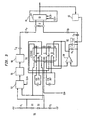
- FIG 1 illustrates a prior art respiration monitor 8 wherein a differential current source 10 generates two identical, but differential (180° out of phase), AC examination currents.
- the differential currents are applied to patient mounted electrodes 12 and 14, respectively, via a patient connected cable 16.
- the electrodes are of the type used for EKG monitoring, and patient cable 16 is the EKG cable used to connect the EKG electrodes to an EKG monitor.
- EKG signal processing circuitry (not shown) would also be connected to cable 16 in parallel with respiration circuitry 18, for developing and displaying EKG waveforms, as well known.
- the body of a patient P presents a varying impedance Z between electrodes 12 and 14, the variations in the patient impedance corresponding to the expansion and contraction of the transthoracic cavity of the patient in response to patient respirations.
- Respiration circuitry 18 within the monitor is connected to the electrodes 12 and 14 via cable 16 for sensing amplitude modulations of a voltage developed between electrodes 12 and 14 due to the applied AC examination current and the patient respirations.
- these sensed amplitude modulations are processed for developing a respiration signal which may be used for display and/or alarm monitoring of the respirations of the patient.
- C C the effective capacitance of cable 16, and C B and R P , comprising a DC blocking capacitor and a high voltage protection resistor, respectively.
- the effective capacitance C C of cable 16 tends to shunt a portion of the AC examination current around, rather than through, the patient.
- One major effect of this shunting is a reduced signal level of the induced voltage modulations, thereby reducing the ability to accurately monitor the changes in patient impedance, which is on the order of only 1 or 2 Ohms out of approximately 600 to 6000 Ohms of patient impedance. At approximately 5000-6000 Ohms of patient impedance, current shunting by the cable is significant.
- FIG 2 a block diagram of a respiration monitor constructed in accordance with the principles of the present invention is shown. Circuits and components that are substantially the same in Figures 1 and 2 are similarly numbered. Basically, there are at least two improvements over the prior art. Firstly, compensation networks 20 and 22 are incorporated with the differential outputs of current source 10 forming a modified current source 10', and secondly, in the preferred embodiment, the differential current source is provided using a switched "flying" capacitor circuit arrangement.
- a differential current source 11 provides a square wave examination current 24 (of, for example, ⁇ 100 ⁇ A), and compensation networks 20 and 22 modify the examination current so as to develop a compensated current at the respective outputs of current source 11' which has an overshoot at its leading edges, as illustrated by waveform 26.
- Waveform 28 is illustrative of the voltage developed across the patient in response to application to the patient of the compensated examination current, which voltage is transmitted to the respiration detection circuits 18 via cable 16. Note that the level transitions in waveform 28 are substantially rectangular, wherein if the compensated examination current, as illustrated by waveform 26, were not provided, a portion of the examination current will initially be shunted across the patient by the capacitance C c of cable 16, and then slowly increase thereafter.
- FIG 3 illustrates partially in block diagram form and partially in detailed schematic diagram form a respiration monitor constructed in accordance with the principles of the present invention, including the compensated current source 11'.
- the compensated current source 11' develops two identical differential AC currents that are 180° out of phase, and basically comprises two identical current sources, details of only one-half of the circuitry will be described.
- a voltage reference 50 comprises series connected diodes D 1 and D 2 , which are forward biased via resistors R 1 and R 2 connected to power supply voltages of + 5 volts and - 5 volts, respectively.
- First and second substantially identical switching arrangements 52 and 54 are simultaneously coupled to the positive and negative sides, respectively, of voltage reference source 50 for developing in a complimentary manner first and second differential voltage signals, respectively.
- a system clock (not shown) provides complimentary (180° out of phase) clock signals CLK + and CLK - , which are provided to switching arrangements 52 and 54, respectively.
- the first and second differential voltage signals provided by switching arrangements 52 and 54 are then converted to current signals via first and second voltage to current (V/I) converters 56 and 58, respectively.
- the examination current signals developed at the output of converters 56 and 58 are modified by compensation networks 60 and 62, respectively, before being applied to the patient via the previously described blocking capacitor, high voltage protection resistor, patient cable and patient electrodes.
- the modification is by an amount sufficient to substantially compensate for the undesirable shunting of the examination current around the patient.
- voltage reference 50 provides a low impedance reference source for charging a "flying" capacitor C 9 via a clocked integrated circuit switch arrangement 54, which includes switch portions 54A that are normally closed in response to the CLK - clock signals, as shown.
- switch portion 54A On the first half-cycle of the CLK - clock signal, switch portion 54A connects capacitor C 9 across reference voltage source 50.
- switch portion 54B On the second half-cycle of CLK - clock signal, switch portion 54B connects capacitor C 9 across capacitor C 10 , thereby maintaining a steady state voltage on capacitor C 10 at a value equal to the reference voltage.
- a reversing switch arrangement comprising switches 54C and 54D alternately reverses the polarity of the voltage developed across capacitor C 10 for application to a voltage to current (V/I) converter amplifier 58.
- Amplifier 58 forces the voltage on capacitor C 10 to appear across compensation network 62.
- the timing of switches 54C and 54D are controlled by the CLK - clock signal, with normal switch positions as shown in Figure 3.
- the output of amplifier 58 is provided as the examination current after being modified via compensation network 62.
- Network 62 comprises a parallel connection of R 4 and C 14 .
- Compensation of the current source is achieved as follows. At the instant the voltage across the compensation network 62 changes polarity, due to the operation of reversing switch 54C/54D, a transient current substantially larger than the steady state current is created by a rapid charging action of capacitor C 14 by amplifier 58. This transient current is used to rapidly charge the distributed capacitance in patient cable 16. This transient current surge then decays at an exponential rate, as determined by the RC time constant of R 4 and C 14 of compensation network 62. If the product of R 4 and C 14 is made to be substantially equal to the RC product formed by the transthoracic impedance of the patient and the distributed capacitance of the patient cable, then the effects of cable capacitance can be substantially diminished.
- Synchronous detector 64 operates in a manner well known to those of ordinary skill in the art, and is responsive to the CLK + and CLK - clock signals for detecting the AC voltage, with amplitude modulations corresponding to respirations, generated at its output.
- the setting of R 4 and C 14 can be made at the factory during manufacture, using fixed values that provide appropriate compensation for typical patients, as determined by trial and error during circuit design.
- the output of the synchronous detector portion of respiration circuit 18 could be monitored for a predetermined output level while C 14 is manually adjusted by the user.
- capacitor C 14 can be made automatic by using a varactor diode as C 14 and developing a control signal from the output of the synchronous detector which is applied in a feedback manner to diode C 14 .
- current source 11 is illustrated using a switched capacitor arrangement, other arrangements for generating a current source are also possible, such as a large valve resistor, but which are not as advantageous as the illustrated embodiment. All such changes, modifications, variations and other uses and applications which do not depart from the scope of the invention are deemed to be covered by the invention which is limited only by the claims which follow.
Landscapes
- Health & Medical Sciences (AREA)
- Life Sciences & Earth Sciences (AREA)
- Pulmonology (AREA)
- Biomedical Technology (AREA)
- Medical Informatics (AREA)
- Biophysics (AREA)
- Pathology (AREA)
- Engineering & Computer Science (AREA)
- Physiology (AREA)
- Heart & Thoracic Surgery (AREA)
- Physics & Mathematics (AREA)
- Molecular Biology (AREA)
- Surgery (AREA)
- Animal Behavior & Ethology (AREA)
- General Health & Medical Sciences (AREA)
- Public Health (AREA)
- Veterinary Medicine (AREA)
- Measurement Of The Respiration, Hearing Ability, Form, And Blood Characteristics Of Living Organisms (AREA)
- Respiratory Apparatuses And Protective Means (AREA)
Claims (11)
- Un appareil pour la surveillance de l'expansion et de la contraction de la cavité thoracique d'un patient provoquées par la respiration, comprenant :caractérisé par des moyens de modification de courant (20, 22) couplés aux moyens générateurs pour modifier le courant d'examen en courant alternatif pendant son application aux électrodes de manière à développer un courant compensé qui présente un dépassement au niveau de ses bords de montée de sorte que ladite partie du courant d'examen qui ne passe à travers lesdites électrodes est au moins en partie compensée.des moyens générateurs (11) pour générer un signal de courant d'examen en courant alternatif ;des électrodes (12, 14) pour appliquer au patient ledit signal de courant d'examen ;des moyens de couplage (16) pour appliquer aux électrodes ledit signal de courant d'examen de sorte qu'une partie dudit courant d'examen passe à travers les électrodes, alors qu'une partie dudit courant ne passe pas à travers les électrodes mais est dérivée du fait de la capacitance effective des moyens de couplage ; etdes moyens de détection (18) couplés auxdits moyens de couplage pour détecter un signal de tension modulé en amplitude développé aux bornes desdites électrodes en réponse à ladite application du courant d'examen et à la variation de l'impédance présentée auxdites électrodes ;
- Appareil selon la revendication 1, dans lequel lesdits moyens de modification sont disposés pour appliquer audit courant d'examen une quantité de courant supplémentaire qui est sensiblement égale à ladite partie dudit courant d'examen qui ne passe à travers lesdites électrodes.
- Appareil selon la revendication 2, dans lequel ladite partie dudit courant d'examen qui ne passe pas à travers lesdites électrodes est une partie variable dans le temps, et lesdits moyens de modification sont disposés pour fournir un changement variable dans le temps au niveau dudit courant d'examen de manière à compenser pour ladite partie dudit courant d'examen qui ne passe à travers lesdites électrodes.
- Appareil selon l'une quelconque des revendications précédentes, dans lequel lesdits moyens de modification comprennent une liaison parallèle d'une résistance et d'une capacitance, laquelle est couplée auxdits moyens de couplage, et dans lequel la constante de temps RC desdits moyens de modification est sensiblement égale à une constante de temps RC desdits moyens de couplage.
- Appareil selon l'une quelconque des revendications précédentes, dans lequel lesdits moyens de couplage comprennent un câble relié par une extrémité auxdites électrodes et par une autre extrémité audit appareil pour la surveillance.
- Appareil selon l'une quelconque des revendications précédentes, dans lequel lesdits moyens générateurs comprennent :une source de tension de référence (50) pour fournir de première et seconde tensions de polarités opposées ;une première disposition de commutation (52) pour coupler de manière périodique lesdites première et seconde tensions de référence aux côtés opposés d'une première capacitance ;de second moyen de commutation (54) pour coupler de manière alternée, pendant des périodes de temps qui sont de 180° déphasées par rapport au couplage périodique de ladite source de tension de référence à ladite première capacitance, ladite première capacitance à une seconde capacitance ;des moyens de commutation inverseurs (54C, 54D) pour fournir à leur sortie, pendant des périodes de temps alternées, une tension développée aux bornes de ladite seconde capacitance et une polarité inverse de ladite tension développée aux bornes de ladite seconde capacitance ; etun convertisseur tension-en-courant présentant une entrée répondant à la sortie desdits moyens de commutation pour fournir, au niveau d'une sortie, un courant d'examen en courant alternatif.
- Appareil selon la revendication 6, dans lequel ledit convertisseur tension-en-courant comprend un amplificateur opérationnel.
- Appareil selon la revendication 7, dans lequel lesdits moyens de modification comprennent une liaison parallèle d'une résistance et d'un condensateur couplée entre une sortie desdits moyens formant amplificateur opérationnel et leur entrée.
- Appareil selon l'une quelconque des revendications précédentes, dans lequel lesdits moyens de détection comprennent un détecteur synchrone présentant une entrée couplée auxdits moyens de couplage.
- Appareil selon l'une quelconque des revendications précédentes, comprenant en outre des moyens de réglage couplés auxdits moyens de modification de courant pour régler la quantité de compensation ainsi fournie.
- Appareil selon la revendication 10, dans lequel lesdits moyens de réglage comprennent des moyens de contre-réaction reliés entre une sortie dudit détecteur synchrone et lesdits moyens de modification de courant pour régler de manière automatique ladite compensation.
Applications Claiming Priority (2)
| Application Number | Priority Date | Filing Date | Title |
|---|---|---|---|
| US537175 | 1990-06-13 | ||
| US08/537,175 US5623938A (en) | 1995-09-29 | 1995-09-29 | Method and apparatus for respiration monitoring |
Publications (3)
| Publication Number | Publication Date |
|---|---|
| EP0765632A2 EP0765632A2 (fr) | 1997-04-02 |
| EP0765632A3 EP0765632A3 (fr) | 1998-01-07 |
| EP0765632B1 true EP0765632B1 (fr) | 2004-05-12 |
Family
ID=24141528
Family Applications (1)
| Application Number | Title | Priority Date | Filing Date |
|---|---|---|---|
| EP96113850A Expired - Lifetime EP0765632B1 (fr) | 1995-09-29 | 1996-08-29 | Procédé et appareil pour la surveillance de la respiration |
Country Status (5)
| Country | Link |
|---|---|
| US (1) | US5623938A (fr) |
| EP (1) | EP0765632B1 (fr) |
| AT (1) | ATE266353T1 (fr) |
| CA (1) | CA2186705A1 (fr) |
| DE (1) | DE69632440T2 (fr) |
Cited By (2)
| Publication number | Priority date | Publication date | Assignee | Title |
|---|---|---|---|---|
| US7092757B2 (en) | 2002-07-12 | 2006-08-15 | Cardiac Pacemakers, Inc. | Minute ventilation sensor with dynamically adjusted excitation current |
| US8880171B2 (en) | 2003-07-02 | 2014-11-04 | Cardiac Pacemakers, Inc. | Cardiac cycle synchronized sampling of impedance signal |
Families Citing this family (10)
| Publication number | Priority date | Publication date | Assignee | Title |
|---|---|---|---|---|
| US6076015A (en) * | 1998-02-27 | 2000-06-13 | Cardiac Pacemakers, Inc. | Rate adaptive cardiac rhythm management device using transthoracic impedance |
| US6190326B1 (en) | 1999-04-23 | 2001-02-20 | Medtrac Technologies, Inc. | Method and apparatus for obtaining patient respiratory data |
| US6522914B1 (en) | 2000-07-14 | 2003-02-18 | Cardiac Pacemakers, Inc. | Method and apparatuses for monitoring hemodynamic activities using an intracardiac impedance-derived parameter |
| WO2004047643A1 (fr) * | 2002-11-27 | 2004-06-10 | Z-Tech (Canada) Inc. | Mesure de bioimpedance au moyen d'une injection de courant commute par un dispositif de commande et d'une connexion d'electrodes selectionnees par multiplexeur |
| US7101339B2 (en) | 2002-12-13 | 2006-09-05 | Cardiac Pacemakers, Inc. | Respiration signal measurement apparatus, systems, and methods |
| WO2004062501A2 (fr) * | 2003-01-09 | 2004-07-29 | Koninklijke Philips Electronics N.V. | Moniteur de respiration pour tomographie informatisee |
| US20070123110A1 (en) * | 2003-10-08 | 2007-05-31 | Koninklijke Philips Electronics N.V. | Ultrasonic volumetric imaging by coordination of acoustic sampling resolution, volumetric line density, and volume imaging rate |
| US8273053B2 (en) * | 2009-05-05 | 2012-09-25 | Pyng Medical Corp. | Patient status sensor |
| US20170150902A1 (en) * | 2015-11-30 | 2017-06-01 | Draeger Medical Systems, Inc. | Systems and methods for measuring respiration rate |
| JP6916441B2 (ja) * | 2017-10-19 | 2021-08-11 | 株式会社ソシオネクスト | 半導体集積回路及び呼吸運動検査装置 |
Family Cites Families (9)
| Publication number | Priority date | Publication date | Assignee | Title |
|---|---|---|---|---|
| US3452743A (en) * | 1965-03-01 | 1969-07-01 | Gen Electric | Body impedance bridge |
| US3524058A (en) * | 1966-08-01 | 1970-08-11 | North American Rockwell | Respiration monitor having means for triggering a utilization device |
| US4506678A (en) * | 1982-06-07 | 1985-03-26 | Healthdyne, Inc. | Patient monitor for providing respiration and electrocardiogram signals |
| US4576183A (en) * | 1983-09-21 | 1986-03-18 | Gianni Plicchi | Electronic circuit for monitoring respiratory parameter for controlling operation of implantable medical device |
| DE3774332D1 (de) * | 1986-06-16 | 1991-12-12 | Siemens Ag | Vorrichtung zur impedanzmessung an koerpergeweben. |
| US4708146A (en) * | 1986-08-06 | 1987-11-24 | Spacelabs, Inc. | Apparatus and method for impedance pneumography |
| US4919145A (en) * | 1988-07-13 | 1990-04-24 | Physio-Control Corporation | Method and apparatus for sensing lead and transthoracic impedances |
| IL102300A (en) * | 1992-06-24 | 1996-07-23 | N I Medical Ltd | Non-invasive system for determining of the main cardiorespiratory parameters of the human body |
| US5335669A (en) * | 1993-04-21 | 1994-08-09 | American Medical Systems, Inc. | Rectal probe with temperature sensor |
-
1995
- 1995-09-29 US US08/537,175 patent/US5623938A/en not_active Expired - Lifetime
-
1996
- 1996-08-29 AT AT96113850T patent/ATE266353T1/de not_active IP Right Cessation
- 1996-08-29 DE DE69632440T patent/DE69632440T2/de not_active Expired - Lifetime
- 1996-08-29 EP EP96113850A patent/EP0765632B1/fr not_active Expired - Lifetime
- 1996-09-27 CA CA002186705A patent/CA2186705A1/fr not_active Abandoned
Non-Patent Citations (1)
| Title |
|---|
| Manual Hewlett Packard Monitor/Terminal 78534A (1983) * |
Cited By (2)
| Publication number | Priority date | Publication date | Assignee | Title |
|---|---|---|---|---|
| US7092757B2 (en) | 2002-07-12 | 2006-08-15 | Cardiac Pacemakers, Inc. | Minute ventilation sensor with dynamically adjusted excitation current |
| US8880171B2 (en) | 2003-07-02 | 2014-11-04 | Cardiac Pacemakers, Inc. | Cardiac cycle synchronized sampling of impedance signal |
Also Published As
| Publication number | Publication date |
|---|---|
| DE69632440D1 (de) | 2004-06-17 |
| EP0765632A2 (fr) | 1997-04-02 |
| EP0765632A3 (fr) | 1998-01-07 |
| DE69632440T2 (de) | 2005-05-12 |
| ATE266353T1 (de) | 2004-05-15 |
| CA2186705A1 (fr) | 1997-03-30 |
| US5623938A (en) | 1997-04-29 |
Similar Documents
| Publication | Publication Date | Title |
|---|---|---|
| EP0765632B1 (fr) | Procédé et appareil pour la surveillance de la respiration | |
| EP0800787B1 (fr) | Dispositif de contrôle d'électrodes de mesure destinées à la réception de signaux physiologiques | |
| US5427111A (en) | Receiver for differential signals with means for adjusting a floating ground state | |
| US4947862A (en) | Body composition analyzer | |
| CA2159854C (fr) | Circuit d'interface auto-alimente pour capteur a transducteur | |
| JP4415215B2 (ja) | 干渉の存在下での生体電気インピーダンス測定システムおよび方法 | |
| JPS6217044Y2 (fr) | ||
| CN105476628A (zh) | 用于在测量生物电信号时抑制共模干扰信号的电路装置 | |
| US5940257A (en) | Method and apparatus for alternating current monitoring with phase and magnitude measurement | |
| JPS6217043Y2 (fr) | ||
| US3656065A (en) | Bio-potential isolated amplifier | |
| JP2758402B2 (ja) | 連続波周波数変換器用の逆相分検出装置 | |
| US4804903A (en) | System for measuring load current in an electronically controlled switch | |
| US6580275B2 (en) | Single sensor control of power converters | |
| US4022990A (en) | Technique and apparatus for measuring the value of a capacitance in an electrical circuit such as a telephone communication line | |
| JPH07128387A (ja) | 非接地配線方式の電路の絶縁監視装置 | |
| EP0159786B1 (fr) | Mesure de rapports d'impédance | |
| FI67967B (fi) | Referensspaenningskaella | |
| JPS5824792Y2 (ja) | ダンピング回路 | |
| FI105300B (fi) | Kytkentäjärjestely vahvavirtajohdossa siirrettyjen informaatioiden vastaanottamiseksi | |
| JPH10177043A (ja) | Whパルス検出回路 | |
| JPH0320785Y2 (fr) | ||
| SU744368A1 (ru) | Измеритель активного сопротивлени | |
| JP3073052B2 (ja) | インピーダンス測定器 | |
| KR0183810B1 (ko) | 심전도 파형을 왜곡시키지 않는 고감도 기선 회복 회로 |
Legal Events
| Date | Code | Title | Description |
|---|---|---|---|
| PUAI | Public reference made under article 153(3) epc to a published international application that has entered the european phase |
Free format text: ORIGINAL CODE: 0009012 |
|
| AK | Designated contracting states |
Kind code of ref document: A2 Designated state(s): AT DE DK FR GB IT NL SE |
|
| PUAL | Search report despatched |
Free format text: ORIGINAL CODE: 0009013 |
|
| AK | Designated contracting states |
Kind code of ref document: A3 Designated state(s): AT DE DK FR GB IT NL SE |
|
| 17P | Request for examination filed |
Effective date: 19980220 |
|
| 17Q | First examination report despatched |
Effective date: 20020905 |
|
| RAP1 | Party data changed (applicant data changed or rights of an application transferred) |
Owner name: SIEMENS MEDICAL SOLUTIONS USA, INC. |
|
| GRAP | Despatch of communication of intention to grant a patent |
Free format text: ORIGINAL CODE: EPIDOSNIGR1 |
|
| RAP1 | Party data changed (applicant data changed or rights of an application transferred) |
Owner name: DRAEGER MEDICAL SYSTEMS, INC. |
|
| GRAS | Grant fee paid |
Free format text: ORIGINAL CODE: EPIDOSNIGR3 |
|
| GRAA | (expected) grant |
Free format text: ORIGINAL CODE: 0009210 |
|
| AK | Designated contracting states |
Kind code of ref document: B1 Designated state(s): AT DE DK FR GB IT NL SE |
|
| PG25 | Lapsed in a contracting state [announced via postgrant information from national office to epo] |
Ref country code: NL Free format text: LAPSE BECAUSE OF FAILURE TO SUBMIT A TRANSLATION OF THE DESCRIPTION OR TO PAY THE FEE WITHIN THE PRESCRIBED TIME-LIMIT Effective date: 20040512 Ref country code: IT Free format text: LAPSE BECAUSE OF FAILURE TO SUBMIT A TRANSLATION OF THE DESCRIPTION OR TO PAY THE FEE WITHIN THE PRE;WARNING: LAPSES OF ITALIAN PATENTS WITH EFFECTIVE DATE BEFORE 2007 MAY HAVE OCCURRED AT ANY TIME BEFORE 2007. THE CORRECT EFFECTIVE DATE MAY BE DIFFERENT FROM THE ONE RECORDED.SCRIBED TIME-LIMIT Effective date: 20040512 Ref country code: AT Free format text: LAPSE BECAUSE OF FAILURE TO SUBMIT A TRANSLATION OF THE DESCRIPTION OR TO PAY THE FEE WITHIN THE PRESCRIBED TIME-LIMIT Effective date: 20040512 |
|
| REG | Reference to a national code |
Ref country code: GB Ref legal event code: FG4D |
|
| REF | Corresponds to: |
Ref document number: 69632440 Country of ref document: DE Date of ref document: 20040617 Kind code of ref document: P |
|
| PGFP | Annual fee paid to national office [announced via postgrant information from national office to epo] |
Ref country code: NL Payment date: 20040729 Year of fee payment: 9 |
|
| PG25 | Lapsed in a contracting state [announced via postgrant information from national office to epo] |
Ref country code: SE Free format text: LAPSE BECAUSE OF FAILURE TO SUBMIT A TRANSLATION OF THE DESCRIPTION OR TO PAY THE FEE WITHIN THE PRESCRIBED TIME-LIMIT Effective date: 20040812 Ref country code: DK Free format text: LAPSE BECAUSE OF FAILURE TO SUBMIT A TRANSLATION OF THE DESCRIPTION OR TO PAY THE FEE WITHIN THE PRESCRIBED TIME-LIMIT Effective date: 20040812 |
|
| NLV1 | Nl: lapsed or annulled due to failure to fulfill the requirements of art. 29p and 29m of the patents act | ||
| ET | Fr: translation filed | ||
| PLBE | No opposition filed within time limit |
Free format text: ORIGINAL CODE: 0009261 |
|
| STAA | Information on the status of an ep patent application or granted ep patent |
Free format text: STATUS: NO OPPOSITION FILED WITHIN TIME LIMIT |
|
| 26N | No opposition filed |
Effective date: 20050215 |
|
| PGFP | Annual fee paid to national office [announced via postgrant information from national office to epo] |
Ref country code: DE Payment date: 20130828 Year of fee payment: 18 |
|
| PGFP | Annual fee paid to national office [announced via postgrant information from national office to epo] |
Ref country code: FR Payment date: 20130819 Year of fee payment: 18 Ref country code: GB Payment date: 20130827 Year of fee payment: 18 |
|
| REG | Reference to a national code |
Ref country code: DE Ref legal event code: R119 Ref document number: 69632440 Country of ref document: DE |
|
| GBPC | Gb: european patent ceased through non-payment of renewal fee |
Effective date: 20140829 |
|
| REG | Reference to a national code |
Ref country code: FR Ref legal event code: ST Effective date: 20150430 |
|
| REG | Reference to a national code |
Ref country code: DE Ref legal event code: R119 Ref document number: 69632440 Country of ref document: DE Effective date: 20150303 |
|
| PG25 | Lapsed in a contracting state [announced via postgrant information from national office to epo] |
Ref country code: DE Free format text: LAPSE BECAUSE OF NON-PAYMENT OF DUE FEES Effective date: 20150303 Ref country code: GB Free format text: LAPSE BECAUSE OF NON-PAYMENT OF DUE FEES Effective date: 20140829 |
|
| PG25 | Lapsed in a contracting state [announced via postgrant information from national office to epo] |
Ref country code: FR Free format text: LAPSE BECAUSE OF NON-PAYMENT OF DUE FEES Effective date: 20140901 |