EP0767077B1 - Transferfolie mit einer kleberschicht und deren verwendung - Google Patents
Transferfolie mit einer kleberschicht und deren verwendung Download PDFInfo
- Publication number
- EP0767077B1 EP0767077B1 EP96907744A EP96907744A EP0767077B1 EP 0767077 B1 EP0767077 B1 EP 0767077B1 EP 96907744 A EP96907744 A EP 96907744A EP 96907744 A EP96907744 A EP 96907744A EP 0767077 B1 EP0767077 B1 EP 0767077B1
- Authority
- EP
- European Patent Office
- Prior art keywords
- image
- layer
- adhesive layer
- transfer
- interposing
- Prior art date
- Legal status (The legal status is an assumption and is not a legal conclusion. Google has not performed a legal analysis and makes no representation as to the accuracy of the status listed.)
- Expired - Lifetime
Links
- 239000012790 adhesive layer Substances 0.000 title claims description 186
- 239000010410 layer Substances 0.000 claims description 169
- 239000000758 substrate Substances 0.000 claims description 45
- 230000009477 glass transition Effects 0.000 claims description 22
- 238000000034 method Methods 0.000 claims description 17
- 238000000859 sublimation Methods 0.000 claims description 12
- 230000008022 sublimation Effects 0.000 claims description 12
- 239000002344 surface layer Substances 0.000 claims description 12
- 239000000945 filler Substances 0.000 claims description 9
- 230000008569 process Effects 0.000 claims description 6
- 229920005989 resin Polymers 0.000 description 53
- 239000011347 resin Substances 0.000 description 53
- 239000000463 material Substances 0.000 description 33
- ZWEHNKRNPOVVGH-UHFFFAOYSA-N 2-Butanone Chemical compound CCC(C)=O ZWEHNKRNPOVVGH-UHFFFAOYSA-N 0.000 description 27
- 238000000576 coating method Methods 0.000 description 27
- 239000011248 coating agent Substances 0.000 description 26
- 239000000975 dye Substances 0.000 description 26
- 239000007788 liquid Substances 0.000 description 23
- 230000000052 comparative effect Effects 0.000 description 13
- -1 for example Polymers 0.000 description 13
- 229920001296 polysiloxane Polymers 0.000 description 12
- 239000000123 paper Substances 0.000 description 11
- 239000011241 protective layer Substances 0.000 description 11
- 239000000203 mixture Substances 0.000 description 10
- 230000000740 bleeding effect Effects 0.000 description 9
- 229920001577 copolymer Polymers 0.000 description 8
- 229920003229 poly(methyl methacrylate) Polymers 0.000 description 8
- 229920001225 polyester resin Polymers 0.000 description 8
- 239000004645 polyester resin Substances 0.000 description 8
- 239000004926 polymethyl methacrylate Substances 0.000 description 8
- 229920002554 vinyl polymer Polymers 0.000 description 8
- BZHJMEDXRYGGRV-UHFFFAOYSA-N Vinyl chloride Chemical compound ClC=C BZHJMEDXRYGGRV-UHFFFAOYSA-N 0.000 description 7
- 239000003795 chemical substances by application Substances 0.000 description 7
- 238000000926 separation method Methods 0.000 description 7
- VYPSYNLAJGMNEJ-UHFFFAOYSA-N Silicium dioxide Chemical compound O=[Si]=O VYPSYNLAJGMNEJ-UHFFFAOYSA-N 0.000 description 6
- 230000015572 biosynthetic process Effects 0.000 description 6
- 239000003086 colorant Substances 0.000 description 6
- 230000035515 penetration Effects 0.000 description 6
- DHKHKXVYLBGOIT-UHFFFAOYSA-N acetaldehyde Diethyl Acetal Natural products CCOC(C)OCC DHKHKXVYLBGOIT-UHFFFAOYSA-N 0.000 description 5
- 150000001241 acetals Chemical class 0.000 description 5
- 230000001070 adhesive effect Effects 0.000 description 5
- 239000000835 fiber Substances 0.000 description 5
- 239000010408 film Substances 0.000 description 5
- 229920006122 polyamide resin Polymers 0.000 description 5
- 238000002360 preparation method Methods 0.000 description 5
- 239000001993 wax Substances 0.000 description 5
- 239000004925 Acrylic resin Substances 0.000 description 4
- 229920000178 Acrylic resin Polymers 0.000 description 4
- XLOMVQKBTHCTTD-UHFFFAOYSA-N Zinc monoxide Chemical compound [Zn]=O XLOMVQKBTHCTTD-UHFFFAOYSA-N 0.000 description 4
- 150000001875 compounds Chemical class 0.000 description 4
- 238000007756 gravure coating Methods 0.000 description 4
- 239000000314 lubricant Substances 0.000 description 4
- 229920002037 poly(vinyl butyral) polymer Polymers 0.000 description 4
- 230000002265 prevention Effects 0.000 description 4
- 229920003002 synthetic resin Polymers 0.000 description 4
- 239000000057 synthetic resin Substances 0.000 description 4
- 239000001856 Ethyl cellulose Substances 0.000 description 3
- ZZSNKZQZMQGXPY-UHFFFAOYSA-N Ethyl cellulose Chemical compound CCOCC1OC(OC)C(OCC)C(OCC)C1OC1C(O)C(O)C(OC)C(CO)O1 ZZSNKZQZMQGXPY-UHFFFAOYSA-N 0.000 description 3
- 239000004698 Polyethylene Substances 0.000 description 3
- 239000004820 Pressure-sensitive adhesive Substances 0.000 description 3
- 229920000297 Rayon Polymers 0.000 description 3
- PPBRXRYQALVLMV-UHFFFAOYSA-N Styrene Chemical compound C=CC1=CC=CC=C1 PPBRXRYQALVLMV-UHFFFAOYSA-N 0.000 description 3
- 239000000853 adhesive Substances 0.000 description 3
- 239000011230 binding agent Substances 0.000 description 3
- 229920002678 cellulose Polymers 0.000 description 3
- 239000001913 cellulose Substances 0.000 description 3
- 235000010980 cellulose Nutrition 0.000 description 3
- 229920002301 cellulose acetate Polymers 0.000 description 3
- 229920001971 elastomer Polymers 0.000 description 3
- 229920001249 ethyl cellulose Polymers 0.000 description 3
- 235000019325 ethyl cellulose Nutrition 0.000 description 3
- 238000010438 heat treatment Methods 0.000 description 3
- 239000000025 natural resin Substances 0.000 description 3
- 229920000120 polyethyl acrylate Polymers 0.000 description 3
- 229920000573 polyethylene Polymers 0.000 description 3
- 229920000139 polyethylene terephthalate Polymers 0.000 description 3
- 239000005020 polyethylene terephthalate Substances 0.000 description 3
- 229920005749 polyurethane resin Polymers 0.000 description 3
- 229920002689 polyvinyl acetate Polymers 0.000 description 3
- 239000011118 polyvinyl acetate Substances 0.000 description 3
- 229920000915 polyvinyl chloride Polymers 0.000 description 3
- 239000004800 polyvinyl chloride Substances 0.000 description 3
- 239000005060 rubber Substances 0.000 description 3
- 239000000377 silicon dioxide Substances 0.000 description 3
- 125000000391 vinyl group Chemical group [H]C([*])=C([H])[H] 0.000 description 3
- IANQTJSKSUMEQM-UHFFFAOYSA-N 1-benzofuran Chemical compound C1=CC=C2OC=CC2=C1 IANQTJSKSUMEQM-UHFFFAOYSA-N 0.000 description 2
- YBYIRNPNPLQARY-UHFFFAOYSA-N 1H-indene Chemical compound C1=CC=C2CC=CC2=C1 YBYIRNPNPLQARY-UHFFFAOYSA-N 0.000 description 2
- NLHHRLWOUZZQLW-UHFFFAOYSA-N Acrylonitrile Chemical compound C=CC#N NLHHRLWOUZZQLW-UHFFFAOYSA-N 0.000 description 2
- KAKZBPTYRLMSJV-UHFFFAOYSA-N Butadiene Chemical compound C=CC=C KAKZBPTYRLMSJV-UHFFFAOYSA-N 0.000 description 2
- VTYYLEPIZMXCLO-UHFFFAOYSA-L Calcium carbonate Chemical compound [Ca+2].[O-]C([O-])=O VTYYLEPIZMXCLO-UHFFFAOYSA-L 0.000 description 2
- 239000000020 Nitrocellulose Substances 0.000 description 2
- 239000004793 Polystyrene Substances 0.000 description 2
- 239000004372 Polyvinyl alcohol Substances 0.000 description 2
- 238000010276 construction Methods 0.000 description 2
- 239000013039 cover film Substances 0.000 description 2
- 230000000694 effects Effects 0.000 description 2
- 239000003822 epoxy resin Substances 0.000 description 2
- 238000011156 evaluation Methods 0.000 description 2
- 239000010419 fine particle Substances 0.000 description 2
- 125000002887 hydroxy group Chemical group [H]O* 0.000 description 2
- 239000011256 inorganic filler Substances 0.000 description 2
- 229910003475 inorganic filler Inorganic materials 0.000 description 2
- 229920000554 ionomer Polymers 0.000 description 2
- 229920001220 nitrocellulos Polymers 0.000 description 2
- 239000012766 organic filler Substances 0.000 description 2
- 239000012188 paraffin wax Substances 0.000 description 2
- 239000002985 plastic film Substances 0.000 description 2
- 229920000647 polyepoxide Polymers 0.000 description 2
- 229920000098 polyolefin Polymers 0.000 description 2
- 229920002223 polystyrene Polymers 0.000 description 2
- 229920002451 polyvinyl alcohol Polymers 0.000 description 2
- 230000001105 regulatory effect Effects 0.000 description 2
- 229920002545 silicone oil Polymers 0.000 description 2
- 229920003051 synthetic elastomer Polymers 0.000 description 2
- 239000000454 talc Substances 0.000 description 2
- 229910052623 talc Inorganic materials 0.000 description 2
- 229920005992 thermoplastic resin Polymers 0.000 description 2
- 239000011787 zinc oxide Substances 0.000 description 2
- RSWGJHLUYNHPMX-UHFFFAOYSA-N Abietic-Saeure Natural products C12CCC(C(C)C)=CC2=CCC2C1(C)CCCC2(C)C(O)=O RSWGJHLUYNHPMX-UHFFFAOYSA-N 0.000 description 1
- 239000005995 Aluminium silicate Substances 0.000 description 1
- 208000023514 Barrett esophagus Diseases 0.000 description 1
- 229920008347 Cellulose acetate propionate Polymers 0.000 description 1
- VGGSQFUCUMXWEO-UHFFFAOYSA-N Ethene Chemical compound C=C VGGSQFUCUMXWEO-UHFFFAOYSA-N 0.000 description 1
- 239000005977 Ethylene Substances 0.000 description 1
- 239000004716 Ethylene/acrylic acid copolymer Substances 0.000 description 1
- 229920002153 Hydroxypropyl cellulose Polymers 0.000 description 1
- 239000004640 Melamine resin Substances 0.000 description 1
- 229920000877 Melamine resin Polymers 0.000 description 1
- 239000004677 Nylon Substances 0.000 description 1
- 239000004952 Polyamide Substances 0.000 description 1
- 239000005062 Polybutadiene Substances 0.000 description 1
- 239000004695 Polyether sulfone Substances 0.000 description 1
- 239000004642 Polyimide Substances 0.000 description 1
- 239000004734 Polyphenylene sulfide Substances 0.000 description 1
- 239000004743 Polypropylene Substances 0.000 description 1
- 229920001328 Polyvinylidene chloride Polymers 0.000 description 1
- KHPCPRHQVVSZAH-HUOMCSJISA-N Rosin Natural products O(C/C=C/c1ccccc1)[C@H]1[C@H](O)[C@@H](O)[C@@H](O)[C@@H](CO)O1 KHPCPRHQVVSZAH-HUOMCSJISA-N 0.000 description 1
- 239000006087 Silane Coupling Agent Substances 0.000 description 1
- 239000004809 Teflon Substances 0.000 description 1
- 229920006362 Teflon® Polymers 0.000 description 1
- GWEVSGVZZGPLCZ-UHFFFAOYSA-N Titan oxide Chemical compound O=[Ti]=O GWEVSGVZZGPLCZ-UHFFFAOYSA-N 0.000 description 1
- 229920002433 Vinyl chloride-vinyl acetate copolymer Polymers 0.000 description 1
- FJWGYAHXMCUOOM-QHOUIDNNSA-N [(2s,3r,4s,5r,6r)-2-[(2r,3r,4s,5r,6s)-4,5-dinitrooxy-2-(nitrooxymethyl)-6-[(2r,3r,4s,5r,6s)-4,5,6-trinitrooxy-2-(nitrooxymethyl)oxan-3-yl]oxyoxan-3-yl]oxy-3,5-dinitrooxy-6-(nitrooxymethyl)oxan-4-yl] nitrate Chemical compound O([C@@H]1O[C@@H]([C@H]([C@H](O[N+]([O-])=O)[C@H]1O[N+]([O-])=O)O[C@H]1[C@@H]([C@@H](O[N+]([O-])=O)[C@H](O[N+]([O-])=O)[C@@H](CO[N+]([O-])=O)O1)O[N+]([O-])=O)CO[N+](=O)[O-])[C@@H]1[C@@H](CO[N+]([O-])=O)O[C@@H](O[N+]([O-])=O)[C@H](O[N+]([O-])=O)[C@H]1O[N+]([O-])=O FJWGYAHXMCUOOM-QHOUIDNNSA-N 0.000 description 1
- NIXOWILDQLNWCW-UHFFFAOYSA-N acrylic acid group Chemical group C(C=C)(=O)O NIXOWILDQLNWCW-UHFFFAOYSA-N 0.000 description 1
- XYLMUPLGERFSHI-UHFFFAOYSA-N alpha-Methylstyrene Chemical compound CC(=C)C1=CC=CC=C1 XYLMUPLGERFSHI-UHFFFAOYSA-N 0.000 description 1
- 235000012211 aluminium silicate Nutrition 0.000 description 1
- 239000002280 amphoteric surfactant Substances 0.000 description 1
- 239000003945 anionic surfactant Substances 0.000 description 1
- 230000008901 benefit Effects 0.000 description 1
- MTAZNLWOLGHBHU-UHFFFAOYSA-N butadiene-styrene rubber Chemical compound C=CC=C.C=CC1=CC=CC=C1 MTAZNLWOLGHBHU-UHFFFAOYSA-N 0.000 description 1
- 229920005549 butyl rubber Polymers 0.000 description 1
- 229910000019 calcium carbonate Inorganic materials 0.000 description 1
- 239000003990 capacitor Substances 0.000 description 1
- 150000001735 carboxylic acids Chemical class 0.000 description 1
- 239000003093 cationic surfactant Substances 0.000 description 1
- 229920006217 cellulose acetate butyrate Polymers 0.000 description 1
- 239000007795 chemical reaction product Substances 0.000 description 1
- 239000004927 clay Substances 0.000 description 1
- 238000007796 conventional method Methods 0.000 description 1
- 239000003431 cross linking reagent Substances 0.000 description 1
- 125000000118 dimethyl group Chemical group [H]C([H])([H])* 0.000 description 1
- 150000002148 esters Chemical class 0.000 description 1
- 229920006242 ethylene acrylic acid copolymer Polymers 0.000 description 1
- 239000011086 glassine Substances 0.000 description 1
- 238000007646 gravure printing Methods 0.000 description 1
- LNEPOXFFQSENCJ-UHFFFAOYSA-N haloperidol Chemical compound C1CC(O)(C=2C=CC(Cl)=CC=2)CCN1CCCC(=O)C1=CC=C(F)C=C1 LNEPOXFFQSENCJ-UHFFFAOYSA-N 0.000 description 1
- 239000001863 hydroxypropyl cellulose Substances 0.000 description 1
- 235000010977 hydroxypropyl cellulose Nutrition 0.000 description 1
- 150000002484 inorganic compounds Chemical class 0.000 description 1
- 229910010272 inorganic material Inorganic materials 0.000 description 1
- NLYAJNPCOHFWQQ-UHFFFAOYSA-N kaolin Chemical compound O.O.O=[Al]O[Si](=O)O[Si](=O)O[Al]=O NLYAJNPCOHFWQQ-UHFFFAOYSA-N 0.000 description 1
- 239000002932 luster Substances 0.000 description 1
- 150000002689 maleic acids Chemical class 0.000 description 1
- 239000000155 melt Substances 0.000 description 1
- 239000002184 metal Substances 0.000 description 1
- 229910052751 metal Inorganic materials 0.000 description 1
- 229910044991 metal oxide Inorganic materials 0.000 description 1
- 150000004706 metal oxides Chemical class 0.000 description 1
- 229920000609 methyl cellulose Polymers 0.000 description 1
- 239000001923 methylcellulose Substances 0.000 description 1
- 235000010981 methylcellulose Nutrition 0.000 description 1
- 239000002736 nonionic surfactant Substances 0.000 description 1
- 229920001778 nylon Polymers 0.000 description 1
- 235000019809 paraffin wax Nutrition 0.000 description 1
- 239000002245 particle Substances 0.000 description 1
- 235000019271 petrolatum Nutrition 0.000 description 1
- 229920003023 plastic Polymers 0.000 description 1
- 239000004033 plastic Substances 0.000 description 1
- 229920006255 plastic film Polymers 0.000 description 1
- 229920001490 poly(butyl methacrylate) polymer Polymers 0.000 description 1
- 229920001643 poly(ether ketone) Polymers 0.000 description 1
- 229920001483 poly(ethyl methacrylate) polymer Polymers 0.000 description 1
- 229920003207 poly(ethylene-2,6-naphthalate) Polymers 0.000 description 1
- 229920002401 polyacrylamide Polymers 0.000 description 1
- 229920002647 polyamide Polymers 0.000 description 1
- 229920002857 polybutadiene Polymers 0.000 description 1
- 229920001707 polybutylene terephthalate Polymers 0.000 description 1
- 239000004417 polycarbonate Substances 0.000 description 1
- 229920000515 polycarbonate Polymers 0.000 description 1
- 229920000728 polyester Polymers 0.000 description 1
- 229920006393 polyether sulfone Polymers 0.000 description 1
- 239000011112 polyethylene naphthalate Substances 0.000 description 1
- 229920001721 polyimide Polymers 0.000 description 1
- 229920001228 polyisocyanate Polymers 0.000 description 1
- 239000005056 polyisocyanate Substances 0.000 description 1
- 229920000306 polymethylpentene Polymers 0.000 description 1
- 239000011116 polymethylpentene Substances 0.000 description 1
- 229920000069 polyphenylene sulfide Polymers 0.000 description 1
- 229920001155 polypropylene Polymers 0.000 description 1
- 229920002102 polyvinyl toluene Polymers 0.000 description 1
- 239000005033 polyvinylidene chloride Substances 0.000 description 1
- 239000001267 polyvinylpyrrolidone Substances 0.000 description 1
- 229920000036 polyvinylpyrrolidone Polymers 0.000 description 1
- 235000013855 polyvinylpyrrolidone Nutrition 0.000 description 1
- 238000001454 recorded image Methods 0.000 description 1
- 238000007763 reverse roll coating Methods 0.000 description 1
- 238000007650 screen-printing Methods 0.000 description 1
- 229920002050 silicone resin Polymers 0.000 description 1
- 229920002379 silicone rubber Polymers 0.000 description 1
- 239000000344 soap Substances 0.000 description 1
- 239000007787 solid Substances 0.000 description 1
- 239000000126 substance Substances 0.000 description 1
- 239000004094 surface-active agent Substances 0.000 description 1
- 239000005061 synthetic rubber Substances 0.000 description 1
- 229920001169 thermoplastic Polymers 0.000 description 1
- 229920001187 thermosetting polymer Polymers 0.000 description 1
- 239000004416 thermosoftening plastic Substances 0.000 description 1
- XOLBLPGZBRYERU-UHFFFAOYSA-N tin dioxide Chemical compound O=[Sn]=O XOLBLPGZBRYERU-UHFFFAOYSA-N 0.000 description 1
- 229910001887 tin oxide Inorganic materials 0.000 description 1
- OGIDPMRJRNCKJF-UHFFFAOYSA-N titanium oxide Inorganic materials [Ti]=O OGIDPMRJRNCKJF-UHFFFAOYSA-N 0.000 description 1
- KHPCPRHQVVSZAH-UHFFFAOYSA-N trans-cinnamyl beta-D-glucopyranoside Natural products OC1C(O)C(O)C(CO)OC1OCC=CC1=CC=CC=C1 KHPCPRHQVVSZAH-UHFFFAOYSA-N 0.000 description 1
- 229920006337 unsaturated polyester resin Polymers 0.000 description 1
- 150000003673 urethanes Chemical class 0.000 description 1
- 238000011179 visual inspection Methods 0.000 description 1
Images


Classifications
-
- B—PERFORMING OPERATIONS; TRANSPORTING
- B44—DECORATIVE ARTS
- B44C—PRODUCING DECORATIVE EFFECTS; MOSAICS; TARSIA WORK; PAPERHANGING
- B44C1/00—Processes, not specifically provided for elsewhere, for producing decorative surface effects
- B44C1/16—Processes, not specifically provided for elsewhere, for producing decorative surface effects for applying transfer pictures or the like
- B44C1/165—Processes, not specifically provided for elsewhere, for producing decorative surface effects for applying transfer pictures or the like for decalcomanias; sheet material therefor
- B44C1/17—Dry transfer
- B44C1/1712—Decalcomanias applied under heat and pressure, e.g. provided with a heat activable adhesive
- B44C1/1725—Decalcomanias applied under heat and pressure, e.g. provided with a heat activable adhesive using an intermediate support
-
- B—PERFORMING OPERATIONS; TRANSPORTING
- B41—PRINTING; LINING MACHINES; TYPEWRITERS; STAMPS
- B41M—PRINTING, DUPLICATING, MARKING, OR COPYING PROCESSES; COLOUR PRINTING
- B41M7/00—After-treatment of prints, e.g. heating, irradiating, setting of the ink, protection of the printed stock
- B41M7/0027—After-treatment of prints, e.g. heating, irradiating, setting of the ink, protection of the printed stock using protective coatings or layers by lamination or by fusion of the coatings or layers
-
- B—PERFORMING OPERATIONS; TRANSPORTING
- B44—DECORATIVE ARTS
- B44C—PRODUCING DECORATIVE EFFECTS; MOSAICS; TARSIA WORK; PAPERHANGING
- B44C1/00—Processes, not specifically provided for elsewhere, for producing decorative surface effects
- B44C1/16—Processes, not specifically provided for elsewhere, for producing decorative surface effects for applying transfer pictures or the like
- B44C1/165—Processes, not specifically provided for elsewhere, for producing decorative surface effects for applying transfer pictures or the like for decalcomanias; sheet material therefor
-
- Y—GENERAL TAGGING OF NEW TECHNOLOGICAL DEVELOPMENTS; GENERAL TAGGING OF CROSS-SECTIONAL TECHNOLOGIES SPANNING OVER SEVERAL SECTIONS OF THE IPC; TECHNICAL SUBJECTS COVERED BY FORMER USPC CROSS-REFERENCE ART COLLECTIONS [XRACs] AND DIGESTS
- Y10—TECHNICAL SUBJECTS COVERED BY FORMER USPC
- Y10S—TECHNICAL SUBJECTS COVERED BY FORMER USPC CROSS-REFERENCE ART COLLECTIONS [XRACs] AND DIGESTS
- Y10S428/00—Stock material or miscellaneous articles
- Y10S428/913—Material designed to be responsive to temperature, light, moisture
-
- Y—GENERAL TAGGING OF NEW TECHNOLOGICAL DEVELOPMENTS; GENERAL TAGGING OF CROSS-SECTIONAL TECHNOLOGIES SPANNING OVER SEVERAL SECTIONS OF THE IPC; TECHNICAL SUBJECTS COVERED BY FORMER USPC CROSS-REFERENCE ART COLLECTIONS [XRACs] AND DIGESTS
- Y10—TECHNICAL SUBJECTS COVERED BY FORMER USPC
- Y10S—TECHNICAL SUBJECTS COVERED BY FORMER USPC CROSS-REFERENCE ART COLLECTIONS [XRACs] AND DIGESTS
- Y10S428/00—Stock material or miscellaneous articles
- Y10S428/914—Transfer or decalcomania
-
- Y—GENERAL TAGGING OF NEW TECHNOLOGICAL DEVELOPMENTS; GENERAL TAGGING OF CROSS-SECTIONAL TECHNOLOGIES SPANNING OVER SEVERAL SECTIONS OF THE IPC; TECHNICAL SUBJECTS COVERED BY FORMER USPC CROSS-REFERENCE ART COLLECTIONS [XRACs] AND DIGESTS
- Y10—TECHNICAL SUBJECTS COVERED BY FORMER USPC
- Y10T—TECHNICAL SUBJECTS COVERED BY FORMER US CLASSIFICATION
- Y10T428/00—Stock material or miscellaneous articles
- Y10T428/24—Structurally defined web or sheet [e.g., overall dimension, etc.]
- Y10T428/24802—Discontinuous or differential coating, impregnation or bond [e.g., artwork, printing, retouched photograph, etc.]
-
- Y—GENERAL TAGGING OF NEW TECHNOLOGICAL DEVELOPMENTS; GENERAL TAGGING OF CROSS-SECTIONAL TECHNOLOGIES SPANNING OVER SEVERAL SECTIONS OF THE IPC; TECHNICAL SUBJECTS COVERED BY FORMER USPC CROSS-REFERENCE ART COLLECTIONS [XRACs] AND DIGESTS
- Y10—TECHNICAL SUBJECTS COVERED BY FORMER USPC
- Y10T—TECHNICAL SUBJECTS COVERED BY FORMER US CLASSIFICATION
- Y10T428/00—Stock material or miscellaneous articles
- Y10T428/24—Structurally defined web or sheet [e.g., overall dimension, etc.]
- Y10T428/24942—Structurally defined web or sheet [e.g., overall dimension, etc.] including components having same physical characteristic in differing degree
-
- Y—GENERAL TAGGING OF NEW TECHNOLOGICAL DEVELOPMENTS; GENERAL TAGGING OF CROSS-SECTIONAL TECHNOLOGIES SPANNING OVER SEVERAL SECTIONS OF THE IPC; TECHNICAL SUBJECTS COVERED BY FORMER USPC CROSS-REFERENCE ART COLLECTIONS [XRACs] AND DIGESTS
- Y10—TECHNICAL SUBJECTS COVERED BY FORMER USPC
- Y10T—TECHNICAL SUBJECTS COVERED BY FORMER US CLASSIFICATION
- Y10T428/00—Stock material or miscellaneous articles
- Y10T428/28—Web or sheet containing structurally defined element or component and having an adhesive outermost layer
-
- Y—GENERAL TAGGING OF NEW TECHNOLOGICAL DEVELOPMENTS; GENERAL TAGGING OF CROSS-SECTIONAL TECHNOLOGIES SPANNING OVER SEVERAL SECTIONS OF THE IPC; TECHNICAL SUBJECTS COVERED BY FORMER USPC CROSS-REFERENCE ART COLLECTIONS [XRACs] AND DIGESTS
- Y10—TECHNICAL SUBJECTS COVERED BY FORMER USPC
- Y10T—TECHNICAL SUBJECTS COVERED BY FORMER US CLASSIFICATION
- Y10T428/00—Stock material or miscellaneous articles
- Y10T428/28—Web or sheet containing structurally defined element or component and having an adhesive outermost layer
- Y10T428/2813—Heat or solvent activated or sealable
-
- Y—GENERAL TAGGING OF NEW TECHNOLOGICAL DEVELOPMENTS; GENERAL TAGGING OF CROSS-SECTIONAL TECHNOLOGIES SPANNING OVER SEVERAL SECTIONS OF THE IPC; TECHNICAL SUBJECTS COVERED BY FORMER USPC CROSS-REFERENCE ART COLLECTIONS [XRACs] AND DIGESTS
- Y10—TECHNICAL SUBJECTS COVERED BY FORMER USPC
- Y10T—TECHNICAL SUBJECTS COVERED BY FORMER US CLASSIFICATION
- Y10T428/00—Stock material or miscellaneous articles
- Y10T428/28—Web or sheet containing structurally defined element or component and having an adhesive outermost layer
- Y10T428/2839—Web or sheet containing structurally defined element or component and having an adhesive outermost layer with release or antistick coating
-
- Y—GENERAL TAGGING OF NEW TECHNOLOGICAL DEVELOPMENTS; GENERAL TAGGING OF CROSS-SECTIONAL TECHNOLOGIES SPANNING OVER SEVERAL SECTIONS OF THE IPC; TECHNICAL SUBJECTS COVERED BY FORMER USPC CROSS-REFERENCE ART COLLECTIONS [XRACs] AND DIGESTS
- Y10—TECHNICAL SUBJECTS COVERED BY FORMER USPC
- Y10T—TECHNICAL SUBJECTS COVERED BY FORMER US CLASSIFICATION
- Y10T428/00—Stock material or miscellaneous articles
- Y10T428/28—Web or sheet containing structurally defined element or component and having an adhesive outermost layer
- Y10T428/2848—Three or more layers
Definitions
- the present invention relates to a transfer sheet for an adhesive layer, particularly a transfer sheet, for an adhesive layer, which has a combination of excellent adhesion to a transfer material and excellent adhesion to an image-forming object or releasability of an adhesive layer from the transfer sheet for an adhesive layer, and an image-forming method and an object, with an image formed thereon, using the transfer sheet for an adhesive layer.
- the present invention relates to a transfer sheet for an adhesive layer, particularly a transfer sheet, for an adhesive layer, which can conduct temporary bonding and separation a plurality of times in bonding a transfer material to a different material through an adhesive layer transferred onto the transfer material, an image-forming method using the transfer sheet for an adhesive layer, and an object, with an image formed thereon, and, an intermediate thereof, that is, an intermediate image-forming object, formed using the transfer sheet for an adhesive layer.
- a melt type thermal transfer system and a sublimation type thermal transfer system have hitherto been used extensively as a thermal transfer system.
- a thermal transfer sheet comprising a substrate sheet, such as a plastic film, bearing a dye layer formed of a binder resin with a sublimable dye as a colorant melted or dispersed therein is used with an image-forming object comprising a support, such as paper or a plastic sheet, bearing an image-receptive layer, and energy corresponding to image information is applied by means of a heating device, such as a thermal head, to transfer a sublimable dye contained in a dye layer of the thermal transfer sheet onto an image-receptive layer of the image-forming object, thereby recording an image.
- a heating device such as a thermal head
- the amount of the dye transferred can be regulated on a dot basis by regulating the amount of energy applied to the thermal transfer sheet, enabling tone reproduction by taking advantage of density gradation.
- the colorant used is a dye
- the recorded image has good transparency and, at the same time, the reproduction of an intermediate color created by superposition of colors using a plurality of dye layers is excellent. Therefore, a high-quality, full-color image can be recorded by using a thermal transfer sheet(s) for three colors of yellow, magenta, and cyan or four colors of yellow, magenta, cyan, and black to superpose these three or four colors on top of one another on an object.
- an image can be formed on image-forming materials having various shapes by once forming an image on an intermediate transfer medium having an image-receptive layer and transferring the image-receptive layer, with an image formed thereon, onto an image-forming object.
- the formation of an image using the intermediate transfer medium by the sublimation type thermal transfer system often suffers form a drawback that the adhesion between the image-receptive layer and the image-forming object in its image-forming surface is unsatisfactory. In this case, it is preferred to transfer the image-receptive layer onto the image-forming object through an adhesive layer.
- EP-A-0487727 relates to a heat transfer cover film, enabling heat transferred images to show durability such as rub resistance and allow them to develop colour and luster and a heat transfer process making use of said cover films.
- the heat transfer cover film comprises a substrate film, a transparent resin layer and a heat-sensitive adhesive layer further provided on the transparent resin layer, said heat-sensitive adhesive layer being made of a resin having a glass transition temperature lying in the range of 40 to 75° C.
- JP-05-177994 relates to a heat transfer material for transferring marks having specific shape and colour, said material comprising a releasable base material made of paper or a synthetic resin film, a patterned heat-sensitive adhesive layer temporarily bonded with said releasable base material, a patterned adhesive layer comprising a strong adhesive having stretching properties, a fibre planted layer.
- JP 07-052522 relates to an intermediate transfer recording medium that forms an image acceptable layer on one surface of a base material sheet so that the image acceptable layer can be peeled off.
- JP 04-078599 relates to thermally transferring method for video print image to T-undershirts.
- a transfer sheet for an adhesive layer is used in the formation of an adhesive layer used in the above transfer of an image-receptive layer onto an image-forming object.
- the transfer sheet, for an adhesive layer basically comprises a substrate sheet and an adhesive layer provided on the substrate sheet. It is put on top of an image-receptive layer in an intermediate transfer medium so as for the adhesive layer to face the image-receptive layer, and, in this state, heat and pressure are applied through the substrate sheet to transfer the adhesive layer onto the image-receptive layer in the intermediate transfer medium.
- the transferred adhesive layer is in direct contact with the image-receptive layer in the intermediate transfer medium. Therefore, the adhesive layer should be formed of a resin which has good adhesion to the resin constituting the image-receptive layer and into which the dye constituting the image is not bled. This greatly limits the material usable for the adhesive layer. Further, an adhesive layer, which is easily adhered to the image-receptive layer, is in many cases difficult to be adhered to an image-forming object, such as paper. In this respect as well, there is a limitation on the selection of the material.
- the transfer of an image-receptive layer onto an image-forming object through an adhesive layer causes the adhesive layer to be penetrated into the image-forming object, posing a problem that the fiber texture of the image-forming object appears on the surface of the formed image.
- the thermal transfer sheet for an adhesive layer. If the transferred adhesive layer has a smaller thickness than a desired one or poor surface smoothness, the adhesion of the transferred image-receptive layer to an image-forming object is poor, or irregularities are created on the image-receptive layer, resulting in deteriorated image quality.
- an object of the present invention is to provide a transfer sheet, for an adhesive layer, which can transfer an adhesive layer and has excellent adhesion to a transfer material (an intermediate transfer medium), is free from bleeding of dyes, has excellent adhesion to an image-forming object, and is free from penetration into the image-forming object, and an image-forming method and an object, with an image formed thereon, using said transfer sheet for an adhesive layer.
- a transfer sheet for an adhesive layer, which can transfer an adhesive layer and has excellent adhesion to a transfer material (an intermediate transfer medium), is free from bleeding of dyes, has excellent adhesion to an image-forming object, and is free from penetration into the image-forming object, and an image-forming method and an object, with an image formed thereon, using said transfer sheet for an adhesive layer.
- Another object of the present invention is to provide a transfer sheet, for an adhesive layer, which can transfer and form an adhesive layer, with desired thickness, possessing very good releasability and having uniform thickness and high surface smoothness.
- a further object of the present invention is to provide a transfer sheet, for an adhesive layer, which is excellent in transferability and adhesion of an adhesive layer onto a transfer material and enables temporary bonding and separation to be repeated a plurality of times to achieve satisfactory positioning for bonding of a transfer material to a different object, an image-forming method, which can form a high-quality image using said transfer sheet for an adhesive layer, and an object, with an image formed thereon, and an intermediate thereof, that is, an intermediate image-forming object, formed using the transfer sheet for an adhesive layer.
- the transfer sheet for an adhesive layer basically comprises a substrate sheet and an adhesive layer separably provided on the substrate sheet.
- a transfer sheet for an adhesive layer comprising: a substrate sheet; and an adhesive layer and an interposing layer laminated in that order on at least part of one surface of the substrate sheet, the substrate sheet and the adhesive layer being separable from each other, the interposing layer having a glass transition point higher than that of said adhesive layer.
- the interposing layer has a glass transition point in the range of from 50 to 115°C and the adhesive layer has a glass transition point in the range of from 35 to 100°C, the glass transition point of the interposing layer being above that of the adhesive layer; at least one of the interposing layer and the adhesive layer contains a filler; or the transfer sheet for an adhesive layer further comprises a back surface layer on the surface of the substrate sheet remote from the adhesive layer.
- an image forming method comprising the steps of: forming an image on a releasable image-receptive layer in an intermediate transfer medium by a thermal sublimation transfer process; putting the intermediate transfer medium and the above transfer sheet, for an adhesive layer, on top of the other so as for the image-receptive layer to abut against the interposing layer on the intermediate transfer medium and applying heat and/or pressure to the laminate by transfer means to transfer the adhesive layer onto the image-receiving layer through the interposing layer; and putting an image-forming object onto the intermediate transfer medium so as for the image-forming object to abut against the adhesive layer and applying heat and/or pressure to the laminate by transfer means to transfer the image-receptive layer onto the image-forming object through the adhesive layer.
- an object with an image formed thereon comprising: an image-forming object; an adhesive layer and an interposing layer laminated in that order on a desired site of the image-receiving object; said interposing layer having a glass transition point higher than that of the adhesive layer and an image-receptive layer provided on the interposing layer, the image-receptive layer having an image formed by a thermal sublimation transfer process.
- the interposing layer has a glass transition point in the range of from 50 to 115°C and the adhesive layer has a glass transition point in the range of from 35 to 100°C, the glass transition point of the interposing layer being above that of the adhesive layer; or at least one of the interposing layer and the adhesive layer contains a filler.
- the adhesive layer provided on the substrate sheet has thereon an interposing layer which has good adhesion to a transfer material, onto which the adhesive layer is to be transferred, and, at the same time, can prevent bleeding of dyes. Therefore, the transfer of the adhesive layer onto a transfer material is very good, and, for the adhesive layer, importance can be placed on the adhesion to the image-forming object and properties which enable prevention of penetration of the adhesive layer, thus realizing a transfer sheet, for an adhesive layer, which can develop good transfer onto a transfer material by virtue of the interposing layer and good transfer onto an image-forming object by virtue of the adhesive layer.
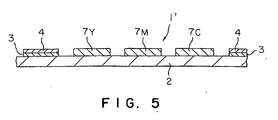
- Figs. 1, 2, 5 are schematic cross-sectional views showing embodiments of the transfer sheet for an adhesive layer according to the present invention
- Figs. 3A to 3C, Figs. 4A to 4C are cross-sectional views showing embodiments of the image-forming method according to the present invention.
- Fig. 1 is a schematic cross-sectional view showing an embodiment of the transfer sheet, for an adhesive layer, according to the first aspect of the present invention.
- a transfer sheet 1 for an adhesive layer comprises a substrate sheet 2, an adhesive layer 3 separably provided on the substrate sheet 2, and an interposing layer 4 provided on the adhesive layer 3.
- the transfer sheet 1 for an adhesive layer according to the present invention is characterized in that the interposing layer 4 is further provided on the adhesive layer 3 separably provided on the substrate sheet 2.
- the transfer sheet 1 for an adhesive layer By virtue of the above construction of the transfer sheet 1 for an adhesive layer according to the present invention, good adhesion to a transfer material and a capability of preventing bleeding of dyes can be imparted to the interposing layer 4, the adhesive layer 3 can be transferred to a transfer material (an intermediate transfer medium) through the interposing layer 4, and, at the same time, after transfer to an image-forming object, has good adhesion to the image-forming object and a capability of preventing penetration into the image-forming object.
- various properties required of the adhesive layer of the conventional transfer sheet for an adhesive layer can be shared by the adhesive layer 3 and the interposing layer 4.
- the presence of the interposing layer 4 prevents the surface state of the image-forming object from appearing on the surface of the image. This increases the degree of freedom for the selection of material for the adhesive layer 3 (not to mention the degree of freedom of material for the interposing layer 4), realizing a transfer sheet, for an adhesive layer, which can stably develop various required properties.
- the adhesive layer 3 constituting the transfer sheet for an adhesive layer is formed of a material which develops adhesion upon heating, for example, a thermoplastic synthetic resin, natural resin, rubber, or wax.
- a material which develops adhesion upon heating for example, a thermoplastic synthetic resin, natural resin, rubber, or wax.
- the material usable for constituting the adhesive layer 3 include synthetic resins, for example, cellulose derivatives, such as ethyl cellulose and cellulose acetate propionate, styrene resins, such as polystyrene and poly- ⁇ -methylstyrene, acrylic resins, such as polymethyl methacrylate and polyethyl acrylate, vinyl resins, such as polyvinyl chloride, polyvinyl acetate, vinyl chloride/vinyl acetate copolymer, polyvinyl butyral, and polyvinyl acetal, polyester resins, polyamide resins, epoxy resins, polyurethane resins, ionomers, ethylene
- the adhesive layer 3 may be formed of a composition comprising one or more materials described above.
- the thickness thereof can be determined by taking into consideration the necessary adhesive property and the processability. In general, however, it is preferably about 0.1 to 200 ⁇ m.
- the interposing layer 4 provided on the adhesive layer 3 comes into direct contact with a dye image formed on the image-receptive layer of the transfer material (intermediate transfer medium) and, hence, is formed of a resin into which a dye is not bled. For this reason, preferably, a resin commonly used for constituting a dye-receptive layer in the art is employed as a resin for constituting the interposing layer.
- the adhesive layer 3 When paper is used as the image-forming object, the adhesive layer 3 often penetrates into paper.
- the interposing layer 4 is formed of a resin having a high glass transition point, it does not penetrate into paper, preventing paper texture from appearing on the surface of the interposing layer 4.
- the resin for constituting the interposing layer 4 has a glass transition point above that of the resin for constituting the adhesive layer 3.
- a resin having a glass transition point of 50 to 115°C, preferably 60 to 90°C may be used for constituting the interposing layer 4, with a resin having a glass transition point of 35 to 100°C, preferably 35 to 70°C, more preferably 45 to 65°C, being used for constituting the adhesive layer 3.
- resins usable for the interposing layer 4 include vinyl chloride resin, vinyl chloride/vinyl acetate copolymer, polyester resin, polyvinyl acetal, and polymethyl methacrylate.
- Preferred examples of combinations of the resin for constituting the adhesive layer 3 with the resin for constituting the interposing layer 4 are as follows.
- Adhesive layer 3 (Adhesive layer 3) (Interposing layer 4) polyamide resin / vinyl chloride-vinyl acetate copolymer polyethyl acrylate / polyester resin polyvinyl butyral / polyvinyl acetal ethylene-acrylic acid copolymer / polymethyl methacrylate polychlorinated polyolefin / polyvinyl chloride
- the thickness of the interposing layer 4 can be determined by taking into consideration necessary properties, for example, adhesion to a transfer material (an intermediate transfer medium) and a capability of preventing bleeding of dyes, processability and the like. In general, however, it is preferably about 0.1 to 200 ⁇ m.
- a filler is preferably added to the adhesive layer 3 and the interposing layer 4 from the viewpoint of improving the transferability.
- conventional organic or inorganic fillers may be used.
- examples of fillers usable herein include organic fillers, such as acrylic, nylon, and teflon fillers and polyethylene wax, and inorganic fillers, such as fine particles of various metal oxides including titanium oxide, zinc oxide, kaolin clay, calcium carbonate, finely divided silica, zinc oxide, and tin oxide.
- the particle diameter of the filler is preferably in the range of from 0.05 to 10 ⁇ m, and the amount of the filler added is preferably in the range of from 10 to 300 parts by weight based on 100 parts by weight of the resin for constituting the adhesive layer 3 or the interposing layer 4.
- the substrate sheet 2 constituting the transfer sheet 1 for an adhesive layer may be any substrate sheet commonly used in the conventional transfer sheet for an adhesive layer.
- substrate sheets usable herein include thin papers, such as glassine, capacitor, and paraffin papers; stretched or unstretched plastic files of polyesters having high heat resistance, such as polyethylene terephthalate, polyethylene naphthalate, polybutylene terephthalate, polyphenylene sulfide, polyether ketone, and polyether sulfone, polypropylene, polycarbonate, cellulose acetate, polyethylene derivatives, polyvinyl chloride, polyvinylidene chloride, polystyrene, polyamide, polyimide, polymethylpentene, and ionomers; and laminates of the above sheets.
- the thickness of the substrate sheet 2 may be properly selected, depending upon the material, so as to provide proper properties such as strength and heat resistance. In general, however, it is preferably about 1 to 100 ⁇ m.
- a release layer may be provided between the substrate sheet and the adhesive layer.
- the release layer may be formed of a resin, examples of which include: thermoplastic resins, for example, acrylic resins, such as polymethyl methacrylate, polyethyl methacrylate, and polybutyl methacrylate, vinyl resins, such as polyvinyl acetate, vinyl chloride/vinyl acetate copolymer, polyvinyl alcohol, polyvinyl butyral, and polyvinyl acetal, cellulose derivatives, such as ethyl cellulose, nitrocellulose, and cellulose acetate; and thermosetting resins, for example, unsaturated polyester resins, polyester resins, polyurethane resins, and aminoalkyd resins.
- thermoplastic resins for example, acrylic resins, such as polymethyl methacrylate, polyethyl methacrylate, and polybutyl methacrylate
- vinyl resins such as polyvinyl acetate, vinyl chloride/vinyl acetate
- release agents usable herein include silicone compounds, wax, melamine resin, fluororesin, talc, finely divided silica, and lubricants, such as surfactants and metal soaps.
- silicone compounds are particularly preferred.
- Specific examples of silicone compounds include silicone oils, such as dimethyl silicone, epoxy-modified silicone, reactive silicone, alkyl-modified silicone, and amino-modified silicone oils, reaction products of a polyester resin or an epoxy resin with a silane coupling agent, silicone rubbers, silicone compounds, and silicone waxes.
- the addition of the above release agent to the adhesive layer 3 can improve the release effect. This, however, deteriorates the adhesive property of the adhesive layer 3 when the adhesive layer 3 and paper are adhered to each other. Therefore, as described above, the addition of the release agent to the release layer is preferred.
- the above release layer can be formed by coating a coating liquid comprising a binder resin or a coating liquid comprising a binder resin, with a release agent incorporated therein, onto a substrate sheet 2 by a conventional method such as gravure printing, screen printing, or reverse roll coating using a gravure plate, and the thickness thereof is preferably about 0.05 to 5 ⁇ m.
- the transfer sheet for an adhesive layer may comprise: a substrate sheet 2; an adhesive layer 3 and an interposing layer 4 provided on one surface of the substrate sheet 2; and a back surface layer 5 provided on the other surface of the substrate sheet 2.
- the back surface layer 5 is provided on the substrate sheet 2 for the purpose of preventing the substrate sheet 2 from being heat-fused to a heating device, such as a thermal head, at the time of transfer of the adhesive layer 3 and the interposing layer 4 onto a transfer material, enabling the transfer sheet to be smoothly carried.
- resins usable for the back surface layer 5 include natural or synthetic resins, for examples, cellulosic resins, such as ethyl cellulose, hydroxy cellulose, hydroxypropyl cellulose, methyl cellulose, cellulose acetate, cellulose acetate butyrate, and nitrocellulose, vinyl resins, such as polyvinyl alcohol, polyvinyl acetate, polyvinyl butyral, polyvinyl acetal, and polyvinyl pyrrolidone, acrylic resins, such as polymethyl methacrylate, polyethyl acrylate, polyacrylamide, and acrylonitrile/styrene copolymer, polyamide resins, polyvinyltoluene resins, coumarone/indene resins, polyester resins, polyurethane resins, and silicone-modified or fluorine-modified urethanes.
- cellulosic resins such as ethyl cellulose, hydroxy cellulose, hydroxypropyl
- a resin having a hydroxyl reactive group, among the above resins is used in combination with a crosslinking agent, such as polyisocyanate, to form a crosslinked resin layer.
- a crosslinking agent such as polyisocyanate
- a solid or liquid release agent or lubricant is added to the back surface layer so that the transfer sheet have a thermal slip property.
- Release agents or lubricants usable herein include, for example, various waxes, such as polyethylene and paraffin waxes, higher aliphatic alcohols, organopolysiloxanes, anionic surfactants, cationic surfactants, amphoteric surfactants, nonionic surfactants, fluorosurfactants, organic carboxylic acids and derivatives thereof, fluororesins, silicone resin, and fine particles of inorganic compounds, such as talc and silica.
- the content of the lubricant in the back surface layer 5 is about 5 to 50% by weight, preferably about 10 to 30% by weight.
- the thickness of the back surface layer 5 may be about 0.1 to 10 ⁇ m, preferably about 0.5 to 5 ⁇ m.
- an intermediate transfer medium 31 is put on top of a sublimation type thermal transfer sheet 21 so that a dye layer 23 in the thermal transfer sheet 21 comes into contact with an image-receptive layer 33 in the intermediate transfer medium 31.
- the intermediate transfer medium 31 and the thermal transfer sheet 21 are passed through between a thermal head 11 and a platen roller 12 and brought into press-contact with each other by means of the thermal head 11 and the platen roller 12.
- the thermal head 11 is heated according to image data (Fig. 3A).
- a sublimable dye contained in the dye layer 23 is transferred onto the image-receptive layer 33 in the intermediate transfer medium 31 to form an image A (Fig. 3B).
- the thermal transfer sheet 21 comprises a substrate sheet 22, a dye layer 23 provided on one surface of the substrate sheet 22, and a back surface layer 24 on the other surface of the substrate sheet 22.
- the intermediate transfer medium 31 comprises a substrate sheet 32 bearing an image-receptive layer 33.
- a thermal transfer sheet 1 for an adhesive layer is put on top of the intermediate transfer medium 31 with the image A formed thereon so that an interposing layer 4 in the transfer sheet 1 for an adhesive layer comes into contact with the image-receptive layer 33 in the intermediate transfer medium 31 with the image A formed thereon.
- the intermediate transfer sheet 31 with the image A formed thereon and the transfer sheet 1 for an adhesive layer are passed through between the thermal head 11 and the platen roller 12 and brought into press-contact with each other by means of the thermal head 11 and the platen roller 12, and the thermal head 11 is heated (Fig. 3C).
- the interposing layer 4 has good adhesion to the image-receptive layer 33 and a capability of preventing bleeding of dyes, and, hence, there is no need to impart such properties to the adhesive layer 3.
- the intermediate transfer medium 31 is put on top of an image-forming object 41 so that the adhesive layer 3 in the intermediate transfer medium 31 faces the image-forming object 41, and heat and pressure are applied to the laminate by means of the heat roller 15 and the platen 16 (Fig. 4B).
- the object 40 with an image formed thereon has such a construction that the adhesive layer 3 and the interposing layer 4 are laminated in that order on a desired site of the image-forming object 41, and the image-receptive layer 33 with the image A formed thereon is provided on the interposing layer 4.
- the adhesion of the adhesive layer 3 to the image-forming object 41 is so good that the adhesion of the image-receptive layer 33 to the image-forming object 41 is very good. Further, even though the adhesive layer 3 penetrates into the image-forming object 41, there is no fear of the image quality being deteriorated by appearance of the surface state of the image-forming object 41 on the image A because, as described above, the interposing layer 4 has a capability of preventing penetration and the like.
- the above intermediate transfer medium 31 used in the image-forming method according to the present invention comprises a substrate sheet 32 and an image-receptive layer 33 provided on the substrate sheet 32.
- a peelable protective layer may be provided between the substrate sheet 32 and the image-receptive layer 33.
- the peelable protective layer may be formed in the same manner as described above in connection with the formation of the peel layer of the transfer sheet for an adhesive layer according to the present invention.
- the thickness of the peelable protective layer may be, for example, about 2 to 3 g/m 2 on a dry basis.
- an adhesive layer and an interposing layer are provided on substantially the whole area of one surface of the substrate sheet.
- the transfer sheet for an adhesive layer according to the present invention is not limited to these embodiments only.
- a laminate of an adhesive layer 3 and an interposing layer 4 a dye layer 7Y, a dye layer 7M, and a dye layer 7C are formed in a face serial manner on a substrate sheet 2 to constitute a transfer sheet for an adhesive layer (a thermal transfer sheet integral with an adhesive layer) 1'.
- thermal transfer sheet 1' integral with an adhesive layer is advantageous in that, in the above image formation, an image is formed on the image-receptive layer in the intermediate transfer medium by the transfer of the dye layer and the thermal head for the formation of an image as such may be used to continuously transfer and form an adhesive layer on the image-receptive layer.
- a 6 ⁇ m-thick polyethylene terephthalate film (Lumirror, manufactured by Toray Industries, Inc.) with a back surface layer coated thereon was provided as a substrate sheet.
- a coating liquid, for an adhesive layer, having the following composition was coated by gravure coating on the substrate sheet, and the coating was dried (coverage on a dry basis: 3 g/m 2 ) to form an adhesive layer.
- composition of coating liquid X for adhesive layer Polyamide resin (Tg: 50°C) (Macromelt 6240, manufactured by Henkel Hakusui Corp.) 100 parts by weight Methyl ethyl ketone 500 parts by weight
- composition of coating liquid Y for adhesive layer Polyester resin (Tg: 75°C) (UE3600, manufactured by Unitika Ltd.) 100 parts by weight Methyl ethyl ketone 500 parts by weight
- (Coating resin liquid A for interposing layer) Vinyl chloride/vinyl acetate copolymer (1000 ALK, manufactured by Denki Kagaku Kogyo K.K.) 100 parts by weight Methyl ethyl ketone 500 parts by weight (Coating resin liquid B for interposing layer) Polymethyl methacrylate resin (BR-85, manufactured by Mitsubishi Rayon Co., Ltd.) 100 parts by weight Methyl ethyl ketone 500 parts by weight (Coating resin liquid C for interposing layer) Polyester resin (Vylon 600, manufactured by Toyobo Co., Ltd.) 100 parts by weight Methyl ethyl ketone 500 parts by weight (Coating resin liquid D for interposing layer) Polymethyl methacrylate resin (LP-45M, manufactured by Soken Chemical Engineering Co., Ltd.) 100 parts by weight Methyl ethyl ketone 500 parts by weight
- a transfer sheet for an adhesive layer (comparative sample 1) was prepared in the same manner as described above in connection with the preparation of sample 1, except that no interposing layer was formed.
- transfer sheets for an adhesive layer were prepared in the same manner as described above in connection with the preparation of sample 1, except that, as the resin used in the coating liquid for an interposing layer, a releasable resin (Gosenol NH-8, manufactured by Nippon Synthetic Chemical Industry Co., Ltd.) or a resin having a low glass transition point (AE 322, manufactured by Japan Synthetic Rubber Co., Ltd.) was used instead of the vinyl chloride/vinyl acetate copolymer.
- a releasable resin Gosenol NH-8, manufactured by Nippon Synthetic Chemical Industry Co., Ltd.
- AE 322 manufactured by Japan Synthetic Rubber Co., Ltd.
- a transfer sheet for an adhesive layer was prepared using the following coating liquid Z as the coating liquid for an adhesive layer and the above coating liquid A as the resin coating liquid for an interposing layer.
- coating liquid Z for adhesive layer Acrylic resin (BR-85 (Tg: 105°C), manufactured by Mitsubishi Rayon Co., Ltd., ) 100 parts by weight Methyl ethyl ketone 500 parts by weight
- a 6 ⁇ m-thick polyethylene terephthalate film (Lumirror, manufactured by Toray Industries, Inc.) with a back surface layer coated thereon was provided as a substrate sheet.
- a coating liquid, for a peelable protective layer having the following composition was coated by gravure coating on the untreated surface of the substrate sheet, and the coating was dried (coverage on a dry basis: 3 g/m 2 ) to form a peelable protective layer.
- Composition of coating liquid for peelable protective layer Polymethyl methacrylate resin (BR-83, manufactured by Mitsubishi Rayon Co., Ltd.) 100 parts by weight Methyl ethyl ketone 500 parts by weight
- the following coating liquid for a receptive layer was coated by gravure coating on the releasable protective layer, and the coating was dried (coverage on a dry basis: 3 g/m 2 ) to form a dye-receptive layer, thereby preparing an intermediate transfer medium.
- Vinyl chloride/vinyl acetate copolymer (VYHD, manufactured by Union Carbide Corporation) 100 parts by weight Epoxy-modified silicone (KF-393, manufactured by The Shin-Etsu Chemical Co., Ltd.) 1 part by weight Amino-modified silicone (KS-343, manufactured by The Shin-Etsu Chemical Co., Ltd.) 1 part by weight Methyl ethyl ketone 500 parts by weight
- thermal sublimation transfer sheet was used to form an image on the image-receptive layer in the intermediate transfer medium sheet, and an adhesive layer was transferred thereon using the above transfer sheets for an adhesive layer (samples 1 to 5 and comparative samples 1 to 3) under the following transfer conditions.
- Transfer conditions Thermal head 6 dots/mm Thermal energy 1.0 mJ/dot
- the image-receptive layer and the releasable protective layer were then transferred through the transferred adhesive layer onto a postal card as an image-forming object under the above transfer conditions to prepare objects with an image formed thereon.
- separation occurred between the peelable protective layer and the substrate sheet in the intermediate transfer medium sheet.
- a pressure-sensitive adhesive tape (Cello-Tape 545, manufactured by Nichiban Co., Ltd.) having a width of 12 mm was adhered to the image, and 180° peeling was then carried out at a peel rate of 100 cm/sec to evaluate the adhesion.
- the image quality was evaluated by visual inspection. Evaluation criteria
- both the adhesion and the image quality were poor for the transfer sheet, having no interposing layer, for an adhesive layer (comparative sample 1).
- comparative sample 2 using a releasable resin for constituting the interposing layer, the adhesion of the image-receptive layer transferred onto the postal card was unsatisfactory due to poor adhesion between the interposing layer and the image-receptive layer.
- comparative sample 3 using a resin, having a low glass transition point, for constituting the interposing layer, although the adhesion was good, bleeding of the dye into the interposing layer occurred resulting in poor image quality.
- the adhesion of the adhesive layer to the image-forming object was unsatisfactory.
- an interposing layer is provided on the adhesive layer, and the adhesive layer is transferred onto a transfer material through the interposing layer. Therefore, when necessary properties, such as adhesion to a transfer material and prevention of bleeding of dye, are imparted to the interposing layer, properties required of the adhesive layer may be limited to those such as adhesion to the image-forming object and prevention of penetration of the adhesive, markedly increasing the degree of freedom in selection of materials for the adhesive layer and thus making it possible to provide a transfer sheet, for an adhesive layer, which has excellent properties such as excellent adhesion in the transfer to the transfer material and resistance to bleeding of the dye and, at the same time, has excellent adhesion to the image-forming object and prevention of penetration of the adhesive.
- the transfer of an interposing layer and an adhesive layer using the above transfer sheet, for an adhesive layer, onto an image-receptive layer of an intermediate transfer medium with an image formed thereon by transfer, followed by transfer of the image-receptive layer onto an image-forming object through the interposing layer and the adhesive layer can provide an object, with an image formed thereon, which is free from bleeding of the image and has a smooth image surface independently of the surface profile of the image-forming object.
Landscapes
- Thermal Transfer Or Thermal Recording In General (AREA)
- Decoration By Transfer Pictures (AREA)
Claims (8)
- Haftschichttransferblatt zum Bilden eines Bildes auf einer trennbaren Bildempfangsschicht in einem Zwischentransfermedium durch ein Thermosublimationstransferverfahren mittels eines Thermokopfs, wobei das Haftschichttransferblatt:ein Substratblatt,eine Haftschicht, die auf dem Substratblatt gebildet ist, undeine zwischengeschaltete Schicht, die auf der Haftschicht gebildet ist, wobei die zwischengeschaltete Schicht einen höheren Glasübergangspunkt als der der Haftschicht aufweist, umfaßt.
- Haftschichttransferblatt nach Anspruch 1, wobei die zwischengeschaltete Schicht einen Glasübergangspunkt in einem Bereich von 50 bis 115°C und die Haftschicht einen Glasübergangspunkt in einem Bereich von 35 bis 100°C aufweisen.
- Haftschichttransferblatt nach Anspruch 1 oder 2, wobei mindestens eine von der zwischengeschalteten Schicht und der Haftschicht einen Füllstoff enthält.
- Haftschichttransferblatt nach einem der Ansprüche 1 bis 3, ferner umfassend eine auf der Oberfläche des Substratblatts entfernt von der Haftschicht angeordnete rückseitige Oberflächenschicht.
- Bildformungsverfahren, umfassend die Schritte:Bilden eines Bildes auf einer trennbaren Bildempfangsschicht in einem Zwischentransfermedium durch ein Thermosublimationstransferverfahren,Anordnen des Zwischentransfermediums und eines Haftschichttransferblatts nach einem der Ansprüche 1 bis 4 übereinander, so daß die Bildempfangsschicht an die zwischengeschaltete Schicht angrenzt, und Anwenden von Wärme und/oder Druck auf das Laminat durch Transfermittel, um die Haftschicht auf die Bildempfangsschicht durch die zwischengeschaltete Schicht zu übertragen, undAnordnen eines Bild-formenden Gegenstands auf das Zwischentransfermedium, um den Bild-formenden Gegenstand an die Haftschicht angrenzen zu lassen, und Anwenden von Wärme und/oder Druck auf das Laminat durch Transfermittel, um die Bildempfangsschicht auf den Bild-formenden Gegenstand durch die Haftschicht zu übertragen.
- Gegenstand mit einem darauf gebildeten Bild, umfassend:einen Bild-formenden Gegenstand, eine Haftschicht und eine zwischengeschaltete Schicht, gebildet in dieser Reihenfolge auf einer gewünschten Stelle des Bildempfangsgegenstands, wobei die zwischengeschaltete Schicht einen höheren Glasübergangspunkt als der der Haftschicht aufweist und eine Bildempfangsschicht auf der zwischengeschalteten Schicht vorgesehen ist, wobei die Bildempfangsschicht ein durch ein Thermosublimationstransferverfahren gebildetes Bild aufweist.
- Gegenstand mit einem darauf gebildeten Bild nach Anspruch 6, wobei die zwischengeschaltete Schicht einen Glasübergangspunkt in einem Bereich von 50 bis 115°C aufweist und die Haftschicht einen Glasübergangspunkt in einem Bereich von 35 bis 100°C aufweist, wobei der Glasübergangspunkt der zwischengeschalteten Schicht über dem der Haftschicht liegt.
- Gegenstand mit einem darauf gebildeten Bild nach Anspruch 6 oder 7, wobei mindestens eine von der zwischengeschalteten Schicht und der Haftschicht einen Füllstoff enthält.
Priority Applications (2)
| Application Number | Priority Date | Filing Date | Title |
|---|---|---|---|
| EP07015904A EP1847405B1 (de) | 1995-04-06 | 1996-04-01 | Verwendung einer Transferfolie mit einer Kleberschicht |
| EP04028042A EP1524130B1 (de) | 1995-04-06 | 1996-04-01 | Bildaufzeichnungsverfahren |
Applications Claiming Priority (13)
| Application Number | Priority Date | Filing Date | Title |
|---|---|---|---|
| JP7106901A JPH08276697A (ja) | 1995-04-06 | 1995-04-06 | 接着層転写シートとこの接着層転写シートを用いた画像形成方法および中間画像形成物と画像形成物 |
| JP106901/95 | 1995-04-06 | ||
| JP7106900A JPH08276696A (ja) | 1995-04-06 | 1995-04-06 | 接着層転写シートおよびこの接着層転写シートを用いた画像形成方法と画像形成物 |
| JP106900/95 | 1995-04-06 | ||
| JP10689995A JPH08276699A (ja) | 1995-04-06 | 1995-04-06 | 接着層転写シートおよびこの接着層転写シートを用いた画像形成方法と画像形成物 |
| JP10689995 | 1995-04-06 | ||
| JP106898/95 | 1995-04-06 | ||
| JP10689895A JPH08276700A (ja) | 1995-04-06 | 1995-04-06 | 接着層転写シート |
| JP10689895 | 1995-04-06 | ||
| JP10690195 | 1995-04-06 | ||
| JP106899/95 | 1995-04-06 | ||
| JP10690095 | 1995-04-06 | ||
| PCT/JP1996/000886 WO1996031355A1 (en) | 1995-04-06 | 1996-04-01 | Adhesive layer transfer sheet and utilization of the same |
Related Child Applications (1)
| Application Number | Title | Priority Date | Filing Date |
|---|---|---|---|
| EP04028042A Division EP1524130B1 (de) | 1995-04-06 | 1996-04-01 | Bildaufzeichnungsverfahren |
Publications (3)
| Publication Number | Publication Date |
|---|---|
| EP0767077A1 EP0767077A1 (de) | 1997-04-09 |
| EP0767077A4 EP0767077A4 (de) | 1999-10-13 |
| EP0767077B1 true EP0767077B1 (de) | 2005-07-27 |
Family
ID=27469482
Family Applications (3)
| Application Number | Title | Priority Date | Filing Date |
|---|---|---|---|
| EP07015904A Expired - Lifetime EP1847405B1 (de) | 1995-04-06 | 1996-04-01 | Verwendung einer Transferfolie mit einer Kleberschicht |
| EP04028042A Expired - Lifetime EP1524130B1 (de) | 1995-04-06 | 1996-04-01 | Bildaufzeichnungsverfahren |
| EP96907744A Expired - Lifetime EP0767077B1 (de) | 1995-04-06 | 1996-04-01 | Transferfolie mit einer kleberschicht und deren verwendung |
Family Applications Before (2)
| Application Number | Title | Priority Date | Filing Date |
|---|---|---|---|
| EP07015904A Expired - Lifetime EP1847405B1 (de) | 1995-04-06 | 1996-04-01 | Verwendung einer Transferfolie mit einer Kleberschicht |
| EP04028042A Expired - Lifetime EP1524130B1 (de) | 1995-04-06 | 1996-04-01 | Bildaufzeichnungsverfahren |
Country Status (4)
| Country | Link |
|---|---|
| US (3) | US6040268A (de) |
| EP (3) | EP1847405B1 (de) |
| DE (3) | DE69638143D1 (de) |
| WO (1) | WO1996031355A1 (de) |
Families Citing this family (25)
| Publication number | Priority date | Publication date | Assignee | Title |
|---|---|---|---|---|
| IL121951A0 (en) * | 1997-10-12 | 1998-03-10 | Indigo Nv | Coating system for substrates |
| DE69931823T2 (de) * | 1998-03-06 | 2007-01-04 | Dai Nippon Printing Co., Ltd. | Zwischenträger eines Übertragungsaufzeichnungsmaterials, Verfahren zur Herstellung eines Druckes, sowie entsprechendes Druckerzeugnis |
| EP0943462B1 (de) | 1998-03-17 | 2005-07-13 | Dai Nippon Printing Co., Ltd. | Methode zur Herstellung eines Druckerzeugnisses |
| IL141019A (en) * | 1998-07-29 | 2004-09-27 | Sanders W A Papier | Transfer paper for ink-jet printing |
| JP2000141994A (ja) * | 1998-11-13 | 2000-05-23 | Ricoh Co Ltd | 転写シート及びそれを用いた画像形成転写シート並びにそれを用いた転写画像形成方法 |
| BR0115030A (pt) * | 2000-10-31 | 2004-06-15 | Kimberly Clark Co | Material de transferência de calor com filme descascável e revestimentos reticulados |
| JP4033771B2 (ja) * | 2000-10-31 | 2008-01-16 | ニーナ ペイパー インコーポレイテッド | 剥離可能フィルム及び不連続コーティングを有する熱転写紙 |
| US6984429B2 (en) * | 2001-01-12 | 2006-01-10 | 3M Innovative Properties Company | Laminate from which decorative films can be applied to a substrate |
| US6602006B2 (en) * | 2001-06-29 | 2003-08-05 | Hewlett-Packard Development Company, L.P. | Techniques for printing onto a transparent receptor media using an inkjet printer |
| EP1569988A1 (de) * | 2002-12-12 | 2005-09-07 | Denki Kagaku Kogyo Kabushiki Kaisha | Oberflächenschutzfilm |
| US7361247B2 (en) * | 2003-12-31 | 2008-04-22 | Neenah Paper Inc. | Matched heat transfer materials and method of use thereof |
| US20050227024A1 (en) * | 2004-04-09 | 2005-10-13 | Fuji Photo Film Co., Ltd. | Image forming method and final medium to be transferred |
| US8372232B2 (en) * | 2004-07-20 | 2013-02-12 | Neenah Paper, Inc. | Heat transfer materials and method of use thereof |
| US7470343B2 (en) * | 2004-12-30 | 2008-12-30 | Neenah Paper, Inc. | Heat transfer masking sheet materials and methods of use thereof |
| WO2006074549A1 (en) * | 2005-01-14 | 2006-07-20 | National Research Council Of Canada | Tie layer and method for forming thermoplastics |
| US20070095870A1 (en) * | 2005-11-01 | 2007-05-03 | Griffith Grant L | Continuously variable, closed loop, instrument tether |
| US9079681B1 (en) | 2009-08-14 | 2015-07-14 | Nucoat, Inc. | Methods and articles for image transfer |
| US10099462B2 (en) * | 2013-06-28 | 2018-10-16 | Toray Plastics (America), Inc. | Releasable polyester high gloss metal transfer film |
| US9630385B2 (en) * | 2012-11-08 | 2017-04-25 | Toray Plastics (America), Inc. | Releasable polyester metal transfer film |
| JP6481572B2 (ja) * | 2014-09-30 | 2019-03-13 | 大日本印刷株式会社 | 転写シート |
| DE102015218193A1 (de) | 2015-09-22 | 2017-03-23 | Ccl Label Gmbh | Flächengebilde mit vernetztem hydrophilen Polymer |
| JP6828848B2 (ja) * | 2018-03-16 | 2021-02-10 | 大日本印刷株式会社 | 熱転写シート、中間転写媒体と熱転写シートの組合せ、及び印画物の製造方法 |
| JP7118481B2 (ja) * | 2020-02-17 | 2022-08-16 | 米島フエルト産業株式会社 | 転写シート、転写シートの製造方法、中間シートの製造方法、及び、複合材の製造方法 |
| CN115551718A (zh) * | 2020-05-13 | 2022-12-30 | 大日本印刷株式会社 | 热转印片、以及该热转印片与中间转印介质的组合 |
| DE102022109733B4 (de) | 2022-04-22 | 2025-09-18 | Ucosan b.v. (Villeroy & Boch Wellness) | Verfahren zur Herstellung eines Bildes in einer Oberfläche eines Gebrauchsgegenstandes |
Family Cites Families (15)
| Publication number | Priority date | Publication date | Assignee | Title |
|---|---|---|---|---|
| JPS5282508A (en) * | 1975-12-27 | 1977-07-09 | Tanazawa Hakkosha Kk | Transfer film |
| GB2005598B (en) * | 1977-10-04 | 1982-02-24 | Letraset International Ltd | Transfer materials |
| JPS5770690A (en) * | 1980-10-21 | 1982-05-01 | Dainippon Printing Co Ltd | Production decorative doubled article |
| EP0190316A4 (de) * | 1984-08-15 | 1987-03-26 | Avery Internat Corp | Bildübertragungsverfahren. |
| JPH0748816B2 (ja) | 1987-07-03 | 1995-05-24 | 株式会社タムロン | ビデオカメラの自動焦点調整装置 |
| JP2678274B2 (ja) * | 1987-08-13 | 1997-11-17 | 鈴木総業株式会社 | プラスチック成形体への導電性付与方法 |
| EP0487727B1 (de) | 1989-07-14 | 1995-01-25 | Dai Nippon Insatsu Kabushiki Kaisha | Abdeckfilm für wärmetransfer |
| JPH0478599A (ja) * | 1990-07-20 | 1992-03-12 | Yukiaki Yoshida | ビデオプリント画のtシャツへの熱転写法 |
| JP2847450B2 (ja) * | 1991-12-30 | 1999-01-20 | 三英ケミカル株式会社 | 熱転写式アップリケ及びその製造法 |
| JP3317992B2 (ja) * | 1992-02-27 | 2002-08-26 | 大日本印刷株式会社 | 昇華型複合熱転写シート |
| US5372987A (en) * | 1992-09-17 | 1994-12-13 | Minnesota Mining And Manufacturing Company | Thermal receptor sheet and process of use |
| US5397634A (en) * | 1993-07-22 | 1995-03-14 | Rexham Graphics Incorporated | Transferable protective cover layers |
| JP3475298B2 (ja) * | 1993-08-19 | 2003-12-08 | 大日本印刷株式会社 | 中間転写記録媒体を用いた画像形成方法 |
| US5576264A (en) * | 1993-11-24 | 1996-11-19 | Dai Nippon Printing Co., Ltd. | Receiving-layer transfer sheet |
| JP3324103B2 (ja) * | 1993-11-24 | 2002-09-17 | ソニー株式会社 | 熱転写用受像シート |
-
1996
- 1996-04-01 DE DE69638143T patent/DE69638143D1/de not_active Expired - Lifetime
- 1996-04-01 EP EP07015904A patent/EP1847405B1/de not_active Expired - Lifetime
- 1996-04-01 DE DE69637281T patent/DE69637281T2/de not_active Expired - Lifetime
- 1996-04-01 EP EP04028042A patent/EP1524130B1/de not_active Expired - Lifetime
- 1996-04-01 WO PCT/JP1996/000886 patent/WO1996031355A1/ja not_active Ceased
- 1996-04-01 EP EP96907744A patent/EP0767077B1/de not_active Expired - Lifetime
- 1996-04-01 DE DE69634970T patent/DE69634970T2/de not_active Expired - Lifetime
- 1996-04-01 US US08/682,611 patent/US6040268A/en not_active Expired - Lifetime
-
1999
- 1999-02-18 US US09/412,138 patent/US6350508B1/en not_active Expired - Lifetime
-
2001
- 2001-10-18 US US09/978,683 patent/US6730633B2/en not_active Expired - Fee Related
Also Published As
| Publication number | Publication date |
|---|---|
| EP1524130B1 (de) | 2007-10-03 |
| EP1847405A1 (de) | 2007-10-24 |
| DE69638143D1 (de) | 2010-04-15 |
| US6350508B1 (en) | 2002-02-26 |
| DE69637281D1 (de) | 2007-11-15 |
| EP0767077A4 (de) | 1999-10-13 |
| DE69634970T2 (de) | 2006-05-24 |
| EP1847405B1 (de) | 2010-03-03 |
| WO1996031355A1 (en) | 1996-10-10 |
| EP1524130A1 (de) | 2005-04-20 |
| US20020048663A1 (en) | 2002-04-25 |
| DE69637281T2 (de) | 2008-07-10 |
| EP0767077A1 (de) | 1997-04-09 |
| US6040268A (en) | 2000-03-21 |
| DE69634970D1 (de) | 2005-09-01 |
| US6730633B2 (en) | 2004-05-04 |
Similar Documents
| Publication | Publication Date | Title |
|---|---|---|
| US6040268A (en) | Transfer sheet for adhesive layer and use thereof | |
| EP0474355B1 (de) | Empfangsschicht für eine Übertragungsschicht und thermische Übertragungsschicht. | |
| CA2050789C (en) | Thermal transfer image receiving sheet, production process therefor and thermal transfer sheet | |
| EP0333873B1 (de) | Wärmeübertragungsblatt | |
| JPH08276700A (ja) | 接着層転写シート | |
| US5202176A (en) | Heat transfer recording materials | |
| JPH07156532A (ja) | 中間転写記録媒体及び画像形成物 | |
| JPH08276699A (ja) | 接着層転写シートおよびこの接着層転写シートを用いた画像形成方法と画像形成物 | |
| JP3336480B2 (ja) | 染料受容層転写シート | |
| JPH11180052A (ja) | 受容層転写シートおよび画像形成方法 | |
| JPH08276696A (ja) | 接着層転写シートおよびこの接着層転写シートを用いた画像形成方法と画像形成物 | |
| JPH08276697A (ja) | 接着層転写シートとこの接着層転写シートを用いた画像形成方法および中間画像形成物と画像形成物 | |
| JP2002187370A (ja) | 中間転写記録媒体 | |
| EP1306227B1 (de) | Übertragungsblatt mit Farbstoffempfangsschicht | |
| JP3205584B2 (ja) | 熱転写受像シート | |
| JPH04133793A (ja) | 熱転写画像形成方法 | |
| JPH07205560A (ja) | 受容層転写シート | |
| JPH04221693A (ja) | 複合熱転写シート | |
| JPH0999648A (ja) | 感熱転写記録媒体 | |
| JPH06278382A (ja) | 受容層転写シート及びその製造方法 | |
| JPH07237360A (ja) | 受容層転写シート | |
| JPH04320895A (ja) | 複合熱転写シート | |
| JPH03234593A (ja) | 画像形成方法 | |
| JPH068646A (ja) | 熱転写受像シート | |
| JPH07144481A (ja) | 受容層転写シート |
Legal Events
| Date | Code | Title | Description |
|---|---|---|---|
| PUAI | Public reference made under article 153(3) epc to a published international application that has entered the european phase |
Free format text: ORIGINAL CODE: 0009012 |
|
| 17P | Request for examination filed |
Effective date: 19961219 |
|
| AK | Designated contracting states |
Kind code of ref document: A1 Designated state(s): DE FR GB |
|
| A4 | Supplementary search report drawn up and despatched |
Effective date: 19990831 |
|
| AK | Designated contracting states |
Kind code of ref document: A4 Designated state(s): DE FR GB |
|
| RIC1 | Information provided on ipc code assigned before grant |
Free format text: 6B 44C 1/165 A, 6B 41M 7/00 B, 6B 44C 1/17 B, 6B 32B 7/12 B |
|
| 17Q | First examination report despatched |
Effective date: 20020208 |
|
| GRAP | Despatch of communication of intention to grant a patent |
Free format text: ORIGINAL CODE: EPIDOSNIGR1 |
|
| GRAP | Despatch of communication of intention to grant a patent |
Free format text: ORIGINAL CODE: EPIDOSNIGR1 |
|
| GRAS | Grant fee paid |
Free format text: ORIGINAL CODE: EPIDOSNIGR3 |
|
| GRAA | (expected) grant |
Free format text: ORIGINAL CODE: 0009210 |
|
| AK | Designated contracting states |
Kind code of ref document: B1 Designated state(s): DE FR GB |
|
| REG | Reference to a national code |
Ref country code: GB Ref legal event code: FG4D |
|
| REF | Corresponds to: |
Ref document number: 69634970 Country of ref document: DE Date of ref document: 20050901 Kind code of ref document: P |
|
| ET | Fr: translation filed | ||
| PLBE | No opposition filed within time limit |
Free format text: ORIGINAL CODE: 0009261 |
|
| STAA | Information on the status of an ep patent application or granted ep patent |
Free format text: STATUS: NO OPPOSITION FILED WITHIN TIME LIMIT |
|
| 26N | No opposition filed |
Effective date: 20060428 |
|
| REG | Reference to a national code |
Ref country code: FR Ref legal event code: PLFP Year of fee payment: 20 |
|
| PGFP | Annual fee paid to national office [announced via postgrant information from national office to epo] |
Ref country code: DE Payment date: 20150421 Year of fee payment: 20 Ref country code: GB Payment date: 20150420 Year of fee payment: 20 |
|
| PGFP | Annual fee paid to national office [announced via postgrant information from national office to epo] |
Ref country code: FR Payment date: 20150421 Year of fee payment: 20 |
|
| REG | Reference to a national code |
Ref country code: DE Ref legal event code: R071 Ref document number: 69634970 Country of ref document: DE |
|
| REG | Reference to a national code |
Ref country code: GB Ref legal event code: PE20 Expiry date: 20160331 |
|
| PG25 | Lapsed in a contracting state [announced via postgrant information from national office to epo] |
Ref country code: GB Free format text: LAPSE BECAUSE OF EXPIRATION OF PROTECTION Effective date: 20160331 |