EP0770006B1 - Pochoir pour le depot et le dosage de couches plus ou moins epaisses, a base de points, d'un produit visqueux - Google Patents
Pochoir pour le depot et le dosage de couches plus ou moins epaisses, a base de points, d'un produit visqueux Download PDFInfo
- Publication number
- EP0770006B1 EP0770006B1 EP95925010A EP95925010A EP0770006B1 EP 0770006 B1 EP0770006 B1 EP 0770006B1 EP 95925010 A EP95925010 A EP 95925010A EP 95925010 A EP95925010 A EP 95925010A EP 0770006 B1 EP0770006 B1 EP 0770006B1
- Authority
- EP
- European Patent Office
- Prior art keywords
- stencil
- sheet
- borings
- substrate
- thickness
- Prior art date
- Legal status (The legal status is an assumption and is not a legal conclusion. Google has not performed a legal analysis and makes no representation as to the accuracy of the status listed.)
- Expired - Lifetime
Links
- 238000000151 deposition Methods 0.000 title claims abstract description 14
- 239000011345 viscous material Substances 0.000 title description 2
- 229920000728 polyester Polymers 0.000 claims abstract description 34
- 239000007787 solid Substances 0.000 claims abstract description 11
- 229920002994 synthetic fiber Polymers 0.000 claims abstract description 8
- 239000000758 substrate Substances 0.000 claims description 26
- 238000000034 method Methods 0.000 claims description 19
- 239000003292 glue Substances 0.000 claims description 13
- 230000008021 deposition Effects 0.000 claims description 5
- 238000004519 manufacturing process Methods 0.000 claims description 4
- 238000012546 transfer Methods 0.000 claims description 3
- 230000009471 action Effects 0.000 claims description 2
- 230000003746 surface roughness Effects 0.000 claims 3
- 238000005219 brazing Methods 0.000 claims 1
- 239000002184 metal Substances 0.000 abstract description 19
- 239000004744 fabric Substances 0.000 abstract description 15
- 239000000463 material Substances 0.000 description 11
- 238000007650 screen-printing Methods 0.000 description 8
- 238000005520 cutting process Methods 0.000 description 7
- 238000005553 drilling Methods 0.000 description 7
- 229910000679 solder Inorganic materials 0.000 description 6
- 230000008901 benefit Effects 0.000 description 4
- 239000006071 cream Substances 0.000 description 4
- 238000005476 soldering Methods 0.000 description 4
- 238000003698 laser cutting Methods 0.000 description 3
- 238000003754 machining Methods 0.000 description 3
- 230000008569 process Effects 0.000 description 3
- 230000004888 barrier function Effects 0.000 description 2
- 235000011837 pasties Nutrition 0.000 description 2
- 229910001220 stainless steel Inorganic materials 0.000 description 2
- 239000010935 stainless steel Substances 0.000 description 2
- 239000000126 substance Substances 0.000 description 2
- 238000003466 welding Methods 0.000 description 2
- 101100135641 Caenorhabditis elegans par-3 gene Proteins 0.000 description 1
- 229920000914 Metallic fiber Polymers 0.000 description 1
- 239000002253 acid Substances 0.000 description 1
- 150000007513 acids Chemical class 0.000 description 1
- 239000000853 adhesive Substances 0.000 description 1
- 230000001070 adhesive effect Effects 0.000 description 1
- 238000013459 approach Methods 0.000 description 1
- 238000005452 bending Methods 0.000 description 1
- 230000015572 biosynthetic process Effects 0.000 description 1
- 230000001143 conditioned effect Effects 0.000 description 1
- 239000004020 conductor Substances 0.000 description 1
- 230000007547 defect Effects 0.000 description 1
- 230000005489 elastic deformation Effects 0.000 description 1
- 238000005323 electroforming Methods 0.000 description 1
- 238000005516 engineering process Methods 0.000 description 1
- 238000005530 etching Methods 0.000 description 1
- 239000007788 liquid Substances 0.000 description 1
- 238000004377 microelectronic Methods 0.000 description 1
- 230000004048 modification Effects 0.000 description 1
- 238000012986 modification Methods 0.000 description 1
- 238000007639 printing Methods 0.000 description 1
- 230000003252 repetitive effect Effects 0.000 description 1
- 238000000926 separation method Methods 0.000 description 1
- 238000007493 shaping process Methods 0.000 description 1
- 239000002904 solvent Substances 0.000 description 1
- 230000009897 systematic effect Effects 0.000 description 1
- 239000004753 textile Substances 0.000 description 1
- 238000012549 training Methods 0.000 description 1
Images


Classifications
-
- B—PERFORMING OPERATIONS; TRANSPORTING
- B41—PRINTING; LINING MACHINES; TYPEWRITERS; STAMPS
- B41N—PRINTING PLATES OR FOILS; MATERIALS FOR SURFACES USED IN PRINTING MACHINES FOR PRINTING, INKING, DAMPING, OR THE LIKE; PREPARING SUCH SURFACES FOR USE AND CONSERVING THEM
- B41N1/00—Printing plates or foils; Materials therefor
- B41N1/12—Printing plates or foils; Materials therefor non-metallic other than stone, e.g. printing plates or foils comprising inorganic materials in an organic matrix
-
- B—PERFORMING OPERATIONS; TRANSPORTING
- B41—PRINTING; LINING MACHINES; TYPEWRITERS; STAMPS
- B41N—PRINTING PLATES OR FOILS; MATERIALS FOR SURFACES USED IN PRINTING MACHINES FOR PRINTING, INKING, DAMPING, OR THE LIKE; PREPARING SUCH SURFACES FOR USE AND CONSERVING THEM
- B41N1/00—Printing plates or foils; Materials therefor
- B41N1/24—Stencils; Stencil materials; Carriers therefor
- B41N1/243—Stencils; Stencil materials; Carriers therefor characterised by the ink pervious sheet, e.g. yoshino paper
-
- B—PERFORMING OPERATIONS; TRANSPORTING
- B41—PRINTING; LINING MACHINES; TYPEWRITERS; STAMPS
- B41C—PROCESSES FOR THE MANUFACTURE OR REPRODUCTION OF PRINTING SURFACES
- B41C1/00—Forme preparation
- B41C1/14—Forme preparation for stencil-printing or silk-screen printing
-
- B—PERFORMING OPERATIONS; TRANSPORTING
- B41—PRINTING; LINING MACHINES; TYPEWRITERS; STAMPS
- B41C—PROCESSES FOR THE MANUFACTURE OR REPRODUCTION OF PRINTING SURFACES
- B41C1/00—Forme preparation
- B41C1/14—Forme preparation for stencil-printing or silk-screen printing
- B41C1/141—Forme preparation for stencil-printing or silk-screen printing by cutting or perforation with mechanical means; Electrical spark cutting
-
- B—PERFORMING OPERATIONS; TRANSPORTING
- B41—PRINTING; LINING MACHINES; TYPEWRITERS; STAMPS
- B41F—PRINTING MACHINES OR PRESSES
- B41F15/00—Screen printers
- B41F15/14—Details
- B41F15/34—Screens, Frames; Holders therefor
- B41F15/36—Screens, Frames; Holders therefor flat
-
- H—ELECTRICITY
- H05—ELECTRIC TECHNIQUES NOT OTHERWISE PROVIDED FOR
- H05K—PRINTED CIRCUITS; CASINGS OR CONSTRUCTIONAL DETAILS OF ELECTRIC APPARATUS; MANUFACTURE OF ASSEMBLAGES OF ELECTRICAL COMPONENTS
- H05K3/00—Apparatus or processes for manufacturing printed circuits
- H05K3/10—Apparatus or processes for manufacturing printed circuits in which conductive material is applied to the insulating support in such a manner as to form the desired conductive pattern
- H05K3/12—Apparatus or processes for manufacturing printed circuits in which conductive material is applied to the insulating support in such a manner as to form the desired conductive pattern using thick film techniques, e.g. printing techniques to apply the conductive material or similar techniques for applying conductive paste or ink patterns
- H05K3/1216—Apparatus or processes for manufacturing printed circuits in which conductive material is applied to the insulating support in such a manner as to form the desired conductive pattern using thick film techniques, e.g. printing techniques to apply the conductive material or similar techniques for applying conductive paste or ink patterns by screen printing or stencil printing
- H05K3/1225—Screens or stencils; Holders therefor
-
- Y—GENERAL TAGGING OF NEW TECHNOLOGICAL DEVELOPMENTS; GENERAL TAGGING OF CROSS-SECTIONAL TECHNOLOGIES SPANNING OVER SEVERAL SECTIONS OF THE IPC; TECHNICAL SUBJECTS COVERED BY FORMER USPC CROSS-REFERENCE ART COLLECTIONS [XRACs] AND DIGESTS
- Y10—TECHNICAL SUBJECTS COVERED BY FORMER USPC
- Y10T—TECHNICAL SUBJECTS COVERED BY FORMER US CLASSIFICATION
- Y10T428/00—Stock material or miscellaneous articles
- Y10T428/24—Structurally defined web or sheet [e.g., overall dimension, etc.]
- Y10T428/24273—Structurally defined web or sheet [e.g., overall dimension, etc.] including aperture
-
- Y—GENERAL TAGGING OF NEW TECHNOLOGICAL DEVELOPMENTS; GENERAL TAGGING OF CROSS-SECTIONAL TECHNOLOGIES SPANNING OVER SEVERAL SECTIONS OF THE IPC; TECHNICAL SUBJECTS COVERED BY FORMER USPC CROSS-REFERENCE ART COLLECTIONS [XRACs] AND DIGESTS
- Y10—TECHNICAL SUBJECTS COVERED BY FORMER USPC
- Y10T—TECHNICAL SUBJECTS COVERED BY FORMER US CLASSIFICATION
- Y10T428/00—Stock material or miscellaneous articles
- Y10T428/26—Web or sheet containing structurally defined element or component, the element or component having a specified physical dimension
-
- Y—GENERAL TAGGING OF NEW TECHNOLOGICAL DEVELOPMENTS; GENERAL TAGGING OF CROSS-SECTIONAL TECHNOLOGIES SPANNING OVER SEVERAL SECTIONS OF THE IPC; TECHNICAL SUBJECTS COVERED BY FORMER USPC CROSS-REFERENCE ART COLLECTIONS [XRACs] AND DIGESTS
- Y10—TECHNICAL SUBJECTS COVERED BY FORMER USPC
- Y10T—TECHNICAL SUBJECTS COVERED BY FORMER US CLASSIFICATION
- Y10T428/00—Stock material or miscellaneous articles
- Y10T428/26—Web or sheet containing structurally defined element or component, the element or component having a specified physical dimension
- Y10T428/266—Web or sheet containing structurally defined element or component, the element or component having a specified physical dimension of base or substrate
-
- Y—GENERAL TAGGING OF NEW TECHNOLOGICAL DEVELOPMENTS; GENERAL TAGGING OF CROSS-SECTIONAL TECHNOLOGIES SPANNING OVER SEVERAL SECTIONS OF THE IPC; TECHNICAL SUBJECTS COVERED BY FORMER USPC CROSS-REFERENCE ART COLLECTIONS [XRACs] AND DIGESTS
- Y10—TECHNICAL SUBJECTS COVERED BY FORMER USPC
- Y10T—TECHNICAL SUBJECTS COVERED BY FORMER US CLASSIFICATION
- Y10T428/00—Stock material or miscellaneous articles
- Y10T428/31504—Composite [nonstructural laminate]
- Y10T428/31786—Of polyester [e.g., alkyd, etc.]
Definitions
- the present invention relates to a stencil for depositing and dosing layers more or less thick, based on points, of a viscous product.
- the present invention relates to surface mounting technologies for electronic components on printed circuits and in microelectronics.
- paste or glue can thus be deposited by dispensing equipment liquids
- the preferred method is screen printing, using a metal screen or stencil made by chemical cutting, by laser cutting or by electroforming. These three methods are valid for dimensions up to 300 micro-meters but even smaller dimensions are required.
- the yield corresponds to the degree of obturation of the holes of the stencil which is function of the presence of threads in the case of woven stencil.
- Non-contact is the angle that can be formed by the stencil with the support surface in the working position when the doctor blade is in contact. The larger this angle, the better the removal of the viscous product from the stencil. Obtaining the out of contact supposes a significant tension force of the stencil and a good coefficient of elastic deformation. Depending on the out-of-contact, the metallic screen fabric is worse than the polyester screen fabric and better than a metal stencil.
- the polyester screen fabric is less good than the metal screen fabric which is itself less good than the metal stencil.
- the method and the means of machining the stencils also condition the quality of the deposits, as will be explained below.
- the present invention overcomes these drawbacks by presenting a means for depositing thick layers by using a stencil produced by a full and homogeneous sheet of flexible and extensible synthetic material pierced by cutting means in accordance with the deposits to be produced. Such stencils have been used.
- GB patent 2054462 uses such a stencil to mask metal for electrochemical etching so metal removal not product deposit viscous.
- the concept of stencil thickness and height variable deposits is foreign to this patent.
- US Patent 3,981,237 uses such a stencil to printing ink on textiles, the stencil or mask being mounted on a rotary drum.
- the object is different in the present invention, which aims to deposit and dose viscous products.
- the invention is essentially characterized in that than the stencil for depositing and dosing more layers or thinner with dots or dots viscous product on a substrate, said stencil being made of a full and homogeneous sheet of material synthetic with holes made by holes.
- the thickness of the sheet is determined according to the greater deposition height to be produced on the substrate, and that the sheet has drilling diameters different depending on the height of the different deposits at achieve, said diameters also being conditioned by the thickness of the sheet, the said holes constituting tank loaded with each pass of a doctor blade quantity of products all or part of which will be deposited on the substrate on a regular basis by close contact between the stencil and the substrate where the doctor blade exerts a linear pressure and opposite the opening of the holes, which makes it possible to measure the quantities of product deposited and to control the height of the deposits, the doses of product deposited and the deposit heights obtained by a single passage of the doctor blade being different.
- the thickness of the stencil sheet is determined depending on the greatest deposit height to be achieved, and has holes of different diameters depending on the doses of product to be applied to the substrate and heights deposit, the smallest diameter up to being smaller than the sheet thickness of the stencil.
- the present invention proposes to use a polyester or similar canvas, this canvas is no longer made of threads but is even a full sheet. This solid polyester sheet is mechanically pierced with wanted places.
- the polyester fabric because it is full, admits tension forces greater than the canvas with metallic threads and at least equal to the metallic stencils.
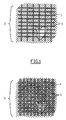
- Figure 1 shows the textures of masks and stencils of known types.
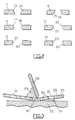
- Figure 2 shows sections of stencils and their respective qualities.
- Figure 3 shows a view of a thick layer deposition in progress.
- Figure 4 shows two stencils, one being made according to the present invention and the other being representative of the state of the prior art.
- Figure 5 shows a sectional view of a stencil according to the invention on the plate of printed circuits which must receive the deposits.
- FIG. 6 represents an example seen in plan and in section of simultaneous deposition of glue dots of different height and diameter depending on the type of component.
- Figure 7 shows in plan view an example of constitution with the invention of physical barriers between areas where there is a risk of bridging when passing the component welding wave.
- FIG. 8 represents exemplary embodiments, by implementing the invention, solid lines or solid surfaces.
- FIG. 9 represents the stencil schematically in operation in different cases.
- Figure 1 are presented the textures of masks and stencils of known types.
- Meshes 1 and 4 have identical surfaces. However, network performance 2 is greater than that of the network 5 since the diameters of the wires 3 are less than wire diameters 6. The voltage value is identical for networks 2 and 5. Finally the off contact is better for network 5 than for network 2.
- Figure 2 shows sections of stencils and their respective qualities.
- FIG. 2 In FIG. 2 are shown sections of screen printing screens 7, 8, 9, 10, 11 and 12, each passing through an opening whose sides 13 and 14 for the screen 7, 15 and 16 for screen 8, 17 and 18 for screen 9, 19 and 20 for screen 10, 21 and 22 for screen 11, 23 and 24 for the screen 12, have different shapes.
- the sides 13 and 14 correspond to a good filling since the sides 13 and 14 are closer to each other at the bottom than at the top.
- flanks 15 and 16 correspond to a good mold release since the flanks 15 and 16 are closer to each other, above than below.
- the sides 17 and 18 correspond to a usual compromise between these two forms and these two qualities.
- the sides are brought together at equal distance from the two surfaces from screen 9.
- the sides 19 and 20 correspond to a compromise favoring demoulding since they are closer together at a smaller distance from the upper surface than from the lower surface of the screen 10.
- the sides 21 and 22 correspond to an ideal shape. They are parallel to each other and perpendicular to the screen 11.
- the sides 23 and 24 correspond to the shape obtained by laser cutting. Their shapes are very close to those of flanks 21 and 22, however they are rough.
- Screen printing uses a metal or polyester canvas as support.
- a mask made using a photosensitive film to ultraviolet, allows the realization of stencils.
- the polyester canvas allows a certain elasticity, which allows an out-of-contact up to 3 or 4 millimeters without image distortion. The off contact favors demoulding because it reduces the lateral surfaces in contact.
- This out-of-contact is very important because it is he who allows the tearing of the material to be deposited, from the hole in the fabric, not obstructed during the passage of the doctor blade. The more fabric tensile force, the better the tearing off of the fabric and the better is the deposit.
- the tension can be all the more important that the number of wires per unit of length will be important. Now a greater number of sons allows a lower yield (the yield being the ratio between the free surface and the total surface of the mesh).
- the metallic fabric generally made of stainless steel mesh, allows, due to its superior resistance, to offer a higher opening percentage than polyester (70% maximum). As a result, the size of the deposits may be reduced. However, the off-contact possible will be less than polyester and tearing may be more delicate, which risks drive the product in the screen (note: the high voltage is close to the limit of rupture).
- the opening percentage is 100%.
- the metal is not extensible, it is rigid and its admissible bending angle is very small.
- a non-contact pseudo is obtained by suspending the metal stencil on a sieve made of polyester threads.
- metal With metal, the contact area is very wide.
- synthetic material, in sheet form according to the invention which is flexible and extensible, the admissible folding angle being very large, a contact surface of small width is obtained. This is a major problem because it often happens, for small openings, that the adhesion forces of the product to be deposited on the lateral surface of the hole are greater than the adhesion forces of the product on the support. In this case, the deposit cannot be made and the product is entrained on the stencil.
- Figure 3 shows a view of a thick layer deposition in progress.
- FIG. 3 a stencil 25 comprising wires 26 and a material 27, on which a doctor blade 28 which pushes a solder paste 29 or glue or any other viscous material in orifices 30, 31 and 32, the solder paste emerging orifices and depositing in the form of points 34 on a printed circuit 33 when the stencil 25 moves away from a printed circuit 33.
- the stencil 25 is produced according to methods known to those skilled in the art. It comprises wires 26 which ensure the solidity and a material 27 which ensures the watertightness of the stencil 25.
- the doctor blade 28 is of known type. Its hardness is adapted to prevent passage of paste between it and the stencil 25.
- the solder paste 29 is a viscous paste comprising different components including electrically conductive materials. It spreads in holes 30, 31 and 32. In Figure 3, hole 31 is much smaller that the orifice 30. The orifice 30 is empty and the orifice 32 is being filled.
- the stencil is stretched upwards to be removed from the printed circuit 33 before and after the passage of the doctor blade 28. It itself presses at the same time, the solder paste 29 on the stencil 25 and the stencil 25 on the printed circuit 33.
- the qualities of the stencil 25 depend on the wires 26 possibly inserted in the material 27, the elasticity of the stencil 25, its thickness and the way of making its orifices.
- the stencil or screen printing screen 25 is constituted of a solid sheet of a flexible and extensible synthetic material such as polyester or plastic derivatives or similar materials, preferably machined by cutting mechanical to make the circular holes.
- the material used for the realization of the stencil is capable of undergoing localized shaping by plastic deformation for example to allow passage of extra thicknesses.
- the present invention thus relates both to the stencil 25, as a device, as the process for achieving it.
- the present invention proposes to use a screen printing polyester or derivatives in a full sheet.
- This full sheet in polyester is mechanically or thermally drilled where desired.
- Polyester canvas due to the fact that it is full, admits higher tension forces to the wire fabrics metallic and at least equal to metallic stencils.
- FIG 4 In Figure 4 are shown a stencil 42 having an orifice 35 whose flanks 36 and 37 are a classic compromise in the electronics industry and a stencil 38 according to the invention comprising an orifice 39 whose sides 40 and 41 are produced by mechanical means.
- the stencil 42 is metallic. It has an orifice 35 whose sides 36 and 37 have been presented in Figure 2 as the usual compromise in the electronics industry.
- the stencil 42 does not accept contact well, has a very limited folding angle because of its base material, and has high coefficients of friction.
- the stencil 38 according to the invention consists of a solid polyester sheet machined by mechanical cutting. It has an orifice 39 whose sides 40 and 41 are made by drilling and therefore have an almost ideal shape, as shown in figure 2.
- Stencil 38 accepts high off-contacts, has a very folding angle high and a low coefficient of friction. The precision of the cutting shape is very high.
- Figure 5 shows a stencil made according to the present invention.
- Figure 5 is shown the production of a deposit on a substrate surface 33 through a stencil according to the invention 25 by means of a doctor blade 28.
- the printed circuit which will receive the deposits of viscous or pasty products and / or tights presents a relief or asperities of variable thicknesses. These reliefs are due to the presence of tracks and reception areas.
- the rule to respect for a transfer of the product to be deposited on the substrate is that there is contact between the stencil and the substrate at the precise place where the doctor blade exerts a linear pressure and opposite an opening. . If there is no contact next to the opening, the product will be guided through the hole but will be received randomly with spreads and burrs.
- the edge is sharp and clean with drilling diameters up to 0.1 mm possible.
- the great advantage of mechanical machining by drills lies in the fact that for the same drilling diameter, it is the same drill which operates regardless of the number of holes or orifices of the diameter concerned to be produced.
- the drill is a tool with constant diameter and profile with a constant calculated cutting speed, it works a material of constant thickness and nature. This leads to constant hole diameters with an identical surface condition on all holes of the same diameter, the holes are smooth with a roughness of the order of 0.001 micron (for 0.1 micron by laser cutting).
- the modification of the surface condition of the holes makes it possible to obtain results different in particular on the dosage of the products deposited, and the height of the points made in relation to the diameter of the holes.
- the stencil 25 has been shown, on the one hand applied to the substrate 33 (printed circuit) and on the other hand, during lifting to represent the removal of glue by the stencil and the action it can have on the formation of glue dots.
- Figure 6 is shown seen in plan and in section, an example of depositing points glue of different heights to fix different components on the circuit.
- FIG. 7 is shown an example of the constitution of physical barriers by glue dots between areas where there is a risk of bridging when going to the wave welding.
- the material remaining attached to the side walls of the orifices of the same diameter is strictly identical from one to the other.
- the solid polyester sheet does not have any insert or any particular shape. Its thickness is constant and it is homogeneous.
- the polyester used is transparent, the marking of the respective positions stencil and circuit board is therefore better.
- the height deposited depends on the diameter of the hole, the viscosity of the product, its density, the thickness of the stencil and the forces that oppose the flow (roughness).
- the roughness being constant
- the other parameters being constant
- the result is constant, that is to say that for the same hole diameter, we always have the same deposit height.
- the roughness being variable
- the deposits are inconsistent.
- the viscosity is the most influential factor on the height of the deposit, the lower the viscosity, the more the deposited height will approach the thickness of the stencil and this regardless of the diameter of the hole.
- the height deposited is depending on the diameter and thickness of the stencil. For very small diameters (200 to 400 micrometers), the height deposited is much less than the thickness of the stencil.
- the hole serves as a reservoir and refills with each pass of the doctor blade of a quantity of product viscous equivalent to that deposited on the circuit. Glue adhesion on the sides of the hole leads a part with the stencil and leaves only another part on the substrate.
- the part reentrained by the stencil is very well controlled and repetitive due to the consistency of roughness of the hole.
- the partial re-training of very viscous glue causes the systematic realization of a dome whose height can go up to 1.8 times the thickness of the stencil.
- the heights deposited are identical to the thickness of the stencil. If you want to file higher heights, you will have to choose a thicker stencil and select the appropriate drilling diameter, knowing that for the smallest diameters, the height deposited will be identical regardless of the thickness of the stencil.
- the properties of the invention make it possible to coexist side by side (there is no shape limit) very high glue dots and very low glue dots.
- the ratio of 1 to 20 is possible. It is possible to stick micro-components side by side and big cobblestones.
- the stencil produced according to the present invention still admits elasticity which allows to have out of contact during the deposit while ensuring an intimate contact with the substrate.
- the opening percentage being 100%, the size of the possible deposit becomes even lower.
- micro-points of glue or soldering cream by using the device object of the present invention, reaches limit diameters of about 100 micrometers with a height limit of 50 micro-meters
Landscapes
- Engineering & Computer Science (AREA)
- Manufacturing & Machinery (AREA)
- Mechanical Engineering (AREA)
- Microelectronics & Electronic Packaging (AREA)
- Printing Plates And Materials Therefor (AREA)
- Manufacture Or Reproduction Of Printing Formes (AREA)
- Printing Methods (AREA)
- Medicinal Preparation (AREA)
- Screen Printers (AREA)
- Manufacture Of Porous Articles, And Recovery And Treatment Of Waste Products (AREA)
- Laminated Bodies (AREA)
- Coloring (AREA)
- Treatment Of Fiber Materials (AREA)
Description
Plus cet angle est important, meilleur est l'arrachement du produit visqueux du pochoir.
L'obtention du hors contact suppose une force de tension importante du pochoir et un bon coefficient de déformation élastique.
Selon le hors-contact, la toile de sérigraphie métallique est moins bonne que la toile de sérigraphie en polyester et meilleure qu'un pochoir métallique.
La méthode et les moyens d'usinage des pochoirs conditionnent également la qualité des dépôts ainsi qu'il sera expliqué plus loin.
De tels pochoirs ont été utilisés.
Dans la figure 1 sont présentés les textures de masques et pochoirs de types connus.
Avec le métal, la zone de contact est très large.
Avec le matériau synthetique, en feuille selon l'invention, qui est souple et extensible, l'angle admissible de pliage étant très grand, une surface de contact de faible largeur est obtenue.
Ceci est un problème majeur car il arrive souvent, pour les petites ouvertures, que les forces d'adhérence du produit à déposer sur la surface latérale du trou soient supérieures aux forces d'adhérence du produit sur le support. Dans ce cas, le dépôt ne peut pas se faire et le produit est entraíné sur le pochoir.
S'il n'y a pas contact en regard de l'ouverture, le produit sera guidé par le trou mais sera reçu de manière aléatoire avec des étalements et des bavures.
Le foret est un outil à diamètre et à profil constant avec une vitesse de coupe calculée constante, il usine une matière d'épaisseur et de nature constante. Cela conduit à des diamètres de trous constants avec un état de surface identique sur tous les trous de même diamètre, les trous sont lisses avec une rugosité de l'ordre de 0,001 micron (pour 0,1 micron par une découpe laser).
La viscosité est le facteur le plus influent sur la hauteur du dépôt, plus la viscosité est faible, plus la hauteur déposée se rapprochera de l'épaisseur du pochoir et ceci quel que soit le diamètre du trou.
Pour la même épaisseur donnée et pour le même diamètre ou dimension de perçage (800 à 1200 micro-mètres), le réentraínement partiel de la colle très visqueuse, lors de la séparation, provoque la réalisation systématique d'un dôme dont la hauteur peut aller jusqu'à 1,8 fois l'épaisseur du pochoir.
Pour les diamètres supérieurs à 2000 micro-mètres et pour la même épaisseur, les hauteurs déposées sont identiques à l'épaisseur du pochoir. Si l'on veut déposer des hauteurs plus élevées, il faudra choisir un pochoir plus épais et sélectionner le diamètre de perçage approprié en sachant que pour les plus petits diamètres, la hauteur déposée sera identique quelle que soit l'épaisseur de pochoir.
- le prix de revient est divisé au moins par 3;
- les moyens à mettre en oeuvre pour le fabriquer sont moins onéreux que pour le pochoir métallique;
- le polyester est inaltérable aux acides et solvants;
- la durée de vie est supérieure à celle du pochoir métallique. Le pochoir polyester peut subir à la demande, une déformation plastique permanente pour éviter certaines zones de circuit si besoin.
Claims (17)
- Pochoir (25), (38) pour le dépôt et le dosage de couches plus ou moins épaisses à base de points ou en forme de points d'un produit visqueux sur un substrat, ledit pochoir étant constitué d'une feuille pleine et homogène en un matériau synthétique dotée d'orifices réalisés par des perçages caractérisé en ce que :l'épaisseur de la feuille est déterminée en fonction de la plus grande hauteur de dépôt à réaliser sur le substrat,et que la feuille présente des diamètres de perçage différents en fonction de la hauteur des différents dépôts à réaliser, les dits diamètres étant également conditionnés par l'épaisseur de la feuille, les dits perçages constituant réservoir chargés à chaque passage d'une racle d'une quantité de produits dont tout ou partie sera déposée sur le substrat de manière régulière par contact étroit entre le pochoir et le substrat à l'endroit où la racle exerce une pression linéaire et en regard de l'ouverture des perçages, ce qui permet de doser les quantités de produit déposées et de contrôler la hauteur des dépôts, les doses de produit déposées et les hauteurs de dépôt obtenues par un passage de la racle étant différentes.
- Pochoir selon la revendication 1 caractérisé en ce que :le plus petit diamètre de perçage du pochoir peut aller jusqu'à être de dimension inférieure à l'épaisseur de la feuille du pochoir.
- Pochoir selon la revendication 1 caractérisé en ce que chacun des perçages quelle que soit sa dimension a un diamètre constant sur toute l'épaisseur de la feuille.
- Pochoir selon la revendication 1 et la revendication 3 caractérisé en ce que les orifices de perçage réalisés pour l'un quelconque des différents diamètres sont rigoureusement identiques pour un même diamètre, ce qui permet de réaliser des dépôts rigoureusement semblables.
- Pochoir selon la revendication 3 caractérisé en ce que les parois des perçages sont relativement lisses ayant une rugosité de surface de l'ordre de 0,001 micron.
- Pochoir selon la revendication 1 caractérisé en ce que les flancs des perçages sont parallèles entre eux.
- Procédé pour le dépôt et le dosage de produits visqueux en couches plus ou moins épaisses à base de points ou en forme de points sur un substrat, ledit procédé comprenant l'apposition d'un pochoir plan au-dessus du substrat et l'application du produit visqueux sur le substrat à travers des perçages du pochoir par action d'une racle qui exerce une pression linéaire sur le pochoir plan perpendiculairement au dit pochoir et au substrat, en sens opposé au dit substrat, cette pression linéaire étant suffisante pour déformer le pochoir et pour le mettre en contact avec le substrat au point exact de la pression linéaire, les perçages du pochoir correspondant au dépôt à réaliser sur le substrat caractérisé en ce que le pochoir est constitué d'une feuille pleine extensible homogène réalisée en un matériau synthétique élastique possédant un angle de pliage élevé avec des perçages de transfert dont les flancs sont parallèles entre eux et perpendiculaires au pochoir, la tension étant suffisante pour créer un hors-contact entre le pochoir et le substrat du côté opposé à la racle et en ce que la quantité de produit visqueux déposée à chaque point et la hauteur du point déposé sont déterminées en fonction de l'épaisseur de la feuille du pochoir et du diamètre du perçage de transfert correspondant en sorte que chacun des dépôts issus de perçage ayant le même diamètre et la même rugosité de surface auront la même hauteur.
- Procédé selon la revendication 7 caractérisé en ce que le pochoir est doté de perçages d'au moins deux diamètres différents pour réaliser des dépôts de différentes hauteurs sur le substrat.
- Procédé selon les revendications 7 et 8 caractérisé en ce que le produit visqueux est une colle ou une pâte à braser.
- Procédé selon l'une quelconque des revendications 7, 8, 9 caractérisé en ce que les perçages sont circulaires.
- Procédé selon l'une quelconque des revendications 7, 8, 9 et 10 caractérisé en ce que la feuille du pochoir est en polyester.
- Procédé selon l'une quelconque des revendications 7, 8, 9, 10 et 11 caractérisé en ce que les perçages du pochoir sont relativement lisses ayant une rugosité de surface de l'ordre de 0,001 micron.
- Procédé selon l'une quelconque des revendications 7 à 12 caractérisé en ce que les perçages du pochoir sont réalisés par des forêts.
- Procédé selon l'une quelconque des revendications 7 à 13 caractérisé en ce que les perçages sont réalisés par laser.
- Procédé selon l'une quelconque des revendications 7 à 14 caractérisé en ce que l'épaisseur de la feuille du pochoir est choisie en sorte qu'un diamètre de perçage de 200 à 400 micromètres réalise une hauteur de dépôt inférieure à l'épaisseur du pochoir et qu'un diamètre de perçage supérieur à 2000 micromètres réalise une hauteur de dépôt sensiblement égale à l'épaisseur de la feuille du pochoir.
- Procédé de fabrication d'écrans de sérigraphie à partir d'une feuille pleine et homogène en un matériau synthétique dotée d'orifices réalisés par des perçages caractérisé en ce qu'il consiste à déterminer l'épaisseur de la feuille en fonction de la plus grande hauteur de dépôt à réaliser sur le substrat, à réaliser des perçages de diamètres différents en fonction de la hauteur des différents dépôts à réaliser, les dits diamètres étant également conditionnés par l'épaisseur de la feuille.
- Procédé selon la revendication 16 caractérisé en ce qu'il consiste à utiliser un outillage mécanique pour réaliser les découpes de la feuille de matière synthétique.
Applications Claiming Priority (3)
| Application Number | Priority Date | Filing Date | Title |
|---|---|---|---|
| FR9408518 | 1994-07-07 | ||
| FR9408518A FR2722138B1 (fr) | 1994-07-07 | 1994-07-07 | Pochoir de serigraphie et procede pour le realiser |
| PCT/FR1995/000898 WO1996001743A1 (fr) | 1994-07-07 | 1995-07-05 | Pochoir pour le depot et le dosage de couches plus ou moins epaisses, a base de points, d'un produit visqueux |
Publications (2)
| Publication Number | Publication Date |
|---|---|
| EP0770006A1 EP0770006A1 (fr) | 1997-05-02 |
| EP0770006B1 true EP0770006B1 (fr) | 1998-01-07 |
Family
ID=9465214
Family Applications (1)
| Application Number | Title | Priority Date | Filing Date |
|---|---|---|---|
| EP95925010A Expired - Lifetime EP0770006B1 (fr) | 1994-07-07 | 1995-07-05 | Pochoir pour le depot et le dosage de couches plus ou moins epaisses, a base de points, d'un produit visqueux |
Country Status (16)
| Country | Link |
|---|---|
| US (1) | US6183839B1 (fr) |
| EP (1) | EP0770006B1 (fr) |
| JP (1) | JP3557618B2 (fr) |
| KR (1) | KR100229990B1 (fr) |
| CN (1) | CN1046899C (fr) |
| AT (1) | ATE161777T1 (fr) |
| AU (1) | AU700852B2 (fr) |
| BR (1) | BR9507743A (fr) |
| CA (1) | CA2189539C (fr) |
| DE (1) | DE69501405T2 (fr) |
| DK (1) | DK0770006T3 (fr) |
| ES (1) | ES2113210T3 (fr) |
| FR (1) | FR2722138B1 (fr) |
| GR (1) | GR3026480T3 (fr) |
| NO (1) | NO319023B1 (fr) |
| WO (1) | WO1996001743A1 (fr) |
Cited By (1)
| Publication number | Priority date | Publication date | Assignee | Title |
|---|---|---|---|---|
| DE19826998A1 (de) * | 1998-06-19 | 1999-12-23 | Stefan Walther | Auftragswerk zum direkten Auftrag pastöser Medien auf textilen Flächengebilden |
Families Citing this family (21)
| Publication number | Priority date | Publication date | Assignee | Title |
|---|---|---|---|---|
| TW289901B (fr) | 1994-12-28 | 1996-11-01 | Ricoh Microelectronics Kk | |
| TW342365B (en) * | 1995-12-21 | 1998-10-11 | Ricoh Microelectronics Kk | A printing mask with a plastic printing plate and process for producing the same |
| FR2768365B1 (fr) * | 1997-09-16 | 1999-10-29 | Novatec | Mini pochoir et son systeme d'autopositionnement pour la reparation et/ou le remplacement de composants unitaires sur une carte electronique |
| WO1999014049A1 (fr) * | 1997-09-16 | 1999-03-25 | Societe Novatec S.A. | Mini pochoir et son dispositif de mise en oeuvre |
| US6722275B2 (en) | 2001-09-28 | 2004-04-20 | Photo Stencil, Llc | Reservoir stencil with relief areas and method of using |
| DE10200181A1 (de) * | 2001-10-12 | 2003-04-30 | Daniel Mahler | Siebdruckform sowie Verfahren zu deren Herstellung |
| US6887737B1 (en) | 2001-12-13 | 2005-05-03 | Henkel Corporation | Epoxidized acetals and thioacetals, episulfidized acetals and thioacetals, and reworkable thermosetting resin compositions formulated therefrom |
| US20060273138A1 (en) * | 2005-06-07 | 2006-12-07 | Samsung Electronics Co., Ltd. | Soldering apparatus for printed circuit board, soldering method for printed circuit board and soldering cream printing unit for soldering printed circuit board |
| DE102008034906A1 (de) * | 2008-07-26 | 2010-02-11 | Kocher + Beck Gmbh + Co. Rotationsstanztechnik Kg | Siebdruckform für grafische Anwendungen und Verfahren zur Herstellung einer Siebdruckform |
| DE202008012829U1 (de) | 2008-09-26 | 2008-12-04 | Nb Technologies Gmbh | Siebdruckform |
| DE102009024873A1 (de) * | 2009-06-09 | 2010-12-16 | Nb Technologies Gmbh | Siebdruckform |
| DE102009024875A1 (de) * | 2009-06-09 | 2010-12-16 | Nb Technologies Gmbh | Siebdruckschablone |
| GB2481079B (en) | 2009-09-21 | 2014-06-25 | Dtg Int Gmbh | Printing screens and method of fabricating the same |
| US8268389B2 (en) | 2010-01-08 | 2012-09-18 | International Business Machines Corporation | Precast thermal interface adhesive for easy and repeated, separation and remating |
| DE202010006945U1 (de) * | 2010-05-18 | 2011-10-07 | Cadilac Laser Gmbh Cad Industrial Lasercutting | Druckschablone |
| CN103042818B (zh) * | 2011-10-17 | 2015-12-16 | 正中科技股份有限公司 | 网版结构 |
| CN103203984B (zh) * | 2012-01-16 | 2016-06-15 | 昆山允升吉光电科技有限公司 | 一种印刷用三维立体掩模板 |
| WO2014033861A1 (fr) * | 2012-08-29 | 2014-03-06 | ヤマハ発動機株式会社 | Machine à imprimer |
| ITVI20130273A1 (it) * | 2013-11-14 | 2015-05-15 | Eurotech S P A | Scheda elettronica per supercalcolo refrigerata e procedimento per produrla |
| CN104249548A (zh) * | 2014-09-24 | 2014-12-31 | 深圳市华星光电技术有限公司 | 一种印刷网版 |
| DE102015120185A1 (de) * | 2015-11-20 | 2017-05-24 | Asm Assembly Systems Gmbh & Co. Kg | Verfahren und Vorrichtung zum Auswählen einer Pastenschablone für einen Pastendruck sowie zum Auftragen von Paste auf ein Substrat mittels der ausgewählten Pastenschablone |
Family Cites Families (28)
| Publication number | Priority date | Publication date | Assignee | Title |
|---|---|---|---|---|
| US3981237A (en) * | 1973-02-21 | 1976-09-21 | Rhodes John M | Plastic rotary printing screens construction method therefor |
| JPS54105774A (en) | 1978-02-08 | 1979-08-20 | Hitachi Ltd | Method of forming pattern on thin film hybrid integrated circuit |
| GB2054462A (en) * | 1979-07-19 | 1981-02-18 | Pryor Edward & Son | Stencil for electrochemical etching |
| US4359928A (en) | 1981-02-02 | 1982-11-23 | General Electric Company | High rate of fire revolving battery gun |
| US4379185A (en) * | 1981-02-13 | 1983-04-05 | American Biltrite, Inc. | Method for manufacture of inlaid vinyl-flooring |
| JPS5835995A (ja) * | 1981-08-28 | 1983-03-02 | 富士通株式会社 | プリント配線板の製造方法 |
| US4537647A (en) * | 1982-10-06 | 1985-08-27 | The Boeing Company | Method for applying turbulators to wind tunnel models |
| ATE27788T1 (de) | 1983-11-04 | 1987-07-15 | Bopp & Co Ag | Einrichtung zum spannen von rechteckigen gewebestuecken. |
| US4796560A (en) | 1984-03-06 | 1989-01-10 | Northern Telecom Limited | Automatic solder paste application to circuit boards |
| US4704305A (en) | 1984-03-06 | 1987-11-03 | Northern Telecom Limited | Automatic solder paste application to circuit boards |
| GB8524584D0 (en) | 1985-10-04 | 1985-11-06 | Wiggins Teape Group Ltd | Remoistenable adhesives |
| JPS63222496A (ja) | 1987-03-11 | 1988-09-16 | 株式会社村田製作所 | 配線基板の製造方法 |
| DE3885267T2 (de) | 1987-08-27 | 1994-03-31 | Dainippon Printing Co Ltd | Wärmeempfindliches schablonenpapier für die mimeographie. |
| US5046415A (en) | 1989-01-06 | 1991-09-10 | Motorola, Inc. | Composite stencil for screen printing |
| US5104213A (en) * | 1989-01-17 | 1992-04-14 | Wolfson Leonard G | Polymer buttons having holes therein and contact lenses manufactured therefrom and method of manufacture |
| DE3936408A1 (de) | 1989-11-02 | 1991-05-08 | Merck Patent Gmbh | Ueberexpression von proteinen in rekombinanten wirtszellen |
| DE4028556C1 (fr) | 1990-09-08 | 1992-04-02 | Robert Bosch Gmbh, 7000 Stuttgart, De | |
| EP0511334B1 (fr) | 1990-11-19 | 1995-02-01 | Prss- Maschinen Ag | Dispositif pour l'impression de pate a souder ou de pate conductrice |
| US5314709A (en) | 1991-03-20 | 1994-05-24 | International Business Machines Corporation | Unzippable polymer mask for screening operations |
| US5265773A (en) | 1991-05-24 | 1993-11-30 | Kabushiki Kaisha Marukomu | Paste feeding apparatus |
| JPH0539965A (ja) * | 1991-08-06 | 1993-02-19 | Hitachi Plant Eng & Constr Co Ltd | ヒートポンプ装置 |
| CA2076442A1 (fr) * | 1991-08-30 | 1993-03-01 | Yoshinori Sato | Pellicule pour stencil thermique |
| US5334815A (en) | 1992-01-15 | 1994-08-02 | Wear Guard Corp. | Apparatus and method for producing a printing screen |
| WO1993020562A1 (fr) | 1992-04-03 | 1993-10-14 | Thermoset Plastics, Inc. | Resine thermodurcissable contenant une charge conductrice |
| JP3216920B2 (ja) * | 1992-10-16 | 2001-10-09 | 理想科学工業株式会社 | レーザを用いた孔版印刷法及び孔版印刷装置 |
| JP3307716B2 (ja) * | 1993-04-28 | 2002-07-24 | 三菱化学ポリエステルフィルム株式会社 | 高感度感熱孔版印刷原紙用フィルム |
| JP3279761B2 (ja) | 1993-09-16 | 2002-04-30 | リコーマイクロエレクトロニクス株式会社 | クリーム半田印刷用マスク及びそれを用いた印刷方法 |
| US5532439A (en) | 1994-06-23 | 1996-07-02 | Transco Products Inc. | Silencer assembly with acoustical modules therein |
-
1994
- 1994-07-07 FR FR9408518A patent/FR2722138B1/fr not_active Expired - Fee Related
-
1995
- 1995-07-05 WO PCT/FR1995/000898 patent/WO1996001743A1/fr not_active Ceased
- 1995-07-05 DE DE69501405T patent/DE69501405T2/de not_active Expired - Lifetime
- 1995-07-05 CA CA002189539A patent/CA2189539C/fr not_active Expired - Fee Related
- 1995-07-05 KR KR1019970700051A patent/KR100229990B1/ko not_active Expired - Fee Related
- 1995-07-05 AU AU29298/95A patent/AU700852B2/en not_active Ceased
- 1995-07-05 AT AT95925010T patent/ATE161777T1/de not_active IP Right Cessation
- 1995-07-05 EP EP95925010A patent/EP0770006B1/fr not_active Expired - Lifetime
- 1995-07-05 DK DK95925010T patent/DK0770006T3/da active
- 1995-07-05 JP JP50415196A patent/JP3557618B2/ja not_active Expired - Fee Related
- 1995-07-05 US US08/776,331 patent/US6183839B1/en not_active Expired - Fee Related
- 1995-07-05 BR BR9507743A patent/BR9507743A/pt not_active IP Right Cessation
- 1995-07-05 ES ES95925010T patent/ES2113210T3/es not_active Expired - Lifetime
- 1995-07-05 CN CN95193224A patent/CN1046899C/zh not_active Expired - Fee Related
-
1996
- 1996-11-14 NO NO19964827A patent/NO319023B1/no unknown
-
1998
- 1998-03-27 GR GR980400666T patent/GR3026480T3/el unknown
Cited By (1)
| Publication number | Priority date | Publication date | Assignee | Title |
|---|---|---|---|---|
| DE19826998A1 (de) * | 1998-06-19 | 1999-12-23 | Stefan Walther | Auftragswerk zum direkten Auftrag pastöser Medien auf textilen Flächengebilden |
Also Published As
| Publication number | Publication date |
|---|---|
| JP3557618B2 (ja) | 2004-08-25 |
| WO1996001743A1 (fr) | 1996-01-25 |
| ATE161777T1 (de) | 1998-01-15 |
| FR2722138A1 (fr) | 1996-01-12 |
| FR2722138B1 (fr) | 1996-09-20 |
| KR100229990B1 (ko) | 1999-11-15 |
| AU2929895A (en) | 1996-02-09 |
| NO964827L (no) | 1996-11-14 |
| NO964827D0 (no) | 1996-11-14 |
| GR3026480T3 (en) | 1998-06-30 |
| DE69501405T2 (de) | 1998-07-09 |
| EP0770006A1 (fr) | 1997-05-02 |
| DE69501405D1 (de) | 1998-02-12 |
| CA2189539A1 (fr) | 1996-01-25 |
| CA2189539C (fr) | 1999-12-14 |
| CN1148830A (zh) | 1997-04-30 |
| KR970704583A (ko) | 1997-09-06 |
| NO319023B1 (no) | 2005-06-06 |
| DK0770006T3 (da) | 1998-09-07 |
| JPH10510223A (ja) | 1998-10-06 |
| US6183839B1 (en) | 2001-02-06 |
| AU700852B2 (en) | 1999-01-14 |
| CN1046899C (zh) | 1999-12-01 |
| ES2113210T3 (es) | 1998-04-16 |
| BR9507743A (pt) | 1997-08-19 |
Similar Documents
| Publication | Publication Date | Title |
|---|---|---|
| EP0770006B1 (fr) | Pochoir pour le depot et le dosage de couches plus ou moins epaisses, a base de points, d'un produit visqueux | |
| EP3666524B1 (fr) | Procede d'impression par serigraphie sur un composant electrique et/ou electronique avec deux systemes de raclage | |
| MC2169A1 (fr) | Resistance electrique sous forme de puce a montage de surface et son procede de fabrication | |
| FR2742687A1 (fr) | Procede de fourniture de soudure, appareil de fourniture de soudure et procede de soudage | |
| EP0710433A1 (fr) | Circuits electriques a tres haute conductibilite et de grande finesse, leurs procedes de fabrication, et dispositifs les comprenant | |
| EP3508916B1 (fr) | Methode de fabrication d'un micromoule multi-niveaux pour electroformage | |
| FR2977189A1 (fr) | Systeme d'impression serigraphique pour cellule photovoltaique | |
| WO1983004003A1 (fr) | Procede et dispositif d'encrage pour machine d'imprimerie | |
| EP3839627A1 (fr) | Methode de fabrication d'un micromoule pour electroformage de composants micromecaniques | |
| EP1109672A1 (fr) | Racle capillaire a injection surfacique pour la serigraphie de produits liquides et procede de travail de ladite racle | |
| US5669972A (en) | Flex tab thick film metal mask | |
| EP1932804A2 (fr) | Pièces mixtes silicium/métal et méthodes de fabrication s'y référant | |
| EP0994778B1 (fr) | Racle d'application de produits presentant un degre de viscosite important et des caracteristiques de thixotropie sur un substrat pouvant presenter des variations de hauteur, a travers un pochoir, applique au dit substrat | |
| FR2754473A1 (fr) | Procede de realisation de depots de produit visqueux et/ou pateux sur un substrat a travers les ouvertures d'un pochoir et dispositif distributeur de produit | |
| MXPA97000202A (en) | Stored for the deposit and the dosage decaps more or less thicken, based on points of a visc product | |
| EP2229040B1 (fr) | Procédé pour appliquer un produit èlectriquement conducteur, liquide lors de son application, sur un support afin de relier deux éléments électriquement conducteurs | |
| WO2006079725A2 (fr) | Dispositif de transfert par sérigraphie | |
| FR2834656A1 (fr) | Pochoir et son dispositif de mise en oeuvre pour le remplissage en contact plan et pour le demoulage progressif et angulaire | |
| EP2521638B1 (fr) | Procede de realisation de trous a l'aide d'un jet de fluide | |
| FR2816525A1 (fr) | Dispositif dispensateur de fluide et procede de realisation d'un tel dispositif | |
| FR2785445A1 (fr) | Gabarit d'alignement/de fixation d'une cathode formee d'oxyde et procede de fabrication de cathodes formees d'oxyde utilisant un tel gabarit | |
| EP2072458A1 (fr) | Procédé de formation de catalyseur de croissance de nanotubes/nanofibres et de croissance horizontale de nanotubes/nanofibres | |
| EP2365743A2 (fr) | Structure d'interconnexion comprenant des vias borgnes destines a etre metallises | |
| FR2837345A1 (fr) | Procede de remplissage de zones situees en creux sur un substrat |
Legal Events
| Date | Code | Title | Description |
|---|---|---|---|
| PUAI | Public reference made under article 153(3) epc to a published international application that has entered the european phase |
Free format text: ORIGINAL CODE: 0009012 |
|
| REG | Reference to a national code |
Ref country code: CH Ref legal event code: PLI Owner name: BOURRIERES, FRANCIS TRANSFER- LOCTITE (IRELAND) LI |
|
| 17P | Request for examination filed |
Effective date: 19961227 |
|
| AK | Designated contracting states |
Kind code of ref document: A1 Designated state(s): AT BE CH DE DK ES FR GB GR IE IT LI LU MC NL PT SE |
|
| 111L | Licence recorded |
Free format text: 970327 0100 NOVATEC S.A. * 970317 0101 LOCTITE (IRELAND) LIMITED |
|
| GRAG | Despatch of communication of intention to grant |
Free format text: ORIGINAL CODE: EPIDOS AGRA |
|
| REG | Reference to a national code |
Ref country code: CH Ref legal event code: PLI Owner name: BOURRIERES, FRANCIS TRANSFER- LOCTITE (IRELAND) LI |
|
| 17Q | First examination report despatched |
Effective date: 19970623 |
|
| GRAG | Despatch of communication of intention to grant |
Free format text: ORIGINAL CODE: EPIDOS AGRA |
|
| GRAH | Despatch of communication of intention to grant a patent |
Free format text: ORIGINAL CODE: EPIDOS IGRA |
|
| GRAH | Despatch of communication of intention to grant a patent |
Free format text: ORIGINAL CODE: EPIDOS IGRA |
|
| GRAA | (expected) grant |
Free format text: ORIGINAL CODE: 0009210 |
|
| REG | Reference to a national code |
Ref country code: CH Ref legal event code: PLI Owner name: BOURRIERES, FRANCIS TRANSFER- LOCTITE (IRELAND) LI |
|
| AK | Designated contracting states |
Kind code of ref document: B1 Designated state(s): AT BE CH DE DK ES FR GB GR IE IT LI LU MC NL PT SE |
|
| REF | Corresponds to: |
Ref document number: 161777 Country of ref document: AT Date of ref document: 19980115 Kind code of ref document: T |
|
| REG | Reference to a national code |
Ref country code: CH Ref legal event code: EP |
|
| REF | Corresponds to: |
Ref document number: 69501405 Country of ref document: DE Date of ref document: 19980212 |
|
| GBT | Gb: translation of ep patent filed (gb section 77(6)(a)/1977) |
Effective date: 19980303 |
|
| ITF | It: translation for a ep patent filed | ||
| REG | Reference to a national code |
Ref country code: CH Ref legal event code: NV Representative=s name: BOVARD AG PATENTANWAELTE |
|
| REG | Reference to a national code |
Ref country code: ES Ref legal event code: FG2A Ref document number: 2113210 Country of ref document: ES Kind code of ref document: T3 |
|
| REG | Reference to a national code |
Ref country code: IE Ref legal event code: FG4D Free format text: 78293 |
|
| REG | Reference to a national code |
Ref country code: PT Ref legal event code: SC4A Free format text: AVAILABILITY OF NATIONAL TRANSLATION Effective date: 19980402 |
|
| REG | Reference to a national code |
Ref country code: DK Ref legal event code: T3 |
|
| PLBE | No opposition filed within time limit |
Free format text: ORIGINAL CODE: 0009261 |
|
| STAA | Information on the status of an ep patent application or granted ep patent |
Free format text: STATUS: NO OPPOSITION FILED WITHIN TIME LIMIT |
|
| 26N | No opposition filed | ||
| REG | Reference to a national code |
Ref country code: GB Ref legal event code: 732E |
|
| REG | Reference to a national code |
Ref country code: GB Ref legal event code: IF02 |
|
| PGFP | Annual fee paid to national office [announced via postgrant information from national office to epo] |
Ref country code: AT Payment date: 20020606 Year of fee payment: 8 |
|
| PGFP | Annual fee paid to national office [announced via postgrant information from national office to epo] |
Ref country code: CH Payment date: 20020617 Year of fee payment: 8 |
|
| PGFP | Annual fee paid to national office [announced via postgrant information from national office to epo] |
Ref country code: MC Payment date: 20020618 Year of fee payment: 8 |
|
| PGFP | Annual fee paid to national office [announced via postgrant information from national office to epo] |
Ref country code: GR Payment date: 20020626 Year of fee payment: 8 |
|
| PGFP | Annual fee paid to national office [announced via postgrant information from national office to epo] |
Ref country code: LU Payment date: 20020715 Year of fee payment: 8 |
|
| PG25 | Lapsed in a contracting state [announced via postgrant information from national office to epo] |
Ref country code: LU Free format text: LAPSE BECAUSE OF NON-PAYMENT OF DUE FEES Effective date: 20030705 Ref country code: AT Free format text: LAPSE BECAUSE OF NON-PAYMENT OF DUE FEES Effective date: 20030705 |
|
| PG25 | Lapsed in a contracting state [announced via postgrant information from national office to epo] |
Ref country code: MC Free format text: LAPSE BECAUSE OF NON-PAYMENT OF DUE FEES Effective date: 20030731 Ref country code: LI Free format text: LAPSE BECAUSE OF NON-PAYMENT OF DUE FEES Effective date: 20030731 Ref country code: CH Free format text: LAPSE BECAUSE OF NON-PAYMENT OF DUE FEES Effective date: 20030731 |
|
| PG25 | Lapsed in a contracting state [announced via postgrant information from national office to epo] |
Ref country code: GR Free format text: LAPSE BECAUSE OF NON-PAYMENT OF DUE FEES Effective date: 20040205 |
|
| REG | Reference to a national code |
Ref country code: CH Ref legal event code: PL |
|
| REG | Reference to a national code |
Ref country code: FR Ref legal event code: CL Ref country code: FR Ref legal event code: AU |
|
| PGFP | Annual fee paid to national office [announced via postgrant information from national office to epo] |
Ref country code: DK Payment date: 20070713 Year of fee payment: 13 |
|
| PGFP | Annual fee paid to national office [announced via postgrant information from national office to epo] |
Ref country code: IE Payment date: 20070718 Year of fee payment: 13 |
|
| PGFP | Annual fee paid to national office [announced via postgrant information from national office to epo] |
Ref country code: ES Payment date: 20070808 Year of fee payment: 13 |
|
| PGFP | Annual fee paid to national office [announced via postgrant information from national office to epo] |
Ref country code: SE Payment date: 20070718 Year of fee payment: 13 Ref country code: BE Payment date: 20070817 Year of fee payment: 13 |
|
| REG | Reference to a national code |
Ref country code: PT Ref legal event code: MM4A Free format text: LAPSE DUE TO NON-PAYMENT OF FEES Effective date: 20090105 |
|
| REG | Reference to a national code |
Ref country code: DK Ref legal event code: EBP |
|
| EUG | Se: european patent has lapsed | ||
| REG | Reference to a national code |
Ref country code: IE Ref legal event code: MM4A |
|
| PG25 | Lapsed in a contracting state [announced via postgrant information from national office to epo] |
Ref country code: PT Free format text: LAPSE BECAUSE OF NON-PAYMENT OF DUE FEES Effective date: 20090105 |
|
| PG25 | Lapsed in a contracting state [announced via postgrant information from national office to epo] |
Ref country code: IE Free format text: LAPSE BECAUSE OF NON-PAYMENT OF DUE FEES Effective date: 20080707 Ref country code: DK Free format text: LAPSE BECAUSE OF NON-PAYMENT OF DUE FEES Effective date: 20080731 |
|
| REG | Reference to a national code |
Ref country code: ES Ref legal event code: FD2A Effective date: 20080707 |
|
| PG25 | Lapsed in a contracting state [announced via postgrant information from national office to epo] |
Ref country code: ES Free format text: LAPSE BECAUSE OF NON-PAYMENT OF DUE FEES Effective date: 20080707 |
|
| PGFP | Annual fee paid to national office [announced via postgrant information from national office to epo] |
Ref country code: FR Payment date: 20090716 Year of fee payment: 15 |
|
| PGFP | Annual fee paid to national office [announced via postgrant information from national office to epo] |
Ref country code: PT Payment date: 20070720 Year of fee payment: 13 Ref country code: NL Payment date: 20090730 Year of fee payment: 15 Ref country code: GB Payment date: 20090605 Year of fee payment: 15 |
|
| PGFP | Annual fee paid to national office [announced via postgrant information from national office to epo] |
Ref country code: IT Payment date: 20090724 Year of fee payment: 15 |
|
| PG25 | Lapsed in a contracting state [announced via postgrant information from national office to epo] |
Ref country code: SE Free format text: LAPSE BECAUSE OF NON-PAYMENT OF DUE FEES Effective date: 20080706 Ref country code: BE Free format text: LAPSE BECAUSE OF NON-PAYMENT OF DUE FEES Effective date: 20080731 |
|
| REG | Reference to a national code |
Ref country code: NL Ref legal event code: V1 Effective date: 20110201 |
|
| GBPC | Gb: european patent ceased through non-payment of renewal fee |
Effective date: 20100705 |
|
| REG | Reference to a national code |
Ref country code: FR Ref legal event code: ST Effective date: 20110331 |
|
| PG25 | Lapsed in a contracting state [announced via postgrant information from national office to epo] |
Ref country code: NL Free format text: LAPSE BECAUSE OF NON-PAYMENT OF DUE FEES Effective date: 20110201 Ref country code: IT Free format text: LAPSE BECAUSE OF NON-PAYMENT OF DUE FEES Effective date: 20100705 Ref country code: FR Free format text: LAPSE BECAUSE OF NON-PAYMENT OF DUE FEES Effective date: 20100802 |
|
| PG25 | Lapsed in a contracting state [announced via postgrant information from national office to epo] |
Ref country code: GB Free format text: LAPSE BECAUSE OF NON-PAYMENT OF DUE FEES Effective date: 20100705 |
|
| PGFP | Annual fee paid to national office [announced via postgrant information from national office to epo] |
Ref country code: DE Payment date: 20140721 Year of fee payment: 20 |
|
| REG | Reference to a national code |
Ref country code: DE Ref legal event code: R071 Ref document number: 69501405 Country of ref document: DE |