EP0776856A2 - Navette avec cabine d'ascenseur de secours réquisitionnable - Google Patents
Navette avec cabine d'ascenseur de secours réquisitionnable Download PDFInfo
- Publication number
- EP0776856A2 EP0776856A2 EP96308656A EP96308656A EP0776856A2 EP 0776856 A2 EP0776856 A2 EP 0776856A2 EP 96308656 A EP96308656 A EP 96308656A EP 96308656 A EP96308656 A EP 96308656A EP 0776856 A2 EP0776856 A2 EP 0776856A2
- Authority
- EP
- European Patent Office
- Prior art keywords
- cab
- car
- floor
- emergency
- fire
- Prior art date
- Legal status (The legal status is an assumption and is not a legal conclusion. Google has not performed a legal analysis and makes no representation as to the accuracy of the status listed.)
- Withdrawn
Links
- 238000012546 transfer Methods 0.000 claims abstract description 19
- 230000004044 response Effects 0.000 claims description 22
- 238000000034 method Methods 0.000 claims description 6
- 238000012360 testing method Methods 0.000 description 158
- 238000010586 diagram Methods 0.000 description 7
- 230000002441 reversible effect Effects 0.000 description 7
- 230000001360 synchronised effect Effects 0.000 description 5
- 230000008859 change Effects 0.000 description 3
- 230000000284 resting effect Effects 0.000 description 3
- 230000001133 acceleration Effects 0.000 description 2
- 238000004891 communication Methods 0.000 description 2
- 230000006698 induction Effects 0.000 description 2
- 230000008569 process Effects 0.000 description 2
- NWGKJDSIEKMTRX-AAZCQSIUSA-N Sorbitan monooleate Chemical compound CCCCCCCC\C=C/CCCCCCCC(=O)OC[C@@H](O)[C@H]1OC[C@H](O)[C@H]1O NWGKJDSIEKMTRX-AAZCQSIUSA-N 0.000 description 1
- 238000007792 addition Methods 0.000 description 1
- 238000013459 approach Methods 0.000 description 1
- 230000003247 decreasing effect Effects 0.000 description 1
- 238000005265 energy consumption Methods 0.000 description 1
- 230000003116 impacting effect Effects 0.000 description 1
- 238000003801 milling Methods 0.000 description 1
- 230000004048 modification Effects 0.000 description 1
- 238000012986 modification Methods 0.000 description 1
- 230000009467 reduction Effects 0.000 description 1
- 230000003014 reinforcing effect Effects 0.000 description 1
Images





Classifications
-
- B—PERFORMING OPERATIONS; TRANSPORTING
- B66—HOISTING; LIFTING; HAULING
- B66B—ELEVATORS; ESCALATORS OR MOVING WALKWAYS
- B66B9/00—Kinds or types of lifts in, or associated with, buildings or other structures
- B66B9/003—Kinds or types of lifts in, or associated with, buildings or other structures for lateral transfer of car or frame, e.g. between vertical hoistways or to/from a parking position
-
- B—PERFORMING OPERATIONS; TRANSPORTING
- B66—HOISTING; LIFTING; HAULING
- B66B—ELEVATORS; ESCALATORS OR MOVING WALKWAYS
- B66B5/00—Applications of checking, fault-correcting, or safety devices in elevators
- B66B5/02—Applications of checking, fault-correcting, or safety devices in elevators responsive to abnormal operating conditions
- B66B5/021—Applications of checking, fault-correcting, or safety devices in elevators responsive to abnormal operating conditions the abnormal operating conditions being independent of the system
- B66B5/024—Applications of checking, fault-correcting, or safety devices in elevators responsive to abnormal operating conditions the abnormal operating conditions being independent of the system where the abnormal operating condition is caused by an accident, e.g. fire
-
- B—PERFORMING OPERATIONS; TRANSPORTING
- B66—HOISTING; LIFTING; HAULING
- B66B—ELEVATORS; ESCALATORS OR MOVING WALKWAYS
- B66B9/00—Kinds or types of lifts in, or associated with, buildings or other structures
Definitions
- This invention relates to the commandeering of an elevator shuttle car frame to carry an emergency cab to a floor where an alarm is registered.
- an elevator cab may be moved in a first car frame in a first hoistway, from the ground floor up to a transfer floor, moved horizontally into a second elevator car frame in a second hoistway, and moved therein upwardly in the building, and so forth .
- another way to increase hoistway utilization, thereby decreasing core requirements includes moving the elevator cab out of the hoistway for unloading and loading, as is described in our European patent application claiming priority of U.S. patent application Serial No. 08/565,606 and filed contemporaneously herewith.
- Objects of the invention include provision of emergency cabs in very tall buildings; movement of emergency cabs to various floors in very tall buildings in response to alarms registered at other floors in the buildings; and rapid deployment of emergency equipment in very tall buildings, without inefficiently impacting the building core.
- one of a plurality of adjacent elevators is selected to be commandeered, it is brought to a floor where an emergency cab is parked, the normal cab is exchanged for the emergency cab, and the emergency cab is brought to the floor where the alarm is registered.
- the emergency cab is returned to the floor where it parks and the normal cab is exchanged therefor.
- the commandeered elevator may be returned to a designated floor, such as a low lobby, to resume normal service.
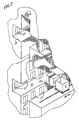
- a plurality of elevators 1-9 comprise an upper bank 12, the elevator cars of which can transfer to a lower bank 13 of elevators at a transfer floor 14, in a manner described in our European patent application claiming priority of US application Serial No. 08/564,534 and filed contemporaneously herewith.
- landings 16 are provided on one side of the hoistways of the elevators 1-9, opposite which a single landing 20 accommodates a fire cab F which can transfer horizontally in response to a controller 17 so as to be exchangeable for a cab on any one of the elevator cars 1-9.
- the fire cab F When a fire alarm is registered, one of the cars 1-9 is selected to become commandeered, after which, the fire cab F will move horizontally (arrow, Fig. 2) to be positioned adjacent the selected car C, and then exchange cabs therewith so that the selected elevator can take the fire cab F to the floor where the fire is, referred to herein as the alarm floor.
- the fire floor FF
- the fire cab is not moved to any other floor, so no cab selection or cab exchange process is required.
- Fig. 2 when one of the elevators 1-9 has been selected to be commandeered, which is referred to herein as car C, and its car frame 22 has been arrested at the fire floor FF, the fire cab F will have moved horizontally parallel to the row of elevators, such as by means of a linear induction motor and casters, to be juxtaposed therewith.
- the cabs can be exchanged horizontally by a horizontal motion means as described briefly with respect to Fig. 12 hereinafter.
- each of the landings of the elevators 1-9 on the fire floor have hoistway doors 23 leading from those landings into the building. These are similar to hoistway doors 25 on the terminal landings 26 of the shuttle elevators, as described in the aforementioned application.
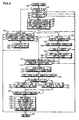
- a first embodiment of a fire routine for use in the embodiment of Figs. 1 and 2 is reached through an entry point 30, and a first test 31 determines if a response flag (utilized to advance the program as described hereinafter) has been set as yet or not. Initially, it will not have been so a test 32 determines if a car selected flag (also used to advance the program as described hereinafter) has been set or not. Initially it will not have been so a test 33 determines if a reverse flag (also utilized to advance the program as referred to hereinafter) has been set or not. Initially it will not have, so a negative result of test 33 reaches a test 34 to see if a fire alarm has been registered.
- a response flag (utilized to advance the program as described hereinafter) has been set as yet or not. Initially, it will not have been so a test 32 determines if a car selected flag (also used to advance the program as described hereinafter) has been set or not. Initially it will not have been
- test 34 the fire floor (the floor where the fire alarm is registered) is the fire floor. If so, the fire cab need not be moved so the rest of the routine is bypassed. But if the alarm has been registered on other than the fire floor, a negative result of test 36 reaches a step 38 to set a car counter, C, to the number of cars in the bank (nine in this example), and a step 39 to set a minimum time to some maximum value for purposes to be described. Then a subroutine 40 is reached to calculate the remaining response time for car C (beginning with car 9) to reach the fire floor, FF.
- the time required for the fire cab F to reach either hoistway 1 or hoistway 9 is greater than the time required to reach hoistway 4 or hoistway 6. Since one of the cars at the end may be closest to the fire floor, but other cars nearly as close, the amount of time for the fire cab F to reach such an elevator is taken into account by a step 43 which calculates the horizontal time to reach car C as the absolute value of the difference between the shaft number e.g, 9 minus 5 times a constant, K. Then a test 44 determines if this time is greater than the remaining response time for that particular car to reach the fire floor.
- test 46 determines if the remaining response time for each car is less than minimum time. For the first car (car 9 in this example) it will automatically be less because the min time has been set to some maximum value in the step 39.
- an affirmative result of test 46 reaches a step 47 to substitute the remaining response time of the cab in question for the minimum time for further tests, and a step 48 to designate the car being examined as the one (so far) selected to be commandeered. Then a step 49 decrements the C counter and a test 50 determines if all the cars have been examined yet or not. If not, a negative result of test 50 causes the program to revert to the subroutine 40 to be performed on the next car in sequence, and so forth. Eventually, all the cars will have been tested and one which can respond most quickly (including the time required for the fire cab F to reach the landing of the car) will have been selected as car C.
- a test 53 determines if the committable floor of the selected car (that is, the nearest floor at which it could stop) is above the fire floor. If it is, then a test 54 determines if the selected car is going up, and therefore away from the fire floor. If it is, the car must stop and turn around so a step 55 sets the destination for the selected car to be equal to its committable floor and resets a direction for car C equal up flag in a step 56, for use hereinafter, and then a step 57 will set a reverse flag described below.
- test 54 determines if the committable floor of the car is above the fire floor, but test 54 indicates that the car is not heading up, but rather is heading down, a negative result reaches a step 58 to set the destination for the selected car to be the fire floor, and a step 59 which sets a car selected flag, indicating that the car to be commandeered has already been chosen, for use hereinafter.
- a test 63 determines if the car can only stop below the fire floor, and a test 64 determines if the car direction is down, which would then indicate it is heading away from the fire floor.
- a pair of steps 65, 66 will set the destination for the car equal to its committable floor but in this case will set the direction for car C equal up flag for use hereinafter, and then a step 67 sets the reverse flag. If the committable floor of the car is below the floor, but the car is heading up, a negative result of test 64 will also reach the steps 58 and 59. If the committable floor of the car is at the fire floor, then a negative result of test 63 will reach the steps 58 and 59. In any event, other programming is then reached through the return point 35.
- test 70 will be affirmative until the car reaches its committable floor to reverse itself.
- test 70 will be negative reaching a test 71 to determine if the direction for car C equal up flag was set in step 66 or reset in step 56. If it is set, a step 72 sets the direction for car C to up. But if it was reset, a step 73 sets the direction for car c to down. In this way, the car is directed toward the fire floor. Then, a series of steps 74-77 set the destination for car C equal to the fire floor, set the run command for car C, reset the reverse flag, and set the car selected flag.
- test 31 will be negative but test 32 will be affirmative reaching the change cabs routine of Fig. 4 through a transfer point 80.
- a first test 81 determines if the transfer flag (used to advance the program as described hereinafter) has been set or not. Initially, it will not have been set, so a test 82 determines if car C is still running. In the first pass, car C will generally still be running so an affirmative result of test 82 causes other programming to be reached through a return point 83. Eventually, car C will come to a stop at the fire floor and in a subsequent pass through Fig. 4, test 82 will be negative reaching a test 84 to check that the speed of car C is zero. If it is not, then the routine is bypassed and other programming is reached through the return point 83.
- a test 85 determines if the door of the fire cab is fully closed, or not. Normally, when the alarm goes off, the firefighters will enter the cab and press the door close button so as to prepare to be moved to the fire. However, until this happens, the programming must wait. Therefore, if the doors are not closed, a negative result of test 85 will simply cause other programming to be reached through the return point 83. Eventually, the firemen are aboard the cab and its doors are closed. Then, an affirmative result of test 85 will reach step 88 to set the car/floor lock of car C, so as to rigidly support the car at the fire floor.
- a step 89 will reset a cab/landing lock for the fire cab, thereby releasing the cab from its normal parking place on the landing.
- a step 90 will reset the cab car lock for car C so that the cab thereon can be exchanged for the fire cab.
- a step 91 sets the transfer flag, indicating that the cabs can be transferred from a landing to the car and from the car to a landing.
- test 31 is negative
- test 32 is affirmative reaching Fig. 4 in which test 81 is now affirmative.
- This reaches a test 94 to see if an eject flag, used to keep track of the time when the cabs are in motion in their exchange from landing to car and car to landing, has been set. Initially, the eject flag is not set so a negative result of test 94 reaches tests 95 to see if the cab car lock for car C and the fire cab are as yet unlocked, and a test 97 to see whether car C is locked to the floor. In a first pass through them, all of the tests 95-97 will typically be negative, causing other programming to be reached through the return point 83.
- step 100 will order car C to eject its normal cab to the left, and simultaneously cause the fire cab to be received from the right (assuming the configuration disclosed in Figs. 1 and 2 hereinbefore). Then a step 101 will set the eject flag, and other programming is reached through the return point 83.
- test 31 is still negative
- test 32 is positive reaching test 81 which is still affirmative.
- test 94 again which is now affirmative reaching a test 104 to determine if a lock flag (described hereinafter) is set, or not.
- a negative result of test 104 reaches a test 105 to see if the normal cab is fully on the landing of car C on the fire floor yet, or not.
- a negative result reaches the return point 83.
- test 107 determines if the fire car has been firmly placed in car C. By this time, it may have; if not, the return point 83 is reached; if so, an affirmative result of test 107 reaches a step 108 to set the cab car lock for car C, so as to lock the fire cab into car C, in a step 109 which sets the lock flag.
- test 31 is negative, tests 32 and 81 are affirmative, tests 94 and 104 are affirmative, reaching a pair of tests 110, 111 to determine if both cabs are locked yet or not. If not, the return point 83 is reached. If so, affirmative results of both tests 110 and 111 reach a step 112 to open the doors of the cab of car C on the fire floor landing (FF,C) so that passengers can be guided to local elevators to resume their trips. Then a step 114 sets the destination floor for car C equal to the alarm floor, where the fire is.
- a test 118 determines if the alarm floor is above the fire floor. (As used herein, to designate a target floor for a fire, the alarm floor may be set one or two floors below the floor where the alarm was registered, if desired.) If it is, a pair of steps 119, 120 will set the direction for car C to up and set a direction for car C equals up flag, for use hereinafter. On the other hand, if the alarm floor is not above the fire floor, it must be below it since this part of the program is not reached whenever the fire floor and the alarm floor are the same due to test 35 in Fig. 3.
- a negative result of test 118 reaches a pair of steps 121, 122 which set the direction for car C down and reset the direction for car C equals up flag. Then, the program may cycle on a test 127 to determine that the car floor locks of car C are unlocked. If it is inappropriate to hold the program at this point while the locks are released (which may take a second or so), an unlock flag may be used to allow other programming to be reached at the return point 83 until such time as the locks are unlocked. Once the car floor lock is unlocked, an affirmative result of test 127 reaches a pair of steps 128 and 129 to set car C into the run state, and to set a response flag, to control the program as described more fully hereinafter.
- a plurality of steps 130-133 reset the response, transfer, eject, lock and car selected flags, and other programming is reverted to through the return point 83.
- steps 130-133 reset the response, transfer, eject, lock and car selected flags, and other programming is reverted to through the return point 83.
- test 31 is affirmative reaching the recall routine of Fig. 5 through a transfer point 140.
- car C has been enabled to run, and it is carrying the fire cab to the floor where the fire alarm was sounded. Because the destination for car C has been set to be the alarm floor, it will stop at that floor under its normal motion control.
- the fire cab will remain on car C in the hoistway and access to the floor will be had through hoistway doors 26 (Fig. 2).
- the firemen will control the car, including the opening of the doors, if desired. This is irrelevant to the present invention.
- a test 141 determines if the lock flag is set.
- test 142 Since it has been reset in step 132, Fig. 4, initially it will not be set, reaching a test 142 to see if the transfer flag is set. It also has just been reset in a step 130, therefore a negative result of test 142 reaches a test 143 to see if a recall flag, used to advance the program, has been set or not. Initially, it will not have been set, so a test 144 is reached to see if the response flag is set. The response flag having been set in step 129 of Fig. 4, an affirmative result of test 144 reaches a test 145 to see if a firemen's key to start up car C has been turned or not. While the fire is being responded to, test 145 will be negative causing other programming to be reverted to through a return point 146.
- test 145 will be affirmative reaching a test 147 to check for closed doors. Initially, this may be negative, causing the program to reach a return point 146.
- tests 141 and 142 are negative and tests 144, 145 and 147 are affirmative, thereby reaching a test 148 to determine if the direction equals up flag for car C was set or not.
- step 149 will set the direction for car C to down so that it may return to the fire floor. If the flag were reset in Fig. 3, then a negative result of test 150 reaches a step 150 to set the direction of car C to up so that car C can return to the fire floor. Then, a step 151 will set the destination of car C equal to the fire floor, a step 152 will set car C to run, and a step 153 will set a recall flag used to advance the program as described hereinafter.
- test 141 and 142 are negative, but this time test 143 is affirmative reaching a test 154 to see if car C is still in the run condition, which it will be until it becomes level at the fire floor.
- test 154 will be affirmative, causing other programming to be reached through the return point 146.
- the car will be leveled at the fire floor and the run command will be reset for car C, in the usual fashion.
- test 154 is negative reaching a test 155 to determine if car C is perfectly at rest.
- step 156 If it is, an affirmative result of test 155 will reset the cab/car lock on car C in a step 156, thus releasing the fire cab.
- a step 157 will set the car/floor lock for car C so as to ensure there will no whipping of the rope as the cabs are exchanged on the car.
- a step 158 will reset the cab/landing lock on the fire floor adjacent to car C, to release the normal cab that was jettisoned from car C in response to the fire alarm as car C was commandeered.
- a step 159 sets a retransfer flag to keep track of the fact that a reexchange of the original passenger car and the fire cab is about to take place. Then other programming is reached through the return point 146.
- test 141 is still negative, but test 142 is now positive, reaching a test 160 to determine if a launch flag (used to advance the program and described hereinafter) is set or not. Initially it will not be set, so a negative result of test 160 reaches a set of tests 161-163 to see if the fire cab has been unlocked on car C and passenger cab unlocked from the landing, and to see if car C has been locked to the building. In the first few passes through these tests, the result is likely to be negative, reaching the return point 146.
- step 164 When both cabs are unlocked and the car is locked, an affirmative result of test 161-163 reaches a step 164 to cause the car to eject the fire cab to the right (in the convention of Figs. 1 and 2) which also will cause the passenger cab originally on car C to be loaded back onto car C. Then a step 165 sets a launch flag used to advance the program, which is described hereinafter. And other programming is then reverted to through the return point 146.
- test 141 is still negative
- test 142 is still positive
- test 160 is positive
- reaching a pair of tests 166, 167 which determine if the fire cab is fully in place on the fire floor and the passenger cab is in place on car C.
- the cabs will not have been fully transferred so negative results reach other programming through the return point 146.
- test 141 is still negative, test 142 is positive, test 156 is positive and both tests 163 and 164 will be positive reaching a step 168 to set the cab car lock on car C, and a step 169 to set a lock flag used to control the program, as described hereinafter.
- test 141 is positive reaching a test 170 to see if an unlock flag has been set or not. Initially, it will not have been, so a negative result of test 170 reaches a test 171 to see if the passenger cab is locked in car C as yet, or not. If the lock is not yet locked, a negative result of test 170 and 171 reach the return point 146. When the lock is locked, an affirmative result of test 171 reaches a subroutine 172, similar to the subroutine 115 described with respect to Fig.
- a step 173 sets the destination for car C to the main floor (or to any other floor which is desired) so that it can resume handling its normal function, which may be passenger traffic. Then the direction for car C is set to lead it towards its destination, which in this case would be down, by a step 174. Then, the unlock flag 175 is set in a step 175.
- test 131 is still positive reaching the recall routine of Fig. 5 in which test 141 is still positive. This time, test 170 is positive, reaching a test 178 to determine if the car floor lock for car C has been released as yet or not.
- a test 191 determines if the launch flag, of step 165 and test 160 in Fig. 5, has been set or not. When the alarm first goes off, and the fire is to be responded to, test 191 will be negative reaching a test 192 to see if the car selected flag (of steps 59 and 77 and test 32 of Fig. 3) has been set or not. In the initial stages of responding to a fire, or when there is no alarm to be responded to, test 192 will be negative reaching other programming through a return point 193.
- test 192 will be affirmative reaching a test 194 to see if the door on the fire cab has been closed by the firemen. If not, the remainder of the program is bypassed to the return point 193.
- test 194 reaches a test 195 to see if the cab/landing lock for the fire cab is unlocked or not. Initially it is not, so a negative result of test 195 reaches a step 196 to reset the cab/landing lock for the fire cab.
- test 191 is negative, tests 192 and 194 are affirmative but until the fire cab is unlocked, test 195 will be negative, reinforcing the reset of the lock in step 196.
- test 195 will be negative, reinforcing the reset of the lock in step 196.
- an affirmative result of test 195 reaches a step 197 which sets the horizontal destination for the fire cab to the position of car C (adjacent the hoistway of one of the elevators 1-9).
- the run command for the horizontal movement of the fire cab is set in a step 198.
- the fire cab will then run to a position adjacent to car C and be stopped by normal controls in response to its destination command, in any well-known manner (not shown).
- the handling of the fire cab is then as described with respect to Figs. 3-5 until the fire cab is returned to the fire floor.
- the routine may proceed through a negative result of test 191, and affirmative results of tests 192, 194 and 195 causing a redundant resetting of the destination of the fire cab to the position of car C and setting run for the fire cab. But since the cab is at its destination, nothing will happen. As soon as the cab is moved toward car C, leaving the fire floor, it will lose its communication with the fire floor, and establish communication with car C. Therefore, the door fully closed signal for the fire cab which is tested in test 194 will become negative reaching the return point 193. Soon thereafter, the car selected flag is reset in step 133 of Fig. 4 so that subsequent passes through Fig.
- test 191 is affirmative reaching a test 203 to determine if the fire cab is fully in its own landing, F. Initially, it will not be, so a negative result of test 203 reaches a test 204 to see if an F flag, used to advance the program, has been set or not. Initially, the flag will not be set so a negative result of test 204 will reach a test 205 to see if the cab has arrived on the fire floor adjacent to car C, or not.
- the cab When the launch flag is first set, initially, the cab will be moving from car C toward the landing on the fire floor, so a negative result of test 205 will reach the return point 193. Eventually, the fire cab will be disposed fully on the landing adjacent to car C on the fire floor, so an affirmative result of test 205 will reach a step 206 to set the destination for the fire cab to its normal resting place, referred to as F. Then the fire cab is enabled to run by a step 207, and the F flag is set in a step 208. In the next pass through the routine of Fig. 6, the fire cab has probably not reached its landing, F, so test 203 is probably still negative.
- test 204 will be affirmative so that the rest of the routine is bypassed during the time that the fire cab moves from the position of car C to the position where it rests. Eventually, the fire cab will reach the landing where it normally resides to that in a subsequent pass through Fig. 6, test 203 will be affirmative reaching a step 212 which orders that the fire cab be locked in its landing, and a step 213 which restores the F flag to the reset state. This concludes the entire operation from fire alarm to the restoration of the system to the way it is before the alarm.
- Figs. 1 and 2 hereinbefore has been assumed to allow each of the elevators 1-9 to operate independently of the others, and therefore, the routine of Fig. 3 between step 38 and test 50 selects a car on a universal basis to be used for carrying the fire cab.
- the invention may also be practiced in an elevator system in which the elevators 1-9 are operated in a synchronized fashion.
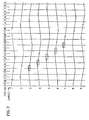
- An example of a nine elevator system synchronized in 18 periods is illustrated in Fig. 7.
- the cycles appear across the top.
- car one is at the high landing during the 17th cycle and leaves the landing heading downward at the beginning of the 18th cycle. It reaches the bottom landing 14 (Fig.
- Fig. 8 illustrates a second embodiment of the present invention, within the structure illustrated in the embodiment of Figs. 1 and 2, but utilizing synchronized dispatching of the various cars as in Fig. 7.
- a second fire routine is reached through an entry point 220, and the first two tests 31, 32, are the same as described hereinbefore with respect to Fig. 3.
- no reverse flag is needed since the chosen car is always heading toward the fire floor.
- the tests 34 and 35 are the same as described with respect to Fig. 3, and will not be described further.
- a negative result of test 35 reaches a whole series of tests 221-230 to pick one of the cars in a series of steps 233-237, as the designated car C, in dependence upon the current cycle when a negative result of test 35 is first reached.
- car five is chosen instead. Car five remains the car of choice during the first cycle. But during the second cycle, it is too late for car five so car six is selected, and so forth. Under the scheme depicted in Figs.
- Figs. 7 and 8 are not descriptive of an exact working model, but rather are illustrative of an embodiment of the invention that selects a car heading for the fire floor which will be the next car that can get there. If desired, should there be a negative result from the test 230, an appropriate error could be noted and an alarm sounded in steps 238, 239 since obviously the system would not select the car. In any event, after one of the steps 233-239, other programming is reverted to through the return point 240.
- Figs. 1 and 2 utilizes a fire floor which has complete landings on both sides of the elevator hoistways so that any car could be eligible, even though in the modification illustrated in Figs. 7 and 8, cars 1, 2, 8 and 9 would not be selected, such cars may be selected in the embodiment of Fig. 3.
- a different embodiment of the invention, Fig. 9, utilizes only three of the cars 4-6 as possible candidates for commandeering to carry the fire cab to a floor where an alarm has been set; the three cars 4-6 have full landings (not shown) on the opposite side from where the fire cab is parked.
- the routine of Fig. 8 can be modified as shown in Fig.
- the invention could be utilized with double deck cabs.
- the doors of the fire cab open for the firemen
- the doors of the upper deck cab can open, and open the doors 27 adjacent thereto, to allow the upper deck passengers to seek an alternative route to their destination.
- the foregoing embodiments have been described with respect to a fire cab responding to a registered fire alarm.
- the cab might be any form of emergency cab, such as an ambulance, or other medical emergency cab.
- the dispatching of one emergency car may frequently be accompanied by the dispatching of another emergency cab.
- a medical emergency cab could select a second car to be commandeered for carrying the medical emergency cab to the same or a different floor in response to the same alarm or another demand for service, from a different floor, such as the 39th or 41st floor.
- any floor may be chosen.
- the emergency cab is disposed in a hoistway which interconnects with another hoistway.
- the cab in the present instance could have as its destination a floor in the lower bank 13 of shuttles, rather than in the upper bank of shuttles, going through a transfer between cars at the transfer floor. This is particularly true in the case where a second emergency cab is being dispatched from one bank of elevators (12, 13) to the other bank of elevators (13, 12) to back up an emergency cab already dispatched from a floor in one bank of elevators (13) to respond to an emergency in the same bank of elevators (12, 13).
- the invention may also be practised in embodiments of elevator shuttles which do not normally transfer cabs onto landings, but do transfer cabs from one hoistway to another.
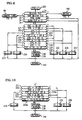
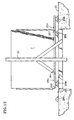
- a special landing for the fire cab and for the normal cab to be removed from a selected car may be provided as shown in Fig. 11, in which the horizontal motive means of Fig. 12 may preferably be used for transferring the cabs between the car and the landings, including motorized pinions 260, 255.
- the bottom of the cab F has a fixed, main rack 250 extending from front to back (right to left in Fig. 12), and a sliding rack 253 that can slide outwardly to the right, as shown, or to the left.
- an auxiliary motorized pinion 255 turns clockwise to drive the sliding auxiliary rack 253 out from under the cab into the position shown, where it can engage an auxiliary motorized pinion 256 on the landing 20, which is the limit that the rack 253 can slide.
- the auxiliary motorized pinion 256 will turn clockwise pulling the auxiliary rack 253 (which now is extended to its limit) and therefore the entire cab F to the right as seen in Fig.
- main motorized pinion (not shown) which is located just behind the auxiliary motorized pinion 256 in Fig. 12. Then, that main motorized pinion will pull the entire cab 22 fully onto the landing 20 by means of the main rack 250, and as it does so a spring causes the slidable auxiliary rack 253 to retract under the cab 22.
- Auxiliary motorized pinions 259, 260 can assist in moving a cab to the right to the landing FF, and can also assist in moving cab C from the landing FF onto the car frame 22.
- the auxiliary pinion 256 will operate counterclockwise, causing the sliding, auxiliary rack 253 to move outwardly to the left until its left end 261 engages the auxiliary pinion 255. Then the auxiliary pinion 256 pulls the auxiliary rack 253 and the entire cab F to the left until the left end 262 of the main rack engages a main motorized pinion (not shown) located behind the auxiliary motorized pinion 255, which then pulls the entire cab to the left until it is fully on the car frame 22.
Landscapes
- Engineering & Computer Science (AREA)
- Automation & Control Theory (AREA)
- Structural Engineering (AREA)
- Maintenance And Inspection Apparatuses For Elevators (AREA)
- Lift-Guide Devices, And Elevator Ropes And Cables (AREA)
- Cage And Drive Apparatuses For Elevators (AREA)
- Elevator Control (AREA)
Applications Claiming Priority (2)
| Application Number | Priority Date | Filing Date | Title |
|---|---|---|---|
| US564773 | 1995-11-29 | ||
| US08/564,773 US5655625A (en) | 1995-11-29 | 1995-11-29 | Emergency elevator cab commandeering shuttle |
Publications (2)
| Publication Number | Publication Date |
|---|---|
| EP0776856A2 true EP0776856A2 (fr) | 1997-06-04 |
| EP0776856A3 EP0776856A3 (fr) | 1998-03-18 |
Family
ID=24255826
Family Applications (1)
| Application Number | Title | Priority Date | Filing Date |
|---|---|---|---|
| EP96308656A Withdrawn EP0776856A3 (fr) | 1995-11-29 | 1996-11-29 | Navette avec cabine d'ascenseur de secours réquisitionnable |
Country Status (7)
| Country | Link |
|---|---|
| US (1) | US5655625A (fr) |
| EP (1) | EP0776856A3 (fr) |
| JP (1) | JPH09165155A (fr) |
| KR (1) | KR970026872A (fr) |
| AU (1) | AU7198596A (fr) |
| CA (1) | CA2189922A1 (fr) |
| ZA (1) | ZA969383B (fr) |
Cited By (6)
| Publication number | Priority date | Publication date | Assignee | Title |
|---|---|---|---|---|
| EP0842888A1 (fr) * | 1996-11-14 | 1998-05-20 | Otis Elevator Company | Transport horizontal et vertical pour passager |
| WO1999050165A1 (fr) * | 1998-03-31 | 1999-10-07 | Allen Thomas H | Batiment multi-niveaux equipe d'un systeme d'ascenseur faisant office de sortie de secours et d'evacuation lors d'un incendie |
| WO2004026748A1 (fr) * | 2002-09-23 | 2004-04-01 | Medtronic Physio-Control Corp. | Ascenseur equipe de dispositif d'urgence medicale |
| WO2011079975A1 (fr) * | 2009-12-31 | 2011-07-07 | Inventio Ag | Procédé d'exploitation d'ascenseurs en situation d'urgence |
| WO2015187775A1 (fr) * | 2014-06-03 | 2015-12-10 | Otis Elevator Company | Système d'évacuation de bâtiment intégré |
| WO2016126627A1 (fr) * | 2015-02-05 | 2016-08-11 | Otis Elevator Company | Opérations hors groupe pour systèmes de cage d'ascenseur à cabines multiples |
Families Citing this family (7)
| Publication number | Priority date | Publication date | Assignee | Title |
|---|---|---|---|---|
| US5865274A (en) * | 1995-10-24 | 1999-02-02 | Kabushiki Kaisha Toshiba | Elevator group management control apparatus and elevator group management control method |
| JP2004002020A (ja) * | 2002-05-27 | 2004-01-08 | Inventio Ag | 数台の自走式かごと少なくとも3つの隣接配置されたエレベータ昇降路とを備えたエレベータ設備 |
| ES2373726T3 (es) * | 2005-02-04 | 2012-02-08 | Otis Elevator Company | Avisos indicando que una cabina está esperando a otra cabina en el mismo hueco de ascensor. |
| US20100183407A1 (en) * | 2009-01-21 | 2010-07-22 | Tai-Up Kim | Container transfer port system |
| CN102616630A (zh) * | 2012-04-09 | 2012-08-01 | 李凯 | 单向电梯及其运行方法 |
| US10865072B2 (en) | 2015-08-03 | 2020-12-15 | Otis Elevator Company | Intermediate transfer station |
| US10494229B2 (en) * | 2017-01-30 | 2019-12-03 | Otis Elevator Company | System and method for resilient design and operation of elevator system |
Family Cites Families (9)
| Publication number | Priority date | Publication date | Assignee | Title |
|---|---|---|---|---|
| US1580310A (en) * | 1924-09-17 | 1926-04-13 | Daniel F Lepley | Removable elevator cage |
| US1949399A (en) * | 1933-05-23 | 1934-03-06 | Darrell P Ayer | Mine shaft ore skip and cage changing device |
| SE372921B (fr) * | 1972-07-20 | 1975-01-20 | Linden Alimak Ab | |
| US4386680A (en) * | 1981-03-13 | 1983-06-07 | Multi-Story Transporters, Inc. | Emergency rescue system |
| US4865155A (en) * | 1988-07-21 | 1989-09-12 | Pegasus International, Inc. | High-rise fire fighting and rescue system |
| DE69021417T2 (de) * | 1989-03-20 | 1996-04-04 | Hitachi Elevator Eng | Personenbeförderungseinrichtung. |
| JP2507275B2 (ja) * | 1990-10-17 | 1996-06-12 | フジテック株式会社 | 循環式エレベ―タの横行移動装置 |
| JPH04361968A (ja) * | 1991-06-11 | 1992-12-15 | Mitsubishi Electric Corp | エレベーター装置 |
| EP0615946B1 (fr) * | 1993-03-18 | 1997-06-04 | Inventio Ag | Système transporteur de passagers vertical-/horizontal |
-
1995
- 1995-11-29 US US08/564,773 patent/US5655625A/en not_active Expired - Fee Related
-
1996
- 1996-11-07 ZA ZA969383A patent/ZA969383B/xx unknown
- 1996-11-08 CA CA002189922A patent/CA2189922A1/fr not_active Abandoned
- 1996-11-23 KR KR1019960056930A patent/KR970026872A/ko not_active Withdrawn
- 1996-11-26 AU AU71985/96A patent/AU7198596A/en not_active Abandoned
- 1996-11-29 EP EP96308656A patent/EP0776856A3/fr not_active Withdrawn
- 1996-11-29 JP JP8319340A patent/JPH09165155A/ja not_active Withdrawn
Cited By (12)
| Publication number | Priority date | Publication date | Assignee | Title |
|---|---|---|---|---|
| EP0842888A1 (fr) * | 1996-11-14 | 1998-05-20 | Otis Elevator Company | Transport horizontal et vertical pour passager |
| WO1999050165A1 (fr) * | 1998-03-31 | 1999-10-07 | Allen Thomas H | Batiment multi-niveaux equipe d'un systeme d'ascenseur faisant office de sortie de secours et d'evacuation lors d'un incendie |
| WO2004026748A1 (fr) * | 2002-09-23 | 2004-04-01 | Medtronic Physio-Control Corp. | Ascenseur equipe de dispositif d'urgence medicale |
| US6948592B2 (en) | 2002-09-23 | 2005-09-27 | Medtronic Emergency Response Systems, Inc. | Elevators equipped with emergency medical devices |
| EP2230205A1 (fr) * | 2002-09-23 | 2010-09-22 | Medtronic Physio-Control Corp. | Ascenseur équipé avec une défibrillateur |
| WO2011079975A1 (fr) * | 2009-12-31 | 2011-07-07 | Inventio Ag | Procédé d'exploitation d'ascenseurs en situation d'urgence |
| CN102712445A (zh) * | 2009-12-31 | 2012-10-03 | 因温特奥股份公司 | 紧急状态下操作升降机的方法 |
| CN102712445B (zh) * | 2009-12-31 | 2014-10-22 | 因温特奥股份公司 | 紧急状态下操作升降机的方法 |
| WO2015187775A1 (fr) * | 2014-06-03 | 2015-12-10 | Otis Elevator Company | Système d'évacuation de bâtiment intégré |
| US10410310B2 (en) | 2014-06-03 | 2019-09-10 | Otis Elevator Company | Integrated building evacuation system |
| WO2016126627A1 (fr) * | 2015-02-05 | 2016-08-11 | Otis Elevator Company | Opérations hors groupe pour systèmes de cage d'ascenseur à cabines multiples |
| US10766738B2 (en) | 2015-02-05 | 2020-09-08 | Otis Elevator Company | Out-of-group operations for multicar hoistway systems |
Also Published As
| Publication number | Publication date |
|---|---|
| EP0776856A3 (fr) | 1998-03-18 |
| ZA969383B (en) | 1997-06-02 |
| US5655625A (en) | 1997-08-12 |
| JPH09165155A (ja) | 1997-06-24 |
| KR970026872A (ko) | 1997-06-24 |
| CA2189922A1 (fr) | 1997-05-30 |
| AU7198596A (en) | 1997-06-12 |
Similar Documents
| Publication | Publication Date | Title |
|---|---|---|
| FI111929B (fi) | Hissiryhmän ohjaus | |
| US5758748A (en) | Synchronized off-shaft loading of elevator cabs | |
| US5655625A (en) | Emergency elevator cab commandeering shuttle | |
| TWI343357B (en) | Elevator installation with individually movable elevator cars and method for operating such an elevator installation | |
| US5861586A (en) | Horizontal and vertical passenger transport | |
| EP0781724A2 (fr) | Système sychronisé d'ascenseur-navette | |
| EP0388814A2 (fr) | Equipement de transport de personnes | |
| US5773772A (en) | Transferring elevator cabs between non-contiguous hoistways | |
| MXPA03004344A (es) | Instalacion de ascensores con varias cabinas autopropulsadas y como minimo tres cajas de ascensor dispuestas una junto a otra. | |
| JPH06305648A (ja) | マルチカー方式エレベーターの運行制御装置 | |
| US5660249A (en) | Elevator cabs transferred horizontally between double deck elevators | |
| US5823299A (en) | Shuttle elevators feeding local elevators | |
| JPH0859139A (ja) | エレベータ | |
| CA1201829A (fr) | Systeme d'ascenseur | |
| US4401190A (en) | Cars/floors and calls/cars elevator assignments | |
| CN211998305U (zh) | 一种自动装卸货梯 | |
| EP0863841B1 (fr) | Ascenseur navette utilisant une cabine a deplacement horizontal | |
| CN1154338A (zh) | 紧急电梯舱室征用传送装置 | |
| JP4798836B2 (ja) | ダブルデッキエレベータの救出運転装置 | |
| JP3011804B2 (ja) | 中間乗入型エレベータ式駐車装置 | |
| KR19980063784A (ko) | 승객용 셔틀 엘리베이터로 화물을 이동시키는 방법 및 그시스템 | |
| HK1148258A1 (en) | Operating method for an elevator having two elevator cabs and one counterweight | |
| HK1148258B (en) | Operating method for an elevator having two elevator cabs and one counterweight | |
| HK1006255A (en) | Synchronized off-shaft loading of elevator cabs | |
| JPH02282178A (ja) | エレベータ |
Legal Events
| Date | Code | Title | Description |
|---|---|---|---|
| PUAI | Public reference made under article 153(3) epc to a published international application that has entered the european phase |
Free format text: ORIGINAL CODE: 0009012 |
|
| AK | Designated contracting states |
Kind code of ref document: A2 Designated state(s): DE FR GB |
|
| PUAL | Search report despatched |
Free format text: ORIGINAL CODE: 0009013 |
|
| RHK1 | Main classification (correction) |
Ipc: B66B 5/02 |
|
| AK | Designated contracting states |
Kind code of ref document: A3 Designated state(s): DE FR GB |
|
| 17P | Request for examination filed |
Effective date: 19980507 |
|
| STAA | Information on the status of an ep patent application or granted ep patent |
Free format text: STATUS: THE APPLICATION HAS BEEN WITHDRAWN |
|
| 18W | Application withdrawn |
Withdrawal date: 19980708 |