EP0778280A2 - Etiketierreagenz und Nachweismethode - Google Patents
Etiketierreagenz und Nachweismethode Download PDFInfo
- Publication number
- EP0778280A2 EP0778280A2 EP96119962A EP96119962A EP0778280A2 EP 0778280 A2 EP0778280 A2 EP 0778280A2 EP 96119962 A EP96119962 A EP 96119962A EP 96119962 A EP96119962 A EP 96119962A EP 0778280 A2 EP0778280 A2 EP 0778280A2
- Authority
- EP
- European Patent Office
- Prior art keywords
- group
- synthesis
- analyte
- tag
- oligonucleotide
- Prior art date
- Legal status (The legal status is an assumption and is not a legal conclusion. Google has not performed a legal analysis and makes no representation as to the accuracy of the status listed.)
- Granted
Links
- 0 *Cc1cc(OCCCN(C*)CCOC(CCC(ON(C(CC2)=O)C2=O)=O)=O)ccc1O Chemical compound *Cc1cc(OCCCN(C*)CCOC(CCC(ON(C(CC2)=O)C2=O)=O)=O)ccc1O 0.000 description 1
Images



Classifications
-
- C—CHEMISTRY; METALLURGY
- C12—BIOCHEMISTRY; BEER; SPIRITS; WINE; VINEGAR; MICROBIOLOGY; ENZYMOLOGY; MUTATION OR GENETIC ENGINEERING
- C12Q—MEASURING OR TESTING PROCESSES INVOLVING ENZYMES, NUCLEIC ACIDS OR MICROORGANISMS; COMPOSITIONS OR TEST PAPERS THEREFOR; PROCESSES OF PREPARING SUCH COMPOSITIONS; CONDITION-RESPONSIVE CONTROL IN MICROBIOLOGICAL OR ENZYMOLOGICAL PROCESSES
- C12Q1/00—Measuring or testing processes involving enzymes, nucleic acids or microorganisms; Compositions therefor; Processes of preparing such compositions
- C12Q1/68—Measuring or testing processes involving enzymes, nucleic acids or microorganisms; Compositions therefor; Processes of preparing such compositions involving nucleic acids
- C12Q1/6869—Methods for sequencing
- C12Q1/6874—Methods for sequencing involving nucleic acid arrays, e.g. sequencing by hybridisation
-
- C—CHEMISTRY; METALLURGY
- C07—ORGANIC CHEMISTRY
- C07F—ACYCLIC, CARBOCYCLIC OR HETEROCYCLIC COMPOUNDS CONTAINING ELEMENTS OTHER THAN CARBON, HYDROGEN, HALOGEN, OXYGEN, NITROGEN, SULFUR, SELENIUM OR TELLURIUM
- C07F7/00—Compounds containing elements of Groups 4 or 14 of the Periodic Table
- C07F7/02—Silicon compounds
- C07F7/08—Compounds having one or more C—Si linkages
- C07F7/18—Compounds having one or more C—Si linkages as well as one or more C—O—Si linkages
- C07F7/1804—Compounds having Si-O-C linkages
-
- C—CHEMISTRY; METALLURGY
- C07—ORGANIC CHEMISTRY
- C07H—SUGARS; DERIVATIVES THEREOF; NUCLEOSIDES; NUCLEOTIDES; NUCLEIC ACIDS
- C07H21/00—Compounds containing two or more mononucleotide units having separate phosphate or polyphosphate groups linked by saccharide radicals of nucleoside groups, e.g. nucleic acids
-
- C—CHEMISTRY; METALLURGY
- C12—BIOCHEMISTRY; BEER; SPIRITS; WINE; VINEGAR; MICROBIOLOGY; ENZYMOLOGY; MUTATION OR GENETIC ENGINEERING
- C12N—MICROORGANISMS OR ENZYMES; COMPOSITIONS THEREOF; PROPAGATING, PRESERVING, OR MAINTAINING MICROORGANISMS; MUTATION OR GENETIC ENGINEERING; CULTURE MEDIA
- C12N15/00—Mutation or genetic engineering; DNA or RNA concerning genetic engineering, vectors, e.g. plasmids, or their isolation, preparation or purification; Use of hosts therefor
- C12N15/09—Recombinant DNA-technology
- C12N15/10—Processes for the isolation, preparation or purification of DNA or RNA
- C12N15/1034—Isolating an individual clone by screening libraries
- C12N15/1075—Isolating an individual clone by screening libraries by coupling phenotype to genotype, not provided for in other groups of this subclass
-
- C—CHEMISTRY; METALLURGY
- C12—BIOCHEMISTRY; BEER; SPIRITS; WINE; VINEGAR; MICROBIOLOGY; ENZYMOLOGY; MUTATION OR GENETIC ENGINEERING
- C12Q—MEASURING OR TESTING PROCESSES INVOLVING ENZYMES, NUCLEIC ACIDS OR MICROORGANISMS; COMPOSITIONS OR TEST PAPERS THEREFOR; PROCESSES OF PREPARING SUCH COMPOSITIONS; CONDITION-RESPONSIVE CONTROL IN MICROBIOLOGICAL OR ENZYMOLOGICAL PROCESSES
- C12Q1/00—Measuring or testing processes involving enzymes, nucleic acids or microorganisms; Compositions therefor; Processes of preparing such compositions
- C12Q1/68—Measuring or testing processes involving enzymes, nucleic acids or microorganisms; Compositions therefor; Processes of preparing such compositions involving nucleic acids
- C12Q1/6813—Hybridisation assays
- C12Q1/6816—Hybridisation assays characterised by the detection means
-
- C—CHEMISTRY; METALLURGY
- C12—BIOCHEMISTRY; BEER; SPIRITS; WINE; VINEGAR; MICROBIOLOGY; ENZYMOLOGY; MUTATION OR GENETIC ENGINEERING
- C12Q—MEASURING OR TESTING PROCESSES INVOLVING ENZYMES, NUCLEIC ACIDS OR MICROORGANISMS; COMPOSITIONS OR TEST PAPERS THEREFOR; PROCESSES OF PREPARING SUCH COMPOSITIONS; CONDITION-RESPONSIVE CONTROL IN MICROBIOLOGICAL OR ENZYMOLOGICAL PROCESSES
- C12Q1/00—Measuring or testing processes involving enzymes, nucleic acids or microorganisms; Compositions therefor; Processes of preparing such compositions
- C12Q1/68—Measuring or testing processes involving enzymes, nucleic acids or microorganisms; Compositions therefor; Processes of preparing such compositions involving nucleic acids
- C12Q1/6813—Hybridisation assays
- C12Q1/6834—Enzymatic or biochemical coupling of nucleic acids to a solid phase
- C12Q1/6837—Enzymatic or biochemical coupling of nucleic acids to a solid phase using probe arrays or probe chips
-
- C—CHEMISTRY; METALLURGY
- C12—BIOCHEMISTRY; BEER; SPIRITS; WINE; VINEGAR; MICROBIOLOGY; ENZYMOLOGY; MUTATION OR GENETIC ENGINEERING
- C12Q—MEASURING OR TESTING PROCESSES INVOLVING ENZYMES, NUCLEIC ACIDS OR MICROORGANISMS; COMPOSITIONS OR TEST PAPERS THEREFOR; PROCESSES OF PREPARING SUCH COMPOSITIONS; CONDITION-RESPONSIVE CONTROL IN MICROBIOLOGICAL OR ENZYMOLOGICAL PROCESSES
- C12Q1/00—Measuring or testing processes involving enzymes, nucleic acids or microorganisms; Compositions therefor; Processes of preparing such compositions
- C12Q1/68—Measuring or testing processes involving enzymes, nucleic acids or microorganisms; Compositions therefor; Processes of preparing such compositions involving nucleic acids
- C12Q1/6869—Methods for sequencing
- C12Q1/6872—Methods for sequencing involving mass spectrometry
-
- Y—GENERAL TAGGING OF NEW TECHNOLOGICAL DEVELOPMENTS; GENERAL TAGGING OF CROSS-SECTIONAL TECHNOLOGIES SPANNING OVER SEVERAL SECTIONS OF THE IPC; TECHNICAL SUBJECTS COVERED BY FORMER USPC CROSS-REFERENCE ART COLLECTIONS [XRACs] AND DIGESTS
- Y10—TECHNICAL SUBJECTS COVERED BY FORMER USPC
- Y10S—TECHNICAL SUBJECTS COVERED BY FORMER USPC CROSS-REFERENCE ART COLLECTIONS [XRACs] AND DIGESTS
- Y10S435/00—Chemistry: molecular biology and microbiology
- Y10S435/8215—Microorganisms
- Y10S435/911—Microorganisms using fungi
- Y10S435/912—Absidia
Definitions
- analyte molecules labelled with reporter groups In biological and chemical analyses, the use of analyte molecules labelled with reporter groups is routine.
- This invention addresses the idea of providing reagents having at least two analyte groups linked to one or more reporter groups. Such reagents can be used, in ways described below, to generate much more analytical information than can simple labelled analytes. It is possible to code reporter groups so that reagents carrying multiple analyte groups and multiple reporter groups can by synthesised combinatorially and used simultaneously and the reporter groups resolved in the analytical stage.
- WO 93/06121 (Affymax) describes a synthetic oligomer library comprising a plurality of different members, each member comprising an oligomer composed of a sequence of monomers linked to one or more identifier tags identifying the sequence of monomers in the oligomer.
- the linkage between the oligomer and the identifier tag preferably comprises a solid particle.
- the identifier tag is preferably an oligonucleotide.
- the present invention provides a reagent comprising
- the analyte moiety is linked to the tag moiety by a link which is cleavable, e.g. photocleavable.
- a linker group to which the analyte moiety and the tag moiety are both attached.
- the analyte moiety is a chain of n analyte residues
- the tag moiety is a chain of up to n reporter groups, the reporter group at each position of the tag chain being chosen to designate the analyte residue at a corresponding position of the analyte chain.
- n is an integer of at least 2, preferably 3 to 20.
- the invention may be used for the detection of all analytes of interest. These include, but are not limited to, a protein/peptide chain so that the analyte residues are amino acid residues; a nucleic acid/oligonucleotide chain so that the analyte residues are nucleotide residues; a carbohydrate chain so that the analyte residues are sugar residues. Additionally the analyte may be a class of small molecules with biological, pharmacological or therapeutic activity. For example it could be a core molecule with the ability to vary various substituent groups eg. alkyl, esters, amines, ethers etc in a combinatorial manner with mass spectrometry tags.
- substituent groups eg. alkyl, esters, amines, ethers etc in a combinatorial manner with mass spectrometry tags.
- the tag moiety and/or the or each reporter group in it is capable of being observed/detected/analysed so as to provide information about the nature of the analyte moiety, and/or the analyte residues in it.
- the reagent has the formula A - L - R where A is a chain of n analyte residues constituting the analyte moiety, L is the linker, R is a chain of up to n reporter groups constituting the tag moiety, and n is 2 - 20, wherein the tag moiety contains information defining the location of analyte residues in the analyte moiety.
- the tag moiety consists of one or more reporter groups distinguishable by mass and thus capable of being analysed by mass spectrometry.
- the reporter groups may be chemically different and thus distinguished from one another by molecular weight. Or the reporter groups may be chemically identical, but distinguished from one another by containing different isotopes (e.g. 12 C/ 13 C and 1 H/ 2 H as discussed below).
- the tag moiety is, and/or the reporter groups are, suitable or adapted for analysis by mass spectrometry e.g. after cleavage by photochemical or other means from the reagent.
- mass spectrometry as a detection system is: its great sensitivity - only a few hundred molecules are needed to give a good signal; its wide dynamic range and high resolving power - molecules in the mass range 100 to 200,000 Daltons can be resolved with a resolution better than 0.01; its versatility - molecules of many different chemical structures are readily analysed; the potential to image analytes by combining mass spectrometry with, for example, scanning laser desorption: and the ability to make quantitative as opposed to merely qualitative measurements.
- mass-labelling combines advantages of radioactivity and fluorescence and has additional attributes which suggest novel applications.
- the invention provides a library of the above reagents, wherein the library consists of a plurality of reagents each comprising a different analyte moiety of n analyte residues.
- the library may consist of 4 n reagents each comprising a different oligonucleotide chain of n nucleotide residues.
- the reagents of the library may be present mixed together in solution.
- the invention provides an assay method which comprises the steps of: providing a target substance; incubating the target substance with the said library of reagents under conditions to cause at least one reagent to bind to the target substance; removing non-bound reagents; recovering the tag moieties of the or each bound reagent; and analysing the recovered tag moieties as an indication of the nature of the analyte moieties bound to the target substance.
- the target substance may be immobilised, as this provides a convenient means for separating bound from non-bound reagent.
- the target substance may be an organism or tissue or group of cells, and the assay may be performed to screen a family of candidate drugs.
- the target substance may be a nucleic acid, and this aspect is discussed in greater detail below.
- the principle of the method used for tagging multiple analytes simultaneously is similar to that proposed by Brenner and Lerner (1992) for coding peptides with attached nucleic acid sequences.
- the intention of their idea is to add a tag which can be amplified by the polymerase chain reaction and read by sequencing the DNA molecule produced.
- reagents The structure of reagents is best illustrated by considering how they could be made. Synthesis starts with a bivalent or multivalent linker which can be extended stepwise in one direction to add a residue to the analyte and in another to add residue-specific reporter groups (Fig. 1). Suppose we wish to make a mixture of organic compounds, introducing different residues at each stage in the synthesis.
- the mixture could comprise a set of peptides with different amino acid sequences or of oligonucleotides with different base sequences, or a set of variants with potential pharmacological activity with different groups attached to a core structure; in each case we wish to label each structural variant with a unique tag. This is done by dividing the synthesis at each step where different residues are added to the compound of interest, and adding corresponding residues to the tag.
- the linker and reporter groups are .
- the linker should have one group that is compatible with analyte synthesis - hydroxyl, amino or sulphydryl group are all suitable for initiating oligonucleotide synthesis, and similar groups can be found to initiate other pathways, for example, synthesis of polypeptides.
- a "core" compound which forms part of the analyte.
- the choice of the group(s) for starting addition of reporters depends on the nature of the reporter groups and the chemistry used to couple them. This chemistry has to be compatible with that used for synthesising the analyte.
- oligonucleotide synthesis there are a number of alternatives.
- the established method uses benzoyl and isopropyl groups to protect the bases, acid-labile trityl groups for temporary protection of the 5'-OH groups during coupling, and ⁇ -cyanoethyl groups to protect the phosphates.
- the method used for coupling the reporters should not attack these protecting groups or other bonds in the oligonucleotide, and the synthesis of the tags should not be affected by the coupling, oxidation, and deprotection used in the extension of the oligonucleotide.
- the coupling of the reporter monomers or the capping of the chain may be incomplete at each step (Fig. 2, B and C) , so that the analyte is coupled to a nested set of reporter structures. This will make it easier to deduce the structure of the analyte from the composition of the tag (Fig. 1; Fig. 3).
- the linker may be attached to a solid support by a linkage which can be cleaved without degrading the analyte or the reporter groups.
- the linker may carry a group such as a charged group or a lipophilic group which enables separation of intermediates and the final product from reagents.
- the reporter groups could take many forms, the main consideration is the need to read the composition or sequence of the tag by mass spectrometry. Possibilities include groups with different atomic or formula weights, such as aliphatic chains of different lengths or different isotopic composition. Using isotopically labelled methylene groups, it is possible to assign a group of unique formula weight to each of four different reporters (Table 1). Table 1 Example reporters based on isotopes of hydrogen and carbon: Isotopic Composition Formula Weight (of -OCH 2 ) Symbol Base 12 CH 2 30 r 30 A 12 CHD, 13 CH 2 31 r 31 C 12 CD 2 , 13 CHD 32 r 32 G 13 CD 2 33 r 33 T
- these tags can make a set which allows the base at each position in the oligonucleotide to be read from the incremental masses of the partial products in the series (Table 2). All oligonucleotide sequences will give a unique series of tag fragment weights provided the smallest increment in adding a reporter is larger than the mass difference between the smallest and the largest reporter.
- tags should be compatible with the chemical and biochemical processes used in the analysis: for the example of oligonucleotides used in molecular hybridisation or for one of the proposed sequencing methods, they must be soluble and they must not inhibit certain enzymatic reactions which may be used in the analysis.
- oligoethylene glycol linkages similar to the methylene analogues shown in Table 1, are compatible with molecular reassociation of oligonucleotides.
- linkages are compatible with at least some enzymatic reactions as we have shown that oligonucleotides tethered to glass through a hexaethylene glycol linker can be converted to a 5'-phosphomonoester by treatment with polynucleotide kinase and ATP.
- the linker molecule has the following properties:
- linker should be possible to link it to a solid support to allow for synthetic cycles to produce the analyte and corresponding tags to proceed without the need for cumbersome purification of intermediates. Following synthesis cycles, the linker should be removable from the solid support under conditions which leave the analyte and tags intact.
- the functional group for tag synthesis should be such that it allows for the ready synthesis of tags which are distinguishable from each other by mass spectrometry.
- the linker should have protected functional groups that allow for the extension of the analyte and the tags separately, under conditions in which the chemistry for one does not interfere with that of the other.
- the linker should preferably carry a charged group so that mass spectrometry can be carried out in the absence of a matrix. Further to this aim, it is desirable that the tags should comprise compounds which are volatile enough to evaporate in the mass spectrometer, without recourse to complex techniques such as the electrospray. The tags should either produce stable ions or ions which fragment to characteristic patterns that can be used to identify the corresponding analyte.
- the link between the tag and analyte should preferably be photocleavable, so that tags can be directly cleaved in the mass spectrometer by laser irradiation, and further cleavage to remove them completely to allow biochemical steps such as ligation, can be carried out conveniently by exposure to a lamp.
- the linked products should preferably be soluble in aqueous solvents, so that they can be used in biochemical reactions.
- the photocleavable group has been based on the known photolabile o-nitrobenzyl group. This group has been used as a protecting group for both the phosphate group and 2' hydroxy group in oligo nucleotide synthesis [see the review by Pillai Synthesis 1 (1980)]. In itself the o-nitrobenzyl group lacks further functionalisation for subsequent attachment of a linker between tags and analyte. Available from commercial sources is the compound 5-hydroxy-2-nitrobenzyl alcohol. It is known that OMe groups can be added in the 5,4 position without significant reduction in photolabile properties (see Pillai review). Thus, the 5-hydroxy-2-nitrobenzyl alcohol was used as a starting point with the aim of extending DNA synthesis from the benzyl alcohol and the linker chain to the tags from an ether coupling at the 5-hydroxy group.
- linker arm is therefore required from the photocleavable group to the required functional group for tag synthesis. It is also a preferment that the combinatorial synthesis be carried out on a solid support. Thus, the linker arm must be bivalent in functional groups and have orthogonal protecting groups to permit selective synthetic transformation.
- Preferred tag reagents contain glycol linkages/ether linkages. For synthesis oligonucleotides are normally linked to a long chain amino CPG support via the 3' hydroxy and a succinic ester link. Thus the functional groups required were deemed to be alcohols.
- This comprises an aromatic linker carrying:
- the 2-nitrobenzyl group is stable under most of the conditions of peptide synthesis and it and related analogues have already been used as photo labile groups in peptide synthesis (see Pillai review and the references contained therein). There are already several resins suited to peptide synthesis with different modes of cleavage.
- the orthogonal protecting groups for analyte and tag synthesis would be based on t-butoxycarbonyl and 2-methoxyethoxymethyl. The t-butoxycarbonyl group would be used to protect the amino group in the amino acids with cleavage being effected by a trifluoroacetic acid treatment.
- the 2-methoxyethoxymethyl would be used to protect the tagging groups and the tags based on mass diffentiated on 1, n alkyldiol derivatives as before.
- the cleavage of t-butoxycarbonyl groups has been shown to be compatible with the 2-methoxyethoxymethyl protecting groups.
- the 2-methoxyethoxymethyl protecting groups can be selectively cleaved with zinc bromide in dichloromethane. While the above illustrates the procedure those skilled in the art will recognize that this set of orthogonal protecting groups is by no means limiting but serves as a representative example.
- Photocleavage is the favoured method of releasing tags from analytes; it is fast, can be carried out in the dry state, and scanning lasers can be used to image at a very small scale, small enough to image features within cells (de Vries et al ., 1992), so that the proposed method could be used to detect the positions of specific analytes that had been used to "stain" the surface or the insides of cells, or different cells in a tissue slice, such as may be required to image interactions between ligands, e.g. candidate drugs, and their receptors.
- ligands e.g. candidate drugs
- Photosensitive protecting groups are available for a very wide range of chemical residues [reviewed in Pillai, 1980].
- the photolabile o-nitro benzyl group which can be used as a protecting group for a wide range of compounds forms an ideal starting point for a linker for many analytes that could be envisaged, peptides and oligonucleotides among them. Taking the example of oligonucleotides, it provides a photosensitive link that can be broken quantitatively to give a hydroxyl group. This will permit the deprotected oligonucleotide to take place in the ligation extension as described in the sequencing method below. Furthermore, the group is known to be stable during oligonucleotide synthesis.
- the proposed molecular tags would be analysed by one of several forms of mass spectrometry. For many purposes, although it will be desirable to cleave the tags from the analytes, it will not be necessary to fragment the tags, and indeed it may be undesirable as it could lead to ambiguities. Recent developments in mass spectrometry allow the measurement of very large molecules without too much fragmentation; and as it is possible to design the linker so that it is readily cleaved, under conditions where the rest of the tag is stable, fragmentation of the tag during measurement should be avoidable.
- the analyte group will, in most cases, be less volatile than the tag, and in many applications will be bound to a solid substrate, and thus prevented from interfering with mass spectrometry.
- the linker illustrated above is very labile to photon irradiation under conditions which will cause no cleavage of the great majority of covalent chemical bonds.
- a suitable instrument has been described [de Vries et al ., 1992]. This uses a laser that can be focussed down to a spot smaller than 1 ⁇ m. Images of up to 250mm are scanned by moving a stage that can be positioned to 0.1 ⁇ m.
- This instrument also allows for ionisation of the species to be measured by shining an ionising laser across the surface of the stage so that it interacts with the species lifted by the desorption laser. This could be useful for the present method if it were not possible to include a charged residue in the tags, or if fragmentation is desirable for reading the tags.
- the invention provides a method of sequencing a target nucleic acid, which method comprises the steps of:
- the sequence to be determined is first hybridised in step b) to an oligonucleotide attached to a solid support. If the DNA to be sequenced has been cloned in a single strand vector such as bacteriophage M 13 , the "primer" oligonucleotide on the solid support can be chosen to be part of the vector sequence.
- the solid support carrying the hybrids from step b) is incubated with a solution of the coded oligonucleotide reagents, e.g. with the aforesaid library, comprising all sequences of a given length, say 4096 hexanucleotides (4 n n-mers, in general).
- step d ligase is introduced so that the hexanucleotide complementary to the first six bases in the target DNA is joined to the immobilised primer oligonucleotide.
- a first coded oligonucleotide reagent from the library is joined, by ligation of its oligonucleotide chain to the immobilised primer oligonucleotide, and is herein referred to as a ligated first reagent.
- step e non-ligated reagents are removed, e.g. by washing.
- step f the linker of the ligated first reagent is broken to detach the tag chain, which is recovered and analysed as a indication of the sequence of a first part of the target DNA.
- removal of the linker also exposes a hydroxyl or phosphate group at the end of the first oligonucleotide chain, making it available for ligation with the oligonucleotide chain of a second reagent.
- Several methods for breaking the linker including photochemical and enzymatic and chemical hydrolysis, can be used to generate the 3'-hydroxyl or 5'-phosphate group needed for further ligation.
- Steps c), d), e) and f) are then repeated. These steps involve hybridisation of a second reagent from the library, ligation recovery and analysis of the tag chain of the ligated second reagent, and generation of another 3'-hydroxyl or 5'-phosphate group needed for further ligation. The process can be repeated until the whole DNA sequence has been read or until yields in the reaction become too low to be useful.
- the first diagram corresponds to the situation at the end of step e) first time round.
- the second diagram corresponds to the situation at the end of step f).
- the third diagram corresponds to the position at the end of step c) second time round.
- the fourth diagram Corresponds to the situation at the end of step d) second time round.
- the cyclic nature of the technique is indicated.
- oligonucleotides For fingerprinting and for sequence determination, oligonucleotides must be applied either singly or in small sets so that the hybridisation patterns are not too complex to interpret; as a consequence, only a small proportion of templates give signal at each round of analysis. If the signal from each hybridisation contained coded information which allowed its sequence to be determined, more complex mixtures could be used and much more information collected at each round of hybridisation. The complexity of the mixture would depend on the length of the DNA templates and on the ability of the analytical method to resolve sequences in mixed oligonucleotides.
- Nucleic acid probes encoded with these mass spectrometry tags or reporter groups will be very valuable where the use of multiple probes is advantageous eg. DNA fingerprinting or mutation analysis.
- the mass spectrometry tags offer the advantage of multiplexing.
- a number of different probes each labelled with its own unique and appropriate mass spectrometry tag can be used together in typical nucleic acid hybridisation assays.
- the sequence of each individual probe which hybridises can be uniquely determined in the presence of others because of the separation and resolution of the tags in the mass spectrum.
- the invention provides a method of sequencing a target nucleic acid, which method comprises the steps of:
- nucleic acid sequences from the pattern of duplexes formed when they are hybridised to an array of oligonucleotides.
- the length of sequence that can be determined is approximately the square root of the size of the array: if an array of all 65,536 octanucleotides is used, the sequences to be determined should be around 200bp [Southern et al ., 1992].
- the limit in size is imposed by the constraint that no run of eight bases should occur more than once in the sequence to be determined.
- the array and its use in sequence determination are described in International patent application WO 89/10977; and a method of providing an array of oligonucleotides immobilised e.g. by their 5'-ends or their 3'-ends on a surface is described in International application WO 90/03382.
- the sequence length that can be determined can be greatly extended.
- the method comprises the steps of:
- cleavage of the tag chain at each spaced location is effected photochemically by means of a laser.
- analysis of the tag chains is by mass spectrometry.
- the hybridisation, ligation, cleavage and analysis steps are repeated cyclically, as described above, so as to obtain additional information about the sequence of the target nucleic acid.
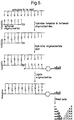
- a preferred sequence of operations is shown in the four diagrams constituting Figure 5.
- the first diagram shows the position at the start of step b).
- the second diagram shows the position at the end of step b) - a portion of the target nucleic acid has become hybridised to a tethered oligonucleotide forming part of the array.
- the third diagram shows the position at the end of step c), and the fourth diagram shows the position at the end of step d); a reagent from the library has become hybridised to the target nucleic acid and ligated to the immobilised oligonucleotide.
- Examples 1 to 6 show steps, according to the following Reaction Scheme 1, in the synthesis of a compound (8) comprising an aromatic linker carrying: a methyloxytrityl group (-CH 2 ODMT) for analyte synthesis; an o-nitro group for photocleavage; an O-t-butyl diphenyl silyl group (OTBDPS) for tag synthesis; a tertiary amino group for conversion to a positively charged group for analysis by mass spectrometry; and an N-hydroxysuccinimidyl group for attachment to a support.
- a methyloxytrityl group (-CH 2 ODMT) for analyte synthesis
- an o-nitro group for photocleavage
- an O-t-butyl diphenyl silyl group (OTBDPS) for tag synthesis
- OTBDPS O-t-butyl diphenyl silyl group
- N-hydroxysuccinimidyl group for attachment to a support.
- Examples 9 and 10 show steps, according to the following reaction Scheme 3, of preparing reporter groups (13) based on propan -1,3-diol.
- Examples 11 to 13 show steps, according to the following Reaction Scheme 4, involved in attaching a protected propan -1,3-diol residue as a reporter group to compound (6).
- Examples 14 to 19 describe the preparation, characterisation and use of various reagents according to the invention.
- 5-Hydroxy-2-nitrobenzyl alcohol was purchased from Aldrich, long chain alkylamino controlled pore glass from Sigma.
- Anhydrous solvents refer to Aldrich Sure Seal grade material packed under Nitrogen.
- Triethylamine was predistilled from calcium hydride and stored under nitrogen prior to use.
- Other solvents and reagents are available from a range of commercial sources.
- Infra Reds were obtained on a Nicolet 5DXC F.T. IR machine either as a potassium bromide disc or chloroform solution as indicated.
- Tlcs were run on Kieselgel 60F 254 aluminium backed Tlc plates using the solvent system indicated.
- the plates were visualised by both ultra violet and/or dipping in a 3% w/v ethanolic solution of molybdophosphoric acid and then heating with a hot air gun. Trityl containing species show up as a bright orange spot, alcohols as a blue spot.
- Silica gel chromatography was performed using flash grade silica gel, particles size 40 ⁇ 63 ⁇ m.
- the resultant gum was dissolved up in ethyl acetate and the solution washed with water (x1) and brine (x1). The ethyl acetate solution was then dried over anhydrous magnesium sulphate and evaporated to a reddish brown gum.
- the gum was dissolved in CH 2 Cl 2 (20 ml) and then applied to a silica gel column (14 cm x 6.5 cm) which was eluated with ether/ pet. ether 40 - 60°C, 65%/35%.
- the product fractions were combined and the solvent removed by rotary evaporation to give an off white solid (13.49 g, 95%, mpt. 80 - 82°C with decomposition).
- An analytical sample was prepared by recrystallisation from chloroform/ pet. ether 40 - 60°C, mpt. 134 - 7°C with decomposition.
- IR (KBr disc), 1610, 1509, 1447, 1334, 1248, 1090, 1060, 1033, 828 cm -1 .
- IR (KBr disc) 3100, 1430, 1114, 1080, 969, 749, 738, 707 cm -1 .
- the ethyl acetate extracts were then combined and dried over anhydrous magnesium sulphate.
- the ethyl acetate was then removed by rotary evaporation to give a brown gum from which a crystalline product slowly formed.
- the minimum amount of ethyl acetate was added to dissolve up the residual gum such that the crystalline product could be filtered, the hydrogen bromide salt of compound 5.
- the ethyl acetate solution was then applied to a silica gel column (13 cm x 6.5 cm) which was eluted with ethyl acetate. Insufficient separation of residual compound 3 and the desired product was obtained from this column so the product fractions were combined and evaporated to a gum.
- This gum was dissolved up in the minimum of ethyl acetate necessary and applied to another silica gel column (14 cm x 6.5 cm) eluting using a gradient eluation, first ethyl acetate/pet. ether 40 ⁇ 60°C, 50%/50% followed by ethyl acetate.
- the product fractions were combined and the solvent removed by rotary evaporation to give compound 6 as a gum.
- the last traces of solvent were removed by placing the gum under high vacuum for one hour.
- the yield of product was 7.64 g, 71%.
- IR (KBr disc), 1608, 1579, 1509, 1287, 1251, 1232, 1112, 1092, 1064, 1035, 826, 754, 703, 613 cm -1 .
- the solvent was removed by rotary evaporation with the last traces of pyridine being removed by co-evaporation with toluene (x2).
- the resultant gum was then partitioned between chloroform and water.
- the organic phase was separated and the aqueous phase further extracted with chloroform (x1).
- the organic phases were then combined and washed with brine (x1).
- the chloroform solution was then dried with anhydrous magnesium sulphate and evaporated to a gum.
- the last traces of solvent were then removed by placing the gum under high vacuum for one hour to give compound 7, 6.75 g. This product was used in the next step without further purification.
- the mixture was then gently agitated for a total of 18 hours after which time the beads were given multiple washes of pyridine (7 x 10 ml), methanol (5 x 15 ml) and chloroform (5 x 15 ml) and then dried in vacuo.
- the THF was then removed by rotary evaporation and the residue partitioned between dichloromethane and 0.1M sodium bicarbonate solution.
- the dichloromethane solution was separated off and washed with brine (x1).
- the dichloromethane solution was then dried over magnesium sulphate and evaporated down to an oil. This oil was applied to a silica gel column (16 cm x 5 cm) which was eluted with an ether/pet. ether 40 ⁇ 60°C, 30%/70% mixture.
- the product fractions were combined and rotary evaporated down to provide the desired 1,3-propanediol derivative.
- IR (KBr disc) 1386, 1329, 1274, 1258, 1185, 1164, 1137, 1094, 941, 763, 506 cm -1 .
- Controlled pore glass carrying linkers 9 and 10 (compounds 9 and 10 in Scheme 2) was loaded into the columns used in the automatic oligonucleotide synthesizer (ABI 381A); the amounts used provided for 0.2 or 1 ⁇ mol scale synthesis. The columns were inserted in the automatic synthesizer which was then programmed for appropriate cycles. Two different types of nucleotide precursors were used: normal phosphoramidites, with dimethoxytrityl protecting groups on the 5' hydroxyls; "reverse synthons" with 5' phosphoramidites and dimethoxytrityl protecting groups on the 3' hydroxyls.
- oligonucleotides which have a phosphate group at the 5'end. Such a group is necessary if the oligonucleotide is to be used as the donor in a ligation reaction; and it is a useful way of introducing a radioactive group to test biochemical properties.
- the oligonucleotides A 5 , A 10 , and T 5 were made with the tags R9 and R10 attached to the 3' ends, with and without the silyl protecting group removed (This was achieved by treating the oligonucleotide, still on the solid support, with a 5mM solution of tetrabutylammonium fluoride in acetonitrile, at room temperature for 15 min.) These oligonucleotides were phosphorylated using T4 polynucleotide kinase and gamma- 33 P-ATP using standard protocols recommended by the supplier. Thin layer chromatography of the products on polyethyleneimine (PEI) impregnated cellulose developed in 0.5M ammonium bicarbonate showed in each case that the labelled phosphorus had been transferred almost completely to the oligonucleotide.
- PEI polyethyleneimine
- tagged oligonucleotides For some applications of tagged oligonucleotides, it will be useful to ligate them to a receptor. We have shown that tagged oligonucleotides can take place in enzymatic ligation by the following tests:
- the template was 5' ATCAAGTCAGAAAAATATATA (SEQ ID No. 1). This was hybridised to the donor, 3' TAGTTCAGTC (SEQ ID No. 2), which had been phosphorylated at its 5'-end using radioactive phosphorus.
- Four ligation reactions were carried out, each with a modification of the sequence T 5 , which could ligate to the 5' phosphorylated end of the donor after hybridising to the run of 5 A's in the template.
- the four oligoT's used in the reactions differed in the nature of their 5'-end. One had a dimethoxytrityl group attached through the hydroxyl.
- the second and third had tags R9 and R10 attached to the 5'-end through a phosphodiester bond.
- the fourth was a positive control, with a normal 5'OH.
- a negative control lacked any oligoT.
- Ligation reactions were performed using T4 ligase according to the suppliers' instructions. Reactions were analysed by TLC on PEI-cellulose, developed in 0.75M ammonium bicarbonate solution. All four reactions showed an additional spot on the chromatogram, of lower mobility than the donor; as expected, the negative control showed no additional spot. This illustrates how oligonucleotides with different tags can take part in sequence-specific ligation reactions.
- Cozzarelli et al (1967) have shown that polynucleotides attached to solid supports can be ligated to an acceptor in the presence of a complementary template.
- Example 16b shows that tagged oligonucleotides can take part in ligation reactions, inferring that they can also take part in duplex formation in solution, as ligation depends on this process.
- the following experiment shows that they can also form duplexes with oligonucleotides tethered to a solid support.
- T 10 was synthesized on the surface of a sheet of aminated polypropylene according to the manufacturer's instructions. It is known that this process yields around 10 pmols of oligonucleotide per mm 2 .
- tags by photolysis would greatly enhance their usefulness: it would allow for direct analysis by laser desorption in the mass spectrometer; it would provide a simple method of removing the tags to allow other biochemical or chemical processes.
- nitrobenzyl group is known to be labile to irradiation at 305nm.
- Solutions of R10A 10 and R10T 5 in water were irradiated at 2 cm, from a transilluminator for 20 min. under conditions known to cause no detectable damage to nucleic acids.
- Analysis by HPLC showed the expected products of photocleavage, with no detectable residue of the original compound.
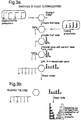
- Fig. 1 General scheme for synthesis of molecules with specific tags.
- Synthesis starts from a linker (L) with at least one site for the addition of groups for synthesising the analyte and one for synthesising the tag.
- the linker may also be attached reversibly to a solid support during synthesis, and may have sites for generating groups such as charged groups which may help in analysis
- P a and P r are temporary protecting groups for the analyte precursors and the reporters respectively; they will be removable by different treatments.
- P a may be an acid or base labile group such as trityl, F-MOC or t-BOC
- P r a group removable by treatment with fluoride such as a silyl residue.
- Groups U-Z may also have protecting groups which must be stable to the reagents used to remove P a and P r . Coupling chemistries will be different for different analyte types; standard methods are available for oligonucleotide and peptide synthesis.
- each extension of the tag is carried out with a reporter which is specific for both position and type of residue added to the analyte. Capping is not important for this scheme.
- position is defined by the total mass of reporter reached at the stage in synthesis when the residue is added to the analyte. In this case it is important to terminate part of the extension of the tag by capping a portion of the molecules.
- the second and third schemes differ from each other in the way the reporters are added. In the second they are in the extension agents; in the third they are in the caps.
- Fig. 2 Three types of molecule-specific tags.
Landscapes
- Chemical & Material Sciences (AREA)
- Life Sciences & Earth Sciences (AREA)
- Organic Chemistry (AREA)
- Health & Medical Sciences (AREA)
- Proteomics, Peptides & Aminoacids (AREA)
- Engineering & Computer Science (AREA)
- Zoology (AREA)
- Wood Science & Technology (AREA)
- Genetics & Genomics (AREA)
- Biotechnology (AREA)
- Biochemistry (AREA)
- Molecular Biology (AREA)
- Bioinformatics & Cheminformatics (AREA)
- Physics & Mathematics (AREA)
- General Engineering & Computer Science (AREA)
- General Health & Medical Sciences (AREA)
- Biophysics (AREA)
- Microbiology (AREA)
- Analytical Chemistry (AREA)
- Immunology (AREA)
- Biomedical Technology (AREA)
- Crystallography & Structural Chemistry (AREA)
- Bioinformatics & Computational Biology (AREA)
- Plant Pathology (AREA)
- Spectroscopy & Molecular Physics (AREA)
- Measuring Or Testing Involving Enzymes Or Micro-Organisms (AREA)
- Investigating Or Analysing Biological Materials (AREA)
- Other Investigation Or Analysis Of Materials By Electrical Means (AREA)
- Automatic Analysis And Handling Materials Therefor (AREA)
- Saccharide Compounds (AREA)
- Pyrrole Compounds (AREA)
Applications Claiming Priority (3)
| Application Number | Priority Date | Filing Date | Title |
|---|---|---|---|
| GB9315847 | 1993-07-30 | ||
| GB939315847A GB9315847D0 (en) | 1993-07-30 | 1993-07-30 | Tag reagent and assay method |
| EP94922966A EP0711362B1 (de) | 1993-07-30 | 1994-08-01 | Etikettierreagenz und nachweismethode |
Related Parent Applications (2)
| Application Number | Title | Priority Date | Filing Date |
|---|---|---|---|
| EP94922966A Division EP0711362B1 (de) | 1993-07-30 | 1994-08-01 | Etikettierreagenz und nachweismethode |
| EP94922966.0 Division | 1995-02-09 |
Publications (3)
| Publication Number | Publication Date |
|---|---|
| EP0778280A2 true EP0778280A2 (de) | 1997-06-11 |
| EP0778280A3 EP0778280A3 (de) | 1999-01-27 |
| EP0778280B1 EP0778280B1 (de) | 2003-01-02 |
Family
ID=10739735
Family Applications (2)
| Application Number | Title | Priority Date | Filing Date |
|---|---|---|---|
| EP94922966A Expired - Lifetime EP0711362B1 (de) | 1993-07-30 | 1994-08-01 | Etikettierreagenz und nachweismethode |
| EP96119962A Expired - Lifetime EP0778280B1 (de) | 1993-07-30 | 1994-08-01 | Etiketierreagenz und Nachweismethode |
Family Applications Before (1)
| Application Number | Title | Priority Date | Filing Date |
|---|---|---|---|
| EP94922966A Expired - Lifetime EP0711362B1 (de) | 1993-07-30 | 1994-08-01 | Etikettierreagenz und nachweismethode |
Country Status (16)
| Country | Link |
|---|---|
| US (4) | US5770367A (de) |
| EP (2) | EP0711362B1 (de) |
| JP (1) | JP3289911B2 (de) |
| CN (1) | CN1088758C (de) |
| AT (2) | ATE230409T1 (de) |
| AU (1) | AU695349B2 (de) |
| CA (1) | CA2168010C (de) |
| DE (2) | DE69406544T2 (de) |
| DK (1) | DK0711362T3 (de) |
| ES (1) | ES2108479T3 (de) |
| FI (1) | FI960403A7 (de) |
| GB (1) | GB9315847D0 (de) |
| HU (1) | HU220967B1 (de) |
| NO (1) | NO960370L (de) |
| RU (1) | RU2158310C2 (de) |
| WO (1) | WO1995004160A1 (de) |
Cited By (10)
| Publication number | Priority date | Publication date | Assignee | Title |
|---|---|---|---|---|
| EP1251136A3 (de) * | 2001-04-17 | 2003-03-19 | Agilent Technologies, Inc. | Methode und Reagenzien zur Analyse der Nukleotidsequenz von Nukleinsäuren |
| EP1221491A4 (de) * | 1999-10-12 | 2003-04-16 | Prec System Science Co Ltd | System und verfahren zum sequenzieren genetischer substanzen |
| WO2004001042A3 (en) * | 2002-06-20 | 2004-03-18 | Nuevolution As | Microarrays displaying encoded molecules |
| US7022491B2 (en) | 2001-12-28 | 2006-04-04 | Peter James | Method for determining molecule—molecule interaction analysis |
| US10077440B2 (en) | 2002-10-30 | 2018-09-18 | Nuevolution A/S | Method for the synthesis of a bifunctional complex |
| US10730906B2 (en) | 2002-08-01 | 2020-08-04 | Nuevolutions A/S | Multi-step synthesis of templated molecules |
| US10731151B2 (en) | 2002-03-15 | 2020-08-04 | Nuevolution A/S | Method for synthesising templated molecules |
| US11118215B2 (en) | 2003-09-18 | 2021-09-14 | Nuevolution A/S | Method for obtaining structural information concerning an encoded molecule and method for selecting compounds |
| US11225655B2 (en) | 2010-04-16 | 2022-01-18 | Nuevolution A/S | Bi-functional complexes and methods for making and using such complexes |
| US11702652B2 (en) | 2005-12-01 | 2023-07-18 | Nuevolution A/S | Enzymatic encoding methods for efficient synthesis of large libraries |
Families Citing this family (254)
| Publication number | Priority date | Publication date | Assignee | Title |
|---|---|---|---|---|
| US5800992A (en) | 1989-06-07 | 1998-09-01 | Fodor; Stephen P.A. | Method of detecting nucleic acids |
| WO1992010588A1 (en) | 1990-12-06 | 1992-06-25 | Affymax Technologies N.V. | Sequencing by hybridization of a target nucleic acid to a matrix of defined oligonucleotides |
| US5605798A (en) * | 1993-01-07 | 1997-02-25 | Sequenom, Inc. | DNA diagnostic based on mass spectrometry |
| GB9315847D0 (en) | 1993-07-30 | 1993-09-15 | Isis Innovation | Tag reagent and assay method |
| UA48119C2 (uk) * | 1993-09-27 | 2002-08-15 | Арч Девелопмент Корп. | Спосіб визначення послідовності молекули нуклеїнової кислоти (варіанти) та набір для використання при визначенні послідовності нуклеїнової кислоти |
| US6401267B1 (en) | 1993-09-27 | 2002-06-11 | Radoje Drmanac | Methods and compositions for efficient nucleic acid sequencing |
| US6015880A (en) * | 1994-03-16 | 2000-01-18 | California Institute Of Technology | Method and substrate for performing multiple sequential reactions on a matrix |
| JPH10507160A (ja) * | 1994-06-23 | 1998-07-14 | アフィマックス テクノロジーズ エヌ.ブイ. | 光活性化合物およびその使用方法 |
| US5679773A (en) * | 1995-01-17 | 1997-10-21 | Affymax Technologies N.V | Reagants and methods for immobilized polymer synthesis and display |
| US5604097A (en) * | 1994-10-13 | 1997-02-18 | Spectragen, Inc. | Methods for sorting polynucleotides using oligonucleotide tags |
| US6974666B1 (en) | 1994-10-21 | 2005-12-13 | Appymetric, Inc. | Methods of enzymatic discrimination enhancement and surface-bound double-stranded DNA |
| US5891742A (en) * | 1995-01-19 | 1999-04-06 | Chiron Corporation | Affinity selection of ligands by mass spectroscopy |
| GB9504598D0 (en) * | 1995-03-03 | 1995-04-26 | Imp Cancer Res Tech | Method of nucleic acid analysis |
| GB9507238D0 (en) | 1995-04-07 | 1995-05-31 | Isis Innovation | Detecting dna sequence variations |
| US5750341A (en) * | 1995-04-17 | 1998-05-12 | Lynx Therapeutics, Inc. | DNA sequencing by parallel oligonucleotide extensions |
| US5624711A (en) * | 1995-04-27 | 1997-04-29 | Affymax Technologies, N.V. | Derivatization of solid supports and methods for oligomer synthesis |
| US5830655A (en) | 1995-05-22 | 1998-11-03 | Sri International | Oligonucleotide sizing using cleavable primers |
| GB9517661D0 (en) * | 1995-08-30 | 1995-11-01 | Smithkline Beecham Plc | Novel compounds |
| US5780231A (en) * | 1995-11-17 | 1998-07-14 | Lynx Therapeutics, Inc. | DNA extension and analysis with rolling primers |
| US5763175A (en) * | 1995-11-17 | 1998-06-09 | Lynx Therapeutics, Inc. | Simultaneous sequencing of tagged polynucleotides |
| US6312893B1 (en) | 1996-01-23 | 2001-11-06 | Qiagen Genomics, Inc. | Methods and compositions for determining the sequence of nucleic acid molecules |
| EP0962464A3 (de) * | 1996-01-23 | 2004-02-11 | Qiagen Genomics, Inc. | Methoden und Zusammensetzungen zum Nachweis der Bindung eines Liganden-Paars mittels nicht-fluoriszierender Markierungen |
| EP0992511B1 (de) | 1996-01-23 | 2009-03-11 | Operon Biotechnologies, Inc. | Verfahren und Zusammensetzungen zur Bestimmung von Sequenzen von Nukleinsäure-Molekülen |
| US6027890A (en) | 1996-01-23 | 2000-02-22 | Rapigene, Inc. | Methods and compositions for enhancing sensitivity in the analysis of biological-based assays |
| DE69739465D1 (de) * | 1996-01-23 | 2009-07-30 | Operon Biotechnologies Inc | Methoden zur Analyse von Nukleinsäure-Molekülen mittels Techniken zur Grössen-bestimmung |
| US6613508B1 (en) | 1996-01-23 | 2003-09-02 | Qiagen Genomics, Inc. | Methods and compositions for analyzing nucleic acid molecules utilizing sizing techniques |
| EP0868535B9 (de) * | 1996-01-23 | 2007-05-09 | Qiagen Genomics, Inc. | Verfahren und zusammenstellungen zur sequenzbestimmung von nukleinsäuremolekulen |
| NZ331042A (en) * | 1996-01-23 | 1999-10-28 | Rapigene Inc | Methods and compositions for detecting binding of ligand pair using non-fluorescent label |
| AU2069597A (en) * | 1996-03-04 | 1997-09-22 | Genetrace Systems, Inc. | Methods of screening nucleic acids using mass spectrometry |
| ES2213823T3 (es) * | 1996-04-08 | 2004-09-01 | Glaxo Group Limited | Codificacion y analisis cualitativo de bibliotecas combinatorias basadas en masa. |
| ES2288760T3 (es) | 1996-04-25 | 2008-01-16 | Bioarray Solutions Ltd. | Ensamblaje electrocinetico controlado por luz de particulas proximas a superficies. |
| US5958342A (en) * | 1996-05-17 | 1999-09-28 | Incyte Pharmaceuticals, Inc. | Jet droplet device |
| US5965363A (en) * | 1996-09-19 | 1999-10-12 | Genetrace Systems Inc. | Methods of preparing nucleic acids for mass spectrometric analysis |
| US5777324A (en) * | 1996-09-19 | 1998-07-07 | Sequenom, Inc. | Method and apparatus for maldi analysis |
| AU4428497A (en) | 1996-09-20 | 1998-04-14 | James P. Demers | Spatially addressable combinatorial chemical arrays in cd-rom format |
| EP0954612A2 (de) | 1996-11-06 | 1999-11-10 | Sequenom, Inc. | Dna-diagnostik mittels massenspektrometrie |
| CA2274587A1 (en) * | 1996-12-10 | 1998-06-18 | Genetrace Systems Inc. | Releasable nonvolatile mass-label molecules |
| US6699668B1 (en) * | 1997-01-15 | 2004-03-02 | Xzillion Gmbh & Co. | Mass label linked hybridisation probes |
| US7094531B1 (en) * | 1997-01-15 | 2006-08-22 | Xzillion Gmbh Co. | Nucleic acid sequencing |
| WO1998031830A1 (en) * | 1997-01-15 | 1998-07-23 | Brax Group Limited | Mass label linked hybridisation probes |
| GB9707980D0 (en) | 1997-04-21 | 1997-06-11 | Brax Genomics Ltd | Characterising DNA |
| GB9714716D0 (en) | 1997-07-11 | 1997-09-17 | Brax Genomics Ltd | Characterising nucleic acids |
| AU8234898A (en) | 1997-07-11 | 1999-02-08 | Brax Group Limited | Characterising nucleic acid |
| AU734636B2 (en) | 1997-07-11 | 2001-06-21 | Xzillion Gmbh & Co. Kg | Characterising nucleic acids |
| WO1999005322A1 (en) * | 1997-07-22 | 1999-02-04 | Rapigene, Inc. | Computer method and system for correlating sequencing data by ms |
| CN1270598A (zh) * | 1997-07-22 | 2000-10-18 | 拉普吉恩公司 | 用于质谱分析核酸的方法和组合物 |
| WO1999005321A1 (en) | 1997-07-22 | 1999-02-04 | Rapigene, Inc. | Amplification and other enzymatic reactions performed on nucleic acid arrays |
| EP0996500A1 (de) | 1997-07-22 | 2000-05-03 | Rapigene, Inc. | Vorrichtung und verfahren zur gruppierung von einer lösung auf einem festen träger |
| GB9718921D0 (en) | 1997-09-05 | 1997-11-12 | Brax Genomics Ltd | Catalytically generated mass labels |
| US6607878B2 (en) * | 1997-10-06 | 2003-08-19 | Stratagene | Collections of uniquely tagged molecules |
| US6101946A (en) * | 1997-11-21 | 2000-08-15 | Telechem International Inc. | Microarray printing device including printing pins with flat tips and exterior channel and method of manufacture |
| DK1036202T3 (da) * | 1997-12-05 | 2002-08-12 | Max Planck Gesellschaft | Fremgangsmåde til identifikation af nucleinsyrer ved matriksassisteret laserdesorptions/ionisationsmassespektrometri |
| EP1728776A3 (de) * | 1998-01-05 | 2006-12-13 | Neogenesis, Inc. | Methode zur Herstellung von massen-kodierten kombinatorischen Bibliotheken |
| US6207861B1 (en) * | 1998-01-05 | 2001-03-27 | Neogenesis, Inc. | Method for producing and screening mass coded combinatorial libraries for drug discovery and target validation |
| EP2241541A1 (de) | 1998-01-05 | 2010-10-20 | Neogenesis, Inc. | Methode zur Identifizierung von massen-kodierten kombinatorischen Bibliotheken |
| US6265163B1 (en) * | 1998-01-09 | 2001-07-24 | Lynx Therapeutics, Inc. | Solid phase selection of differentially expressed genes |
| US6562567B2 (en) * | 1998-01-27 | 2003-05-13 | California Institute Of Technology | Method of detecting a nucleic acid |
| EP1068216B1 (de) | 1998-05-15 | 2003-12-10 | Isis Innovation Limited | Bibliotheken von unterschiedlich markierten oligomeren |
| US6104028A (en) | 1998-05-29 | 2000-08-15 | Genetrace Systems Inc. | Volatile matrices for matrix-assisted laser desorption/ionization mass spectrometry |
| US6218118B1 (en) | 1998-07-09 | 2001-04-17 | Agilent Technologies, Inc. | Method and mixture reagents for analyzing the nucleotide sequence of nucleic acids by mass spectrometry |
| US5998175A (en) * | 1998-07-24 | 1999-12-07 | Lumigen, Inc. | Methods of synthesizing and amplifying polynucleotides by ligation of multiple oligomers |
| US6232067B1 (en) * | 1998-08-17 | 2001-05-15 | The Perkin-Elmer Corporation | Adapter directed expression analysis |
| US20040242521A1 (en) * | 1999-10-25 | 2004-12-02 | Board Of Regents, The University Of Texas System | Thio-siRNA aptamers |
| US6867289B1 (en) * | 1998-10-26 | 2005-03-15 | Board Of Regents, The University Of Texas Systems | Thio-modified aptamer synthetic methods and compositions |
| JP2003527075A (ja) * | 1999-03-25 | 2003-09-16 | ハイセック,インコーポレーテッド | ハイブリダイゼーションによる配列分析のための、溶液ベースの方法 |
| AU4051300A (en) * | 1999-04-02 | 2000-10-23 | Tropix, Inc. | High throughput and high sensitivity detection assays |
| US7244559B2 (en) * | 1999-09-16 | 2007-07-17 | 454 Life Sciences Corporation | Method of sequencing a nucleic acid |
| US7211390B2 (en) * | 1999-09-16 | 2007-05-01 | 454 Life Sciences Corporation | Method of sequencing a nucleic acid |
| US7582420B2 (en) | 2001-07-12 | 2009-09-01 | Illumina, Inc. | Multiplex nucleic acid reactions |
| US20040014102A1 (en) * | 2000-02-22 | 2004-01-22 | Shiping Chen | High density parallel printing of microarrays |
| KR20020097181A (ko) | 2000-02-22 | 2002-12-31 | 제노스펙트라 인코포레이티드 | 마이크로어레이 제작 기술 및 장치 |
| US6953551B2 (en) | 2000-02-22 | 2005-10-11 | Genospectra, Inc. | Microarray fabrication techniques and apparatus |
| GB0006141D0 (en) | 2000-03-14 | 2000-05-03 | Brax Group Ltd | Mass labels |
| DE10021204A1 (de) * | 2000-04-25 | 2001-11-08 | Epigenomics Ag | Verfahren zur hochparallelen Analyse von Polymorphismen |
| WO2001094639A1 (en) * | 2000-06-08 | 2001-12-13 | The Regents Of The University Of California | Address/capture tags for flow-cytometry based minisequencing |
| AU2001268468A1 (en) | 2000-06-13 | 2001-12-24 | The Trustees Of Boston University | Use of nucleotide analogs in the analysis of oligonucleotide mixtures and in highly multiplexed nucleic acid sequencing |
| US7892854B2 (en) | 2000-06-21 | 2011-02-22 | Bioarray Solutions, Ltd. | Multianalyte molecular analysis using application-specific random particle arrays |
| US9709559B2 (en) | 2000-06-21 | 2017-07-18 | Bioarray Solutions, Ltd. | Multianalyte molecular analysis using application-specific random particle arrays |
| US6680203B2 (en) * | 2000-07-10 | 2004-01-20 | Esperion Therapeutics, Inc. | Fourier transform mass spectrometry of complex biological samples |
| US20060057565A1 (en) * | 2000-09-11 | 2006-03-16 | Jingyue Ju | Combinatorial fluorescence energy transfer tags and uses thereof |
| US6627748B1 (en) | 2000-09-11 | 2003-09-30 | The Trustees Of Columbia University In The City Of New York | Combinatorial fluorescence energy transfer tags and their applications for multiplex genetic analyses |
| US7018794B2 (en) | 2000-10-06 | 2006-03-28 | Novozymes, Inc. | Methods for monitoring multiple gene expression |
| ATE356222T1 (de) | 2000-10-06 | 2007-03-15 | Univ Columbia | Massives parallelverfahren zur dekodierung von dna und rna |
| US9708358B2 (en) | 2000-10-06 | 2017-07-18 | The Trustees Of Columbia University In The City Of New York | Massive parallel method for decoding DNA and RNA |
| US7635571B2 (en) * | 2000-12-07 | 2009-12-22 | Siemens Healthcare Diagnostics Products Gmbh | Amplified signal in binding assays |
| RU2195668C2 (ru) * | 2001-02-12 | 2002-12-27 | Мешандин Алексей Гаврилович | Способ постановки реакции агглютинационного иммунологического анализа |
| US7718354B2 (en) * | 2001-03-02 | 2010-05-18 | Ibis Biosciences, Inc. | Methods for rapid identification of pathogens in humans and animals |
| US7666588B2 (en) | 2001-03-02 | 2010-02-23 | Ibis Biosciences, Inc. | Methods for rapid forensic analysis of mitochondrial DNA and characterization of mitochondrial DNA heteroplasmy |
| US20040121314A1 (en) * | 2002-12-06 | 2004-06-24 | Ecker David J. | Methods for rapid detection and identification of bioagents in containers |
| WO2004060278A2 (en) | 2002-12-06 | 2004-07-22 | Isis Pharmaceuticals, Inc. | Methods for rapid identification of pathogens in humans and animals |
| US7226739B2 (en) | 2001-03-02 | 2007-06-05 | Isis Pharmaceuticals, Inc | Methods for rapid detection and identification of bioagents in epidemiological and forensic investigations |
| US20030027135A1 (en) | 2001-03-02 | 2003-02-06 | Ecker David J. | Method for rapid detection and identification of bioagents |
| US20040121310A1 (en) * | 2002-12-18 | 2004-06-24 | Ecker David J. | Methods for rapid detection and identification of bioagents in forensic studies |
| US20040121309A1 (en) | 2002-12-06 | 2004-06-24 | Ecker David J. | Methods for rapid detection and identification of bioagents in blood, bodily fluids, and bodily tissues |
| US7070928B2 (en) * | 2001-03-19 | 2006-07-04 | President And Fellows Of Harvard College | Evolving new molecular function |
| EP1383920B1 (de) * | 2001-04-03 | 2010-09-29 | Thermo Finnigan Llc | Zur vereinfachung komplexer peptidgemische geeignete verfahren und kits |
| EP1401850A1 (de) | 2001-06-20 | 2004-03-31 | Nuevolution A/S | Nukleosidderivate zur herstellung einer verbindungsbibliothek |
| US7262063B2 (en) | 2001-06-21 | 2007-08-28 | Bio Array Solutions, Ltd. | Directed assembly of functional heterostructures |
| US7217510B2 (en) * | 2001-06-26 | 2007-05-15 | Isis Pharmaceuticals, Inc. | Methods for providing bacterial bioagent characterizing information |
| US8073627B2 (en) | 2001-06-26 | 2011-12-06 | Ibis Biosciences, Inc. | System for indentification of pathogens |
| US6855538B2 (en) * | 2001-06-27 | 2005-02-15 | The Regents Of The University Of California | High-efficiency microarray printing device |
| US7402286B2 (en) * | 2001-06-27 | 2008-07-22 | The Regents Of The University Of California | Capillary pins for high-efficiency microarray printing device |
| US20050009022A1 (en) * | 2001-07-06 | 2005-01-13 | Weiner Michael P. | Method for isolation of independent, parallel chemical micro-reactions using a porous filter |
| US20030087309A1 (en) * | 2001-08-27 | 2003-05-08 | Shiping Chen | Desktop drug screening system |
| US10539561B1 (en) | 2001-08-30 | 2020-01-21 | Customarray, Inc. | Enzyme-amplified redox microarray detection process |
| US20030054396A1 (en) * | 2001-09-07 | 2003-03-20 | Weiner Michael P. | Enzymatic light amplification |
| JP4290003B2 (ja) * | 2001-09-14 | 2009-07-01 | エレクトロフォレティクス リミテッド | 質量標識体 |
| CA2497740C (en) * | 2001-10-15 | 2011-06-21 | Bioarray Solutions, Ltd. | Multiplexed analysis of polymorphic loci by probe elongation-mediated detection |
| US20070264641A1 (en) * | 2001-10-15 | 2007-11-15 | Li Alice X | Multiplexed analysis of polymorphic loci by concurrent interrogation and enzyme-mediated detection |
| US20050124022A1 (en) * | 2001-10-30 | 2005-06-09 | Maithreyan Srinivasan | Novel sulfurylase-luciferase fusion proteins and thermostable sulfurylase |
| US6956114B2 (en) | 2001-10-30 | 2005-10-18 | '454 Corporation | Sulfurylase-luciferase fusion proteins and thermostable sulfurylase |
| US6902921B2 (en) * | 2001-10-30 | 2005-06-07 | 454 Corporation | Sulfurylase-luciferase fusion proteins and thermostable sulfurylase |
| US20030124599A1 (en) * | 2001-11-14 | 2003-07-03 | Shiping Chen | Biochemical analysis system with combinatorial chemistry applications |
| GB0129012D0 (en) | 2001-12-04 | 2002-01-23 | Solexa Ltd | Labelled nucleotides |
| US7057026B2 (en) * | 2001-12-04 | 2006-06-06 | Solexa Limited | Labelled nucleotides |
| DE60324778D1 (de) | 2002-03-15 | 2009-01-02 | Nuevolution As | Eine verbesserte methode zur synthese von matritzenabhängigen molekülen |
| US7214492B1 (en) | 2002-04-24 | 2007-05-08 | The University Of North Carolina At Greensboro | Nucleic acid arrays to monitor water and other ecosystems |
| US9126165B1 (en) | 2002-04-24 | 2015-09-08 | The University Of North Carolina At Greensboro | Nucleic acid arrays to monitor water and other ecosystems |
| US8383342B2 (en) | 2002-04-24 | 2013-02-26 | The University Of North Carolina At Greensboro | Compositions, products, methods and systems to monitor water and other ecosystems |
| US8048623B1 (en) | 2002-04-24 | 2011-11-01 | The University Of North Carolina At Greensboro | Compositions, products, methods and systems to monitor water and other ecosystems |
| GB0210535D0 (en) * | 2002-05-08 | 2002-06-19 | Novartis Ag | Organic compounds |
| US7074597B2 (en) * | 2002-07-12 | 2006-07-11 | The Trustees Of Columbia University In The City Of New York | Multiplex genotyping using solid phase capturable dideoxynucleotides and mass spectrometry |
| WO2004016767A2 (en) * | 2002-08-19 | 2004-02-26 | The President And Fellows Of Harvard College | Evolving new molecular function |
| US11008359B2 (en) | 2002-08-23 | 2021-05-18 | Illumina Cambridge Limited | Labelled nucleotides |
| EP2607369B1 (de) * | 2002-08-23 | 2015-09-23 | Illumina Cambridge Limited | Modifizierte Nucleotide zur Polynucleotidsequenzierung |
| US7414116B2 (en) | 2002-08-23 | 2008-08-19 | Illumina Cambridge Limited | Labelled nucleotides |
| CA2749227A1 (en) * | 2002-10-16 | 2005-01-13 | Board Of Regents Of The University Of Texas System | Bead bound combinatorial oligonucleoside phosphorothioate and phosphorodithioate aptamer libraries |
| US20040091850A1 (en) * | 2002-11-08 | 2004-05-13 | Travis Boone | Single cell analysis of membrane molecules |
| WO2004047007A1 (en) | 2002-11-15 | 2004-06-03 | Bioarray Solutions, Ltd. | Analysis, secure access to, and transmission of array images |
| WO2004055160A2 (en) * | 2002-12-13 | 2004-07-01 | The Trustees Of Columbia University In The City Of New York | Biomolecular coupling methods using 1,3-dipolar cycloaddition chemistry |
| ATE450609T1 (de) | 2002-12-19 | 2009-12-15 | Nuevolution As | Durch quasizufallsstrukturen und funktionen geführte synthesemethode |
| CA2513889A1 (en) * | 2003-01-29 | 2004-08-19 | 454 Corporation | Double ended sequencing |
| US7575865B2 (en) * | 2003-01-29 | 2009-08-18 | 454 Life Sciences Corporation | Methods of amplifying and sequencing nucleic acids |
| JP2004235111A (ja) * | 2003-01-31 | 2004-08-19 | Ebara Corp | イオン伝導体及びその製造方法 |
| US20070026397A1 (en) | 2003-02-21 | 2007-02-01 | Nuevolution A/S | Method for producing second-generation library |
| US7915201B2 (en) | 2003-03-20 | 2011-03-29 | Nuevolution A/S | Ligational encoding of small molecules |
| GB0306756D0 (en) * | 2003-03-24 | 2003-04-30 | Xzillion Gmbh & Co Kg | Mass labels |
| US8017323B2 (en) * | 2003-03-26 | 2011-09-13 | President And Fellows Of Harvard College | Free reactant use in nucleic acid-templated synthesis |
| US20050233390A1 (en) * | 2003-04-09 | 2005-10-20 | Allen John W | Device including a proteinaceous factor, a recombinant proteinaceous factor, and a nucleotide sequence encoding the proteinaceous factor |
| US8046171B2 (en) | 2003-04-18 | 2011-10-25 | Ibis Biosciences, Inc. | Methods and apparatus for genetic evaluation |
| US8057993B2 (en) | 2003-04-26 | 2011-11-15 | Ibis Biosciences, Inc. | Methods for identification of coronaviruses |
| EP1623020A4 (de) * | 2003-05-09 | 2007-05-09 | Sigma Aldrich Co | Genomische und proteomische ansätze zur entwicklung eines zellkulturmediums |
| US8158354B2 (en) | 2003-05-13 | 2012-04-17 | Ibis Biosciences, Inc. | Methods for rapid purification of nucleic acids for subsequent analysis by mass spectrometry by solution capture |
| US7964343B2 (en) | 2003-05-13 | 2011-06-21 | Ibis Biosciences, Inc. | Method for rapid purification of nucleic acids for subsequent analysis by mass spectrometry by solution capture |
| EP1635693A2 (de) * | 2003-05-23 | 2006-03-22 | Board Of Regents, The University Of Texas System | Screening mit hohem durchsatz von aptamer-bibliotheken für die spezifische bindung an proteine auf viren und anderen erregern |
| CA2526690C (en) * | 2003-05-23 | 2014-01-14 | Board Of Regents The University Of Texas System | Structure based and combinatorially selected oligonucleoside phosphorothioate and phosphorodithioate aptamer targeting ap-1 transcription factors |
| WO2005003778A2 (en) * | 2003-07-02 | 2005-01-13 | Nuevolution A/S | A method for identifying a synthetic molecule having affinity towards a target |
| EP1648909A4 (de) * | 2003-07-24 | 2008-11-12 | Univ Texas | Thioaptamere, die die entdeckung von physiologischen pfaden und neue therapeutische strategien ermöglichen |
| GB0320059D0 (en) * | 2003-08-27 | 2003-10-01 | Solexa Ltd | A method of sequencing |
| US7198900B2 (en) * | 2003-08-29 | 2007-04-03 | Applera Corporation | Multiplex detection compositions, methods, and kits |
| US20050048498A1 (en) * | 2003-08-29 | 2005-03-03 | Applera Corporation | Compositions, methods, and kits for assembling probes |
| US20050069895A1 (en) * | 2003-08-29 | 2005-03-31 | Applera Corporation | Compositions, methods, and kits for fabricating coded molecular tags |
| US8546082B2 (en) | 2003-09-11 | 2013-10-01 | Ibis Biosciences, Inc. | Methods for identification of sepsis-causing bacteria |
| US8242254B2 (en) | 2003-09-11 | 2012-08-14 | Ibis Biosciences, Inc. | Compositions for use in identification of bacteria |
| US8097416B2 (en) | 2003-09-11 | 2012-01-17 | Ibis Biosciences, Inc. | Methods for identification of sepsis-causing bacteria |
| US7927796B2 (en) | 2003-09-18 | 2011-04-19 | Bioarray Solutions, Ltd. | Number coding for identification of subtypes of coded types of solid phase carriers |
| JP4564959B2 (ja) | 2003-09-22 | 2010-10-20 | バイオアレイ ソリューションズ リミテッド | 生体分子に共有結合できる、複数の官能基を持つ表面固定化高分子電解質 |
| US7563569B2 (en) | 2003-10-28 | 2009-07-21 | Michael Seul | Optimization of gene expression analysis using immobilized capture probes |
| AU2004287069B2 (en) | 2003-10-29 | 2009-07-16 | Bioarray Solutions, Ltd. | Multiplexed nucleic acid analysis by fragmentation of double-stranded DNA |
| US20050239102A1 (en) * | 2003-10-31 | 2005-10-27 | Verdine Gregory L | Nucleic acid binding oligonucleotides |
| US8163895B2 (en) | 2003-12-05 | 2012-04-24 | Ibis Biosciences, Inc. | Compositions for use in identification of orthopoxviruses |
| RU2470077C2 (ru) * | 2003-12-17 | 2012-12-20 | ГЛЭКСОСМИТКЛАЙН ЭлЭлСи | Биологически активное соединение, содержащее кодирующий олигонуклеотид (варианты), способ его синтеза, библиотека соединений (варианты), способ ее синтеза и способ поиска соединения, связывающегося с биологической мишенью (варианты) |
| EP2287179A3 (de) | 2004-01-09 | 2011-05-18 | Novozymes A/S | Gesteigerte Bacillus YweA-Expression |
| US7666592B2 (en) | 2004-02-18 | 2010-02-23 | Ibis Biosciences, Inc. | Methods for concurrent identification and quantification of an unknown bioagent |
| CA2557818A1 (en) * | 2004-03-03 | 2005-09-15 | The Trustees Of Columbia University In The City Of New York | Photocleavable fluorescent nucleotides for dna sequencing on chip constructed by site-specific coupling chemistry |
| US8119336B2 (en) | 2004-03-03 | 2012-02-21 | Ibis Biosciences, Inc. | Compositions for use in identification of alphaviruses |
| WO2005090566A2 (en) | 2004-03-22 | 2005-09-29 | Nuevolution A/S | Ligational encoding using building block oligonucleotides |
| US20050239134A1 (en) * | 2004-04-21 | 2005-10-27 | Board Of Regents, The University Of Texas System | Combinatorial selection of phosphorothioate single-stranded DNA aptamers for TGF-beta-1 protein |
| WO2006073436A2 (en) * | 2004-04-29 | 2006-07-13 | The Trustees Of Columbia University In The City Of New York | Mass tag pcr for multiplex diagnostics |
| ES2641832T3 (es) | 2004-05-24 | 2017-11-14 | Ibis Biosciences, Inc. | Espectrometría de masas con filtración de iones selectiva por establecimiento de umbrales digitales |
| US20050266411A1 (en) | 2004-05-25 | 2005-12-01 | Hofstadler Steven A | Methods for rapid forensic analysis of mitochondrial DNA |
| US7811753B2 (en) | 2004-07-14 | 2010-10-12 | Ibis Biosciences, Inc. | Methods for repairing degraded DNA |
| US20060024722A1 (en) | 2004-07-30 | 2006-02-02 | Mark Fischer-Colbrie | Samples for detection of oncofetal fibronectin and uses thereof |
| US7848889B2 (en) | 2004-08-02 | 2010-12-07 | Bioarray Solutions, Ltd. | Automated analysis of multiplexed probe-target interaction patterns: pattern matching and allele identification |
| US20060102471A1 (en) | 2004-11-18 | 2006-05-18 | Karl Maurer | Electrode array device having an adsorbed porous reaction layer |
| EP2272983A1 (de) | 2005-02-01 | 2011-01-12 | AB Advanced Genetic Analysis Corporation | Reagentien, Verfahren und Bibliotheken zur Sequenzierung mit Kügelchen |
| US20060205040A1 (en) | 2005-03-03 | 2006-09-14 | Rangarajan Sampath | Compositions for use in identification of adventitious viruses |
| US8084207B2 (en) | 2005-03-03 | 2011-12-27 | Ibis Bioscience, Inc. | Compositions for use in identification of papillomavirus |
| US20070034513A1 (en) | 2005-03-25 | 2007-02-15 | Combimatrix Corporation | Electrochemical deblocking solution for electrochemical oligomer synthesis on an electrode array |
| US9394167B2 (en) | 2005-04-15 | 2016-07-19 | Customarray, Inc. | Neutralization and containment of redox species produced by circumferential electrodes |
| US8486629B2 (en) | 2005-06-01 | 2013-07-16 | Bioarray Solutions, Ltd. | Creation of functionalized microparticle libraries by oligonucleotide ligation or elongation |
| CA2611297A1 (en) | 2005-06-07 | 2007-01-18 | Universite Des Sciences Et Technologies De Lille | Use of ionic matrices for maldi mass spectrometry analysis of tissue sections |
| WO2007002204A2 (en) | 2005-06-21 | 2007-01-04 | The Trustees Of Columbia University In The City Of New York | Pyrosequencing methods and related compostions |
| EP1904655A2 (de) | 2005-07-21 | 2008-04-02 | Isis Pharmaceuticals, Inc. | Verfahren zur raschen identifizierung und quantifizierung von nukleinsäurevarianten |
| GB0515323D0 (en) | 2005-07-26 | 2005-08-31 | Electrophoretics Ltd | Mass labels |
| GB0517097D0 (en) | 2005-08-19 | 2005-09-28 | Solexa Ltd | Modified nucleosides and nucleotides and uses thereof |
| GB0518585D0 (en) | 2005-09-12 | 2005-10-19 | Electrophoretics Ltd | Mass labels |
| US20070065877A1 (en) | 2005-09-19 | 2007-03-22 | Combimatrix Corporation | Microarray having a base cleavable succinate linker |
| US8855955B2 (en) * | 2005-09-29 | 2014-10-07 | Custom Array, Inc. | Process and apparatus for measuring binding events on a microarray of electrodes |
| WO2007061981A2 (en) * | 2005-11-21 | 2007-05-31 | Lumera Corporation | Surface plasmon resonance spectrometer with an actuator-driven angle scanning mechanism |
| CA2630544A1 (en) * | 2005-11-21 | 2007-05-31 | The Trustees Of Columbia University In The City Of New York | Multiplex digital immuno-sensing using a library of photocleavable mass tags |
| US7463358B2 (en) * | 2005-12-06 | 2008-12-09 | Lumera Corporation | Highly stable surface plasmon resonance plates, microarrays, and methods |
| WO2007093050A1 (en) * | 2006-02-13 | 2007-08-23 | Olga Ornatsky | Gene expression assays conducted by elemental analysis |
| JP2009538123A (ja) * | 2006-04-19 | 2009-11-05 | アプライド バイオシステムズ, エルエルシー | ゲル非含有ビーズベースの配列決定のための試薬、方法およびライブラリー |
| US8889348B2 (en) * | 2006-06-07 | 2014-11-18 | The Trustees Of Columbia University In The City Of New York | DNA sequencing by nanopore using modified nucleotides |
| AU2007353877B2 (en) | 2006-09-14 | 2012-07-19 | Ibis Biosciences, Inc. | Targeted whole genome amplification method for identification of pathogens |
| US8399188B2 (en) | 2006-09-28 | 2013-03-19 | Illumina, Inc. | Compositions and methods for nucleotide sequencing |
| EP2099818A2 (de) | 2006-11-29 | 2009-09-16 | Novozymes Inc. | Bacillus licheniformis-chromosom |
| DE112007002932B4 (de) | 2006-12-01 | 2015-08-06 | The Trustees Of Columbia University In The City Of New York | Vierfarben DNA-Sequenzierung mittels Synthese unter Verwendung von abspaltbaren, reversiblen, fluoreszierenden Nucleotidterminatoren |
| US7897737B2 (en) * | 2006-12-05 | 2011-03-01 | Lasergen, Inc. | 3′-OH unblocked, nucleotides and nucleosides, base modified with photocleavable, terminating groups and methods for their use in DNA sequencing |
| US8133701B2 (en) * | 2006-12-05 | 2012-03-13 | Sequenom, Inc. | Detection and quantification of biomolecules using mass spectrometry |
| US7902345B2 (en) * | 2006-12-05 | 2011-03-08 | Sequenom, Inc. | Detection and quantification of biomolecules using mass spectrometry |
| US7893227B2 (en) * | 2006-12-05 | 2011-02-22 | Lasergen, Inc. | 3′-OH unblocked nucleotides and nucleosides base modified with non-cleavable, terminating groups and methods for their use in DNA sequencing |
| JP5680304B2 (ja) | 2007-02-23 | 2015-03-04 | アイビス バイオサイエンシズ インコーポレイティッド | 迅速な法医学的dna分析法 |
| GB0704764D0 (en) | 2007-03-12 | 2007-04-18 | Electrophoretics Ltd | Isobarically labelled reagents and methods of their use |
| US9598724B2 (en) | 2007-06-01 | 2017-03-21 | Ibis Biosciences, Inc. | Methods and compositions for multiple displacement amplification of nucleic acids |
| US20090060786A1 (en) * | 2007-08-29 | 2009-03-05 | Gibum Kim | Microfluidic apparatus for wide area microarrays |
| US9404150B2 (en) | 2007-08-29 | 2016-08-02 | Sequenom, Inc. | Methods and compositions for universal size-specific PCR |
| EP4310194A3 (de) | 2007-10-19 | 2024-10-16 | The Trustees of Columbia University in the City of New York | Entwurf und synthese von spaltbaren fluoreszierenden nukleotiden als reversible terminatoren zur dna-sequenzierung durch synthese |
| US9115163B2 (en) | 2007-10-19 | 2015-08-25 | The Trustees Of Columbia University In The City Of New York | DNA sequence with non-fluorescent nucleotide reversible terminators and cleavable label modified nucleotide terminators |
| GB0809488D0 (en) | 2008-05-23 | 2008-07-02 | Electrophoretics Ltd | Mass spectrometric analysis |
| US8148503B2 (en) | 2008-06-11 | 2012-04-03 | Lasergen, Inc. | Nucleotides and nucleosides and methods for their use in DNA sequencing |
| WO2010033627A2 (en) | 2008-09-16 | 2010-03-25 | Ibis Biosciences, Inc. | Sample processing units, systems, and related methods |
| US8534447B2 (en) | 2008-09-16 | 2013-09-17 | Ibis Biosciences, Inc. | Microplate handling systems and related computer program products and methods |
| EP2349549B1 (de) | 2008-09-16 | 2012-07-18 | Ibis Biosciences, Inc. | Mischpatronen, mischstationen und verwandte ausrüstungen, und system |
| EP2396803A4 (de) | 2009-02-12 | 2016-10-26 | Ibis Biosciences Inc | Ionisationssondenanordnungen |
| KR102231531B1 (ko) | 2009-02-13 | 2021-03-23 | 엑스-켐, 인크. | Dna―코딩된 라이브러리의 생성 및 스크리닝 방법 |
| US20100279295A1 (en) * | 2009-03-18 | 2010-11-04 | Sequenom, Inc. | Use of thermostable endonucleases for generating reporter molecules |
| US8950604B2 (en) | 2009-07-17 | 2015-02-10 | Ibis Biosciences, Inc. | Lift and mount apparatus |
| EP2454000A4 (de) | 2009-07-17 | 2016-08-10 | Ibis Biosciences Inc | Systeme zur identifizierung von biowirkstoffen |
| US10174368B2 (en) * | 2009-09-10 | 2019-01-08 | Centrillion Technology Holdings Corporation | Methods and systems for sequencing long nucleic acids |
| US10072287B2 (en) * | 2009-09-10 | 2018-09-11 | Centrillion Technology Holdings Corporation | Methods of targeted sequencing |
| EP2957641B1 (de) | 2009-10-15 | 2017-05-17 | Ibis Biosciences, Inc. | Multiple-displacement-amplifikation |
| US9927434B2 (en) | 2010-01-20 | 2018-03-27 | Customarray, Inc. | Multiplex microarray of serially deposited biomolecules on a microarray |
| US8324914B2 (en) | 2010-02-08 | 2012-12-04 | Genia Technologies, Inc. | Systems and methods for characterizing a molecule |
| US9605307B2 (en) | 2010-02-08 | 2017-03-28 | Genia Technologies, Inc. | Systems and methods for forming a nanopore in a lipid bilayer |
| US20110192723A1 (en) * | 2010-02-08 | 2011-08-11 | Genia Technologies, Inc. | Systems and methods for manipulating a molecule in a nanopore |
| US9678055B2 (en) | 2010-02-08 | 2017-06-13 | Genia Technologies, Inc. | Methods for forming a nanopore in a lipid bilayer |
| WO2012003478A2 (en) | 2010-07-02 | 2012-01-05 | Ventana Medical Systems, Inc. | Detecting targets using mass tags and mass spectrometry |
| EP2652153B1 (de) | 2010-12-17 | 2017-07-05 | The Trustees of Columbia University in the City of New York | Dna-sequenzierung durch synthese unter verwendung modifizierter nukleotide und nanoporennachweis |
| WO2012088339A2 (en) | 2010-12-22 | 2012-06-28 | Genia Technologies, Inc. | Nanopore-based single dna molecule characterization using speed bumps |
| US8962242B2 (en) | 2011-01-24 | 2015-02-24 | Genia Technologies, Inc. | System for detecting electrical properties of a molecular complex |
| US9110478B2 (en) | 2011-01-27 | 2015-08-18 | Genia Technologies, Inc. | Temperature regulation of measurement arrays |
| US9624539B2 (en) | 2011-05-23 | 2017-04-18 | The Trustees Of Columbia University In The City Of New York | DNA sequencing by synthesis using Raman and infrared spectroscopy detection |
| ES2675111T3 (es) | 2011-09-07 | 2018-07-06 | X-Chem, Inc. | Métodos para etiquetar bibliotecas con codificación de ADN |
| CN104024269B (zh) | 2011-09-13 | 2017-05-24 | 激光基因公司 | 5‑甲氧基,3’‑oh未阻断,可快速光切割的终止核苷酸以及用于核酸测序的方法 |
| US8986629B2 (en) | 2012-02-27 | 2015-03-24 | Genia Technologies, Inc. | Sensor circuit for controlling, detecting, and measuring a molecular complex |
| US10246479B2 (en) | 2012-04-09 | 2019-04-02 | The Trustees Of Columbia University In The City Of New York | Method of preparation of nanopore and uses thereof |
| GB2510719A (en) | 2012-06-15 | 2014-08-13 | Genia Technologies Inc | Chip set-up and high-accuracy nucleic acid sequencing |
| EP2864502B1 (de) | 2012-06-20 | 2019-10-23 | The Trustees of Columbia University in the City of New York | Nucleinsäuresequenzierung durch nanoporendetektion von markierungsmolekülen |
| CN104685115A (zh) | 2012-07-13 | 2015-06-03 | X-化学有限公司 | 具有聚合酶不可读的编码性寡核苷酸连接的dna编码文库 |
| US9605309B2 (en) | 2012-11-09 | 2017-03-28 | Genia Technologies, Inc. | Nucleic acid sequencing using tags |
| US9759711B2 (en) | 2013-02-05 | 2017-09-12 | Genia Technologies, Inc. | Nanopore arrays |
| US10648026B2 (en) | 2013-03-15 | 2020-05-12 | The Trustees Of Columbia University In The City Of New York | Raman cluster tagged molecules for biological imaging |
| CN105102627B (zh) * | 2013-03-15 | 2018-10-19 | 纽约哥伦比亚大学理事会 | 用于检测样品中多种预定化合物的方法 |
| KR102230831B1 (ko) | 2013-03-15 | 2021-03-22 | 일루미나 케임브리지 리미티드 | 변형된 뉴클레오사이드 또는 뉴클레오타이드 |
| US9551697B2 (en) | 2013-10-17 | 2017-01-24 | Genia Technologies, Inc. | Non-faradaic, capacitively coupled measurement in a nanopore cell array |
| US9322062B2 (en) | 2013-10-23 | 2016-04-26 | Genia Technologies, Inc. | Process for biosensor well formation |
| EP3640349A3 (de) | 2013-10-23 | 2020-07-29 | Roche Sequencing Solutions, Inc. | Schnelle molekulare erfassung mit nanoporen |
| CA2943952A1 (en) | 2014-03-24 | 2015-10-01 | The Trustees Of Columbia University In The City Of New York | Chemical methods for producing tagged nucleotides |
| CN105131035B (zh) * | 2015-08-05 | 2017-03-22 | 延边大学 | 氨基官能团化合物及糖链标记带正电荷质谱衍生化试剂 |
| JP6657721B2 (ja) | 2015-09-30 | 2020-03-04 | ソニー株式会社 | 細胞の分析方法、細胞分析用チップ、細胞分析用試薬、細胞分析用キット及び細胞分析用装置 |
| KR102873902B1 (ko) * | 2024-04-03 | 2025-10-20 | 건국대학교 산학협력단 | 질량 변환이 용이한 광분해성 질량 태그 물질 및 이를 이용한 분자진단 방법 |
| EP4667939A1 (de) | 2024-06-21 | 2025-12-24 | Commissariat à l'Energie Atomique et aux Energies Alternatives | Multiplex-krebszellenprofilierung mit ms-markierten sonden mit einem spaltbaren iminosydnon-linker |
Citations (3)
| Publication number | Priority date | Publication date | Assignee | Title |
|---|---|---|---|---|
| WO1989010977A1 (en) | 1988-05-03 | 1989-11-16 | Isis Innovation Limited | Analysing polynucleotide sequences |
| WO1990003382A1 (en) | 1988-09-21 | 1990-04-05 | Isis Innovation Limited | Support-bound oligonucleotides |
| WO1993006121A1 (en) | 1991-09-18 | 1993-04-01 | Affymax Technologies N.V. | Method of synthesizing diverse collections of oligomers |
Family Cites Families (7)
| Publication number | Priority date | Publication date | Assignee | Title |
|---|---|---|---|---|
| US5258506A (en) * | 1984-10-16 | 1993-11-02 | Chiron Corporation | Photolabile reagents for incorporation into oligonucleotide chains |
| IL86164A0 (en) * | 1987-04-28 | 1988-11-15 | Tamir Biotechnology Ltd | Improved dna probes |
| US5003059A (en) * | 1988-06-20 | 1991-03-26 | Genomyx, Inc. | Determining DNA sequences by mass spectrometry |
| EP0473984A1 (de) * | 1990-09-07 | 1992-03-11 | The Board Of Governors Of Wayne State University | 1,2-Dioxetan-Verbindungen als chemilumineszierende Markierungen für organische und biologische Moleküle |
| WO1993005183A1 (en) * | 1991-09-09 | 1993-03-18 | Baylor College Of Medicine | Method and device for rapid dna or rna sequencing determination by a base addition sequencing scheme |
| GB9315847D0 (en) | 1993-07-30 | 1993-09-15 | Isis Innovation | Tag reagent and assay method |
| WO2002092128A1 (en) | 2001-05-11 | 2002-11-21 | Genzyme Corporation | Compositions and methods to regulate serum phosphate |
-
1993
- 1993-07-30 GB GB939315847A patent/GB9315847D0/en active Pending
-
1994
- 1994-08-01 RU RU96103646/13A patent/RU2158310C2/ru not_active IP Right Cessation
- 1994-08-01 EP EP94922966A patent/EP0711362B1/de not_active Expired - Lifetime
- 1994-08-01 HU HU9600027A patent/HU220967B1/hu not_active IP Right Cessation
- 1994-08-01 WO PCT/GB1994/001675 patent/WO1995004160A1/en not_active Ceased
- 1994-08-01 AU AU72691/94A patent/AU695349B2/en not_active Ceased
- 1994-08-01 CN CN94193442A patent/CN1088758C/zh not_active Expired - Fee Related
- 1994-08-01 EP EP96119962A patent/EP0778280B1/de not_active Expired - Lifetime
- 1994-08-01 DK DK94922966.0T patent/DK0711362T3/da active
- 1994-08-01 US US08/586,875 patent/US5770367A/en not_active Expired - Fee Related
- 1994-08-01 CA CA002168010A patent/CA2168010C/en not_active Expired - Fee Related
- 1994-08-01 AT AT96119962T patent/ATE230409T1/de not_active IP Right Cessation
- 1994-08-01 DE DE69406544T patent/DE69406544T2/de not_active Expired - Lifetime
- 1994-08-01 AT AT94922966T patent/ATE159767T1/de not_active IP Right Cessation
- 1994-08-01 DE DE69431967T patent/DE69431967D1/de not_active Expired - Lifetime
- 1994-08-01 JP JP50568795A patent/JP3289911B2/ja not_active Expired - Fee Related
- 1994-08-01 ES ES94922966T patent/ES2108479T3/es not_active Expired - Lifetime
-
1996
- 1996-01-29 NO NO960370A patent/NO960370L/no unknown
- 1996-01-29 FI FI960403A patent/FI960403A7/fi not_active IP Right Cessation
-
1997
- 1997-12-10 US US08/988,384 patent/US6218111B1/en not_active Expired - Fee Related
-
2001
- 2001-03-19 US US09/810,162 patent/US20010031472A1/en not_active Abandoned
- 2001-12-06 US US10/003,830 patent/US6576426B2/en not_active Expired - Fee Related
Patent Citations (3)
| Publication number | Priority date | Publication date | Assignee | Title |
|---|---|---|---|---|
| WO1989010977A1 (en) | 1988-05-03 | 1989-11-16 | Isis Innovation Limited | Analysing polynucleotide sequences |
| WO1990003382A1 (en) | 1988-09-21 | 1990-04-05 | Isis Innovation Limited | Support-bound oligonucleotides |
| WO1993006121A1 (en) | 1991-09-18 | 1993-04-01 | Affymax Technologies N.V. | Method of synthesizing diverse collections of oligomers |
Cited By (13)
| Publication number | Priority date | Publication date | Assignee | Title |
|---|---|---|---|---|
| US7399844B2 (en) | 1998-07-09 | 2008-07-15 | Agilent Technologies, Inc. | Method and reagents for analyzing the nucleotide sequence of nucleic acids |
| EP1221491A4 (de) * | 1999-10-12 | 2003-04-16 | Prec System Science Co Ltd | System und verfahren zum sequenzieren genetischer substanzen |
| EP1251136A3 (de) * | 2001-04-17 | 2003-03-19 | Agilent Technologies, Inc. | Methode und Reagenzien zur Analyse der Nukleotidsequenz von Nukleinsäuren |
| US7022491B2 (en) | 2001-12-28 | 2006-04-04 | Peter James | Method for determining molecule—molecule interaction analysis |
| US10731151B2 (en) | 2002-03-15 | 2020-08-04 | Nuevolution A/S | Method for synthesising templated molecules |
| WO2004001042A3 (en) * | 2002-06-20 | 2004-03-18 | Nuevolution As | Microarrays displaying encoded molecules |
| US10730906B2 (en) | 2002-08-01 | 2020-08-04 | Nuevolutions A/S | Multi-step synthesis of templated molecules |
| US10077440B2 (en) | 2002-10-30 | 2018-09-18 | Nuevolution A/S | Method for the synthesis of a bifunctional complex |
| US11001835B2 (en) | 2002-10-30 | 2021-05-11 | Nuevolution A/S | Method for the synthesis of a bifunctional complex |
| US11118215B2 (en) | 2003-09-18 | 2021-09-14 | Nuevolution A/S | Method for obtaining structural information concerning an encoded molecule and method for selecting compounds |
| US11965209B2 (en) | 2003-09-18 | 2024-04-23 | Nuevolution A/S | Method for obtaining structural information concerning an encoded molecule and method for selecting compounds |
| US11702652B2 (en) | 2005-12-01 | 2023-07-18 | Nuevolution A/S | Enzymatic encoding methods for efficient synthesis of large libraries |
| US11225655B2 (en) | 2010-04-16 | 2022-01-18 | Nuevolution A/S | Bi-functional complexes and methods for making and using such complexes |
Also Published As
| Publication number | Publication date |
|---|---|
| FI960403A0 (fi) | 1996-01-29 |
| FI960403A7 (fi) | 1996-01-29 |
| DE69406544D1 (de) | 1997-12-04 |
| US6576426B2 (en) | 2003-06-10 |
| HU220967B1 (hu) | 2002-07-29 |
| WO1995004160A1 (en) | 1995-02-09 |
| NO960370D0 (no) | 1996-01-29 |
| NO960370L (no) | 1996-03-28 |
| JPH09501830A (ja) | 1997-02-25 |
| JP3289911B2 (ja) | 2002-06-10 |
| US20020115091A1 (en) | 2002-08-22 |
| DE69431967D1 (de) | 2003-02-06 |
| RU2158310C2 (ru) | 2000-10-27 |
| EP0778280B1 (de) | 2003-01-02 |
| HU9600027D0 (en) | 1996-03-28 |
| CA2168010C (en) | 2002-10-01 |
| CA2168010A1 (en) | 1995-02-09 |
| EP0711362A1 (de) | 1996-05-15 |
| DE69406544T2 (de) | 1998-02-26 |
| EP0711362B1 (de) | 1997-10-29 |
| US20010031472A1 (en) | 2001-10-18 |
| US5770367A (en) | 1998-06-23 |
| AU7269194A (en) | 1995-02-28 |
| US6218111B1 (en) | 2001-04-17 |
| HUT73802A (en) | 1996-09-30 |
| EP0778280A3 (de) | 1999-01-27 |
| ATE230409T1 (de) | 2003-01-15 |
| ATE159767T1 (de) | 1997-11-15 |
| DK0711362T3 (da) | 1997-12-22 |
| CN1088758C (zh) | 2002-08-07 |
| AU695349B2 (en) | 1998-08-13 |
| GB9315847D0 (en) | 1993-09-15 |
| CN1131440A (zh) | 1996-09-18 |
| ES2108479T3 (es) | 1997-12-16 |
Similar Documents
| Publication | Publication Date | Title |
|---|---|---|
| EP0778280B1 (de) | Etiketierreagenz und Nachweismethode | |
| EP1068216B1 (de) | Bibliotheken von unterschiedlich markierten oligomeren | |
| Gupta et al. | A general method for the synthesis of 3′-sulfhydryl and phosphate group containing oligonucleotides | |
| EP0937097B1 (de) | Zusammensetzungen und verfahren zur immobilisierung von nukleinsäure auf festträgern | |
| US7807807B2 (en) | Linkers and co-coupling agents for optimization of oligonucleotide synthesis and purification on solid supports | |
| US6287780B1 (en) | Compounds for mass spectrometry comprising nucleic acid bases and aryl ether mass markers | |
| EP0198207B1 (de) | Spezifische Jodierung von Nukleinsäure | |
| US7098326B2 (en) | Methods for the integrated synthesis and purification of oligonucleotides | |
| AU2002300406B9 (en) | Compositions and Methods for Immobilizing Nucleic Acids to Solid Supports | |
| HK1020197B (en) | Compositions and methods for immobilizing nucleic acids to solid supports | |
| AU2005203605A1 (en) | Compositions and methods for immobilizing nucleic acids to solid supports |
Legal Events
| Date | Code | Title | Description |
|---|---|---|---|
| PUAI | Public reference made under article 153(3) epc to a published international application that has entered the european phase |
Free format text: ORIGINAL CODE: 0009012 |
|
| 17P | Request for examination filed |
Effective date: 19961212 |
|
| AC | Divisional application: reference to earlier application |
Ref document number: 711362 Country of ref document: EP |
|
| AK | Designated contracting states |
Kind code of ref document: A2 Designated state(s): AT BE CH DE DK ES FR GB IT LI NL SE |
|
| RAP1 | Party data changed (applicant data changed or rights of an application transferred) |
Owner name: OXFORD GENE TECHNOLOGY LIMITED |
|
| PUAL | Search report despatched |
Free format text: ORIGINAL CODE: 0009013 |
|
| AK | Designated contracting states |
Kind code of ref document: A3 Designated state(s): AT BE CH DE DK ES FR GB IT LI NL SE |
|
| 17Q | First examination report despatched |
Effective date: 20001117 |
|
| GRAG | Despatch of communication of intention to grant |
Free format text: ORIGINAL CODE: EPIDOS AGRA |
|
| GRAG | Despatch of communication of intention to grant |
Free format text: ORIGINAL CODE: EPIDOS AGRA |
|
| RAP1 | Party data changed (applicant data changed or rights of an application transferred) |
Owner name: OXFORD GENE TECHNOLOGY IP LIMITED |
|
| GRAG | Despatch of communication of intention to grant |
Free format text: ORIGINAL CODE: EPIDOS AGRA |
|
| GRAH | Despatch of communication of intention to grant a patent |
Free format text: ORIGINAL CODE: EPIDOS IGRA |
|
| GRAH | Despatch of communication of intention to grant a patent |
Free format text: ORIGINAL CODE: EPIDOS IGRA |
|
| GRAA | (expected) grant |
Free format text: ORIGINAL CODE: 0009210 |
|
| AC | Divisional application: reference to earlier application |
Ref document number: 711362 Country of ref document: EP |
|
| AK | Designated contracting states |
Kind code of ref document: B1 Designated state(s): AT BE CH DE DK ES FR GB IT LI NL SE |
|
| PG25 | Lapsed in a contracting state [announced via postgrant information from national office to epo] |
Ref country code: NL Free format text: LAPSE BECAUSE OF FAILURE TO SUBMIT A TRANSLATION OF THE DESCRIPTION OR TO PAY THE FEE WITHIN THE PRESCRIBED TIME-LIMIT Effective date: 20030102 Ref country code: LI Free format text: LAPSE BECAUSE OF FAILURE TO SUBMIT A TRANSLATION OF THE DESCRIPTION OR TO PAY THE FEE WITHIN THE PRESCRIBED TIME-LIMIT Effective date: 20030102 Ref country code: IT Free format text: LAPSE BECAUSE OF FAILURE TO SUBMIT A TRANSLATION OF THE DESCRIPTION OR TO PAY THE FEE WITHIN THE PRE;WARNING: LAPSES OF ITALIAN PATENTS WITH EFFECTIVE DATE BEFORE 2007 MAY HAVE OCCURRED AT ANY TIME BEFORE 2007. THE CORRECT EFFECTIVE DATE MAY BE DIFFERENT FROM THE ONE RECORDED.SCRIBED TIME-LIMIT Effective date: 20030102 Ref country code: FR Free format text: LAPSE BECAUSE OF FAILURE TO SUBMIT A TRANSLATION OF THE DESCRIPTION OR TO PAY THE FEE WITHIN THE PRESCRIBED TIME-LIMIT Effective date: 20030102 Ref country code: CH Free format text: LAPSE BECAUSE OF FAILURE TO SUBMIT A TRANSLATION OF THE DESCRIPTION OR TO PAY THE FEE WITHIN THE PRESCRIBED TIME-LIMIT Effective date: 20030102 Ref country code: BE Free format text: LAPSE BECAUSE OF FAILURE TO SUBMIT A TRANSLATION OF THE DESCRIPTION OR TO PAY THE FEE WITHIN THE PRESCRIBED TIME-LIMIT Effective date: 20030102 Ref country code: AT Free format text: LAPSE BECAUSE OF FAILURE TO SUBMIT A TRANSLATION OF THE DESCRIPTION OR TO PAY THE FEE WITHIN THE PRESCRIBED TIME-LIMIT Effective date: 20030102 |
|
| REF | Corresponds to: |
Ref document number: 230409 Country of ref document: AT Date of ref document: 20030115 Kind code of ref document: T |
|
| REG | Reference to a national code |
Ref country code: GB Ref legal event code: FG4D Free format text: 20030102 |
|
| REG | Reference to a national code |
Ref country code: CH Ref legal event code: EP |
|
| REF | Corresponds to: |
Ref document number: 69431967 Country of ref document: DE Date of ref document: 20030206 Kind code of ref document: P |
|
| PG25 | Lapsed in a contracting state [announced via postgrant information from national office to epo] |
Ref country code: SE Free format text: LAPSE BECAUSE OF FAILURE TO SUBMIT A TRANSLATION OF THE DESCRIPTION OR TO PAY THE FEE WITHIN THE PRESCRIBED TIME-LIMIT Effective date: 20030402 Ref country code: DK Free format text: LAPSE BECAUSE OF FAILURE TO SUBMIT A TRANSLATION OF THE DESCRIPTION OR TO PAY THE FEE WITHIN THE PRESCRIBED TIME-LIMIT Effective date: 20030402 |
|
| PG25 | Lapsed in a contracting state [announced via postgrant information from national office to epo] |
Ref country code: DE Free format text: LAPSE BECAUSE OF FAILURE TO SUBMIT A TRANSLATION OF THE DESCRIPTION OR TO PAY THE FEE WITHIN THE PRESCRIBED TIME-LIMIT Effective date: 20030403 |
|
| REG | Reference to a national code |
Ref country code: CH Ref legal event code: PL |
|
| PG25 | Lapsed in a contracting state [announced via postgrant information from national office to epo] |
Ref country code: ES Free format text: LAPSE BECAUSE OF FAILURE TO SUBMIT A TRANSLATION OF THE DESCRIPTION OR TO PAY THE FEE WITHIN THE PRESCRIBED TIME-LIMIT Effective date: 20030730 |
|
| PG25 | Lapsed in a contracting state [announced via postgrant information from national office to epo] |
Ref country code: GB Free format text: LAPSE BECAUSE OF NON-PAYMENT OF DUE FEES Effective date: 20030801 |
|
| PLBE | No opposition filed within time limit |
Free format text: ORIGINAL CODE: 0009261 |
|
| STAA | Information on the status of an ep patent application or granted ep patent |
Free format text: STATUS: NO OPPOSITION FILED WITHIN TIME LIMIT |
|
| EN | Fr: translation not filed | ||
| 26N | No opposition filed |
Effective date: 20031003 |
|
| GBPC | Gb: european patent ceased through non-payment of renewal fee |
Effective date: 20030801 |