EP0778300A1 - Procédé de préparation de polycarbodiimides réticulées - Google Patents
Procédé de préparation de polycarbodiimides réticulées Download PDFInfo
- Publication number
- EP0778300A1 EP0778300A1 EP96118993A EP96118993A EP0778300A1 EP 0778300 A1 EP0778300 A1 EP 0778300A1 EP 96118993 A EP96118993 A EP 96118993A EP 96118993 A EP96118993 A EP 96118993A EP 0778300 A1 EP0778300 A1 EP 0778300A1
- Authority
- EP
- European Patent Office
- Prior art keywords
- compound
- crosslinked
- linkage
- polycarbodiimide
- substance
- Prior art date
- Legal status (The legal status is an assumption and is not a legal conclusion. Google has not performed a legal analysis and makes no representation as to the accuracy of the status listed.)
- Granted
Links
- 238000000034 method Methods 0.000 title claims abstract description 32
- 150000001875 compounds Chemical class 0.000 claims abstract description 56
- 125000003396 thiol group Chemical group [H]S* 0.000 claims abstract description 33
- 125000004356 hydroxy functional group Chemical group O* 0.000 claims abstract description 28
- 229910052783 alkali metal Inorganic materials 0.000 claims abstract description 19
- 150000001340 alkali metals Chemical class 0.000 claims abstract description 19
- 229910052784 alkaline earth metal Inorganic materials 0.000 claims abstract description 19
- 150000001342 alkaline earth metals Chemical class 0.000 claims abstract description 19
- 150000001718 carbodiimides Chemical class 0.000 claims description 58
- 239000000126 substance Substances 0.000 claims description 45
- 238000004132 cross linking Methods 0.000 claims description 26
- XSQUKJJJFZCRTK-UHFFFAOYSA-N Urea Chemical compound NC(N)=O XSQUKJJJFZCRTK-UHFFFAOYSA-N 0.000 claims description 17
- UMGDCJDMYOKAJW-UHFFFAOYSA-N thiourea Chemical compound NC(N)=S UMGDCJDMYOKAJW-UHFFFAOYSA-N 0.000 claims description 13
- 229910010272 inorganic material Inorganic materials 0.000 claims description 9
- 239000011147 inorganic material Substances 0.000 claims description 9
- 125000002887 hydroxy group Chemical group [H]O* 0.000 claims description 8
- 238000005829 trimerization reaction Methods 0.000 claims description 8
- 229920001296 polysiloxane Polymers 0.000 claims description 3
- 125000005372 silanol group Chemical group 0.000 claims description 3
- 150000005846 sugar alcohols Polymers 0.000 claims description 3
- 238000006243 chemical reaction Methods 0.000 description 32
- 229920006037 cross link polymer Polymers 0.000 description 27
- 239000002904 solvent Substances 0.000 description 17
- MVPPADPHJFYWMZ-UHFFFAOYSA-N chlorobenzene Chemical compound ClC1=CC=CC=C1 MVPPADPHJFYWMZ-UHFFFAOYSA-N 0.000 description 14
- 230000015572 biosynthetic process Effects 0.000 description 13
- OKKJLVBELUTLKV-UHFFFAOYSA-N Methanol Chemical compound OC OKKJLVBELUTLKV-UHFFFAOYSA-N 0.000 description 12
- 239000000463 material Substances 0.000 description 12
- WQDUMFSSJAZKTM-UHFFFAOYSA-N Sodium methoxide Chemical compound [Na+].[O-]C WQDUMFSSJAZKTM-UHFFFAOYSA-N 0.000 description 10
- 229920000642 polymer Polymers 0.000 description 9
- 238000003786 synthesis reaction Methods 0.000 description 9
- 238000010438 heat treatment Methods 0.000 description 8
- WYURNTSHIVDZCO-UHFFFAOYSA-N Tetrahydrofuran Chemical compound C1CCOC1 WYURNTSHIVDZCO-UHFFFAOYSA-N 0.000 description 6
- 239000011521 glass Substances 0.000 description 6
- 230000009257 reactivity Effects 0.000 description 6
- 238000010521 absorption reaction Methods 0.000 description 5
- 238000002329 infrared spectrum Methods 0.000 description 5
- 238000005259 measurement Methods 0.000 description 5
- XKRFYHLGVUSROY-UHFFFAOYSA-N Argon Chemical compound [Ar] XKRFYHLGVUSROY-UHFFFAOYSA-N 0.000 description 4
- IJGRMHOSHXDMSA-UHFFFAOYSA-N Atomic nitrogen Chemical compound N#N IJGRMHOSHXDMSA-UHFFFAOYSA-N 0.000 description 4
- 239000008204 material by function Substances 0.000 description 4
- 238000002360 preparation method Methods 0.000 description 4
- ZIBGPFATKBEMQZ-UHFFFAOYSA-N triethylene glycol Chemical compound OCCOCCOCCO ZIBGPFATKBEMQZ-UHFFFAOYSA-N 0.000 description 4
- LYCAIKOWRPUZTN-UHFFFAOYSA-N Ethylene glycol Chemical compound OCCO LYCAIKOWRPUZTN-UHFFFAOYSA-N 0.000 description 3
- CYTYCFOTNPOANT-UHFFFAOYSA-N Perchloroethylene Chemical group ClC(Cl)=C(Cl)Cl CYTYCFOTNPOANT-UHFFFAOYSA-N 0.000 description 3
- YXFVVABEGXRONW-UHFFFAOYSA-N Toluene Chemical compound CC1=CC=CC=C1 YXFVVABEGXRONW-UHFFFAOYSA-N 0.000 description 3
- 238000013019 agitation Methods 0.000 description 3
- 239000003054 catalyst Substances 0.000 description 3
- 230000003197 catalytic effect Effects 0.000 description 3
- 239000003153 chemical reaction reagent Substances 0.000 description 3
- 230000001276 controlling effect Effects 0.000 description 3
- 125000005442 diisocyanate group Chemical group 0.000 description 3
- XXMIOPMDWAUFGU-UHFFFAOYSA-N hexane-1,6-diol Chemical compound OCCCCCCO XXMIOPMDWAUFGU-UHFFFAOYSA-N 0.000 description 3
- 239000004615 ingredient Substances 0.000 description 3
- 238000000465 moulding Methods 0.000 description 3
- 239000012299 nitrogen atmosphere Substances 0.000 description 3
- DGTNSSLYPYDJGL-UHFFFAOYSA-N phenyl isocyanate Chemical compound O=C=NC1=CC=CC=C1 DGTNSSLYPYDJGL-UHFFFAOYSA-N 0.000 description 3
- 230000035484 reaction time Effects 0.000 description 3
- 239000007858 starting material Substances 0.000 description 3
- 229950011008 tetrachloroethylene Drugs 0.000 description 3
- YLQBMQCUIZJEEH-UHFFFAOYSA-N tetrahydrofuran Natural products C=1C=COC=1 YLQBMQCUIZJEEH-UHFFFAOYSA-N 0.000 description 3
- 238000007669 thermal treatment Methods 0.000 description 3
- DVKJHBMWWAPEIU-UHFFFAOYSA-N toluene 2,4-diisocyanate Chemical compound CC1=CC=C(N=C=O)C=C1N=C=O DVKJHBMWWAPEIU-UHFFFAOYSA-N 0.000 description 3
- SSUJUUNLZQVZMO-UHFFFAOYSA-N 1,2,3,4,8,9,10,10a-octahydropyrimido[1,2-a]azepine Chemical compound C1CCC=CN2CCCNC21 SSUJUUNLZQVZMO-UHFFFAOYSA-N 0.000 description 2
- IAVCFZPUOKBIHK-UHFFFAOYSA-N 3-[[dimethyl(3-sulfanylpropyl)silyl]oxy-dimethylsilyl]propane-1-thiol Chemical compound SCCC[Si](C)(C)O[Si](C)(C)CCCS IAVCFZPUOKBIHK-UHFFFAOYSA-N 0.000 description 2
- UPMLOUAZCHDJJD-UHFFFAOYSA-N 4,4'-Diphenylmethane Diisocyanate Chemical compound C1=CC(N=C=O)=CC=C1CC1=CC=C(N=C=O)C=C1 UPMLOUAZCHDJJD-UHFFFAOYSA-N 0.000 description 2
- RTZKZFJDLAIYFH-UHFFFAOYSA-N Diethyl ether Chemical compound CCOCC RTZKZFJDLAIYFH-UHFFFAOYSA-N 0.000 description 2
- LFQSCWFLJHTTHZ-UHFFFAOYSA-N Ethanol Chemical compound CCO LFQSCWFLJHTTHZ-UHFFFAOYSA-N 0.000 description 2
- 238000007259 addition reaction Methods 0.000 description 2
- 229910052786 argon Inorganic materials 0.000 description 2
- 239000012298 atmosphere Substances 0.000 description 2
- YCIMNLLNPGFGHC-UHFFFAOYSA-N catechol Chemical compound OC1=CC=CC=C1O YCIMNLLNPGFGHC-UHFFFAOYSA-N 0.000 description 2
- 238000009833 condensation Methods 0.000 description 2
- 230000005494 condensation Effects 0.000 description 2
- NNBZCPXTIHJBJL-UHFFFAOYSA-N decalin Chemical compound C1CCCC2CCCCC21 NNBZCPXTIHJBJL-UHFFFAOYSA-N 0.000 description 2
- 229910021397 glassy carbon Inorganic materials 0.000 description 2
- YBNBOGKRCOCJHH-UHFFFAOYSA-N hydroxy-[4-[hydroxy(dimethyl)silyl]phenyl]-dimethylsilane Chemical compound C[Si](C)(O)C1=CC=C([Si](C)(C)O)C=C1 YBNBOGKRCOCJHH-UHFFFAOYSA-N 0.000 description 2
- 229910052757 nitrogen Inorganic materials 0.000 description 2
- 230000001590 oxidative effect Effects 0.000 description 2
- 229910052708 sodium Inorganic materials 0.000 description 2
- 239000011734 sodium Substances 0.000 description 2
- -1 sodium alkoxide Chemical class 0.000 description 2
- JIAARYAFYJHUJI-UHFFFAOYSA-L zinc dichloride Chemical compound [Cl-].[Cl-].[Zn+2] JIAARYAFYJHUJI-UHFFFAOYSA-L 0.000 description 2
- XGINAUQXFXVBND-UHFFFAOYSA-N 1,2,6,7,8,8a-hexahydropyrrolo[1,2-a]pyrimidine Chemical compound N1CC=CN2CCCC21 XGINAUQXFXVBND-UHFFFAOYSA-N 0.000 description 1
- ZWVMLYRJXORSEP-UHFFFAOYSA-N 1,2,6-Hexanetriol Chemical compound OCCCCC(O)CO ZWVMLYRJXORSEP-UHFFFAOYSA-N 0.000 description 1
- MTZUIIAIAKMWLI-UHFFFAOYSA-N 1,2-diisocyanatobenzene Chemical compound O=C=NC1=CC=CC=C1N=C=O MTZUIIAIAKMWLI-UHFFFAOYSA-N 0.000 description 1
- VYMPLPIFKRHAAC-UHFFFAOYSA-N 1,2-ethanedithiol Chemical compound SCCS VYMPLPIFKRHAAC-UHFFFAOYSA-N 0.000 description 1
- BDNKZNFMNDZQMI-UHFFFAOYSA-N 1,3-diisopropylcarbodiimide Chemical compound CC(C)N=C=NC(C)C BDNKZNFMNDZQMI-UHFFFAOYSA-N 0.000 description 1
- SRZXCOWFGPICGA-UHFFFAOYSA-N 1,6-Hexanedithiol Chemical compound SCCCCCCS SRZXCOWFGPICGA-UHFFFAOYSA-N 0.000 description 1
- RILZRCJGXSFXNE-UHFFFAOYSA-N 2-[4-(trifluoromethoxy)phenyl]ethanol Chemical compound OCCC1=CC=C(OC(F)(F)F)C=C1 RILZRCJGXSFXNE-UHFFFAOYSA-N 0.000 description 1
- ISPWSRVEMSGMKS-UHFFFAOYSA-N 3-[[3-hydroxypropyl(dimethyl)silyl]oxy-dimethylsilyl]propan-1-ol Chemical compound OCCC[Si](C)(C)O[Si](C)(C)CCCO ISPWSRVEMSGMKS-UHFFFAOYSA-N 0.000 description 1
- MJXUEUPECDTYCR-UHFFFAOYSA-N 4-methyl-n-[(4-methylbenzoyl)iminomethylidene]benzamide Chemical compound C1=CC(C)=CC=C1C(=O)N=C=NC(=O)C1=CC=C(C)C=C1 MJXUEUPECDTYCR-UHFFFAOYSA-N 0.000 description 1
- 239000004215 Carbon black (E152) Substances 0.000 description 1
- QOSSAOTZNIDXMA-UHFFFAOYSA-N Dicylcohexylcarbodiimide Chemical compound C1CCCCC1N=C=NC1CCCCC1 QOSSAOTZNIDXMA-UHFFFAOYSA-N 0.000 description 1
- 239000005057 Hexamethylene diisocyanate Substances 0.000 description 1
- CTQNGGLPUBDAKN-UHFFFAOYSA-N O-Xylene Chemical compound CC1=CC=CC=C1C CTQNGGLPUBDAKN-UHFFFAOYSA-N 0.000 description 1
- XSTXAVWGXDQKEL-UHFFFAOYSA-N Trichloroethylene Chemical group ClC=C(Cl)Cl XSTXAVWGXDQKEL-UHFFFAOYSA-N 0.000 description 1
- 230000002378 acidificating effect Effects 0.000 description 1
- 125000002723 alicyclic group Chemical group 0.000 description 1
- 150000001338 aliphatic hydrocarbons Chemical class 0.000 description 1
- 150000004703 alkoxides Chemical class 0.000 description 1
- 150000004945 aromatic hydrocarbons Chemical class 0.000 description 1
- WPYMKLBDIGXBTP-UHFFFAOYSA-N benzoic acid Chemical compound OC(=O)C1=CC=CC=C1 WPYMKLBDIGXBTP-UHFFFAOYSA-N 0.000 description 1
- SMTOKHQOVJRXLK-UHFFFAOYSA-N butane-1,4-dithiol Chemical compound SCCCCS SMTOKHQOVJRXLK-UHFFFAOYSA-N 0.000 description 1
- AMJQWGIYCROUQF-UHFFFAOYSA-N calcium;methanolate Chemical compound [Ca+2].[O-]C.[O-]C AMJQWGIYCROUQF-UHFFFAOYSA-N 0.000 description 1
- 125000004432 carbon atom Chemical group C* 0.000 description 1
- 239000007795 chemical reaction product Substances 0.000 description 1
- 239000003431 cross linking reagent Substances 0.000 description 1
- 230000000911 decarboxylating effect Effects 0.000 description 1
- 238000006114 decarboxylation reaction Methods 0.000 description 1
- 230000007547 defect Effects 0.000 description 1
- 230000002939 deleterious effect Effects 0.000 description 1
- OLLFKUHHDPMQFR-UHFFFAOYSA-N dihydroxy(diphenyl)silane Chemical compound C=1C=CC=CC=1[Si](O)(O)C1=CC=CC=C1 OLLFKUHHDPMQFR-UHFFFAOYSA-N 0.000 description 1
- BGRWYRAHAFMIBJ-UHFFFAOYSA-N diisopropylcarbodiimide Natural products CC(C)NC(=O)NC(C)C BGRWYRAHAFMIBJ-UHFFFAOYSA-N 0.000 description 1
- VHJLVAABSRFDPM-ZXZARUISSA-N dithioerythritol Chemical compound SC[C@H](O)[C@H](O)CS VHJLVAABSRFDPM-ZXZARUISSA-N 0.000 description 1
- VHJLVAABSRFDPM-QWWZWVQMSA-N dithiothreitol Chemical compound SC[C@@H](O)[C@H](O)CS VHJLVAABSRFDPM-QWWZWVQMSA-N 0.000 description 1
- 239000007772 electrode material Substances 0.000 description 1
- 238000003912 environmental pollution Methods 0.000 description 1
- 150000002148 esters Chemical class 0.000 description 1
- 230000002349 favourable effect Effects 0.000 description 1
- 238000010304 firing Methods 0.000 description 1
- 125000000524 functional group Chemical group 0.000 description 1
- 239000000499 gel Substances 0.000 description 1
- 229910001385 heavy metal Inorganic materials 0.000 description 1
- RRAMGCGOFNQTLD-UHFFFAOYSA-N hexamethylene diisocyanate Chemical compound O=C=NCCCCCCN=C=O RRAMGCGOFNQTLD-UHFFFAOYSA-N 0.000 description 1
- 229930195733 hydrocarbon Natural products 0.000 description 1
- 150000002430 hydrocarbons Chemical class 0.000 description 1
- 239000012212 insulator Substances 0.000 description 1
- 230000004298 light response Effects 0.000 description 1
- 239000004973 liquid crystal related substance Substances 0.000 description 1
- CRGZYKWWYNQGEC-UHFFFAOYSA-N magnesium;methanolate Chemical compound [Mg+2].[O-]C.[O-]C CRGZYKWWYNQGEC-UHFFFAOYSA-N 0.000 description 1
- 238000004519 manufacturing process Methods 0.000 description 1
- 239000000155 melt Substances 0.000 description 1
- 230000003287 optical effect Effects 0.000 description 1
- 125000000962 organic group Chemical group 0.000 description 1
- 238000010647 peptide synthesis reaction Methods 0.000 description 1
- 239000002861 polymer material Substances 0.000 description 1
- RPDAUEIUDPHABB-UHFFFAOYSA-N potassium ethoxide Chemical compound [K+].CC[O-] RPDAUEIUDPHABB-UHFFFAOYSA-N 0.000 description 1
- BDAWXSQJJCIFIK-UHFFFAOYSA-N potassium methoxide Chemical compound [K+].[O-]C BDAWXSQJJCIFIK-UHFFFAOYSA-N 0.000 description 1
- 239000000843 powder Substances 0.000 description 1
- 239000000047 product Substances 0.000 description 1
- 239000012070 reactive reagent Substances 0.000 description 1
- 230000001105 regulatory effect Effects 0.000 description 1
- 239000011369 resultant mixture Substances 0.000 description 1
- 238000007789 sealing Methods 0.000 description 1
- 239000004065 semiconductor Substances 0.000 description 1
- QDRKDTQENPPHOJ-UHFFFAOYSA-N sodium ethoxide Chemical compound [Na+].CC[O-] QDRKDTQENPPHOJ-UHFFFAOYSA-N 0.000 description 1
- 239000007787 solid Substances 0.000 description 1
- 239000000758 substrate Substances 0.000 description 1
- 238000011282 treatment Methods 0.000 description 1
- UBOXGVDOUJQMTN-UHFFFAOYSA-N trichloroethylene Natural products ClCC(Cl)Cl UBOXGVDOUJQMTN-UHFFFAOYSA-N 0.000 description 1
- IMNIMPAHZVJRPE-UHFFFAOYSA-N triethylenediamine Chemical compound C1CN2CCN1CC2 IMNIMPAHZVJRPE-UHFFFAOYSA-N 0.000 description 1
- UHUUYVZLXJHWDV-UHFFFAOYSA-N trimethyl(methylsilyloxy)silane Chemical compound C[SiH2]O[Si](C)(C)C UHUUYVZLXJHWDV-UHFFFAOYSA-N 0.000 description 1
- 239000008096 xylene Substances 0.000 description 1
- 235000005074 zinc chloride Nutrition 0.000 description 1
- 239000011592 zinc chloride Substances 0.000 description 1
Images
Classifications
-
- C—CHEMISTRY; METALLURGY
- C08—ORGANIC MACROMOLECULAR COMPOUNDS; THEIR PREPARATION OR CHEMICAL WORKING-UP; COMPOSITIONS BASED THEREON
- C08G—MACROMOLECULAR COMPOUNDS OBTAINED OTHERWISE THAN BY REACTIONS ONLY INVOLVING UNSATURATED CARBON-TO-CARBON BONDS
- C08G18/00—Polymeric products of isocyanates or isothiocyanates
- C08G18/02—Polymeric products of isocyanates or isothiocyanates of isocyanates or isothiocyanates only
- C08G18/025—Polymeric products of isocyanates or isothiocyanates of isocyanates or isothiocyanates only the polymeric products containing carbodiimide groups
-
- C—CHEMISTRY; METALLURGY
- C04—CEMENTS; CONCRETE; ARTIFICIAL STONE; CERAMICS; REFRACTORIES
- C04B—LIME, MAGNESIA; SLAG; CEMENTS; COMPOSITIONS THEREOF, e.g. MORTARS, CONCRETE OR LIKE BUILDING MATERIALS; ARTIFICIAL STONE; CERAMICS; REFRACTORIES; TREATMENT OF NATURAL STONE
- C04B35/00—Shaped ceramic products characterised by their composition; Ceramics compositions; Processing powders of inorganic compounds preparatory to the manufacturing of ceramic products
- C04B35/515—Shaped ceramic products characterised by their composition; Ceramics compositions; Processing powders of inorganic compounds preparatory to the manufacturing of ceramic products based on non-oxide ceramics
- C04B35/52—Shaped ceramic products characterised by their composition; Ceramics compositions; Processing powders of inorganic compounds preparatory to the manufacturing of ceramic products based on non-oxide ceramics based on carbon, e.g. graphite
- C04B35/524—Shaped ceramic products characterised by their composition; Ceramics compositions; Processing powders of inorganic compounds preparatory to the manufacturing of ceramic products based on non-oxide ceramics based on carbon, e.g. graphite obtained from polymer precursors, e.g. glass-like carbon material
Definitions
- the present invention provides a highly functional material, a polymeric material having an excellent heat resistance and mechanical properties, and an inorganic material having a high-level heat resistance by introducing specific functional crosslinking agents into a polymer which has reactive functional groups comprising carbodiimide linkages.
- a low molelcular weight carbodiimide such as dicyclohexylcarbodiimide, diisopropylcarbodiimide, di-p-toluoylcarbodiimide or the like, is a highly reactive reagent commonly used for a dehydrating condensation and is used in such fields as ester synthesis and peptide synthesis.
- a polycarbodiimide having a plurality of carbodiimide linkages in a molecule is generally prepared by a decarboxylating condensation of a diisocyanate in the presence of a carbodiimidization catalyst in an appropriate solvent.
- a polycarbodiimide which derives from an aromatic diisocyanate in particular is known to be useful as a heat resisting polymer (J. Org.Chem., 28 , 2069(1963) and U.S. Pat. No.2,941,966).
- a carbodiimide linkage is known to react with a hydroxy-bearing compound such as an alcohol to form an isourea-type addition product.
- a hydroxy-bearing compound such as an alcohol
- a polycarbodiimide in particular exhibits a considerably lower reactivity than a low molecular weight carbodiimide. That is, a polycarbodiimide in a solid state is very stable and entirely non-reactive to the above-mentioned reagents. In addition, even if a polycarbodiimide is dissolved in a solvent, it hardly reacts with the above-mentioned reagents even under a rigorous condition.
- a method whereby a hydroxy- or mercapto-bearing compound is reacted with a polycarbodiimide having a high molecular weight is not known, nor is known a method whereby a compound which has in a molecule thereof two or more hydroxy or mercapto groups is reacted with a polycarbodiimide to produce a crosslinked polymer.
- Japanese Patent Application Laid-Open(JP-A) Nos. 3-247,504 and 3-247,505 a polycarbodiimide undergoes a thermal crosslinking reaction to finally provide a glassy carbon.
- Japanese Patent Application Laid-Open(JP-A) Nos.61-235,414 and 61-268,714 discloses a method whereby a polycarbodiimide is crosslinked through a trimerization of carbodiimide linkage of polycarbodiimide.
- the present invention provides a method for easily preparing a crosslinked substance having a variety of functions and mechanical properties by using as a starting material a polymeric compound having a plurality of carbodiimide linkages.
- the present invention provides a method for preparing a novel material by further crosslinking the carbodiimide linkage remaining in the foregoing crosslinked substance.
- the present inventors have conducted studies in order to find a safer method whereby a high molecular weight polycarbodiimide can also be crosslinked, and, as a result, they have found that the presence of a catalytic amount of an alcoholate of an alkali metal or of an alkaline earth metal is effective to an addition reaction between a polycarbodiimide and a hydroxy-bearing compound and that the alcoholate is also effective to an addition reaction between a polycarbodiimide and a mercapto-bearing compound.
- a high molecular weight polycarbodiimide which has a lower reactivity than a low molecular weight carbodiimide, reacts in the above-described process in a short period of time and quantitatively at room temperature.
- the method for preparing a crosslinked polycarbodiimide according to the present invention is characterized in that a polycarbodiimide compound is reacted with a compound which has in a molecule thereof two or more hydroxy or mercapto groups in the presence of an alcoholate of an alkali metal or of an alkaline earth metal.
- preferred examples of the above-mentioned compounds which have in a molecule thereof two or more hydroxy or mercapto groups include a polyhydric alcohol.
- the method for preparing a thermally crosslinked substance according to the present invention is characterized in that a crosslinked substance, which is prepared by reacting a polycarbodiimide compound with a compound having in a molecule thereof two or more hydroxy or mercapto groups in the presence of an alcoholate of an alkali metal or of an alkaline earth metal and which has an isourea or isothiourea linkage and a carbodiimide linkage, is thermally treated at a temperature in the range of 50 to 300°C to crosslink the carbodiimide linkage present in the foregoing crosslinked substance.
- the method for preparing a crosslinked substance according to the present invention is characterized in that a crosslinked substance, which is prepared by reacting a polycarbodiimide compound with a compound having in a molecule thereof two or more hydroxy or mercapto groups in the presence of an alcoholate of an alkali metal or of an alkaline earth metal and which has an isourea or isothiourea linkage and a carbodiimide linkage, is crosslinked by addition thereto a basic substance which promotes the trimerization of the carbodiimide linkage.
- the method for preparing an inorganic material according to the present invention is characterized in that a crosslinked substance, which is prepared by reacting a polycarbodiimide compound with a compound having in a molecule thereof two or more hydroxy or mercapto groups in the presence of an alcoholate of an alkali metal or of an alkaline earth metal and which has an isourea or isothiourea linkage and a carbodiimide linkage, is thermally treated at a temperature in the range of 50 to 300°C to further crosslink the carbodiimide linkage to thereby obtain a thermally crosslinked substance, and the foregoing thermally crosslinked substance is again thermally treated at a temperature in the range of 500 to 3000°C to be converted into an inorganic substance.
- a crosslinked substance which is prepared by reacting a polycarbodiimide compound with a compound having in a molecule thereof two or more hydroxy or mercapto groups in the presence of an alcoholate of an alkali metal or of an alka
- the method for preparing an inorganic material according to the present invention is characterized in that a crosslinked substance, which is prepared by reacting a polycarbodiimide compound with a compound having in a molecule thereof two or more hydroxy groups in the presence of an alcoholate of an alkali metal or of an alkaline earth metal and which has an isourea or isothiourea linkage and a carbodiimide linkage, is further crosslinked by adding thereto a basic substance which promotes the trimerization of the carbodiimide linkage to obtain a crosslinked substance, and the foregoing crosslinked substance is thermally treated at a temperature in the range of 500 to 3000°C to be converted into an inorganic substance.
- the present invention it is possible to carry out a quick reaction between a polymeric compound having a carbodiimide linkage and a compound having two or more hydroxy or mercapto groups and to easily obtain a crosslinked polymer which is difficult to obtain by an ordinary method.
- the ratio between an isourea or thiourea linkage and a carbodiimide linkage can be controlled at will and easily by merely regulating the amount to be added of the compound having two or more hydroxy or mercapto groups.
- novel functional materials excellent in such properties as mechanical strength and thermal properties can be obtained by further crosslinking the carbodiimide linkage still remaining in a crosslinked substance.
- These novel functional materials may be used in such applications as heat resisting insulator materials and liquid crystal orientating materials.
- inorganic materials having high-level heat resistance and tenacity can be obtained by heating and firing the aforedescribed crosslinked substances. These inorganic materials may be used in such applications as hard disk substrates and battery electrode materials.
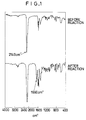
- Fig.1 shows an IR spectrum of a polymer obtained by crosslinking a polycarbodiimide by triethylene glycol.
- Polycarbodiimide is usually prepared by a method which consists in the decarboxylation of an organic diisocyanate in a hydrocarbon solvent such as toluene, xylene or decahydronaphthalene under heating.
- This method generally provides an insoluble reaction product and therefore is not favorable to a subsequent crosslinking reaction with a compound having two or more hydroxy or mercapto groups. Because of this, a method, whereby a molecular weight is adjusted by controlling conditions including reaction temperature and reaction time as disclosed in Japanese Patent Application Laid-Open(JP-A) No 7-140,144 by the present inventors, is preferred.
- a halogenated aliphatic hydrocarbon solvent such as tetrachloroethylene and an alicyclic ether solvent such as tetrahydrofuran, which are used in the methods disclosed in Japanese Patent Application Laid-Open(JP-A) Nos.2-292,316 and 4-279,618, are desirable as a starting material to be used in the method of the present invention because these solvents constitute a stable solvent for polycarbodiimide.
- organic diisocyanates examples include hexamethylene diisocyanate, phenylene diisocyanate, tolylene diisocyanate, methylene bis(4-phenylisocyanate) and naphthylene diisocyanate.
- a usable polycarbodiimide is a compound having two or more, preferably five or more, carbodiimide linkages in a molecule thereof.
- Such a polycarbodiimide has a molecular weight preferably larger than 5000 in order to provide general properties as a polymer.
- a polycarbodiimide is crosslinked by a compound having two or more hydroxy or mercapto groups
- the polycarbodiimide is dissolved in a suitable solvent such as chlorobenzene or tetrachloroethylene, and then the solution is admixed with a compound having two or more hydroxy or mercapto groups along with an alcoholate of an alkali metal or of an alkaline earth metal.
- a suitable solvent such as chlorobenzene or tetrachloroethylene
- the reaction occurs at room temperature or at a temperature in its neighborhood for a short time and the compound having two or more hydroxy or mercapto groups reacts almost quantitatively.
- the added amount of the alcoholate of an alkali metal or of an alkaline earth metal is a catalytic amount and ranges from 0.1 to 20 mole percent, preferably from 0.5 to 10 mole percent, based on the carbodiimide linkage.
- Examples of compounds having two or more hydroxy groups include polyhydric alcohols, such as ethylene glycol, hexamethylene glycol, triethylene glycol, catechol, 1,2,6-hexanetriol and 1,3-bis(3-hydroxypropyl)-1,1,3,3-tetramethyldisiloxane and silicone compounds having a plurality of silanols groups in a molecule thereof such as diphenylsilanediol and 1,4-bis(hydroxydimethylsilyl)benzene.
- polyhydric alcohols such as ethylene glycol, hexamethylene glycol, triethylene glycol, catechol, 1,2,6-hexanetriol and 1,3-bis(3-hydroxypropyl)-1,1,3,3-tetramethyldisiloxane
- silicone compounds having a plurality of silanols groups in a molecule thereof such as diphenylsilanediol and 1,4-bis(hydroxydimethylsilyl)benzene.
- Examples of compounds having two or more mercapto groups include 1,2-ethanedithiol, 1,4-butanedithiol, 1,6-hexanedithiol, toluenedithiol, 1,3-bis(3-mercaptopropyl)tetramethyldisiloxane.
- the present invention is also effectively applicable to compounds having both a hydroxy group and a mercapto group in a molecule such as dithiothreitol and dithioerythritol.
- the number of carbon atoms for alcoholates of an alkali metal or of an alkaline earth metal ranges from 1 to 30, preferably from 1 to 5.
- Examples of alcoholates of an alkali metal or of an alkaline earth metal include potassium methoxide, potassium ethoxide, sodium methoxide, sodium ethoxide, calcium dimethoxide and magnesium dimethoxide.
- the resultant crosslinkage type is an isourea or isothiourea.
- the added amount of a compound having two or more hydroxy or mercapto groups is less than that amount which will be deleterious to the moldability of the resultant crosslinked polymer. That is, the added amount is not limited so long as it does not produce gels or deposits in the case of a solution molding operation and is not limited so long as it allows the polymer to melt and the melt viscosity is not too high in the case of a powder molding operation. And, the ratio between the isourea or isothiourea linkage that will result from crosslinking and the carbodiimide linkage can be easily set to any value by controlling the amount to be added of a compound having two or more hydroxy or mercapto groups. Accordingly, the carbodiimide linkage, which has been left unconsumed, may be used to a variety of reactions.
- the added amount of a compound having two or more hydroxy or mercapto groups is preferably less than 50 mol % and most preferably from 0.1 to 30 mol % based on the carbodiimide linkage.
- the carbodiimide linkage which has been left unconsumed in the above-described crosslinking reaction, can be crosslinked by means of a thermal treatment or trimerization to provide a polymer material having higher mechanical strength and heat resistance.
- the heating of a polymer having a carbodiimide linkage may be conducted at a temperature in the range of 50 to 300°C, and preferably in the range of 100 to 260°C.
- the heating is preferably conducted in vacuum or in a non-oxidizing atmosphere such as in nitrogen or in argon. However, the heating may be conducted in air, if the temperature does not exceed 300°C. If the heating is conducted at a temperature below 50°C, self-crosslinking does not proceed. If the heating is conducted at a temperature above 300°C, organic groups are removed and mechanical strength deteriorates.
- the catalytic crosslinking of the carbodiimide linkage can also be effected by a trimerization reaction through the addition of a basic substance such as 1,5-diazabicyclo[4.3.0]nonen, 1,4-diazabicyclo[2.2.2]octane or 1,8-diazabicyclo[5.4.0]-undecene.
- the added amount of the basic substance may be that amount which brings about a crosslinking rate acceptable to the molding operation and it ranges from 0.1 to 10 mole percent based on the carbodiimide linkage.
- the reaction temperature may be room temperature (-10 ⁇ 30°C), but it will be more effective to heat the reaction system at a temperature not exceeding 200°C and preferably at a temperature not exceeding 100°C for the completion of the reaction in a shorter period of time.
- the reaction time is 1 to 60 minutes.
- a highly heat resisting inorganic material can be obtained by thermally treating the above-mentioned polymeric material at a temperature in the range of 500 to 3000°C, which temperature range is commonly adopted for the preparation of so-called glassy carbon, in vacuum or in a non-oxidizing atmosphere such as in nitrogen or in argon. If the temperature is below 500°C, the conversion of the polymeric material into an inorganic substance does not occur. If the temperature is above 300°C, the thermal treatment is not economical. In this case, a novel, highly heat resisting inorganic material can be obtained by appropriately selecting the type and quantity of a compound having two or more hydroxy or mercapto groups.
- the above solution was admixed with 20mg of 28% sodium methoxide/methanol solution (1.2 mole percent per carbodiimide linkage) to obtain a crosslinked polymer.
- the IR spectrum of the obtained crosslinked polymer is indicated as (2) in Fig.1, which indicates the decrease in the absorption of carbodiimide-derived 2140cm -1 and the emergence of the absorption of isourea linkage-derived 1660cm -1 , thereby indicating the formation of an isourea-type crosslinkage.
- the crosslinked polymer solution was cast onto a glass plate to make a layer, which was air-dried and then vacuum-dried to remove solvent. In this way, a crosslinked polymer film having a thickness of 35 ⁇ m was obtained, which was subjected to the measurement of tensile strength and the result is shown in Table 1. The strength increased by crosslinking and the film exhibited flexibility.
- the crosslinked polymer solution was cast onto a glass plate to make a layer, which was air-dried and then vacuum-dried to remove solvent. In this way, a crosslinked polymer film having a thickness of 35 ⁇ m was obtained, which was subjected to the measurement of tensile strength and the result is shown in Table 1. The strength increased by crosslinking and the film exhibited flexibility.
- the crosslinked polymer solution was cast onto a glass plate to make a layer, which was air-dried and then vacuum-dried to remove solvent. In this way, a crosslinked polymer film having a thickness of 32 ⁇ m was obtained, which was subjected to the measurement of tensile strength and the result is shown in Table 1. The strength increased by crosslinking and the film exhibited flexibility.
- the above solution was admixed with 30mg of 28% sodium methoxide/methanol solution (1.9 mole percent per carbodiimide linkage) to obtain a crosslinked polymer.
- the IR spectrum of the obtained crosslinked polymer indicated the emergence of the absorption of isothiourea linkage-derived 1625cm -1 , thereby indicating the formation of an isothiourea-type crosslinkage.
- the crosslinked polymer solution was cast onto a glass plate to make a layer, which was air-dried and then vacuum-dried to remove solvent. In this way, a crosslinked polymer film having a thickness of 38 ⁇ m was obtained, which was subjected to the measurement of tensile strength and the result is shown in Table 1. The strength increased by crosslinking and the film exhibited flexibility.
- the crosslinked polymer film obtained according to Example 1 was thermally treated in vacuum at 200°C for one hour to obtain a 32 ⁇ m thick film of crosslinked polymer.
- the tensile strength of the obtained film is shown in Table 1, which indicates a significantly increased strength due to the crosslink formed by the thermal treatment while maintaining the flexibility.
- the crosslinked polymer solution in chlorobenzene obtained according to Example 1 was admixed with 1,8-diazabicyclo[5.4.0]undecene in an amount of 1 mole percent per carbodiimide linkage, and the resultant mixture was cast onto a glass plate to make a layer, which was air-dried and then vacuum-dried and was further heated at 80°C for one hour. In this way, a trimerization-crosslinked polymer film having a thickness of 28 ⁇ m was obtained.
- the tensile strength of the obtained film is shown in Table 1, which indicates a significantly increased strength due to the trimerization-induced crosslink while maintaining the flexibility.
- the crosslinked polymer film obtained according to Example 6 was heated in vacuum at 250°C for five hours. Then, the film was subjected to stepwise heat treatments with progressively elevated temperatures consisting of 15 minutes at 250 to 300°C, 60 minutes at 300 to 500°C, 90 minutes at 500 to 1000°C, and 30 minutes at 1000°C. In this way, an inorganic film having a thickness of 25 ⁇ m was obtained.
- the tensile strength of the obtained film is shown in Table 1.
- the observation of the surface of this inorganic film by means of SEM proved that the surface was very smooth and was almost free of defects such as bubble.
- the inorganic film was excellent in flexibility and toughness.
Landscapes
- Chemical & Material Sciences (AREA)
- Engineering & Computer Science (AREA)
- Organic Chemistry (AREA)
- Ceramic Engineering (AREA)
- Materials Engineering (AREA)
- Structural Engineering (AREA)
- Manufacturing & Machinery (AREA)
- Health & Medical Sciences (AREA)
- Chemical Kinetics & Catalysis (AREA)
- Medicinal Chemistry (AREA)
- Polymers & Plastics (AREA)
- Polyurethanes Or Polyureas (AREA)
- Macromolecular Compounds Obtained By Forming Nitrogen-Containing Linkages In General (AREA)
Applications Claiming Priority (3)
| Application Number | Priority Date | Filing Date | Title |
|---|---|---|---|
| JP31632595 | 1995-12-05 | ||
| JP316325/95 | 1995-12-05 | ||
| JP31632595 | 1995-12-05 |
Publications (2)
| Publication Number | Publication Date |
|---|---|
| EP0778300A1 true EP0778300A1 (fr) | 1997-06-11 |
| EP0778300B1 EP0778300B1 (fr) | 2001-01-31 |
Family
ID=18075880
Family Applications (1)
| Application Number | Title | Priority Date | Filing Date |
|---|---|---|---|
| EP96118993A Expired - Lifetime EP0778300B1 (fr) | 1995-12-05 | 1996-11-27 | Procédé de préparation de polycarbodiimides réticulées |
Country Status (3)
| Country | Link |
|---|---|
| US (1) | US5837801A (fr) |
| EP (1) | EP0778300B1 (fr) |
| DE (1) | DE69611718T2 (fr) |
Families Citing this family (4)
| Publication number | Priority date | Publication date | Assignee | Title |
|---|---|---|---|---|
| US8778456B2 (en) * | 2011-08-30 | 2014-07-15 | Basf Se | Coating composition including high molecular weight polycarbodiimide, method of preparing same, and method of preparing coating on a substrate |
| PT2751154T (pt) | 2011-08-30 | 2019-11-04 | Basf Se | Policarbodiimida de elevado peso molecular e método de produção da mesma |
| JP6803842B2 (ja) | 2015-04-13 | 2020-12-23 | ハネウェル・インターナショナル・インコーポレーテッドHoneywell International Inc. | オプトエレクトロニクス用途のためのポリシロキサン製剤及びコーティング |
| JP7028401B2 (ja) * | 2018-02-23 | 2022-03-02 | 日清紡ケミカル株式会社 | 水性カルボジイミド含有液の製造方法 |
Citations (12)
| Publication number | Priority date | Publication date | Assignee | Title |
|---|---|---|---|---|
| US2941966A (en) | 1956-08-27 | 1960-06-21 | Du Pont | Carbodiimide polymers |
| DE2423482A1 (de) | 1973-05-15 | 1974-12-05 | Fuji Photo Film Co Ltd | Photographisches, ein antischleiermittel enthaltendes lichtempfindliches material |
| FR2242331A1 (fr) * | 1973-08-31 | 1975-03-28 | Bayer Ag | |
| FR2579600A1 (fr) * | 1985-03-29 | 1986-10-03 | Nisshin Spinning | Resine thermodurcissable a base de polycarbodiimides reticules et sa preparation |
| JPS61235414A (ja) | 1985-03-29 | 1986-10-20 | Nisshinbo Ind Inc | 熱硬化性樹脂の製造方法 |
| JPS61268714A (ja) | 1985-05-22 | 1986-11-28 | Nisshinbo Ind Inc | 耐熱性の高い熱硬化性樹脂の製造方法 |
| JPH02292316A (ja) | 1989-05-02 | 1990-12-03 | Nisshinbo Ind Inc | 高分子量ポリカルボジイミド溶液及びその製造方法 |
| EP0443524A1 (fr) * | 1990-02-21 | 1991-08-28 | Nisshinbo Industries, Inc. | Matériau en carbone vitreux ayant une densité élevée et procédé de sa fabrication |
| JPH03247504A (ja) | 1990-02-21 | 1991-11-05 | Akira Takaku | 炭素薄板及びその製造方法 |
| JPH04279618A (ja) | 1991-03-08 | 1992-10-05 | Nisshinbo Ind Inc | 高分子量ポリカルボジイミド溶液及びその製造方法 |
| JPH07140144A (ja) | 1993-11-19 | 1995-06-02 | S R L:Kk | アレルゲン特異的IgE抗体の測定方法および抗原抗体複合体の測定方法 |
| JPH07140145A (ja) | 1993-11-12 | 1995-06-02 | Nitto Boseki Co Ltd | 特定の抗体の測定方法及び測定試薬 |
-
1996
- 1996-11-27 EP EP96118993A patent/EP0778300B1/fr not_active Expired - Lifetime
- 1996-11-27 DE DE69611718T patent/DE69611718T2/de not_active Expired - Fee Related
- 1996-12-04 US US08/759,381 patent/US5837801A/en not_active Expired - Fee Related
Patent Citations (13)
| Publication number | Priority date | Publication date | Assignee | Title |
|---|---|---|---|---|
| US2941966A (en) | 1956-08-27 | 1960-06-21 | Du Pont | Carbodiimide polymers |
| DE2423482A1 (de) | 1973-05-15 | 1974-12-05 | Fuji Photo Film Co Ltd | Photographisches, ein antischleiermittel enthaltendes lichtempfindliches material |
| FR2242331A1 (fr) * | 1973-08-31 | 1975-03-28 | Bayer Ag | |
| FR2579600A1 (fr) * | 1985-03-29 | 1986-10-03 | Nisshin Spinning | Resine thermodurcissable a base de polycarbodiimides reticules et sa preparation |
| JPS61235414A (ja) | 1985-03-29 | 1986-10-20 | Nisshinbo Ind Inc | 熱硬化性樹脂の製造方法 |
| JPS61268714A (ja) | 1985-05-22 | 1986-11-28 | Nisshinbo Ind Inc | 耐熱性の高い熱硬化性樹脂の製造方法 |
| JPH02292316A (ja) | 1989-05-02 | 1990-12-03 | Nisshinbo Ind Inc | 高分子量ポリカルボジイミド溶液及びその製造方法 |
| EP0443524A1 (fr) * | 1990-02-21 | 1991-08-28 | Nisshinbo Industries, Inc. | Matériau en carbone vitreux ayant une densité élevée et procédé de sa fabrication |
| JPH03247504A (ja) | 1990-02-21 | 1991-11-05 | Akira Takaku | 炭素薄板及びその製造方法 |
| JPH03247505A (ja) | 1990-02-21 | 1991-11-05 | Akira Takaku | 高密度ガラス状炭素材及びその製造方法 |
| JPH04279618A (ja) | 1991-03-08 | 1992-10-05 | Nisshinbo Ind Inc | 高分子量ポリカルボジイミド溶液及びその製造方法 |
| JPH07140145A (ja) | 1993-11-12 | 1995-06-02 | Nitto Boseki Co Ltd | 特定の抗体の測定方法及び測定試薬 |
| JPH07140144A (ja) | 1993-11-19 | 1995-06-02 | S R L:Kk | アレルゲン特異的IgE抗体の測定方法および抗原抗体複合体の測定方法 |
Non-Patent Citations (5)
| Title |
|---|
| AN. QUIM., vol. 67, 1971, pages 901 |
| ARCH. PHARM., vol. 305, 1972, WEINHEIM, pages 654 |
| J. CHEM. SOC., no. C, 1968, pages 1480 |
| J. ORG. CHEM., vol. 28, 1963, pages 2069 |
| J. ORG. CHEM., vol. 34, 1969, pages 3707 |
Also Published As
| Publication number | Publication date |
|---|---|
| EP0778300B1 (fr) | 2001-01-31 |
| DE69611718T2 (de) | 2001-06-07 |
| DE69611718D1 (de) | 2001-03-08 |
| US5837801A (en) | 1998-11-17 |
Similar Documents
| Publication | Publication Date | Title |
|---|---|---|
| EP0686626B1 (fr) | Tétraméthylxylylènecarbodiimides hydrophiliques | |
| US4729976A (en) | Polymer of dicyclopentadiene and a process for preparation | |
| JPH01138108A (ja) | 無機シラザン高重合体、その製造方法及びその用途 | |
| EP0610960B1 (fr) | Solution de polycarbodiimides de haut poids moléculaire et ses procédés de préparation | |
| EP0778300B1 (fr) | Procédé de préparation de polycarbodiimides réticulées | |
| KR100500547B1 (ko) | 폴리아릴렌설파이드및그의조성물 | |
| US4861844A (en) | Cationic catalysis process for the treatment of a polysilazane containing on average at least two .tbd.SiH groups per molecule | |
| JPH01138107A (ja) | 改質ポリシラザン、その製造方法及びその用途 | |
| US6248857B1 (en) | Aromatic polycarbodiimide and polycarbodiimide sheet | |
| US6228972B1 (en) | Aromatic polycarbodiimide and water repellent sheet made therefrom | |
| US5821325A (en) | Polycarbodiimide derivatives and method for preparing the same | |
| JPS61255935A (ja) | イオン性無機塩と錯化剤とから成る触媒系によってポリオルガノシラザン及びポリオルガノ(ジシリル)シラザンを処理する方法 | |
| JPH09216931A (ja) | ポリカルボジイミド架橋体の製造方法 | |
| US20120015194A1 (en) | Method For Producing Carbonitrides by Means of a Polycondensation or Sol-Gel Method Using Hydrogen-Free Isocyanates | |
| EP0447816B1 (fr) | Plaque mince en carbon et procédé de sa fabrication | |
| JPS63191832A (ja) | 新規ポリアルミノシラザン及びその製造方法 | |
| JPH0256310B2 (fr) | ||
| EP0443524A1 (fr) | Matériau en carbone vitreux ayant une densité élevée et procédé de sa fabrication | |
| KR100287332B1 (ko) | 플라즈마 에칭용 전극판 및 지그 | |
| US4767831A (en) | Process for preparing ceramic materials | |
| JPH09221532A (ja) | ポリカルボジイミド誘導体及びその製造方法 | |
| KR100697180B1 (ko) | 방향족 폴리카보디이미드의 안정성을 향상시키는 방법 | |
| EP0785222A2 (fr) | Dérivé de polycarbodiimide et procédé de fabrication | |
| EP0803485B1 (fr) | Procédé de fabrication d'un matériau moulé en carbure de silicium | |
| EP0416506A1 (fr) | Matériau conducteur et procédé pour le fabriquer |
Legal Events
| Date | Code | Title | Description |
|---|---|---|---|
| PUAI | Public reference made under article 153(3) epc to a published international application that has entered the european phase |
Free format text: ORIGINAL CODE: 0009012 |
|
| 17P | Request for examination filed |
Effective date: 19961127 |
|
| AK | Designated contracting states |
Kind code of ref document: A1 Designated state(s): DE FR GB |
|
| 17Q | First examination report despatched |
Effective date: 19990406 |
|
| GRAG | Despatch of communication of intention to grant |
Free format text: ORIGINAL CODE: EPIDOS AGRA |
|
| GRAG | Despatch of communication of intention to grant |
Free format text: ORIGINAL CODE: EPIDOS AGRA |
|
| GRAH | Despatch of communication of intention to grant a patent |
Free format text: ORIGINAL CODE: EPIDOS IGRA |
|
| GRAH | Despatch of communication of intention to grant a patent |
Free format text: ORIGINAL CODE: EPIDOS IGRA |
|
| GRAA | (expected) grant |
Free format text: ORIGINAL CODE: 0009210 |
|
| AK | Designated contracting states |
Kind code of ref document: B1 Designated state(s): DE FR GB |
|
| REF | Corresponds to: |
Ref document number: 69611718 Country of ref document: DE Date of ref document: 20010308 |
|
| ET | Fr: translation filed | ||
| PGFP | Annual fee paid to national office [announced via postgrant information from national office to epo] |
Ref country code: FR Payment date: 20011113 Year of fee payment: 6 |
|
| PGFP | Annual fee paid to national office [announced via postgrant information from national office to epo] |
Ref country code: GB Payment date: 20011128 Year of fee payment: 6 |
|
| PLBE | No opposition filed within time limit |
Free format text: ORIGINAL CODE: 0009261 |
|
| STAA | Information on the status of an ep patent application or granted ep patent |
Free format text: STATUS: NO OPPOSITION FILED WITHIN TIME LIMIT |
|
| PGFP | Annual fee paid to national office [announced via postgrant information from national office to epo] |
Ref country code: DE Payment date: 20011210 Year of fee payment: 6 |
|
| REG | Reference to a national code |
Ref country code: GB Ref legal event code: IF02 |
|
| 26N | No opposition filed | ||
| PG25 | Lapsed in a contracting state [announced via postgrant information from national office to epo] |
Ref country code: GB Free format text: LAPSE BECAUSE OF NON-PAYMENT OF DUE FEES Effective date: 20021127 |
|
| PG25 | Lapsed in a contracting state [announced via postgrant information from national office to epo] |
Ref country code: DE Free format text: LAPSE BECAUSE OF NON-PAYMENT OF DUE FEES Effective date: 20030603 |
|
| GBPC | Gb: european patent ceased through non-payment of renewal fee | ||
| PG25 | Lapsed in a contracting state [announced via postgrant information from national office to epo] |
Ref country code: FR Free format text: LAPSE BECAUSE OF NON-PAYMENT OF DUE FEES Effective date: 20030731 |
|
| REG | Reference to a national code |
Ref country code: FR Ref legal event code: ST |