EP0790313A2 - Nukleinsäurekonstrukte für die zellzyklusregulierte Expression von Genen, derartige Konstrukte enthaltende Zellen sowie deren Verwendung zur Herstellung von Heilmitteln - Google Patents
Nukleinsäurekonstrukte für die zellzyklusregulierte Expression von Genen, derartige Konstrukte enthaltende Zellen sowie deren Verwendung zur Herstellung von Heilmitteln Download PDFInfo
- Publication number
- EP0790313A2 EP0790313A2 EP97101507A EP97101507A EP0790313A2 EP 0790313 A2 EP0790313 A2 EP 0790313A2 EP 97101507 A EP97101507 A EP 97101507A EP 97101507 A EP97101507 A EP 97101507A EP 0790313 A2 EP0790313 A2 EP 0790313A2
- Authority
- EP
- European Patent Office
- Prior art keywords
- nucleic acid
- acid construct
- sequence
- cell
- gene
- Prior art date
- Legal status (The legal status is an assumption and is not a legal conclusion. Google has not performed a legal analysis and makes no representation as to the accuracy of the status listed.)
- Withdrawn
Links
- 108090000623 proteins and genes Proteins 0.000 title claims abstract description 143
- 102000039446 nucleic acids Human genes 0.000 title claims abstract description 45
- 108020004707 nucleic acids Proteins 0.000 title claims abstract description 45
- 150000007523 nucleic acids Chemical class 0.000 title claims abstract description 45
- 230000001105 regulatory effect Effects 0.000 title claims abstract description 15
- 230000022131 cell cycle Effects 0.000 title claims abstract description 14
- 238000002360 preparation method Methods 0.000 title claims description 6
- 239000000203 mixture Substances 0.000 title 1
- 102000004169 proteins and genes Human genes 0.000 claims abstract description 62
- 239000013543 active substance Substances 0.000 claims abstract description 34
- 108091028043 Nucleic acid sequence Proteins 0.000 claims abstract description 29
- 210000004027 cell Anatomy 0.000 claims description 97
- 238000009739 binding Methods 0.000 claims description 47
- 230000027455 binding Effects 0.000 claims description 46
- 239000012190 activator Substances 0.000 claims description 35
- 239000002773 nucleotide Substances 0.000 claims description 26
- 125000003729 nucleotide group Chemical group 0.000 claims description 26
- 206010028980 Neoplasm Diseases 0.000 claims description 24
- 108020004414 DNA Proteins 0.000 claims description 18
- 210000002889 endothelial cell Anatomy 0.000 claims description 17
- 102000004190 Enzymes Human genes 0.000 claims description 13
- 108090000790 Enzymes Proteins 0.000 claims description 13
- 241000700605 Viruses Species 0.000 claims description 11
- 230000001085 cytostatic effect Effects 0.000 claims description 11
- 239000000824 cytostatic agent Substances 0.000 claims description 10
- 210000000329 smooth muscle myocyte Anatomy 0.000 claims description 10
- 102000004127 Cytokines Human genes 0.000 claims description 9
- 108090000695 Cytokines Proteins 0.000 claims description 9
- 230000035755 proliferation Effects 0.000 claims description 9
- 208000032839 leukemia Diseases 0.000 claims description 8
- 102000019274 E2F Family Human genes 0.000 claims description 7
- 108050006730 E2F Family Proteins 0.000 claims description 7
- 210000004881 tumor cell Anatomy 0.000 claims description 7
- 239000003102 growth factor Substances 0.000 claims description 6
- 210000004698 lymphocyte Anatomy 0.000 claims description 6
- 210000002540 macrophage Anatomy 0.000 claims description 6
- 239000002243 precursor Substances 0.000 claims description 6
- 238000011282 treatment Methods 0.000 claims description 6
- 201000010099 disease Diseases 0.000 claims description 5
- 208000037265 diseases, disorders, signs and symptoms Diseases 0.000 claims description 5
- 239000003814 drug Substances 0.000 claims description 5
- 102000008394 Immunoglobulin Fragments Human genes 0.000 claims description 4
- 108010021625 Immunoglobulin Fragments Proteins 0.000 claims description 4
- 229940079593 drug Drugs 0.000 claims description 4
- 238000004519 manufacturing process Methods 0.000 claims description 4
- 210000004498 neuroglial cell Anatomy 0.000 claims description 4
- 241000598436 Human T-cell lymphotropic virus Species 0.000 claims description 3
- 239000003146 anticoagulant agent Substances 0.000 claims description 3
- 229940127219 anticoagulant drug Drugs 0.000 claims description 3
- 230000004663 cell proliferation Effects 0.000 claims description 3
- 238000011144 upstream manufacturing Methods 0.000 claims description 3
- 239000013598 vector Substances 0.000 claims description 3
- 102000015081 Blood Coagulation Factors Human genes 0.000 claims description 2
- 108010039209 Blood Coagulation Factors Proteins 0.000 claims description 2
- 239000004037 angiogenesis inhibitor Substances 0.000 claims description 2
- 229940121369 angiogenesis inhibitor Drugs 0.000 claims description 2
- 239000003114 blood coagulation factor Substances 0.000 claims description 2
- 239000013600 plasmid vector Substances 0.000 claims description 2
- 239000013603 viral vector Substances 0.000 claims description 2
- 230000001028 anti-proliverative effect Effects 0.000 claims 1
- -1 antibodies Proteins 0.000 claims 1
- 229940126601 medicinal product Drugs 0.000 claims 1
- 230000003213 activating effect Effects 0.000 abstract description 10
- 101710115153 Myb-related protein B Proteins 0.000 description 47
- 102100034670 Myb-related protein B Human genes 0.000 description 36
- 201000011510 cancer Diseases 0.000 description 18
- 238000013518 transcription Methods 0.000 description 14
- 230000035897 transcription Effects 0.000 description 14
- 230000010190 G1 phase Effects 0.000 description 12
- 230000000259 anti-tumor effect Effects 0.000 description 12
- 238000004458 analytical method Methods 0.000 description 11
- 108091023040 Transcription factor Proteins 0.000 description 10
- 102000040945 Transcription factor Human genes 0.000 description 10
- 239000004480 active ingredient Substances 0.000 description 10
- UYTPUPDQBNUYGX-UHFFFAOYSA-N guanine Chemical class O=C1NC(N)=NC2=C1N=CN2 UYTPUPDQBNUYGX-UHFFFAOYSA-N 0.000 description 10
- 239000002253 acid Substances 0.000 description 9
- 238000007069 methylation reaction Methods 0.000 description 9
- 102000004058 Leukemia inhibitory factor Human genes 0.000 description 8
- 108090000581 Leukemia inhibitory factor Proteins 0.000 description 8
- 150000007513 acids Chemical class 0.000 description 8
- 239000002260 anti-inflammatory agent Substances 0.000 description 8
- 230000011987 methylation Effects 0.000 description 8
- 239000000523 sample Substances 0.000 description 8
- 101000895882 Homo sapiens Transcription factor E2F4 Proteins 0.000 description 7
- 102000000589 Interleukin-1 Human genes 0.000 description 7
- 108010002352 Interleukin-1 Proteins 0.000 description 7
- 102000003992 Peroxidases Human genes 0.000 description 7
- 102100021783 Transcription factor E2F4 Human genes 0.000 description 7
- 108010019530 Vascular Endothelial Growth Factors Proteins 0.000 description 7
- VAYGXNSJCAHWJZ-UHFFFAOYSA-N dimethyl sulfate Chemical compound COS(=O)(=O)OC VAYGXNSJCAHWJZ-UHFFFAOYSA-N 0.000 description 7
- 108040007629 peroxidase activity proteins Proteins 0.000 description 7
- 102000005962 receptors Human genes 0.000 description 7
- 108020003175 receptors Proteins 0.000 description 7
- 102000005367 Carboxypeptidases Human genes 0.000 description 6
- 108010006303 Carboxypeptidases Proteins 0.000 description 6
- 208000035473 Communicable disease Diseases 0.000 description 6
- 102000053187 Glucuronidase Human genes 0.000 description 6
- 108010060309 Glucuronidase Proteins 0.000 description 6
- 101000924577 Homo sapiens Adenomatous polyposis coli protein Proteins 0.000 description 6
- 102100037850 Interferon gamma Human genes 0.000 description 6
- 108010074328 Interferon-gamma Proteins 0.000 description 6
- 102000000646 Interleukin-3 Human genes 0.000 description 6
- 108010002386 Interleukin-3 Proteins 0.000 description 6
- 230000018199 S phase Effects 0.000 description 6
- 102100024026 Transcription factor E2F1 Human genes 0.000 description 6
- 108010000134 Vascular Cell Adhesion Molecule-1 Proteins 0.000 description 6
- 239000002299 complementary DNA Substances 0.000 description 6
- 231100000433 cytotoxic Toxicity 0.000 description 6
- 230000001472 cytotoxic effect Effects 0.000 description 6
- 108020004999 messenger RNA Proteins 0.000 description 6
- 230000036961 partial effect Effects 0.000 description 6
- 230000000284 resting effect Effects 0.000 description 6
- 230000035519 G0 Phase Effects 0.000 description 5
- 108700028146 Genetic Enhancer Elements Proteins 0.000 description 5
- 101000904152 Homo sapiens Transcription factor E2F1 Proteins 0.000 description 5
- 230000004913 activation Effects 0.000 description 5
- 230000000840 anti-viral effect Effects 0.000 description 5
- 230000001580 bacterial effect Effects 0.000 description 5
- 210000004369 blood Anatomy 0.000 description 5
- 239000008280 blood Substances 0.000 description 5
- 239000000499 gel Substances 0.000 description 5
- 210000003958 hematopoietic stem cell Anatomy 0.000 description 5
- 239000003112 inhibitor Substances 0.000 description 5
- 230000002401 inhibitory effect Effects 0.000 description 5
- 239000000126 substance Substances 0.000 description 5
- 241000701161 unidentified adenovirus Species 0.000 description 5
- MZOFCQQQCNRIBI-VMXHOPILSA-N (3s)-4-[[(2s)-1-[[(2s)-1-[[(1s)-1-carboxy-2-hydroxyethyl]amino]-4-methyl-1-oxopentan-2-yl]amino]-5-(diaminomethylideneamino)-1-oxopentan-2-yl]amino]-3-[[2-[[(2s)-2,6-diaminohexanoyl]amino]acetyl]amino]-4-oxobutanoic acid Chemical compound OC[C@@H](C(O)=O)NC(=O)[C@H](CC(C)C)NC(=O)[C@H](CCCN=C(N)N)NC(=O)[C@H](CC(O)=O)NC(=O)CNC(=O)[C@@H](N)CCCCN MZOFCQQQCNRIBI-VMXHOPILSA-N 0.000 description 4
- 102100021943 C-C motif chemokine 2 Human genes 0.000 description 4
- 108700013048 CCL2 Proteins 0.000 description 4
- 102000002045 Endothelin Human genes 0.000 description 4
- 108050009340 Endothelin Proteins 0.000 description 4
- 101800004490 Endothelin-1 Proteins 0.000 description 4
- 108010017213 Granulocyte-Macrophage Colony-Stimulating Factor Proteins 0.000 description 4
- 102100039620 Granulocyte-macrophage colony-stimulating factor Human genes 0.000 description 4
- 206010061218 Inflammation Diseases 0.000 description 4
- 102100026720 Interferon beta Human genes 0.000 description 4
- 108010047761 Interferon-alpha Proteins 0.000 description 4
- 102000006992 Interferon-alpha Human genes 0.000 description 4
- 108090000467 Interferon-beta Proteins 0.000 description 4
- 102000003815 Interleukin-11 Human genes 0.000 description 4
- 108090000177 Interleukin-11 Proteins 0.000 description 4
- 102000000588 Interleukin-2 Human genes 0.000 description 4
- 108010002350 Interleukin-2 Proteins 0.000 description 4
- 102000004388 Interleukin-4 Human genes 0.000 description 4
- 108090000978 Interleukin-4 Proteins 0.000 description 4
- 108010002616 Interleukin-5 Proteins 0.000 description 4
- 108090001005 Interleukin-6 Proteins 0.000 description 4
- 108010002586 Interleukin-7 Proteins 0.000 description 4
- 102000004083 Lymphotoxin-alpha Human genes 0.000 description 4
- 108090000542 Lymphotoxin-alpha Proteins 0.000 description 4
- 108700020796 Oncogene Proteins 0.000 description 4
- 108010001014 Plasminogen Activators Proteins 0.000 description 4
- 102000001938 Plasminogen Activators Human genes 0.000 description 4
- 108010076504 Protein Sorting Signals Proteins 0.000 description 4
- FAPWRFPIFSIZLT-UHFFFAOYSA-M Sodium chloride Chemical compound [Na+].[Cl-] FAPWRFPIFSIZLT-UHFFFAOYSA-M 0.000 description 4
- 108010000499 Thromboplastin Proteins 0.000 description 4
- 102000002262 Thromboplastin Human genes 0.000 description 4
- 108060008682 Tumor Necrosis Factor Proteins 0.000 description 4
- 102000000852 Tumor Necrosis Factor-alpha Human genes 0.000 description 4
- 108010053099 Vascular Endothelial Growth Factor Receptor-2 Proteins 0.000 description 4
- 102000005789 Vascular Endothelial Growth Factors Human genes 0.000 description 4
- 150000001413 amino acids Chemical class 0.000 description 4
- 230000033228 biological regulation Effects 0.000 description 4
- ZUBDGKVDJUIMQQ-UBFCDGJISA-N endothelin-1 Chemical compound C([C@@H](C(=O)N[C@@H](CC(C)C)C(=O)N[C@@H](CC(O)=O)C(=O)N[C@@H]([C@@H](C)CC)C(=O)N[C@@H]([C@@H](C)CC)C(=O)N[C@@H](CC=1C2=CC=CC=C2NC=1)C(O)=O)NC(=O)[C@H]1NC(=O)[C@H](CC=2C=CC=CC=2)NC(=O)[C@@H](CC=2C=CC(O)=CC=2)NC(=O)[C@H](C(C)C)NC(=O)[C@H]2CSSC[C@@H](C(N[C@H](CO)C(=O)N[C@@H](CO)C(=O)N[C@H](CC(C)C)C(=O)N[C@@H](CCSC)C(=O)N[C@H](CC(O)=O)C(=O)N[C@@H](CCCCN)C(=O)N[C@@H](CCC(O)=O)C(=O)N2)=O)NC(=O)[C@@H](CO)NC(=O)[C@H](N)CSSC1)C1=CNC=N1 ZUBDGKVDJUIMQQ-UBFCDGJISA-N 0.000 description 4
- 238000002474 experimental method Methods 0.000 description 4
- 108020001507 fusion proteins Proteins 0.000 description 4
- 102000037865 fusion proteins Human genes 0.000 description 4
- 238000001415 gene therapy Methods 0.000 description 4
- 230000004054 inflammatory process Effects 0.000 description 4
- 230000035772 mutation Effects 0.000 description 4
- OHDXDNUPVVYWOV-UHFFFAOYSA-N n-methyl-1-(2-naphthalen-1-ylsulfanylphenyl)methanamine Chemical compound CNCC1=CC=CC=C1SC1=CC=CC2=CC=CC=C12 OHDXDNUPVVYWOV-UHFFFAOYSA-N 0.000 description 4
- 229940127126 plasminogen activator Drugs 0.000 description 4
- 230000002062 proliferating effect Effects 0.000 description 4
- 238000003757 reverse transcription PCR Methods 0.000 description 4
- 210000002966 serum Anatomy 0.000 description 4
- 238000002560 therapeutic procedure Methods 0.000 description 4
- 208000023275 Autoimmune disease Diseases 0.000 description 3
- 229940123587 Cell cycle inhibitor Drugs 0.000 description 3
- 108010036466 E2F2 Transcription Factor Proteins 0.000 description 3
- 102100033902 Endothelin-1 Human genes 0.000 description 3
- 108700039691 Genetic Promoter Regions Proteins 0.000 description 3
- PEDCQBHIVMGVHV-UHFFFAOYSA-N Glycerine Chemical compound OCC(O)CO PEDCQBHIVMGVHV-UHFFFAOYSA-N 0.000 description 3
- 101000904150 Homo sapiens Transcription factor E2F3 Proteins 0.000 description 3
- 101000866336 Homo sapiens Transcription factor E2F5 Proteins 0.000 description 3
- 108060003951 Immunoglobulin Proteins 0.000 description 3
- 108060001084 Luciferase Proteins 0.000 description 3
- 239000005089 Luciferase Substances 0.000 description 3
- 102100039364 Metalloproteinase inhibitor 1 Human genes 0.000 description 3
- 241000713333 Mouse mammary tumor virus Species 0.000 description 3
- 108090000608 Phosphoric Monoester Hydrolases Proteins 0.000 description 3
- 102000004160 Phosphoric Monoester Hydrolases Human genes 0.000 description 3
- 108010022233 Plasminogen Activator Inhibitor 1 Proteins 0.000 description 3
- 102100039418 Plasminogen activator inhibitor 1 Human genes 0.000 description 3
- 102100024024 Transcription factor E2F2 Human genes 0.000 description 3
- 102100024027 Transcription factor E2F3 Human genes 0.000 description 3
- 102100031632 Transcription factor E2F5 Human genes 0.000 description 3
- 230000000844 anti-bacterial effect Effects 0.000 description 3
- 206010003246 arthritis Diseases 0.000 description 3
- 230000032823 cell division Effects 0.000 description 3
- 239000003795 chemical substances by application Substances 0.000 description 3
- 230000015271 coagulation Effects 0.000 description 3
- 238000005345 coagulation Methods 0.000 description 3
- 230000000694 effects Effects 0.000 description 3
- 210000003038 endothelium Anatomy 0.000 description 3
- 230000008105 immune reaction Effects 0.000 description 3
- 102000018358 immunoglobulin Human genes 0.000 description 3
- 239000012678 infectious agent Substances 0.000 description 3
- 244000045947 parasite Species 0.000 description 3
- 238000011321 prophylaxis Methods 0.000 description 3
- 230000000638 stimulation Effects 0.000 description 3
- 229960005486 vaccine Drugs 0.000 description 3
- AFWRJOYNLMVZQO-GMFATLNBSA-N (1r,2r,4as,8as)-1-[(1e,3e)-5-hydroxy-3-methylpenta-1,3-dienyl]-2,5,5,8a-tetramethyl-3,4,4a,6,7,8-hexahydro-1h-naphthalen-2-ol Chemical compound CC1(C)CCC[C@]2(C)[C@@H](/C=C/C(=C/CO)/C)[C@](C)(O)CC[C@H]21 AFWRJOYNLMVZQO-GMFATLNBSA-N 0.000 description 2
- 108091032973 (ribonucleotides)n+m Proteins 0.000 description 2
- 102000012936 Angiostatins Human genes 0.000 description 2
- 108010079709 Angiostatins Proteins 0.000 description 2
- 241000894006 Bacteria Species 0.000 description 2
- 102100032367 C-C motif chemokine 5 Human genes 0.000 description 2
- 102100034871 C-C motif chemokine 8 Human genes 0.000 description 2
- 101710155833 C-C motif chemokine 8 Proteins 0.000 description 2
- 108010059108 CD18 Antigens Proteins 0.000 description 2
- 101150002678 CDC25C gene Proteins 0.000 description 2
- 101150012716 CDK1 gene Proteins 0.000 description 2
- 101100381481 Caenorhabditis elegans baz-2 gene Proteins 0.000 description 2
- 108010055166 Chemokine CCL5 Proteins 0.000 description 2
- HEDRZPFGACZZDS-UHFFFAOYSA-N Chloroform Chemical compound ClC(Cl)Cl HEDRZPFGACZZDS-UHFFFAOYSA-N 0.000 description 2
- 108010068192 Cyclin A Proteins 0.000 description 2
- 102100025191 Cyclin-A2 Human genes 0.000 description 2
- 102000000311 Cytosine Deaminase Human genes 0.000 description 2
- 108010080611 Cytosine Deaminase Proteins 0.000 description 2
- 108010041986 DNA Vaccines Proteins 0.000 description 2
- 229940021995 DNA vaccine Drugs 0.000 description 2
- 101100059559 Emericella nidulans (strain FGSC A4 / ATCC 38163 / CBS 112.46 / NRRL 194 / M139) nimX gene Proteins 0.000 description 2
- 101000904460 Encephalitozoon cuniculi (strain GB-M1) Probable glycerol-3-phosphate dehydrogenase Proteins 0.000 description 2
- 102100037241 Endoglin Human genes 0.000 description 2
- 108010036395 Endoglin Proteins 0.000 description 2
- 102000054184 GADD45 Human genes 0.000 description 2
- 108700007032 GADD45 Proteins 0.000 description 2
- 102400001301 Gasdermin-B, C-terminal Human genes 0.000 description 2
- 102000004269 Granulocyte Colony-Stimulating Factor Human genes 0.000 description 2
- 108010017080 Granulocyte Colony-Stimulating Factor Proteins 0.000 description 2
- 101000691574 Homo sapiens Junction plakoglobin Proteins 0.000 description 2
- 101000942967 Homo sapiens Leukemia inhibitory factor Proteins 0.000 description 2
- 101000624643 Homo sapiens M-phase inducer phosphatase 3 Proteins 0.000 description 2
- 101001117314 Homo sapiens Prostaglandin D2 receptor 2 Proteins 0.000 description 2
- 102100025390 Integrin beta-2 Human genes 0.000 description 2
- 102000014150 Interferons Human genes 0.000 description 2
- 108010050904 Interferons Proteins 0.000 description 2
- 102000003777 Interleukin-1 beta Human genes 0.000 description 2
- 108090000193 Interleukin-1 beta Proteins 0.000 description 2
- 102000019223 Interleukin-1 receptor Human genes 0.000 description 2
- 108050006617 Interleukin-1 receptor Proteins 0.000 description 2
- 108090001007 Interleukin-8 Proteins 0.000 description 2
- 102100026153 Junction plakoglobin Human genes 0.000 description 2
- 102100023330 M-phase inducer phosphatase 3 Human genes 0.000 description 2
- 102000007651 Macrophage Colony-Stimulating Factor Human genes 0.000 description 2
- 108010046938 Macrophage Colony-Stimulating Factor Proteins 0.000 description 2
- 102000009571 Macrophage Inflammatory Proteins Human genes 0.000 description 2
- 108010009474 Macrophage Inflammatory Proteins Proteins 0.000 description 2
- 108060003100 Magainin Proteins 0.000 description 2
- 102100026262 Metalloproteinase inhibitor 2 Human genes 0.000 description 2
- 102100026261 Metalloproteinase inhibitor 3 Human genes 0.000 description 2
- 108091034117 Oligonucleotide Proteins 0.000 description 2
- 102000004140 Oncostatin M Human genes 0.000 description 2
- 108090000630 Oncostatin M Proteins 0.000 description 2
- 102000004316 Oxidoreductases Human genes 0.000 description 2
- 108090000854 Oxidoreductases Proteins 0.000 description 2
- KHGNFPUMBJSZSM-UHFFFAOYSA-N Perforine Natural products COC1=C2CCC(O)C(CCC(C)(C)O)(OC)C2=NC2=C1C=CO2 KHGNFPUMBJSZSM-UHFFFAOYSA-N 0.000 description 2
- 108700019535 Phosphoprotein Phosphatases Proteins 0.000 description 2
- 102000045595 Phosphoprotein Phosphatases Human genes 0.000 description 2
- OAICVXFJPJFONN-UHFFFAOYSA-N Phosphorus Chemical compound [P] OAICVXFJPJFONN-UHFFFAOYSA-N 0.000 description 2
- NQRYJNQNLNOLGT-UHFFFAOYSA-N Piperidine Chemical compound C1CCNCC1 NQRYJNQNLNOLGT-UHFFFAOYSA-N 0.000 description 2
- 102100024078 Plasma serine protease inhibitor Human genes 0.000 description 2
- 102000004179 Plasminogen Activator Inhibitor 2 Human genes 0.000 description 2
- 108090000614 Plasminogen Activator Inhibitor 2 Proteins 0.000 description 2
- 102000004211 Platelet factor 4 Human genes 0.000 description 2
- 108090000778 Platelet factor 4 Proteins 0.000 description 2
- 102100024218 Prostaglandin D2 receptor 2 Human genes 0.000 description 2
- 108010001953 Protein C Inhibitor Proteins 0.000 description 2
- 101000805140 Pyrococcus furiosus (strain ATCC 43587 / DSM 3638 / JCM 8422 / Vc1) DNA polymerase II large subunit Proteins 0.000 description 2
- 101100372762 Rattus norvegicus Flt1 gene Proteins 0.000 description 2
- 108700008625 Reporter Genes Proteins 0.000 description 2
- 108050002653 Retinoblastoma protein Proteins 0.000 description 2
- 102100022828 Retinoblastoma-like protein 2 Human genes 0.000 description 2
- 108050002651 Retinoblastoma-like protein 2 Proteins 0.000 description 2
- 244000082988 Secale cereale Species 0.000 description 2
- 235000007238 Secale cereale Nutrition 0.000 description 2
- 241000700584 Simplexvirus Species 0.000 description 2
- 102000011971 Sphingomyelin Phosphodiesterase Human genes 0.000 description 2
- 108010061312 Sphingomyelin Phosphodiesterase Proteins 0.000 description 2
- 102000006601 Thymidine Kinase Human genes 0.000 description 2
- 108020004440 Thymidine kinase Proteins 0.000 description 2
- 108010031374 Tissue Inhibitor of Metalloproteinase-1 Proteins 0.000 description 2
- 108010031372 Tissue Inhibitor of Metalloproteinase-2 Proteins 0.000 description 2
- 108010031429 Tissue Inhibitor of Metalloproteinase-3 Proteins 0.000 description 2
- 102000004887 Transforming Growth Factor beta Human genes 0.000 description 2
- 108090001012 Transforming Growth Factor beta Proteins 0.000 description 2
- 239000007984 Tris EDTA buffer Substances 0.000 description 2
- 102100040247 Tumor necrosis factor Human genes 0.000 description 2
- 102000016549 Vascular Endothelial Growth Factor Receptor-2 Human genes 0.000 description 2
- 101100273808 Xenopus laevis cdk1-b gene Proteins 0.000 description 2
- 239000000427 antigen Substances 0.000 description 2
- 108091007433 antigens Proteins 0.000 description 2
- 102000036639 antigens Human genes 0.000 description 2
- FZCSTZYAHCUGEM-UHFFFAOYSA-N aspergillomarasmine B Natural products OC(=O)CNC(C(O)=O)CNC(C(O)=O)CC(O)=O FZCSTZYAHCUGEM-UHFFFAOYSA-N 0.000 description 2
- 102000055574 bcl-2 Homologous Antagonist-Killer Human genes 0.000 description 2
- 108700039689 bcl-2 Homologous Antagonist-Killer Proteins 0.000 description 2
- 230000015572 biosynthetic process Effects 0.000 description 2
- 210000004556 brain Anatomy 0.000 description 2
- 230000006369 cell cycle progression Effects 0.000 description 2
- 230000010261 cell growth Effects 0.000 description 2
- 210000003169 central nervous system Anatomy 0.000 description 2
- 238000006243 chemical reaction Methods 0.000 description 2
- 238000011161 development Methods 0.000 description 2
- 239000000284 extract Substances 0.000 description 2
- 210000002950 fibroblast Anatomy 0.000 description 2
- 238000001943 fluorescence-activated cell sorting Methods 0.000 description 2
- 239000012634 fragment Substances 0.000 description 2
- 102000046645 human LIF Human genes 0.000 description 2
- 238000000338 in vitro Methods 0.000 description 2
- 238000001727 in vivo Methods 0.000 description 2
- 230000002779 inactivation Effects 0.000 description 2
- 210000004969 inflammatory cell Anatomy 0.000 description 2
- 230000005764 inhibitory process Effects 0.000 description 2
- 230000003993 interaction Effects 0.000 description 2
- 229940047124 interferons Drugs 0.000 description 2
- 238000002372 labelling Methods 0.000 description 2
- AEUKDPKXTPNBNY-XEYRWQBLSA-N mcp 2 Chemical compound C([C@@H](C(=O)N[C@@H](CS)C(=O)N[C@@H](CCCNC(N)=N)C(=O)N[C@@H]([C@@H](C)CC)C(=O)N[C@@H](CCCNC(N)=N)C(=O)NCC(=O)N[C@@H](CCCNC(N)=N)C(=O)N[C@@H]([C@@H](C)CC)C(=O)N[C@@H](CC=1NC=NC=1)C(=O)N1[C@@H](CCC1)C(=O)N[C@@H](CC(C)C)C(=O)N[C@@H](CS)C(=O)N[C@@H](CS)C(=O)N[C@@H](CCCNC(N)=N)C(=O)N[C@@H](CCCNC(N)=N)C(O)=O)NC(=O)CNC(=O)[C@H](C)NC(=O)[C@H](CCCNC(N)=N)NC(=O)[C@H](CCCNC(N)=N)NC(=O)[C@H](CCC(O)=O)NC(=O)[C@H](CC(C)C)NC(=O)[C@H]1N(CCC1)C(=O)[C@H](CC(C)C)NC(=O)[C@H](CS)NC(=O)[C@H](CC(C)C)NC(=O)[C@H](C)NC(=O)[C@H](CCCNC(N)=N)NC(=O)[C@H](CCCNC(N)=N)NC(=O)[C@H](CS)NC(=O)[C@H](C)NC(=O)[C@H](CS)NC(=O)[C@@H](NC(=O)[C@@H](N)C(C)C)C(C)C)C1=CC=CC=C1 AEUKDPKXTPNBNY-XEYRWQBLSA-N 0.000 description 2
- 230000007246 mechanism Effects 0.000 description 2
- 230000011278 mitosis Effects 0.000 description 2
- 238000006386 neutralization reaction Methods 0.000 description 2
- 210000000440 neutrophil Anatomy 0.000 description 2
- 229930192851 perforin Natural products 0.000 description 2
- 238000003322 phosphorimaging Methods 0.000 description 2
- 230000026731 phosphorylation Effects 0.000 description 2
- 238000006366 phosphorylation reaction Methods 0.000 description 2
- INAAIJLSXJJHOZ-UHFFFAOYSA-N pibenzimol Chemical compound C1CN(C)CCN1C1=CC=C(N=C(N2)C=3C=C4NC(=NC4=CC=3)C=3C=CC(O)=CC=3)C2=C1 INAAIJLSXJJHOZ-UHFFFAOYSA-N 0.000 description 2
- 229940002612 prodrug Drugs 0.000 description 2
- 239000000651 prodrug Substances 0.000 description 2
- 230000022983 regulation of cell cycle Effects 0.000 description 2
- 239000011780 sodium chloride Substances 0.000 description 2
- 210000000130 stem cell Anatomy 0.000 description 2
- 230000001360 synchronised effect Effects 0.000 description 2
- 210000002437 synoviocyte Anatomy 0.000 description 2
- ZRKFYGHZFMAOKI-QMGMOQQFSA-N tgfbeta Chemical compound C([C@H](NC(=O)[C@H](C(C)C)NC(=O)CNC(=O)[C@H](CCC(O)=O)NC(=O)[C@H](CCCNC(N)=N)NC(=O)[C@H](CC(N)=O)NC(=O)[C@H](CC(C)C)NC(=O)[C@H]([C@@H](C)O)NC(=O)[C@H](CCC(O)=O)NC(=O)[C@H]([C@@H](C)O)NC(=O)[C@H](CC(C)C)NC(=O)CNC(=O)[C@H](C)NC(=O)[C@H](CO)NC(=O)[C@H](CCC(N)=O)NC(=O)[C@@H](NC(=O)[C@H](C)NC(=O)[C@H](C)NC(=O)[C@@H](NC(=O)[C@H](CC(C)C)NC(=O)[C@@H](N)CCSC)C(C)C)[C@@H](C)CC)C(=O)N[C@@H]([C@@H](C)O)C(=O)N[C@@H](C(C)C)C(=O)N[C@@H](CC=1C=CC=CC=1)C(=O)N[C@@H](C)C(=O)N1[C@@H](CCC1)C(=O)N[C@@H]([C@@H](C)O)C(=O)N[C@@H](CC(N)=O)C(=O)N[C@@H](CCC(O)=O)C(=O)N[C@@H](C)C(=O)N[C@@H](CC=1C=CC=CC=1)C(=O)N[C@@H](CCCNC(N)=N)C(=O)N[C@@H](C)C(=O)N[C@@H](CC(C)C)C(=O)N1[C@@H](CCC1)C(=O)N1[C@@H](CCC1)C(=O)N[C@@H](CCCNC(N)=N)C(=O)N[C@@H](CCC(O)=O)C(=O)N[C@@H](CCCNC(N)=N)C(=O)N[C@@H](CO)C(=O)N[C@@H](CCCNC(N)=N)C(=O)N[C@@H](CC(C)C)C(=O)N[C@@H](CC(C)C)C(O)=O)C1=CC=C(O)C=C1 ZRKFYGHZFMAOKI-QMGMOQQFSA-N 0.000 description 2
- 210000001519 tissue Anatomy 0.000 description 2
- 108010047303 von Willebrand Factor Proteins 0.000 description 2
- 108020005065 3' Flanking Region Proteins 0.000 description 1
- 108020005029 5' Flanking Region Proteins 0.000 description 1
- HRPVXLWXLXDGHG-UHFFFAOYSA-N Acrylamide Chemical compound NC(=O)C=C HRPVXLWXLXDGHG-UHFFFAOYSA-N 0.000 description 1
- 108010057856 Adenovirus E2 Proteins Proteins 0.000 description 1
- 102000002260 Alkaline Phosphatase Human genes 0.000 description 1
- 108020004774 Alkaline Phosphatase Proteins 0.000 description 1
- 102000004411 Antithrombin III Human genes 0.000 description 1
- 108090000935 Antithrombin III Proteins 0.000 description 1
- 108010077805 Bacterial Proteins Proteins 0.000 description 1
- 102000004506 Blood Proteins Human genes 0.000 description 1
- 108010017384 Blood Proteins Proteins 0.000 description 1
- 108091003079 Bovine Serum Albumin Proteins 0.000 description 1
- 108010078791 Carrier Proteins Proteins 0.000 description 1
- 102000016938 Catalase Human genes 0.000 description 1
- 108010053835 Catalase Proteins 0.000 description 1
- 102100025064 Cellular tumor antigen p53 Human genes 0.000 description 1
- 102000019034 Chemokines Human genes 0.000 description 1
- 108010012236 Chemokines Proteins 0.000 description 1
- 102100022641 Coagulation factor IX Human genes 0.000 description 1
- 101710172562 Cobra venom factor Proteins 0.000 description 1
- 108091033380 Coding strand Proteins 0.000 description 1
- 101150074155 DHFR gene Proteins 0.000 description 1
- 230000006820 DNA synthesis Effects 0.000 description 1
- 230000004568 DNA-binding Effects 0.000 description 1
- 102100020743 Dipeptidase 1 Human genes 0.000 description 1
- 108090000204 Dipeptidase 1 Proteins 0.000 description 1
- 206010013710 Drug interaction Diseases 0.000 description 1
- KCXVZYZYPLLWCC-UHFFFAOYSA-N EDTA Chemical compound OC(=O)CN(CC(O)=O)CCN(CC(O)=O)CC(O)=O KCXVZYZYPLLWCC-UHFFFAOYSA-N 0.000 description 1
- 102000013128 Endothelin B Receptor Human genes 0.000 description 1
- 108010090557 Endothelin B Receptor Proteins 0.000 description 1
- 102000010180 Endothelin receptor Human genes 0.000 description 1
- 108050001739 Endothelin receptor Proteins 0.000 description 1
- 241000991587 Enterovirus C Species 0.000 description 1
- 241000588724 Escherichia coli Species 0.000 description 1
- 102000010834 Extracellular Matrix Proteins Human genes 0.000 description 1
- 108010037362 Extracellular Matrix Proteins Proteins 0.000 description 1
- 108010076282 Factor IX Proteins 0.000 description 1
- 108010054218 Factor VIII Proteins 0.000 description 1
- 102000001690 Factor VIII Human genes 0.000 description 1
- 230000010337 G2 phase Effects 0.000 description 1
- 101710082961 GATA-binding factor 2 Proteins 0.000 description 1
- 102000011852 GATA2 Transcription Factor Human genes 0.000 description 1
- 108010075641 GATA2 Transcription Factor Proteins 0.000 description 1
- 102000006587 Glutathione peroxidase Human genes 0.000 description 1
- 108700016172 Glutathione peroxidases Proteins 0.000 description 1
- 102000016355 Granulocyte-Macrophage Colony-Stimulating Factor Receptors Human genes 0.000 description 1
- 108010092372 Granulocyte-Macrophage Colony-Stimulating Factor Receptors Proteins 0.000 description 1
- 102000007625 Hirudins Human genes 0.000 description 1
- 108010007267 Hirudins Proteins 0.000 description 1
- 101000933465 Homo sapiens Beta-glucuronidase Proteins 0.000 description 1
- 101000715499 Homo sapiens Catalase Proteins 0.000 description 1
- 101000868333 Homo sapiens Cyclin-dependent kinase 1 Proteins 0.000 description 1
- 101000909198 Homo sapiens DNA polymerase delta catalytic subunit Proteins 0.000 description 1
- 101000987586 Homo sapiens Eosinophil peroxidase Proteins 0.000 description 1
- 101001054867 Homo sapiens Protein-lysine 6-oxidase Proteins 0.000 description 1
- 101000799461 Homo sapiens Thrombopoietin Proteins 0.000 description 1
- 101000694103 Homo sapiens Thyroid peroxidase Proteins 0.000 description 1
- 206010020751 Hypersensitivity Diseases 0.000 description 1
- 102000010789 Interleukin-2 Receptors Human genes 0.000 description 1
- 108010038453 Interleukin-2 Receptors Proteins 0.000 description 1
- 102000010790 Interleukin-3 Receptors Human genes 0.000 description 1
- 108010038452 Interleukin-3 Receptors Proteins 0.000 description 1
- 102000010787 Interleukin-4 Receptors Human genes 0.000 description 1
- 108010038486 Interleukin-4 Receptors Proteins 0.000 description 1
- 108020004684 Internal Ribosome Entry Sites Proteins 0.000 description 1
- 108091026898 Leader sequence (mRNA) Proteins 0.000 description 1
- 230000027311 M phase Effects 0.000 description 1
- 102000019218 Mannose-6-phosphate receptors Human genes 0.000 description 1
- 108050006616 Mannose-6-phosphate receptors Proteins 0.000 description 1
- 102000004459 Nitroreductase Human genes 0.000 description 1
- 102000007999 Nuclear Proteins Human genes 0.000 description 1
- 108010089610 Nuclear Proteins Proteins 0.000 description 1
- 102000004669 Protein-Lysine 6-Oxidase Human genes 0.000 description 1
- 108010003894 Protein-Lysine 6-Oxidase Proteins 0.000 description 1
- 108060006706 SRC Proteins 0.000 description 1
- 108091081024 Start codon Proteins 0.000 description 1
- 102000007591 Tartrate-Resistant Acid Phosphatase Human genes 0.000 description 1
- 108010032050 Tartrate-Resistant Acid Phosphatase Proteins 0.000 description 1
- 208000035199 Tetraploidy Diseases 0.000 description 1
- 101710120037 Toxin CcdB Proteins 0.000 description 1
- 101710138750 Transcription factor E2F1 Proteins 0.000 description 1
- 239000007983 Tris buffer Substances 0.000 description 1
- 108090000435 Urokinase-type plasminogen activator Proteins 0.000 description 1
- 108091008605 VEGF receptors Proteins 0.000 description 1
- 102000009484 Vascular Endothelial Growth Factor Receptors Human genes 0.000 description 1
- 206010053648 Vascular occlusion Diseases 0.000 description 1
- 208000036142 Viral infection Diseases 0.000 description 1
- FZNCGRZWXLXZSZ-CIQUZCHMSA-N Voglibose Chemical compound OCC(CO)N[C@H]1C[C@](O)(CO)[C@@H](O)[C@H](O)[C@H]1O FZNCGRZWXLXZSZ-CIQUZCHMSA-N 0.000 description 1
- JLCPHMBAVCMARE-UHFFFAOYSA-N [3-[[3-[[3-[[3-[[3-[[3-[[3-[[3-[[3-[[3-[[3-[[5-(2-amino-6-oxo-1H-purin-9-yl)-3-[[3-[[3-[[3-[[3-[[3-[[5-(2-amino-6-oxo-1H-purin-9-yl)-3-[[5-(2-amino-6-oxo-1H-purin-9-yl)-3-hydroxyoxolan-2-yl]methoxy-hydroxyphosphoryl]oxyoxolan-2-yl]methoxy-hydroxyphosphoryl]oxy-5-(5-methyl-2,4-dioxopyrimidin-1-yl)oxolan-2-yl]methoxy-hydroxyphosphoryl]oxy-5-(6-aminopurin-9-yl)oxolan-2-yl]methoxy-hydroxyphosphoryl]oxy-5-(6-aminopurin-9-yl)oxolan-2-yl]methoxy-hydroxyphosphoryl]oxy-5-(6-aminopurin-9-yl)oxolan-2-yl]methoxy-hydroxyphosphoryl]oxy-5-(6-aminopurin-9-yl)oxolan-2-yl]methoxy-hydroxyphosphoryl]oxyoxolan-2-yl]methoxy-hydroxyphosphoryl]oxy-5-(5-methyl-2,4-dioxopyrimidin-1-yl)oxolan-2-yl]methoxy-hydroxyphosphoryl]oxy-5-(4-amino-2-oxopyrimidin-1-yl)oxolan-2-yl]methoxy-hydroxyphosphoryl]oxy-5-(5-methyl-2,4-dioxopyrimidin-1-yl)oxolan-2-yl]methoxy-hydroxyphosphoryl]oxy-5-(5-methyl-2,4-dioxopyrimidin-1-yl)oxolan-2-yl]methoxy-hydroxyphosphoryl]oxy-5-(6-aminopurin-9-yl)oxolan-2-yl]methoxy-hydroxyphosphoryl]oxy-5-(6-aminopurin-9-yl)oxolan-2-yl]methoxy-hydroxyphosphoryl]oxy-5-(4-amino-2-oxopyrimidin-1-yl)oxolan-2-yl]methoxy-hydroxyphosphoryl]oxy-5-(4-amino-2-oxopyrimidin-1-yl)oxolan-2-yl]methoxy-hydroxyphosphoryl]oxy-5-(4-amino-2-oxopyrimidin-1-yl)oxolan-2-yl]methoxy-hydroxyphosphoryl]oxy-5-(6-aminopurin-9-yl)oxolan-2-yl]methoxy-hydroxyphosphoryl]oxy-5-(4-amino-2-oxopyrimidin-1-yl)oxolan-2-yl]methyl [5-(6-aminopurin-9-yl)-2-(hydroxymethyl)oxolan-3-yl] hydrogen phosphate Polymers Cc1cn(C2CC(OP(O)(=O)OCC3OC(CC3OP(O)(=O)OCC3OC(CC3O)n3cnc4c3nc(N)[nH]c4=O)n3cnc4c3nc(N)[nH]c4=O)C(COP(O)(=O)OC3CC(OC3COP(O)(=O)OC3CC(OC3COP(O)(=O)OC3CC(OC3COP(O)(=O)OC3CC(OC3COP(O)(=O)OC3CC(OC3COP(O)(=O)OC3CC(OC3COP(O)(=O)OC3CC(OC3COP(O)(=O)OC3CC(OC3COP(O)(=O)OC3CC(OC3COP(O)(=O)OC3CC(OC3COP(O)(=O)OC3CC(OC3COP(O)(=O)OC3CC(OC3COP(O)(=O)OC3CC(OC3COP(O)(=O)OC3CC(OC3COP(O)(=O)OC3CC(OC3COP(O)(=O)OC3CC(OC3COP(O)(=O)OC3CC(OC3CO)n3cnc4c(N)ncnc34)n3ccc(N)nc3=O)n3cnc4c(N)ncnc34)n3ccc(N)nc3=O)n3ccc(N)nc3=O)n3ccc(N)nc3=O)n3cnc4c(N)ncnc34)n3cnc4c(N)ncnc34)n3cc(C)c(=O)[nH]c3=O)n3cc(C)c(=O)[nH]c3=O)n3ccc(N)nc3=O)n3cc(C)c(=O)[nH]c3=O)n3cnc4c3nc(N)[nH]c4=O)n3cnc4c(N)ncnc34)n3cnc4c(N)ncnc34)n3cnc4c(N)ncnc34)n3cnc4c(N)ncnc34)O2)c(=O)[nH]c1=O JLCPHMBAVCMARE-UHFFFAOYSA-N 0.000 description 1
- OMOVVBIIQSXZSZ-UHFFFAOYSA-N [6-(4-acetyloxy-5,9a-dimethyl-2,7-dioxo-4,5a,6,9-tetrahydro-3h-pyrano[3,4-b]oxepin-5-yl)-5-formyloxy-3-(furan-3-yl)-3a-methyl-7-methylidene-1a,2,3,4,5,6-hexahydroindeno[1,7a-b]oxiren-4-yl] 2-hydroxy-3-methylpentanoate Chemical compound CC12C(OC(=O)C(O)C(C)CC)C(OC=O)C(C3(C)C(CC(=O)OC4(C)COC(=O)CC43)OC(C)=O)C(=C)C32OC3CC1C=1C=COC=1 OMOVVBIIQSXZSZ-UHFFFAOYSA-N 0.000 description 1
- 230000002378 acidificating effect Effects 0.000 description 1
- 230000009471 action Effects 0.000 description 1
- 239000000654 additive Substances 0.000 description 1
- 230000000996 additive effect Effects 0.000 description 1
- 238000001042 affinity chromatography Methods 0.000 description 1
- 230000007815 allergy Effects 0.000 description 1
- 230000033115 angiogenesis Effects 0.000 description 1
- 230000003110 anti-inflammatory effect Effects 0.000 description 1
- 230000002141 anti-parasite Effects 0.000 description 1
- 239000003096 antiparasitic agent Substances 0.000 description 1
- 229960005348 antithrombin iii Drugs 0.000 description 1
- 102000023732 binding proteins Human genes 0.000 description 1
- 108091008324 binding proteins Proteins 0.000 description 1
- 210000000601 blood cell Anatomy 0.000 description 1
- 230000023555 blood coagulation Effects 0.000 description 1
- 229940019700 blood coagulation factors Drugs 0.000 description 1
- 239000000872 buffer Substances 0.000 description 1
- 210000000845 cartilage Anatomy 0.000 description 1
- 208000037976 chronic inflammation Diseases 0.000 description 1
- 230000006020 chronic inflammation Effects 0.000 description 1
- 238000003776 cleavage reaction Methods 0.000 description 1
- 239000002642 cobra venom Substances 0.000 description 1
- 230000000295 complement effect Effects 0.000 description 1
- 210000002808 connective tissue Anatomy 0.000 description 1
- 210000004748 cultured cell Anatomy 0.000 description 1
- 229940043378 cyclin-dependent kinase inhibitor Drugs 0.000 description 1
- 210000001151 cytotoxic T lymphocyte Anatomy 0.000 description 1
- 230000002950 deficient Effects 0.000 description 1
- 230000001419 dependent effect Effects 0.000 description 1
- 230000004069 differentiation Effects 0.000 description 1
- 239000000539 dimer Substances 0.000 description 1
- 238000010494 dissociation reaction Methods 0.000 description 1
- 230000005593 dissociations Effects 0.000 description 1
- 238000002337 electrophoretic mobility shift assay Methods 0.000 description 1
- 230000008030 elimination Effects 0.000 description 1
- 238000003379 elimination reaction Methods 0.000 description 1
- 230000003511 endothelial effect Effects 0.000 description 1
- 238000005516 engineering process Methods 0.000 description 1
- 239000003623 enhancer Substances 0.000 description 1
- 239000002532 enzyme inhibitor Substances 0.000 description 1
- 229940125532 enzyme inhibitor Drugs 0.000 description 1
- 210000002744 extracellular matrix Anatomy 0.000 description 1
- 230000001815 facial effect Effects 0.000 description 1
- 229960004222 factor ix Drugs 0.000 description 1
- 229960000301 factor viii Drugs 0.000 description 1
- 239000012894 fetal calf serum Substances 0.000 description 1
- 230000020764 fibrinolysis Effects 0.000 description 1
- 102000034356 gene-regulatory proteins Human genes 0.000 description 1
- 108091006104 gene-regulatory proteins Proteins 0.000 description 1
- 238000010353 genetic engineering Methods 0.000 description 1
- RWSXRVCMGQZWBV-WDSKDSINSA-N glutathione Chemical compound OC(=O)[C@@H](N)CCC(=O)N[C@@H](CS)C(=O)NCC(O)=O RWSXRVCMGQZWBV-WDSKDSINSA-N 0.000 description 1
- 229960003180 glutathione Drugs 0.000 description 1
- 235000003969 glutathione Nutrition 0.000 description 1
- 230000036541 health Effects 0.000 description 1
- 238000010438 heat treatment Methods 0.000 description 1
- 229940006607 hirudin Drugs 0.000 description 1
- WQPDUTSPKFMPDP-OUMQNGNKSA-N hirudin Chemical compound C([C@@H](C(=O)N[C@@H](CCC(O)=O)C(=O)N[C@@H](CCC(O)=O)C(=O)N[C@@H]([C@@H](C)CC)C(=O)N1[C@@H](CCC1)C(=O)N[C@@H](CCC(O)=O)C(=O)N[C@@H](CCC(O)=O)C(=O)N[C@@H](CC=1C=CC(OS(O)(=O)=O)=CC=1)C(=O)N[C@@H](CC(C)C)C(=O)N[C@@H](CCC(N)=O)C(O)=O)NC(=O)[C@H](CC(O)=O)NC(=O)CNC(=O)[C@H](CC(O)=O)NC(=O)[C@H](CC(N)=O)NC(=O)[C@H](CC=1NC=NC=1)NC(=O)[C@H](CO)NC(=O)[C@H](CCC(N)=O)NC(=O)[C@H]1N(CCC1)C(=O)[C@H](CCCCN)NC(=O)[C@H]1N(CCC1)C(=O)[C@@H](NC(=O)CNC(=O)[C@H](CCC(O)=O)NC(=O)CNC(=O)[C@@H](NC(=O)[C@@H](NC(=O)[C@H]1NC(=O)[C@H](CCC(N)=O)NC(=O)[C@H](CC(N)=O)NC(=O)[C@H](CCCCN)NC(=O)[C@H](CCC(O)=O)NC(=O)CNC(=O)[C@H](CC(O)=O)NC(=O)[C@H](CO)NC(=O)CNC(=O)[C@H](CC(C)C)NC(=O)[C@H]([C@@H](C)CC)NC(=O)[C@@H]2CSSC[C@@H](C(=O)N[C@@H](CCC(O)=O)C(=O)NCC(=O)N[C@@H](CO)C(=O)N[C@@H](CC(N)=O)C(=O)N[C@H](C(=O)N[C@H](C(NCC(=O)N[C@@H](CCC(N)=O)C(=O)NCC(=O)N[C@@H](CC(N)=O)C(=O)N[C@@H](CCCCN)C(=O)N2)=O)CSSC1)C(C)C)NC(=O)[C@H](CC(C)C)NC(=O)[C@H]1NC(=O)[C@H](CC(C)C)NC(=O)[C@H](CC(N)=O)NC(=O)[C@H](CCC(N)=O)NC(=O)CNC(=O)[C@H](CO)NC(=O)[C@H](CCC(O)=O)NC(=O)[C@H]([C@@H](C)O)NC(=O)[C@@H](NC(=O)[C@H](CC(O)=O)NC(=O)[C@@H](NC(=O)[C@H](CC=2C=CC(O)=CC=2)NC(=O)[C@@H](NC(=O)[C@@H](N)C(C)C)C(C)C)[C@@H](C)O)CSSC1)C(C)C)[C@@H](C)O)[C@@H](C)O)C1=CC=CC=C1 WQPDUTSPKFMPDP-OUMQNGNKSA-N 0.000 description 1
- 210000003630 histaminocyte Anatomy 0.000 description 1
- 102000045501 human CAT Human genes 0.000 description 1
- 102000051318 human LOX Human genes 0.000 description 1
- 102000053400 human TPO Human genes 0.000 description 1
- 230000001771 impaired effect Effects 0.000 description 1
- 238000011065 in-situ storage Methods 0.000 description 1
- 239000000411 inducer Substances 0.000 description 1
- 208000015181 infectious disease Diseases 0.000 description 1
- 230000003834 intracellular effect Effects 0.000 description 1
- 230000009545 invasion Effects 0.000 description 1
- 238000011835 investigation Methods 0.000 description 1
- 238000005342 ion exchange Methods 0.000 description 1
- 238000002955 isolation Methods 0.000 description 1
- 230000002147 killing effect Effects 0.000 description 1
- 239000003446 ligand Substances 0.000 description 1
- 230000003137 locomotive effect Effects 0.000 description 1
- 210000003712 lysosome Anatomy 0.000 description 1
- 230000001868 lysosomic effect Effects 0.000 description 1
- 229920002521 macromolecule Polymers 0.000 description 1
- 230000001404 mediated effect Effects 0.000 description 1
- 238000000329 molecular dynamics simulation Methods 0.000 description 1
- 239000013642 negative control Substances 0.000 description 1
- 230000007514 neuronal growth Effects 0.000 description 1
- 108020001162 nitroreductase Proteins 0.000 description 1
- 210000000056 organ Anatomy 0.000 description 1
- 210000000496 pancreas Anatomy 0.000 description 1
- 244000052769 pathogen Species 0.000 description 1
- 230000001717 pathogenic effect Effects 0.000 description 1
- 230000037361 pathway Effects 0.000 description 1
- 210000002381 plasma Anatomy 0.000 description 1
- 229920002401 polyacrylamide Polymers 0.000 description 1
- 230000002265 prevention Effects 0.000 description 1
- 210000002307 prostate Anatomy 0.000 description 1
- 238000011002 quantification Methods 0.000 description 1
- 230000002285 radioactive effect Effects 0.000 description 1
- 108091008598 receptor tyrosine kinases Proteins 0.000 description 1
- 102000027426 receptor tyrosine kinases Human genes 0.000 description 1
- 230000002829 reductive effect Effects 0.000 description 1
- 230000003362 replicative effect Effects 0.000 description 1
- 230000007017 scission Effects 0.000 description 1
- 230000028327 secretion Effects 0.000 description 1
- 238000004088 simulation Methods 0.000 description 1
- 208000010110 spontaneous platelet aggregation Diseases 0.000 description 1
- 108020003113 steroid hormone receptors Proteins 0.000 description 1
- 102000005969 steroid hormone receptors Human genes 0.000 description 1
- 230000002195 synergetic effect Effects 0.000 description 1
- 230000001225 therapeutic effect Effects 0.000 description 1
- 210000001578 tight junction Anatomy 0.000 description 1
- LENZDBCJOHFCAS-UHFFFAOYSA-N tris Chemical compound OCC(N)(CO)CO LENZDBCJOHFCAS-UHFFFAOYSA-N 0.000 description 1
- 239000002753 trypsin inhibitor Substances 0.000 description 1
- 208000021331 vascular occlusion disease Diseases 0.000 description 1
- 235000013311 vegetables Nutrition 0.000 description 1
- 230000009385 viral infection Effects 0.000 description 1
- 102100036537 von Willebrand factor Human genes 0.000 description 1
- 229960001134 von willebrand factor Drugs 0.000 description 1
- XLYOFNOQVPJJNP-UHFFFAOYSA-N water Substances O XLYOFNOQVPJJNP-UHFFFAOYSA-N 0.000 description 1
- DGVVWUTYPXICAM-UHFFFAOYSA-N β‐Mercaptoethanol Chemical compound OCCS DGVVWUTYPXICAM-UHFFFAOYSA-N 0.000 description 1
Images


Classifications
-
- C—CHEMISTRY; METALLURGY
- C12—BIOCHEMISTRY; BEER; SPIRITS; WINE; VINEGAR; MICROBIOLOGY; ENZYMOLOGY; MUTATION OR GENETIC ENGINEERING
- C12N—MICROORGANISMS OR ENZYMES; COMPOSITIONS THEREOF; PROPAGATING, PRESERVING, OR MAINTAINING MICROORGANISMS; MUTATION OR GENETIC ENGINEERING; CULTURE MEDIA
- C12N15/00—Mutation or genetic engineering; DNA or RNA concerning genetic engineering, vectors, e.g. plasmids, or their isolation, preparation or purification; Use of hosts therefor
- C12N15/09—Recombinant DNA-technology
- C12N15/63—Introduction of foreign genetic material using vectors; Vectors; Use of hosts therefor; Regulation of expression
- C12N15/79—Vectors or expression systems specially adapted for eukaryotic hosts
- C12N15/85—Vectors or expression systems specially adapted for eukaryotic hosts for animal cells
-
- A—HUMAN NECESSITIES
- A61—MEDICAL OR VETERINARY SCIENCE; HYGIENE
- A61K—PREPARATIONS FOR MEDICAL, DENTAL OR TOILETRY PURPOSES
- A61K48/00—Medicinal preparations containing genetic material which is inserted into cells of the living body to treat genetic diseases; Gene therapy
-
- C—CHEMISTRY; METALLURGY
- C12—BIOCHEMISTRY; BEER; SPIRITS; WINE; VINEGAR; MICROBIOLOGY; ENZYMOLOGY; MUTATION OR GENETIC ENGINEERING
- C12N—MICROORGANISMS OR ENZYMES; COMPOSITIONS THEREOF; PROPAGATING, PRESERVING, OR MAINTAINING MICROORGANISMS; MUTATION OR GENETIC ENGINEERING; CULTURE MEDIA
- C12N2830/00—Vector systems having a special element relevant for transcription
- C12N2830/007—Vector systems having a special element relevant for transcription cell cycle specific enhancer/promoter combination
-
- C—CHEMISTRY; METALLURGY
- C12—BIOCHEMISTRY; BEER; SPIRITS; WINE; VINEGAR; MICROBIOLOGY; ENZYMOLOGY; MUTATION OR GENETIC ENGINEERING
- C12N—MICROORGANISMS OR ENZYMES; COMPOSITIONS THEREOF; PROPAGATING, PRESERVING, OR MAINTAINING MICROORGANISMS; MUTATION OR GENETIC ENGINEERING; CULTURE MEDIA
- C12N2830/00—Vector systems having a special element relevant for transcription
- C12N2830/80—Vector systems having a special element relevant for transcription from vertebrates
- C12N2830/85—Vector systems having a special element relevant for transcription from vertebrates mammalian
Definitions
- Nucleic acid constructs are described which can be used in genetic engineering and in particular in the gene therapy of diseases.
- genes are introduced into the organism that are to be expressed in the organism.
- the regulation of the expression of these genes is important for the therapeutic effect of gene therapy.
- the promoter module (b) has a nucleotide sequence which on the one hand binds at least one protein of the E2F family.
- This sequence is preferably selected from nucleotide sequences which contain the nucleotide sequence CTTGGCGGG or a functionally similar (analog) sequence, such as, for example, TTTCGCGCC (E2F binding site of the DHFR gene) or TTTCGCGGC (E2F-1 binding site).
- the promoter module (b) has a nucleotide sequence that binds at least one protein of the CHF family.
- This sequence preferably contains the nucleotide sequence TAGGAAA or a functionally similar (analog) sequence.
- the promoter module (b) can inhibit the action of the upstream activator sequence in the G0 and G1 phase of the cell cycle and thereby inhibit the expression of the downstream gene (c).
- the activator sequence (a) in the nucleic acid constructs according to the invention is cell-specific or virus-specific.
- nucleic acid constructs preferably consist of DNA.
- nucleic acid constructs is understood to mean artificial structures made of nucleic acid which can be transcribed in the target cells. They are preferably inserted into a vector, plasmid vectors or viral vectors being particularly preferred.
- a gene (c) can be expressed both cell-specifically or virus-specifically as well as cell-cycle-specifically, the gene (c) preferably being a gene which codes for a pharmacologically active substance or else for an enzyme which codes for a inactive precursor of a pharmaceutical splits into an active pharmaceutical.
- the nucleic acid constructs according to the invention have an activation sequence (a) which is preferably selected from the group of promoters or enhancers which activate transcription in endothelial cells, smooth muscle cells, blood-forming cells, lymphocytes, macrophages, tumor cells or glial cells or from promoter sequences or enhancer sequences Viruses HBV, HCV, HSV, HPV, EBV, HTLV or HIV.
- an activation sequence (a) which is preferably selected from the group of promoters or enhancers which activate transcription in endothelial cells, smooth muscle cells, blood-forming cells, lymphocytes, macrophages, tumor cells or glial cells or from promoter sequences or enhancer sequences Viruses HBV, HCV, HSV, HPV, EBV, HTLV or HIV.
- the present invention also relates to isolated cells which contain a nucleic acid construct according to the invention.
- the nucleic acid constructs according to the invention or cells containing them are preferably used for the production of a heating agent for the treatment of a disease which is accompanied by excessive cell proliferation, the preparation of the medicament comprising the introduction of a nucleic acid construct into a target cell and its expression at the stage of cell proliferation.
- the nucleic acid constructs according to the invention do not occur naturally in this form, ie the gene (c) of the nucleic acid construct is not naturally combined with the activator sequence (a) and the promoter module (b).
- Component (a) the activation sequence, is understood to mean a partial section of a gene to which regulatory proteins, the so-called transcription factors, can bind, which in their entirety activate the transcription of the structural gene located downstream.
- Downstream sequences are those regions which lie in the direction of transcription, whereas sequences which are arranged in the opposite direction are referred to as “upstream” sequences.
- Both the transcription factors of the E2F family and transcription factors of the CHF family bind to the promoter module used according to the invention and located downstream of the activation sequence.
- the family of E2F molecules includes, for example, the molecules E2F1, E2F2, E2F3, E2F4 and E2F5, optionally in complex with DP1, DP2 or DP3.
- the E2F molecules include activating dimeric complexes such as E2F1-DP1 and trimeric E2F complexes such as E2F1-DP1-pRb [Bandara et al., Nature, 252, 249 (1991); Chellappan et al., Cell 65, 1053 (1991); Chittenden et al., Cell 65, 1073 (1991); Helin et al., Cell 70: 337 (1992); Kaelin et al., Cell 70, 351 (1992)].
- E2F4-DP1 and E2F4-DP1-p107 have been described, for example, by Beijersbergen et al., Genes Dev. 8, 2680 (1994) and Ginsberg et al., Genes Dev. 8, 2665 (1994).
- Corresponding complexes containing E2F2, E2F3, E2F5, DP2 and DP3 should also be mentioned.
- the transcription factors to which the E2F molecules belong is the property that there is a relationship between the expression of genes and the state in which the cell is located. In resting cells, the transcription of the genes is very low, whereas the transcription in dividing cells is increased. In the experiment with cultured cells, stimulation of expression can be achieved by adding serum, preferably fetal calf serum, to resting cells.
- Non-dividing, resting cells are in a phase called G0 or are inhibited in their cell status progression by the G1 phase.
- the G1 phase is usually a relatively long phase.
- the DNA content of the cell is in the diploid state.
- the G1 phase is followed by the S phase, in which DNA synthesis takes place and in which the genome is duplicated. This is followed by the second G phase, G2, in which the cell is in the tetraploid state. Mitosis then occurs and the cell enters a G1 or G0 state.
- the B-myb gene is involved in cell division.
- the transcription of the B-myb gene increases (eg in mouse fibroblasts) in the late G1 phase of the cell cycle and is most pronounced in the S phase (Lam et al., EMBO J. 12, 2705 (1993)).
- the nucleotide sequence CTTGGCGGGAG is a component of the promoter sequence of the B-myb gene and is involved in the repression of the gene in the G0 and early G1 phases (Lam et al., EMBO J. 12, 2705 (1993)).
- TTTCGCGC is a component of the E2a promoter of the adenovirus and represents a zone of the activating E2F binding sites (Mudryj et al., EMBO J. 9, 2179 (1990)).
- promoter module (b) is significantly involved in the regulation, in particular repression, of the downstream gene in the G0 and early G1 phases.
- the promoter module (b) used according to the invention has a nucleotide sequence to which the transcription factors of the E2F family can bind. This is the following sequence: CTTGGCGGG SEQ ID 1 or analog variants of this sequence, such as TTTCGCGCC SEQ ID 2 TTTCGCGGC SEQ ID 3.
- the promoter module (b) has a sequence located downstream from the E2F site at the 3 'end to which a molecule of the CHF family can bind.
- This nucleotide sequence which is also necessary for repression, cooperates with the E2F binding site during repression and comprises the sequence TAGGAAA Seq. ID 4 or analog variants of this sequence.
- Sequence 1 and sequence 4 of the promoter module according to the invention are present in the following assignment in the B-myb gene CTTGGCGGGAGATAGGAAAGT SEQ ID 5.
- the promoter module contains this sequence.
- this promoter module has a high-affinity E2F binding site and that the binding of E2F molecules to this nucleotide sequence (in particular CTTGGCGGG) surprisingly (and in contrast to that in vivo in the living cell) von Lam et al., EMBO-J. 12, 2705 (1993) biochemical (in vitro) binding data) to the G0 and early G1 phase and in the S, G2 and M phase, (ie with the strongest transcription of the B -myb Genes) is undetectable.
- E2F-mediated repression is the key mechanism in the regulation of B-myb.
- nucleic acid constructs according to the invention can be represented schematically as follows:
- the activator sequence and the structural gene for the active substance of the nucleic acid constructs according to the invention are selected depending on the intended use. The following possible uses are preferred:
- the preferred activator sequences include those gene regulatory sequences or elements from promoters for genes which code for proteins which are particularly detectable in endothelial cells (or in cells in the immediate vicinity with proliferating endothelial cells).
- genes which have mutations for the inactivation sites of the expressed proteins without the function thereof being impaired thereby.
- the retinoblastoma protein (pRb) and the relatives p107 and p130 proteins are inactivated by phosphorylation.
- a pRb / p110, p107 or p130 cDNA sequence is therefore preferably used which is point-mutated in such a way that the phosphorylation sites of the encoded protein are replaced by non-phosphorylatable amino acids.
- DNA sequences of fusion proteins between the cytokines listed on the one hand and the Fc part of the human immunoglobulin on the other hand can also be used as active substance in the sense of the invention. Such DNA sequences and their preparation have been described in EP 0464 633 A1.
- DNA sequence for an enzyme is also to be understood as an anti-tumor or anti-inflammatory substance, which is capable of converting precursors of an anti-tumor active substance into an anti-tumor active substance.
- the homologous signal sequence contained in the DNA sequence can be replaced by a heterologous signal sequence which improves the extracellular discharge.
- the signal sequence of the ⁇ -glucuronidase (DNA position ⁇ 27 to 93; Oshima et al., PNAS 84, 685 (1987)) can be replaced by the signal sequence for the immunoglobulin (DNA position ⁇ 63 to ⁇ 107; Riechmann et al ., Nature 332, 323 (1988)).
- DNAs of such enzymes are preferred, which are stored to a lesser extent in lysosomes by point mutations and increasingly secreted.
- the invention further relates to nucleic acid constructs in which a combination of the DNA sequences of several identical antitumor or anti-inflammatory substances (A, A) or of different antitumor substances (A, B) is present.
- A, A identical antitumor or anti-inflammatory substances
- A, B different antitumor substances
- the cDNA of an "internal ribosome entry site" (IRES) is preferably interposed as a regulatory element.
- IRES IRES have been described, for example, by Mountford and Smith TIG 11, 179 (1995), Kaufman et al., Nucl. Acids Res. 19, 4485 (1991), Morgan et al., Nucl. Acids Res. 20, 1293 (1992, Dirks et al., Gene 128, 247 (1993), Pelletier and Sonenberg, Nature 334, 320 (1988) and Sugitomo et al., BioTechn. 12, 694 (1994).
- the cDNA of the IRES sequence of the poliovirus (position ⁇ 140 to ⁇ 630 of the 5 'UTR; Pelletier and Sonenberg, Nature 334, 320 (1988)) can be used to link the DNA of the anti-inflammatory substance A (at the 3' end) and the DNA of anti-inflammatory substance B (at the 5 'terminus) can be used.
- such an active ingredient has additive (A + A, A + B1) or synergistic effect in the sense of the invention.
- An active substance in the sense of the invention is a DNA sequence, the expressed protein of which causes the proliferation and / or differentiation of blood cells.
- the active substance in the sense of the invention is the DNA sequence for a cytokine, a chemokine, a growth factor or one of its inhibitors, an antibody, an antibody fragment, an enzyme inhibitor or an enzyme.
- the selection of the active substance depends on the underlying disease to be treated and the chosen promoter sequence.
- an activator sequence is to be understood as a nucleotide sequence (promoter or enhancer sequence) with which transcription factors are formed or interact actively in synovial cells and inflammatory cells.
- the preferred promoter sequences include gene regulatory sequences or elements from genes which code for proteins which are particularly expressed in synovial cells and inflammatory cells.
- An active substance in the sense of the invention is a DNA sequence whose expressed protein directly or indirectly inhibits inflammation, for example in the joint, and / or promotes the reconstitution of extracellular matrix (cartilage, connective tissue) in the joint.
- Vaccines are used to prevent infectious diseases.
- the possibilities of producing effective vaccines by conventional means are limited (Brown, Int.J. Technol. Assessm. Health Care 10, 161 (1994), Ellis, Adv. Exp. Med. Biol. 327, 263 (1992), Arnon et al., FASEB J. 6, 3265 (1992)).
- Active substances for the prophylaxis of infectious diseases in the sense of this invention are distinguished by a high degree of safety because of their cell specificity and cell cycle regulation.
- Promoter sequences of cell genes are selected as the activator sequence, the activity of which is changed particularly by infections with bacteria or parasites, or promoter sequences of those viruses are to be selected which transform the cells infected by them and stimulate proliferation.
- viruses include, for example, HBV, HCV, HSV, HPV, HIV, EBV and HTLV.
- the active substance to be selected is the DNA of a protein which has cytostatic, cytotoxic, antibacterial or antiviral effects.
- cytotoxic or cytostatic proteins have already been listed above.
- Antibodies or antibody fragments can be mentioned as examples of antibacterial or antiviral proteins.
- DNA sequences of fusion proteins between the cytokines, growth factors or the extracellular part of the receptors on the one hand and the Fc part of the human immunoglobulin on the other can also be used as active substance in the sense of the invention.
- DNA sequences and their preparation have been described, for example, in EPA 0464 633 A1.
- the DNA of either an antibody or an antibody fragment is to be selected specifically for the infectious agent or the DNA of a protein formed by the infectious agent which is caused by an immune reaction, i.e. leads to neutralization and / or killing of the pathogen by antibody binding and / or by cytotoxic T-lymphocytes.
- neutralization antigens are already used as vaccine antigens (see overview in Ellis, Adv. Exp. Med. Biol. 327, 263 (1992)).
- a nucleotide sequence is provided as the activator sequence, with which transcription factors, formed or actively in leukemia cells or tumor cells, interact.
- the preferred activator sequences include gene regulatory sequences or elements from genes which encode proteins formed especially in tumor cells or leukemia cells.
- An active substance in the sense of the invention is a DNA sequence whose expressed protein inhibits the proliferation of cells, in particular also tumor cells or leukemia cells.
- These cell cycle inhibitors include, for example, the DNA sequences for inhibitory cytostatic and cytotoxic proteins and enzymes, as have already been described.
- a cell cycle inhibitor is also to be understood as a DNA sequence which expresses a protein which has, directly or indirectly, a cytostatic or cytotoxic effect on leukemia or tumors.
- gene regulatory sequences or elements from genes are preferred which encode proteins formed, particularly in smooth muscle cells.
- An active substance in the sense of the invention is a DNA sequence whose expressed protein inhibits the proliferation of smooth muscle cells.
- the proteins already mentioned belong to these inhibitors of proliferation.
- the active substance is also to be understood as the DNA sequence for an enzyme which converts an inactive precursor of a cytostatic into a cytostatic.
- gene regulatory sequences or elements from genes are preferably used which encode detectable proteins in smooth muscle cells, in activated endothelial cells, in activated macrophages or in activated lymphocytes.
- proteins which are formed especially in activated endothelial cells are described by Burrows et al. (Pharmac. Therp. 64, 155 (1994)).
- these proteins, which occur more frequently in endothelial cells include, for example, those proteins and the promoter sequences of their genes which have already been listed above.
- An activator sequence in the sense of this invention is also understood to mean promoter sequences of the genes for proteins which are formed to an increased extent in the immune reaction in macrophages and / or in lymphocytes.
- a DNA ⁇ sequence is to be used which encodes a protein which directly or indirectly Inhibits platelet aggregation or a blood coagulation factor or stimulates fibrinolysis.
- Such an active substance is called an anticoagulant.
- Genes for, for example, plasminogen activators (PA), such as tissue PA (tPA) or urokinase-like PA (uPA) or protein G, antithrombin III, C-1S inhibitor, ⁇ 1-antitrypsin, the tissue facial pathway inhibitor, are anticoagulants (TFPI) or hirudin.
- DNA sequence which encodes a protein which promotes blood clotting is also to be used as active substance in the sense of this invention.
- proteins are, for example, blood plasma proteins such as factor VIII or factor IX.
- these include the promoter sequences for the genes of endothelial cell-specific proteins.
- a preferred activator sequence is further to be understood as a nucleotide sequence (promoter or enhancer sequence) which interact with transcription factors, formed to a particular extent or actively in glial cells.
- a neurospecific factor is to be understood as a DNA sequence which codes for a neuronal growth factor.
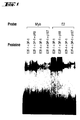
- EMSA was performed as described by Barberis et al., Cell 50, 347 (1987).
- the purified proteins (about 100 ng) were incubated with about 0.5 pmol of a 32 P-labeled probe for 30 min at 22 ° C. in 15 ⁇ l of a buffer of 50 mM Tris / HCl pH 8.0, 50 mM NaCl, 10% v / v glycerol, 0.2 mM EDTA, 1 mM DTT and 67 ⁇ g poly [dA / dT] / ⁇ l contained.
- the probes were labeled by inserting the 4-7 base overhanging ends at the 5 '.
- the samples were separated in 4%, non-denaturing polyacrylamide gel in 0.5x TBE at 4 ° C and 10 V / cm. The gels were exposed, with an X-ray sensitive film and quantitatively analyzed with the aid of a "Molecular Dynamics phosphor imager".
- the B-myb coding oligonucleotide sequence was finally labeled, purified and linked to the non-coding strand.
- the binding reaction was carried out as already described for EMSA. Two microliters of 2% dimethyl sulfate (DMS) were added and the methylation reaction was stopped 3 minutes later by adding 2 ⁇ l of 60 mM ⁇ -mercaptoethanol. The samples were separated in a 4% gel and transferred to ion exchange paper. The bands were cut out, washed in TE buffer and eluted at 65 ° C with TE buffer containing 1.5 M NaCl. The eluted DNA was extracted with chloroform, precipitated and dissolved in water.
- DMS dimethyl sulfate
- Equal radioactive quantities of the gang remaining at the place of application (free sample) and the locomotive being transported Bands (complex) were cleaved with 10% piperidine at 95 ° C for 30 minutes.
- the DNA was prepared and applied to a 15% denaturing acrylamide gel.
- E2F1-DP1, E2F1-DP1-pRb, E2F4-DP1 and E2F4-DP1-p107 to the E2F binding site of the B-myb promoter with comparable strength and with similar affinity to that of the high affinity Adenovirus E2a promoter binding site (Mudryj et al., EMBO J. 9, 2179 (1990)).
- E2F4 complexes were selected for a dimethyl sulfate (DMS) "protection footprinting" analysis, since the protein p107 is regarded as the essential binding protein in E2F complexes that react with the binding structure (Lam et al., EMBO J. 13, 871 (1994) ) and E2F4 is in turn the only known member of the E2F family that reacts with p107 (Beijersbergen et al., Genes Dev. 8, 2680 (1994) and Ginsberg et al., Genes Dev. 8, 2665 (1994)).
- DMS dimethyl sulfate
- NIH3T3 fibroblasts were synchronized by serum withdrawal in G0 and subsequently stimulated with 10% FCS.
- cell cycle progression DNA content
- B-myb mRNA expression was examined in vivo.
- stimulation of resting cells leads to the S phase after about 12 hours.
- the B-myb mRNA expression increases 8 hours after the simulation (ie in the late G1 phase) and reaches the highest value after about 12 Hours, ie at the time of entering the S phase.
- E2F complexes which are found when analyzing cell extracts in the late G1 and in the S phase, such as free E2F and E2F complexes
- E2F complexes do not exist in the living cell, ie in situ to which B-myb E2F binding sequence are bound.
- Nucleotide sequences to which transcription factors of the E2F and CHF families bind such as, for example, the nucleotide sequence CTTGGCGGGAGATAGGAAAGT, must therefore be regarded as new promoter modules which, by binding of E2F and CHF complexes in the G0 and G1 phases, the transcription of a downstream inhibit located genes.
Landscapes
- Genetics & Genomics (AREA)
- Health & Medical Sciences (AREA)
- Engineering & Computer Science (AREA)
- Life Sciences & Earth Sciences (AREA)
- Chemical & Material Sciences (AREA)
- Wood Science & Technology (AREA)
- Organic Chemistry (AREA)
- Biotechnology (AREA)
- General Engineering & Computer Science (AREA)
- Biomedical Technology (AREA)
- Zoology (AREA)
- Bioinformatics & Cheminformatics (AREA)
- Molecular Biology (AREA)
- Microbiology (AREA)
- Plant Pathology (AREA)
- Physics & Mathematics (AREA)
- Biochemistry (AREA)
- General Health & Medical Sciences (AREA)
- Biophysics (AREA)
- Medicines That Contain Protein Lipid Enzymes And Other Medicines (AREA)
- Micro-Organisms Or Cultivation Processes Thereof (AREA)
- Pharmaceuticals Containing Other Organic And Inorganic Compounds (AREA)
Abstract
- a) eine Aktivatorsequenz, deren Funktion die zellspezifische oder virusspezifische Aktivierung der basalen Transkription ist.
- b) ein Promotormodul, das eine Nukleotidsequenz aufweist, die wenigstens ein Protein der E2F-Familie bindet und eine weitere Nukleotidsequenz aufweist, die wenigstens ein Protein der CHF-Familie bindet und die desweiteren eine die Transkription initiierende Sequenz enthalten kann.
- c) ein Strukturgen, das für einen Wirkstoff kodiert, der sowohl zellspezifisch oder virusspezifisch wie auch zellzyklusabhängig exprimiert wird.
Description
- Es werden Nukleinsäurekonstrukte beschrieben, die in der Gentechnologie und insbesondere in der Gentherapie von Erkrankungen verwendet werden können.
- Bei der Gentherapie werden Gene in den Organismus eingeführt, die im Organismus exprimiert werden sollen. Die Regulation der Expression dieser Gene ist bedeutsam für den therapeutischen Effekt der Gentherapie.
- Gegenstand der vorliegenden Erfindung sind daher Nukleinsäurekonstrukte, die bei der Gentherapie verwendet werden können. Hierbei handelt es sich um Nukleinsäurekonstrukte für die sowohl zellspezifische oder virusspezifische wie auch zellzyklusregulierte Expression von wenigstens einem Gen umfassend folgende Komponenten:
- a) eine Aktivatorsequenz, deren Funktion die zellspezifische oder virusspezifische Aktivierung der basalen Transkription ist.
- b) ein Promotormodul, das eine Nukleotidsequenz aufweist, die wenigstens ein Protein der E2F-Familie bindet und eine weitere Nukleotidsequenz aufweist, die wenigstens ein Protein der CHF-Familie bindet und die desweiteren eine die Transkription initiierende Sequenz enthalten kann.
- c) ein Strukturgen, das für einen Wirkstoff kodiert, der sowohl zellspezifisch oder virusspezifisch wie auch zellzyklusabhängig exprimiert wird.
- Bei den erfindungsgemäßen Nukleinsäurekonstrukten weist das Promotormodul (b) eine Nukleotidsequenz auf, die einerseits wenigstens ein Protein der E2F-Familie bindet. Diese Sequenz wird bevorzugt ausgewählt aus Nukleotidsequenzen, die die Nukleotidsequenz CTTGGCGGG oder eine funktionell ähnliche (analoge) Sequenz, wie beispielsweise TTTCGCGCC (E2F-Bindestelle des DHFR-Genes) oder TTTCGCGGC (E2F-1 Bindestelle) enthalten.
- Andererseits weist das Promotormodul (b) eine Nukleotidsequenz auf, die wenigstens ein Protein der CHF-Familie bindet. Diese Sequenz enthält bevorzugterweise die Nukleotidsequenz TAGGAAA oder eine funktionell ähnliche (analoge) Sequenz.
- Bei den erfindungsgemäßen Nukleinsäurekonstrukten kann das Promotormodul (b) die Wirkung der stromaufwärts gelegenen Aktivatorsequenz in der G0- und G1-Phase des Zellzyklus hemmen und dadurch die Expression des stromabwärts gelegenen Gens (c) inhibieren.
- In bevorzugter Ausführungsform ist bei den erfindungsgemäßen Nukleinsäurekonstrukten die Aktivatorsequenz (a) zellspezifisch oder virusspezifisch.
- Die Nukleinsäurekonstrukte bestehen bevorzugterweise aus DNS. Unter dem Begriff "Nukleinsäurekonstrukte" werden künstliche Gebilde aus Nukleinsäure verstanden, die sich in den Zielzellen transkribieren können. Sie sind bevorzugt in einen Vektor eingefügt, wobei Plasmidvektoren oder virale Vektoren besonders bevorzugt sind.
- Durch die erfindungsgemäßen Nukleinsäurekonstrukte kann ein Gen (c) sowohl zellspezifisch oder virusspezifisch als auch zellzyklusspezifisch exprimiert werden, wobei es sich bei dem Gen (c) bevorzugt um ein Gen handelt, das für einen pharmakologisch aktiven Wirkstoff oder aber für ein Enzym kodiert, welches eine inaktive Vorstufe eines Pharmakons spaltet in ein aktives Pharmakon.
- Die erfindungsgemäßen Nukleinsäurekonstrukte weisen eine Aktivierungssequenz (a) auf, die bevorzugt ausgewählt ist aus der Gruppe von Promotoren oder Enhancern, die die Transkription in Endothelzellen, glatte Muskelzellen, blutbildende Zellen, Lymphozyten, Makrophagen, Tumorzellen oder Gliazellen aktivieren oder aus Promotorsequenzen bzw. Enhancersequenzen der Viren HBV, HCV, HSV, HPV, EBV, HTLV oder HIV.
- Gegenstand der vorliegenden Erfindung sind auch isolierte Zellen, die ein erfindungsgemäßes Nukleinsäurekonstrukt enthalten.
- Bevorzugt verwendet werden die erfindungsgemäßen Nukleinsäurekonstrukte oder diese enthaltende Zellen zur Herstellung eines Hei mittels zur Behandlung einer Erkrankung, die mit übermäßiger Zellvermehrung einhergeht, wobei die Herstellung des Heilmittels die Einführung eines Nukleinsäurekonstrukts in eine Zielzelle und seine Expression in dem Stadium der Zellproliferation umfaßt.
Die erfindungsgemäßen Nukleinsäurekonstrukte kommen in dieser Form nicht in der Natur vor, d.h. das Gen (c) des Nukleinsäurekonstrukts ist nicht natürlicherweise kombiniert mit der Aktivatorsequenz (a) und dem Promotormodul (b). - Unter der Komponente (a), der Aktivierungssequenz, wird ein Teilabschnitt eines Gens verstanden, an den regulatorische Proteine, die sogenannten Transkriptionsfaktoren, binden können, welche in ihrer Gesamtheit die Transkription des stromabwärts gelegenen Strukturgens aktivieren.
- Als "stromabwärts"-Sequenzen werden diejenigen Bereiche bezeichnet, die in Richtung der Transkription liegen, wohingegen Sequenzen, die in der entgegengesetzten Richtung angeordnet sind, als "stromaufwärts"-Sequenzen bezeichnet werden.
- An das erfindungsgemäß verwendete, stromabwärts der Aktivierungssequenz gelegene Promotormodul binden sowohl Transkriptionsfaktoren der E2F-Familie als auch Transkriptionsfaktoren der CHF-Familie.
- Zu der Familie der E2F-Moleküle gehören beispielsweise die Moleküle E2F1, E2F2, E2F3, E2F4 und E2F5, gegebenenfalls im Komplex mit DP1, DP2 oder DP3. Zu den E2F-Molekülen gehören aktivierende dimere Komplexe, wie beispielsweise E2F1-DP1 und trimere E2F-Komplexe, wie beispielsweise E2F1-DP1-pRb [Bandara et al., Nature, 252, 249 (1991); Chellappan et al., Cell 65, 1053 (1991); Chittenden et al., Cell 65, 1073 (1991); Helin et al., Cell 70, 337 (1992); Kaelin et al., Cell 70, 351 (1992)]. Die Komplexe E2F4-DP1 und E2F4-DP1-p107 wurden beispielsweise beschrieben von Beijersbergen et al., Genes Dev. 8, 2680 (1994) und Ginsberg et al., Genes Dev. 8, 2665 (1994). Weiterhin wären zu erwähnen entsprechende Komplexe enthaltend E2F2, E2F3, E2F5, DP2 und DP3.
- Den Transkriptionsfaktoren, zu denen die E2F-Moleküle gehören, gemeinsam ist die Eigenschaft, daß eine Beziehung zwischen der Expression von Genen und dem Zustand, in dem sich die Zelle befindet, besteht. In ruhenden Zellen ist die Transkription der Gene sehr gering, wohingegen die Transkription in sich teilenden Zellen erhöht ist. Im Experiment mit kultivierten Zellen kann die Stimulierung der Expression durch Zugabe von Serum, bevorzugt fötales Kälberserum, zu ruhenden Zellen erreicht werden.
- Zellen vermehren sich durch Zellteilung, wobei das Genom der Zelle vor der Mitose repliziert wird. Sich nicht teilende, ruhende Zellen befinden sich in einer als G0 bezeichneten Phase oder sind in ihrer Zellstatusprogression durch die G1-Phase inhibiert. Wenn die Zellteilung beginnt, werden die Zellen aus der G0-Phase bzw. dem G1-Block entlassen. Die G1-Phase ist eine üblicherweise verhältnismäßig lang andauernde Phase. In der G0- und G1-Phase befindet sich der DNA-Gehalt der Zelle im diploiden Zustand. An die G1-Phase schließt sich die S-Phase an, in der die DNA-Synthese stattfindet und in der das Genom dupliziert wird. Hieran schließt sich die zweite G-Phase, G2 an, in der die Zelle im tetraploiden Zustand ist. Daraufhin findet die Mitose statt und die Zelle kommt in einen G1- oder G0-Zustand.
- Das B-myb Gen ist an der Zellteilung beteiligt. Die Transkription des B-myb Genes steigt (z.B. in Mäusefibroblasten) in der späten G1-Phase des Zellzyklus an und ist am stärksten ausgeprägt in der S-Phase (Lam et al., EMBO J. 12, 2705 (1993)).
- Die Nukleotidsequenz CTTGGCGGGAG ist ein Bestandteil der Promotorsequenz des B-myb-Genes und an der Repression des Gens in der G0- und frühen G1-Phase beteiligt (Lam et al., EMBO J. 12, 2705 (1993)). TTTCGCGC ist ein Bestandteil des E2a Promotors des Adenovirus und repräsentiert eine Zone der aktivierenden E2F-Bindestellen (Mudryj et al., EMBO J. 9, 2179 (1990)).
- Im Rahmen der vorliegenden Erfindung wurde nun gefunden, daß ein bestimmter Bereich aus der Promotorsequenz des B-myb-Genes die Expression eines Genes, das Teil eines erfindungsgemäßen Nukleinsäurekonstruktes ist, steuern kann. Diese Nukleotidsequenz, die erfindungsgemäß als Promotormodul (b) bezeichnet wird, ist wesentlich an der Regulation, insbesondere Repression des stromabwärts gelegenen Gens in der G0- und frühen G1-Phase beteiligt.
- Das erfindungsgemäß verwendete Promotormodul (b) weist eine Nukleotidsequenz auf, an welche die Transkriptionsfaktoren der E2F-Familie binden können. Hierbei handelt es sich um folgende Sequenz:
CTTGGCGGG Seq.-ID 1
oder um analoge Varianten dieser Sequenz, wie beispielsweise
TTTCGCGCC Seq.-ID 2
TTTCGCGGC Seq.-ID 3. - Weiterhin weist das erfindungsgemäße Promotormodul (b) eine von der E2F-Stelle am 3'-Ende stromabwärts gelegene Sequenz auf, an die ein Molekül der CHF-Familie binden kann. Diese Nukleotidsequenz, die für die Repression ebenfalls notwendig ist, kooperiert mit der E2F-Bindestelle bei der Repression und umfaßt die Sequenz
TAGGAAA Seq.-ID 4
oder um analoge Varianten dieser Sequenz. - Im B-myb Gen liegen die Sequenz 1 und Sequenz 4 des erfindungsgemäßen Promotormoduls in folgender Zuordnung vor
CTTGGCGGGAGATAGGAAAGT Seq.-ID 5. - In besonders bevorzugter Ausführungsform beinhaltet das Promotormodul diese Sequenz.
- Im Rahmen der vorliegenden Erfindung wurde nun festgestellt, daß dieses Promotormodul eine hochaffine E2F-Bindestelle aufweist und, daß die Bindung von E2F-Molekülen an diese Nukleotidsequenz (insbesondere CTTGGCGGG) in vivo, also in der lebenden Zelle, überraschenderweise (und im Gegensatz zu den von Lam et al., EMBO-J. 12, 2705 (1993) biochemischen (in vitro) Bindungsdaten) auf die G0- und frühe G1-Phase beschränkt und in der S, G2 und M Phase, (d.h. bei stärkster Transkription des B-myb Genes) nicht nachweisbar ist.
- Weiterhin war nicht vorherzusehen, daß für die wirkungsvolle Repression eine weitere, von der E2F Bindestelle stromabwärts gelegene Bindungsregion für Proteine aus der CHF-Familie (bevorzugt TAGGAAA) erforderlich ist.
- Da zum Zeitpunkt der Transkription des B-myb-Genes keine Bindung des E2F-Proteins an die Nukleotidsequenz CTTGGCGGGAG festgestellt wird, spielen die in der Zelle vorhandenen aktivierenden E2F-Dimere bei der Zellzyklusregulation des B-myb-Gens keine erkennbare Rolle. Somit ist die E2F-vermittelte Repression der ausschlaggebende Mechanismus bei der Regulation von B-myb.
- Die Anordnung der erfindungsgemäßen Nukleinsäurekonstrukte kann in schematischer Weise dargestellt werden wie folgt:

- Die Aktivatorsequenz und das Strukturgen für den Wirkstoff der erfindungsgemäßen Nukleinsäurekonstrukte werden je nach Verwendungszweck ausgewählt. Bevorzugt sind folgende Anwendungsmöglichkeiten:
- Im Sinne dieser Erfindung zählen zu den bevorzugten Aktivatorsequenzen solche genregulatorische Sequenzen bzw. Elemente aus Promotoren für Gene, die für besonders in Endothelzellen (oder aber in Zellen in unmittelbarer Nachbarschaff mit proliferierenden Endothelzellen) nachweisbare Proteine kodieren.
- Einige dieser Proteine sind von Burrows et al. (Pharmac. Therp. 64, 155 (1994)) und Plate et al. (Brain Pathol. 4, 207 (1994)) beschrieben worden. Im besonderen zählen zu diesen Endothelzell-spezifischen Proteinen beispielsweise:
- Hirn-spezifischer, endothelialer Glucose-1-Transporter Die Promotorsequenz wurde von Murakami et al. (J. Biol. Chem. 267, 9300 (1992)) beschrieben.
- Endoglin
Die Promotorsequenz wurde von Bellon et al. (Eur. J. Immunol. 23, 2340 (1993)) und Ge et al. (Gene 138, 201 (1994)) beschrieben. - VEGF-Rezeptoren
Zwei Rezeptoren werden unterschieden (Plate et al., Int. J. Cancer 59, 520 (1994)):- VEGF-Rezeptor-1 (flt-1)
(de Vries et al., Science 255, 989 (1992)) und der - VEGF-Rezeptor-2 (flk-1, KDR)
(Terman et al., BBRC 187, 1579 (1992)).
- VEGF-Rezeptor-1 (flt-1)
- Beide Rezeptoren sind fast ausschließlich auf endothelialen Zellen (Senger et al., Cancer Metast. Rev. 12, 303 (1993)) anzutreffen.
- andere endothelspezifische Rezeptortyrosinkinasen
- til-1 oder til-2
(Partanen et al., Mol. Cell. Biol. 12, 1698 (1992), Schnürch and Risau, Development 119, 957 (1993), Dumont et al., Oncogene 7, 1471 (1992)) - B61-Rezeptor (Eck-Rezeptor)
(Bartley et al., Nature 368, 558 (1994), Pandey et al., Science 268, 567 (1995), van der Geer et al., Ann. Rev. Cell. Biol. 10, 251 (1994))
- til-1 oder til-2
- B61
Das B61-Molekül stellt den Liganden dar für den B61-Rezeptor.
(Holzman et al., J. Am. Soc. Nephrol. 4, 466 (1993), Bartley et al., Nature 368, 558 (1994)) - Endothelin, im speziellen
- Endothelin B
Die Promotorsequenz wurde von Benatti et al., J. Clin. Invest. 91, 1149 (1993) beschrieben. - Endothelin-1
Die Promotorsequenz wurde von Wilson et al., Mol. Cell. Biol. 10, 4654 (1990) beschrieben.
- Endothelin B
- Endothelin-Rezeptoren, insbesondere der Endothelin-B
Rezeptor
(Webb et al., Mol. Pharmacol. 47, 730 (1995), Haendler et al., J. Cardiovasc. Pharm. 20, 1 (1992)). - Mannose-6-Phosphat-Rezeptoren Die Promotorsequenzen sind von Ludwig et al. (Gene 142, 311 (1994)), Oshima et al. (J. Biol. Chem. 263, 2553 (1988)) und Pohlmann et al. (PNAS USA 84, 5575 (1987)) beschrieben worden.
- von Willebrand Faktor
Die Promotorsequenz wurde von Jahroudi und Lynch, Mol. Cell. Biol. 14, 999 (1994), Ferreira et al., Biochem. J. 293, 641 (1993) und Aird et al., PNAS USA 92, 4567 (1995)) beschrieben. - IL-1α, IL-1β
Die Promotorsequenzen wurden von Hangen et al., Mol. Carcinog. 2, 68 (1986), Turner et al., J. Immunol. 143, 3556 (1989), Fenton et al., J. Immunol. 138, 3972 (1987), Bensi et al., Cell Growth Diff. 1, 491 (1990), Hiscott et al., Mol. Cell. Biol. 13, 6231 (1993) und Mori et al., Blood 84, 1688 (1994) beschrieben. - IL-1-Rezeptor
Die Promotorsequenz wurde von Ye et al., PNAS USA 90, 2295 (1993) beschrieben. - Vascular Cell Adhesion Molecule (VCAM-1)
Die Promotorsequenz des VCAM-1 wurde beschrieben von Neish et al., Mol. Cell. Biol. 15, 2558 (1995), Ahmad et al., J. Biol. Chem. 270, 8976 (1995), Neish et al., J. Exp. Med. 176, 1583 (1992), Iademarco et al., J. Biol. Chem. 267, 16323 (1992) und Cybulsky et al., PNAS USA 88, 7859 (1991). - synthetische Aktivatorsequenz
Als Alternative zu natürlichen endothelspezifischen Promotoren lassen sich auch synthetische Aktivatorsequenzen verwenden, die aus oligomerisierten Bindestellen für Transkriptionsfaktoren, die preferentiell oder selektiv in Endothelzellen aktiv sind, bestehen. Ein Beispiel hierfür ist der Transkriptionsfaktor GATA-2, dessen Bindestelle im Endothelin-1 Gen 5'-TTATCT-3' ist (Lee et al., Biol. Chem. 266, 16188 (1991), Dorfmann et al., J. Biol. Chem. 267, 1279 (1992) und Wilson et al., Mol. Cell. Biol. 10, 4854 (1990)). - Bei proliferierenden Endothelien werden durch geöffnete "tight junctions" Nachbarzellen für Makromoleküle vom Blut aus zugänglich. Durch die funktionellen und anatomischen Wechselbeziehungen sind die Nachbarzellen von aktivierten Endothelzellen Zielzellen im Sinne dieser Erfindung.
- VEGF
Die genregulatorischen Sequenzen für das VEGF-Gen sind- die Promotorsequenz des VEGF-Gens (5' flankierende Region) (Michenko et al., Cell. Mol. Biol. Res. 40, 35 (1994), Tischer et al., J. Biol. Chem. 266, 11947 (1991)) oder
- die Enhancersequenz des VEGF-Gens (3' flankierende Region) (Michenko et al., Cell. Mol. Biol. Res. 40, 35 (1994)) oder
- das c-Src-Gen
(Mukhopadhyay et al., Nature 375, 577 (1995), Bonham et al., Oncogene 8, 1973 (1993), Parker et al., Mol. Cell. Biol. 5, 831 (1985), Anderson et al., Mol. Cell. Biol. 5, 1122 (1985)) oder - das V-Src-Gen
(Mukhodpadhyay et al., Nature 375, 577 (1995), Anderson et al., Mol. Cell. Biol. 5, 1122 (1985), Gibbs et al., J. Virol. 53, 19 (1985))
- Steroid-Hormonrezeptoren und deren Promotorelemente (Truss and Beato, Endocr. Rev. 14, 459 (1993)), insbesondere der
- Maus-Mammatumor-Virus-Promotor
Die cDNA-Sequenz der Promotorregion der long terminal repeat region des MMTV wurde von Chalepakis et al., Cell 53, 371 (1988) und Truss und Beato (Endocr. Rev. 14, 459 (1993)) beschrieben.
- Maus-Mammatumor-Virus-Promotor
- Als antitumorale oder antientzündliche Substanz im Sinne dieser Erfindung ist die DNA-Sequenz eines Proteins zu verstehen, welches die Proliferation von Endothelzellen inhibiert. Hierzu gehören beispielsweise die DNA-Sequenzen für:
- das Retinoblastomprotein (pRb/p110) oder für seine Analoga p107 und p120
- das p53 Protein
- das p21 (WAF-1) Protein
- das p16 Protein
- weitere CdK-Inhibitoren
- das GADD45 Protein
- das bak Protein
- Um eine schnelle intrazelluläre Inaktivierung dieser Zellzyklusinhibitoren zu verhindern, sind bevorzugt solche Gene zu verwenden, welche Mutationen für die Inaktivierungsstellen der exprimierten Proteine aufweisen, ohne daß diese hierdurch in ihrer Funktion beeinträchtigt werden.
- Das Retinoblastomprotein (pRb) und die Verwandten p107 und p130 Proteine werden durch Phosphorylierung inaktiviert. Bevorzugt wird somit eine pRb/p110-, p107 - oder p130 cDNA-Sequenz verwendet, die derartig punktmutiert ist, daß die Phosphorylierungsstellen des kodierten Proteins gegen nicht phosphorylierbare Aminosäuren ausgetauscht sind.
- Als antitumorale bzw. antientzündliche Substanz ist desweiteren die DNA-Sequenz für ein Protein zu verstehen, welches die Angiogenese inhibiert. Zu diesen Proteinen zählt beispielsweise:
- Tissuefactor (TF) und gerinnungsaktive Fragmente von ihm
- Plasminogenaktivatorinhibitor-1 (PAI-1)
- PAI-2
- PAI-3
- Angiostatin
- Interferone
- IFNα
- IFNβ
- IFNγ
- Platelet factor 4
- IL-12
- TIMP-1
- TIMP-2
- TIMP-3
- Leukemia Inhibitory Factor (LIF)
- Als antitumorale bzw. antientzündliche Substanz ist jedoch auch eine DNA-Sequenz für ein Protein zu verstehen, welches direkt oder indirekt eine zytostatische Wirkung auf Tumoren aufweist. Hierzu zählen im besonderen
- Antikörper und Antikörperspaltprodukte
- Perforin
- Granzym
- IL-2
- IL-4
- IL-12
- Interferone, wie beispielsweise
- * IFN-α
- * IFN-β
- * IFN-γ
- TNF
- * TNF-α
- * TNF-β
- Oncostatin M
- Magainin und Magininderivate (Cruciani et al. PNAS 88, 3792 (1991); Peck-Miller et al.; Cancer Chemoth. Pharmac. 32, 109, (1993))
- Sphingomyelinase (Jarvis et al. PNAS-USA 91, 73 (1994))
- Als antitumorale Substanz ist des weiteren die DNA-Sequenz für ein Protein zu verstehen, welches ggf. zusätzlich zur antitumoralen Wirkung Entzündungen stimuliert und hierdurch zur Elimination von Tumorzellen beiträgt. Hierzu zählen im besonderen beispielsweise:
- RANTES (MCP-2)
- monocyte chemotactic and activating factor (MCAF)
- IL-8
- macrophage inflammatory protein-1 (MIP-1a, -β)
- neutrophil activating protein-2 (NAP-2)
- IL-3
- IL-5
- human leukemia inhibitory factor (LIF)
- IL-7
- IL-11
- IL-13
- GM-CSF
- G-CSF
- M-CSF
- Bakterielle Proteine, welche Komplement aktivieren
- Cobra Venom Faktor (CVF) und Teilsequenzen vom CVF
- Als Wirksubstanz in Sinne der Erfindung können auch DNA-Sequenzen von Fusionsproteinen zwischen den aufgeführten Cytokinen zum einen und dem Fc-Teil des menschlichen Immunglobulins zum anderen Verwendung finden. Derartige DNA-Sequenzen und ihre Herstellung wurden in der EP 0464 633 A1 beschrieben.
- Als antitumorale bzw. antientzündliche Substanz ist jedoch auch die DNA-Sequenz für ein Enzym zu verstehen, welches in der Lage ist, Vorstufen eines antitumoralen Wirkstoffes in einen antitumoralen Wirkstoff zu überführen.
- Derartige Enzyme, welche inaktive Vorsubstanzen (Prodrugs) in aktive Zytostatika (Drugs) spalten und die jeweils zugehörigen Prodrugs und Drugs sind bereits von Deonarain et al. Br. J. Cancer 70, 786 (1994), von Mullen, Pharmac. Ther. 63, 199 (1994) und Harris et al., Gene Ther. 1, 170 (1994) übersichtlich beschrieben worden.
- Beispielsweise ist die DNA-Sequenz eines der folgenden Enzyme zu verwenden:
- Herpes Simplex Virus Thymidinkinase
(Garapin et al., PNAS USA 76, 3755 (1979), Vile et al., Cancer Res. 53, 3860 (1993), Wagner et al., PNAS USA 78, 1441 (1981), Moelten et al., Cancer Res. 46, 5276 (1986), J. Natl. Cancer Inst. 82, 297 (1990)) - Varizella Zosier Virus Thymidinkinase (Huber et al., PNAS USA 88, 8039 (1991), Snoeck, Int. J. Antimicrob. Agents 4, 211 (1994))
- bakterielle Nitroreduktase
(Michael et al., FEMS Microbiol. Letters 124, 195 (1994), Bryant et al., J. Biol. Chem. 266, 4126 (1991), Watanabe et al., Nucleic Acids Res. 18, 1059 (1990)) - bakterielle β-Glucuronidase
(Jefferson et al., PNAS USA 83, 8447 (1986)) - pflanzliche β-Glucuronidase aus Secale cereale
(Schulz et al., Phytochemistry 26, 933 (1987)) - humane β-Glucuronidase
(Bosslet et al., Br. J. Cancer 65, 234 (1992), Oshima et al., PNAS USA 84, 685 (1987)) - humane Carboxy peptidase (CB) z.B.
- * CB-A der Mastzelle
(Reynolds et al., J. Clin. Invest. 89, 273 (1992)) - * CB-B des Pankreas
(Yamamoto et al., J. Biol. Chem. 267, 2575 (1992), Catasus et al., J. Biol. Chem. 270, 6651 (1995)) - * bakterielle Carboxy peptidase
(Hamilton et al., J. Bacteriol. 174, 1626 (1992), Osterman et al., J. Protein Chem. 11, 561 (1992))
- * CB-A der Mastzelle
- bakierielle β-Laktamase
(Rodrigues et al., Cancer Res. 55, 63 (1995), Hussain et al., J. Bacteriol. 164, 223 (1985), Coque et al., Embo J. 12, 631 (1993)) - bakterielle Cytosine deaminase
(Mullen et al., PNAS USA 89, 33 (1992), Austin et al., Mol. Pharmac. 43, 380 (1993), Danielson et al., Mol. Microbiol. 6, 1335 (1992)) - humane Catalase bzw. Peroxidase
(Ezurum et al., Nucl. Acids Res. 21, 1607 (1993)) - Phosphatase, im besonderen
- * humane alkalische Phosphatase
(Gum et al., Cancer Res. 50, 1085 (1990)) - * humane saure Prostataphosphatase
(Sharieff et al., Am. J. Hum. Gen. 49, 412 (1991), Song et al., Gene 129, 291 (1993), Tailor et al., Nucl. Acids Res. 18, 4928 (1990)) - * Typ 5 saure Phosphatase
(Gene 130, 201 (1993))
- * humane alkalische Phosphatase
- Oxidase, im besonderen
- * humane Lysyloxidase
(Kimi et al., J. Biol. Chem. 270, 7176 (1995)) - * humane saure D-aminooxidase
(Fukui et al., J. Biol. Chem. 267, 18631 (1992))
- * humane Lysyloxidase
- Peroxidase, im besonderen
- * humane Glutathion Peroxidase
(Chada et al., Genomcis 6, 268 (1990), Ishida et al., Nucl. Acids Res. 15, 10051 (1987)) - * humane Eosinophilen Peroxidase
(Ten et al., J. Exp. Med. 169, 1757 (1989), Sahamaki et al., J. Biol. Chem. 264, 16828 (1989)) - * humane Schilddrüsen Peroxidase
(Kimura, PNAS USA 84, 5555 (1987)).
- * humane Glutathion Peroxidase
- Zur Erleichterung der Sekretion der aufgeführten Enzyme kann die jeweils in der DNA-Sequenz enthaltende homologe Signalsequenz ersetzt werden durch eine heterologe, die extrazelluläre Ausschleusung verbessernde Signalsequenz.
- So kann beispielsweise die Signalsequenz der β-Glucuronidase (DNA Position 〈 27 bis 93; Oshima et al., PNAS 84, 685 (1987)) ersetzt werden durch die Signalsequenz für das Immunglobulin (DNA Position 〈 63 bis 〉 107; Riechmann et al., Nature 332, 323 (1988)).
- Des weiteren sind bevorzugt DNAs solcher Enzyme zu wählen, welche durch Punktmutationen in einem geringeren Maße in Lysosomen gespeichert und vermehrt sekretiert werden.
- Gegenstand der Erfindung sind desweiteren Nukleinsäurekonstrukte, in welchen eine Kombination der DNA-Sequenzen von mehreren gleichen antitumoralen oder antientzündlichen Substanzen (A,A) oder von unterschiedlichen antitumoralen Substanzen (A,B) vorliegt. Zur Expression von zwei DNA-Sequenzen wird vorzugsweise die cDNA einer "internal ribosome entry site" (IRES) als regulatorisches Element zwischengeschaltet.

- Derartige IRES wurden beispielsweise von Mountford und Smith TIG 11, 179 (1995), Kaufman et al., Nucl. Acids Res. 19, 4485 (1991), Morgan et al., Nucl. Acids Res. 20, 1293 (1992, Dirks et al., Gene 128, 247 (1993), Pelletier und Sonenberg, Nature 334, 320 (1988) und Sugitomo et al., BioTechn. 12, 694 (1994) beschrieben.
- So kann die cDNA der IRES-Sequenz des Poliovirus (Position 〈 140 bis 〉 630 des 5' UTR; Pelletier und Sonenberg, Nature 334, 320 (1988)) zur Verknüpfung der DNA der antientzündlichen Substanz A (am 3' Ende) und der DNA der antientzündlichen Substanz B (am 5' Terminus) verwendet werden.
- Ein derartiger Wirkstoff weist je nach Kombination additive (A+A, A+B1) oder synergistische Wirkung im Sinne der Erfindung auf.
- Im Sinne der vorliegenden Erfindung wird als Aktivatorsequenz bevorzugt eine genregulatorische Sequenz bzw. ein Element aus einem Gen verwendet, welches ein Protein kodiert, welches besonders stark oder selektiv in Zellen der Blutbildung exprimiert ist. Zu solchen genregulatorischen Sequenzen gehören Promotorsequenzen für Gene eines Cytokins oder seines Rezeptors, dessen Expression in den unreifen blutbildenden Zellen (oder in benachbarten Zellen, wie beispielsweise dem Stroma), dem nachfolgenden, auf die blutbildenden Zellen einwirkenden und als Wirksubstanz gewünschten Cytokin vorgeschaltet ist. Beispielsweise sind derartige auf unreife blutbildende Zellen einwirkende Cytokine wie:
- Stem Cell Factor
- IL-1
- IL-3
- IL-6
GM-CSF - Als Wirksubstanz im Sinne der Erfindung ist eine DNA-Sequenz zu verstehen, deren exprimiertes Protein die Proliferation und/oder Differenzierung von Blutzellen bewirkt.
- Als Aktivatorsequenzen sind die Promotorsequenzen der Gene für solche Proteine zu verwenden, welche bei der Immunreaktion in Makrophagen und/oder in Lymphozyten verstärkt gebildet werden. Derartige Proteine sind beispielsweise
- IL-1
- IL-1-β
- IL-1 -Rezeptor
- IL-2
- IL-2-Rezeptor
- IL-3
- IL-3-Rezeptor
- IFN-γ
- IL-4
- IL-4-Rezeptor
- IL-5
- IL-6
- LIF
- IL-7
- IL-10
- IL-11
- IL-12
- IL-13
- IM-CSF
- GM-CSF-Rezeptor
- Integrin beta 2 proteins
- Die Wirksubstanz im Sinne der Erfindung ist die DNA-Sequenz für ein Cytokin, ein Chemokin, einen Wachstumsfaktor oder einer ihrer Inhibitoren, einen Antikörper, ein Antikörperfragment, einen Enzyminhibitor oder ein Enzym. Die Auswahl der Wirksubstanz richtet sich nach der zu behandelnden Grunderkrankung und der gewählten Promotorsequenz.
- Als Aktivatorsequenz ist eine Nukleotidsequenz (Promotor- oder Enhancersequenz) zu verstehen, mit der Transkriptionsfaktoren gebildet oder aktiv in Synovialzellen und Entzündungszellen interagieren. Im Sinne dieser Erfindung zählen zu den bevorzugten Promotorsequenzen genregulatorische Sequenzen bzw. Elemente aus Genen, die für besonders in Synovialzellen und Entzündungszellen exprimierte Proteine kodieren.
- Als Wirksubstanz im Sinne der Erfindung ist eine DNA-Sequenz zu verstehen deren exprimiertes Protein die Entzündung beispielsweise im Gelenk direkt oder indirekt hemmt und/oder die Rekonstitution von extrazellulärer Matrix (Knorpel, Bindegewebe) im Gelenk fördert.
- Der Wirkstoff kann in zwei grundsätzlich unterschiedlichen Formen hergestellt werden
- für die Therapie von Virusinfektionen und Parasiteninvasionen oder aber
- für die Prophylaxe von Infektionserkrankungen durch Viren, Bakterien oder Parasiten.
- Zur Prophylaxe von Infektionserkrankungen dienen Impfstoffe. Die Möglichkeiten, auf konventionellem Wege wirkungsvolle Impfstoffe herzustellen, sind jedoch beschränkt (Brown, Int.J. Technol. Assessm. Health Care 10, 161 (1994), Ellis, Adv. Exp. Med. Biol. 327, 263 (1992), Arnon et al., FASEB J. 6, 3265 (1992)).
- Demzufolge wurde die Technologie der DNA-Vakzine ent▼wickelt. Diese DNA-Vakzinen werfen jedoch Fragen zur Sicherheit und zu Nebenwirkungen auf (Fynan et al., Int. J. Immunopharm. 17, 79 (1995), Donnelly et al., Immunol. 2, 20 (1994)).
- Wirkstoffe zur Prophylaxe von Infektionserkrankungen im Sinne dieser Erfindung zeichnen sich wegen ihrer Zellspezifität und Zellzyklusregulation durch ein hohes Maß an Sicherheit aus.
- Als Aktivatorsequenz sind Promotorsequenzen von Zellgenen auszuwählen, deren Aktivität besonders durch Infektionen mit Bakterien oder Parasiten verändert wird oder es sind Promotorsequenzen solcher Viren auszuwählen, die die von ihnen infizierten Zellen transformieren und zur Proliferation anregen.
- Zu diesen Viren gehören beispielsweise HBV, HCV, HSV, HPV, HIV, EBV und HTLV.
- Als Wirksubstanz ist die DNA eines Proteins auszuwählen, welches zytostatische, zytotoxische, antibakterielle oder antivirale Wirkungen aufweist. Beispiele für zytotoxische oder zytostatische Proteine wurden schon oben aufgeführt. Als Beispiel für antibakterielle oder antivirale Proteine sind Antikörper oder Antikörperfragmente zu nennen. Bei der Wahl eines Enzyms ist nachfolgend die durch dieses Enzym spaltbare Vorstufe einer antibakteriellen, antiviralen zytotoxischen oder antiparasitären Substanz zu verabreichen.
- Wirksubstanzen für antivirale Proteine im Sinne dieser Erfindung sind des weiteren antiviral wirksame Cytokine und Wachstumsfaktoren. Hierzu zählen beispielsweise die DNA-Sequenzen für folgende Wirksubstanzen:
- IFN-α
- IFN-β
- IFN-γ
- TNF-β
- TNF-α
- IL-1
- TGF-β
- Als Wirksubstanz im Sinne der Erfindung können jedoch auch DNA-Sequenzen von Fusionsproteinen zwischen den aufgeführten Cytokinen, Wachstumsfaktoren oder dem extrazellulären Teil der Rezeptoren zum einen und dem Fc-Teil des menschlichen Immunglobulins zum anderen Verwendung finden. Derartige DNA-Sequenzen und ihre Herstellung wurden beispielsweise in der EPA 0464 633 A1 beschrieben.
- Als Wirksubstanz ist die DNA entweder eines Antikörpers oder eines Antikörperfragmentes spezifisch für den Infektionserreger oder die DNA eines vom Infektionserreger gebildeten Proteins auszuwählen, welches durch eine Immunreaktion, d.h. durch Antikörperbindung und/oder durch zytotoxische T-Lymphozyten zur Neutralisierung und/oder zur Abtötung des Erregers führt. Derartige Neutralisationsantigene werden als Impfantigene bereits angewandt (siehe Übersicht bei Ellis, Adv. Exp. Med. Biol. 327, 263 (1992)).
- Als Aktivatorsequenz ist eine Nukleotidsequenz (Promotor- oder Enhancersequenz) vorgesehen, mit der Transkriptionsfaktoren, gebildet oder aktiv in Leukämiezellen oder Tumorzellen, interagieren.
- Im Sinne dieser Erfindung zählen zu den bevorzugten Aktivatorsequenzen jedoch genregulatorische Sequenzen bzw. Elemente aus Genen, die besonders in Tumorzellen oder Leukämiezellen gebildete Proteine kodieren.
- Als Wirksubstanz im Sinne der Erfindung ist eine DNA-Sequenz zu verstehen deren exprimiertes Protein die Proliferation von Zellen, insbesondere auch von Tumorzellen oder Leukämiezellen, inhibiert. Zu diesen Zellzyklusinhibitoren gehören beispielsweise die DNA-Sequenzen für inhibitorische zytostatische und ztyotoxische Proteine und Enzyme, wie sie bereits beschrieben wurden.
- Als Zellzyklusinhibitor ist des weiteren eine DNA-Sequenz zu verstehen, welche ein Protein exprimiert, welches direkt oder indirekt eine zytostatische oder zytotoxische Wirkung auf Leukämien oder Tumoren aufweist.
- Als Aktivatorsequenzen im Sinne der Erfindung sind bevorzugt genregulatorische Sequenzen bzw. Elemente aus Genen zu verwenden, die, besonders in glatten Muskelzellen, gebildete Proteine kodieren.
- Als Wirksubstanz in Sinne der Erfindung ist eine DNA-Sequenz zu verstehen, deren exprimiertes Protein die Proliferation von glatten Muskelzellen inhibiert. Zu diesen Inhibitoren der Proliferation gehören die bereits erwähnten Proteine.
- Als Wirksubstanz ist jedoch auch die DNA-Sequenz für ein Enzym zu verstehen, welches eine inaktive Vorstufe eines Zytostatikums in ein Zytostatikum umwandelt.
- Als Aktivatorsequenzen im Sinne der Erfindung sind bevorzugt genregulatorische Sequenzen bzw. Elemente aus Genen zu verwenden, welche in glatten Muskelzellen, in aktivierten Endothelzellen, in aktivierten Makrophagen oder in aktivierten Lymphozyten nachweisbare Proteine kodieren.
- Beispiele für Promotorsequenzen für Gene in glatten Muskelzellen sind bereits erwähnt.
- Beispiele für Proteine, welche besonders in aktivierien Endothelzellen gebildet werden, sind von Burrows et al. (Pharmac. Therp. 64, 155 (1994)) beschrieben worden. Im besonderen zählen zu diesen in Endothelzellen verstärkt auftretenden Proteinen beispielsweise solche Proteine, wie sie und die Promotorsequenzen ihrer Gene bereits im oben aufgeführt wurden.
- Als Aktivatorsequenz im Sinne dieser Erfindung sind außerdem Promotorsequenzen der Gene für Proteine zu verstehen, welche bei der Immunreaktion in Makrophagen und/oder in Lymphozyten verstärkt gebildet werden.
- Als Wirksubstanz im Sinne dieser Erfindung ist eine DNA▼Sequenz zu verwenden, welche ein Protein kodiert, welches direkt oder indirekt die Thrombozytenaggregation oder einen Blutgerinnungsfaktor inhibiert oder die Fibrinolyse stimuliert.
- Eine derartige Wirksubstanz wird als Gerinnungshemmer bezeichnet. Als Gerinnungshemmer sind Gene für beispielsweise Plasminogenaktivatoren (PA), so der Gewebe-PA (tPA) oder der Urokinase ähnliche PA (uPA) oder Protein G, Antithrombin-III, C-1S-Inhibitor, µ1-Antitrypsin, der Tissue Facior Pathway Inhibitor (TFPI) oder Hirudin einzusetzen.
- Als Wirksubstanz im Sinne dieser Erfindung ist jedoch auch eine DNA-Sequenz zu verwenden, welche ein Protein kodiert, welches die Blutgerinnung fördert. Beispiele für derartige Proteine sind beispielsweise Blutplasmaproteine wie Faktor VIII oder Faktor IX.
- Im besonderen zählen hierzu die Promotorsequenzen für die Gene von Endothelzell-spezifischen Proteinen.
- Als bevorzugte Aktivatorsequenz ist desweiteren eine Nukleotidsequenz (Promotor- oder Enhancersequenz) zu verstehen, welche mit Transkriptionsfaktoren, im besonderen Maße gebildet oder aktiv in Gliazellen, interagieren.
- Als neurospezifischer Faktor im Sinne der Erfindung ist eine DNA-Sequenz zu verstehen, welche für einen neuronalen Wachstumsfaktor kodiert.
- Anhand der nachfolgenden Beispiele wird die vorliegende Erfindung näher erläutert.
- Die Wechselwirkung zwischen der Nukleotidsequenz CTTGCGGGAG des B-myb Promotors und den E2F-Komplexen wurde durch den "electrophoretic mobility shift assay" (EMSA) und durch "methylation protection footprinting" untersucht.
- Der EMSA wurde durchgeführt wie von Barberis et al., Cell 50, 347 (1987) beschrieben.
- Hierzu wurden folgende GST-Fusionsproteine in E. coli exprimiert und durch Affinitätschromatographie gereinigt:
- E2F1, Aminosäuren 87-1398 (Helin et al., Cell 70, 337 (1992) and Kaelin et al., Genes Dev. 8, 2665 (1994))
- E2F4, Gesamtprotein (Beijersbergen et al., Genes Dev. 8, 2680 (1994) and Ginsberg et al., Genes Dev. 8, 2665 (1994))
- pRb, Aminosäuren 300-928 (Bernards et al., Proc. Natl. Acad. Sci. USA 86, 6474 (1989))
- p107, Aminosäuren 744-2460 (Ewen et al., Cell 66, 1155 (1991).
- Die gereinigten Proteine (etwa 100 ng) wurden inkubiert mit etwa 0,5 pmol einer 32P-markierten Sonde für 30 min bei 22 °C in 15 µl eines Puffers der 50 mM Tris/HCl pH 8.0, 50 mM NaCl, 10% v/v Glycerol, 0.2 mM EDTA, 1 mM DTT und 67 µg poly[dA/dT]/µl enthielt. Die Sonden wurden markiert durch Einfügung der an den 5' überhängenden Enden von 4-7 Basen. Die Proben wurden in 4%igem, nicht denaturierendem Polyacrylamid-Gel in 0.5x TBE bei 4 °C und 10 V/cm aufgetrennt. Die Gele wurden exponiert, mit einem Röntgenstrahlen-empfindlichen Film und quantitativ analysiert mit Hilfe eines "Molecular Dynamics Phosphor-Imager".
- Die folgenden Sonden wurden benutzt:
- B-myb [Lam et al., EMBO J. 12, 2705 (1993)],
5'-GGCGCCGACGCACTTG GCGGGAGATAGGAAAGTGGTTCTGTG (Seq.-ID 6) (die E2F Bindungsstelle ist unterstrichen) - mutiertes B-myb:
5'-GGCGCCGACGCACTT GGCTGGAGATAGGAAAGT GGTTCTGTG (Seq.-ID 7) - der E2a Promotor des Adenovirus:
5'-gatcGACTAGT TTCGCGCCCTTTCTActag (Seq.-ID 8) (die kleinen Buchstaben stellen nicht relevante Sequenzen dar, die für die "fill-in labelling reactions" benutzt wurden) - Kontrollsonde:
5'-GATCCTCTCACCTGCTGCTAG. (Seq.-ID 9) - Das "methylation protection foot printing" wurde wie folgt durchgeführt:
- Die B-myb kodierende Oligonukleotidsequenz wurde am Ende markiert, gereinigt und verbunden mit dem nicht kodierenden Strang. Die Bindungssreaktion wurde, wie für EMSA bereits beschrieben, durchgeführt. Zwei Mikroliter von 2% Dimethylsulfat (DMS) wurden zugefügt und die Methylierungsreaktion wurde 3 Minuten später gestoppt durch Zugabe von 2 µl von 60 mM β-Mercaptoethanol. Die Proben wurden in einem 4% Gel aufgetrennt und auf Ionenaustauschpapier übertragen. Die Banden wurden ausgeschnitten, gewaschen in TE-Puffer und eluiert bei 65 °C mit TE-Puffer enthaltend 1,5 M NaCl. Die eluierte DNA wurde mit Chloroform extrahiert, prezipitiert und in Wasser gelöst. Gleiche radioaktive Mengen der am Auftragungsort verbliebenen Bande (freie Probe) und der fortbewegten Bande (Komplex) wurden mit 10% Piperidin bei 95 °C für 30 Minuten gespalten. Die DNA wurde prezipitiert und auf ein 15% denaturierendes Acrylamid-Gel aufgetragen.
- Wie in Abb. 1 gezeigt, binden E2F1-DP1, E2F1-DP1-pRb, E2F4-DP1 und
E2F4-DP1-p107 an die E2F Bindungsstelle des B-myb Promotors mit vergleichbarer Stärke und mit ähnlicher Affinität wie zu der hochaffinen
E2a-Promotorbindungsstelle des Adenovirus (Mudryj et al., EMBO J. 9, 2179 (1990)). - Die Quantifizierung der Bindung der E2F-Komplexe an die E2F-Bindungsstelle des B-myb Promotors wurde am EMSA Gel ermittelt mit Hilfe eines "Phosphor-Imager", der die Menge der gebundenen Probe ermittelte. Die folgenden Ergebnisse wurden erhalten (Anteil der gebundenen Probe):
- E2a-Promotor E2F Bindungsstelle: 1.0% (E2F1-DP1) bzw. 0.8% (E2F4-DP1)
- B-myb: 0.7% (E2F1-DP1) bzw. 2.0% (E2F1-DP1 bzw. 2.0% (E2F4-DP1)
- mutiertes B-myb: < 0.01%
- Negativkontrollprobe: < 0.002%.
- E2F4 Komplexe wurden für eine Dimethylsulfat (DMS) "protection footprinting" Analyse ausgewählt, da das Protein p107 als das wesentliche Bindungsprotein in E2F Komplexen angesehen wird, die mit der Bindungsstruktur reagieren (Lam et al., EMBO J. 13, 871 (1994)) und E2F4 seinerseits das einzige bekannte Mitglied der E2F-Familie ist, welches mit p107 reagiert (Beijersbergen et al., Genes Dev. 8, 2680 (1994) and Ginsberg et al., Genes Dev. 8, 2665 (1994)).
- Wie in Fig. 2 dargestellt, waren die Nukleotide in der Region der E2F-Bindungssielle geschützt (CTTGGCGGGAG, geschützte Guanine sind unterstrichen, wobei die zwei am äußersten 3' Ende Iokalisierten Guanine stromabwärts der E2F-Kernbindungstelle nur einen Teilschutz zeigten). Die Ergebnisse zeigen des weiteren, daß keine Unterschiede nachweisbar waren zwischen den "footprints" erhalten mit E2F4-DP1 ("freies E2F") und dem E2F4-DP1-p107. Diese Beobachtung zeigt klar, daß E2F-Komplexe unabhängig vom Protein p107 an die DNA binden und daß diese DNA-Bindung durch "methylation protection footprinting" nachgewiesen werden kann. In Übereinstimmung hierzu steht der Befund, daß Assoziations- und Dissoziationsraten für E2F4-DP1 und E2F4-DP1-p107-Komplexe sehr ähnlich sind.
- Um die Bindung von E2F an den B-myb-Promotor nicht nur biochemisch sondern auch an der lebenden Zelle nachzuweisen, wurden NIH3T3 Fibroblasten durch Serumentzug in G0 synchronisiert und nachfolgend mit 10 % FKS stimuliert. Zu unterschiedlichen Zeiten nach der Stimulierung wurde die Zellzyklusprogression (DNA-Gehalt), die B-myb mRNA-Expression und die Bindung von E2F-Komplexen an der E2F-Bindungsstelle (Schutz vor Methylierung) in vivo untersucht. Wie in Fig. 3A dargestellt, führt die Stimulation von ruhenden Zellen nach etwa 12 Stunden zum Eintritt in die S-Phase.
- Wie bereits von Lam et al., EMBO J. 12, 2705 (1993) dargestellt, steigt die B-myb mRNA-Expression 8 Stunden nach der Simulation (d.h. in der späten G1-Phase) an und erreicht den größten Wert nach etwa 12 Stunden, d.h. zum Zeitpunkt des Eintretens in die S-Phase.
- Um die Rolle der E2F-Bindungsstelle in der Zelle zu analysieren, wurde ein genomisches DMS "footprinting" durchgeführt, wie von Lucibello et al., EMBO J. 14, 132 (1995) und von Pfeifer et al., Science 246, 810 (1989) beschrieben.
- Die folgenden Primer wurden hierzu verwendet:
- 1. Primer: 5'-TCAGGACTCAGGCTGCT (Seq.-ID 10)
- 2. Primer: 5'-CGAGCCGCTCCGGGCCCCAGG (Seq.-ID 11)
- 3. Primer: 5'-GGCCCCAGGCGGTGCTCTCAGGCG. (Seq.-ID 12)
- Die Analyse der G0 Zellen durch genomisches "footprinting" (Fig. 3C) zeigte eine deutliche Besetzung der E2F-Bindungsstelle, sowohl des Kernelementes als auch der zwei Guanine unmittelbar stromabwärts gelegen. So waren die ♂6 Guanine in den Positionen -209, -208, -206, -205, -204 und -202 (bezogen auf das ATG Startcodon (Lam et al., EMBO J. 12, 2705 (1993)) eindeutig geschützt, wobei die zwei letzteren nur einen Teilschutz aufwiesen. Dieser Schutz gegen Methylierung war ähnlich demjenigen bei der rein biochemischen Untersuchung was die Schlußfolgerung zuläßt, daß der Proteinkomplex, der intrazellulär schützt, in der Tat E2F ist.
- Ähnliche Ergebnisse konnten mit Komplexen, die E2F2, E2F3, E2F5, DP2 und DP3 enthalten, erzielt werden. Erwartungsgemäß war keine Bindung festzustellen, wenn eine Punktmutation in die E2F-Bindungsstelle eingefügt wurde (CTTGGCGG → CTTGGCTG).
- Die Analyse von serumstimulierten Zellen zeigte einen ähnlichen Schutz der E2F-Bindungsequenz nach 4 Stunden. Nach 8 Stunden war dieser Schutz jedoch beträchtlich vermindert und zu späteren Zeiten konnte kein signifikanter Schutz mehr beobachtet werden. Diese Abnahme des Schutzes verlief gleichzeitig mit der Zunahme der B-myb Transkription. Im Gegensatz zum zellzyklusregulierten Schutz der E2F-Bindungssequenz vor Methylierung war beispielsweise das Guanin in der Position -223 unverändert über den gesamten Zellzyklus hypermethyliert.
- Diese Ergebnisse weisen darauf hin, daß E2F-Komplexe (die zwar bei Analyse von Zellextrakten in der späten G1 und in der S-Phase gefunden werden, wie z.B. als freie E2F und E2F-Komplexe) in der lebenden Zelle, d.h. in situ, nicht an der B-myb E2F-Bindungssequenz gebunden sind.
- Diese Ergebnisse belegen des weiteren, daß eine Bindung von E2F an die E2F-Bindungssequenz keine entscheidende Rolle bei der Aktivierung der Transkription des B-myb Genes spielt, da diese Bindungssequenz nicht durch E2F besetzt ist, wenn die Transkription ansteigt. Im Gegenteil: der prinzipielle Mechanismus der Wirkung von E2F zum Beispiel auf die Regulation der B-myb Expression während des Zellzyklus ist eine Hemmung der Expression in der G0- und G1-Phase.
- Ein Vergleich der proximalen Promotorsequenz der CDC25C, Zyklin A und CDC2-Gene mit dem B-myb-Promotor zeigte eine deutliche Ähnlichkeit nicht nur zwischen den CDEs und E2F-Bindestelle, sondern auch im Bereich der CHRs (Figur 4). In vitro-Bindungsversuche durch EMSA mit Kernextrakien aus Helazellen zeigen in der Tat, daß das B-myb-CHR von nuklearen Protein(en) erkannt wird. Aufgrund dieser Befunde wurden Konstrukte hergestellt, in denen der B-myb Promotor (Lam et al., EMBO J. 12, 2705 (1993)) an ein Luziferase-Reportergen (p x P2-Vektor beschrieben von Nordeen BioTechniques 6, 454, (1988)) gekoppelt wurde. Dieses Konstrukt zeigte, wie bei Lam et al. (1993) beschrieben, eine ca. 15-fache Repression in ruhenden Zellen (im Vergleich zu proliferierenden Zellen). Diese Repression wurde praktisch völlig zerstört (ca. 2-fache Repression) durch eine Mutation der CHR-Sequenz (TAGGAAAG → TAGGCCTG). In weiteren Experimenten wurden Konstrukte hergestellt, in denen der CDC25C-Promotor an ein Luziferase-Reportergen gekoppelt wurde. Außerdem wurde in diesem Konstrukt das CHR-Element des CDC25C-Gens gegen das CHR-Element vom B-myb-Gen ausgetauscht (Figur 5). Dieses chimäre Konstrukt war nicht mehr zellzyklusreguliert. Diese Daten belegen eindeutig, daß das B-myb-CHR und das CHR des CDC25C-Gens funktionell nicht äquivalent sind.
- Nukleotidsequenzen, an welche Transkriptionsfaktoren der E2F- und CHF-Familien binden, wie beispielsweise die Nukleotidsequenz CTTGGCGGGAGATAGGAAAGT, müssen somit als neue Promotormodule angesehen werden, welche durch Bindung von E2F- und CHF-Komplexen in der G0- und G1-Phase die Transkription eines stromabwärts gelegenes Genes inhibieren.
- Die Ergebnisse der Experimente werden in den anliegenden Zeichnungen näher erläutert. Die einzelnen Figuren zeigen dabei:
- Figur 1
Wechselwirkung der B-myb E2F-Bindungsstelle mit unterschiedlichen E2F-DP1 und E2F-DP1-p107 Komplexen. Komplexe wurden als rekombinante GST-Fusionsproteine hergestellt und analysiert durch EMSA (Barberis et al., Cell 50, 347 (1987)) mit Hilfe von synthetischen Oligonukleotiden, die entweder die B-myb E2F-Bindungsstelle (Lam et al., EMBO J. 12, 2705 (1993)) oder die E2F-Bindungsstelle des E2a Promotors des Adenovirus enthielten (Mudryj et al., EMBO J. 9, 2179 (1990)) Die Unterschiede in den Intensitäten, die zwischen E2F1 und E2F4 Komplexen zu sehen sind, reflektieren die Variationen in der E2F Proteinpräparationen und weniger die unterschiedlichen Bindungsaffinitäten. - Figur 2
"Methylation protection footprints" von E2F2-DP1 und E2F4-DP1-p107 Komplexen. Methylierte Komplexe wurden mit Hilfe von EMSA (siehe Fig. 1) getrennt, die geschützte Guanine analysiert (siehe Text). Gefüllte Kreise: voller Schutz; halbgefüllte Kreise: teilweise Schutz. - Figur 3
Kinetik der B-myb mRNA Expression und Besetzung der E2F-Bindungsstelle in der Zelle. (A) Zellzyklusanalyse von NIH3T3-Zellen, synchronisiert in G0 durch Serumentzug und stimuliert mit 10% FKS. Zellen wurden zum Nachweis der DNA mit Hoechst 33258 gefärbt und analysiert mit Hilfe des FACS (Luzibello et al., EMBO J. 14, 132 (1995)). (B) Expression von B-myb mRNA während des Zellzyklus gemessen durch RT-PCR.
Die Isolierung der RNA und die RT-PCR wurden durchgeführt wie von Lucibello et al., EMBO J. 14, 132 (1995) beschrieben. Die Region der B-myb cDNA von Position +1630 bis +2228 wurde amplifiziert mit Hilfe der folgenden Primer: 5'-GACACCC CTGCACCAGAAGTATC und 5'-GGCTGGACTTCAGGCGGCT. GPDH diente als Kontrolle. (C) Genomisches DMS "footprinting" (Lucibello et al., EMBO J. 14, 132 (1995) and Pfeiffer et al., Science 256, 810 (1989)) der B-myb-Kern-Promotorregion in unterschiedlichen Stadien der Zellzyklusprogression. Die E2F-Bindungsstelle und eine potentiale Sp1-Bindungsstelle sind markiert. Die Analyse der Panel A, B und C wurden durchgeführt mit identischen Zellpopulationen. Gefüllte Kreise: starker Schutz (> 80%, entsprechend der "'phosphor-imaging" Analyse; halbgefüllte Kreise: teilweiser Schutz (≈ 50%)). - Figur 4
Vergleich der proximalen Promotorsequenzen der cdc25C, Cyclin A, cdc2 und B-myb Gene. Positionsangaben sind der Literatur entnommen (Zwicker et al., EMBO J. 14, 132 (1995)) bzw. beziehen sich auf die jeweilige Hauptstartstelle (B-myb, Lam et al., EMBO J. 12, 2705 (1993)). - Figur 5
Analyse von cdc25C-Promotor-Luziferase-Reporierkonstrukien in ruhenden (G0) und wachsenden NIH3T3-Zellen. Das Wildtyp C290 Konstrukt (Abbildung oben, Zwicker et al., 1995) wurde in CHR so mutiert (Abbildung unten, Basen unterstrichen), daß ein B-myb CHR entsteht. Die Analyse wurde durchgeführt wie in Lucibello et al., EMBO J. 14, 132 (1995) und Zwicker et al., EMBO J. 14, 4514 (1995) beschrieben.
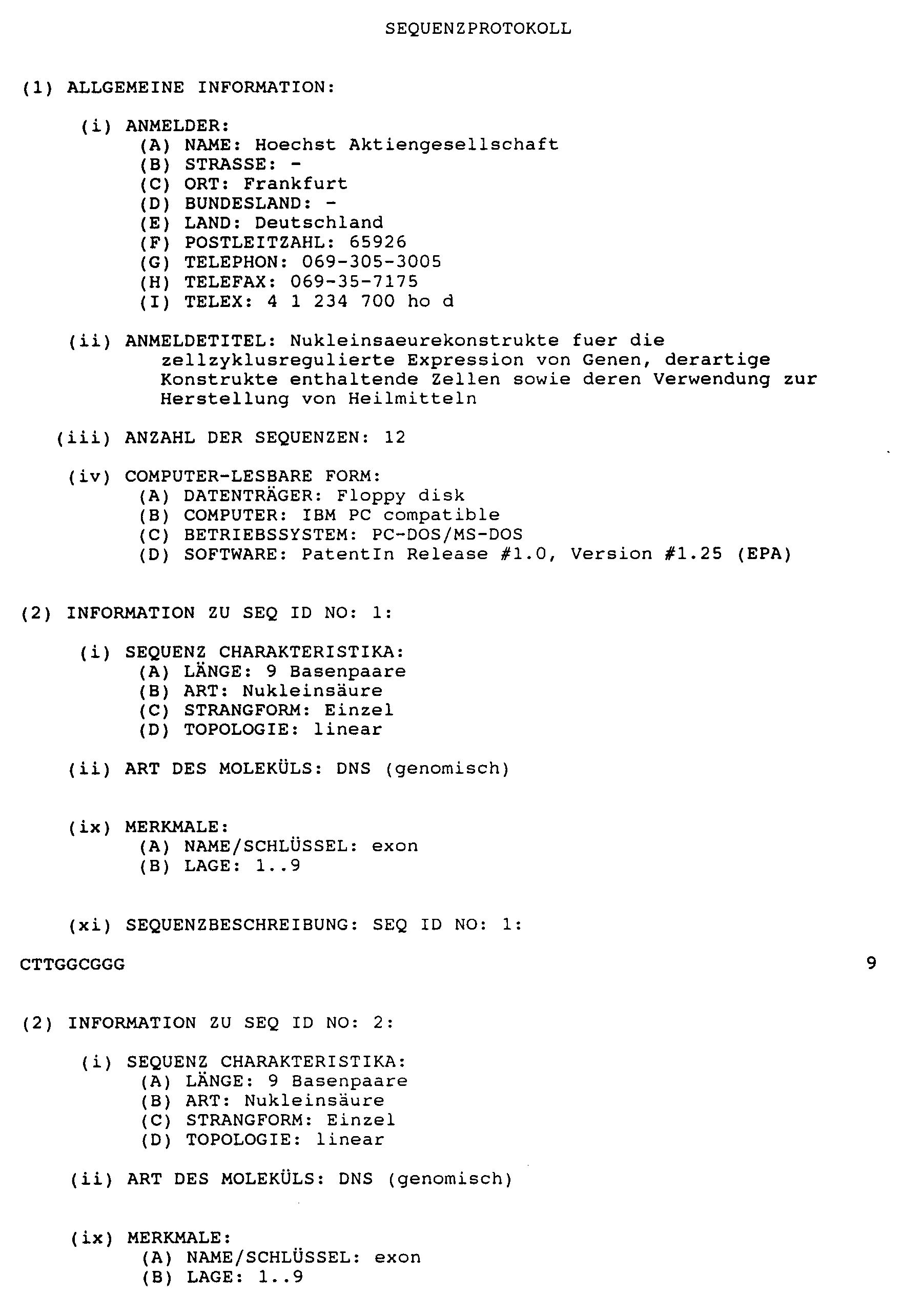

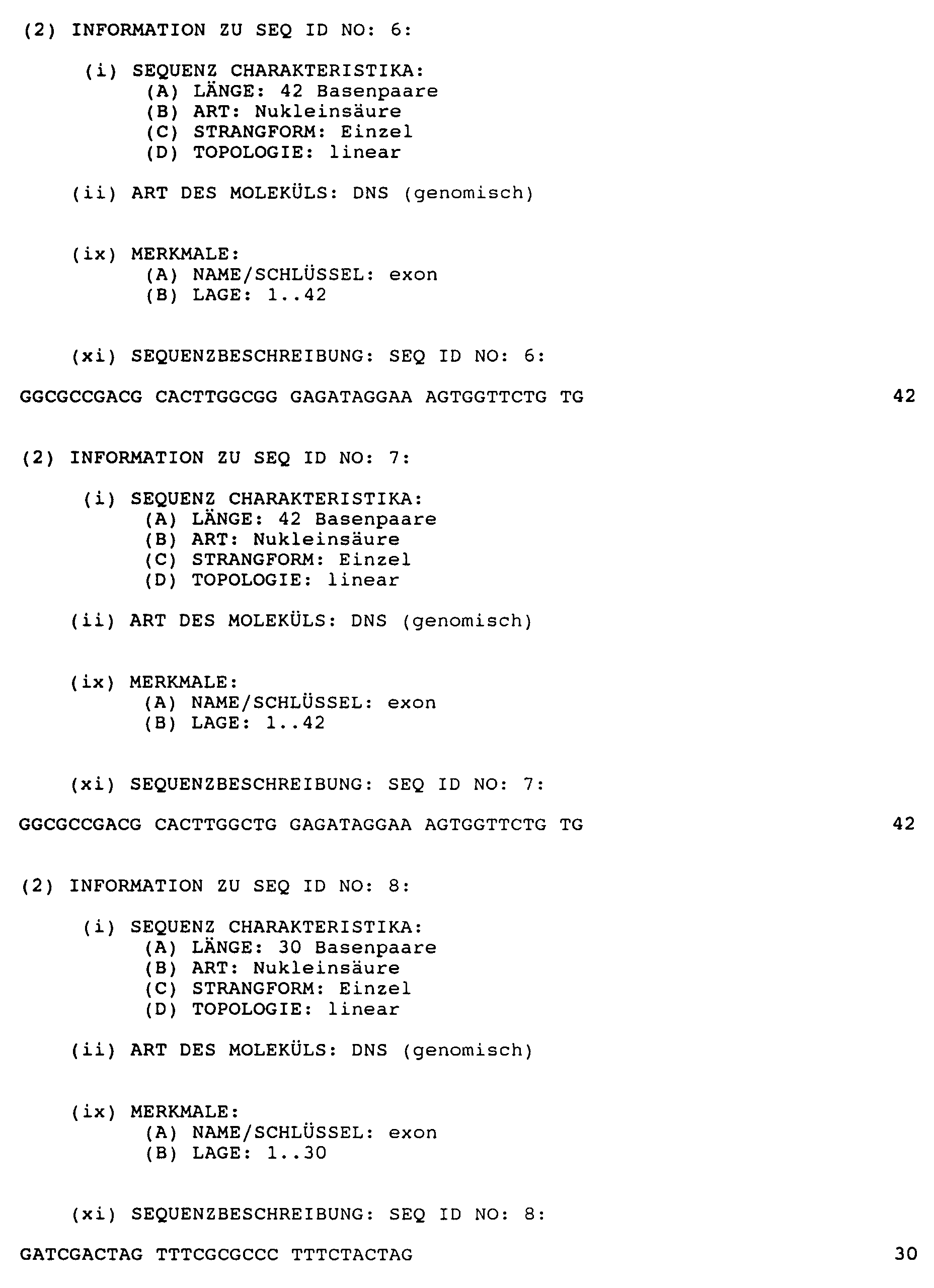


Claims (18)
- Nukleinsäurekonstrukt für die zellzyklusregulierte Expression von wenigstens einem Gen umfassend folgende Komponenten:a) eine Aktivatorsequenz,b) ein Promotormodul, das eine Nukleotidsequenz aufweist, die wenigstens ein Protein der E2F-Familie bindet und eine weitere Nukleotidsequenz aufweist, die wenigstens ein Protein der CHF-Familie bindet undc) ein Gen, das für einen Wirkstoff kodiert, der zellzyklus-abhängig exprimiert wird.
- Nukleinsäurekonstrukt nach Anspruch 1, dadurch gekennzeichnet, daß bei dem Promotormodul (b) die Nukleotidsequenz, die wenigstens ein Protein der E2F-Familie bindet, wenigstens eine Sequenz umfaßt, die ausgewählt ist aus den Nukleotidsequenzen CTTGGCGGG, TTTCGCGCC oder TTTCGCGGC.
- Nukleinsäurekonstrukt nach einem der Ansprüche 1 oder 2, dadurch gekennzeichnet, daß bei dem Promotormodul (b) die Nukleotidsequenz, die wenigstens ein Protein der CHF-Familie bindet, wenigstens eine Sequenz umfaßt, die die Nukleotidsequenz TAGGAAA beinhaltet.
- Nukleinsäurekonstrukt nach einem der Ansprüche 2 oder 3, dadurch gekennzeichnet, daß die Nukleotidsequenz, die CHF bindet, stromabwärts der Nukleotidsequenz für die Bindung von E2F liegt und zwischen beiden die Nukleotidsequenz AGA sich befindet (CTTGGCGGGAGATAGGAAA).
- Nukleinsäurekonstrukt nach einem der vorhergehenden Ansprüche, dadurch gekennzeichnet, daß das Promotormodul (b) mit der stromaufwärts gelegenen Aktivatorsequenz (a) interagieren kann und dadurch die Expression des stromabwärts gelegenen Genes (c) beeinflussen, insbesondere inhibieren kann.
- Nukleinsäurekonstrukt nach einem der vorhergehenden Ansprüche, dadurch gekennzeichnet, daß die Aktivatorsequenz zellspezifisch ist.
- Nukleinsäurekonstrukt nach einem der vorhergehenden Ansprüche, dadurch gekennzeichnet, daß die Aktivatorsequenz virusspezifisch ist.
- Nukleinsäurekonstrukt nach einem der vorhergehenden Ansprüche, dadurch gekennzeichnet, daß es sich bei der Nukleinsäure um DNS handelt.
- Nukleinsäurekonstrukt nach einem der vorhergehenden Ansprüche, dadurch gekennzeichnet, daß es sich bei dem Nukleinsäurekonstrukt um einen Vektor handelt.
- Nukleinsäurekonstrukt nach Anspruch 9, dadurch gekennzeichnet, daß es sich um einen Plasmidvektor handelt.
- Nukleinsäurekonstrukt nach Anspruch 9, dadurch gekennzeichnet, daß es sich um einen viralen Vektor handelt.
- Nukleinsäurekonstrukt nach einem der vorhergehenden Ansprüche, dadurch gekennzeichnet, daß es sich bei dem Gen (c) um ein Gen handelt, das für einen Wirkstoff kodiert, der ausgewählt ist aus der Gruppe umfassend Cytokine, Wachstumsfaktoren, Rezeptoren für Cytokine oder Wachstumsfaktoren, antiproliferativ oder zytostatisch wirkende Proteine, Antikörper, Antikörperfragmente, Angiogeneseinhibitoren, Gerinnungsfaktoren und Gerinnungshemmer.
- Nukleinsäurekonstrukt nach einem der vorhergehenden Ansprüche, dadurch gekennzeichnet, daß die Aktivatorsequenz (a) ausgewählt ist aus der Gruppe von Promotoren aktiviert in Endothelzellen, glatten Muskelzellen, Makrophagen, Lymphozyten, Leukämiezellen, Tumorzellen und Gliazellen oder von Promotorsequenzen der Viren HBV, HCV, HSV, HPV, EBV, HTLV oder HIV.
- Nukleinsäurekonstrukt nach einem der vorhergehenden Ansprüche, dadurch gekennzeichnet, daß es sich bei dem Gen (c) um ein Gen handelt, das für ein Enzym kodiert, welches eine Vorstufe eines Pharmakons in ein Pharmakon spaltet.
- Isolierte Zelle, dadurch gekennzeichnet, daß sie ein Nukleinsäurekonstrukt gemäß einem der Ansprüche 1 bis 14 enthält.
- Verwendung eines Nukleinsäurekonstrukts nach einem der Ansprüche 1 bis 14 oder einer Zelle nach Anspruch 15 zur Herstellung eines Heilmittels zur Behandlung einer Erkrankung, die mit Vermehrung einer Zielzelle einhergeht, wobei die Herstellung des Heilmittels die Einführung eines Nukleinsäurekonstrukts in die Zielzelle umfaßt.
- Verwendung nach Anspruch 16, dadurch gekennzeichnet, daß es sich bei der Erkrankung, die mit übermäßiger Zellvermehrung einhergeht, um eine Tumorerkrankung handelt.
- Verwendung nach Anspruch 16 oder 17, dadurch gekennzeichnet, daß die Herstellung des Heilmittels die Überführung eines Nukleinsäurekonstruktes nach einem der Ansprüche 1 bis 14 in eine Form umfaßt, die die Einführung des Nukleinsäurekonstruktes in die Zielzelle umfaßt.
Applications Claiming Priority (2)
| Application Number | Priority Date | Filing Date | Title |
|---|---|---|---|
| DE19605274 | 1996-02-13 | ||
| DE19605274A DE19605274A1 (de) | 1996-02-13 | 1996-02-13 | Nukleinsäurekonstrukte für die zellzyklusregulierte Expression von Genen, derartige Konstrukte enthaltende Zellen sowie deren Verwendung zur Herstellung von Heilmitteln |
Publications (2)
| Publication Number | Publication Date |
|---|---|
| EP0790313A2 true EP0790313A2 (de) | 1997-08-20 |
| EP0790313A3 EP0790313A3 (de) | 1998-12-02 |
Family
ID=7785276
Family Applications (1)
| Application Number | Title | Priority Date | Filing Date |
|---|---|---|---|
| EP97101507A Withdrawn EP0790313A3 (de) | 1996-02-13 | 1997-01-31 | Nukleinsäurekonstrukte für die zellzyklusregulierte Expression von Genen, derartige Konstrukte enthaltende Zellen sowie deren Verwendung zur Herstellung von Heilmitteln |
Country Status (9)
| Country | Link |
|---|---|
| US (1) | US5885833A (de) |
| EP (1) | EP0790313A3 (de) |
| JP (1) | JPH104980A (de) |
| AU (1) | AU716500B2 (de) |
| CA (1) | CA2197286A1 (de) |
| CZ (1) | CZ41897A3 (de) |
| DE (1) | DE19605274A1 (de) |
| HU (1) | HUP9700429A3 (de) |
| ZA (1) | ZA971158B (de) |
Cited By (3)
| Publication number | Priority date | Publication date | Assignee | Title |
|---|---|---|---|---|
| WO2000004178A1 (de) * | 1998-07-14 | 2000-01-27 | Aventis Pharma Deutschland Gmbh | Expressionssysteme enthaltend chimäre promotoren mit bindungsstellen für rekombinante transkriptionsfaktoren |
| US6465246B1 (en) | 1997-11-21 | 2002-10-15 | Aventis Pharma Deutschland Gmbh | Oncogene- or virus-controlled expression systems |
| US6759518B1 (en) | 1998-04-09 | 2004-07-06 | Vectron Therapeutics Ag | Single-chain multiple antigen-binding molecule, its preparation and use |
Families Citing this family (20)
| Publication number | Priority date | Publication date | Assignee | Title |
|---|---|---|---|---|
| CA2198462A1 (en) | 1994-08-26 | 1996-03-07 | Hans-Harald Sedlacek | Genetic therapy of diseases caused by the immune system, said therapy using a cell-specific active substance regulated by the cell cycle |
| GB9506466D0 (en) | 1994-08-26 | 1995-05-17 | Prolifix Ltd | Cell cycle regulated repressor and dna element |
| DE19605279A1 (de) | 1996-02-13 | 1997-08-14 | Hoechst Ag | Zielzellspezifische Vektoren für die Einschleusung von Genen in Zellen, Arzneimittel enthaltend derartige Vektoren und deren Verwendung |
| DE19617851A1 (de) | 1996-05-03 | 1997-11-13 | Hoechst Ag | Nukleinsäurekonstrukte mit Genen kodierend für Transportsignale |
| DE19639103A1 (de) | 1996-09-24 | 1998-03-26 | Hoechst Ag | Nukleinsäurekonstrukte mit Hybridpromotoren für gentherapeutische Maßnahmen |
| WO1998013508A1 (en) * | 1996-09-24 | 1998-04-02 | Dana-Farber Cancer Institute | Method of targeting malignant cells using an e2f responsive promoter |
| DE19651443A1 (de) | 1996-12-11 | 1998-06-18 | Hoechst Ag | Selbstverstärkende, pharmakologisch kontrollierbare Expressionssysteme |
| DE19701141C1 (de) | 1997-01-16 | 1998-04-09 | Hoechst Ag | Genkonstrukte für durch Proteasen aktivierbare Wirksubstanzen |
| EP0860445A1 (de) | 1997-02-18 | 1998-08-26 | Hoechst Aktiengesellschaft | Neue Nukleotidsequenzen für zellzyklusabhängige Expression von Strukturgenen |
| US7112338B2 (en) * | 1997-03-12 | 2006-09-26 | The Regents Of The University Of California | Cationic liposome delivery of taxanes to angiogenic blood vessels |
| US5837283A (en) | 1997-03-12 | 1998-11-17 | The Regents Of The University Of California | Cationic lipid compositions targeting angiogenic endothelial cells |
| DE19756975A1 (de) | 1997-12-20 | 1999-06-24 | Hoechst Marion Roussel De Gmbh | Bindungspartner für Inhibitoren von cyclinabhängigen Kinasen und ihre Verwendung zur Suche nach Inhibitoren, zur Diagnose oder zur Therapie einer Erkrankung |
| DE19900743A1 (de) | 1999-01-12 | 2000-07-13 | Aventis Pharma Gmbh | Neue komplexbildende Proteine |
| KR100591767B1 (ko) * | 1999-09-09 | 2006-06-23 | 더 리젠츠 오브 더 유니버시티 오브 캘리포니아 | 탁산의 맥관형성 혈관 전달을 위한 양이온성 리포좀 |
| US6864355B1 (en) | 2000-05-02 | 2005-03-08 | Yale University | Inhibition of NF-κB activation by blockade of IKKβ-NEMO interactions at the NEMO binding domain |
| WO2001032222A1 (en) * | 1999-11-03 | 2001-05-10 | Mbt Munich Biotechnology Gmbh | Selective toxin expression in angiogenic endothelial cells |
| US7396679B2 (en) * | 1999-11-15 | 2008-07-08 | Onyx Pharmaceuticals, Inc. | Oncolytic adenovirus |
| CN1382218A (zh) * | 1999-11-15 | 2002-11-27 | 昂尼克斯药物公司 | 溶瘤腺病毒 |
| AU4147200A (en) * | 1999-12-31 | 2001-07-16 | Chong Kun Dang Pharmaceutical Corp. | Cancer cell-specific gene expression system |
| WO2005085455A1 (en) * | 2004-03-09 | 2005-09-15 | Kam Man Hui | Compositions and methods for treating disease |
Citations (1)
| Publication number | Priority date | Publication date | Assignee | Title |
|---|---|---|---|---|
| EP0464633A1 (de) | 1990-07-03 | 1992-01-08 | Kuraray Co., Ltd. | Katalysator und Verfahren zur Herstellung von ungesättigten Estern |
Family Cites Families (1)
| Publication number | Priority date | Publication date | Assignee | Title |
|---|---|---|---|---|
| WO1996006938A1 (de) * | 1994-08-26 | 1996-03-07 | Hoechst Aktiengesellschaft | Gentherapeutische behandlung von gefässerkrankungen durch einen zellspezifischen, zellzyklusabhängigen wirkstoff |
-
1996
- 1996-02-13 DE DE19605274A patent/DE19605274A1/de not_active Withdrawn
-
1997
- 1997-01-31 EP EP97101507A patent/EP0790313A3/de not_active Withdrawn
- 1997-02-11 AU AU12650/97A patent/AU716500B2/en not_active Ceased
- 1997-02-11 CZ CZ97418A patent/CZ41897A3/cs unknown
- 1997-02-11 CA CA002197286A patent/CA2197286A1/en not_active Abandoned
- 1997-02-12 ZA ZA9701158A patent/ZA971158B/xx unknown
- 1997-02-12 HU HU9700429A patent/HUP9700429A3/hu unknown
- 1997-02-13 US US08/798,738 patent/US5885833A/en not_active Expired - Fee Related
- 1997-02-13 JP JP9044772A patent/JPH104980A/ja active Pending
Patent Citations (1)
| Publication number | Priority date | Publication date | Assignee | Title |
|---|---|---|---|---|
| EP0464633A1 (de) | 1990-07-03 | 1992-01-08 | Kuraray Co., Ltd. | Katalysator und Verfahren zur Herstellung von ungesättigten Estern |
Non-Patent Citations (40)
| Title |
|---|
| AIRD ET AL., PNAS. USA., vol. 92, 1995, pages 4567 |
| APPLICATION CONTAINS STILL MORE REFERENCES. |
| BANDARA ET AL., NATURE., vol. 252, 1991, pages 249 |
| BARTLEY ET AL., NATURE., vol. 368, 1994, pages 558 |
| BEIJERSBERGEN ET AL., GENES DEV., vol. 8, 1994, pages 2680 |
| BELLON ET AL., EUR. J. IMMUNOL., vol. 23, 1993, pages 2340 |
| BENATTI ET AL., J. CLIN. INVEST., vol. 91, 1993, pages 1149 |
| BENSI ET AL., CELL GROWTH DIFF., vol. 1, 1990, pages 491 |
| BURROWS ET AL., PHARMAC. THERP., vol. 64, 1994, pages 155 |
| CHELLAPPAN ET AL., CELL., vol. 65, 1991, pages 1053 |
| CHITTENDEN ET AL., CELL., vol. 65, 1991, pages 1073 |
| DE VRIES ET AL., SCIENCE., vol. 255, 1992, pages 989 |
| DUMONT ET AL., ONCOGENE., vol. 7, 1992, pages 1471 |
| FENTON ET AL., J. IMMUNOL., vol. 138, 1987, pages 3972 |
| FERREIRA ET AL., BIOCHEM. J., vol. 293, 1993, pages 641 |
| GE ET AL., GENE., vol. 138, 1994, pages 201 |
| GINSBERG ET AL., GENES DEV., vol. 8, 1994, pages 2665 |
| HAENDLER ET AL., J. CARDIOVASC. PHARM., vol. 20, 1992, pages 1 |
| HANGEN ET AL., MOL. CARCINOG., vol. 2, 1986, pages 68 |
| HELIN ET AL., CELL., vol. 70, 1992, pages 337 |
| HOLZMAN ET AL., J. AM. SOC. NEPHROL., vol. 4, 1993, pages 466 |
| JAHROUDI AND LYNCH., MOL. CELL. BIOL., vol. 14, 1994, pages 999 |
| KAELIN ET AL., CELL., vol. 70, 1992, pages 351 |
| LAM ET AL., EMBO J., vol. 12, 1993, pages 2705 |
| LUDWIG ET AL., GENE., vol. 142, 1994, pages 311 |
| MUDRYJ ET AL., EMBO J., vol. 9, 1990, pages 2179 |
| MURAKAMI ET AL., J. BIOL. CHEM., vol. 267, 1992, pages 9300 |
| OSHIMA ET AL., J. BIOL. CHEM., vol. 263, 1988, pages 2553 |
| PANDEY ET AL., SCIENCE., vol. 268, 1995, pages 567 |
| PARTANEN ET AL., MOL. CELL. BIOL., vol. 12, 1992, pages 1698 |
| PLATE ET AL., BRAIN PATHOL., vol. 4, 1994, pages 207 |
| PLATE ET AL., INT. J. CANCER., vol. 59, 1994, pages 520 |
| POHLMANN ET AL., PNAS. USA., vol. 84, 1987, pages 5575 |
| SCHNUERCH AND RISAU., DEVELOPMENT., vol. 119, 1993, pages 957 |
| SENGER ET AL., CANCER METAST. REV., vol. 12, 1993, pages 303 |
| TERMAN ET AL., BBRC., vol. 187, 1992, pages 1579 |
| TURNER ET AL., J. IMMUNOL., vol. 143, 1989, pages 3556 |
| VAN DER GEER ET AL., ANN. REV. CELL. BIOL., vol. 10, 1994, pages 251 |
| WEBB ET AL., MOL. PHARMACOL., vol. 47, 1995, pages 730 |
| WILSON ET AL., MOL. CELL. BIOL., vol. 10, 1990, pages 4654 |
Cited By (5)
| Publication number | Priority date | Publication date | Assignee | Title |
|---|---|---|---|---|
| US6465246B1 (en) | 1997-11-21 | 2002-10-15 | Aventis Pharma Deutschland Gmbh | Oncogene- or virus-controlled expression systems |
| US6759518B1 (en) | 1998-04-09 | 2004-07-06 | Vectron Therapeutics Ag | Single-chain multiple antigen-binding molecule, its preparation and use |
| EP2036926A2 (de) | 1998-04-09 | 2009-03-18 | Affitech AS | Einzelkettiges, mehrfach-antigenbindendes Molekül, dessen Herstellung und Verwendung |
| US7838637B2 (en) | 1998-04-09 | 2010-11-23 | Affitech Research As | Single-chain multiple antigen-binding molecule, its preparation and use |
| WO2000004178A1 (de) * | 1998-07-14 | 2000-01-27 | Aventis Pharma Deutschland Gmbh | Expressionssysteme enthaltend chimäre promotoren mit bindungsstellen für rekombinante transkriptionsfaktoren |
Also Published As
| Publication number | Publication date |
|---|---|
| CZ41897A3 (en) | 1997-09-17 |
| AU1265097A (en) | 1997-08-21 |
| HUP9700429A3 (en) | 2001-10-29 |
| HUP9700429A2 (en) | 1997-10-28 |
| US5885833A (en) | 1999-03-23 |
| AU716500B2 (en) | 2000-02-24 |
| JPH104980A (ja) | 1998-01-13 |
| EP0790313A3 (de) | 1998-12-02 |
| HU9700429D0 (en) | 1997-03-28 |
| ZA971158B (en) | 1997-11-13 |
| DE19605274A1 (de) | 1997-08-14 |
| CA2197286A1 (en) | 1997-08-14 |
Similar Documents
| Publication | Publication Date | Title |
|---|---|---|
| EP0790313A2 (de) | Nukleinsäurekonstrukte für die zellzyklusregulierte Expression von Genen, derartige Konstrukte enthaltende Zellen sowie deren Verwendung zur Herstellung von Heilmitteln | |
| EP0804601B1 (de) | Gentherapeutische behandlung von tumoren mit einem endothelzellspezifischen, zellzyklusabhängigen wirkstoff | |
| Lenardo et al. | Repression of the IgH enhancer in teratocarcinoma cells associated with a novel octamer factor | |
| DE69615650T2 (de) | Virale vektoren für die gentherapie | |
| DE3884610T2 (de) | Durch sterole regulierbare promoterelemente. | |
| DE3588199T2 (de) | Lymphokin-Herstellung und -Reinigung | |
| DE69534791T2 (de) | Vektoren zur gewebsspezifischen replikation | |
| DE68926892T3 (de) | Verfahren zur Herstellung von Zellen, die stabil integrierte fremde DNS mit hoher Kopiezahl enthalten, durch dieses Verfahren hergestellte Zellen und Verwendung dieser Zellen zur Herstellung von durch diese fremde DNS kodierten Polypeptiden | |
| DE69432500T2 (de) | Rekombinante Foamy-Virus-Vektoren zur medizinischen und diagnostischen Verwendung und Verfahren zur Herstellung rekombinanter Foamy-Virus-Vektoren | |
| US6380170B1 (en) | Nucleic acid construct for the cell cycle regulated expression of structural genes | |
| DE69101634T4 (de) | Rekombinant hergestellte blutfaktoren, verfahren zur exprimierung besagter blutfaktoren sowie in besagtem prozess verwendeter rekombinanter vaccina-virus. | |
| DE3308030A1 (de) | Tierische interferone | |
| DE69231676T2 (de) | Methoden zur selektion von rekombinanten wirtszellen welche hohe mengen von einem gewünschten protein exprimieren | |
| DE19639103A1 (de) | Nukleinsäurekonstrukte mit Hybridpromotoren für gentherapeutische Maßnahmen | |
| EP0805209A2 (de) | Nukleinsäurekonstrukte mit Genen kodierend für Transportsignale | |
| DE19710643A1 (de) | Der Promotor des cdc25B Genes und seine Verwendung in der Gentherapie | |
| EP1097232A1 (de) | Expressionssysteme enthaltend chimäre promotoren mit bindungsstellen für rekombinante transkriptionsfaktoren | |
| Vos et al. | DNA interstrand cross-links promote chromosomal integration of a selected gene in human cells | |
| WO1996006938A1 (de) | Gentherapeutische behandlung von gefässerkrankungen durch einen zellspezifischen, zellzyklusabhängigen wirkstoff | |
| Annab et al. | Isolation of a functional copy of the human BRCA1 gene by transformation-associated recombination in yeast | |
| DE3686909T2 (de) | Lymphotoxin-dns, lymphotoxin-expressionsvektor, lymphotoxin-expressionsvektor enthaltender transformant und verfahren zur herstellung von lymphotoxin. | |
| DE69332373T2 (de) | Menschlicher epidermaler Gen-Promotor | |
| Haidar et al. | Sp1 is essential and its position is important for p120 gene transcription: a 35 bp juxtaposed positive regulatory element enhances transcription 2.5 fold | |
| DE69531955T2 (de) | PROGRESSIVE ANDERUNG VON SIGNAL-PROTEINEN UND PEPTIDEn UND DIE HERGESTELLTEN SUPERAGONISTEN UND ANTAGONISTEN | |
| WO2000065075A1 (de) | Verwendung von coxsackieviren zur verbesserung der transfektion von zellen |
Legal Events
| Date | Code | Title | Description |
|---|---|---|---|
| PUAI | Public reference made under article 153(3) epc to a published international application that has entered the european phase |
Free format text: ORIGINAL CODE: 0009012 |
|
| AK | Designated contracting states |
Kind code of ref document: A2 Designated state(s): AT BE CH DE DK ES FI FR GB GR IE IT LI LU NL PT SE |
|
| PUAL | Search report despatched |
Free format text: ORIGINAL CODE: 0009013 |
|
| AK | Designated contracting states |
Kind code of ref document: A3 Designated state(s): AT BE CH DE DK ES FI FR GB GR IE IT LI LU NL PT SE |
|
| 17P | Request for examination filed |
Effective date: 19990409 |
|
| RAP1 | Party data changed (applicant data changed or rights of an application transferred) |
Owner name: AVENTIS PHARMA DEUTSCHLAND GMBH |
|
| 17Q | First examination report despatched |
Effective date: 20020423 |
|
| STAA | Information on the status of an ep patent application or granted ep patent |
Free format text: STATUS: THE APPLICATION IS DEEMED TO BE WITHDRAWN |
|
| 18D | Application deemed to be withdrawn |
Effective date: 20030716 |