EP0792073B1 - Farbsignaleinstellungsgerät - Google Patents
Farbsignaleinstellungsgerät Download PDFInfo
- Publication number
- EP0792073B1 EP0792073B1 EP97301004A EP97301004A EP0792073B1 EP 0792073 B1 EP0792073 B1 EP 0792073B1 EP 97301004 A EP97301004 A EP 97301004A EP 97301004 A EP97301004 A EP 97301004A EP 0792073 B1 EP0792073 B1 EP 0792073B1
- Authority
- EP
- European Patent Office
- Prior art keywords
- signal
- gain
- phase
- quadrant
- circuit
- Prior art date
- Legal status (The legal status is an assumption and is not a legal conclusion. Google has not performed a legal analysis and makes no representation as to the accuracy of the status listed.)
- Expired - Lifetime
Links
Images


Classifications
-
- H—ELECTRICITY
- H04—ELECTRIC COMMUNICATION TECHNIQUE
- H04N—PICTORIAL COMMUNICATION, e.g. TELEVISION
- H04N23/00—Cameras or camera modules comprising electronic image sensors; Control thereof
- H04N23/80—Camera processing pipelines; Components thereof
- H04N23/84—Camera processing pipelines; Components thereof for processing colour signals
-
- H—ELECTRICITY
- H04—ELECTRIC COMMUNICATION TECHNIQUE
- H04N—PICTORIAL COMMUNICATION, e.g. TELEVISION
- H04N23/00—Cameras or camera modules comprising electronic image sensors; Control thereof
- H04N23/80—Camera processing pipelines; Components thereof
- H04N23/84—Camera processing pipelines; Components thereof for processing colour signals
- H04N23/86—Camera processing pipelines; Components thereof for processing colour signals for controlling the colour saturation of colour signals, e.g. automatic chroma control circuits
-
- H—ELECTRICITY
- H04—ELECTRIC COMMUNICATION TECHNIQUE
- H04N—PICTORIAL COMMUNICATION, e.g. TELEVISION
- H04N23/00—Cameras or camera modules comprising electronic image sensors; Control thereof
- H04N23/80—Camera processing pipelines; Components thereof
- H04N23/84—Camera processing pipelines; Components thereof for processing colour signals
- H04N23/85—Camera processing pipelines; Components thereof for processing colour signals for matrixing
Definitions
- This invention relates to color signal adjustment apparatus which can be used in, for example, a camera device.
- the signs of the (R-G) signal and the (B-G) signal as parameters are discriminated for deciding whether these signals define the (R-Y) signal or the (B-G) signal. Subsequently, the coefficients of X and G are determined. That is, if the sign of the (R-G) signal is plus or minus, the gain of the (R-Y) signal becomes positive or negative, respectively. On the other hand, if the sign of the (B-G) signal is plus or minus, the phase of the (R-Y) signal becomes positive or negative, respectively.
- the phase of the (B-Y) signal becomes positive or negative, respectively.
- the sign of the (B-G) signal is plus or minus, the gain of the (B-Y) signal becomes positive or negative, respectively.
- the phase of the (B-Y) signal is increased if the gain of the (R-Y) signal is increased, such that the phase or the gain, which are not desired to be adjusted, are undesirably changed.
- the color signal adjustment apparatus also includes first parameter outputting means for outputting a gain and a phase for the (R-Y) signal and a gain and a phase for the (B-Y) signal in the first quadrant in the (B-Y) - (R-Y) coordinate system, and second parameter outputting means for outputting a gain and a phase for the (R-Y) signal and a gain and a phase for the (B-Y) signal in the second quadrant in the (B-Y) - (R-Y) coordinate system.
- the color signal adjustment apparatus also includes third parameter outputting means for outputting a gain and a phase for the (R-Y) signal and a gain and a phase for the (B-Y) signal in the third quadrant in the (B-Y) - (R-Y) coordinate system, and fourth parameter outputting means for outputting a gain and a phase for the (R-Y) signal and a gain and a phase for the (B-Y) signal in the fourth quadrant in the (B-Y) - (R-Y) coordinate system.
- the color signal adjustment apparatus also includes selection means for switchingly selecting the gain or the phase from the first parameter setting means, second parameter setting means, third parameter setting means and the fourth parameter setting means, and sending the selected gain or phase to the second color difference generating means, and control means for controlling the selection means based on the (R-G) signal and the (B-G) signal from the first color difference signal generating means.
- the gain X and the phase Z can be set for effecting color signal adjustment of the (R-Y) and (B-Y) signals by discriminating four parameters comprised of positive and negative R-G signals and positive and negative B-G signals supplied to the second color difference signal generating means. Since the number of parameters required for conversion of the (R-Y) and (B-Y) signals can be reduced to one-half that required in the conventional circuit, the above-described color signal adjustment circuit contributes to improved communication speed between respective circuits.
- gain/phase conversion in the (B-Y) and (R-Y) coordinate systems can be controlled independently from one quadrant to another, such that there is no risk of the color signal adjustment for a given quadrant being made during color signal adjustment for another quadrant .
- the gain/phase adjustment may be achieved for plural quadrants simultaneously.
- the camera device embodying the present invention comprises a color signal adjustment circuit for effecting color signal adjustment from pixel to pixel, which includes an imaging signal processing unit 10 for outputting generated imaging signals and also outputting an imaging signal delayed by one horizontal scanning period (1H), 'and a Y-signal processing unit 20 for generating Y signals (luminance signals) from the supplied imaging signals.
- the camera device also includes a luminance serial I/O interface or luminance SIO 28 for processing signals of the Y-signal processing unit 20 and a C signal processing unit 30 for generating carrier color signals (C signals) from the supplied imaging signals and from the imaging signals delayed by 1H.
- the camera device additionally includes a chroma serial I/O interface or chroma SIO 41 for processing signals of the C signal processing unit 30 and a micro-computer 50 for controlling the operation of the luminance SIO 28 and the chroma SIO 41.
- the imaging signal processing unit 10 has a CCD image sensor 11, an automatic gain control circuit (AGC circuit) 12, an A/D converter 13 and a delay circuit 14, as shown for example in Fig.1.
- AGC circuit automatic gain control circuit
- the CCD image sensor 11 generates imaging signals corresponding to the imaging light of the object and sends the imaging signals to a sample-and-hold circuit, not shown.
- the sample-and-hold circuit sample-holds the supplied imaging signals to reduce so-called random noise to send the resulting imaging signals to the AGC circuit 12.
- the AGC circuit 12 detects the difference in level of the imaging signals to adjust the gain of the imaging signals.
- the A/D converter 13 converts the imaging signals from the AGC circuit 12 into digital signals to send the imaging data to the delay circuit 14.
- the delay circuit 14 sends the imaging data to the Y-signal processing unit 20 and to the C-signal processing unit 3, while sending the imaging data delayed by 1H to the C-signal processing unit 30.
- the Y-signal processing unit 20 has a low-pass filter (LPF) 21, a gamma correction circuit 22, a white clip circuit 23, a blanking inserting circuit 24, a synchronization appendage circuit 25, a delay circuit 26 and a D/A converter 27, as shown in Fig.1.
- LPF low-pass filter
- the LPF 21 takes out Y signals contained in the imaging data from the imaging signal processing unit 10 to send the Y-signals to the'gamma correction circuit 22.
- the gamma correction circuit 22 performs gamma correction of the Y-signals to send the resulting Y-signals to the white clip circuit 23.
- the white clip circuit 23 compresses the Y-signals, supplied at a quadruple rate of the standard level rate, by a factor of 1.1 to 1.3, and sends the resulting Y-signals to the blanking insertion circuit 24.
- the blanking insertion circuit 24 first pulls down the blanking period of the Y-signals to a position sufficiently below the black level, for removing unneeded sporadic signals superimposed in the blanking period and subsequently performs black-clipping to send the resulting Y-signals to the synchronization appendage circuit 25.
- the synchronization appendage circuit 25 appends the synchronization signal to the Y-signals to send the resulting signals to the delay circuit 26.
- the delay circuit 26 delays the Y-signals a pre-set amount for phase matching with respect to the C-signals outputted by the C-signal processing unit 30 and outputs the resulting analog Y-signals via D/A converter 27.
- the luminance SIO 28 performs control operations for gamma correction, white clipping or blanking insertion in the Y-signal processing unit 20 under control by the micro-computer 50.
- the C-signal processing unit 30 includes an LPF 31, a YC matrix circuit 32, an RGB matrix circuit 33, a white balance adjustment circuit 34, a gamma correction circuit 35, a phase/gain control circuit 36, a blanking insertion circuit 37, an encoder 38, a delay circuit 39 and a D/A converter 40.
- the LPF 31 removes components of unneeded frequency bands of the imaging data offset by 1H as described above.
- the YC matrix circuit 32 generates Y-signals and C-signals from the imaging data offset by 1H to route the generated Y-signals and C-signals to the RGB matrix circuit 33.
- the RGB matrix circuit 33 generates red (R), green (G) and blue (B).color signals from the Y and C signals to route the respective color signals to the white balance circuit 34.
- the white balance adjustment circuit 34 adjusts the ratio of respective color signals obtained on imaging the white object to 1:1:1 to route the respective color signals to the gamma correction circuit 35.
- the gamma correction circuit 35 gammacorrects the R, G and B color signals to route the resulting signals to the phase/gain control circuit 36.
- the phase/gain control circuit 36 generates pre-set color difference signals from the respective color signals and adjusts the phase and the gain with the color difference signals as coordinate axes, by way of performing color signal adjustment, in a manner which will be subsequently explained in detail.
- the blanking insertion circuit 37 pulls down the blanking period of the color-signal-adjusted color difference signals sufficiently below the black level to insert the blanking and routes the color difference signals to the encoder 38.
- the encoder 38 generates C-signals of the NTSC (National television System Committee) system from the pre-set color difference signals and routes the resulting C-signals to the delay circuit 39.
- the delay circuit 39 delays the C-signals in a pre-set amount for synchronization with the Y-signals and outputs the color-signal-adjusted C-signals via D/A converter 40.
- the phase/gain control circuit 36 includes an (R-G)/(B-G) converting circuit 36A for generating (R-G) signal and the (B-G) signal from the respective color signals of R, G and B and a phase/gain adjustment circuit 36B for generating (R-Y) and (B-Y) signals from the (R-G) and (B-G) signals in accordance with the following equations (1) and (2):
- R-Y X ⁇ (R-G) + Z(B-G) ⁇
- the (R-G)/(B-G) conversion circuit 36A converts the respective color signals from the gamma correction circuit 35 into color difference (R-G) and (B-G) signals to route the color difference signals to a phase/gain adjustment circuit 36B.
- the phase/gain adjustment circuit 36B performs processing of the above equations, pixel by pixel, based on X and Z signals from the chroma SIO 41, as later explained, for generating (R-Y) and (B-Y) signals.
- the chroma SIO 41 performs white balance and gamma correction in the C-signal processing unit 30, under control by the micro-computer 50, while generating X and Z signals and routing these signals to the phase/gain adjustment circuit 36B.
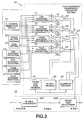
- the chroma SIO 41 has an X.Z signal generating circuit 61, a phase setting circuit 62, a gain setting circuit 63, a first quadrant selection circuit 64, a second quadrant selection circuit 65, a third quadrant selection circuit 66 and a fourth quadrant selection circuit 67.
- the X ⁇ Z signal generating circuit 61 generates X and Z signals, required in the equations (1) and (2), under control by the micro-computer 50.
- the micro-computer 50 computes a gain X R of the (R-Y) signal, a phase Z R of the (R-Y) signal, a gain X B of the (B-Y) signal, and a phase Z B of the (B-Y) signal, for each of the first to fourth quadrants in the (B-Y) and (R-Y) coordinate systems, and routes the computed results to the X ⁇ Z signal generating circuit 61.
- the X ⁇ Z signal generating circuit 61 generates the gain signal X R1 and the phase signals Z B1 of the (R-Y) signals of the first quadrant, while generating the gain signal X B1 and the phase signals Z R1 of the (B-Y) signals of the first quadrant.
- the X ⁇ Z signal generating circuit 61 generates X R2 , Z R2 , X B2 , Z B2 signals for the second quadrant, while generating X R3 , Z R3 , X B3 and Z B3 signals and X R4 , Z R4 , X B4 and Z B4 signals for the third and fourth quadrants, respectively.
- the X ⁇ Z signal generating circuit 61 sends these X and Z signals to a first quadrant parameter circuit 71, a second quadrant parameter circuit 72, a third quadrant parameter circuit 73 and to a fourth quadrant parameter circuit 74.
- phase setting circuit 62 performs control, under control by the micro-computer 50, so that no Z-signals will be outputted by the first quadrant parameter circuit 71, second quadrant parameter circuit 72, third quadrant parameter circuit 73 nor fourth quadrant parameter circuit 74.
- the gain setting circuit 63 performs control, under control by the micro-computer 50, so that no X-signals will be outputted by the first quadrant parameter circuit 71, second quadrant parameter circuit 72, third quadrant parameter circuit 73 nor fourth quadrant parameter circuit 74.
- the first quadrant selection circuit 64 controls the first quadrant parameter circuit 71, under control by the micro-computer 50, for outputting X and Z signals supplied from the X ⁇ Z signal generating circuit 61.
- the second quadrant selection circuit 65 controls the second quadrant parameter circuit 72, under control by the micro-computer 50, for outputting X and Z signals supplied from the X ⁇ Z signal generating circuit 61.
- the third quadrant selection circuit 66 controls the third quadrant parameter circuit 73, under control by the micro-computer 50, for outputting X and Z signals supplied from the X ⁇ Z signal generating circuit 61.
- the fourth quadrant selection circuit 67 controls the fourth quadrant parameter circuit 74, under control by the micro-computer 50, for outputting X and Z signals supplied from the X-Z signal generating circuit 61.
- the chroma SIO 41 has the above-mentioned first to fourth quadrant parameter circuits 71 to 74, switches 75 to 87, a phase/gain decision circuit 88, an (R-Y)/(B-Y) decision circuit 89 and a quadrant decision circuit 90.
- the first quadrant parameter circuit 71 outputs the X R1 signal, Z R1 signal, X B1 signal and the Z B1 signal from the X ⁇ Z signal generating circuit 61 at terminals a, b, c and d, respectively.
- the second quadrant parameter circuit 72 outputs the X R2 signal, Z R2 signal, X B2 signal and the Z B2 signal from the X-Z signal generating circuit 61 at terminals a, b, c and d, respectively.
- the third quadrant parameter circuit 73 outputs the X R3 signal, Z R3 signal, X B3 signal and the Z B3 signal from the X ⁇ Z signal generating circuit 61 at terminals a, b, c and d, respectively.
- the fourth quadrant parameter circuit 74 outputs the X R4 signal, Z R4 signal, X B4 signal and the Z B4 signal from the X ⁇ Z signal generating circuit 61 at terminals a, b, c and d, respectively.
- the switch 75 outputs signals from terminals a and b of the first quadrant parameter circuit 71 under control by the phase/gain decision circuit 88.
- the switch 76 outputs signals from terminals c and d of the first quadrant parameter circuit 71 under control by the phase/gain decision circuit 88.
- the switch 77 outputs signals from terminals a and b of the second quadrant parameter circuit 72 under control by the phase/gain decision circuit 88.
- the switch 78 outputs signals from terminals c and d of the second quadrant parameter circuit 72 under control by the phase/gain decision circuit 88.
- the switch 79 outputs signals from terminals a and b of the third quadrant parameter circuit 73 under control by the phase/gain decision circuit 88.
- the switch 80 outputs signals from terminals c and d of the third quadrant parameter circuit 73 under control by the phase/gain decision circuit 88.
- the switch 81 outputs signals from terminals a and b of the fourth quadrant parameter circuit 74 under control by the phase/gain decision circuit 88.
- the switch 82 outputs signals from terminals c and d of the fourth quadrant parameter circuit 74 under control by the phase/gain decision circuit 88.
- the switch 83 outputs signals from the switch 75 or 76 under control by the (R-Y)/(B-Y) decision circuit 89.
- the switch 84 outputs signals from the switch 77 or 78, while the switch 85 outputs signals from the switch 79 or 80 and the switch 86 outputs signals from the switch 81 or 82.
- the switch 87 outputs a signal from one of the switches 83 to 86 under control by the quadrant decision circuit 90.
- the phase/gain decision circuit 88 controls the switching of the switches 75 to 82 based on the (R-G) signal or the (B-G) signal supplied from the (R-G)/(B-G) conversion circuit 36A.
- the phase/gain decision circuit 88 judges whether the supplied signal is for conversion of the (R-Y) signal or (B-Y) signal and whether the supplied signal itself is the (R-G) signal or the (B-G) signal. If the phase/gain decision circuit 88 decides that the (R-G) signal for the (R-Y) signal conversion has been supplied, or that the (B-G) signal for (B-Y) signal conversion has been supplied, the decision circuit 88 selects gain adjustment and sets the switches 75, 77, 79 and 81 to the terminal b, while setting the switches 76, 78, 80 and 82 to the terminal d.
- phase/gain decision circuit 88 decides that the (B-G) signal for (B-Y) signal conversion has been supplied, or that the (R-G) signal for (B-Y) signal conversion has been supplied, the decision circuit 88 selects phase adjustment and sets the switches 75, 77, 79 and 81 to the terminal a, while setting the switches 76, 78, 80 and 82 to the terminal c.
- the (R-Y)/(B-Y) decision circuit 89 judges whether the (R-G) signal or the (B-G) signal supplied from the gain control circuit 36 is for (R-Y) signal conversion or for (B-Y) conversion.
- the (R-Y)/(B-Y) decision circuit 89 sets the switches 83 to 86 to the terminals e or f if the signal for (R-Y) signal conversion or the signal for (B-Y) signal conversion is supplied thereto, respectively.
- the quadrant decision circuit 90 judges in which quadrant the adjustment of the color difference signal of the gain/phase should be performed, and accordingly controls the switching of the switch 87. For example, if the signs of the (R-G) signal and (B-G) signal are both ⁇ + ⁇ , the quadrant decision circuit 90 judges the color difference signal adjustment should be performed in the first quadrant. If the signs of the (R-G) signal and (B-G) signal are ⁇ + ⁇ and ⁇ - ⁇ , the quadrant decision circuit 90 judges the color difference signal adjustment should be performed in the second quadrant. If the signs of the (R-G) signal and (B-G) signal are ⁇ - ⁇ and ⁇ + ⁇ , the quadrant decision circuit 90 judges the color difference signal adjustment should be performed in the third quadrant.
- the quadrant decision circuit 90 judges the color difference signal adjustment should be performed in the fourth quadrant.
- the quadrant decision circuit 90 sets the switch 87 to terminals g, h, i, or j if the conversion is in the first, second, third or fourth quadrant, respectively.
- the X and Z signals outputted by the switch 87 are routed to the phase/gain adjustment circuit 36B.
- the chroma SIO 41 generates a pre-set control signal, under control by the micro-computer 50, subject to the setting operation by the operating unit.
- the chroma SIO 41 judges which of the phase processing or the gain processing is carried out at the time of conversion of the color difference signal in the phase/gain control circuit 36, which of the (R-Y) signal or the (B-Y) signal is controlled, or in which quadrant the adjustment is performed, and routes X and Z signals satisfying the above decision conditions pixel by pixel to the phase/gain adjustment circuit 36B.
- phase/gain adjustment circuit 36B fed with the X and Z signals for color signal adjustment from the switch 87, to output (R-Y) and (B-Y) signals, which are optimally color-signal-adjusted color difference signals, at the time of conversion from the (R-G) and (B-G) signals to (R-Y) and (B-Y) signals.
- the color signal adjustment circuit of the present invention to judge the four parameters comprised of the positive and negative (R-G) and (B-G) signals before performing signal conversion of the color difference signals by the phase/gain adjustment circuit 36B for deciding the gain X and the phase Z for performing color signal adjustment of the(R-Y) and (B-Y) signals.
- the parameters required for conversion of the (R-Y) and (B-Y) signals may be reduced to one-half that required in the conventional circuit, thus contributing to improved communication speed between respective circuits.
- the color signal adjustment circuit includes the (R-G)/(B-G) conversion circuit 36A, phase/gain adjustment circuit 36B, chroma SIO 41, (R-Y)/(B-Y) four-quadrant adjustment circuit 81 and the four-quadrant independent parameter setting unit 82 for enabling color signal adjustment to higher accuracy.
- the four-quadrant independent parameter setting unit 82 adjusts the gain X and the phase Z of 'the (R-Y) and (B-Y) signals supplied to the (R-Y)/(B-Y) four-quadrant adjustment circuit 81.
Landscapes
- Engineering & Computer Science (AREA)
- Multimedia (AREA)
- Signal Processing (AREA)
- Processing Of Color Television Signals (AREA)
Claims (3)
- Farbsignal-Einstellvorrichtung, umfassendeine erste Farbdifferenzsignal-Erzeugungseinrichtung zur Erzeugung eines (R-G)-Signals und eines (B-G)-Signals aus R-. G- und B-Signalen,eine zweite Farbdifferenzsignal-Erzeugungseinrichtung zur Erzeugung in einem (B-Y)-(B-G)-Koordinatensystem mit einem (B-Y)-Signal und einem (R-Y)-Signal als Abszisse bzw. Ordinate das (R-Y)-Signal bzw. das (B-Y)-Signal unter Heranziehung des (R-G)-Signals und des (B-G)-Signals von der genannten ersten Farbdifferenzsignal-Erzeugungseinrichtung entsprechend den folgenden Gleichungenundworin X die Verstärkung des (R-Y)-Signals undZ die Phase des (R-Y)-Signals bedeuten,worin X die Verstärkung des (B-Y)-Signals undZ die Phase des (B-Y)-Signals bedeuten,eine erste Parameter-Abgabeeinrichtung zur Abgabe einer Verstärkung und einer Phase für das (R-Y)-Signal sowie einer Verstärkung und einer Phase für das (B-Y)-Signal im ersten Quadranten in dem genannten (B-Y)-(R-Y)-Koordinatensystem, eine zweite Parameter-Abgabeeinrichtung zur Abgabe einer Verstärkung und einer Phase für das (R-Y)-Signal sowie einer Verstärkung und einer Phase für das (B-Y)-Signal im zweiten Quadranten in dem genannten (B-Y)-(R-Y)-Koordinatensystem, eine dritte Parameter-Abgabeeinrichtung zur Abgabe einer Verstärkung und einer Phase für das (R-Y)-Signal sowie einer Verstärkung und einer Phase für das (B-Y)-Signal im dritten Quadranten in dem genannten (B-Y)-(R-Y)-Koordinatensystem, eine vierte Parameter-Abgabeeinrichtung zur Abgabe einer Verstärkung und einer Phase für das (R-Y)-Signal sowie einer Verstärkung und einer Phase für das (B-Y)-Signal im vierten Quadranten in dem genannten (B-Y)-(R-Y)-Koordinatensystem, eine Auswahleinrichtung zur umschaltbaren Auswahl der Verstärkung oder der Phase von einer der genannten ersten Parameter-Einstelleinrichtung, zweiten Parameter-Einstelleinrichtung, dritten Parameter-Einstelleinrichtung und vierten Parameter-Einstelleinrichtung und zum Aussenden der ausgewählten Verstärkung oder Phase an die genannte zweite Farbdifferenz-Erzeugungseinrichtung,und eine Steuereinrichtung zur Steuerung der genannten Auswahleinrichtung auf der Grundlage des (R-G)-Signals und des (B-G)-Signals von der genannten ersten Farbdifferenzsignal-Erzeugungseinrichtung.
- Farbsignal-Einstellvorrichtung nach Anspruch 1, wobei die genannte Steuereinrichtung die genannte Umschalteinrichtung zur Abgabe der Verstärkung für das (R-Y)-Signal des ersten Quadrantens steuert, falls die Vorzeichen des (R-G)-Signals und des (B-G)-Signals von der ersten Farbdifferenz-Erzeugungseinrichtung beide positiv sind und falls das genannte (R-G)-Signal und das (B-G)-Signal die Verstärkung für das (R-Y)-Signal angeben,wobei die genannte Steuereinrichtung die genannte Umschalteinrichtung zur Abgabe der Verstärkung für das (B-Y)-Signal des ersten Quadrantens steuert, falls die Vorzeichen des (R-G)-Signals und des (B-G)-Signals von der ersten Farbdifferenz-Erzeugungseinrichtung beide positiv sind und falls das genannte (R-G)-Signal und das (B-G)-Signal die Verstärkung für das (B-Y)-Signal angeben,wobei die genannte Steuereinrichtung die genannte Umschalteinrichtung zur Abgabe der Phase für das (R-Y)-Signal des ersten Quadranten steuert, falls die Vorzeichen des (R-G)-Signals und des (B-G)-Signals von der ersten Farbdifferenz-Erzeugungseinrichtung beide positiv sind und falls das genannte (R-G)-Signal und das (B-G)-Signal die Phase für das (R-Y)-Signal angeben,wobei die genannte Steuereinrichtung die genannte Umschalteinrichtung zur Abgabe der Phase für das (B-Y)-Signal des ersten Quadranten steuert, falls die Vorzeichen des (R-G)-Signals und des (B-G)-Signals von der ersten Farbdifferenz-Erzeugungseinrichtung beide positiv sind und falls das genannte (R-G)-Signal und das (B-G)-Signal die Phase für das (B-Y)-Signal angeben,wobei die genannte Steuereinrichtung die Umschalteinrichtung zur Abgabe der Verstärkung für das (R-Y)-Signal des zweiten Quadranten steuert, falls die Vorzeichen des (R-G)-Signals und des (B-G)-Signals von der ersten Farbdifferenz-Erzeugungseinrichtung positiv bzw. negativ sind und falls das genannte (R-G)-Signal und das (B-G)-Signal die Verstärkung für das (R-Y)-Signal angeben,wobei die genannte Steuereinrichtung die Umschalteinrichtung zur Abgabe der Verstärkung für das (B-Y)-Signal des zweiten Quadranten steuert, falls die Vorzeichen des (R-G)-Signals und des (B-G)-Signals von der ersten Farbdifferenz-Erzeugungseinrichtung positiv bzw. negativ sind und falls das genannte (R-G)-Signal und das (B-G)-Signal die Verstärkung für das (B-Y)-Signal angeben,wobei die genannte Steuereinrichtung die Umschalteinrichtung zur Abgabe der Phase für das (R-Y)-Signal des zweiten Quadranten steuert, falls die Vorzeichen des (R-G)-Signals und des (B-G)-Signals von der ersten Farbdifferenz-Erzeugungseinrichtung positiv bzw. negativ sind und falls das genannte (R-G)-Signal und das (B-G)-Signal die Phase für das (R-Y)-Signal angeben,wobei die genannte Steuereinrichtung die Umschalteinrichtung zur Abgabe der Verstärkung für das (B-Y)-Signal des zweiten Quadranten steuert, falls die Vorzeichen des (R-G)-Signals und des (B-G)-Signals von der ersten Farbdifferenz-Erzeugungseinrichtung positiv bzw. negativ sind und falls das genannte (R-G)-Signal und das (B-G)-Signal die Phase für das (B-Y)-Signal angeben,wobei die genannte Steuereinrichtung die genannte Umschalteinrichtung zur Abgabe der Verstärkung für das (R-Y)-Signal des dritten Quadranten steuert, falls die Vorzeichen des (R-G)-Signals und des (B-G)-Signals von der ersten Farbdifferenz-Erzeugungseinrichtung beide negativ sind und falls das genannte (R-G)-Signal und das (B-G)-Signal die Verstärkung für das (R-Y)-Signal angeben,wobei die genannte Steuereinrichtung die genannte Umschalteinrichtung zur Abgabe der Verstärkung für das (B-Y)-Signal des dritten Quadranten steuert, falls die Vorzeichen des (R-G)-Signals und des (B-G)-Signals von der ersten Farbdifferenz-Erzeugungseinrichtung beide negativ sind und falls das genannte (R-G)-Signal und das (B-G)-Signal die Verstärkung für das (B-Y)-Signal angeben,wobei die genannte Steuereinrichtung die genannte Umschalteinrichtung zur Abgabe der Phase für das (R-Y)-Signal des dritten Quadranten steuert, falls die Vorzeichen des (R-G)-Signals und des (B-G)-Signals von der ersten Farbdifferenz-Erzeugungseinrichtung beide negativ sind und falls das genannte (R-G)-Signal und das (B-G)-Signal die Phase für das (R-Y)-Signal angeben,wobei die genannte Steuereinrichtung die genannte Umschalteinrichtung zur Abgabe der Phase für das (B-Y)-Signal des dritten Quadranten steuert, falls die Vorzeichen des (R-G)-Signals und des (B-G)-Signals von der ersten Farbdifferenz-Erzeugungseinrichtung beide negativ sind und falls das genannte (R-G)-Signal und das (B-G)-Signal die Phase für das (B-Y)-Signal angeben,wobei die genannte Steuereinrichtung die genannte Umschalteinrichtung zur Abgabe der Verstärkung für das (R-Y)-Signal des vierten Quadranten steuert, falls die Vorzeichen des (R-G)-Signals und des (B-G)-Signals von der ersten Farbdifferenz-Erzeugungseinrichtung negativ bzw. positiv sind und falls das genannte (R-G)-Signal und das (B-G)-Signal die Verstärkung für das (R-Y)-Signal angeben,wobei die genannte Steuereinrichtung die genannte Umschalteinrichtung zur Abgabe der Verstärkung für das (B-Y)-Signal des vierten Quadranten steuert, falls die Vorzeichen des (R-G)-Signals und des (B-G)-Signals von der ersten Farbdifferenz-Erzeugungseinrichtung negativ bzw. positiv sind und falls das genannte (R-G)-Signal und das (B-G)-Signal die Verstärkung für das (B-Y)-Signal angeben,wobei die genannte Steuereinrichtung die genannte Umschalteinrichtung zur Abgabe der Phase für das (R-Y)-Signal des vierten Quadranten steuert, falls die Vorzeichen des (R-G)-Signals und des (B-G)-Signals von der ersten Farbdifferenz-Erzeugungseinrichtung negativ bzw. positiv sind und falls das genannte (R-G)-Signal und das (B-G)-Signal die Phase für das (R-Y)-Signal angeben, undwobei die genannte Steuereinrichtung die genannte Umschalteinrichtung zur Abgabe der Phase für das (B-Y)-Signal des vierten Quadranten steuert, falls die Vorzeichen des (R-G)-Signals und des (B-G)-Signals von der ersten Farbdifferenz-Erzeugungseinrichtung negativ bzw. positiv sind und falls das genannte (R-G)-Signal und das (B-G)-Signal die Phase für das (B-Y)-Signal angeben.
- Farbsignal-Einstellvorrichtung nach Anspruch 1, wobei die genannte Auswahleinrichtung eine erste Auswahleinrichtung zur umschaltbaren Auswahl der genannten ersten Parameter-Abgabeeinrichtung, der zweiten Parameter-Abgabeeinrichtung, der dritten Parameter-Abgabeeinrichtung oder der genannten vierten Parameter-Abgabeeinrichtung,
eine zweite Auswahleinrichtung zur umschaltbaren Auswahl der Verstärkung oder der Phase des (R-Y)-Signals und des (B-Y)-Signals, welche von der genannten ersten Parameter-Abgabeeinrichtung abgegeben sind, der Verstärkung oder Phase des (R-Y)-Signals und des (B-Y)-Signals, welche von der genannten zweiten Parameter-Abgabeeinrichtung abgegeben sind, der Verstärkung oder der Phase des (R-Y)-Signals und des (B-Y)-Signals, welche von der genannten dritten Parameter-Abgabeeinrichtung abgegeben sind, oder der Verstärkung oder Phase des (R-Y)-Signals und des (B-Y)-Signals, welche von der genannten vierten Parameter-Abgabeeinrichtung abgegeben sind, und eine dritte Auswahleinrichtung umfaßt zur umschaltbaren Auswahl der Verstärkung und der Phase des (R-Y)-Signals oder des (B-Y)-Signals, das von der genannten ersten Parameter-Abgabeeinrichtung abgegeben ist, der Verstärkung und der Phase des (R-Y)-Signals oder des (B-Y)-Signals, das von der genannten zweiten Parameter-Abgabeeinrichtung abgegeben ist, der Verstärkung und Phase des (R-Y)-Signals oder des (B-Y)-Signals, das von der genannten dritten Parameter-Abgabeeinrichtung abgegeben ist, oder der Verstärkung und der Phase (R-Y)-Signals oder des (B-Y)-Signals, das von der genannten vierten Parameter-Abgabeeinrichtung abgegeben ist.
Applications Claiming Priority (3)
| Application Number | Priority Date | Filing Date | Title |
|---|---|---|---|
| JP3251696 | 1996-02-20 | ||
| JP03251696A JP3724038B2 (ja) | 1996-02-20 | 1996-02-20 | 色信号調整装置及びカメラ装置 |
| JP32516/96 | 1996-02-20 |
Publications (3)
| Publication Number | Publication Date |
|---|---|
| EP0792073A2 EP0792073A2 (de) | 1997-08-27 |
| EP0792073A3 EP0792073A3 (de) | 1997-11-26 |
| EP0792073B1 true EP0792073B1 (de) | 2002-01-16 |
Family
ID=12361143
Family Applications (1)
| Application Number | Title | Priority Date | Filing Date |
|---|---|---|---|
| EP97301004A Expired - Lifetime EP0792073B1 (de) | 1996-02-20 | 1997-02-17 | Farbsignaleinstellungsgerät |
Country Status (6)
| Country | Link |
|---|---|
| US (1) | US6040855A (de) |
| EP (1) | EP0792073B1 (de) |
| JP (1) | JP3724038B2 (de) |
| KR (1) | KR100442160B1 (de) |
| DE (1) | DE69709557T2 (de) |
| MY (1) | MY115525A (de) |
Families Citing this family (2)
| Publication number | Priority date | Publication date | Assignee | Title |
|---|---|---|---|---|
| US6798449B2 (en) * | 2001-01-18 | 2004-09-28 | Kinpo Electronics, Inc. | Automatic white-balance correction for digital camera |
| JP4156631B2 (ja) * | 2006-04-26 | 2008-09-24 | シャープ株式会社 | 画像処理方法および画像処理装置 |
Family Cites Families (6)
| Publication number | Priority date | Publication date | Assignee | Title |
|---|---|---|---|---|
| US3558806A (en) * | 1968-04-01 | 1971-01-26 | Rca Corp | Matrixing apparatus |
| US3662097A (en) * | 1970-05-18 | 1972-05-09 | Zenith Radio Corp | Chroma processing circuitry with selectable color correction mode |
| US4364080A (en) * | 1981-04-13 | 1982-12-14 | Jovan Vidovic | Digital video analyzer |
| JPS6429079A (en) * | 1987-07-24 | 1989-01-31 | Nippon Denki Home Electronics | Chrominance signal correction system |
| JP3253125B2 (ja) * | 1991-07-04 | 2002-02-04 | 株式会社東芝 | カラー画像読取り補正装置 |
| JP2851979B2 (ja) * | 1991-12-31 | 1999-01-27 | 三星電子 株式会社 | ディジタル信号処理器によるマトリックス回路 |
-
1996
- 1996-02-20 JP JP03251696A patent/JP3724038B2/ja not_active Expired - Fee Related
-
1997
- 1997-02-17 DE DE69709557T patent/DE69709557T2/de not_active Expired - Lifetime
- 1997-02-17 EP EP97301004A patent/EP0792073B1/de not_active Expired - Lifetime
- 1997-02-18 US US08/801,519 patent/US6040855A/en not_active Expired - Lifetime
- 1997-02-18 MY MYPI97000579A patent/MY115525A/en unknown
- 1997-02-20 KR KR1019970005118A patent/KR100442160B1/ko not_active Expired - Fee Related
Also Published As
| Publication number | Publication date |
|---|---|
| DE69709557D1 (de) | 2002-02-21 |
| US6040855A (en) | 2000-03-21 |
| JP3724038B2 (ja) | 2005-12-07 |
| KR970064278A (ko) | 1997-09-12 |
| EP0792073A3 (de) | 1997-11-26 |
| MY115525A (en) | 2003-07-31 |
| KR100442160B1 (ko) | 2004-10-28 |
| DE69709557T2 (de) | 2002-08-22 |
| JPH09233491A (ja) | 1997-09-05 |
| EP0792073A2 (de) | 1997-08-27 |
Similar Documents
| Publication | Publication Date | Title |
|---|---|---|
| US6204878B1 (en) | Image pickup device having interlacing circuitry | |
| JP3661817B2 (ja) | 色補正装置、色補正制御装置および色補正システム | |
| US5548330A (en) | Image pickup device for generating a corrected luminance signal | |
| US6353488B1 (en) | Image sensing apparatus having common circuitry for processing digital adjustment signals | |
| US5481317A (en) | Gamma correction circuit which selects one of a plurality of gamma corrected signals as an output signal based on the level of an input signal | |
| JP2002095002A (ja) | 色調補正回路および色相補正回路 | |
| US5691821A (en) | A/D converting apparatus and image sensing apparatus | |
| EP0521367B1 (de) | Videosignalverarbeitungsschaltung | |
| EP0705516B1 (de) | Schaltung zur unterdrückung von farben mit hoher luminanz | |
| EP0516460B1 (de) | Digitalsignalverarbeitungssystem für ein Farbkameragerät | |
| US6147707A (en) | Method and apparatus for gain adjustment of an image sensor | |
| JP3583952B2 (ja) | 白黒/カラー切換カメラ | |
| US6690418B1 (en) | Image sensing apparatus image signal controller and method | |
| JPS59193684A (ja) | ネガポジ反転装置 | |
| EP0792073B1 (de) | Farbsignaleinstellungsgerät | |
| KR950008129B1 (ko) | 2계통의 촬상부와 1계통의 신호 처리부를 갖고 있고 화이트 밸런스 제어가 개선된 촬상 장치 | |
| US5912702A (en) | Video camera and image enhancing apparatus | |
| EP0620692B1 (de) | Schaltung zum Detektieren des Farbtons | |
| JPH09224186A (ja) | ビデオカメラおよび輪郭補正装置 | |
| JPH03213064A (ja) | ガンマ補正装置 | |
| JP3101609B2 (ja) | 撮像装置及び撮像信号処理装置 | |
| KR0176843B1 (ko) | 자동색균형 조정장치 및 그의 제어방법 | |
| JP3299781B2 (ja) | 画像処理装置 | |
| JPH07322102A (ja) | 撮像装置 | |
| JP2521832B2 (ja) | カラ―ビデオカメラ |
Legal Events
| Date | Code | Title | Description |
|---|---|---|---|
| PUAI | Public reference made under article 153(3) epc to a published international application that has entered the european phase |
Free format text: ORIGINAL CODE: 0009012 |
|
| AK | Designated contracting states |
Kind code of ref document: A2 Designated state(s): DE FR GB |
|
| PUAL | Search report despatched |
Free format text: ORIGINAL CODE: 0009013 |
|
| AK | Designated contracting states |
Kind code of ref document: A3 Designated state(s): DE FR GB |
|
| 17P | Request for examination filed |
Effective date: 19980421 |
|
| GRAG | Despatch of communication of intention to grant |
Free format text: ORIGINAL CODE: EPIDOS AGRA |
|
| 17Q | First examination report despatched |
Effective date: 20010314 |
|
| GRAG | Despatch of communication of intention to grant |
Free format text: ORIGINAL CODE: EPIDOS AGRA |
|
| GRAH | Despatch of communication of intention to grant a patent |
Free format text: ORIGINAL CODE: EPIDOS IGRA |
|
| GRAH | Despatch of communication of intention to grant a patent |
Free format text: ORIGINAL CODE: EPIDOS IGRA |
|
| GRAA | (expected) grant |
Free format text: ORIGINAL CODE: 0009210 |
|
| REG | Reference to a national code |
Ref country code: GB Ref legal event code: IF02 |
|
| AK | Designated contracting states |
Kind code of ref document: B1 Designated state(s): DE FR GB |
|
| REF | Corresponds to: |
Ref document number: 69709557 Country of ref document: DE Date of ref document: 20020221 |
|
| ET | Fr: translation filed | ||
| PLBE | No opposition filed within time limit |
Free format text: ORIGINAL CODE: 0009261 |
|
| STAA | Information on the status of an ep patent application or granted ep patent |
Free format text: STATUS: NO OPPOSITION FILED WITHIN TIME LIMIT |
|
| 26N | No opposition filed | ||
| PGFP | Annual fee paid to national office [announced via postgrant information from national office to epo] |
Ref country code: FR Payment date: 20120227 Year of fee payment: 16 |
|
| PGFP | Annual fee paid to national office [announced via postgrant information from national office to epo] |
Ref country code: DE Payment date: 20120221 Year of fee payment: 16 |
|
| PGFP | Annual fee paid to national office [announced via postgrant information from national office to epo] |
Ref country code: GB Payment date: 20120221 Year of fee payment: 16 |
|
| REG | Reference to a national code |
Ref country code: GB Ref legal event code: 746 Effective date: 20120703 |
|
| REG | Reference to a national code |
Ref country code: DE Ref legal event code: R084 Ref document number: 69709557 Country of ref document: DE Effective date: 20120614 |
|
| GBPC | Gb: european patent ceased through non-payment of renewal fee |
Effective date: 20130217 |
|
| REG | Reference to a national code |
Ref country code: FR Ref legal event code: ST Effective date: 20131031 |
|
| REG | Reference to a national code |
Ref country code: DE Ref legal event code: R119 Ref document number: 69709557 Country of ref document: DE Effective date: 20130903 |
|
| PG25 | Lapsed in a contracting state [announced via postgrant information from national office to epo] |
Ref country code: GB Free format text: LAPSE BECAUSE OF NON-PAYMENT OF DUE FEES Effective date: 20130217 Ref country code: FR Free format text: LAPSE BECAUSE OF NON-PAYMENT OF DUE FEES Effective date: 20130228 Ref country code: DE Free format text: LAPSE BECAUSE OF NON-PAYMENT OF DUE FEES Effective date: 20130903 |