EP0794936B1 - Verfahren zur herstellung von fluoroanilinen aus fluoronitrobenzolen - Google Patents
Verfahren zur herstellung von fluoroanilinen aus fluoronitrobenzolen Download PDFInfo
- Publication number
- EP0794936B1 EP0794936B1 EP95941159A EP95941159A EP0794936B1 EP 0794936 B1 EP0794936 B1 EP 0794936B1 EP 95941159 A EP95941159 A EP 95941159A EP 95941159 A EP95941159 A EP 95941159A EP 0794936 B1 EP0794936 B1 EP 0794936B1
- Authority
- EP
- European Patent Office
- Prior art keywords
- formula
- compound
- compounds
- process according
- mixture
- Prior art date
- Legal status (The legal status is an assumption and is not a legal conclusion. Google has not performed a legal analysis and makes no representation as to the accuracy of the status listed.)
- Expired - Lifetime
Links
- 0 CCC(C)C(CC1)(*CC(*CC=C)C[C@@]1(C)C(C1)(*C2)C3)C12CCCC3(C)C(CC1)CCC1C1C=CC1 Chemical compound CCC(C)C(CC1)(*CC(*CC=C)C[C@@]1(C)C(C1)(*C2)C3)C12CCCC3(C)C(CC1)CCC1C1C=CC1 0.000 description 2
- FWMRUAODTCVEQK-UHFFFAOYSA-N CC1CC=CC1 Chemical compound CC1CC=CC1 FWMRUAODTCVEQK-UHFFFAOYSA-N 0.000 description 1
Classifications
-
- C—CHEMISTRY; METALLURGY
- C07—ORGANIC CHEMISTRY
- C07C—ACYCLIC OR CARBOCYCLIC COMPOUNDS
- C07C209/00—Preparation of compounds containing amino groups bound to a carbon skeleton
- C07C209/30—Preparation of compounds containing amino groups bound to a carbon skeleton by reduction of nitrogen-to-oxygen or nitrogen-to-nitrogen bonds
- C07C209/32—Preparation of compounds containing amino groups bound to a carbon skeleton by reduction of nitrogen-to-oxygen or nitrogen-to-nitrogen bonds by reduction of nitro groups
- C07C209/36—Preparation of compounds containing amino groups bound to a carbon skeleton by reduction of nitrogen-to-oxygen or nitrogen-to-nitrogen bonds by reduction of nitro groups by reduction of nitro groups bound to carbon atoms of six-membered aromatic rings in presence of hydrogen-containing gases and a catalyst
Definitions
- the present invention relates to a preparation process fluoroanilines, especially difluoroanilines, from compounds fluorinated benzene nitrates and optionally substituted.
- Fluoroanilines are synthetic precursors which are of particular interest in the field of drugs and plant protection.
- US Patent 5,294,742 describes hydrogenation of 2,6-dichloro 3,5-difluoro nitrobenzene to give 3,5-difluoroaniline with a yield of 88.9%.
- the present invention aims to provide a process for the preparation of fluoroanilines, in particular difluoroanilines, from nitro fluorinated benzene compounds with a yield almost quantitative, without significant formation of toxic by-products.
- the object of the invention is in particular to propose a method hydrogenation of such nitro fluorinated benzene compounds allowing to carry out the reduction of said compounds, and optionally hydrogenolysis halogen substituents other than fluorine atoms, so selective with respect to hydrogen-defluorination.
- the radical Z can be any hydrocarbon radical, comprising optionally at least one heteroatom, non-hydrogenolysable, that is to say which is not replaced by a hydrogen atom in catalytic hydrogenation conditions.
- a group may be in particular an alkyl group.
- the compound of formula (II) is gradually introduced into the hydrogenation medium so that the content of compound of formula (II) in the reaction liquid remains less than or equal to 1000 ppm, preferably less than or equal at 500 ppm, especially in the range from 200 to 500 ppm.
- the nitrated benzene compound is introduced in continuous in the hydrogenation medium.
- the reaction can be advantageously carried out in an enclosure provided with means for measuring the content of compound of formula (II) in the reaction liquid, to which the means are optionally controlled of introduction of the compound of formula (II).
- the compound of formula (II) is introduced gradually in a liquid hydrogenation medium with stirring, in order to avoid over-concentration, i.e. local concentrations higher than the maximum desired concentration.
- the liquid medium in which is produced the hydrogenation of the compound of formula (II) is a solvent liquid at the same time for the compound of formula (II) and for the various reaction products.
- the method according to the invention is particularly effective when the reaction takes place in solution in a liquid medium homogeneous, that is to say in the presence of a single liquid phase.
- This middle homogeneous or monophasic liquid can however include suspended solid particles introduced as such into the medium, namely catalyst particles.
- reaction can also be conducted by heterogeneous medium, i.e. if the reaction partners are insoluble or partially soluble in the medium; reaction conditions appropriate will be detailed later.
- the solvent is preferably a polar solvent, which can be protic or aprotic.
- the relative dielectric constant ⁇ of said solvent is advantageously at least equal to 5, preferably less than or equal to 50.
- the solvent has an acceptor index A of at least minus 8, preferably greater than or equal to 9.
- the index acceptor A we will refer to the work of C. Reichardt, Solvents and solvent effects in Organic Chemistry, 2nd edition, VCH (RFA), 1990, pp. 23-24.
- Solvents whose donor index D are also advantageous expressed by the change in enthalpy ( ⁇ H in kcal / mol) of the association of said solvent with antimony pentachloride is 10 to 30.
- the solvent can be chosen from water-miscible solvents.
- the pH of the medium When working in an alcoholic environment, it is preferable, to avoid parasitic reactions due to the solvent, to limit the pH of the medium to a value less than or equal to 13.
- Solvents containing sulfur that can be reduced under the conditions of hydrogenation are to be avoided because they lead to unwanted byproducts that can particular make the catalyst inactive.
- a sulfur solvent such as sulfolane is however acceptable because it is very difficult to reduce.
- the catalyst can be chosen from all the catalysts known hydrogenation, especially metals such as nickel, palladium or platinum mine metals, possibly on a mineral or organic support such as carbon black and / or carbon active.
- Palladium proves to be very suitable when working in an environment heterogeneous and the reaction is possible by working at a temperature of at least minus about 100 ° C and up to about 150 ° C. Position zeros do not are not considered significant figures in this description unless otherwise specified.
- the process of the invention can be applied to the preparation fluoroanilines by hydrogenation of fluoronitrobenzenes, i.e. compounds of formula (II) where q is 0.
- the choice of catalyst is less crucial and we can choose in particular palladium on carbon.
- the reaction temperature conditions can be from 0 to 150 ° C, preferably from 30 to 130 ° C.
- the method of the invention can also be applied to the preparation of fluoroanilines by catalytic hydrogenation of chloro fluoro nitrobenzenes, i.e. compounds of formula (II) where p is zero and X represents CI, in particular for the preparation of difluoroanilines by catalytic hydrogenation of compounds of the indicated type where q is 1 (chloro difluoro nitrobenzènes), where q is 2 (dichloro difluoro nitrobenzènes) or good 3 (trichloro difluoro nitrobenzenes).
- the process of the invention then achieves the reduction of the nitro group to amino and hydrogenolysis of the chlorine atom (s).
- the reduction of the nitro group to the amino group, which leads transiently or effectively to the fluorinated amino benzene compound and halogenated corresponding, and the hydrogenolysis of the group (s) X can be concomitant or preferably successive. Hydrogenolysis can take place on the amino compound as an intermediate compound or transition intermediary, or concomitantly with the reduction of nitro compound.
- the hydrogenation conditions are adapted to form in a step a) a compound of formula (III) from the compound of formula (II) by catalytic reduction, then in a step b) forming the compound of formula (I) from the compound of formula (III) by hydrogenolysis.
- the conditions for hydrogenation can be such that the same catalyst performs the reactions of step (a) and step (b).
- a such a catalyst can comprise palladium-on-carbon.
- catalytic hydrogenation conditions carrying out the reactions of steps (a) and (b) concomitant comprise a temperature of 50 to 130 ° C.
- the hydrogen pressure is advantageously from 10 5 to 5.10 6 Pa in this case.
- Hydrogenation conditions first carrying out the conversion of substantially all of the compound of formula (II) into the compound of formula (III) according to step (a) catalyzed by palladium on carbon comprise a temperature of 0 to 70 ° C., in particular less than 60 ° C, preferably less than or equal to 50 ° C.
- the partial pressure of hydrogen is preferably from 10 5 to 2.10 6 Pa.
- palladium-on-carbon effectively catalyzes the reaction from step (b).
- Step (b) can then be carried out with a temperature above 80 ° C, in particular above 100 ° C, in particular at 120 ° C.
- the partial pressure of hydrogen is advantageously from 1.5 ⁇ 10 6 to 5.10 6 Pa during this step.
- the hydrogenation conditions can also be such as a catalyst is used for step (a), and another catalyst, separate from the previous one, for step (b).
- the hydrogenation catalyst can be chosen to selectively obtain the compound of formula (III) firstly, which can be isolated.
- nickel is preferred, in particular Raney nickel, or a metal catalyst poisoned in a manner known in the hydrogenation technique, for example poisoned Raney nickel.
- the reaction is then preferably carried out at a temperature below 80 ° C, preferably at 70 ° C.
- the partial pressure of hydrogen is preferably from 10 5 to 2.10 6 Pa.
- step (b) can then take place in a second step using another catalyst not belonging to the group mentioned above, which is active to catalyze said hydrogenolysis.
- another catalyst not belonging to the group mentioned above, which is active to catalyze said hydrogenolysis.
- palladium-on-carbon can be used.
- the reaction is then preferably carried out at a temperature above 80 ° C, in particular above 100 ° C, in particular at 120 ° C.
- the partial pressure of hydrogen is preferably from 1.5 ⁇ 10 6 to 5 ⁇ 10 6 Pa in this step.
- step (a) it is particularly advantageous to operate in a boiling point solvent relatively high, to be able to carefully separate this intermediate product by distillation, possibly even as it is synthesis before the end of step (a).
- hydrogen can be used pure or a mixture of hydrogen and an inert gas, in particular nitrogen.
- step (a)) the reaction for reducing the nitro group to amino (step (a)) is complete if the quantity of hydrogen is not limited.
- the hydrogenolysis reaction of groups X can be limited by the use of a selective catalyst, such as partially Raney nickel poisoned, or by the use of temperature conditions and / or insufficient pressure.
- step (b) When X represents a halogen atom, the reaction of step (b) releases the halogen atom (s) in the form of hydrohalic acid.
- the pH should be preferably be maintained at a value such as the essentials of aniline formed, that is to say at least 80%, advantageously at least 90%, remains in free form in the reaction medium.
- the added base is preferably an alkaline base, in particular sodium hydroxide, which can be introduced into the medium in the form aqueous solution.
- alkaline earth oxides such as that in particular MgO and CaO. These compounds are however hardly soluble in water, or at least have a very slow kinetics of dissolution, so their use can introduce a lot of solids into the hydrogenation medium and thus not achieve results as good as those obtained under the conditions adapted to a solution homogeneous (apart from the solid catalyst). As we said previously, we can however work without problem in the middle heterogeneous under appropriate conditions.
- the base used is relatively weak, in particular that its pKa is at least equal to that of the ion Mg 2+ and less than 13; or else to regulate the pH by gradually adding the base so as to prevent the pH from exceeding 13. It is also possible to regulate the pH by using a buffer.
- a basic aqueous solution it is preferable to choose to constitute the hydrogenation medium, a solvent miscible with water so that the hydrogenation takes place homogeneous solution.
- the amount of reagents present is such that the concentration of the products (such as the nitrogenous base, or its halohydrate, or the salts resulting from the reaction of the hydrohalic acid released with the base introduced) remains below the limit solubility of each of these products in the reaction medium.
- the precipitation of solids in the medium is avoided reaction by maintaining the concentrations of the species in solution at a less than 90%, more specifically less than 80% of their solubility limit.
- the change in pH implied by the addition of base in the reaction medium can be advantageously used for modify said solubility limits and continue to operate in solution homogeneous.
- reaction is possible in a heterogeneous medium by working in particular in step b) at a temperature of at least about 100 ° C and up to around 150 ° C (position zeros are not considered to be significant figures).
- a catalyst will be used. palladium.
- Any known base can be used in quantity variable but, when these bases are in the form of little salts soluble, like soda or potash, it's best to be a concentration less than or equal to 1 mol / l, in particular less than or equal to 0.5 mol / l.
- the base is advantageously introduced into the medium reaction as the hydrohalic acid is released during of the reaction.
- step (a) When a selective catalyst is used in order not to first realize that the reaction of step (a), it is better not to operate in the presence of a base to limit the risks side reactions.
- the medium reaction can comprise only the compound of formula (III) or a mixture of compound of formula (III) and of compound of formula (II) according to the reaction conditions.
- reaction mixture at the end of the addition contains compound of formula (III)
- the hydrogenation operation can be continued to reach the compound of formula (I) with a quantitative yield.
- the product can also be separated reaction of the hydrogenation, in the form of the compounds of formula (I) and of formula (III), or in the form of a mixture thereof.
- the compound of formula (III) can then be subjected, alone or mixed with the compound of formula (I), in a new operation of catalytic hydrogenation in a hydrogenation enclosure containing a liquid solvent medium for fluorinated anilines in the presence of a hydrogenation catalyst and a base.
- the reaction medium can be identical or different from the reaction medium of the first hydrogenation, preferably respecting the advantageous variants set out previously (in particular by choosing a polar solvent, advantageously miscible with water ).
- the hydrogenation is carried out in a single medium by linking reactions (a) and (b) to ultimately obtain the compound of formula (I). It is preferably carried out in the presence of palladium-on-carbon in as a catalyst.
- the catalyst can advantageously include 5 15% palladium.
- the temperature is maintained below 70 ° C during the gradual introduction of the compound of formula (II), then it is brought to a value greater than 80 ° C., preferably higher than 100-120 ° C to complete the reaction.
- the fluorinated aniline obtained can be separated from the medium reaction at the end of hydrogenation, in particular by distillation.
- the process according to the present invention can be applied very advantageously to the preparation of 2,4-difluoroaniline of formula (la) by catalytic hydrogenation of compounds of formula (IIa) in which q is an integer from 0 to 2, the chlorine atom (s) being in the meta position relative to the nitro group.
- reaction can be carried out with a mixture of these compounds.
- Scheme 1 proposes a multi-stage synthesis of 2,4-difluoroaniline using this hydrogenation and starting from very simple precursors.
- a compound or a mixture of compounds of formula (IIIa) where q is from 0 to 2, chosen from 2,4-difluoronitrobenzene and its chlorinated derivatives in position 3 or 5, or in positions 3 and 5, can be obtained by reaction of a compound or a mixture of compounds of formula (IV) chosen respectively from 2,4-dichloronitrobenzene and its chlorinated derivatives in position 3 or 5, or in positions 3 and 5, with a source of fluorides.
- a source of fluoride conventionally a alkaline fluoride, especially potassium or cesium fluoride, or a quaternary ammonium fluoride, in slight excess calculated compared to two chlorine atoms in ortho and para to be substituted by fluorine.
- the reaction preferably takes place in a polar solvent dry aprotic known to those skilled in the art, including the dielectric constant ⁇ and donor index D characteristics indicated previously.
- the compound or mixture of compounds of formula (IV) is obtained by reaction of a compound or of a mixture of compounds of formula (V) chosen respectively from 1,3-dichlorobenzene and its chlorinated derivatives in position 2 or 4, or in positions 2 and 4, with a reagent for nitration of aromatic compounds, in particular with nitric acid.
- the nitro function is introduced in position 6 to 96% on 1,2,3-trichloro benzene, and in position 5 to 90% on 1,2,4-trichlorobenzene.
- the process according to the present invention can be applied to the preparation of 3,5-difluoroaniline of formula (Ib) by catalytic hydrogenation of a compound or mixture of compounds of compounds of formula (IIb) where q is from 0 to 2, chosen from 2-chloro 3,5-difluoronitrobenzene and its chlorinated derivatives in position 4 or 6, or in positions 4 and 6.
- Scheme 2 proposes two multi-step synthetic routes of 3,5-difluoroaniline using this hydrogenation and starting from very simple precursors.
- a compound or a mixture of compounds of formula (IIb) where q is from 0 to 2, chosen from 2-chloro 3,5-difluoronitrobenzene and its chlorinated derivatives in position 4 or 6, or in positions 4 and 6, can be obtained by reaction of a compound or a mixture of compounds of formula (VI) chosen respectively from 2-amino 3,5-difluoronitrobenzene and its chlorinated derivatives in position 4 or 6, or in positions 4 and 6, with cuprous chloride in the presence of a source of nitrite ions, in particular nitrous acid or sodium nitrite in an acid medium.
- This reaction known as the reaction of Sandmeyer, performs a diazotization on the nitrogen atom of the function amine, the azo group then being substituted by a chlorine atom.
- the compound or mixture of compounds of formula (VI) is obtained by reaction of a compound or mixture of compounds of formula (VII) chosen respectively from 2,4-difluoroaniline and its chlorinated derivatives in position 3 or 5, or in positions 3 and 5, with a reagent for nitration of aromatic compounds, in particular with nitric acid.
- One of the best environments to carry out this reaction nitration is a medium which contains nitric acid, sulfuric acid and a carboxylic acid.
- reaction mixture can also contain a significant proportion of water which can be introduced as such or through a solution of one of the aforementioned mineral acids.
- the water content of the reaction medium is between 1 / 10th and once the amount of pure nitric acid has been used.
- the group Aniline amino can be deactivated by acylation.
- the acyl group can be installed in a conventional manner by reaction of aniline with an anhydride or an acid halide, or with compounds derived from the acid carbon dioxide by mono-amidation.
- the anilides remain stable under the conditions of the nitration reaction.
- the reaction of anilide cleavage to restore aniline can be carried out in the same reaction system as that of nitration. To do this, it suffices to heat to a temperature at least equal to 50 ° C., preferably at least equal to 80 ° C., the reaction mixture resulting from the nitration after addition, optional, of a certain amount of water.
- the product of the nitration reaction leads to a final product in the form of the nitroaniline salt.
- This salt can be involved in the Sandmeyer reaction in the same way as the nitro aniline itself.
- the compound or mixture of compounds of formula (IIb), can advantageously be obtained by reversing the order of nitration and Sandmeyer reactions, starting from compound (s) of formula (VII).
- a compound or a mixture of compounds of formula (IIb) where q is from 0 to 2, chosen from 2-chloro 3,5-difluoronitrobenzene and its chlorinated derivatives in position 4 or 6, or in positions 4 and 6, can be obtained by reaction of a compound or a mixture of compounds of formula (VIII) chosen respectively from 1-chloro 2,4-difluorobenzene and its chlorinated derivatives in position 3 or 5, or in positions 3 and 5, with a reagent for nitration of aromatic compounds, in particular with nitric acid.
- the meta nitration of the two fluorine atoms is done easily and regioselectively.
- the compound or mixture of compounds of formula (VIII) is preferably obtained by subjecting to the Sandmeyer reaction a compound or a mixture of compounds of formula (VII) chosen respectively from 2,4-difluoroaniline and its chlorinated derivatives in position 3 or 5, or in positions 3 and 5.
- This variant is very advantageous compared to the sequence previously explained, since it avoids the step of protecting the amine in the presence of the nitro group by passage anilide, which involves expensive reagents and which implies the need for treat effluents produced during the application of the Sandmeyer reaction with chlorofluoronitroaniline protected in the form of an anilide.
- the compound or mixture of compounds of formula (VII) can be advantageously obtained by hydrogenation of a compound or of a mixture of compounds of formula (IIa) where q is from 0 to 2, chosen from 2,4-difluoronitrobenzene and its chlorinated derivatives in position 3 or 5, or in positions 3 and 5, in particular according to a catalytic hydrogenation process according to the invention as described above.
- Any known method of reducing the nitro group to amino may be used provided that the latter does not affect halogen substituents, and especially fluorine.
- This process also makes it possible to synthesize 2,4-difluoroaniline by engaging in step (i) 1,2,4-trichlorobenzene or 1,2,3-trichlorobenzene, or even a mixture of at least two products chosen from 1,2,3-trichlorobenzene, 1,2,4-trichlorobenzene and 1,2,3,4-tetrachlorobenzene.
- Products or mixtures of products intermediates react with the same reagents in steps (ii) and (iii), to lead at the end of step (iii) to 2,4-difluoroaniline so majority.
- Any isomers by-products, 2,6-difluoroaniline or 3,5-difluoroaniline can be easily separated by distillation.
- step (i) 1,2,4-trichlorobenzene or 1,2,3-trichlorobenzene, or even a mixture of at least two products chosen from 1,2,3-trichlorobenzene, 1,2,4-trichlorobenzene and 1,2,3,4-tetrachlorobenzene.
- All starting materials lead to the end of step (vi) mainly 3,5-difluoroaniline.
- step (vi) mainly 3,5-difluoroaniline.
- step (vi) mainly 3,5-difluoroaniline.
- any isomers byproducts 2,6-difluoroaniline or 2,4-difluoroaniline can be easily separated by distillation.
- a method of the aforementioned type which comprises steps (i) and (ii), has the advantage of being able to manufacture with the same equipment industrial both 2,4-difluoroaniline, by simple modification of the hydrogenation conditions of step (iii ').
- An industrialist with this versatile equipment can easily adapt its production to suit Requirement.
- the reactor is purged three times with nitrogen then three times with hydrogen.
- the temperature of the reactor is brought to 50 ° C. and a hydrogen pressure of 1.5 ⁇ 10 6 Pa is installed.
- 50 ml of a solution of 18 g (0.093 mol) of 3-chloro 2,4-difluoronitrobenzene in methanol are injected at a rate of 28 ml / h.
- the temperature and pressure conditions are kept constant throughout the injection, the concentration of 3-chloro 2,4-difluoronitrobenzene being maintained by the injection rate at a value less than 500 ppm.
- the speed of the reaction was approximately 0.2 mol.h -1 .g -1 of catalyst.
- Hydrogen consumption is constantly the stoichiometry of 3 moles per mole of nitro derivative.
- Example 2 The procedure is as in Example 2 but in a mixture water-methanol (10-90 by volume) as solvent and with charcoal palladium on 10% Pd as catalyst.
- the reactor is pressurized to 4.10 5 Pa with hydrogen and heated to 60 ° C.
- the 3-chloro 2,4-difluoronitrobenzene (0.18 mole) is dissolved in 70 ml of methanol and injected into the reactor. 150 min.
- the concentration of nitro derivative is less than 500 ppm throughout the duration of the hydrogenation.
- This example shows that palladium on carbon is a catalyst capable of catalyzing both the reduction of the nitro group and substitution of chlorine atoms by hydrogen.
- the hydrogenation of 3-chloro 2,4-difluoro nitrobenzene is performed by placing all of the nitrated benzene compound in the reactor at the start of the reaction.
- the autoclave is purged three times with nitrogen then three times with hydrogen.
- the temperature of the autoclave is brought to 35 ° C. and a hydrogen pressure of 4.2.10 6 Pa is installed.
- the pressure is maintained at this value by continuously introducing hydrogen, while the temperature rises to 50 ° C due to the exothermicity of the reaction.
- the reaction is completed in 45 minutes.
- 3-chloro 2,4-difluoronitrobenzene is 100%.
- the rate of formation of 3-chloro 2,4-difluoroaniline which is equal to 81 %, the rest of the transformation product being made up of products various including halogenated nitro benzene compounds with azo functions or azoxy, possibly having lost chlorine and fluorine.
- 3-chloro 2,4-difluoroaniline can be isolated by distillation and then subjected to salification in the form of hydrochloride and further distillation. These purification operations, however, drop the yield to around 50 %.
- the reaction rate was 0.83 mol.h -1 .g -1 of catalyst.
- the temperature of the autoclave is brought to 35 ° C. and a hydrogen pressure of 1.10 5 Pa is installed. The pressure and the temperature are maintained for 400 minutes.
- the speed of the reaction was close to 0.1 mol.h -1 .g -1 of catalyst.
- the hydrogenation is carried out by gradually introducing 3-chloro 2,4-difluoronitrobenzene but without respecting the condition that the content of 3-chloro 2,4-difluoronitrobenzene in the reaction medium remains below 1000 ppm.
- the reactor is purged three times with nitrogen then three times with hydrogen.
- the temperature of the reactor is brought to 60 ° C. and a hydrogen pressure of 3.10 5 Pa is installed.
- 50 ml of a solution of 39 g (0.2 mol) of 3-chloro 2,4-difluoronitrobenzene in methanol are injected at the rate of 28 ml / h.
- the temperature and pressure conditions are kept constant throughout the injection.
- Example 1 compared with comparative examples 1, 2 and 3, highlights the remarkable improvement in performance of the reducing hydrogenation reaction by injecting the starting material gradually while maintaining a concentration of nitro compound less than 1000 ppm.
- Examples 5 to 8 Hydrodehalogenation of 3-chloro 2,4-difluoroaniline to form 2,4-difluoroaniline (hydrodechlorination).
- the closed autoclave is purged three times with nitrogen at a pressure of 3.10 5 Pa and then three times with hydrogen at a pressure of 3.10 5 Pa.
- the pressure in the autoclave is brought to 2.10 6 Pa of hydrogen and the temperature is raised to 90 ° C in 25 minutes. These conditions are maintained for 3 hours.
- the reaction rate was 0.065 mol.h -1 .g -1 of catalyst.
- the mixture is heated to 90 ° C. under hydrogen pressure which is kept constant at 7.5 ⁇ 10 5 Pa absolute at 90 ° C.
- the reaction is terminated after 4 hours.
- the final transformation rate of 3-chloro 2,4-difluoro aniline is 75.5%.
- the yield of 2,4-difluoroaniline is 80% per compared to the transformation product and there is 20% aniline.
- Raney nickel is not very effective in carrying out the reaction hydrodechlorination and in addition significantly catalyzes hydrodefluorination 2,4-difluoroaniline under these conditions.
- a pressure of hydrogen is installed in the reactor which is heated to 90 ° C.
- the hydrogen pressure is kept constant at 1.9 ⁇ 10 6 Pa absolute at 90 ° C.
- soda as hydrochloric acid is released up to an amount comparable to that used for a corresponding amount of chlorodifluoroaniline in Example 6.
- Example 7 is repeated at 125 ° C under 2.10 6 Pa of hydrogen. After 2 hours, the yield of 2,4-difluoroaniline is 99.2% and that of 4-fluoroaniline is 0.8%.
- Example 9 Hydrogenation of 3-chloro 2,4-difluoronitrobenzene to 2,4-difluoroaniline in a single reactor linking the reduction and then hydrodechlorination reactions.
- Example 10 Hydrodechlorination of 2,6-dichloro 3,5-difluoroaniline to 3,5-difluoroaniline in the presence of sodium hydroxide.
- the rest of the transformation product includes fluoromethoxyaniline formed by aromatic nucleophilic substitution in the basic methanolic medium.
- This parasitic reaction can be eliminated by using a weaker base as shown in the following example.
- the other transformation product is the monochlorine derivative (2-chloro 3,5-diluoroaniline) which can be transformed into 3,5-difluoroaniline by continuing the hydrogenation.
- the monochlorine derivative (2-chloro 3,5-diluoroaniline) which can be transformed into 3,5-difluoroaniline by continuing the hydrogenation.
- there is no parasitic reaction of aromatic nucleophilic substitution due to the solvent thanks to the low basicity of magnesia.
- the temperature conditions make it possible to work in the presence of a suspension of magnesia without any problem.
Landscapes
- Chemical & Material Sciences (AREA)
- Organic Chemistry (AREA)
- Chemical Kinetics & Catalysis (AREA)
- Organic Low-Molecular-Weight Compounds And Preparation Thereof (AREA)
- Low-Molecular Organic Synthesis Reactions Using Catalysts (AREA)
Claims (22)
- Verfahren zur Herstellung einer Verbindung der Formel (I)
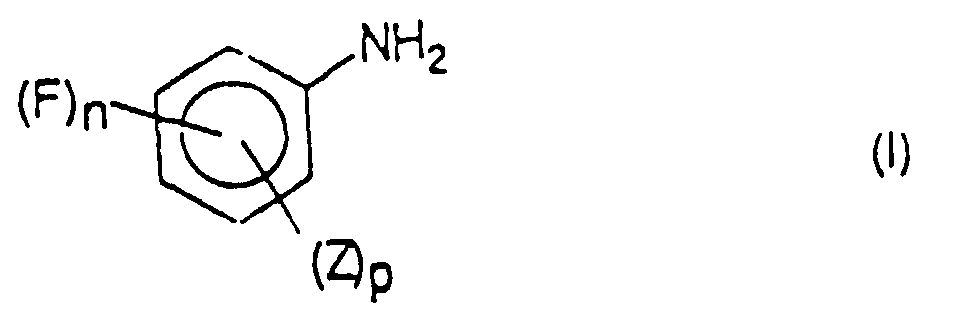 wobei man eine Verbindung der Formel (II),in der n = 1 bis 5,Z ein unter den Bedingungen einer katalytischen Hydrierung beständiges Radikal undp kleiner als 5 - n ist,in der n, Z und p die vorstehende Bedeutung haben,
 unter Wasserstoffdruck einer katalytischen Hydrierung in einer einen Katalysator enthaltenden Flüssigkeit unterzieht, bei der eine katalytische Reduktion und gegebenenfalls eine Hydrogenolyse erfolgt, dadurch gekennzeichnet, daß die Verbindung der Formel (II) nach und nach in das besagte Milieu gegeben wird, so daß der Gehalt an der Verbindung der Formel (II) in der Flüssigkeit kleiner oder gleich 1000 ppm bleibt, um selektiv die Verbindung der Formel (I) zu bilden.X ein hydrogenolysierbares Radikal undq = 0 bis 5-(n + p) ist,
 - Verfahren nach Anspruch 1, dadurch gekennzeichnet, daß die Verbindung der Formel (II) nach und nach in das besagte Milieu gegeben wird, so daß der Gehalt an der Verbindung der Formel (II) in der Flüssigkeit kleiner oder gleich 500 ppm bleibt, vor allem im Bereich von 200 bis 500 ppm.
- Verfahren nach Anspruch 1 oder 2, dadurch gekennzeichnet, daß X ein Chloratom und q = 1 bis 5 - (n + p) ist, und die Hydrierbedingungen so angepaßt werden, daß in einer Stufe (a) ausgehend von der Verbindung der Formel (II) durch katalytische Reduktion eine Verbindung der Formel (III)gebildet wird, und in einer anschließenden Stufe (b) ausgehend von der Verbindung der Formel (III) durch Hydrogenolyse die Verbindung der Formel (I) entsteht.

- Verfahren nach einem der Ansprüche 1 bis 3, dadurch gekennzeichnet, daß der Katalysator während der gesamten Dauer der Hydrierung der gleiche ist und Palladiumkohle enthält.
- Verfahren nach Anspruch 3, dadurch gekennzeichnet, daß der Katalysator der Stufe (a) unter Raneynickel und vergifteten Metallkatalysatoren, wie etwa vergiftetem Raneynickel ausgewählt wird, und der Katalysator der Stufe (b) unter Raneynickel und vergifteten Metallkatalysatoren wie etwa vergiftetem Raneynickel nicht ausgewählt wird.
- Verfahren nach einem der Ansprüche 1 bis 5, dadurch gekennzeichnet, daß die besagte Flüssigkeit ein polares Lösungsmittel ist, das protisch oder aprotisch sein kann.
- Verfahren nach einem der Ansprüche 1 bis 6, dadurch gekennzeichnet, daß die Reaktionstemperatur während der gesamten Hydrierung 0 bis 80°C beträgt, wenn q = 0, oder während der Stufe (a), wenn q > 0.
- Verfahren nach einem der Ansprüche 1 bis 7, dadurch gekennzeichnet, daß der Wasserstoff-Partialdruck während der gesamten Hydrierung 105 bis 5·106 Pa beträgt, wenn q = 0, oder während der Stufe (a), wenn q > 0.
- Verfahren nach Anspruch 4, bei dem das besagte Milieu eine Base, besonders eine Alkalibase enthält.
- Verfahren nach Anspruch 4, dadurch gekennzeichnet, daß man in das Milieu der Stufe (b) eine Base, besonders eine Alkalibase gibt.
- Verfahren nach einem der Ansprüche 9 oder 10, dadurch gekennzeichnet, daß es sich bei der besagten Base um Natronlauge handelt, die in der Reaktionsflüssigkeit in einer Konzentration kleiner oder gleich 1 ml/l vorliegt.
- Verfahren nach Anspruch 4, dadurch gekennzeichnet, daß die Reaktionstemperatur der Stufe (b) 80 bis 150°C beträgt.
- Verfahren nach Anspruch 4, dadurch gekennzeichnet, daß der Wasserstoff-Partialdruck in der Stufe (b) 1,5·106 bis 5·106 Pa beträgt.
- Verfahren nach einem der Ansprüche 1 bis 13 zur Herstellung von 2,4-Difluoranilin der Formel (Ia),dadurch gekennzeichnet, daß man eine katalytische Hydrierung durchführt bei einer Verbindung oder Mischung von Verbindungen der Formel (IIa),
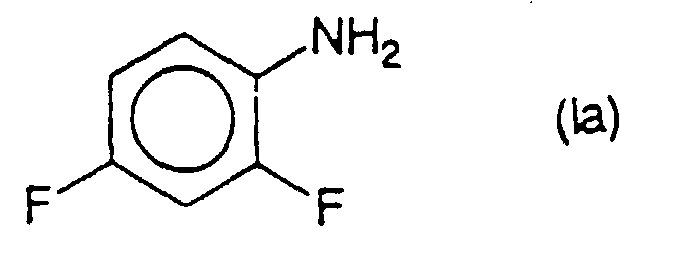 in der q = 0 bis 2 ist, und die man unter 2,4-Difluornitrobenzol und seinen in Position 3 oder 5 oder in Position 3 und 5 chlorierten Derivaten auswählt.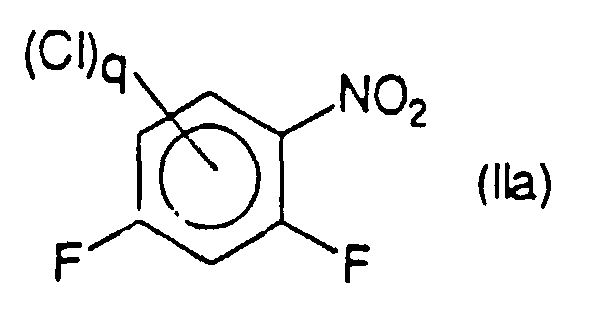
- Verfahren nach Anspruch 14, dadurch gekennzeichnet, daß die Verbindung oder die Mischung aus Verbindungen der Formel (IIa) durch Reaktion einer Verbindung oder einer Mischung aus Verbindungen der Formel (IV)mit einem Alkalifluorid, besonders Kaliumfluorid, in einem polaren aprotischen Lösungsmittel erhalten wird, die man jeweils zwischen 2,4-Dichlornitrobenzol und seinen in Position 3 oder 5, oder in Position 3 und 5 chlorierten Derivaten auswählt.
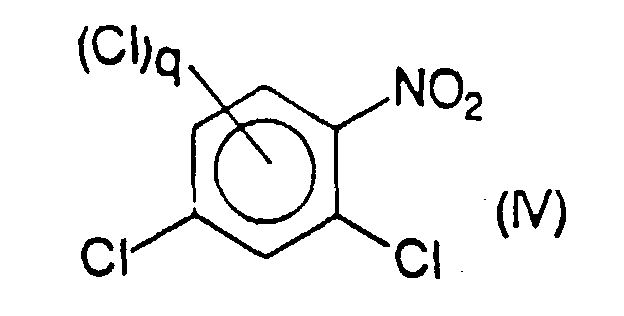
- Verfahren nach Anspruch 15, dadurch gekennzeichnet, daß die Verbindung oder die Mischung aus Verbindungen der Formel (IV) durch Reaktion einer Verbindung oder einer Mischung aus Verbindungen der Formel (V),mit einem Reagenz für die Nitrierung aromatischer Verbindungen, besonders mit Salpetersäure erhalten wird, die man jeweils unter 1,3-Dichlorbenzol und seinen in Position 2 oder 4 oder in Position 2 und 4 chlorierten Derivaten auswählt.

- Verfahren nach einem der Ansprüche 1 bis 13 für die Herstellung von 3,5-Difluoranilin der Formel (Ib),dadurch gekennzeichnet, daß man eine Verbindung oder eine Mischung aus Verbindungen der Formel (IIb)
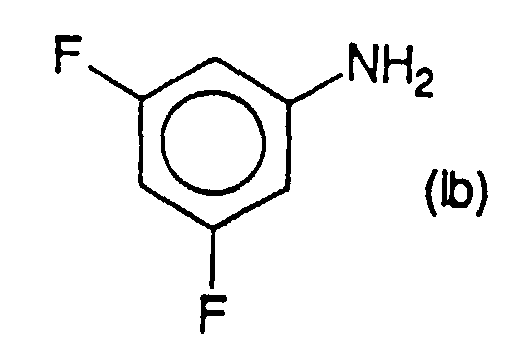 in der q = 0 bis 2 ist, und die man unter 2-Chlor-3,5-difluornitrobenzol und seinen in Position 4 oder 6 oder in Position 4 und 6 chlorierten Derivaten auswählt, der katalytischen Hydrolyse unterzieht.
- Verfahren nach Anspruch 17, dadurch gekennzeichnet, daß die Verbindung oder die Mischung aus Verbindungen der Formel (IIb) durch Reaktion einer Verbindung oder einer Mischung aus Verbindungen der Formel (VI)mit Kupfer(I)-chlorid in Gegenwart von salpetriger Säure erhalten wird, die man jeweils unter 2-Amino-3,5-difluornitrobenzol und seinen in Position 4 oder 6 oder in Position 4 und 6 chlorierten Derivaten auswählt.
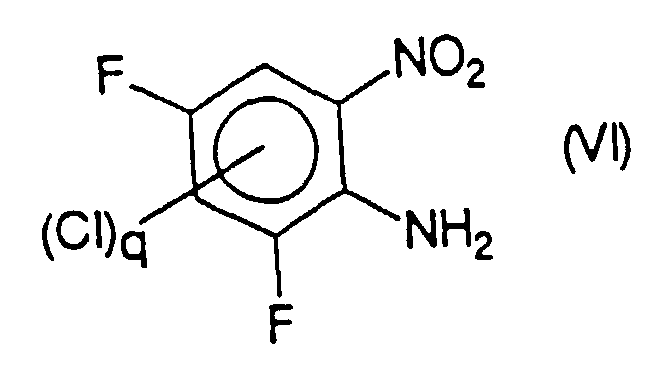
- Verfahren nach Anspruch 18, dadurch gekennzeichnet, daß die Verbindung oder die Mischung aus Verbindungen der Formel (VI) durch Reaktion einer Verbindung oder einer Mischung aus Verbindungen der Formel (VII),mit einem Reagenz für die Nitrierung aromatischer Verbindungen, besonders mit Salpetersäure erhalten wird, die man jeweils unter 2,4-Difluoranilin und seinen in Position 3 oder 5 oder in Position 3 und 5 chlorierten Derivaten auswählt.
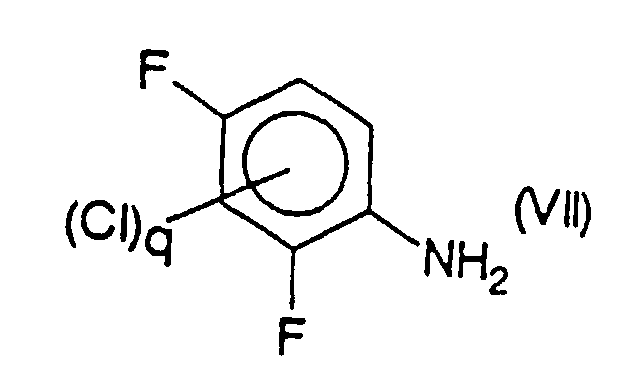
- Verfahren nach Anspruch 17, dadurch gekennzeichnet, daß die Verbindung oder die Mischung aus Verbindungen der Formel (IIb) durch Reaktion einer Verbindung oder Mischung aus Verbindungen der Formel (VIII),mit einem Reagenz für die Nitrierung aromatischer Verbindungen, besonders mit Salpetersäure erhalten wird, die man jeweils unter 1-Chlor-2,4-difluorbenzol und seinen in Position 3 oder 5 oder in Position 3 und 5 chlorierten Derivaten auswählt.
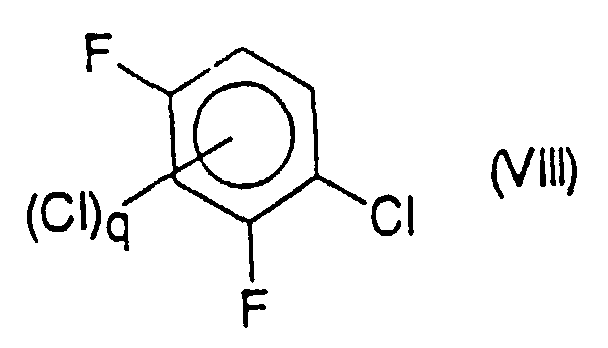
- Verfahren nach Anspruch 20, dadurch gekennzeichnet, daß die Verbindung oder die Mischung aus Verbindungen der Formel (VIII) durch Reaktion einer Verbindung oder einer Mischung aus Verbindungen der Formel (VII),mit Kupfer(I)-chlorid in Gegenwart von salpetriger Säure erhalten wird, die man jeweils unter 2,4-Difluoranilin und seinen in Position 3 oder 5 oder in Position 3 und 5 chlorierten Derivaten auswählt.
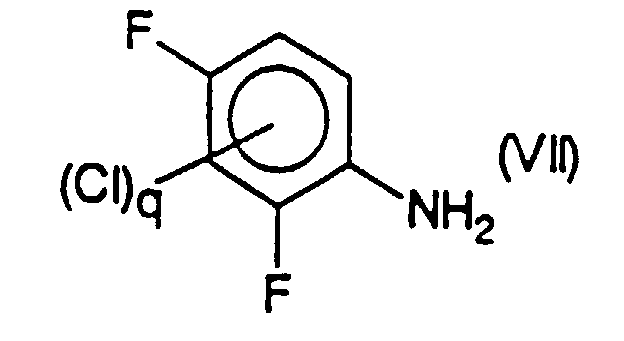
- Verfahren nach Anspruch 19 oder 21, dadurch gekennzeichnet, daß die Verbindung oder die Mischung aus Verbindungen der Formel (VII) durch Hydrierung einer Verbindung oder einer Mischung aus Verbindungen der Formel (IIa),erhalten wird, in der q = 0 bis 2 ist, und die man unter 2,4-Difluornitrobenzol und seinen in Position 3 oder 5 oder in Position 3 und 5 chlorierten Derivaten auswählt, besonders gemäß einem Verfahren nach irgendeinem der Ansprüche 1 bis 14.

Priority Applications (1)
| Application Number | Priority Date | Filing Date | Title |
|---|---|---|---|
| EP98113371A EP0875497A3 (de) | 1994-11-30 | 1995-11-29 | Verfahren zur Herstellung von Fluoroanilinen aus Fluoronitrobenzolen |
Applications Claiming Priority (5)
| Application Number | Priority Date | Filing Date | Title |
|---|---|---|---|
| FR9414395 | 1994-11-30 | ||
| FR9414395A FR2727406A1 (fr) | 1994-11-30 | 1994-11-30 | Procede de preparation de fluoroanilines a partir de composes benzeniques fluores nitres |
| FR9415956 | 1994-12-30 | ||
| FR9415956A FR2728899B1 (fr) | 1994-12-30 | 1994-12-30 | Procede de preparation de fluoroanilines a partir de composes benzeniques fluores nitres |
| PCT/FR1995/001575 WO1996016926A1 (fr) | 1994-11-30 | 1995-11-29 | Procede de preparation de fluoroanilines a partir de composes benzeniques fluores nitres |
Related Child Applications (1)
| Application Number | Title | Priority Date | Filing Date |
|---|---|---|---|
| EP98113371A Division EP0875497A3 (de) | 1994-11-30 | 1995-11-29 | Verfahren zur Herstellung von Fluoroanilinen aus Fluoronitrobenzolen |
Publications (2)
| Publication Number | Publication Date |
|---|---|
| EP0794936A1 EP0794936A1 (de) | 1997-09-17 |
| EP0794936B1 true EP0794936B1 (de) | 1999-03-17 |
Family
ID=26231576
Family Applications (2)
| Application Number | Title | Priority Date | Filing Date |
|---|---|---|---|
| EP98113371A Withdrawn EP0875497A3 (de) | 1994-11-30 | 1995-11-29 | Verfahren zur Herstellung von Fluoroanilinen aus Fluoronitrobenzolen |
| EP95941159A Expired - Lifetime EP0794936B1 (de) | 1994-11-30 | 1995-11-29 | Verfahren zur herstellung von fluoroanilinen aus fluoronitrobenzolen |
Family Applications Before (1)
| Application Number | Title | Priority Date | Filing Date |
|---|---|---|---|
| EP98113371A Withdrawn EP0875497A3 (de) | 1994-11-30 | 1995-11-29 | Verfahren zur Herstellung von Fluoroanilinen aus Fluoronitrobenzolen |
Country Status (7)
| Country | Link |
|---|---|
| US (1) | US5856577A (de) |
| EP (2) | EP0875497A3 (de) |
| JP (1) | JPH10509969A (de) |
| AT (1) | ATE177731T1 (de) |
| AU (1) | AU4265396A (de) |
| DE (1) | DE69508428T2 (de) |
| WO (1) | WO1996016926A1 (de) |
Families Citing this family (5)
| Publication number | Priority date | Publication date | Assignee | Title |
|---|---|---|---|---|
| US6127577A (en) * | 2000-02-08 | 2000-10-03 | Basf Corporation | Method of making 3,5-difluoroaniline from 1,3,5-trichlorobenzene |
| CN101624348B (zh) * | 2009-08-13 | 2013-01-02 | 浙江大学 | 一种对氟苯胺的制备方法 |
| JP2014508108A (ja) * | 2010-12-06 | 2014-04-03 | ビーエーエスエフ ソシエタス・ヨーロピア | 芳香族アミンを製造するための方法 |
| US8981155B2 (en) * | 2010-12-06 | 2015-03-17 | Basf Se | Process for preparing aromatic amines |
| CN116440811B (zh) * | 2023-04-07 | 2025-12-30 | 万华化学(宁波)有限公司 | 一种硝基苯液相加氢制苯胺的低剂耗工艺及应用 |
Family Cites Families (9)
| Publication number | Priority date | Publication date | Assignee | Title |
|---|---|---|---|---|
| US2619503A (en) * | 1947-09-05 | 1952-11-25 | Du Pont | Catalytic hydrogenation of dinitroaromatic compounds |
| US3361819A (en) * | 1964-06-05 | 1968-01-02 | Du Pont | Process for producing chlorinesubstituted aromatic amines |
| IE47471B1 (en) * | 1977-10-31 | 1984-03-21 | Merck & Co Inc | Method of preparing 2,4-difluoroaniline |
| US4140719A (en) * | 1977-10-31 | 1979-02-20 | Merck & Co., Inc. | Solid-liquid phase transfer catalysis improved method of preparing 2,4-difluoroaniline |
| DD154214A1 (de) * | 1980-11-07 | 1982-03-03 | Wolfgang Lambrecht | Verfahren zur hydrierung von nitrobenzol |
| JP2801358B2 (ja) * | 1990-05-15 | 1998-09-21 | 三井化学株式会社 | 高純度アニリンの製造方法 |
| FR2664590B1 (fr) * | 1990-07-16 | 1994-04-01 | Rhone Poulenc Chimie | Procede d'hydrogenation de derives halogeno nitroaromatiques en presence d'un derive soufre. |
| US5347052A (en) * | 1991-04-15 | 1994-09-13 | Occidental Chemical Corporation | Preparation of 3,5-diaminobenzotrifluoride |
| US5294742A (en) * | 1992-03-21 | 1994-03-15 | Hoechst Atkiengesellschaft | Process for preparing 3,5-difluoroaniline |
-
1995
- 1995-11-22 AU AU42653/96A patent/AU4265396A/en not_active Abandoned
- 1995-11-29 US US08/849,144 patent/US5856577A/en not_active Expired - Fee Related
- 1995-11-29 WO PCT/FR1995/001575 patent/WO1996016926A1/fr not_active Ceased
- 1995-11-29 DE DE69508428T patent/DE69508428T2/de not_active Expired - Fee Related
- 1995-11-29 EP EP98113371A patent/EP0875497A3/de not_active Withdrawn
- 1995-11-29 AT AT95941159T patent/ATE177731T1/de not_active IP Right Cessation
- 1995-11-29 EP EP95941159A patent/EP0794936B1/de not_active Expired - Lifetime
- 1995-11-29 JP JP8518338A patent/JPH10509969A/ja active Pending
Also Published As
| Publication number | Publication date |
|---|---|
| DE69508428D1 (de) | 1999-04-22 |
| EP0875497A2 (de) | 1998-11-04 |
| EP0794936A1 (de) | 1997-09-17 |
| ATE177731T1 (de) | 1999-04-15 |
| JPH10509969A (ja) | 1998-09-29 |
| EP0875497A3 (de) | 1999-08-18 |
| DE69508428T2 (de) | 1999-07-22 |
| WO1996016926A1 (fr) | 1996-06-06 |
| US5856577A (en) | 1999-01-05 |
| AU4265396A (en) | 1996-06-19 |
Similar Documents
| Publication | Publication Date | Title |
|---|---|---|
| KR100895141B1 (ko) | 4-아미노디페닐아민의 제조 방법 | |
| EP1713750A1 (de) | Verfahren zur herstellung einer fluorarmatischen verbindung aus einer aminoaromatischen aminverbindung | |
| EP0794936B1 (de) | Verfahren zur herstellung von fluoroanilinen aus fluoronitrobenzolen | |
| EP0054464B1 (de) | Verfahren zur Herstellung von ortho-Trifluormethylanilin | |
| EP2197829B1 (de) | Verfahren zur synthese von arylamin | |
| EP0733614A1 (de) | Reagenz und Verfahren zum Anbringen einer substituierten Difluoromethylgruppe an einer Verbindung mit mindenstens einer elektrophilen Funktion | |
| JPS63502181A (ja) | 弗化カリウム分散液中でのフルオロ芳香族化合物の製造方法 | |
| EP0905113B1 (de) | Verfahren zur Herstellung von 2-Chlorprop-1-en | |
| FR2728899A1 (fr) | Procede de preparation de fluoroanilines a partir de composes benzeniques fluores nitres | |
| FR2727406A1 (fr) | Procede de preparation de fluoroanilines a partir de composes benzeniques fluores nitres | |
| WO1998005609A1 (fr) | Procede pour greffer un groupement difluoromethyle substitue | |
| JP3296487B2 (ja) | 4−ニトロソアニリンの製造方法 | |
| EP0409709A1 (de) | Verfahren zur Hydrierung von halogen-nitroaromatischen Derivaten in Anwesenheit von einem Schwefelderivat | |
| Bachman et al. | The BF3· N2O3 Complex. Its Use in Diazotization and Nitration1 | |
| AU2010100312A4 (en) | A process for preparing polyhalogenated perhalo alkyl aniline | |
| FR2547815A1 (fr) | Procede d'halogenation-nitration-fluoration de derives aromatiques | |
| EP0421878A1 (de) | Verfahren zur Hydrierung von halogenierten nitroaromatischen Derivaten in Gegenwart von Edelmetall-Katalysatoren | |
| EP0427603A1 (de) | Verfahren zur Herstellung von fluorierten aromatischen Verbindungen und auf Lewis-Säuren basierte Katalysatoren | |
| EP0536070B1 (de) | Material aus Wolframcarbid, Katalysator und Verfahren zur Hydrierung von nitro- oder nitrosoaromatischen Derivaten durch Verwendung dieses Katalysators | |
| FR2519631A1 (fr) | Procede de preparation de 3,3'- ou 3,4'-diamino benzophenone | |
| JPS5848541B2 (ja) | メタ位塩素置換アニリン類の製法 | |
| FR2547812A1 (fr) | Procede d'halogenation et de fluoration simultanees de derives aromatiques | |
| EP1189872B1 (de) | Verfahren zum austausch und zur freisetzung von aminen aus ihrem carbamoylfluorid | |
| CA2348704C (fr) | Procede et reactif de sulfonylation utiles pour la synthese de sulfanilide perhalogene | |
| EP1259476B1 (de) | Orthochlorierung eines anilins in einem fluorwasserstoffmedium |
Legal Events
| Date | Code | Title | Description |
|---|---|---|---|
| PUAI | Public reference made under article 153(3) epc to a published international application that has entered the european phase |
Free format text: ORIGINAL CODE: 0009012 |
|
| 17P | Request for examination filed |
Effective date: 19970122 |
|
| AK | Designated contracting states |
Kind code of ref document: A1 Designated state(s): AT BE CH DE DK ES FR GB GR IE IT LI LU MC NL PT SE |
|
| GRAG | Despatch of communication of intention to grant |
Free format text: ORIGINAL CODE: EPIDOS AGRA |
|
| 17Q | First examination report despatched |
Effective date: 19980121 |
|
| RAP1 | Party data changed (applicant data changed or rights of an application transferred) |
Owner name: RHODIA CHIMIE |
|
| GRAG | Despatch of communication of intention to grant |
Free format text: ORIGINAL CODE: EPIDOS AGRA |
|
| GRAH | Despatch of communication of intention to grant a patent |
Free format text: ORIGINAL CODE: EPIDOS IGRA |
|
| GRAG | Despatch of communication of intention to grant |
Free format text: ORIGINAL CODE: EPIDOS AGRA |
|
| GRAH | Despatch of communication of intention to grant a patent |
Free format text: ORIGINAL CODE: EPIDOS IGRA |
|
| GRAG | Despatch of communication of intention to grant |
Free format text: ORIGINAL CODE: EPIDOS AGRA |
|
| GRAH | Despatch of communication of intention to grant a patent |
Free format text: ORIGINAL CODE: EPIDOS IGRA |
|
| GRAH | Despatch of communication of intention to grant a patent |
Free format text: ORIGINAL CODE: EPIDOS IGRA |
|
| GRAA | (expected) grant |
Free format text: ORIGINAL CODE: 0009210 |
|
| AK | Designated contracting states |
Kind code of ref document: B1 Designated state(s): AT BE CH DE DK ES FR GB GR IE IT LI LU MC NL PT SE |
|
| PG25 | Lapsed in a contracting state [announced via postgrant information from national office to epo] |
Ref country code: SE Free format text: THE PATENT HAS BEEN ANNULLED BY A DECISION OF A NATIONAL AUTHORITY Effective date: 19990317 Ref country code: GR Free format text: LAPSE BECAUSE OF NON-PAYMENT OF DUE FEES Effective date: 19990317 Ref country code: ES Free format text: THE PATENT HAS BEEN ANNULLED BY A DECISION OF A NATIONAL AUTHORITY Effective date: 19990317 Ref country code: AT Free format text: LAPSE BECAUSE OF FAILURE TO SUBMIT A TRANSLATION OF THE DESCRIPTION OR TO PAY THE FEE WITHIN THE PRESCRIBED TIME-LIMIT Effective date: 19990317 |
|
| REF | Corresponds to: |
Ref document number: 177731 Country of ref document: AT Date of ref document: 19990415 Kind code of ref document: T |
|
| REG | Reference to a national code |
Ref country code: CH Ref legal event code: EP |
|
| REG | Reference to a national code |
Ref country code: IE Ref legal event code: FG4D Free format text: FRENCH |
|
| REF | Corresponds to: |
Ref document number: 69508428 Country of ref document: DE Date of ref document: 19990422 |
|
| GBT | Gb: translation of ep patent filed (gb section 77(6)(a)/1977) |
Effective date: 19990520 |
|
| PG25 | Lapsed in a contracting state [announced via postgrant information from national office to epo] |
Ref country code: PT Free format text: LAPSE BECAUSE OF FAILURE TO SUBMIT A TRANSLATION OF THE DESCRIPTION OR TO PAY THE FEE WITHIN THE PRESCRIBED TIME-LIMIT Effective date: 19990617 Ref country code: DK Free format text: LAPSE BECAUSE OF FAILURE TO SUBMIT A TRANSLATION OF THE DESCRIPTION OR TO PAY THE FEE WITHIN THE PRESCRIBED TIME-LIMIT Effective date: 19990617 |
|
| PG25 | Lapsed in a contracting state [announced via postgrant information from national office to epo] |
Ref country code: IE Free format text: LAPSE BECAUSE OF NON-PAYMENT OF DUE FEES Effective date: 19991019 |
|
| REG | Reference to a national code |
Ref country code: IE Ref legal event code: FD4D |
|
| PG25 | Lapsed in a contracting state [announced via postgrant information from national office to epo] |
Ref country code: LU Free format text: LAPSE BECAUSE OF NON-PAYMENT OF DUE FEES Effective date: 19991129 |
|
| PLBE | No opposition filed within time limit |
Free format text: ORIGINAL CODE: 0009261 |
|
| STAA | Information on the status of an ep patent application or granted ep patent |
Free format text: STATUS: NO OPPOSITION FILED WITHIN TIME LIMIT |
|
| 26N | No opposition filed | ||
| PG25 | Lapsed in a contracting state [announced via postgrant information from national office to epo] |
Ref country code: MC Free format text: LAPSE BECAUSE OF NON-PAYMENT OF DUE FEES Effective date: 20000531 |
|
| PGFP | Annual fee paid to national office [announced via postgrant information from national office to epo] |
Ref country code: FR Payment date: 20010926 Year of fee payment: 7 |
|
| PGFP | Annual fee paid to national office [announced via postgrant information from national office to epo] |
Ref country code: NL Payment date: 20011016 Year of fee payment: 7 Ref country code: CH Payment date: 20011016 Year of fee payment: 7 |
|
| PGFP | Annual fee paid to national office [announced via postgrant information from national office to epo] |
Ref country code: DE Payment date: 20011019 Year of fee payment: 7 |
|
| PGFP | Annual fee paid to national office [announced via postgrant information from national office to epo] |
Ref country code: GB Payment date: 20011123 Year of fee payment: 7 |
|
| REG | Reference to a national code |
Ref country code: GB Ref legal event code: IF02 |
|
| PG25 | Lapsed in a contracting state [announced via postgrant information from national office to epo] |
Ref country code: GB Free format text: LAPSE BECAUSE OF NON-PAYMENT OF DUE FEES Effective date: 20021129 |
|
| PG25 | Lapsed in a contracting state [announced via postgrant information from national office to epo] |
Ref country code: LI Free format text: LAPSE BECAUSE OF NON-PAYMENT OF DUE FEES Effective date: 20021130 Ref country code: CH Free format text: LAPSE BECAUSE OF NON-PAYMENT OF DUE FEES Effective date: 20021130 |
|
| PGFP | Annual fee paid to national office [announced via postgrant information from national office to epo] |
Ref country code: BE Payment date: 20030121 Year of fee payment: 8 |
|
| PG25 | Lapsed in a contracting state [announced via postgrant information from national office to epo] |
Ref country code: NL Free format text: LAPSE BECAUSE OF NON-PAYMENT OF DUE FEES Effective date: 20030601 |
|
| PG25 | Lapsed in a contracting state [announced via postgrant information from national office to epo] |
Ref country code: DE Free format text: LAPSE BECAUSE OF NON-PAYMENT OF DUE FEES Effective date: 20030603 |
|
| REG | Reference to a national code |
Ref country code: CH Ref legal event code: PL |
|
| GBPC | Gb: european patent ceased through non-payment of renewal fee | ||
| PG25 | Lapsed in a contracting state [announced via postgrant information from national office to epo] |
Ref country code: FR Free format text: LAPSE BECAUSE OF NON-PAYMENT OF DUE FEES Effective date: 20030731 |
|
| NLV4 | Nl: lapsed or anulled due to non-payment of the annual fee |
Effective date: 20030601 |
|
| REG | Reference to a national code |
Ref country code: FR Ref legal event code: ST |
|
| PG25 | Lapsed in a contracting state [announced via postgrant information from national office to epo] |
Ref country code: BE Free format text: LAPSE BECAUSE OF NON-PAYMENT OF DUE FEES Effective date: 20031130 |
|
| BERE | Be: lapsed |
Owner name: *RHODIA CHIMIE Effective date: 20031130 |
|
| PG25 | Lapsed in a contracting state [announced via postgrant information from national office to epo] |
Ref country code: IT Free format text: LAPSE BECAUSE OF NON-PAYMENT OF DUE FEES Effective date: 20051129 |