EP0798865A2 - Konverter für digitale Daten - Google Patents
Konverter für digitale Daten Download PDFInfo
- Publication number
- EP0798865A2 EP0798865A2 EP97400491A EP97400491A EP0798865A2 EP 0798865 A2 EP0798865 A2 EP 0798865A2 EP 97400491 A EP97400491 A EP 97400491A EP 97400491 A EP97400491 A EP 97400491A EP 0798865 A2 EP0798865 A2 EP 0798865A2
- Authority
- EP
- European Patent Office
- Prior art keywords
- data
- delta
- level
- sigma modulator
- processing
- Prior art date
- Legal status (The legal status is an assumption and is not a legal conclusion. Google has not performed a legal analysis and makes no representation as to the accuracy of the status listed.)
- Withdrawn
Links
Images


Classifications
-
- H—ELECTRICITY
- H03—ELECTRONIC CIRCUITRY
- H03M—CODING; DECODING; CODE CONVERSION IN GENERAL
- H03M3/00—Conversion of analogue values to or from differential modulation
-
- H—ELECTRICITY
- H03—ELECTRONIC CIRCUITRY
- H03M—CODING; DECODING; CODE CONVERSION IN GENERAL
- H03M7/00—Conversion of a code where information is represented by a given sequence or number of digits to a code where the same, similar or subset of information is represented by a different sequence or number of digits
- H03M7/30—Compression; Expansion; Suppression of unnecessary data, e.g. redundancy reduction
- H03M7/3002—Conversion to or from differential modulation
- H03M7/3004—Digital delta-sigma modulation
-
- H—ELECTRICITY
- H03—ELECTRONIC CIRCUITRY
- H03M—CODING; DECODING; CODE CONVERSION IN GENERAL
- H03M7/00—Conversion of a code where information is represented by a given sequence or number of digits to a code where the same, similar or subset of information is represented by a different sequence or number of digits
- H03M7/30—Compression; Expansion; Suppression of unnecessary data, e.g. redundancy reduction
- H03M7/3002—Conversion to or from differential modulation
- H03M7/3004—Digital delta-sigma modulation
- H03M7/3015—Structural details of digital delta-sigma modulators
- H03M7/3031—Structural details of digital delta-sigma modulators characterised by the order of the loop filter, e.g. having a first order loop filter in the feedforward path
- H03M7/3033—Structural details of digital delta-sigma modulators characterised by the order of the loop filter, e.g. having a first order loop filter in the feedforward path the modulator having a higher order loop filter in the feedforward path, e.g. with distributed feedforward inputs
-
- H—ELECTRICITY
- H03—ELECTRONIC CIRCUITRY
- H03M—CODING; DECODING; CODE CONVERSION IN GENERAL
- H03M7/00—Conversion of a code where information is represented by a given sequence or number of digits to a code where the same, similar or subset of information is represented by a different sequence or number of digits
- H03M7/30—Compression; Expansion; Suppression of unnecessary data, e.g. redundancy reduction
- H03M7/3002—Conversion to or from differential modulation
- H03M7/3004—Digital delta-sigma modulation
- H03M7/3015—Structural details of digital delta-sigma modulators
- H03M7/3031—Structural details of digital delta-sigma modulators characterised by the order of the loop filter, e.g. having a first order loop filter in the feedforward path
- H03M7/3033—Structural details of digital delta-sigma modulators characterised by the order of the loop filter, e.g. having a first order loop filter in the feedforward path the modulator having a higher order loop filter in the feedforward path, e.g. with distributed feedforward inputs
- H03M7/304—Structural details of digital delta-sigma modulators characterised by the order of the loop filter, e.g. having a first order loop filter in the feedforward path the modulator having a higher order loop filter in the feedforward path, e.g. with distributed feedforward inputs with distributed feedback, i.e. with feedback paths from the quantiser output to more than one filter stage
Definitions
- the present invention relates to a word-length conversion apparatus for converting the word length of digital data.
- the present invention also relates to a data processing apparatus for carrying out predetermined processing on digital data by performing processing of the digital data along with predetermined processing data.
- a DELTA-SIGMA method draws attention.
- a sampling output of an analog audio signal and a previous conversion output are processed and coded in order to convert the analog audio data into digital audio data with a word length, typically, of 1 bit.
- level-adjustment coefficient or level-adjustment data
- this problem arises not only when level-adjustment processing is carried out on 1-bit digital audio data, but also when processing to eliminate a direct-current offset component or processing to change a frequency characteristic is performed. This is because, even when such processing is carried out, data for eliminating a direct-current offset component and data for changing a frequency characteristic must be added to the 1-bit digital audio data.
- the word-length conversion apparatus changes the word length of digital audio data by means of a DELTA-SIGMA converter which has as an input/output characteristic thereof a characteristic capable of passing through only original signal components.
- the data processing apparatus After performing predetermined processing on digital data by carrying out processing on the digital data along with predetermined processing data, the data processing apparatus provided by the present invention changes the word length of an output of the data processing by means of a DELTA-SIGMA modulator which has as an input/output characteristic thereof a characteristic capable of passing through only original signal components.
- digital data undergoes DELTA-SIGMA modulation in the DELTA-SIGMA modulator.
- the word length of the digital data is converted into a predetermined word length.
- components other than the original signal component included in the digital data are removed from it. Therefore, when the digital data is supplied to the DELTA-SIGMA modulator, the input level thereof can be set on the basis of the level of the original signal component.
- the level of the original signal component is lower than the maximum input level of the DELTA-SIGMA modulator, it is possible not only to lower the level of the signal component, but also to raise the level thereof.
- digital data undergoes predetermined data processing through processing thereof along with predetermined processing data. Thereafter, the output of the processing undergoes DELTA-SIGMA modulation in the DELTA-SIGMA modulator. As a result, the word length of digital data can be changed to a predetermined word length.
- the input level thereof can be set on the basis of the level of the original signal component.
- the level of the original signal component is lower than the maximum input level of the DELTA-SIGMA modulator, it is possible not only to lower the level of the signal component, but also to raise the level thereof.
- the maximum degree of modulation Mmax of the DELTA-SIGMA modulator becomes smaller than unity, (100%).
- S/N ratio the signal-to-noise ratio
- the maximum degree of modulation Mmax varies dependent upon the transfer function of the DELTA-SIGMA modulator. Now, let the maximum degree of modulation Mmax be 0.5 (50%). In this case, only a signal with a level up to about 0.5 (50%) of the output level (+/-1) of the DELTA-SIGMA modulator can be supplied thereto. That is to say, only a signal with a level of up to +/-0.5 (50%) can be supplied.
- the input level of the digital audio data supplied to the DELTA-SIGMA modulator can be set on the basis of the level of the signal component.
- the level of the signal component in the audible band prior to the level adjustment is lower than the maximum input level ILmax of the DELTA-SIGMA modulator, it is possible not only to lower the level of the signal component, but also to raise the level thereof.
- the digital audio signal resulting from the DELTA-SIGMA modulation includes quantization noise N.
- quantization noise N As shown in Fig. 2, the higher the frequency, the higher the level of the quantization noise N.
- the level of quantization noise N having a high frequency is normally the maximum input level ILmax of the DELTA-SIGMA modulator and also higher than the level of the signal component S in the audible band.
- Quantization noise N having a high frequency is called high-frequency noise HN.
- the setting of the input level of digital audio data supplied to the DELTA-SIGMA modulator for restoring data must be based on the level of the high-frequency noise HN instead of being based on the level of the signal component S in the audible band.
- the level of the component signal S in the audible band can be lowered even if the level of the component signal S in the audible band prior to the level adjustment is lower than the maximum input level ILmax as long as the level of the high-frequency noise HN is higher than the maximum input level ILmax.
- the input/output frequency characteristic of the DELTA-SIGMA converter is not flat up to the Nyquist frequency fN.
- the input/output frequency, thereof is such a frequency with a large gain over a range from several kilohertz to the Nyquist frequency fN as shown in Fig. 4.
- Such a problem can be solved by supplying 1-bit digital audio data to the DELTA-SIGMA modulator for restoring data after removing high-frequency noise HN from the 1-bit digital audio data.
- the present embodiment provides a level adjusting apparatus wherein, in the case of 1-bit digital audio data which is multiplied by a level-adjustment coefficient during level-adjustment processing, the word length can be restored to the original value thereof without leading to degradation of the accuracy of the processing output and, in addition, for digital audio data with a level prior to the level adjustment lower than the maximum input level ILmax of the DELTA-SIGMA modulator, the level of the original signal component can be raised without using a digital filter.
- FIG. 1 is a block diagram showing the configuration of a data processing apparatus provided by the first embodiment of the present invention.
- the data processing apparatus (to be more specific, the level adjusting apparatus) comprises a data input terminal 11, a coefficient input terminal 12, a multiplier 13, a low-pass DELTA-SIGMA modulator 14 and an output terminal 15.
- digital audio data DD1 output by a DELTA-SIGMA modulator for coding is supplied to the level adjusting apparatus by way of the data input terminal 11.
- the word length of the digital audio data DD1 is set at 1 bit for example.
- data of a coefficient LD for level adjustment is supplied to the level adjusting apparatus by way of the coefficient input terminal 12.
- the multiplier 13 has the function of multiplying each bit of the digital audio data DD1 supplied to the level adjusting apparatus by way of the data input terminal 11 by the level-adjustment coefficient LD.
- the DELTA-SIGMA modulator 14 has the function of restoring digital audio data DD2 resulting from the multiplication carried out by the multiplier 13 into 1-bit digital audio data DD3 by modulation of the digital audio data DD2.
- the DELTA-SIGMA modulator 14 is the word-length conversion apparatus provided by the present invention.
- the 1-bit digital audio data DD3, the result of the restoration, is output to the output terminal 15.
- the DELTA-SIGMA modulator 14 has a low-pass characteristic capable of removing high-frequency noise HN. Such a low-pass characteristic can be obtained by properly setting the transfer function of a feed-forward element and the transfer function of a feedback element.
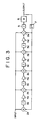
- the DELTA-SIGMA modulator 14 comprises an input terminal 21, an adding element 22, a feed-forward element 23, an amplifying element 24, a feedback element 25 and an output terminal 26 as shown in Fig. 5.
- the digital audio data DD2 is supplied to the DELTA-SIGMA modulator 14 by way of the input terminal 21.
- the adding element 22 has a function for finding the difference between the input digital audio data DD2 and the digital audio data DD3, a conversion output.
- the feed-forward element 23 has a function for converting the difference found by the adding element 22 into 1-bit data.
- the amplifying element 24 has a function for amplifying the 1-bit data output by the feed-forward element 23 into the digital audio data DD3.
- the feedback element 25 has a function for feeding back the digital audio data DD3 output by the amplifying element 24 (which is the conversion output cited above).
- the digital audio data DD3 is also supplied to the output terminal 26.
- the transfer function G(z) of the DELTA-SIGMA modulator 14 is expressed by Eq. (2) as follows: where reference notations X(z) and Y(z) are the input and output signals respectively, reference notation F(z) is the transfer function of the feed-forward element 23, reference notation Q is the gain of the amplifying element 24, reference notation S(z) is the transfer function of the feedback element 25, reference notation z is j ⁇ and reference notation ⁇ is the angular speed.
- the frequency characteristic of the DELTA-SIGMA modulator 14 can be set as a low-pass characteristic by properly setting the transfer function F(z) of the feed-forward element 23 and the transfer function S(z) of the feedback element 25.
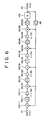
- Fig. 6 is a diagram showing a typical actual configuration of the DELTA-SIGMA modulator 14 having a low-pass characteristic.
- the DELTA-SIGMA modulator 14 comprises an input terminal 41, five two-input adders 42(1) to 42(5), five integrators 43(1) to 43(5), four coefficient multipliers 44(1) to 44(4), an amplifier 45, a delay element 46 and an output terminal 47.
- the digital audio data DD2 output by the multiplier 13 is supplied to the input terminal 41.
- the two-input adders 42(1) to 42(5) each have the function of subtracting a signal supplied to one of the two input terminals thereof from a signal supplied to the other input signal.
- the integrators 43(1) to 43(5) each have the function of integrating an input signal supplied thereto.
- the coefficient multipliers 44(1) to 44(4) each have the function of multiplying an input signal supplied thereto by a coefficient of 1/16, 1/8, 1/4 or 1/2.
- the delay element 46 has the function of delaying an input signal supplied thereto by a 1-bit period.
- the digital audio data DD3, the word length of which has been restored to 1 bit, is supplied to the output terminal 47.
- the input terminal 41 is connected to one of the input terminals of the two-input adder 42(1).
- the output terminal of the adder 42(1) is connected to the input terminal of the integrator 43(1).
- the output terminal of the integrator 43(1) is connected to the input terminal of the coefficient multiplier 44(1).
- the output terminal of the coefficient multiplier 44(1) is connected to one of the input terminals of the two-input adder 42(2). Thereafter, the other elements up to the integrator 43(5) are connected to each other in the same way.
- the output terminal of the integrator 43(5) is connected to the input terminal of the amplifier 45.
- the output terminal of the amplifier 45 is connected to the output terminal 47 and to the input terminal of the delay element 46.
- the output terminal of the delay element 46 is connected to the other input terminal of each of the adders 42(1) to 42(5).
- the integrators 43(1) to 43(5) may each comprise an adder 431 and a delay element 432.
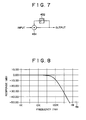
- the frequency characteristic of the DELTA-SIGMA modulator 14 shown in Fig. 6 is all but flat up to the upper-limit frequency of the audible band.
- the curve exhibits an attenuation characteristic in the frequency zone from the upper-limit frequency to the Nyquist frequency fN.
- Digital audio data DD1 is supplied to the data input terminal 11.
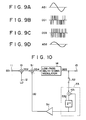
- the digital audio data DD1 is obtained by carrying out DELTA-SIGMA modulation on an analog audio data signal AD1 shown in Fig. 9A.
- the word length of the digital audio data DD1 is set at 1 bit.
- the digital audio data DD1 is shown in Fig. 9B. As shown in the figure, the digital audio data DD1 has "+1" and “-1” levels. Typically, the "+1" and “-1” levels correspond to the logic values "1" and "0" respectively.
- the digital audio data DD1 received by way of the data input terminal 11 is supplied to the multiplier 13 to be multiplied by the level-adjustment coefficient LD.
- the multiplication results in digital audio data DD2 with the level thereof adjusted.
- the digital audio data DD2 is then supplied to the DELTA-SIGMA modulator 14.
- the digital audio data DD2 again undergoes DELTA-SIGMA modulation through integration, quantization and feedback processing.
- the word length which was extended in the level-adjustment processing is restored to the original value thereof. That is to say, the DELTA-SIGMA modulator 14 produces digital audio data DD3 with a word length restored to 1 bit.
- the digital audio data DD3 with a word length restored to 1 bit is shown in Fig. 9C.
- the digital audio data DD3 is supplied to a digital filter (which is not shown in the figure) by way of the output terminal 15.
- the digital filter restores the digital audio data DD3 to the original analog audio data AD2 that is shown in Fig. 9D.
- the digital audio data DD1 supplied to the input terminal 11 includes quantization noise N in addition to the signal component S in the audible band.
- the digital audio data DD2 output by the multiplier 13 also includes quantization noise N in addition to the signal component S in the audible band.
- the level of high-frequency noise HN the quantization noise N which has frequencies higher than the upper-limit frequency of the audible band, is normally higher than the level of the signal component S in the audible band. For this reason, if a DELTA-SIGMA modulator having a frequency characteristic like the one shown in Fig. 4 is employed as the DELTA-SIGMA modulator 14, the setting of the value of the level-adjustment coefficient LD must be based on the level of the high-frequency noise HN.
- the DELTA-SIGMA modulator 14 provided by the present embodiment has a low-pass characteristic.
- the curve representing the low-pass characteristic is flat in the audible band and exhibits a gradually decreasing gain in a frequency zone from a frequency in close proximity to the upper-limit frequency of the audible band to the Nyquist frequency fN. Therefore, high-frequency noise HN supplied to the DELTA-SIGMA modulator 14 is eliminated thereby.
- the value of the level-adjustment coefficient LD can be set without having much regard to the level of the high-frequency noise HN.
- the value of the level-adjustment coefficient LD can be set by mainly taking the level of the signal component S in the audible band. In this way, the level-adjustment processing can solve the problem that the level of the signal component in the audible band always decreases.
- the level-adjustment coefficient LD must be set at a value of smaller than unity. As a result, in this case, the level of the signal component S in the audible band is lowered by the level-adjustment processing.
- the level-adjustment coefficient LD can be set at a value equal to unity.
- the level of the signal component S in the audible band can be sustained as it is.
- the level-adjustment coefficient LD can be set at a value of greater than unity. As a result, in this case, the level of the signal component S in the audible band can be raised by the level-adjustment processing.
- the level of a signal component S in the audible band prior to the level adjustment is explained through an example. Let the maximum degree of modulation Mmax of the DELTA-SIGMA modulator for coding and Mmax of the DELTA-SIGMA modulator 14 for changing the word length be both 0.5 (50%). In addition, let us assume that the level of the analog audio data AD1 is 0.5.
- digital audio data DD1 with a degree of modulation M of 0.5 (50%) is supplied to the input terminal 11. That is to say, the digital audio data DD1 has a signal component S in the audible band with a level of 0.5.
- the level-adjustment coefficient LD can be set at a value of equal to or smaller than unity. This is because the maximum degree of modulation Mmax of the DELTA-SIGMA modulator 14 is set at 0.5 (50%). That is to say, this is because a signal component S in the audible band with a level of 0.5 can be input.
- the value of the level-adjustment coefficient LD be set 0.5.
- digital audio data DD3 including a signal component S in the audible band with a level of 0.25 is obtained.
- the level of the signal component S in the audible band is lowered from 0.5 to 0.25 by the level-adjustment processing.
- the digital audio data DD3 can be restored to the analog audio data AD2 with a level of 0.25.
- digital audio data DD3 including a signal component S in the audible band with a level of 0.50 is obtained.
- the level of the signal component S in the audible band is kept at 1.0 as it is by the level-adjustment processing.
- the digital audio data DD3 can be restored to the analog audio data AD2 with a level of 0.50.
- the level of the analog audio data AD1 is set at 0.1.
- digital audio data DD1 with a degree of modulation M of 0.1 (10%) is supplied to the input terminal 11. That is to say, digital audio data DD1 including a signal component S in the audible band with a level of 0.1 is supplied.
- the level-adjustment coefficient LD can be set at a value of equal to or smaller than 5.0.
- digital audio data DD3 including a signal component S in the audible band with a level of 0.4 is obtained.
- the level of the signal component S in the audible band is raised from 0.1 to 0.4 by the level-adjustment processing.
- thc digital audio data DD3 can be restored to the analog audio data AD2 with a level of 0.4. What has been described so far is the operation of the level adjusting circuit shown in Fig. 1.
- the digital audio data DD2 received by way of the input terminal 41 is supplied to the adder 42(1).
- a conversion output leading by 1 sample from the delay element 46 is subtracted from each bit of the digital audio data DD2.
- the result of the subtraction is integrated by the integrator 43(1) before being multiplied by a multiplying coefficient of 1/16 by means of the multiplier 44(1).
- the product output by the multiplier 44(1) is supplied to the adder 42(2) for subtracting the conversion output cited above from the product.
- the digital audio data DD2 undergoes the same subtraction, integration and multiplication processings which are carried out one after another before being amplified by the amplifier 45. In this way, the digital audio data DD3 with the word length thereof restored to 1 bit is obtained. After being delayed by 1 sampling period by means of the delay element 46, the digital audio data DD3 is supplied to the adders 42(1) to 42(5).
- the digital audio data DD2 can be converted to digital audio data DD3 with the word length thereof restored to 1 bit.
- the word length can be restored to the original value thereof without degrading the accuracy of the output of the level adjustment.
- the DELTA-SIGMA modulator 14 for changing the word length is designed to exhibit a low-pass characteristic capable of eliminating high-frequency noise HN.
- the value of the level-adjustment coefficient LD can be set almost without the need to take the level of the high-frequency noise HN into consideration.
- the level (the degree of modulation) of the signal component S in the audible band can be lowered.
- the signal component S in the audible band aftcr the level adjustment can be set at the maximum degree of modulation Mmax and, on top of that, if the increase in level from the input is in a range of about +12 dB, the level of the signal component S in the audible band can be raised with barely any degradation TD+N.
- the level-adjustment coefficient LD can be set at a value of equal to or greater than unity. In this way, it is possible to raise the level of the signal component S in the audible band.
- the data processing apparatus provided by the first embodiment of the present invention is applied to a level adjusting apparatus.
- the data processing apparatus provided by the second embodiment of the present invention is applied to an apparatus that has a function of eliminating a direct-current offset component and a function of adjusting the level of digital data.
- Fig. 10 is a block diagram showing the configuration of the second embodiment.
- the data processing apparatus shown in the figure comprises a configuration for eliminating a direct-current offset component and a configuration for adjusting the level of digital data which are independent of each other.
- the configuration for adjusting the level of digital data is the same as that shown in Fig. 1.
- components composing the configuration for adjusting the level of digital data shown in the figure are denoted by the same reference numerals as those used in Fig. 1 and the explanation of the level adjusting configuration is omitted.
- the configuration shown in Fig. 10 is different from that shown in Fig. 1 in that, in the case of the former, an adder 51, a switch 52, an integrator 53 and a shifter 54 are added to the data processing apparatus shown in Fig. 1. These additional components are used for eliminating from the data DD2 a direct-current offset component DC included in the digital audio data DD2.
- the adder 51 has a function of subtracting data OD for eliminating the direct-current offset component DC from the digital audio data DD2.
- the data OD is referred to hereafter as omitting data.
- the switch 52 has a function of flattening the frequency characteristic of the DELTA-SIGMA modulator 14 up to the direct-current zone.
- the integrator 53 has a function of integrating the digital audio data DD3 output by the DELTA-SIGMA modulator 14.
- the shifter 54 has a function of generating the omitting data OD by shifting an integration output of the integrator 53 in a direction of lowering the level thereof.
- the value of the level-adjustment coefficient LD be 1.
- the level of the digital audio data DD1 supplied to the input terminal 11 is "+1”
- the level of the digital audio data DD2 output by the multiplier 13 is also "+1”.
- the level of the digital audio data 11 is "-1”
- the level of the digital audio data DD2 output by the multiplier 13 is also "-1".
- the digital audio data DD2 is supplied to the adder 51 for subtracting the omitting data OD from the data DD2.
- the subtraction results in digital audio data DD4 with the direct-current offset component DC thereof eliminated.
- the digital audio data DD4 undergoes DELTA-SIGMA modulation in the DELTA-SIGMA modulator 14 for generating the digital audio data DD3 with the word length thereof restored to 1 bit.
- the omitting data OD is generated as follows.
- the switch 52 is set in an ON state.
- the digital audio data DD3 is supplied to the integrator 53 by way of the switch 52.
- the digital audio data DD3 is integrated by the integrator 53.
- the integrator 53 has a characteristic that, the lower the frequency, the higher the gain. For this reason, the direct-current offset component DC is integrated by the integrator 53. As a result, an integration output proportional to the level of the direct-current offset component DC is obtained.
- the level of the integration output is much higher than the level of the direct-current offset component DC. For this reason, the integration output is shifted by the shifter 54 in such a direction that the level of the integration output is lowered. As a result, omitting data OD with a level about equal to that of the directcurrent offset component DC is obtained.
- the switch 52 is set in such a way that it is turned off after a predetermined time has lapsed since the start of the processing.
- the switch 52 is turned off, the integration carried out by the integrator 53 is also terminated as well.
- the level of the omitting data OD is sustained at a level which was achieved before the switch 52 is turned off.
- the switch 52 is provided to preserve a flat frequency characteristic up to the direct-current zone. It means that, in actuality, the integrator 53 also integrates direct-current components other than the direct-current offset component DC and components with very low frequencies. Thus, if the integration were continued, the level of the omitting data OD would be affected by these additional components. As a result, the processing to eliminate the direct-current offset component DC would eliminate not only the direct-current offset component DC, but also the direct-current components other than the direct-current offset component DC and the components with very low frequencies. The frequency characteristic in the direct-current zone would thereby be deteriorated.
- the switch 52 is provided in the present embodiment.
- the switch 52 is turned on at the beginning of the processing and kept in the ON state till a predetermined period of time has lapsed since the start of the processing. As the predetermined period of time lapses, the switch 52 is turned off.
- the level of the omitting data OD can be made close to the level of the direct-current offset component DC.
- the frequency characteristic up to the direct-current zone can be improved.
- the frequency characteristic up to the direct-current zone can be made flat.
- a low-pass DELTA-SIGMA modulator 14 is employed as a DELTA-SIGMA modulator for changing the word length.
- the processing to eliminate the direct-current offset componcnt DC allows the level of the signal component S in the audible band to be prevented from inevitably becoming low.
- the integration is carried out only during a predetermined period of time. It is thus possible to prevent components other than the direct-current offset component DC and the components with very low frequencies from being inadvertently eliminated. As a result, a flat frequency characteristic up to thc direct-currcnt zone can bc obtained.
- digital audio data with a word length of 1 bit is processed. It should be noted, however, that the present invention can cope with digital data with a word length of 2 or more bits.
- the word-length conversion apparatus provided by the present invention is applied to an application for restoring the word length of digital data, the word length of which has been changed, to the original value thereof. It is worth noting, howcver, that the word-length conversion apparatus provided by the present invention can be applied not only to an application for restoring the word length of digital data, the word length of which has been changed, to the original value thereof, but also to a general application for changing word length.
- the data processing apparatus provided by the present invention is applied to an apparatus having a function of adjusting the level of digital data and an apparatus having a function of eliminating the direct-current offset component. It should be noted, however, that the present invention can also be applied to other data processing apparatuses. To be more specific, the present invention can be applied to a general data processing apparatus for carrying out data processing which can keep up with fluctuations in word length by performing processing on digital data along with predetermined processing data.
- the DELTA-SIGMA modulator is designed to exhibit a low-pass charactcristic as an input/output frequency characteristic thereof. It is worth noting, howcver, that the DELTA-SIGMA modulator provided by the present invention can have another frequency characteristic as long as only a signal component that is naturally required is passed through thereby.
- the word length of digital data can be changed.
- the word length of the digital data can be restored to the original value thereof with out degrading the accuracy of the result of the data processing even in the case of predetermined data processing carried out on digital data.
- a DELTA-SIGMA modulator having a frequency characteristic capable of passing through only a naturally desired signal component is employed as a DELTA-SIGMA modulator for changing the word length of digital data.
- the level of the naturally desired signal component can be raised as long as the level of the signal component is lower than the maximum input level of the DELTA-SIGMA modulator.
Landscapes
- Engineering & Computer Science (AREA)
- Theoretical Computer Science (AREA)
- Compression, Expansion, Code Conversion, And Decoders (AREA)
- Signal Processing For Digital Recording And Reproducing (AREA)
Applications Claiming Priority (3)
| Application Number | Priority Date | Filing Date | Title |
|---|---|---|---|
| JP8097433A JPH09266447A (ja) | 1996-03-28 | 1996-03-28 | 語長変換装置及びデータ処理装置 |
| JP97433/96 | 1996-03-28 | ||
| JP9743396 | 1996-03-28 |
Publications (2)
| Publication Number | Publication Date |
|---|---|
| EP0798865A2 true EP0798865A2 (de) | 1997-10-01 |
| EP0798865A3 EP0798865A3 (de) | 1999-07-28 |
Family
ID=14192256
Family Applications (1)
| Application Number | Title | Priority Date | Filing Date |
|---|---|---|---|
| EP97400491A Withdrawn EP0798865A3 (de) | 1996-03-28 | 1997-03-04 | Konverter für digitale Daten |
Country Status (5)
| Country | Link |
|---|---|
| US (1) | US5877716A (de) |
| EP (1) | EP0798865A3 (de) |
| JP (1) | JPH09266447A (de) |
| KR (2) | KR100497702B1 (de) |
| TW (1) | TW441196B (de) |
Cited By (3)
| Publication number | Priority date | Publication date | Assignee | Title |
|---|---|---|---|---|
| EP1021876A4 (de) * | 1997-10-09 | 2003-05-02 | Atmel Corp | Signal-verarbeitungs-methode und -vorrichtung |
| EP1573420A4 (de) * | 2001-07-13 | 2006-11-15 | Cirrus Logic Inc | Schaltungen, systeme und verfahren zur lautstärkeregelung in 1-bit-digital-audiosystemen |
| TWI854527B (zh) * | 2022-04-05 | 2024-09-01 | 瑞士商Ams國際股份公司 | 用於過濾輸入訊號之漣波之電子濾波電路 |
Families Citing this family (13)
| Publication number | Priority date | Publication date | Assignee | Title |
|---|---|---|---|---|
| GB2323488B (en) * | 1997-03-20 | 2000-12-27 | Sony Uk Ltd | Signal processors |
| GB2330710B (en) * | 1997-10-24 | 2001-07-25 | Sony Uk Ltd | Signal processors |
| US6816100B1 (en) | 1999-03-12 | 2004-11-09 | The Regents Of The University Of California | Analog-to-digital converters with common-mode rejection dynamic element matching, including as used in delta-sigma modulators |
| US7183954B1 (en) * | 2001-07-13 | 2007-02-27 | Cirrus Logic, Inc. | Circuits, systems and methods for volume control in low noise 1-bit digital audio systems |
| US7173550B1 (en) * | 2001-07-13 | 2007-02-06 | Cirrus Logic, Inc. | Circuits, systems and methods for volume control in low noise 1-bit digital audio systems |
| JP3785361B2 (ja) * | 2001-12-25 | 2006-06-14 | 株式会社ルネサステクノロジ | Δςモジュレータ、a/dコンバータおよびd/aコンバータ |
| US7116721B1 (en) | 2002-05-20 | 2006-10-03 | Cirrus Logic, Inc. | Delta-sigma modulators with integral digital low-pass filtering |
| US7038606B2 (en) * | 2002-10-29 | 2006-05-02 | Sharp Kabushiki Kaisha | Digital signal processing device and audio signal reproduction device |
| JP2005117146A (ja) * | 2003-10-03 | 2005-04-28 | Hitachi Kokusai Electric Inc | 変調器 |
| KR100691144B1 (ko) * | 2004-12-03 | 2007-03-09 | 삼성전기주식회사 | 시그마-델타 변조기 |
| US7358881B2 (en) * | 2005-07-22 | 2008-04-15 | Cirrus Logic, Inc. | Quantizer overload prevention for feed-back type delta-sigma modulators |
| US8779956B2 (en) * | 2006-12-01 | 2014-07-15 | Intersil Americas Inc. | Sigma-delta converter system and method |
| US7808415B1 (en) * | 2009-03-25 | 2010-10-05 | Acco Semiconductor, Inc. | Sigma-delta modulator including truncation and applications thereof |
Family Cites Families (13)
| Publication number | Priority date | Publication date | Assignee | Title |
|---|---|---|---|---|
| US3706944A (en) * | 1970-12-02 | 1972-12-19 | Bell Telephone Labor Inc | Discrete adaptive delta modulator |
| US4371850A (en) * | 1980-12-12 | 1983-02-01 | Honeywell Inc. | High accuracy delta modulator |
| US4746899A (en) * | 1986-10-07 | 1988-05-24 | Crystal Semiconductor Corporation | Method for reducing effects of electrical noise in an analog-to-digital converter |
| JPH01233921A (ja) * | 1988-03-15 | 1989-09-19 | Toshiba Corp | △−σ変調器を用いたa/d変換回路 |
| JP2693577B2 (ja) * | 1989-05-30 | 1997-12-24 | 株式会社東芝 | デルタ・シグマ変調回路 |
| US5087914A (en) * | 1990-08-22 | 1992-02-11 | Crystal Semiconductor Corp. | DC calibration system for a digital-to-analog converter |
| FI88980C (fi) * | 1991-01-09 | 1993-07-26 | Nokia Mobile Phones Ltd | Sigma-delta-modulator foer d/a-omvandlare |
| NL9100379A (nl) * | 1991-03-01 | 1992-10-01 | Philips Nv | Sigma-deltamodulator. |
| JPH0563577A (ja) * | 1991-08-30 | 1993-03-12 | Matsushita Electric Ind Co Ltd | Δς変調器 |
| US5181033A (en) * | 1992-03-02 | 1993-01-19 | General Electric Company | Digital filter for filtering and decimating delta sigma modulator output signals |
| US5625358A (en) * | 1993-09-13 | 1997-04-29 | Analog Devices, Inc. | Digital phase-locked loop utilizing a high order sigma-delta modulator |
| JPH08274646A (ja) * | 1995-03-31 | 1996-10-18 | Sony Corp | ディジタル信号処理方法及び装置 |
| US5682161A (en) * | 1996-05-20 | 1997-10-28 | General Electric Company | High-order delta sigma modulator |
-
1996
- 1996-03-28 JP JP8097433A patent/JPH09266447A/ja active Pending
-
1997
- 1997-03-04 EP EP97400491A patent/EP0798865A3/de not_active Withdrawn
- 1997-03-06 US US08/810,812 patent/US5877716A/en not_active Expired - Fee Related
- 1997-03-26 TW TW086103844A patent/TW441196B/zh not_active IP Right Cessation
- 1997-03-26 KR KR1019970010467A patent/KR100497702B1/ko not_active Expired - Fee Related
-
2005
- 2005-01-04 KR KR1020050000420A patent/KR100514340B1/ko not_active Expired - Fee Related
Cited By (3)
| Publication number | Priority date | Publication date | Assignee | Title |
|---|---|---|---|---|
| EP1021876A4 (de) * | 1997-10-09 | 2003-05-02 | Atmel Corp | Signal-verarbeitungs-methode und -vorrichtung |
| EP1573420A4 (de) * | 2001-07-13 | 2006-11-15 | Cirrus Logic Inc | Schaltungen, systeme und verfahren zur lautstärkeregelung in 1-bit-digital-audiosystemen |
| TWI854527B (zh) * | 2022-04-05 | 2024-09-01 | 瑞士商Ams國際股份公司 | 用於過濾輸入訊號之漣波之電子濾波電路 |
Also Published As
| Publication number | Publication date |
|---|---|
| TW441196B (en) | 2001-06-16 |
| US5877716A (en) | 1999-03-02 |
| KR100497702B1 (ko) | 2005-09-30 |
| KR970068183A (ko) | 1997-10-13 |
| EP0798865A3 (de) | 1999-07-28 |
| JPH09266447A (ja) | 1997-10-07 |
| KR100514340B1 (ko) | 2005-09-13 |
Similar Documents
| Publication | Publication Date | Title |
|---|---|---|
| EP0798865A2 (de) | Konverter für digitale Daten | |
| US6414613B1 (en) | Apparatus for noise shaping a pulse width modulation (PWM) signal and method therefor | |
| US7148829B2 (en) | Delta-sigma modulation circuit with gain control function | |
| EP0756384A2 (de) | Verfahren zur Erhöhung der Stabilität eines Sigma-Delta-Modulators unter Verwendung eines Zittersignals | |
| JP3593805B2 (ja) | 特殊効果処理装置 | |
| EP0476973A1 (de) | Rauschformerschaltung | |
| US5854599A (en) | Digital-to-analog conversion with reduced quantization noise | |
| US6034629A (en) | Analog-to-digital conversion apparatus | |
| EP1130786B9 (de) | Digitale Signalverarbeitungsvorrichtung und -verfahren und Delta-Sigma Modulatorwelcher dieses Verfahren anwendet | |
| JP4339490B2 (ja) | 信号処理装置 | |
| JP4214850B2 (ja) | ディジタル信号処理装置及びディジタル信号処理方法 | |
| JP3858785B2 (ja) | ディジタル信号処理装置及びディジタル信号処理方法 | |
| KR20010012348A (ko) | 신호 처리 방법 및 장치 | |
| JPH09307447A (ja) | 高次δς変調器とδς変調型コンバータ | |
| EP0310274B1 (de) | Digitales Signalverarbeitungsgerät | |
| EP1855384B1 (de) | Akkumulator für adaptive Sigma-Delta-Modulation | |
| JP3870575B2 (ja) | デルタシグマ変調装置及び方法、並びにディジタル信号処理装置 | |
| JP3799146B2 (ja) | 1ビット信号処理装置 | |
| JPH10341121A (ja) | ディジタル減衰器 | |
| JPH0340525A (ja) | デジタルレベル調整回路 | |
| JPH0514084A (ja) | デイジタルゲイン制御装置 | |
| JPH11340790A (ja) | ミキシング装置 | |
| JP3640795B2 (ja) | ディジタル信号処理装置及びスピーカシステム | |
| JPH0563577A (ja) | Δς変調器 | |
| JP2003348178A (ja) | データ処理装置、プログラムおよび記録媒体、並びに、それを用いたパルス幅変調装置 |
Legal Events
| Date | Code | Title | Description |
|---|---|---|---|
| PUAI | Public reference made under article 153(3) epc to a published international application that has entered the european phase |
Free format text: ORIGINAL CODE: 0009012 |
|
| AK | Designated contracting states |
Kind code of ref document: A2 Designated state(s): DE FR GB |
|
| PUAL | Search report despatched |
Free format text: ORIGINAL CODE: 0009013 |
|
| AK | Designated contracting states |
Kind code of ref document: A3 Designated state(s): DE FR GB |
|
| 17P | Request for examination filed |
Effective date: 20000128 |
|
| 17Q | First examination report despatched |
Effective date: 20030305 |
|
| STAA | Information on the status of an ep patent application or granted ep patent |
Free format text: STATUS: THE APPLICATION IS DEEMED TO BE WITHDRAWN |
|
| 18D | Application deemed to be withdrawn |
Effective date: 20050607 |