EP0802666A2 - Kommunikationsvorrichtung - Google Patents
Kommunikationsvorrichtung Download PDFInfo
- Publication number
- EP0802666A2 EP0802666A2 EP97106466A EP97106466A EP0802666A2 EP 0802666 A2 EP0802666 A2 EP 0802666A2 EP 97106466 A EP97106466 A EP 97106466A EP 97106466 A EP97106466 A EP 97106466A EP 0802666 A2 EP0802666 A2 EP 0802666A2
- Authority
- EP
- European Patent Office
- Prior art keywords
- image data
- page
- memory
- management information
- instruction
- Prior art date
- Legal status (The legal status is an assumption and is not a legal conclusion. Google has not performed a legal analysis and makes no representation as to the accuracy of the status listed.)
- Withdrawn
Links
Images




Classifications
-
- H—ELECTRICITY
- H04—ELECTRIC COMMUNICATION TECHNIQUE
- H04N—PICTORIAL COMMUNICATION, e.g. TELEVISION
- H04N1/00—Scanning, transmission or reproduction of documents or the like, e.g. facsimile transmission; Details thereof
- H04N1/32—Circuits or arrangements for control or supervision between transmitter and receiver or between image input and image output device, e.g. between a still-image camera and its memory or between a still-image camera and a printer device
- H04N1/32358—Circuits or arrangements for control or supervision between transmitter and receiver or between image input and image output device, e.g. between a still-image camera and its memory or between a still-image camera and a printer device using picture signal storage, e.g. at transmitter
- H04N1/32363—Circuits or arrangements for control or supervision between transmitter and receiver or between image input and image output device, e.g. between a still-image camera and its memory or between a still-image camera and a printer device using picture signal storage, e.g. at transmitter at the transmitter or at the receiver
- H04N1/32368—Functions of a still picture terminal memory associated with transmission
-
- H—ELECTRICITY
- H04—ELECTRIC COMMUNICATION TECHNIQUE
- H04N—PICTORIAL COMMUNICATION, e.g. TELEVISION
- H04N1/00—Scanning, transmission or reproduction of documents or the like, e.g. facsimile transmission; Details thereof
- H04N1/32—Circuits or arrangements for control or supervision between transmitter and receiver or between image input and image output device, e.g. between a still-image camera and its memory or between a still-image camera and a printer device
- H04N1/32358—Circuits or arrangements for control or supervision between transmitter and receiver or between image input and image output device, e.g. between a still-image camera and its memory or between a still-image camera and a printer device using picture signal storage, e.g. at transmitter
- H04N1/32363—Circuits or arrangements for control or supervision between transmitter and receiver or between image input and image output device, e.g. between a still-image camera and its memory or between a still-image camera and a printer device using picture signal storage, e.g. at transmitter at the transmitter or at the receiver
-
- H—ELECTRICITY
- H04—ELECTRIC COMMUNICATION TECHNIQUE
- H04N—PICTORIAL COMMUNICATION, e.g. TELEVISION
- H04N1/00—Scanning, transmission or reproduction of documents or the like, e.g. facsimile transmission; Details thereof
- H04N1/32—Circuits or arrangements for control or supervision between transmitter and receiver or between image input and image output device, e.g. between a still-image camera and its memory or between a still-image camera and a printer device
- H04N1/32358—Circuits or arrangements for control or supervision between transmitter and receiver or between image input and image output device, e.g. between a still-image camera and its memory or between a still-image camera and a printer device using picture signal storage, e.g. at transmitter
- H04N1/32459—Circuits or arrangements for control or supervision between transmitter and receiver or between image input and image output device, e.g. between a still-image camera and its memory or between a still-image camera and a printer device using picture signal storage, e.g. at transmitter for changing the arrangement of the stored data
- H04N1/32464—Changing the arrangement of pages or documents, e.g. for producing pages to be bound
-
- H—ELECTRICITY
- H04—ELECTRIC COMMUNICATION TECHNIQUE
- H04N—PICTORIAL COMMUNICATION, e.g. TELEVISION
- H04N2201/00—Indexing scheme relating to scanning, transmission or reproduction of documents or the like, and to details thereof
- H04N2201/32—Circuits or arrangements for control or supervision between transmitter and receiver or between image input and image output device, e.g. between a still-image camera and its memory or between a still-image camera and a printer device
- H04N2201/3285—Circuits or arrangements for control or supervision between transmitter and receiver or between image input and image output device, e.g. between a still-image camera and its memory or between a still-image camera and a printer device using picture signal storage, e.g. at transmitter
- H04N2201/3295—Deletion of stored data; Preventing such deletion
Definitions
- the present invention generally relates to a communication apparatus, and in particular to an image communication apparatus having a memory which stores image data to be transmitted.
- a facsimile (fax) machine that can send images of pages to another fax machine or to a personal computer equipped with a fax modem
- the image data to be transmitted is first stored onto a memory and then is transmitted to the destination via the telephone system. Since the image data stored in the memory, needless to say, is invisible, the user cannot check the contents of the transmission page which will be transmitted and printed at the receiving side. There may be cases where, contrary to intention of a sender, a received page is different in layout from the original page.
- fax apparatuses having a means of printing out a stored transmission page before sending in Japanese Patent Unexamined Publication Nos. 4-222159 and 5-300298.
- the user can check the transmission page before sending a fax.
- all the materials must be input to the fax apparatus again by an image reader or through a personal computer.
- An object of the present invention is to provide a communication apparatus and a transmission method which can provide easy and reliable transmission of image data without the inconvenience of inputting all the materials again.
- Another object of the present invention is to provide a communication apparatus and a transmission method which can provide a partial modification or correction to a transmission image before sending.
- a communication apparatus is provided with an editor by which image data stored in a memory is edited. After edited as necessary, the image data stored in the memory may be transmitted.
- the communication apparatus includes an instruction input device for inputting an instruction, a memory for storing the image data, and an editor for editing the image data stored in the memory according to an edit instruction received from the instruction input device.
- the editor may be comprised of a management memory and a processor.
- the management memory stores management information including page information of the image data.
- the processor edits the image data stored in the memory in pages by changing the page information according to the edit instruction.
- the processor may perform one selected from addition of a new page, deletion of a page and a changing of a sequence of pages according to the edit instruction.
- the processor may perform insertion of a new page by using a combination of the addition of the new page and the changing of a sequence of pages.
- the communication apparatus may be further comprised of an input device for inputting the image data to store it to the memory, an output device for outputting the image data stored in the memory in a page form, and a controller for instructing the output device to output the image data stored in the memory in the page form before transmitting the image data to the desired destination according to an instruction received from the instruction input device.
- the output device may be a printer.
- the facsimile apparatus is connected to a personal computer 101 and to a communication line such as a public telephone line to receive and transmit coded data.
- the printer emulator 102 converts print data such as text data and graphics data received from the personal computer 101 into bit-mapped data BMD PC which is generated based on a document size designated by size data received from the personal computer 101.
- the bit-mapped data BMD PC is output to an encoder 103 for storage.
- the printer emulator 102 may be incorporated in either the personal computer 101 or the facsimile apparatus.
- the facsimile apparatus is provided with an image reader 104 which reads a document by scanning with a photosensor such as a CCD device to generate analog or multi-value image signals.
- An image processor 105 converts the image signals into binary form to generate bit-mapped data BMD R which is output to the encoder 103 for storage.
- a communication line controller 106 receives coded data through the communication line and a decoder 107 for communication demodulates and decodes the received coded data into received bit-mapped data BMD C which is output to the encoder 103 for compression.
- the encoder 103 encodes the bit-mapped data BMD PC , BMD R and BMD C to generate encoded image data, respectively, based on a common coding scheme such as Modified Huffman (MH) or Modified READ (MR) coding scheme.
- the encoder 103 may be comprised of three separate encoders corresponding to the bit-mapped data BMD PC , BMD R and BMD C , respectively.
- MH Modified Huffman
- MR Modified READ
- the encoded image data blocks stored in the image data file memory 109 are read and linked according to the block management information to reproduce the encoded image data under control of the storage data controller 108.
- the reproduced encoded image data is decoded into bit-mapped data by a decoder 110 for expansion and the expanded data is selectively output to a laser printer engine 111 and an encoder 112 for communication.
- the decoder 110 for expansion has a function of outputting the bit-mapped data so as to match the data rate of the bit-mapped data with the respective rates required by the laser printer engine 111 and the encoder 112 for communication.
- the encoder 112 for communication encodes the expanded bit-mapped data to generate encoded image data according to a facsimile coding scheme such as MH, MR or MMR (Modified-Modified READ) coding scheme and modulates the encoded image data into transmission encoded image data.
- the transmission encoded image data is transmitted to the receiving end through the communication line controller 106 and the communication line.
- a primary processor 113 controls the communication line controller 106, the storage data controller 108 and other component circuits of the facsimile apparatus.
- the primary processor 113 performs editing of the image data stored in the image data file memory 109 using management information stored in a management information memory 114.
- the fax sending, editing and other operations are performed according to instructions input by a user operating an input device 115 such as a keypad or a touch-sensitive display.
- the facsimile apparatus is provided with a display controller 116 and a display such as a liquid-crystal display (LCD) to display at least page information of a data file to be transmitted so that the user can easily edit the image data stored in the image data file memory 109.
- LCD liquid-crystal display
- the data file to be transmitted is printed through the laser printer engine 111 so that the user checks before sending if the data file is printed as intended. If the printed data file is different from as intended, the user instructs the primary processor 113 to start an editor program so as to edit the image data of the data file stored in the image data file memory 109.
- the image data file memory 109 has a block management area 109A and a data block area 109B.
- the block management area 109A stores block management information which is used to manage data storage locations of the data block area 109B.
- the data block area 109B includes a plurality of block areas B 1 -B N each having 8K Byte. As described above, the bit-mapped data is divided into 8KB data blocks which are stored onto the data block area 109B in blocks under control of the storage data controller 108. At the same time, the block management information is generated and stored in the block management area 109A.
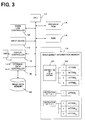
- an editor of the image data stored in the image data file memory 109 is comprised of the primary processor (here, CPU) 113, the management information memory 114 and other necessary components including a program ROM 118 and a RAM 119.
- the program ROM 118 previously stores a facsimile communication program, an editor program and other necessary programs.
- the RAM 119 may stores a list of registered destination addresses.
- the primary processor 113 performs the facsimile operations and the editing operation according to the facsimile communication program and the editor program stored in the program ROM 118, respectively.
- the primary processor 113 starts the editor program and performs the editing of the image data stored in the image data file memory 109 using the management information memory 114 as will be described in detail.
- the primary processor 113 controls the other circuits (not shown in this figure) of the facsimile apparatus to perform the input of bit-mapped data, the print-out of the image data, fax sending and receiving, and other necessary functions.
- the management information memory 114 has a destination information area 201 and a page management table 202 for each data file.
- the destination information area 201 and the page management table 202 are generated and the contents thereof are designated by the user operating the input device 115.
- the destination address of the destination information area 201 is used to transmit the data file. That is, when receiving a fax transmission instruction from the input device 115, the primary processor 113 reads the destination address from the destination information area 201 of the file, instructs the storage data controller 108 to read the image data of the file from the data block area 109B while referring to the block management area 109A, and then controls the decoder 110, the encoder 112 and the communication line controller 106 to send a fax of the image data to the designation address.
- the page management table 202 stores designated attributes including an image size, resolution and a memory location for each page of a data file. Edits of the stored image of a file, for example, page change, page deletion and page addition or insertion, are performed by changing the page management table 202 corresponding to the file. More specifically, the user can change the page management table 202 by operating the input device while looking at the display 117. For example, the page change, the page deletion and the page addition are performed by changing the sequence of the attributes, deleting the attributes of a page from the page management table 202, and adding the attributes of a new page to the page management table 202, respectively. In the case of editing, the file structure of the destination information area 201 and the page management table 202 as shown in this figure may be displayed on the display 117 to allow easy editing. The details will be described hereinafter.
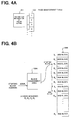
- the primary processor 113 when receiving a storage instruction from the input device, starts the editor program which builds a destination information area 201 and a page management table 202 of a data file in the management information memory 114.
- the destination information area 201 may store a plurality of destination addresses.
- the page management table 202 stores the attribute management information for each page of the data file. When the file is just generated, however, there is no need to store a destination address in the destination information area 201 and attributes in the page management table 202.
- the block management area 109A stores block management information which is used to manage data storage locations (block areas B 1 -B N ) of the data block area 109B.
- block management information which is used to manage data storage locations (block areas B 1 -B N ) of the data block area 109B.
- the access sequence, B 3 -B 6 -B 8 -B 9 is stored as the block management information in the block management area 109A.
- the storage data controller 108 can read the entire image data of the page from the data block area 109B by referring to the access sequence, B 3 -B 6 -B 8 -B 9 , stored in the block management area 109A.
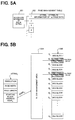
- the primary processor 113 receives the destination information of a data file from the input device 115 or the RAM and then the storage data controller 108 receives the image data of a first page of the data file from the personal computer 101 or the image reader 104.
- the primary processor 113 generates the destination information area 201 and the page management table 202 in the management information memory 114 and stores the attribute information ATTRIB 1 of the first page onto the first page location of the page management table 202.
- the attribute information ATTRIB 1 of the first page includes page resolution, page width, page length, and the address ADDR S1 of a starting data block B 2 .
- the printer emulator 102 receives print data including text and/or graphics described with any page description language for a page printer from the personal computer 101, the printer emulator 102 generates a page of bit-mapped data BMD PC based on a designated document size and then outputs the page of bit-mapped data BMD PC to the encoder 103 for storage compression.
- the encoder 103 encodes the page of bit-mapped data BMD PC to generate the page of encoded image data, which is divided into a plurality of blocks (here, two blocks) under control of the storage data controller 108.
- the two data blocks are stored onto available blocks of the data block area 109B. It is assumed that the two data blocks corresponding to a first page are stored onto the blocks B 2 and B 5 , respectively, as shown in Fig. 5B.
- the access sequence of the blocks B 2 and B 5 is generated and stored in the block management area 109A.
- the access sequence is set to a sequence of B 2 -B 5 , which is used to link the data blocks B 2 and B 5 in the original sequence to reproduce the first page data. Therefore, when the address ADDR S1 of the starting block B 2 included in the attribute information ATTRIB 1 is received from the primary processor 113, the storage data controller 108 can read the entire image data of the first page from the data block area 109B by referring to the access sequence, B 2 -B 5 , stored in the block management area 109A.
- the first page data is stored onto the image data file memory 109 and the attribute information ATTRIB 1 of the first page data is stored onto the first location of the page management table 202. It is the same with the bit-mapped data BMD R received from the image reader 104 and the bit-mapped data BMD C received from the communication line controller 106.
- the storage data controller 108 receives the image data of a second page from the personal computer 101.
- the primary processor 113 stores the attribute information ATTRIB 2 of the second page onto the second page location of the page management table 202.
- the attribute information ATTRIB 2 of the second page includes page resolution, page width, page length, and the address ADDR S2 of a starting data block B 3 .
- the printer emulator 102 receives print data including text and/or graphics described with a known or unknown page description language for a page printer from the personal computer 101
- the printer emulator 102 generates a page of bit-mapped data BMD PC based on a designated document size and then outputs the page of bit-mapped data BMD PC to the encoder 103 for storage compression.
- the encoder 103 encodes the page of bit-mapped data BMD PC to generate the page of encoded image data, which is divided into a plurality of blocks (here, two blocks) under control of the storage data controller 108.
- the two data blocks are stored onto available blocks of the data block area 109B. It is assumed that the two data blocks corresponding to the second page are stored onto the available blocks B 3 and B 9 , respectively, as shown in Fig. 6B.
- the access sequence of the blocks B 3 and B 9 is generated and stored in the block management area 109A.
- the access sequence is set to a sequence of B 3 -B 9 , which is used to link the data blocks B 3 and B 9 in the original sequence to reproduce the second page data. Therefore, when the address ADDR S2 of the starting block B 3 included in the attribute information ATTRIB 2 is received from the primary processor 113, the storage data controller 108 can read the entire image data of the second page from the data block area 109B by referring to the access sequence, B 3 -B 9 , stored in the block management area 109A.
- the second page data is stored onto the image data file memory 109 and the attribute information ATTRIB 2 of the second page data is stored onto the second location of the page management table 202.
- the attribute information ATTRIB 2 is added to the attribute information ATTRIB 1 . It is the same with the bit-mapped data BMD R received from the image reader 104 and the bit-mapped data BMD C received from the communication line controller 106.
- a third page data is stored onto available blocks (here, B 6 and B 8 ) of the image data file memory 109 and the attribute information ATTRIB 3 of the third page data is stored onto the third location following the second location in the page management table 202.
- the attribute information ATTRIB 3 is added to the attribute information ATTRIB 1 and ATTRIB 2 .
- a plurality of pages of image data are stored in the image data file memory 109 and the image data are reproduced in a page format from the image data file memory 109 using the page management table 202.
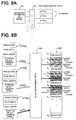
- the user instructs the primary processor 113 to display the file structure corresponding to the page management table 202 on the display 117 and then deletes the second page.
- This causes the address ADDR S2 of the starting block B 3 of the attribute information ATTRIB 2 to be transferred to the storage data controller 108, together with a deletion instruction of the second page data.
- the storage data controller 108 when receiving the address ADDR S2 of the starting block B 3 as well as the deletion instruction from the primary processor 113, the storage data controller 108 makes the blocks B 3 and B 9 available according to the access sequence of the second page data stored in the block management area 109A by writing a release of protection of the second page data onto the block management area 109A.
- the attribute information ATTRIB 2 of the second page data is deleted from the page management table 202 of the data file in question. And then the attribute information ATTRIB 3 at the third page location is moved to the second page location in the page management table 202 as shown in Fig. 8A. Therefore, the third page data is changed into second page data.
- the primary processor 113 reads the attribute information ATTRIB 1 and ATTRIB 2 from the page management table 202 of the data file in question and temporarily stores them onto the RAM 119. And a changing of the first and second pages is performed by storing the attribute information ATTRIB 1 onto the second page location and the attribute information ATTRIB 2 onto the first page location. In this manner, the first page data is changed into the second page data and the second page data is changed into the first page date as shown in Fig. 9B.
- An insertion of new page data after any page is performed by a combination of the page addition and the page changing. For example, after appending a new page of image data to the page management table 202, a changing of the sequence of the pages is performed, resulting in the new page inserted after a designated page.
- the primary processor 113 transfers the destination address from the destination information area 201 to a transmission queue file stored in the RAM 119. If the destination information area 201 stores no destination address, it should be input. When the turn of the data file to be transmitted has comes, the primary processor 113 instructs the communication line controller 106 to make a call using the destination address. When the connection is established, the facsimile transmission is started according to the well-known facsimile procedure. More specifically, the primary processor 113 instructs the storage data controller 108 to read the data file in question from the image data memory 109 according to the sequence of pages and the attribute information, that is, resolution, page width and page length, of each page stored in the page management table 202 of the data file. The page data of the data file is decoded by the decoder 110 for expansion. After the expanded data is encoded for communication by the encoder 112, it is transmitted to the destination through the communication line controller 106 and the communication line.
Landscapes
- Engineering & Computer Science (AREA)
- Multimedia (AREA)
- Signal Processing (AREA)
- Facsimiles In General (AREA)
- Storing Facsimile Image Data (AREA)
Applications Claiming Priority (2)
| Application Number | Priority Date | Filing Date | Title |
|---|---|---|---|
| JP98046/96 | 1996-04-19 | ||
| JP8098046A JPH09284458A (ja) | 1996-04-19 | 1996-04-19 | ファクシミリ装置 |
Publications (2)
| Publication Number | Publication Date |
|---|---|
| EP0802666A2 true EP0802666A2 (de) | 1997-10-22 |
| EP0802666A3 EP0802666A3 (de) | 1998-04-01 |
Family
ID=14209221
Family Applications (1)
| Application Number | Title | Priority Date | Filing Date |
|---|---|---|---|
| EP97106466A Withdrawn EP0802666A3 (de) | 1996-04-19 | 1997-04-18 | Kommunikationsvorrichtung |
Country Status (2)
| Country | Link |
|---|---|
| EP (1) | EP0802666A3 (de) |
| JP (1) | JPH09284458A (de) |
Family Cites Families (4)
| Publication number | Priority date | Publication date | Assignee | Title |
|---|---|---|---|---|
| US5243439A (en) * | 1990-09-28 | 1993-09-07 | Xerox Corporation | Image relocation in an electronic reprographic system |
| JPH05130340A (ja) * | 1991-11-01 | 1993-05-25 | Toshiba Corp | フアクシミリ装置 |
| JPH0662209A (ja) * | 1992-08-12 | 1994-03-04 | Ricoh Co Ltd | ファクシミリ装置 |
| JPH06189043A (ja) * | 1992-12-22 | 1994-07-08 | Ricoh Co Ltd | ファクシミリ装置 |
-
1996
- 1996-04-19 JP JP8098046A patent/JPH09284458A/ja active Pending
-
1997
- 1997-04-18 EP EP97106466A patent/EP0802666A3/de not_active Withdrawn
Also Published As
| Publication number | Publication date |
|---|---|
| JPH09284458A (ja) | 1997-10-31 |
| EP0802666A3 (de) | 1998-04-01 |
Similar Documents
| Publication | Publication Date | Title |
|---|---|---|
| JPS60105367A (ja) | フアクシミリ通信方式 | |
| JPH1098606A (ja) | 通信端末装置及びコンピュータ装置 | |
| EP0656720A2 (de) | Zur Datenkommunikation mit einem Computerfähiges Faksimilegerät und Steuerungsverfahren dazu | |
| EP0802666A2 (de) | Kommunikationsvorrichtung | |
| JP2002218180A (ja) | ファクシミリ装置及びその制御方法 | |
| JPH09116777A (ja) | カラー通信装置および方法および方法のプログラムを記憶した記憶媒体 | |
| JP3470661B2 (ja) | ファクシミリ装置 | |
| JP3823874B2 (ja) | 通信装置 | |
| JP3727259B2 (ja) | 画像伝送方式及び該画像伝送方式を用いた情報端末装置 | |
| JP3104595B2 (ja) | ファクシミリ装置システム | |
| JPH0898008A (ja) | 画像処理装置 | |
| JP3703337B2 (ja) | 画像通信装置及び画像通信方法 | |
| JPH0583506A (ja) | フアクシミリ装置 | |
| JP3820901B2 (ja) | 通信装置および記憶媒体 | |
| JP2642219B2 (ja) | 画信号編集処理装置 | |
| JP2001169121A (ja) | ファクシミリ装置 | |
| JPS58165476A (ja) | フアクシミリ通信方式 | |
| JPH0897945A (ja) | データ通信装置 | |
| JPS63142767A (ja) | フアクシミリ装置 | |
| JP3631137B2 (ja) | インターネットファクシミリ装置およびアドレス入力制御方法 | |
| JPH089166A (ja) | 複写電送装置 | |
| JPH03129968A (ja) | 画像通信装置 | |
| JPH11164062A (ja) | 画像通信装置、画像通信方法及び画像通信プログラムを記録した記録媒体 | |
| JP2001268305A (ja) | ファクシミリ装置およびその画像データの変換方法 | |
| JPH09307743A (ja) | ファクシミリ装置 |
Legal Events
| Date | Code | Title | Description |
|---|---|---|---|
| PUAI | Public reference made under article 153(3) epc to a published international application that has entered the european phase |
Free format text: ORIGINAL CODE: 0009012 |
|
| AK | Designated contracting states |
Kind code of ref document: A2 Designated state(s): DE FR GB |
|
| PUAL | Search report despatched |
Free format text: ORIGINAL CODE: 0009013 |
|
| AK | Designated contracting states |
Kind code of ref document: A3 Designated state(s): DE FR GB |
|
| 17P | Request for examination filed |
Effective date: 19980220 |
|
| 17Q | First examination report despatched |
Effective date: 19991223 |
|
| STAA | Information on the status of an ep patent application or granted ep patent |
Free format text: STATUS: THE APPLICATION IS DEEMED TO BE WITHDRAWN |
|
| 18D | Application deemed to be withdrawn |
Effective date: 20010524 |