EP0803546B1 - Composé de phtalocyanine d'hydroxygallium, son procédé de fabrication et élément photosensible électrophotographique utilisant ce composé - Google Patents
Composé de phtalocyanine d'hydroxygallium, son procédé de fabrication et élément photosensible électrophotographique utilisant ce composé Download PDFInfo
- Publication number
- EP0803546B1 EP0803546B1 EP97106946A EP97106946A EP0803546B1 EP 0803546 B1 EP0803546 B1 EP 0803546B1 EP 97106946 A EP97106946 A EP 97106946A EP 97106946 A EP97106946 A EP 97106946A EP 0803546 B1 EP0803546 B1 EP 0803546B1
- Authority
- EP
- European Patent Office
- Prior art keywords
- photosensitive member
- hydroxygallium phthalocyanine
- charge
- electrophotographic
- layer
- Prior art date
- Legal status (The legal status is an assumption and is not a legal conclusion. Google has not performed a legal analysis and makes no representation as to the accuracy of the status listed.)
- Expired - Lifetime
Links
Images

Classifications
-
- C—CHEMISTRY; METALLURGY
- C09—DYES; PAINTS; POLISHES; NATURAL RESINS; ADHESIVES; COMPOSITIONS NOT OTHERWISE PROVIDED FOR; APPLICATIONS OF MATERIALS NOT OTHERWISE PROVIDED FOR
- C09B—ORGANIC DYES OR CLOSELY-RELATED COMPOUNDS FOR PRODUCING DYES, e.g. PIGMENTS; MORDANTS; LAKES
- C09B47/00—Porphines; Azaporphines
- C09B47/04—Phthalocyanines abbreviation: Pc
- C09B47/08—Preparation from other phthalocyanine compounds, e.g. cobaltphthalocyanineamine complex
- C09B47/18—Obtaining compounds having oxygen atoms directly bound to the phthalocyanine skeleton
-
- C—CHEMISTRY; METALLURGY
- C07—ORGANIC CHEMISTRY
- C07F—ACYCLIC, CARBOCYCLIC OR HETEROCYCLIC COMPOUNDS CONTAINING ELEMENTS OTHER THAN CARBON, HYDROGEN, HALOGEN, OXYGEN, NITROGEN, SULFUR, SELENIUM OR TELLURIUM
- C07F5/00—Compounds containing elements of Groups 3 or 13 of the Periodic Table
- C07F5/003—Compounds containing elements of Groups 3 or 13 of the Periodic Table without C-Metal linkages
-
- C—CHEMISTRY; METALLURGY
- C09—DYES; PAINTS; POLISHES; NATURAL RESINS; ADHESIVES; COMPOSITIONS NOT OTHERWISE PROVIDED FOR; APPLICATIONS OF MATERIALS NOT OTHERWISE PROVIDED FOR
- C09B—ORGANIC DYES OR CLOSELY-RELATED COMPOUNDS FOR PRODUCING DYES, e.g. PIGMENTS; MORDANTS; LAKES
- C09B67/00—Influencing the physical, e.g. the dyeing or printing properties of dyestuffs without chemical reactions, e.g. by treating with solvents grinding or grinding assistants, coating of pigments or dyes; Process features in the making of dyestuff preparations; Dyestuff preparations of a special physical nature, e.g. tablets, films
- C09B67/0001—Post-treatment of organic pigments or dyes
- C09B67/0003—Drying, e.g. sprax drying; Sublimation of the solvent
-
- C—CHEMISTRY; METALLURGY
- C09—DYES; PAINTS; POLISHES; NATURAL RESINS; ADHESIVES; COMPOSITIONS NOT OTHERWISE PROVIDED FOR; APPLICATIONS OF MATERIALS NOT OTHERWISE PROVIDED FOR
- C09B—ORGANIC DYES OR CLOSELY-RELATED COMPOUNDS FOR PRODUCING DYES, e.g. PIGMENTS; MORDANTS; LAKES
- C09B67/00—Influencing the physical, e.g. the dyeing or printing properties of dyestuffs without chemical reactions, e.g. by treating with solvents grinding or grinding assistants, coating of pigments or dyes; Process features in the making of dyestuff preparations; Dyestuff preparations of a special physical nature, e.g. tablets, films
- C09B67/0025—Crystal modifications; Special X-ray patterns
- C09B67/0026—Crystal modifications; Special X-ray patterns of phthalocyanine pigments
-
- G—PHYSICS
- G03—PHOTOGRAPHY; CINEMATOGRAPHY; ANALOGOUS TECHNIQUES USING WAVES OTHER THAN OPTICAL WAVES; ELECTROGRAPHY; HOLOGRAPHY
- G03G—ELECTROGRAPHY; ELECTROPHOTOGRAPHY; MAGNETOGRAPHY
- G03G5/00—Recording-members for original recording by exposure, e.g. to light, to heat or to electrons; Manufacture thereof; Selection of materials therefor
- G03G5/02—Charge-receiving layers
- G03G5/04—Photoconductive layers; Charge-generation layers or charge-transporting layers; Additives therefor; Binders therefor
- G03G5/06—Photoconductive layers; Charge-generation layers or charge-transporting layers; Additives therefor; Binders therefor characterised by the photoconductive material being organic
- G03G5/0664—Dyes
- G03G5/0696—Phthalocyanines
Definitions
- the present invention relates to a novel hydroxygallium phthalocyanine compound, an electrophotographic photosensitive member using the hydroxygallium phthalocyanine compound, and an electrophotographic apparatus and a process cartridge including the photosensitive member.
- phthalocyanine pigments have been noted and studied not only as coloring agents but also as electronic materials for constituting electrophotographic photosensitive member, solar batteries, photosensors, etc.
- printers utilizing electrophotography have been widely used as terminal printers in recent years. These printers are principally constituted as laser beam printers using a laser as a light source. As the light source, a semiconductor laser has been predominantly used in view of its cost and apparatus size. A semiconductor laser principally used at present has an emission wavelength in a long wavelength region of 790 - 820 nm, so that electrophotographic photoconductors having a sufficient sensitivity to such a long-wavelength light have been developed.
- the sensitivity of an electrophotographic photoconductor varies depending on a charge-generating material, and many studies have been made on charge-generating materials having a sensitivity to a long-wavelength light including metallic phthalocyanines and non-metallic phthalocyanines, such as aluminum chlorophthalocyanine, chloroindium phthalocyanine, oxyvanadium phthalocyanine, hydroxygallium phthalocyanine, chlorogallium phthalocyanine, magnesium phthalocyanine, and oxytitanium phthalocyanine.
- metallic phthalocyanines and non-metallic phthalocyanines such as aluminum chlorophthalocyanine, chloroindium phthalocyanine, oxyvanadium phthalocyanine, hydroxygallium phthalocyanine, chlorogallium phthalocyanine, magnesium phthalocyanine, and oxytitanium phthalocyanine.
- phthalocyanine compounds are known to have various crystal forms.
- non-metallic phthalocyanine is known to have ⁇ -form, ⁇ -form, ⁇ -form, ⁇ -form, ⁇ -form, ⁇ -form, etc.
- copper phthalocyanine is known to have ⁇ -form, ⁇ -form, ⁇ -form, ⁇ -form, etc.
- Specific examples of these phthalocyanine compounds are disclosed in, e.g., Japanese Laid-Open Patent Application (JP-A) 50-38543, JP-A 51-108847, and JP-A 53-37423.
- hydroxygallium phthalocyanine As for hydroxygallium phthalocyanine, several crystal forms have been disclosed in, e.g., JP-A 5-263007 and JP-A 6-93203. However, electrophotographic photosensitive members prepared by using such hydroxygallium phthalocyanine compounds have not been satisfactory in view of applicability to high-speed and high-image quality electrophotographic processes, sensitivity, potential stability in repetitive use, and memory characteristic in response to white light.
- EP-A-0 617 091 discloses a hydroxygallium phthalocyanine crystal having distinct peaks at Bragg angles (2 ⁇ ⁇ 0.2°) of 7.0°, 13,4°, 16.6°, 26.0°, and 26.7° to CuK ⁇ characteristic X-ray, wherein the highest peak is at 7.0° (2 ⁇ ). Furthermore; there is disclosed a process for preparing the same and an electrophotographic photoreceptor comprising the same.
- a principal object of the present invention is to provide a novel crystal form of hydroxygallium phthalocyanine (compound).
- Another object of the present invention is to provide an electrophotographic photosensitive member using such a hydroxygallium phthalocyanine and showing a high sensitivity to long-wavelength rays and little potential change during repetitive use.
- Another object of the present invention is to provide an electrophotographic photosensitive member free from photomemory even illuminated with visible rays for a long period.
- a further object of the present invention is to provide a process cartridge and an electrophotographic appparatus including such an electrophotographic photosensitive member.
- a hydroxygallium phthalocyanine having a crystal form characterized by a strongest peak at a Bragg angle (2 ⁇ ⁇ 0.2 deg.) of 28.1 deg. in a CuK ⁇ characteristic X-ray diffraction pattern.
- Such a hydroxygallium phthalocyanine may be manufactured by a process comprising the steps of:
- an electrophotographic photosensitive member comprising: an electroconductive support, and at least a photosensitive layer formed on the electroconductive support containing the above-mentioned hydroxygallium phthalocyanine.
- an electrophotographic apparatus comprising: the above-mentioned electrophotographic photosensitive member, charging means for charging the photosensitive member, imagewise exposure means for exposing imagewise the photosensitive member to form an electrostatic latent image into the photosensitive member, and developing means for developing the electrostatic latent image on the photosensitive member with a toner.
- the present invention further provides a process cartridge, comprising: the above-mentioned electrophotographic photosensitive member and a charging means for charging the photosensitive member so as to form an integral unit, which is detachably mountable to a main assembly of an electrophotographic apparatus.
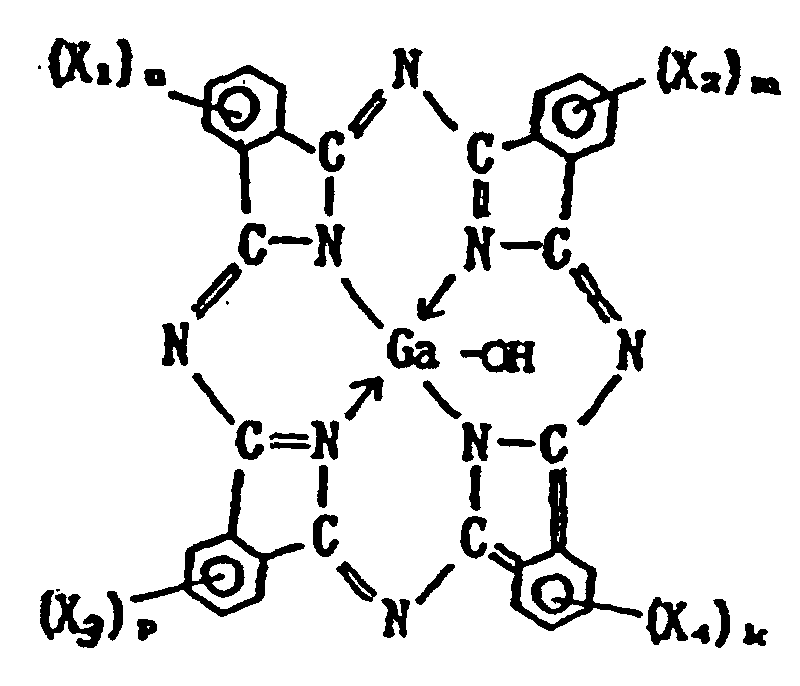
- the hydroxygallium phthalocyanine according to the present invention has a chemical structure as represented by the following formula and is characterized by a strongest peak (i.e., a highest peak) at a Bragg angle (2 ⁇ ⁇ 0.2 deg.) of 28.1 deg. in a CuK ⁇ characteristic X-ray diffraction pattern: wherein X 1 , X 2 , X 3 and X 4 respectively denote Cl or Br, and n, m, p and k respectively denote an integer of 0 - 4.
- the hydroxygallium phthalocyanine according to the present invention may.also have peaks at Bragg angles of 7.3 deg., 24.9 deg., etc., in addition to the peak at 28.1 deg., but these peaks are all lower than the one at 28.1 deg.
- hydroxygallium phthalocyanine as a charge-generating material in an electrophotographic photosensitive member, it is possible to obtain an electrophotographic photosensitive member having a high sensitivity to long-wavelength light, excellent durability and also an improved memory characteristic.
- the X-ray diffraction data referred to herein for determining the crystal form of hydroxygallium phthalocyanine according to the present invention are based on data measured by X-ray diffractometry using CuK ⁇ characteristic X-rays according to the following conditions:
- the hydroxygallium phthalocyanine according to the present invention has an excellent function and performance as a photoconductor and is applicable for constituting a solar battery, a photosensor, a switching element, etc., in addition to an electrophotographic photosensitive member as described above.
- the hydroxygallium phthalocyanine according to the present invention may be produced, e.g., through a process as described below.
- a halogenated gallium phthalocyanine is subjected to an acid pasting treatment (i.e., a method including dissolving the phthalocyanine in acid (e.g., sulfuric acid) and pouring the resultant solution into water to reprecipitate the crystal into a paste) to obtain pasty hydrous hydroxygallium phthalocyanine, which is then freeze-dried to obtain low-crystallinity hydroxygallium phthalocyanine.
- acid pasting treatment i.e., a method including dissolving the phthalocyanine in acid (e.g., sulfuric acid) and pouring the resultant solution into water to reprecipitate the crystal into a paste
- the resultant low-crystallinity hydroxygallium phthalocyanine is then subjected to milling in a dispersing medium which may preferably be an amide solvent, examples of which may include: acetamide, N,N-dimethylformamide, N,N-dimethylacetamide, N-methylformamide, N-methylacetamide, N-methylpropioamide, and formamide.
- a dispersing medium which may preferably be an amide solvent, examples of which may include: acetamide, N,N-dimethylformamide, N,N-dimethylacetamide, N-methylformamide, N-methylacetamide, N-methylpropioamide, and formamide.
- the halogenated gallium phthalocyanine may be produced through various processes as described in JP-A 6-93203.
- the milling referred to herein is a treatment performed by using a milling device, such as a sand mill or a ball mill, together with dispersion media, such as glass beads, steel beads, and alumina balls.
- the milling time may preferably be on the order of 4 - 24 hours while it can vary depending on the milling device used and the uniform determination thereof is difficult. Too long a milling time is not appropriate for production of the hydroxygallium phthalocyanine according to the present invention.
- the best result may be attained by controlling the milling time while checking the Bragg angle of a milled product sampled every 1 to 3 hours.
- the dispersing medium for the milling may preferably be used in an amount which is 5 to 30 times the low-crystallinity hydroxygallium phthalocyanine by weight.
- a characteristic feature of the production process is the freeze drying of hydrous hydroxygallium phthalocyanine.
- a hydroxygallium phthalocyanine obtained without the freeze drying step fails to provide the strongest peak appearing at the Bragg angle (2 ⁇ ⁇ 0.2 deg.) of 28.1 deg.
- the condition for the freeze-drying is one for causing the sublimation of water.
- a reduced pressure of at most 4 Torr after freezing of the hydrous hydroxygallium phthalocyanine may be appropriate and the sublimation may be thereafter continued even at room temperature.
- a freeze drying apparatus (“KFD-1", available from Kaneda Rika K.K.) was used for the freeze drying while connecting a vacuum pump thereto.
- the temperature at the water trap unit could be adjusted in the range of -20 to -110 °C.
- the vacuum pump used exhibited a gas discharge rate of 100 liter/min. and an ultimate vacuum of 10 -4 Torr.
- the halogenated gallium phthalocyanine as a starting material can also be bromogallium phthalocyanine or iodogallium phthalocyanine in addition to chlorogallium phthalocyanine.
- the electrophotographic photosensitive member according to the present invention may have a laminar structure including a single photosensitive layer containing both a charge-generating material and a charge-transporting material formed on an electroconductive support, or alternatively a laminar photosensitive layer including a charge generation layer containing a charge-generating material and a charge transport layer containing a charge-transporting material formed successively on an electroconductive support.
- a laminar photosensitive layer including a charge generation layer containing a charge-generating material and a charge transport layer containing a charge-transporting material formed successively on an electroconductive support. The order of lamination of the charge generation layer and the charge transport layer can be reversed.
- the electroconductive support may comprise any material exhibiting electroconductivity, examples of which may include: metals, such as aluminum and stainless steel; and solid substrates of, e.g., metals, plastics and paper, provided with an electroconductive coating layer.
- the electroconductive support may assume a form of a cylinder or a flat, curved or wound sheet or belt.
- the undercoating layer may for example comprise a material, such as polyvinyl alcohol, polyethylene oxide, ethyl cellulose, methyl cellulose, casein, polyamide, glue or gelatin. These materials may be dissolved in an appropriate solvent to be applied onto the electroconductive support, thereby forming a film in a thickness of, e.g., 0.2 - 3.0 ⁇ m.
- the photosensitive layer of a single layer may be formed by mixing the hydroxygallium phthalocyanine according to the present invention as a charge-generating material and a charge-transporting material into an appropriate binder resin solution to form a mixture liquid and applying the mixture liquid onto the electroconductive support, optionally via an undercoating layer as described above.
- the charge generation layer may suitably be formed by dispersing the hydroxygallium phthalocyanine according to the present invention in an appropriate binder solution to form a dispersion liquid and applying the dispersion liquid, followed by drying.
- the charge generating layer can also be formed by vapor deposition of the hydroxygallium phthalocyanine.
- the charge transport layer may be formed by applying and drying a paint formed by dissolving a charge-transporting material and a binder resin in a solvent.
- the charge-transporting material may include: triarylamine compounds, hydrazone compounds, stilbene compounds, pyrazoline compounds, oxazole compounds, thiazole compounds, and triarylmethane compounds.
- binder for constituting the above-mentioned photosensitive layer or constituent layers thereof may include: polyesters, acrylic resin, polyvinylcarbazole, phenoxy resins, polycarbonates, polyvinyl butyral, polystyrene, polyvinyl acetate, polysulfone, polyarylate, vinylidene chloride-acrylonitrile copolymer, and polyvinyl benzal.
- the application of the photosensitive layer(s) may be performed by coating methods, such as dipping, splay coating, spinner coating, bead coating, blade coating and beam coating.
- the single-layered photosensitive layer may have a thickness of 5 - 40 ⁇ m, preferably 10 - 30 ⁇ m.
- the charge generation layer may have a thickness of 0.1 - 10 ⁇ m, preferably 0.05 - 5 ⁇ m
- the charge transport layer may have a thickness of 5 - 40 ⁇ m, preferably 10 - 30 ⁇ m.
- the charge-generating material may preferably be contained in 20 - 80 wt. %, more preferably 30 - 70 wt. %, of the charge generation layer.
- the charge-transporting material may preferably be contained in 20 - 80 wt. %, more preferably 30 - 70 wt. %, of the charge transport layer.
- the single-layered photosensitive layer may preferably contain 3 - 30 wt. % of the charge-generating material and 30 - 70 wt. % of the charge-transporting material, respectively with respect to the total weight thereof.
- the hydroxygallium phthalocyanine according to the present invention can be used in mixture with another charge-generating material if such is desired, e.g., for use in a panchromatic system or a digital analog combined system, or for improving the sensitivity or durability.
- the hydroxygallium phthalocyanine may preferably constitute 50 wt. % of the total charge-generating materials.
- the photosensitive layer may be further be coated with a protective layer as desired.
- a protective layer may be formed by applying a solution in an appropriate solvent of a resin, such as polyvinyl butyral, polyester, polycarbonate resin (such as polycarbonate Z and modified polycarbonate), nylon, polyimide, polyarylate, polyurethane, styrenebutadiene copolymer, styrene-acrylic acid copolymer or styrene-acrylonitrile-copolymer onto a photosensitive layer, followed by drying.
- the protective layer may preferably be formed in a thickness of 0.05 - 20 ⁇ m.
- the protective layer can contain electroconductive particles or an ultraviolet absorber.
- the electroconductive particles may for example comprise particles of a metal oxide, such as tin oxide.
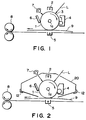
- a drum-shaped photosensitive member 1 is driven in rotation at a prescribed peripheral speed in an indicated arrow direction about an axis 1.
- the outer peripheral surface of the photosensitive member 1 is uniformly charged at a prescribed positive or negative potential, and then exposed to light-image L (as by slit exposure or laser beam scanning exposure) by using an imagewise exposure means (not shown), whereby an electrostatic latent image corresponding to an exposure image is successively formed on the peripheral surface of the photosensitive member 1.
- the electrostatic latent image is then developed with a toner by developing means 4 to form a toner image on the photosensitive member 1.
- the toner image is transferred by corona transfer means 5 onto a recording material 9 which has been supplied from a paper supply unit (not shown) to a position between the photosensitive member 1 and the transfer means 9 in synchronism with the rotation of the photosensitive member 1.
- the recording material 9 carrying the received toner image is then separated from the photosensitive member surface and guided to an image fixing device 8 to fix the toner image.
- the resultant print or copy comprising the fixed toner image is then discharged out of the electrophotographic apparatus.
- the surface of the photosensitive member 1 after the image transfer is subjected to removal of the residual toner by a cleaning means to be cleaned and then subjected to charge removal by a pre-exposure means 7, to be recycled for repetitive image formation.
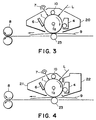
- Figure 2 shows another embodiment of the electrophotographic apparatus wherein at least a photosensitive member 1, a charging means 2 and a developing means 4 are housed within a container 20 to form a process cartridge, which is detachably mountable or insertable to a main assembly of the electrophotographic apparatus along a guide means 12, such as a guide rail, provided to the main assembly.
- a cleaning means 6 disposed within the container 20 in this embodiment can be omitted or disposed outside the container 20.
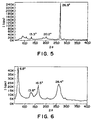
- a direct charging member 10 and cause the direct charging member 10 supplied with a voltage to contact the photosensitive member 1 to charge the photosensitive member.
- This mode may be referred to as a "direct charging” scheme.
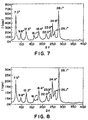
- a toner image on the photosensitive member 1 is also transferred onto a recording material 9 by the action of a direct charging member 23. More specifically, by causing the direct charging member 23 supplied with a voltage to contact the recording material 9 to transfer the toner image on the photosensitive member 1 onto the recording material 9.
- At least the photosensitive member 1 and the direct charging member 10 are housed within a first container 21 to form a first process cartridge, and at least a developing means 4 is housed within a second vessel 22 to form a second process cartridge, so that the first and second process cartridges are detachably mountable to a main assembly of the apparatus.
- a cleaning means 6 can be disposed or not disposed within the container 21.
- exposure light image L may be given as reflected light from or transmitted light through an original, or by converting data read from the original into a signal and effecting a laser beam scanning, a drive of an LED array or a drive of a liquid crystal shutter array.
- a hydroxygallium phthalocyanine exhibiting a powdery X-ray diffraction pattern as shown in Figure 8 was prepared through the same process as in Example 1 except that the milling time was changed from 5 hours to 15 hours.
- the hydroxygallium phthalocyanine also provide an infrared absorption spectrum as shown in Figure 9 and the following elementary analysis results: C (%) H (%) N (%) Cl (%) Calculated value 64.14 2.86 18.70 - Measured value 62.19 2.70 18.06 0.54
- the aluminum cylinder with the electroconductive layer was further coated by dipping within a solution of 5 parts of 6-66-610-12 quaternary polyamide copolymer in a mixture solvent of 70 parts of methanol and 25 parts of butanol, followed by drying, to form a 1 ⁇ m-thick undercoating layer.
- An electrophotographic photosensitive member was prepared in the same manner as in Example 3 except for using the hydroxygallium phthalocyanine produced in Example 1 instead of the hydroxygallium phthalocyanine of Example 2 as a charge-generating material.
- An electrophotographic photosensitive member was prepared in the same manner as in Example 3 except for using the hydroxygallium phthalocyanine produced in Comparative Example 1 instead of the hydroxygallium phthalocyanine of Example 2 as a charge-generating material.
- the photosensitive members prepared in Examples 3 and 4 and Comparative Example 2 were respectively set in a laser beam printer "LBP-SX", available from Canon K.K.) and subjected to a sensitivity measurement wherein each photosensitive member was charged to a set dark potential of -700 volts and then illuminated with laser light having a. wavelength of 820 nm to measure an exposure light quantity required for lowering the potential from -700 volts to -150 volts as a photosensitivity.
- Table 1 Photosensitive member Exposure quantity ( ⁇ J/cm 2 )
- Example 4 0.29 Comparative Example 2 0.33
- V D dark-part potential
- V L V D
- V L V L
- An electrophotographic photosensitive member was prepared in the same manner as in Example 3 except for replacing the polyvinyl butyral resin (binder resin) used in Example 3 with bisphenol Z-type polycarbonate resin.
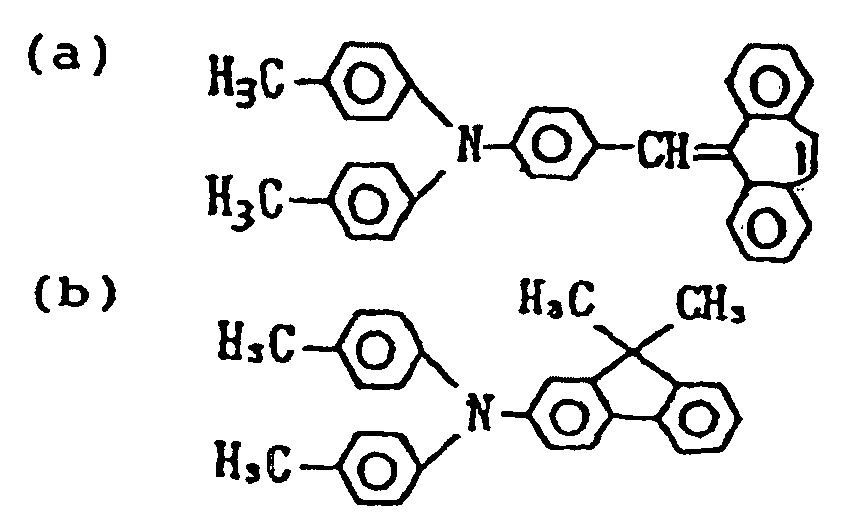
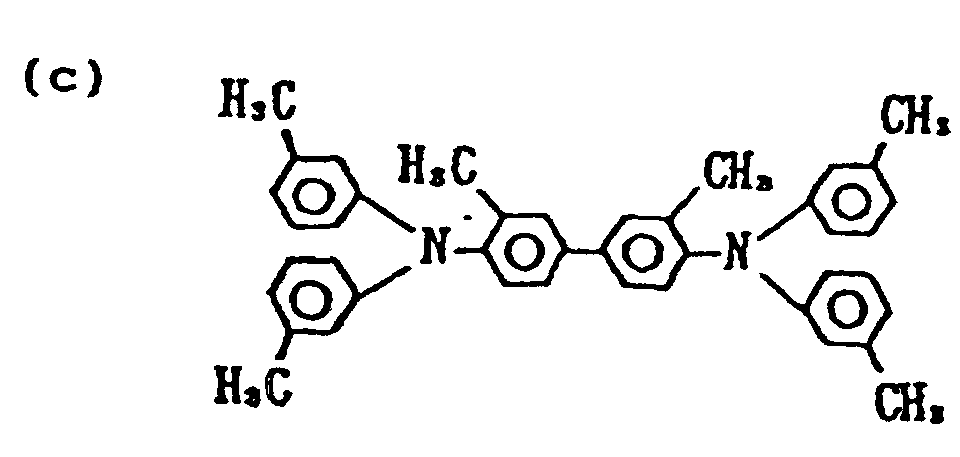
- An electrophotographic photosensitive member was prepared in the same manner as in Example 3 except for replacing the charge-transporting material with a compound of the following formula:
- An electrophotographic photosensitive member was prepared in the same manner as in Example 3 except for replacing the charge-transporting material with a compound of the following formula:
- An electrophotographic photosensitive member having a high sensitivity to long-wavelength light as emitted by a semiconductor laser and causing little change in potential change during repetitive use is formed by using as a charge-generating material a hydroxygallium phthalocyanine having a crystal form characterized by a strongest peak at a Bragg angle (2 ⁇ ⁇ 0.2 deg.) of 28.1 deg. in a CuK ⁇ characteristic X-ray diffraction pattern.
- the hydroxygallium phthalocyanine may preferably be produced through a process including treating a halogenated gallium phthalocyanine for conversion into a hydrous hydroxygallium phthalocyanine, freeze-drying the hydrous hydroxygallium phthalocyanine into a low-crystallinity hydroxygallium phthalocyanine, and milling the low-crystallinity hydroxygallium phthalocyanine.
Landscapes
- Chemical & Material Sciences (AREA)
- Organic Chemistry (AREA)
- Chemical Kinetics & Catalysis (AREA)
- Physics & Mathematics (AREA)
- General Physics & Mathematics (AREA)
- Photoreceptors In Electrophotography (AREA)
- Nitrogen Condensed Heterocyclic Rings (AREA)
Claims (8)
- Hydroxygallium-phthalocyanine ayant la structure chimique suivante:dans laquelle X1, X2, X3 et X4 représentent respectivement Cl ou Br, et n, m, p et k représentent respectivement un nombre entier de 0 à 4 ;
et ayant une forme cristalline caractérisée par un pic le plus intense à un angle de Bragg (2 ± 0,2 degré) de 28,1 degrés dans un diagramme de diffraction des rayons X caractéristique de CuKα. - Elément photosensible électrophotographique, comprenant : un support électroconducteur et au moins une couche photosensible formée sur le support électroconducteur, la couche photosensible contenant une hydroxygallium-phthalocyanine suivant la revendication 1.
- Elément photosensible suivant la revendication 2, dans lequel ladite couche photosensible a une structure stratifiée comprenant une couche de production de charge et une couche de transport de charge, et ladite hydroxygallium-phthoalacyanine est présente dans la couche de production de charge.
- Elément photosensible suivant la revendication 3, dans lequel ladite couche de production de charge comprend un mélange d'un liant, choisi entre le polyvinylbutyral et un polycarbonate de type bisphénol Z, et de l'hydroxygallium-phthalocyanine dispersée dans le liant.
- Elément photosensible suivant la revendication 3, dans lequel ladite couche de transport de charge contient une matière de transport de charge choisie parmi celles représentées par les formules (a) à (c) suivantes :
- Appareil électrophotographique, comprenant:un élément photosensible électrophotographique suivant la revendication 2,un moyen de charge pour charger l'élément photosensible,un moyen d'exposition à des fins de formation d'image pour exposer à des fins de formation d'image l'élément photosensible afin de former une image latente électrostatique dans l'élément photosensible, etun moyen de développement pour développer l'image latente électrostatique sur l'élément photosensible avec un toner.
- Cartouche de traitement, comprenant:un élément photosensible électrophotographique suivant la revendication 2, et un moyen de charge pour charger l'élément photosensible de manière à former une unité intégrée, qui peut être montée de manière amovible grâce à un assemblage principal d'un appareil électrophotographique.
- Cartouche de traitement suivant la revendication 7, comprenant en outre un moyen de développement pour développer une image latente électrostatique formée sur l'élément photosensible.
Priority Applications (1)
| Application Number | Priority Date | Filing Date | Title |
|---|---|---|---|
| EP00123659A EP1081555B1 (fr) | 1996-04-26 | 1997-04-25 | Procédé de production de phthalocyanine d'hydroxygallium |
Applications Claiming Priority (3)
| Application Number | Priority Date | Filing Date | Title |
|---|---|---|---|
| JP12928896 | 1996-04-26 | ||
| JP129288/96 | 1996-04-26 | ||
| JP12928896 | 1996-04-26 |
Related Child Applications (1)
| Application Number | Title | Priority Date | Filing Date |
|---|---|---|---|
| EP00123659A Division EP1081555B1 (fr) | 1996-04-26 | 1997-04-25 | Procédé de production de phthalocyanine d'hydroxygallium |
Publications (2)
| Publication Number | Publication Date |
|---|---|
| EP0803546A1 EP0803546A1 (fr) | 1997-10-29 |
| EP0803546B1 true EP0803546B1 (fr) | 2004-01-14 |
Family
ID=15005878
Family Applications (2)
| Application Number | Title | Priority Date | Filing Date |
|---|---|---|---|
| EP00123659A Expired - Lifetime EP1081555B1 (fr) | 1996-04-26 | 1997-04-25 | Procédé de production de phthalocyanine d'hydroxygallium |
| EP97106946A Expired - Lifetime EP0803546B1 (fr) | 1996-04-26 | 1997-04-25 | Composé de phtalocyanine d'hydroxygallium, son procédé de fabrication et élément photosensible électrophotographique utilisant ce composé |
Family Applications Before (1)
| Application Number | Title | Priority Date | Filing Date |
|---|---|---|---|
| EP00123659A Expired - Lifetime EP1081555B1 (fr) | 1996-04-26 | 1997-04-25 | Procédé de production de phthalocyanine d'hydroxygallium |
Country Status (5)
| Country | Link |
|---|---|
| US (1) | US5885737A (fr) |
| EP (2) | EP1081555B1 (fr) |
| KR (1) | KR100233633B1 (fr) |
| CN (2) | CN100380236C (fr) |
| DE (2) | DE69727168T2 (fr) |
Families Citing this family (23)
| Publication number | Priority date | Publication date | Assignee | Title |
|---|---|---|---|---|
| JPH10274868A (ja) * | 1997-03-31 | 1998-10-13 | Canon Inc | 画像形成装置及びプロセスカートリッジ |
| DE69935556T2 (de) * | 1998-07-31 | 2007-12-06 | Canon K.K. | Elektrophotographisches Gerät |
| DE69925212T2 (de) * | 1998-08-25 | 2006-02-23 | Canon K.K. | Elektrophotographisches lichtempfindliches Element, Prozesskartusche und elektrophotographisches Gerät |
| US5985505A (en) * | 1999-04-21 | 1999-11-16 | Xerox Corporation | Processes for the preparation of hydroxygallium phthalocyanine |
| US6335132B1 (en) | 1999-06-25 | 2002-01-01 | Canon Kabushiki Kaisha | Electrophotographic photosensitive member, and process cartridge and electrophotographic apparatus including the photosensitive member |
| US6465143B2 (en) | 2000-01-31 | 2002-10-15 | Canon Kabushiki Kaisha | Electrophotographic photosensitive member, process cartridge and electrophotographic apparatus |
| US6447967B2 (en) * | 2000-01-31 | 2002-09-10 | Canon Kabushiki Kaisha | Phthalocyanine crystal, production process therefor, and electrophotographic photosensitive member, process cartridge and apparatus using the crystal |
| US6683175B2 (en) | 2001-04-12 | 2004-01-27 | Canon Kabushiki Kaisha | Porphyrin compound, and electrophotographic photosensitive member, process-cartridge and apparatus using the compound |
| US6773856B2 (en) * | 2001-11-09 | 2004-08-10 | Canon Kabushiki Kaisha | Electrophotographic photosensitive member, process cartridge, and electrophotographic apparatus |
| JP4635461B2 (ja) * | 2003-11-06 | 2011-02-23 | 富士ゼロックス株式会社 | ヒドロキシガリウムフタロシアニン顔料及びその製造方法、感光層形成用塗布液の製造方法、電子写真感光体、プロセスカートリッジ、電子写真装置、並びに、画像形成方法 |
| JP5610907B2 (ja) * | 2009-08-18 | 2014-10-22 | キヤノン株式会社 | 電子写真感光体、プロセスカートリッジおよび電子写真装置 |
| JP5713596B2 (ja) * | 2009-09-29 | 2015-05-07 | キヤノン株式会社 | 電子写真感光体の製造方法 |
| JP2012073323A (ja) * | 2010-09-28 | 2012-04-12 | Konica Minolta Business Technologies Inc | 有機感光体と画像形成装置 |
| JP5688333B2 (ja) * | 2011-06-23 | 2015-03-25 | 富士フイルム株式会社 | ポリマーフィルム、位相差フィルム、偏光板、液晶表示装置、Rth発現剤及びメロシアニン系化合物 |
| JP2014016609A (ja) | 2012-06-14 | 2014-01-30 | Mitsubishi Chemicals Corp | 画像形成装置および電子写真感光体 |
| JP6188535B2 (ja) * | 2012-11-20 | 2017-08-30 | キヤノン株式会社 | 電子写真感光体、プロセスカートリッジおよび電子写真装置 |
| CN105377943B (zh) | 2013-07-12 | 2017-05-24 | 三菱化学株式会社 | 电子照相感光体、电子照相感光体盒、图像形成装置、以及聚芳酯树脂 |
| US9141006B2 (en) * | 2013-10-17 | 2015-09-22 | Xerox Corporation | Imaging member having improved imaging layers |
| JP6425411B2 (ja) * | 2014-04-24 | 2018-11-21 | キヤノン株式会社 | 電子写真感光体、電子写真感光体の製造方法、プロセスカートリッジおよび電子写真装置、ならびに、ヒドロキシガリウムフタロシアニン結晶 |
| JP6541447B2 (ja) * | 2014-06-13 | 2019-07-10 | キヤノン株式会社 | ヒドロキシガリウムフタロシアニン結晶、電子写真感光体、プロセスカートリッジ及び電子写真装置 |
| JP6859734B2 (ja) | 2016-02-12 | 2021-04-14 | 三菱ケミカル株式会社 | 積層型電子写真感光体、電子写真感光体カートリッジ、及び画像形成装置 |
| US10838313B2 (en) * | 2017-04-28 | 2020-11-17 | Canon Kabushiki Kaisha | Electrophotographic photosensitive member, process cartridge, and electrophotographic apparatus |
| US12235606B2 (en) | 2020-09-28 | 2025-02-25 | Canon Kabushiki Kaisha | Process cartridge |
Family Cites Families (13)
| Publication number | Priority date | Publication date | Assignee | Title |
|---|---|---|---|---|
| JPS521667B2 (fr) * | 1973-08-08 | 1977-01-17 | ||
| JPS5921020B2 (ja) * | 1975-03-20 | 1984-05-17 | トウヨウインキセイゾウ カブシキガイシヤ | 電子写真感光体 |
| JPS5337423A (en) * | 1976-09-17 | 1978-04-06 | Ricoh Co Ltd | Electrophotographic light sensitive material |
| JP3166293B2 (ja) * | 1991-04-26 | 2001-05-14 | 富士ゼロックス株式会社 | ヒドロキシガリウムフタロシアニンの新規な結晶、その新規な結晶よりなる光導電材料およびそれを用いた電子写真感光体 |
| US5338636A (en) * | 1991-09-27 | 1994-08-16 | Fuji Xerox Co., Ltd. | Dichlorotin phthalocyanine crystal electrophotographic photoreceptor using the same, and coating composition for electrophotographic photoreceptor |
| JP3166283B2 (ja) * | 1992-03-31 | 2001-05-14 | 富士ゼロックス株式会社 | ヒドロキシガリウムフタロシアニンの新規な結晶の製造方法 |
| JPH0693203A (ja) * | 1992-09-14 | 1994-04-05 | Fuji Xerox Co Ltd | ハロゲン含有ヒドロキシガリウムフタロシアニン結晶およびそれを用いた電子写真感光体 |
| US5384625A (en) * | 1992-12-28 | 1995-01-24 | Canon Kabushiki Kaisha | Image forming method |
| JP2814872B2 (ja) * | 1993-03-25 | 1998-10-27 | 富士ゼロックス株式会社 | ヒドロキシガリウムフタロシアニン結晶、その製造方法およびそれを用いた電子写真感光体 |
| DE69410942T2 (de) * | 1993-10-04 | 1998-12-17 | Canon K.K., Tokio/Tokyo | Elektrophotographisches lichtempfindliches Element, Arbeitseinheit und ein elektrophotographisches Gerät, worin eine solche Einheit eingesetzt wird |
| US5407766A (en) * | 1993-12-20 | 1995-04-18 | Xerox Corporation | Hydroxygallium phthalocyanine photoconductive imaging members |
| US5482811A (en) * | 1994-10-31 | 1996-01-09 | Xerox Corporation | Method of making hydroxygallium phthalocyanine type V photoconductive imaging members |
| US5567558A (en) * | 1995-03-30 | 1996-10-22 | Xerox Corporation | Imaging member with hydroxygallium phthalocyanine type A,B,C or D |
-
1997
- 1997-04-22 US US08/837,212 patent/US5885737A/en not_active Expired - Lifetime
- 1997-04-25 EP EP00123659A patent/EP1081555B1/fr not_active Expired - Lifetime
- 1997-04-25 CN CNB011216387A patent/CN100380236C/zh not_active Expired - Fee Related
- 1997-04-25 DE DE1997627168 patent/DE69727168T2/de not_active Expired - Lifetime
- 1997-04-25 DE DE69737774T patent/DE69737774T2/de not_active Expired - Lifetime
- 1997-04-25 CN CN97111270A patent/CN1075831C/zh not_active Expired - Fee Related
- 1997-04-25 EP EP97106946A patent/EP0803546B1/fr not_active Expired - Lifetime
- 1997-04-26 KR KR1019970015749A patent/KR100233633B1/ko not_active Expired - Fee Related
Also Published As
| Publication number | Publication date |
|---|---|
| EP1081555B1 (fr) | 2007-05-30 |
| EP0803546A1 (fr) | 1997-10-29 |
| EP1081555A2 (fr) | 2001-03-07 |
| KR970070130A (ko) | 1997-11-07 |
| EP1081555A3 (fr) | 2001-06-27 |
| US5885737A (en) | 1999-03-23 |
| HK1003058A1 (en) | 1998-10-09 |
| DE69727168T2 (de) | 2004-11-18 |
| CN100380236C (zh) | 2008-04-09 |
| CN1356597A (zh) | 2002-07-03 |
| CN1075831C (zh) | 2001-12-05 |
| DE69737774D1 (de) | 2007-07-12 |
| CN1176274A (zh) | 1998-03-18 |
| KR100233633B1 (ko) | 1999-12-01 |
| DE69737774T2 (de) | 2008-01-31 |
| DE69727168D1 (de) | 2004-02-19 |
Similar Documents
| Publication | Publication Date | Title |
|---|---|---|
| EP1081555B1 (fr) | Procédé de production de phthalocyanine d'hydroxygallium | |
| EP0409737B1 (fr) | Phtalocyanine d'oxytitane, son procédé de fabrication et élément électrophotoconducteur l'utilisant | |
| JP3639691B2 (ja) | ヒドロキシガリウムフタロシアニン、その製造方法、該ヒドロキシガリウムフタロシアニンを用いた電子写真感光体、該電子写真感光体を用いた電 | |
| EP0433172B1 (fr) | Elément photosensible électrophotographique | |
| EP1721940B1 (fr) | Composés de JGaPc, procédé pour leur fabrication et élément électrophotographique, photosensible, les utilisant | |
| EP0658814B1 (fr) | Elément photosensible électrophotographique, appareil électrophotographique le comprenant, ainsi qu'une unité de construction d'appareil électrophotographique | |
| US5932722A (en) | Hydroxygallium phthalocyanine compound, production process therefor and electrophotographic photosensitive member using the compound | |
| EP0982632B1 (fr) | Elément photosensible, électrophotographique, unité de traitement et appareil électrophotographique | |
| EP0482884B1 (fr) | Elément électrophotographique photosensible | |
| JP3796411B2 (ja) | フタロシアニンの新規な結晶型、該化合物結晶型の製造方法、該化合物を用いた電子写真感光体、プロセスカートリッジ及び電子写真装置 | |
| EP1130475A1 (fr) | Cristal de phthalocyanine, procédé pour sa préparation, et élément photosensible, électrophotographique, unité de traitement et appareil utilisant un tel cristal | |
| JP4109796B2 (ja) | クロロガリウムフタロシアニンの製造方法、クロロガリウムフタロシアニン結晶の製造方法、ヒドロキシガリウムフタロシアニン結晶の製造方法、電子写真感光体、プロセスカートリッジ及び電子写真装置 | |
| JP2850665B2 (ja) | 電子写真感光体 | |
| HK1003058B (en) | Hydroxygallium phthalocyanine compound, production process therefor and electrophotographic photosensitive member using the compound | |
| JP2000137340A (ja) | 電子写真感光体、プロセスカ―トリッジ及び電子写真装置 | |
| JP3211913B2 (ja) | フタロシアニン化合物、その製造方法及び該フタロシアニン化合物を用いた電子写真感光体、該電子写真感光体を有する装置ユニット、並びに該電子写真感光体を備えた電子写真装置 | |
| JP2931070B2 (ja) | 新規な結晶形のオキシチタニウムフタロシアニンおよびそれを用いた電子写真感光体 | |
| JPH0337658A (ja) | 感光体 | |
| JPH04254862A (ja) | 電子写真感光体、該電子写真感光体を備えた電子写真装置並びにファクシミリ | |
| JPH04181258A (ja) | 電子写真感光体、該電子写真感光体を備えた電子写真装置並びにファクシミリ | |
| JP2002003741A (ja) | ペリレン混成顔料、及び該ペリレン混成顔料を用いた電子写真感光体、画像形成装置、プロセスカートリッジ | |
| JP2002038047A (ja) | 混成顔料、混成顔料の製造方法、及び該混成顔料を用いた電子写真感光体、画像形成装置、プロセスカートリッジ | |
| JPH11249327A (ja) | 電子写真感光体、該電子写真感光体を備えた装置ユニット及び電子写真装置 | |
| JPH04181259A (ja) | 電子写真感光体、該電子写真感光体を備えた電子写真装置並びにファクシミリ | |
| JPH11184118A (ja) | 電子写真感光体、該電子写真感光体を有するプロセスカ−トリッジ及び電子写真装置 |
Legal Events
| Date | Code | Title | Description |
|---|---|---|---|
| PUAI | Public reference made under article 153(3) epc to a published international application that has entered the european phase |
Free format text: ORIGINAL CODE: 0009012 |
|
| 17P | Request for examination filed |
Effective date: 19970425 |
|
| AK | Designated contracting states |
Kind code of ref document: A1 Designated state(s): DE FR GB IT |
|
| 17Q | First examination report despatched |
Effective date: 20000411 |
|
| GRAH | Despatch of communication of intention to grant a patent |
Free format text: ORIGINAL CODE: EPIDOS IGRA |
|
| GRAS | Grant fee paid |
Free format text: ORIGINAL CODE: EPIDOSNIGR3 |
|
| GRAA | (expected) grant |
Free format text: ORIGINAL CODE: 0009210 |
|
| AK | Designated contracting states |
Kind code of ref document: B1 Designated state(s): DE FR GB IT |
|
| REG | Reference to a national code |
Ref country code: GB Ref legal event code: FG4D |
|
| REF | Corresponds to: |
Ref document number: 69727168 Country of ref document: DE Date of ref document: 20040219 Kind code of ref document: P |
|
| REG | Reference to a national code |
Ref country code: HK Ref legal event code: GR Ref document number: 1003058 Country of ref document: HK |
|
| ET | Fr: translation filed | ||
| PLBE | No opposition filed within time limit |
Free format text: ORIGINAL CODE: 0009261 |
|
| STAA | Information on the status of an ep patent application or granted ep patent |
Free format text: STATUS: NO OPPOSITION FILED WITHIN TIME LIMIT |
|
| 26N | No opposition filed |
Effective date: 20041015 |
|
| PGFP | Annual fee paid to national office [announced via postgrant information from national office to epo] |
Ref country code: GB Payment date: 20150424 Year of fee payment: 19 |
|
| PGFP | Annual fee paid to national office [announced via postgrant information from national office to epo] |
Ref country code: IT Payment date: 20150424 Year of fee payment: 19 |
|
| REG | Reference to a national code |
Ref country code: FR Ref legal event code: PLFP Year of fee payment: 20 |
|
| PGFP | Annual fee paid to national office [announced via postgrant information from national office to epo] |
Ref country code: DE Payment date: 20160430 Year of fee payment: 20 |
|
| PGFP | Annual fee paid to national office [announced via postgrant information from national office to epo] |
Ref country code: FR Payment date: 20160426 Year of fee payment: 20 |
|
| GBPC | Gb: european patent ceased through non-payment of renewal fee |
Effective date: 20160425 |
|
| PG25 | Lapsed in a contracting state [announced via postgrant information from national office to epo] |
Ref country code: GB Free format text: LAPSE BECAUSE OF NON-PAYMENT OF DUE FEES Effective date: 20160425 |
|
| PG25 | Lapsed in a contracting state [announced via postgrant information from national office to epo] |
Ref country code: IT Free format text: LAPSE BECAUSE OF NON-PAYMENT OF DUE FEES Effective date: 20160425 |
|
| REG | Reference to a national code |
Ref country code: DE Ref legal event code: R071 Ref document number: 69727168 Country of ref document: DE |