EP0806531B1 - Axial (ent)kuppelndes Schloss für ein Schlossmechanismus eines Personenkraftwagens - Google Patents
Axial (ent)kuppelndes Schloss für ein Schlossmechanismus eines Personenkraftwagens Download PDFInfo
- Publication number
- EP0806531B1 EP0806531B1 EP97106600A EP97106600A EP0806531B1 EP 0806531 B1 EP0806531 B1 EP 0806531B1 EP 97106600 A EP97106600 A EP 97106600A EP 97106600 A EP97106600 A EP 97106600A EP 0806531 B1 EP0806531 B1 EP 0806531B1
- Authority
- EP
- European Patent Office
- Prior art keywords
- rotor
- indexer
- stator
- driving member
- lug
- Prior art date
- Legal status (The legal status is an assumption and is not a legal conclusion. Google has not performed a legal analysis and makes no representation as to the accuracy of the status listed.)
- Expired - Lifetime
Links
- 230000007246 mechanism Effects 0.000 title claims description 22
- 230000008878 coupling Effects 0.000 title claims description 5
- 238000010168 coupling process Methods 0.000 title claims description 5
- 238000005859 coupling reaction Methods 0.000 title claims description 5
- 230000000295 complement effect Effects 0.000 claims description 6
- 210000002445 nipple Anatomy 0.000 description 8
- 238000006073 displacement reaction Methods 0.000 description 3
- 230000006835 compression Effects 0.000 description 2
- 238000007906 compression Methods 0.000 description 2
- 230000000694 effects Effects 0.000 description 2
- 230000002093 peripheral effect Effects 0.000 description 2
- 241001080024 Telles Species 0.000 description 1
- 240000008042 Zea mays Species 0.000 description 1
- 230000004308 accommodation Effects 0.000 description 1
- 230000004323 axial length Effects 0.000 description 1
- 230000015556 catabolic process Effects 0.000 description 1
- 230000003247 decreasing effect Effects 0.000 description 1
- 238000006731 degradation reaction Methods 0.000 description 1
- 230000006866 deterioration Effects 0.000 description 1
- 238000012423 maintenance Methods 0.000 description 1
- 238000000465 moulding Methods 0.000 description 1
- 230000000284 resting effect Effects 0.000 description 1
Images



Classifications
-
- E—FIXED CONSTRUCTIONS
- E05—LOCKS; KEYS; WINDOW OR DOOR FITTINGS; SAFES
- E05B—LOCKS; ACCESSORIES THEREFOR; HANDCUFFS
- E05B17/00—Accessories in connection with locks
- E05B17/04—Devices for coupling the turning cylinder of a single or a double cylinder lock with the bolt operating member
-
- Y—GENERAL TAGGING OF NEW TECHNOLOGICAL DEVELOPMENTS; GENERAL TAGGING OF CROSS-SECTIONAL TECHNOLOGIES SPANNING OVER SEVERAL SECTIONS OF THE IPC; TECHNICAL SUBJECTS COVERED BY FORMER USPC CROSS-REFERENCE ART COLLECTIONS [XRACs] AND DIGESTS
- Y10—TECHNICAL SUBJECTS COVERED BY FORMER USPC
- Y10T—TECHNICAL SUBJECTS COVERED BY FORMER US CLASSIFICATION
- Y10T70/00—Locks
- Y10T70/50—Special application
- Y10T70/5093—For closures
- Y10T70/5155—Door
- Y10T70/5199—Swinging door
- Y10T70/5372—Locking latch bolts, biased
- Y10T70/5385—Spring projected
- Y10T70/5389—Manually operable
- Y10T70/5394—Directly acting dog for exterior, manual, bolt manipulator
- Y10T70/5416—Exterior manipulator declutched from bolt when dogged
-
- Y—GENERAL TAGGING OF NEW TECHNOLOGICAL DEVELOPMENTS; GENERAL TAGGING OF CROSS-SECTIONAL TECHNOLOGIES SPANNING OVER SEVERAL SECTIONS OF THE IPC; TECHNICAL SUBJECTS COVERED BY FORMER USPC CROSS-REFERENCE ART COLLECTIONS [XRACs] AND DIGESTS
- Y10—TECHNICAL SUBJECTS COVERED BY FORMER USPC
- Y10T—TECHNICAL SUBJECTS COVERED BY FORMER US CLASSIFICATION
- Y10T70/00—Locks
- Y10T70/70—Operating mechanism
- Y10T70/7441—Key
- Y10T70/7486—Single key
- Y10T70/7508—Tumbler type
- Y10T70/7559—Cylinder type
- Y10T70/7576—Sliding and rotary plug
-
- Y—GENERAL TAGGING OF NEW TECHNOLOGICAL DEVELOPMENTS; GENERAL TAGGING OF CROSS-SECTIONAL TECHNOLOGIES SPANNING OVER SEVERAL SECTIONS OF THE IPC; TECHNICAL SUBJECTS COVERED BY FORMER USPC CROSS-REFERENCE ART COLLECTIONS [XRACs] AND DIGESTS
- Y10—TECHNICAL SUBJECTS COVERED BY FORMER USPC
- Y10T—TECHNICAL SUBJECTS COVERED BY FORMER US CLASSIFICATION
- Y10T70/00—Locks
- Y10T70/70—Operating mechanism
- Y10T70/7441—Key
- Y10T70/7486—Single key
- Y10T70/7508—Tumbler type
- Y10T70/7559—Cylinder type
- Y10T70/7667—Operating elements, parts and adjuncts
- Y10T70/7706—Operating connections
-
- Y—GENERAL TAGGING OF NEW TECHNOLOGICAL DEVELOPMENTS; GENERAL TAGGING OF CROSS-SECTIONAL TECHNOLOGIES SPANNING OVER SEVERAL SECTIONS OF THE IPC; TECHNICAL SUBJECTS COVERED BY FORMER USPC CROSS-REFERENCE ART COLLECTIONS [XRACs] AND DIGESTS
- Y10—TECHNICAL SUBJECTS COVERED BY FORMER USPC
- Y10T—TECHNICAL SUBJECTS COVERED BY FORMER US CLASSIFICATION
- Y10T70/00—Locks
- Y10T70/70—Operating mechanism
- Y10T70/7441—Key
- Y10T70/7486—Single key
- Y10T70/7508—Tumbler type
- Y10T70/7559—Cylinder type
- Y10T70/7667—Operating elements, parts and adjuncts
- Y10T70/7706—Operating connections
- Y10T70/7712—Rollbacks
-
- Y—GENERAL TAGGING OF NEW TECHNOLOGICAL DEVELOPMENTS; GENERAL TAGGING OF CROSS-SECTIONAL TECHNOLOGIES SPANNING OVER SEVERAL SECTIONS OF THE IPC; TECHNICAL SUBJECTS COVERED BY FORMER USPC CROSS-REFERENCE ART COLLECTIONS [XRACs] AND DIGESTS
- Y10—TECHNICAL SUBJECTS COVERED BY FORMER USPC
- Y10T—TECHNICAL SUBJECTS COVERED BY FORMER US CLASSIFICATION
- Y10T70/00—Locks
- Y10T70/70—Operating mechanism
- Y10T70/7441—Key
- Y10T70/7915—Tampering prevention or attack defeating
- Y10T70/7932—Anti-pick
-
- Y—GENERAL TAGGING OF NEW TECHNOLOGICAL DEVELOPMENTS; GENERAL TAGGING OF CROSS-SECTIONAL TECHNOLOGIES SPANNING OVER SEVERAL SECTIONS OF THE IPC; TECHNICAL SUBJECTS COVERED BY FORMER USPC CROSS-REFERENCE ART COLLECTIONS [XRACs] AND DIGESTS
- Y10—TECHNICAL SUBJECTS COVERED BY FORMER USPC
- Y10T—TECHNICAL SUBJECTS COVERED BY FORMER US CLASSIFICATION
- Y10T70/00—Locks
- Y10T70/70—Operating mechanism
- Y10T70/7441—Key
- Y10T70/7915—Tampering prevention or attack defeating
- Y10T70/7949—Yielding or frangible connections
Definitions
- the invention relates to an axial release lock improved for a vehicle lock mechanism automobile.
- the invention relates more particularly to a lock disengageable, in particular for a vehicle lock mechanism automobile, of the type in which the lock comprises a stator fixed, a tubular intermediate sleeve which is mounted at rotation about its axis in the stator and which is fixed axially with respect to the stator, a rotor which is mounted at rotation in the socket, which is fixed axially in the socket, and which has flakes movable radially under the action of a key intended to be introduced axially into the rotor, of the type in which the flakes are entirely retracted radially inside the rotor when the key is conform, so as to allow free rotation of the rotor by relative to the socket and the stator and thus allow the rotary drive of a lock control lever which is coupled to the rotor via a driver, of the type in which the rotor and the intermediate sleeve are locked in rotation relative to each other by the glitter when the key does not conform, of the type in which the lock comprises an indexer which is axial
- a declutching mechanism to such a lock prevents it from being "forced". Indeed, if a false key, or any other flat tool of adequate shape, is introduced into the rotor, and if we then try to drive in rotation the rotor, the declutching mechanism allows the rotor and the intermediate sleeve to pivot freely inside of the stator without being exerted on the flakes of the forces too important.
- the glitter is likely to be deteriorated or to be retracted, in force, which then unlocks the lock without the correct key.
- the indexer consists of two balls which are received in two axial grooves formed in the internal periphery of the stator and which are intended to cooperate with ramps formed in the free front end of the intermediate sleeve so that when the intermediate sleeve is rotated by the flakes of the rotor, the sleeve ramps cause balls to move axially forward inside the grooves.
- the marbles forming indexer then cause displacement, axially forward, of a trainer, against a spring of reminder interposed between the control lever and the coach, which are linked in rotation. When the coach is in axially advanced position, this is locked in rotation by relation to the stator so that the control lever of the the lock mechanism is also blocked, making it impossible to pick the lock.
- the mechanism shown proposes the use of balls whose immobilization in rotation around the axis of the lock is ensured by their maintenance inside the grooves.
- the balls are subjected to a force which tends to make them come out tangentially from the axial groove of the fact that they cooperate, by a first spherical cap internal radial, with the intermediate sleeve and in particular with the ramps thereof, and, by a second radial cap external, with the stator grooves.
- the balls are therefore subjected to each disengagement to a shear stress and the balls tend to damage the edges of the stator grooves and the ramps of the socket intermediate.
- the present invention provides a design in particular of the coach which allows an axial assembly of all parts of the lock, assembly which can then be easily automated.
- the invention proposes a disengageable lock, in particular for a motor vehicle lock mechanism, of the type in which the lock comprises a fixed stator, a tubular intermediate sleeve which is rotatably mounted around of its axis in the stator and which is axially fixed relative to on the stator, a rotor which is rotatably mounted in the socket, which is fixed axially in the socket, and which has means for locking the rotor with respect to the sleeve, type in which the locking means are retracted when a conforming key is inserted into the rotor so to allow free rotation of the rotor relative to the sleeve and the stator and thus allow the rotational drive of a lock control lever which is coupled to the rotor by through a coach, of the type in which the lock includes an indexer which is axially movable between a rest position and a declutching position, under the effect of a rotation of the sleeve relative to the stator following the rotational
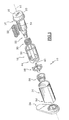
- FIG. 1 a rotary axis lock longitudinal A1 comprising declutching means conforming to teachings of the invention.
- the lock 10 essentially comprises a rotor 12 which is mounted rotating around the axis A1, inside a stator 14, with interposition between the two of a socket intermediate 16.
- the rotor 12 is intended to be rotated at using a key (not shown) inserted axially from back to front inside the rotor 12 through a key entry 18 arranged in a rear transverse face 20 of the rotor 12, which face 20 is intended for example to flush with the outside of a body panel (not shown) of the vehicle.
- the front axial end 22 of the rotor 12 is intended to drive in rotation a control lever 24 of a mechanism lock (not shown) to authorize the locking and unlocking a door of the vehicle.
- the rotor 12 is capable of rotating the control lever 24, only in the presence of a key compliant, via a coach 26 which is movable axially in the latch 10, under the action of an indexer 28, between a engaged position in which it rotates the rotor 12 and the control lever 24, and a disengaged position in which the rotor 12 is no longer likely to cause the lever 24 in rotation and in which the coach 26 ensures the rotation lock of the lever 24 relative to the stator 14 of the lock 10.
- the rotor 12, the stator 14 and the intermediate sleeve 16 are stationary in translation along the axis A1, one with respect to to the other and a compression coil spring 30 is interposed between the rotor 12 and the driver 26 to stress the latter axially forward towards its engaged position.
- stator 14 is of generally cylindrical tubular shape and it comprises means (not shown) which allow the mounting and fixing the lock 12 on the vehicle.
- the rotor 12 is intended to receive glitter 32 arranged in transverse planes which are follow each other at regular intervals along the direction of the A1 axis of latch 10 and which are received in corresponding housings 34 of rotor 12.
- the flakes 32 are movable radially in the rotor 12 and they are resiliently biased towards a protruding position in which they partially protrude at the exterior of the housings 34 of the rotor 12.
- the glitter 34 is not fully retracted and are received inside a corresponding window 36 arranged in the intermediate sleeve 16.
- the flakes 34 immobilize the rotor in rotation 12 with respect to the intermediate sleeve 16 which itself remains free to rotate relative to stator 14.
- the indexer notably includes a main ring 38 and guide tabs 40 which extend axially towards the rear from the ring 38 and which are intended to be received in corresponding axial cuts 42 of the sleeve intermediate 16.
- the notches 42 open axially forward in the front axial end 44 of the socket 16 so that, with the guide tabs 40, they ensure the permanent rotation connection of the indexer 28 with the sleeve intermediate 16, while leaving the possibility for the indexer 28 to move axially in the latch 10.
- the legs of guide 40 are radially protruding from to ring 38 so that ring 38 can be received at inside the axial end 44 of the socket 16.
- the indexer 28 also includes two pins 46 which extend axially forward in the extension of two guide lugs 40 diametrically opposite.
- the lugs 46 have, in section through a plane tangential to the ring 38, a substantially trapezoidal shape, symmetrical about the axial direction, the small base of the trapezoid forming a transverse front edge 48 and the large base trapezoid forming two transverse surfaces 50 arranged on both sides of the longitudinal faces of the guide tab 40 corresponding.
- the lug 46 and the corresponding tab 40 have thus substantially an arrow shape facing forward in the axial direction.
- the pins 46 are intended to cooperate with the stator 14.
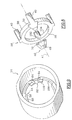
- the stator 14 comprises, at its front axial end 52, an internal radial collar 54 whose rear transverse face is stepped so as to form two concentric annular faces 58, 60 of which the first, peripheral 58, is arranged axially behind the second, internal 60.
- the radial collar 54 is provided with orifices 62 of shape complementary to the lugs 46 of the indexer 38 so that the two faces 64 which angularly delimit an orifice 62 in the radial collar 54 form two inclined ramps so that that the housing 62 is open towards the rear.
- the indexer 28 is likely to occupy two axial positions in the stator.
- the first corresponds to that in which the pins 46 are supported axially towards the front in the corresponding holes 62 of the stator 14.
- the lugs 46 are driven out of their orifice of the made of the inclination of the ramps 64 which delimit the housings 62, and the indexer 28 is then in the retracted position axially backwards in the stator 14, for example in support by the front face 48 of the lugs 46 against the face peripheral annular 58 of the radial collar 54.
- the indexer 28 is linked in intermediate stator rotation 16.
- the indexer 28 controls the displacements in translation of the coach 26 so as to pass it from a front axial position clutched to rear axial position disengaged.
- Coach 26 who is shown more particularly in Figures 6 and 7, has essentially two successive coaxial tubular sections, rear 66 and front 68, the rear section 66 being further larger diameter than the front section 68.
- the rear section 66 comprises, at its axial end rear, an external radial collar 70 whose external diameter is substantially equal to that of the ring 38 of the indexer 28.
- the external radial collar 70 is intended to cooperate with the lugs 46 of the indexer 28 to ensure axial coupling of the indexer 28 on the coach 26.
- the lugs 46 each have, at the front, an internal radial rim 72 so that the lug 46 has, in section through a radial plane of the indexer 28, a L shape.
- the indexer 28 is intended to be mounted by engagement, in the transverse direction, of the two pins 46 on the radial collar 70 of the coach 26, the rim 72 of each of the two pins 46 then being in contact with a front annular face 74 of the external radial collar 70.
- the ring 38 of the indexer 28 is then in support axially forward between an annular end face rear 76 of the coach 26 so as to make the coach 26 and the indexer 28 axially integral with one another.
- the front section 68 of the coach 26 comprises, on its external cylindrical face, hollow grooves 77 which are intended to cooperate with complementary grooves 78 of the control lever 24 which, as we can see more particularly in Figure 4, are formed in relief on a internal cylindrical face of a cylindrical crown 80 which extends axially towards the rear from a rear face 82 of the lever 24.
- the driver 26 and the control lever 24 are intended to be always coupled in rotation by their complementary splines 77, 78, whatever the axial position of the coach 26 which is movable in the lock 10 while the lever 24 is axially fixed relative to the stator 14.
- the raised grooves 78 of the lever 24 extend axially rearward beyond the crown 80 and the hollow grooves 77 of the coach 26 are formed of so as to open axially towards the rear inside of the space delimited by the rear cylindrical section 66 of coach 26.
- the front cylindrical section 68 of the coach 26 has an internal radial collar at its front axial end 84.
- the coach 26 is intended to be mounted at the front of the rotor 12 which essentially comprises a central section 86, in which the housings 34 of the flakes 32 are fitted, and which is extended axially forwards by a section intermediate 88 and by an end section 90 which are of decreasing diameters.
- the front end section 90 of the rotor 12 comprises four drive notches 92 which extend radially towards the outside, being arranged at 90 ° relative to each other, and which are intended to be received in cavities corresponding 94 formed in the radial collar 84 of the coach 26 when the latter is in the engaged position.
- the cavities 94 of the coach 26 open radially inward and axially forward and toward the back.
- the diameter of the opening defined by the collar internal radial 84 of the coach 26 is substantially equivalent to the external diameter of the end section 90 of the rotor 12.
- the notches 92 of the rotor 12 are arranged axially at a sufficient distance from the rear end of the section end 90, delimited by the front end of the section intermediate 88, to allow the coach 26 to move back towards its disengaged position in which the notches 92 of the rotor 12 are released from the cavities 94 of the coach 26.
- the internal diameter of the front tubular section 68 of the coach 26 is substantially equal to the external diameter of the intermediate section 88 of the rotor 12 so that the intermediate section 88 can be received inside the front section 68 of the coach 26 when the latter is in retracted position disengaged.
- the internal diameter of the tubular section rear 66 of the coach 26 is greater than that of the section before 68 and therefore greater than the external diameter of the section intermediate 88 of rotor 12 so as to delimit radially between the intermediate section 88 and the rear section 66 of the indexer 26 an annular space in which the compression spring 30 which urges the coach 26 and the indexer 28 axially forward.
- the spring 30 bears axially forwards against an annular face 96 of the coach 26 which is turned backwards and which forms the step between the sections front 66 and rear 68 of the coach 26.
- the spring 30 is by elsewhere resting axially rearward against a face transverse annular 98, facing forward, delimited between the central 86 and intermediate 88 sections of the rotor 12.
- This transverse face 98 of the rotor 12 is also notched on its outer radial periphery so as to delimit four axial fingers 100 which are arranged at 90 ° one on the other and which are intended to be received in notches corresponding 102 which are formed in a transverse face rear 104 of ring 38 of indexer 28 when indexer 28 is in the retracted disengagement position.
- the notches 102 are arranged in correspondence with each of the guide tabs 40 of the indexer 28.
- indexer 28 when, following the introduction of a non-key compliant in rotor 12, indexer 28 is in the retracted position clutch, it is immobilized in rotation relative to the rotor 12.
- the trainer 26 also includes nipples 106 which extend radially outward from a surface external cylindrical of the rear section 66 of the coach 26.
- the nipples 106 are intended to be received, when the coach 26 is in the disengaged retracted position, inside a housing correspondent 108 formed in the front transverse face 110 of the radial collar 54 of the stator 14.
- the coach 26 is then locked in rotation by stator report 14.
- the housings 108 of the stator 14 extend angularly according to an arc greater than the angular arc corresponding to the transverse dimension of the nipples 106. Indeed, this is made necessary because when the coach 26 is pulled back to its position disengaged by the indexer 28, it continues to be rotated by the rotor 12, as long as it has not reached its disengaged position. Thus, the coach 26 is animated by a substantially helical movement.
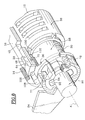
- FIG 8 there is shown the latch 10 when the indexer 28 and the coach 26 are in the advanced position clutched so as to allow, using a conforming key, control the rotation of the lever 24.
- the lugs 46 of the indexer 28 are then received at the bottom of the orifices 62 of the stator 14 so that the spring 30 stresses all of indexer 28 and the coach 26 forwards.
- the flakes 32 are retracted inside the rotor 12 and the intermediate sleeve 16 is free to rotate relative to the rotor 12 and it is immobilized relative to the stator 14 due to the engagement of the lugs 46 in the housings 62.
- the coach 26 is in the advanced position clutch so that in addition to being integral in rotation with the lever 24 by the complementary grooves 77, 78, it is also coupled in rotation with the rotor 12 due to the engagement of the notches 92 of the rotor 12 in the cavities 94 corresponding to coach 26.
- the rotor 12 is able to drive in rotation lever 24 for controlling the locking or unlocking of the lock mechanism.
- the flakes 32 then hold the sleeve intermediate 16 integral in rotation with the rotor 12 so that an attempt to rotate the rotor 12 causes a rotation relative of the socket 16 with respect to the stator 14, rotation allowed by the fact that the indexer 28 moves back to its position of declutching by the cooperation of the lugs 46 with the ramps 64 delimiting the orifices 62 of the stator 14.
- the rotor 12 is no longer linked in rotation with coach 26 and thus finds himself completely free in rotation. The rotor 12 is thus disengaged from the rest of the the lock and can no longer have any action on it.
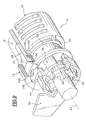
- FIG. 10 shows an intermediate position of the coach 26 and of the indexer 28, between their engaged and disengaged positions. This position is likely to occur after the lock has been released and therefore the indexer 28 and the coach 26 are then initially in position remote shown in Figure 9.
- the indexer 28 is rotated by the rotor 12 due to the engagement of the axial fingers 100 of the rotor 12 in the notches 102 of indexer 28.
- the indexer 28 is driven simultaneously by the sleeve intermediate 16 which is integral with the rotor 12 thanks to the sequins in projecting position.
- the lugs 46 of the indexer 28 are therefore likely to be found opposite corresponding orifices 62 of the stator 14. So, under the action of the spring 30, the indexer 28 and the driver 26 are moved forward toward their engaged position.
- Adequate axial positioning of the different elements of the latch 10 then makes it possible, on the one hand, to prevent the complete re-engagement of the mechanism if the rotor 12 is actuated at using a non-compliant key, and secondly the assurance of a automatic clutch mechanism requiring less than a quarter of rotation of rotor 12, in the presence of a conforming key.
- the indexer 28 when the indexer 28 is in the position of declutching, we choose that the axial fingers 100 of the rotor 12 and the notches 102 of the indexer 28 cooperate only on one axial length of the order of 1 mm.
- nipples 106 of the coach 26 cooperate with the corresponding housings 108 over a length about 3 mm, approximately equal to the travel of the coach 26 but slightly lower than this.
- the axial fingers 100 of the rotor 12 are then released notches 102 of the indexer but the nipples 106 of the coach remain blocked inside the housing 108.
- the intermediate sleeve 16 remains integral with the rotor 12 due to the presence of the sequins 32 and any pursuit of the rotational movement of the rotor 12 results in a new complete disengagement of the mechanism.
- indexer 28 and the coach 26 do not return not in fully engaged position if the key is not compliant, which prevents lever 24 from being released relative to stator 14.
- the coach 26 can advance to its engaged position and the rotor 12 can then control the rotation of the control lever 24.
- the lock 10 which has just been described therefore makes it possible to achieve a high security releasable lock while using components which can be obtained in a way simple by molding.
- the efforts transmitted by the different components are in such a way that we minimize risks of deterioration of the parts involved.
- the assembly of such a lock turns out to be very easily automatable.
Landscapes
- Lock And Its Accessories (AREA)
Claims (10)
- Entkuppelbarer Schließzylinder insbesondere für den Schloßmechanismus eines Kraftfahrzeugs, wobei der Schließzylinder (10) ein feststehendes Teil (14), eine rohrförmige Zwischenhülse (16), die drehbar um ihre Achse (A1) in dem feststehenden Teil (14) angeordnet und in axialer Richtung gegenüber dem feststehenden Teil (14) unbeweglich ist, sowie ein drehbares Teil (12) umfaßt, das in der Hülse (16) drehbar sowie in axialer Richtung in der Hülse unbeweglich angeordnet ist und Elemente (32) zur Verriegelung des drehbaren Teils (12) gegenüber der Hülse (16) umfaßt, wobei die Verriegelungselemente (32) versenkt werden, wenn ein richtiger Schlüssel in das drehbare Teil (12) gesteckt wird, um so eine ungehinderte Drehung des drehbaren Teils (12) gegenüber der Hülse (16) und dem feststehenden Teil (14) und somit ein Mitführen eines drehbaren Betätigungshebels (24) des Schlosses zu erlauben, der mit Hilfe eines Mitnehmers (26) mit dem drehbaren Teil (12) verbunden ist, wobei der Schließzylinder (10) eine Rastvorrichtung (28) umfaßt, die in axialer Richtung zwischen einer Ruhestellung und einer Ausrückstellung beweglich ist, und zwar unter der Einwirkung einer Drehbewegung der Hülse (16) gegenüber dem feststehenden Teil (14) infolge des Mitführens des drehbaren Teils (12) mit Hilfe eines falschen Schlüssels, um den Mitnehmer (26) in Richtung auf eine ausgerückte Stellung axial zu verschieben, in der der Mitnehmer (26) bei Drehung gegenüber dem feststehenden Teil (14) gesperrt ist, wobei sich die Rastvorrichtung (28) bei Drehung der Zwischenhülse (16) und des drehbaren Teils (12) gemeinsam ungehindert gegenüber dem feststehenden Teil (14) dreht, wenn er sich in der Ausrückstellung befindet, wobei die genannte Rastvorrichtung (28) einen Ring (38) umfaßt, der hinten mit axialen Führungslaschen (40) versehen ist, die dazu bestimmt sind, in entsprechende Einschnitte (42) aufgenommen zu werden, die in der Zwischenhülse (16) ausgebildet sind und die in das vordere axiale Ende (44) der Hülse (16) münden, wobei der genannte Ring (38) mindestens einen Nocken (46) umfaßt, der sich axial nach vorne in Richtung auf eine Querfläche (54) des feststehenden Teils (14) erstreckt, der mit einer axialen Öffnung (62) versehen ist, in die der Nocken (46) aufgenommen wird, wenn sich die Rastvorrichtung (28) in der Ruhestellung befindet, und wobei die Ränder (64) der Öffnung (62) die Form einer Rampe aufweisen, um den Rücklauf des Nokkens (46) aus der Öffnung heraus hervorzurufen, wenn die Zwischenhülse (16) gegenüber dem feststehenden Teil (14) um ihre Achse (A1) schwenkt, wobei der Mitnehmer (26) und die Rastvorrichtung (28) in axialer Richtung fest miteinander verbunden sind, wobei eine Feder (30) den Mitnehmer (26) axial nach vorne in seine ausgerückte Stellung belastet, die der Ruhestellung der Rastvorrichtung (28) entspricht, dadurch gekennzeichnet, daß der Mitnehmer (26) vorne und hinten rohrförmige Abschnitte (66,68) umfaßt, die einen großen und einen kleinen Durchmesser aufweisen, daß der Mitnehmer an seinem hinteren Ende einen radialen Außenkragen (70) aufweist, um den sich die Rastvorrichtung (28) einhakt, so daß ihre Verbindung axial unbeweglich, bei der Drehung aber frei ist, und daß ein Ansatz (106) vorgesehen ist, der sich radial von dem vorderen Ende der zylinderförmigen Außenfläche des hinteren Abschnitts (68) mit großem Durchmesser aus erstreckt und der dazu bestimmt ist, in einen Sitz (108) des feststehenden Teils (14) aufgenommen zu werden, wenn sich der Mitnehmer (26) in seiner ausgerückten zurückgeschobenen Stellung befindet.
- Schließzylinder nach Anspruch 1, dadurch gekennzeichnet, daß der Ring (38) der Rastvorrichtung (28) mindestens eine Aussparung (102) aufweist, die axial nach hinten verläuft und in welche ein sich axial nach vorne erstreckender entsprechender Finger (100) des drehbaren Teils (12) aufgenommen wird.
- Schließzylinder nach einem der vorhergehenden Ansprüche, dadurch gekennzeichnet, daß das feststehende Teil (14) mindestens einen Sitz (108) umfaßt, in den ein entsprechender Ansatz (106) des Mitnehmers (26) aufgenommen wird, wenn dieser sich in einer ausgerückten zurückgeschobenen Stellung befindet.
- Schließzylinder nach einem der vorhergehenden Ansprüche, dadurch gekennzeichnet, daß der Mitnehmer (26) mit dem Hebel (24) für die Betätigung des Schloßmechanismus durch zugeordnete axiale Auskehlungen (77,78) drehfest verbunden ist.
- Schließzylinder nach einem der vorhergehenden Ansprüche, dadurch gekennzeichnet, daß das drehbare Teil (12) einen zylinderförmigen Endabschnitt (90) umfaßt, der mit mindestens einer radialen Raste (92) versehen ist, die in einer entsprechenden Vertiefung (94) des Mitnehmers (26) aufgenommen wird, wenn dieser sich in seiner eingerückten Stellung befindet.
- Schließzylinder nach einer Kombination der Ansprüche 1 und 3, dadurch gekennzeichnet, daß das feststehende Teil (14) im wesentlichen rohrförmig ausgebildet ist, daß die Zwischenhülse (16) und das drehbare Teil (12) drehbar in dem feststehenden Teil (14) angeordnet sind, daß das vordere axiale Ende (52) des feststehenden Teils (14) einen inneren radialen Kragen (54) umfaßt, dessen hintere ringförmige Querfläche (58) eine Auflagefläche für den axialen Nocken (46) der Rastvorrichtung (28) darstellt und die entsprechende Öffnung (62) umfaßt, und daß der radiale Kragen (54) mindestens einen Ausschnitt aufweist, der axial in Richtung nach vorne verläuft, um den Sitz (108) zu bilden, in den der Ansatz (106) des Mitnehmers (26) aufgenommen wird, wenn dieser sich in einer ausgerückten zurückgeschobenen Stellung befindet.
- Schließzylinder nach einer Kombination der Ansprüche 1, 3, 4 und 5, dadurch gekennzeichnet, daß der Mitnehmer (26) an seinem vorderen axialen Ende einen inneren radialen Kragen (84) aufweist, in dem eine Vertiefung (94) ausgebildet ist, in welche die axiale Raste (92) des drehbaren Teils (12) aufgenommen wird und daß die Auskehlungen (77) zur Verbindung mit dem Hebel (24) in der zylinderförmigen Außenfläche des vorderen Abschnitts (68) mit kleinem Durchmesser ausgebildet sind.
- Schließzylinder nach Anspruch 1, dadurch gekennzeichnet, daß die Rastvorrichtung (28) zwei Nocken (46) umfaßt, die diametral entgegengesetzt an dem Ring (38) angeordnet sind und die jeweils eine radiale Innenkante (72) aufweisen, die dazu bestimmt ist, mit einer ringförmigen Vorderfläche (74) des radialen Außenkragens (70) des Mitnehmers (26) zusammenzuwirken, dessen rückseitige Fläche (76) an einer Vorderfläche des Rings (38) anliegt, um die axiale Kopplung der Rastvorrichtung (28) und des Mitnehmers (26) sicherzustellen.
- Schließzylinder nach Anspruch 2 in Kombination mit Anspruch 5, dadurch gekennzeichnet, daß das drehbare Teil (12) einen mittleren zylinderförmigen Abschnitt (86) umfaßt, der drehbar in der Hülse (16) angeordnet ist und der nach vorne durch einen Zwischenabsatz (88) mit einem kleineren Durchmesser verlängert ist, welcher wiederum durch einen Endabschnitt (90) mit einem kleineren Durchmesser verlängert ist, auf dem die Raste (92) des Mitnehmers (26) ausgebildet ist und daß der mittlere Abschnitt (86) sowie der Zwischenabschnitt (88) eine ringförmige Querfläche (98) begrenzen, die den axialen Finger (100) trägt, der vorgesehen ist, um mit der Aussparung (102) der Rastvorrichtung (28) zusammenzuwirken.
- Schließzylinder gemäß einer Kombination der vorhergehenden Ansprüche, dadurch gekennzeichnet, daß für den Fall, daß ein richtiger Schlüssel in das drehbare Teil (12) gesteckt wird, nachdem der Schließzylinder (10) mit Hilfe eines falschen Schlüssels ausgerückt wurde, eine axiale Zwischenstellung des aus der Rastvorrichtung (28) und dem Mitnehmer (26) gebildeten Gesamtaufbaus vorgesehen ist, bei der der Nocken (46) der Rastvorrichtung (28) teilweise von der Öffnung des feststehenden Teils (14) umfaßt wird, bei der der Ansatz (106) des Mitnehmers (26) teilweise in den Sitz (108) des feststehenden Teils (14) aufgenommen wird, bei der der axiale Finger (100) des drehbaren Teils (12) aus der Aussparung (102) der Rastvorrichtung (28) ausgetreten ist und bei der die radiale Raste (92) des drehbaren Teils (12) ebenfalls aus der Vertiefung (94) des Mitnehmers (26) ausgetreten ist, so daß das feststehende Teil (14) und die Zwischenhülse (16) bei Drehung durch die Rastvorrichtung (28) miteinander verbunden sind, daß der Mitnehmer durch das feststehende Teil (14) blockiert ist, und daß das drehbare Teil (12) gegenüber der Rastvorrichtung (28) und dem Mitnehmer (26) sich ungehindert drehen kann, damit durch Schwenken des drehbaren Teils (12) die Raste (92) des drehbaren Teils (12) in die Vertiefung (94) des Mitnehmers (26) eingreift, um so zu ermöglichen, daß der aus Rastvorrichtung (28) und Mitnehmer (26) bestehende Gesamtaufbau unter der Einwirkung der Feder (30) in die eingerückte vorgeschobene Stellung zurückkehren kann.
Applications Claiming Priority (2)
| Application Number | Priority Date | Filing Date | Title |
|---|---|---|---|
| FR9605831A FR2748513B1 (fr) | 1996-05-10 | 1996-05-10 | Verrou a debrayage axial pour un mecanisme de serrure de vehicule automobile |
| FR9605831 | 1996-05-10 |
Publications (2)
| Publication Number | Publication Date |
|---|---|
| EP0806531A1 EP0806531A1 (de) | 1997-11-12 |
| EP0806531B1 true EP0806531B1 (de) | 2000-09-27 |
Family
ID=9492010
Family Applications (1)
| Application Number | Title | Priority Date | Filing Date |
|---|---|---|---|
| EP97106600A Expired - Lifetime EP0806531B1 (de) | 1996-05-10 | 1997-04-22 | Axial (ent)kuppelndes Schloss für ein Schlossmechanismus eines Personenkraftwagens |
Country Status (7)
| Country | Link |
|---|---|
| US (1) | US5732580A (de) |
| EP (1) | EP0806531B1 (de) |
| AR (1) | AR007031A1 (de) |
| BR (1) | BR9703109A (de) |
| DE (1) | DE69703178T2 (de) |
| ES (1) | ES2151202T3 (de) |
| FR (1) | FR2748513B1 (de) |
Families Citing this family (56)
| Publication number | Priority date | Publication date | Assignee | Title |
|---|---|---|---|---|
| US5907963A (en) * | 1997-08-25 | 1999-06-01 | Fort Lock Corporation | Lock assembly with a key-activated removable core structure |
| JP3527394B2 (ja) * | 1997-09-29 | 2004-05-17 | 株式会社東海理化電機製作所 | ステアリングロック装置 |
| KR100264685B1 (ko) * | 1998-01-15 | 2000-09-01 | 서정윤 | 도어록 장치 |
| FR2776325B1 (fr) | 1998-03-17 | 2000-04-28 | Valeo Securite Habitacle | Verrou a debrayage axial perfectionne pour un mecanisme de serrure de vehicule automobile |
| US6058751A (en) * | 1998-09-08 | 2000-05-09 | Strattec Security Corporation | Free-wheeling lock |
| US6523382B1 (en) * | 1998-09-08 | 2003-02-25 | Strattec Security Corporation | Free wheeling lock assembly |
| SE517283C2 (sv) * | 1998-12-10 | 2002-05-21 | Volvo Personvagnar Ab | Anordning vid cylinderlås |
| GB2350146A (en) * | 1999-05-13 | 2000-11-22 | Rover Group | Motor vehicle lock assembly |
| FR2796412B1 (fr) * | 1999-07-16 | 2001-09-07 | Valeo Securite Habitacle | Poignee d'ouvrant de vehicule automobile comportant des moyens debrayables commandes d'actionnement d'une serrure |
| US6185966B1 (en) * | 1999-07-27 | 2001-02-13 | Waterson Chen | Lock apparatus |
| ES2189571B2 (es) * | 1999-12-31 | 2004-06-01 | Escudos Kala Internacional, S.L. | Mecanismo de embrague para cerraduras electronicas. |
| US6443505B1 (en) * | 2000-02-22 | 2002-09-03 | S.P.E.P. Acquisitions, Inc. | Variable turn latch assembly and method |
| US6711924B2 (en) * | 2002-06-18 | 2004-03-30 | Strattec Security Corporation | Freewheeling lock apparatus and method |
| US6978645B2 (en) * | 2003-06-23 | 2005-12-27 | Strattec Security Corporation | Freewheeling lock apparatus and method |
| CN1849434B (zh) * | 2003-09-12 | 2010-05-12 | 株式会社有信 | 筒锁 |
| US20050115288A1 (en) * | 2003-12-02 | 2005-06-02 | Burmahln Jedediah A. | Adjustable locking mechanism |
| FR2869053B1 (fr) * | 2004-04-15 | 2006-07-14 | Norinco Sa | Dispositif de verrouillage et deverouillage avec cle d'un tampon sur un cadre |
| US7406847B2 (en) * | 2004-07-02 | 2008-08-05 | Honda Lock Mfg. Co., Ltd. | Cylinder lock |
| JP4403395B2 (ja) * | 2004-07-02 | 2010-01-27 | 株式会社ホンダロック | シリンダ錠 |
| FR2882463B1 (fr) * | 2005-02-24 | 2007-03-30 | Schneider Electric Ind Sas | Bouton tournant a serrure |
| FR2882772B1 (fr) | 2005-03-04 | 2007-05-04 | Valeo Securite Habitacle Sas | Verrou debrayable pour un mecanisme de serrure automobile |
| FR2882771B1 (fr) * | 2005-03-04 | 2008-09-05 | Valeo Securite Habitacle Sas | Verrou debrayable pour un mecanisme de serrure automobile |
| FR2883322B1 (fr) * | 2005-03-18 | 2008-09-05 | Valeo Securite Habitacle Sas | Verrou debrayable pour un mecanisme de serrure automobile |
| FR2889859B1 (fr) * | 2005-08-17 | 2007-10-19 | Valeo Securite Habitacle Sas | Verrou debrayable pour un mecanisme de serrure automobile |
| JP4704935B2 (ja) * | 2006-03-07 | 2011-06-22 | 株式会社東海理化電機製作所 | シリンダ錠装置及び係合解除機構 |
| US7930916B2 (en) * | 2006-03-15 | 2011-04-26 | Kabushiki Kaisha Tokai-Rika-Denki-Seisakusho | Locking device and key |
| US7275401B1 (en) * | 2006-04-13 | 2007-10-02 | Siemens Aktiengesellschaft | Key switch with at least one switching position |
| GB0608227D0 (en) * | 2006-04-26 | 2006-06-07 | Global Biotec Ltd | Access control means |
| JP4740806B2 (ja) * | 2006-07-06 | 2011-08-03 | 株式会社東海理化電機製作所 | 錠装置 |
| CN101688410A (zh) | 2006-10-23 | 2010-03-31 | 艾可品牌美国有限公司 | 安全设备 |
| US7357010B1 (en) * | 2006-11-21 | 2008-04-15 | Taiwan Fu Hsing Industrial Co., Ltd. | Plug assembly for a door lock |
| JP4842874B2 (ja) * | 2007-03-30 | 2011-12-21 | 株式会社東海理化電機製作所 | 錠装置 |
| JP5005459B2 (ja) * | 2007-07-30 | 2012-08-22 | 株式会社東海理化電機製作所 | シリンダ錠及びこれを備えた解錠装置 |
| JP4926875B2 (ja) * | 2007-07-30 | 2012-05-09 | 株式会社東海理化電機製作所 | シリンダ錠、クラッチ装置、及びこれらシリンダ錠,クラッチ装置を備えた解錠装置 |
| JP4926874B2 (ja) * | 2007-07-30 | 2012-05-09 | 株式会社東海理化電機製作所 | シリンダ錠及びこれを備えた解錠装置 |
| JP4907489B2 (ja) * | 2007-10-25 | 2012-03-28 | 株式会社東海理化電機製作所 | シリンダ錠及びこれを備えた解錠装置 |
| KR100890425B1 (ko) | 2007-10-30 | 2009-03-26 | 주식회사 신창전기 | 자동차의 시동 키 장치 |
| RU2383707C1 (ru) * | 2008-08-19 | 2010-03-10 | Открытое Акционерное Общество "Димитровградский автоагрегатный завод" | Выключатель замка двери легкового автомобиля |
| DE102008060561B4 (de) * | 2008-12-04 | 2014-06-12 | Harting Electric Gmbh & Co. Kg | Verriegelungsvorrichtung für mehrteilige Gehäuse |
| US8276416B2 (en) * | 2009-02-18 | 2012-10-02 | Vsi, Llc | Master key lock, system and method |
| DE102009052406A1 (de) | 2009-11-10 | 2011-05-12 | Huf Hülsbeck & Fürst Gmbh & Co. Kg | Schließzylinder |
| US8943864B2 (en) * | 2010-01-18 | 2015-02-03 | Liberty Safe And Security Products, Inc. | Proportional torque shaft clutch assembly |
| FR2965003A1 (fr) * | 2010-09-16 | 2012-03-23 | Valeo Securite Habitacle | Vehicule comprenant un verrou de verrouillage d'ouvrant |
| DE102010038266B4 (de) * | 2010-10-19 | 2013-05-23 | Harting Electric Gmbh & Co. Kg | Mehrteiliges Steckverbindergehäuse |
| US9234369B2 (en) | 2012-03-21 | 2016-01-12 | Carrier Corporation | Furnace door latch assembly |
| US10753125B2 (en) * | 2013-09-11 | 2020-08-25 | Moose Junction Limited | Lock mechanism |
| US20150211257A1 (en) * | 2014-01-28 | 2015-07-30 | Vsi, Llc | Free-wheel lock and assembly |
| FR3025767B1 (fr) * | 2014-09-17 | 2016-09-23 | U-Shin France Sas | Antivol pour vehicule automobile |
| TWI527956B (zh) * | 2014-09-25 | 2016-04-01 | 緯創資通股份有限公司 | 可切換不同款式安全鎖的鎖附機構及其電子裝置 |
| JP5964482B1 (ja) * | 2015-05-29 | 2016-08-03 | 株式会社東海理化電機製作所 | キーシリンダ装置 |
| DE102016118843A1 (de) * | 2016-10-05 | 2018-04-05 | Lisa Dräxlmaier GmbH | Verdrehsicherung für ein Schließsystem |
| US11326368B2 (en) | 2017-05-02 | 2022-05-10 | Carrier Corporation | Lead screw latch |
| DE102018212701A1 (de) * | 2018-07-30 | 2020-01-30 | D. la Porte Söhne GmbH | Selbstverriegelnder Druckknopf |
| JP7343408B2 (ja) * | 2020-01-16 | 2023-09-12 | 株式会社東海理化電機製作所 | シリンダ錠装置 |
| US12152409B2 (en) * | 2022-04-15 | 2024-11-26 | Security People, Inc. | Electronic mortise lock cylinder |
| CN116430914B (zh) * | 2023-03-15 | 2026-01-27 | 中国核动力研究设计院 | 一种控制转子旋转角度的装置及转子控制模拟结构 |
Family Cites Families (12)
| Publication number | Priority date | Publication date | Assignee | Title |
|---|---|---|---|---|
| US3442102A (en) * | 1966-12-14 | 1969-05-06 | Gen Motors Corp | Cylinder lock actuator |
| GB2165295B (en) * | 1984-10-04 | 1987-09-23 | Ford Motor Co | A lock assembly |
| FR2589926B1 (fr) * | 1985-11-14 | 1993-12-31 | Neiman Sa | Verrou a pistons a rotor coulissant embrayable avec un organe de commande |
| US4773240A (en) * | 1986-10-20 | 1988-09-27 | Best Lock Corporation | Lock with force-override assembly |
| FR2631067B1 (fr) * | 1988-05-04 | 1991-02-08 | Neiman Sa | Verrou a rotor debrayable |
| DE3827418A1 (de) * | 1988-08-12 | 1990-02-15 | Daimler Benz Ag | Schliesszylinder |
| US5265453A (en) * | 1990-11-30 | 1993-11-30 | Alpha Corporation | Cylinder lock |
| CN1072750A (zh) * | 1991-11-29 | 1993-06-02 | 赵满堂 | 防盗锁 |
| FR2691496B1 (fr) * | 1992-05-20 | 1999-12-03 | Valeo Securite Habitacle | Verrou a rotor debrayable, notamment pour serrure de vehicule automobile. |
| ES2073369B1 (es) * | 1993-10-08 | 1999-06-16 | Valeo Sistemas De Seguridad S | Cerradura desembragable para vehiculos y similares. |
| JPH084378A (ja) * | 1993-11-30 | 1996-01-09 | Tokai Rika Co Ltd | シリンダ錠装置 |
| US5640864A (en) * | 1993-12-27 | 1997-06-24 | Alpha Corporation | Cylinder lock resistible against breaking |
-
1996
- 1996-05-10 FR FR9605831A patent/FR2748513B1/fr not_active Expired - Lifetime
-
1997
- 1997-04-22 ES ES97106600T patent/ES2151202T3/es not_active Expired - Lifetime
- 1997-04-22 DE DE69703178T patent/DE69703178T2/de not_active Expired - Lifetime
- 1997-04-22 EP EP97106600A patent/EP0806531B1/de not_active Expired - Lifetime
- 1997-05-07 AR ARP970101889A patent/AR007031A1/es unknown
- 1997-05-08 US US08/853,116 patent/US5732580A/en not_active Expired - Lifetime
- 1997-05-09 BR BR9703109A patent/BR9703109A/pt not_active IP Right Cessation
Also Published As
| Publication number | Publication date |
|---|---|
| US5732580A (en) | 1998-03-31 |
| AR007031A1 (es) | 1999-10-13 |
| EP0806531A1 (de) | 1997-11-12 |
| FR2748513A1 (fr) | 1997-11-14 |
| BR9703109A (pt) | 1998-10-06 |
| ES2151202T3 (es) | 2000-12-16 |
| DE69703178D1 (de) | 2000-11-02 |
| FR2748513B1 (fr) | 1998-06-26 |
| DE69703178T2 (de) | 2001-05-17 |
Similar Documents
| Publication | Publication Date | Title |
|---|---|---|
| EP0806531A1 (de) | Axial (ent)kuppelndes Schloss für ein Schlossmechanismus eines Personenkraftwagens | |
| EP1084915B1 (de) | Kraftfahrzeuglenkungsdiebstahlsicherung | |
| EP0943758B1 (de) | Axial entkuppelndes Schloss für ein Schlossmechanismus eines Personenkraftwagens | |
| EP1859112B1 (de) | Entkuppelbare verriegelung für ein schliessmechanismus eines fahrzeuges | |
| EP0647752B1 (de) | Entkuppelbares Schloss für Kraftfahrzeuge und dgl. | |
| EP1859113B1 (de) | Lösbarer verschluss für ein verschlusssystem eines kraftfahrzeugs | |
| EP1863986B1 (de) | Entkuppelbare verriegelung für kraftfahrzeugverriegelungssystem | |
| EP1580358B1 (de) | Schutz für Verstellvorrichtung zur Verschlussbetätigung mittels eines Schlosses | |
| EP1020337A1 (de) | Kraftfahrzeuglenkungs- Diebstahlsicherung | |
| EP0429336A1 (de) | Behälterverschluss, insbesondere Tankverschluss für Kraftfahrzeug | |
| EP0795662B1 (de) | Kraftwagendrehschloss worin ein montierter Rotor blockiert ist von einem bajonettartigen Sicherungsring | |
| WO2008152327A2 (fr) | Dispositif de liaison entre un verrou et une serrure de porte de vehicule automobile | |
| EP0731243B1 (de) | Riegel mit entkuppelbarem Rotor und Automobillenkschloss mit einem solchen Riegel | |
| EP0869236B1 (de) | Von einer Seite aus betätigbarer Sicherheitszylinder selbst wenn ein Schlüssel auf der anderen Seite eingesteckt ist | |
| FR3008726A1 (fr) | Verrou pour portiere de vehicule automobile | |
| EP0571249A1 (de) | Riegel mit entkuppelbarem Rotor, insbesondere für ein Kraftfahrzeug | |
| EP2635465A1 (de) | Diebstahlsicherung für eine fahrzeuglenksäule mit einer zu drückenden sicherheitsfunktion | |
| EP1744926B1 (de) | Kraftstoffklappe für ein kraftfahrzeug | |
| FR2755173A1 (fr) | Verrou a autocodage | |
| WO1998057817A1 (fr) | Bouchon de reservoir de carburant a barillet, notamment pour vehicule | |
| EP0701932A1 (de) | Lenkradfreilauf-Diebstahlsicherung für Kraftfahrzeuge | |
| FR2771051A3 (fr) | Dispositif d'attelage de remorque | |
| FR2769658A1 (fr) | Barillet de serrure pour serrure de securite | |
| WO2000000371A1 (fr) | Dispositif antivol pouvant etre fixe sur la couronne d'un volant de direction d'un vehicule automobile | |
| FR2657828A1 (fr) | Dispositif antivol par blocage de la direction pour vehicules automobiles. |
Legal Events
| Date | Code | Title | Description |
|---|---|---|---|
| PUAI | Public reference made under article 153(3) epc to a published international application that has entered the european phase |
Free format text: ORIGINAL CODE: 0009012 |
|
| AK | Designated contracting states |
Kind code of ref document: A1 Designated state(s): DE ES GB IT |
|
| 17P | Request for examination filed |
Effective date: 19980417 |
|
| GRAG | Despatch of communication of intention to grant |
Free format text: ORIGINAL CODE: EPIDOS AGRA |
|
| 17Q | First examination report despatched |
Effective date: 19990917 |
|
| GRAG | Despatch of communication of intention to grant |
Free format text: ORIGINAL CODE: EPIDOS AGRA |
|
| GRAH | Despatch of communication of intention to grant a patent |
Free format text: ORIGINAL CODE: EPIDOS IGRA |
|
| GRAH | Despatch of communication of intention to grant a patent |
Free format text: ORIGINAL CODE: EPIDOS IGRA |
|
| GRAA | (expected) grant |
Free format text: ORIGINAL CODE: 0009210 |
|
| AK | Designated contracting states |
Kind code of ref document: B1 Designated state(s): DE ES GB IT |
|
| RIN1 | Information on inventor provided before grant (corrected) |
Inventor name: MENAGER, CHRISTOPHE Inventor name: GARNAULT, JOEL |
|
| REF | Corresponds to: |
Ref document number: 69703178 Country of ref document: DE Date of ref document: 20001102 |
|
| GBT | Gb: translation of ep patent filed (gb section 77(6)(a)/1977) |
Effective date: 20001020 |
|
| REG | Reference to a national code |
Ref country code: ES Ref legal event code: FG2A Ref document number: 2151202 Country of ref document: ES Kind code of ref document: T3 |
|
| ITF | It: translation for a ep patent filed | ||
| PLBE | No opposition filed within time limit |
Free format text: ORIGINAL CODE: 0009261 |
|
| STAA | Information on the status of an ep patent application or granted ep patent |
Free format text: STATUS: NO OPPOSITION FILED WITHIN TIME LIMIT |
|
| 26N | No opposition filed | ||
| REG | Reference to a national code |
Ref country code: GB Ref legal event code: IF02 |
|
| PGFP | Annual fee paid to national office [announced via postgrant information from national office to epo] |
Ref country code: ES Payment date: 20140422 Year of fee payment: 18 Ref country code: IT Payment date: 20140417 Year of fee payment: 18 |
|
| REG | Reference to a national code |
Ref country code: DE Ref legal event code: R082 Ref document number: 69703178 Country of ref document: DE |
|
| REG | Reference to a national code |
Ref country code: DE Ref legal event code: R081 Ref document number: 69703178 Country of ref document: DE Owner name: U-SHIN FRANCE SAS, FR Free format text: FORMER OWNER: VALEO SECURITE HABITACLE, CRETEIL, FR Effective date: 20150515 |
|
| PG25 | Lapsed in a contracting state [announced via postgrant information from national office to epo] |
Ref country code: IT Free format text: LAPSE BECAUSE OF NON-PAYMENT OF DUE FEES Effective date: 20150422 |
|
| REG | Reference to a national code |
Ref country code: ES Ref legal event code: FD2A Effective date: 20160526 |
|
| PG25 | Lapsed in a contracting state [announced via postgrant information from national office to epo] |
Ref country code: ES Free format text: LAPSE BECAUSE OF NON-PAYMENT OF DUE FEES Effective date: 20150423 |
|
| PGFP | Annual fee paid to national office [announced via postgrant information from national office to epo] |
Ref country code: GB Payment date: 20160418 Year of fee payment: 20 Ref country code: DE Payment date: 20160413 Year of fee payment: 20 |
|
| REG | Reference to a national code |
Ref country code: DE Ref legal event code: R071 Ref document number: 69703178 Country of ref document: DE |
|
| REG | Reference to a national code |
Ref country code: GB Ref legal event code: PE20 Expiry date: 20170421 |
|
| PG25 | Lapsed in a contracting state [announced via postgrant information from national office to epo] |
Ref country code: GB Free format text: LAPSE BECAUSE OF EXPIRATION OF PROTECTION Effective date: 20170421 |