EP0809311B1 - Electrode négative pour accumulateur au plomb, comprenant de la poudre de graphite - Google Patents
Electrode négative pour accumulateur au plomb, comprenant de la poudre de graphite Download PDFInfo
- Publication number
- EP0809311B1 EP0809311B1 EP97108156A EP97108156A EP0809311B1 EP 0809311 B1 EP0809311 B1 EP 0809311B1 EP 97108156 A EP97108156 A EP 97108156A EP 97108156 A EP97108156 A EP 97108156A EP 0809311 B1 EP0809311 B1 EP 0809311B1
- Authority
- EP
- European Patent Office
- Prior art keywords
- negative electrode
- battery
- lignin
- capacity
- amount
- Prior art date
- Legal status (The legal status is an assumption and is not a legal conclusion. Google has not performed a legal analysis and makes no representation as to the accuracy of the status listed.)
- Expired - Lifetime
Links
Images


Classifications
-
- H—ELECTRICITY
- H01—ELECTRIC ELEMENTS
- H01M—PROCESSES OR MEANS, e.g. BATTERIES, FOR THE DIRECT CONVERSION OF CHEMICAL ENERGY INTO ELECTRICAL ENERGY
- H01M10/00—Secondary cells; Manufacture thereof
- H01M10/06—Lead-acid accumulators
-
- H—ELECTRICITY
- H01—ELECTRIC ELEMENTS
- H01M—PROCESSES OR MEANS, e.g. BATTERIES, FOR THE DIRECT CONVERSION OF CHEMICAL ENERGY INTO ELECTRICAL ENERGY
- H01M4/00—Electrodes
- H01M4/02—Electrodes composed of, or comprising, active material
- H01M4/14—Electrodes for lead-acid accumulators
-
- H—ELECTRICITY
- H01—ELECTRIC ELEMENTS
- H01M—PROCESSES OR MEANS, e.g. BATTERIES, FOR THE DIRECT CONVERSION OF CHEMICAL ENERGY INTO ELECTRICAL ENERGY
- H01M4/00—Electrodes
- H01M4/02—Electrodes composed of, or comprising, active material
- H01M4/62—Selection of inactive substances as ingredients for active masses, e.g. binders, fillers
- H01M4/624—Electric conductive fillers
- H01M4/625—Carbon or graphite
-
- H—ELECTRICITY
- H01—ELECTRIC ELEMENTS
- H01M—PROCESSES OR MEANS, e.g. BATTERIES, FOR THE DIRECT CONVERSION OF CHEMICAL ENERGY INTO ELECTRICAL ENERGY
- H01M4/00—Electrodes
- H01M4/02—Electrodes composed of, or comprising, active material
- H01M4/62—Selection of inactive substances as ingredients for active masses, e.g. binders, fillers
- H01M4/627—Expanders for lead-acid accumulators
-
- Y—GENERAL TAGGING OF NEW TECHNOLOGICAL DEVELOPMENTS; GENERAL TAGGING OF CROSS-SECTIONAL TECHNOLOGIES SPANNING OVER SEVERAL SECTIONS OF THE IPC; TECHNICAL SUBJECTS COVERED BY FORMER USPC CROSS-REFERENCE ART COLLECTIONS [XRACs] AND DIGESTS
- Y02—TECHNOLOGIES OR APPLICATIONS FOR MITIGATION OR ADAPTATION AGAINST CLIMATE CHANGE
- Y02E—REDUCTION OF GREENHOUSE GAS [GHG] EMISSIONS, RELATED TO ENERGY GENERATION, TRANSMISSION OR DISTRIBUTION
- Y02E60/00—Enabling technologies; Technologies with a potential or indirect contribution to GHG emissions mitigation
- Y02E60/10—Energy storage using batteries
-
- Y—GENERAL TAGGING OF NEW TECHNOLOGICAL DEVELOPMENTS; GENERAL TAGGING OF CROSS-SECTIONAL TECHNOLOGIES SPANNING OVER SEVERAL SECTIONS OF THE IPC; TECHNICAL SUBJECTS COVERED BY FORMER USPC CROSS-REFERENCE ART COLLECTIONS [XRACs] AND DIGESTS
- Y02—TECHNOLOGIES OR APPLICATIONS FOR MITIGATION OR ADAPTATION AGAINST CLIMATE CHANGE
- Y02P—CLIMATE CHANGE MITIGATION TECHNOLOGIES IN THE PRODUCTION OR PROCESSING OF GOODS
- Y02P70/00—Climate change mitigation technologies in the production process for final industrial or consumer products
- Y02P70/50—Manufacturing or production processes characterised by the final manufactured product
Definitions
- the present invention relates to an improvement in a negative electrode plate for a lead storage battery.
- Lead storage batteries are used for a lot of purposes widely from starting/lighting batteries for cars and small-capacity consumer batteries to large-capacity stationary batteries. Further, recently, the lead storage battery has attracted public attention also as an electric source for an electric car from the point of view of environmental problems.
- the battery for an electric vehicle requires a large current and repetition of deep charging and discharging. Further, because the battery is arranged in a narrow space in order to maximize the interior space of a car, release of heat becomes insufficient. As a result, the battery is exposed to a high temperature. Accordingly, in the battery for an electric car, the high-rate discharging characteristic of the negative electrode may be lowered in a relatively early stage.
- an organic expander an inorganic expander (barium sulfate) and carbon are added to a negative electrode plate for a lead storage battery so that they contribute to improvement in various performances of the negative electrode plate for a lead storage battery.
- the organic expander is generally constituted by a by-product called lignin (or lignin derivatives) obtained at the time of production of pulp, so that the organic expander suppresses the contraction of the active material and finely divide the active material to thereby prevent the lowering of the discharging capacity of the negative electrode plate, especially, the lowering of the high-rate discharging capacity of the negative electrode plate with the charging/discharging of the battery.
- EP-A-0 352 115 discloses a lead-acid battery wherein active material of at least one of its positive and negative plates, incorporates electrically conductive whiskers in an amount of 0.01 to 10 weight percent of the active material, the whiskers having diameters of 10 ⁇ m or less, aspect ratios of 50 or more, and specific surface area of 2 m 2 /g, and the whiskers serving to interconnect active material particles electrically.
- the whiskers used encourage the flow of electrons into the active material particles remote from the current collector.
- the solution of this problem is the provision of a negative electrode plate for a lead storage battery comprising a negative electrode material and graphite powder having a mean particle size equal to or not small than 0.5 ⁇ m to equal to or not larger than 30 ⁇ m is added.
- the mean particle size of the graphite powder is equal to or not smaller than 0.5 ⁇ m in the present invention, because if it is less than 0.5 ⁇ m, the conductivity of the graphite can not sufficiently obtained. Moreover, the mean particle size of the graphite powder is preferably in the range of 5 to 30 ⁇ m.
- the amount of graphite powder added is preferably in the range of 0.3 to 2 % by weight, preferably, 0.3 to 0.8 % by weight, and preferably crystalline graphite powder is used as the graphite powder.
- crystalline graphite includes flake graphite and vein graphite. Vein graphite is more preferable. More preferably, 0.3 % by weight or more of an organic expander is added thereto.
- the performance of the battery can be improved but also the lowering of the high-rate discharging capacity under a high temperature can be prevented.
- the lead storage battery according to the present invention is produced by an ordinary method after graphite powder having a mean particle size equal to or not larger than 30 ⁇ m is added to a negative electrode plate.
- the amount of graphite powder added is in the range of 0.3 to 2 % by weight and vein graphite powder is used as the graphite powder. More preferably, 0.3 % by weight or more of an organic expander is added thereto. Therefore, not only the performance of the battery can be improved but also the lowering of the high-rate discharging capacity under a high temperature can be prevented.
- lignin Na salt of sulfite lignin (hereinafter referred to as lignin) produced by a sulfite method.
- the amount of lignin added was changed (0.1 %, 0.5 % by weight as the ratio of the negative electrode active material).
- the carbon used was acetylene black, thermal black and vein graphite powder (hereinafter referred to as graphite) which has a mean particle size in a range of from 5 to 70 ⁇ m.
- the amount of the carbon added was changed (0.2 %, 1 % by weight).
- NOTE 1 0.1 wt% 0.2 wt% OF ACETYLENE BLACK CONVENTIONAL ARTICLE 2 0.5 wt% 0.2 wt% OF ACETYLENE BLACK COMPARATIVE EXAMPLE 3 0.5 wt% 1.0 wt% OF ACETYLENE BLACK COMPARATIVE EXAMPLE 4 0.5 wt% 1.0 wt% OF THERMAL BLACK COMPARATIVE EXAMPLE 5 0.5 wt% 1.0 wt% OF GRAPHITE WITH MEANS PARTICLE SIZE OF 70 ⁇ m COMPARATIVE EXAMPLE 6 0.5 wt% 1.0 wt% OF GRAPHITE WITH MEANS PARTICLE
- barium sulfate and the kneading solution can be changed correspondingly to the purpose of use of the battery so that, generally, the range of barium sulfate may be from 0 to 2 % by weight and the specific gravity and liquid amount of dilute sulfuric acid may be selected suitably so long as the paste state adapted for filling can be maintained.
- an electrode plate reinforcer such as synthetic fiber or the like may be added when the grid has large meshes or when the electrode plate requires large strength.
- the amount of the electrode plate reinforcer added is generally from 0.05 % to 0.2 %.
- the negative electrode plate No. 1 is a conventional plate prepared by adding 0.1 % by weight of lignin and 0.2 % by weight of acetylene black as carbon.
- the negative electrode plates 2 to 8 are plates prepared by increasing the amount of lignin to 0.5 % by weight in order to improve the high-rate discharging characteristic.
- the negative electrode plate No. 2 is a plate prepared by setting the amount of carbon as in the conventional case (acetylene black: 0.2 % by weight).
- the negative electrode plates No. 3 to 8 are plates prepared by increasing the amounts of the three kinds of carbon to 1 % by weight in order to improve the charge acceptance. That is, the negative electrode plate No.
- the negative electrode plate No. 4 is a plate prepared by adding 1 % by weight of thermal black
- the negative electrode plates No. 5 to 8 are plates prepared by adding 1 % by weight of graphite having mean particle sizes of 70, 30, 10 and 5 ⁇ m, respectively.
- an expanded metal grid formed from a Pb alloy containing 0.07 % by weight of Ca and 0.5 % by weight of Sn was used as the negative electrode grid in this example
- a cast grid as generally used in a lead storage battery may be used.
- any alloy such as a Pb-Sb alloy, etc., other than the Pb-Ca(-Sn) alloy may be used as the grid alloy.
- the positive electrode paste used was a mixture prepared by kneading 100 kg of leady oxides containing about 75 % by weight of PbO and about 25 % by weight of metallic Pb and having apparent density of about 1.8 g/cm 3 and about 25 l of dilute sulfuric acid having specific gravity of about 1.15.
- Red lead may be added to the positive electrode paste in order to improve forming efficiency and/or synthetic fiber having a length of about 1 mm to about 5 mm may be added to the positive electrode paste in order to improve the strength of the electrode plate.
- the amount of synthetic fiber added is suitably in the range of about 0.1 % to 0.3 % by weight.
- the grid used in this example is a cast grid formed from a Pb alloy containing 0.07 % by weight of Ca and 1.5 % by weight of Sn, reduction in cost-can be attained if an expanded metal grid is used.
- the grid alloy used for the positive electrode there can be used any alloy such as a Pb-Ca(-Sn) alloy, a Pb-Sb alloy, etc. generally used in a lead storage battery.
- the capacities of the comparative batteries No. 2, 4 and 5 were inferior to the capacity of the conventional battery 1.
- the capacities of the batteries No. 6 to 8 according to the present invention and the capacity of the comparative battery No. 3 were substantially equal to the capacity of the conventional battery 1.
- the capacities of all the comparative batteries No. 2, 4 and 5 and the capacities of all the batteries No. 6 to 8 according to the present invention were superior to the capacity of the conventional battery No. 1.
- the capacity of the conventional battery No. 3 was inferior to the capacity of the conventional battery No. 1.
- the high-rate discharging capacities of the batteries No. 2, 4 and 5 and of the batteries No. 6 to 8 were superior because the high-rate discharging characteristic were improved by the increase in the amount of lignin.
- the discharging capacity of the battery No. 3 with the increase in the amount of lignin was inferior to the battery 1 with no increase in the amount of lignin similarly because lignin was adsorbed by 1 % by weight of acetylene black added so that the effect of lignin was not obtained.
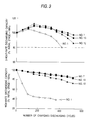
- the same batteries were subjected to a charging/discharging cycle life test. That is, after the cycle in which discharging was carried out for 2.4 hours at a current of 16.7 ⁇ 0.05 A and then charging was carried out for 8.4 hours at a current of 5.0 ⁇ 0.05 A while the storage battery ambient temperature was set 50 ⁇ 2°C was repeated 50 times, the 3-hour-rate discharging capacity and high-rate discharging capacity of each battery were measured in the condition in which the electrolyte temperature was set to 30 ⁇ 2°C. These measurements were repeated unless the 3-hour-rate discharging capacity obtained per 50 cycles reached 80 % or less (40 Ah or less) of the nominal capacity.
- the results of the charging/discharging cycle life test are shown in Fig. 1.
- the 3-hour-rate discharging capacity in each of the comparative batteries No. 2 and 4 inferior in the initial 3-hour-rate discharging capacity was lowered earlier than the conventional battery No. 1.
- the comparative battery No. 5 exhibited the same passage of the 3-hour-rate discharging capacity as in the conventional battery.
- Each of the comparative battery No. 3 and the batteries No. 6 to 8 according to the present invention exhibited an excellent 3-hour-rate discharging capacity even after 500 charging/discharging cycles had passed.
- the 3-hour-rate discharging capacity of the battery No. 2 was lowered in an early stage of the life test because the lowering of the charge acceptance was brought about only by the increase in the amount of lignin in the battery No. 2 so that charging was not carried out sufficiently in each cycle and, accordingly, accumulation of lead sulfate in the negative electrode plate, so-called sulfation occurred.
- the capacity of the battery No. 4 having the 3-hour-rate discharging capacity lowered in an early stage was lowered by sulfation of the negative electrode plate in the same manner as in the battery No. 2 because the lowering of the charge acceptance caused by the increase in the amount of lignin was not compensated by the carbon added. It is considered that the battery No.
- each of the comparative batteries No. 2, 4 and 5 and the batteries No. 6 to 8 according to the present invention substantially exhibited 80 % or more of the initial capacity even after 200 cycles had passed.
- the comparative batteries No. 2 and 4 substantially exhibiting the same passage of the capacity were removed from the life test at the 200th cycle and the 250th cycle respectively due to the lowering of the 3-hour-rate discharging capacity.
- the comparative battery No. 5 and the batteries No. 6 to 8 according to the present invention were excellent in the high-rate discharging capacity so that each of these batteries exhibited 80 % or more of the initial capacity even after 400-500 cycles had passed.
- the conventional battery No. 1 brought about the lowering of the capacity at an early stage because the temperature in the life test was a high temperature of 50°C so that lignin added was decomposed or dissolved in an early stage and, accordingly, the effect of lignin for improving the high-rate discharging characteristic was eliminated simultaneously.
- the battery No. 2 exhibited the good passage of the high-rate discharging capacity because the amount of lignin was increased so that a sufficient amount of lignin still remained even in the case where decomposition or dissolution of lignin advanced. It is considered the reason why the battery No. 3, in spite of the increase in the amount of lignin, exhibited the same high-rate discharging characteristic as the battery No.
- the batteries No. 6 to 8 according to the present invention were excellent both in 3-hour-rate discharging capacity and in high-rate discharging capacity in an initial stage and in the life test.
- an unexpected effect was obtained by using a negative electrode plate prepared by adding graphite powder having a mean particle size not larger than 30 ⁇ m so that both excellent initial performance and excellent life performance were exhibited.
- Example 2 The same lignin as that was used in Example 1 was used as an organic expander and the amount of lignin added was selected to be 0.5 % by weight as the ratio of the negative electrode active material. Further, graphite was used as carbon and the amount of graphite added was variously changed to 0.2 %, 0.3 %, 1 % and 2 % by weight to thereby obtain four kinds of negative electrode plates shown in Table 3. NEGATIVE ELECTRODE NO.
- NOTE 1 0.1 wt% 0.2 wt% OF ACETYLENE BLACK CONVENTIONAL ARTICLE 7 0.5 wt% 1.0 wt% OF GRAPHITE WITH MEANS PARTICLE SIZE OF 10 ⁇ m EXAMPLE 9 0.5 wt% 2.0 wt% OF GRAPHITE WITH MEANS PARTICLE SIZE OF 10 ⁇ m EXAMPLE 10 0.5 wt% 0.3 wt% OF GRAPHITE WITH MEANS PARTICLE SIZE OF 10 ⁇ m EXAMPLE 11 0.5 wt% 0.2 wt% OF GRAPHITE WITH MEANS PARTICLE SIZE OF 10 ⁇ m COMPARATIVE EXAMPLE
- a conventional negative electrode plate prepared by adding 0.1 % by weight of lignin as an organic expander and 0.2 % by weight of acetylene black as carbon was subjected to a test together with the aforementioned negative electrode plates.
- the negative electrode plate No. 1 is a conventional plate prepared by adding 0.1 % by weight of lignin and adding 0.2 % by weight of acetylene black as carbon.
- the negative electrode plate No. 7 and the negative electrode plates No. 9 to 11 are plates prepared by increasing the amount of lignin to 0.5 % by weight in order to improve the high-rate discharging characteristic and adding 1 %, 2 %, 0.3 % and 0.2 % by weight of graphite having a mean particle size of 10 ⁇ m respectively.
- the negative electrode plates No. 1 and 7 are the same plates as used in Example 1.
- Batteries were assembled by use of those members and subjected to a test in the same manner as in Example 1.
- the batteries No. 1 and 7 and the batteries No. 9 to 11 correspond to the negative electrode plates No. 1 and 7 and the negative electrode plates No. 9 to 11, respectively.
- Initial 3-hour-rate discharging capacities and initial high-rate discharging capacities were shown in Table 4 and results of the charging/discharging cycle life test were shown in Fig. 2.
- the comparative battery No. 11 and the batteries No. 7, 9 and 10 according to the present invention were superior to the conventional battery No. 1. It is considered that this was because the high-rate discharging capacity was improved by the increase in the amount of lignin.
- the conventional battery No. 11 inferior in initial 3-hour-rate discharging capacity exhibited the same passage of the 3-hour-rate discharging capacity as the conventional battery No. 1.
- Each of the batteries No. 7, 9 and 10 according to the present invention exhibited an excellent 3-hour-rate discharging capacity even after 500 charging/discharging cycles had passed.
- the 3-hour-rate discharging capacity of the battery No. 11 was equal to that of the battery No. 1 because the amount of graphite in the battery No. 11 was small so that the lowering of the charge acceptance caused by the increase in the amount of lignin could not be suppressed and, accordingly, the capacity was lowered by accumulation of lead sulfate in the negative electrode plate, that is, so-called sulfation.
- the capacity of the conventional battery No. 1 was lowered to 80 % or less of the initial capacity within 100 cycles.
- the comparative battery No. 11 and the batteries No. 7, 9 and 10 according to the present invention generally exhibited 80 % or more of the initial capacity even after 400-500 cycles had passed.
- the comparative battery No. 11 was removed from the life test at the 400th cycle because of the lowering of the 3-hour-rate discharging capacity.
- the conventional battery No. 1 brought about the lowering of the capacity in an early stage because the temperature in the life test was a high temperature of 50°C so that the added lignin was decomposed or dissolved in an early stage and, accordingly, the effect of lignin for improving the high-rate discharging characteristic was eliminated simultaneously. It is considered that each of the battery No. 7 and the batteries No. 9 to 11 exhibited the good passage of the high-rate discharging capacity because the amount of lignin was increased so that a sufficient amount of lignin still remained even in the case where decomposition or dissolution of lignin advanced to a some extent.
- the batteries No. 7, 9 and 10 according to the present invention were excellent both in 3-hour-rate discharging capacity and in high-rate discharging capacity in an initial state and in the life.
- a negative electrode plate prepared by adding 0.3 % to 2 % by weight of graphite powder having a mean particle size not larger than 30 ⁇ m so that both excellent initial performance and excellent life performance were exhibited.
- the negative electrode plate when a negative electrode plate prepared by adding 3 % by weight or more of graphite powder was used, the negative electrode plate was inferior to that of the conventional battery both in the initial 3-hour-rate discharging capacity and in the initial high-rate discharging capacity. It is considered that this was because the amount of graphite powder in the electrode became large so that the amount of an active material became small.
- lignin that is, Na salt of sulfite lignin
- other materials such as acid type of sulfite lignin, kraft lignin, polystyrene sulfonic acid, etc. which are recognized to have the effect as an organic expander may be also used.
- vein graphite powder is used as graphite, flake and other-graphite powder may be also used.
- the life performance of the negative electrode plate according to the present invention is apparently excellent also in other tests such as a cycle test at a low temperature and a float charging life test in comparison with the conventional battery and the comparative battery.
- the effect of the present invention described above in the Examples 1 and 2 is not changed in accordance with the form of the lead storage battery and the test method thereof so that the effect can be used for various kinds of lead storage batteries and for various kinds purposes.
- Example 2 The same lignin as that described in Example 1 was used as an organic expander and the amount of lignin added was selected to be 0.2 %, 0.3 % and 0.5 % by weight as the ratio of a negative electrode active material. Further, graphite was used as carbon and the amount of graphite added was selected to be 1 % by weight to thereby obtain three kinds of negative electrode plates shown in Table 5. NEGATIVE ELECTRODE NO.
- a conventional negative electrode plate prepared by adding 0.1 % by weight of lignin as an organic expander and 0.2 % by weight of acetylene black as carbon was subjected to a test together with the aforementioned negative electrode plates.
- the negative electrode plate No. 1 is a conventional plate prepared by adding 0.1 % by weight of lignin and adding 0.2 % by weight of acetylene black as carbon.
- the negative electrode plates No. 7, 12 and 13 are plates prepared by increasing the amount of lignin to 0.2 %, 0.3 % and 0.5 % by weight respectively and adding 1 % by weight of graphite having a mean particle size of 10 ⁇ m.
- the negative electrode plates No. 1 and 7 were the same plates as those used in Example 1.
- the batteries No. 7, 12 and 13 according the present invention were equivalent to the conventional battery No. 1.
- the batteries No. 7 and 13 according to the present invention were all superior to the conventional battery No. 1. It is considered that this was because the high-rate discharging characteristic was improved by the increase in the amount of lignin.
- the battery No. 12 was equivalent to the conventional battery.
- the batteries No. 7, 12 and 13 according to the present invention exhibited excellent 3-hour-rate discharging capacities even after 500 charging/discharging cycles had passed.
- the capacity of the conventional battery No. 1 was lowered to 80 % or less of the initial capacity within 100 cycles.
- the batteries No. 7, 12 and 13 according to the present invention generally exhibited 80 % or more of the initial capacity even after 500 cycles had passed. Of these batteries, the battery No. 12 was slightly inferior in the passage of the capacity.
- the conventional battery No. 1 brought about the lowering of the capacity in an early stage because the temperature in the life test was a high temperature of 50°C so that the added lignin was decomposed or dissolved in an early stage and, accordingly, the effect of lignin for improving the high-rate discharging characteristic was eliminated simultaneously.
- each of the batteries No. 7 and 13 exhibited the good passage of the high-rate discharging capacity because the amount of lignin was increased so that a sufficient amount of lignin still remained even in the case where decomposition or dissolution of lignin advanced to a some extent.
- the battery No. 12 was slightly inferior in the passage of the capacity because the amount of lignin was small.
- a negative electrode plate for a lead storage battery prepared by adding graphite powder having a mean particle size not larger than 30 ⁇ m, preferably setting the amount of graphite added to be in a range of from 0.3 % to 2 % by weight, preferably using vein graphite powder as the graphite powder and more preferably adding 0.3 % or more by weight of an organic expander is used, so that not only the initial battery performance can be improved but also the life performance can be improved on the basis of prevention of the lowering of the high-rate discharging capacity under a high temperature.
- the industrial value thereof is very large.
Landscapes
- Chemical & Material Sciences (AREA)
- Chemical Kinetics & Catalysis (AREA)
- Electrochemistry (AREA)
- General Chemical & Material Sciences (AREA)
- Engineering & Computer Science (AREA)
- Manufacturing & Machinery (AREA)
- Battery Electrode And Active Subsutance (AREA)
Claims (5)
- Plaque d'électrode négative pour un accumulateur au plomb comprenant :un matériau actif d'électrode négative ; etune poudre de graphite présentant une dimension moyenne de particule égale ou non inférieure à 0,5 µm à égale ou non supérieure à 30 µm qui est additionnée.
- Plaque d'électrode négative pour un accumulateur au plomb selon la revendication 1, dans laquelle la quantité de ladite poudre de graphite est dans la plage de 0,3 à 2 % en poids en tant que rapport d'un matériau actif d'électrode négative.
- Plaque d'électrode négative pour un accumulateur au plomb selon la revendication 1, dans laquelle une poudre de graphite cristallin est utilisée en tant que dite poudre de graphite.
- Plaque d'électrode négative pour un accumulateur au plomb selon la revendication 1, dans laquelle 0,3 % en poids ou plus d'un agent d'expansion organique est additionné.
- Plaque d'électrode négative pour un accumulateur au plomb selon la revendication 3, dans laquelle une poudre de graphite en veines est utilisée en tant que dite poudre de graphite.
Applications Claiming Priority (3)
| Application Number | Priority Date | Filing Date | Title |
|---|---|---|---|
| JP149947/96 | 1996-05-20 | ||
| JP8149947A JPH09306497A (ja) | 1996-05-20 | 1996-05-20 | 鉛蓄電池用負極板 |
| JP14994796 | 1996-05-20 |
Publications (2)
| Publication Number | Publication Date |
|---|---|
| EP0809311A1 EP0809311A1 (fr) | 1997-11-26 |
| EP0809311B1 true EP0809311B1 (fr) | 2000-08-02 |
Family
ID=15486066
Family Applications (1)
| Application Number | Title | Priority Date | Filing Date |
|---|---|---|---|
| EP97108156A Expired - Lifetime EP0809311B1 (fr) | 1996-05-20 | 1997-05-20 | Electrode négative pour accumulateur au plomb, comprenant de la poudre de graphite |
Country Status (5)
| Country | Link |
|---|---|
| US (1) | US6548211B1 (fr) |
| EP (1) | EP0809311B1 (fr) |
| JP (1) | JPH09306497A (fr) |
| CN (1) | CN1166063A (fr) |
| DE (1) | DE69702688T2 (fr) |
Cited By (1)
| Publication number | Priority date | Publication date | Assignee | Title |
|---|---|---|---|---|
| CN101849308B (zh) * | 2007-08-06 | 2013-03-27 | 电池工业及电动设备贸易有限公司 | 用于双极性电池的极板和双极性电池 |
Families Citing this family (17)
| Publication number | Priority date | Publication date | Assignee | Title |
|---|---|---|---|---|
| US6346347B1 (en) | 1999-09-21 | 2002-02-12 | Lignotech, U.S.A., Inc. | Organic expander for lead-acid storage batteries |
| US7678528B2 (en) * | 2005-11-16 | 2010-03-16 | Az Electronic Materials Usa Corp. | Photoactive compounds |
| US8637183B2 (en) * | 2007-06-06 | 2014-01-28 | Hammond Group, Inc. | Expanders for lead-acid batteries |
| WO2010008392A1 (fr) * | 2008-07-18 | 2010-01-21 | Meadwestvaco Corporation | Plaques négatives améliorées pour batteries au plomb-acide |
| JP5598532B2 (ja) * | 2010-03-02 | 2014-10-01 | 新神戸電機株式会社 | 鉛蓄電池 |
| BR112012028803A2 (pt) * | 2010-05-10 | 2016-07-26 | Shin Kobe Electric Machinery | bateria acumuladora de chumbo |
| JP5857962B2 (ja) * | 2010-08-05 | 2016-02-10 | 新神戸電機株式会社 | 鉛蓄電池 |
| CN101969120B (zh) * | 2010-09-15 | 2012-08-08 | 超威电源有限公司 | 铅酸蓄电池极板制造工艺 |
| WO2012042917A1 (fr) * | 2010-09-30 | 2012-04-05 | 新神戸電機株式会社 | Batterie d'accumulateurs au plomb |
| RU2013133847A (ru) * | 2010-12-21 | 2015-01-27 | Син-Кобе Электрик Машинери Ко., Лтд. | Свинцово-кислотная батарея |
| US8765297B2 (en) | 2011-01-04 | 2014-07-01 | Exide Technologies | Advanced graphite additive for enhanced cycle-life of lead-acid batteries |
| US10014520B2 (en) | 2012-10-31 | 2018-07-03 | Exide Technologies Gmbh | Composition that enhances deep cycle performance of valve-regulated lead-acid batteries filled with gel electrolyte |
| JP6056454B2 (ja) * | 2012-12-21 | 2017-01-11 | 株式会社Gsユアサ | 鉛蓄電池 |
| CN107210495A (zh) * | 2015-01-28 | 2017-09-26 | 日立化成株式会社 | 铅蓄电池和具备其的汽车 |
| US20160240857A1 (en) * | 2015-02-18 | 2016-08-18 | Gs Yuasa International Ltd. | Lead-acid battery |
| JP6202477B1 (ja) * | 2016-04-21 | 2017-09-27 | 株式会社Gsユアサ | 鉛蓄電池 |
| US11469460B1 (en) * | 2018-01-11 | 2022-10-11 | Hunt Energy Enterprises, L.L.C. | Subsurface electrical storage batteries |
Family Cites Families (10)
| Publication number | Priority date | Publication date | Assignee | Title |
|---|---|---|---|---|
| US4146401A (en) * | 1975-08-02 | 1979-03-27 | Hitachi Chemical Company, Ltd. | Graphite material having compressibility and recovering property and method for manufacturing the same |
| JPS6043627B2 (ja) | 1979-08-31 | 1985-09-28 | 新神戸電機株式会社 | 鉛蓄電池用陰極板の製造法 |
| US4457988A (en) | 1982-06-04 | 1984-07-03 | Ryeczek John J | Earth battery |
| JPS6132365A (ja) | 1984-07-23 | 1986-02-15 | Japan Storage Battery Co Ltd | リテ−ナ式鉛蓄電池 |
| JPH01258361A (ja) * | 1988-04-07 | 1989-10-16 | Japan Storage Battery Co Ltd | 鉛蓄電池 |
| US5156935A (en) | 1988-07-21 | 1992-10-20 | Yuasa Battery Co., Ltd. | Lead-acid battery |
| US5223352A (en) * | 1992-01-07 | 1993-06-29 | Rudolph V. Pitts | Lead-acid battery with dimensionally isotropic graphite additive in active material |
| WO1995003890A1 (fr) * | 1993-08-03 | 1995-02-09 | Indresco Inc. | Enrichissement du graphite lamellaire |
| US6019802A (en) * | 1994-10-27 | 2000-02-01 | Fuji Photo Film Co., Ltd. | Nonaqueous secondary battery and process for producing the same using a dispersion aid |
| US5510213A (en) * | 1994-11-16 | 1996-04-23 | General Motors Corporation | Method of preparing electrodes for lead-acid electrode battery |
-
1996
- 1996-05-20 JP JP8149947A patent/JPH09306497A/ja active Pending
-
1997
- 1997-05-20 US US08/859,430 patent/US6548211B1/en not_active Expired - Lifetime
- 1997-05-20 EP EP97108156A patent/EP0809311B1/fr not_active Expired - Lifetime
- 1997-05-20 CN CN97104295A patent/CN1166063A/zh active Pending
- 1997-05-20 DE DE69702688T patent/DE69702688T2/de not_active Expired - Lifetime
Cited By (1)
| Publication number | Priority date | Publication date | Assignee | Title |
|---|---|---|---|---|
| CN101849308B (zh) * | 2007-08-06 | 2013-03-27 | 电池工业及电动设备贸易有限公司 | 用于双极性电池的极板和双极性电池 |
Also Published As
| Publication number | Publication date |
|---|---|
| US6548211B1 (en) | 2003-04-15 |
| CN1166063A (zh) | 1997-11-26 |
| EP0809311A1 (fr) | 1997-11-26 |
| DE69702688D1 (de) | 2000-09-07 |
| DE69702688T2 (de) | 2000-11-23 |
| JPH09306497A (ja) | 1997-11-28 |
Similar Documents
| Publication | Publication Date | Title |
|---|---|---|
| EP0809311B1 (fr) | Electrode négative pour accumulateur au plomb, comprenant de la poudre de graphite | |
| US5547783A (en) | Valve-regulated lead-acid battery | |
| KR100483246B1 (ko) | 음극활물질 및 그 제조방법 그리고 납축전지 | |
| US12288897B2 (en) | Absorbent glass mat battery | |
| EP0477461B1 (fr) | Accumulateur du type nickel-hydrogène et procédé de fabrication | |
| EP0352115B1 (fr) | Accumulateur au plomb | |
| KR20010012362A (ko) | 개선된 배터리 패이스트 조성물 및 이들을 사용한전기화학전지 | |
| JP2011528844A (ja) | 鉛酸蓄電池用改良負極板 | |
| JP2003051306A (ja) | 鉛蓄電池用負極 | |
| CN112470308A (zh) | 锂二次电池用负极活性材料以及包含其的二次电池 | |
| JP2003123760A (ja) | 鉛蓄電池用負極 | |
| US7166391B2 (en) | Cobalt compound for use in alkaline storage battery, method for manufacturing the same, and positive electrode plate of alkaline storage battery employing the same | |
| WO2018105067A1 (fr) | Batterie de stockage au plomb-acide | |
| CN1337750A (zh) | 碱性蓄电池正极活性物质的制备方法,以及镍电极和碱性蓄电池 | |
| JP4186197B2 (ja) | 鉛蓄電池用正極板 | |
| JP2002313332A (ja) | 制御弁式鉛蓄電池 | |
| JP7783872B2 (ja) | 電極群及び鉛蓄電池 | |
| JP2004327299A (ja) | 密閉型鉛蓄電池 | |
| JP4904658B2 (ja) | 鉛蓄電池の製造方法 | |
| JP3764978B2 (ja) | 鉛蓄電池の製造法 | |
| KR20200057465A (ko) | 납축전지의 극판용 음극 활물질 페이스트 조성물, 및 이의 제조 방법 | |
| JP4742424B2 (ja) | 制御弁式鉛蓄電池 | |
| JPH0414760A (ja) | 鉛蓄電池 | |
| JPH0414758A (ja) | 液入充済鉛蓄電池 | |
| JP3040718B2 (ja) | 鉛蓄電池 |
Legal Events
| Date | Code | Title | Description |
|---|---|---|---|
| PUAI | Public reference made under article 153(3) epc to a published international application that has entered the european phase |
Free format text: ORIGINAL CODE: 0009012 |
|
| AK | Designated contracting states |
Kind code of ref document: A1 Designated state(s): DE FR GB IT |
|
| 17P | Request for examination filed |
Effective date: 19980226 |
|
| 17Q | First examination report despatched |
Effective date: 19980414 |
|
| GRAG | Despatch of communication of intention to grant |
Free format text: ORIGINAL CODE: EPIDOS AGRA |
|
| GRAG | Despatch of communication of intention to grant |
Free format text: ORIGINAL CODE: EPIDOS AGRA |
|
| GRAG | Despatch of communication of intention to grant |
Free format text: ORIGINAL CODE: EPIDOS AGRA |
|
| GRAH | Despatch of communication of intention to grant a patent |
Free format text: ORIGINAL CODE: EPIDOS IGRA |
|
| GRAH | Despatch of communication of intention to grant a patent |
Free format text: ORIGINAL CODE: EPIDOS IGRA |
|
| GRAA | (expected) grant |
Free format text: ORIGINAL CODE: 0009210 |
|
| AK | Designated contracting states |
Kind code of ref document: B1 Designated state(s): DE FR GB IT |
|
| ITF | It: translation for a ep patent filed | ||
| REF | Corresponds to: |
Ref document number: 69702688 Country of ref document: DE Date of ref document: 20000907 |
|
| ET | Fr: translation filed | ||
| PLBE | No opposition filed within time limit |
Free format text: ORIGINAL CODE: 0009261 |
|
| STAA | Information on the status of an ep patent application or granted ep patent |
Free format text: STATUS: NO OPPOSITION FILED WITHIN TIME LIMIT |
|
| 26N | No opposition filed | ||
| REG | Reference to a national code |
Ref country code: GB Ref legal event code: IF02 |
|
| PGFP | Annual fee paid to national office [announced via postgrant information from national office to epo] |
Ref country code: FR Payment date: 20030508 Year of fee payment: 7 |
|
| PG25 | Lapsed in a contracting state [announced via postgrant information from national office to epo] |
Ref country code: FR Free format text: LAPSE BECAUSE OF NON-PAYMENT OF DUE FEES Effective date: 20050131 |
|
| REG | Reference to a national code |
Ref country code: FR Ref legal event code: ST |
|
| PG25 | Lapsed in a contracting state [announced via postgrant information from national office to epo] |
Ref country code: IT Free format text: LAPSE BECAUSE OF NON-PAYMENT OF DUE FEES;WARNING: LAPSES OF ITALIAN PATENTS WITH EFFECTIVE DATE BEFORE 2007 MAY HAVE OCCURRED AT ANY TIME BEFORE 2007. THE CORRECT EFFECTIVE DATE MAY BE DIFFERENT FROM THE ONE RECORDED. Effective date: 20050520 |
|
| REG | Reference to a national code |
Ref country code: GB Ref legal event code: 732E |
|
| REG | Reference to a national code |
Ref country code: GB Ref legal event code: 732E Free format text: REGISTERED BETWEEN 20110324 AND 20110330 |
|
| REG | Reference to a national code |
Ref country code: DE Ref legal event code: R081 Ref document number: 69702688 Country of ref document: DE Owner name: GS YUASA INTERNATIONAL LTD., JP Free format text: FORMER OWNER: GS YUASA CORP., KYOTO, JP Effective date: 20110315 |
|
| PGFP | Annual fee paid to national office [announced via postgrant information from national office to epo] |
Ref country code: GB Payment date: 20150520 Year of fee payment: 19 Ref country code: DE Payment date: 20150512 Year of fee payment: 19 |
|
| REG | Reference to a national code |
Ref country code: DE Ref legal event code: R119 Ref document number: 69702688 Country of ref document: DE |
|
| GBPC | Gb: european patent ceased through non-payment of renewal fee |
Effective date: 20160520 |
|
| PG25 | Lapsed in a contracting state [announced via postgrant information from national office to epo] |
Ref country code: DE Free format text: LAPSE BECAUSE OF NON-PAYMENT OF DUE FEES Effective date: 20161201 |
|
| PG25 | Lapsed in a contracting state [announced via postgrant information from national office to epo] |
Ref country code: GB Free format text: LAPSE BECAUSE OF NON-PAYMENT OF DUE FEES Effective date: 20160520 |