EP0816916A1 - Photographische Entwicklungszusammensetzung - Google Patents
Photographische Entwicklungszusammensetzung Download PDFInfo
- Publication number
- EP0816916A1 EP0816916A1 EP97420091A EP97420091A EP0816916A1 EP 0816916 A1 EP0816916 A1 EP 0816916A1 EP 97420091 A EP97420091 A EP 97420091A EP 97420091 A EP97420091 A EP 97420091A EP 0816916 A1 EP0816916 A1 EP 0816916A1
- Authority
- EP
- European Patent Office
- Prior art keywords
- developer
- sol
- group
- alkyl
- developing
- Prior art date
- Legal status (The legal status is an assumption and is not a legal conclusion. Google has not performed a legal analysis and makes no representation as to the accuracy of the status listed.)
- Granted
Links
Images

Classifications
-
- G—PHYSICS
- G03—PHOTOGRAPHY; CINEMATOGRAPHY; ANALOGOUS TECHNIQUES USING WAVES OTHER THAN OPTICAL WAVES; ELECTROGRAPHY; HOLOGRAPHY
- G03C—PHOTOSENSITIVE MATERIALS FOR PHOTOGRAPHIC PURPOSES; PHOTOGRAPHIC PROCESSES, e.g. CINE, X-RAY, COLOUR, STEREO-PHOTOGRAPHIC PROCESSES; AUXILIARY PROCESSES IN PHOTOGRAPHY
- G03C5/00—Photographic processes or agents therefor; Regeneration of such processing agents
- G03C5/26—Processes using silver-salt-containing photosensitive materials or agents therefor
- G03C5/29—Development processes or agents therefor
- G03C5/30—Developers
- G03C5/3028—Heterocyclic compounds
- G03C5/3035—Heterocyclic compounds containing a diazole ring
-
- G—PHYSICS
- G03—PHOTOGRAPHY; CINEMATOGRAPHY; ANALOGOUS TECHNIQUES USING WAVES OTHER THAN OPTICAL WAVES; ELECTROGRAPHY; HOLOGRAPHY
- G03C—PHOTOSENSITIVE MATERIALS FOR PHOTOGRAPHIC PURPOSES; PHOTOGRAPHIC PROCESSES, e.g. CINE, X-RAY, COLOUR, STEREO-PHOTOGRAPHIC PROCESSES; AUXILIARY PROCESSES IN PHOTOGRAPHY
- G03C5/00—Photographic processes or agents therefor; Regeneration of such processing agents
- G03C5/26—Processes using silver-salt-containing photosensitive materials or agents therefor
- G03C5/29—Development processes or agents therefor
- G03C5/30—Developers
- G03C2005/3007—Ascorbic acid
-
- G—PHYSICS
- G03—PHOTOGRAPHY; CINEMATOGRAPHY; ANALOGOUS TECHNIQUES USING WAVES OTHER THAN OPTICAL WAVES; ELECTROGRAPHY; HOLOGRAPHY
- G03C—PHOTOSENSITIVE MATERIALS FOR PHOTOGRAPHIC PURPOSES; PHOTOGRAPHIC PROCESSES, e.g. CINE, X-RAY, COLOUR, STEREO-PHOTOGRAPHIC PROCESSES; AUXILIARY PROCESSES IN PHOTOGRAPHY
- G03C2200/00—Details
- G03C2200/34—Hydroquinone
-
- G—PHYSICS
- G03—PHOTOGRAPHY; CINEMATOGRAPHY; ANALOGOUS TECHNIQUES USING WAVES OTHER THAN OPTICAL WAVES; ELECTROGRAPHY; HOLOGRAPHY
- G03C—PHOTOSENSITIVE MATERIALS FOR PHOTOGRAPHIC PURPOSES; PHOTOGRAPHIC PROCESSES, e.g. CINE, X-RAY, COLOUR, STEREO-PHOTOGRAPHIC PROCESSES; AUXILIARY PROCESSES IN PHOTOGRAPHY
- G03C5/00—Photographic processes or agents therefor; Regeneration of such processing agents
- G03C5/26—Processes using silver-salt-containing photosensitive materials or agents therefor
- G03C5/29—Development processes or agents therefor
- G03C5/30—Developers
Definitions
- the present invention concerns photography and novel compounds of the 3-pyrazolidinone type used for the development of silver halide photographic products, in particular as co-developing agents for developing black and white photographic films or papers.
- Developing agents are described in Chimie et Physique Photographiques, P Glafkides, Chapter IX, pages 152-170, fifth edition.
- a main developing agent is used in association with an auxiliary developing agent.
- auxiliary developing agent a synergetic effect is observed between the main developing agent, referred to hereinafter as the "developing agent”, and the auxiliary developer or “co-developin agent”. That is to say, the combined activity of the mixture of these two agents is greater than the sum of the activities of each of these agents used separately in the same solution.
- This phenomenon called “superadditivity”, is explained in Mason, “Photographic Processing Chemistry", Focal Press, London, 1975.
- Polyphenols for example hydroquinone, and reductones, for examples compounds of the ascorbic acid type, are the most widely used developers in practice in black and white developing solutions.
- the most frequently used co-developing agents include aminophenols, such as Elon® (methyl-p-aminophenol sulfate), 1-phenyl-3-pyrazolidinones or Phenidones, such as Phenidone-A (1-phenyl-3-pyrazolidinone), Phenidone-B (1-phenyl-4 methyl-3-pyrazolidinone), Dimezone (1-phenyl-4,4'dimethyl-3-pyrazolidinone), Dimezone-S (1-phenyl-4-methyl-4'-hydroxymethyl-3-pyrazolidinone).
- aminophenols such as Elon® (methyl-p-aminophenol sulfate)
- Phenidones such as Phenidone-A (1-phenyl-3-pyrazolidinone), Phenidone-B (1-phenyl-4 methyl-3-pyrazolidinone), Dimezone (1-phenyl-4,4'dimethyl-3-pyrazolidinone), Dimezone-S
- Co-developing agents with improved solubility in water are desirable in order to facilitate the manufacture of the developer, or its ease of use.
- photographic processing solutions are often packaged in the form of powders to be dissolved in water or concentrated liquids to be diluted before use. These concentrates must be easily soluble.
- European patent 0 528 480 describes a radiographic product comprising a 3-pyrazolidinone substituted by a carboxy group directly attached to the phenyl ring. This compound is used as an anti-fog agent.
- the radiographic product is developed with a conventional developer comprising hydroquinone and a 1-phenyl-pyrazolidine-1-one co-developing agent.
- US patent 5 098 819 describes a developing combination comprising ascorbic acid or a derivative thereof, and a 3-pyrazolidinone.
- the developers in the examples contain sodium erythorbate, Phenidone or Dimezone-S and potassium carbonate.
- US patent 3 938 997 describes a developer for the fast development of high-contrast products of the microfilm type.
- This developer comprises three developing agents: the first is a ferrous iron chelate, the second is a compound of the ascorbic acid type, the third is Phenidone, glycine, hydroxylamine sulfate etc. Developing solutions are obtained which can be easily concentrated.
- European patent 0 588 408 describes a developing composition comprising a main developer of the ascorbic acid type and a mixture of two co-developers of the phenidone type selected from Phenidone-A, Phenidone-B, Dimezone and Dimezone-S.
- the developing composition enables an improved sensitometric stability to be obtained which does not depend on the reduction of the pH level observed during continuous processing without regeneration.
- the examples show that this developer is used for developing microfilms.
- Patent application WO 95/00881 describes stable developers adapted to the fast development of graphic art films, comprising ascorbic acid or a derivative of the sugar type or an alkaline salts thereof, and a compound of the 3-pyrazolidinone or aminophenol type.
- US patent 5 264 323 describes compositions for the development of graphic arts films comprising ascorbic acid or an isomer thereof and a compound of the 3-pyrazolidinone or aminophenol type.
- European patent 0 461 783 describes a developing composition comprising ascorbic acid or a derivative thereof, a 3-pyrazolidinone, sulfite or bisulfite and sodium sulfate or glutaraldehyde, which can be used for the development of medical X-ray films.
- the co-developing agents defined herein have an improved solubility in an aqueous alkaline medium without their superadditivity effect being impaired.
- Another object of the invention is a developing composition
- a developing composition comprising a developing agent for silver halides selected from the reductones or the compounds of the ascorbic acid type and at least one co-developing agent which is one of the compounds of the 3-pyrazolidinone type described herein.
- the preferred developing compositions comprise a developing agent selected from ascorbic acid, derivatives of the ascorbic acid or sugar type, stereoisomers, diastereoisomers, precursors salts of these compounds and at least one co-developing agent which is one of the compounds of the 3-pyrazolidinone type defined herein.
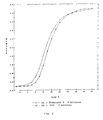
- Figure 1 which depicts the sensitometric curves obtained with control developers and with a developer according to the invention comprising ascorbic acid and compound II in a "Slow Access" process for the development of a film of stills.
- Figure 2 which depicts the sensitometric curves obtained with a control developer and with a developer according to the invention comprising ascorbic acid and compound VI.
- Black and white photographic products can be considered as forming two distinct groups depending on development time.
- black and white films designed for motion picture, industrial radiography, and black and white papers are developed relatively slowly.
- Typical development times are of the order of 1 to 3 minutes for papers and from 4 to 12 minutes for films.
- the development temperature is between 18 and 27°C but can also be higher.
- a known developer of the "slow access” type is the Kodak D-76® universal developer in powder form, used for example for the development of black and white films for still photography and which contains hydroquinone and Elon®.
- the rapid development systems also referred to as "rapid access” systems, are used for the development of medical X-ray films, graphic arts films and microfilms. These products are developed using very active solutions.
- the development time is of the order of 30 seconds or less and the development temperature is around 35°C.
- a example of the "rapid access” type developer is the Kodak RP X-OMAT® developer used for the development of radiographic films, which comprises hydroquinone and phenidone-A as a co-developer.
- Other "rapid access” developers comprising ascorbic acid and dimezone-S as co-developer are described in Research Disclosure, August 1993, Article 35249.
- novel compounds of the 3-pyrazolidinone type according to the invention have solubilising groups which are not attached directly to the phenyl ring or to the pyrazolidine ring.
- the 3-pyrazolidinones according to the invention have one of the formulae: where R 1 , R 2 , R 8 , R 10 and A have the aforementioned signification.
- the developers of the invention preferentially can comprise a first developing agent of the di- and polyhydroxybenzene or the reductone type, and at least one co-developing agent of the 3-pyrazolidinone type as defined above.
- the compound according to the invention can be used as the sole co-developing agent or in admixture with other compounds according to the invention or with known aminophenols or phenidones such as Elon®, Phenidone-A, Phenidone-B, Dimezone, Dimezone-S or 4,4-dihydroxymethyl-1-phenyl-5-pyrazolidinone.
- the co-developing agent of the 3-pyrazolidinone type can be used in the developing composition at an amount which depends on the photographic product to be processed, the desired effects or the nature of the developing agents.
- the amount of co-developing agent can be in the range of from 0.0005 to 0.2 mol./l, or more, and preferably from 0.005 to 0.06 mol./l of ready-to-use solution.
- novel compounds of the 3-pyrazolidinone type according to the invention can be used in developing compositions as "slow access” or "rapid access” co-developers in combination with all known developing agents.
- the developing agent is a compound chosen generally from the di- and polyhydroxybenzenes and reductones.
- dihydroxybenzenes are hydroquinone, catechol and their derivatives.
- reductones include ene-diols, ene-animols, ene-diamines, thio-enols and enamine-thiols.
- reductones are cited in US patent 2 691 589, in particular ascorbic acid, its stereoisomers, diastereoisomers and derivatives of the sugar type.
- hydroquinone can be used as the first developing agent in the developing compositions according to the invention, the ascorbic acid and sugar-type derivatives, stereoisomers, diastereoisomers, precursors and salts thereof are preferred.
- D-isoascorbic (or erythorbic) acid L-ascorbic acid and their salts such as sodium or potassium ascorbate or erythorbate
- sugar-type derivatives of ascorbic acid such as D-glucoascorbic acid, 6-desoxyl-1-ascorbic acid, L-rhamnoascorbic acid, L-fucoascorbic acid, D-glucoheptoascorbic acid, sorboascorbic acid, ⁇ -lactoascorbic acid, maltoascorbic acid, 1-araboascorbic acid, L-glucoascorbic acid, D-galactoascorbic acid, L-guloascorbic acid and L-alloascorbic, imino-ascorbic and L-gluco-ascorbic acid; the ketal derivatives of ascorbic and isoascorbic acid, for example 5,6-isopropylene
- a quantity of developing agent of the hydroquinone or ascorbic acid type is used in the developing composition which is between 0.1 and 0.4 mol./l or more, and preferably between 0.15 and 0.30 mol./l of ready-to-use solution.
- the developing composition according to the invention can contain, in addition to the developing agent and co-developer, numerous conventional additives such as silver halide solvents, alkaline bases, organic or inorganic anti-fog agents, pH buffers, antioxidants, sequestering agents, agents for controlling swelling, hardeners and wetting agents.
- the developing composition is amenable to numerous variations accessible to persons skilled in the art in accordance with the envisaged application.
- These developers can be in the form of a concentrated liquid or in solid form such as powders, tablets or granules, which can be respectively diluted or dissolved in water to obtain the ready-to-use solution.
- the compounds according to the invention have an improved solubility compared with known phenidones.
- the presence of these solubilising groups which are not attached directly to the phenyl ring or to the pyrazolidine ring do not cause the large decrease in superadditivity observed in the article in Zhurnal Nauchnoi i Prikladnoi Anlageni i kinematografii already cited.
- the developing solutions comprising these compounds as co-developers have a satisfactory photographic activity.
- the developing agents based on ascorbic acid are also advantageous because they have little tendency to form silver sludges or to cause metallic silver to be deposited on the equipment.
- These developing solutions according to the invention can be used for developing black and white products, such as graphic art products, radiographic products, black and white photographic papers or microfilms or for the black and white development stage of reversible colour films and papers.
- a suspension of compound (1) (5 g, 18.45 mmol) is heated in a mixture of acetic acid (45 ml) and water (5 ml) over a steam bath until the solid dissolves.
- Iron powder (6 g, 105 mmol) is added in portions over a period of around 10 minutes. Heating is continued for another 1.5 hours after the end of the addition.
- the hot reaction mixture is poured into water (200 ml) whilst rapidly stirring, and the mixture is extracted in its entirety with some ethyl acetate (2 x 200 ml).
- the combined organic extracts are washed with brine (200 ml) and dried on magnesium sulphate and the solvent is evaporated under reduced pressure in order to obtain a yellow oil (5.8 g).
- a suspension of compound (2) (7.9 g, 28.5 mmol) in a mixture of concentrated HCl (32 ml) and water (11 ml) is cooled to 0°C.
- a solution cooled in sodium nitrite ice (2.2 g, 31 mmol) in water (6.5 ml) is added to the above suspension for a period of 15 minutes, keeping the internal temperature below 5°C.
- the mixture is stirred for 10 minutes more before adding a mixture of tin II chloride (23.8 g, 126.2 mmol), concentrated HCl (130 ml) and water (260 ml) at room temperature, stirring rapidly.
- a solution of compound (4) (3.5 g, 10.35 mmol) is hydrogenated on palladium-containing carbon (0.3 g, 10% Pd) in tetrahydrofuran (270 ml) under 34 atmospheres of hydrogen at room temperature for 24 hours.
- the catalyst is eliminated by filtration on a kieselguhr buffer and the filtrate evaporated under reduced pressure in order to obtain a yellow gum.
- the raw product is titrated with diethylether (100 ml), filtered and dried under vacuum. 2.13 g (83%) of 2-(4-(4,4'-dimethyl-3-oxopyrazolidinyl)phenyl) acetic acid (compound II) is obtained in the form of a cream-coloured solid.
- 3-chloropivaloyl chloride (18.1 g, 116.5 mmol) is added to a suspension of 3-nitrophenylhydrazine hydrochloride (22.1 g, 116.5 mmol) in anhydrous pyridine (250 ml). The addition is carried out at 5°C with stirring. This addition takes 35 minutes. Stirring is then continued at +5°C for 1 hour, and then at room temperature for a further hour, after which the mixture is heated to reflux under nitrogen for 20 hours. It is cooled to room temperature, and then the suspension is poured into a vigorously stirred mixture of water and ice (2.75 l) and concentrated hydrochloric acid (250 ml). A yellow solid is formed which is collected by filtration and washed in water (2 l). After drying under vacuum and on P 2 O 5 , 24.9 g of a yellow solid, 4,4-dimethyl-1-(3-nitrophenyl-pyrazolidine-3-one), is collected; yield 91%.
- a black and white still film is exposed at 2850°K with a colour-corrective filter for 1/25 of a second through a stepped sensitometric wedge.
- This film is developed for 12 minutes, whilst stirring, at 33°C, fixed for 5 minutes in T-Max® fixative and washed for 10 minutes under running water.
- a developing solution according to the invention comprising ascorbic acid as a developing agent and compound II as a co-developer is evaluated by comparing it with a commercially available developer Kodak D-76® which comprises hydroquinone and Elon® and with a second control which comprises ascorbic acid and Elon®.
- All the developers contain 45 mmol/l of developing agent, 12 mmol/l of co-developer and 126 g/l of potassium sulphite and the pH is adjusted to 8.6 by potassium carbonate.
- Figure 1 gives the D(Log E) sensitometric curves obtained for a development time of 12 minutes at 33°C. It can be see that at 33°C compound II gives a sensitometric curve very close to that obtained when Elon® is associated with hydroquinone.
- a radiographic film is exposed for 1/50 of a second on both faces through a filter simulating the re-emission of a green screen at 2850°K.
- This film is developed for 3 minutes at room temperature, manually reproducing the conditions of RP X-OMAT® processing machines, fixed for 2 minutes and washed for 3 minutes in running water.
- control used is the developer whose formula is given in Research Disclosure of August 1993, Article 35249, already cited: ascorbic acid 32.0 g/l dimezone-S (HMMP) 2.5 g/l benzotriazol 0.2 g/l KBr 4.0 g/l K 2 SO 3 50.0 g/l K 2 CO 3 100.0 g/l Na DTPA 4.3 g/l pH 10.2 * DTPA solution with 40% diethylenetriaminepentacetic acid.
- HMMP dimezone-S
- the developer according to the invention comprises the same constituents, except that compound VI replaces Dimezone-S.
- Figure 2 gives the sensitometric curve obtained with compound VI associated with ascorbic acid.
- the sensitometric curve is very similar to that obtained with dimezone-S associated with ascorbic acid.
Landscapes
- Physics & Mathematics (AREA)
- General Physics & Mathematics (AREA)
- Silver Salt Photography Or Processing Solution Therefor (AREA)
Applications Claiming Priority (2)
| Application Number | Priority Date | Filing Date | Title |
|---|---|---|---|
| FR9608149 | 1996-06-24 | ||
| FR9608149A FR2750225B1 (fr) | 1996-06-24 | 1996-06-24 | Composition de developpement photographique |
Publications (2)
| Publication Number | Publication Date |
|---|---|
| EP0816916A1 true EP0816916A1 (de) | 1998-01-07 |
| EP0816916B1 EP0816916B1 (de) | 2004-08-11 |
Family
ID=9493576
Family Applications (1)
| Application Number | Title | Priority Date | Filing Date |
|---|---|---|---|
| EP97420091A Expired - Lifetime EP0816916B1 (de) | 1996-06-24 | 1997-06-17 | Photographische Entwicklungszusammensetzung |
Country Status (4)
| Country | Link |
|---|---|
| US (1) | US5780212A (de) |
| EP (1) | EP0816916B1 (de) |
| DE (1) | DE69730179T2 (de) |
| FR (1) | FR2750225B1 (de) |
Cited By (1)
| Publication number | Priority date | Publication date | Assignee | Title |
|---|---|---|---|---|
| FR2841347A1 (fr) * | 2002-06-24 | 2003-12-26 | Eastman Kodak Co | Concentre de revelateur pour le developpement noir et blanc de produits photographiques |
Families Citing this family (3)
| Publication number | Priority date | Publication date | Assignee | Title |
|---|---|---|---|---|
| EP1182498A1 (de) | 2000-08-21 | 2002-02-27 | Eastman Kodak Company | Zuckerhaltige Ascorbinsäureentwicklerzusammensetzungen und Verfahren zu ihrer Verwendung |
| US6489090B1 (en) | 2000-08-21 | 2002-12-03 | Eastman Kodak Company | Stabilized ascorbic acid developing compositions and methods of use |
| EP3886854A4 (de) | 2018-11-30 | 2022-07-06 | Nuvation Bio Inc. | Pyrrol- und pyrazolverbindungen und verfahren zu deren verwendung |
Citations (2)
| Publication number | Priority date | Publication date | Assignee | Title |
|---|---|---|---|---|
| US3865591A (en) * | 1973-05-10 | 1975-02-11 | Delaware Photographic Products | General purpose developer |
| US4266002A (en) * | 1978-10-02 | 1981-05-05 | Eastman Kodak Company | Substituted 1-phenyl-3-pyrazolidinone electron transfer agents |
Family Cites Families (5)
| Publication number | Priority date | Publication date | Assignee | Title |
|---|---|---|---|---|
| US5194367A (en) * | 1986-11-28 | 1993-03-16 | Fuji Photo Film Co., Ltd. | Method for processing a silver halide photographic material |
| US5098819A (en) * | 1990-01-31 | 1992-03-24 | Knapp Audenried W | Non-toxic photographic developer composition |
| US5264323A (en) * | 1992-04-10 | 1993-11-23 | Eastman Kodak Company | Photographic developing solution and use thereof in the high contrast development of nucleated photographic elements |
| GB9226488D0 (en) * | 1992-12-19 | 1993-02-17 | Ilford Ltd | Photographic developing solution |
| FR2743905B1 (fr) * | 1996-01-23 | 1999-03-05 | Kodak Pathe | Composition de revelateur organique-inorganique |
-
1996
- 1996-06-24 FR FR9608149A patent/FR2750225B1/fr not_active Expired - Fee Related
-
1997
- 1997-06-17 EP EP97420091A patent/EP0816916B1/de not_active Expired - Lifetime
- 1997-06-17 DE DE69730179T patent/DE69730179T2/de not_active Expired - Fee Related
- 1997-06-24 US US08/881,408 patent/US5780212A/en not_active Expired - Fee Related
Patent Citations (2)
| Publication number | Priority date | Publication date | Assignee | Title |
|---|---|---|---|---|
| US3865591A (en) * | 1973-05-10 | 1975-02-11 | Delaware Photographic Products | General purpose developer |
| US4266002A (en) * | 1978-10-02 | 1981-05-05 | Eastman Kodak Company | Substituted 1-phenyl-3-pyrazolidinone electron transfer agents |
Cited By (2)
| Publication number | Priority date | Publication date | Assignee | Title |
|---|---|---|---|---|
| FR2841347A1 (fr) * | 2002-06-24 | 2003-12-26 | Eastman Kodak Co | Concentre de revelateur pour le developpement noir et blanc de produits photographiques |
| WO2004001503A1 (en) * | 2002-06-24 | 2003-12-31 | Eastman Kodak Company | Developer concentrate for black and white development of photographic materials |
Also Published As
| Publication number | Publication date |
|---|---|
| DE69730179D1 (de) | 2004-09-16 |
| US5780212A (en) | 1998-07-14 |
| EP0816916B1 (de) | 2004-08-11 |
| FR2750225A1 (fr) | 1997-12-26 |
| FR2750225B1 (fr) | 1999-09-24 |
| DE69730179T2 (de) | 2005-08-11 |
Similar Documents
| Publication | Publication Date | Title |
|---|---|---|
| JPH04270343A (ja) | 写真用現像剤組成物 | |
| EP0816916B1 (de) | Photographische Entwicklungszusammensetzung | |
| US5942379A (en) | 3-pyrazolidone compounds and photographic developer solutions containing same | |
| JPH07119972B2 (ja) | 露光写真ハロゲン化銀乳剤材料を現像する方法 | |
| EP0758646B1 (de) | In der Photographie verwendbare Verbindungen des 3-Pyrazolidon-Typs | |
| US5389502A (en) | Hardening developer for silver halide photography and development method | |
| EP0786698B1 (de) | Organische-Inorganische Entwicklerzusammensetzung | |
| EP0446457B1 (de) | Alkalischer photographischer Schwarzweissentwickler | |
| US5108880A (en) | Developer composition for silver halide photographic material | |
| US5686232A (en) | Composition for developing an exposed photographic product having improved stability in air | |
| EP0696759B1 (de) | Verfahren zur Verarbeitung eines photographischen lichtempfindlichen Silberhalogenidmaterials | |
| US4040832A (en) | Pyrazolidone type developing agents | |
| JP3184896B2 (ja) | 黒白ハロゲン化銀写真感光材料の現像処理方法 | |
| JP3177797B2 (ja) | 黒白ハロゲン化銀写真感光材料の現像処理方法 | |
| EP0753793B1 (de) | Entwicklerzusammensetzung für photographische Silberhalogenidmaterialien | |
| JPH09218492A (ja) | ハロゲン化銀写真感光材料処理用固体現像剤およびそれを用いる処理方法 | |
| EP0964303A1 (de) | Verfahren zur Herstellung eines granulierten Mittels und Verfahren zur Herstellung einer Tablette | |
| JPH06347954A (ja) | ハロゲン化銀写真感光材料の画像形成方法 | |
| JPH103143A (ja) | ハロゲン化銀写真感光材料の処理方法 | |
| EP1516227A1 (de) | Entwicklerkonzentrat für schwarz-weiss entwicklung photographischer materialien | |
| JPH11327073A (ja) | 黒白ネガ型ハロゲン化銀写真感光材料及びその処理方法 | |
| JPH05257223A (ja) | ハロゲン化銀写真感光材料 | |
| JPH075643A (ja) | ハロゲン化銀写真感光材料の画像形成方法 | |
| JPH05216182A (ja) | 現像液組成物及び画像形成方法 | |
| JPH05346646A (ja) | ハロゲン化銀白黒写真感光材料の処理方法 |
Legal Events
| Date | Code | Title | Description |
|---|---|---|---|
| PUAI | Public reference made under article 153(3) epc to a published international application that has entered the european phase |
Free format text: ORIGINAL CODE: 0009012 |
|
| AK | Designated contracting states |
Kind code of ref document: A1 Designated state(s): DE FR GB |
|
| 17P | Request for examination filed |
Effective date: 19980622 |
|
| AKX | Designation fees paid |
Free format text: DE FR GB |
|
| RBV | Designated contracting states (corrected) |
Designated state(s): DE FR GB |
|
| 17Q | First examination report despatched |
Effective date: 20030325 |
|
| GRAP | Despatch of communication of intention to grant a patent |
Free format text: ORIGINAL CODE: EPIDOSNIGR1 |
|
| GRAS | Grant fee paid |
Free format text: ORIGINAL CODE: EPIDOSNIGR3 |
|
| GRAA | (expected) grant |
Free format text: ORIGINAL CODE: 0009210 |
|
| AK | Designated contracting states |
Kind code of ref document: B1 Designated state(s): DE FR GB |
|
| REG | Reference to a national code |
Ref country code: GB Ref legal event code: FG4D |
|
| REF | Corresponds to: |
Ref document number: 69730179 Country of ref document: DE Date of ref document: 20040916 Kind code of ref document: P |
|
| ET | Fr: translation filed | ||
| PG25 | Lapsed in a contracting state [announced via postgrant information from national office to epo] |
Ref country code: GB Free format text: LAPSE BECAUSE OF NON-PAYMENT OF DUE FEES Effective date: 20050617 |
|
| PLBE | No opposition filed within time limit |
Free format text: ORIGINAL CODE: 0009261 |
|
| STAA | Information on the status of an ep patent application or granted ep patent |
Free format text: STATUS: NO OPPOSITION FILED WITHIN TIME LIMIT |
|
| 26N | No opposition filed |
Effective date: 20050512 |
|
| PG25 | Lapsed in a contracting state [announced via postgrant information from national office to epo] |
Ref country code: DE Free format text: LAPSE BECAUSE OF NON-PAYMENT OF DUE FEES Effective date: 20060103 |
|
| PG25 | Lapsed in a contracting state [announced via postgrant information from national office to epo] |
Ref country code: FR Free format text: LAPSE BECAUSE OF NON-PAYMENT OF DUE FEES Effective date: 20060228 |
|
| GBPC | Gb: european patent ceased through non-payment of renewal fee |
Effective date: 20050617 |
|
| REG | Reference to a national code |
Ref country code: FR Ref legal event code: ST Effective date: 20060228 |