EP0820439B1 - Verfahren zur asymmetrischen synthese von s-acylierten derivaten von 2-mercaptomethyl-3-phenylpropionsäure und deren verwendung zur synthese von n-mercaptoacyl aminosäure-derivaten - Google Patents
Verfahren zur asymmetrischen synthese von s-acylierten derivaten von 2-mercaptomethyl-3-phenylpropionsäure und deren verwendung zur synthese von n-mercaptoacyl aminosäure-derivaten Download PDFInfo
- Publication number
- EP0820439B1 EP0820439B1 EP97904485A EP97904485A EP0820439B1 EP 0820439 B1 EP0820439 B1 EP 0820439B1 EP 97904485 A EP97904485 A EP 97904485A EP 97904485 A EP97904485 A EP 97904485A EP 0820439 B1 EP0820439 B1 EP 0820439B1
- Authority
- EP
- European Patent Office
- Prior art keywords
- formula
- group
- acid
- process according
- vii
- Prior art date
- Legal status (The legal status is an assumption and is not a legal conclusion. Google has not performed a legal analysis and makes no representation as to the accuracy of the status listed.)
- Expired - Lifetime
Links
- 230000015572 biosynthetic process Effects 0.000 title claims abstract description 20
- 238000003786 synthesis reaction Methods 0.000 title claims abstract description 20
- 150000003862 amino acid derivatives Chemical class 0.000 title claims abstract description 9
- 238000000034 method Methods 0.000 title claims description 48
- ZUEBVBPVXLQMQR-UHFFFAOYSA-N 2-benzyl-3-sulfanylpropanoic acid Chemical class OC(=O)C(CS)CC1=CC=CC=C1 ZUEBVBPVXLQMQR-UHFFFAOYSA-N 0.000 title claims description 7
- 239000002253 acid Substances 0.000 claims abstract description 32
- 150000002009 diols Chemical class 0.000 claims abstract description 28
- 150000001875 compounds Chemical class 0.000 claims abstract description 23
- 150000001261 hydroxy acids Chemical class 0.000 claims abstract description 20
- 150000007513 acids Chemical class 0.000 claims abstract description 9
- 238000006243 chemical reaction Methods 0.000 claims abstract description 9
- 150000004678 hydrides Chemical class 0.000 claims abstract description 8
- 238000011914 asymmetric synthesis Methods 0.000 claims abstract description 5
- IYXGSMUGOJNHAZ-UHFFFAOYSA-N Ethyl malonate Chemical compound CCOC(=O)CC(=O)OCC IYXGSMUGOJNHAZ-UHFFFAOYSA-N 0.000 claims abstract description 4
- 238000007254 oxidation reaction Methods 0.000 claims abstract description 4
- PXQLVRUNWNTZOS-UHFFFAOYSA-N sulfanyl Chemical class [SH] PXQLVRUNWNTZOS-UHFFFAOYSA-N 0.000 claims abstract description 4
- 230000003647 oxidation Effects 0.000 claims abstract description 3
- 239000000243 solution Substances 0.000 claims description 38
- WMFOQBRAJBCJND-UHFFFAOYSA-M Lithium hydroxide Chemical compound [Li+].[OH-] WMFOQBRAJBCJND-UHFFFAOYSA-M 0.000 claims description 22
- CSCPPACGZOOCGX-UHFFFAOYSA-N Acetone Chemical compound CC(C)=O CSCPPACGZOOCGX-UHFFFAOYSA-N 0.000 claims description 21
- 108090001060 Lipase Proteins 0.000 claims description 20
- 239000004367 Lipase Substances 0.000 claims description 20
- 102000004882 Lipase Human genes 0.000 claims description 20
- WYURNTSHIVDZCO-UHFFFAOYSA-N Tetrahydrofuran Chemical compound C1CCOC1 WYURNTSHIVDZCO-UHFFFAOYSA-N 0.000 claims description 20
- 235000019421 lipase Nutrition 0.000 claims description 20
- QTBSBXVTEAMEQO-UHFFFAOYSA-M Acetate Chemical compound CC([O-])=O QTBSBXVTEAMEQO-UHFFFAOYSA-M 0.000 claims description 19
- 102000004190 Enzymes Human genes 0.000 claims description 18
- 108090000790 Enzymes Proteins 0.000 claims description 18
- 125000000217 alkyl group Chemical group 0.000 claims description 17
- HEMHJVSKTPXQMS-UHFFFAOYSA-M Sodium hydroxide Chemical compound [OH-].[Na+] HEMHJVSKTPXQMS-UHFFFAOYSA-M 0.000 claims description 15
- ZMANZCXQSJIPKH-UHFFFAOYSA-N Triethylamine Chemical compound CCN(CC)CC ZMANZCXQSJIPKH-UHFFFAOYSA-N 0.000 claims description 15
- RIOQSEWOXXDEQQ-UHFFFAOYSA-N triphenylphosphine Chemical compound C1=CC=CC=C1P(C=1C=CC=CC=1)C1=CC=CC=C1 RIOQSEWOXXDEQQ-UHFFFAOYSA-N 0.000 claims description 14
- 238000002360 preparation method Methods 0.000 claims description 12
- BCAAXVOKLXDSPD-NSHDSACASA-N (2r)-2-(acetylsulfanylmethyl)-3-phenylpropanoic acid Chemical compound CC(=O)SC[C@@H](C(O)=O)CC1=CC=CC=C1 BCAAXVOKLXDSPD-NSHDSACASA-N 0.000 claims description 11
- 239000007864 aqueous solution Substances 0.000 claims description 11
- 125000004435 hydrogen atom Chemical group [H]* 0.000 claims description 11
- 239000000203 mixture Substances 0.000 claims description 11
- 241000589540 Pseudomonas fluorescens Species 0.000 claims description 10
- YLQBMQCUIZJEEH-UHFFFAOYSA-N tetrahydrofuran Natural products C=1C=COC=1 YLQBMQCUIZJEEH-UHFFFAOYSA-N 0.000 claims description 10
- WFDIJRYMOXRFFG-UHFFFAOYSA-N Acetic anhydride Chemical compound CC(=O)OC(C)=O WFDIJRYMOXRFFG-UHFFFAOYSA-N 0.000 claims description 9
- XTXRWKRVRITETP-UHFFFAOYSA-N Vinyl acetate Chemical compound CC(=O)OC=C XTXRWKRVRITETP-UHFFFAOYSA-N 0.000 claims description 9
- 239000002904 solvent Substances 0.000 claims description 9
- -1 amino ester Chemical class 0.000 claims description 8
- 230000001590 oxidative effect Effects 0.000 claims description 8
- KOUKXHPPRFNWPP-UHFFFAOYSA-N pyrazine-2,5-dicarboxylic acid;hydrate Chemical compound O.OC(=O)C1=CN=C(C(O)=O)C=N1 KOUKXHPPRFNWPP-UHFFFAOYSA-N 0.000 claims description 8
- VHYFNPMBLIVWCW-UHFFFAOYSA-N 4-Dimethylaminopyridine Chemical compound CN(C)C1=CC=NC=C1 VHYFNPMBLIVWCW-UHFFFAOYSA-N 0.000 claims description 7
- 125000004432 carbon atom Chemical group C* 0.000 claims description 7
- BCAAXVOKLXDSPD-LLVKDONJSA-N (2s)-2-(acetylsulfanylmethyl)-3-phenylpropanoic acid Chemical compound CC(=O)SC[C@H](C(O)=O)CC1=CC=CC=C1 BCAAXVOKLXDSPD-LLVKDONJSA-N 0.000 claims description 6
- 108010084311 Novozyme 435 Proteins 0.000 claims description 6
- QAOWNCQODCNURD-UHFFFAOYSA-N Sulfuric acid Chemical compound OS(O)(=O)=O QAOWNCQODCNURD-UHFFFAOYSA-N 0.000 claims description 6
- 239000003153 chemical reaction reagent Substances 0.000 claims description 6
- 239000012280 lithium aluminium hydride Substances 0.000 claims description 6
- 230000020477 pH reduction Effects 0.000 claims description 6
- NGNBDVOYPDDBFK-UHFFFAOYSA-N 2-[2,4-di(pentan-2-yl)phenoxy]acetyl chloride Chemical compound CCCC(C)C1=CC=C(OCC(Cl)=O)C(C(C)CCC)=C1 NGNBDVOYPDDBFK-UHFFFAOYSA-N 0.000 claims description 5
- 239000007800 oxidant agent Substances 0.000 claims description 5
- VVWRJUBEIPHGQF-UHFFFAOYSA-N propan-2-yl n-propan-2-yloxycarbonyliminocarbamate Chemical compound CC(C)OC(=O)N=NC(=O)OC(C)C VVWRJUBEIPHGQF-UHFFFAOYSA-N 0.000 claims description 5
- 238000006751 Mitsunobu reaction Methods 0.000 claims description 4
- CIUQDSCDWFSTQR-UHFFFAOYSA-N [C]1=CC=CC=C1 Chemical compound [C]1=CC=CC=C1 CIUQDSCDWFSTQR-UHFFFAOYSA-N 0.000 claims description 4
- 125000006294 amino alkylene group Chemical group 0.000 claims description 4
- 125000001797 benzyl group Chemical group [H]C1=C([H])C([H])=C(C([H])=C1[H])C([H])([H])* 0.000 claims description 4
- 239000003054 catalyst Substances 0.000 claims description 4
- 238000006389 diacetylation reaction Methods 0.000 claims description 4
- ZMYJSOIMFGAQRQ-UHFFFAOYSA-N dimethyl 2-benzylpropanedioate Chemical compound COC(=O)C(C(=O)OC)CC1=CC=CC=C1 ZMYJSOIMFGAQRQ-UHFFFAOYSA-N 0.000 claims description 4
- 125000001997 phenyl group Chemical group [H]C1=C([H])C([H])=C(*)C([H])=C1[H] 0.000 claims description 4
- 239000008363 phosphate buffer Substances 0.000 claims description 3
- GRYLNZFGIOXLOG-UHFFFAOYSA-N Nitric acid Chemical compound O[N+]([O-])=O GRYLNZFGIOXLOG-UHFFFAOYSA-N 0.000 claims description 2
- UIJGNTRUPZPVNG-UHFFFAOYSA-N benzenecarbothioic s-acid Chemical compound SC(=O)C1=CC=CC=C1 UIJGNTRUPZPVNG-UHFFFAOYSA-N 0.000 claims description 2
- 239000012320 chlorinating reagent Substances 0.000 claims description 2
- 229910017604 nitric acid Inorganic materials 0.000 claims description 2
- 239000012286 potassium permanganate Substances 0.000 claims description 2
- 125000003158 alcohol group Chemical group 0.000 claims 4
- 230000003301 hydrolyzing effect Effects 0.000 claims 3
- QTBSBXVTEAMEQO-UHFFFAOYSA-N Acetic acid Chemical group CC(O)=O QTBSBXVTEAMEQO-UHFFFAOYSA-N 0.000 claims 2
- DHMQDGOQFOQNFH-UHFFFAOYSA-M Aminoacetate Chemical compound NCC([O-])=O DHMQDGOQFOQNFH-UHFFFAOYSA-M 0.000 claims 2
- WGLPBDUCMAPZCE-UHFFFAOYSA-N Trioxochromium Chemical compound O=[Cr](=O)=O WGLPBDUCMAPZCE-UHFFFAOYSA-N 0.000 claims 2
- 239000012670 alkaline solution Substances 0.000 claims 2
- VEXZGXHMUGYJMC-UHFFFAOYSA-M Chloride anion Chemical compound [Cl-] VEXZGXHMUGYJMC-UHFFFAOYSA-M 0.000 claims 1
- OFOBLEOULBTSOW-UHFFFAOYSA-L Malonate Chemical compound [O-]C(=O)CC([O-])=O OFOBLEOULBTSOW-UHFFFAOYSA-L 0.000 claims 1
- 125000002777 acetyl group Chemical group [H]C([H])([H])C(*)=O 0.000 claims 1
- FAMRKDQNMBBFBR-BQYQJAHWSA-N diethyl azodicarboxylate Substances CCOC(=O)\N=N\C(=O)OCC FAMRKDQNMBBFBR-BQYQJAHWSA-N 0.000 claims 1
- FAMRKDQNMBBFBR-UHFFFAOYSA-N ethyl n-ethoxycarbonyliminocarbamate Chemical compound CCOC(=O)N=NC(=O)OCC FAMRKDQNMBBFBR-UHFFFAOYSA-N 0.000 claims 1
- 239000012279 sodium borohydride Substances 0.000 claims 1
- 229910000033 sodium borohydride Inorganic materials 0.000 claims 1
- 239000001117 sulphuric acid Substances 0.000 claims 1
- 235000011149 sulphuric acid Nutrition 0.000 claims 1
- RTZKZFJDLAIYFH-UHFFFAOYSA-N Diethyl ether Chemical compound CCOCC RTZKZFJDLAIYFH-UHFFFAOYSA-N 0.000 description 20
- LODRGECCKZZTEQ-UHFFFAOYSA-N 2-benzylpropane-1,3-diol Chemical compound OCC(CO)CC1=CC=CC=C1 LODRGECCKZZTEQ-UHFFFAOYSA-N 0.000 description 17
- XEKOWRVHYACXOJ-UHFFFAOYSA-N Ethyl acetate Chemical compound CCOC(C)=O XEKOWRVHYACXOJ-UHFFFAOYSA-N 0.000 description 15
- CSNNHWWHGAXBCP-UHFFFAOYSA-L Magnesium sulfate Chemical compound [Mg+2].[O-][S+2]([O-])([O-])[O-] CSNNHWWHGAXBCP-UHFFFAOYSA-L 0.000 description 13
- XLYOFNOQVPJJNP-UHFFFAOYSA-N water Chemical compound O XLYOFNOQVPJJNP-UHFFFAOYSA-N 0.000 description 13
- HEDRZPFGACZZDS-UHFFFAOYSA-N Chloroform Chemical compound ClC(Cl)Cl HEDRZPFGACZZDS-UHFFFAOYSA-N 0.000 description 12
- VEXZGXHMUGYJMC-UHFFFAOYSA-N Hydrochloric acid Chemical compound Cl VEXZGXHMUGYJMC-UHFFFAOYSA-N 0.000 description 12
- 238000003756 stirring Methods 0.000 description 10
- YMWUJEATGCHHMB-UHFFFAOYSA-N Dichloromethane Chemical compound ClCCl YMWUJEATGCHHMB-UHFFFAOYSA-N 0.000 description 9
- OKKJLVBELUTLKV-UHFFFAOYSA-N Methanol Chemical compound OC OKKJLVBELUTLKV-UHFFFAOYSA-N 0.000 description 9
- FYSNRJHAOHDILO-UHFFFAOYSA-N thionyl chloride Chemical compound ClS(Cl)=O FYSNRJHAOHDILO-UHFFFAOYSA-N 0.000 description 8
- 239000012429 reaction media Substances 0.000 description 7
- UIIMBOGNXHQVGW-UHFFFAOYSA-M Sodium bicarbonate Chemical compound [Na+].OC([O-])=O UIIMBOGNXHQVGW-UHFFFAOYSA-M 0.000 description 6
- 241001080024 Telles Species 0.000 description 6
- 239000008346 aqueous phase Substances 0.000 description 6
- 229910052943 magnesium sulfate Inorganic materials 0.000 description 6
- 235000019341 magnesium sulphate Nutrition 0.000 description 6
- 0 C1CC*CC1 Chemical compound C1CC*CC1 0.000 description 5
- 230000003287 optical effect Effects 0.000 description 5
- 239000012074 organic phase Substances 0.000 description 5
- KFZMGEQAYNKOFK-UHFFFAOYSA-N Isopropanol Chemical compound CC(C)O KFZMGEQAYNKOFK-UHFFFAOYSA-N 0.000 description 4
- CBYFARAUSMBSDY-GFCCVEGCSA-N [(2r)-2-benzyl-3-hydroxypropyl] acetate Chemical compound CC(=O)OC[C@@H](CO)CC1=CC=CC=C1 CBYFARAUSMBSDY-GFCCVEGCSA-N 0.000 description 4
- 150000001413 amino acids Chemical class 0.000 description 4
- 239000002609 medium Substances 0.000 description 4
- 239000012071 phase Substances 0.000 description 4
- 238000007127 saponification reaction Methods 0.000 description 4
- 229920006395 saturated elastomer Polymers 0.000 description 4
- 239000007787 solid Substances 0.000 description 4
- KWGRBVOPPLSCSI-WPRPVWTQSA-N (-)-ephedrine Chemical compound CN[C@@H](C)[C@H](O)C1=CC=CC=C1 KWGRBVOPPLSCSI-WPRPVWTQSA-N 0.000 description 3
- XMLOIFZEDYSEGK-NSHDSACASA-N (2s)-2-(acetyloxymethyl)-3-phenylpropanoic acid Chemical compound CC(=O)OC[C@@H](C(O)=O)CC1=CC=CC=C1 XMLOIFZEDYSEGK-NSHDSACASA-N 0.000 description 3
- 230000002378 acidificating effect Effects 0.000 description 3
- 125000005604 azodicarboxylate group Chemical group 0.000 description 3
- KWGRBVOPPLSCSI-UHFFFAOYSA-N d-ephedrine Natural products CNC(C)C(O)C1=CC=CC=C1 KWGRBVOPPLSCSI-UHFFFAOYSA-N 0.000 description 3
- 150000002148 esters Chemical class 0.000 description 3
- 238000002844 melting Methods 0.000 description 3
- 230000008018 melting Effects 0.000 description 3
- 239000003208 petroleum Substances 0.000 description 3
- 150000003839 salts Chemical class 0.000 description 3
- 238000000926 separation method Methods 0.000 description 3
- 235000017557 sodium bicarbonate Nutrition 0.000 description 3
- 229910000030 sodium bicarbonate Inorganic materials 0.000 description 3
- 229920002554 vinyl polymer Polymers 0.000 description 3
- RDUHFHDKXQBHMH-SECBINFHSA-N (2r)-2-benzyl-3-hydroxypropanoic acid Chemical compound OC[C@H](C(O)=O)CC1=CC=CC=C1 RDUHFHDKXQBHMH-SECBINFHSA-N 0.000 description 2
- HBAQYPYDRFILMT-UHFFFAOYSA-N 8-[3-(1-cyclopropylpyrazol-4-yl)-1H-pyrazolo[4,3-d]pyrimidin-5-yl]-3-methyl-3,8-diazabicyclo[3.2.1]octan-2-one Chemical class C1(CC1)N1N=CC(=C1)C1=NNC2=C1N=C(N=C2)N1C2C(N(CC1CC2)C)=O HBAQYPYDRFILMT-UHFFFAOYSA-N 0.000 description 2
- OKTJSMMVPCPJKN-UHFFFAOYSA-N Carbon Chemical compound [C] OKTJSMMVPCPJKN-UHFFFAOYSA-N 0.000 description 2
- DGAQECJNVWCQMB-PUAWFVPOSA-M Ilexoside XXIX Chemical compound C[C@@H]1CC[C@@]2(CC[C@@]3(C(=CC[C@H]4[C@]3(CC[C@@H]5[C@@]4(CC[C@@H](C5(C)C)OS(=O)(=O)[O-])C)C)[C@@H]2[C@]1(C)O)C)C(=O)O[C@H]6[C@@H]([C@H]([C@@H]([C@H](O6)CO)O)O)O.[Na+] DGAQECJNVWCQMB-PUAWFVPOSA-M 0.000 description 2
- OFOBLEOULBTSOW-UHFFFAOYSA-N Malonic acid Chemical compound OC(=O)CC(O)=O OFOBLEOULBTSOW-UHFFFAOYSA-N 0.000 description 2
- 102000003729 Neprilysin Human genes 0.000 description 2
- 108090000028 Neprilysin Proteins 0.000 description 2
- VYPSYNLAJGMNEJ-UHFFFAOYSA-N Silicium dioxide Chemical compound O=[Si]=O VYPSYNLAJGMNEJ-UHFFFAOYSA-N 0.000 description 2
- FAPWRFPIFSIZLT-UHFFFAOYSA-M Sodium chloride Chemical compound [Na+].[Cl-] FAPWRFPIFSIZLT-UHFFFAOYSA-M 0.000 description 2
- 238000004458 analytical method Methods 0.000 description 2
- 229910052799 carbon Inorganic materials 0.000 description 2
- 230000001684 chronic effect Effects 0.000 description 2
- 230000000694 effects Effects 0.000 description 2
- 239000000706 filtrate Substances 0.000 description 2
- 238000010534 nucleophilic substitution reaction Methods 0.000 description 2
- CTSLXHKWHWQRSH-UHFFFAOYSA-N oxalyl chloride Chemical compound ClC(=O)C(Cl)=O CTSLXHKWHWQRSH-UHFFFAOYSA-N 0.000 description 2
- 238000010992 reflux Methods 0.000 description 2
- SYIWWWZVQZBRJE-UHFFFAOYSA-N s-(2-benzyl-3-chloro-3-oxopropyl) ethanethioate Chemical compound CC(=O)SCC(C(Cl)=O)CC1=CC=CC=C1 SYIWWWZVQZBRJE-UHFFFAOYSA-N 0.000 description 2
- 239000011734 sodium Substances 0.000 description 2
- 229910052708 sodium Inorganic materials 0.000 description 2
- 238000006467 substitution reaction Methods 0.000 description 2
- 239000000725 suspension Substances 0.000 description 2
- 238000002560 therapeutic procedure Methods 0.000 description 2
- KWGRBVOPPLSCSI-PSASIEDQSA-N (1s,2r)-2-(methylamino)-1-phenylpropan-1-ol Chemical compound CN[C@H](C)[C@@H](O)C1=CC=CC=C1 KWGRBVOPPLSCSI-PSASIEDQSA-N 0.000 description 1
- XMLOIFZEDYSEGK-LLVKDONJSA-N (2r)-2-(acetyloxymethyl)-3-phenylpropanoic acid Chemical compound CC(=O)OC[C@H](C(O)=O)CC1=CC=CC=C1 XMLOIFZEDYSEGK-LLVKDONJSA-N 0.000 description 1
- RDUHFHDKXQBHMH-VIFPVBQESA-N (2s)-2-benzyl-3-hydroxypropanoic acid Chemical compound OC[C@@H](C(O)=O)CC1=CC=CC=C1 RDUHFHDKXQBHMH-VIFPVBQESA-N 0.000 description 1
- CUKWUWBLQQDQAC-VEQWQPCFSA-N (3s)-3-amino-4-[[(2s)-1-[[(2s)-1-[[(2s)-1-[[(2s,3s)-1-[[(2s)-1-[(2s)-2-[[(1s)-1-carboxyethyl]carbamoyl]pyrrolidin-1-yl]-3-(1h-imidazol-5-yl)-1-oxopropan-2-yl]amino]-3-methyl-1-oxopentan-2-yl]amino]-3-(4-hydroxyphenyl)-1-oxopropan-2-yl]amino]-3-methyl-1-ox Chemical compound C([C@@H](C(=O)N[C@@H]([C@@H](C)CC)C(=O)N[C@@H](CC=1NC=NC=1)C(=O)N1[C@@H](CCC1)C(=O)N[C@@H](C)C(O)=O)NC(=O)[C@@H](NC(=O)[C@H](CCCN=C(N)N)NC(=O)[C@@H](N)CC(O)=O)C(C)C)C1=CC=C(O)C=C1 CUKWUWBLQQDQAC-VEQWQPCFSA-N 0.000 description 1
- YJTKZCDBKVTVBY-UHFFFAOYSA-N 1,3-Diphenylbenzene Chemical group C1=CC=CC=C1C1=CC=CC(C=2C=CC=CC=2)=C1 YJTKZCDBKVTVBY-UHFFFAOYSA-N 0.000 description 1
- JAEJSNFTJMYIEF-UHFFFAOYSA-N 2-benzylpropanedioic acid Chemical class OC(=O)C(C(O)=O)CC1=CC=CC=C1 JAEJSNFTJMYIEF-UHFFFAOYSA-N 0.000 description 1
- WWYDYZMNFQIYPT-UHFFFAOYSA-L 2-phenylpropanedioate Chemical compound [O-]C(=O)C(C([O-])=O)C1=CC=CC=C1 WWYDYZMNFQIYPT-UHFFFAOYSA-L 0.000 description 1
- XOAMURIABKEBKW-UHFFFAOYSA-N 2-sulfonylpropanoic acid Chemical class OC(=O)C(C)=S(=O)=O XOAMURIABKEBKW-UHFFFAOYSA-N 0.000 description 1
- 102000005862 Angiotensin II Human genes 0.000 description 1
- 101800000734 Angiotensin-1 Proteins 0.000 description 1
- 102400000344 Angiotensin-1 Human genes 0.000 description 1
- 101800000733 Angiotensin-2 Proteins 0.000 description 1
- 108010064733 Angiotensins Proteins 0.000 description 1
- 102000015427 Angiotensins Human genes 0.000 description 1
- 101800001288 Atrial natriuretic factor Proteins 0.000 description 1
- 102400001282 Atrial natriuretic peptide Human genes 0.000 description 1
- 101800001890 Atrial natriuretic peptide Proteins 0.000 description 1
- JXYACYYPACQCDM-UHFFFAOYSA-N Benzyl glycinate Chemical compound NCC(=O)OCC1=CC=CC=C1 JXYACYYPACQCDM-UHFFFAOYSA-N 0.000 description 1
- BVKZGUZCCUSVTD-UHFFFAOYSA-M Bicarbonate Chemical compound OC([O-])=O BVKZGUZCCUSVTD-UHFFFAOYSA-M 0.000 description 1
- VDTLMIQJMWTUKK-UHFFFAOYSA-N CC(C[I](C)C[I](Cc1ccccc1)CI)O Chemical compound CC(C[I](C)C[I](Cc1ccccc1)CI)O VDTLMIQJMWTUKK-UHFFFAOYSA-N 0.000 description 1
- ODUOJXZPIYUATO-LJQANCHMSA-N CC(SC[C@@H](Cc1ccccc1)C(NCC(OCc1ccccc1)=O)=O)=O Chemical compound CC(SC[C@@H](Cc1ccccc1)C(NCC(OCc1ccccc1)=O)=O)=O ODUOJXZPIYUATO-LJQANCHMSA-N 0.000 description 1
- PGDVOWWSXFBUJL-UHFFFAOYSA-N CCC(COC(CC1[IH]C1)=O)COC(N)=O Chemical compound CCC(COC(CC1[IH]C1)=O)COC(N)=O PGDVOWWSXFBUJL-UHFFFAOYSA-N 0.000 description 1
- UXVMQQNJUSDDNG-UHFFFAOYSA-L Calcium chloride Chemical compound [Cl-].[Cl-].[Ca+2] UXVMQQNJUSDDNG-UHFFFAOYSA-L 0.000 description 1
- ZAFNJMIOTHYJRJ-UHFFFAOYSA-N Diisopropyl ether Chemical compound CC(C)OC(C)C ZAFNJMIOTHYJRJ-UHFFFAOYSA-N 0.000 description 1
- 108010092674 Enkephalins Proteins 0.000 description 1
- 239000003810 Jones reagent Substances 0.000 description 1
- URLZCHNOLZSCCA-VABKMULXSA-N Leu-enkephalin Chemical class C([C@@H](C(=O)N[C@@H](CC(C)C)C(O)=O)NC(=O)CNC(=O)CNC(=O)[C@@H](N)CC=1C=CC(O)=CC=1)C1=CC=CC=C1 URLZCHNOLZSCCA-VABKMULXSA-N 0.000 description 1
- WHXSMMKQMYFTQS-UHFFFAOYSA-N Lithium Chemical compound [Li] WHXSMMKQMYFTQS-UHFFFAOYSA-N 0.000 description 1
- 208000001132 Osteoporosis Diseases 0.000 description 1
- 229910019142 PO4 Inorganic materials 0.000 description 1
- 101000968491 Pseudomonas sp. (strain 109) Triacylglycerol lipase Proteins 0.000 description 1
- CBYFARAUSMBSDY-LBPRGKRZSA-N [(2s)-2-benzyl-3-hydroxypropyl] acetate Chemical compound CC(=O)OC[C@H](CO)CC1=CC=CC=C1 CBYFARAUSMBSDY-LBPRGKRZSA-N 0.000 description 1
- 125000002947 alkylene group Chemical group 0.000 description 1
- 150000001412 amines Chemical class 0.000 description 1
- ORWYRWWVDCYOMK-HBZPZAIKSA-N angiotensin I Chemical compound C([C@@H](C(=O)N[C@@H]([C@@H](C)CC)C(=O)N[C@@H](CC=1NC=NC=1)C(=O)N1[C@@H](CCC1)C(=O)N[C@@H](CC=1C=CC=CC=1)C(=O)N[C@@H](CC=1NC=NC=1)C(=O)N[C@@H](CC(C)C)C(O)=O)NC(=O)[C@@H](NC(=O)[C@H](CCCN=C(N)N)NC(=O)[C@@H](N)CC(O)=O)C(C)C)C1=CC=C(O)C=C1 ORWYRWWVDCYOMK-HBZPZAIKSA-N 0.000 description 1
- 229950006323 angiotensin ii Drugs 0.000 description 1
- 150000008064 anhydrides Chemical class 0.000 description 1
- 230000003276 anti-hypertensive effect Effects 0.000 description 1
- 230000001262 anti-secretory effect Effects 0.000 description 1
- 239000011260 aqueous acid Substances 0.000 description 1
- 239000012736 aqueous medium Substances 0.000 description 1
- 125000003118 aryl group Chemical group 0.000 description 1
- 125000004429 atom Chemical group 0.000 description 1
- 239000001110 calcium chloride Substances 0.000 description 1
- 229910001628 calcium chloride Inorganic materials 0.000 description 1
- NSQLIUXCMFBZME-MPVJKSABSA-N carperitide Chemical compound C([C@H]1C(=O)NCC(=O)NCC(=O)N[C@@H](CCCNC(N)=N)C(=O)N[C@@H](CCSC)C(=O)N[C@@H](CC(O)=O)C(=O)N[C@@H](CCCNC(N)=N)C(=O)N[C@H](C(NCC(=O)N[C@@H](C)C(=O)N[C@@H](CCC(N)=O)C(=O)N[C@@H](CO)C(=O)NCC(=O)N[C@@H](CC(C)C)C(=O)NCC(=O)N[C@@H](CSSC[C@@H](C(=O)N1)NC(=O)[C@H](CO)NC(=O)[C@H](CO)NC(=O)[C@H](CCCNC(N)=N)NC(=O)[C@H](CCCNC(N)=N)NC(=O)[C@H](CC(C)C)NC(=O)[C@@H](N)CO)C(=O)N[C@@H](CC(N)=O)C(=O)N[C@@H](CO)C(=O)N[C@@H](CC=1C=CC=CC=1)C(=O)N[C@@H](CCCNC(N)=N)C(=O)N[C@@H](CC=1C=CC(O)=CC=1)C(O)=O)=O)[C@@H](C)CC)C1=CC=CC=C1 NSQLIUXCMFBZME-MPVJKSABSA-N 0.000 description 1
- 239000003795 chemical substances by application Substances 0.000 description 1
- 238000004587 chromatography analysis Methods 0.000 description 1
- 239000012141 concentrate Substances 0.000 description 1
- YWEUIGNSBFLMFL-UHFFFAOYSA-N diphosphonate Chemical compound O=P(=O)OP(=O)=O YWEUIGNSBFLMFL-UHFFFAOYSA-N 0.000 description 1
- 238000001035 drying Methods 0.000 description 1
- 239000003480 eluent Substances 0.000 description 1
- 229960002179 ephedrine Drugs 0.000 description 1
- 238000000605 extraction Methods 0.000 description 1
- 238000001914 filtration Methods 0.000 description 1
- 238000006460 hydrolysis reaction Methods 0.000 description 1
- XLYOFNOQVPJJNP-UHFFFAOYSA-M hydroxide Chemical compound [OH-] XLYOFNOQVPJJNP-UHFFFAOYSA-M 0.000 description 1
- 239000005457 ice water Substances 0.000 description 1
- 230000002779 inactivation Effects 0.000 description 1
- 230000002401 inhibitory effect Effects 0.000 description 1
- 239000000543 intermediate Substances 0.000 description 1
- 230000000968 intestinal effect Effects 0.000 description 1
- 229910052744 lithium Inorganic materials 0.000 description 1
- FZRNJOXQNWVMIH-UHFFFAOYSA-N lithium;hydrate Chemical compound [Li].O FZRNJOXQNWVMIH-UHFFFAOYSA-N 0.000 description 1
- 239000003960 organic solvent Substances 0.000 description 1
- 230000000144 pharmacologic effect Effects 0.000 description 1
- NBIIXXVUZAFLBC-UHFFFAOYSA-K phosphate Chemical compound [O-]P([O-])([O-])=O NBIIXXVUZAFLBC-UHFFFAOYSA-K 0.000 description 1
- 239000010452 phosphate Substances 0.000 description 1
- 229910000073 phosphorus hydride Inorganic materials 0.000 description 1
- DLYUQMMRRRQYAE-UHFFFAOYSA-N phosphorus pentoxide Inorganic materials O1P(O2)(=O)OP3(=O)OP1(=O)OP2(=O)O3 DLYUQMMRRRQYAE-UHFFFAOYSA-N 0.000 description 1
- 239000002244 precipitate Substances 0.000 description 1
- 239000000047 product Substances 0.000 description 1
- 238000000746 purification Methods 0.000 description 1
- 239000002994 raw material Substances 0.000 description 1
- 239000002461 renin inhibitor Substances 0.000 description 1
- 229940086526 renin-inhibitors Drugs 0.000 description 1
- 239000000377 silicon dioxide Substances 0.000 description 1
- 239000011780 sodium chloride Substances 0.000 description 1
- 230000003595 spectral effect Effects 0.000 description 1
- JOXIMZWYDAKGHI-UHFFFAOYSA-M toluene-4-sulfonate Chemical class CC1=CC=C(S([O-])(=O)=O)C=C1 JOXIMZWYDAKGHI-UHFFFAOYSA-M 0.000 description 1
- 230000009466 transformation Effects 0.000 description 1
- 125000000391 vinyl group Chemical group [H]C([*])=C([H])[H] 0.000 description 1
Classifications
-
- C—CHEMISTRY; METALLURGY
- C07—ORGANIC CHEMISTRY
- C07C—ACYCLIC OR CARBOCYCLIC COMPOUNDS
- C07C29/00—Preparation of compounds having hydroxy or O-metal groups bound to a carbon atom not belonging to a six-membered aromatic ring
- C07C29/132—Preparation of compounds having hydroxy or O-metal groups bound to a carbon atom not belonging to a six-membered aromatic ring by reduction of an oxygen containing functional group
- C07C29/136—Preparation of compounds having hydroxy or O-metal groups bound to a carbon atom not belonging to a six-membered aromatic ring by reduction of an oxygen containing functional group of >C=O containing groups, e.g. —COOH
- C07C29/147—Preparation of compounds having hydroxy or O-metal groups bound to a carbon atom not belonging to a six-membered aromatic ring by reduction of an oxygen containing functional group of >C=O containing groups, e.g. —COOH of carboxylic acids or derivatives thereof
- C07C29/149—Preparation of compounds having hydroxy or O-metal groups bound to a carbon atom not belonging to a six-membered aromatic ring by reduction of an oxygen containing functional group of >C=O containing groups, e.g. —COOH of carboxylic acids or derivatives thereof with hydrogen or hydrogen-containing gases
-
- C—CHEMISTRY; METALLURGY
- C07—ORGANIC CHEMISTRY
- C07C—ACYCLIC OR CARBOCYCLIC COMPOUNDS
- C07C327/00—Thiocarboxylic acids
- C07C327/20—Esters of monothiocarboxylic acids
- C07C327/32—Esters of monothiocarboxylic acids having sulfur atoms of esterified thiocarboxyl groups bound to carbon atoms of hydrocarbon radicals substituted by carboxyl groups
-
- C—CHEMISTRY; METALLURGY
- C07—ORGANIC CHEMISTRY
- C07C—ACYCLIC OR CARBOCYCLIC COMPOUNDS
- C07C59/00—Compounds having carboxyl groups bound to acyclic carbon atoms and containing any of the groups OH, O—metal, —CHO, keto, ether, groups, groups, or groups
- C07C59/40—Unsaturated compounds
- C07C59/42—Unsaturated compounds containing hydroxy or O-metal groups
- C07C59/48—Unsaturated compounds containing hydroxy or O-metal groups containing six-membered aromatic rings
Definitions
- the present invention relates to a method of enantioselective synthesis of the S-acylated derivatives of 2-mercaptomethyl 3-phenyl propanoic acid and their use in the asymmetric synthesis of N- (mercaptoacyl) amino acid derivatives. More specifically, the present invention relates to a new process for the synthesis of optically pure derivatives of general formula (I): in which : R 1 represents a linear or branched aliphatic acyl radical or an aromatic acyl radical.
- lower alkyl group is meant straight or branched chain alkyl groups containing from 1 to 6 carbon atoms and, preferably, 1 to 4 carbon atoms.
- lower alkykene group we mean alkylene groups containing from 1 to 6 carbon atoms and preferably 1 to 4 carbon atoms.
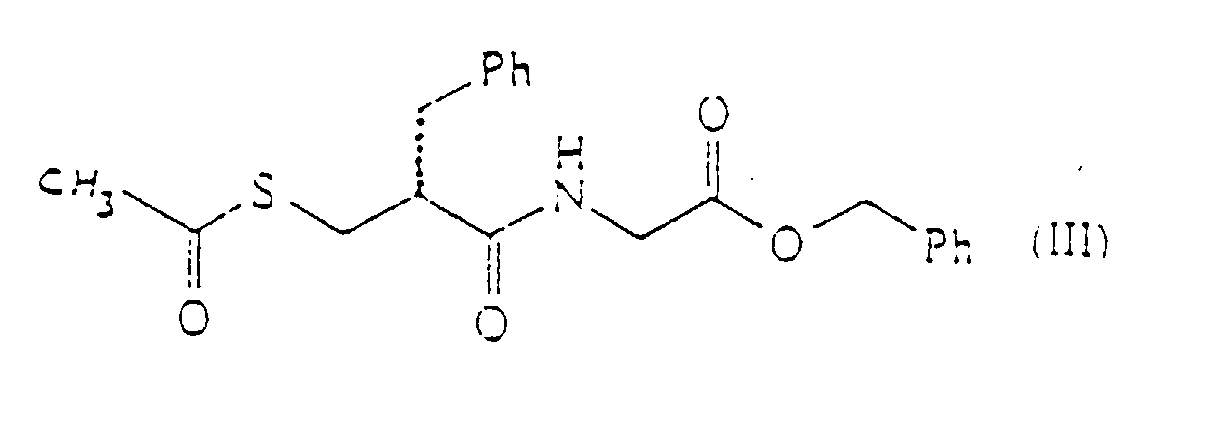
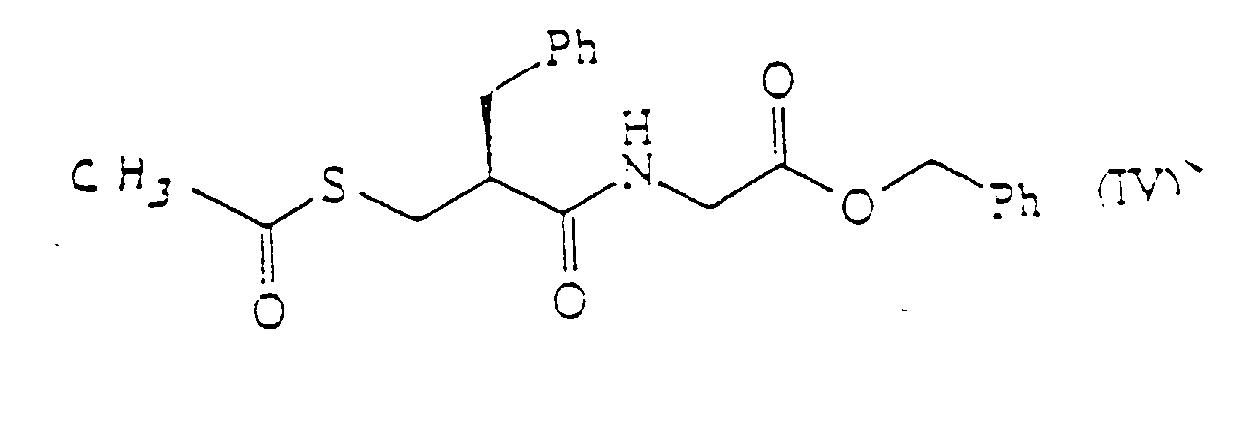
- the preferred compounds of formula (II) are the compounds corresponding to the following formulas (III) and (IV): or benzyl N- (R) - [2-acetylthiomethyl-1-oxo-3 phenyl-propyl] -glycinate; or benzyl N- (S) - [2-acetylthiomethyl-1-oxo-3-phenyl-propyl] -glycinate, for which the method of the present invention can be more particularly applied.
- the compounds of formula (II) have interesting pharmacological properties. They practise in particular an inhibitory activity on certain enzymes, such as neutral endopeptidase (EC 3.4.24.11) and the enzyme conversion of angiotensin (EC 3.4.15.1).
- the administration compounds of formula (II) therefore make it possible to reduce or suppress the activity of these enzymes, responsible respectively for the inactivation of enkephalins, atrial natriuretic factor, and transformation of angiotensin I into angiotensin II.
- these compounds exercise activities anti-secretory, intestinal or antihypertensive and are used in the treatment of insufficiency chronic heart.
- such compounds can are used in the treatment of insufficiency chronic heart.
- such compounds can also be used in the treatment of osteoporosis (WO. 94/21242).
- the compounds of formula (I) can be used for the preparation of the compounds of formula (II).
- the compounds of formula (I) comprise a carbon, called asymmetric, which can have two configurations R or S. They therefore exist in the form of two enantiomers, which can be designated by (IR) and (IS), according to the configuration of this asymmetric carbon:
- the present invention aims to provide a process for the preparation of S-acylated derivatives 2-mercaptomethyl 3-phenyl propanoic acid, under optically pure form.
- Another object of the invention is also to providing such a process without the disadvantage an optical separation as mentioned above.
- the invention also aims to provide a process for the preparation of N- (mercaptoacyl) derivatives optically active amino acids from S-acylated derivatives 2-mercaptomethyl 3-phenyl propanoic acid.
- the invention also relates to the use of S-acylated derivatives of 2-mercapto-methyl-3-phenyl acid propanoic of formula (I) in the form optically pure as obtained by the above process, for the synthesis of N- (mercaptoacyl) amino acid derivatives optically active of formula (II) given above.
- the process according to the invention uses as raw material the benzylmalonic acid esters of formula (V): in which R 4 represents an alkyl chain containing from one to four carbon atoms.
- the diol of formula (VI) is then monoacetylated using an enzyme, such as lipase PS (Amano) or lipase derived from Pseudomonas fluorescens (Fluka), in vinyl acetate to yield monoacetate (VII R) configuration (R):
- an enzyme such as lipase PS (Amano) or lipase derived from Pseudomonas fluorescens (Fluka)
- the diol of formula (VI) is diacetylated either by the action of acetic anhydride in the presence of a catalyst such as, for example, the 4-dimethylaminopyridine / triethylamine mixture or l sulfuric acid, either using an enzyme such as Novozym 435 (Novo Nordisk) in vinyl acetate, to yield the diacetate of formula (VIII):
- a catalyst such as, for example, the 4-dimethylaminopyridine / triethylamine mixture or l sulfuric acid, either using an enzyme such as Novozym 435 (Novo Nordisk) in vinyl acetate
- the diacetate of formula (VIII) is then mono-hydrolyzed using an enzyme, such as lipase PS (Amano) or lipase derived from Pseudomonas fluorescens (Fluka), in aqueous medium, to lead to monoacetate (VII S) configuration (S):
- an enzyme such as lipase PS (Amano) or lipase derived from Pseudomonas fluorescens (Fluka)
- the monoacetate of formula (VII R) or (VII S) is then oxidized using an oxidant, such as Jones' reagent (CrO 3 -H 2 SO 4 ), in a solvent, such as acetone , to lead to the acid (IX S) of configuration (S) or to the acid of formula (IX R) of configuration (R):
- an oxidant such as Jones' reagent (CrO 3 -H 2 SO 4 )
- a solvent such as acetone
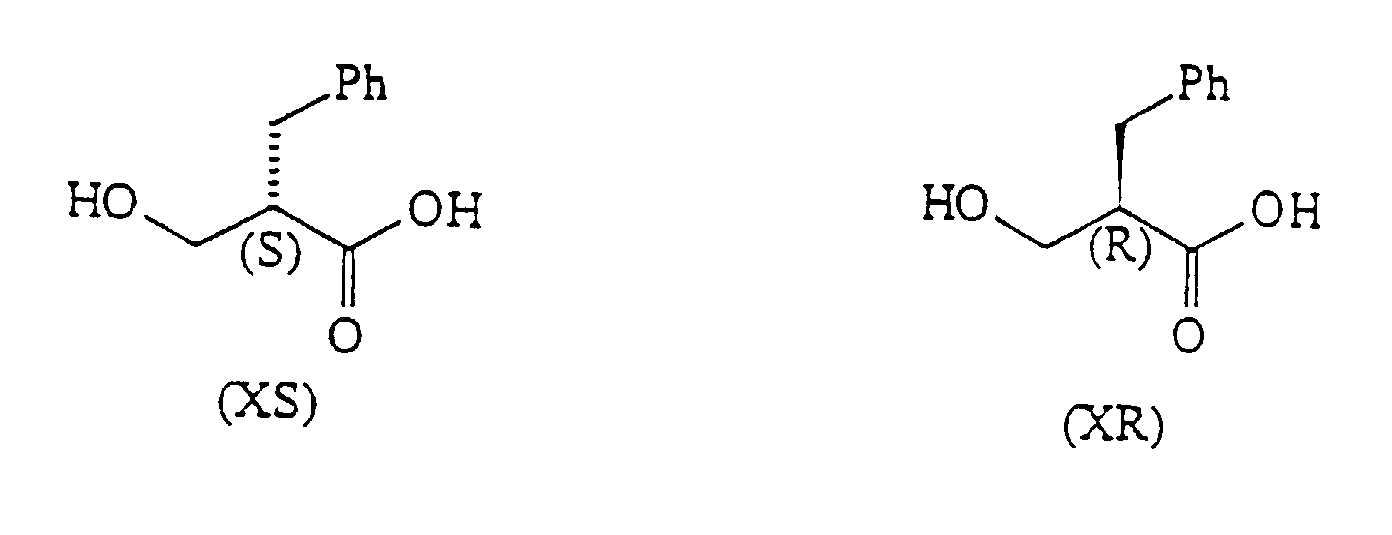
- the compound of formula (IX S) or (IX R) is then saponified by a basic aqueous solution, such as an aqueous sodium hydroxide solution or an aqueous lithine solution, to yield the hydroxy acid (XS) of configuration (S ) or with the hydroxy acid (XR) of configuration (R):
- a basic aqueous solution such as an aqueous sodium hydroxide solution or an aqueous lithine solution
- the hydroxy acid of formula (XS) or (XR) is then thioacylated according to a Mitsunobu type reaction (O. MITSUNOBU, Synthesis, pp. 1-27, 1991) in the presence of an alkyl azodicarboxylate / triphenyl complex.
- the alkyl azodicarboxylate used for the Mitsunobu reaction is preferably chosen from diisopropyl azodicarboxylate or azodicarboxylate diethyl.
- the mercaptoacid (XI) used for the Mitsunobu reaction is preferably chosen from thioacetic acid or thiobenzoic acid.
- optically pure acids of formula (I S) configuration (S) or (I R) configuration (R), obtained by the process according to the present invention find a particularly advantageous use in the synthesis of N- (mercaptoacyl) amino acids optically pure of formula (II).
- N- (mercaptoacyl) amino acids from the acids of formula (I) is known and is, for example, described in the European patent No. EP 501 870.
- reaction medium After 0.5 hours of stirring at room temperature, the reaction medium is milky white. The precipitate is filtered and washed with 300 ml of ethyl ether. The organic phase is dried over magnesium sulfate, filtered and concentrated. 16 g of solid are obtained which is triturated in 200 ml of ice-cold petroleum ether. After filtration and drying under vacuum over P 2 O 5 , 15 g (90.24 mmol) of 2-benzyl-1,3-propanediol are obtained.
- reaction medium is filtered.
- the filtrate is diluted with 40 ml of water, then concentrated under vacuum to to eliminate acetone.
- the basic aqueous phase is then washed with ethyl acetate (three times 15 ml).
- the aqueous phase is extracted with ethyl acetate (three times 15 ml).
- reaction medium is evaporated under vacuum and 25 ml of a saturated aqueous hydrogen carbonate solution are added sodium, then 15 ml of ethyl acetate. After five minutes of vigorous stirring, the mixture is left to settle and the aqueous phase is collected. The organic phase is then again extracted with 20 ml of a solution saturated aqueous sodium hydrogencarbonate. The basic aqueous phases are combined, washed with 10 ml ethyl acetate and acidified to pH 1 with 3 ml of acid concentrated hydrochloric.
- the acidic aqueous phase is then extracted with ethyl acetate (2 x 15 ml).
- the reaction medium is washed with water (one 5 ml), with an aqueous hydrochloric acid solution normal (once 5 ml), with an aqueous solution saturated with sodium hydrogen carbonate (once 5 ml) and with a saturated aqueous solution of sodium chloride (once 5 ml).
Landscapes
- Chemical & Material Sciences (AREA)
- Organic Chemistry (AREA)
- Organic Low-Molecular-Weight Compounds And Preparation Thereof (AREA)
- Preparation Of Compounds By Using Micro-Organisms (AREA)
- Low-Molecular Organic Synthesis Reactions Using Catalysts (AREA)
Claims (26)
- Verfahren zur asymmetrischen Synthese von S-acylierten Derivaten von 2-Mercaptomethyl-3-phenyl-propansäure der Formel (I):wobei

R1 einen linearen oder verzweigten aliphatischen Acylrest oder einen aromatischen Acylrest darstellt, dadurch charakterisiert, daß es die Schritte umfaßt, welche bestehen aus:a) Herstellung des Diols der Formel (VI):durch Reduktion eines Malonesters der Formel (V):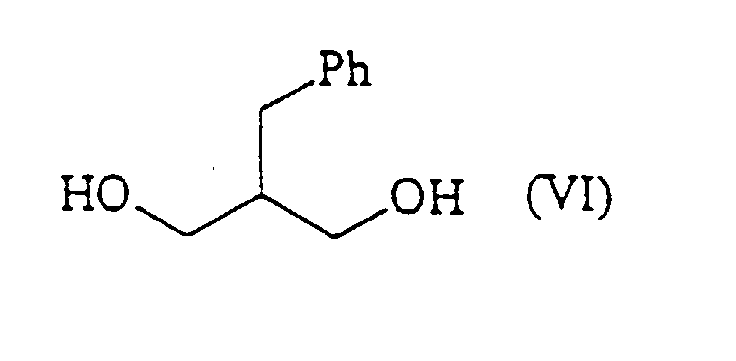 wobei R4 eine Alkylkette darstellt, die 1 bis 4 Kohlenstoffatome umfaßt, in Gegenwart eines Hydrids;
 b) Herstellung des Monoacetats (VII), jeweils der Konfiguration (R) und der Konfiguration (S), der Formel (VII R) oder (VII S):
 c) Durchführung einer Oxidation mit den Monoacetaten der Formel (VII R) oder (VII S) zur Bildung von Säuren der Formel (IX S) oder (IX R):
 d) Verseifen der Verbindungen der Formel (IX S) oder (IX R) in Gegenwart einer wäßrigen basischen Lösung zur Bildung der Hydroxysäuren der Formel (X S) oder (X R):
 e) Thioacylierung der Hydroxysäuren der Formel (X S) oder (X R) mit einer Mercaptosäure der Formel (XI):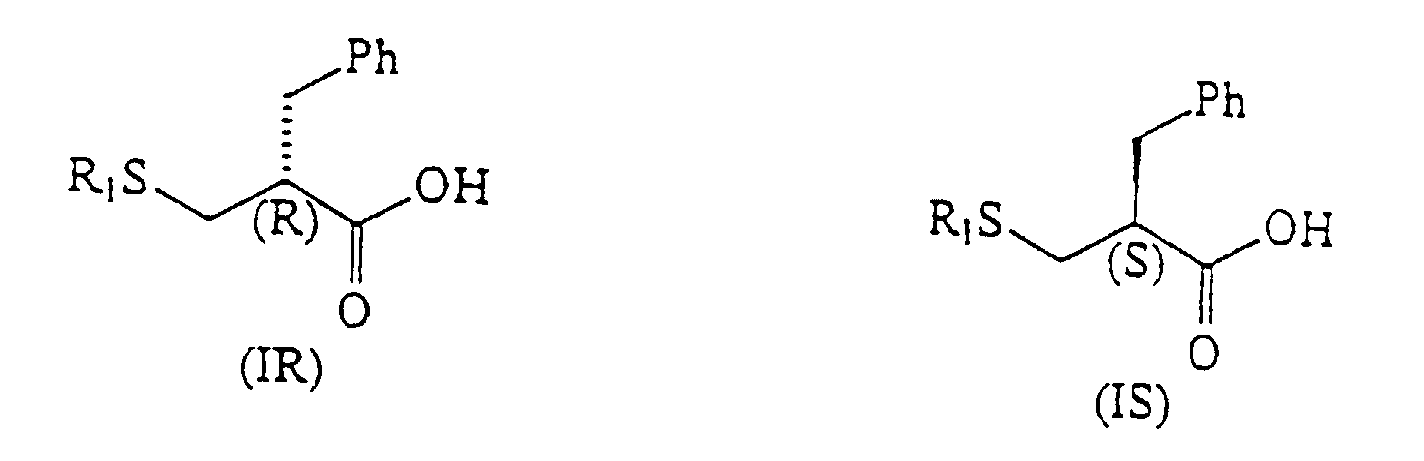
- Verfahren nach Anspruch 1, dadurch charakterisiert, daß das Monoacetat (VII R) der Konfiguration (R) erhalten wird, indem das Diol der Formel (VI) mit Vinylacetat in Gegenwart eines Enzyms umgesetzt wird.
- Verfahren nach Anspruch 1, dadurch charakterisiert, daß das Monoacetat (VII S) der Konfiguration (S) erhalten wird durch Herstellung des Diacetats der Formel (VIII):ausgehend vom Diol der Formel (VI) und anschließend durch enantioselektive Mono-Hydrolyse des Diacetats der Formel (VIII) in Gegenwart eines Enzyms zur Bildung des abgeleiteten Monoacetats.

- Verfahren nach Anspruch 3, dadurch charakterisiert, daß das Diacetat der Formel (VIII) erhalten wird, indem das Diol der Formel (VI) mit Acetanhydrid in Gegenwart eines Katalysators umgesetzt wird.
- Verfahren nach Anspruch 3, dadurch charakterisiert, daß das Diacetat der Formel (VIII) erhalten wird, indem das Diol der Formel (VI) mit Vinylacetat in Gegenwart eines Enzyms umgesetzt wird.
- Verfahren nach einem der Ansprüche 1 bis 5, dadurch charakterisiert, daß das in Schritt a) verwendete Hydrid ausgewählt wird aus Lithiumaluminiumhydrid und Natriumborhydrid.
- Verfahren nach Anspruch 2, dadurch charakterisiert, daß das in Schritt b) zur Herstellung des Monoacetats (VII R) verwendete Enzym ausgewählt wird aus Lipase PS (Amano) und aus Pseudomonas fluoreszens stammender Lipase (Fluka).
- Verfahren nach einem der Ansprüche 3 und 4, dadurch charakterisiert, daß der in Schritt b) für die Diacetylierung des Diols (VI) verwendete Katalysator ausgewählt wird aus der Mischung 4-Dimethylaminopyridin/Triethylamin und Schwefelsäure.
- Verfahren nach einem der Ansprüche 3 und 5, dadurch charakterisiert, daß das in Schritt b) für die Diacetylierungsreaktion des Diols (VI) verwendete Enzym Novozym 435 (Novo Nordisk) ist.
- Verfahren nach Anspruch 3, dadurch charakterisiert, daß das in Schritt b) für die Monohydrolyse des Diacetats (VIII) verwendete Enzym ausgewählt wird aus der Gruppe, bestehend aus aus Pseudomonas fluoreszens stammender Lipase (Fluka) und Lipase PS (Amano).
- Verfahren nach einem der vorstehenden Ansprüche, dadurch charakterisiert, daß das in Schritt c) verwendete Oxidationsmittel ausgewählt wird aus dem Jones-Reagens, Kaliumpermanganat und Salpetersäure.
- Verfahren nach einem der vorstehenden Ansprüche, dadurch charakterisiert, daß die in Schritt d) verwendete wäßrige basische Lösung ausgewählt wird aus einer wäßrigen Lösung von Lithiumhydroxid und einer wäßrigen Lösung von Natriumhydroxid.
- Verfahren nach einem der vorstehenden Ansprüche, dadurch charakterisiert, daß das in Schritt e) für die Mitsunobu-Reaktion verwendete Alkylazodicarboxylat ausgewählt wird aus Diisopropylazodicarboxylat und Diethylazodicarboxylat.
- Verfahren nach einem der vorstehenden Ansprüche, dadurch charakterisiert, daß die in Schritt e) für die Mitsunobu-Reaktion verwendete Mercaptosäure ausgewählt wird aus Thioessigsäure und Thiobenzoesäure.
- Verfahren nach einem der vorstehenden Ansprüche, dadurch charakterisiert, daß es, wenn es für die Herstellung von (R) 2-Acetylthiomethyl-3-phenyl-propansäure (R1 = Acetyl) der Formel (Ia R) verwendet wird, die Schritte umfaßt, welche bestehen aus:
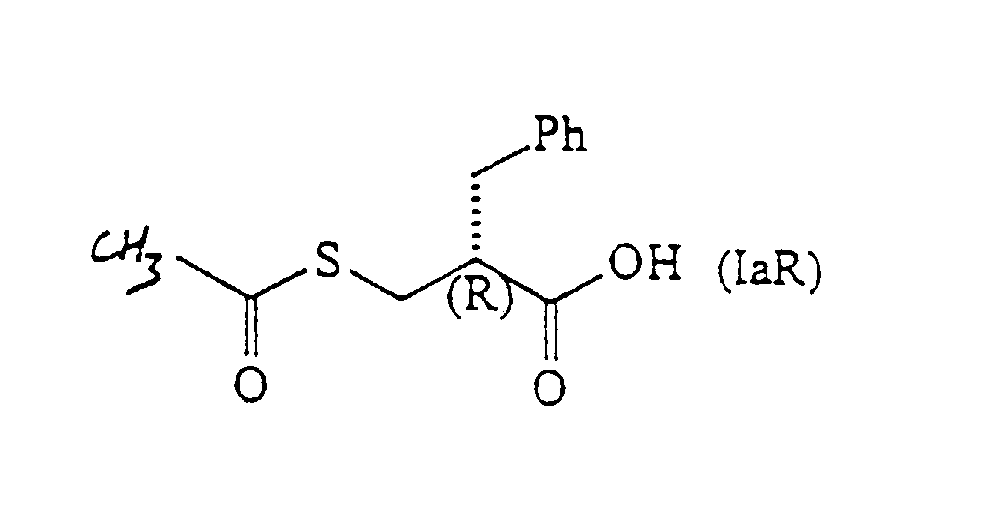 a) Durchführung einer Reduktion eines Malonsäureesters wie Dimethylbenzylmalonat (R4 = CH3) mit Hilfe eines Hydrids wie Lithiumaluminiumhydrid in einem Lösungsmittel wie Tetrahydrofuran, zur Herstellung des entsprechenden Diols (VI);b) Durchführung einer Monoacetylierung des so erhaltenen Diols der Formel (VI) in Vinylacetat in Gegenwart von Lipase PS (Amano),c) Oxidieren der Alkoholfunktion des so erhaltenen Monoacetats der Formel (VII R) in Aceton mit Hilfe des Jones-Reagens (CrO3-H2SO4),d) Verseifen der Acetatfunktion durch eine alkalische wäßrige Lösung wie einer wäßrigen Lithiumhydroxid-Lösung, anschließend Freisetzung der Hydroxysäure der Formel (X S) durch Ansäuern:
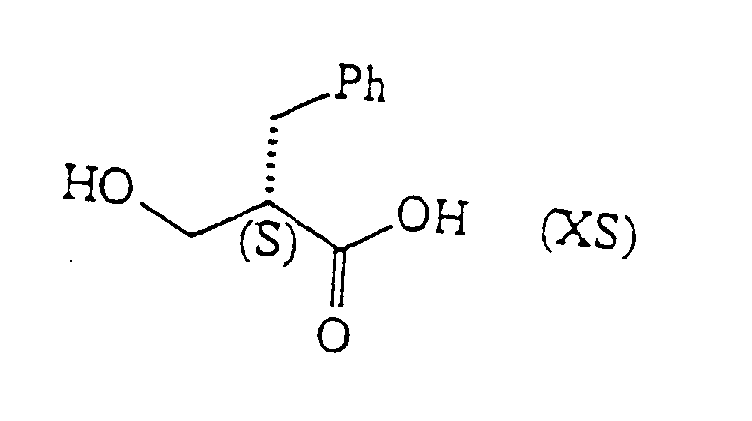 e) Substituieren der Alkoholfunktion der Hydroxysäure der Formel (X S) mit einer Reaktion vom Typ Mitsunobu in Gegenwart eines Komplexes Triphenylphosphin/Diisopropylazodicarboxylat und von Thioessigsäure zur Herstellung der Säure der Konfiguration (R) der Formel (Ia R).
 - Verfahren nach einem der Ansprüche 1 bis 14, dadurch charakterisiert, daß es, wenn es zur Herstellung der Säure (S)-2-Acetylthiomethyl-3-phenylpropansäure der Formel (Ia S) verwendet wird:die Schritte umfaßt, die bestehen aus:
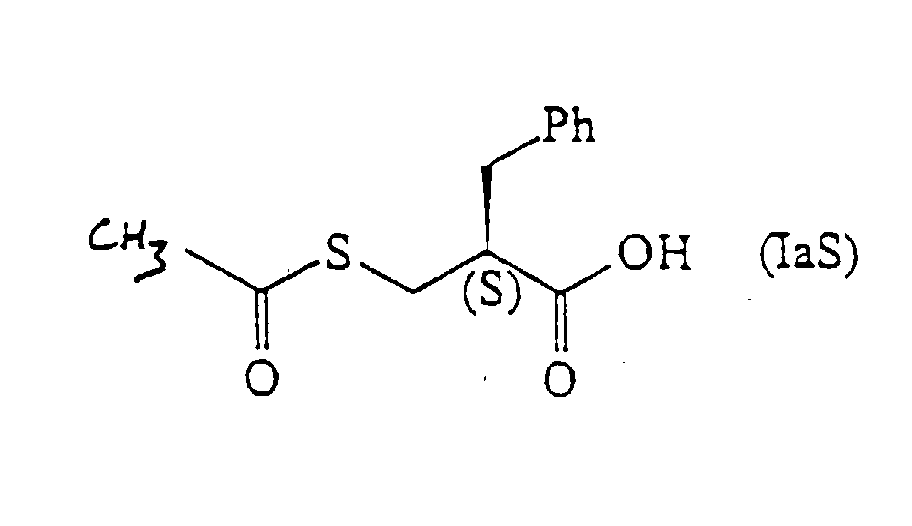 a) Durchführung einer Reduktion eines Malonats (V) wie Dimethylbenzylmalonat (R4 = CH3) mit Hilfe eines Hydrids wie Lithiumaluminiumhydrid,b) Durchführung einer Diacetylierung des Diols der Formel (VI) in Vinylacetat in Gegenwart des Enzyms Novozym 435 (Novo Nordisk), anschließend Durchführung einer Monohydrolyse des so gebildeten Diacetats der Formel (VIII) in Phosphatpuffer pH 7 in Gegenwart von aus Pseudomonas fluoreszens stammender Lipase (Fluka),c) Oxidieren der Alkoholfunktion des Monoacetats der Formel (VII S) in Aceton mit Hilfe des Jones-Reagens (CrO3-H2SO4),d) Verseifen der Acetatfunktion durch eine alkalische wäßrige Lösung wie eine wäßrige Lithiumhydroxid-Lösung, anschließend Freisetzung der Hydroxysäure der Formel (X R) durch Ansäuern:
 e) Substituieren der Alkoholfunktion der Hydroxysäure der Formel (X R) mit einer Reaktion vom Typ Mitsunobu in Gegenwart eines Komplexes aus Triphenylphosphin/Diisopropylazodicarboxolat und von Thioessigsäure zur Herstellung der Säure der Konfiguration (S) der Formel (Ia S).
 - Verfahren zur Herstellung von optische aktiven N-(Mercaptoacyl)amino-Säure-Derivaten der Formel (II):wobei
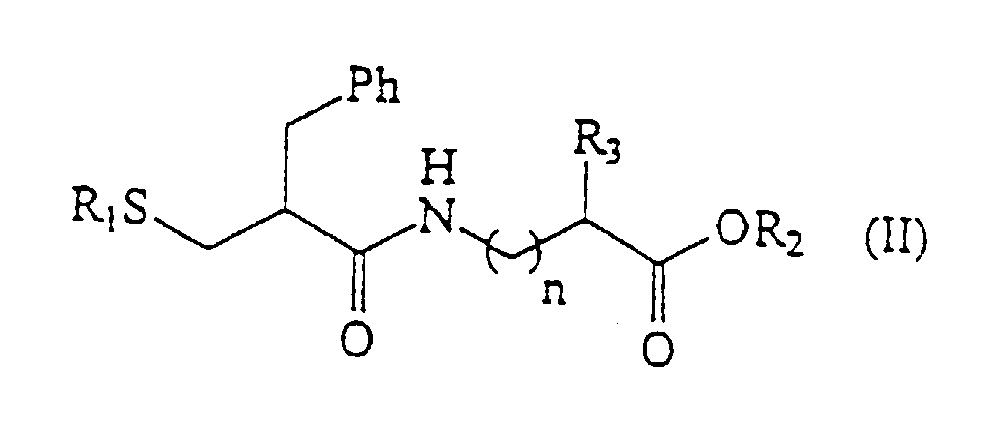 dadurch charakterisiert, daß es Verwendung der S-Acylierten Derivate von 2-Mercaptomethyl-3-phenylpropansäure der Formel (I) in optisch reiner Form nach deren Herstellung mit Hilfe des Verfahrens der Ansprüche 1 bis 16 umfaßt.R1 ein Wasserstoffatom, einen linearen oder verzweigten aliphatischen Acylrest oder einen aromatischen Acylrest darstellt,R2 ein Wasserstoffatom, einen niedrigen Alkylrest, einen Phenylrest oder eine niedrige Phenylalkylengruppe darstellt,R3 ein Wasserstoffatom; eine niedrige Alkylgruppe; eine niedrige Hydroxyalkylengruppe; eine Phenylgruppe; eine niedrige Phenylalkylengruppe; eine niedrige Hydroxyphenylalkylengruppe; eine niedrige Aminoalkylengruppe; eine niedrige Guanidinoalkylengruppe; eine niedrige Mercaptoalkylengruppe; eine niedrige Alkyl-niedrige Thioalkylengruppe; eine niedrige Imidazolylalkylengruppe; eine niedrige Indolylalkylengruppe; eine niedrige Carbamoylalkylengruppe; eine niedrige Carboxyalkylengruppe darstellt;n von 0 bis 10 variiert;
 - Verfahren nach Anspruch 17, dadurch charakterisiert, daß es Verwendung der Verbindung der Formel (Ia R) oder (Ia S) umfaßt.
- Verfahren nach Anspruch 17, dadurch charakterisiert, daß man die Verbindung (Ia R) für die Synthese der Verbindung der Formel (III) verwendet:
- Verfahren nach Anspruch 17, dadurch charakterisiert, daß man die Verbindung (Ia S) für die Synthese der Verbindung der Formel (IV) verwendet:
- Verfahren nach einem der Ansprüche 17 bis 20, dadurch charakterisiert, daß es die Schritte umfaßt, welche bestehen aus:f) Bildung des Chlorids (XII S) oder (XII R)der Säure (I R) oder (I S) mit Hilfe eines Chlorierungsmittels und
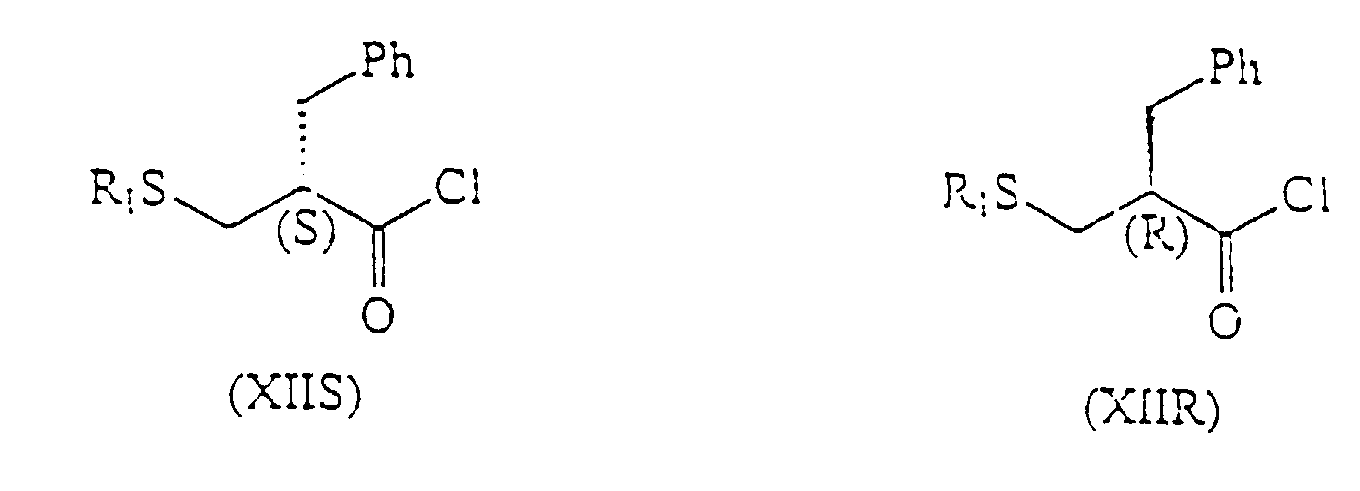 g) Umsetzung des Säurechlorids (XII S) oder (XII R) mit einem Aminoester der Formel (XIII)in Gegenwart einer Base.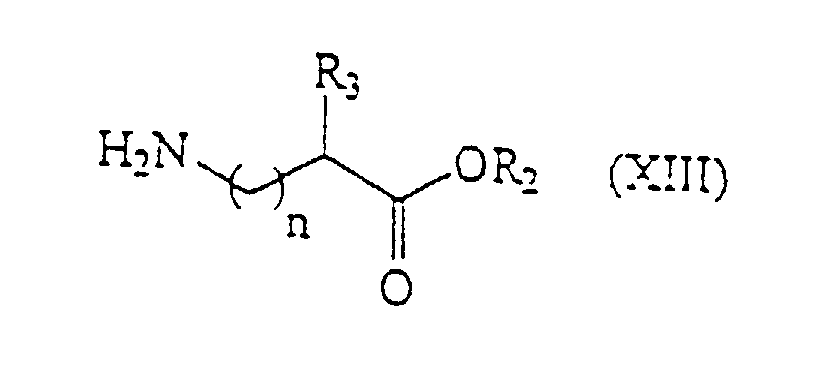
- Verwendung von S-acylierten Derivaten von optisch reiner 2-Mercaptomethyl-3-phenylpropansäure der Formel (I), erhalten durch das Verfahren nach einem der Ansprüche 1 bis 16, für die Synthese von optisch reiner N-(Mercaptoacyl)aminosäure-Derivaten der Formel (II):wobei
 R1 ein Wasserstoffatom, einen linearen oder verzweigten aliphatischen Acylrest oder einen aromatischen Acylrest darstellt,R2 ein Wasserstoffatom, einen niedrigen Alkylrest, einen Phenylrest oder eine niedrige Phenylalkylengruppe darstellt,R3 ein Wasserstoffatom; eine niedrige Alkylgruppe; eine niedrige Hydroxyalkylengruppe; eine Phenylgruppe; eine niedrige Phenylalkylengruppe; eine niedrige Hydroxyphenylalkylengruppe; eine niedrige Aminoalkylengruppe; eine niedrige Guanidinoalkylengruppe; eine niedrige Mercaptoalkylengruppe; eine niedrige Alkyl-niedrige Thioalkylengruppe; eine niedrige Imidazolylalkylengruppe; eine niedrige Indolylalkylengruppe; eine niedrige Carbamoylalkylengruppe; eine niedrige Carboxyalkylengruppe darstellt;n von 0 bis 10 variiert.
 - Verwendung von (R)-2-Acetylthiomethyl-3-phenylpropansäure der Formel (Ia R) für die Synthese von Derivaten der Formel (II).
- Verwendung von (R)-2-Acetylthiomethyl-3-phenylpropansäure der Formel (Ia R) nach Anspruch 23 für die Synthese von N-(R)-[2-Acetylthiomethyl-1-oxo-3-phenylpropyl]benzylglycinat der Formel (III).
- Verwendung von (S)-2-Acetlythiomethyl-3-phenylpropansäure der Formel (Ia S) nach Anspruch 23 für die Synthese von Derivaten der Formel (II).
- Verwendung von (S)-2-Acetylthiomethyl-3-phenylpropansäure der Formel (Ia S) nach Anspruch 25 für die Synthese von N-(S)-[2-Acetylthiomethyl-1-oxo-3-phenylpropyl]benzylglycinat der Formel (IV).
Applications Claiming Priority (3)
| Application Number | Priority Date | Filing Date | Title |
|---|---|---|---|
| FR9601360A FR2744446B1 (fr) | 1996-02-05 | 1996-02-05 | Procede de synthese asymetrique des derives s-acyles de l'acide 2-mercaptomethyl 3-phenyl propanoique, application a la synthese de derives n-(mercaptoacyl) amino-acides |
| FR9601360 | 1996-02-05 | ||
| PCT/FR1997/000218 WO1997029086A1 (fr) | 1996-02-05 | 1997-02-04 | Procede de synthese asymetrique des derives s-acyles de l'acide 2-mercaptomethyl 3-phenyl propanoique, application a la synthese de derives n-(mercaptoacyl) amino-acides |
Publications (2)
| Publication Number | Publication Date |
|---|---|
| EP0820439A1 EP0820439A1 (de) | 1998-01-28 |
| EP0820439B1 true EP0820439B1 (de) | 2000-05-03 |
Family
ID=9488842
Family Applications (1)
| Application Number | Title | Priority Date | Filing Date |
|---|---|---|---|
| EP97904485A Expired - Lifetime EP0820439B1 (de) | 1996-02-05 | 1997-02-04 | Verfahren zur asymmetrischen synthese von s-acylierten derivaten von 2-mercaptomethyl-3-phenylpropionsäure und deren verwendung zur synthese von n-mercaptoacyl aminosäure-derivaten |
Country Status (11)
| Country | Link |
|---|---|
| US (1) | US6013829A (de) |
| EP (1) | EP0820439B1 (de) |
| JP (1) | JP4560147B2 (de) |
| AT (1) | ATE192433T1 (de) |
| DE (1) | DE69701840T2 (de) |
| DK (1) | DK0820439T3 (de) |
| ES (1) | ES2146981T3 (de) |
| FR (1) | FR2744446B1 (de) |
| GR (1) | GR3033843T3 (de) |
| PT (1) | PT820439E (de) |
| WO (1) | WO1997029086A1 (de) |
Families Citing this family (9)
| Publication number | Priority date | Publication date | Assignee | Title |
|---|---|---|---|---|
| JPH11106363A (ja) * | 1997-10-03 | 1999-04-20 | Ajinomoto Co Inc | 光学活性2−ヒドロキシメチル−3−フェニルプロピオン酸の製造方法 |
| FR2772027B1 (fr) * | 1997-12-10 | 2000-02-04 | Fournier Ind & Sante | Procede de preparation asymetrique de derives de l'acide 2-mercaptomethyl-3-phenyl-propanoique, utilisation pour synthese de principes actifs chiraux |
| EP0937710B1 (de) | 1998-02-16 | 2003-04-16 | Ajinomoto Co., Inc. | Verfahren zur Herstellung von optisch aktiven Phenylpropionsäure-Derivat |
| WO2004060885A1 (ja) * | 2002-12-27 | 2004-07-22 | Kaneka Corporation | 光学活性2−チオメチル−3−フェニルプロピオン酸誘導体およびその合成中間体の製造法 |
| CN101768095A (zh) * | 2008-12-26 | 2010-07-07 | 山东齐都药业有限公司 | 一种消旋卡多曲的制备方法 |
| WO2013098826A1 (en) * | 2011-12-26 | 2013-07-04 | Symed Labs Limited | "a process for the preparation of n-[2-[(acetylthio) methyl]-1-oxo-3-phenylpropyl] glycine phenyl methyl ester and intermediates thereof" |
| CN109438303B (zh) * | 2018-11-13 | 2020-10-16 | 山东齐都药业有限公司 | 一锅法制备消旋卡多曲的方法 |
| CN115074404B (zh) * | 2022-06-28 | 2025-02-18 | 吉尔多肽生物制药(大连市)有限公司 | 一种(2s, 4r)-2-氨基-4-甲基壬酸的合成方法 |
| WO2025192727A1 (ja) * | 2024-03-15 | 2025-09-18 | 国立大学法人福井大学 | 硫黄含有ビニルエーテルの製造方法 |
Family Cites Families (5)
| Publication number | Priority date | Publication date | Assignee | Title |
|---|---|---|---|---|
| FR501870A (fr) * | 1919-06-24 | 1920-04-28 | Knut Eenberg | Nouvel alliage et son procédé d'obtention |
| DE3467754D1 (de) * | 1983-10-03 | 1988-01-07 | Squibb & Sons Inc | Enkephalinase inhibitors |
| FR2623498B1 (fr) * | 1987-11-24 | 1990-04-06 | Bioprojet Soc Civ | Nouveaux composes enantiomeres derives d'amino-acides, leur procede de preparation et leurs applications therapeutiques |
| CA2004846A1 (en) * | 1988-12-19 | 1990-06-19 | Yutaka Koike | N-substituted acylamino acid compounds, process for their production and their use |
| FR2673105B1 (fr) * | 1991-02-26 | 1995-01-13 | Bioprojet Soc Civ | Nouvelles compositions pharmaceutiques, notamment pour le traitement des colopathies fonctionnelles, et procedes de preparation de compositions et de medicaments, notamment pour le traitement de ces affections. |
-
1996
- 1996-02-05 FR FR9601360A patent/FR2744446B1/fr not_active Expired - Fee Related
-
1997
- 1997-02-04 JP JP52821897A patent/JP4560147B2/ja not_active Expired - Lifetime
- 1997-02-04 WO PCT/FR1997/000218 patent/WO1997029086A1/fr not_active Ceased
- 1997-02-04 DE DE69701840T patent/DE69701840T2/de not_active Expired - Lifetime
- 1997-02-04 PT PT97904485T patent/PT820439E/pt unknown
- 1997-02-04 AT AT97904485T patent/ATE192433T1/de active
- 1997-02-04 US US08/930,734 patent/US6013829A/en not_active Expired - Lifetime
- 1997-02-04 EP EP97904485A patent/EP0820439B1/de not_active Expired - Lifetime
- 1997-02-04 DK DK97904485T patent/DK0820439T3/da active
- 1997-02-04 ES ES97904485T patent/ES2146981T3/es not_active Expired - Lifetime
-
2000
- 2000-06-30 GR GR20000401544T patent/GR3033843T3/el unknown
Also Published As
| Publication number | Publication date |
|---|---|
| JPH11503470A (ja) | 1999-03-26 |
| EP0820439A1 (de) | 1998-01-28 |
| PT820439E (pt) | 2000-10-31 |
| FR2744446B1 (fr) | 1998-04-17 |
| WO1997029086A1 (fr) | 1997-08-14 |
| DE69701840T2 (de) | 2000-10-12 |
| ATE192433T1 (de) | 2000-05-15 |
| JP4560147B2 (ja) | 2010-10-13 |
| DK0820439T3 (da) | 2000-08-07 |
| US6013829A (en) | 2000-01-11 |
| GR3033843T3 (en) | 2000-10-31 |
| ES2146981T3 (es) | 2000-08-16 |
| FR2744446A1 (fr) | 1997-08-08 |
| DE69701840D1 (de) | 2000-06-08 |
Similar Documents
| Publication | Publication Date | Title |
|---|---|---|
| EP0971915B1 (de) | Verfahren zur herstellung von 2-thienylamin-derivaten | |
| CZ280006B6 (cs) | Způsob přípravy opticky aktivního (2S) nebo (2R)-endobicyklo-2.2.1heptan-2-olu | |
| EP0515541B1 (de) | Verfahren zur herstellung von (2r,3r)-cis-beta-phenyl-glycidil-säure | |
| EP0729936B1 (de) | Verfahren zur Synthese der alpha-substiuierten Akrylsäuren und N-(mercaptoacyl)aminsäuren | |
| EP0820439A1 (de) | Verfahren zur asymmetrischen synthese von s-acylierten derivaten von 2-mercaptomethyl-3-phenylpropionsäure und deren verwendung zur synthese von n-mercaptoacyl aminosäure-derivaten | |
| EP0004493A1 (de) | Äther deren organische Reste asymmetrische Atome enthalten, Verfahren zu ihrer Herstellung und ihre Anwendung zur Spaltung von Alkoholen, Phenolen oder gewissen Verbindungen mit Laktonstruktur | |
| EP2121555B1 (de) | Neues verfahren zur herstellung ungesättigter fetthydroxysäuren | |
| AU2001290774B2 (en) | Enzymatic resolution of aryl- and thio-substituted acids | |
| JPH0149712B2 (de) | ||
| FR2956400A1 (fr) | Procede de preparation de composes adamantyles | |
| EP0718407B1 (de) | Intermediate für die Synthese von Eliprodilenantiomeren und Verfahren zu ihrer Herstellung | |
| EP1140842B1 (de) | Ester von 3-(3,4-dihalogenophenyl)-2,6-dioxopiperidine-3-propionsäure als zwischenprodukte | |
| EP2146954B1 (de) | Verfahren zur synthese von (z)-3-[2-butoxy-3'-(3-heptyl-1-methylureid)-biphenyl-4-yl]-2-methoxy-acrylsäure | |
| EP1735297B1 (de) | Syntheseverfahren und benzoxathiepinzwischenprodukte | |
| EP0277052B1 (de) | 4,4-Dimethyltetrahydropyr-2-on-Derivate, Verfahren zu ihrer Herstellung und ihre Verwendung zur Synthese von Pyretrinverbindungen | |
| EP2111387B1 (de) | Neues verfahren zur herstellung ungesättigter hydroxyfettsäuren | |
| FR2486526A1 (fr) | Procede de preparation de derives de l'oxyde de diphenyle | |
| FR2565584A1 (fr) | Derives d'acide heptanoique, leur procede de preparation ainsi que leur utilisation | |
| JPH05501883A (ja) | アルコール―エステル分離のための保護ヒドロキシ方法 | |
| US6242635B1 (en) | Process for producing propionic acid derivatives | |
| FR2636624A1 (fr) | Procede d'inversion stereochimique d'une fonction hydroxy d'un ester par un processus reactionnel de mitsunobu modifie | |
| JPH0723356B2 (ja) | 4,4―ジスルホニルブタン酸エステル類の製造法 | |
| JP2877976B2 (ja) | 光学活性2,4,4−トリメチル−2−シクロヘキセン−1−オール及びその製法 | |
| JPH05500966A (ja) | 再結晶によるアルコール―エステル分離 | |
| FR2777278A1 (fr) | Nouveau procede de preparation de la 3-hydroxymethyl quinuclidine, intermediaire de synthese de la mequitazine |
Legal Events
| Date | Code | Title | Description |
|---|---|---|---|
| PUAI | Public reference made under article 153(3) epc to a published international application that has entered the european phase |
Free format text: ORIGINAL CODE: 0009012 |
|
| 17P | Request for examination filed |
Effective date: 19971007 |
|
| AK | Designated contracting states |
Kind code of ref document: A1 Designated state(s): AT BE CH DE DK ES FI FR GB GR IE IT LI LU MC NL PT SE |
|
| GRAG | Despatch of communication of intention to grant |
Free format text: ORIGINAL CODE: EPIDOS AGRA |
|
| 17Q | First examination report despatched |
Effective date: 19990727 |
|
| GRAG | Despatch of communication of intention to grant |
Free format text: ORIGINAL CODE: EPIDOS AGRA |
|
| GRAH | Despatch of communication of intention to grant a patent |
Free format text: ORIGINAL CODE: EPIDOS IGRA |
|
| GRAH | Despatch of communication of intention to grant a patent |
Free format text: ORIGINAL CODE: EPIDOS IGRA |
|
| GRAA | (expected) grant |
Free format text: ORIGINAL CODE: 0009210 |
|
| AK | Designated contracting states |
Kind code of ref document: B1 Designated state(s): AT BE CH DE DK ES FI FR GB GR IE IT LI LU MC NL PT SE |
|
| REF | Corresponds to: |
Ref document number: 192433 Country of ref document: AT Date of ref document: 20000515 Kind code of ref document: T |
|
| REG | Reference to a national code |
Ref country code: CH Ref legal event code: EP |
|
| REG | Reference to a national code |
Ref country code: IE Ref legal event code: FG4D Free format text: FRENCH |
|
| REF | Corresponds to: |
Ref document number: 69701840 Country of ref document: DE Date of ref document: 20000608 |
|
| GBT | Gb: translation of ep patent filed (gb section 77(6)(a)/1977) |
Effective date: 20000526 |
|
| ITF | It: translation for a ep patent filed | ||
| REG | Reference to a national code |
Ref country code: DK Ref legal event code: T3 |
|
| REG | Reference to a national code |
Ref country code: ES Ref legal event code: FG2A Ref document number: 2146981 Country of ref document: ES Kind code of ref document: T3 |
|
| REG | Reference to a national code |
Ref country code: PT Ref legal event code: SC4A Free format text: AVAILABILITY OF NATIONAL TRANSLATION Effective date: 20000713 |
|
| PLBE | No opposition filed within time limit |
Free format text: ORIGINAL CODE: 0009261 |
|
| STAA | Information on the status of an ep patent application or granted ep patent |
Free format text: STATUS: NO OPPOSITION FILED WITHIN TIME LIMIT |
|
| 26N | No opposition filed | ||
| REG | Reference to a national code |
Ref country code: GB Ref legal event code: IF02 |
|
| REG | Reference to a national code |
Ref country code: FR Ref legal event code: PLFP Year of fee payment: 20 |
|
| PGFP | Annual fee paid to national office [announced via postgrant information from national office to epo] |
Ref country code: LU Payment date: 20160121 Year of fee payment: 20 Ref country code: NL Payment date: 20160113 Year of fee payment: 20 |
|
| PGFP | Annual fee paid to national office [announced via postgrant information from national office to epo] |
Ref country code: MC Payment date: 20160118 Year of fee payment: 20 Ref country code: CH Payment date: 20160208 Year of fee payment: 20 Ref country code: IT Payment date: 20160212 Year of fee payment: 20 Ref country code: ES Payment date: 20160301 Year of fee payment: 20 Ref country code: DK Payment date: 20160125 Year of fee payment: 20 Ref country code: DE Payment date: 20160212 Year of fee payment: 20 Ref country code: IE Payment date: 20160118 Year of fee payment: 20 |
|
| PGFP | Annual fee paid to national office [announced via postgrant information from national office to epo] |
Ref country code: GR Payment date: 20160121 Year of fee payment: 20 Ref country code: PT Payment date: 20160118 Year of fee payment: 20 Ref country code: AT Payment date: 20160120 Year of fee payment: 20 Ref country code: BE Payment date: 20160224 Year of fee payment: 20 Ref country code: FI Payment date: 20160120 Year of fee payment: 20 Ref country code: FR Payment date: 20160218 Year of fee payment: 20 Ref country code: SE Payment date: 20160212 Year of fee payment: 20 Ref country code: GB Payment date: 20160216 Year of fee payment: 20 |
|
| REG | Reference to a national code |
Ref country code: DE Ref legal event code: R071 Ref document number: 69701840 Country of ref document: DE |
|
| REG | Reference to a national code |
Ref country code: DK Ref legal event code: EUP Effective date: 20170204 |
|
| REG | Reference to a national code |
Ref country code: NL Ref legal event code: MK Effective date: 20170203 |
|
| REG | Reference to a national code |
Ref country code: CH Ref legal event code: PL |
|
| REG | Reference to a national code |
Ref country code: GB Ref legal event code: PE20 Expiry date: 20170203 |
|
| REG | Reference to a national code |
Ref country code: AT Ref legal event code: MK07 Ref document number: 192433 Country of ref document: AT Kind code of ref document: T Effective date: 20170204 |
|
| REG | Reference to a national code |
Ref country code: IE Ref legal event code: MK9A |
|
| REG | Reference to a national code |
Ref country code: SE Ref legal event code: EUG |
|
| REG | Reference to a national code |
Ref country code: GR Ref legal event code: MA Ref document number: 20000401544 Country of ref document: GR Effective date: 20170205 |
|
| REG | Reference to a national code |
Ref country code: ES Ref legal event code: FD2A Effective date: 20170526 |
|
| PG25 | Lapsed in a contracting state [announced via postgrant information from national office to epo] |
Ref country code: PT Free format text: LAPSE BECAUSE OF EXPIRATION OF PROTECTION Effective date: 20170213 Ref country code: IE Free format text: LAPSE BECAUSE OF EXPIRATION OF PROTECTION Effective date: 20170204 Ref country code: GB Free format text: LAPSE BECAUSE OF EXPIRATION OF PROTECTION Effective date: 20170203 |
|
| PG25 | Lapsed in a contracting state [announced via postgrant information from national office to epo] |
Ref country code: ES Free format text: LAPSE BECAUSE OF EXPIRATION OF PROTECTION Effective date: 20170205 |