EP0827039B2 - Magenta-Toner zur Entwicklung elektrostatischer Bilder und Herstellungsverfahren - Google Patents
Magenta-Toner zur Entwicklung elektrostatischer Bilder und Herstellungsverfahren Download PDFInfo
- Publication number
- EP0827039B2 EP0827039B2 EP97115120A EP97115120A EP0827039B2 EP 0827039 B2 EP0827039 B2 EP 0827039B2 EP 97115120 A EP97115120 A EP 97115120A EP 97115120 A EP97115120 A EP 97115120A EP 0827039 B2 EP0827039 B2 EP 0827039B2
- Authority
- EP
- European Patent Office
- Prior art keywords
- magenta toner
- magenta
- process according
- pigment
- toner particles
- Prior art date
- Legal status (The legal status is an assumption and is not a legal conclusion. Google has not performed a legal analysis and makes no representation as to the accuracy of the status listed.)
- Expired - Lifetime
Links
Images
Classifications
-
- G—PHYSICS
- G03—PHOTOGRAPHY; CINEMATOGRAPHY; ANALOGOUS TECHNIQUES USING WAVES OTHER THAN OPTICAL WAVES; ELECTROGRAPHY; HOLOGRAPHY
- G03G—ELECTROGRAPHY; ELECTROPHOTOGRAPHY; MAGNETOGRAPHY
- G03G9/00—Developers
- G03G9/08—Developers with toner particles
- G03G9/087—Binders for toner particles
- G03G9/08742—Binders for toner particles comprising macromolecular compounds obtained otherwise than by reactions only involving carbon-to-carbon unsaturated bonds
- G03G9/08755—Polyesters
-
- G—PHYSICS
- G03—PHOTOGRAPHY; CINEMATOGRAPHY; ANALOGOUS TECHNIQUES USING WAVES OTHER THAN OPTICAL WAVES; ELECTROGRAPHY; HOLOGRAPHY
- G03G—ELECTROGRAPHY; ELECTROPHOTOGRAPHY; MAGNETOGRAPHY
- G03G9/00—Developers
- G03G9/08—Developers with toner particles
- G03G9/087—Binders for toner particles
- G03G9/08784—Macromolecular material not specially provided for in a single one of groups G03G9/08702 - G03G9/08775
- G03G9/08795—Macromolecular material not specially provided for in a single one of groups G03G9/08702 - G03G9/08775 characterised by their chemical properties, e.g. acidity, molecular weight, sensitivity to reactants
-
- G—PHYSICS
- G03—PHOTOGRAPHY; CINEMATOGRAPHY; ANALOGOUS TECHNIQUES USING WAVES OTHER THAN OPTICAL WAVES; ELECTROGRAPHY; HOLOGRAPHY
- G03G—ELECTROGRAPHY; ELECTROPHOTOGRAPHY; MAGNETOGRAPHY
- G03G9/00—Developers
- G03G9/08—Developers with toner particles
- G03G9/09—Colouring agents for toner particles
- G03G9/0906—Organic dyes
- G03G9/092—Quinacridones
Definitions
- the present invention relates to a magenta toner for developing electrostatic images formed by image forming methods, such as electrophotography and electrostatic printing, and a process for production thereof. More specifically, the present invention relates to a magenta toner having a stable triboelectric chargeability and suitable for developing electrostatic images to form full-color images of high-image quality and excellent color reproduction.
- a color image original is color-separated by color filters of B (blue), G (green) and R (red) to form electrostatic latent images in a dot size of 20 ⁇ m to 70 ⁇ m for the respective colors, the latent images are developed with respective color toners of Y (yellow), M (magenta), C (cyan) and B (black), and the resultant superposed color toner images are subjected to subtractive color mixing during heat-pressure fixation to reproduce the original color image. Accordingly, a larger amount of toner has to be transferred from a photosensitive member to a transfer-receiving material, such as paper, via or without via an intermediate transfer member, than in a white and black monochromatic copying machine.
- a transfer-receiving material such as paper
- a magenta toner is important for reproducing a human skin color which is a halftone color requiring a good developing performance of the toner.
- known colorants for magenta toners include quinacridone colorants, thioindigo colorants, xanthene colorants, monoazo colorants, perylene colorants, and diketopyrrolopyrrole colorants.
- JP-B 49-46951 has proposed a 2,9-dimethylquinacridone pigment
- JP-A 55-26574 has proposed a thioindigo pigment
- JP-A 59-57256 has proposed a xanthene dye
- JP-A 2-210459 has proposed a diketopyrrolopyrrole pigment
- JP-B 55-42383 has proposed an anthraquinone dye.
- EP-A-0247576 describes an improved magenta colorant comprising a solid solution pigment of 95 to 60 parts of C.I. Pigment Red 122 and 5 to 40 parts of C.I. Pigment Violet 19 and its use in the preparation of magenta toners.
- magenta colorants have a good affinity with a binder resin and good light-fastness and provide magenta toners which have generally good triboelectric chargeability and color hue, but it has been desired to provide a magenta toner having further improved hue, saturation and electrophotographic characteristics in order to provide images which have a satisfactory transparency and are more faithful to the original.
- a generic object of the present invention is to provide a magenta toner for developing electrostatic images having solved the above-mentioned problems.
- a more specific object of the present invention is to provide a magenta toner for developing electrostatic images capable of providing a very clear color at a high image density.
- Another object of the present invention is to provide a magenta toner for developing electrostatic images capable of providing a fixed image having excellent transparency on an OHP sheet.
- Another object of the present invention is to provide a magenta toner for developing electrostatic images having an excellent reproducibility of a highlight (or halftone) portion.
- Another object of the present invention is to provide a magenta toner for developing electrostatic images having an excellent negative chargeability and excellent electrophotographic performances.
- a further object of the present invention is to provide a process for producing such a magenta toner.
- magenta toner for developing an electrostatic image, comprising magenta toner particles containing at least a binder resin, a magenta pigment and a polar resin;
- a process for producing a magenta toner comprising magenta toner particles comprising the steps of:
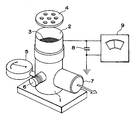
- a sole figure in the drawing is a schematic illustration of an apparatus for measuring a triboelectric chargeability of a toner.
- a characteristic feature of the toner according to the present invention is that the toner particles contain a specific solid solution pigment and a polar resin having a specific acid value.
- the solid solution pigment used in the present invention may generally be prepared by mixing at least the two species of magenta pigments before the dehydration and pigmentization steps, followed by dehydration and pigmentization.
- the solid solution pigment is easily disintegratable and can be dispersed into pigment particles close to primary particles.
- the pigments constituting the solid solution pigment have a structural similarity in combination because of the structural stability and the easiness of production of the solid solution pigment.
- a substituted quinacridone pigment and non-substituted quinacridone pigment as shown below is used in the present invention in view of excellent light-fastness and coloring power.
- C.I. Pigment Violet 19 is liable to change its light-fastness and coloring power, which are however stabilized by formation of solid solution.
- the color hue of the solid solution pigment may be varied to have a broadened hue space by changing the content of C.I. Pigment Violet 19 and the conditions for crystallization thereof without impairing the saturation and lightness of the pigment.
- the substituted quinacridone pigment and the non-substituted quinacridone pigment may preferably be contained in a weight ratio of 85:15 - 30:70, more preferably 80:20 - 50:50.
- the solid solution pigment may be formed, e.g., through a process wherein the solid solution components are simultaneously recrystallized from sulfuric acid or an appropriate solvent, optionally ground with a salt and then treated with a solvent (as disclosed in U.S. Patent No. 3,160,510 ), or a process wherein a mixture of appropriately substituted diamino-terephthalic acid compounds is cyclized and treated with a solvent (as disclosed in DE-B 1217333 ).
- magenta toner particles in the magenta toner may preferably be formed through a process including the steps of:
- the magenta solid solution pigment is dispersed as particles close to primary particles, and the re-agglomeration of the dispersed particles of the magenta solid solution pigment having a nitrogen atom is suppressed owing to the polar resin having an acid value of 3 - 20 mgKOH/g, thereby increasing the coloring power, lightness and saturation of the magenta toner particles.
- the polar resin used in the present invention exhibits both a function of being uniformly dispersed in the polymerizable monomer mixture to suppress the re-agglomeration of the solid solution pigment particles and a function of stabilizing the dispersion of the polymerizable monomer mixture particles in the aqueous medium in an early stage of polymerization of the polymerizable monomer mixture, so that it is important that the polar resin has an acid value in the range of 3 - 20 mgKOH/g.
- the acid value of the polar resin is below 3 mgKOH/g, the polar resin and the solid solution pigment have a low affinity therebetween and are liable to be separated from each other, thus exhibiting only a low re-agglomeration suppression effect to result in lower coloring power and chargeability.
- the acid value of the polar resin exceeds 20 mgKOH/g, the agglomeratability between the molecular chains of the polar resin, the dispersibility of the polar resin in styrene monomer (which is a non-polar liquid) is lowered, so that the effect of stabilization of the polymerizable monomer mixture particles in the aqueous medium due to the polar polymer is lowered to provide a lower stability of production of the magenta toner particles.
- the polar resin may preferably be contained in a proportion of 1 - 20 wt. %, more preferably 2.0 - 10.0 wt. %, further preferably in a proportion satisfying the following formula (A): 5.0 ⁇ [ acid value of polar resin ( mgKOH / g ) ⁇ content ( wt . % ) of the solution pigment / content wt . % ⁇ of the polar resin ] ⁇ 20.0.
- the polar resin content is below 1 wt. %, the addition effect thereof is scarce, thus being liable to result in a lower negative triboelectric chargeability of the resultant toner. If the polar resin content exceeds 20 wt. %, the polymerizable monomer mixture is caused to have an increased viscosity so that the particulation thereof in the aqueous medium becomes difficult to lower the production stability.
- the polar resin does not contain an unsaturation group reactive with styrene monomer.
- the styrene monomer and the polar resin are liable to form a crosslinkage to result in a toner exhibiting a lower color mixability.
- the polar resin may include: saturated polyester resin, epoxy resin, styrene- acrylic acid copolymer, styrene-methacrylic acid copolymer, and styrene-maleic acid copolymer.
- saturated polyester resin or epoxy resin is preferred, and particularly saturated polyester resin is preferred in view of easy controllability of acid value, and flowability, negative triboelectric chargeability and transparency of the resultant toner particles.
- the polar resin may preferably have a number average molecular weight (Mn) of 2.5x10 3 - 1.0x10 4 in view of the solubility thereof in styrene monomer, effect of suppressing re-agglomeration of the solid solution pigment particles, and continuous image forming performance on a large number of sheets of the resultant magenta toner particles.
- Mn number average molecular weight
- a polymerizable monomer mixture by dispersing and sufficiently mixing the solid solution pigment and the polar resin in styrene monomer in advance, and then adding thereto a polymerization initiator.
- the polymerizable monomer mixture containing styrene monomer can further contain, as desired, another vinyl monomer, examples of which may include: substituted styrene monomers, such as o (or m,p)-methylstyrene, and m (or p)-ethylstyrene; (meth)acrylate monomers, such as methyl (meth)acrylate, ethyl (meth)-acrylate, propyl (meth)acrylate, butyl (meth)acrylate, octyl (meth)acrylate, dodecyl (meth)acrylate, stearyl (meth)acrylate, behenyl (meth)acrylate, 2-ethylhexyl (meth)acrylate, dimethylaminoethyl (meth)acrylate, and diethylaminoethyl (meth)acrylate; and butadiene, isoprene, cyclohexane
- Tg glass transition temperature
- the THF-soluble content in the toner including the binder resin (i.e., styrene polymer, styrene-copolymer or a mixture of these) and the polar resin may preferably have a molecular weight distribution including a number-average molecular weight (Mn) of 5x10 3 - 1x10 6 , and a ratio of weight-average molecular weight (Mw) to number-average molecular weight (Mw/Mn) of 2 - 100, more preferably 5 - 50.
- Mn number-average molecular weight
- Mw weight-average molecular weight
- Mw/Mn number-average molecular weight
- the magenta toner particles of the present invention may preferably comprise 65 - 98 wt. % of the binder resin (i.e., styrene polymer, styrene copolymer or mixture of these), 1 - 15 wt. % of the magenta pigment, and 1 - 20 wt. %, more preferably 2.0 - 10.0 wt. %, of the polar resin.
- the binder resin i.e., styrene polymer, styrene copolymer or mixture of these
- the magenta toner may preferably contain a low-softening point substance exhibiting a heat-absorption main peak in a temperature range of 50 - 130 °C, more preferably 55 - 110 °C, on a DSC heat-absorption main peak as measured according to ASTM D3418-8. If the heat-absorption main peak temperature is below 50 °C, the low-softening point substance can exhibit only a weak cohesion to provide an inferior anti-high-temperature offset characteristic, and this is particularly undesirable for a magenta toner for full-color image formation. On the other hand, if the heat-absorption main peak temperature exceeds 130 °C, the resultant magenta toner is liable to have inferior low-temperature fixability and transparency.
- the heat-absorption main peak temperature measurement may be performed by using a differential scanning calorimeter (e.g., "DSC-7", available from Perkin-Elmer Corp.) in a temperature range of 20 - 200 °C.
- the temperature calibration of the detector unit may be performed by using the melting points of indium and zinc, and the calorie calibration may be performed by using the heat of fusion of indium.
- the measurement may be performed at a temperature-raising rate of 10 °C/min. by placing a sample on an aluminum pan while setting a blank pan as a control.
- the low-softening point substance may preferably be contained in 5 - 25 wt. % of the toner particles.
- the low-softening point substance may preferably comprise a wax so as to provide an easy meltability in heat-pressure fixation. It is particularly preferred to use a wax comprising an ester compound having a long-chain ester unit represented by R 1 -CO ⁇ O- or R 1 -O ⁇ CO-, wherein R 1 is an organic group having 15 or more carbon atoms so as to provide good anti-offset characteristic and transparency. It is particularly preferred to use a wax comprising an ester compound as represented by any of the following formulae (1) - (5): Formula (1) R 2 -COO-R 3 , wherein R 2 and R 3 denote a saturated hydrocarbon group having 15 - 45 carbon atoms. R 2 and R 3 are preferably alkyl groups.
- R 4 -O-CO-R 5 -CO-O-R 6 wherein R 4 and R 6 denote an organic group having 15 - 32 carbon atoms, and R 5 denotes an organic group having 2 - 20 carbon atoms.
- R 4 and R 6 are preferably alkyl groups, and R 5 is preferably an alkylene group.
- R 7 -CO-O-R 8 -O-CO-R 9 wherein R 7 and R 9 denote an organic group having 15 - 32 carbon atoms, and R 8 denote an organic group having 2 - 20 carbon atoms.
- R 7 and R 9 are preferably alkyl groups, and R 8 is preferably an alkylene group.
- R 10 and R 11 denote an organic group having 15 - 40 carbon atoms
- m and n are integers of 0 - 25 giving m+n ⁇ 1.
- R 10 and R 11 are preferably alkyl groups.
- R 12 and R 13 denote an organic group having 15 - 40 carbon atoms
- R 14 denotes a hydrogen atom or an organic group having 1 - 40 carbon atoms
- z is an integer of 1 to 3.
- R 12 , R 13 and R 14 are preferably alkyl groups.
- a wax having a hardness of 0.5 - 5.0 it is preferred to use a wax having a hardness of 0.5 - 5.0.
- the wax hardness values referred to herein are based on Vickers hardness values measured by using a cylindrical wax sample having a diameter of 20 mm and a thickness of 5 mm and an ultra-micro hardness meter ("DUH-200", available from Shimazu Seisakusho K.K.). The measurement was performed by using a load of 0.5 g and a loading speed of 9.67 mm/sec until a displacement of 10 ⁇ m was caused. From the depression mark, a Vickers hardness of the sample was measured.
- a wax having a hardness of below 0.5 results in a toner having too large pressure-dependence and process-speed dependence of the fixability and also a lower anti-low-temperature offset characteristic.
- the resultant toner is caused to have a lower storage stability and a lower anti-high-temperature offset characteristic because of a small self-cohesion of the wax per se.
- ester compounds contained in ester waxes are enumerated hereinbelow:
- the magenta toner particles used in the present invention may preferably contain 5 - 25 wt. % of an ester wax. If the ester wax content is below 5 wt. %, a sufficient effect of addition may not be exhibited to result in a somewhat lower coloring power.
- ester wax content exceeds 25 wt. %, the resultant toner is liable to-have inferior continuous image forming performance on a large number of sheets and lower anti-blocking property.
- the magenta toner according to the present invention can further contain a negative charge control agent. It is preferred to use a negative charge control agent which is colorless or pale-colored, provides a magenta toner with a quick chargeability and allows the stable maintenance of a constant charge.
- a charge control agent which is free from polymerization-inhibiting property and does not contain a component soluble in an aqueous medium.
- the negative charge control agent may include: metal compounds of salicylic acid, alkylsalicylic acid, dialkylsalicylic acid, naphthoic acid and dicaroxylic acids; polymeric compounds having a side chain comprising a sulfonic acid group or a carboxylic acid group; boron compounds, urea compounds, silicon compounds, and calixarene.
- Such a charge control agent may preferably be contained in 0.5 - 10 wt. % of the magenta toner particles.
- Examples of the polymerization initiator usable to be contained in the polymerizable monomer mixture may include: azo- or diazo-type polymerization initiators, such as 2,2'-azobis-(2,4-dimethylvaleronitrile), 2,2'-azobisisobutylonitrile, 1,1'-azobis-(cyclohexane-2-carbonitrile), 2,2'-azobis-4-methoxy-2,4-dimethylvaleronitrile, azobisisobutyronitrile; and peroxide-type polymerization initiators such as benzoyl peroxide, methyl ethyl ketone peroxide, diisopropyl peroxycarbonate, cumene hydroperoxide, 2,4-dichlorobenzoyl peroxide, and lauroyl peroxide.
- azo- or diazo-type polymerization initiators such as 2,2'-azobis-(2,4-dimethylvaleronitrile), 2,2'-azobisisobutylon
- the addition amount of the polymerization initiator varies depending on a polymerization degree to be attained.
- the polymerization initiator may generally be used in the range of about 0.5 - 20 wt. % based on the weight of the polymerizable monomer.
- the polymerization initiators may somewhat vary depending on the polymerization process used and may be selectively used singly or in mixture with reference to their 10-hour half-life period temperature.
- an inorganic or/and an organic dispersion stabilizer may be added in an aqueous dispersion medium.
- the inorganic dispersion stabilizer may include: tricalcium phosphate, magnesium phosphate, aluminum phosphate, zinc phosphate, calcium carbonate, magnesium carbonate, calcium hydroxide, magnesium hydroxide, aluminum hydroxide, calcium metasilicate, calcium sulfate, barium sulfate, bentonite, silica, and alumina.
- organic dispersion stabilizer may include: polyvinyl alcohol, gelatin, methyl cellulose, methyl hydroxypropyl cellulose, ethyl cellulose, carboxymethyl cellulose sodium salt, polyacrylic acid and its salt and starch. These dispersion stabilizers may preferably be used in the aqueous dispersion medium in an amount of 0.2 - 20 wt. parts per 100 wt. parts of the polymerizable monomer mixture. It is also preferred that the dispersion stabilizer is used in a proportion of 0.01 to .5 wt. part per 100 wt. parts of water.
- an inorganic dispersion stabilizer a commercially available product can be used as it is, but it is also possible to form the stabilizer in situ in the dispersion medium so as to obtain fine particles thereof.
- tricalcium phosphate for example, it is adequate to blend an aqueous sodium phosphate solution and an aqueous calcium chloride solution under an intensive stirring to produce tricalcium phosphate particles in the aqueous medium, suitable for suspension polymerization.
- Examples of the surfactant may include: sodium dodecylbenzenesulfonate, sodium tetradecyl sulfate, sodium pentadecyl sulfate, sodium octyl sulfate, sodium oleate, sodium laurate, potassium stearate, and calcium oleate.
- magenta toner particles may preferably be produced in the following manner. Into a polymerizable monomer, the magenta pigment, the polar resin, a low-softening point substance, a charge control agent and other additives may be added, and the mixture is dispersed by an attritor.
- a polymerization initiator may be added and uniformly dissolved or dispersed by a homogenizer or an ultrasonic dispersing device, to form a polymerizable monomer mixture or composition, which is then dispersed and formed into particles in a dispersion medium containing a dispersion stabilizer by means of an ordinary stirrer, a homomixer or a homogenizer preferably under such a condition that droplets of the polymerizable monomer composition can have a desired particle size of the resultant toner particles by controlling stirring speed and/or stirring time. Thereafter, the stirring may be continued in such a degree as to retain the particles of the polymerizable monomer composition thus formed and prevent the sedimentation of the particles.
- the polymerization may be performed at a temperature of at least 40 °C, generally 50 - 90 °C.
- the temperature can be raised at a later stage of the polymerization.
- the produced toner particles are washed, filtered out, and dried.
- the magenta toner particles in the magenta toner according to the present invention may preferably have a shape factor SF-1 of 100 - 150, particularly 100 - 125.
- the shape factor SF-1 referred to herein is based on values measured in the following manner.
- the shape factor SF-1 referred to herein is defined as a number-average value of SF-1 values calculated in the above-described manner for the 100 toner particles selected at random.
- a smaller shape factor (closer to 100) represents a shape closer to a true sphere.
- the toner particles are substantially deviated from spheres but approach indefinite or irregularly shaped particles and correspondingly show a lowering in transfer efficiency (or transfer ratio).
- magenta toner should preferably have a large triboelectric chargeability and a shape factor SF-1 of 100 - 150.
- the toner according to the present invention may preferably have a weight-average particle size of 3 - 9 ⁇ m, particularly 3 - 8 ⁇ m, and a number-basis variation coefficient of particle size of at most 35 %.
- a toner having a weight-average particle size of below 3 ⁇ m is liable to show a low transfer ratio, result in much transfer residue toner on the photosensitive member or intermediate transfer member and cause fog and image irregularity due to transfer failure.
- a toner having a weight-average particle size in excess of 9 ⁇ m is liable to result in lower resolution and dot-reproducibility and cause melt-sticking onto various members involved. These liabilities are promoted when the toner has a number-basis particle size variation coefficient in excess of 35 %.
- the molecular-weight distribution of the binder resin and the polar resin may be measured by gel permeation chromatography (GPC) as follows.
- the toner particles are subjected to extraction with toluene for 20 hours by means of a Soxhlet extractor in advance, followed by distilling-off of the solvent (toluene) from the extract liquid to recover a solid.
- An organic solvent e.g.,chloroform
- ester wax is dissolved but the binder resin is not dissolved is added to the solid and sufficiently washed therewith to obtain a residue product.
- the residue product is dissolved in tetrahydrofuran (THF) and subjected to filtration with a solvent-resistant membrane filter having a pore size of 0.3 ⁇ m to obtain a sample solution (THF solution)
- THF solution tetrahydrofuran
- the sample solution is injected in a GPC apparatus ("GPC-150C", available from Waters Co.) using columns of A-801, 802, 803, 804, 805, 806 and 807 (manufactured by Showa Denko K.K.) in combination.
- GPC-150C available from Waters Co.
- the identification of sample molecular weight and its molecular weight distribution is performed based on a calibration curve obtained by using monodisperse polystyrene standard samples.
- the sole figure in the drawing is an illustration of an apparatus for measuring a toner triboelectric charge.
- a blend of a sample magenta toner (containing no external additive) and a carrier is placed in a polyethylene bottle of 50 - 100 ml, and the bottle is shaked by hands for ca. 5 min. to effect triboelectric charging.
- the carrier is a silicone resin-coated ferrite carrier (having an average particle size of 35 ⁇ m) and blended with the toner in a toner/carrier weight ratio of 7/93.
- the toner-carrier blend in a weight M 0 (of ca. 0.5 - 1.5 g) is placed in a metal measurement vessel 2 bottomed with a 500-mesh screen 3 and then covered with a metal lid 4.
- the weight of the entire measurement vessel 2 at this time is weighed at W 1 (g).
- an aspirator 1 (composed of an insulating material at least with respect to a portion contacting the measurement vessel 2) is operated to suck the toner through a suction port 7 while adjusting a gas flow control valve 6 to provide a pressure of 2450 hPa at a vacuum gauge 5. Under this state, the toner is sufficiently removed by sucking, preferably for 2 min.
- H.T./H.H. 35 °C/90 %RH
- N.T./N.H. 23 °C/60 %RH
- L.T./L.H. 15 °C/10 % RH
- a sample magenta toner 7 wt. parts of a sample magenta toner is blended with 93 wt. parts of silicone resin-coated ferrite carrier to prepare a two component-type developer.
- the developer is evaluated by a commercially available full-color copying machine ("CLC 500", made by Canon K.K.) after remodeling thereof for allowing variable fixing temperatures and by omitting the fixing oil applicator system to fix a toner image on a transfer-receiving material (paper having a gloss level 4 and a basis weight of 99 g/m 2 ) and evaluate the fixed image.
- a magenta solid image is formed at a toner coating rate of 0.5 mg/cm 2 while adjusting the fixation temperature so as to provide the image with a gloss level 10 - 15.
- a coloring power is evaluated in terms of the image density of the monochromatic solid image.
- the gloss level measurement is performed according to Method 2 of JIS Z8741, and the image density is measured by a reflection densitometer ("RD 918", available from Macbeth Co.).
- a magenta solid image is formed at a toner coating rate of 0.5 mg/cm 2 while adjusting the fixation temperature so as to provide the image with a gloss level 10 - 15.
- the density level was adjusted by using a gray scale and color patch sheet (made by Eastman Kodak Co.) so as to reproduce the gray scale by full-color images as faithfully as possible and provide a magenta (M) monochromatic image with a maximum density of at least 1:1.
- magenta (M) solid image having an image density of 1.2 is used for evaluation of color reproducibility based on the lightness L* and saturation C*
- a highlight image having an image density of 0.2 is used for evaluation of the image quality uniformity, respectively after formation of the images by the above-mentioned re-modeled full-color copying machine.
- E Lightness L * 2 ⁇ Saturation C * 2 1 / 2 .
- the relative color reproducibility range factors for images obtained in other Examples and Comparative Examples were obtained and evaluated at 5 levels of A - E according to the following standard.
- E ⁇ 80 E
- the highlight portion uniformity was also evaluated by eye observation at 5 levels of A - E while setting the highlight image of Comparative Example 1 at level "B".
- a gradational unfixed toner image is formed on an OHP transparency sheet by development and transfer in an environment of temperature 23.5 °C/humidity 65 %RH at a developing contrast of 320 volts.
- the unfixed toner image is fixed by an external fixing device having a 40 mm-dia. fixing roller surfaced with a fluorine-containing resin and equipped with no oil applicator system at a fixing temperature of 180 °C and a fixing process speed of 30 mm/sec to obtain a fixed image.
- the transmittance measurement was performed by using an auto-spectro-photometer ("UV 2200", available from Shimazu Seisakusho K.K.), and the transmittance of a sample image was measured at a maximum absorption wavelength of 650 nm with respect to the transmittance of an OHP sheet per se as 100 %.
- UV 2200 auto-spectro-photometer
- a compound of the following formula: was cyclized in phosphoric acid to form 2,9-dimethylquinacridone.
- the phosphoric acid containing 2,9-dimethylquinacridone was dispersed in water, and the resultant aqueous dispersion was filtrated to prepare wet crude 2,9-dimethylquinacridone (C.I. Pigment Red 122).
- a compound of the following formula was cyclized in phosphoric acid to form non-substituted quinacridone.
- the phosphoric acid containing quinacridone was dispersed in water, and the resultant aqueous dispersion was filtrated to prepare wet quinacridone (C.I. Pigment Violet 19).
- a compound of the following formula: was cyclized in phosphoric acid to form 3,10-dichloroquinacridone.
- the phosphoric acid containing 3,10-dichloroquinacridone was dispersed in water, and the resultant aqueous dispersion was filtrated to prepare wet crude 3,10-dichloroquinacridone (C.I. Pigment Red 202).
- a 0.1 M-Na 3 PO 4 aqueous solution and a 1.0M-CaCl 2 aqueous solution were prepared.
- TK homomixer madee by Tokushu Kita Kogyo K.K.
- 710 wt. parts of deionized water and 450 wt. parts of the 0.1M-Na 3 PO 4 aqueous were added, and the mixture was stirred at 12,000 rpm. Further, 68 wt.
- the magenta toner particles comprised ca. 200 wt. parts of styrene-n-butyl acrylate copolymer, ca. 7 wt. parts of solid-solution magenta pigment, ca. 10 wt. parts of saturated polyester resin, ca. 2 wt. parts of dialkylsalicylic acid metal compound, and ca. 15 wt. parts of ester wax.
- magenta toner particles 100 wt. parts of the thus obtained magenta toner particles were blended with 2 wt. parts of externally added hydrophobized titanium oxide fine powder to obtain a magenta toner. Further, 7 wt. parts of the magenta toner was blended with 93 wt. parts of acrylic resin-coated ferrite carrier to obtain a two-component type developer, which was evaluated by the re-modeled full-color copying machine ("CLC 500" (available from Canon) after remodeling) with respect to continuous image formation performances. Under the normal temperature/normal humidity (23 °C/60 %RH) conditions, the developer provided stably clear and good magenta image without lowering in developing performance even after continuous image formation on 20,000 sheets. Further, the magenta toner exhibited good coloring power and OHP transparency.
- CLC 500 re-modeled full-color copying machine
- Magenta toner particles were prepared in the same manner as in Example 1 except that Solid solution magenta pigment (1) was replaced by 7 wt. parts of C.I. Pigment Red 122.
- magenta toner particles were formulated into a two-component type developer and evaluated for continuous image formation performances in the same manner as in Example 1.
- the magenta toner resulted in magenta images accompanied with fog on the non-image portion because of a low chargeability.
- magenta toner exhibited a coloring power lower than that in Example 1 and, particularly a practically insufficient OHP transparency.
- magenta toner particles were formulated into a two-component type developer and evaluated for continuous image formation performances in the same manner as in Example 1. As a result of continuous image formation on 20,000 sheets under the normal temperature/normal humidity conditions, the magenta toner resulted in images of inferior image quality and accompanied with fog from the initial stage because of a low chargeability.
- magenta toner exhibited inferior coloring power, color reproducibility and OHP transparency.
- Magenta toner particles were prepared in the same manner as in Example 1 except that Solid solution magenta pigment (1) was replaced by 4.6 wt. parts of C.I. Pigment Red 122 and 2.4 wt. parts of C.I. Pigment Violet 19.
- the above-used mixture magenta pigment was subjected to a sedimentation test in a monomer mixture similarly as in Example 1, whereby the colorant was precipitated in ca. 10 hours.
- magenta toner particles were formulated into a two-component type developer and evaluated for continuous image formation performances in the same manner as in Example 1. As a result of continuous image formation on 20,000 sheets under the normal temperature/normal humidity conditions, the magenta toner gradually resulted in inferior images accompanied with fog as the image formation was continued.
- magenta toner exhibited inferior coloring power and OHP transparency, and particularly inferior color reproducibility.
- magenta toner particles were formulated into a two-component type developer and evaluated for continuous image formation performances in the same manner as in Example 1. As a result of continuous image formation, the magenta toner exhibited a lower charging stability than in Example 1 and resulted in images accompanied with fog as the image formation was continued.
- magenta toner exhibited inferior results with respect to any of the coloring power, color reproducibility and OHP transparency than in Example 1.
- magenta toner particles were formulated into a two-component type developer and evaluated for continuous image formation performances in the same manner as in Example 1. As a result, the magenta toner exhibited less stable chargeability than in Example 1 and resulted in fog.
- magenta toner exhibit inferior results with respect to any of the coloring power, color reproducibility and OHP transparency than in Example 1.
- magenta toner particles were formulated into a two-component type developer and evaluated for continuous image formation performances in the same manner as in Example 1. As a result, the magenta toner provided clear and good magenta images at a stable developing performance.
- magenta toner Because of slightly inferior dispersibility of the colorant than in Example 1, the magenta toner exhibited somewhat worse coloring power, color reproducibility and OHP transparency, but they were all at practically acceptable level.
- magenta toner particles were formulated into a two-component type developer and evaluated for continuous image formation performances in the same manner as in Example 1. As a result, the magenta toner provided clear and good images at a stable developing performance.
- magenta toner Because of slightly lower dispersibility of the colorant than in Example 1, the magenta toner exhibited somewhat inferior color reproducibility, but it was at a level of practically no problem.
- magenta toner particles were formulated into a two-component type developer and evaluated for continuous image formation performances in the same manner as in Example 1.
- the magenta toner caused slight and acceptable level of fog because of a somewhat lower chargeability than in Example 1 and resulted in clear and good magenta images at a practically stable developing performance.
- Magenta toner particles were prepared in the same manner as in Example 1 except that Solid solution magenta pigment (1) was replaced by Solid solution magenta pigment (2).
- magenta toner particles were formulated into a two-component type developer and evaluated for continuous image formation performances in the same manner as in Example 1. As a result, the magenta toner provided clear and good images at a stable developing performance.
- magenta toner particles Because of a somewhat larger amount of coarse colorant particles in the magenta toner particles, the magenta toner exhibited somewhat worse color reproducibility and coloring power, but they were at levels of practically no problem.
Landscapes
- Physics & Mathematics (AREA)
- Spectroscopy & Molecular Physics (AREA)
- General Physics & Mathematics (AREA)
- Chemical & Material Sciences (AREA)
- Chemical Kinetics & Catalysis (AREA)
- Developing Agents For Electrophotography (AREA)
Claims (68)
- Magentatoner zur Entwicklung eines elektrostatischen Bildes, der Magenta-Tonerteilchen umfasst, welche wenigstens ein Binderharz, ein Magentapigment und ein polares Harz enthalten;
worin das Binderharz ein Styrolpolymer, ein Styrolcopolymer oder eine Mischung aus diesen umfasst,
das Magentapigment ein Festlösungspigment aus C.I. Pigment Rot 122 und C.I. Pigment Violett 19 umfasst, und
das polare Harz einen Säurewert von 3 bis 20 mgKOH/g besitzt. - Magentatoner nach Anspruch 1, wobei das Festlösungspigment C.I. Pigment Rot 122 und C.I. Pigment Violett 19 in einem Gewichtsverhältnis von 85:15 bis 30:70 umfasst.
- Magentatoner nach Anspruch 1, wobei die Magenta-Tonerteilchen 65 bis 98 Gew.-% des Binderharzes, 1 bis 15 Gew.-% des Magentapigments und 1 bis 20 Gew.-% des polaren Harzes umfassen.
- Magentatoner nach Anspruch 1, wobei die Magenta-Tonerteilchen 2,0 bis 10,0 Gew.-% des polaren Harzes umfassen.
- Magentatoner nach Anspruch 1, wobei die Magenta-Tonerteilchen das Magentapigment umfassen:

- Magentatoner nach Anspruch 5, wobei die Magenta-Tonerteilchen 2,0 bis 10,0 Gew.-% des polaren Harzes umfassen.
- Magentatoner nach Anspruch 1, wobei das polare Harz ein gesättigtes Polyesterharz umfasst.
- Magentatoner nach Anspruch 7, wobei das gesättigte Polyesterharz ein zahlenbezogenes mittleres Molekulargewicht von 2500 bis 10000 besitzt.
- Magentatoner nach Anspruch 1, wobei das polare Harz ein Epoxidharz umfasst.
- Magentatoner nach Anspruch 9, wobei das Epoxidharz ein zahlenbezogenes mittleres Molekulargewicht von 2500 bis 10000 besitzt.
- Magentatoner nach Anspruch 1, wobei das polare Harz ein Styrol/(Meth)acrylsäure-Copolymer umfasst.
- Magentatoner nach Anspruch 11, wobei das Styrol/(Meth)acrylsäure-Copolymer ein zahlenbezogenes mittleres Molekulargewicht von 2500 bis 10000 besitzt.
- Magentatoner nach Anspruch 1, wobei die Magenta-Tonerteilchen eine Substanz mit niedrigem Erweichungspunkt enthalten, so dass sich ein Wärmeabsorptionshauptpeak bei 55 bis 130°C auf einer DSC-Wärmeabsorptionskurve ergibt.
- Magentatoner nach Anspruch 13, wobei die Magenta-Tonerteilchen 5 bis 25 Gew.-% der Substanz mit niedrigem Erweichungspunkt enthalten.
- Magentatoner nach Anspruch 14, wobei die Substanz mit niedrigem Erweichungspunkt ein Wachs umfasst.
- Magentatoner nach Anspruch 13, wobei die Substanz mit niedrigem Erweichungspunkt eine Esterverbindung mit einer langkettigen Estereinheit, dargestellt durch R1-CO•O- oder R1-O•CO- umfasst, wobei R1 eine organische Gruppe mit 15 oder mehr Kohlenstoffatomen ist.
- Magentatoner nach Anspruch 14, wobei die Substanz mit niedrigem Erweichungspunkt eine Esterverbindung, dargestellt durch die folgende Formel (1), umfasst:
R2-COO-R3 (1),
in der R2 und R3 eine gesättigte Kohlenwasserstoffgruppe mit 15 bis 45 Kohlenstoffatomen bezeichnen. - Magentatoner nach Anspruch 17, wobei R2 und R3 Alkylgruppen sind.
- Magentatoner nach Anspruch 13, wobei die Substanz mit niedrigem Erweichungspunkt eine Esterverbindung, dargestellt durch die folgende Formel (2), umfasst:
R4-O•CO-R5-CO•O-R6 (2),
in der R4 und R6 eine organische Gruppe mit 15 bis 32 Kohlenstoffatomen bezeichnen, und R5 eine organische Gruppe mit 2 bis 20 Kohlenstoffatomen bezeichnet. - Magentatoner nach Anspruch 19, wobei R4 und R6 Alkylgruppen und R5 eine Alkylengruppe ist.
- Magentatoner nach Anspruch 13, wobei die Substanz mit niedrigem Erweichungspunkt eine Esterverbindung, dargestellt durch die folgende Formel (3), umfasst:
R7-CO•O-R8-O•CO-R9 (3),
in der R7 und R9 eine organische Gruppe mit 15 bis 32 Kohlenstoffatomen bezeichnen und R8 eine organische Gruppe mit 2 bis 20 Kohlenstoffatomen bezeichnet. - Magentatoner nach Anspruch 21, wobei R7 und R9 Alkylgruppen sind und R8 eine Alkylengruppe ist.
- Magentatoner nach Anspruch 13, wobei die Substanz mit niedrigem Erweichungspunkt eine Esterverbindung, dargestellt durch die folgende Formel (4), umfasst:

- Magentatoner nach Anspruch 23, wobei R10 und R11 Alkylgruppen sind.
- Magentatoner nach Anspruch 13, wobei die Substanz mit niedrigem Erweichungspunkt eine Esterverbindung, dargestellt durch die folgende Formel (5), umfasst:

- Magentatoner nach Anspruch 25, wobei R12, R13 und R14 Alkylgruppen sind.
- Magentatoner nach Anspruch 1, wobei die Magenta-Tonerteilchen einen Formfaktor SF-1 von 100 bis 150 besitzen.
- Magentatoner nach Anspruch 1, wobei die Magenta-Tonerteilchen einen Formfaktor SF-1 von 100 bis 125 besitzen.
- Magentatoner nach Anspruch 1, wobei die Magenta-Tonerteilchen 0,5 bis 10 Gew.-% eines negativen Ladungssteuerungsmittels enthalten.
- Magentatoner nach Anspruch 29, wobei das negative Ladungssteuerungsmittel eine Metallverbindung einer aromatischen Hydroxycarbonsäure umfasst.
- Magentatoner nach Anspruch 1, wobei die Magenta-Tonerteilchen polymerisierte Magenta-Tonerteilchen umfassen, die hergestellt werden durch Bilden von Teilchen einer polymerisierbaren Monomermischung, die wenigstens Styrolmonomer, ein Magentapigment, ein polares Harz und einen Polymerisationsinitiator in einem wässrigen Dispersionsmedium umfasst, und Polymerisieren des Styrolmonomers in den Teilchen, die in dem wässrigen Medium dispergiert sind.
- Magentatoner nach Anspruch 31, wobei die polymerisierbare Monomermischung ferner ein Acrylatestermonomer oder ein Methacrylatestermonomer enthält und die resultierenden Magenta-Tonerteilchen ein Styrol/(Meth)acrylat-Copolymer enthalten.
- Magentatoner nach Anspruch 1, wobei die Magenta-Tonerteilchen eine gewichtsbezogene mittlere Teilchengröße von 3 bis 9 µm besitzen.
- Magentatoner nach Anspruch 1, wobei die Magenta-Tonerteilchen eine gewichtsbezogene mittlere Teilchengröße von 3 bis 8 µm besitzen.
- Verfahren zur Herstellung eines Magenta-Tonerteilchen umfassenden Magentatoners, das die folgenden Schritte aufweist:Vermischen wenigstens eines Monomers einschließlich wenigstens von Styrolmonomer und ggfs. eines weiteren Vinylmonomers, eines Magentapigments, eines polaren Harzes und eines Polymerisationsinitiators, um eine polymerisierbare Monomermischung herzustellen,Dispergieren der polymerisierbaren Monomermischung in einem wässrigen Medium unter Bildung von Teilchen der polymerisierbaren Monomermischung, undPolymerisieren des wenigstens einen Monomers in den Teilchen der polymerisierbaren Monomermischung unter Bildung eines Binderharzes und Überführung der Teilchen in Magenta-Tonerteilchen;wobei das Binderharz, das Magentapigment und das polare Harz gemäß Anspruch 1 definiert sind.
- Verfahren nach Anspruch 35, wobei die polymerisierbare Monomermischung gebildet wird, indem zuerst das wenigstens eine Monomer, das Magentapigment und das polare Harz vermischt werden und dann hierzu der Polymerisationsinitiator zugegeben wird.
- Verfahren nach Anspruch 35, wobei der Polymerisationsschritt zur Überführung der Teilchen der polymerisierbaren Monomermischung in Magenta-Tonerteilchen durch Suspensionspolymerisation in Wasser durchgeführt wird.
- Verfahren nach Anspruch 35, wobei das Festlösungspigment C.I. Pigment Rot 122 und C.I. Pigment Violett 19 in einem Gewichtsverhältnis von 85:15 bis 30:70 umfasst.
- Verfahren nach Anspruch 35, wobei die Magenta-Tonerteilchen 65 bis 98 Gew.-% des Binderharzes, 1 bis 15 Gew.-% des Magentapigments und 1 bis 20 Gew.-% des polaren Harzes umfassen.
- Verfahren nach Anspruch 35, wobei die Magenta-Tonerteilchen 2,0 bis 10,0 Gew.-% des polaren Harzes umfassen.
- Verfahren nach Anspruch 35, wobei die Magenta-Tonerteilchen das Magentapigment und das polare Harz in relativen Mengen gemäß der folgenden Formel (A) umfassen:

- Verfahren nach Anspruch 41, wobei die Magenta-Tonerteilchen 2,0 bis 10,0 Gew.-% des polaren Harzes umfassen.
- Verfahren nach Anspruch 35, wobei das polare Harz ein gesättigtes Polyesterharz umfasst.
- Verfahren nach Anspruch 43, wobei das gesättigte Polyesterharz ein zahlenbezogenes mittleres Molekulargewicht von 2500 bis 10000 besitzt.
- Verfahren nach Anspruch 35, wobei das polare Harz ein Epoxidharz umfasst.
- Verfahren nach Anspruch 45, wobei das Epoxidharz ein zahlenbezogenes mittleres Molekulargewicht von 2500 bis 10000 besitzt.
- Verfahren nach Anspruch 35, wobei das polare Harz ein Styrol/(Meth)acrylsäure-Copolymer umfasst.
- Verfahren nach Anspruch 47, wobei das Styrol/(Meth)acrylsäure-Copolymer ein zahlenbezogenes mittleres Molekulargewicht von 2500 bis 10000 besitzt.
- Verfahren nach Anspruch 35, wobei die Magenta-Tonerteilchen eine Substanz mit niedrigem Erweichungspunkt enthalten, so dass sich ein Wärmeabsorptionshauptpeak bei 55 bis 130°C auf einer DSC-Wärmeabsorptionskurve ergibt.
- Verfahren nach Anspruch 49, wobei die Magenta-Tonerteilchen 5 bis 25 Gew.-% der Substanz mit niedrigem Erweichungspunkt enthalten.
- Verfahren nach Anspruch 50, wobei die Substanz mit niedrigem Erweichungspunkt ein Wachs umfasst.
- Verfahren nach Anspruch 49, wobei die Substanz mit niedrigem Erweichungspunkt eine Esterverbindung mit einer langkettigen Estereinheit umfasst, dargestellt durch R1-CO•O- oder R1-O•CO-, wobei R1 eine organische Gruppe mit 15 oder mehr Kohlenstoffatomen ist.
- Verfahren nach Anspruch 49, wobei die Substanz mit niedrigem Erweichungspunkt eine Esterverbindung, dargestellt durch die folgende Formel (1), umfasst:
R2-COO-R3 (1),
in der R2 und R3 eine gesättigte Kohlenwasserstoffgruppe mit 15 bis 45 Kohlenstoffatomen bezeichnen. - Verfahren nach Anspruch 53, wobei R2 und R3 Alkylgruppen sind.
- Verfahren nach Anspruch 49, wobei die Substanz mit niedrigem Erweichungspunkt eine Esterverbindung, dargestellt durch die folgende Formel (2), umfasst:
R4-O•CO-R5-CO•O-R6 (2),
in der R4 und R6 eine organische Gruppe mit 15 bis 32 Kohlenstoffatomen bezeichnen und R5 eine organische Gruppe mit 2 bis 20 Kohlenstoffatomen bezeichnet. - Verfahren nach Anspruch 55, wobei R4 und R6 Alkylgruppen und R5 eine Alkylengruppe ist.
- Verfahren nach Anspruch 49, wobei die Substanz mit niedrigem Erweichungspunkt eine Esterverbindung, dargestellt durch die folgende Formel (3), umfasst:
R7-CO•O-R8-O•CO-R9 (3)
in der R7 und R9 eine organische Gruppe mit 15 bis 32 Kohlenstoffatomen bezeichnen und R8 eine organische Gruppe mit 2 bis 20 Kohlenstoffatomen bezeichnet. - Verfahren nach Anspruch 57, wobei R7 und R9 Alkylgruppen sind und R8 eine Alkylengruppe ist.
- Verfahren nach Anspruch 49, wobei die Substanz mit niedrigem Erweichungspunkt eine Esterverbindung, dargestellt durch die folgende Formel (4), umfasst:

- Verfahren nach Anspruch 59, wobei R10 und R11 Alkylgruppen sind.
- Verfahren nach Anspruch 49, wobei die Substanz mit niedrigem Erweichungspunkt eine Esterverbindung, dargestellt durch die folgende Formel (5), umfasst:

- Verfahren nach Anspruch 61, wobei R12, R13 und R14 Alkylgruppen sind.
- Verfahren nach Anspruch 35, wobei die Magenta-Tonerteilchen einen Formfaktor SF-1 von 100 bis 150 besitzen.
- Verfahren nach Anspruch 35, wobei die Magenta-Tonerteilchen einen Formfaktor SF-1 von 100 bis 125 besitzen.
- Verfahren nach Anspruch 35, wobei die Magenta-Tonerteilchen 0,5 bis 10 Gew.-% eines negativen Ladungssteuerungsmittels enthalten.
- Verfahren nach Anspruch 65, wobei das negative Ladungssteuerungsmittel eine Metallverbindung einer aromatischen Hydroxycarbonsäure umfasst.
- Verfahren nach Anspruch 35, wobei die Magenta-Tonerteilchen eine gewichtsbezogene mittlere Teilchengröße von 3 bis 9 µm besitzen.
- Verfahren nach Anspruch 35, wobei die Magenta-Tonerteilchen eine gewichtsbezogene mittlere Teilchengröße von 3 bis 8 µm besitzen.
Applications Claiming Priority (3)
| Application Number | Priority Date | Filing Date | Title |
|---|---|---|---|
| JP231551/96 | 1996-09-02 | ||
| JP23155196 | 1996-09-02 | ||
| JP23155196 | 1996-09-02 |
Publications (3)
| Publication Number | Publication Date |
|---|---|
| EP0827039A1 EP0827039A1 (de) | 1998-03-04 |
| EP0827039B1 EP0827039B1 (de) | 2001-08-01 |
| EP0827039B2 true EP0827039B2 (de) | 2009-02-25 |
Family
ID=16925276
Family Applications (1)
| Application Number | Title | Priority Date | Filing Date |
|---|---|---|---|
| EP97115120A Expired - Lifetime EP0827039B2 (de) | 1996-09-02 | 1997-09-01 | Magenta-Toner zur Entwicklung elektrostatischer Bilder und Herstellungsverfahren |
Country Status (3)
| Country | Link |
|---|---|
| US (1) | US5811213A (de) |
| EP (1) | EP0827039B2 (de) |
| DE (1) | DE69705904T3 (de) |
Families Citing this family (21)
| Publication number | Priority date | Publication date | Assignee | Title |
|---|---|---|---|---|
| US6117605A (en) * | 1997-07-08 | 2000-09-12 | Canon Kabushiki Kaisha | Magenta toner for developing electrostatic images and process for production thereof |
| DE19854571A1 (de) | 1998-11-26 | 2000-05-31 | Clariant Gmbh | Verwendung von Mischkristallpigmenten der Chinacridonreihe in elektrophotographischen Tonern und Entwicklern, Pulverlacken und Ink-Jet-Tinten |
| DE60038189T2 (de) * | 2000-05-25 | 2009-02-19 | Fuji Xerox Co., Ltd. | Toner und bilderzeugungsmethode |
| EP1329774B1 (de) | 2002-01-18 | 2006-12-20 | Canon Kabushiki Kaisha | Farb-Toner und Vielfarben-Bilderzeugungsverfahren |
| CN100440066C (zh) * | 2002-05-20 | 2008-12-03 | 佳能株式会社 | 调色剂盒、调色剂和图像形成方法 |
| JP4289981B2 (ja) * | 2003-07-14 | 2009-07-01 | キヤノン株式会社 | トナー及び画像形成方法 |
| US7550041B2 (en) | 2004-11-01 | 2009-06-23 | Ciba Specialty Chemicals Corporation | Highly concentrated flowable pigment composition and process for its manufacture |
| US8016930B2 (en) | 2005-11-16 | 2011-09-13 | Seiko Epson Corporation | Magenta ink composition, ink cartridge, and recording system and recorded matter using the same |
| JP5293987B2 (ja) | 2007-07-19 | 2013-09-18 | セイコーエプソン株式会社 | インクセット、インクジェット記録方法 |
| JP5365095B2 (ja) | 2008-08-25 | 2013-12-11 | セイコーエプソン株式会社 | インクセット |
| JP5365111B2 (ja) | 2008-09-10 | 2013-12-11 | セイコーエプソン株式会社 | インクセット、記録方法、および記録装置 |
| JP5387037B2 (ja) | 2009-02-23 | 2014-01-15 | セイコーエプソン株式会社 | インクセット、記録装置、および記録方法 |
| JP2011116876A (ja) | 2009-12-04 | 2011-06-16 | Seiko Epson Corp | インクセット、記録装置、および記録方法 |
| JP2012150163A (ja) * | 2011-01-17 | 2012-08-09 | Fuji Xerox Co Ltd | マゼンタトナー、トナーセット、マゼンタ現像剤、トナー収容容器、プロセスカートリッジ、及び、画像形成装置 |
| JP2013130834A (ja) * | 2011-12-22 | 2013-07-04 | Fuji Xerox Co Ltd | 電子写真用マゼンタトナー、現像剤、トナーカートリッジ、プロセスカートリッジ、画像形成装置、及び、画像形成方法 |
| WO2015187143A1 (en) | 2014-06-04 | 2015-12-10 | Hewlett-Packard Development Company, L.P. | Magenta inks |
| EP3152271B1 (de) | 2014-06-04 | 2019-07-31 | Hewlett-Packard Development Company, L.P. | Pigmentbasierte tintenstrahltinten |
| US10294381B2 (en) | 2014-06-04 | 2019-05-21 | Hewlett-Packard Development Company, L.P. | Pigment-based inkjet inks |
| JP6762706B2 (ja) * | 2015-12-04 | 2020-09-30 | キヤノン株式会社 | トナー |
| EP3835369A4 (de) | 2018-08-06 | 2022-06-01 | DIC Corporation | Kondensierte polycyclische organische pigmentzusammensetzung mit polyvalentem anorganischem metallsalz |
| JP7314948B2 (ja) * | 2018-09-28 | 2023-07-26 | 日本ゼオン株式会社 | マゼンタトナー及びその製造方法 |
Family Cites Families (17)
| Publication number | Priority date | Publication date | Assignee | Title |
|---|---|---|---|---|
| DE1217333B (de) * | 1959-04-29 | 1966-05-26 | Ici Ltd | Farbpigmente |
| US3160510A (en) * | 1960-04-25 | 1964-12-08 | Du Pont | Quinacridone pigment compositions |
| JPS5133746B2 (de) * | 1972-09-11 | 1976-09-21 | ||
| JPS5526574A (en) * | 1978-08-17 | 1980-02-26 | Ricoh Co Ltd | Toner for color electrophotography |
| JPS5542383A (en) * | 1978-09-21 | 1980-03-25 | Mitsubishi Electric Corp | Pcm reproducer |
| JPS5957256A (ja) * | 1982-09-27 | 1984-04-02 | Canon Inc | マゼンタトナ− |
| DE3618214A1 (de) * | 1986-05-30 | 1987-12-03 | Hoechst Ag | Verbessertes magentafarbmittel fuer elektrophotographische aufzeichnungsverfahren |
| JPH0753313B2 (ja) * | 1987-07-16 | 1995-06-07 | ミヤチテクノス株式会社 | インバ−タ式抵抗溶接機の電源制御装置 |
| DE3833422A1 (de) * | 1988-10-01 | 1990-04-05 | Hoechst Ag | Chinacridone mit gezielt eingestellten triboelektrischen effekten |
| JPH02210459A (ja) * | 1989-02-10 | 1990-08-21 | Minolta Camera Co Ltd | トナー |
| EP0396086B1 (de) * | 1989-05-02 | 1996-08-14 | Canon Kabushiki Kaisha | Farbiger Entwickler |
| JP2899177B2 (ja) * | 1991-09-19 | 1999-06-02 | キヤノン株式会社 | 静電荷像現像用トナー及び静電荷像現像用二成分系現像剤 |
| US5354640A (en) * | 1991-09-25 | 1994-10-11 | Canon Kabushiki Kaisha | Toner for developing electrostatic image |
| DE69329704T2 (de) * | 1992-06-29 | 2001-05-10 | Canon K.K., Tokio/Tokyo | Bilderzeugungsverfahrenn und Wärmefixierverfahren |
| JP3028276B2 (ja) * | 1993-10-29 | 2000-04-04 | キヤノン株式会社 | 静電荷像現像用カラートナー,その製造方法及びカラー画像形成方法 |
| SG49550A1 (en) * | 1994-05-31 | 1998-06-15 | Canon Kk | Toner for developing electrostatic images and image forming method |
| US5712072A (en) * | 1995-02-28 | 1998-01-27 | Canon Kabusbiki Kaisha | Toner for developing electrostatic image |
-
1997
- 1997-09-01 EP EP97115120A patent/EP0827039B2/de not_active Expired - Lifetime
- 1997-09-01 DE DE69705904T patent/DE69705904T3/de not_active Expired - Lifetime
- 1997-09-02 US US08/921,544 patent/US5811213A/en not_active Expired - Lifetime
Also Published As
| Publication number | Publication date |
|---|---|
| DE69705904T2 (de) | 2001-12-06 |
| US5811213A (en) | 1998-09-22 |
| DE69705904T3 (de) | 2009-08-27 |
| EP0827039B1 (de) | 2001-08-01 |
| DE69705904D1 (de) | 2001-09-06 |
| EP0827039A1 (de) | 1998-03-04 |
Similar Documents
| Publication | Publication Date | Title |
|---|---|---|
| EP0827039B2 (de) | Magenta-Toner zur Entwicklung elektrostatischer Bilder und Herstellungsverfahren | |
| AU592225B2 (en) | Toner for developing electrostatic images, binder resin therefor and process for production thereof | |
| US5863697A (en) | Toner for developing electrostatic image and process for production thereof | |
| EP0658816B1 (de) | Bildherstellungsverfahren | |
| EP0730205B1 (de) | Toner für die Entwicklung elektrostatischer Bilder | |
| EP0890883B1 (de) | Magenta-Toner zur Entwicklung elektrostatischer Bilder und Herstellungsverfahren | |
| US5985502A (en) | Toner for developing an electrostatic image and process for producing a toner | |
| EP0627669A1 (de) | Toner für die Entwicklung elektrostatischer Bilder, und deren Herstellungsverfahren | |
| EP0621511A1 (de) | Toner für die Entwicklung elektrostatischer Bilder und Verfahren zu dessen Herstellung | |
| JP3382519B2 (ja) | 静電荷像現像用マゼンタトナー及びその製造方法 | |
| JP3437436B2 (ja) | 静電荷像現像用マゼンタトナー及びその製造方法 | |
| EP1645915A1 (de) | Toner zur entwicklung elektrostatischer ladungsbilder | |
| US6329114B1 (en) | Electrostatic image developing toner, production method thereof, electrostatic image developer and image-forming process | |
| US20070172751A1 (en) | Toner for developing electrostatic latent image | |
| JP3563925B2 (ja) | 静電荷像現像用ネガ帯電性マゼンタトナー | |
| JP3581551B2 (ja) | イエロートナー及びその製造方法 | |
| US20070172750A1 (en) | Toner for developing electrostatic latent image | |
| JP2000075552A (ja) | イエロートナー及びその製造方法 | |
| JP3387776B2 (ja) | 静電荷像現像用トナー | |
| JP3747730B2 (ja) | マゼンタトナーの製造方法 | |
| JP7127646B2 (ja) | マゼンタトナー | |
| JPH10282719A (ja) | イエロートナー及びその製造方法 | |
| JPH10319623A (ja) | 静電荷像現像用トナー | |
| HK1011734B (en) | Toner for developing electrostatic image and process for production thereof | |
| HK1011425B (en) | Toner for developing electrostatic image |
Legal Events
| Date | Code | Title | Description |
|---|---|---|---|
| PUAI | Public reference made under article 153(3) epc to a published international application that has entered the european phase |
Free format text: ORIGINAL CODE: 0009012 |
|
| 17P | Request for examination filed |
Effective date: 19970901 |
|
| AK | Designated contracting states |
Kind code of ref document: A1 Designated state(s): DE FR GB IT |
|
| AKX | Designation fees paid |
Free format text: DE FR GB IT |
|
| RBV | Designated contracting states (corrected) |
Designated state(s): DE FR GB IT |
|
| 17Q | First examination report despatched |
Effective date: 19981126 |
|
| GRAG | Despatch of communication of intention to grant |
Free format text: ORIGINAL CODE: EPIDOS AGRA |
|
| GRAG | Despatch of communication of intention to grant |
Free format text: ORIGINAL CODE: EPIDOS AGRA |
|
| GRAH | Despatch of communication of intention to grant a patent |
Free format text: ORIGINAL CODE: EPIDOS IGRA |
|
| GRAH | Despatch of communication of intention to grant a patent |
Free format text: ORIGINAL CODE: EPIDOS IGRA |
|
| GRAA | (expected) grant |
Free format text: ORIGINAL CODE: 0009210 |
|
| AK | Designated contracting states |
Kind code of ref document: B1 Designated state(s): DE FR GB IT |
|
| REF | Corresponds to: |
Ref document number: 69705904 Country of ref document: DE Date of ref document: 20010906 |
|
| ET | Fr: translation filed | ||
| REG | Reference to a national code |
Ref country code: GB Ref legal event code: IF02 |
|
| PLBI | Opposition filed |
Free format text: ORIGINAL CODE: 0009260 |
|
| PLBF | Reply of patent proprietor to notice(s) of opposition |
Free format text: ORIGINAL CODE: EPIDOS OBSO |
|
| 26 | Opposition filed |
Opponent name: CIBA SPECIALTY CHEMICALS HOLDING INC. Effective date: 20020429 |
|
| PLBF | Reply of patent proprietor to notice(s) of opposition |
Free format text: ORIGINAL CODE: EPIDOS OBSO |
|
| PLAY | Examination report in opposition despatched + time limit |
Free format text: ORIGINAL CODE: EPIDOSNORE2 |
|
| PLAY | Examination report in opposition despatched + time limit |
Free format text: ORIGINAL CODE: EPIDOSNORE2 |
|
| PLBC | Reply to examination report in opposition received |
Free format text: ORIGINAL CODE: EPIDOSNORE3 |
|
| PLAY | Examination report in opposition despatched + time limit |
Free format text: ORIGINAL CODE: EPIDOSNORE2 |
|
| PLBC | Reply to examination report in opposition received |
Free format text: ORIGINAL CODE: EPIDOSNORE3 |
|
| PUAH | Patent maintained in amended form |
Free format text: ORIGINAL CODE: 0009272 |
|
| STAA | Information on the status of an ep patent application or granted ep patent |
Free format text: STATUS: PATENT MAINTAINED AS AMENDED |
|
| 27A | Patent maintained in amended form |
Effective date: 20090225 |
|
| AK | Designated contracting states |
Kind code of ref document: B2 Designated state(s): DE FR GB IT |
|
| REG | Reference to a national code |
Ref country code: FR Ref legal event code: PLFP Year of fee payment: 19 |
|
| PGFP | Annual fee paid to national office [announced via postgrant information from national office to epo] |
Ref country code: DE Payment date: 20150930 Year of fee payment: 19 Ref country code: GB Payment date: 20150922 Year of fee payment: 19 |
|
| PGFP | Annual fee paid to national office [announced via postgrant information from national office to epo] |
Ref country code: FR Payment date: 20150928 Year of fee payment: 19 |
|
| PGFP | Annual fee paid to national office [announced via postgrant information from national office to epo] |
Ref country code: IT Payment date: 20150903 Year of fee payment: 19 |
|
| REG | Reference to a national code |
Ref country code: DE Ref legal event code: R119 Ref document number: 69705904 Country of ref document: DE |
|
| GBPC | Gb: european patent ceased through non-payment of renewal fee |
Effective date: 20160901 |
|
| REG | Reference to a national code |
Ref country code: FR Ref legal event code: ST Effective date: 20170531 |
|
| PG25 | Lapsed in a contracting state [announced via postgrant information from national office to epo] |
Ref country code: FR Free format text: LAPSE BECAUSE OF NON-PAYMENT OF DUE FEES Effective date: 20160930 Ref country code: GB Free format text: LAPSE BECAUSE OF NON-PAYMENT OF DUE FEES Effective date: 20160901 Ref country code: DE Free format text: LAPSE BECAUSE OF NON-PAYMENT OF DUE FEES Effective date: 20170401 |
|
| PG25 | Lapsed in a contracting state [announced via postgrant information from national office to epo] |
Ref country code: IT Free format text: LAPSE BECAUSE OF NON-PAYMENT OF DUE FEES Effective date: 20160901 |