EP0827228B1 - Feste protonenleitende Polymerelektrolyten für elektrochemische Systeme, die bei Raumtemperatur arbeiten - Google Patents
Feste protonenleitende Polymerelektrolyten für elektrochemische Systeme, die bei Raumtemperatur arbeiten Download PDFInfo
- Publication number
- EP0827228B1 EP0827228B1 EP97650029A EP97650029A EP0827228B1 EP 0827228 B1 EP0827228 B1 EP 0827228B1 EP 97650029 A EP97650029 A EP 97650029A EP 97650029 A EP97650029 A EP 97650029A EP 0827228 B1 EP0827228 B1 EP 0827228B1
- Authority
- EP
- European Patent Office
- Prior art keywords
- proton conductor
- liquid proton
- solvent
- conductor membrane
- electrochemical system
- Prior art date
- Legal status (The legal status is an assumption and is not a legal conclusion. Google has not performed a legal analysis and makes no representation as to the accuracy of the status listed.)
- Expired - Lifetime
Links
Images


Classifications
-
- H—ELECTRICITY
- H01—ELECTRIC ELEMENTS
- H01M—PROCESSES OR MEANS, e.g. BATTERIES, FOR THE DIRECT CONVERSION OF CHEMICAL ENERGY INTO ELECTRICAL ENERGY
- H01M8/00—Fuel cells; Manufacture thereof
- H01M8/10—Fuel cells with solid electrolytes
- H01M8/1016—Fuel cells with solid electrolytes characterised by the electrolyte material
- H01M8/1018—Polymeric electrolyte materials
- H01M8/1069—Polymeric electrolyte materials characterised by the manufacturing processes
- H01M8/1081—Polymeric electrolyte materials characterised by the manufacturing processes starting from solutions, dispersions or slurries exclusively of polymers
-
- C—CHEMISTRY; METALLURGY
- C25—ELECTROLYTIC OR ELECTROPHORETIC PROCESSES; APPARATUS THEREFOR
- C25B—ELECTROLYTIC OR ELECTROPHORETIC PROCESSES FOR THE PRODUCTION OF COMPOUNDS OR NON-METALS; APPARATUS THEREFOR
- C25B13/00—Diaphragms; Spacing elements
- C25B13/04—Diaphragms; Spacing elements characterised by the material
- C25B13/08—Diaphragms; Spacing elements characterised by the material based on organic materials
-
- G—PHYSICS
- G01—MEASURING; TESTING
- G01N—INVESTIGATING OR ANALYSING MATERIALS BY DETERMINING THEIR CHEMICAL OR PHYSICAL PROPERTIES
- G01N27/00—Investigating or analysing materials by the use of electric, electrochemical, or magnetic means
- G01N27/26—Investigating or analysing materials by the use of electric, electrochemical, or magnetic means by investigating electrochemical variables; by using electrolysis or electrophoresis
- G01N27/403—Cells and electrode assemblies
- G01N27/404—Cells with anode, cathode and cell electrolyte on the same side of a permeable membrane which separates them from the sample fluid, e.g. Clark-type oxygen sensors
- G01N27/4045—Cells with anode, cathode and cell electrolyte on the same side of a permeable membrane which separates them from the sample fluid, e.g. Clark-type oxygen sensors for gases other than oxygen
-
- H—ELECTRICITY
- H01—ELECTRIC ELEMENTS
- H01G—CAPACITORS; CAPACITORS, RECTIFIERS, DETECTORS, SWITCHING DEVICES, LIGHT-SENSITIVE OR TEMPERATURE-SENSITIVE DEVICES OF THE ELECTROLYTIC TYPE
- H01G11/00—Hybrid capacitors, i.e. capacitors having different positive and negative electrodes; Electric double-layer [EDL] capacitors; Processes for the manufacture thereof or of parts thereof
- H01G11/54—Electrolytes
- H01G11/56—Solid electrolytes, e.g. gels; Additives therein
-
- H—ELECTRICITY
- H01—ELECTRIC ELEMENTS
- H01G—CAPACITORS; CAPACITORS, RECTIFIERS, DETECTORS, SWITCHING DEVICES, LIGHT-SENSITIVE OR TEMPERATURE-SENSITIVE DEVICES OF THE ELECTROLYTIC TYPE
- H01G11/00—Hybrid capacitors, i.e. capacitors having different positive and negative electrodes; Electric double-layer [EDL] capacitors; Processes for the manufacture thereof or of parts thereof
- H01G11/84—Processes for the manufacture of hybrid or EDL capacitors, or components thereof
-
- H—ELECTRICITY
- H01—ELECTRIC ELEMENTS
- H01G—CAPACITORS; CAPACITORS, RECTIFIERS, DETECTORS, SWITCHING DEVICES, LIGHT-SENSITIVE OR TEMPERATURE-SENSITIVE DEVICES OF THE ELECTROLYTIC TYPE
- H01G9/00—Electrolytic capacitors, rectifiers, detectors, switching devices, light-sensitive or temperature-sensitive devices; Processes of their manufacture
- H01G9/004—Details
- H01G9/02—Diaphragms; Separators
-
- H—ELECTRICITY
- H01—ELECTRIC ELEMENTS
- H01G—CAPACITORS; CAPACITORS, RECTIFIERS, DETECTORS, SWITCHING DEVICES, LIGHT-SENSITIVE OR TEMPERATURE-SENSITIVE DEVICES OF THE ELECTROLYTIC TYPE
- H01G9/00—Electrolytic capacitors, rectifiers, detectors, switching devices, light-sensitive or temperature-sensitive devices; Processes of their manufacture
- H01G9/004—Details
- H01G9/022—Electrolytes; Absorbents
- H01G9/025—Solid electrolytes
-
- H—ELECTRICITY
- H01—ELECTRIC ELEMENTS
- H01M—PROCESSES OR MEANS, e.g. BATTERIES, FOR THE DIRECT CONVERSION OF CHEMICAL ENERGY INTO ELECTRICAL ENERGY
- H01M10/00—Secondary cells; Manufacture thereof
- H01M10/05—Accumulators with non-aqueous electrolyte
- H01M10/052—Li-accumulators
-
- H—ELECTRICITY
- H01—ELECTRIC ELEMENTS
- H01M—PROCESSES OR MEANS, e.g. BATTERIES, FOR THE DIRECT CONVERSION OF CHEMICAL ENERGY INTO ELECTRICAL ENERGY
- H01M10/00—Secondary cells; Manufacture thereof
- H01M10/05—Accumulators with non-aqueous electrolyte
- H01M10/056—Accumulators with non-aqueous electrolyte characterised by the materials used as electrolytes, e.g. mixed inorganic/organic electrolytes
- H01M10/0564—Accumulators with non-aqueous electrolyte characterised by the materials used as electrolytes, e.g. mixed inorganic/organic electrolytes the electrolyte being constituted of organic materials only
- H01M10/0565—Polymeric materials, e.g. gel-type or solid-type
-
- H—ELECTRICITY
- H01—ELECTRIC ELEMENTS
- H01M—PROCESSES OR MEANS, e.g. BATTERIES, FOR THE DIRECT CONVERSION OF CHEMICAL ENERGY INTO ELECTRICAL ENERGY
- H01M8/00—Fuel cells; Manufacture thereof
- H01M8/06—Combination of fuel cells with means for production of reactants or for treatment of residues
- H01M8/0606—Combination of fuel cells with means for production of reactants or for treatment of residues with means for production of gaseous reactants
- H01M8/065—Combination of fuel cells with means for production of reactants or for treatment of residues with means for production of gaseous reactants by dissolution of metals or alloys; by dehydriding metallic substances
-
- H—ELECTRICITY
- H01—ELECTRIC ELEMENTS
- H01M—PROCESSES OR MEANS, e.g. BATTERIES, FOR THE DIRECT CONVERSION OF CHEMICAL ENERGY INTO ELECTRICAL ENERGY
- H01M8/00—Fuel cells; Manufacture thereof
- H01M8/10—Fuel cells with solid electrolytes
- H01M8/1004—Fuel cells with solid electrolytes characterised by membrane-electrode assemblies [MEA]
-
- H—ELECTRICITY
- H01—ELECTRIC ELEMENTS
- H01M—PROCESSES OR MEANS, e.g. BATTERIES, FOR THE DIRECT CONVERSION OF CHEMICAL ENERGY INTO ELECTRICAL ENERGY
- H01M2300/00—Electrolytes
- H01M2300/0017—Non-aqueous electrolytes
- H01M2300/0065—Solid electrolytes
- H01M2300/0082—Organic polymers
-
- H—ELECTRICITY
- H01—ELECTRIC ELEMENTS
- H01M—PROCESSES OR MEANS, e.g. BATTERIES, FOR THE DIRECT CONVERSION OF CHEMICAL ENERGY INTO ELECTRICAL ENERGY
- H01M2300/00—Electrolytes
- H01M2300/0085—Immobilising or gelification of electrolyte
-
- Y—GENERAL TAGGING OF NEW TECHNOLOGICAL DEVELOPMENTS; GENERAL TAGGING OF CROSS-SECTIONAL TECHNOLOGIES SPANNING OVER SEVERAL SECTIONS OF THE IPC; TECHNICAL SUBJECTS COVERED BY FORMER USPC CROSS-REFERENCE ART COLLECTIONS [XRACs] AND DIGESTS
- Y02—TECHNOLOGIES OR APPLICATIONS FOR MITIGATION OR ADAPTATION AGAINST CLIMATE CHANGE
- Y02E—REDUCTION OF GREENHOUSE GAS [GHG] EMISSIONS, RELATED TO ENERGY GENERATION, TRANSMISSION OR DISTRIBUTION
- Y02E60/00—Enabling technologies; Technologies with a potential or indirect contribution to GHG emissions mitigation
- Y02E60/10—Energy storage using batteries
-
- Y—GENERAL TAGGING OF NEW TECHNOLOGICAL DEVELOPMENTS; GENERAL TAGGING OF CROSS-SECTIONAL TECHNOLOGIES SPANNING OVER SEVERAL SECTIONS OF THE IPC; TECHNICAL SUBJECTS COVERED BY FORMER USPC CROSS-REFERENCE ART COLLECTIONS [XRACs] AND DIGESTS
- Y02—TECHNOLOGIES OR APPLICATIONS FOR MITIGATION OR ADAPTATION AGAINST CLIMATE CHANGE
- Y02E—REDUCTION OF GREENHOUSE GAS [GHG] EMISSIONS, RELATED TO ENERGY GENERATION, TRANSMISSION OR DISTRIBUTION
- Y02E60/00—Enabling technologies; Technologies with a potential or indirect contribution to GHG emissions mitigation
- Y02E60/13—Energy storage using capacitors
-
- Y—GENERAL TAGGING OF NEW TECHNOLOGICAL DEVELOPMENTS; GENERAL TAGGING OF CROSS-SECTIONAL TECHNOLOGIES SPANNING OVER SEVERAL SECTIONS OF THE IPC; TECHNICAL SUBJECTS COVERED BY FORMER USPC CROSS-REFERENCE ART COLLECTIONS [XRACs] AND DIGESTS
- Y02—TECHNOLOGIES OR APPLICATIONS FOR MITIGATION OR ADAPTATION AGAINST CLIMATE CHANGE
- Y02E—REDUCTION OF GREENHOUSE GAS [GHG] EMISSIONS, RELATED TO ENERGY GENERATION, TRANSMISSION OR DISTRIBUTION
- Y02E60/00—Enabling technologies; Technologies with a potential or indirect contribution to GHG emissions mitigation
- Y02E60/30—Hydrogen technology
- Y02E60/50—Fuel cells
-
- Y—GENERAL TAGGING OF NEW TECHNOLOGICAL DEVELOPMENTS; GENERAL TAGGING OF CROSS-SECTIONAL TECHNOLOGIES SPANNING OVER SEVERAL SECTIONS OF THE IPC; TECHNICAL SUBJECTS COVERED BY FORMER USPC CROSS-REFERENCE ART COLLECTIONS [XRACs] AND DIGESTS
- Y02—TECHNOLOGIES OR APPLICATIONS FOR MITIGATION OR ADAPTATION AGAINST CLIMATE CHANGE
- Y02P—CLIMATE CHANGE MITIGATION TECHNOLOGIES IN THE PRODUCTION OR PROCESSING OF GOODS
- Y02P70/00—Climate change mitigation technologies in the production process for final industrial or consumer products
- Y02P70/50—Manufacturing or production processes characterised by the final manufactured product
-
- Y—GENERAL TAGGING OF NEW TECHNOLOGICAL DEVELOPMENTS; GENERAL TAGGING OF CROSS-SECTIONAL TECHNOLOGIES SPANNING OVER SEVERAL SECTIONS OF THE IPC; TECHNICAL SUBJECTS COVERED BY FORMER USPC CROSS-REFERENCE ART COLLECTIONS [XRACs] AND DIGESTS
- Y10—TECHNICAL SUBJECTS COVERED BY FORMER USPC
- Y10T—TECHNICAL SUBJECTS COVERED BY FORMER US CLASSIFICATION
- Y10T29/00—Metal working
- Y10T29/49—Method of mechanical manufacture
- Y10T29/49002—Electrical device making
- Y10T29/49108—Electric battery cell making
- Y10T29/49115—Electric battery cell making including coating or impregnating
Definitions
- the present invention relates to electrochemical systems. More particularly, the present invention relates to non-liquid proton conductors such as solid polymer proton conducting membranes, for use in electrochemical systems, under ambient conditions.
- An electrochemical system includes two electrodes, referred to as cathode, where reduction occurs during use, and anode, where oxidation occurs.
- cathode where reduction occurs during use
- anode where oxidation occurs.
- Electrodes are separated therebetween by an aqueous solution, referred to as an electrolyte, through which ions can freely move.
- non-liquid electrolytes are non-liquid proton conductors typically in the form of an organic polymer or an inorganic material.
- non-liquid electrolytes are non-liquid proton conductors typically in the form of an organic polymer or an inorganic material.
- a familiar organic material is a Du-Pont product under the name of Nafion, which contains fluorinated methanesulfonic acid groups giving it its thermal stability.
- An example of an inorganic material frequently used in this range of temperatures is hydrogenuranylphosphate.
- a non-liquid proton conductor for use in electrochemical systems under ambient conditions, which systems are characterized by (i) an electrical contact between the non-liquid proton conductor and the electrodes, which is as good as that obtained using liquid electrolytes; and (ii) a proton conductor which by nature does not leach out.
- an electrochemical system operating under ambient conditions comprising a non-liquid proton conductor membrane.
- the electrochemical system comprising (a) an anode plate; (b) a cathode plate; and (c) a non-liquid proton conductor membrane interposed between the anode plate and cathode plate, such that an electrical contact is formed between the anode plate and the cathode plate via the non-liquid proton conductor membrane and ions flow therebetween, the non-liquid proton conductor membrane including (i) a matrix polymer dissolvable in a first solvent; (ii) an acidic multimer dissolvable in the first solvent; wherein, the matrix polymer is selected such that when the non-liquid proton conductor membrane is contacted with a second solvent, the non-liquid proton conductor membrane swells and as a result the electrical contact between the anode plate and/or the cathode plate and the membrane, improves, and wherein said first and second solvents include water.
- the second solvent is externally added to the system.
- the electrochemical system is a fuel cell and the second solvent is water formed while the cell operates.
- the matrix polymer is selected from the group consisting of polyvinylidene fluoride, polyhydroxyethylene, polyethyleneimine, polyacrylic acid, polyethylene oxide, poly-2-ethyl-2-oxazoline, phenol formaldehyde resins, polyacrylamide, poly-N-substitued acrylamide, poly-4-vinylpyridine, polymethacrylic acid, poly-N-vinylimidazole, polyvinyl sulfonic acid, poly-2-vinylpyridine, polyvinylpyrrolidone, polyvinylphosphonic acid, a polymer having a hydrophilic functional moiety, agar, agarose, polyvinyl alcohol and mixtures thereof.
- the acidic multimer is obtained by acidification of an organic multimer.
- the organic multimer is selected from the group consisting of polyolefins, polystyrenes, phthalocyanines, porphyrins, nylons, paraffin wax and a vinyl polymer or copolymer having a functional group of the formula [-CH 2 -] n .
- the acidic multimer is obtained by polymerization or copolymerization of monomers.
- the acidic multimer is in its salt form during the preparation of said membrane.
- the acidic multimer is selected from the group consisting of sulfonated wax, polyvinylsulfonic acid, polyvinylphosphoric acid, sulfonated polyolefins, sulfonated polystyrenes, sulfonated phthalocyanines, sulfonated porphyrins, poly-2-acrylamido-2-methylpropanesulfonic acid, polyacrylic acid and polymethacrylic acid.
- the system is a fuel cell
- the anode plate and the cathode plate contain a catalyst selected from the group consisting of platinum, palladium, rhodium, ruthenium, tin, cobalt, chromium, metal phthalocyanines, metaloporphyrins and mixtures thereof.
- the system is a battery
- the anode plate includes a mixture of a first ingredient selected from the group consisting of chloranilic acid and compounds (e.g., salts and oxides) containing metal ions having a redox potential ranging between -400 to +400 mvolts versus a standard hydrogen electrode and of a second ingredient selected from the group consisting of acetylene black, forms of carbon like carbon black and activated carbon
- the cathode plate includes a mixture of a third ingredient selected from the group consisting of compounds (e.g., salts, oxides, sulfates such as manganese sulfate) containing metal ions having a redox potential higher than one volt versus the standard hydrogen electrode and a fourth ingredient selected from the group consisting of acetylene black, forms of carbon like carbon black and activated carbon.
- the system is selected from the group consisting of batteries, fuel cells, capacitors and electrolizers.
- the non-liquid proton conductor membrane further includes a filler.
- the filler is selected from the group consisting of alumina powder, titania powder, silica powder, ceria powder, polyolefin powder, polystyrene powder and their acidified derivatives.
- non-liquid proton conductor membrane further includes cross-links formed at least between molecules of the matrix polymer.
- non-liquid proton conductor membrane further includes cross-links formed at least between molecules of the acidic multimer.
- non-liquid proton conductor membrane further includes cross-links formed at least between molecules of the acidic multimer and molecules of the matrix polymer.
- a method of preparing an electrochemical system such as batteries, a fuel cell, a capacitor and an electrolizer, operated at ambient temperatures, the method comprising the steps of (a) dissolving a matrix polymer and an acidic multimer in a first solvent to obtain a homogenous solution; (b) pouring the homogenous solution onto a surface; (c) evaporating the first solvent and therefore obtaining a non-liquid proton conductor membrane; and (d) interposing the non-liquid proton conductor membrane in an electrical contact between an anode plate and a cathode plate.
- the matrix polymer is selected such that when the non-liquid proton conductor membrane is contacted with a second solvent, the non-liquid proton conductor membrane swells and as a result the electrical contact improves.
- the methods further comprising the step of forming cross-links within the non-liquid proton conductor membrane.
- a reference electrode for reference measurements of non-liquid systems, the reference electrode comprising an electrode embedded in a non-liquid proton conductor material, such that an electrical contact is formed between the electrode and the non-liquid proton conductor material, the non-liquid proton conductor material including (i) a matrix polymer dissolvable in a first solvent; and (ii) an acidic multimer dissolvable in the first solvent; wherein, the matrix polymer is selected such that when the non-liquid proton conductor material is contacted with a second solvent, the non-liquid proton conductor material swells and as a result the electrical contact improves.
- the present invention successfully addresses the shortcomings of the presently known configurations by providing a non-liquid proton conductor membrane for use in electrochemical systems under ambient conditions, the conductors according to the invention are characterized by (i) an electrical contact which is as good as that obtained with liquid electrolytes; and by (ii) being leach proof.
- the present invention is of non-liquid proton conductor membranes i.e., solid polymer proton conducting substrates, for use in electrochemical systems under ambient conditions.
- the present invention can be used (i) to improve the electrical contact between the non-liquid proton conductor membrane and the electrodes of the electrochemical system to obtain conductivity which is as good as that obtained with liquid electrolytes; and (ii) to provide an electrochemical system having a proton conductor which by nature does not leach out.
- Figure 1 illustrates few of the basic components of an electrochemical system according to the present invention, generally referred to hereinbelow as system 10 .
- System 10 includes an anode plate 12 , a cathode plate 14 and a non-liquid proton conductor membrane 16 interposed between anode plate 12 and cathode plate 14 , such that an electrical contact is formed between anode plate 12 and cathode plate 14 via non-liquid proton conductor membrane 16 and ions flow-therebetween.
- non-liquid proton conductor membrane 16 includes a matrix polymer dissolvable in a first solvent and an acidic multimer (i.e., polymer and/or oligomer) also dissolvable in the first solvent, such that both materials may be homogeneously dissolved in their multimeric forms in the first solvent, which is preferably water, and thereafter dried out to obtain non-liquid proton conductor membrane 16 .
- an acidic multimer i.e., polymer and/or oligomer
- the matrix polymer is selected such that when non-liquid proton conductor membrane 16 is contacted with a second solvent, typically water, non-liquid proton conductor membrane 16 swells. and as a result the electrical contact between anode plate 12 and cathode plate 14 formed via non-liquid proton conductor membrane 16 , improves.
- a second solvent typically water
- Selecting acidic multimer which can be homogeneously mixed with the matrix polymer ensures that (i) the acidic multimer, which is the proton conducting agent in the system, is uniformly distributed within non-liquid proton conductor membrane 16 ; and (ii) at the same time the acidic multimer by nature cannot leach out of the membrane, as it is homogeneously distributed among the matrix polymer molecules.
- Electrochemical systems according to the present invention may be batteries, fuel cells, capacitors, electrolizers and reference electrodes used in these systems.
- the electrodes i.e., cathode and anode
- the electrodes contain a material which is capable of redox reactions.
- the difference between the redox potential of the anode and the cathode gives the open circuit potential of the battery.
- the electrodes When the electrodes are connected over a load, a current starts to flow. In order not to lose valuable energy, it is preferred that the voltage changes as little as possible when the current starts to flow. In this respect the resistance of the electrolyte becomes important. If the electrolyte is a good proton conductor, appreciable currents can be drawn without a drop in voltage.
- the redox reactions of the electrode are reversible, the battery is rechargeable.
- the battery is a primary battery, which can be used only once. Further details concerning the construction and operation of batteries may be found in "Handbook of Batteries", second edition, editor in chief David Linden, McGraw Hill, NY, 1994.
- the resistance of the battery depends not only on the proton conductivity of the electrolyte but also on the contact between the electrolyte and electrodes. If the electrolyte is a liquid, there is an inherent good contact. Yet, if the electrolyte is a rigid polymer, contact may become be poor. By using a swellable matrix polymer, the physical and thus electrical contact is tremendously improved, as the non-liquid proton conductor membrane adapts itself to the roughness of the electrode surfaces as a liquid would.
- Fuel cells are actually batteries where the redox materials are constantly fed into the system, all as well known in the art.
- an electrolyte is positioned and on both sides of which a catalyst is deposited. Hydrogen is fed towards the anode plate and oxygen towards the cathode plate. Because of the catalyst, oxygen is reduced and hydrogen is oxidized to a proton which passes through the electrolyte where it combines with the reduced oxygen to form water. Therefore in a hydrogen/oxygen fuel cell water is produced during operation.
- electrolizer The opposite of a fuel cell is an electrolizer.
- electrolizer By applying a voltage and passing, water alongside the catalysts, hydrogen and oxygen are evolved. Further details concerning the construction and operation of electrolizers may be found in "Fuel Cell Systems", edited by Leo J.M.J. Blomen and Michael M. Mugerwa, Plenum New York and London, 1993.
- reference electrodes contain a liquid and are therefore difficult to use in non-liquid systems. It is possible to use the non-liquid proton conductor material according to the invention also for making a reference electrode for non-liquid systems.
- a reference electrode is made for instance from silver/silver chloride embedded in agar/agar. This system is immersed in a polymer solution containing a multimeric acid, taken out and given to dry. There is now a non-liquid proton conducting barrier between the system to be measured and the reference electrode, which prevents leaching out of the active materials. Further details concerning the construction and operation of reference electrodes may be found in "Reference Electrodes Theory and Practice", George J. Janz and David J. Ives editors, Academic Press, New York and London, 1961.
- reference electrode 20 which is suitable for reference measurements of non-liquid systems.
- Reference electrode 20 includes an electrode 22 embedded in a non-liquid proton conductor material 24 , such that an electrical contact is formed between electrode 22 and non-liquid proton conductor material 24 .
- Non-liquid proton conductor material includes a matrix polymer dissolvable in a first solvent; and an acidic multimer also dissolvable in the first solvent. The matrix polymer is selected such that when non-liquid proton conductor material 24 is contacted with a second solvent it swells and as a result the electrical contact improves.
- the second solvent e.g., water or aqueous solution
- the second solvent is added to the system to swell the non-liquid proton conductor membrane. This is the case in systems such as batteries, capacitors, electrolizers and reference electrodes.
- the water is formed while the electrochemical system operates. This is the case in fuel cells where water is formed during the reduction of oxygen.
- the matrix polymer may be of any type which will swell when contacted with a selected solvent (e.g., water).
- a selected solvent e.g., water
- examples include but are not limited to polyvinylidene fluoride, polyhydroxyethylene, polyethyleneimine, polyacrylic acid, polyethylene oxide, poly-2-ethyl-2-oxazoline, phenol formaldehyde resins, polyacrylamide, poly-N-substitued acrylamide, poly-4-vinylpyridine, polymethacrylic acid, poly-N-vinylimidazole, polyvinyl sulfonic acid, poly-2-vinylpyridine, polyvinylpyrrolidone, polyvinylphosphonic acid, a polymer having a hydrophilic functional moiety, agar, agarose, polyvinyl alcohol and mixtures thereof.
- the acidic multimer may be obtained by acidification of an organic multimer, such as but not limited to polyolefins, polystyrenes, phthalocyanines, porphyrins, nylons, paraffin wax and a vinyl polymer or copolymer having a functional group of the formula [-CH 2 -] n .
- organic multimer such as but not limited to polyolefins, polystyrenes, phthalocyanines, porphyrins, nylons, paraffin wax and a vinyl polymer or copolymer having a functional group of the formula [-CH 2 -] n .
- the acidic multimer is obtained by polymerization or copolymerization of suitable monomers such as but not limited to vinyl sulfonic acid, vinyl phosphoric acid, acrylic acid, methacrylic acid, 2-acrylamido-2-methyl-propylsulfonic acid, styrenesulfonic acid and other vinylmonomers carrying an acidic group, which can be polymerized or copolymerized in the presence or absence of other vinyl including monomers.
- suitable monomers such as but not limited to vinyl sulfonic acid, vinyl phosphoric acid, acrylic acid, methacrylic acid, 2-acrylamido-2-methyl-propylsulfonic acid, styrenesulfonic acid and other vinylmonomers carrying an acidic group, which can be polymerized or copolymerized in the presence or absence of other vinyl including monomers.
- the acidic multimer may be in its salt form during the preparation of said membrane, or its hydrogen containing form.
- the acidic multimer is sulfonated wax, polyvinylsulfonic acid, polyvinylphosphoric acid, sulfonated polyolefins, sulfonated polystyrenes, sulfonated phthalocyanines, sulfonated porphyrins, poly-2-acrylamido-2-methylpropanesulfonic acid, polyacrylic acid or polymethacrylic acid, yet other acidic polymers are also suitable.
- the anode plate and cathode plate may contain a catalyst such as but not limited to platinum. palladium. rhodium, ruthenium, tin, cobalt, chromium, metal phthalocyanines, metaloporphyrins and mixtures thereof.
- a catalyst such as but not limited to platinum. palladium. rhodium, ruthenium, tin, cobalt, chromium, metal phthalocyanines, metaloporphyrins and mixtures thereof.
- the anode plate When the electrochemical system is a battery, the anode plate includes a mixture of a first ingredient such as but not limited to chloranilic acid and compounds (e.g., salts and oxides) containing metal ions having a redox potential ranging between -400 to +400 mvolts versus a standard hydrogen electrode, and of a second ingredient such as but not limited to acetylene black, forms of carbon like carbon black and activated carbon.
- a first ingredient such as but not limited to chloranilic acid and compounds (e.g., salts and oxides) containing metal ions having a redox potential ranging between -400 to +400 mvolts versus a standard hydrogen electrode
- a second ingredient such as but not limited to acetylene black, forms of carbon like carbon black and activated carbon.
- the cathode plate includes a mixture of a third ingredient such as but not limited to compounds (e.g., salts, oxides and sulfates such as manganese sulfate) containing metal ions having a redox potential higher than one volt versus the standard hydrogen electrode, and a fourth ingredient such as but not limited to acetylene black, forms of carbon like carbon black and activated carbon.
- a third ingredient such as but not limited to compounds (e.g., salts, oxides and sulfates such as manganese sulfate) containing metal ions having a redox potential higher than one volt versus the standard hydrogen electrode
- a fourth ingredient such as but not limited to acetylene black, forms of carbon like carbon black and activated carbon.
- the non-liquid proton conductor membrane further includes a filler, such as but not limited to alumina powder, titania powder, silica powder, ceria powder, polyolefin powder, polystyrene powder and their acidified derivatives.
- a filler such as but not limited to alumina powder, titania powder, silica powder, ceria powder, polyolefin powder, polystyrene powder and their acidified derivatives.
- a method of preparing a non-liquid proton conductor membrane for use in electrochemical systems which method includes the steps of (a) dissolving a matrix polymer and an acidic multimer in a first solvent to obtain a homogenous solution; (b) pouring the homogenous solution onto a surface; and (c) evaporating the first solvent to obtain the non-liquid proton conductor membrane.
- a method of preparing an electrochemical system such as batteries, fuel cells, capacitors and electrolizers, operated at ambient temperatures, which method includes the steps of (a) dissolving a matrix polymer and an acidic multimer in a first solvent to obtain a homogenous solution; (b) pouring the homogenous solution onto a surface; (c) evaporating the first solvent and therefore obtaining a non-liquid proton conductor membrane: and (d) interposing the non-liquid proton conductor membrane in an electrical contact between an anode plate and a cathode plate.
- the matrix polymer is selected such that when the non-liquid proton conductor membrane is contacted with a second solvent, the non-liquid proton conductor membrane swells and as a result the electrical contact improves.
- any of the methods further includes a step of forming cross-links within the non-liquid proton conductor membrane and/or including a filler within the membrane.
- the cross-links and/or filler are directed at providing the membrane with physical toughness, which is important in some applications. This may permit the use of thinner membranes which thereby improve the conductivity of the electrolytic layer.
- a matrix polymer solution is prepared, mostly of the order of 5-10% polymer, typically in water, yet other solvents, e.g., acetone, acetonitrile, alcohol, methylethylketone, dioxane, tetrahydrofuran, dimethylformamide, dimethylsulfoxide and the like are also suitable depending on the nature of the matrix polymer and the multimeric acid, see stage 2 below.
- solvents e.g., acetone, acetonitrile, alcohol, methylethylketone, dioxane, tetrahydrofuran, dimethylformamide, dimethylsulfoxide and the like are also suitable depending on the nature of the matrix polymer and the multimeric acid, see stage 2 below.
- an oligomeric or polymeric (i.e., multimeric) acid i.e., acidic multimer
- acidic multimer is prepared either by polymerization or copolymerization of monomers, or by treatment of an existing polymer or oligomer by which acidic groups are introduced thereon.
- the acidic multimer thus formed, as such, or in the form of one of its salts. is dissolved in the same solvent as used to dissolve the matrix polymer.
- the mixture contains a salt form of the multimeric acid, it can be treated with the hydrogen form of a strongly acidic ion exchange resin (e.g., Dowex or Amberlite beads), which may be filtered off or left in the mixture. This results in replacement of the metal ions by protons.
- a strongly acidic ion exchange resin e.g., Dowex or Amberlite beads
- a filler such as but not limited to alumina powder, titania powder, silica powder, ceria powder, polyolefin powder, polystyrene powder and their acidified derivatives, or beads (e.g., the resin beads) can be added.
- the filler increases the toughness of the membrane. Ion exchange resin left in the mixture as described under the fourth stage above may serve also the function of a filler.
- the physical toughness of the membrane is of great importance.
- a cross linking procedure may be employed. To this end, either a cross-linking substance is added to the solution prior to the final step, wherein the solvent is evaporated, or, a cross linking treatment such as heat and/or radiation is applied to the membrane post the final stage.
- cross-links are formed at least between molecules of the matrix polymer, at least between molecules of the acidic multimer, or at least between molecules of the acidic multimer and molecules of the matrix polymer.
- Soft paraffin wax is dissolved in carbon tetrachloride and a quantity of chlorosulfonic acid is added in an amount sufficient for reaching a sulfonation product of 3 meq/gram.
- the mixture is boiled for two hours, afterwhich time an insoluble layer is formed.
- the solvent containing unreacted wax is decanted. After washing and drying the residue, a blackish water soluble product is obtained.
- This product is dissolved in a 5% polyvinyl alcohol (PVA) in water solution, such that the ratio of sulfonated wax to PVA is 1 to 10.
- PVA polyvinyl alcohol
- Fuel cell electrodes of the E-Tek Inc. (6 Mercer Road, Natick, MA 01760 USA), containing 1 mg platinum (Pt) catalyst per one cm 2 are wetted with a 50% phosphoric acid solution in alcohol and the alcohol removed by drying at 80 °C. In such a way the pores characterizing the surface of the fuel cell electrodes are partially filled with phosphoric acid. This procedure is necessary to get ionic conduction also within the pores where the polymer does not enter during preparation.
- the non-liquid proton conductor membrane obtained above is wetted slightly with 2 M phosphoric acid in order to make it sticky, and the treated electrodes are pressed on, by which contact is made between the phosphoric acid within the pores and the membrane.
- the fuel cell thus prepared has an open circuit voltage of 993 mV, and a current of 900 mA/cm 2 can be maintained at a voltage of 102 mV. At 200 mA/cm 2 the voltage is 533 mV. All data were derived under ambient conditions.
- a solution of 20 grams of polyvinyl alcohol (PVA) in 500 ml water is prepared.
- PVA polyvinyl alcohol
- To 15 ml of the obtained solution 0.6 grams of a 25 % aqueous solution of polyvinylsulfonic acid sodium salt is added, as well as 1 gram of Dowex 50 W X 8 200-400 mesh strongly acidic ion exchanger. After stirring, the solution is poured onto a flat surface and given to dry.
- the resulting non-liquid proton conductor membrane which contains the Dowex particles is interposed between two electrodes, wherein the anode plate is a mixture of chloranilic acid and acetylene black and the cathode plate a mixture of manganese sulfate and acetylene black, both slightly wetted with 4 M sulfuric acid.
- This cell cycles between 0.8 and 2.0 volts at 4 mA per cm 2 , and is capable of cycling for hundreds of cycles giving an energy density of approximately 40 mWh/cm 3 . All data were derived under ambient conditions.
- a silver wire is thoroughly anodized in a chloride containing solution in the dark.
- the resulting silver/silver chloride system is covered with an agar/agar layer containing chloride. After drying, it is immersed in a solution prepared as described under Example 2 above and dried.
- the resulting reference electrode has a potential of 210 mV towards a standard hydrogen electrode and can be advantageously used as a reference electrode in non liquid systems. All data were derived under ambient conditions.
- a solution of 20 grams of polyvinylalcohol in 500 ml of water is prepared. To 30 ml of this solution, 0.5 gram of a 25% aqueous solution of polyvinylsulfonic acid sodium salt is carefully added. When the mixture is clear, 0.5 gram of 200-400 mesh Dowex 50 W X 8 acidic ion exchanger is added and mixed well, after which it is filtered off. The solution obtained is poured onto a flat dish and given to dry. The non-liquid proton conductor membrane obtained, which is transparent with a slight rose hue, is converted into a fuel cell as described under Example 2 above.
- the cell thus obtained yields an open circuit voltage of 948 mV, a current of 750 mA/cm 2 can be maintained at 0.082 volts, while at a current of 225 mA/cm 2 the voltage is 501 mV. All data were derived under ambient conditions.
- a fuel cell was constructed as described under Example 5 above and was operated against a load of five ohms.
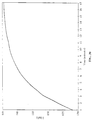
- the voltage in volts ( Figure 3a) and current in mA ( Figure 3b) were recorded as a function of time elapsed from operating the cell.
- the swelling of the non-liquid proton conductor membrane due to water formed during the operation of the fuel cell was visually estimated. Most of the swelling occurred within Ca. ten minutes post operation of the fuel cell. Swelling and therefore contact between the membrane and the electrodes has intensified after Ca. six minutes to a degree that it was practically impossible to separate them without causing irreversible damage to the cell.
- Example 5 The same procedure as described under Example 5 above was followed. PVA solution, polyvinylsulfonic acid sodium salt aqueous solution and Dowex powder are mixed and the Dowex filtered off. To the clear solution obtained, 50 mg of alumina powder filler are added and the mixture poured onto a flat surface and given to dry, resulting in a toughened membrane.
- a fuel cell as described under Example 2 above was prepared using this non-liquid proton conductor membrane. The cell yields an open circuit of 721 mV, a current of 800 mA/cm 2 can be maintained at 80 mV, while at a current of 225 mA/cm 2 , the voltage is 484 mV. All data were derived under ambient conditions.
- a fuel cell is prepared as described under example 2 above.
- the fuel cell thus prepared has an open circuit voltage of 600 mV, and a current of 200 mA/cm 2 can be maintained at a voltage of 327 mV. All data were derived under ambient conditions.
- Preparing hydrogen in situ may for example be by reacting a hydride compound (e.g., a metal hydride such as sodium hydride, a metal borohydride such as sodium borohydride, or a compound containing a metal hydride such as lithium aluminum hydride) or an elemental metal (e.g., sodium) with a compound that contains protons such as but not limited to water, acidic compounds, etc., in which reaction molecular hydrogen is released at ambient conditions.
- a hydride compound e.g., a metal hydride such as sodium hydride, a metal borohydride such as sodium borohydride, or a compound containing a metal hydride such as lithium aluminum hydride
- an elemental metal e.g., sodium
Landscapes
- Chemical & Material Sciences (AREA)
- Engineering & Computer Science (AREA)
- Chemical Kinetics & Catalysis (AREA)
- Electrochemistry (AREA)
- Power Engineering (AREA)
- Manufacturing & Machinery (AREA)
- General Chemical & Material Sciences (AREA)
- Life Sciences & Earth Sciences (AREA)
- Microelectronics & Electronic Packaging (AREA)
- Sustainable Energy (AREA)
- Sustainable Development (AREA)
- Health & Medical Sciences (AREA)
- Dispersion Chemistry (AREA)
- General Physics & Mathematics (AREA)
- Physics & Mathematics (AREA)
- Metallurgy (AREA)
- Condensed Matter Physics & Semiconductors (AREA)
- Organic Chemistry (AREA)
- Inorganic Chemistry (AREA)
- Materials Engineering (AREA)
- Molecular Biology (AREA)
- Analytical Chemistry (AREA)
- Biochemistry (AREA)
- General Health & Medical Sciences (AREA)
- Immunology (AREA)
- Pathology (AREA)
- Fuel Cell (AREA)
Claims (19)
- Ein elektrochemisches System, das bei Umgebungstemperaturen arbeitet, wobei das System folgende Merkmale aufweist:dadurch gekennzeichnet, daß das Matrixpolymer derart ausgewählt ist, daß während des Betriebs des Systems die nicht-flüssige Protonenleitermembran mit einem zweiten Lösungsmittel kontaktiert ist, was bewirkt, daß die nicht-flüssige Protonenleitermembran anschwillt und sich folglich der elektrische Kontakt verbessert, wobei das erste und zweite Lösungsmittel Wasser umfassen, und wobei das zweite Lösungsmittel zu dem System von außen zugefügt wird oder das elektrochemische System eine Brennstoffzelle ist und das zweite Lösungsmittel Wasser ist, das gebildet wird, während die Zelle in Betrieb ist.(a) eine Anodenplatte;(b) eine Kathodenplatte; und(c) eine nicht-flüssige Protonenleitermembran, die zwischen der Anodenplatte und der Kathodenplatte derart angeordnet ist, daß ein elektrischer Kontakt zwischen der Anodenplatte und der Kathodenplatte über die nicht-flüssige Protonenleitermembran gebildet ist und Ionen zwischen denselben fließen, wobei die nicht-flüssige Protonenleitermembran folgende Merkmale faßt:(i) ein Matrixpolymer, das in einem ersten Lösungsmittel löslich ist;(ii) ein acidisches Multimer, das in dem ersten Lösungsmittel löslich ist;
- Ein elektrochemisches System gemäß Anspruch 1, bei dem das Matrixpolymer aus der Gruppe ausgewählt ist, die aus Polyvinylidenfluorid, Polyhydroxyehtylen, Polyethylen-Imin, Polyacrylsäure, Polyethylenoxid, Poly-2-Ethyl-2-Oxazolin, Phenolformaldehydharze, Polyacrylamid, Poly-N-substituiertes Acrylamid, Poly-4-Vinylpyridin, Polymethacrylsäure, Poly-N-Vinylimidazol, Polyvinylsulfosäure, Poly-2-Vinylpyridin, Polyvinylpyrrolidon, Polyvinylphosphorsäure, ein Polymer mit einem hydrophil wirkendem Anteil, Agar-Agar, Agarose, Polyvinylalkohol und Mischungen derselben besteht.
- Ein elektrochemisches System gemäß Anspruch 1, bei dem das acidische Multimer durch eine Säuerung eines organischen Multimers erhalten wird.
- Ein elektrochemisches System gemäß Anspruch 3, bei dem das organische Multimer aus der Gruppe ausgewählt ist, die aus Polyolefinen, Polystyrenen, Phthalocyaninen, Porphyrinen, Nylon, Paraffinwachs und einem Vinylpolymer oder Copolymer mit einer Funktionsgruppe der Formel [-CH2-]n besteht.
- Ein elektrochemisches System gemäß Anspruch 1, bei dem das acidische Multimer durch eine Polymerisation oder Copolymerisation von Monomeren erhalten wird.
- Ein elektrochemisches System gemäß Anspruch 1, bei dem das acidische Multimer während der Vorbereitung der Membran in seiner Salzform vorliegt.
- Ein elektrochemisches System gemäß Anspruch 1, bei dem das acidische Multimer aus der Gruppe ausgewählt ist, die aus sulfoniertem Wachs, Polyvinylsulfosäure, Polyvinylphosphorsäure, sulfonierten Polyolefinen, sulfonierten Polystyrenen, sulfonierten Phthalocyaninen, sulfonierten Porphyrinen, Poly-2-Acrylamido-2-Methylpropansulfosäure, Polyacrylsäure und Polymethacrylsäure besteht.
- Ein elektrochemisches System gemäß Anspruch 1, bei dem das System eine Brennstoffzelle ist, wobei die Anodenplatte und die Kathodenplatte einen Katalysator enthalten, der aus der Gruppe ausgewählt, die aus Platin, Palladium, Rhodium, Ruthenium, Zinn, Kobalt, Chrom, Metall-Phthalocyaninen, Metall-Oporphyrenen und Mischungen derselben besteht.
- Ein elektrochemisches System gemäß Anspruch 1, bei dem das System eine Batterie ist, wobei die Anodenplatte eine Mischung eines ersten Bestandteils umfaßt, der aus der Gruppe ausgewählt ist, die aus Chloranilsäure und Verbindungen besteht, die Metallionen mit einem Redoxpotential, das zwischen -400 und +400 Millivolt gegen eine Standardwasserstoffelektrode liegt, enthält, und aus einem zweiten Bestandteil besteht, der aus der Gruppe ausgewählt ist, die aus schwarzem Acetylen, Formen von Karbon, wie schwarzes Karbon und aktiviertes Karbon, besteht, und bei dem die Kathodenplatte eine Mischung eines dritten Bestandteils umfaßt, der aus der Gruppe ausgewählt ist, die aus Verbindungen besteht, die Metallionen mit einem Redoxpotential höher als 1 Volt gegen die Standardwasserstoffelektrode enthält, und einen vierten Bestandteil umfaßt, der aus der Gruppe ausgewählt ist, die aus schwarzem Acetylen, Formen von Karbon, wie schwarzes Karbon und aktiviertes Karbon, besteht.
- Ein elektrochemisches System gemäß Anspruch 1, bei dem das System aus der Gruppe ausgewählt ist, die aus Batterien, Brennstoffzellen, Kodensatoren und elektrolytischen Apparaten besteht.
- Ein elektrochemisches System gemäß Anspruch 1, bei dem die nicht-flüssige Protonenleitermembran ferner ein Füllmaterial aufweist.
- Ein elektrochemisches System gemäß Anspruch 11, bei dem das Füllmaterial aus der Gruppe ausgewählt ist, die aus Aluminiumoxidpulver, Titandioxidpulver, Siliziumdioxidpulver, Zerdioxidpulver, Polyolefinpulver, Polystyrenpulver und deren versäuerten Derivaten besteht.
- Ein elektrochemisches System gemäß Anspruch 1, bei dem die nicht-flüssige Protonenleitermembran ferner Querverbindungen umfaßt, die mindestens zwischen Molekülen des Matrixpolymers gebildet sind.
- Ein elektrochemisches System gemäß Anspruch 1, bei dem die nicht-flüssige Protonenleitermembran ferner Querverbindungen umfaßt, die mindestens zwischen Molekülen des acidischen Multimers gebildet sind.
- Ein elektrochemisches System gemäß Anspruch 1, bei dem die nicht-flüssige Protonenleitermembran ferner Querverbindungen umfaßt, die mindestens zwischen Molekülen des acidischen Multimers und Molekülen des Matrixpolymers gebildet sind.
- Ein Verfahren zum Vorbereiten einer nicht-flüssigen Protonenleitermembran für eine Verwendung in elektrochemischen Systemen gemäß Anspruch 1, wobei das Verfahren folgende Schritte aufweist:gekennzeichnet durch Auswählen des Matrixpolymers derart, daß die nicht-flüssige Protonenleitermembran anschwillt und sich folglich der elektrische Kontakt verbessert, wenn die nicht-flüssige Protonenleitermembran während des Betriebs des Systems mit einem zweiten Lösungsmittel kontaktiert ist, Auswählen des ersten und zweiten Lösungsmittels derart, daß diese Wasser umfassen, und Anschwellen der Membran während der Verwendung in dem elektrochemischen System durch Zufügen des zweiten Lösungsmittels zu dem System von außen oder durch Auswählen des elektrochemischen Systems als eine Brennstoffzelle und Bilden von Wasser als das zweite Lösungsmittel, während die Zelle in Betrieb ist.(a) Lösen eines Matrixpolymers und eines acidischen Multimers in einem ersten Lösungsmittel, um eine homogene Lösung zu erhalten;(b) Gießen der homogenen Lösung auf eine Oberfläche; und(c) Verdampfen des ersten Lösungsmittels, um die nicht-flüssige Protonenleitermembran zu erhalten,
- Ein Verfahren gemäß Anspruch 16, das ferner den Schritt des Bildens von Querverbindungen innerhalb der nicht-flüssigen Protonenleitermembran aufweist.
- Ein Verfahren zum Vorbereiten eines elektrochemischen Systems, das aus der Gruppe ausgewählt ist, die aus Batterien, Brennstoffzellen, Kondensatoren und elektrolytischen Apparaten besteht, die bei Umgebungstemperaturen betrieben werden, wobei das Verfahren folgende Schritte aufweist:gekennzeichnet durch Auswählen des Matrixpolymers derart, daß die nicht-flüssige Protonenleitermembran anschwillt und sich folglich der elektrische Kontakt verbessert, wenn die nicht-flüssige Protonenleitermembran mit einem zweiten Lösungsmittel während des Betriebs des Systems kontaktiert ist, Auswählen des ersten und zweiten Lösungsmittels derart, daß diese Wasser umfassen, und Anschwellen der Membran während der Verwendung in dem elektrochemischen System durch Zufügen des zweiten Lösungsmittels zu dem System von außen oder durch Auswählen des elektrochemischen Systems als eine Brennstoffzelle und Bilden von Wasser als das zweite Lösungsmittel, während die Brennstoffzelle in Betrieb ist.(a) Lösen eines Matrixpolymers und eines acidischen Multimers in einem ersten Lösungsmittel, um eine homogene Lösung zu erhalten;(b) Gießen der homogenen Lösung auf eine Oberfläche;(c) Verdampfen des ersten Lösungsmittels und daher Erhalten einer nicht-flüssigen Protonenleitermembran; und(d) Anordnen der nicht-flüssigen Protonenleitermembran in einem elektrischen Kontakt zwischen einer Anodenplatte und einer Kathodenplatte;
- Ein Verfahren gemäß Anspruch 18, das ferner den Schritt des Bildens von Querverbindungen innerhalb der nicht-flüssigen Protonenleitermembran aufweist.
Applications Claiming Priority (2)
| Application Number | Priority Date | Filing Date | Title |
|---|---|---|---|
| US08/697,835 US5643689A (en) | 1996-08-28 | 1996-08-28 | Non-liquid proton conductors for use in electrochemical systems under ambient conditions |
| US697835 | 1996-08-28 |
Publications (2)
| Publication Number | Publication Date |
|---|---|
| EP0827228A1 EP0827228A1 (de) | 1998-03-04 |
| EP0827228B1 true EP0827228B1 (de) | 2000-03-29 |
Family
ID=24802774
Family Applications (1)
| Application Number | Title | Priority Date | Filing Date |
|---|---|---|---|
| EP97650029A Expired - Lifetime EP0827228B1 (de) | 1996-08-28 | 1997-07-29 | Feste protonenleitende Polymerelektrolyten für elektrochemische Systeme, die bei Raumtemperatur arbeiten |
Country Status (8)
| Country | Link |
|---|---|
| US (2) | US5643689A (de) |
| EP (1) | EP0827228B1 (de) |
| JP (1) | JPH10162846A (de) |
| KR (1) | KR100300483B1 (de) |
| AU (1) | AU717377B2 (de) |
| CA (1) | CA2212677A1 (de) |
| DE (1) | DE69701550T2 (de) |
| IL (1) | IL121405A (de) |
Families Citing this family (44)
| Publication number | Priority date | Publication date | Assignee | Title |
|---|---|---|---|---|
| US5731105A (en) * | 1993-09-07 | 1998-03-24 | E.C.R. - Electro-Chemical Research Ltd. | Battery electrochemical cell with a non-liquid electrolyte |
| US6444343B1 (en) * | 1996-11-18 | 2002-09-03 | University Of Southern California | Polymer electrolyte membranes for use in fuel cells |
| US6132904A (en) * | 1997-07-24 | 2000-10-17 | Sanyo Electric Co., Ltd. | Polyelectrolytic battery having a polyelectrolyte based on a polystyrene main chain and polyethylene oxide side chain |
| US6221523B1 (en) * | 1998-02-10 | 2001-04-24 | California Institute Of Technology | Direct deposit of catalyst on the membrane of direct feed fuel cells |
| WO1999044245A1 (en) | 1998-02-24 | 1999-09-02 | Ramot University Authority For Applied Research & Industrial Development Ltd. | Ion conductive matrixes and their use |
| DE19816622A1 (de) * | 1998-04-15 | 1999-10-21 | Degussa | Brennstoffzellenanode für die Oxidation von Methanol |
| JP2000011756A (ja) * | 1998-06-22 | 2000-01-14 | Toyota Central Res & Dev Lab Inc | 高耐久性固体高分子電解質 |
| US20040209965A1 (en) * | 1998-10-16 | 2004-10-21 | Gascoyne John Malcolm | Process for preparing a solid polymer electrolyte membrane |
| DE19857398B4 (de) * | 1998-12-12 | 2010-07-08 | GM Global Technology Operations, Inc., Detroit | Brennstoffzellensystem, insbesondere für elektromotorisch angetriebene Fahrzeuge |
| EP1171924B1 (de) * | 1999-01-22 | 2007-10-03 | University Of Southern California | Verbesserter membranelektrodenaufbau für brennstoffzelle |
| DE19917813A1 (de) * | 1999-04-20 | 2000-10-26 | Siemens Ag | Membranelektrolyt für eine Hochtemperatur-Membran-Brennstoffzelle und Verfahren zu seiner Herstellung |
| US6277512B1 (en) * | 1999-06-18 | 2001-08-21 | 3M Innovative Properties Company | Polymer electrolyte membranes from mixed dispersions |
| US6523699B1 (en) | 1999-09-20 | 2003-02-25 | Honda Giken Kogyo Kabushiki Kaisha | Sulfonic acid group-containing polyvinyl alcohol, solid polymer electrolyte, composite polymer membrane, method for producing the same and electrode |
| US6720109B1 (en) | 1999-10-07 | 2004-04-13 | Showa Denko K. K. | Secondary battery and material therefor |
| JP2001110423A (ja) * | 1999-10-07 | 2001-04-20 | Showa Denko Kk | 二次電池及びその材料 |
| US6426863B1 (en) * | 1999-11-25 | 2002-07-30 | Lithium Power Technologies, Inc. | Electrochemical capacitor |
| JP3656244B2 (ja) | 1999-11-29 | 2005-06-08 | 株式会社豊田中央研究所 | 高耐久性固体高分子電解質及びその高耐久性固体高分子電解質を用いた電極−電解質接合体並びにその電極−電解質接合体を用いた電気化学デバイス |
| CN101127401A (zh) * | 2000-10-19 | 2008-02-20 | 佳能株式会社 | 含有磷酸基的固体高分子电解质(复合)膜及其制造方法 |
| US7318972B2 (en) * | 2001-09-07 | 2008-01-15 | Itm Power Ltd. | Hydrophilic polymers and their use in electrochemical cells |
| EP1444748B1 (de) * | 2001-10-15 | 2008-08-13 | E.I. Du Pont De Nemours And Company | Festpolymermembran für eine brennstoffzelle mit darin eingebettetem polyvinylamin für verringerte methanoldurchlässigkeit |
| US6982128B2 (en) | 2002-01-28 | 2006-01-03 | Hewlett-Packard Development Company, L.P. | Co-catalyst proton exchange membrane fuel cell utilizing borohydride fuels |
| US20050053818A1 (en) * | 2002-03-28 | 2005-03-10 | Marc St-Arnaud | Ion exchange composite material based on proton conductive functionalized inorganic support compounds in a polymer matrix |
| GB0211164D0 (en) * | 2002-05-16 | 2002-06-26 | Accentus Plc | Electrochemical cell assembly |
| JP4467227B2 (ja) * | 2002-08-12 | 2010-05-26 | ユニケミカル株式会社 | 高耐久性固体高分子電解質(複合)膜 |
| US20040229108A1 (en) * | 2002-11-08 | 2004-11-18 | Valdez Thomas I. | Anode structure for direct methanol fuel cell |
| US7282291B2 (en) * | 2002-11-25 | 2007-10-16 | California Institute Of Technology | Water free proton conducting membranes based on poly-4-vinylpyridinebisulfate for fuel cells |
| DE10301810A1 (de) * | 2003-01-20 | 2004-07-29 | Sartorius Ag | Membran-Elektroden-Einheit, Polymermembranen für eine Membran-Elektroden-Einheit und Polymerelektrolyt-Brennstoffzellen sowie Verfahren zur Herstellung derselben |
| US7115333B2 (en) * | 2003-02-07 | 2006-10-03 | Gas Technology Institute | High temperature composite proton exchange membranes |
| US7020562B2 (en) * | 2003-03-31 | 2006-03-28 | Proton Energy Systems, Inc. | Method of monitoring the operation of gas sensor and system therefor |
| US20040247977A1 (en) * | 2003-06-06 | 2004-12-09 | Steven Holdcroft | Electrochemical cell and fuel cell with curable liquid electrolyte |
| US20040259001A1 (en) * | 2003-06-19 | 2004-12-23 | Mclean Gerard Francis | Method of making an electrochemical cell |
| US20040258990A1 (en) * | 2003-06-19 | 2004-12-23 | Mclean Gerard Francis | Electrochemical cell with curable liquid electrolyte and method of making |
| GB0329459D0 (en) * | 2003-12-19 | 2004-01-28 | Itm Power Ltd | Hydrophilic materials used as ionically active membranes |
| JP3928052B2 (ja) * | 2004-02-09 | 2007-06-13 | 独立行政法人産業技術総合研究所 | 標準電極 |
| JP2006114277A (ja) * | 2004-10-13 | 2006-04-27 | Toyota Motor Corp | プロトン伝導材料、固体高分子電解質膜、及び燃料電池 |
| EP1897166A2 (de) * | 2005-06-27 | 2008-03-12 | ITM Power (Research) Limited | Membran-elektroden-baugruppen |
| KR100696672B1 (ko) * | 2006-04-19 | 2007-03-19 | 삼성에스디아이 주식회사 | 혼합 주입형 연료 전지용 스택 및 이를 포함하는 혼합주입형 연료 전지 시스템 |
| GB0611736D0 (en) * | 2006-06-14 | 2006-07-26 | Johnson Matthey Plc | Ion-conducting membrane |
| JP4586794B2 (ja) * | 2006-11-07 | 2010-11-24 | トヨタ自動車株式会社 | 固体高分子電解質並びにその製造方法及びこれを用いた燃料電池用膜・電極接合体 |
| US20100141211A1 (en) * | 2008-11-04 | 2010-06-10 | Rachid Yazami | Hybrid electrochemical generator with a soluble anode |
| US8409765B2 (en) * | 2009-08-31 | 2013-04-02 | GM Global Technology Operations LLC | Co(II)tetramethoxyphenylporphyrin additive to PFSA PEMS for improved fuel cell durability |
| US20130149589A1 (en) * | 2011-12-07 | 2013-06-13 | Oliver Gronwald | Electrochemical cells comprising a nitrogen-containing polymer |
| US10000385B2 (en) | 2013-04-02 | 2018-06-19 | Israzion Ltd. | Process of converting textile or plastic solid waste into activated carbon |
| WO2016002176A1 (ja) * | 2014-07-03 | 2016-01-07 | パナソニックIpマネジメント株式会社 | 電解コンデンサの製造方法 |
Family Cites Families (19)
| Publication number | Priority date | Publication date | Assignee | Title |
|---|---|---|---|---|
| US3265536A (en) * | 1962-12-11 | 1966-08-09 | American Cyanamid Co | Alkali saturated cross-linked polyvinyl alcohol membranes and fuel cell with same |
| US4089816A (en) * | 1973-09-19 | 1978-05-16 | Sumitomo Chemical Company, Limited | Cation exchanger |
| US4024036A (en) * | 1975-02-03 | 1977-05-17 | Agency Of Industrial Science & Technology | Proton permselective solid-state member and apparatus utilizing said permselective member |
| US4179491A (en) * | 1976-11-15 | 1979-12-18 | National Research Development Corporation | Electrical device with separator as conductor for hydrogen cations |
| US4306774A (en) * | 1978-10-04 | 1981-12-22 | Rockwell International Corporation | Solid state electrochromic display |
| JPS6030069B2 (ja) * | 1980-11-14 | 1985-07-13 | 工業技術院長 | 化学エネルギ−を電気エネルギ−に変換する方法 |
| JPS60143575A (ja) * | 1983-12-28 | 1985-07-29 | Matsushita Electric Ind Co Ltd | 熱を電気に変換する装置 |
| US4594297A (en) * | 1983-12-29 | 1986-06-10 | Uop Inc. | Fuel cell using novel electrolyte membrane |
| US4664761A (en) * | 1985-12-27 | 1987-05-12 | Uop Inc. | Electrochemical method and apparatus using proton-conducting polymers |
| JPH04101360A (ja) * | 1990-08-20 | 1992-04-02 | Matsushita Electric Ind Co Ltd | 固体電解質型燃料電池の作製法 |
| EP0549670B1 (de) * | 1990-09-20 | 1995-11-29 | Scimat Limited | Polymermembran |
| JPH04345762A (ja) * | 1991-05-24 | 1992-12-01 | Nippon Telegr & Teleph Corp <Ntt> | ガス分離膜式燃料電池 |
| US5272017A (en) * | 1992-04-03 | 1993-12-21 | General Motors Corporation | Membrane-electrode assemblies for electrochemical cells |
| JPH06231778A (ja) * | 1993-01-29 | 1994-08-19 | Asahi Glass Co Ltd | 固体高分子電解質型燃料電池 |
| JPH06325787A (ja) * | 1993-05-12 | 1994-11-25 | Nippon Telegr & Teleph Corp <Ntt> | 固体電解質型燃料電池 |
| US5422411A (en) * | 1993-09-21 | 1995-06-06 | Ballard Power Systems Inc. | Trifluorostyrene and substituted trifluorostyrene copolymeric compositions and ion-exchange membranes formed therefrom |
| JP3111817B2 (ja) * | 1994-07-07 | 2000-11-27 | 信越化学工業株式会社 | プロトン導電性高分子固体電解質 |
| US5523177A (en) * | 1994-10-12 | 1996-06-04 | Giner, Inc. | Membrane-electrode assembly for a direct methanol fuel cell |
| US5525436A (en) * | 1994-11-01 | 1996-06-11 | Case Western Reserve University | Proton conducting polymers used as membranes |
-
1996
- 1996-08-28 US US08/697,835 patent/US5643689A/en not_active Expired - Fee Related
-
1997
- 1997-02-26 US US08/805,414 patent/US5741611A/en not_active Expired - Fee Related
- 1997-07-27 IL IL12140597A patent/IL121405A/xx not_active IP Right Cessation
- 1997-07-29 DE DE69701550T patent/DE69701550T2/de not_active Expired - Fee Related
- 1997-07-29 EP EP97650029A patent/EP0827228B1/de not_active Expired - Lifetime
- 1997-08-11 CA CA002212677A patent/CA2212677A1/en not_active Abandoned
- 1997-08-19 AU AU34284/97A patent/AU717377B2/en not_active Ceased
- 1997-08-28 KR KR1019970041815A patent/KR100300483B1/ko not_active Expired - Fee Related
- 1997-08-28 JP JP9232298A patent/JPH10162846A/ja active Pending
Also Published As
| Publication number | Publication date |
|---|---|
| US5741611A (en) | 1998-04-21 |
| AU717377B2 (en) | 2000-03-23 |
| AU3428497A (en) | 1999-03-04 |
| KR19980019091A (ko) | 1998-06-05 |
| DE69701550T2 (de) | 2001-01-04 |
| US5643689A (en) | 1997-07-01 |
| IL121405A0 (en) | 1998-01-04 |
| DE69701550D1 (de) | 2000-05-04 |
| JPH10162846A (ja) | 1998-06-19 |
| KR100300483B1 (ko) | 2002-06-20 |
| CA2212677A1 (en) | 1998-02-28 |
| EP0827228A1 (de) | 1998-03-04 |
| IL121405A (en) | 2000-06-29 |
Similar Documents
| Publication | Publication Date | Title |
|---|---|---|
| EP0827228B1 (de) | Feste protonenleitende Polymerelektrolyten für elektrochemische Systeme, die bei Raumtemperatur arbeiten | |
| US5346780A (en) | Fuel cell and method for producing an electrode used therefor | |
| US6387230B1 (en) | Composite membrane suitable for use in electrochemical devices | |
| JP3795920B2 (ja) | 有機燃料電池 | |
| US5294232A (en) | Process of preparing solid polymer electrolyte type fuel cell | |
| JP5150895B2 (ja) | 膜電極接合体及び膜電極接合体の製造方法並びに固体高分子形燃料電池 | |
| US6444343B1 (en) | Polymer electrolyte membranes for use in fuel cells | |
| US8652704B2 (en) | Direct alcohol fuel cell with cathode catalyst layer containing silver and method for producing the same | |
| JP4791822B2 (ja) | 電解質膜、その製造方法、膜電極複合体及びそれを用いた燃料電池 | |
| US7494733B2 (en) | Electrode structure for solid polymer fuel cell, its production method, and solid polymer fuel cell | |
| CA2085549A1 (en) | Fuel cell and electrolyte membrane therefor | |
| JPH0536418A (ja) | 固体高分子電解質型燃料電池およびその製造方法 | |
| KR101549525B1 (ko) | 레독스 흐름전지용 바나듐 이온 저투과성 양쪽성 이온 교환막 및 이를 포함하는 레독스 흐름전지 | |
| JPH0676838A (ja) | イオン交換膜型燃料電池およびその製造方法 | |
| JPS6261119B2 (de) | ||
| KR100947781B1 (ko) | 수용성 고분자 및 가교성 멀티블록 공중합체를 이용한전해질 막 | |
| JP3261425B2 (ja) | 固体イオン導電体 | |
| JP2002305007A (ja) | 固体高分子型燃料電池 | |
| JPH027398B2 (de) | ||
| JP2002298858A (ja) | 固体高分子型燃料電池 | |
| JPH027400B2 (de) | ||
| JP2003045450A (ja) | 固体高分子型燃料電池用電極構造体 | |
| CN116315317A (zh) | 一种锌空气电池及其制备方法 | |
| JPH01167956A (ja) | 電極 | |
| JPS63148559A (ja) | 臭素吸収電極の製造方法 |
Legal Events
| Date | Code | Title | Description |
|---|---|---|---|
| PUAI | Public reference made under article 153(3) epc to a published international application that has entered the european phase |
Free format text: ORIGINAL CODE: 0009012 |
|
| AK | Designated contracting states |
Kind code of ref document: A1 Designated state(s): DE FR GB IT |
|
| AX | Request for extension of the european patent |
Free format text: AL;LT;LV;RO;SI |
|
| 17P | Request for examination filed |
Effective date: 19980316 |
|
| 17Q | First examination report despatched |
Effective date: 19980504 |
|
| AKX | Designation fees paid |
Free format text: DE FR GB IT |
|
| RBV | Designated contracting states (corrected) |
Designated state(s): DE FR GB IT |
|
| GRAG | Despatch of communication of intention to grant |
Free format text: ORIGINAL CODE: EPIDOS AGRA |
|
| GRAG | Despatch of communication of intention to grant |
Free format text: ORIGINAL CODE: EPIDOS AGRA |
|
| GRAG | Despatch of communication of intention to grant |
Free format text: ORIGINAL CODE: EPIDOS AGRA |
|
| GRAH | Despatch of communication of intention to grant a patent |
Free format text: ORIGINAL CODE: EPIDOS IGRA |
|
| GRAH | Despatch of communication of intention to grant a patent |
Free format text: ORIGINAL CODE: EPIDOS IGRA |
|
| GRAA | (expected) grant |
Free format text: ORIGINAL CODE: 0009210 |
|
| AK | Designated contracting states |
Kind code of ref document: B1 Designated state(s): DE FR GB IT |
|
| REF | Corresponds to: |
Ref document number: 69701550 Country of ref document: DE Date of ref document: 20000504 |
|
| ITF | It: translation for a ep patent filed | ||
| ET | Fr: translation filed | ||
| PLBE | No opposition filed within time limit |
Free format text: ORIGINAL CODE: 0009261 |
|
| STAA | Information on the status of an ep patent application or granted ep patent |
Free format text: STATUS: NO OPPOSITION FILED WITHIN TIME LIMIT |
|
| 26N | No opposition filed | ||
| REG | Reference to a national code |
Ref country code: GB Ref legal event code: IF02 |
|
| PGFP | Annual fee paid to national office [announced via postgrant information from national office to epo] |
Ref country code: FR Payment date: 20020528 Year of fee payment: 6 |
|
| PGFP | Annual fee paid to national office [announced via postgrant information from national office to epo] |
Ref country code: GB Payment date: 20030612 Year of fee payment: 7 |
|
| PGFP | Annual fee paid to national office [announced via postgrant information from national office to epo] |
Ref country code: DE Payment date: 20030731 Year of fee payment: 7 |
|
| PG25 | Lapsed in a contracting state [announced via postgrant information from national office to epo] |
Ref country code: FR Free format text: LAPSE BECAUSE OF NON-PAYMENT OF DUE FEES Effective date: 20040331 |
|
| REG | Reference to a national code |
Ref country code: FR Ref legal event code: ST |
|
| PG25 | Lapsed in a contracting state [announced via postgrant information from national office to epo] |
Ref country code: GB Free format text: LAPSE BECAUSE OF NON-PAYMENT OF DUE FEES Effective date: 20040729 |
|
| PG25 | Lapsed in a contracting state [announced via postgrant information from national office to epo] |
Ref country code: DE Free format text: LAPSE BECAUSE OF NON-PAYMENT OF DUE FEES Effective date: 20050201 |
|
| GBPC | Gb: european patent ceased through non-payment of renewal fee |
Effective date: 20040729 |
|
| PG25 | Lapsed in a contracting state [announced via postgrant information from national office to epo] |
Ref country code: IT Free format text: LAPSE BECAUSE OF NON-PAYMENT OF DUE FEES Effective date: 20050729 |