EP0835698B1 - Bande d'acier inoxydable laminée à chaud et procédé pour sa fabrication - Google Patents
Bande d'acier inoxydable laminée à chaud et procédé pour sa fabrication Download PDFInfo
- Publication number
- EP0835698B1 EP0835698B1 EP97307720A EP97307720A EP0835698B1 EP 0835698 B1 EP0835698 B1 EP 0835698B1 EP 97307720 A EP97307720 A EP 97307720A EP 97307720 A EP97307720 A EP 97307720A EP 0835698 B1 EP0835698 B1 EP 0835698B1
- Authority
- EP
- European Patent Office
- Prior art keywords
- hot
- rolling
- steel strip
- scale
- thickness
- Prior art date
- Legal status (The legal status is an assumption and is not a legal conclusion. Google has not performed a legal analysis and makes no representation as to the accuracy of the status listed.)
- Expired - Lifetime
Links
Images

Classifications
-
- B—PERFORMING OPERATIONS; TRANSPORTING
- B21—MECHANICAL METAL-WORKING WITHOUT ESSENTIALLY REMOVING MATERIAL; PUNCHING METAL
- B21B—ROLLING OF METAL
- B21B45/00—Devices for surface or other treatment of work, specially combined with or arranged in, or specially adapted for use in connection with, metal-rolling mills
- B21B45/04—Devices for surface or other treatment of work, specially combined with or arranged in, or specially adapted for use in connection with, metal-rolling mills for de-scaling, e.g. by brushing
- B21B45/06—Devices for surface or other treatment of work, specially combined with or arranged in, or specially adapted for use in connection with, metal-rolling mills for de-scaling, e.g. by brushing of strip material
-
- C—CHEMISTRY; METALLURGY
- C21—METALLURGY OF IRON
- C21D—MODIFYING THE PHYSICAL STRUCTURE OF FERROUS METALS; GENERAL DEVICES FOR HEAT TREATMENT OF FERROUS OR NON-FERROUS METALS OR ALLOYS; MAKING METAL MALLEABLE, e.g. BY DECARBURISATION OR TEMPERING
- C21D8/00—Modifying the physical properties of ferrous metals or ferrous alloys by deformation combined with, or followed by, heat treatment
- C21D8/02—Modifying the physical properties of ferrous metals or ferrous alloys by deformation combined with, or followed by, heat treatment during manufacturing of plates or strips
-
- B—PERFORMING OPERATIONS; TRANSPORTING
- B21—MECHANICAL METAL-WORKING WITHOUT ESSENTIALLY REMOVING MATERIAL; PUNCHING METAL
- B21B—ROLLING OF METAL
- B21B3/00—Rolling materials of special alloys so far as the composition of the alloy requires or permits special rolling methods or sequences ; Rolling of aluminium, copper, zinc or other non-ferrous metals
- B21B3/02—Rolling special iron alloys, e.g. stainless steel
-
- B—PERFORMING OPERATIONS; TRANSPORTING
- B21—MECHANICAL METAL-WORKING WITHOUT ESSENTIALLY REMOVING MATERIAL; PUNCHING METAL
- B21B—ROLLING OF METAL
- B21B45/00—Devices for surface or other treatment of work, specially combined with or arranged in, or specially adapted for use in connection with, metal-rolling mills
-
- B—PERFORMING OPERATIONS; TRANSPORTING
- B21—MECHANICAL METAL-WORKING WITHOUT ESSENTIALLY REMOVING MATERIAL; PUNCHING METAL
- B21B—ROLLING OF METAL
- B21B45/00—Devices for surface or other treatment of work, specially combined with or arranged in, or specially adapted for use in connection with, metal-rolling mills
- B21B45/04—Devices for surface or other treatment of work, specially combined with or arranged in, or specially adapted for use in connection with, metal-rolling mills for de-scaling, e.g. by brushing
- B21B45/08—Devices for surface or other treatment of work, specially combined with or arranged in, or specially adapted for use in connection with, metal-rolling mills for de-scaling, e.g. by brushing hydraulically
-
- C—CHEMISTRY; METALLURGY
- C21—METALLURGY OF IRON
- C21D—MODIFYING THE PHYSICAL STRUCTURE OF FERROUS METALS; GENERAL DEVICES FOR HEAT TREATMENT OF FERROUS OR NON-FERROUS METALS OR ALLOYS; MAKING METAL MALLEABLE, e.g. BY DECARBURISATION OR TEMPERING
- C21D8/00—Modifying the physical properties of ferrous metals or ferrous alloys by deformation combined with, or followed by, heat treatment
- C21D8/02—Modifying the physical properties of ferrous metals or ferrous alloys by deformation combined with, or followed by, heat treatment during manufacturing of plates or strips
- C21D8/0278—Modifying the physical properties of ferrous metals or ferrous alloys by deformation combined with, or followed by, heat treatment during manufacturing of plates or strips involving a particular surface treatment
Definitions
- the present invention relates to a hot-rolled stainless steel strip (a generic term including steel sheet), and a method for producing the same. More particularly, the present invention relates to a hot-rolled stainless steel strip which can be worked by bending, drawing, etc., without first descaling the strip by pickling after hot-rolling, and which has excellent descalability if pickling is to be performed, as well as excellent surface properties after descaling, and a production method for such steel strip.
- a hot-rolled stainless steel strip is generally produced by hot-rolling a steel slab formed by continuous casting after heating at about 1100 to 1300°C.
- the hot-rolled stainless steel strip is then subjected to continuous or batch annealing or passed through sulfuric acid bath and mixed nitric acid/hydrofluoric acid bath for pickling without annealing, and then cold-rolled to form a cold-rolled stainless steel strip.
- the cold-rolled stainless steel strip is further annealed and pickled, and then used for various applications.
- the hot-rolled stainless steel strip is annealed, pickled and then used for various applications without cold-rolling.
- a Fe-Cr oxide layer mainly comprising (Fe,Cr) 2 O 3 and (Fe,Cr) 3 O 4 is formed on the surface of the steel strip during hot rolling, and an intermediate oxide layer comprising SiO 2 is formed at the interface of the Fe-Cr oxide layer and the alloy substitute, due to Si present in the steel.
- Cold rolling after annealing of the hot-rolled steel strip having such oxide layers (scales) causes peeling of the scales during rolling, thereby damaging the cold rolling roll and causing bite defects in the surface of the strip.
- a pickling step is performed after the hot rolling step in a production line for stainless steel.
- the scales of the hot-rolled stainless steel strip are dense and have poor descalability by pickling, the pickling rate must be decreased, thereby decreasing productivity.
- shot blasting in which the scales are cracked by spraying hard fine particles (shot particles) on the surface of the steel strip under high pressure, is frequently performed before pickling.
- shots blast marks unevenness
- the surface of the shot-blast strip and thus the surface roughness is increased, thereby deteriorating surface quality. It is therefore difficult to use a pickled hot-rolled stainless steel strip as a substitute for a cold-rolled steel strip.
- Japanese Patent Unexamined Publication Nos. 58-53323, 59-97710 and 61-123403 disclose a method comprising providing a box whose interior has a controlled atmosphere of inert gas or reducing gas in the region between the outlet side of a final rolling mill and a coiler, with the hot-rolled steel strip being passed through the box after rolling.
- Japanese Patent Unexamined Publication No. 6-71330 discloses a method of descaling an austenitic stainless steel sheet by spraying high-pressure water on the surface of the steel sheet at an impact pressure of 20 to 180 g/mm 2 and a flow rate of 0.1 to 0.6 l/(min ⁇ mm 2 ) before hot finish rolling.
- this method can decrease the amount of scale defects caused mainly by Si oxides, it cannot completely eliminate the scale defects. Also, this method does not permit increasing the pickling rate or achieving pickling without shot blasting.
- Japanese Patent Unexamined Publication No. 8-108210 discloses a method of producing a hot-rolled ferritic stainless steel strip comprising descaling by spraying high-pressure water on the surface of the steel strip with impact energy (kJ/m 2 )of [-6.00 x 10 - 6T + 8.60 x 10] or more, wherein T indicates the temperature (°C) of the steel strip immediately before descaling, between the end of hot finish rolling and coiling.
- this method requires a high flow rate of water for obtaining high impact energy, and has the drawback of significantly increasing the size of the associated equipment. Also, since high-pressure water is sprayed after the steel strip is thinned, the surface of the steel strip is locally deformed, and thus the shape of the steel strip becomes unstable, thereby causing difficulty during rolling in some cases.
- a hot-rolled stainless steel strip having scales can be used for applications in which little attention is given to the surface properties, then the pickling step can be omitted, and thus significant cost reduction is expected.
- the hot-rolled stainless steel strip having scales produced by a conventional process is subjected to molding using a mold, such as bending, drawing, or the like, the scales are partially peeled off, thereby causing the problem of deteriorating the life of the mold and polluting the working environment due to the scattered dust.
- An object of the present invention is to solve the above problems of conventional materials and techniques by providing a hot-rolled stainless steel strip having scale adherence which causes neither peeling nor dust even if the steel strip having scales is worked, a grade of descalability which requires no shot blasting before pickling, and excellent surface quality without baking defects; as well as a method for producing such steel strip.
- the thickness of hot rolling scales and the thickness of the Si-containing oxide layer formed in the scale/alloy substitute interface are important for descalability in the pickling step using sulfuric acid-nitric acid/hydrofluoric acid subsequent to a hot rolling step, and shot blasting can be omitted by decreasing the scale thickness to 2.5 ⁇ m or less and the thickness of the Si oxide layer to 0.1 ⁇ m or less.
- the inventors further studied phenomena associated with the hot rolling conditions, particularly conditions of descaling before hot finish rolling and conditions of subsequent hot finish rolling. As a result, when superhigh pressure descaling was practiced, which has not heretofore been performed, and subsequent hot finish rolling was appropriately carried out, the scale thickness on the surface of the hot-rolled steel strip could be decreased to 2.5 ⁇ m or less, and the thickness of the Si oxide layer could be decreased to 0.1 ⁇ m or less.
- this method does not produce baking defects which occur in conventional hot finish rolling after descaling using such superhigh pressure water, and can produce hot-rolled stainless steel having excellent surface quality.
- a hot-rolled stainless steel strip of the present invention contains at least 10 wt% Cr and not more than 1.0 wt% Si, the oxide scale layer formed on the surface thereof has an average thickness of 2.5 ⁇ m or less, and the Si-containing oxide layer formed at the scale/alloy substitute interface has a thickness of 0.1 ⁇ m or less.
- the scale thickness of the surface layer of the steel strip be not more than about 2.5 ⁇ m.
- the Cr content of the stainless steel is less than 10 wt%, it is difficult to obtain a scale structure having a thickness of 2.5 ⁇ m or less, and the corrosion resistance initially possessed by stainless steel is insufficient. Therefore, the Cr content is preferably 10 wt% or more.
- the upper limit of the Cr content is preferably about 30 wt% for reasons of economy.
- the Si content of the alloy base exceeds about 1.0 wt%, the thickness of the Si-containing oxide layer will exceed 0.1 ⁇ m even after hot rolling at an elongation rate of 150 or more. Therefore, the Si content of steel is preferably 1.0 wt% or less. The lower limit of the Si content is preferably about 0.1 wt% because Si is an element effective for deoxidizing steel and improving the oxidation resistance at high temperatures.
- Average thickness of the oxide scale layer on the surface of the steel strip 2.5 ⁇ m or less
- the scale thickness possibly affects the permeation force of an acid which reaches the alloy substitute through fine cracks produced in the scales due to rebending after hot rolling and bending strain of the strip introduced in the annealing process.
- Average thickness of the Si-containing oxide layer 0.1 ⁇ m or less
- the descalability greatly depends upon the total thickness of the scales and the thickness of the Si-containing oxide layer (considered as a SiO 2 layer) formed at the scale/alloy substitute interface. If the average thickness of the Si-containing oxide layer (considered as a SiO 2 layer) exceeds 0.1 ⁇ m, the descalability significantly deteriorates, and thus mechanical descaling such as shot blasting or the like is required before pickling. With an average thickness of 0.1 ⁇ m or less, the descalability is improved to an extent which eliminates the need for mechanical descaling.
- the average thickness of all scales is 2.5 ⁇ m or less, and the average thickness of the Si-containing oxide layer is 0.1 ⁇ m or less.
- the exact reasons why the thicknesses can be controlled as described above by hot-rolling at an elongation rate of 150 or higher are not presently known.
- the thickness of the scale surface layer is decreased to 2.5 ⁇ m or less, it is thought that surface scales are elongated under the hot-rolling condition of a high elongation rate, and the scale thickness decreases as rolling proceeds. It is also thought that in hot rolling at an elongation rate of as high as 150 or higher, which has not previously been used, scales are partially cracked in the later stage of hot rolling, scales are newly produced in the surface of the alloy substitute newly exposed in the cracked portion, and the new scales finally become thinner than the scales produced before cracking.
- the Si-containing oxide layer is produced and grown during heating of the slab at a temperature of 1100°C or more, which is the temperature of the initial stage (rough rolling) of hot rolling, but is scarcely further produced in the temperature region (about 600 to 1010°C) of the later stage (finish rolling) of hot rolling.
- the possible reasons why such a thin Si-containing oxide layer is present after coiling is that the initial Si-containing oxide layer is thinned by elongation as described above, and also a new Si-containing oxide layer is scarcely produced in the exposed surface of the alloy substitute in the cracks produced in the later stage of hot rolling.
- the upper limit of the elongation rate is not particularly limited within the allowable range of the rolling ability of hot-rolling equipment.
- a second method comprises hot rough rolling of a stainless steel slab having a composition containing 10 wt% or more of Cr and 1.0 wt% or less of Si to form a sheet bar, spraying superhigh pressure water on the surface of the sheet bar at impact pressure (p) per unit spray area of 25 kgf/cm 2 or more, which is represented by equation (2) below, and a flow rate density of 0.002 l/m 2 or more, and then performing finish rolling in such a matter that the maximum reduction ratio R per pass satisfies equation (3) below, to control the average thickness of the oxide scale layer formed on the surface of the steel strip to 2.5 ⁇ m or less, and the average thickness of the Si-containing oxide layer formed at the interface of the scale layer and the alloy substitute to 0.1 ⁇ m or less.
- p 5.64 PQ/H 2
- slab heating is preferably done in a temperature range of 1050 to 1300°C.
- superhigh pressure water is sprayed on the surface of the sheet bar.
- Descaling is performed by using superhigh pressure water spray at an impact pressure of 25 kgf/cm 2 or more per unit spray area and a flow rate density of 0.002 l/cm 2 or more.
- the flow rate density used in the present invention represents the total amount of water supplied per unit area of the sheet bar in descaling.
- the descaled sheet bar is then subjected to hot finish rolling to form a hot-rolled steel strip.
- hot finish rolling is appropriately controlled so as to prevent the occurrence of baking and seizing between the finish rolling roll and the surface of the steel strip.
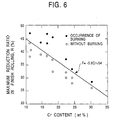
- finish rolling is controlled according to the Cr content of the material so that the maximum reduction ratio R per pass during hot finish rolling satisfies the equation (3).
- the maximum reduction ratio R per pass does not satisfy equation (3), baking occurs.
- the Cr content of the material is possibly related to the amount of the scaled produced, and the adhesion between the roll surface and the new exposed surface of the steel strip in the roll bite.
- the conditions for hot finish rolling other than the reduction ratio per pass for example, the rolling temperature, the coiling temperature, etc., can be selected according to desired material properties. Although not limited, a decrease in the finish rolling temperature increases the rolling load, and adversely affects passage properties and the rolling mill. Therefore, for example, the finish rolling temperature for steel having an austenite texture is preferably 950°C or more, and the finish rolling temperature for steel having a ferritic texture is preferably 700°C or more.
- Slabs having the various thicknesses shown in Table 2-1 and 2-2 were produced by continuous casting of the stainless steel compositions shown in Table 1, hot-rolled at the various elongation rates shown in Table 2-1, 2-2, and then coiled to obtain hot-rolled steel sheets having the various thicknesses shown in Table 2-1, 2-2.
- the slab heating temperatures were 1150°C (steel A-1), 1200°C (steel B-1) and 1100°C (steels C-1, D-1 and E-1), respectively, and the coiling temperatures for all sheets were 800°C.
- a steel sheet was cut off from the top end of coil in the lengthwise direction, the middle of coil and the tail end of coil of each hot-rolled coil.
- a sample was obtained from a half width (the center of the width) in the transverse direction, a 1/4 width and a distance of 30 mm from the edge of the coil.
- the scales of the samples were measured, and an average scale thickness was determined.
- a polished section of each of the samples which were cut out from the hot-rolled steel sheet was observed by SEM(Scanning type Electron microscope), and the distance between the scale surface and the surface of the alloy substitute was directly measured from the photographic image to obtain a value as the scale thickness.
- the composition of the scale layer was further analyzed by AES(Auger Electron Spectro.scopy) analysis, and the thickness of a layer from which a Si peak was detected was measured as the thickness of the Si-containing oxide layer. Furthermore, an SiO 2 peak was observed in X-ray diffraction of the scale layer. Therefore, the Si-containing oxide layer was considered as an SiO 2 layer.
- the scale adherence during working was evaluated by the amount of scale peeling.
- a tensile test piece of 10 mm width x 100 mm length was cut from the hot-rolled steel sheet in the rolling direction, and adhesive tape was adhered to the front and back sides of a gage mark portion (10 mm x 20 mm) of the test piece. After 10% tensile working, the tapes were peeled off, and an increase in the weight of the tapes after peeling was measured.
- the descalability was evaluated by the following method.
- a test piece (100 ⁇ 100mm) was cut from the hot-rolled steel sheet, pickled with sulfuric acid (H 2 SO 4 [200 g/l]) and a mixed acid (HNO 3 [150 g/l] + HF [25 g/l]) in a laboratory. After pickling, the sheet surface was visually inspected, and evaluation was made on the basis of the following four grades:
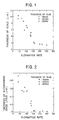
- Figs. 1, 2, 3 and 4 show the relations of the elongation rate of the hot-rolled steel sheet obtained by hot-rolling a slab of steel A-1 (TYPE 430 [16Cr-0.06C]; Nos. 1-1 to 1-15) to the scale thickness, the thickness of the Si-containing oxide layer, the amount of the scales peeled and the descalability, respectively.
- the thicknesses of the scales and the Si-containing oxide layer decrease as the elongation rate increases, regardless of the thicknesses of the slab and the hot finished rolled steel sheet.
- a scale thickness of 2.5 ⁇ m or less can be attained, and at the same time, the thickness of the Si-containing oxide layer can be controlled to 0.1 ⁇ m or less (see Figs. 1 and 2). Accordingly, in steels Nos. 1-5, 1-10, 1-11, 1-12 and 1-15, the amount of the scales peeled was as low as 0.1 mg/cm 2 or less (see Fig. 3), and no residual scale was observed after pickling (see Fig. 4).
- the hot-rolled steel sheet has a level of scale adherence which causes no trouble of deterioration in a mold or generation of dust pollution, even if a steel sheet is worked without being descaled, and at the same time, has a scale structure with excellent descalability even if it is not mechanically descaled before pickling.
- austenitic stainless steel slab B (Type 304; Nos. 1-16 - 1-20) containing a large amount of Ni, and slabs C and D (Nos. 1-21 - 1-26) having a relatively low Cr content of about 11 wt%.
- the scale thickness was controlled to 2.0 ⁇ m, and the amount of the scales peeled after working was as small as 0.02 mg/cm 2 .
- This hot-rolled steel sheet thus exhibited good scale adherence.
- the thickness of the Si-containing oxide layer in the scale layer was 0.21 ⁇ m and thus exceeds 0.1 ⁇ m, and residual point scales were observed after pickling.
- the hot-rolled stainless steel sheet rolled at an elongation rate of 150 or higher in accordance with the method of the present invention exhibits a small amount of scales peeled when the stainless steel with scale is worked, regardless of the thickness of the original slab and the thickness of the hot finished rolled sheet. It is also apparent that when hot-rolling a stainless steel material having an Si content limited to 1.0 wt% or less in accordance with the method of the present invention, a hot-rolled stainless steel sheet having excellent descalability can be obtained without using mechanical pretreatment such as shot blasting or the like. Steel No.
- Ferritic stainless steel slab A-2 (slab thickness of 200 mm) having the composition shown in Table 3 was heated to 1150°C, and then formed into a sheet bar having a thickness of 30 mm by hot rough rolling (7 passes).
- the thus-formed sheet bar was then descaled by spraying superhigh pressure water on its surface under the conditions shown in Table 4-1, 4-2, followed by 7 passes of hot finish rolling (the maximum reduction ratio per pass is shown in Table 4-1, 4-2) to obtain a hot-rolled steel sheet having a thickness of 4 mm.
- the rolling end temperature of hot rough rolling was 970°C
- the end temperature of hot finish rolling was 800°C
- the coiling temperature was 700°C.
- the thus-obtained hot-rolled steel sheet was examined with respect to the thickness of the scales which adhered to the surface, and also with respect to descalability and surface quality after pickling.
- the scale thickness of the hot-rolled steel sheet was measured by a method in which the scales were peeled off from the alloy substitute by constant current electrolysis (current density: 20 mA/cm 2 or less) using a non-aqueous solvent electrolyte comprising methanol as a solvent, 10% acetylacetone and 1% tetramethylammonium bromide, and weighed, and the measured weight was converted into the scale thickness using a density of 5.2 g/cm 3 (the density of Fe 3 O 4 ).
- the steel sheet was annealed in a nitrogen atmosphere at 850°C for 8 hours, and then pickled by dipping in sulfuric acid (H 2 SO 4 ) 200 g/l and a mixed acid (HNO 3 : 150 g/l, HF: 25 g/l) at a temperature of 80°C for 100 seconds. After pickling, the surface of the sheet was visually inspected to evaluate the presence of residual scales.
- sulfuric acid H 2 SO 4
- HNO 3 150 g/l
- HF 25 g/l
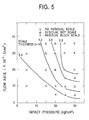
- Fig. 5 shows the relation between the descaling conditions and the scale thickness.
- Table 4-1, 4-2 and Fig. 5 indicate that under the conditions satisfying the range of the present invention (example Nos. 2-19 to 2-21, 2-23, 2-24, 2-28 to 2-30), the scale thicknesses of all sheets are 2.5 ⁇ m or less, and good descalability is obtained without shot blasting.
- Steel No. Chemical Component (Wt%) C Si Mn P S Cr Ni Mo Ti Nb A-2 0.009 0.34 0.35 0.04 0.006 11.2 0.2 - 0.22 - No. Steel No.
- Example 2-8 300 15.06 20 43.2 ⁇ 4.6 ⁇ ⁇ Comparative Ex. 2-9 300 15.06 30 43.1 ⁇ 4.0 ⁇ ⁇ Comparative Ex. 2-10 300 15.06 36 43.3 ⁇ 3.8 ⁇ ⁇ Comparative Ex. 2-11 400 20.08 5 42.8 ⁇ 5.5 ⁇ ⁇ Comparative Ex. 2-12 400 20.08 10 42.9 ⁇ 4.8 ⁇ ⁇ Comparative Ex. 2-13 400 20.08 20 43.0 ⁇ ⁇ ⁇ Comparative Ex. 2-14 400 20.08 30 43.2 ⁇ 3.1 ⁇ ⁇ Comparative Ex. 2-15 400 20.08 36 43.2 ⁇ 2.9 ⁇ ⁇ Comparative Ex.
- Table 6-1, 6-2 and Fig. 6 indicate that under the conditions which satisfy the ranges of the present invention, the scale thickness is 2.5 ⁇ m or less, and good descalability is obtained without shot blasting. The surface quality is also good without defects such as baking. On the other hand, Comparative Examples outside the ranges of the present invention show deterioration in descalability or surface quality due to baking. Steel No.
- a ferritic stainless steel slab of steel No. D-3 having the composition shown in Table 5 was heated to 1200°C, rough rolled and then descaled by spraying superhigh pressure water under the conditions shown in Table 7.
- the slab was then formed into a hot-rolled steel sheet having a thickness of 3-mm by hot finish rolling with the maximum reduction ratio in hot finish rolling shown in Table 7.
- the end temperature of hot finish rolling was 740°C, and the coiling temperature was 510°C.
- the thus-obtained hot-rolled, coil was pickled by dipping in sulfuric acid (H 2 SO 4 ) 200 g/l and a mixed acid (HNO 3 : 150 g/l, HF: 25 g/l) at a temperature of 80°C for 100 seconds, after shot blasting (Coil Nos, 4-1 and 4-2) or without shot blasting (Coil No. 4-3).
- the thus-pickled hot-rolled coil was formed into a cold-rolled coil having a sheet thickness of 0.8 mm by tandem rolling with a roll diameter of 250 mm. After annealing, the coil was pickled, and glossiness was measured. The results are shown in Table 7. No. Steel No.
- the hot-rolled coil (Coil No. 4-3) produced within the ranges of the present invention has excellent descalability which enables pickling even if shot blasting is omitted, and the cold-rolled coil produced by cold rolling using large-diameter rolls has high surface glossiness, thereby obtaining the cold-rolled steel sheet having good surface quality.
- the present invention provides a hot-rolled stainless steel strip which has excellent scale adherence and which can be worked such as by bending and drawing in a state having scales, without causing troubles of deterioration in the mold and dust pollution.
- the present invention can also produce, at low cost, a hot-rolled steel strip having good descalability and good surface quality without baking defects produced in hot rolling, and thus has significant industrial applicability.
- the invention also has the benefit that shot blasting, an essential prerequisite to pickling of conventional steel strips, can be omitted.
- the hot-rolled steel strip produced by the method of the present invention can be used as a stainless steel strip having good surface quality without unevenness such as shot blast marks for applications in which conventional cold-rolled steel sheets are used.
- a cold-rolled product having excellent surface glossiness can be obtained, as compared with conventional hot-rolled steel strips passed through shot blasting.
Landscapes
- Engineering & Computer Science (AREA)
- Mechanical Engineering (AREA)
- Chemical & Material Sciences (AREA)
- Materials Engineering (AREA)
- Crystallography & Structural Chemistry (AREA)
- Thermal Sciences (AREA)
- Physics & Mathematics (AREA)
- Metallurgy (AREA)
- Organic Chemistry (AREA)
- Heat Treatment Of Sheet Steel (AREA)
- Heat Treatment Of Steel (AREA)
- Metal Rolling (AREA)
- Bending Of Plates, Rods, And Pipes (AREA)
Claims (6)
- Bande d'acier inoxydable laminée à chaud comprenant une composition contenant au moins environ 10 % en poids de Cr, et du Si en une quantité non supérieure à environ 1,0 % en poids, dans laquelle une couche de calamine ayant une épaisseur moyenne non supérieure à environ 2,5 µm est formée sur une surface de ladite bande d'acier, et dans laquelle une couche d'oxyde contenant du Si est formée à une interface de substitution calamine/alliage et a une épaisseur non supérieure à environ 0,1 µm.
- Bande d'acier inoxydable laminée à chaud selon la revendication 1, dans laquelle la teneur en Cr est comprise entre 10 et 30 % en poids et la teneur en Si est comprise entre 0,1 et 1,0 % en poids.
- Bande d'acier inoxydable laminée à chaud selon la revendication 1, dans laquelle la couche de calamine a une épaisseur moyenne dans la plage de 1,5 à 2,5 µm.
- Procédé de production d'une bande d'acier inoxydable laminée à chaud comprenant les étapes consistant à :laminer à chaud à l'état brut de laminage une brame ayant une composition contenant au moins environ 10 % en poids et pas plus d'environ 1,0 % en poids de Si pour former un larget ; etlaminer par finition à chaud le larget, dans lequel, pendant le laminage à chaud ou pendant le décalaminage en pulvérisant de l'eau à très haute pression sur la surface du larget et le laminage par finition à chaud, l'épaisseur moyenne de la couche de calamine formée sur la surface de la bande d'acier est régulée à 2,5 µm ou moins, et l'épaisseur moyenne de la couche d'oxyde contenant du Si formée dans l'interface de substitution calamine/alliage est régulée à 0,1 µm ou moins.
- Procédé selon la revendication 4, dans lequel le laminage à chaud est effectué à une vitesse d'allongement d'au moins environ 150, dans lequel :
- Procédé selon la revendication 4, dans lequel ladite étape de régulation comprend le décalaminage en pulvérisant de l'eau à très haute pression sur la surface du larget à une pression d'impact (p) d'au moins environ 25 kgf/cm2 et une densité de débit de 0,002 l/cm2 ou plus, et dans lequel ledit laminage de finition à chaud est réalisé selon un rapport de réduction (R) maximal par passe, dans lequel :p = 5,64 PQ/H2, où P est la pression de l'eau de la buse (kgf/cm2), Q est la consommation d'eau (l/s) et H est la distance entre la surface de la bande d'acier et la buse (cm)et dans lequel R ≤ -0,9 Cr + 54, où R est le rapport de réduction maximal par passe (%).
Applications Claiming Priority (6)
| Application Number | Priority Date | Filing Date | Title |
|---|---|---|---|
| JP259318/96 | 1996-09-30 | ||
| JP25931896 | 1996-09-30 | ||
| JP08259318A JP3091418B2 (ja) | 1996-09-30 | 1996-09-30 | 熱延ステンレス鋼板およびその製造方法 |
| JP242267/97 | 1997-09-08 | ||
| JP24226797 | 1997-09-08 | ||
| JP9242267A JPH1177142A (ja) | 1997-09-08 | 1997-09-08 | 熱延ステンレス鋼板の製造方法 |
Publications (3)
| Publication Number | Publication Date |
|---|---|
| EP0835698A2 EP0835698A2 (fr) | 1998-04-15 |
| EP0835698A3 EP0835698A3 (fr) | 1999-01-27 |
| EP0835698B1 true EP0835698B1 (fr) | 2002-12-11 |
Family
ID=26535691
Family Applications (1)
| Application Number | Title | Priority Date | Filing Date |
|---|---|---|---|
| EP97307720A Expired - Lifetime EP0835698B1 (fr) | 1996-09-30 | 1997-09-30 | Bande d'acier inoxydable laminée à chaud et procédé pour sa fabrication |
Country Status (5)
| Country | Link |
|---|---|
| US (1) | US5948181A (fr) |
| EP (1) | EP0835698B1 (fr) |
| KR (1) | KR100237526B1 (fr) |
| DE (1) | DE69717757T2 (fr) |
| TW (1) | TW338729B (fr) |
Families Citing this family (12)
| Publication number | Priority date | Publication date | Assignee | Title |
|---|---|---|---|---|
| US6088895A (en) * | 1999-01-21 | 2000-07-18 | Armco Inc. | Method for descaling hot rolled strip |
| DE10064134A1 (de) * | 2000-12-19 | 2002-06-27 | Bsh Bosch Siemens Hausgeraete | Verfahren zum Veredeln von metallischen Oberflächen zur Vermeidung von thermischen Anlauf-Farben |
| JP3726770B2 (ja) * | 2001-04-27 | 2005-12-14 | 住友金属工業株式会社 | 連続酸洗方法および連続酸洗装置 |
| KR101073262B1 (ko) | 2008-12-23 | 2011-10-12 | 주식회사 포스코 | 니오븀 첨가 페라이트계 스테인리스강의 산세방법 |
| TWI420069B (zh) * | 2011-01-03 | 2013-12-21 | China Steel Corp | Method of measurement of derusting device configuration |
| WO2013047237A1 (fr) * | 2011-09-26 | 2013-04-04 | 日立金属株式会社 | Acier inoxydable pour coutellerie et son procédé de fabrication |
| CN103272855B (zh) * | 2013-06-13 | 2015-11-18 | 北京首钢自动化信息技术有限公司 | 一种在预设定模型计算中提高轧机入口厚度精度的方法 |
| DE102014111779A1 (de) * | 2014-08-18 | 2016-02-18 | Iva Industrieöfen Gmbh | Verfahren zur Herstellung einer Retorte für einen Nitrierofen sowie Retorte |
| CN112872064B (zh) * | 2020-12-29 | 2022-10-11 | 天津市新天钢联合特钢有限公司 | 一种酸洗用低碳热轧窄带钢氧化铁皮控制工艺 |
| CN114130835B (zh) * | 2021-11-26 | 2023-10-03 | 山东钢铁股份有限公司 | 一种应用于高速高负荷轴的35CrMnSiA圆钢的生产方法及其制得的35CrMnSiA圆钢 |
| CN115569988A (zh) * | 2022-09-16 | 2023-01-06 | 太仓新兰电子有限公司 | 一种提高复合金属材料界面焊合的复合轧制工艺 |
| CN117568570A (zh) * | 2023-11-16 | 2024-02-20 | 山西太钢不锈钢股份有限公司 | 一种热轧奥氏体不锈钢退火后大肚板板形的控制方法 |
Family Cites Families (10)
| Publication number | Priority date | Publication date | Assignee | Title |
|---|---|---|---|---|
| JPS5943993B2 (ja) * | 1978-03-18 | 1984-10-25 | 日新製鋼株式会社 | 燃焼器具用ステンレス鋼材料の製法 |
| JPS6053112B2 (ja) * | 1981-12-07 | 1985-11-22 | 日立金属株式会社 | 防振合金 |
| JPH0762213B2 (ja) * | 1989-07-21 | 1995-07-05 | 川崎製鉄株式会社 | 塗膜密着性に優れた熱延h形鋼 |
| WO1993021356A1 (fr) * | 1992-04-09 | 1993-10-28 | Nippon Steel Corporation | Acier inoxydable ferritique a resistance excellente a l'alteration saline a temperature elevee et a resistance aux temperatures elevees |
| JP3296374B2 (ja) * | 1992-07-06 | 2002-06-24 | 川崎製鉄株式会社 | オーステナイト系ステンレス鋼熱間圧延時のデスケーリング方法 |
| JPH07132317A (ja) * | 1993-11-12 | 1995-05-23 | Sumitomo Metal Ind Ltd | ステンレス鋼板の表面疵防止方法 |
| JP3113490B2 (ja) * | 1994-03-29 | 2000-11-27 | 新日本製鐵株式会社 | 極薄スケール鋼板の製造方法 |
| JPH07310145A (ja) * | 1994-05-13 | 1995-11-28 | Kawasaki Steel Corp | 加工用ステンレス熱延鋼板およびその製造方法 |
| JPH08108210A (ja) * | 1994-10-06 | 1996-04-30 | Sumitomo Metal Ind Ltd | 薄スケール熱延フェライト系ステンレス鋼帯の製造方法 |
| JP3390584B2 (ja) * | 1995-08-31 | 2003-03-24 | 川崎製鉄株式会社 | 熱延鋼板およびその製造方法 |
-
1997
- 1997-09-27 TW TW086114158A patent/TW338729B/zh active
- 1997-09-29 KR KR1019970049636A patent/KR100237526B1/ko not_active Expired - Fee Related
- 1997-09-29 US US08/939,945 patent/US5948181A/en not_active Expired - Fee Related
- 1997-09-30 DE DE69717757T patent/DE69717757T2/de not_active Expired - Fee Related
- 1997-09-30 EP EP97307720A patent/EP0835698B1/fr not_active Expired - Lifetime
Also Published As
| Publication number | Publication date |
|---|---|
| EP0835698A3 (fr) | 1999-01-27 |
| DE69717757D1 (de) | 2003-01-23 |
| EP0835698A2 (fr) | 1998-04-15 |
| US5948181A (en) | 1999-09-07 |
| KR100237526B1 (ko) | 2000-01-15 |
| KR19980025116A (ko) | 1998-07-06 |
| DE69717757T2 (de) | 2003-09-11 |
| TW338729B (en) | 1998-08-21 |
Similar Documents
| Publication | Publication Date | Title |
|---|---|---|
| EP0835698B1 (fr) | Bande d'acier inoxydable laminée à chaud et procédé pour sa fabrication | |
| EP4502195A1 (fr) | Tôle d'acier, élément et procédés de production correspondants | |
| US10927441B2 (en) | High-strength galvanized hot-rolled steel sheet and method for manufacturing same | |
| EP3178961B1 (fr) | Plaque d'acier galvanisée à chaud hautement résistante | |
| EP4506474A1 (fr) | Tôle d'acier, élément, et leur procédé de fabrication | |
| JP7722608B2 (ja) | 熱延鋼板およびその製造方法 | |
| EP3178960B1 (fr) | Plaque d'acier galvanisée à chaud hautement résistante | |
| WO2023188643A1 (fr) | Tôle d'acier galvanisé, élément et leurs procédés de production | |
| EP2166115A2 (fr) | Procédé de production d'un matériau en acier présentant une excellente propriété de détachement de la couche d'oxyde, et matériau de câblage en acier présentant une excellente propriété de détachement de la couche d oxyde | |
| EP0931847B1 (fr) | Méthode pour la fabrication d'une tôle plaquée | |
| JP3744279B2 (ja) | スケール密着性に優れた高炭素熱延鋼板の製造方法 | |
| JP3598981B2 (ja) | フェライト系ステンレス鋼板及びその製造法 | |
| JP3113490B2 (ja) | 極薄スケール鋼板の製造方法 | |
| JP3052787B2 (ja) | 建材用純チタン、純チタン板およびその製造方法 | |
| JP4070253B2 (ja) | 防眩性に優れた高耐銹フェライト系ステンレス鋼板およびその製造方法 | |
| US6217679B1 (en) | Method for producing chromium-containing hot rolled steel strip | |
| JPH1081919A (ja) | ノンイヤリング性および耐肌荒れ性に優れる2ピース缶用鋼板の製造方法 | |
| JP3398261B2 (ja) | Alを含有するフェライト系ステンレス鋼帯の製造方法 | |
| JP2012006128A (ja) | 化成処理性に優れた高張力鋼板の製造方法およびその製造装置 | |
| JP3091418B2 (ja) | 熱延ステンレス鋼板およびその製造方法 | |
| JPH1177142A (ja) | 熱延ステンレス鋼板の製造方法 | |
| EP4667618A1 (fr) | Feuille d'acier électrique à grains orientés, et procédé de formation d'une couche intermédiaire et d'un film de revêtement isolant d'une feuille d'acier électrique à grains orientés | |
| JPH07126751A (ja) | 被膜密着性の良い鏡面方向性珪素鋼板の製造方法 | |
| JP3111853B2 (ja) | ステンレス冷延鋼板の製造方法 | |
| JP3539160B2 (ja) | 脱スケール性、表面性状および生産性に優れたステンレス鋼の製造方法 |
Legal Events
| Date | Code | Title | Description |
|---|---|---|---|
| PUAI | Public reference made under article 153(3) epc to a published international application that has entered the european phase |
Free format text: ORIGINAL CODE: 0009012 |
|
| 17P | Request for examination filed |
Effective date: 19971211 |
|
| AK | Designated contracting states |
Kind code of ref document: A2 Designated state(s): BE DE ES FI FR GB IT SE Kind code of ref document: A2 Designated state(s): DE FR |
|
| PUAL | Search report despatched |
Free format text: ORIGINAL CODE: 0009013 |
|
| AK | Designated contracting states |
Kind code of ref document: A3 Designated state(s): AT BE CH DE DK ES FI FR GB GR IE IT LI LU MC NL PT SE |
|
| AKX | Designation fees paid |
Free format text: BE DE ES FI FR GB IT SE |
|
| GRAG | Despatch of communication of intention to grant |
Free format text: ORIGINAL CODE: EPIDOS AGRA |
|
| GRAG | Despatch of communication of intention to grant |
Free format text: ORIGINAL CODE: EPIDOS AGRA |
|
| GRAH | Despatch of communication of intention to grant a patent |
Free format text: ORIGINAL CODE: EPIDOS IGRA |
|
| 17Q | First examination report despatched |
Effective date: 20020416 |
|
| RBV | Designated contracting states (corrected) |
Designated state(s): DE FI FR |
|
| GRAH | Despatch of communication of intention to grant a patent |
Free format text: ORIGINAL CODE: EPIDOS IGRA |
|
| GRAA | (expected) grant |
Free format text: ORIGINAL CODE: 0009210 |
|
| AK | Designated contracting states |
Kind code of ref document: B1 Designated state(s): DE FR |
|
| RBV | Designated contracting states (corrected) |
Designated state(s): DE FR |
|
| REF | Corresponds to: |
Ref document number: 69717757 Country of ref document: DE Date of ref document: 20030123 |
|
| ET | Fr: translation filed | ||
| PGFP | Annual fee paid to national office [announced via postgrant information from national office to epo] |
Ref country code: FR Payment date: 20030919 Year of fee payment: 7 |
|
| PGFP | Annual fee paid to national office [announced via postgrant information from national office to epo] |
Ref country code: DE Payment date: 20030924 Year of fee payment: 7 |
|
| PLBE | No opposition filed within time limit |
Free format text: ORIGINAL CODE: 0009261 |
|
| STAA | Information on the status of an ep patent application or granted ep patent |
Free format text: STATUS: NO OPPOSITION FILED WITHIN TIME LIMIT |
|
| 26N | No opposition filed |
Effective date: 20030912 |
|
| RAP2 | Party data changed (patent owner data changed or rights of a patent transferred) |
Owner name: JFE STEEL CORPORATION |
|
| PG25 | Lapsed in a contracting state [announced via postgrant information from national office to epo] |
Ref country code: DE Free format text: LAPSE BECAUSE OF NON-PAYMENT OF DUE FEES Effective date: 20050401 |
|
| PG25 | Lapsed in a contracting state [announced via postgrant information from national office to epo] |
Ref country code: FR Free format text: LAPSE BECAUSE OF NON-PAYMENT OF DUE FEES Effective date: 20050531 |
|
| REG | Reference to a national code |
Ref country code: FR Ref legal event code: ST |