EP0843372A1 - Positivelektrode für Lithiumbatterie und Lithiumbatterie - Google Patents
Positivelektrode für Lithiumbatterie und Lithiumbatterie Download PDFInfo
- Publication number
- EP0843372A1 EP0843372A1 EP97120212A EP97120212A EP0843372A1 EP 0843372 A1 EP0843372 A1 EP 0843372A1 EP 97120212 A EP97120212 A EP 97120212A EP 97120212 A EP97120212 A EP 97120212A EP 0843372 A1 EP0843372 A1 EP 0843372A1
- Authority
- EP
- European Patent Office
- Prior art keywords
- nickel
- positive electrode
- lithium
- battery
- cobalt
- Prior art date
- Legal status (The legal status is an assumption and is not a legal conclusion. Google has not performed a legal analysis and makes no representation as to the accuracy of the status listed.)
- Granted
Links
Images


Classifications
-
- H—ELECTRICITY
- H01—ELECTRIC ELEMENTS
- H01M—PROCESSES OR MEANS, e.g. BATTERIES, FOR THE DIRECT CONVERSION OF CHEMICAL ENERGY INTO ELECTRICAL ENERGY
- H01M10/00—Secondary cells; Manufacture thereof
- H01M10/05—Accumulators with non-aqueous electrolyte
- H01M10/052—Li-accumulators
-
- H—ELECTRICITY
- H01—ELECTRIC ELEMENTS
- H01M—PROCESSES OR MEANS, e.g. BATTERIES, FOR THE DIRECT CONVERSION OF CHEMICAL ENERGY INTO ELECTRICAL ENERGY
- H01M4/00—Electrodes
- H01M4/02—Electrodes composed of, or comprising, active material
- H01M4/13—Electrodes for accumulators with non-aqueous electrolyte, e.g. for lithium-accumulators; Processes of manufacture thereof
- H01M4/131—Electrodes based on mixed oxides or hydroxides, or on mixtures of oxides or hydroxides, e.g. LiCoOx
-
- H—ELECTRICITY
- H01—ELECTRIC ELEMENTS
- H01M—PROCESSES OR MEANS, e.g. BATTERIES, FOR THE DIRECT CONVERSION OF CHEMICAL ENERGY INTO ELECTRICAL ENERGY
- H01M4/00—Electrodes
- H01M4/02—Electrodes composed of, or comprising, active material
- H01M4/36—Selection of substances as active materials, active masses, active liquids
- H01M4/48—Selection of substances as active materials, active masses, active liquids of inorganic oxides or hydroxides
- H01M4/52—Selection of substances as active materials, active masses, active liquids of inorganic oxides or hydroxides of nickel, cobalt or iron
- H01M4/525—Selection of substances as active materials, active masses, active liquids of inorganic oxides or hydroxides of nickel, cobalt or iron of mixed oxides or hydroxides containing iron, cobalt or nickel for inserting or intercalating light metals, e.g. LiNiO2, LiCoO2 or LiCoOxFy
-
- H—ELECTRICITY
- H01—ELECTRIC ELEMENTS
- H01M—PROCESSES OR MEANS, e.g. BATTERIES, FOR THE DIRECT CONVERSION OF CHEMICAL ENERGY INTO ELECTRICAL ENERGY
- H01M10/00—Secondary cells; Manufacture thereof
- H01M10/05—Accumulators with non-aqueous electrolyte
- H01M10/052—Li-accumulators
- H01M10/0525—Rocking-chair batteries, i.e. batteries with lithium insertion or intercalation in both electrodes; Lithium-ion batteries
-
- Y—GENERAL TAGGING OF NEW TECHNOLOGICAL DEVELOPMENTS; GENERAL TAGGING OF CROSS-SECTIONAL TECHNOLOGIES SPANNING OVER SEVERAL SECTIONS OF THE IPC; TECHNICAL SUBJECTS COVERED BY FORMER USPC CROSS-REFERENCE ART COLLECTIONS [XRACs] AND DIGESTS
- Y02—TECHNOLOGIES OR APPLICATIONS FOR MITIGATION OR ADAPTATION AGAINST CLIMATE CHANGE
- Y02E—REDUCTION OF GREENHOUSE GAS [GHG] EMISSIONS, RELATED TO ENERGY GENERATION, TRANSMISSION OR DISTRIBUTION
- Y02E60/00—Enabling technologies; Technologies with a potential or indirect contribution to GHG emissions mitigation
- Y02E60/10—Energy storage using batteries
Definitions
- the present invention relates to a positive electrode for lithium battery and to a lithium battery using it.
- a manganese dioxide-zinc battery is used as a primary battery and a nickel battery such as a nickel-cadmium battery, a nickel-zinc battery, and a nickel-hydride battery, and a lead battery are used as a secondary battery.
- a nickel battery such as a nickel-cadmium battery, a nickel-zinc battery, and a nickel-hydride battery, and a lead battery are used as a secondary battery.
- alkaline solution such as potassium hydroxide or acid solution of sulfuric acid is used.
- a new high-performance battery has been expected and the development of a high energy density battery using a non-aqueous electrolyte has been proceeded in place of the above-described aqueous electrolyte battery.
- the typical battery there is a lithium battery using lithium or a carbon material as a negative electrode.
- the lithium battery includes a primary battery such as a manganese dioxide-lithium battery and fluorinated carbon-lithium battery and a secondary battery such as a manganese dioxide-lithium battery, a vanadium oxide-lithium battery, etc.
- the secondary battery using metallic lithium as the negative electrode has a disadvantage that a short-circuit is apt to occur by the dendritic growth of metallic lithium deposited at charging and the life is short. Also, there is a problem that it is difficult to ensure the safety thereof owing to the high reactivity of metallic lithium.
- a so-called lithium ion battery using graphite, carbon or the like as the negative electrode to prevent the dendritic deposition of the metallic lithium by forming an intercalation compound thereof with lithium and using lithium cobaltate as the positive electrode has been devised and the battery is used as a high energy density battery.
- lithium cobaltate is expensive, a lithium-containing manganese composite oxide or lithium nickelate is proposed for lithium cobaltate.
- the lithium-containing manganese composite oxide there is a problem that the theoretical capacity is low and also with the progress of the charge-discharge cycle, the reduction of the obtained capacity becomes large.
- lithium nickelate has the same crystal structure as lithium cobaltate but has a fault that when charging and discharging are repeated, the capacity is decreased. Recently, there is provided an attempt of synthesizing lithium nickelate exhibiting a homogeneous charging-discharging reaction by lithium nitrate and nickel oxyhydroxide containing cobalt.
- a process of grinding the course particles after synthesis to form fine particles, mixing the fine particles with carbon, etc., as an electro-conductive material, and coating the mixture together with a binder such as polyviylidene fluoride and the like on to a metal current collector such as aluminum, nickel and the like is required. Accordingly, there is a problem that the production process is complicated and also the performance is strongly influenced by the amounts of the carbon powder and the binder.
- nickel oxyhydroxide has the same layer structure as lithium cobaltate practically used but in spite of that nickel oxyhydroxide is proposed in Unexamined Japanese Patent Publication (kokai) No. Sho-63-19760, it has not been practically used up to now.
- the cause is considered from the view point of electrode reaction, it is considered to be caused by that the diffusion of lithium ion into the positive electrode active material with the charging-discharging reaction, that is, the intercalation of the lithium ion into nickel oxyhydroxide does not uniformly occur. Also, it is considered to be one of the causes that the optimum electrode structure of the active material and the current collector has not yet been established.
- Aluminum is mainly used for the material of a current collector which is used for a positive electrode of a lithium battery at present.
- a sintered nickel substrate or a three-dimensional nickel porous material serving as a current collector is used as an active material holding material but it has scarcely been investigated to use nickel as the material of a positive electrode for a lithium battery which is a nonaqueous electrolyte battery. The reason is that not only nickel is dissolved in an electrolyte but also it is feared that nickel is deposited on a negative electrode to cause the short-circuit of the battery.
- LiCoO 2 , LiNiO 2 , V 2 O 5 , LiMn 2 O 4 , etc. which are general as positive electrode active materials used for lithium batteries are particles of about 20 ⁇ m average diameter produced by burning usually at a temperature of 500°C or higher called a solid phase method, it is particularly impossible, in fact, to apply these particles to a sintered nickel substrate having an average pore diameter of about 10 ⁇ m.
- nickel oxyhydroxide as a positive active material is held in an electro-conductive three-dimensional porous material.
- the positive active material containing cobalt is preferably held by the electro-conductive three-dimensional porous material.
- the content of cobalt is from 2 to 50 mol%.
- the material of the electro-conductive three-dimensional porous material for nickel oxyhydroxide is preferably aluminum, nickel, carbon, or stainless steel.
- nickel oxyhydroxide is preferably held in a sintered nickel substrate.
- nickel oxide or nickel oxyhydroxide is preferably formed on the surface of the sintered nickel substrate.
- a material containing at least one selected from the group of cobalt oxyhydroxide, metallic cobalt, cobalt oxide, tricobalt tetroxide, lithium cobaltate, and proton-containing lithium cobaltate is preferably further held in electro-conductive three-dimensional porous material.
- the present invention provides a battery having the positive electrode as described above.
- the feature of the present invention is not in that nickel oxyhydroxide is held in a nickel mesh as disclosed in Unexamined Japanese Patent Publication (kokai) No. Sho-63-19769 but in that nickel oxyhydroxide is held in a sintered nickel substrate or an electro-conductive three-dimensional porous material.
- Such an electro-conductive three-dimensional porous material is used, at present, as an active material-holding material of the nickel hydroxide positive electrode of a nickel-cadmium battery or a nickel-hydride battery and in the present invention, a porous material of aluminum, nickel, carbon, stainless steel and the like can be used.
- a porous material of aluminum, nickel, carbon, stainless steel and the like can be used.
- the life is prolonged and the reliability is improved.
- the positive electrode contains at least one selected from the group of cobalt oxyhydroxide, metallic cobalt, cobalt oxide, tricobalt tetroxide, lithium cobaltate, and proton-containing lithium cobaltate, charging and discharging efficiently proceed.
- the positive electrode charging and discharging reactions of the lithium battery using nickel oxyhydroxide as the positive electrode seem to be the following equations wherein lithium ion is intercalated or deintercalated in nickel oxyhydroxide.
- the foamed metal plate After filling a foamed aluminum metal substrate having a porosity of 80% with a mixed paste of 20 ml of a solution of n-methyl-2-pyrrolidene containing 1% polyvinylidene difluoride and 20 parts of a nickel oxyhydroxide powder containing cobalt of 2 mol%[ ⁇ Co/(Ni + Co) ⁇ x 100], the foamed metal plate was dried at 130°C to prepare a positive electrode A of the present invention having a size of 30 mm x 40 mm x 0.8 mm and a nominal capacity of 200 mAh.
- a foamed aluminum substrate having a porosity of 80% After filling a foamed aluminum substrate having a porosity of 80% with a mixed paste of 15 ml of an aqueous dispersion of a nickel oxyhydroxide powder of 20 ⁇ m average diameter, the foamed metal plate was dried at 130°C to prepare a positive electrode B of the present invention having a size of 30 mm x 40 mm x 0.8 mm and a nominal capacity of 200 mAh.
- a positive electrode C of the present invention After filling a fibrous aluminum metal substrate having a porosity of 80% with a mixed paste of 15 ml of an aqueous dispersion of 2% by weight a polytetrafluoroethylene powder and 20 parts of a nickel oxyhydroxide powder of 20 ⁇ m average diameter, the electrode was dried at 130°C to prepare a positive electrode C of the present invention having a size of 30 mm x 40 mm x 0.8 mm and a nominal capacity of 200 mAh.
- each of the batteries A, B, and C of the present invention and the conventional battery D was prepared by combining with each of the positive electrodes described above.
- Fig. 1 it can be understood that the discharge performances of the batteries using the positive electrodes A, B, and C of the present invention are clearly excellent as compared with that of the conventional battery. That is, it can be seen that the performance of the battery using the positive electrode using the three-dimensional porous substrate having a good current collecting property is better than the performance of the conventional press-type battery.
- cobalt has an effect even in the case of using the substrate having a good current collecting property as in the present invention.
- the preferred content of cobalt is from 2 to 90 mol% but the cobalt content exceeding 50 mol% is undesirable because it becomes expensive.
- the effect of cobalt is assumed to be that the diffusion of lithium becomes more easy and the active materials electrochemically uniformly. Further, it is considered that as the result thereof, the performance is improved. In this case, it is advantageous to form a solid solution of nickel oxyhydroxide and cobalt oxyhydroxide.
- the reason that the performances of the positive electrode of the present invention and of the battery using it are excellent as described above is assumed to be caused by the following reasons.
- the electric contact of the nickel oxyhydroxide active material and the current collector is good.
- the contact state of the nickel oxyhydroxide particles, which are active materials, each other is good.
- the contact resistance among the particles becomes small, and the diffusion of the lithium ions, which is the rate-determining step of the reaction, becomes easy among the particles.
- the porous electrode is dried under the environment having a less oxygen content than an air atmosphere.
- Nickel oxyhydroxide may be the ⁇ -type, ⁇ -type, or the mixture thereof.
- ⁇ -NiOOH having a less content of ⁇ -NiOOH, and preferably having no water of crystallization is preferred.
- lithium battery also includes these batteries and according to the present invention, such excellent lithium batteries can be provided.
- a sintered nickel substrate (using a nickel gauze of 100 mesh as the core material) having a porosity of about 85% obtained by sintering a carbonyl nickel powder, which was used as the active material holder of a sintered nickel-cadmium battery, was heated for 30 minutes at 200°C in an air atmosphere to form a thin film of nickel oxide on the surface thereof.
- a substrate containing nickel hydroxide was prepared. That is, by repeatedly carrying out 6 times a known operation that after vacuum impregnating the sintered nickel substrate with an aqueous solution of 4M nickel nitrate containing cobalt of 3 mol%[ ⁇ Co/(Ni + Co) ⁇ x 100] at 5 mmHg, the impregnated substrate was neutralized with alkaline solution of 5M sodium hydroxide and after washing with hot water, the substrate was dried at 100°C, an electrode filled with nickel hydroxide was prepared.
- the electrode was immersed in an alkaline solution of 4.5M potassium hydroxide and using 2 nickel plates as the counter electrode, an electric current was passed through the anode at a current density of 5 mA/cm 2 for 3 hours. Thereafter, after removing the remaining alkali components from the electrode by washing with hot water, the electrode was dried at 120°C to prepare a nickel oxyhydroxide positive electrode E of the present invention having a size of 30 mm x 30 mm x 0.7 mm and a nominal capacity of 300 mAh.
- Example 5 A sintered nickel substrate (using a nickel gauze of 100 mesh as the core material) having a porosity of about 85% obtained by sintering a carbonyl nickel powder, which was used as the active material holder of a sintered nickel ⁇ cadmium battery, was prepared.
- a substrate containing nickel hydroxide was prepared. That is, by repeatedly carrying out 6 times a known operation that after vacuum impregnating the sintered nickel substrate with 4M nickel nitrate solution containing cobalt of 3 mol%[ ⁇ Co/(Ni + Co) ⁇ x 100] at 5 mmHg, the impregnated substrate was neutralized with alkaline solution of 5M sodium hydroxide and after washing with hot water, the substrate was dried at 100°C, an electrode filled with nickel hydroxide was prepared.
- the electrode was immersed in an alkaline solution of 4.5M potassium hydroxide and using 2 nickel plates as the counter electrode, an electric current was passed through the anode at a current density of 5 mA/cm 2 for 3 hours. Thereafter, after removing the remaining alkali components from the electrode by washing with hot water, the electrode was hot-blast dried at 100°C and further heat-treated for 2 hours at 135°C to form a thin film of nickel oxide on the surface of the nickel substrate, whereby a nickel oxyhydroxide positive electrode F of the present invention having a size of 30 mm x 40 mm x 0.8 mm and a nominal capacity of 300 mAh was prepared.
- the electrode was immersed in alkaline solution of 5M sodium hydroxide and using 2 nickel plates as the counter electrode, current was passed through the anode at a current density of 5 mA/cm 2 for 3 hours to convert nickel hydroxide into nickel oxyhydroxide, and thereafter, the electrode was dried for 1 hour at 110°C to prepare a nickel oxyhydroxide positive electrode G of the present invention having a size of 30 mm x 40 mm x 0.8 mm and a nominal capacity of 300 mAh. On the surface of the substrate of the positive electrode was formed a thin film of nickel oxyhydroxide.
- a positive electrode H of the present invention having a size of 30 mm x 40 mm x 0.8 mm and a nominal capacity of 300 mAh. It was confirmed by an X-ray diffraction analysis that a thin film of nickel oxyhydroxide was formed on the surface of the substrate of the electrode.
- each of the batteries E, F, G, and H of the present invention and the comparative battery I was prepared by using each of the positive electrodes described above.
- cobalt-containing nickel oxyhydroxide Ni 1-x Co x OOH
- the content of cobalt was at least 2 mol%[ ⁇ Co/(Ni + Co) ⁇ x 100]. It can be seen that the addition of cobalt has an effect even in the case of using the substrate having a good current collecting property as in the present invention.
- the preferred content of cobalt is from 2 to 90 mol% but the cobalt content exceeding 50 mol% is undesirable because in this case, the cost is increased.
- the effect of cobalt is assumed to be that the diffusion of lithium becomes more easy and the active materials electrochemically work, and it is considered that as the result thereof, the performance is improved. In this case, it is advantageous to form a solid solution of nickel oxyhydroxide and cobalt oxyhydroxide.
- the reason that the performances of the positive electrode of the present invention and of the battery using it are excellent as described above is assumed to be caused by that when the three-dimensional porous material having the functions of both the active material holder and the current collector is used, the electric contact of the nickel oxyhydroxide active material, and the current collector is good and the contact state of the nickel oxyhydroxide particles, which are active materials, each other is good. Furthermore, it is assumed that the contact resistance among the particles becomes small and the diffusion of the lithium ions, which is the rate-determining step of the reaction becomes easy among the particles.
- Nickel oxyhydroxide may be the ⁇ -type, ⁇ -type, or the mixture thereof as described above but, in particular, in the case of the aluminum three-dimensional porous substrate, because a hydroxide containing water is also formed, ⁇ -NiOOH having a less content of ⁇ -NiCOOH, and preferably having no water of crystallization is preferred.
- metallic lithium was used as the negative electrode but when after making nickel oxyhydroxide a discharged state, a carbon material such as, for example, graphite is used as the negative electrode active material, a lithium ion battery is constructed. Furthermore, when LiC 6 is used as the negative electrode active material and nickel oxyhydroxide is used as the positive electrode, a lithium ion battery is also constructed.
- batteries K, L, M, and N having the construction as the above-described battery J were prepared except that each of a cobalt oxide powder, a tricobalt tetroxide powder, a lithium cobaltate powder, and a proton-containing lithium cobaltate powder respectively was used in place of cobalt oxyhydroxide in the battery J.
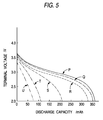
- the capacities of the batteries J, K, L, M, and N according to the present invention are greatly larger than that of the comparative battery O. That is, it can be seen by using each of cobalt oxyhydroxide, the cobalt oxide powder, the tricobalt tetroxide powder, the lithium cobaltate powder, and the proton-containing lithium cobaltate (H 0.25 Li 0.75 CoO 2 ) powder, the capacity is remarkably improved. As the reason thereof, it is considered that by the addition of the above-described powder, the current collecting property of the active material becomes good and the diffusion of the active material becomes easy, which result in that the active material electrochemically works uniformly and the performance is improved.
- a sintered nickel substrate (using a nickel gauze as the core material) having a porosity of about 85% obtained by sintering a carbonyl nickel powder which was used as the active material holder of a sintered type nickel ⁇ cadmium battery was prepared and by applying a so-called vacuum impregnation method, which was widely used as the production method of a nickel hydroxide positive electrode of a nickel ⁇ cadmium battery, to the substrate, a substrate containing nickel hydroxide was prepared.
- the electrode was immersed in alkaline solution of 4.5M sodium hydroxide, using 2 nickel plates as the counter electrode, and a current was passed through the anode at a current density of 3.5 mA/cm 2 for 10 hours.
- the electrode was dried at 120°C to prepare a nickel oxyhydroxide positive electrode P of the present invention having a size of 30 mm x 40 mm x 0.8 mm and a nominal capacity of 300 mAh was prepared.
- the electrode was immersed in solution of 5M sodium hydroxide, and using 2 nickel plates as the counter electrode, a current was passed through the anode for 12 hours at a current density of 3.5 mA/cm 2 . Then, after removing the remaining alkali components by washing with hot water, the electrode was dried by hot blast at 100°C and further heat-treated for 2 hours at 135°C in an air atmosphere to prepare a nickel oxyhydroxide positive electrode Q having a size of 30 mm x 40 mm x 0.8 mm and a nominal capacity of 350 mAh.
- the electrode was immersed in alkaline solution of 5M sodium hydroxide, and using 2 nickel plates as the counter electrode, an electric current was passed through the anode for 11 hours at a current density of 3.5 mA/cm 2 . Then, after removing the remaining alkali components by washing with hot water, the electrode was dried by hot blast at 100°C and further heat-treated for 2 hours at 135°C in an air atmosphere to prepare a nickel oxyhydroxide positive electrode R having a size of 30 mm x 40 mm x 0.8 mm and a nominal capacity of 350 mAh.
- each of the batteries P, Q, and R of the present invention was prepared by using each of the positive electrodes described above.
- Example 9 For comparison, by the same construction as Example 9 except that cobalt hydroxide was not formed, a nickel oxyhydroxide positive electrode S having a size of 30 mm x 40 mm x 0.8 mm and a nominal capacity of 350 mAh was prepared. Also, by the same construction as Example 10 except that the metallic cobalt powder was not contained, a nickel oxyhydroxide positive electrode T having a size of 30 mm x 40 mm x 0.8 mm and a nominal capacity of 350 mAh was prepared. Furthermore, by the same construction as Example 11 except that the cobalt oxide powder was not contained, a nickel oxyhydroxide positive electrode U having a size of 30 mm x 40 mm x 0.8 mm and a nominal capacity of 350 mAh was prepared. Also, batteries S, T, and U were prepared using these positive electrodes respectively.
- the current collecting property among the active materials becomes good and the diffusion of the active materials becomes more easy, and the active materials electrically work uniformly, and it is considered that as the result thereof, the performance is improved.
- the electric contact between the active material and the current collector becomes good, the contact state of the nickel oxyhydroxide particles, which are active materials, each other is good, furthermore, the contact resistance among the particles is low, and also, the diffusion of the lithium ion, which is the rate-determining step of the reaction becomes easy among the particles.
- the film functions as a protective film to prevent nickel as the base from dissolving in an electrolyte.
- the electric contact of the active material and the current collector is good, further, the contact state of the nickel oxyhydroxide particles, which are active materials, each other is good, the contact resistance among the particles is low, and also, the diffusion of the lithium ion, which is the rate-determining step of the reaction becomes easy among the particles. Thereby, a lithium battery of a high performance can be provided.
- a positive electrode for a lithium battery wherein lithium is intercalated into nickel oxyhydroxide by discharging and lithium is deintercalated from nickel oxyhydroxide by charging, characterized in that the positive electrode contains at least one kind selected from the group of cobalt oxyhydroxide, metallic cobalt, cobalt oxide, tricobalt tetroxide, lithium cobaltate, and proton-containing lithium cobaltate, and the invention of a lithium battery equipped with the above-described positive electrode, the characteristics of the lithium battery using nickel oxyhydroxide as the positive electrode are improved and the lithium which is inexpensive and has a good performance can be provided.
- the nickel oxyhydroxide may be the ⁇ -type, the ⁇ -type, or the mixture thereof but ⁇ -NiOOH having a less content of ⁇ -NiOOH and preferably having no water of crystallization is preferred.
- metallic lithium is used as a negative electrode but with nickel oxyhydroxide a discharged state, a carbon material such as graphite can be used as a negative electrode active material thereby to construct, a so-called lithium ion battery.
- a lithium ion battery is constructed and as a matter of course, the above-described effects are obtained.
- the technical idea of improving the performance by adding cobalt or a compound thereof to a nickel oxyhydroxide is a known means in the field of alkali battery as applied to a nickel positive electrode for a nickel ⁇ cadmium battery for improving the precharge in the battery or the active material utilization ratio in Unexamined Japanese Patent Publication (kokai) No. Sho-52-09127, National Technical Report, 27, 106(1986), 27th Denchi Touron-Kai Koen Youshishu, p. 47(1986), GS NEWSTECHNICAL REPORT 48, p23(1986), etc.
- the present invention relates to the improvement of the new idea of using nickel oxyhydroxide as the positive electrode active material of a lithium battery, which is hitherto unexpected by a person skilled in the art and it shall be bear in mind that the present invention is not easily considered by a simple knowledge about alkali batteries.
Landscapes
- Chemical & Material Sciences (AREA)
- Chemical Kinetics & Catalysis (AREA)
- Electrochemistry (AREA)
- General Chemical & Material Sciences (AREA)
- Engineering & Computer Science (AREA)
- Materials Engineering (AREA)
- Manufacturing & Machinery (AREA)
- Inorganic Chemistry (AREA)
- Battery Electrode And Active Subsutance (AREA)
Applications Claiming Priority (9)
| Application Number | Priority Date | Filing Date | Title |
|---|---|---|---|
| JP8323608A JPH10149811A (ja) | 1996-11-18 | 1996-11-18 | リチウム電池用正極板およびリチウム電池 |
| JP323608/96 | 1996-11-18 | ||
| JP323609/96 | 1996-11-18 | ||
| JP32360996 | 1996-11-18 | ||
| JP32360896 | 1996-11-18 | ||
| JP8323609A JPH10149812A (ja) | 1996-11-18 | 1996-11-18 | リチウム電池用正極板およびリチウム電池 |
| JP8342517A JPH10172560A (ja) | 1996-12-05 | 1996-12-05 | リチウム電池用正極およびリチウム電池 |
| JP34251796 | 1996-12-05 | ||
| JP342517/96 | 1996-12-05 |
Publications (2)
| Publication Number | Publication Date |
|---|---|
| EP0843372A1 true EP0843372A1 (de) | 1998-05-20 |
| EP0843372B1 EP0843372B1 (de) | 2003-03-12 |
Family
ID=27339990
Family Applications (1)
| Application Number | Title | Priority Date | Filing Date |
|---|---|---|---|
| EP97120212A Expired - Lifetime EP0843372B1 (de) | 1996-11-18 | 1997-11-18 | Positivelektrode für Lithiumbatterie und Lithiumbatterie |
Country Status (4)
| Country | Link |
|---|---|
| US (1) | US6221529B1 (de) |
| EP (1) | EP0843372B1 (de) |
| CN (1) | CN1185666A (de) |
| DE (1) | DE69719677T2 (de) |
Cited By (1)
| Publication number | Priority date | Publication date | Assignee | Title |
|---|---|---|---|---|
| EP3345236A4 (de) * | 2015-09-02 | 2019-01-23 | The Regents Of The University Of Michigan | Elektrochemische vorrichtung mit dreidimensionalem elektrodensubstrat |
Families Citing this family (7)
| Publication number | Priority date | Publication date | Assignee | Title |
|---|---|---|---|---|
| JP2000156224A (ja) * | 1998-11-17 | 2000-06-06 | Japan Storage Battery Co Ltd | 非水電解質電池 |
| CN1269247C (zh) * | 2001-11-22 | 2006-08-09 | 索尼公司 | 非水原电池 |
| JP3705801B1 (ja) * | 2004-03-29 | 2005-10-12 | シャープ株式会社 | リチウムイオン二次電池 |
| CN101202347A (zh) * | 2007-11-22 | 2008-06-18 | 山东神工海特电子科技有限公司 | 具有金属骨架正极的1.5v锂二硫化铁扣式电池 |
| DE102010048009A1 (de) * | 2010-10-09 | 2012-04-12 | Hoppecke Batterie Systeme Gmbh | Verfahren zur Herstellung einer positiven Nickel-Hydroxidelektrode für einen Nickel-Metallhydrid- oder Nickel-Cadmium-Akkumulator |
| JP6612238B2 (ja) * | 2014-01-28 | 2019-11-27 | チュンシェン ワン | 多電子水系電池 |
| CN105322142A (zh) * | 2015-09-26 | 2016-02-10 | 河南新太行电源有限公司 | 一种纤维式镉镍蓄电池正极板的制造方法 |
Citations (5)
| Publication number | Priority date | Publication date | Assignee | Title |
|---|---|---|---|---|
| JPS6319760A (ja) * | 1986-07-10 | 1988-01-27 | Japan Storage Battery Co Ltd | 非水電解液電池及びその正極活物質の製造方法 |
| EP0573040A1 (de) * | 1992-06-04 | 1993-12-08 | Matsushita Electric Industrial Co., Ltd. | Positivelektrode für Lithium-Sekundärbatterie und Verfahren zu seiner Herstellung und eine nichtwässrige elektrolyte Lithium-Sekundärbatterie unter Verwendung derselben |
| EP0714144A1 (de) * | 1994-11-22 | 1996-05-29 | Sumitomo Chemical Company, Limited | Kathode für Lithium Sekundärbatterie und Verfahren zu ihrer Herstellung |
| EP0730315A1 (de) * | 1995-03-03 | 1996-09-04 | Saft | Nickelelektrode für Alkaliakkumulator |
| EP0800222A1 (de) * | 1996-04-01 | 1997-10-08 | Japan Storage Battery Company Limited | Verfahren zur Herstellung von Lithiumnickelat positiver Elektrode sowie diese verwendende Lithiumbatterie |
Family Cites Families (7)
| Publication number | Priority date | Publication date | Assignee | Title |
|---|---|---|---|---|
| JPS5671276A (en) * | 1979-11-13 | 1981-06-13 | Toshiba Corp | Organic-solvent battery |
| US5180574A (en) * | 1990-07-23 | 1993-01-19 | Moli Energy (1990) Limited | Hydrides of lithiated nickel dioxide and secondary cells prepared therefrom |
| EP0667787B1 (de) * | 1992-09-24 | 2001-07-18 | Brigham And Women's Hospital | Gruppe b streptococcus typ ii und typ v polysaccharid-protein konjugate als impfstoffe |
| US5376475A (en) * | 1994-03-16 | 1994-12-27 | Ovonic Battery Company, Inc. | Aqueous lithium-hydrogen ion rechargeable battery |
| JP3568052B2 (ja) * | 1994-12-15 | 2004-09-22 | 住友電気工業株式会社 | 金属多孔体、その製造方法及びそれを用いた電池用極板 |
| US5630993A (en) * | 1995-07-05 | 1997-05-20 | Bell Communications Research, Inc. | Low temperature synthesis of layered lithiated transition metal oxides |
| US5747195A (en) * | 1996-05-06 | 1998-05-05 | Alamgir; Mohammed | Current collectors for high energy density cells |
-
1997
- 1997-11-18 EP EP97120212A patent/EP0843372B1/de not_active Expired - Lifetime
- 1997-11-18 DE DE69719677T patent/DE69719677T2/de not_active Expired - Fee Related
- 1997-11-18 CN CN97120177A patent/CN1185666A/zh active Pending
- 1997-11-18 US US08/972,485 patent/US6221529B1/en not_active Expired - Fee Related
Patent Citations (5)
| Publication number | Priority date | Publication date | Assignee | Title |
|---|---|---|---|---|
| JPS6319760A (ja) * | 1986-07-10 | 1988-01-27 | Japan Storage Battery Co Ltd | 非水電解液電池及びその正極活物質の製造方法 |
| EP0573040A1 (de) * | 1992-06-04 | 1993-12-08 | Matsushita Electric Industrial Co., Ltd. | Positivelektrode für Lithium-Sekundärbatterie und Verfahren zu seiner Herstellung und eine nichtwässrige elektrolyte Lithium-Sekundärbatterie unter Verwendung derselben |
| EP0714144A1 (de) * | 1994-11-22 | 1996-05-29 | Sumitomo Chemical Company, Limited | Kathode für Lithium Sekundärbatterie und Verfahren zu ihrer Herstellung |
| EP0730315A1 (de) * | 1995-03-03 | 1996-09-04 | Saft | Nickelelektrode für Alkaliakkumulator |
| EP0800222A1 (de) * | 1996-04-01 | 1997-10-08 | Japan Storage Battery Company Limited | Verfahren zur Herstellung von Lithiumnickelat positiver Elektrode sowie diese verwendende Lithiumbatterie |
Non-Patent Citations (1)
| Title |
|---|
| PATENT ABSTRACTS OF JAPAN vol. 012, no. 228 (E - 627) 28 June 1988 (1988-06-28) * |
Cited By (1)
| Publication number | Priority date | Publication date | Assignee | Title |
|---|---|---|---|---|
| EP3345236A4 (de) * | 2015-09-02 | 2019-01-23 | The Regents Of The University Of Michigan | Elektrochemische vorrichtung mit dreidimensionalem elektrodensubstrat |
Also Published As
| Publication number | Publication date |
|---|---|
| DE69719677T2 (de) | 2003-09-18 |
| CN1185666A (zh) | 1998-06-24 |
| EP0843372B1 (de) | 2003-03-12 |
| DE69719677D1 (de) | 2003-04-17 |
| US6221529B1 (en) | 2001-04-24 |
Similar Documents
| Publication | Publication Date | Title |
|---|---|---|
| EP1291941B1 (de) | Aktivmaterial für Batterie und Verfahren zu seiner Herstellung | |
| EP0800222B1 (de) | Verfahren zur Herstellung von Lithiumnickelat positiver Elektrode sowie diese verwendende Lithiumbatterie | |
| JP3994238B2 (ja) | 非水電解質リチウム二次電池 | |
| EP1347524A1 (de) | Aktives positivelektrodenmaterial und nichtwässrige elektrolytische sekundärzelle | |
| EP1193789A1 (de) | Nicht-wässrige elektrolytische sekundärzelle | |
| TW201031044A (en) | Positive electrode materials for high discharge capacity lithium ion batteries | |
| JPWO2000060679A1 (ja) | 正極活物質の製造方法及び非水電解質二次電池の製造方法 | |
| JP3436600B2 (ja) | 二次電池 | |
| JPH05174818A (ja) | 非水電解質二次電池及びその負極活物質の製造方法 | |
| JP4235702B2 (ja) | 正極活物質とその製造方法とこれを用いた非水電解質二次電池 | |
| US5670277A (en) | Lithium copper oxide cathode for lithium cells and batteries | |
| EP1306912A1 (de) | Negative elektrode für nichtwässrige-elektrolyt-sekundärbatterieund diese elektrode verwendende batterie | |
| EP0843372B1 (de) | Positivelektrode für Lithiumbatterie und Lithiumbatterie | |
| JP4013327B2 (ja) | 非水二次電池 | |
| JP5073504B2 (ja) | 少なくとも一種の遷移金属を含有するリチウムベースの酸化物を修飾する方法、当該酸化物を含む正極、及びリチウム二次電池 | |
| CN119419382A (zh) | 一种碱性镍氢电池 | |
| CN114512660A (zh) | 正极活性材料前驱体及其制备方法和正极活性材料 | |
| JP2002042890A (ja) | 非水電解質電池 | |
| JP3680306B2 (ja) | リチウム電池用正極板およびリチウム電池 | |
| JP3144832B2 (ja) | 非水溶媒二次電池 | |
| JP2000012026A (ja) | 非水電解液二次電池 | |
| JPH10172560A (ja) | リチウム電池用正極およびリチウム電池 | |
| JPH09171825A (ja) | 非水溶媒電解液を有する二次電池 | |
| JPH07302618A (ja) | 非水溶媒電解液を有する二次電池 | |
| JP2001110406A (ja) | 非水電解質二次電池 |
Legal Events
| Date | Code | Title | Description |
|---|---|---|---|
| PUAI | Public reference made under article 153(3) epc to a published international application that has entered the european phase |
Free format text: ORIGINAL CODE: 0009012 |
|
| AK | Designated contracting states |
Kind code of ref document: A1 Designated state(s): DE FR GB |
|
| AX | Request for extension of the european patent |
Free format text: AL;LT;LV;MK;RO;SI |
|
| 17P | Request for examination filed |
Effective date: 19980709 |
|
| AKX | Designation fees paid |
Free format text: DE FR GB |
|
| RBV | Designated contracting states (corrected) |
Designated state(s): DE FR GB |
|
| 17Q | First examination report despatched |
Effective date: 20000107 |
|
| GRAH | Despatch of communication of intention to grant a patent |
Free format text: ORIGINAL CODE: EPIDOS IGRA |
|
| GRAH | Despatch of communication of intention to grant a patent |
Free format text: ORIGINAL CODE: EPIDOS IGRA |
|
| GRAA | (expected) grant |
Free format text: ORIGINAL CODE: 0009210 |
|
| AK | Designated contracting states |
Designated state(s): DE FR GB |
|
| PG25 | Lapsed in a contracting state [announced via postgrant information from national office to epo] |
Ref country code: FR Free format text: LAPSE BECAUSE OF FAILURE TO SUBMIT A TRANSLATION OF THE DESCRIPTION OR TO PAY THE FEE WITHIN THE PRESCRIBED TIME-LIMIT Effective date: 20030312 |
|
| REG | Reference to a national code |
Ref country code: GB Ref legal event code: FG4D |
|
| REF | Corresponds to: |
Ref document number: 69719677 Country of ref document: DE Date of ref document: 20030417 Kind code of ref document: P |
|
| PG25 | Lapsed in a contracting state [announced via postgrant information from national office to epo] |
Ref country code: GB Free format text: LAPSE BECAUSE OF NON-PAYMENT OF DUE FEES Effective date: 20031118 |
|
| PLBE | No opposition filed within time limit |
Free format text: ORIGINAL CODE: 0009261 |
|
| STAA | Information on the status of an ep patent application or granted ep patent |
Free format text: STATUS: NO OPPOSITION FILED WITHIN TIME LIMIT |
|
| EN | Fr: translation not filed | ||
| 26N | No opposition filed |
Effective date: 20031215 |
|
| GBPC | Gb: european patent ceased through non-payment of renewal fee |
Effective date: 20031118 |
|
| PGFP | Annual fee paid to national office [announced via postgrant information from national office to epo] |
Ref country code: DE Payment date: 20041111 Year of fee payment: 8 |
|
| PG25 | Lapsed in a contracting state [announced via postgrant information from national office to epo] |
Ref country code: DE Free format text: LAPSE BECAUSE OF NON-PAYMENT OF DUE FEES Effective date: 20060601 |