EP0844252A2 - Peptides cycliques ayant une extrémité destinée à un couplage chimique ultérieur et leurs procédés de préparation - Google Patents
Peptides cycliques ayant une extrémité destinée à un couplage chimique ultérieur et leurs procédés de préparation Download PDFInfo
- Publication number
- EP0844252A2 EP0844252A2 EP97870182A EP97870182A EP0844252A2 EP 0844252 A2 EP0844252 A2 EP 0844252A2 EP 97870182 A EP97870182 A EP 97870182A EP 97870182 A EP97870182 A EP 97870182A EP 0844252 A2 EP0844252 A2 EP 0844252A2
- Authority
- EP
- European Patent Office
- Prior art keywords
- cyclic peptide
- cyclic
- peptide
- tail
- peptide according
- Prior art date
- Legal status (The legal status is an assumption and is not a legal conclusion. Google has not performed a legal analysis and makes no representation as to the accuracy of the status listed.)
- Withdrawn
Links
Images


Classifications
-
- C—CHEMISTRY; METALLURGY
- C12—BIOCHEMISTRY; BEER; SPIRITS; WINE; VINEGAR; MICROBIOLOGY; ENZYMOLOGY; MUTATION OR GENETIC ENGINEERING
- C12N—MICROORGANISMS OR ENZYMES; COMPOSITIONS THEREOF; PROPAGATING, PRESERVING, OR MAINTAINING MICROORGANISMS; MUTATION OR GENETIC ENGINEERING; CULTURE MEDIA
- C12N5/00—Undifferentiated human, animal or plant cells, e.g. cell lines; Tissues; Cultivation or maintenance thereof; Culture media therefor
- C12N5/0068—General culture methods using substrates
-
- A—HUMAN NECESSITIES
- A61—MEDICAL OR VETERINARY SCIENCE; HYGIENE
- A61L—METHODS OR APPARATUS FOR STERILISING MATERIALS OR OBJECTS IN GENERAL; DISINFECTION, STERILISATION OR DEODORISATION OF AIR; CHEMICAL ASPECTS OF BANDAGES, DRESSINGS, ABSORBENT PADS OR SURGICAL ARTICLES; MATERIALS FOR BANDAGES, DRESSINGS, ABSORBENT PADS OR SURGICAL ARTICLES
- A61L27/00—Materials for grafts or prostheses or for coating grafts or prostheses
- A61L27/14—Macromolecular materials
- A61L27/22—Polypeptides or derivatives thereof, e.g. degradation products
- A61L27/227—Other specific proteins or polypeptides not covered by A61L27/222, A61L27/225 or A61L27/24
-
- A—HUMAN NECESSITIES
- A61—MEDICAL OR VETERINARY SCIENCE; HYGIENE
- A61L—METHODS OR APPARATUS FOR STERILISING MATERIALS OR OBJECTS IN GENERAL; DISINFECTION, STERILISATION OR DEODORISATION OF AIR; CHEMICAL ASPECTS OF BANDAGES, DRESSINGS, ABSORBENT PADS OR SURGICAL ARTICLES; MATERIALS FOR BANDAGES, DRESSINGS, ABSORBENT PADS OR SURGICAL ARTICLES
- A61L27/00—Materials for grafts or prostheses or for coating grafts or prostheses
- A61L27/36—Materials for grafts or prostheses or for coating grafts or prostheses containing ingredients of undetermined constitution or reaction products thereof, e.g. transplant tissue, natural bone, extracellular matrix
- A61L27/38—Materials for grafts or prostheses or for coating grafts or prostheses containing ingredients of undetermined constitution or reaction products thereof, e.g. transplant tissue, natural bone, extracellular matrix containing added animal cells
-
- A—HUMAN NECESSITIES
- A61—MEDICAL OR VETERINARY SCIENCE; HYGIENE
- A61L—METHODS OR APPARATUS FOR STERILISING MATERIALS OR OBJECTS IN GENERAL; DISINFECTION, STERILISATION OR DEODORISATION OF AIR; CHEMICAL ASPECTS OF BANDAGES, DRESSINGS, ABSORBENT PADS OR SURGICAL ARTICLES; MATERIALS FOR BANDAGES, DRESSINGS, ABSORBENT PADS OR SURGICAL ARTICLES
- A61L31/00—Materials for other surgical articles, e.g. stents, stent-grafts, shunts, surgical drapes, guide wires, materials for adhesion prevention, occluding devices, surgical gloves, tissue fixation devices
- A61L31/04—Macromolecular materials
- A61L31/043—Proteins; Polypeptides; Degradation products thereof
- A61L31/047—Other specific proteins or polypeptides not covered by A61L31/044 - A61L31/046
-
- C—CHEMISTRY; METALLURGY
- C07—ORGANIC CHEMISTRY
- C07K—PEPTIDES
- C07K7/00—Peptides having 5 to 20 amino acids in a fully defined sequence; Derivatives thereof
- C07K7/50—Cyclic peptides containing at least one abnormal peptide link
- C07K7/54—Cyclic peptides containing at least one abnormal peptide link with at least one abnormal peptide link in the ring
- C07K7/56—Cyclic peptides containing at least one abnormal peptide link with at least one abnormal peptide link in the ring the cyclisation not occurring through 2,4-diamino-butanoic acid
-
- C—CHEMISTRY; METALLURGY
- C07—ORGANIC CHEMISTRY
- C07K—PEPTIDES
- C07K7/00—Peptides having 5 to 20 amino acids in a fully defined sequence; Derivatives thereof
- C07K7/64—Cyclic peptides containing only normal peptide links
-
- C—CHEMISTRY; METALLURGY
- C12—BIOCHEMISTRY; BEER; SPIRITS; WINE; VINEGAR; MICROBIOLOGY; ENZYMOLOGY; MUTATION OR GENETIC ENGINEERING
- C12N—MICROORGANISMS OR ENZYMES; COMPOSITIONS THEREOF; PROPAGATING, PRESERVING, OR MAINTAINING MICROORGANISMS; MUTATION OR GENETIC ENGINEERING; CULTURE MEDIA
- C12N2533/00—Supports or coatings for cell culture, characterised by material
- C12N2533/50—Proteins
Definitions
- the present invention is in the field of the biotechnology and relates to cyclic peptides designed for subsequent chemical grafting or coupling on a solid support, on a marker, on a high molecular weight compound and/or another cyclic peptide, and to their preparation process.
- Peptides play a primordial role in vivo because of their ubiquitous implication in a variety of interactions with other biological molecules and proteins such as cell receptors, antibodies or enzymes. Although they are naturally flexible and can adopt a large number of different conformations, their biological activity is usually the result of one specific three-dimensional conformation. In laboratory experiments the conformation of peptides is also studied to reproduce specific determinants (epitopes) of high molecular weight proteins. The length of the peptides used for these studies is in general limited (up to fifteen amino acids) to overcome the problems that arise with increasing length of the peptide.
- Cyclic peptides can be formed in solution, in diluted conditions, by activation of a side-chain protected linear peptide using carbodiimide or diphenylphosphorylazide, followed by subsequent deprotection of the side-chains (Kessler H et al., 1989, in Computer-aided drug design, methods and applications, Ed. T.J. Perun and C.L. Probst, pp. 461-484, Marcel Dekker, New-York; Toniolo C., 1990, Int. J. Pept. Protein Res., 35 , 287- 300; Gurrath M. et al., 1992, Eur. J. Biochem., 210, 911-921; Izumiya N.
- an ⁇ -allyl protected acid residue like Fmoc-Asp-OAl or Fmoc-Glu-OAl is incorporated as the first residue during the synthesis by fixation of its free carboxylic side-chain on the synthesis support.
- the peptidic chain is then elongated following the standard Fmoc synthesis procedure before specific cleavage of the ⁇ -allyl protecting group, at the carboxyterminal end of the peptide, with palladium (0). Then the nucleophilic attack of the amino-terminal group of the peptide on the deprotected carboxylic end, allows the head-to-tail cyclization on the column (Kates S.A. et al., 1993, Anal. Biochem., 212, 303-310).
- the present invention aims to provide cyclic peptides and their preparation process, which allow subsequent chemical grafting on coupling on said cyclic peptides, i.e. their attachment to a solid support, to a high molecular weight compound, to a marker and/or to other cyclic peptides, in order to provide new or improved biotechnological applications, particularly in the field of affinity chromatography, immunisation, development of diagnostic tests, vaccines and pharmaceutical compositions, for Biacor experiments, for development of libraries of various conformational constrained peptides or for the development of new biomaterials which allow or improve the binding of specific antibodies, receptors, ligands, cells, tissues ... .
- the present invention is related to a cyclic peptide comprising a dicarboxylic amino acid, said cyclic peptide bearing at least one tail for subsequent coupling on a solid support, on a high molecular weight compound, on a marker and/or on one or more other (similar or different) cyclic peptides.
- cyclic peptide a peptide comprising 4 or more amino acids (preferably between 4 and 15 amino acids) linked together to form a cycle, wherein at least one of said amino acids is a dicarboxylic amino acid.
- the cyclic peptide according to the invention may also comprise amino acids which are coupled or grafted to other chemical compounds, such as saccharides (polysaccharides, oligosaccharides, monosaccharides, ..., made of glucose, fructose, mannose, fucose, ribose, ... units).
- saccharides polysaccharides, oligosaccharides, monosaccharides, ..., made of glucose, fructose, mannose, fucose, ribose, ... units.
- the dicarboxylic amino acid included in the cyclic peptide according to the invention is a (D or L) glutamic acid or a 2-aminoadipic acid (D or L).
- tail a chain or an arm made of chemical compounds, which allows the coupling of the cyclic peptide according to the invention on a solid support, on a high molecular weight compound, on a marker and/or on other cyclic peptides.
- said tail can be branched in order to obtain the coupling of the cyclic peptide to several solid supports, several high molecular weight compounds, several markers and/or several cyclic peptides.
- a high molecular weight compound a molecule such as a protein carrier (BSA, KLH, lysosyme, 3) having a molecular weight higher than 5 KD.
- a marker any chemical compound, such as a fluorescent chemical compound, a radioactive compound, ..., which allows the specific identification of the cyclic peptide according to the invention.
- the tail of the cyclic peptide is made of amino acids units such as cysteine, lysine, aspartic acid or glutamic acid, possibly separated by one or more spacers.
- a spacer between the various amino acids units of the tail one or more organic compounds which can link two or more amino acids such as amino acids having the formula -NH 2 -alkyl-COOH or -NH 2 -aryl-COOH.
- said spacer is a 6-amino-hexanoil.
- amino acids present in the cylce of the cyclic peptide according to the invention are natural amino acids or non-natural amino acids (other amino acids than the 20 amino acids used in the build up of natural proteins).
- said amino acids of the cycle of the cyclic peptide according to the invention are building blocks such as the ones described by James G.L. et al. (1993, Sciences, 260 , 1937-1942), William B.J. et al. (1993, J. Med. Chemistry, 31 ), Ward P. et al. (1990, J. Med Chemistry, 33 , 1848) or templates as described by Jackson S. et al. (1994, J. Am. Chem. Soc., 116 , 3220-3230) used for the synthesis of peptido-monomers.
- the cyclic peptide according to the invention comprises in its cycle a sequence which mimics one binding sequence of a growth factor, preferably the sequence SEQ ID NO. 1 : EQIMRIKPHQ.
- the present invention is also related to the solid support coupled to the cyclic peptide according to the invention.
- said solid support is selected from the group consisting of a chromatographic gel (of a chromatography column), beads, the surface of any container such as a multiwell plate, preferably an ELISA polystyrene multiwell plate, or any other solid support which can be used for the culture of cells.
- Another aspect of the present invention is related to the high molecular weight compound such as a protein carrier (BSA, KLH, lysosyme, ...) coupled to the cyclic peptide according to the invention.
- a protein carrier BSA, KLH, lysosyme,
- Another aspect of the present invention is related to the biomaterial comprising the high molecular and/or the solid support coupled to the cyclic peptide according to the invention, which allows adhesion, preferably a selective adhesion, of specific cells and/or tissues.
- Said biomaterial comprising said cells and/or tissues grafted or fixed upon the cyclic peptide according to the invention, and which can be incorporated into a biosensor, a bioreactor, an artificial organ or an artificial tissue.
- said biomaterial according to the invention can be used for the grafting or binding of specific antibodies, receptors, ligands, cells or tissues, and may be used for the production or the identification or known or new drugs, vaccines, hormones, interferons, cytokines, etc.
- the biomaterial according to the invention may also be used for the screening of specific cells, in particular for the diagnostic of tumour cells, which may adhere differently than the normal cells upon the various types of the biomaterial according to the invention.
- the cells (or tissues) above-described can be of vegetal, animal and fungi origin, or can be unicellular micro-organisms.
- the biomaterial according to the invention can also be used to allow preferential cells and/or tissues adhesion on specific parts of the biomaterial in order to guide the cells and tissue growth along preferential directions, particularly for specific applications such as nerve reconstruction.
- biomaterial according to the invention may also comprise specific mediums or compounds, such as extra-cellular matrix proteins or a portion thereof, which allow the proliferation of specific cells or tissues upon said biomaterial.
- extra-cellular matrix proteins are collagen, laminin, fibronectin, fibrin, chondronectin or a mixture thereof, as described in the Patent Application WO96/09372, incorporated herein by reference.
- the biomaterial according to the invention may also comprise specific mediums well known by the person skilled in the art and which will allow the survival and/or the proliferation of specific cells upon the biomaterial according to the invention (for instance, DMEM medium obtained from Bio Whittacker, which allows the proliferation of Schwann cells, the William's E medium obtained from Sigma, which allows the proliferation of hepatocytes, etc.).
- specific mediums well known by the person skilled in the art and which will allow the survival and/or the proliferation of specific cells upon the biomaterial according to the invention
- DMEM medium obtained from Bio Whittacker, which allows the proliferation of Schwann cells
- the William's E medium obtained from Sigma, which allows the proliferation of hepatocytes, etc.
- the solid support of the biomaterial according to the invention can also be a microporous polymeric membrane covered upon one or both of its sides by one or more different cells strains in a specific nutritive medium, such as the "system” described in the International Patent Application WO96/09372, incorporated herein by reference.
- a last aspect of the present invention is related to the process for the preparation of the cyclic peptide according to the invention, which is advantageously obtained by chemical synthesis using an automatic peptide synthesiser, preferably by a chemical synthesis directly on a solid support or a high molecular weight compound.
- the washing conditions comprise the use of dichloromethane as a solvent in the presence of an aminated base in an additional washing step, after the steps of allyl cleavage and palladium wash.
- the cyclisation of the peptide could be achieved by replacing the Fmoc-Glu-Oal compound by Fmoc-Glu-ODmab and performing the cleavage step of Dmab protecting groups by lowing 2% hydrazine monohydrate in DMF through the resin (60 minutes) and subsequent washing of the resin with 8% DIEA in DMF.
- the resin cyclisation was achieved by treatment of the resin either with diisopropylcarbodiimide (DIPCDI)/HOAE/DIEA in a fourfold excess for 2 x 18 hours, or with PyAOP/DIEA (fourfold excess) for 2 x 5 hours.
- the tailed cyclic peptide according to the invention is a peptidic sequence which contains a dicarboxylic amino acid, like glutamic acid, which is linked in the peptidic cycle part of the peptide by its a-carboxylic and amino group, and bears the anchoring tail on its side-chain carboxylic group.
- a dicarboxylic amino acid like glutamic acid
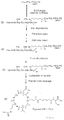
- Fig 1 summarises the procedure followed to obtain a five amino acid peptide cyclo (-D-Val-Arg-Gly-Asp-Glu-) with as anchoring tail 6-aminohexanoid acid and cysteine.
- this tail composition is based on the fact that the 6-aminohexanoic acid introduces a 6 atom long tail which is usually sufficient to allow the peptide to be far enough from the solid support and to be recognised by a binding constituent like a receptor, an antibody, etc. If necessary other amino acids or longer chains can be incorporated in the arm in the same way.
- the cysteine comprises a free thiol group which can be used as reactive function for further grafting on solid support like amine group in the presence of SMCC.
- other amino acid molecules can be incorporated in said side chain tail in order to obtain a longer arm, more hydrophobic or more hydrophilic or to introduce specific chemical groups.
- the formation of the aspartimide ring led to a product with the same molecular weight as the expected cyclic peptide, and prevented the reaction of the free terminal amino group for cyclization. This allowed additional side reactions to occur during the last step of the synthesis such as N-terminal acetylation or tetramethylguanidium formation by TBTU treatment.
- the side reaction identified as N-terminal acetylation
- the side reaction can be due to the presence of acetic acid in the solubilization solution of palladium(0) which is used for the allyl cleavage and which was probably not completely removed during the subsequent steps of the synthesis.
- the carboxylate of the peptide is left as a piperidine salt which can be converted to piperidine amide under the coupling conditions of the cyclization step, adding +67 Da to the linear peptide.
- the additional washing step was included in the protocol a non competitive cyclization was obtained.
- the obtention of a cyclic peptide bearing a side chain tail can be obtained if the D-isomer of glutamic acid is used or another dicarboxylic amino acid with a longer side chain than glutamic acid, like the 2-amino adipic acid (D or L) .
- the first or a subsequent amino acid which is incorporated during the synthesis of the peptide and which after release from the support will serve for further grafting can be any amino acid with function suitable for such use. This is the case for the amino group if lysine is used or the carboxyl group if aspartic or glutamic acid is used. These functional amino or carboxyl groups are easy to bind on activated support or proteins.
- tailed cyclic peptides are ready-to-use for chemical grafting in various applications like the development of new biomaterials for improved cell adhesion, affinity chromatography, immunisation, vaccine development, ELISA kits or for building libraries of conformationally constrained peptides.
- a cyclic peptide bearing a RGD motif grafted on aminated poly(ethylene terephtalate) is given in the example 1 (Fig 3).
- said tailed cyclic peptide is grafted on bovine serumalbumin coated on polystyrene plates can serve as anchorage for the adhesion of cells.
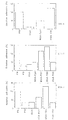
- the tailed cyclic peptide was grafted on the BSA either before adsorption of the BSA on the plate (Figs 4A and 5) or after its adsorption on the plate (Figs 4B and 6).
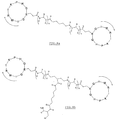
- the tailed cyclic peptides were directly adsorbed on the BSA without any colent coupling on the protein (Fig 7). These examples can be extended to any ligand which binds to a receptor.
- a peptide can be defined which mimics the ligand binding structure and which can take the place of the ligand on the receptor or enzyme binding site, and in this way obtain the desired biological response. This is especially useful for the preparation of biomaterial compatible with living cells.
- Such cyclic tailed peptides can also be constructed from non natural amino acids or using building blocks which can be incorporated in the amino acid sequence
- the design of the peptide can also affect the cell behaviour, for example leading to a pro-adhesive surface as shown in example 2 for the tailed cyclic RGD peptide.
- other peptides could have different effects on cells.
- REDV would be pro-adhesive
- DGEA would be anti-adhesive
- SFLLR would enhance activation of cells
- ANFLVWEIVRKKP would lower the activation of cells.
- Other peptides like TLEGTKKGHKLHLDYIGP would be pro-proliferative, mainly due to the GHK aminoacids, while GHE and GHP would have anti-proliferative effects on endothelial cells.
- tailed cyclic peptides One particular application of tailed cyclic peptides is to construct dimeric cyclic peptides using the tail for linking two peptides together. This is a particularly easy way to obtain dimeric cyclic peptides. The application of such construct are numerous. The most interesting is to obtain an agonist effect once the dimer is linked to the corresponding dimeric receptor. Indeed many receptors are active only in a dimeric form and this can be obtained with such dimeric cyclic peptide.
- a peptidic tail can also be added to this cyclic dimeric peptide for its fixation on a support or a macromolecule such as a protein.
- Multimeric peptides can also be constructed in the same way by linking the tail of a cyclic peptide to the cyclic part of a second tailed cyclic peptide, leaving the tail of the second peptide free for another linking.
- An alternative is to provide on the peptide two tails ready for further linking.
- the peptide sequence which is responsible for the binding of growth factors on their receptors is often known, and these peptides can advantageously be used as tailed cyclic peptides.
- the CYAAPLKPAKSC and CGTGYGSSSRRC are two peptides which can fix on the IGF-1 receptor.
- APSGHYKG and KRTGQYKL are specific for the bFGF receptor;
- ANFLVWEIVRKKP is specific for PDGF, and we propose a cyclic EQIMRIKPHQ for the receptor KDR of VEGF.
- These peptides can have antagonist effect when used as monomers, but agonist when dimeric as explained here above.
- An agonist effect of peptide mimicking the VEGF can be particularly useful for preparing biomaterial substitute for blood vessels since they could speed up the anchorage and the growth of endothelial cells, protecting this surface from platelet aggregation and other pro-inflammatory reactions.
- a proposed dimeric cyclic peptide with a tail ready for grafting on a polymeric surface is presented in the enclosed figure 7.
- Fmoc-protected amino acids and reagents including Fmoc-L-Glu-OAl, Fmoc-PAL-EG-PS and solvents used for the synthesis were purchased from PerSeptive Biosystems (Watford Herts, UK) .
- HATU used for on-line cyclization was a generous gift of PerSeptive Biosystems.
- some protected amino acids and TBTU coupling reagents were obtained from Neosystem Laboratoire (Strasbourg, France). All amino acids were used as free acids and activated just before coupling using TBTU. Except when otherwise mentioned in the text, tBu was used for side chain protection of Asp, while Trt and Pmc were used respectively as side chain protecting groups for Cys and Arg.
- Fmoc-cysteine was incorporated as the first amino acid of the sequence (Fig. 2) to allow subsequently end point grafting if required.
- Fmoc-6-aminohexanoic acid was then incorporated as the second amino acid of the sequence to introduce a 6-carbon spacer between the anchoring cysteine of the tail and the cyclizing amino acid residue of the peptidic cycle (Fig. 2).
- An ⁇ -allyl-protected Fmoc-glutamic acid residue Fmoc-L-Glu-OAl was coupled via its free carboxylic side-chain as third amino acid to allow cyclization to occur at the final step of the synthesis.
- the rest of the sequence elongation was achieved following standard Fmoc peptide synthesis, before allyl deprotection ( 2 ) and peptide cyclization ( 4 ) (Fig. 2).
- the peptide-resin was removed from the column, washed with methanol, dichloromethane and dried under vacuum. Cleavage was achieved by treatment with reagent R (Albericio F. et al., 1990, J. Org. Chem., 55 , 3730-3743) i.e. TFA-thioanisole-ethanedithiol-anisole (90:5:3:2) for 2 h. The filtrate was collected and the resin was further washed with TFA. After evaporation of the solution under high vacuum, diethylether was added to the dry residue and cooled to -20°C to precipitate the peptide.
- reagent R Albericio F. et al., 1990, J. Org. Chem., 55 , 3730-3743
- TFA-thioanisole-ethanedithiol-anisole 90:5:3:2
- the supernatant was removed and cold diethylether was further added to repeat the washing step up to five times, followed by extractions in biphasic water-ether (50:50) systems if necessary.
- the aqueous solution obtained was then lyophilised after addition of some drops of glacial acetic acid, to maintain the free thiols in their reduced state.
- Peptide purity was determined by reversed-phase HPLC on a Nucleosil C 18 column (250 mm x 4 mm) from Macherey-Nagel (Düren, Germany).
- Example 2 Grafting of tailed cyclic peptides on aminated poly(ethyleneterephtalate)
- PET film samples (diameter 1.2 cm) were first carboxylated by hydrolysis in 0.25 N NaOH and acetonitrile (1:1; V/V) and subsequent oxidation with permanganate according to Marchand-Brynaert et al. (1995, J. Colloid Interface Sci., 173, 236-244). Carboxylated PET was then aminated according to the method of Zammatteo et al. (1996, Anal. Biochem., 236, 85-94) using ethylenediamine instead of N-methyl-1,3-propane diamine to introduce primary amino groups on the support.
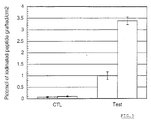
- the tailed cyclic peptide cyclo [-DVal-Arg-Gly-Asp-Glu(- ⁇ Ahx-Tyr-Cys-NH 2 )-] was iodinated with 125 I according to Greenwood et al. (1963, Biochem J., 89 , 114-123) and grafted on the aminated PET using N -succinimidyl 4-( N -maleimidomethyl)cyclohexane-1-carboxylate (SMCC) as bifunctional reagent.
- SMCC N -maleimidomethylcyclohexane-1-carboxylate
- Example 3 Enhancement of cell adhesion on polystyrene microwells coated with bovine serumalbumin (BSA) bearing tailed cyclic peptides containing the Arg-Gly-Asp (RGD) sequence
- the wells of a 96-wells polystyrene microwells plate were coated with bovine serum albumin already grafted with a RGD tailed cyclic peptide before testing the adherence of these coated plates (Fig. 4A) .
- Albumin was activated with the heterobifunctional reagent sulfo-succinimidyl 4-( N -maleimidomethyl) cyclohexane-1-carboxylate i.e. sulfo-SMCC, to introduce reactive maleimido groups at the surface of the protein.
- BSA (8 mg/ml) was incubated in 100 mM NaH 2 PO 4 pH 7.2 during 1 h at room temperature in the presence of sulfo-SMCC at a final concentration of 1.8 mg/ml. The solution was desalted and reconcentrated at 1 mg/ml on Amicon PM10. The activated BSA was then incubated overnight at room temperature in the presence of cyclo [-D-Val-Arg-Gly-Asp-Glu(- ⁇ Ahx-Tyr-Cys-NH 2 )-] at a concentration of 1.6 mg/ml. The BSA-peptide conjugate was desalted and reconcentrated at 1 mg/ml. The wells of a polystyrene microwell plate were then coated with this conjugate by incubation of 100 ml/well during 60 min, before washing two times with PBS.
- the wells were coated with native bovine serum albumin which was then grafted with the tailed cyclic RGD peptide (Fig. 4B).
- the wells of a 96-well polystyrene microwell plate were first coated with bovine serum albumin (BSA) by incubating the protein at a concentration of 1 mg/ml (100 ml/well) during 60 min in PBS buffer.
- BSA bovine serum albumin
- the wells were then washed two times with PBS buffer before activation with succinimidyl-4-( N -maleimidomethyl)cyclohexane-1-carboxylate (SMCC).
- BSA bovine serum albumin
- SMCC was dissolved at a final concentration of 26 mg/ml in 100 mM NaH 2 PO 4 pH 7.2 10 % DMSO and incubated in BSA-activated microwells (100 ml/well) at room temperature during 60 min. The wells were then washed two times with 100 mM NaH 2 PO 4 pH 7.2 to remove unreacted SMCC. The tailed cyclic peptide cyclo [-DVal-Arg-Gly-Asp-Glu(- ⁇ Ahx-Tyr-Cys-NH 2 )] at a concentration of 0.18 mg/ml in 100 mM NaH 2 PO 4 pH 7.2 (100 ml/well) was incubated in the microwells overnight at room temperature.
Landscapes
- Health & Medical Sciences (AREA)
- Chemical & Material Sciences (AREA)
- Life Sciences & Earth Sciences (AREA)
- General Health & Medical Sciences (AREA)
- Organic Chemistry (AREA)
- Engineering & Computer Science (AREA)
- Biomedical Technology (AREA)
- Medicinal Chemistry (AREA)
- Genetics & Genomics (AREA)
- Veterinary Medicine (AREA)
- Zoology (AREA)
- Epidemiology (AREA)
- Biochemistry (AREA)
- Animal Behavior & Ethology (AREA)
- Public Health (AREA)
- Bioinformatics & Cheminformatics (AREA)
- Molecular Biology (AREA)
- Biophysics (AREA)
- Dermatology (AREA)
- Proteomics, Peptides & Aminoacids (AREA)
- Oral & Maxillofacial Surgery (AREA)
- Transplantation (AREA)
- Wood Science & Technology (AREA)
- Cell Biology (AREA)
- Biotechnology (AREA)
- Microbiology (AREA)
- Chemical Kinetics & Catalysis (AREA)
- Botany (AREA)
- General Engineering & Computer Science (AREA)
- Heart & Thoracic Surgery (AREA)
- Surgery (AREA)
- Vascular Medicine (AREA)
- Peptides Or Proteins (AREA)
Applications Claiming Priority (2)
| Application Number | Priority Date | Filing Date | Title |
|---|---|---|---|
| US3098096P | 1996-11-15 | 1996-11-15 | |
| US30980P | 1996-11-15 |
Publications (2)
| Publication Number | Publication Date |
|---|---|
| EP0844252A2 true EP0844252A2 (fr) | 1998-05-27 |
| EP0844252A3 EP0844252A3 (fr) | 1998-07-08 |
Family
ID=21856998
Family Applications (1)
| Application Number | Title | Priority Date | Filing Date |
|---|---|---|---|
| EP97870182A Withdrawn EP0844252A3 (fr) | 1996-11-15 | 1997-11-14 | Peptides cycliques ayant une extrémité destinée à un couplage chimique ultérieur et leurs procédés de préparation |
Country Status (2)
| Country | Link |
|---|---|
| US (1) | US5939383A (fr) |
| EP (1) | EP0844252A3 (fr) |
Cited By (5)
| Publication number | Priority date | Publication date | Assignee | Title |
|---|---|---|---|---|
| WO1999031126A1 (fr) * | 1997-12-16 | 1999-06-24 | Merck Patent Gmbh | Derives cyclopeptitiques presentant des proprietes d'inhibition de l'integrine |
| WO2000023113A1 (fr) * | 1998-10-08 | 2000-04-27 | Stichting Voor De Technische Wetenschappen | Vecteurs peptidiques pour cellules etoilees |
| FR2814744A1 (fr) * | 2000-10-04 | 2002-04-05 | Commissariat Energie Atomique | Cyclopeptides, leur procede de preparation et leur utilisation comme inhibiteur ou activateur de l'angiogenese |
| WO2009010232A1 (fr) * | 2007-07-13 | 2009-01-22 | Nmi Naturwissenschaftliches Und Medizinisches Institut An Der Universität Tübingen In Reutlingen Stiftung Bürgerlichen Rechts | Biomatériau à base d'un support polymère hydrophile |
| WO2011081523A1 (fr) | 2009-12-31 | 2011-07-07 | Rijksuniversiteit Groningen | Analogues d'interférons |
Families Citing this family (6)
| Publication number | Priority date | Publication date | Assignee | Title |
|---|---|---|---|---|
| CZ20003798A3 (cs) * | 1998-04-15 | 2001-08-15 | Aventis Pharmaceuticals Products, Inc. | Způsob výroby cyklických peptidů vázaných k polymernímu nosiči |
| US6913890B2 (en) * | 2002-12-18 | 2005-07-05 | Palo Alto Research Center Incorporated | Process for preparing albumin protein conjugated oligonucleotide probes |
| US6972229B2 (en) | 2003-12-23 | 2005-12-06 | 02Ic, Inc. | Method of manufacturing self-aligned non-volatile memory device |
| KR100729210B1 (ko) | 2004-11-18 | 2007-06-19 | 주식회사 녹십자홀딩스 | 내피세포 성장호르몬에 대한 길항작용이 증진된 펩티드 및이로부터 제조되는 치료제 |
| US8282943B2 (en) | 2005-05-31 | 2012-10-09 | Ralf Jochem | Therapeutic composition for use in the prevention and treatment of bone metastases |
| US20110269231A1 (en) * | 2010-04-22 | 2011-11-03 | Wisconsin Alumni Research Foundation | Proteoglycan-binding peptides that modulate stem cell behavior |
Family Cites Families (3)
| Publication number | Priority date | Publication date | Assignee | Title |
|---|---|---|---|---|
| DE150199C (fr) * | ||||
| DD150199A1 (de) * | 1980-04-30 | 1981-08-19 | Klaus Neubert | Verfahren zur herstellung von neuen peptidwirkstoffen |
| GB9402331D0 (en) * | 1994-02-07 | 1994-03-30 | Univ Mcgill | Nerve growth factor structural analogs and their uses |
-
1997
- 1997-11-14 US US08/970,876 patent/US5939383A/en not_active Expired - Fee Related
- 1997-11-14 EP EP97870182A patent/EP0844252A3/fr not_active Withdrawn
Cited By (17)
| Publication number | Priority date | Publication date | Assignee | Title |
|---|---|---|---|---|
| WO1999031126A1 (fr) * | 1997-12-16 | 1999-06-24 | Merck Patent Gmbh | Derives cyclopeptitiques presentant des proprietes d'inhibition de l'integrine |
| US6995238B2 (en) | 1997-12-16 | 2006-02-07 | Biomet Deutchland Gmbh | Cyclopeptide derivatives |
| US6610826B1 (en) | 1997-12-16 | 2003-08-26 | Merck Patent Department | Cyclopeptide derivatives with integrin inhibitor properties |
| WO2000023113A1 (fr) * | 1998-10-08 | 2000-04-27 | Stichting Voor De Technische Wetenschappen | Vecteurs peptidiques pour cellules etoilees |
| US7348313B2 (en) | 1998-10-08 | 2008-03-25 | Stichting Voor De Technische Wetenschappen | Method for targeting cells involved in sclerotic and/or fibrotic diseases |
| AU770340B2 (en) * | 1998-10-08 | 2004-02-19 | Biorion Technologies B.V. | Peptide-based carrier devices for stellate cells |
| US6844319B1 (en) | 1998-10-08 | 2005-01-18 | Stichting Voor De Technische Wetenschappen | Peptide-based carrier devices for stellate cells |
| AU2001293948B2 (en) * | 2000-10-04 | 2005-11-03 | Commissariat A L'energie Atomique | Cyclic peptides, method for preparing same and use as angiogenesis inhibitor or activator |
| RU2249599C2 (ru) * | 2000-10-04 | 2005-04-10 | Коммиссариат А Л'Энержи Атомик | Циклопептиды, способ их получения и применение в качестве ингибиторов или активаторов антиогенеза |
| WO2002028895A3 (fr) * | 2000-10-04 | 2002-06-06 | Commissariat Energie Atomique | Cyclopeptides, leur procede de preparation et leur utilisation comme inhibiteur ou activateur de l'angiogenese |
| US7199100B2 (en) | 2000-10-04 | 2007-04-03 | Commissariat A L'energie Atomique | Cyclic peptides, method for preparing and use as angiogenesis inhibitors or activator |
| FR2814744A1 (fr) * | 2000-10-04 | 2002-04-05 | Commissariat Energie Atomique | Cyclopeptides, leur procede de preparation et leur utilisation comme inhibiteur ou activateur de l'angiogenese |
| USRE44022E1 (en) | 2000-10-04 | 2013-02-19 | Commissariat A L'energie Atomique | Cyclic peptides, method for preparing and use as angiogenesis inhibitors or activators |
| WO2009010232A1 (fr) * | 2007-07-13 | 2009-01-22 | Nmi Naturwissenschaftliches Und Medizinisches Institut An Der Universität Tübingen In Reutlingen Stiftung Bürgerlichen Rechts | Biomatériau à base d'un support polymère hydrophile |
| US10196602B2 (en) | 2007-07-13 | 2019-02-05 | Nmi Naturwissenschaftliches Und Medizinisches Institut An Der Universitaet Tuebingen | Biomaterial based on a hydrophilic polymeric carrier |
| WO2011081523A1 (fr) | 2009-12-31 | 2011-07-07 | Rijksuniversiteit Groningen | Analogues d'interférons |
| EP2343081A1 (fr) | 2009-12-31 | 2011-07-13 | Rijksuniversiteit Groningen | Analogues d'interféron |
Also Published As
| Publication number | Publication date |
|---|---|
| US5939383A (en) | 1999-08-17 |
| EP0844252A3 (fr) | 1998-07-08 |
Similar Documents
| Publication | Publication Date | Title |
|---|---|---|
| US5965695A (en) | Modified peptide and peptide libraries with protease resistance, derivatives thereof and methods of producing and screening such | |
| US7211395B2 (en) | Serum albumin binding moieties | |
| US6008058A (en) | Cyclic peptide mixtures via side chain or backbone attachment and solid phase synthesis | |
| EP0464140B1 (fr) | Site de fixation hydrophobe pour peptides d'adherence | |
| US20030185870A1 (en) | Interfacial biomaterials | |
| US5939383A (en) | Cyclic peptides bearing a tail designed for subsequent chemical coupling and process for preparing same | |
| Mahto et al. | A reversible protection strategy to improve Fmoc‐SPPS of peptide thioesters by the N‐acylurea approach | |
| US7344884B2 (en) | Peptides promoting cell adherence, growth and secretion | |
| AU2002335930A1 (en) | Serum albumin binding moieties | |
| EP0535155A1 (fr) | Banques de peptides modifies resistant a la protease | |
| JPH03501574A (ja) | 走化性ペプチドによる走化性の刺激 | |
| JP2011231085A (ja) | 環状ペプチド | |
| US6602981B2 (en) | Antinociceptive agent derivative | |
| EP0114887B1 (fr) | Polypeptide | |
| CN113292635A (zh) | 靶向cd47的多肽及其应用 | |
| JPH03503047A (ja) | ポリマーおよびポリマー‐ペプチド複合体 | |
| JP2004511424A (ja) | テンプレートを固定したβヘアピンループ類似物の合成 | |
| Ivanov et al. | Synthesis and use of a new bromoacetyl-derivatized heterotrifunctional amino acid for conjugation of cyclic RGD-containing peptides derived from human bone sialoprotein | |
| CN113599531A (zh) | Pcm多肽组合kala多肽的红细胞仿生纳米材料的应用及其制备方法 | |
| CN113307849A (zh) | 一种靶向肿瘤干细胞标志物cd133的订书肽及其应用 | |
| Delforge et al. | Automated solid-phase synthesis of cyclic peptides bearing a side-chain tail designed for subsequent chemical grafting | |
| CZ2004122A3 (cs) | Glykopeptidy | |
| Hruby et al. | Applications of synthetic peptides | |
| WO1991013098A1 (fr) | Supports solides pour biosystemes a phase solide | |
| WO1999002674A1 (fr) | Peptides contenant le motif igd et leur utilisation comme modulateurs de migration cellulaire |
Legal Events
| Date | Code | Title | Description |
|---|---|---|---|
| PUAI | Public reference made under article 153(3) epc to a published international application that has entered the european phase |
Free format text: ORIGINAL CODE: 0009012 |
|
| PUAL | Search report despatched |
Free format text: ORIGINAL CODE: 0009013 |
|
| 17P | Request for examination filed |
Effective date: 19971127 |
|
| AK | Designated contracting states |
Kind code of ref document: A2 Designated state(s): AT BE CH DE DK ES FI FR GB GR IE IT LI LU MC NL PT SE |
|
| AX | Request for extension of the european patent |
Free format text: AL;LT;LV;MK;RO;SI |
|
| AK | Designated contracting states |
Kind code of ref document: A3 Designated state(s): AT BE CH DE DK ES FI FR GB GR IE IT LI LU MC NL PT SE |
|
| AX | Request for extension of the european patent |
Free format text: AL;LT;LV;MK;RO;SI |
|
| AKX | Designation fees paid | ||
| RBV | Designated contracting states (corrected) | ||
| STAA | Information on the status of an ep patent application or granted ep patent |
Free format text: STATUS: THE APPLICATION IS DEEMED TO BE WITHDRAWN |
|
| 18D | Application deemed to be withdrawn |
Effective date: 19980925 |