EP0844525B1 - Procédé de formation d'image à partir d'un produit photographique à l'halogénure d'argent sensible à la lumière - Google Patents
Procédé de formation d'image à partir d'un produit photographique à l'halogénure d'argent sensible à la lumière Download PDFInfo
- Publication number
- EP0844525B1 EP0844525B1 EP97120282A EP97120282A EP0844525B1 EP 0844525 B1 EP0844525 B1 EP 0844525B1 EP 97120282 A EP97120282 A EP 97120282A EP 97120282 A EP97120282 A EP 97120282A EP 0844525 B1 EP0844525 B1 EP 0844525B1
- Authority
- EP
- European Patent Office
- Prior art keywords
- group
- silver halide
- layer
- substituent
- photographic material
- Prior art date
- Legal status (The legal status is an assumption and is not a legal conclusion. Google has not performed a legal analysis and makes no representation as to the accuracy of the status listed.)
- Expired - Lifetime
Links
- -1 silver halide Chemical class 0.000 title claims description 198
- 229910052709 silver Inorganic materials 0.000 title claims description 121
- 239000004332 silver Substances 0.000 title claims description 121
- 239000000463 material Substances 0.000 title claims description 102
- 238000000034 method Methods 0.000 title claims description 44
- 239000000839 emulsion Substances 0.000 claims description 78
- 239000003795 chemical substances by application Substances 0.000 claims description 76
- 150000001875 compounds Chemical class 0.000 claims description 58
- 125000001424 substituent group Chemical group 0.000 claims description 57
- 238000011161 development Methods 0.000 claims description 52
- 125000000217 alkyl group Chemical group 0.000 claims description 39
- 125000004435 hydrogen atom Chemical group [H]* 0.000 claims description 37
- 230000003321 amplification Effects 0.000 claims description 32
- 238000003199 nucleic acid amplification method Methods 0.000 claims description 32
- BQCADISMDOOEFD-UHFFFAOYSA-N Silver Chemical compound [Ag] BQCADISMDOOEFD-UHFFFAOYSA-N 0.000 claims description 27
- 238000000576 coating method Methods 0.000 claims description 23
- 238000006243 chemical reaction Methods 0.000 claims description 22
- 239000011248 coating agent Substances 0.000 claims description 22
- 125000003545 alkoxy group Chemical group 0.000 claims description 16
- 238000010521 absorption reaction Methods 0.000 claims description 15
- 230000003647 oxidation Effects 0.000 claims description 13
- 238000007254 oxidation reaction Methods 0.000 claims description 13
- 125000006575 electron-withdrawing group Chemical group 0.000 claims description 11
- 125000004453 alkoxycarbonyl group Chemical group 0.000 claims description 9
- 230000008033 biological extinction Effects 0.000 claims description 9
- 229910052757 nitrogen Inorganic materials 0.000 claims description 9
- 125000004433 nitrogen atom Chemical group N* 0.000 claims description 9
- 125000004432 carbon atom Chemical group C* 0.000 claims description 8
- 229910052739 hydrogen Inorganic materials 0.000 claims description 8
- 239000001257 hydrogen Substances 0.000 claims description 8
- 125000000951 phenoxy group Chemical group [H]C1=C([H])C([H])=C(O*)C([H])=C1[H] 0.000 claims description 7
- 229910021607 Silver chloride Inorganic materials 0.000 claims description 5
- 125000006678 phenoxycarbonyl group Chemical group 0.000 claims description 5
- HKZLPVFGJNLROG-UHFFFAOYSA-M silver monochloride Chemical compound [Cl-].[Ag+] HKZLPVFGJNLROG-UHFFFAOYSA-M 0.000 claims description 5
- 229910052717 sulfur Inorganic materials 0.000 claims description 5
- 229910052799 carbon Inorganic materials 0.000 claims description 4
- 125000003356 phenylsulfanyl group Chemical group [*]SC1=C([H])C([H])=C([H])C([H])=C1[H] 0.000 claims description 4
- DNIAPMSPPWPWGF-GSVOUGTGSA-N (R)-(-)-Propylene glycol Chemical compound C[C@@H](O)CO DNIAPMSPPWPWGF-GSVOUGTGSA-N 0.000 claims description 3
- KAESVJOAVNADME-UHFFFAOYSA-N Pyrrole Chemical group C=1C=CNC=1 KAESVJOAVNADME-UHFFFAOYSA-N 0.000 claims description 3
- 125000004429 atom Chemical group 0.000 claims description 3
- 125000002883 imidazolyl group Chemical group 0.000 claims description 3
- 125000004430 oxygen atom Chemical group O* 0.000 claims description 3
- 125000004434 sulfur atom Chemical group 0.000 claims description 3
- 239000010410 layer Substances 0.000 description 158
- 239000000975 dye Substances 0.000 description 78
- 239000000243 solution Substances 0.000 description 60
- 239000003381 stabilizer Substances 0.000 description 41
- 108010010803 Gelatin Proteins 0.000 description 28
- 229920000159 gelatin Polymers 0.000 description 28
- 239000008273 gelatin Substances 0.000 description 28
- 235000019322 gelatine Nutrition 0.000 description 28
- 235000011852 gelatine desserts Nutrition 0.000 description 28
- 238000012545 processing Methods 0.000 description 21
- VEXZGXHMUGYJMC-UHFFFAOYSA-M Chloride anion Chemical compound [Cl-] VEXZGXHMUGYJMC-UHFFFAOYSA-M 0.000 description 20
- MHAJPDPJQMAIIY-UHFFFAOYSA-N Hydrogen peroxide Chemical compound OO MHAJPDPJQMAIIY-UHFFFAOYSA-N 0.000 description 20
- 238000002360 preparation method Methods 0.000 description 18
- DOIRQSBPFJWKBE-UHFFFAOYSA-N dibutyl phthalate Chemical compound CCCCOC(=O)C1=CC=CC=C1C(=O)OCCCC DOIRQSBPFJWKBE-UHFFFAOYSA-N 0.000 description 17
- 230000000694 effects Effects 0.000 description 16
- XLYOFNOQVPJJNP-UHFFFAOYSA-N water Substances O XLYOFNOQVPJJNP-UHFFFAOYSA-N 0.000 description 16
- 239000002250 absorbent Substances 0.000 description 15
- 230000002745 absorbent Effects 0.000 description 15
- 125000003118 aryl group Chemical group 0.000 description 15
- 230000001235 sensitizing effect Effects 0.000 description 15
- IOLCXVTUBQKXJR-UHFFFAOYSA-M potassium bromide Chemical compound [K+].[Br-] IOLCXVTUBQKXJR-UHFFFAOYSA-M 0.000 description 14
- 239000007800 oxidant agent Substances 0.000 description 13
- FAPWRFPIFSIZLT-UHFFFAOYSA-M Sodium chloride Chemical compound [Na+].[Cl-] FAPWRFPIFSIZLT-UHFFFAOYSA-M 0.000 description 12
- 125000000623 heterocyclic group Chemical group 0.000 description 12
- 239000007864 aqueous solution Substances 0.000 description 11
- 125000005843 halogen group Chemical group 0.000 description 11
- 239000000123 paper Substances 0.000 description 11
- 230000015572 biosynthetic process Effects 0.000 description 10
- BKUSIKGSPSFQAC-RRKCRQDMSA-N 2'-deoxyinosine-5'-diphosphate Chemical compound O1[C@H](CO[P@@](O)(=O)OP(O)(O)=O)[C@@H](O)C[C@@H]1N1C(NC=NC2=O)=C2N=C1 BKUSIKGSPSFQAC-RRKCRQDMSA-N 0.000 description 9
- OKKJLVBELUTLKV-UHFFFAOYSA-N Methanol Chemical compound OC OKKJLVBELUTLKV-UHFFFAOYSA-N 0.000 description 9
- 125000004442 acylamino group Chemical group 0.000 description 9
- 125000001997 phenyl group Chemical group [H]C1=C([H])C([H])=C(*)C([H])=C1[H] 0.000 description 9
- 125000000472 sulfonyl group Chemical group *S(*)(=O)=O 0.000 description 9
- PAYRUJLWNCNPSJ-UHFFFAOYSA-N Aniline Chemical compound NC1=CC=CC=C1 PAYRUJLWNCNPSJ-UHFFFAOYSA-N 0.000 description 8
- 125000004414 alkyl thio group Chemical group 0.000 description 8
- 125000005110 aryl thio group Chemical group 0.000 description 8
- 238000001556 precipitation Methods 0.000 description 8
- 125000000475 sulfinyl group Chemical group [*:2]S([*:1])=O 0.000 description 8
- 125000005420 sulfonamido group Chemical group S(=O)(=O)(N*)* 0.000 description 8
- 125000004104 aryloxy group Chemical group 0.000 description 7
- 125000002887 hydroxy group Chemical group [H]O* 0.000 description 7
- 150000002500 ions Chemical class 0.000 description 7
- 230000008569 process Effects 0.000 description 7
- 239000004094 surface-active agent Substances 0.000 description 7
- VYPSYNLAJGMNEJ-UHFFFAOYSA-N Silicium dioxide Chemical compound O=[Si]=O VYPSYNLAJGMNEJ-UHFFFAOYSA-N 0.000 description 6
- QAOWNCQODCNURD-UHFFFAOYSA-N Sulfuric acid Chemical compound OS(O)(=O)=O QAOWNCQODCNURD-UHFFFAOYSA-N 0.000 description 6
- 238000009835 boiling Methods 0.000 description 6
- 239000001267 polyvinylpyrrolidone Substances 0.000 description 6
- 229920000036 polyvinylpyrrolidone Polymers 0.000 description 6
- 235000013855 polyvinylpyrrolidone Nutrition 0.000 description 6
- 239000011780 sodium chloride Substances 0.000 description 6
- 239000002904 solvent Substances 0.000 description 6
- 239000002253 acid Substances 0.000 description 5
- 125000004423 acyloxy group Chemical group 0.000 description 5
- 125000005161 aryl oxy carbonyl group Chemical group 0.000 description 5
- 125000003917 carbamoyl group Chemical group [H]N([H])C(*)=O 0.000 description 5
- 229910052801 chlorine Inorganic materials 0.000 description 5
- 125000001309 chloro group Chemical group Cl* 0.000 description 5
- 125000004093 cyano group Chemical group *C#N 0.000 description 5
- 125000002496 methyl group Chemical group [H]C([H])([H])* 0.000 description 5
- QJGQUHMNIGDVPM-UHFFFAOYSA-N nitrogen group Chemical group [N] QJGQUHMNIGDVPM-UHFFFAOYSA-N 0.000 description 5
- 229920000642 polymer Polymers 0.000 description 5
- GZTPJDLYPMPRDF-UHFFFAOYSA-N pyrrolo[3,2-c]pyrazole Chemical compound N1=NC2=CC=NC2=C1 GZTPJDLYPMPRDF-UHFFFAOYSA-N 0.000 description 5
- CPELXLSAUQHCOX-UHFFFAOYSA-M Bromide Chemical compound [Br-] CPELXLSAUQHCOX-UHFFFAOYSA-M 0.000 description 4
- 101000832225 Homo sapiens Stabilin-1 Proteins 0.000 description 4
- 101000832213 Homo sapiens Stabilin-2 Proteins 0.000 description 4
- XEEYBQQBJWHFJM-UHFFFAOYSA-N Iron Chemical compound [Fe] XEEYBQQBJWHFJM-UHFFFAOYSA-N 0.000 description 4
- 102100024471 Stabilin-1 Human genes 0.000 description 4
- 102100024470 Stabilin-2 Human genes 0.000 description 4
- 125000004466 alkoxycarbonylamino group Chemical group 0.000 description 4
- 125000004397 aminosulfonyl group Chemical group NS(=O)(=O)* 0.000 description 4
- 125000002490 anilino group Chemical group [H]N(*)C1=C([H])C([H])=C([H])C([H])=C1[H] 0.000 description 4
- 125000005162 aryl oxy carbonyl amino group Chemical group 0.000 description 4
- BJQHLKABXJIVAM-UHFFFAOYSA-N bis(2-ethylhexyl) phthalate Chemical compound CCCCC(CC)COC(=O)C1=CC=CC=C1C(=O)OCC(CC)CCCC BJQHLKABXJIVAM-UHFFFAOYSA-N 0.000 description 4
- 238000005282 brightening Methods 0.000 description 4
- 125000001951 carbamoylamino group Chemical group C(N)(=O)N* 0.000 description 4
- 125000002915 carbonyl group Chemical group [*:2]C([*:1])=O 0.000 description 4
- 125000003178 carboxy group Chemical group [H]OC(*)=O 0.000 description 4
- 238000005859 coupling reaction Methods 0.000 description 4
- 125000000753 cycloalkyl group Chemical group 0.000 description 4
- 125000001495 ethyl group Chemical group [H]C([H])([H])C([H])([H])* 0.000 description 4
- 238000005562 fading Methods 0.000 description 4
- 150000004820 halides Chemical class 0.000 description 4
- 239000011229 interlayer Substances 0.000 description 4
- BASFCYQUMIYNBI-UHFFFAOYSA-N platinum Chemical compound [Pt] BASFCYQUMIYNBI-UHFFFAOYSA-N 0.000 description 4
- 239000004848 polyfunctional curative Substances 0.000 description 4
- BWHMMNNQKKPAPP-UHFFFAOYSA-L potassium carbonate Chemical compound [K+].[K+].[O-]C([O-])=O BWHMMNNQKKPAPP-UHFFFAOYSA-L 0.000 description 4
- 238000006479 redox reaction Methods 0.000 description 4
- 230000002829 reductive effect Effects 0.000 description 4
- 229920006395 saturated elastomer Polymers 0.000 description 4
- 238000004904 shortening Methods 0.000 description 4
- SQGYOTSLMSWVJD-UHFFFAOYSA-N silver(1+) nitrate Chemical compound [Ag+].[O-]N(=O)=O SQGYOTSLMSWVJD-UHFFFAOYSA-N 0.000 description 4
- 230000000087 stabilizing effect Effects 0.000 description 4
- 125000000999 tert-butyl group Chemical group [H]C([H])([H])C(*)(C([H])([H])[H])C([H])([H])[H] 0.000 description 4
- VHUUQVKOLVNVRT-UHFFFAOYSA-N Ammonium hydroxide Chemical compound [NH4+].[OH-] VHUUQVKOLVNVRT-UHFFFAOYSA-N 0.000 description 3
- ZMXDDKWLCZADIW-UHFFFAOYSA-N N,N-Dimethylformamide Chemical compound CN(C)C=O ZMXDDKWLCZADIW-UHFFFAOYSA-N 0.000 description 3
- KWYUFKZDYYNOTN-UHFFFAOYSA-M Potassium hydroxide Chemical compound [OH-].[K+] KWYUFKZDYYNOTN-UHFFFAOYSA-M 0.000 description 3
- 206010070834 Sensitisation Diseases 0.000 description 3
- HEMHJVSKTPXQMS-UHFFFAOYSA-M Sodium hydroxide Chemical compound [OH-].[Na+] HEMHJVSKTPXQMS-UHFFFAOYSA-M 0.000 description 3
- 125000002252 acyl group Chemical group 0.000 description 3
- 125000003277 amino group Chemical group 0.000 description 3
- 235000011114 ammonium hydroxide Nutrition 0.000 description 3
- 239000011230 binding agent Substances 0.000 description 3
- 150000001721 carbon Chemical group 0.000 description 3
- 239000003054 catalyst Substances 0.000 description 3
- 239000000084 colloidal system Substances 0.000 description 3
- MTHSVFCYNBDYFN-UHFFFAOYSA-N diethylene glycol Chemical compound OCCOCCO MTHSVFCYNBDYFN-UHFFFAOYSA-N 0.000 description 3
- 229910001385 heavy metal Inorganic materials 0.000 description 3
- 150000002430 hydrocarbons Chemical group 0.000 description 3
- 229910052751 metal Inorganic materials 0.000 description 3
- 239000002184 metal Substances 0.000 description 3
- 229910021645 metal ion Inorganic materials 0.000 description 3
- 239000000203 mixture Substances 0.000 description 3
- 239000003960 organic solvent Substances 0.000 description 3
- 239000011241 protective layer Substances 0.000 description 3
- 239000011347 resin Substances 0.000 description 3
- 229920005989 resin Polymers 0.000 description 3
- 150000003839 salts Chemical class 0.000 description 3
- 230000035945 sensitivity Effects 0.000 description 3
- 230000008313 sensitization Effects 0.000 description 3
- 239000000377 silicon dioxide Substances 0.000 description 3
- 235000012239 silicon dioxide Nutrition 0.000 description 3
- 125000004469 siloxy group Chemical group [SiH3]O* 0.000 description 3
- AKHNMLFCWUSKQB-UHFFFAOYSA-L sodium thiosulfate Chemical compound [Na+].[Na+].[O-]S([O-])(=O)=S AKHNMLFCWUSKQB-UHFFFAOYSA-L 0.000 description 3
- 235000019345 sodium thiosulphate Nutrition 0.000 description 3
- GGCZERPQGJTIQP-UHFFFAOYSA-N sodium;9,10-dioxoanthracene-2-sulfonic acid Chemical compound [Na+].C1=CC=C2C(=O)C3=CC(S(=O)(=O)O)=CC=C3C(=O)C2=C1 GGCZERPQGJTIQP-UHFFFAOYSA-N 0.000 description 3
- 230000003595 spectral effect Effects 0.000 description 3
- 239000000126 substance Substances 0.000 description 3
- 125000003396 thiol group Chemical group [H]S* 0.000 description 3
- CLDZVCMRASJQFO-UHFFFAOYSA-N 2,5-bis(2,4,4-trimethylpentan-2-yl)benzene-1,4-diol Chemical compound CC(C)(C)CC(C)(C)C1=CC(O)=C(C(C)(C)CC(C)(C)C)C=C1O CLDZVCMRASJQFO-UHFFFAOYSA-N 0.000 description 2
- MZZYGYNZAOVRTG-UHFFFAOYSA-N 2-hydroxy-n-(1h-1,2,4-triazol-5-yl)benzamide Chemical compound OC1=CC=CC=C1C(=O)NC1=NC=NN1 MZZYGYNZAOVRTG-UHFFFAOYSA-N 0.000 description 2
- ALYHIRRZMINDCI-UHFFFAOYSA-N 3-(4-amino-n-ethyl-3-methylanilino)propan-1-ol Chemical compound OCCCN(CC)C1=CC=C(N)C(C)=C1 ALYHIRRZMINDCI-UHFFFAOYSA-N 0.000 description 2
- NEOLPILWCFQCPC-UHFFFAOYSA-N 4-(4-amino-n-ethyl-3-methylanilino)butan-1-ol Chemical compound OCCCCN(CC)C1=CC=C(N)C(C)=C1 NEOLPILWCFQCPC-UHFFFAOYSA-N 0.000 description 2
- QTBSBXVTEAMEQO-UHFFFAOYSA-N Acetic acid Chemical compound CC(O)=O QTBSBXVTEAMEQO-UHFFFAOYSA-N 0.000 description 2
- CSCPPACGZOOCGX-UHFFFAOYSA-N Acetone Chemical compound CC(C)=O CSCPPACGZOOCGX-UHFFFAOYSA-N 0.000 description 2
- QGZKDVFQNNGYKY-UHFFFAOYSA-O Ammonium Chemical compound [NH4+] QGZKDVFQNNGYKY-UHFFFAOYSA-O 0.000 description 2
- WKBOTKDWSSQWDR-UHFFFAOYSA-N Bromine atom Chemical group [Br] WKBOTKDWSSQWDR-UHFFFAOYSA-N 0.000 description 2
- XFXPMWWXUTWYJX-UHFFFAOYSA-N Cyanide Chemical compound N#[C-] XFXPMWWXUTWYJX-UHFFFAOYSA-N 0.000 description 2
- LFQSCWFLJHTTHZ-UHFFFAOYSA-N Ethanol Chemical compound CCO LFQSCWFLJHTTHZ-UHFFFAOYSA-N 0.000 description 2
- GYHNNYVSQQEPJS-UHFFFAOYSA-N Gallium Chemical compound [Ga] GYHNNYVSQQEPJS-UHFFFAOYSA-N 0.000 description 2
- DGAQECJNVWCQMB-PUAWFVPOSA-M Ilexoside XXIX Chemical compound C[C@@H]1CC[C@@]2(CC[C@@]3(C(=CC[C@H]4[C@]3(CC[C@@H]5[C@@]4(CC[C@@H](C5(C)C)OS(=O)(=O)[O-])C)C)[C@@H]2[C@]1(C)O)C)C(=O)O[C@H]6[C@@H]([C@H]([C@@H]([C@H](O6)CO)O)O)O.[Na+] DGAQECJNVWCQMB-PUAWFVPOSA-M 0.000 description 2
- CSNNHWWHGAXBCP-UHFFFAOYSA-L Magnesium sulfate Chemical compound [Mg+2].[O-][S+2]([O-])([O-])[O-] CSNNHWWHGAXBCP-UHFFFAOYSA-L 0.000 description 2
- PXHVJJICTQNCMI-UHFFFAOYSA-N Nickel Chemical compound [Ni] PXHVJJICTQNCMI-UHFFFAOYSA-N 0.000 description 2
- KDLHZDBZIXYQEI-UHFFFAOYSA-N Palladium Chemical compound [Pd] KDLHZDBZIXYQEI-UHFFFAOYSA-N 0.000 description 2
- 239000004698 Polyethylene Substances 0.000 description 2
- ZLMJMSJWJFRBEC-UHFFFAOYSA-N Potassium Chemical compound [K] ZLMJMSJWJFRBEC-UHFFFAOYSA-N 0.000 description 2
- WCUXLLCKKVVCTQ-UHFFFAOYSA-M Potassium chloride Chemical compound [Cl-].[K+] WCUXLLCKKVVCTQ-UHFFFAOYSA-M 0.000 description 2
- 108010059712 Pronase Proteins 0.000 description 2
- KJTLSVCANCCWHF-UHFFFAOYSA-N Ruthenium Chemical compound [Ru] KJTLSVCANCCWHF-UHFFFAOYSA-N 0.000 description 2
- NINIDFKCEFEMDL-UHFFFAOYSA-N Sulfur Chemical compound [S] NINIDFKCEFEMDL-UHFFFAOYSA-N 0.000 description 2
- ZMZDMBWJUHKJPS-UHFFFAOYSA-M Thiocyanate anion Chemical compound [S-]C#N ZMZDMBWJUHKJPS-UHFFFAOYSA-M 0.000 description 2
- GWEVSGVZZGPLCZ-UHFFFAOYSA-N Titan oxide Chemical compound O=[Ti]=O GWEVSGVZZGPLCZ-UHFFFAOYSA-N 0.000 description 2
- 230000002411 adverse Effects 0.000 description 2
- 125000003342 alkenyl group Chemical group 0.000 description 2
- 150000001565 benzotriazoles Chemical class 0.000 description 2
- LLEMOWNGBBNAJR-UHFFFAOYSA-N biphenyl-2-ol Chemical compound OC1=CC=CC=C1C1=CC=CC=C1 LLEMOWNGBBNAJR-UHFFFAOYSA-N 0.000 description 2
- 238000004061 bleaching Methods 0.000 description 2
- 229940006460 bromide ion Drugs 0.000 description 2
- 229910017052 cobalt Inorganic materials 0.000 description 2
- 239000010941 cobalt Substances 0.000 description 2
- GUTLYIVDDKVIGB-UHFFFAOYSA-N cobalt atom Chemical compound [Co] GUTLYIVDDKVIGB-UHFFFAOYSA-N 0.000 description 2
- JAWGVVJVYSANRY-UHFFFAOYSA-N cobalt(3+) Chemical compound [Co+3] JAWGVVJVYSANRY-UHFFFAOYSA-N 0.000 description 2
- 125000000392 cycloalkenyl group Chemical group 0.000 description 2
- 230000006866 deterioration Effects 0.000 description 2
- 238000009826 distribution Methods 0.000 description 2
- 238000001035 drying Methods 0.000 description 2
- 230000007613 environmental effect Effects 0.000 description 2
- 125000003754 ethoxycarbonyl group Chemical group C(=O)(OCC)* 0.000 description 2
- 229910052731 fluorine Inorganic materials 0.000 description 2
- 125000001153 fluoro group Chemical group F* 0.000 description 2
- 229910052733 gallium Inorganic materials 0.000 description 2
- 230000006698 induction Effects 0.000 description 2
- 229910052741 iridium Inorganic materials 0.000 description 2
- GKOZUEZYRPOHIO-UHFFFAOYSA-N iridium atom Chemical compound [Ir] GKOZUEZYRPOHIO-UHFFFAOYSA-N 0.000 description 2
- 229910052742 iron Inorganic materials 0.000 description 2
- 125000001449 isopropyl group Chemical group [H]C([H])([H])C([H])(*)C([H])([H])[H] 0.000 description 2
- 239000012452 mother liquor Substances 0.000 description 2
- 125000000449 nitro group Chemical group [O-][N+](*)=O 0.000 description 2
- 229910052762 osmium Inorganic materials 0.000 description 2
- SYQBFIAQOQZEGI-UHFFFAOYSA-N osmium atom Chemical compound [Os] SYQBFIAQOQZEGI-UHFFFAOYSA-N 0.000 description 2
- 125000005499 phosphonyl group Chemical group 0.000 description 2
- XNGIFLGASWRNHJ-UHFFFAOYSA-N phthalic acid Chemical compound OC(=O)C1=CC=CC=C1C(O)=O XNGIFLGASWRNHJ-UHFFFAOYSA-N 0.000 description 2
- 239000000049 pigment Substances 0.000 description 2
- 229910052697 platinum Inorganic materials 0.000 description 2
- 229920000573 polyethylene Polymers 0.000 description 2
- 239000005020 polyethylene terephthalate Substances 0.000 description 2
- 229920000139 polyethylene terephthalate Polymers 0.000 description 2
- 239000011591 potassium Substances 0.000 description 2
- 229910052700 potassium Inorganic materials 0.000 description 2
- 229910000027 potassium carbonate Inorganic materials 0.000 description 2
- 125000002924 primary amino group Chemical group [H]N([H])* 0.000 description 2
- 238000003672 processing method Methods 0.000 description 2
- 230000002035 prolonged effect Effects 0.000 description 2
- 229910052703 rhodium Inorganic materials 0.000 description 2
- 239000010948 rhodium Substances 0.000 description 2
- 229910052707 ruthenium Inorganic materials 0.000 description 2
- 125000000467 secondary amino group Chemical group [H]N([*:1])[*:2] 0.000 description 2
- 229910001961 silver nitrate Inorganic materials 0.000 description 2
- 239000011734 sodium Substances 0.000 description 2
- 229910052708 sodium Inorganic materials 0.000 description 2
- 150000003413 spiro compounds Chemical group 0.000 description 2
- 238000003860 storage Methods 0.000 description 2
- KDYFGRWQOYBRFD-UHFFFAOYSA-N succinic acid Chemical compound OC(=O)CCC(O)=O KDYFGRWQOYBRFD-UHFFFAOYSA-N 0.000 description 2
- 239000011593 sulfur Substances 0.000 description 2
- 125000001302 tertiary amino group Chemical group 0.000 description 2
- 125000002023 trifluoromethyl group Chemical group FC(F)(F)* 0.000 description 2
- 238000005406 washing Methods 0.000 description 2
- 239000012463 white pigment Substances 0.000 description 2
- CUNWUEBNSZSNRX-RKGWDQTMSA-N (2r,3r,4r,5s)-hexane-1,2,3,4,5,6-hexol;(z)-octadec-9-enoic acid Chemical compound OC[C@H](O)[C@@H](O)[C@H](O)[C@H](O)CO.OC[C@H](O)[C@@H](O)[C@H](O)[C@H](O)CO.CCCCCCCC\C=C/CCCCCCCC(O)=O.CCCCCCCC\C=C/CCCCCCCC(O)=O.CCCCCCCC\C=C/CCCCCCCC(O)=O CUNWUEBNSZSNRX-RKGWDQTMSA-N 0.000 description 1
- CFSGUMFOSQULCJ-UHFFFAOYSA-N 1,3-bis(ethenylsulfonyl)-2,2-bis(ethenylsulfonylmethyl)propane Chemical compound C=CS(=O)(=O)CC(CS(=O)(=O)C=C)(CS(=O)(=O)C=C)CS(=O)(=O)C=C CFSGUMFOSQULCJ-UHFFFAOYSA-N 0.000 description 1
- 150000005208 1,4-dihydroxybenzenes Chemical class 0.000 description 1
- ZBEOPWDINRLNQS-UHFFFAOYSA-N 1-(4-amino-n-ethyl-3-methylanilino)propan-2-ol Chemical compound CC(O)CN(CC)C1=CC=C(N)C(C)=C1 ZBEOPWDINRLNQS-UHFFFAOYSA-N 0.000 description 1
- ASFXKDBHBVHSLT-UHFFFAOYSA-N 1-(4-ethoxyphenyl)-2h-tetrazole-5-thione Chemical compound C1=CC(OCC)=CC=C1N1C(=S)N=NN1 ASFXKDBHBVHSLT-UHFFFAOYSA-N 0.000 description 1
- GGZHVNZHFYCSEV-UHFFFAOYSA-N 1-Phenyl-5-mercaptotetrazole Chemical compound SC1=NN=NN1C1=CC=CC=C1 GGZHVNZHFYCSEV-UHFFFAOYSA-N 0.000 description 1
- RZRNAYUHWVFMIP-KTKRTIGZSA-N 1-oleoylglycerol Chemical compound CCCCCCCC\C=C/CCCCCCCC(=O)OCC(O)CO RZRNAYUHWVFMIP-KTKRTIGZSA-N 0.000 description 1
- SPGHVPRNQZLLSK-UHFFFAOYSA-N 1h-imidazo[1,2-c]imidazole Chemical compound C1=NC=C2NC=CN21 SPGHVPRNQZLLSK-UHFFFAOYSA-N 0.000 description 1
- YQTCQNIPQMJNTI-UHFFFAOYSA-N 2,2-dimethylpropan-1-one Chemical group CC(C)(C)[C]=O YQTCQNIPQMJNTI-UHFFFAOYSA-N 0.000 description 1
- 125000004201 2,4-dichlorophenyl group Chemical group [H]C1=C([H])C(*)=C(Cl)C([H])=C1Cl 0.000 description 1
- NWUNKFTVLXWQQC-UHFFFAOYSA-N 2,5-di(dodecan-2-yl)benzene-1,4-diol Chemical compound CCCCCCCCCCC(C)C1=CC(O)=C(C(C)CCCCCCCCCC)C=C1O NWUNKFTVLXWQQC-UHFFFAOYSA-N 0.000 description 1
- BRBROBKGYBWGSF-UHFFFAOYSA-N 2,5-di(tetradecan-2-yl)benzene-1,4-diol Chemical compound CCCCCCCCCCCCC(C)C1=CC(O)=C(C(C)CCCCCCCCCCCC)C=C1O BRBROBKGYBWGSF-UHFFFAOYSA-N 0.000 description 1
- QTLHLXYADXCVCF-UHFFFAOYSA-N 2-(4-amino-n-ethyl-3-methylanilino)ethanol Chemical compound OCCN(CC)C1=CC=C(N)C(C)=C1 QTLHLXYADXCVCF-UHFFFAOYSA-N 0.000 description 1
- WFXLRLQSHRNHCE-UHFFFAOYSA-N 2-(4-amino-n-ethylanilino)ethanol Chemical compound OCCN(CC)C1=CC=C(N)C=C1 WFXLRLQSHRNHCE-UHFFFAOYSA-N 0.000 description 1
- 125000002941 2-furyl group Chemical group O1C([*])=C([H])C([H])=C1[H] 0.000 description 1
- PBOQQFUHXDBADX-UHFFFAOYSA-N 2-heptadecylbutanedioic acid Chemical compound CCCCCCCCCCCCCCCCCC(C(O)=O)CC(O)=O PBOQQFUHXDBADX-UHFFFAOYSA-N 0.000 description 1
- 125000003903 2-propenyl group Chemical group [H]C([*])([H])C([H])=C([H])[H] 0.000 description 1
- 125000000175 2-thienyl group Chemical group S1C([*])=C([H])C([H])=C1[H] 0.000 description 1
- ZJOJXRSMJNWWRN-UHFFFAOYSA-N 3-amino-6-[2-(4-aminophenyl)ethenyl]benzene-1,2-disulfonic acid Chemical class C1=CC(N)=CC=C1C=CC1=CC=C(N)C(S(O)(=O)=O)=C1S(O)(=O)=O ZJOJXRSMJNWWRN-UHFFFAOYSA-N 0.000 description 1
- 125000004801 4-cyanophenyl group Chemical group [H]C1=C([H])C(C#N)=C([H])C([H])=C1* 0.000 description 1
- MTGIPEYNFPXFCM-UHFFFAOYSA-N 4-n-(2-ethoxyethyl)-4-n-ethyl-2-methylbenzene-1,4-diamine Chemical compound CCOCCN(CC)C1=CC=C(N)C(C)=C1 MTGIPEYNFPXFCM-UHFFFAOYSA-N 0.000 description 1
- MTOCKMVNXPZCJW-UHFFFAOYSA-N 4-n-dodecyl-4-n-ethyl-2-methylbenzene-1,4-diamine Chemical compound CCCCCCCCCCCCN(CC)C1=CC=C(N)C(C)=C1 MTOCKMVNXPZCJW-UHFFFAOYSA-N 0.000 description 1
- 125000000339 4-pyridyl group Chemical group N1=C([H])C([H])=C([*])C([H])=C1[H] 0.000 description 1
- ISAVYTVYFVQUDY-UHFFFAOYSA-N 4-tert-Octylphenol Chemical compound CC(C)(C)CC(C)(C)C1=CC=C(O)C=C1 ISAVYTVYFVQUDY-UHFFFAOYSA-N 0.000 description 1
- GDGIVSREGUOIJZ-UHFFFAOYSA-N 5-amino-3h-1,3,4-thiadiazole-2-thione Chemical compound NC1=NN=C(S)S1 GDGIVSREGUOIJZ-UHFFFAOYSA-N 0.000 description 1
- IUQCWFKHSNJWEA-UHFFFAOYSA-N 6-methylheptan-3-yl 2,5-dihydroxy-4-[2-(6-methylheptan-3-yloxycarbonyl)butyl]benzoate Chemical compound CC(C)CCC(CC)OC(=O)C(CC)CC1=CC(O)=C(C(=O)OC(CC)CCC(C)C)C=C1O IUQCWFKHSNJWEA-UHFFFAOYSA-N 0.000 description 1
- KLSJWNVTNUYHDU-UHFFFAOYSA-N Amitrole Chemical group NC1=NC=NN1 KLSJWNVTNUYHDU-UHFFFAOYSA-N 0.000 description 1
- 241000894006 Bacteria Species 0.000 description 1
- BVKZGUZCCUSVTD-UHFFFAOYSA-M Bicarbonate Chemical compound OC([O-])=O BVKZGUZCCUSVTD-UHFFFAOYSA-M 0.000 description 1
- BVKZGUZCCUSVTD-UHFFFAOYSA-L Carbonate Chemical compound [O-]C([O-])=O BVKZGUZCCUSVTD-UHFFFAOYSA-L 0.000 description 1
- VYZAMTAEIAYCRO-UHFFFAOYSA-N Chromium Chemical compound [Cr] VYZAMTAEIAYCRO-UHFFFAOYSA-N 0.000 description 1
- 206010011416 Croup infectious Diseases 0.000 description 1
- MQIUGAXCHLFZKX-UHFFFAOYSA-N Di-n-octyl phthalate Natural products CCCCCCCCOC(=O)C1=CC=CC=C1C(=O)OCCCCCCCC MQIUGAXCHLFZKX-UHFFFAOYSA-N 0.000 description 1
- PQUCIEFHOVEZAU-UHFFFAOYSA-N Diammonium sulfite Chemical compound [NH4+].[NH4+].[O-]S([O-])=O PQUCIEFHOVEZAU-UHFFFAOYSA-N 0.000 description 1
- 229920001174 Diethylhydroxylamine Polymers 0.000 description 1
- ZVFDTKUVRCTHQE-UHFFFAOYSA-N Diisodecyl phthalate Chemical compound CC(C)CCCCCCCOC(=O)C1=CC=CC=C1C(=O)OCCCCCCCC(C)C ZVFDTKUVRCTHQE-UHFFFAOYSA-N 0.000 description 1
- SNRUBQQJIBEYMU-UHFFFAOYSA-N Dodecane Natural products CCCCCCCCCCCC SNRUBQQJIBEYMU-UHFFFAOYSA-N 0.000 description 1
- 101100001675 Emericella variicolor andJ gene Proteins 0.000 description 1
- 108090000790 Enzymes Proteins 0.000 description 1
- 102000004190 Enzymes Human genes 0.000 description 1
- VGGSQFUCUMXWEO-UHFFFAOYSA-N Ethene Chemical compound C=C VGGSQFUCUMXWEO-UHFFFAOYSA-N 0.000 description 1
- 239000005977 Ethylene Substances 0.000 description 1
- DBVJJBKOTRCVKF-UHFFFAOYSA-N Etidronic acid Chemical compound OP(=O)(O)C(O)(C)P(O)(O)=O DBVJJBKOTRCVKF-UHFFFAOYSA-N 0.000 description 1
- UFHFLCQGNIYNRP-UHFFFAOYSA-N Hydrogen Chemical compound [H][H] UFHFLCQGNIYNRP-UHFFFAOYSA-N 0.000 description 1
- 102100025087 Insulin receptor substrate 1 Human genes 0.000 description 1
- 101710201824 Insulin receptor substrate 1 Proteins 0.000 description 1
- VQTUBCCKSQIDNK-UHFFFAOYSA-N Isobutene Chemical group CC(C)=C VQTUBCCKSQIDNK-UHFFFAOYSA-N 0.000 description 1
- ZOKXTWBITQBERF-UHFFFAOYSA-N Molybdenum Chemical compound [Mo] ZOKXTWBITQBERF-UHFFFAOYSA-N 0.000 description 1
- QPCDCPDFJACHGM-UHFFFAOYSA-N N,N-bis{2-[bis(carboxymethyl)amino]ethyl}glycine Chemical compound OC(=O)CN(CC(O)=O)CCN(CC(=O)O)CCN(CC(O)=O)CC(O)=O QPCDCPDFJACHGM-UHFFFAOYSA-N 0.000 description 1
- BZORFPDSXLZWJF-UHFFFAOYSA-N N,N-dimethyl-1,4-phenylenediamine Chemical compound CN(C)C1=CC=C(N)C=C1 BZORFPDSXLZWJF-UHFFFAOYSA-N 0.000 description 1
- 239000004743 Polypropylene Substances 0.000 description 1
- BUGBHKTXTAQXES-UHFFFAOYSA-N Selenium Chemical compound [Se] BUGBHKTXTAQXES-UHFFFAOYSA-N 0.000 description 1
- PRXRUNOAOLTIEF-ADSICKODSA-N Sorbitan trioleate Chemical compound CCCCCCCC\C=C/CCCCCCCC(=O)OC[C@@H](OC(=O)CCCCCCC\C=C/CCCCCCCC)[C@H]1OC[C@H](O)[C@H]1OC(=O)CCCCCCC\C=C/CCCCCCCC PRXRUNOAOLTIEF-ADSICKODSA-N 0.000 description 1
- 239000004147 Sorbitan trioleate Substances 0.000 description 1
- HCHKCACWOHOZIP-UHFFFAOYSA-N Zinc Chemical compound [Zn] HCHKCACWOHOZIP-UHFFFAOYSA-N 0.000 description 1
- SJOOOZPMQAWAOP-UHFFFAOYSA-N [Ag].BrCl Chemical compound [Ag].BrCl SJOOOZPMQAWAOP-UHFFFAOYSA-N 0.000 description 1
- HOLVRJRSWZOAJU-UHFFFAOYSA-N [Ag].ICl Chemical compound [Ag].ICl HOLVRJRSWZOAJU-UHFFFAOYSA-N 0.000 description 1
- RTUHUYACXLFWGS-UHFFFAOYSA-I [Fe+6].[O-]C(=O)CN(CCN(CC([O-])=O)CC([O-])=O)CCN(CC([O-])=O)CC([O-])=O Chemical compound [Fe+6].[O-]C(=O)CN(CCN(CC([O-])=O)CC([O-])=O)CCN(CC([O-])=O)CC([O-])=O RTUHUYACXLFWGS-UHFFFAOYSA-I 0.000 description 1
- 238000002835 absorbance Methods 0.000 description 1
- 238000000862 absorption spectrum Methods 0.000 description 1
- 229960000583 acetic acid Drugs 0.000 description 1
- 125000002777 acetyl group Chemical group [H]C([H])([H])C(*)=O 0.000 description 1
- 230000002378 acidificating effect Effects 0.000 description 1
- 150000007513 acids Chemical class 0.000 description 1
- 239000002671 adjuvant Substances 0.000 description 1
- 150000001298 alcohols Chemical class 0.000 description 1
- 125000005194 alkoxycarbonyloxy group Chemical group 0.000 description 1
- 125000003282 alkyl amino group Chemical group 0.000 description 1
- 125000005115 alkyl carbamoyl group Chemical group 0.000 description 1
- 125000003806 alkyl carbonyl amino group Chemical group 0.000 description 1
- 125000004448 alkyl carbonyl group Chemical group 0.000 description 1
- 125000005196 alkyl carbonyloxy group Chemical group 0.000 description 1
- 125000005153 alkyl sulfamoyl group Chemical group 0.000 description 1
- 125000004390 alkyl sulfonyl group Chemical group 0.000 description 1
- 125000004656 alkyl sulfonylamino group Chemical group 0.000 description 1
- 125000005278 alkyl sulfonyloxy group Chemical group 0.000 description 1
- 125000005281 alkyl ureido group Chemical group 0.000 description 1
- 125000002947 alkylene group Chemical group 0.000 description 1
- 125000000304 alkynyl group Chemical group 0.000 description 1
- WNNBGLYZPXMVJG-UHFFFAOYSA-N amino(phenyl)sulfamic acid Chemical compound OS(=O)(=O)N(N)C1=CC=CC=C1 WNNBGLYZPXMVJG-UHFFFAOYSA-N 0.000 description 1
- 239000000908 ammonium hydroxide Substances 0.000 description 1
- XYXNTHIYBIDHGM-UHFFFAOYSA-N ammonium thiosulfate Chemical compound [NH4+].[NH4+].[O-]S([O-])(=O)=S XYXNTHIYBIDHGM-UHFFFAOYSA-N 0.000 description 1
- 238000004458 analytical method Methods 0.000 description 1
- 230000002421 anti-septic effect Effects 0.000 description 1
- 125000005116 aryl carbamoyl group Chemical group 0.000 description 1
- 125000004658 aryl carbonyl amino group Chemical group 0.000 description 1
- 125000005129 aryl carbonyl group Chemical group 0.000 description 1
- 125000005199 aryl carbonyloxy group Chemical group 0.000 description 1
- 125000005135 aryl sulfinyl group Chemical group 0.000 description 1
- 125000004657 aryl sulfonyl amino group Chemical group 0.000 description 1
- 125000004391 aryl sulfonyl group Chemical group 0.000 description 1
- 125000005279 aryl sulfonyloxy group Chemical group 0.000 description 1
- 239000012298 atmosphere Substances 0.000 description 1
- IRERQBUNZFJFGC-UHFFFAOYSA-L azure blue Chemical compound [Na+].[Na+].[Na+].[Na+].[Na+].[Na+].[Na+].[Na+].[Al+3].[Al+3].[Al+3].[Al+3].[Al+3].[Al+3].[S-]S[S-].[O-][Si]([O-])([O-])[O-].[O-][Si]([O-])([O-])[O-].[O-][Si]([O-])([O-])[O-].[O-][Si]([O-])([O-])[O-].[O-][Si]([O-])([O-])[O-].[O-][Si]([O-])([O-])[O-] IRERQBUNZFJFGC-UHFFFAOYSA-L 0.000 description 1
- QVQLCTNNEUAWMS-UHFFFAOYSA-N barium oxide Chemical compound [Ba]=O QVQLCTNNEUAWMS-UHFFFAOYSA-N 0.000 description 1
- 229910001864 baryta Inorganic materials 0.000 description 1
- 230000006399 behavior Effects 0.000 description 1
- 125000003785 benzimidazolyl group Chemical group N1=C(NC2=C1C=CC=C2)* 0.000 description 1
- 125000003236 benzoyl group Chemical group [H]C1=C([H])C([H])=C(C([H])=C1[H])C(*)=O 0.000 description 1
- 125000001797 benzyl group Chemical group [H]C1=C([H])C([H])=C(C([H])=C1[H])C([H])([H])* 0.000 description 1
- JHXKRIRFYBPWGE-UHFFFAOYSA-K bismuth chloride Chemical compound Cl[Bi](Cl)Cl JHXKRIRFYBPWGE-UHFFFAOYSA-K 0.000 description 1
- 239000000872 buffer Substances 0.000 description 1
- 125000000484 butyl group Chemical group [H]C([*])([H])C([H])([H])C([H])([H])C([H])([H])[H] 0.000 description 1
- 229910052793 cadmium Inorganic materials 0.000 description 1
- BDOSMKKIYDKNTQ-UHFFFAOYSA-N cadmium atom Chemical compound [Cd] BDOSMKKIYDKNTQ-UHFFFAOYSA-N 0.000 description 1
- 150000001719 carbohydrate derivatives Chemical class 0.000 description 1
- 239000011203 carbon fibre reinforced carbon Substances 0.000 description 1
- 230000015556 catabolic process Effects 0.000 description 1
- 239000001913 cellulose Substances 0.000 description 1
- 229920002678 cellulose Polymers 0.000 description 1
- 229910052798 chalcogen Inorganic materials 0.000 description 1
- 150000001786 chalcogen compounds Chemical class 0.000 description 1
- 150000001787 chalcogens Chemical class 0.000 description 1
- 239000002738 chelating agent Substances 0.000 description 1
- DHNRXBZYEKSXIM-UHFFFAOYSA-N chloromethylisothiazolinone Chemical compound CN1SC(Cl)=CC1=O DHNRXBZYEKSXIM-UHFFFAOYSA-N 0.000 description 1
- QBWCMBCROVPCKQ-UHFFFAOYSA-N chlorous acid Chemical compound OCl=O QBWCMBCROVPCKQ-UHFFFAOYSA-N 0.000 description 1
- 229940077239 chlorous acid Drugs 0.000 description 1
- 229910052804 chromium Inorganic materials 0.000 description 1
- 239000011651 chromium Substances 0.000 description 1
- 229920001577 copolymer Polymers 0.000 description 1
- 230000008878 coupling Effects 0.000 description 1
- 238000010168 coupling process Methods 0.000 description 1
- 201000010549 croup Diseases 0.000 description 1
- 239000013078 crystal Substances 0.000 description 1
- 238000007766 curtain coating Methods 0.000 description 1
- MGNCLNQXLYJVJD-UHFFFAOYSA-N cyanuric chloride Chemical compound ClC1=NC(Cl)=NC(Cl)=N1 MGNCLNQXLYJVJD-UHFFFAOYSA-N 0.000 description 1
- 238000006731 degradation reaction Methods 0.000 description 1
- 230000008021 deposition Effects 0.000 description 1
- 238000013461 design Methods 0.000 description 1
- FVCOIAYSJZGECG-UHFFFAOYSA-N diethylhydroxylamine Chemical compound CCN(O)CC FVCOIAYSJZGECG-UHFFFAOYSA-N 0.000 description 1
- 239000000539 dimer Substances 0.000 description 1
- DROMNWUQASBTFM-UHFFFAOYSA-N dinonyl benzene-1,2-dicarboxylate Chemical compound CCCCCCCCCOC(=O)C1=CC=CC=C1C(=O)OCCCCCCCCC DROMNWUQASBTFM-UHFFFAOYSA-N 0.000 description 1
- 239000006185 dispersion Substances 0.000 description 1
- 238000006073 displacement reaction Methods 0.000 description 1
- 125000003438 dodecyl group Chemical group [H]C([H])([H])C([H])([H])C([H])([H])C([H])([H])C([H])([H])C([H])([H])C([H])([H])C([H])([H])C([H])([H])C([H])([H])C([H])([H])C([H])([H])* 0.000 description 1
- 230000008030 elimination Effects 0.000 description 1
- 238000003379 elimination reaction Methods 0.000 description 1
- 238000011156 evaluation Methods 0.000 description 1
- 230000001747 exhibiting effect Effects 0.000 description 1
- 238000007765 extrusion coating Methods 0.000 description 1
- 239000007850 fluorescent dye Substances 0.000 description 1
- 125000002485 formyl group Chemical group [H]C(*)=O 0.000 description 1
- 239000012362 glacial acetic acid Substances 0.000 description 1
- 239000011521 glass Substances 0.000 description 1
- 150000002344 gold compounds Chemical class 0.000 description 1
- 229920000578 graft copolymer Polymers 0.000 description 1
- 229920001903 high density polyethylene Polymers 0.000 description 1
- 239000004700 high-density polyethylene Substances 0.000 description 1
- 125000001165 hydrophobic group Chemical group 0.000 description 1
- XMBWDFGMSWQBCA-UHFFFAOYSA-M iodide Chemical compound [I-] XMBWDFGMSWQBCA-UHFFFAOYSA-M 0.000 description 1
- 229940006461 iodide ion Drugs 0.000 description 1
- IQPQWNKOIGAROB-UHFFFAOYSA-N isocyanate Chemical compound [N-]=C=O IQPQWNKOIGAROB-UHFFFAOYSA-N 0.000 description 1
- 239000003446 ligand Substances 0.000 description 1
- 239000007788 liquid Substances 0.000 description 1
- 239000000314 lubricant Substances 0.000 description 1
- 229910052943 magnesium sulfate Inorganic materials 0.000 description 1
- 235000019341 magnesium sulphate Nutrition 0.000 description 1
- 239000006224 matting agent Substances 0.000 description 1
- QSHDDOUJBYECFT-UHFFFAOYSA-N mercury Chemical compound [Hg] QSHDDOUJBYECFT-UHFFFAOYSA-N 0.000 description 1
- 229910052753 mercury Inorganic materials 0.000 description 1
- 150000002736 metal compounds Chemical class 0.000 description 1
- 150000002739 metals Chemical class 0.000 description 1
- 125000001434 methanylylidene group Chemical group [H]C#[*] 0.000 description 1
- BEGLCMHJXHIJLR-UHFFFAOYSA-N methylisothiazolinone Chemical compound CN1SC=CC1=O BEGLCMHJXHIJLR-UHFFFAOYSA-N 0.000 description 1
- 238000000386 microscopy Methods 0.000 description 1
- 229910052750 molybdenum Inorganic materials 0.000 description 1
- 239000011733 molybdenum Substances 0.000 description 1
- DMEKUKDWAIXWSL-UHFFFAOYSA-N n,n-dimethyl-7-nitro-9h-fluoren-2-amine Chemical compound [O-][N+](=O)C1=CC=C2C3=CC=C(N(C)C)C=C3CC2=C1 DMEKUKDWAIXWSL-UHFFFAOYSA-N 0.000 description 1
- CLJDCQWROXMJAZ-UHFFFAOYSA-N n-[2-(4-amino-n-ethyl-3-methylanilino)ethyl]methanesulfonamide;sulfuric acid Chemical compound OS(O)(=O)=O.CS(=O)(=O)NCCN(CC)C1=CC=C(N)C(C)=C1 CLJDCQWROXMJAZ-UHFFFAOYSA-N 0.000 description 1
- RGQFFQXJSCXIJX-UHFFFAOYSA-N n-[2-[2-amino-5-(diethylamino)phenyl]ethyl]methanesulfonamide Chemical compound CCN(CC)C1=CC=C(N)C(CCNS(C)(=O)=O)=C1 RGQFFQXJSCXIJX-UHFFFAOYSA-N 0.000 description 1
- SCWKACOBHZIKDI-UHFFFAOYSA-N n-[3-(5-sulfanylidene-2h-tetrazol-1-yl)phenyl]acetamide Chemical compound CC(=O)NC1=CC=CC(N2C(N=NN2)=S)=C1 SCWKACOBHZIKDI-UHFFFAOYSA-N 0.000 description 1
- 125000001624 naphthyl group Chemical group 0.000 description 1
- 230000007935 neutral effect Effects 0.000 description 1
- 229910052759 nickel Inorganic materials 0.000 description 1
- 239000003921 oil Substances 0.000 description 1
- 230000003287 optical effect Effects 0.000 description 1
- 150000002894 organic compounds Chemical class 0.000 description 1
- 235000010292 orthophenyl phenol Nutrition 0.000 description 1
- RPDJEKMSFIRVII-UHFFFAOYSA-N oxomethylidenehydrazine Chemical compound NN=C=O RPDJEKMSFIRVII-UHFFFAOYSA-N 0.000 description 1
- 125000001820 oxy group Chemical group [*:1]O[*:2] 0.000 description 1
- 239000006179 pH buffering agent Substances 0.000 description 1
- 229910052763 palladium Inorganic materials 0.000 description 1
- 239000002245 particle Substances 0.000 description 1
- LQPLDXQVILYOOL-UHFFFAOYSA-I pentasodium;2-[bis[2-[bis(carboxylatomethyl)amino]ethyl]amino]acetate Chemical compound [Na+].[Na+].[Na+].[Na+].[Na+].[O-]C(=O)CN(CC([O-])=O)CCN(CC(=O)[O-])CCN(CC([O-])=O)CC([O-])=O LQPLDXQVILYOOL-UHFFFAOYSA-I 0.000 description 1
- 229960003330 pentetic acid Drugs 0.000 description 1
- 125000005007 perfluorooctyl group Chemical group FC(C(C(C(C(C(C(C(F)(F)F)(F)F)(F)F)(F)F)(F)F)(F)F)(F)F)(F)* 0.000 description 1
- KHIWWQKSHDUIBK-UHFFFAOYSA-N periodic acid Chemical compound OI(=O)(=O)=O KHIWWQKSHDUIBK-UHFFFAOYSA-N 0.000 description 1
- 125000003170 phenylsulfonyl group Chemical group C1(=CC=CC=C1)S(=O)(=O)* 0.000 description 1
- 230000000704 physical effect Effects 0.000 description 1
- 229920001155 polypropylene Polymers 0.000 description 1
- 229920000915 polyvinyl chloride Polymers 0.000 description 1
- 239000004800 polyvinyl chloride Substances 0.000 description 1
- 239000001103 potassium chloride Substances 0.000 description 1
- 235000011164 potassium chloride Nutrition 0.000 description 1
- 239000003755 preservative agent Substances 0.000 description 1
- 125000001436 propyl group Chemical group [H]C([*])([H])C([H])([H])C([H])([H])[H] 0.000 description 1
- 102000004169 proteins and genes Human genes 0.000 description 1
- 108090000623 proteins and genes Proteins 0.000 description 1
- 125000003226 pyrazolyl group Chemical group 0.000 description 1
- 125000000246 pyrimidin-2-yl group Chemical group [H]C1=NC(*)=NC([H])=C1[H] 0.000 description 1
- 230000009467 reduction Effects 0.000 description 1
- 230000004044 response Effects 0.000 description 1
- 230000000452 restraining effect Effects 0.000 description 1
- 230000002441 reversible effect Effects 0.000 description 1
- 229910052702 rhenium Inorganic materials 0.000 description 1
- WUAPFZMCVAUBPE-UHFFFAOYSA-N rhenium atom Chemical compound [Re] WUAPFZMCVAUBPE-UHFFFAOYSA-N 0.000 description 1
- MHOVAHRLVXNVSD-UHFFFAOYSA-N rhodium atom Chemical compound [Rh] MHOVAHRLVXNVSD-UHFFFAOYSA-N 0.000 description 1
- 230000005070 ripening Effects 0.000 description 1
- 229910052711 selenium Inorganic materials 0.000 description 1
- 239000011669 selenium Substances 0.000 description 1
- 239000004065 semiconductor Substances 0.000 description 1
- ADZWSOLPGZMUMY-UHFFFAOYSA-M silver bromide Chemical compound [Ag]Br ADZWSOLPGZMUMY-UHFFFAOYSA-M 0.000 description 1
- ZUNKMNLKJXRCDM-UHFFFAOYSA-N silver bromoiodide Chemical compound [Ag].IBr ZUNKMNLKJXRCDM-UHFFFAOYSA-N 0.000 description 1
- 239000002356 single layer Substances 0.000 description 1
- APSBXTVYXVQYAB-UHFFFAOYSA-M sodium docusate Chemical compound [Na+].CCCCC(CC)COC(=O)CC(S([O-])(=O)=O)C(=O)OCC(CC)CCCC APSBXTVYXVQYAB-UHFFFAOYSA-M 0.000 description 1
- DZCAZXAJPZCSCU-UHFFFAOYSA-K sodium nitrilotriacetate Chemical compound [Na+].[Na+].[Na+].[O-]C(=O)CN(CC([O-])=O)CC([O-])=O DZCAZXAJPZCSCU-UHFFFAOYSA-K 0.000 description 1
- SYWDUFAVIVYDMX-UHFFFAOYSA-M sodium;4,6-dichloro-1,3,5-triazin-2-olate Chemical compound [Na+].[O-]C1=NC(Cl)=NC(Cl)=N1 SYWDUFAVIVYDMX-UHFFFAOYSA-M 0.000 description 1
- IFAUIUVKNZDIJX-UHFFFAOYSA-M sodium;4-(2,2,3,3,4,4,5,5-octafluoropentoxy)-4-oxo-3-sulfobutanoate Chemical compound [Na+].[O-]C(=O)CC(S(=O)(=O)O)C(=O)OCC(F)(F)C(F)(F)C(F)(F)C(F)F IFAUIUVKNZDIJX-UHFFFAOYSA-M 0.000 description 1
- 239000007787 solid Substances 0.000 description 1
- 229960005078 sorbitan sesquioleate Drugs 0.000 description 1
- 235000019337 sorbitan trioleate Nutrition 0.000 description 1
- 229960000391 sorbitan trioleate Drugs 0.000 description 1
- 238000005507 spraying Methods 0.000 description 1
- 230000003068 static effect Effects 0.000 description 1
- 239000001384 succinic acid Substances 0.000 description 1
- 150000005846 sugar alcohols Polymers 0.000 description 1
- 125000000020 sulfo group Chemical group O=S(=O)([*])O[H] 0.000 description 1
- 125000000542 sulfonic acid group Chemical group 0.000 description 1
- 229910052714 tellurium Inorganic materials 0.000 description 1
- PORWMNRCUJJQNO-UHFFFAOYSA-N tellurium atom Chemical compound [Te] PORWMNRCUJJQNO-UHFFFAOYSA-N 0.000 description 1
- 125000001973 tert-pentyl group Chemical group [H]C([H])([H])C([H])([H])C(*)(C([H])([H])[H])C([H])([H])[H] 0.000 description 1
- 150000003536 tetrazoles Chemical group 0.000 description 1
- 239000002562 thickening agent Substances 0.000 description 1
- 125000004149 thio group Chemical group *S* 0.000 description 1
- 150000003568 thioethers Chemical class 0.000 description 1
- OGIDPMRJRNCKJF-UHFFFAOYSA-N titanium oxide Inorganic materials [Ti]=O OGIDPMRJRNCKJF-UHFFFAOYSA-N 0.000 description 1
- 229910052723 transition metal Inorganic materials 0.000 description 1
- 150000003624 transition metals Chemical class 0.000 description 1
- 150000003852 triazoles Chemical group 0.000 description 1
- 125000004044 trifluoroacetyl group Chemical group FC(C(=O)*)(F)F 0.000 description 1
- 125000001889 triflyl group Chemical group FC(F)(F)S(*)(=O)=O 0.000 description 1
- WFKWXMTUELFFGS-UHFFFAOYSA-N tungsten Chemical compound [W] WFKWXMTUELFFGS-UHFFFAOYSA-N 0.000 description 1
- 229910052721 tungsten Inorganic materials 0.000 description 1
- 239000010937 tungsten Substances 0.000 description 1
- 238000000108 ultra-filtration Methods 0.000 description 1
- 229910052725 zinc Inorganic materials 0.000 description 1
- 239000011701 zinc Substances 0.000 description 1
Classifications
-
- G—PHYSICS
- G03—PHOTOGRAPHY; CINEMATOGRAPHY; ANALOGOUS TECHNIQUES USING WAVES OTHER THAN OPTICAL WAVES; ELECTROGRAPHY; HOLOGRAPHY
- G03C—PHOTOSENSITIVE MATERIALS FOR PHOTOGRAPHIC PURPOSES; PHOTOGRAPHIC PROCESSES, e.g. CINE, X-RAY, COLOUR, STEREO-PHOTOGRAPHIC PROCESSES; AUXILIARY PROCESSES IN PHOTOGRAPHY
- G03C7/00—Multicolour photographic processes or agents therefor; Regeneration of such processing agents; Photosensitive materials for multicolour processes
- G03C7/30—Colour processes using colour-coupling substances; Materials therefor; Preparing or processing such materials
- G03C7/3017—Colour processes using colour-coupling substances; Materials therefor; Preparing or processing such materials with intensification of the image by oxido-reduction
-
- G—PHYSICS
- G03—PHOTOGRAPHY; CINEMATOGRAPHY; ANALOGOUS TECHNIQUES USING WAVES OTHER THAN OPTICAL WAVES; ELECTROGRAPHY; HOLOGRAPHY
- G03C—PHOTOSENSITIVE MATERIALS FOR PHOTOGRAPHIC PURPOSES; PHOTOGRAPHIC PROCESSES, e.g. CINE, X-RAY, COLOUR, STEREO-PHOTOGRAPHIC PROCESSES; AUXILIARY PROCESSES IN PHOTOGRAPHY
- G03C7/00—Multicolour photographic processes or agents therefor; Regeneration of such processing agents; Photosensitive materials for multicolour processes
- G03C7/30—Colour processes using colour-coupling substances; Materials therefor; Preparing or processing such materials
- G03C7/3003—Materials characterised by the use of combinations of photographic compounds known as such, or by a particular location in the photographic element
- G03C7/3005—Combinations of couplers and photographic additives
- G03C7/3008—Combinations of couplers having the coupling site in rings of cyclic compounds and photographic additives
- G03C7/301—Combinations of couplers having the coupling site in pyrazoloazole rings and photographic additives
-
- G—PHYSICS
- G03—PHOTOGRAPHY; CINEMATOGRAPHY; ANALOGOUS TECHNIQUES USING WAVES OTHER THAN OPTICAL WAVES; ELECTROGRAPHY; HOLOGRAPHY
- G03C—PHOTOSENSITIVE MATERIALS FOR PHOTOGRAPHIC PURPOSES; PHOTOGRAPHIC PROCESSES, e.g. CINE, X-RAY, COLOUR, STEREO-PHOTOGRAPHIC PROCESSES; AUXILIARY PROCESSES IN PHOTOGRAPHY
- G03C7/00—Multicolour photographic processes or agents therefor; Regeneration of such processing agents; Photosensitive materials for multicolour processes
- G03C7/30—Colour processes using colour-coupling substances; Materials therefor; Preparing or processing such materials
- G03C7/32—Colour coupling substances
- G03C7/36—Couplers containing compounds with active methylene groups
- G03C7/38—Couplers containing compounds with active methylene groups in rings
- G03C7/381—Heterocyclic compounds
-
- G—PHYSICS
- G03—PHOTOGRAPHY; CINEMATOGRAPHY; ANALOGOUS TECHNIQUES USING WAVES OTHER THAN OPTICAL WAVES; ELECTROGRAPHY; HOLOGRAPHY
- G03C—PHOTOSENSITIVE MATERIALS FOR PHOTOGRAPHIC PURPOSES; PHOTOGRAPHIC PROCESSES, e.g. CINE, X-RAY, COLOUR, STEREO-PHOTOGRAPHIC PROCESSES; AUXILIARY PROCESSES IN PHOTOGRAPHY
- G03C1/00—Photosensitive materials
- G03C1/005—Silver halide emulsions; Preparation thereof; Physical treatment thereof; Incorporation of additives therein
- G03C1/035—Silver halide emulsions; Preparation thereof; Physical treatment thereof; Incorporation of additives therein characterised by the crystal form or composition, e.g. mixed grain
- G03C2001/03517—Chloride content
-
- G—PHYSICS
- G03—PHOTOGRAPHY; CINEMATOGRAPHY; ANALOGOUS TECHNIQUES USING WAVES OTHER THAN OPTICAL WAVES; ELECTROGRAPHY; HOLOGRAPHY
- G03C—PHOTOSENSITIVE MATERIALS FOR PHOTOGRAPHIC PURPOSES; PHOTOGRAPHIC PROCESSES, e.g. CINE, X-RAY, COLOUR, STEREO-PHOTOGRAPHIC PROCESSES; AUXILIARY PROCESSES IN PHOTOGRAPHY
- G03C7/00—Multicolour photographic processes or agents therefor; Regeneration of such processing agents; Photosensitive materials for multicolour processes
- G03C7/30—Colour processes using colour-coupling substances; Materials therefor; Preparing or processing such materials
- G03C7/3022—Materials with specific emulsion characteristics, e.g. thickness of the layers, silver content, shape of AgX grains
- G03C2007/3025—Silver content
-
- G—PHYSICS
- G03—PHOTOGRAPHY; CINEMATOGRAPHY; ANALOGOUS TECHNIQUES USING WAVES OTHER THAN OPTICAL WAVES; ELECTROGRAPHY; HOLOGRAPHY
- G03C—PHOTOSENSITIVE MATERIALS FOR PHOTOGRAPHIC PURPOSES; PHOTOGRAPHIC PROCESSES, e.g. CINE, X-RAY, COLOUR, STEREO-PHOTOGRAPHIC PROCESSES; AUXILIARY PROCESSES IN PHOTOGRAPHY
- G03C2200/00—Details
- G03C2200/20—Colour paper
-
- G—PHYSICS
- G03—PHOTOGRAPHY; CINEMATOGRAPHY; ANALOGOUS TECHNIQUES USING WAVES OTHER THAN OPTICAL WAVES; ELECTROGRAPHY; HOLOGRAPHY
- G03C—PHOTOSENSITIVE MATERIALS FOR PHOTOGRAPHIC PURPOSES; PHOTOGRAPHIC PROCESSES, e.g. CINE, X-RAY, COLOUR, STEREO-PHOTOGRAPHIC PROCESSES; AUXILIARY PROCESSES IN PHOTOGRAPHY
- G03C2200/00—Details
- G03C2200/22—Dye or dye precursor
-
- G—PHYSICS
- G03—PHOTOGRAPHY; CINEMATOGRAPHY; ANALOGOUS TECHNIQUES USING WAVES OTHER THAN OPTICAL WAVES; ELECTROGRAPHY; HOLOGRAPHY
- G03C—PHOTOSENSITIVE MATERIALS FOR PHOTOGRAPHIC PURPOSES; PHOTOGRAPHIC PROCESSES, e.g. CINE, X-RAY, COLOUR, STEREO-PHOTOGRAPHIC PROCESSES; AUXILIARY PROCESSES IN PHOTOGRAPHY
- G03C7/00—Multicolour photographic processes or agents therefor; Regeneration of such processing agents; Photosensitive materials for multicolour processes
- G03C7/30—Colour processes using colour-coupling substances; Materials therefor; Preparing or processing such materials
- G03C7/3022—Materials with specific emulsion characteristics, e.g. thickness of the layers, silver content, shape of AgX grains
-
- G—PHYSICS
- G03—PHOTOGRAPHY; CINEMATOGRAPHY; ANALOGOUS TECHNIQUES USING WAVES OTHER THAN OPTICAL WAVES; ELECTROGRAPHY; HOLOGRAPHY
- G03C—PHOTOSENSITIVE MATERIALS FOR PHOTOGRAPHIC PURPOSES; PHOTOGRAPHIC PROCESSES, e.g. CINE, X-RAY, COLOUR, STEREO-PHOTOGRAPHIC PROCESSES; AUXILIARY PROCESSES IN PHOTOGRAPHY
- G03C7/00—Multicolour photographic processes or agents therefor; Regeneration of such processing agents; Photosensitive materials for multicolour processes
- G03C7/30—Colour processes using colour-coupling substances; Materials therefor; Preparing or processing such materials
- G03C7/3041—Materials with specific sensitometric characteristics, e.g. gamma, density
-
- G—PHYSICS
- G03—PHOTOGRAPHY; CINEMATOGRAPHY; ANALOGOUS TECHNIQUES USING WAVES OTHER THAN OPTICAL WAVES; ELECTROGRAPHY; HOLOGRAPHY
- G03C—PHOTOSENSITIVE MATERIALS FOR PHOTOGRAPHIC PURPOSES; PHOTOGRAPHIC PROCESSES, e.g. CINE, X-RAY, COLOUR, STEREO-PHOTOGRAPHIC PROCESSES; AUXILIARY PROCESSES IN PHOTOGRAPHY
- G03C7/00—Multicolour photographic processes or agents therefor; Regeneration of such processing agents; Photosensitive materials for multicolour processes
- G03C7/30—Colour processes using colour-coupling substances; Materials therefor; Preparing or processing such materials
- G03C7/32—Colour coupling substances
- G03C7/34—Couplers containing phenols
-
- G—PHYSICS
- G03—PHOTOGRAPHY; CINEMATOGRAPHY; ANALOGOUS TECHNIQUES USING WAVES OTHER THAN OPTICAL WAVES; ELECTROGRAPHY; HOLOGRAPHY
- G03C—PHOTOSENSITIVE MATERIALS FOR PHOTOGRAPHIC PURPOSES; PHOTOGRAPHIC PROCESSES, e.g. CINE, X-RAY, COLOUR, STEREO-PHOTOGRAPHIC PROCESSES; AUXILIARY PROCESSES IN PHOTOGRAPHY
- G03C7/00—Multicolour photographic processes or agents therefor; Regeneration of such processing agents; Photosensitive materials for multicolour processes
- G03C7/30—Colour processes using colour-coupling substances; Materials therefor; Preparing or processing such materials
- G03C7/32—Colour coupling substances
- G03C7/36—Couplers containing compounds with active methylene groups
- G03C7/38—Couplers containing compounds with active methylene groups in rings
- G03C7/381—Heterocyclic compounds
- G03C7/382—Heterocyclic compounds with two heterocyclic rings
- G03C7/3825—Heterocyclic compounds with two heterocyclic rings the nuclei containing only nitrogen as hetero atoms
-
- G—PHYSICS
- G03—PHOTOGRAPHY; CINEMATOGRAPHY; ANALOGOUS TECHNIQUES USING WAVES OTHER THAN OPTICAL WAVES; ELECTROGRAPHY; HOLOGRAPHY
- G03C—PHOTOSENSITIVE MATERIALS FOR PHOTOGRAPHIC PURPOSES; PHOTOGRAPHIC PROCESSES, e.g. CINE, X-RAY, COLOUR, STEREO-PHOTOGRAPHIC PROCESSES; AUXILIARY PROCESSES IN PHOTOGRAPHY
- G03C7/00—Multicolour photographic processes or agents therefor; Regeneration of such processing agents; Photosensitive materials for multicolour processes
- G03C7/30—Colour processes using colour-coupling substances; Materials therefor; Preparing or processing such materials
- G03C7/392—Additives
- G03C7/39208—Organic compounds
- G03C7/39212—Carbocyclic
- G03C7/39216—Carbocyclic with OH groups
-
- G—PHYSICS
- G03—PHOTOGRAPHY; CINEMATOGRAPHY; ANALOGOUS TECHNIQUES USING WAVES OTHER THAN OPTICAL WAVES; ELECTROGRAPHY; HOLOGRAPHY
- G03C—PHOTOSENSITIVE MATERIALS FOR PHOTOGRAPHIC PURPOSES; PHOTOGRAPHIC PROCESSES, e.g. CINE, X-RAY, COLOUR, STEREO-PHOTOGRAPHIC PROCESSES; AUXILIARY PROCESSES IN PHOTOGRAPHY
- G03C7/00—Multicolour photographic processes or agents therefor; Regeneration of such processing agents; Photosensitive materials for multicolour processes
- G03C7/30—Colour processes using colour-coupling substances; Materials therefor; Preparing or processing such materials
- G03C7/392—Additives
- G03C7/39208—Organic compounds
- G03C7/39232—Organic compounds with an oxygen-containing function
Definitions
- the present invention is related to a method for forming an image from a silver halide light sensitive photographic material which is capable of providing image with high maximum density, low minimum density and stably producing excellent tone reproduction upon amplification development.
- Silver halide light sensitive photographic materials which have superior properties such as high sensitivity and excellent tone reproduction as compared to other print materials, are broadly employed.
- An image forming method has been known, employing amplification development of a silver halide photographic material, in which advantageous effects of the silver halide photographic material are displayed, the consumed amount of silver halide can be reduced, and which is preferable in terms of effective usage of natural resource.
- the amplification development is cited a method in which an oxidized color developing agent is formed by using an oxidizing agent such as hydrogen peroxide or a cobalt (III) complex in the presence of developed silver as a catalyst and subsequently, a dye image is formed upon reaction with a coupler.
- an oxidized developing agent which takes part in dye image-forming, results from redox reaction between the developing agent and silver halide having a latent image, so that the amount of silver halide to be used in the photographic material is optimally adjusted in proportion to that of the coupler. After reached a sufficient density, there is shown behavior such that the characteristic curve changes slightly, for awhile, in a manner of parallel displacement.
- a region in which an increase of the minimum density is substantially restrained (a so-called saturated stable region) being present, there can be consistently obtained characteristics of only a little increase of the minimum density, which is important in print material, even when development is prolonged.
- an oxidized developing agent which takes part in dye image-forming is produced from a redox reaction between the developing agent and an oxidizing agent, in which the developing agent and the oxidizing agent are generally present in excess, as compared to the coupler to achieve sufficient reaction.
- a photographic material having on a support plural layers capable of forming different color image is conventionally employed to obtain color images.
- Such photographic material is subjected to amplification development, there tends to occur a so-called interlayer effect in which variation of the dye forming amount in the upper layer affects kinetics of development in the lower layer, making it difficult to stably reproduce contrast.
- developing time can be adjusted so as to obtain optimum development of the lower layer within the time the upper layer is in the saturated stable region, leading to characteristics of little increase of the minimum density and variation of contrast or contrast balance, which are important for print materials.
- Variation in developability of the lower layer due to the variation of the dye forming amount of the upper layer becomes inappreciable, when the time for amplification development is shortened.
- shortening of the amplification development results in insufficient maximum density. Accordingly, there is incompatibility between a higher maximum density and lower minimum density, and stable tone reproduction of the lower layer in response to variation of the dye forming amount of the upper layer.
- JP-A-3 111 844 discloses a method of processing an imagewise exposed color photosensitive material (A) by using the development intensifying liquid which contains H 2 O 2 or a compound to release the H 2 O 2 and a color developing agent and does not contain Br ions and I ions, by which the color images are obtained.
- the photosensitive material A which does not contain AgI and contains ⁇ 80 mol% AgCl as a photosensitive silver halide, contains the pyrazoloazole coupler of the following formula and is further adjusted to 10 to 50 mg/m 2 coating weight of the silver of the coupler-containing layer is used and is subjected to the development intensification processing within 30 seconds
- R denotes H or substituent
- X denotes H or elimination group
- EP-A-0 556 700 discloses a silver halide color photosensensitive material which forms a cyan dye that has superior heat resistance and that will not readily fade in a reducing atmosphere.
- EP-A-0 304 856 discloses a silver halide photographic light sensitive material, which contains a novel cyan coupler excellent in spectral absorption, absorption coefficient and fastness.
- the cyan coupler is represented by the following Formula I: wherein R 1 and R 2 each represent a substituent; R 3 represents a hydrogen atom, an alkyl group, an aryl group, a -COR 4 group, a -COOR 4 group, a group, an -SO 2 R 4 or an group in which R 4 represents an alkyl group,an aryl group or a heterocyclic group, R 5 represents a hydrogen atom or an alkyl group; X represents a hydrogen atom or a group capable of being split off upon reaction with the oxidized product of a color developing agent; m represent an integer of from 0 to 4; and n represents an integer of from 0 to 5.
- formula (I) wherein, R 1 represents a substituent having a Hammett's substituent constant value of at least 0.6; Za, Zb and Zc each represents (wherein R 2 represents a hydrogen atom or a substituent),
- EP-A-0 585 679 discloses a method for forming a color photographic image.
- the method comprises steps of imagewise exposing a silver halide color photographic light-sensitive material comprising a support, and a silver halide emulsion layer and a non-light-sensitive layer each provided on the support, developing the light-sensitive material with a color developer, and bleach-fixing the developed light-sensitive material with a bleach-fixing solution, wherein the silver halide emulsion layer or the non-light-sensitive layer contains a compound represented by the following Formula 1 and the color developer contains a chloride in an amount of not leas than 6 x 10 -2 moles per liter: wherein R 1 is a tertiary alkyl group; R 2 is a primary or a secondary alkyl group; R 3 , R 4 and R 5 are each an alkyl group, an alkoxycarbonyl group, a phenoxycarbonyl group, an alkoxy group, a phenoxy croup or
- EP-A-0 697 625 discloses a silver halide color photographic material improved in color forming properties and light fastness of color image, comprising a support having thereon a light-sensitive silver halide emulsion layer and a nonlight-sensitive layer, wherein the nonlight-sensitive layer contains a UV absorbent and the silver halide emulsion layer contains a polyhydric alcohol.
- US-A-5 326 682 discloses a silver halide color photographic material containing a novel cyan coupler and capable of forming a cyan dye having a high color density and an excellent light fastness.
- the photographic light-sensitive material contains at least one 1H-imidazo[1,5-a]imidazole cyan coupler represented by the following Formula (I) in at least one layer provided on a support: wherein R 1 represents a hydrogen atom or a substituent; R 2 and R 3 each represent a substituent, provided that at least one of R 1 , R 2 and R 3 represents an electron attractive group; and X represents a hydrogen atom or a group capable of splitting off upon a reaction with an oxidation product of a color developing agent.
- Formula (I) 1H-imidazo[1,5-a]imidazole cyan coupler represented by the following Formula (I) in at least one layer provided on a support: wherein R 1 represents a hydrogen atom or a substituent; R 2 and R 3 each represent
- An objective of the present invention is to provide a method for forming an image from a silver halide light sensitive photographic material which is capable of providing image with high maximum density, low minimum density and stably giving excellent tone reproduction upon amplification development.
- the photographic material used in the method claimed according to the present invention is characterized in that a color image forming layer provided farthest from the support contains a cyan coupler capable of forming a cyan dye upon amplification development, having a molar extinction coefficient ( ⁇ ) at a wavelength of an absorption maximum of 60,000 or more, said molar extinction coefficient ( ⁇ ) at a wavelength of an absorption maximum being the largest.
- the value of ⁇ of an image forming dye formed in the cyan image forming layer, which is provided farthest from the support is the largest, as compared to that of the dye formed in the magenta image forming layer or yellow image forming layer.
- ⁇ of the image forming dye can be determined from absorbance at the wavelength(s) of maximal absorption obtained by measuring the absorption spectrum of a solution prepared by dissolving a given amount of the dye in an organic solvent (in this case, methanol is employed), by use of a spectrophotometer.
- an organic solvent in this case, methanol is employed
- the molar extinction coefficient ( ⁇ ) at a wavelength of an absorption maximum is preferably 100,000 or less and more preferably 65,000 to 80,000.
- the reason for occurrence of the fogging induction region is not completely understood, it is presumed that the region corresponds to the period of time until fogging development of silver halide proceeds to some extent and thereafter, the fog density increases rapidly due to amplification development. Thus, shortening of the amplification-developing time results in an increase of the proportion accounted for by the fogging induction region, and therefore, the high maximum density and low minimum density according to the effect of the invention become compatible.
- an image forming dye formed upon amplification development, in a color image forming layer provided farthest from the support, has a maximum molar extinction coefficient ( ⁇ ) at a wavelength of an absorption maximum. It is considered important to control color forming reactions in the upper-most color image forming layer, based on the following reasons.
- a photographic material having at least three different color image forming layers is conventionally employed to obtain color images and in this case, the upper-most image forming layer affects the other two lower image forming layers, which are closer to the support.
- Another reason is that the extent of effects on the lowest image forming layer is greater from the upper-most image forming layer than from the intermediate image forming layer.
- the ⁇ of the image forming dye formed is maximum in the layer farthest from the support of a photographic material relating to the invention, as compared to the ⁇ of other color image forming layer(s). Specifically when the ⁇ is 65,000 or more, there is an increase of freedom with respect to parameters used in the design of a photographic material, such as the thickness of the image forming layer and the ratio of a binder to oil, other than the amount of silver halide, which is preferable for enhancement of overall printing quality.
- couplers used in the photographic material relating to the invention are employed compounds capable of forming, upon coupling reaction with an oxidized developing agent, a cyan dye having an absorption maximum in a wavelength region of 350 to 500 nm.
- the cyan coupler represented by formula (I), (II) or (III) is used due to being marked in effects of the invention and superior in improvements in color reproduction.
- At least one substituents represented by R 1 and R 2 is one selected from an electron-withdrawing group and a group capable of forming a hydrogen bond.
- the electron-withdrawing group refers to one having a Hammett's substituent constant ( ⁇ p) of 0.3 or more, and examples thereof include a cyano group, nitro group, sulfonyl group (e.g., octylsulfonyl, phenylsulfonyl, trifluoromethylsulfonyl, pentafluorophenylsulfonyl), ⁇ -carboxyvinyl group, sulfinyl group (e.g., t-butylsulfinyl, tolylsulfinyl, trifluoromethylsulfinyl, pentafluorophenylsulfinyl), ⁇ ,
- the group capable of forming a hydrogen bond refers to one having a hydrogen atom capable of forming a hydrogen bond with a nitrogen atom on a pyrazoloazole ring in such a strength that when the pyrazoloazole type coupler is reacted with an oxidized developing agent, a dye exhibiting an absorption maximum at the wavelengths of 580 to 700 nm in methanol is formed.
- a dye formed color development exhibits cyan color as a result of forming a strong hydrogen bind between the hydrogen atom and the nitrogen atom on a pyrazoloazole ring and the coupler therefore is a cyan dye forming coupler.
- Ra, Rb, Rc and Rd independently represent a hydrogen atom or a substituent
- Re represents a substituent
- J represents -SO 2 NH-, -SONH- or -CONH-
- 1 is 0 or 1
- m is an integer of 0 to 4, provided that when m is 2 or more, Res may be the same with or different from each other.
- Ra, Rb and Rc include a hydrogen atom, an alkyl group, aryl group or heterocyclic group, or a sulfonyl group or sulfinyl group, which may be substituted.
- Rd include a hydrogen atom, an alkyl group, aryl group or heterocyclic group, or a sulfonyl group, sulfinyl group or carbonyl group, which may be substituted, and of these are preferred a sulfonyl group, sulfinyl group or carbonyl group, which may be substituted.
- the substituent represented by Re is not specifically limited, and the substituent represented by Re is preferably an alkyl group, aryl group, alkyloxy group, aryloxy group, acylamino group, sulfonamido group, halogen atom, hydroxy group or carboxyl group.
- representative examples of those other than the electron-withdrawing group and group capable of forming a hydrogen bond include an alkyl group, aryl group, anilino group, acylamino group, sulfonamido group, alkylthio group, arylthio group, alkenyl group, cycloalkyl group, cycloalkenyl group, alkynyl group, heterocyclic group, alkoxy group, heterocyclic-oxy group, siloxy group, amino group, alkylamino group, imido group, ureido group, sulfamoylamino group, alkoxycarbonylamino group, aryloxycarbonylamino group, alkoxycarbonyl group, aryloxycarbonyl group, heterocyclic-thio group, thioureido group, hydroxy group, mercapto group, spiro-compound residue and bridged
- the alkyl group is preferably one having 1 to 32 carbon atoms, which may be straight-chained or branched.
- the aryl group is preferably a phenyl group.
- the acylamino group includes an alkylcarbonylamino group and arylcarbonylamino group.
- the sulfonamido group includes alkylsulfonylamino group and arylsulfonylamino group.
- An alkyl or aryl component in the alkylthio group and the arylthio group includes the above-described alkyl group and aryl group.
- the cycloalkyl group is preferably one having 2 to 32 carbon atoms; and the alkenyl group, which may be straight-chained or branched, is preferably one having 3 to 12 carbon atom and more preferably 5 to 7 carbon atoms.
- the cycloalkenyl group is preferably one having 3 to 12 carbon atoms and more preferably 5 to 7 carbon atoms.
- the ureido group includes an alkylureido group and arylureido group;
- the sulfamoylamino group includes an alkylsulfamoylamino group and arylsulfamoylamino group;
- the heterocyclic group is preferably 5 to 7-membered one and examples thereof include 2-furyl, 2-thienyl, 2-pyrimidinyl and 2-benzothiazolyl;
- the heterocyclic-oxy group is preferably 5 to 7-membered one, and examples thereof include 3,4,5,6-tetrahydropiranyl-2-oxy group and 1-phenyltetrazole-5-oxy group;
- the heterocyclic-thio group is preferably 5 to 7-membered one and examples thereof include 2-pyridylthio, 2-benzothiazolylthio, 2,4-diphenoxy-1,3,5-triazole-6-thio;
- the siloxy group includes trimethylsiloxy, tri
- Examples of the group represented by X in formula (I), which is capable of being released upon reaction with an oxidation product of a color developing agent, include a halogen atom (e.g., chlorine atom, bromine atom, fluorine atom), an alkoxy group, aryloxy group, heterocyclic-oxy group, , acyloxy group, sulfonyloxy group, group, aryloxycarbonyl group, alkyloxalyloxy group, alkoxyoxalyloxy group, alkylthio group, arylthio group, heterocyclic-thio group, alkyloxythiocarbonylthio group, acylamino group, sulfonamido group, a nitrogen containing heterocyclic group having a bonding site at a nitrogen atom, alkyloxycarbonylamino group, aryloxycarbonylamino group and a group represented by the following formula: in which R 1 ' and R 2 ' each are the same as defined in
- a nitrogen containing ring formed through Z includes a pyrazole ring, an imidazole ring, a benzimidazole ring, a triazole ring and a tetrazole ring.
- examples of the substituent bonded, through a carbon atom, to the ring include an alkyl group ⁇ e.g., methyl, i-propyl, t-butyl, trifluoromethyl, benzyl, 3-(4-aminophenyl)propyl, allyl, 2-dodecyloxyethyl, 3-phenoxypropyl, 2-hexylsulfonylethyl, 3-[4-(4-dodecyloxybenzene)sulfonamidophenyl[propyl, 1-methyl-2-[(2-octyloxy-5-t-octylphenyl)sulfonamidophenyl]ethyl, 1-methyl-2-[2-octyloxy-5-(2-octyloxy-5-t-oc
- Examples of the substituent bonded, through a nitrogen atom, to the ring include an acylamino group (e.g., acetoamido, benzamido, 2,4-di-t-amylphenoxyacetoamido, 2,4-dichlorobenzamido, etc.), an alkoxycarbonylamino group (e.g., methoxycarbonylamino, propoxycarbonylamino, t-butoxycarbonylamino, etc., an aryloxycarbonylamino group (e.g., phenoxycarbonylamino, etc.), a sulfonamido group (e.g., methanesulfonamido, octanesulfoneamido, benzenesulfonamido, 4-dodecyloxybenzenesulfonamido, etc., an anilino group (e.g., phenylamino, 2-chloro
- Examples of the substituent bonded, through an oxygen atom, to the ring include an alkoxy group (e.g., methoxy, ethoxy, i-propoxy, butoxy, 2,2,2-trifluoroethoxy, 3,3,3-trifluoropropoxy, 2-chloroethoxy, 2-cyanoethoxy, 2-butanesulfonylethoxy, etc.), an aryloxy group [e.g., phenoxy, 4-methoxyphenoxy, 2,4,dichlorophenoxy, 4-(2-ethylhexaneamido)phenoxy,etc.], a silyloxy group (e.g., trimethylsiliyloxy, dimethylphenylsilyloxy, dimethyl-t-butylsilyloxy, etc.), a heterocyclic-oxy group [e.g., tetrahydropiranyloxy, 3-pyridyloxy-2-(1,3-benzoimidazolyl)oxy, etc.].
- Examples of the substituent bonded, through a sulfur atom, to the ring include an alkylthio group ⁇ e.g., methylthio, ethylthio, butylthio, 3-[4-(4-dodecyoxybenzene)sulfonamidophenyl]propylthio, 4-(2-butoxy-5-t-octylphenylsulfonamido)benzylthio, etc. ⁇ , an arylthio group (e.g., phenylthio, 2-naphthylthio, 2,5-dichlorophenylthio, 4-dodecylphenylthio, 2-butoxy-5-t-octylphenylthio, etc.), a heterocyclic-thio group [e.g., 2-pyridylthio, 2-(1,3-benzoxazolyl)thio, 1-hexadecyl-1,2,3,4-t
- At least one of A and B is preferably an aryl group.
- Examples of the group represented by X 1 in formula (I), which is capable of being released upon reaction with an oxidation product of a color developing agent, include a halogen atom (e.g., chlorine atom, bromine atom, fluorine atom), hydroxy, an alkoxy group, aryloxy group, heterocyclic-oxy group, , acyloxy group, sulfonyloxy group, alkoxycarbonyloxy group, aryloxycarbonyl group, alkyloxalyloxy group, alkoxyoxalyloxy group, alkylthio group, mercapto group, arylthio group, heterocyclic-thio group, alkoxythiocarbonylthio group, acylamino group, substituted amino group, sulfonamido group, a nitrogen containing heterocyclic group having a bonding site at a nitrogen atom, alkyloxycarbonylamino group, and aryloxycarbonylamino group.
- the coupler represented by formula (III) will be further explained, as below.
- the coupler is further represented by the following formula (IIIa) through (IIId).
- the substituent represented by R 3 , R 4 and R 5 is not limitative, but representative examples thereof include the same as the substituents other than the electron-withdrawing group and the group capable of forming a hydrogen atom, among the substituents represented by R 1 and R 2 in formula (I), and further thereto, are also included a halogen atom, a sulfonyl group, sulfinyl group, phosphonyl group, acyl group, carbamoyl group, sulfamoyl group, cyano group, acyloxy group, sulfonyloxy group, carbamoyloxy group, carboxyl group, nitro group, and sulfo group.
- the sulfonyl group includes an alkylsulfonyl group and arylsulfonyl group;
- the sulfinyl group includes alkylsufinyl group and arylsulfinyl group;
- the phosphonyl group includes an alkylphosphonyl group, alkoxyphosphonyl group, aryloxyphosphonyl group and arylphosphonyl group;
- the acyl group includes an alkylcarbonyl group and arylcarbonyl group;
- the carbamoyl group includes an alkylcarbamoyl and arylcarbamoyl group;
- the sulfamoyl group includes an alkylsulfamoyl and arylsulfamoyl group;
- the acyloxy includes an alkylcarbonyloxy group and arylcarbonyloxy group;
- the sulfonyloxy group includes an alkyls
- substituents represented by R 4 and R 5 are preferred electron-withdrawing groups having a Hammett's substituent constant ( ⁇ p) of 0.3 or more. These substituents are the same as defined, as an electron-withdrawing group, in R 1 and R 2 of formula (I).
- EWG includes the same groups as defined as an electron-withdrawing group in R 1 and R 2 of formula (I). Of the groups represented by EWG are preferred a cyano group, sulfonyl group, sulfinyl group and halogenated alkyl group.
- a group represented by X 2 which is capable of being released upon reaction with an oxidation product of a developing agent, includes the same as X in formula (I).
- X 2 is preferred a hydrogen atom, a halogen atom, an alkoxy group, an aryloxy group, an alkylthio group, an arylthio group and a nitrogen containing heterocyclic group having a bonding site at a nitrogen atom.
- Y represents a hydrogen atom or a substituent.
- the substituent is preferably a group capable of being released upon reaction with an oxidation product of a developing agent.
- Examples of the substituent represented by Y include a group releasable under an alkaline condition, as described in JP-A 61-228444 and a group capable of being coupling-off upon reaction with an oxidation product of an developing agent, as described in JP-A 56-133734.
- Exemplary examples of the cyan couplers which are represented by formula (I), (II) or (III) and preferably employed in the invention, include cyan couplers described in JP-A1-224761 at page 8, right lower column to page 13, right upper column; cyan couplers described in JP-A 2-235056 at page 7 right lower column to page 14, left upper column; cyan couplers described in JP-A 8-171185 at pages 4 to 10; cyan couplers described in JP-A 8-339060 at pages 5 to 11; compounds described in JP-A 7-140617 at pages 12 to 19; and cyan couplers described in JP-A 9-127660 at pages 50 to 62.
- cyan couplers other than the couplers represented by formula (I), (II) or (III), which can be used in combination with the coupler represented by formula (I), (II) or (III), are cited couplers represented by formula (C-I) or (C-II) described in JP-A 4-144154 at page 5 left lower column.
- magenta couplers preferably used in the photographic material employed in the invention include couplers represented by formula (M-I) of (M-II) described in JP-A 4-114154 at page 4, right upper column. Of these couplers are preferred those represented by formula (M-I).
- a coupler which has a tertiary alkyl group as RM of formula (M-I) is more preferable in terms of being superior in light fastness.
- a magenta coupler represented by the following formula (2) or (3) is preferably used:
- Ra, Rb, Rc and Rd independently represent a hydrogen atom or a substituent, provided that two or more of Ra, Rb and Rc is not hydrogen atoms. Two of Ra, Rb and Rc may combine with each other to form a ring.
- a substituents represented by Ra, Rb and Rc is not limitative, and preferably an alkyl group, aryl group, cycloalkyl group, hetrocyclic group, halogen atom, hydroxy group, alkoxy group, anilino group, acylamino group, or sulfonamido group and more preferably an alkyl group.
- a substituent represented by Rd is preferably an alkyl group, aryl group, cycloalkyl group, hetrocyclic group, halogen atom, anilino group, acylamino group, sulfonamido group, alkoxy group, aryloxy group, heterocyclic-oxy group, alkylthio group, arylthio group, sulfonyl group, ureido group, carbamoyl group or sulfamoyl group.
- X represents a hydrogen atom or a group capable of being released upon reaction with an oxidation product of a developing agent.
- Examples thereof include a halogen atom, alkoxy group, aryloxy group, acyloxy group, sulfonyloxy group, alkylthio group, arylthio group. Of these, a halogen atom is more preferable and a chlorine atom is still more preferable. Examples of couplers represented by formula (2) and (3) are shown below.
- yellow couplers preferably used in the photographic material employed in the invention include couplers represented by formula (Y-I) described in JP-A 4-114154 at page 3, right upper column.
- a coupler which has an alkoxy group as RY1 of formula (Y-I), or couplers represented by formula [I] described in JP-A 6-67388 is preferable in terms of preferred reproduction of yellow tone. More preferred compounds are those represented by formula [Y-I] described in JP-A 4-81847 at pages 1 and 11 to 17.
- a coupler used in the photographic material relating to the invention is preferably employed a so-called two-equivalent coupler in which 1 mol of an oxidized developing agent is needed to stoichiometrically form 1 mol of a dye from 1 mol of the coupler, in terms of capability of shortening an amplified-developing time.
- a coupler is dissolved in a high boiling solvent, optionally in combination with a low boiling and/or water-soluble organic solvent, and further dispersed in a hydrophilic colloid such as a gelatin aqueous solution using a surfactant.
- the high boiling solvent used for dissolving and dispersing a coupler preferably has a dielectric constant of 3.5 to 7.0. Two or more high boiling solvents can be employed in combination.
- a water-insoluble and organic solvent-soluble polymeric compound is dissolved in combination with a high boiling solvent, and optionally a low boiling solvent; and then dispersed in a hydrophilic colloid such as a gelatin aqueous solution using a surfactant and by various dispersing means.
- a hydrophilic colloid such as a gelatin aqueous solution using a surfactant and by various dispersing means.
- At least one of component layers of the photographic material including a silver halide emulsion layer and a light insensitive hydrophilic colloidal layer, preferably contains a compound represented by the following formula (1):
- R 1 represents a tertiary alkyl group (e.g., t-butyl, t-pentyl, t-octyl) and preferably a t-butyl group.
- R 2 represents a primary or secondary alkyl group (e.g., methyl, ethyl isopropyl) and preferably a methyl group, provided that R 2 may be substituted by a substituent, but is not substituted by a phenyl group;
- R 3 , R 4 and R 5 independently represent an alkyl group (e.g., methyl, ethyl, butyl, dodecyl), an alkoxy group (e.g., 2-ethylhexyloxy), a phenoxy group [e.g., 4-(2-ethylhexyl)phenoxy, 4-dodecyl-phenoxy], an alkoxycarbonyl group (e.g., ethoxycarbonyl),
- R 1 and R 5 may be substituted by a substituent.
- the compound represented by formula (1) is one not containing a primary, secondary or tertiary amino group or acylamino group; and preferably one not containing a primary, secondary or tertiary amino group.
- R 4 is preferably an alkyl group and more preferably a group having a linkage group represented by the following formula: wherein R 6 , R 6 ', R 7 , R 7 ', R 8 , R 8 ', R 9 , and R 9 ' independently represent a hydrogen atom, an alkyl group, or a phenyl group.
- a compound represented by formula (1A) or (1B) is preferred.
- R 1 , R 2 , R 3 , R 4 and R 5 each are the same as defined in formula (1); and R 11 represents an alkylene group (e.g., ethylene, isobutylene).
- R 11 represents an alkylene group (e.g., ethylene, isobutylene).
- a compound represented by formula (1B) is preferred. Exemplary examples of the compounds represented by formula (1) are shown below.
- At least one of component layers of the photographic material preferably contains a aliphatic alcohol.
- the aliphatic alcohol refers to a compound comprising an alkyl group substituted by at least one hydroxy group, in which the alkyl group may be further substituted by another substituent (e.g., phenoxy, alkoxy, alkoxycarbonyl) .
- the total number of carbon atoms contained in the aliphatic alcohol compound is preferably 20 to 50 and more preferably 25 to 40.
- the compound preferably contains two or more hydroxy groups.
- A-2 C 8 H 17 -CH CH(CH 2 ) 7 CH 2 -OH
- At least one of the component layers preferably contains a compound represented by the following formula (4):
- R 1 ' and R 2 ' independently represent a primary, sendary or tertiary alkyl group (e.g., methyl, ethyl, isopropyl, t-butyl, etc.).
- R 3 , R 4 and R 5 each have the same definition as in in Formula (1).
- R 1 ', R 2 ' and R 3 are preferably an alkyl group. More preferable is a compound with R 1 ' of a tertiary alkyl group. These groups, R 1 ' to R 5 each may be substituted.
- a phenol compound (except for 2,6-dialkylphenol compounds) is containd preferably in an amount of 0.20 to 0.60 g per m 2 of photographic material.
- the phenol compound is one having at least one hydroxy group on the benzene ring, which may be substituted by other substituent (e.g., alkyl, alkoxy, alkoxycarbonyl, phenyl), provided that 2,6-dialkylphenol compounds are excluded. Examples thereof are shown below.
- a surfactant used for dispersing a photographic adjuvant or adjusting surface tension at the time of coating are preferably employed compounds having a hydrophobic group with 8 to 30 carbon atoms and a sulfonic acid group or its salt.
- a surfactant, an alkyl group of which is fluorine-substituted, is also preferably employed.
- the dispersing solution is conventionally added into a coating solution containing a silver halide emulsion. A period of time until added into the coating solution after dispersing, or until coated after adding into the coating solution is the shorter, is the more preferable. It is preferably within 10 hrs. more preferably 3 hrs. and furthermore preferably 20 min.
- a compound (d-11) described in JP-A 4-114154 at page 9, left lower column and a compound (A'-1) described in the same at page 10, left lower column are also employed for allowing the absorption wavelengths of a dye to shift.
- Besides can also be employed a compound capable of releasing a fluorescent dye described in U.S. Patent 4,774,187.
- a compound capable of reacting with an oxidized developing agent is preferably incorporated into a layer between light sensitive layers to prevent color stain or into a silver halide emulsion layer to improve fogging.
- hydroquinone derivatives and more preferably dialkylhydroquinones such as 2,5-di-t-octylhydroquinone.
- a UV absorbent is preferably incorporated into the photographic material to prevent static fogging or improve light fastness of dye images.
- preferred UV absorbents include benzotriazoles, more preferably, a compound represented by formula III-3 described in JP-A1-250944, a compound represented by formula III described in JP-A 64-66646, compounds, UV-1L to UV-27L described in JP-A 63-187240, a compound represented by formula I described in JP-A 4-1633 and a compound represented by formula (I) or (II) described in JP-A 5-165144.
- a silver halide emulsion used in the invention may be any halide composition of silver chloride, silver bromide, silver chlorobromide, silver iodobromide, silver iodochlorobromide and silver iodochloride.
- a high chloride containing silver halide emulsion containing 80 mol% or more chloride can achieve effects of the invention without reduction of the maximum density due to restraining of amplification development and is preferable.
- silver halide emulsion comprised of silver halide grains containing a high bromide within the grain.
- silver halide grains may be core/shell grains having a layered structure or grain with so-called epitaxial deposition.
- the halide composition may be varied continuously or discontinuously.
- a high bromide is preferably localized at the corner of the grain.
- Heavy metal ions can be occluded in silver halide emulsion grains for enhancement of various photographic performance.
- heavy metal ions of 8 to 10 groups metals such as iron, iridium, platinum, palladium, nickel, rhodium, osmium, ruthenium and cobalt; 12 group transition metals such as cadmium, zinc and mercury; and lead, rhenium, molybdenum, tungsten, gallium, chromium.
- metal of iron, iridium, platinum, ruthenium, gallium or osmium The metal ions can be incorporated in the form of a salt or a complex salt.
- a cyanide ion, thiocyanate ion, isothiocyanate ion, cyanate ion, chloride ion, bromide ion, iodide ion, carbonyl, and ammonium are used as a ligand.
- a cyanide ion, thiocyanate ion, isothiocyanate ion, chloride ion and bromide ion are preferred.
- a compound of the metal can be added at any step before or during formation of silver halide grains, or after grain formation and during physical ripening. It is preferred that the metal compound be dissolved with a halide salt and added continuously over a period of the whole or a part of grain formation.
- the metal ions is preferably added 1x10 -9 to 1x10 -2 mol and more, preferably 1x10 -8 to 5x10 -5 mol per mol of silver halide.
- Silver halide grains usable in the invention may be any form.
- One of preferred forms is cubic grains having (100) crystal faces.
- Silver halide grains in an octahedral, tetradecahedral or dodecahedral form can be prepared according to the method described in U.S. Patent 4,183,756 and 4,225,666, JP-A 55-26589, JP-B 55-42737 (herein the term, "JP-B" means an examined and published Japanese Patent) andJ. Photogr. Sd. 21 39 (1973). Further, grains having twin plane(s) can be employed.
- Monodisperse silver halide grains having a single form are preferred in the invention.
- Two or more monodisperse silver halide emulsions can be incorporated into a single layer.
- the monodisperse silver halide emulsion is referred to as one having not more than 0.22 of a coefficient of variation indicating a width of grain size distribution.
- a silver halide emulsion with a coefficient of variation of not more than 0.15 is more preferred.
- the grain size of a silver halide emulsion used in the invention is not limited, but is preferably 0.1 to 1.2 ⁇ m and more preferably 0.2 to 1.0 ⁇ m, in terms of rapid processability, sensitivity and other photographic performance.
- the size of silver halide grains can be determined by methods known in the photographic art. Representative methods include those described in Loveland, "Analysis of Grain Sizes” )A.S.T.M. Symposium on Light microscopy, pages 94-122, 1955) and Mees & James, "Theory of Photographic Process” 3rd ed. chapter 2, (Macmillan, 1966).
- the silver halide can be prepared according to any of acidic precipitation, neutral precipitation and ammoniacal precipitation.
- Silver halide grains can formed through a single process, or through forming seed grains and growing them. Aprocess for preparing seed grains and a growing process thereof may be the same with or different from each other.
- Normal precipitation, reverse precipitation, double jet precipitation or a combination thereof is applicable as a reaction mode of a silver salt and halide salt, and the double jet precipitation is preferred.
- As one mode of the double jet precipitation is applicable a pAg-controlled double jet method described in JP-A 54-48521.
- a apparatus for supplying a silver salt aqueous solution and a halide aqueous solution through an adding apparatus provided in a reaction mother liquor as described in JP-A 57-92523 and 57-92524; an apparatus for adding silver salt and halide solutions with continuously varying the concentration thereof, as described in German Patent 2,921,164; and an apparatus for forming grains in which a reaction mother liquor is taken out from the reaction vessel and concentrated by ultra-filtration to keep constant the distance between silver halide grains.
- Solvents for silver halide such as thioethers are optionally employed.
- a compound containing a mercapto group, nitrogen containing heterocyclic compound or a compound such as a sensitizing dye can also be added at the time of forming silver halide grains or after completion thereof.
- tabular silver halide grains are preferably employed to control the contrast balance.
- high chloride tabular grains having ⁇ 111 ⁇ major faces and those having ⁇ 100 ⁇ major faces are known in terms of stability of the grain form.
- a silver halide emulsion can be chemically sensitized by use of a gold compound or a chalcogen compound.
- Chalcogen sensitizers applicable to the silver halide emulsion used in the invention include a sulfur sensitizer, a selenium sensitizer and a tellurium sensitizer. Of these is preferred a sulfur sensitizer.
- a antifoggant or a stabilizer known in the art are incorporated into the photographic material, for the purpose of preventing fog produced during the process of preparing the photographic material, reducing variation of photographic performance during storage or preventing fog produced in development.
- preferred compounds for the purpose include compounds represented by formula (II) described in JP-A 2-146036 at page 7, lower column. These compounds are added in the step of preparing a silver halide emulsion, the chemical sensitization step or the course of from completion of chemical sensitization to preparation of a coating solution.
- silver halide grains are adequate to form developed silver which acts as a catalyst in the amplification development. Accordingly, the quantity of silver halide grains can be greatly reduced, as compared to conventional color development, in which an oxidized developing agent, necessary for coupling with a coupler, is formed by redox reaction between silver halide and a developing agent.
- the amount of silver halide is preferably not more than 60 mg/m 2 , based on silver, for each color image forming layer, and more preferably not more than 30 mg/m 2 . The less amount of silver halide generally tends to result in poor tone reproduction, therefore, effects of amplified development in the invention become useful.
- the silver halide amount of the color image forming layer farthest from the support is preferably 5 to 60 mg/m 2 , on the basis of silver. Specifically, when the silver amount is 10 to 35 mg/m 2 , the effects of the invention becomes more marked and therefore it is more preferable.
- the silver amount of the image forming layer farthest from the support is preferably 5 to 25% of the total silver amount to display effects of the invention.
- dyes having absorption at various wavelengths for anti-irradiation and anti-halation in the photographic material relating to the invention are employed.
- Avariety of dyes known in the art can be employed, including dyes having absorption in the visible range described in JP-A 3-251840 at page 308, AI-1 to 11, and JP-A 6-3770; infra-red absorbing dyes described in JP-A 1-280750 at page 2, left lower column, formula (I) , (II) and (III).
- the dye is preferably added in an amount that gives a reflection density at 680 nm of not less than 0.7 and more preferably not less than 0.8.
- Fluorescent brightening agents are also incorporated into the photographic material to improve whiteness.
- Examples of preferred compounds include those represented by formula II described in JP-A 2-232652.
- the photographic material used in the invention comprises layer(s) containing silver halide emulsion(s) which are spectrally sensitized in the wavelength region of 400 to 900 nm, in combination with a yellow coupler, a magenta coupler and a cyan coupler.
- the silver halide emulsion contains one or more kinds of sensitizing dyes, singly or in combination thereof.
- sensitizing dyes singly or in combination thereof.
- Compounds BS-1 to 8 described in JP-A 3-251840 at page 28 are preferably employed as a blue-sensitive sensitizing dye.
- Compounds GS-1 to 5 described in JP-A 3-251840 at page 28 are preferably employed as a green-sensitive sensitizing dye.
- Compounds RS-1 to 8 described in JP-A 3-251840 at page 29 are preferably employed as a red-sensitive sensitizing dye. In cases where exposed to infra-red ray with a semiconductor laser, infrared-sensitive sensitizing dyes are employed.
- Compounds IRS-1 to 11 described in JP-A 4-285950 at pages 6-8 are preferably employed as a blue-sensitive sensitizing dye.
- Supersensitizers SS-1 to SS-9 described in JP-A 4-285950 at pages 8-9 and compounds S-1 to S-17 described in JP-A 5-66515 at pages 5-17 are preferably included, in combination with these blue-sensitive, green-sensitive and red-sensitive sensitizing dyes.
- the sensitizing dye is added at any time during the course of silver halide grain formation to completion of chemical sensitization.
- the sensitizing dye is incorporated through solution in water-miscible organic solvents such as methanol, ethanol, fluorinated alcohol, acetone and dimethylformamide or water, or in the form of a solid particle dispersion.
- gelatin in the photographic materials used in the invention is advantageously employed gelatin as a binder.
- other hydrophilic colloidal materials such as gelatin derivatives, graft polymers of gelatin with other polymers, proteins other than gelatin, saccharide derivatives, cellulose derivatives and synthetic hydrophilic polymeric materials.
- Avinylsulfone type hardening agent or a chlorotriazine type hardening agent is employed as a hardener of the binder, and compounds described in JP-A 61-249054 and 61-245153 are preferably employed.
- An antiseptic or antimold described in JP-A 3-157646 is preferably incorporated into a hydrophilic colloid layer to prevent the propagation of bacteria and mold which adversely affect photographic performance and storage stability of images.
- a lubricant or a matting agent is also preferably incorporated to improve surface physical properties of raw or processed photographic materials.
- a variety of supports are employed in the photographic material used in the invention, including paper coated with polyethylene or polyethylene terephthalate, paper support made from natural pulp or synthetic pulp, polyvinyl chloride sheet, polypropylene or polyethylene terephthalate supports which may contain a white pigment, and baryta paper.
- the water-proof resin are preferably employed polyethylene, ethylene terephthalate and a copolymer thereof.
- Inorganic and/or organic white pigments are employed, and inorganic white pigments are preferably employed.
- Supports having a center face roughness (Sra) of 0.15 nm or less are preferably employed in terms of glossiness.
- Trace amounts of a blueing agent or reddening agent such as ultramarine or oil-soluble dyes are incorporated in a water-proof resin layer containing a white pigment or hydrophilic layer(s) of a reflection support to adjust the balance of spectral reflection density in a white portion of processed materials and improve its whiteness .
- the surface of the support may be optionally subjected to corona discharge, UV light exposure or flame treatment and further thereon, directly or through a sublayer (i.e., one or more sublayer for making improvements in surface properties of the support, such as adhesion property, antistatic property, dimensional stability, friction resistance, hardness, anti halation and/or other characteristics), are coated component layers of the photographic material relating to the invention.
- a thickening agent may be employed to enhance coatability of a coating solution.
- a coating method are useful extrusion coating and curtain coating, in which two or more layers are simultaneously coated.
- an image recorded on the negative can optically be formed on a photographic material to be printed.
- the image is converted to digital information to form the image on a CRT (anode ray tube), and the resulting image can be formed on a photographic material to be printed by projecting or scanning with varying the intensity and/or exposing time of laser light, based on the digital information.
- the image forming method according to the invention is preferably applied to photographic materials used for forming a directly observable image, including a color print paper, color reversal paper. direct positive material, display photographic material and a photographic material used for color proof. Specifically, the image forming method is preferably applied to photographic materials having a reflection support.
- the amplification development or amplified developing treatment is defined as a process in which latent images formed by exposing a photographic material to light, is developed with a color or black-and-white developing agent to form developed silver images and dye images can be formed or amplified employing chemical reaction catalyzed by the developed silver.
- an oxidized developing agent produced by developed silver-catalyzed redox reaction between the developing agent and an oxidizing agent, reacts with a coupler through coupling reaction to form a dye image.
- the oxidizing agent examples include hydrogen peroxide, a compound capable of providing hydrogen peroxide such as an adduct of hydrogen peroxide, peroxo compounds such as a peroxoborate and peroxocarbonate, cobalt (III) complexes such as cobalt hexaamine complex, halous acids such as chlorous acid, and periodic acid.
- hydrogen peroxide a compound capable of providing hydrogen peroxide such as an adduct of hydrogen peroxide
- peroxo compounds such as a peroxoborate and peroxocarbonate
- cobalt (III) complexes such as cobalt hexaamine complex
- halous acids such as chlorous acid
- periodic acid halous acids
- aromatic primary amine developing agent A combination of an aromatic primary amine developing agent and hydrogen peroxide is preferably employed in the amplification development in the invention.
- aromatic primary amine developing agents includeN,N-diethyl-p-phenylendiamine2-amino-5-diethylaminotoluene, 2-amino-5-(N-ethyl-N-laurylamino)toluene, 4-(N-ethyl-N-( ⁇ -hydroxyethyl)amino)-aniline, 2-methyl-4-(N-ethyl-N-( ⁇ -hydroxyethyl)amino)aniline, 4-amino-3-methyl-N-ethyl-N-( ⁇ -methanesulfoneamido)-ethyl)aniline, N-(2-amino-5-diethylaminophenylethyl)-methanesulfonamide, N,N-dimethyl-p-phenylenediamine
- sulfophenylhydrazine or carbonylhydrazine type developing agents are also preferably employed, as described in European Patent 565,165, 572,054 and 593,110, JP-A 8-202002, 8-227131 and 8-234390.
- 4-amino-3-methyl-N-ethyl-N-( ⁇ -methanesulfoneamido)ethyl)aniline and 4-amino-3-methyl-N-ethyl-N-( ⁇ -hydroxypropyl)aniline, 4-amino-3-methyl-N-ethyl-N-(4-hydroxybutyl)aniline, in terms of being not only high inventive effects but also high light stability of the dye image.
- a processing solution containing a color developing agent together with an oxidizing agent used for amplification can supplied to the photographic material.
- a processing solution containing the color developing agent and a solution containing the oxidizing agent are separately prepared and both solutions each can be supplied to the photographic material.
- a processing solution containing a developing agent together with oxidizing agent is denoted as "developing/amplifying solution”
- developing/amplifying solution a processing solution containing a developing agent together with oxidizing agent
- formation of developed silver acting as catalyst and subsequent amplification development is carried out in the same bath, as described in JP-A 52-13335, 55-127555 and 61-77851;
- a technique in which a developing bath containing a developing agent is separated from an amplifying bath containing an oxidizing agent and after developed silver is formed in the developing bath, the developing agent is brought into the amplifying bath to carry out amplification development, as described in JP-A 5-216192 and 5-346647;
- the developing agent is contained, in the developing bath, in an amount of 0.2 to 50 g/l and preferably 1 to 25 g/l.
- Hydrogen peroxide (30% aqueous solution) is contained, in the amplifying bath, in an amount of 0.1 to 100 ml/l.
- the developing agent is contained, in the developing/amplifying solution, in an amount of 0.5 to 15 g/l and preferably 1 to 7 g/l; and hydrogen peroxide (30% aqueous solution) is contained in amount of 0.1 to 30 ml/l and preferably 1 to 5 ml/l.
- the amplified developing temperature is preferably 20 to 60°C.
- the higher processing temperature is preferred for shortening the processing time, but not so high temperature is preferred in terms of process stability. In light thereof, processing at a temperature of 25 to 55° C are preferable.
- the amplified developing time, depending of a processing temperature and activity of a processing solution, is preferably within 180 sec. and more preferably within 90 sec.
- developer composing compounds known in the art can be incorporated in the developing solution, amplifying solution and developing/amplifying solution.
- an alkaline agent for pH-buffering a development retarder such as chloride ion and benzotriazoles, preservatives and chelating agents.
- Compounds known as a pH-buffering agent can be used and specifically, a buffer comprised of potassium (or sodium) carbonate/ potassium (or sodium) hydrogen carbonate is preferable in terms of cost and environmental protection.
- the pH in the process of amplification development is not limitative , but preferably less than 10.3 and more preferably not more than 10.0.
- photographic materials after color-developed, may be optionally subjected to bleaching and fixing.
- the bleaching and fixing may be carried out currently.
- washing is conventionally carried out.
- Stabilizing may be conducted in place of washing.
- a processing apparatus used in the invention is applicable a roller transport type processor in which a photographic material is transported with being nipped by rollers and an endless belt type processor in which a photographic material is transported with being fixed in a belt.
- Solution A1 Sodium chloride 3.42 g Potassium bromide 0.03 g Water to make 200 ml Solution B1 Silver nitrate 10 g Water to make 200 ml Solution C1 Sodium chloride 102.7 g Potassium hexachloroiridium (IV) 4x10 -8 mol Potassium hexacyano-iron (II) 2x10 -5 mol Potassium bromide 1.0 g Water to make 600 ml Solution D1 Silver nitrate 300 g Water to make 600 ml
- the resulting emulsion was desalted using a 5% aqueous solution of Demol N (produced by Kao-Atlas) and aqueous 20% magnesium sulfate solution, and redispersed in a gelatin aqueous solution to obtain a monodisperse cubic grain emulsion (EMP-1A) having an average grain size of 0.71 ⁇ m, a coefficient of variation of grain size of 0.07 and a chloride content of 99.5 mol%.
- Demol N produced by Kao-Atlas
- MMP-1A monodisperse cubic grain emulsion having an average grain size of 0.71 ⁇ m, a coefficient of variation of grain size of 0.07 and a chloride content of 99.5 mol%.
- EMP-1B monodisperse cubic grain emulsion having an average grain size of 0.64 ⁇ m, a coefficient of variation of grain size of 0.07 and a chloride content of 99.5 mol% was prepared in the same manner as in preparation of EMP-1A, except that an adding time of Solutions A1 and B1, and that of C1 and D1 were respectively varied.
- the emulsion, EMP-1A was chemically sensitized at 60° C using the following compounds.
- the emulsion, EMP-1B was also optimally chemical-sensitized in a similar manner, and then sensitized EMP-1A and EMP-1B were blended in a ratio of 1:1 based on the silver amount to obtain a blue-sensitive silver halide emulsion (Em-B1).
- Monodisperse cubic grain emulsions, EMP-21A having an average grain size of 0.40 ⁇ m and a chloride content of 99.5 mol% and EMP-21B having an average grain size of 0.38 ⁇ m and a chloride content of 99.5 mol% was prepared in the same manner as in preparation of EMP-1A, except that an adding time of Solutions A1 and B1, and that of C1 and D1 were respectively varied.
- the emulsion, EMP-21A was optimally chemical-sensitized at 60°C using the following compounds.
- EMP-21B was also optimally chemical-sensitized in a similar manner, and then sensitized EMP-21A and EMP-21B emulsions were blended in a ratio of 1:1 based on the silver amount to obtain a blue-sensitive silver halide emulsion (Em-R1).
- Photographic materials 102 to 104 were prepared in the same manner as in photographic material 101, except that couplers used in the 1st and 3rd layers were varied as shown in Table 1. Further, photographic material 105 was prepared in the same manner as photographic material 102, except that the silver coating amount was changed to 0.033 g/m 2 .
- Compounds employed are as follows.
- Photographic material samples (101) to (105) each were exposed to white light or blue light for 0.5 sec. and subjected to amplification development. Processed photographic material samples were subjected to sensitometry using a densitometer PDA-65 (produced by Konica Corp.) to measure reflection densities based on blue light or red light. After sensitometry, each sample was treated with an aqueous solution of pronase (gelatin degradation enzyme) to remove the 3rd and 4th layers for observation of only images formed in the 1st layer, and was again subjected to sensitometry to measure reflection densities.
- PDA-65 produced by Konica Corp.
- pronase gelatin degradation enzyme
- a slope of a straight light connecting two points corresponding to densities 0.75 and 1.75 on a characteristic curve of color images formed in the 1st layer was defined as a contrast.
- a contrast at exposure to white light (denoted as ⁇ W) and contrast at exposure to monochromatic (blue) light (denoted as ⁇ S) was determined and each sample was evaluated with respect to stability of tone reproduction, based on a value of contrast balance ( ⁇ W/ ⁇ S).
- ⁇ W/ ⁇ S contrast balance
- composition of processing solutions is as follows.
- Amplified-developer (CDA-1) Water 800 ml Potassium bromide 0.001 g Potassium chloride 0.35 g N-Ethyl-N-( ⁇ -methanesulfonamidoethyl)-3-methyl-4-aminoaniline sulfate 4.0 g N,N-Diethylhydroxylamine 4.7 g Sodium diethylenetriaminepentaacetate 2.0 g 1-Hydroxyethylidene-1,1'-disulfonic acid 0.35 g Brightener (4,4'-Diaminostilbenedisulfonic acid derivative) 2.0 g Potassium carbonate 20 g Aqueous hydrogen peroxide (5.99%) 25 ml
- Bleach-fixing solution (BF-1) Water 700 ml Ammonium ferric diethylenetriaminepentaacetate dihydride 65 g Diethylenetriaminepentaacetic acid 3 g Ammonium thiosulfate (70% aq. solution) 100 ml 2-Amino-5-mercapto-1,3,4-thiadiazole 2.0 g Ammonium sulfite (40% aq. solution) 27.5 ml
- Stabilizing solution Water 800 ml o-Phenylphenol 1.0 g 5-Chloro-2-methyl-4-isothiazoline-3-one 0.02 g 2-Methyl-4-isothiazoline-3-one 0.02 g Diethylene glycol 1.0 g Brightener (Chinopal SFP) 2.0 g 1-Hydroxyethylidene-1,1-diphosphonic acid 1.8 g Bismuth-chloride (45% aq.
- photographic material sample (102) was low in the maximum density of yellow images and it is undesirable. When subjected to amplified-development for 80 sec., the yellow images reached a sufficient maximum density but the minimum density also increased, not achieving a sufficiently high maximum density and low minimum. density. Samples (101), (103) and (104) each led to not only sufficient maximum densities of yellow and cyan images in amplification development of 60 sec. but also preferably stable tone reproduction of the lower (1st) layer irrespective of occurrence of color image formation of the upper (3rd) layer.
- Monodisperse cubic grain emulsions, EMP-11A having an average grain size of 0.40 ⁇ m and a chloride content of 99.5 mol% and EMP-11B having an average grain size of 0.50 ⁇ m and a chloride content of 99.5 mol% were prepared in the same manner as in preparation of EMP-1A of Example 1, except that an adding time of Solutions A1 and B1, and that of C1 and D1 were respectively varied.
- the emulsion, EMP-11A was optimally chemical-sensitized at 60° C using the following compounds.
- EMP-11B was also optimally chemical-sensitized in a similar manner, and then sensitized EMP-11A and EMP-11B emulsions were blended in a ratio of 1:1 based on the silver amount to obtain a green-sensitive silver halide emulsion (Em-G1).
- a reflection type support prepared in Example 1 was subjected to corona discharge and provided with a sublayer. Further thereon were coated the following component layers to prepare a silver halide photographic material.
- Coating solutions each were prepared so as to have coating amounts as below.
- Hardeners (H-1) and (H-2) were added.
- surfactants (SU-2) and (SU-3) were added to adjust surface tension.
- To each layer was further added (F-1) in an amount of 0.04 g/m 2 .
- Photographic material sample (203) was prepared in the same manner as Sample (201) except that the position of the 1st, 3rd and 5th layer was interchanged.
- Sample (203) was prepared by replacing the 1 st layer and 3 rd layer of Sample (201) with each other.
- Samples (207) to (209) were also prepared in the same manner as Sample (201), except that a cyan coupler employed in the 5th layer was changed to C-2 (0.14 g/m 2 ), C-3 (0.12 g/m 2 ) or C-1 (0.28 g/m 2 ).
- Photographic material samples (201), (203) and (207) to (209) each were exposed to white light for 0.5 sec., or exposed to monochromatic light meeting spectral sensitivity of the 1st layer, for 0.5 sec. and subjected to amplification development.
- Processed photographic material samples were subjected to sensitometry using a densitometer PDA-65 (produced by Konica Corp.) to measure reflection densities based on blue light, green light or red light. After sensitometry, each sample was treated with an aqueous solution of pronase to remove the 2nd to 7th layers for observation of only images formed in the 1st layer, and was again subjected to sensitometry to measure reflection densities.
- Monodisperse cubic grain emulsions EMP-22A having an average grain size of 0.40 ⁇ m, a variation coefficient of grain size of 0.07 and a chloride content of 85 mol% was prepared in the same manner as emulsion EMP-21A of Example 1, except that Solutions A1 and C1 were changed to the following Solutions A2 and C2.
- An emulsion EMP-22B having an average grain size of 0.38 ⁇ m, a variation coefficient of 0.07 and a chloride content of 85 mol% was prepared in the same manner as in preparation of EMP-21A, except that an adding time of Solutions A2 and B1, and that of Solutions C2 and D1 were respectively varied.
- Emulsions EMP-22A and EMP-22B were each optimally chemical-sensitized in the same manner as in Emulsion EMP-21A and EMP-21B, and chemically sensitized emulsions EMP-22A and EMP-22B were blended in a ratio of 1:1 to obtain a red-sensitive silver halide emulsion (Em-R2).
- Em-R2 red-sensitive silver halide emulsion
- Monodisperse cubic grain emulsions EMP-23A having an average grain size of 0.40 ⁇ m, a variation coefficient of grain size of 0.07 and a chloride content of 75 mol% was prepared in the same manner as emulsion EMP-21A of Example 1, except that Solutions A1 and C1 were changed to the following Solutions A3 and C3.
- An emulsion EMP-22B having an average grain size of 0.38 ⁇ m, a variation coefficient of 0.07 and a chloride content of 75 mol% was prepared in the same manner as in preparation of EMP-21A, except that an adding time of Solutions A3 and B1, and that of Solutions C3 and D1 were respectively varied.
- Emulsions EMP-23A and EMP-23B were each optimally chemical-sensitized in the same manner as in Emulsion EMP-21A and EMP-21B, and chemically sensitized emulsions EMP-23A and EMP-23B were blended in a ratio of 1:1 to obtain a red-sensitive silver halide emulsion (Em-R3).
- Photographic material samples (301) and (302) were prepared in the same manner as Sample (209) of Example 2, except that in place of red-sensitive emulsion (Em-R1) were employed emulsions (Em-R2) and (Em-R3).
- Samples (303) and (304) were prepared in the same manner as Sample (201) , except that in place of red-sensitive emulsion (Em-R1) were employed emulsions (Em-R2) and (Em-R3).
- Samples (301) to (304) were each processed and evaluated in the same manner as in Example 2. Results thereof are shown in Table 5.
- Photographic material samples (401) to (404) were prepared in the same manner as Sample 201 of Example 2, except that the silver coating amount of the 5th layer was varied as shown in table 6. Thus prepared Samples (401) to (404) were processed and evaluated in the same manner as in example 2. Results thereof are shown in Table 6.
- a reflection type support prepared in Example 1 was subjected to corona discharge and provided with a sublayer. Further thereon were coated the following component layers to prepare a silver halide photographic material.
- Coating solutions each were prepared so as to have coating amounts as below.
- Hardeners (H-1) and (H-2) were added.
- surfactants (SU-2) and (SU-3) were added to adjust surface tension.
- To each layer was further added (F-1) in an amount of 0.04 g/m 2 .
- Samples (502) through (506) were prepared in the same manner as sample (501), except that to the 1st layer was added a compound as shown in Table 7. Samples were exposed, through an optical wedge, to blue light for 0.5 sec. and subjected to amplified development in the same manner as in Example 1.
- reflection density of the white background of each processed sample was measured with blue light, using X-rite 310 densitometer (produced by X-rite Co.).
- Fading percentage 100 x (Do - D)/Do where Do is a density before exposed (1.0), and D is a density after exposed. Results are summarized in Table 7.
- Photographic material samples 601 to 607 were prepared in the same manner as sample 501 of Example 5, except that to the 3rd layer was added a compound as shown in Table 8. Samples each were exposed to green light for 0.5 sec., processed and evaluated with respect to whiteness and light fastness of magenta images in a manner similar to Example 5. Results thereof are summarizewd in Table 8. Sample No. Compound D G min Color reproduction Fading (%) Remark 501 - 0.12 A 44 Inv. 601 HQ-1 0.15 B 54 Inv. 602 ST-4 0.17 C 34 Inv. 603 A-11 0.12 A 37 Inv. 604 A-8 0.12 A 38 Inv. 605 4-2 0.12 A 39 Inv. 606 4-6 0.13 A 40 Inv. 607 4-6 0.12 A 40 Inv.
Landscapes
- Physics & Mathematics (AREA)
- General Physics & Mathematics (AREA)
- Silver Salt Photography Or Processing Solution Therefor (AREA)
Claims (6)
- Procédé de formation d'une image à partir d'un matériau photographique photosensible à l'halogénure d'argent comprenant un support sur lequel se trouvent des couches constitutives photographiques incluant deux ou plusieurs couches formant une image couleur, chacune contenant une émulsion d'halogénure d'argent et un agent de couplage formant un colorant, ledit procédé de formation d'image comprenant l'étape consistant :dans lequel la couche formant une image couleur placée le plus loin du support contient un agent de couplage cyan apte à former un colorant cyan, par développement, ayant un coefficient d'extinction molaire de 60 000 l/mole/cm ou plus à la longueur d'onde du maximum d'absorption, ledit coefficient d'extinction molaire étant le plus grand, et ledit agent de couplage cyan ayant une structure représentée par la formule (I), (II) ou (III) :à exposer le matériau phtographique à de la lumière et à soumettre le matériau photographique exposé à un développement par amplification pour former une image colorée,dans laquelle R1 représente un atome d'hydrogène ou un substituant ; R2 représente un substituant, avec la condition qu'au moins l'un parmi R1 et R2 est choisi dans le groupe constitué par un groupe arrachant des électrons et un groupe apte à former une liaison hydrogène ; n représente le nombre de substituant R2 ; X représente un atome d'hydrogène ou un groupe apte à être libéré par réaction avec un produit d'oxydation d'un agent de développement couleur ; et Z représente un groupe atomique non métallique nécessaire pour former un noyau azole ;
 dans laquelle A et B représentent indépendamment un substituant lié à un noyau imidazole par un atome de carbone, un atome d'azote, un atome d'oxygène ou un atome de soufre ; et X1 représente un atome d'hydrogène ou un groupe apte à être libéré par réaction avec un produit d'oxydation d'un agent de développement couleur ;
 dans laquelle Za représente -C(R3)= ou -N= ; lorsque Za est -N=, Zb représente -C(R3)= et lorsque Za est -C(R3)=, Zb représente -N=, où R3 représente un atome d'hydrogène ou un substituant ; R1a, R1b et Y représentent indépendamment un atome d'hydrogène ou un substituant ; EWG représente un groupe arrachant des électrons ayant une constante de substituant de Hammett (σp) de 0,3 ou plus.
- Procédé selon la revendication 1, dans lequel les couches formant une image couleur du matériau photographique contiennent une émulsion d'halogénure d'argent comprenant des grains d'halogénure d'argent ayant une teneur moyenne en chlorure d'argent de 80 % en moles ou plus.
- Procédé selon la revendication 2, dans lequel le poids du revêtement d'argent de la couche formant une image couleur placée le plus loin du support est de 5 à 60 mg/m2.
- Procédé selon la revendication 1, dans lequel au moins l'une des couches constitutives contient un composé représenté par la formule (1) suivantedans laquelle R1 représente un groupe alkyle tertiaire ; R2 représente un groupe alkyle primaire ou secondaire ; et R3, R4 et R5 représentent indépendamment un groupe alkyle, un groupe alcoxy, un groupe phénoxy, un groupe alcoxycarbonyle, un groupe phénoxycarbonyle ou un groupe phénylthio.

- Procédé selon la revendication 1, dans lequel au moins l'une des couches constitutives contient un alcool aliphatique.
- Procédé selon la revendication 1, dans lequel au moins l'une des couches constitutives contient un agent de couplage représenté par la formule (2) ou (3) et un composé représenté par la formule (4) :dans lesquelles Ra, Rb, Rc et Rd représentent indépendamment un atome d'hydrogène ou un substituant, avec la condition que deux ou plus parmi Ra, Rb et Rc ne sont pas des atomes d'hydrogène en même temps ; X représente un atome d'hydrogène ou un groupe apte à être libéré par réaction avec un produit d'oxydation d'un agent développant ;
 dans laquelle R1' et R2' représentent indépendamment un groupe alkyle ; R3, R4 et R5 représentent indépendamment un groupe alkyle, un groupe alcoxy, un groupe phénoxy, un groupe alcoxycarbonyle, un groupe phénoxycarbonyle ou un groupe phénylthio.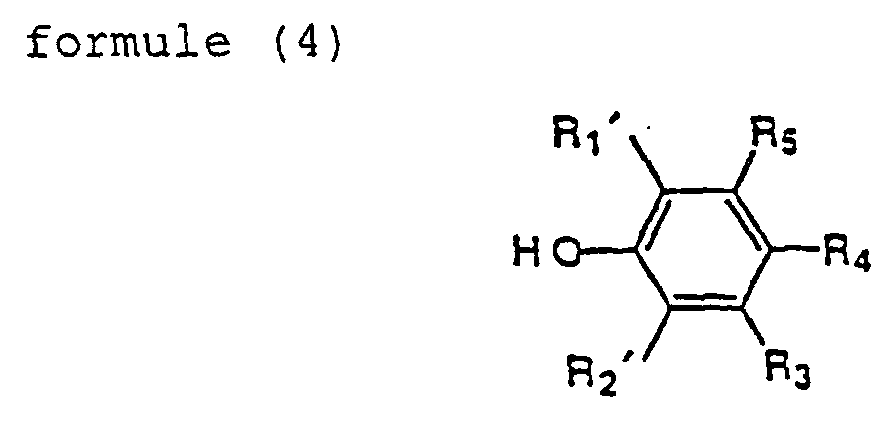
Applications Claiming Priority (3)
| Application Number | Priority Date | Filing Date | Title |
|---|---|---|---|
| JP312024/96 | 1996-11-22 | ||
| JP31202496 | 1996-11-22 | ||
| JP31202496 | 1996-11-22 |
Publications (2)
| Publication Number | Publication Date |
|---|---|
| EP0844525A1 EP0844525A1 (fr) | 1998-05-27 |
| EP0844525B1 true EP0844525B1 (fr) | 2002-10-16 |
Family
ID=18024308
Family Applications (1)
| Application Number | Title | Priority Date | Filing Date |
|---|---|---|---|
| EP97120282A Expired - Lifetime EP0844525B1 (fr) | 1996-11-22 | 1997-11-19 | Procédé de formation d'image à partir d'un produit photographique à l'halogénure d'argent sensible à la lumière |
Country Status (2)
| Country | Link |
|---|---|
| EP (1) | EP0844525B1 (fr) |
| DE (1) | DE69716386D1 (fr) |
Family Cites Families (7)
| Publication number | Priority date | Publication date | Assignee | Title |
|---|---|---|---|---|
| US5182339A (en) * | 1986-12-09 | 1993-01-26 | Fuji Photo Film Co., Ltd. | Pyrazoloazoleazomethine dyes |
| JP2630432B2 (ja) * | 1987-08-24 | 1997-07-16 | コニカ株式会社 | 新規なシアンカプラーを含有するハロゲン化銀カラー写真感光材料 |
| JPH03111844A (ja) * | 1989-09-27 | 1991-05-13 | Fuji Photo Film Co Ltd | カラー画像の増幅形成方法 |
| JP2779728B2 (ja) * | 1992-02-19 | 1998-07-23 | 富士写真フイルム株式会社 | ハロゲン化銀カラー写真感光材料 |
| JP2893154B2 (ja) * | 1992-07-08 | 1999-05-17 | 富士写真フイルム株式会社 | ハロゲン化銀カラー写真感光材料 |
| EP0585679A1 (fr) * | 1992-09-01 | 1994-03-09 | Konica Corporation | procédé de formation d'une image photographique couleur |
| JPH0854716A (ja) * | 1994-08-12 | 1996-02-27 | Konica Corp | ハロゲン化銀写真感光材料およびその処理方法 |
-
1997
- 1997-11-19 DE DE69716386T patent/DE69716386D1/de not_active Expired - Lifetime
- 1997-11-19 EP EP97120282A patent/EP0844525B1/fr not_active Expired - Lifetime
Also Published As
| Publication number | Publication date |
|---|---|
| EP0844525A1 (fr) | 1998-05-27 |
| DE69716386D1 (de) | 2002-11-21 |
Similar Documents
| Publication | Publication Date | Title |
|---|---|---|
| US5916739A (en) | Silver halide light sensitive photographic material and image forming method by use thereof | |
| US5576161A (en) | Silver halide light-sensitive photographic material and method of processing thereof | |
| EP0844525A1 (fr) | Procédé de formation d'image à partir d'un produit photographique à l'halogénure d'argent sensible à la lumière | |
| EP0824221B1 (fr) | Materiau photographique couleur à l'halogénure d'argent sensible à la lumière | |
| JP3491209B2 (ja) | ハロゲン化銀カラー写真感光材料 | |
| JP3517812B2 (ja) | ハロゲン化銀カラー写真感光材料 | |
| JPH10207026A (ja) | ハロゲン化銀写真感光材料及び画像形成方法 | |
| EP0731386B1 (fr) | Produit photographique couleur à l'halogénure d'argent sensible à la lumière | |
| US5837430A (en) | Image forming method | |
| JPH11249271A (ja) | ハロゲン化銀写真感光材料及び画像形成方法 | |
| JPH11160848A (ja) | ハロゲン化銀写真感光材料及び画像形成方法 | |
| US7279271B2 (en) | Color material and silver halide color photographic light-sensitive material | |
| JP3561857B2 (ja) | ハロゲン化銀カラー写真感光材料 | |
| JPH10161287A (ja) | ハロゲン化銀写真感光材料及び画像形成方法 | |
| JPH09146242A (ja) | ハロゲン化銀カラー写真感光材料 | |
| JPH1195361A (ja) | ハロゲン化銀写真感光材料及び画像形成方法 | |
| JPH095957A (ja) | ハロゲン化銀写真感光材料、画像形成方法及びカラープルーフの作製方法 | |
| JPH1090822A (ja) | 写真用水中オイル分散液及びハロゲン化銀写真感光材料 | |
| JPH10171080A (ja) | ハロゲン化銀写真感光材料及び画像形成方法 | |
| JPH1039465A (ja) | ハロゲン化銀写真感光材料 | |
| JPH10153847A (ja) | カラー画像形成方法および処理液の補充方法 | |
| JPH1172864A (ja) | ハロゲン化銀写真感光材料 | |
| JPH11338108A (ja) | ハロゲン化銀写真感光材料 | |
| JPH10171089A (ja) | ハロゲン化銀写真感光材料及び画像形成方法 | |
| JPH07234485A (ja) | ハロゲン化銀カラー写真感光材料および、その処理方法 |
Legal Events
| Date | Code | Title | Description |
|---|---|---|---|
| PUAI | Public reference made under article 153(3) epc to a published international application that has entered the european phase |
Free format text: ORIGINAL CODE: 0009012 |
|
| AK | Designated contracting states |
Kind code of ref document: A1 Designated state(s): DE FR GB NL |
|
| AX | Request for extension of the european patent |
Free format text: AL;LT;LV;MK;RO;SI |
|
| 17P | Request for examination filed |
Effective date: 19981117 |
|
| AKX | Designation fees paid |
Free format text: DE FR GB NL |
|
| RBV | Designated contracting states (corrected) |
Designated state(s): DE FR GB NL |
|
| 17Q | First examination report despatched |
Effective date: 19991220 |
|
| GRAG | Despatch of communication of intention to grant |
Free format text: ORIGINAL CODE: EPIDOS AGRA |
|
| GRAG | Despatch of communication of intention to grant |
Free format text: ORIGINAL CODE: EPIDOS AGRA |
|
| GRAG | Despatch of communication of intention to grant |
Free format text: ORIGINAL CODE: EPIDOS AGRA |
|
| GRAH | Despatch of communication of intention to grant a patent |
Free format text: ORIGINAL CODE: EPIDOS IGRA |
|
| GRAH | Despatch of communication of intention to grant a patent |
Free format text: ORIGINAL CODE: EPIDOS IGRA |
|
| GRAA | (expected) grant |
Free format text: ORIGINAL CODE: 0009210 |
|
| AK | Designated contracting states |
Kind code of ref document: B1 Designated state(s): DE FR GB NL |
|
| PG25 | Lapsed in a contracting state [announced via postgrant information from national office to epo] |
Ref country code: NL Free format text: LAPSE BECAUSE OF FAILURE TO SUBMIT A TRANSLATION OF THE DESCRIPTION OR TO PAY THE FEE WITHIN THE PRESCRIBED TIME-LIMIT Effective date: 20021016 Ref country code: FR Free format text: LAPSE BECAUSE OF FAILURE TO SUBMIT A TRANSLATION OF THE DESCRIPTION OR TO PAY THE FEE WITHIN THE PRESCRIBED TIME-LIMIT Effective date: 20021016 |
|
| REG | Reference to a national code |
Ref country code: GB Ref legal event code: FG4D |
|
| REF | Corresponds to: |
Ref document number: 69716386 Country of ref document: DE Date of ref document: 20021121 |
|
| PG25 | Lapsed in a contracting state [announced via postgrant information from national office to epo] |
Ref country code: GB Free format text: LAPSE BECAUSE OF NON-PAYMENT OF DUE FEES Effective date: 20030116 |
|
| PG25 | Lapsed in a contracting state [announced via postgrant information from national office to epo] |
Ref country code: DE Free format text: LAPSE BECAUSE OF FAILURE TO SUBMIT A TRANSLATION OF THE DESCRIPTION OR TO PAY THE FEE WITHIN THE PRESCRIBED TIME-LIMIT Effective date: 20030117 |
|
| NLV1 | Nl: lapsed or annulled due to failure to fulfill the requirements of art. 29p and 29m of the patents act | ||
| EN | Fr: translation not filed | ||
| PLBE | No opposition filed within time limit |
Free format text: ORIGINAL CODE: 0009261 |
|
| STAA | Information on the status of an ep patent application or granted ep patent |
Free format text: STATUS: NO OPPOSITION FILED WITHIN TIME LIMIT |
|
| GBPC | Gb: european patent ceased through non-payment of renewal fee | ||
| 26N | No opposition filed |
Effective date: 20030717 |