EP0850955A2 - Procédé de préparation d'un copolymère - Google Patents
Procédé de préparation d'un copolymère Download PDFInfo
- Publication number
- EP0850955A2 EP0850955A2 EP97122859A EP97122859A EP0850955A2 EP 0850955 A2 EP0850955 A2 EP 0850955A2 EP 97122859 A EP97122859 A EP 97122859A EP 97122859 A EP97122859 A EP 97122859A EP 0850955 A2 EP0850955 A2 EP 0850955A2
- Authority
- EP
- European Patent Office
- Prior art keywords
- copolymer
- monomer
- producing
- coupler
- monomer component
- Prior art date
- Legal status (The legal status is an assumption and is not a legal conclusion. Google has not performed a legal analysis and makes no representation as to the accuracy of the status listed.)
- Granted
Links
- 229920001577 copolymer Polymers 0.000 title claims abstract description 67
- 238000000034 method Methods 0.000 title claims abstract description 65
- 239000000178 monomer Substances 0.000 claims abstract description 156
- 238000006116 polymerization reaction Methods 0.000 claims abstract description 40
- 230000009257 reactivity Effects 0.000 claims abstract description 34
- 238000004519 manufacturing process Methods 0.000 claims abstract description 28
- 239000003505 polymerization initiator Substances 0.000 claims abstract description 20
- 239000003125 aqueous solvent Substances 0.000 claims abstract description 16
- 238000009835 boiling Methods 0.000 claims abstract description 15
- 229910052799 carbon Inorganic materials 0.000 claims abstract description 6
- 230000000379 polymerizing effect Effects 0.000 claims abstract description 6
- 229920000642 polymer Polymers 0.000 claims description 53
- -1 aromatic primary amine Chemical class 0.000 claims description 20
- 239000003795 chemical substances by application Substances 0.000 claims description 13
- 239000000463 material Substances 0.000 claims description 13
- 125000000217 alkyl group Chemical group 0.000 claims description 12
- 125000004435 hydrogen atom Chemical group [H]* 0.000 claims description 12
- 238000005859 coupling reaction Methods 0.000 claims description 11
- 230000003647 oxidation Effects 0.000 claims description 11
- 238000007254 oxidation reaction Methods 0.000 claims description 11
- 229910052709 silver Inorganic materials 0.000 claims description 9
- 239000004332 silver Substances 0.000 claims description 9
- 239000007787 solid Substances 0.000 claims description 9
- 125000003118 aryl group Chemical group 0.000 claims description 8
- 229910052801 chlorine Inorganic materials 0.000 claims description 8
- 125000001309 chloro group Chemical group Cl* 0.000 claims description 8
- 230000008878 coupling Effects 0.000 claims description 8
- 238000010168 coupling process Methods 0.000 claims description 8
- 125000001434 methanylylidene group Chemical group [H]C#[*] 0.000 claims description 8
- 125000002947 alkylene group Chemical group 0.000 claims description 4
- 125000004432 carbon atom Chemical group C* 0.000 claims description 4
- 239000000975 dye Substances 0.000 claims description 4
- 125000000623 heterocyclic group Chemical group 0.000 claims description 4
- 125000005647 linker group Chemical group 0.000 claims description 4
- AJDUTMFFZHIJEM-UHFFFAOYSA-N n-(9,10-dioxoanthracen-1-yl)-4-[4-[[4-[4-[(9,10-dioxoanthracen-1-yl)carbamoyl]phenyl]phenyl]diazenyl]phenyl]benzamide Chemical compound O=C1C2=CC=CC=C2C(=O)C2=C1C=CC=C2NC(=O)C(C=C1)=CC=C1C(C=C1)=CC=C1N=NC(C=C1)=CC=C1C(C=C1)=CC=C1C(=O)NC1=CC=CC2=C1C(=O)C1=CC=CC=C1C2=O AJDUTMFFZHIJEM-UHFFFAOYSA-N 0.000 claims description 4
- 125000001997 phenyl group Chemical group [H]C1=C([H])C([H])=C(*)C([H])=C1[H] 0.000 claims description 4
- 238000000926 separation method Methods 0.000 claims description 4
- 125000001424 substituent group Chemical group 0.000 claims description 4
- 125000005650 substituted phenylene group Chemical group 0.000 claims description 4
- 239000001043 yellow dye Substances 0.000 claims description 4
- 239000002253 acid Substances 0.000 claims description 3
- 239000006185 dispersion Substances 0.000 claims description 2
- 238000005562 fading Methods 0.000 claims description 2
- 230000008569 process Effects 0.000 abstract description 8
- 238000012545 processing Methods 0.000 abstract description 6
- XEKOWRVHYACXOJ-UHFFFAOYSA-N Ethyl acetate Chemical compound CCOC(C)=O XEKOWRVHYACXOJ-UHFFFAOYSA-N 0.000 description 96
- 238000006243 chemical reaction Methods 0.000 description 28
- IJGRMHOSHXDMSA-UHFFFAOYSA-N Atomic nitrogen Chemical compound N#N IJGRMHOSHXDMSA-UHFFFAOYSA-N 0.000 description 14
- 239000012295 chemical reaction liquid Substances 0.000 description 14
- 238000010992 reflux Methods 0.000 description 13
- 238000003756 stirring Methods 0.000 description 13
- ZQMHJBXHRFJKOT-UHFFFAOYSA-N methyl 2-[(1-methoxy-2-methyl-1-oxopropan-2-yl)diazenyl]-2-methylpropanoate Chemical compound COC(=O)C(C)(C)N=NC(C)(C)C(=O)OC ZQMHJBXHRFJKOT-UHFFFAOYSA-N 0.000 description 11
- PPBRXRYQALVLMV-UHFFFAOYSA-N Styrene Chemical compound C=CC1=CC=CC=C1 PPBRXRYQALVLMV-UHFFFAOYSA-N 0.000 description 10
- CQEYYJKEWSMYFG-UHFFFAOYSA-N butyl acrylate Chemical compound CCCCOC(=O)C=C CQEYYJKEWSMYFG-UHFFFAOYSA-N 0.000 description 10
- 239000003999 initiator Substances 0.000 description 10
- 239000007789 gas Substances 0.000 description 9
- 239000002904 solvent Substances 0.000 description 9
- XLYOFNOQVPJJNP-UHFFFAOYSA-N water Substances O XLYOFNOQVPJJNP-UHFFFAOYSA-N 0.000 description 9
- 239000000203 mixture Substances 0.000 description 8
- ZWEHNKRNPOVVGH-UHFFFAOYSA-N 2-Butanone Chemical compound CCC(C)=O ZWEHNKRNPOVVGH-UHFFFAOYSA-N 0.000 description 7
- 229910052757 nitrogen Inorganic materials 0.000 description 7
- 239000000126 substance Substances 0.000 description 7
- CERQOIWHTDAKMF-UHFFFAOYSA-N Methacrylic acid Chemical compound CC(=C)C(O)=O CERQOIWHTDAKMF-UHFFFAOYSA-N 0.000 description 6
- 239000012456 homogeneous solution Substances 0.000 description 6
- SMZOUWXMTYCWNB-UHFFFAOYSA-N 2-(2-methoxy-5-methylphenyl)ethanamine Chemical compound COC1=CC=C(C)C=C1CCN SMZOUWXMTYCWNB-UHFFFAOYSA-N 0.000 description 5
- NIXOWILDQLNWCW-UHFFFAOYSA-N 2-Propenoic acid Natural products OC(=O)C=C NIXOWILDQLNWCW-UHFFFAOYSA-N 0.000 description 5
- 239000007877 V-601 Substances 0.000 description 5
- NWVVVBRKAWDGAB-UHFFFAOYSA-N p-methoxyphenol Chemical compound COC1=CC=C(O)C=C1 NWVVVBRKAWDGAB-UHFFFAOYSA-N 0.000 description 5
- MYRTYDVEIRVNKP-UHFFFAOYSA-N 1,2-Divinylbenzene Chemical compound C=CC1=CC=CC=C1C=C MYRTYDVEIRVNKP-UHFFFAOYSA-N 0.000 description 4
- OWBTYPJTUOEWEK-UHFFFAOYSA-N butane-2,3-diol Chemical compound CC(O)C(C)O OWBTYPJTUOEWEK-UHFFFAOYSA-N 0.000 description 4
- 238000007334 copolymerization reaction Methods 0.000 description 4
- 239000012153 distilled water Substances 0.000 description 4
- 238000010438 heat treatment Methods 0.000 description 4
- WEVYAHXRMPXWCK-UHFFFAOYSA-N Acetonitrile Chemical compound CC#N WEVYAHXRMPXWCK-UHFFFAOYSA-N 0.000 description 3
- LFQSCWFLJHTTHZ-UHFFFAOYSA-N Ethanol Chemical compound CCO LFQSCWFLJHTTHZ-UHFFFAOYSA-N 0.000 description 3
- YXFVVABEGXRONW-UHFFFAOYSA-N Toluene Chemical compound CC1=CC=CC=C1 YXFVVABEGXRONW-UHFFFAOYSA-N 0.000 description 3
- 239000000654 additive Substances 0.000 description 3
- VLKZOEOYAKHREP-UHFFFAOYSA-N n-Hexane Chemical compound CCCCCC VLKZOEOYAKHREP-UHFFFAOYSA-N 0.000 description 3
- 150000002978 peroxides Chemical class 0.000 description 3
- 238000001226 reprecipitation Methods 0.000 description 3
- OZAIFHULBGXAKX-UHFFFAOYSA-N 2-(2-cyanopropan-2-yldiazenyl)-2-methylpropanenitrile Chemical compound N#CC(C)(C)N=NC(C)(C)C#N OZAIFHULBGXAKX-UHFFFAOYSA-N 0.000 description 2
- SZTBMYHIYNGYIA-UHFFFAOYSA-N 2-chloroacrylic acid Chemical compound OC(=O)C(Cl)=C SZTBMYHIYNGYIA-UHFFFAOYSA-N 0.000 description 2
- MNNOJLNVZNONKQ-UHFFFAOYSA-N 2-methyl-N-(5-oxo-4H-pyrazol-1-yl)prop-2-enamide Chemical class C(C(=C)C)(=O)NN1N=CCC1=O MNNOJLNVZNONKQ-UHFFFAOYSA-N 0.000 description 2
- MHAJPDPJQMAIIY-UHFFFAOYSA-N Hydrogen peroxide Chemical compound OO MHAJPDPJQMAIIY-UHFFFAOYSA-N 0.000 description 2
- KFZMGEQAYNKOFK-UHFFFAOYSA-N Isopropanol Chemical compound CC(C)O KFZMGEQAYNKOFK-UHFFFAOYSA-N 0.000 description 2
- BAPJBEWLBFYGME-UHFFFAOYSA-N Methyl acrylate Chemical compound COC(=O)C=C BAPJBEWLBFYGME-UHFFFAOYSA-N 0.000 description 2
- LRHPLDYGYMQRHN-UHFFFAOYSA-N N-Butanol Chemical compound CCCCO LRHPLDYGYMQRHN-UHFFFAOYSA-N 0.000 description 2
- 150000001253 acrylic acids Chemical class 0.000 description 2
- 230000015572 biosynthetic process Effects 0.000 description 2
- 150000001875 compounds Chemical class 0.000 description 2
- 238000009826 distribution Methods 0.000 description 2
- 238000001035 drying Methods 0.000 description 2
- 230000000694 effects Effects 0.000 description 2
- 239000000839 emulsion Substances 0.000 description 2
- 150000002148 esters Chemical class 0.000 description 2
- FJKIXWOMBXYWOQ-UHFFFAOYSA-N ethenoxyethane Chemical compound CCOC=C FJKIXWOMBXYWOQ-UHFFFAOYSA-N 0.000 description 2
- 230000001939 inductive effect Effects 0.000 description 2
- 239000007788 liquid Substances 0.000 description 2
- BDERNNFJNOPAEC-UHFFFAOYSA-N propan-1-ol Chemical compound CCCO BDERNNFJNOPAEC-UHFFFAOYSA-N 0.000 description 2
- 238000012360 testing method Methods 0.000 description 2
- RYHBNJHYFVUHQT-UHFFFAOYSA-N 1,4-Dioxane Chemical compound C1COCCO1 RYHBNJHYFVUHQT-UHFFFAOYSA-N 0.000 description 1
- KJTIFXWRNXLXHH-UHFFFAOYSA-N 1-[2-(carbamoyldiazenyl)-2-cyanopropyl]-3-(2-cyanopropan-2-ylimino)urea Chemical compound N#CC(C)(C)N=NC(=O)NCC(C)(C#N)N=NC(N)=O KJTIFXWRNXLXHH-UHFFFAOYSA-N 0.000 description 1
- AVTLBBWTUPQRAY-UHFFFAOYSA-N 2-(2-cyanobutan-2-yldiazenyl)-2-methylbutanenitrile Chemical compound CCC(C)(C#N)N=NC(C)(CC)C#N AVTLBBWTUPQRAY-UHFFFAOYSA-N 0.000 description 1
- JAHNSTQSQJOJLO-UHFFFAOYSA-N 2-(3-fluorophenyl)-1h-imidazole Chemical compound FC1=CC=CC(C=2NC=CN=2)=C1 JAHNSTQSQJOJLO-UHFFFAOYSA-N 0.000 description 1
- GOXQRTZXKQZDDN-UHFFFAOYSA-N 2-Ethylhexyl acrylate Chemical compound CCCCC(CC)COC(=O)C=C GOXQRTZXKQZDDN-UHFFFAOYSA-N 0.000 description 1
- SPSNALDHELHFIJ-UHFFFAOYSA-N 2-[(1-cyano-1-cyclopropylethyl)diazenyl]-2-cyclopropylpropanenitrile Chemical compound C1CC1C(C)(C#N)N=NC(C)(C#N)C1CC1 SPSNALDHELHFIJ-UHFFFAOYSA-N 0.000 description 1
- VUDVPVOIALASLB-UHFFFAOYSA-N 2-[(2-cyano-1-hydroxypropan-2-yl)diazenyl]-3-hydroxy-2-methylpropanenitrile Chemical compound OCC(C)(C#N)N=NC(C)(CO)C#N VUDVPVOIALASLB-UHFFFAOYSA-N 0.000 description 1
- PFHOSZAOXCYAGJ-UHFFFAOYSA-N 2-[(2-cyano-4-methoxy-4-methylpentan-2-yl)diazenyl]-4-methoxy-2,4-dimethylpentanenitrile Chemical compound COC(C)(C)CC(C)(C#N)N=NC(C)(C#N)CC(C)(C)OC PFHOSZAOXCYAGJ-UHFFFAOYSA-N 0.000 description 1
- WYGWHHGCAGTUCH-UHFFFAOYSA-N 2-[(2-cyano-4-methylpentan-2-yl)diazenyl]-2,4-dimethylpentanenitrile Chemical compound CC(C)CC(C)(C#N)N=NC(C)(C#N)CC(C)C WYGWHHGCAGTUCH-UHFFFAOYSA-N 0.000 description 1
- AGBXYHCHUYARJY-UHFFFAOYSA-N 2-phenylethenesulfonic acid Chemical compound OS(=O)(=O)C=CC1=CC=CC=C1 AGBXYHCHUYARJY-UHFFFAOYSA-N 0.000 description 1
- ZAWQXWZJKKICSZ-UHFFFAOYSA-N 3,3-dimethyl-2-methylidenebutanamide Chemical compound CC(C)(C)C(=C)C(N)=O ZAWQXWZJKKICSZ-UHFFFAOYSA-N 0.000 description 1
- VFXXTYGQYWRHJP-UHFFFAOYSA-N 4,4'-azobis(4-cyanopentanoic acid) Chemical compound OC(=O)CCC(C)(C#N)N=NC(C)(CCC(O)=O)C#N VFXXTYGQYWRHJP-UHFFFAOYSA-N 0.000 description 1
- OPPHXULEHGYZRW-UHFFFAOYSA-N 4-methoxy-2,4-dimethyl-2-phenyldiazenylpentanenitrile Chemical compound COC(C)(C)CC(C)(C#N)N=NC1=CC=CC=C1 OPPHXULEHGYZRW-UHFFFAOYSA-N 0.000 description 1
- HRPVXLWXLXDGHG-UHFFFAOYSA-N Acrylamide Chemical compound NC(=O)C=C HRPVXLWXLXDGHG-UHFFFAOYSA-N 0.000 description 1
- NLHHRLWOUZZQLW-UHFFFAOYSA-N Acrylonitrile Chemical compound C=CC#N NLHHRLWOUZZQLW-UHFFFAOYSA-N 0.000 description 1
- JIGUQPWFLRLWPJ-UHFFFAOYSA-N Ethyl acrylate Chemical compound CCOC(=O)C=C JIGUQPWFLRLWPJ-UHFFFAOYSA-N 0.000 description 1
- 108010010803 Gelatin Proteins 0.000 description 1
- 206010061218 Inflammation Diseases 0.000 description 1
- VVQNEPGJFQJSBK-UHFFFAOYSA-N Methyl methacrylate Chemical compound COC(=O)C(C)=C VVQNEPGJFQJSBK-UHFFFAOYSA-N 0.000 description 1
- GYCMBHHDWRMZGG-UHFFFAOYSA-N Methylacrylonitrile Chemical compound CC(=C)C#N GYCMBHHDWRMZGG-UHFFFAOYSA-N 0.000 description 1
- DBHBCQDKTPXGKL-UHFFFAOYSA-N N-(5-oxo-4H-pyrazol-1-yl)prop-2-enamide Chemical class C(C=C)(=O)NN1N=CCC1=O DBHBCQDKTPXGKL-UHFFFAOYSA-N 0.000 description 1
- XTXRWKRVRITETP-UHFFFAOYSA-N Vinyl acetate Chemical compound CC(=O)OC=C XTXRWKRVRITETP-UHFFFAOYSA-N 0.000 description 1
- KYIKRXIYLAGAKQ-UHFFFAOYSA-N abcn Chemical compound C1CCCCC1(C#N)N=NC1(C#N)CCCCC1 KYIKRXIYLAGAKQ-UHFFFAOYSA-N 0.000 description 1
- 150000001298 alcohols Chemical class 0.000 description 1
- 150000001408 amides Chemical class 0.000 description 1
- ROOXNKNUYICQNP-UHFFFAOYSA-N ammonium peroxydisulfate Substances [NH4+].[NH4+].[O-]S(=O)(=O)OOS([O-])(=O)=O ROOXNKNUYICQNP-UHFFFAOYSA-N 0.000 description 1
- VAZSKTXWXKYQJF-UHFFFAOYSA-N ammonium persulfate Chemical compound [NH4+].[NH4+].[O-]S(=O)OOS([O-])=O VAZSKTXWXKYQJF-UHFFFAOYSA-N 0.000 description 1
- 229910001870 ammonium persulfate Inorganic materials 0.000 description 1
- 239000003054 catalyst Substances 0.000 description 1
- 239000000084 colloidal system Substances 0.000 description 1
- 238000004040 coloring Methods 0.000 description 1
- 230000000052 comparative effect Effects 0.000 description 1
- 238000007796 conventional method Methods 0.000 description 1
- 230000003247 decreasing effect Effects 0.000 description 1
- 238000011161 development Methods 0.000 description 1
- 238000000921 elemental analysis Methods 0.000 description 1
- 125000005670 ethenylalkyl group Chemical group 0.000 description 1
- PUSKHXMZPOMNTQ-UHFFFAOYSA-N ethyl 2,1,3-benzoselenadiazole-5-carboxylate Chemical compound CCOC(=O)C1=CC=C2N=[Se]=NC2=C1 PUSKHXMZPOMNTQ-UHFFFAOYSA-N 0.000 description 1
- SUPCQIBBMFXVTL-UHFFFAOYSA-N ethyl 2-methylprop-2-enoate Chemical compound CCOC(=O)C(C)=C SUPCQIBBMFXVTL-UHFFFAOYSA-N 0.000 description 1
- 238000002474 experimental method Methods 0.000 description 1
- 229920000159 gelatin Polymers 0.000 description 1
- 239000008273 gelatin Substances 0.000 description 1
- 235000019322 gelatine Nutrition 0.000 description 1
- 235000011852 gelatine desserts Nutrition 0.000 description 1
- 230000004054 inflammatory process Effects 0.000 description 1
- 229960004592 isopropanol Drugs 0.000 description 1
- 150000002576 ketones Chemical class 0.000 description 1
- 150000002688 maleic acid derivatives Chemical class 0.000 description 1
- 238000005259 measurement Methods 0.000 description 1
- FQPSGWSUVKBHSU-UHFFFAOYSA-N methacrylamide Chemical compound CC(=C)C(N)=O FQPSGWSUVKBHSU-UHFFFAOYSA-N 0.000 description 1
- LVHBHZANLOWSRM-UHFFFAOYSA-N methylenebutanedioic acid Natural products OC(=O)CC(=C)C(O)=O LVHBHZANLOWSRM-UHFFFAOYSA-N 0.000 description 1
- 238000012986 modification Methods 0.000 description 1
- 230000004048 modification Effects 0.000 description 1
- PNJWIWWMYCMZRO-UHFFFAOYSA-N pent‐4‐en‐2‐one Natural products CC(=O)CC=C PNJWIWWMYCMZRO-UHFFFAOYSA-N 0.000 description 1
- JRKICGRDRMAZLK-UHFFFAOYSA-L persulfate group Chemical group S(=O)(=O)([O-])OOS(=O)(=O)[O-] JRKICGRDRMAZLK-UHFFFAOYSA-L 0.000 description 1
- 230000000704 physical effect Effects 0.000 description 1
- USHAGKDGDHPEEY-UHFFFAOYSA-L potassium persulfate Chemical compound [K+].[K+].[O-]S(=O)(=O)OOS([O-])(=O)=O USHAGKDGDHPEEY-UHFFFAOYSA-L 0.000 description 1
- 230000002035 prolonged effect Effects 0.000 description 1
- HJWLCRVIBGQPNF-UHFFFAOYSA-N prop-2-enylbenzene Chemical compound C=CCC1=CC=CC=C1 HJWLCRVIBGQPNF-UHFFFAOYSA-N 0.000 description 1
- PNXMTCDJUBJHQJ-UHFFFAOYSA-N propyl prop-2-enoate Chemical compound CCCOC(=O)C=C PNXMTCDJUBJHQJ-UHFFFAOYSA-N 0.000 description 1
- 238000011160 research Methods 0.000 description 1
- 229920006395 saturated elastomer Polymers 0.000 description 1
- 238000013341 scale-up Methods 0.000 description 1
- 239000007921 spray Substances 0.000 description 1
- 238000003786 synthesis reaction Methods 0.000 description 1
- 229920001567 vinyl ester resin Polymers 0.000 description 1
- 125000000391 vinyl group Chemical group [H]C([*])=C([H])[H] 0.000 description 1
- 239000002699 waste material Substances 0.000 description 1
Images
Classifications
-
- C—CHEMISTRY; METALLURGY
- C08—ORGANIC MACROMOLECULAR COMPOUNDS; THEIR PREPARATION OR CHEMICAL WORKING-UP; COMPOSITIONS BASED THEREON
- C08F—MACROMOLECULAR COMPOUNDS OBTAINED BY REACTIONS ONLY INVOLVING CARBON-TO-CARBON UNSATURATED BONDS
- C08F2/00—Processes of polymerisation
- C08F2/04—Polymerisation in solution
- C08F2/06—Organic solvent
-
- C—CHEMISTRY; METALLURGY
- C08—ORGANIC MACROMOLECULAR COMPOUNDS; THEIR PREPARATION OR CHEMICAL WORKING-UP; COMPOSITIONS BASED THEREON
- C08F—MACROMOLECULAR COMPOUNDS OBTAINED BY REACTIONS ONLY INVOLVING CARBON-TO-CARBON UNSATURATED BONDS
- C08F246/00—Copolymers in which the nature of only the monomers in minority is defined
-
- G—PHYSICS
- G03—PHOTOGRAPHY; CINEMATOGRAPHY; ANALOGOUS TECHNIQUES USING WAVES OTHER THAN OPTICAL WAVES; ELECTROGRAPHY; HOLOGRAPHY
- G03C—PHOTOSENSITIVE MATERIALS FOR PHOTOGRAPHIC PURPOSES; PHOTOGRAPHIC PROCESSES, e.g. CINE, X-RAY, COLOUR, STEREO-PHOTOGRAPHIC PROCESSES; AUXILIARY PROCESSES IN PHOTOGRAPHY
- G03C7/00—Multicolour photographic processes or agents therefor; Regeneration of such processing agents; Photosensitive materials for multicolour processes
- G03C7/30—Colour processes using colour-coupling substances; Materials therefor; Preparing or processing such materials
- G03C7/32—Colour coupling substances
- G03C7/327—Macromolecular coupling substances
- G03C7/3275—Polymers obtained by reactions involving only carbon-to-carbon unsaturated bonds, e.g. vinyl polymers
Definitions
- the present invention relates to a method of producing a copolymer that is preferably used in a production of a photographic copolymer.
- a solution containing the substance to be dried is heated and concentrated in a long pipe-type steam heating pipe, to be formed into a solid/gas mixture of a powdery dried substance and a gas, and then, the solid/gas mixture is spouted into an atmosphere having a reduced pressure, to separate the powdery dried substance from the gas, to obtain the powdery dried substance.
- an ether-series solvent such as DMG
- a risk that the formation of a peroxide in the processing by the FVD will lead to inflammation (self-ignition) or the like is feared, and there arises a problem that the spray nozzle at the time of processing (concentrating) by the FVD is clogged.
- an object of the present invention is to provide a production method that can give a copolymer high in solubility and suitable for FVD processing, and the method is excellent from the standpoint of the production capacity and stable/safe production throughout the process.
- Another object of the present invention is to provide a production method capable of giving a photographic copolymer coupler that is excellent in photographic performance.
- still another object of the present invention is to provide a method for producing a copolymer coupler that makes it possible to form an image excellent in gradation, antifogging, etc., in color photographic light-sensitive materials.
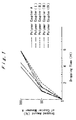
- Fig. 1 is a graph showing the relationship between the added amount and the adding time of the monomer coupler by dropping in the synthesis of the polymer coupler that was carried out in accordance with the process of an Example of the present invention.
- the reactivity of monomers is defined by the value r of the monomer reactivity ratio (MRR), calculated by the Fineman method, and the difference ⁇ r between the r values of the reactivity of at least two monomers is preferably from 0.2 to 4, and more preferably from 0.2 to 1.2.
- MRR monomer reactivity ratio
- the relative reactivity between monomers determines which monomer becomes the monomer component A or the monomer component B.
- the monomer components used in the present invention are not particularly restricted, and examples of the monomer components higher in reactivity can be mentioned below, in order of decreasing reactivity.
- Styrene-series monomers ⁇ methacrylic acid ester-series monomers ⁇ methacrylamide-series monomers ⁇ acrylamide-series monomers ⁇ acryloyl-series monomers acrylic-series monomers
- the monomer reactivity ratio can be measured according to the method described in the following examples. Details are described in "Polymer Handbook (Second Edition)," II-105 to II-386 (written by J. Brandrup, E.H. Immergutt), and documents cited therein.
- the method of the present invention is a method suitable for producing a copolymer, and in particular it is a method suitable for producing a polymer used in silver halide photographic light-sensitive materials.
- the polymer include polymer couplers, acid polymers, anti-fading agent polymers, and polymers for dispersion.
- the monomer component A and the monomer component B for copolymerization can each be, for example, a monomer that can introduce a unit for inducing a coupling reaction with an oxidation product of a color-developing agent in a photographic copolymer coupler, i.e. a monomer coupler, or they can each be a monomer having no part for inducing a coupling reaction with an oxidation product of a color-developing agent, i.e. a non-color-forming monomer.
- a monomer coupler is preferable.
- the monomer coupler is not particularly restricted, and ester-series monomer couplers and amide-series monomer couplers derived from acrylic acids, such as acrylic acid, ⁇ -chloroacrylic acid, and methacrylic acid, are preferable, with particular preference given to acrylamide-series monomer couplers and methacrylamide-series monomer couplers, and more particular preference given to acrylamido-5-pyrazolones and methacrylamido-5-pyrazolones.
- a monomer represented by formula (I) of JP-A-57-94752 a monomer represented by formula (I) of JP-A-58-224352, a monomer represented by formula (I) of JP-A-58-28745, and a monomer represented by formula (a) of US-A-3 356 686 can be mentioned.
- Specific examples include monomers described therein and monomers described in JP-A-2-191501.
- the monomer couplers include magenta monomer couplers, cyan monomer couplers, and yellow monomer couplers.
- R 1 represents a
- R 3 has the same meaning as R 1
- L 3 has the same meaning as L 1
- L 4 has the same meaning as L 2
- g has the same meaning as i
- h has the same meaning as j
- Q 2 represents a cyan coupler residue capable of forming a cyan dye upon coupling with an oxidation product of an aromatic primary amine developing agent.
- R 4 represents a substituent
- R 5 has the same meaning as R 2
- k represents an integer of 0 to 4.
- Exemplified compounds of the compound represented by formula (I), (II), or (III) include the following.
- non-color-forming monomer i.e. the monomer that does not undergo a coupling reaction with an oxidation product of a color-developing agent
- esters derived from acrylic acids such as acrylic acid, ⁇ -chloroacrylic acid, and methacrylic acid (e.g. methyl acrylate, methyl methacrylate, ethyl acrylate, n-propyl acrylate, n-butyl acrylate, and 2-ethylhexyl acrylate); amides (e.g. acrylamide, methacrylamide, and t-butyl acrylamide), vinyl esters (e.g.
- non-color-forming monomers may be used alone or as a combination of two or more; for example, a combination of n-butyl acrylate and divinylbenzene, a combination of styrene and methacrylic acid, and a combination of n-butyl acrylate and methacrylic acid.
- styrene-series monomers As monomers used in the production of copolymers other than polymer couplers, can be mentioned styrene-series monomers, methacrylic acid ester-series monomers, methacrylonitrile-series monomers, methacrylamide-series monomers, acrylamide-series monomers, acrylonitrile-series monomers, and acrylic acid ester-series monomers.
- non-aqueous solvent having a boiling point of 55 °C to 120 °C used in the present invention examples include alcohols (e.g. n-butanol, ethanol, iso-propanol, and n-propanol), ketones (e.g. methylethylketone), esters (e.g. ethyl acetate), toluene, acetonitrile, and dioxane, and among them, one having a boiling point of 68 °C to 85 °C is preferable, one having a boiling point of 70 °C to 80 °C is more preferable, and ethyl acetate is particularly preferable.
- alcohols e.g. n-butanol, ethanol, iso-propanol, and n-propanol
- ketones e.g. methylethylketone
- esters e.g. ethyl acetate
- toluene ace
- water may be mixed to such an extent that the solvent is approximately saturated with water (in an amount of about 3.3% by weight), to increase the solubility of the monomer. This is particularly effective when a coupler monomer is dissolved.
- each of the monomer components is preferably used in a concentration of 5 to 50% by weight, and more preferably 15 to 25% by weight, to the non-aqueous solvent.
- polymerization initiator can be used one usually used as a catalyst for polymerization, and examples include persulfates, such as ammonium persulfate and potassium persulfate; azonitriles, such as 4,4'-azobis(4-cyano-valerianic acid), 2,2'-azobisisobutyronitrile, dimethyl-2,2'-azobisisobutyrate, 2,2'-azobis(4-methoxy-2,4-dimethylvaleronitrile), 2,2'-azobis(2-cyclopropylpropionnitrile), 2,2'-azobis(2,4-dimethylvaleronitrile), 2,2'-azobis(2-methylbutyronitrile), 1,1'-azobis(cyclohexane-1-carbonitrile), 1-[(1-cyano-1-methylethyl)azo]formamido(2-(carbamoylazo)isobutyronitrile), 2-phenylazo-4-methoxy-2,4-
- the polymerization initiator may be added with the monomer components, which are dissolved together, or it may be added, dropwise, as a solution dissolved in a non-aqueous solvent (e.g. ethyl acetate). Preferably the polymerization initiator is added, dropwise, as an ethyl acetate solution, while carrying out the polymerization.
- the polymerization initiator may be further added after the polymerization (i.e. it may be post-added).
- the amount of the polymerization initiator to be added is 1 to 10% by weight, and more preferably 3 to 7% by weight, to the monomer components.
- the temperature of the solution of the monomer component B is preferably elevated to about 40 to 60 °C when it is added, so that the solubility may be increased.
- the monomer component B or a solution containing it is added, it may be dissolved in a solution of the above-mentioned non-aqueous solvent having a boiling point of 55 °C to 120 °C, and the resulting solution may be added.
- polymerization is carried out while the monomer component B is added.
- the addition of the monomer component B is carried out either continuously or intermittently in portions. As a typical mode of the addition, the monomer component B is added dropewise. If the polymerization is carried out by adding the monomer component B in one portion all at once, the polymerization reaction of the monomer component A proceeds little, and the solubility of the produced polymer in ethyl acetate is very poor.
- the term "adding continuously or intermittently” means that preferably 40% or more, more preferably 50% or more, and particularly preferably 60% or more, of the monomer component B is added continuously or intermittently.
- the monomer components are heated to the polymerization reaction temperature.
- the polymerization reaction may be carried out at the reflux temperature of the non-aqueous solvent, and preferably the internal temperature is 65 to 110 °C, more preferably 68 to 85 °C, and further preferably 70 to 80 °C.
- the rate of stirring, the reaction temperature, and the scale-up effect greatly affect the polymerization rate and the physical properties of the copolymer
- the polymerization rate (the polymerization ratio) can be controlled and the polymerization reaction can be carried out stably and quantitatively.
- the photographic performance of the obtained photographic copolymer, and in particular the gradation of the photographic image of the light-sensitive material wherein the obtained copolymer is used are greatly influenced by the adding time and the adding speed (rate) by dropping.
- the method of the present invention is advantageous in that the adding time, the adding speed, by dropping, and the like can be suitably set to meet the desired performance.
- the weight-average molecular weight of the copolymer obtained by the method of the present invention is 6,000 to 200,000, preferably 10,000 to 150,000, and more preferably 10,000 to 120,000.
- a monomer B e.g. a coupler monomer
- a monomer A e.g. several kinds of non-color-forming monomers such as styrene and n-butyl acrylate
- the monomer B and the monomer A to be added may be added separately, or one of them may be added all at once.
- the solutions of them are separately added. The addition may be carried out in two steps.
- the time required for the addition in the method of the present invention can be selected varyingly depending on the type of the monomer B (e.g. a coupler monomer) and the monomer A (e.g. a non-color-forming monomer).
- the ratio of the components is preferably adjusted to obtain excellent photographic performance, and in order to adjust the ratio of the components suited to such required performance, it is necessary to determine the time required for the addition.
- the setting of the adding time by dropping is made by determining conditions under which the adding speed and the adding time by dropping of each of the monomer components and the polymerization initiator are optimized to obtain a preferable composition distribution of the obtained polymer, i.e. a preferable copolymerization composition distribution of the coupler monomer and the non-color-forming monomer, to optimize the photographic performance (particularly the gradation) of the copolymer, especially, the polymer coupler.
- the adding time of the monomer B is varied depending on conditions, including the output, the reaction temperature, etc., and it is preferably 120 to 400 min, more preferably 240 to 300 min, and particularly preferably 260 to 280 min, overall. In order to carry out the production stably, preferably the adding time is controlled to be within the above range, with an error ranging from -8 to +8% and more preferably from -3 to +3%, to the prescribed time.
- the adding time is 120 to 300 min, more preferably 180 to 240 min, and particularly preferably 190 to 230 min, overall.
- the adding time is controlled to be within the above range, with an error ranging from -10 to +10% and more preferably from -5 to +5%, to the prescribed time.
- the adding speed of the polymerization initiator is such that adding is completed within preferably 120 to 500 min, more preferably 400 to 490 min, and particularly preferably 430 to 470 min, overall.
- the adding time is controlled to be within the above range, with an error ranging from -7 to +7% and more preferably from -3 to +3%, to the prescribed time.
- the total time of the polymerization reaction may vary depending on the production conditions, including the output, the reaction temperature, etc., and it is generally 240 to 2,100 min, and preferably 240 to 1,200 min.
- the reaction liquid can be dried by the drying method under reduced pressure, to separate and recover the intended copolymer (e.g. a polymer coupler).
- the intended copolymer e.g. a polymer coupler
- the resulting solution of the substance to be dried after the conclusion of the reaction is heated and concentrated (at a temperature higher than the boiling point of the solvent, i.e. at about 98 °C) in a long pipe-type steam superheating pipe (e.g. a double pipe described in the registered Japanese Utility Model No. 1222088), to be formed into a solid/gas mixture of a powdery substance to be dried and a gas, and the solid/gas mixture is spouted into an atmosphere having a reduced pressure (into a vacuum container), to separate the powdery dried substance from the gas.
- a long pipe-type steam superheating pipe e.g. a double pipe described in the registered Japanese Utility Model No. 1222088
- the FVD in the present invention is desirably carried out such that the viscosity of the reaction liquid obtained in the above polymerization reaction is adjusted generally to 1 to 50 cps, and preferably to 1 to 20 cps, with a suitable solvent.
- the copolymer obtained by the method of the present invention can be used, for example, as various coloring materials and additives for silver halide photographic light-sensitive materials.
- Silver halide photographic light-sensitive materials the production thereof, additives thereof, methods for subjecting them to development, etc., are described in detail in Research Disclosure Vol. 176, RD-17643 (1978) and ibid. RD-40145 (1997).
- hydrophilic colloid layers such as intermediate layers and silver halide emulsion layers, on a base, and the emulsion layers are made up of silver halide grains, couplers, gelatin, etc.
- the method of the present invention is preferable for the stable/safe production of a copolymerization polymer having the desired characteristics, and according to the method of the present invention, a polymer given the required performance (for example, in photographic polymer couplers, gradation and antifogging) can be produced only by adjusting the added amount and the adding time by dropping.
- the production method of the present invention brings about excellent effects/actions that can provide a polymer that is excellent in quality and can give the desired photographic performance, easily, stably, and in a safe manner. Further, according to the method of the present invention, many various products can be easily produced by a single apparatus.
- the above diluted solution was supplied, quantitatively at 100 ml/min using a steady flow pump, into a long pipe-type steam heating pipe, through which reduced-pressure steam having a temperature of 98 °C was passed by a reduced-pressure steam generating apparatus, and then the solution was spouted into a vacuum container.
- the pressure in the vacuum container was kept at 20 to 40 Torr by a vacuum generating apparatus, and warm water at 40 °C was circulated through the jacket of the vacuum container, so that vapor of solvents might not be condensed. From the other end of the heating pipe, the above solution supplied quantitatively was spouted continuously as a powdery solid/gas mixture.
- the reactivity ratio of the monomers used herein is as follows:
- Coupler monomer A and Coupler monomer B were polymerized by using a polymerization initiator, dimethyl-2,2'-azobisisobutyrate, in a solvent ethyl acetate; and then, the resulting polymer was precipitated and separated using a solvent hexane.
- the monomer reactivity (ratio) was calculated by the Fineman method (see, Yoshihiko Kubouchi, "Kobunshi Jikken-gaku-koza", Vol. 10, page 119 (1958), published by Kyoritsu-Shuppan KK.)
- Example 2 the FVD process was carried out in the same manner as Example 1, to obtain Polymer coupler B of 355.8 g (yield: 95.0%), which was in the form of a powdery dried product containing 2.5 wt% of volatile components.
- Example 2 the FVD process was carried out in the same manner as Example 1, to obtain Polymer coupler C of 190 g (yield:92%), which was in the form of a powdery dry product containing 2.0 wt% of volatile components.
- Polymer couplers (I) to (IV) were produced in the same manner as the production of Polymer coupler A in Example 1, except that the dropped amount and the dropping time of the monomer coupler were changed as shown in Fig. 1.
- Coupler EX-1 of Sample 101 as described in Example 1 of JP-A-61-23455 was replaced with the above obtained Polymer coupler A, or Polymer coupler (I), (II), (III), or (IV), to test the gradation ( ⁇ ), respectively.
- the results are shown in Table 2 below.
- Coupler Polymerization formuration (Coupler monomer A contents of modification) Gradation Polymer coupler A Coupler monomer A Dropped amount and dropping time 1/2 ⁇ 1H 1/2 ⁇ 3H 1.58 Polymer coupler (I) 1/2 ⁇ 1H 1/2 ⁇ 5H 1.58 Polymer coupler (II) 1/2 ⁇ 2H 1/2 ⁇ 4H 1.62 Polymer coupler (III) 1/2 ⁇ 1.5H 1/2 ⁇ 4.5H 1.62 Polymer coupler (IV) 1/2 ⁇ 1.5H 1/2 ⁇ 3H 1.55
- Copolymer D was prepared according to the following reaction scheme.
- the thus-obtained copolymer can be used for photographic additives as a pH-controlling acid polymer.
- V-601 dimethyl-2,2'-azobisisobutyrate
- Example 2 the FVD processing was carried out in the same manner as Example 1.
- the thus-obtained polymer coupler was 355.8 g (yield: 95.0%) of a powdery dry product containing 2.5 wt% of volatile components.
- the reaction was carried out in the same manner as Example 1, except that Solution A, Solution B, and Solution C were introduced into the reaction flask all at once, instead of the dropwise addition. Even 7 hours after the introduction, the non-color-forming monomer reacted hardly at all.
- Copolymer E was prepared according to the following reaction scheme.
- Solution A 1000 ml of ethyl acetate, 20 mg of p-methoxyphenol, and 105 g of Coupler monomer C were charged into a three-necked flask having a volume of 2 liters and equipped with a reflux condenser, a thermometer, and stirring blades, and they were stirred to prepare a solution, which resulting solution was named Solution A.
- the FVD processing was carried out in the same manner as Example 1, to obtain the polymer coupler of 204 g (yield: 95%) in the form of a powdery dry product containing 2.0 wt% of the volatile component.
Landscapes
- Chemical & Material Sciences (AREA)
- Chemical Kinetics & Catalysis (AREA)
- Physics & Mathematics (AREA)
- Health & Medical Sciences (AREA)
- Medicinal Chemistry (AREA)
- Polymers & Plastics (AREA)
- Organic Chemistry (AREA)
- Spectroscopy & Molecular Physics (AREA)
- General Physics & Mathematics (AREA)
- Polymerisation Methods In General (AREA)
- Addition Polymer Or Copolymer, Post-Treatments, Or Chemical Modifications (AREA)
- Macromolecular Compounds Obtained By Forming Nitrogen-Containing Linkages In General (AREA)
Applications Claiming Priority (3)
| Application Number | Priority Date | Filing Date | Title |
|---|---|---|---|
| JP34848196 | 1996-12-26 | ||
| JP34848196 | 1996-12-26 | ||
| JP348481/96 | 1996-12-26 |
Publications (3)
| Publication Number | Publication Date |
|---|---|
| EP0850955A2 true EP0850955A2 (fr) | 1998-07-01 |
| EP0850955A3 EP0850955A3 (fr) | 2000-01-19 |
| EP0850955B1 EP0850955B1 (fr) | 2008-03-19 |
Family
ID=18397307
Family Applications (1)
| Application Number | Title | Priority Date | Filing Date |
|---|---|---|---|
| EP97122859A Expired - Lifetime EP0850955B1 (fr) | 1996-12-26 | 1997-12-23 | Procédé de préparation d'un copolymère |
Country Status (4)
| Country | Link |
|---|---|
| US (1) | US6599998B1 (fr) |
| EP (1) | EP0850955B1 (fr) |
| AT (1) | ATE389672T1 (fr) |
| DE (1) | DE69738579T2 (fr) |
Cited By (1)
| Publication number | Priority date | Publication date | Assignee | Title |
|---|---|---|---|---|
| US9882151B2 (en) | 2014-11-14 | 2018-01-30 | Universal Display Corporation | Organic electroluminescent materials and devices |
Family Cites Families (18)
| Publication number | Priority date | Publication date | Assignee | Title |
|---|---|---|---|---|
| US3163625A (en) * | 1960-04-13 | 1964-12-29 | Du Pont | Color-forming monomers and polymers of acrylic acid amides of 3-aminopyrazolone |
| CH485782A (de) * | 1964-06-23 | 1970-02-15 | Gevaert Photo Prod Nv | Verfahren zur Emulsionspolymerisation |
| US3451820A (en) * | 1965-12-01 | 1969-06-24 | Du Pont | Dispersions of lipophilic colorcoupling copolymers |
| US3755264A (en) * | 1971-07-30 | 1973-08-28 | Amicon Corp | Maleic anhydride copolymers and method of making |
| JPS5569138A (en) * | 1978-11-20 | 1980-05-24 | Konishiroku Photo Ind Co Ltd | Photographic polyester substrate applied with undercoating treatment |
| DE3069448D1 (en) * | 1979-05-18 | 1984-11-22 | Ciba Geigy Ag | Photocrosslinkable copolymers, photosensitive recording material containing them, its utilisation in the production of photographic pictures and process for the production of photographic pictures |
| JPS5794752A (en) | 1980-12-05 | 1982-06-12 | Fuji Photo Film Co Ltd | Color photographic sensitive silver halide material |
| US4390670A (en) | 1981-02-09 | 1983-06-28 | Pfizer Inc. | Acrylate/maleate copolymers, their preparation and use as antiscalants |
| JPS5828745A (ja) | 1981-05-08 | 1983-02-19 | Fuji Photo Film Co Ltd | ハロゲン化銀カラ−写真感光材料 |
| JPS58224352A (ja) | 1982-06-23 | 1983-12-26 | Fuji Photo Film Co Ltd | カラ−感光材料の製造方法 |
| DE3340154A1 (de) * | 1983-11-07 | 1985-05-15 | Basf Ag, 6700 Ludwigshafen | Verfahren zur herstellung von bildmaessig strukturierten resistschichten und fuer dieses verfahren geeigneter trockenfilmresist |
| DE3722497A1 (de) | 1987-06-11 | 1988-12-29 | Agfa Gevaert Ag | Purpurkupplermonomer, polymerer purpurkuppler und farbfotografisches aufzeichnungsmaterial, das den polymeren purpurkuppler enthaelt |
| US5462840A (en) * | 1987-09-16 | 1995-10-31 | Hoechst Celanese Corporation | Use of poly(35-disubstituted 4-hydroxystyrene/N-substituted maleimide for forming a negative image |
| JPH02191501A (ja) | 1989-01-20 | 1990-07-27 | Fuji Photo Film Co Ltd | 真空濃縮乾燥方法 |
| JP3278280B2 (ja) * | 1994-03-08 | 2002-04-30 | 富士写真フイルム株式会社 | 感光性平版印刷版 |
| JPH07268274A (ja) * | 1994-04-01 | 1995-10-17 | Kansai Paint Co Ltd | 親水化処理用組成物および親水化処理方法 |
| US5839037A (en) * | 1995-06-07 | 1998-11-17 | Xerox Corporation | Method for transferring a liquid image |
| US5932404A (en) * | 1996-12-18 | 1999-08-03 | Eastman Kodak Company | Silver halide photographic material containing a polymer with a photographically useful group which is rendered non-diffusible by cross-linking |
-
1997
- 1997-12-23 AT AT97122859T patent/ATE389672T1/de not_active IP Right Cessation
- 1997-12-23 DE DE69738579T patent/DE69738579T2/de not_active Expired - Lifetime
- 1997-12-23 US US08/997,087 patent/US6599998B1/en not_active Expired - Fee Related
- 1997-12-23 EP EP97122859A patent/EP0850955B1/fr not_active Expired - Lifetime
Cited By (1)
| Publication number | Priority date | Publication date | Assignee | Title |
|---|---|---|---|---|
| US9882151B2 (en) | 2014-11-14 | 2018-01-30 | Universal Display Corporation | Organic electroluminescent materials and devices |
Also Published As
| Publication number | Publication date |
|---|---|
| DE69738579T2 (de) | 2009-04-23 |
| DE69738579D1 (de) | 2008-04-30 |
| EP0850955B1 (fr) | 2008-03-19 |
| ATE389672T1 (de) | 2008-04-15 |
| EP0850955A3 (fr) | 2000-01-19 |
| US6599998B1 (en) | 2003-07-29 |
Similar Documents
| Publication | Publication Date | Title |
|---|---|---|
| Dunn et al. | The polymerization of vinyl acetate in aqueous solution initiated by potassium persulphate at 60° C. | |
| AU780036B2 (en) | Method for obtaining a photochromic latex | |
| US5021525A (en) | Process for the manufacture of polymers | |
| US4291113A (en) | Method for dispersing photographic additives | |
| US4539362A (en) | Polymerization process | |
| Sindt et al. | Reactive surfactants in heterophase polymerization. XVI. Emulsion copolymerization of styrene–butyl acrylate–acrylic acid in the presence of simple maleate reactive surfactants | |
| US6203973B1 (en) | Polymer latexes with core-shell morphology | |
| GB2120801A (en) | Silver halide photographic light-sensitive material | |
| US4665142A (en) | Emulsion polymers free from emulsifiers and protective colloids, a process for their preparation and their use | |
| JP3096645B2 (ja) | 酸の含有率が高いマクロモノマーおよびその製造方法 | |
| NO833562L (no) | Polymerisasjonsprosess | |
| EP0850955A2 (fr) | Procédé de préparation d'un copolymère | |
| US4410673A (en) | Suspension polymerization with cosolvent partitioning | |
| JP3050903B2 (ja) | アクリレート共重合体 | |
| KR100609870B1 (ko) | 수성수지 분산체의 제조방법 | |
| JPH0819174B2 (ja) | ビニルピロリドン重合体の製法 | |
| EP0102707B1 (fr) | Procédé de préparation de dispersions aqueuses stabilisées stériquement non chargées de polymères | |
| EP0569097B1 (fr) | Produits photographiques couleurs contenant des coupleurs polymériques | |
| JPH10237113A (ja) | 共重合体の製造方法 | |
| JPWO2001004163A1 (ja) | 水性樹脂分散体の製造方法 | |
| EP0727442A2 (fr) | Procédé de préparation de latex polymères de particules solides de monomères | |
| JPH05117306A (ja) | 高重合度ポリアクリル酸の製造方法 | |
| JPH0380162B2 (fr) | ||
| JPH04279604A (ja) | 親水性ポリマー微粒子の製造方法 | |
| US6074809A (en) | Color photographic silver halide material |
Legal Events
| Date | Code | Title | Description |
|---|---|---|---|
| PUAI | Public reference made under article 153(3) epc to a published international application that has entered the european phase |
Free format text: ORIGINAL CODE: 0009012 |
|
| AK | Designated contracting states |
Kind code of ref document: A2 Designated state(s): AT BE CH DE DK ES FI FR GB GR IE IT LI LU MC NL PT SE |
|
| AX | Request for extension of the european patent |
Free format text: AL;LT;LV;MK;RO;SI |
|
| PUAL | Search report despatched |
Free format text: ORIGINAL CODE: 0009013 |
|
| AK | Designated contracting states |
Kind code of ref document: A3 Designated state(s): AT BE CH DE DK ES FI FR GB GR IE IT LI LU MC NL PT SE |
|
| AX | Request for extension of the european patent |
Free format text: AL;LT;LV;MK;RO;SI |
|
| 17P | Request for examination filed |
Effective date: 20000620 |
|
| AKX | Designation fees paid |
Free format text: AT BE CH DE DK ES FI FR GB GR IE IT LI LU MC NL PT SE |
|
| 17Q | First examination report despatched |
Effective date: 20021126 |
|
| RAP1 | Party data changed (applicant data changed or rights of an application transferred) |
Owner name: FUJIFILM CORPORATION |
|
| GRAP | Despatch of communication of intention to grant a patent |
Free format text: ORIGINAL CODE: EPIDOSNIGR1 |
|
| GRAS | Grant fee paid |
Free format text: ORIGINAL CODE: EPIDOSNIGR3 |
|
| GRAA | (expected) grant |
Free format text: ORIGINAL CODE: 0009210 |
|
| AK | Designated contracting states |
Kind code of ref document: B1 Designated state(s): AT BE CH DE DK ES FI FR GB GR IE IT LI LU MC NL PT SE |
|
| REG | Reference to a national code |
Ref country code: GB Ref legal event code: FG4D |
|
| REG | Reference to a national code |
Ref country code: CH Ref legal event code: EP |
|
| REF | Corresponds to: |
Ref document number: 69738579 Country of ref document: DE Date of ref document: 20080430 Kind code of ref document: P |
|
| REG | Reference to a national code |
Ref country code: IE Ref legal event code: FG4D |
|
| PG25 | Lapsed in a contracting state [announced via postgrant information from national office to epo] |
Ref country code: FI Free format text: LAPSE BECAUSE OF FAILURE TO SUBMIT A TRANSLATION OF THE DESCRIPTION OR TO PAY THE FEE WITHIN THE PRESCRIBED TIME-LIMIT Effective date: 20080319 |
|
| PG25 | Lapsed in a contracting state [announced via postgrant information from national office to epo] |
Ref country code: AT Free format text: LAPSE BECAUSE OF FAILURE TO SUBMIT A TRANSLATION OF THE DESCRIPTION OR TO PAY THE FEE WITHIN THE PRESCRIBED TIME-LIMIT Effective date: 20080319 |
|
| NLV1 | Nl: lapsed or annulled due to failure to fulfill the requirements of art. 29p and 29m of the patents act | ||
| PG25 | Lapsed in a contracting state [announced via postgrant information from national office to epo] |
Ref country code: BE Free format text: LAPSE BECAUSE OF FAILURE TO SUBMIT A TRANSLATION OF THE DESCRIPTION OR TO PAY THE FEE WITHIN THE PRESCRIBED TIME-LIMIT Effective date: 20080319 |
|
| PG25 | Lapsed in a contracting state [announced via postgrant information from national office to epo] |
Ref country code: SE Free format text: LAPSE BECAUSE OF FAILURE TO SUBMIT A TRANSLATION OF THE DESCRIPTION OR TO PAY THE FEE WITHIN THE PRESCRIBED TIME-LIMIT Effective date: 20080619 Ref country code: PT Free format text: LAPSE BECAUSE OF FAILURE TO SUBMIT A TRANSLATION OF THE DESCRIPTION OR TO PAY THE FEE WITHIN THE PRESCRIBED TIME-LIMIT Effective date: 20080826 Ref country code: ES Free format text: LAPSE BECAUSE OF FAILURE TO SUBMIT A TRANSLATION OF THE DESCRIPTION OR TO PAY THE FEE WITHIN THE PRESCRIBED TIME-LIMIT Effective date: 20080630 |
|
| PG25 | Lapsed in a contracting state [announced via postgrant information from national office to epo] |
Ref country code: NL Free format text: LAPSE BECAUSE OF FAILURE TO SUBMIT A TRANSLATION OF THE DESCRIPTION OR TO PAY THE FEE WITHIN THE PRESCRIBED TIME-LIMIT Effective date: 20080319 |
|
| EN | Fr: translation not filed | ||
| PLBE | No opposition filed within time limit |
Free format text: ORIGINAL CODE: 0009261 |
|
| STAA | Information on the status of an ep patent application or granted ep patent |
Free format text: STATUS: NO OPPOSITION FILED WITHIN TIME LIMIT |
|
| PG25 | Lapsed in a contracting state [announced via postgrant information from national office to epo] |
Ref country code: DK Free format text: LAPSE BECAUSE OF FAILURE TO SUBMIT A TRANSLATION OF THE DESCRIPTION OR TO PAY THE FEE WITHIN THE PRESCRIBED TIME-LIMIT Effective date: 20080319 |
|
| 26N | No opposition filed |
Effective date: 20081222 |
|
| PG25 | Lapsed in a contracting state [announced via postgrant information from national office to epo] |
Ref country code: MC Free format text: LAPSE BECAUSE OF NON-PAYMENT OF DUE FEES Effective date: 20081231 |
|
| REG | Reference to a national code |
Ref country code: CH Ref legal event code: PL |
|
| GBPC | Gb: european patent ceased through non-payment of renewal fee |
Effective date: 20081223 |
|
| PG25 | Lapsed in a contracting state [announced via postgrant information from national office to epo] |
Ref country code: LI Free format text: LAPSE BECAUSE OF NON-PAYMENT OF DUE FEES Effective date: 20081231 Ref country code: IE Free format text: LAPSE BECAUSE OF NON-PAYMENT OF DUE FEES Effective date: 20081223 Ref country code: CH Free format text: LAPSE BECAUSE OF NON-PAYMENT OF DUE FEES Effective date: 20081231 |
|
| PG25 | Lapsed in a contracting state [announced via postgrant information from national office to epo] |
Ref country code: GB Free format text: LAPSE BECAUSE OF NON-PAYMENT OF DUE FEES Effective date: 20081223 |
|
| PG25 | Lapsed in a contracting state [announced via postgrant information from national office to epo] |
Ref country code: LU Free format text: LAPSE BECAUSE OF NON-PAYMENT OF DUE FEES Effective date: 20081223 |
|
| PG25 | Lapsed in a contracting state [announced via postgrant information from national office to epo] |
Ref country code: GR Free format text: LAPSE BECAUSE OF FAILURE TO SUBMIT A TRANSLATION OF THE DESCRIPTION OR TO PAY THE FEE WITHIN THE PRESCRIBED TIME-LIMIT Effective date: 20080620 |
|
| PGFP | Annual fee paid to national office [announced via postgrant information from national office to epo] |
Ref country code: IT Payment date: 20101224 Year of fee payment: 14 |
|
| PGFP | Annual fee paid to national office [announced via postgrant information from national office to epo] |
Ref country code: DE Payment date: 20101124 Year of fee payment: 14 |
|
| PG25 | Lapsed in a contracting state [announced via postgrant information from national office to epo] |
Ref country code: FR Free format text: LAPSE BECAUSE OF FAILURE TO SUBMIT A TRANSLATION OF THE DESCRIPTION OR TO PAY THE FEE WITHIN THE PRESCRIBED TIME-LIMIT Effective date: 20090109 |
|
| PG25 | Lapsed in a contracting state [announced via postgrant information from national office to epo] |
Ref country code: DE Free format text: LAPSE BECAUSE OF NON-PAYMENT OF DUE FEES Effective date: 20130702 |
|
| REG | Reference to a national code |
Ref country code: DE Ref legal event code: R119 Ref document number: 69738579 Country of ref document: DE Effective date: 20130702 |
|
| PG25 | Lapsed in a contracting state [announced via postgrant information from national office to epo] |
Ref country code: IT Free format text: LAPSE BECAUSE OF NON-PAYMENT OF DUE FEES Effective date: 20121223 |