EP0863545A2 - Elektrostatischer Scheibenhalter aus einkristalliger Keramik - Google Patents
Elektrostatischer Scheibenhalter aus einkristalliger Keramik Download PDFInfo
- Publication number
- EP0863545A2 EP0863545A2 EP98301666A EP98301666A EP0863545A2 EP 0863545 A2 EP0863545 A2 EP 0863545A2 EP 98301666 A EP98301666 A EP 98301666A EP 98301666 A EP98301666 A EP 98301666A EP 0863545 A2 EP0863545 A2 EP 0863545A2
- Authority
- EP
- European Patent Office
- Prior art keywords
- ceramic
- monocrystalline
- distance
- receiving surface
- electrode
- Prior art date
- Legal status (The legal status is an assumption and is not a legal conclusion. Google has not performed a legal analysis and makes no representation as to the accuracy of the status listed.)
- Withdrawn
Links
Images




Classifications
-
- H—ELECTRICITY
- H02—GENERATION; CONVERSION OR DISTRIBUTION OF ELECTRIC POWER
- H02N—ELECTRIC MACHINES NOT OTHERWISE PROVIDED FOR
- H02N13/00—Clutches or holding devices using electrostatic attraction, e.g. using Johnson-Rahbek effect
-
- H—ELECTRICITY
- H10—SEMICONDUCTOR DEVICES; ELECTRIC SOLID-STATE DEVICES NOT OTHERWISE PROVIDED FOR
- H10P—GENERIC PROCESSES OR APPARATUS FOR THE MANUFACTURE OR TREATMENT OF DEVICES COVERED BY CLASS H10
- H10P72/00—Handling or holding of wafers, substrates or devices during manufacture or treatment thereof
- H10P72/70—Handling or holding of wafers, substrates or devices during manufacture or treatment thereof for supporting or gripping
- H10P72/72—Handling or holding of wafers, substrates or devices during manufacture or treatment thereof for supporting or gripping using electrostatic chucks
-
- H—ELECTRICITY
- H10—SEMICONDUCTOR DEVICES; ELECTRIC SOLID-STATE DEVICES NOT OTHERWISE PROVIDED FOR
- H10P—GENERIC PROCESSES OR APPARATUS FOR THE MANUFACTURE OR TREATMENT OF DEVICES COVERED BY CLASS H10
- H10P72/00—Handling or holding of wafers, substrates or devices during manufacture or treatment thereof
- H10P72/70—Handling or holding of wafers, substrates or devices during manufacture or treatment thereof for supporting or gripping
- H10P72/72—Handling or holding of wafers, substrates or devices during manufacture or treatment thereof for supporting or gripping using electrostatic chucks
- H10P72/722—Details of electrostatic chucks
Definitions
- the present invention relates to electrostatic chucks useful for holding substrates during processing.
- Electrostatic chucks are used to hold semiconductor substrates, such as silicon wafers, in a process chamber.
- a typical electrostatic chuck comprises an electrode covered by a dielectric layer.
- an attractive electrostatic force is generated when the electrode of the chuck is electrically biased by a voltage and an electrically charged plasma in the chamber induces electrostatic charge in the substrate.
- a bipolar chuck comprises bipolar electrodes that are electrically biased relative to one another to generate the electrostatic attractive force.
- the electrostatic attractive force generated by electrostatic chucks can also be of different types.
- a chuck 10a having a dielectric layer 11 with a high electrical resistance results in coulombic electrostatic forces where opposing electrostatic charges accumulate in the substrate 12 and in the electrode 13 of the chuck.
- Johnsen-Rahbek electrostatic attraction forces occur in the chuck 10b when an air-gap or interface 14 between a low resistance or leaky dielectric layer 15 and the substrate 12 , has an interfacial contact resistance much greater than the resistance of the dielectric layer 15 , i.e., when the resistance of the dielectric layer 15 is typically from about 10 11 to about 10 14 ⁇ /cm. Free electrostatic charge drifts through the dielectric layer 15 in the applied electric field, and accumulates at the interface of the dielectric layer 15 and the substrate 12 .
- the Johnsen-Rahbek electrostatic attractive force is typically higher than that provided by coulombic forces, because polarization in the dielectric layer 15 , and free charges accumulated at the interface 14 combine to enhance electrostatic force. This provides a stronger electrostatic force that more securely holds the substrate 12 onto the chuck and also improves thermal transfer rates at the interface. Also, the lower voltages used in these chucks reduce the possibility of charge-up damage to active devices on the substrate 12.
- the dielectric layers 11, 15 covering the electrode 13 of these chucks typically comprise a thin polymer film, such as polyimide, adhered to the electrode, as for example disclosed in U.S. Patent No. 08/381,786, entitled “Electrostatic Chuck with Conformal Insulator Film,” filed on January 31, 1995, to Shamouilian, et al., which is incorporated herein by reference.
- the substrate held on the chuck often breaks or chips to form fragments having sharp edges that puncture the polymer film and expose the electrode. Exposure of the electrode at even a single pinhole in the dielectric layer can cause arcing between the electrode and plasma, and require replacement of the entire chuck.
- Polymers also have a limited lifetime in erosive process environments, such as processes using oxygen-containing gases and plasmas. Also, polymers or adhesives used to bond the polymer films to the chuck often cannot operate at elevated temperatures exceeding 1000°C.
- Polycrystalline ceramics have also been used to form the dielectric layer to provide increased puncture resistance and higher temperature performance, as for example, described in U.S. Patent No. 5,280,156 to Niori; U.S. Patent No. 4,480,284; Watanabe, et al., in "Relationship between Electrical Resistivity and Electrostatic Force of Alumina Electrostatic Chuck,” Jpn. J. Appl. Phys. , Vol. 32, Part 1, No. 2, (1993); or "Resistivity and Microstructure of Alumina Ceramics Added with TiO 2 Fired in Reducing Atmosphere,” J. of the Am. Cer. Soc. of Japan Intl. Ed. , Vol. 101, No. 10, pp.
- the ceramic dielectric layers typically comprise a low conductivity polycrystalline ceramic, such as a mixture of Al 2 O 3 and TiO 2 , or BaTiO 3 .
- polycrystalline ceramics such as Al 2 O 3 doped with TiO 2 often have an electrical resistance that changes with temperature, and can exhibit low or insufficient electrical resistance at high temperatures.
- polycrystalline ceramics comprise small grains or crystals that typically have a diameter of 0.1 to 50 microns, and have grain boundaries containing a mixture of glassy materials that hold the grains together.
- Dielectric layers comprising a thin wafer of monocrystalline ceramic that is made of a few, relatively large, ceramic crystals have also been used to cover the electrode.
- U.S. Patent Application No. 5,413,360 to Atari, et al. describes an electrostatic chuck consisting of a monocrystalline ceramic wafer covering an electrode on a dielectric plate. Atari teaches that a bonding agent, or a high temperature joining method, is used to join the monocrystalline ceramic wafer to the electrode of the chuck.
- U.S. Patent No. 5,535,090 to Sherman filed March 3, 1994, discloses an electrostatic chuck comprising small segments of monocrystalline ceramic wafers adhered to the surface of an electrode using a high temperature vacuum braze with a suitable brazing alloy.
- a platinum layer can be sputtered onto the monocrystalline ceramic layer and a platinum paste used to adhere the monocrystalline ceramic layer to the metal electrode.
- chucks arises from their structure, which typically comprises a single relatively thin monocrystalline ceramic wafer bonded to the metal electrode with a layer of bonding material therebetween, and supported by a metal or dielectric plate made from another material.
- the bonding material is typically a metal based material that thermally or chemically degrades during use of the chuck in reactive processes, causing failure of the chuck and movement or misalignment of the substrate during processing.
- the thin monocrystalline ceramic wafer and electrode can also separate from the supporting dielectric or metal plate at high temperatures due to stresses arising from the thermal expansion coefficient mismatches.
- a single crystal of monocrystalline ceramic is drawn from molten alumina, using a die such as an annular ring contacting the molten alumina in a capillary tube.
- the molten alumina rises in the tube via capillary forces and the die provides a seeding surface from which the monocrystalline ceramic crystal is grown.
- the size of the monocrystalline ceramic crystal grown by these methods is restricted by the dimensions of the size of the die opening, preventing growth of large monocrystalline ceramic crystals need for large diameter chucks.
- the fabrication methods can also produce crystals having relatively small grains and with facet defects.
- the drawn out crystal can twist and turn during the drawing out process to provide a disoriented and faceted crystalline structure.
- a chuck made of monocrystalline ceramic that exhibits reduced thermal expansion mismatch, low rates of erosion in plasma environments, and reduced particulate generation during use in semiconductor processing. It is also desirable for the monocrystalline ceramic used in the chuck to provide stable and reliable electrical properties at high operating temperatures, preferably exceeding about 1000°C. It is further desirable to have predefined shapes of grooves, slots and channels for holding cooling fluid or helium gas in the body of the chuck to regulate the temperatures of the substrate and chuck.
- An electrostatic chuck of the present invention comprises monocrystalline ceramic material that exhibits reduced erosion, is resistant to particle generation, and provides reliable and stable electrical properties at high operating temperatures.
- the electrostatic chuck preferably comprises a monocrystalline ceramic monolith having a receiving surface for receiving a substrate.
- An electrode is embedded in the monocrystalline ceramic monolith for generating an electrostatic force for electrostatically holding the substrate.
- An electrical connector extending through the monolith is used to supply a voltage to operate the electrode.
- the monocrystalline ceramic comprises large crystals having a diameter of about 0.5 to about 10 cm, which are substantially oriented to one another in a single crystallographic direction.
- the electrode of the chuck comprises a pattern of lattice defects induced in the ceramic plates, a pattern of dopant in the ceramic plates, or an electrode made of conducting metal.
- the monocrystalline ceramic chuck can be operated at elevated temperatures with little or no contamination of the substrate.
- the electrostatic chuck comprises a monocrystalline ceramic layer covering a mesh electrode on an underlying dielectric layer.
- the monocrystalline ceramic comprises large crystals that are substantially oriented to one another, and that have integral bonding interconnects that extend through apertures in the mesh electrode to bond directly to the underlying dielectric layer.
- the monocrystalline ceramic layer is bonded directly to the underlying dielectric layer substantially without any adhesive layer. More preferably, one or more of the monocrystalline ceramic layer and underlying dielectric layer, are made from single crystal of sapphire.
- the electrostatic chuck useful for regulating the temperature of a substrate, comprises a dielectric member having an electrode embedded therein and a receiving surface for receiving the substrate.
- the dielectric member comprises a fluid conduit for circulating heat transfer fluid in the chuck.
- the fluid conduit comprises first passageways at a distance D 1 from the receiving surface, and second passageways at a distance D 2 from the receiving surface, the distance D 1 being greater than the distance D 2 .
- the first passageways are adjacent to a fluid inlet that supplies heat transfer fluid to the conduit and the second passageways are adjacent to a fluid outlet that removes the heat transfer fluid.
- the distance D 1 is sufficiently greater than the distance D 2 to compensate for a rise in temperature or cooling of the heat transfer fluid as it circulates through the chuck.
- the fluid conduit comprises a rectangular cross-section having a central axis that is at an angle to the receiving surface.
- the fluid conduits comprise a helical conduit rising toward the receiving surface from the fluid inlet to the fluid outlet.
- the electrostatic chuck can be fabricated by a variety of methods, including bonding a plurality of monocrystalline ceramic plates to one another to form a unitary monolithic structure, or directional solidification of molten ceramic, or moving a capillary tube method to seed a monocrystalline layer over an electrode.
- the first method uses a plurality of monocrystalline ceramic plates, such as sapphire, and forms an electrode on one or more of the monocrystalline ceramic plates.
- the monocrystalline ceramic plates are bonded to one another to form a monolithic structure having the electrode embedded therein.
- the monocrystalline ceramic plates can be bonded to one another by applying a bonding compound comprising aluminum oxide to the monocrystalline ceramic plates and heat treating the bonding compound.
- the bonding compound comprises an eutectic mixture of aluminum oxide and eutectic component, the eutectic mixture having an melting temperature of less than about 2000°C.
- ceramic material is melted in a mold to form molten ceramic, the mold having an internal shape of an electrostatic chuck.
- One or more of electrode forms, channel forms, and conduit forms are held in the molten ceramic, and a seeding crystal is maintained in contact with the molten ceramic.
- the molten ceramic is directionally cooled to form monocrystalline ceramic comprising large crystals substantially oriented to one another, and having the electrode, channel forms, or conduit forms embedded therein.
- One or more of the electrode, channel, or conduit shaping forms in the monocrystalline ceramic are then suitably treated, for example, in an oxidation heat treatment or wet chemical etching process, to form a monocrystalline ceramic monolith having an electrode, and channels or conduits for holding heat transfer fluid or gas, respectively.
- the method provides an intermediate product comprising a unitary monolithic monocrystalline ceramic having embedded therein one or more chemically erodible forms that are shaped to form channels and conduits.
- a ceramic material is melted in a melt reservoir to form a molten ceramic.
- a capillary tube is positioned in the melt reservoir, the capillary tube comprising an inlet in the molten ceramic of the melt reservoir, and an outlet adjacent to a workpiece surface (such as a mesh electrode held on a dielectric layer).
- the outlet comprises a leading edge having a seeding surface and a first height, and a trailing edge having a second height smaller than the first height.
- the outlet of the capillary tube is moved across the workpiece surface so that the leading edge of the capillary tube moves ahead of the trailing edge, to deposit a molten ceramic layer on the workpiece surface.
- the molten ceramic material is drawn through the capillary tube and seeded by a seeding crystal on the seeding surface of the leading edge.
- the molten ceramic layer has a thickness, t , substantially controlled by the difference in first and second heights.
- the seeded molten ceramic layer forms a monocrystalline ceramic layer comprising large crystals substantially oriented to one another.
- the capillary tube and the workpiece surface are continuously heated during deposition of the monocrystalline ceramic layer.
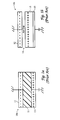
- the present invention relates to an electrostatic chuck 20 comprising a unitary structure of a monocrystalline ceramic monolith 25 which comprises relatively large ceramic crystals 30 that are oriented to one another in a single crystallographic direction, as schematically represented in Figure 2a.
- the electrostatic chuck 20 of monocrystalline ceramic material comprises a receiving surface 35 for receiving a substrate 40 , and one or more electrodes 45 embedded therein and below the receiving surface. As shown in Figure 2a, the electrostatic chuck 20 electrostatically holds the substrate 40 to the receiving surface 35 upon application of a voltage to the electrode 45 via an electrical connector 50 that extends through the monolithic structure 25 .
- the monocrystalline ceramic monolith 25 provides a unitary block of a chemically homogeneous composition that has several advantages in integrated circuit fabrication.
- the term "monocrystalline" which commonly refers to a single crystal material, is used here to denotes material that comprises a few (typically 10 or fewer) large ceramic crystals 30 that are oriented in the same crystallographic direction, i.e., that have crystallographic planes with miller indices that are aligned to one another.
- the large crystals 30 of the monocrystalline ceramic typically have an average diameter of about 0.5 to about 10 cm, and more typically from 1 to 5 cm.
- conventional polycrystalline ceramic materials have small grains or crystals with diameters on the order of 0.1 micron to 50 micron, which is smaller by a factor of at least about 10 5 to about 10 7 .
- the large ceramic crystals 30 in the monolithic structure 25 are oriented in substantially the same single crystallographic direction, and provide exposed surfaces having little or no impurity or glassy grain boundary regions that can erode rapidly in erosive halogen-containing environments as in small grains and crystals.
- the continuously homogeneous and uniform crystallographic structure of the receiving surface 35 of the monolith 25 exhibits reduced erosion or particulate generation in erosive environments and provides a relatively constant electrical resistance that does not change at higher temperatures, unlike the receiving surfaces of polycrystalline ceramic chucks.
- the highly oriented crystals of the monocrystalline ceramic monolith 25 have a resistivity sufficiently high to electrically insulate the electrode 45 .
- the resistivity of the monolith 25 is preferably from about 1 x 10 8 to about 1 x l0 20 ⁇ /cm, and more preferably from about 1 x 10 11 to about 1 x 10 13 ⁇ /cm; and is tailored to provide a resistance suitable for forming either a coulombic electrostatic chuck (high resistance) or Johnsen-Rahbek electrostatic chuck (low resistance).
- the monolith 25 reduces particle generation during processing, provides excellent erosion resistance in erosive halogen-containing plasma environments, and exhibits consistent electrical resistance values at high temperatures, due to the presence of the large ceramic crystals.
- Suitable monocrystalline ceramic materials include monocrystalline Al 2 O 3 , AIN, BaTiO 3 , BeO, BN, CaO, LaB 6 , MgO, MoSi 2 , Si 3 N 4 , SiO 2 , Ta 2 O 5 , TiB 2 , TiN, TiO 2 , TiSi 2 VB 2 , W 2 B 3 , WSi 2 , ZrB 2 , or ZrO 2 .
- the ceramic monolith 25 comprises monocrystalline sapphire which is a single crystal form of alumina that exhibits excellent chemical and erosion resistance in erosive environments, particularly halogen plasma environments.
- Monocrystalline sapphire also has a very high melting temperature that allows high temperature use at temperatures exceeding 1000°C and often even exceeding 2000°C.
- the ceramic monolith 25 can also be mixed with suitable dopants to provide the desired electrical properties such as resistivity and dielectric breakdown strength.
- suitable dopants such as resistivity and dielectric breakdown strength.
- pure sapphire has a resistivity on the order of 1 x 10 14 ⁇ /cm
- sapphire can be mixed with 1 to 3 wt% TiO 2 to provide a lower resistivity on the order of 1 x 10 11 to 1 x 10 13 ⁇ /cm, which is more suitable for use in Johnsen-Rahbek-type electrostatic chucks.
- the electrode 45 of the electrostatic chuck 20 comprises one of a pattern of dopant material, a pattern of lattice defects, or a metal structure embedded in the ceramic monolith 25 .
- Suitable metal electrodes 45 can be made from copper, nickel, chromium, aluminum, molybdenum, and combinations thereof.
- the electrode 45 comprises a refractory metal having a melting point of at least about 2200°C to facilitate fabrication of the electrostatic chuck 20 , the thickness of the electrode being from about 1 ⁇ m to about 100 ⁇ m, and more typically from 1 ⁇ m to 50 ⁇ m.
- the electrode 45 typically covers a total area of about 7,000 to about 70,000 sq.
- the electrode 45 comprises small apertures that are sized (i) sufficiently small to allow the electrode to generate a uniform electrostatic field for holding the substrate 40 upon application of a voltage thereto, and (ii) sufficiently large to allow the monocrystalline ceramic monolith 25 to form a strong and cohesive structure joined by interconnects extending through the apertures.
- Electrical connectors 50 that are used to electrically connect the electrode 45 to a chucking voltage supply 55 , comprise an electrical lead 60 that extends through the ceramic monolith 25 and an electrical contact 65 at the end of the lead.
- the length of the electrical lead 60 is from about 10 mm to about 50 mm, and the width of the electrical lead is from about 0.2 mm to about 10 mm.
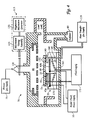
- the process chamber 70 illustrated in Figure 3 represents a CENTURA 5200 oxide etch chamber commercially available from Applied Materials Inc., Santa Clara, California, as described in commonly assigned U.S. Patent Application No. 07/941,507, filed on September 8, 1992, which is incorporated herein by reference.
- the process chamber 70 typically includes a process gas supply 75 for introducing process gas into the process chamber via a gas distributor 80 , and a throttled exhaust 85 for exhausting gaseous byproducts from the process chamber.
- a plasma is formed from the process gas using a plasma generator that couples an electric field into the process chamber 70 .
- the plasma generator can comprise an inductor coil 90 capable of forming an inductive electric field in the process chamber 70 when powered by a coil power supply 95 .
- the process chamber 70 can include process electrodes 100, 105 that are used to generate a capacitive electric field in the process chamber 70 when powered by a process electrode power supply 110.
- the process electrodes 100 can be the same electrode as the electrode 45 in the chuck 20 (not shown) or a separate electrode below the electrostatic chuck as shown in Figure 3.
- the capacitive electric field formed by the electrodes 100, 105 is perpendicular to the plane of the substrate 40 and accelerates inductively formed plasma species toward the substrate 40 .
- the frequency of the voltage applied to the process electrodes 100, 105 , and/or the inductor coil 90 is in the RF range, typically from about 50 kHz to about 60 MHZ, and more typically about 13.56 MHZ.
- the power of the RF voltage applied to the coil 90 or process electrodes 100, 105 is typically from about 100 to about 5000 Watts.
- a combination of both inductor coils 90 and process electrodes 100, 105 is preferred to provide control of both the plasma density and the plasma energy of the plasma ions.
- the process chamber 70 is evacuated and maintained at a subatmospheric pressure and a robot arm (not shown) transports a substrate 40 from a load-lock transfer chamber (also at subatmospheric pressure) through a slit valve and into the process chamber 70 .
- the robot arm places the substrate 40 on the tips of lift fingers (not shown) that are elevated by the pneumatic lift mechanism to extend about 2 to 5 centimeters above the receiving surface 35 of the electrostatic chuck 20 .
- the pneumatic mechanism lowers the substrate 40 onto the receiving surface 35 , and the electrode 45 of the electrostatic chuck 20 is electrically biased with respect to the substrate by the chuck voltage supply 55 .
- the voltage applied to the monopolar electrode 45 shown in Figure 3 causes electrostatic charge to accumulate in the electrode or in the monocrystalline ceramic material covering the electrode.
- the plasma in the process chamber 70 provides electrically charged species having opposing polarity which accumulate in the substrate 40 .
- the accumulated opposing electrostatic charges result in an attractive electrostatic force that electrostatically holds the substrate 40 to the electrostatic chuck 20 .
- the substrate 40 is electrically decoupled or dechucked from the electrostatic chuck 20 by dissipating the residual electrical charges holding the substrate onto the electrostatic chuck after the voltage to the electrode 45 is turned off.
- the pneumatic lifting apparatus then raises the lift pins which lift the substrate 40 to allow the substrate to be removed by the robotic arm.
- the chucking voltage supply 55 is turned off, and the chucking electrode 45 is connected to ground to remove any accumulated charge.
- the substrate 40 can be electrically grounded by contacting it with a grounded conductor or by forming a plasma at a reduced power level to provide an electrically conductive path from the substrate to grounded walls of the process chamber 70 .
- FIG. 70 Another example of a process chamber 70 that can use the present electrostatic chuck 20 , as illustrated in Figure 4, comprises an RPS process chamber, also commercially available from Applied Materials.
- the plasma is generated using a microwave generator assembly 115 comprising a microwave applicator 120 , a microwave tuning assembly 125 , and a magnetron microwave generator 130 .
- a suitable microwave applicator 120 comprises a microwave waveguide positioned in a remote chamber in a flow path of the process gas as described in Applied Materials U.S. Patent Application No. 08/499,984, by Herchen, et al., entitled "MICROWAVE PLASMA BASED APPLICATOR," filed on July 10, 1995, which is incorporated herein by reference.
- the electrostatic chuck 20 illustrated in this process chamber 70 comprises bipolar electrodes 45a, 45b that includes at least two substantially coplanar electrodes that generate substantially equivalent electrostatic clamping forces.
- the bipolar electrodes 45a, 45b can form opposing semicircles, or inner and outer rings of electrodes with electrical isolation voids therebetween.
- the bipolar electrodes 45a, 45b are operated by application of a differential electrical potential to the electrodes that induces opposing electrostatic charges in the substrate 40 to electrostatically hold the substrate to the electrostatic chuck 20 .
- a heat transfer gas supply 135 provides heat transfer gas to the receiving surface 35 of the electrostatic chuck 20 to control the temperature of the substrate 40 .
- the ceramic monolith 25 comprises a gas channel 140 for holding heat transfer gas in the electrostatic chuck 20 , a gas feed 145 for providing heat transfer gas to the gas channel, and gas vents 150 extending from the channel to the receiving surface 35 for providing heat transfer gas to the receiving surface 35 below the substrate 40 .
- the heat transfer gas flows through the gas feed 145 , into the gas channel 140 , and out the gas vents 150 , exiting below the receiving surface 35 .
- the substrate 40 covers and seals the gas vents 150 on the receiving surface 35 to reduce leakage of heat transfer gas from below the substrate 40 .
- the heat transfer gas provides efficient heat transfer rates between the substrate 40 and the electrostatic chuck 20 to maintain the substrate at constant temperatures.
- the heat transfer gas is an inert gas such as helium or argon supplied at a pressure of from about 5 to about 30 Torr.
- a fluid system is used to regulate the temperature of the electrostatic chuck 20 and the substrate 40 .
- the fluid system can be used in any support for holding the substrate 40, and should not be limited to use in electrostatic chucks 20 comprising monocrystalline ceramic material, which are used only to provide illustrative examples of this aspect of the present invention.
- the fluid system comprises (i) a fluid conduit 160 for holding or circulating heat transfer fluid below the receiving surface 35 of the electrostatic chuck 20 , (ii) a fluid inlet 165 for supplying heat transfer fluid to the conduit 160 , and (iii) a fluid outlet 170 for removing or exhausting the heat transfer fluid from the electrostatic chuck 20 .
- the fluid conduit 160 is embedded in the electrostatic chuck 20 to provide more control over the temperature of the electrostatic chuck 20, particularly when the electrostatic chuck is made of ceramic material having a low thermal conductance, such as aluminum oxide or sapphire.
- a fluid supply 175 supplies cooled or heated fluid to the fluid inlet 165 of the fluid conduit 160 .
- the fluid is pumped into the fluid inlet 165 circulates through the fluid conduit 160 to heat or cool the electrostatic chuck 20 (depending on the difference in temperature between the fluid and the electrostatic chuck), and flows out from the fluid outlet 170 .
- the fluid conduit 160 provides lower temperature adjustment response times and higher heat transfer rates than conventional fluid systems in which a fluid is used to control the temperature of a separate metal base below the electrostatic chuck, where there are more thermal impedances between the heat sink of the base and the substrate.
- the fluid conduit 160 in the body of the electrostatic chuck 20 comprises first passageways 180 at a first distance D 1 from the receiving surface 35 and second passageways 185 at a second distance D 2 from the receiving surface.
- the difference ⁇ D between the distances D 1 and D 2 is selected to provide a uniform heat transfer rate from the receiving surface 35 to the conduit 160 , even though the fluid is being heated or cooled by the electrostatic chuck 20 as it travels through the electrostatic chuck.
- the distance D 1 is sufficiently greater or smaller than the distance D 2 to compensate for the change in temperature of the fluid as it flows through the electrostatic chuck 20 .
- first passageways 180 are positioned adjacent to the fluid inlet 165
- second passageways 185 are positioned adjacent to the fluid outlet 170 closer to the receiving surface 35 .
- This arrangement compensates for the large difference in temperature ⁇ T between the receiving surface 35 and the fluid entering the body of the chuck 20 than the temperature difference between the receiving surface 35 and fluid exiting the chuck 20 .
- the fluid inlet 165 is positioned further away from the receiving surface 35 than the fluid outlet 170 .
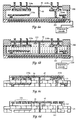
- one arrangement shown in Figure 5a comprises a fluid conduit 160 that is shaped as a helical conduit that rises toward the receiving surface 35 as it proceeds from the fluid inlet 165 to the fluid outlet 170 , with the distance D 1 being sufficiently greater than the distance D 2 to provide uniform rates of thermal transfer across the receiving surface 35 .
- the fluid conduit 160 with the first and second passageways 180, 185 provides more precise control of the temperature of the substrate 40 by compensating for variations in heat generation or heat conductance across the electrostatic chuck 20 , which is a particular problem for ceramic chucks that contain different materials or internal structures, such as electrodes, channels and conduits which have different thermal impedances.
- the first and second passageways 180, 185 can comprise any suitable structure for forming a continuous conduit 160 through the electrostatic chuck 20 , as apparent to one of ordinary skill in the art, that will provide the desired differential or uniformity in temperatures across the receiving surface 35 .
- the fluid conduit 160 can include discrete segments having polyhedra or rectangular shaped cross-sections below the receiving surface 35 , segments that are positioned at an acute or obtuse angle relative to the receiving surface, or a continuous conduit which ascends helically from a perimetric portion to a central portion of the electrostatic chuck 20 , or vice-versa.
- the temperature profile across the substrate 40 held on the receiving surface 35 is further controlled by controlling the difference between the distance D IN which is the distance between the receiving surface 35 and the radially inner portion of the fluid conduit 160 , and the distance D OT which is the distance between the receiving surface 35 and the radially outer or perimetric portion of the fluid conduit.
- the difference in the distances D IN and D OT is selected based on the difference in equilibrium temperatures at the receiving surface 35 , and can be used to design a fluid conduit 160 in conjunction with the distances D 1 and D 2 , or independently.
- Figure 5b shows a conduit where both the distances D IN and D OT and the distances D 1 and D 2 were tailored to achieve a uniform temperature across the receiving surface 35 and the substrate 40 .
- Figures 5c and 5e illustrate additional fluid conduits 160 comprising an outer circumferential diameter D OT at the perimeter of the electrostatic chuck 20 that is closer to the receiving surface 35 than an inner circumferential diameter D IN near the center of the electrostatic chuck.
- This arrangement of the fluid conduit 160 provides increased heat transfer from the peripheral portion of the electrostatic chuck 20 , and is useful when the peripheral portion operates at hotter steady state or equilibrium temperatures than the central portion, so that the cooling fluid can cool the peripheral portion at higher cooling rates than the center.
- the fluid conduit 160 has the shape shown in Figure 5d, where the inner circumferential diameter D IN near the center of the electrostatic chuck is closer to the receiving surface 35 than the outer circumferential diameter D OT , and the distance D IN is less than the distance D OT .
- the fluid conduit 160 comprises an annular ring that extends circumferentially through the electrostatic chuck 20 and has a rectangular cross-section with a central axis inclined to the plane of the receiving surface 35 , as shown in Figures 5b through 5d.
- the angular orientation of the annular ring relative to the receiving surface 35 is selected to maintain a substantially uniform temperature across the receiving surface 35 from the perimeter to the center.
- the annular ring has an inner circumferential edge at a distance D IN from the receiving surface 35, and an outer circumferential edge at a distance D OT from the receiving surface 35 .
- the fluid conduit 160 comprises one or more passages having a circular cross-section that form an ascending spiral about a central vertical axis of the electrostatic chuck 20 .
- Other equivalent fluid conduit structures and configurations as apparent to one of ordinary skill in the art, are also within the scope of the present invention.
- One method of fabricating the electrostatic chuck 20 comprises a melt forming and seeding process that produces a unitary structure of large crystals 30 with an electrode 45 embedded therein.
- the melt process uses an apparatus comprising a heated mold 200 for melting a ceramic material for forming a molten ceramic, as shown in Figure 6a.
- the sidewalls of the heated mold 200 are heated by a conventional heater 205 , extending through or wrapped around the mold.
- the mold 200 is preferably fabricated from a material that uniformly wets the molten ceramic material, and, because the molten ceramic should not be contaminated by dissolution of mold material, is chemically stable with a high melting point.
- the mold 200 is preferably made of a material such as molybdenum, which has a melting point of 2617°C, uniformly wets molten alumina, and has a low reactivity and high chemical compatibility with molten alumina.
- Cooling tubes (not shown) containing a heat transfer fluid, such as water or helium gas, can also be provided around the mold to provide a controlled source of heat dissipation.
- One or more chemically degradable forms 210a-d which are shaped to form the gas channel 140 , gas feed 145 , gas vents 150 , and fluid conduit 160 in the electrostatic chuck 20 .
- the chemically degradable forms 210a-d and the electrode 45 or bipolar electrodes 45a, 45b of the electrostatic chuck 20 are held suspended in the molten ceramic material by fine alumina fibers or supported by alumina blocks.
- a seeding crystal 215 is contacted against the surface of the molten ceramic to seed or nucleate growth of a monocrystalline ceramic in the molten ceramic material.
- the seeding crystal 215 typically comprises a crystal that has the same composition as the molten ceramic material. Because the seeding crystal 215 has an oriented crystallographic structure it serves as a seeding or nucleating surface that initiates growth of a monocrystalline ceramic structure. The surface of the molten ceramic is then slowly cooled while the sidewalls and bottom of the mold 200 are continuously heated by the heater 205 .
- the temperature of the mold 200 and the molten ceramic is controlled by a temperature control system 220 that continuously heats the sidewalls and bottom of the mold 200 while the molten ceramic is cooled from the surface toward the bottom of the mold. Slowly reducing the heat applied to the molten material allows the molten ceramic to form large, highly oriented crystals 30 .
- the solidified ceramic monolith 25 of monocrystalline ceramic material is removed from the mold 200 and treated to remove the chemically degradable forms 210a-d , creating conduits and channels between the ceramic crystals 30 without damaging the electrostatic chuck 20 .
- the chemically degradable forms 210a-d are etched by a suitable chemical, such as a bath of strong nitric acid, in which the ceramic monolith 25 is immersed for about 24 hours.
- chemically degradable forms 210a-d can be made of a material, such as graphite, that is removed through oxidation by simply heating the ceramic monolith 25 to a high temperature of about 700°C in an atmosphere containing oxygen for about 120 minutes.
- the electrode form should be flushed or purged with inert gas to prevent oxidation and cracking of the electrode.
- a refractory metal electrode 210c,d is suspended in the molten ceramic to become embedded in the monocrystalline monolith structure 25 .
- Suitable electrodes include, for example, an electrode formed from metal foil using conventional bonding, stamping, or pressing methods; metal wire joined together in an interconnected pattern to form a mesh of electrically conductive wire; or a metal plate that is etched to form the desired electrode pattern.
- the electrode can also be formed by altering the crystalline lattice structure of the monocrystalline ceramic monolith 25 in a predefined pattern to form a conductive electrode pattern on the crystal structure.
- lattice defects are introduced in the monocrystalline ceramic using a laser focused inside the ceramic monolith 25 .
- Suitable laser methods can use a Nd YAG laser having an intensity of 10 8 Watts/cm 2 that is scanned across the monocrystalline ceramic to form electrically conducting lattice defects within the monocrystalline ceramic.
- the lattice defects typically comprise dislocations, which occur when atoms are moved from their initial crystalline positions to interstitial or other lattice sites.
- the electrode 45 is formed by doping the ceramic monolith 25 with suitable dopants to provide the desired electrical properties such as resistivity and dielectric breakdown strength.
- a sapphire monocrystalline ceramic material can be doped with 0.1 to 5 wt% TiO 2 , in a conductive pattern suitable for use as an electrode 45 .
- Conventional photolithographic and ion implantation methods can also be used to form a patterned layer of dopant on a sapphire layer.
- the electrostatic chuck 20 comprises a plurality of monocrystalline ceramic plates 225 bonded to one another to form the body of the electrostatic chuck, as shown in Figure 2b.
- the electrode 45 is embedded in the electrostatic chuck 20
- the electrical connector 50 extends through one or more monocrystalline ceramic plates 225 to supply a voltage to the electrode.
- the monocrystalline ceramic plates 225 comprise a thickness of about 0.1 to 1 cms, and more preferably 0.1 to 0.25 cms (0.04 to 0.10 inches) with a plurality of bonding regions between the monocrystalline ceramic plates that typically have a thickness of about .0001 to.0050 inches.
- the ceramic monolith 25 comprises from about 2 to about 30 monocrystalline ceramic plates 225 .
- One or more of the monocrystalline ceramic plates 225 have machined therein (i) the gas channel 140 , (ii) the gas feed 145 , and (iii) gas vents 150 to provide heat transfer gas to the receiving surface 35 below the substrate 40 .
- the monocrystalline ceramic plates 225 can also have machined therein fluid conduit 160 , fluid inlet 165 , and fluid outlet 170 .
- the monocrystalline ceramic plates 225 are aligned to one another so that the gas channels 140 , gas feeds 145 , and gas vents 150 form a continuos gas distribution path; and the fluid conduit 160 , fluid inlet 165 , and fluid outlet 170 form a separate continuos fluid path in the electrostatic chuck 20 .
- an electrostatic chuck 20 which comprises a plurality of monocrystalline ceramic plates 225 , illustrated in Figures 5a to 5c, will now be described.
- Conventional crystal growth techniques such as the Czochralski or EFG methods, in which a single crystal of ceramic is seeded from molten ceramic, are used to grow a large diameter single crystal of monocrystalline ceramic.
- the single crystal of monocrystalline ceramic is cut into a number of monocrystalline ceramic plates 225 comprising large aluminum oxide crystals 30 substantially oriented with respect to one another.
- An electrode 45 comprising a metal structure, a dopant pattern, or a pattern of lattice defects is formed on one or more of the monocrystalline ceramic plates 225 , as described above.
- the monocrystalline ceramic plates 225 are bonded to one another to form a ceramic monolith 25 using a eutectic bonding compound 230 comprising mixture of aluminum oxide and a eutectic component.
- the bonding compound 230 is selected to provide an aluminum oxide-containing bond which matches the thermal expansion coefficient of the monocrystalline ceramic plates 225 , yet melts at a relatively low temperature.
- eutectic component it is meant an additive, or mixture of additives, that form an eutectic or glassy system with aluminum oxide that has a melting temperature that is significantly lower than that of pure aluminum oxide, preferably less than about 2000°C, and more preferably less than about 1550°C.
- Preferred eutectic components include for example B 2 O 3 , P 2 O 5 , and SiO 2 .
- a metal electrode 45 on one of the monocrystalline ceramic plates 225 can be formed on a patterned layer of resist on one of the monocrystalline ceramic plates 225 , and metal deposited between the resist features (for example, by electroplating or sputtering) to form an electrode 45 structure.
- Suitable resist materials include "RISTON” fabricated by DuPont de Nemours Chemical Co, and conventional photolithographic methods are described in Silicon Processing for the VLSI Era, Volume 1: Process Technology, Chapters 12, 13, and 14, by Stanley Wolf and Richard N. Tauber, Lattice Press, California (1986), which is incorporated herein by reference.
- the electrode 45 can be fabricated by etching a layer of metal deposited on a sapphire plate using conventional PVD, CVD, or solution deposition methods, such as for example metal CVD or sputtering. Conventional photolithographic and etching methods are used to etch the deposited metal into the desired electrode configuration.
- the electrode 45 can also be formed on a wafer of monocrystalline ceramic material cut from a column of monocrystalline ceramic by altering the lattice structure of the ceramic wafer in a predefined pattern to form a conductive electrode pattern, or by doping the monocrystalline ceramic with suitable dopants to provide the desired electrical properties such as resistivity and dielectric breakdown strength.
- an electrostatic chuck 20 comprises a monocrystalline ceramic layer 235 covering a mesh electrode 240 on an underlying dielectric layer 245 , the mesh electrode having predefined apertures 195 therethrough.
- the underlying dielectric layer 245 can be formed from the same material as the monocrystalline ceramic layer 235 or can be a different ceramic material.
- the mesh electrode 240 is an electrically conductive patterned electrode.
- Suitable materials for the monocrystalline ceramic layer and the underlying dielectric layer 245 include Al 2 O 3 , BeO, SiO 2 , Ta 2 O 5 , ZrO 2 , CaO, MgO, TiO 2 , BaTiO 3 , AIN, TiN, BN, Si 3 N 4 , ZrB 2 , TiB 2 , VB 2 , W 2 B 3 , LaB 6 , MoSi 2 , WSi x , or TiSi x .
- both the monocrystalline ceramic layer 235 and the underlying dielectric layer 245 comprise sapphire. More preferably, the thickness t of the monocrystalline ceramic layer 235 is at least about three times the diameter of the apertures 195 between the patterned mesh electrode 240 to reduce spreading of the electric field from the electrode.
- the monocrystalline ceramic layer 235 further comprises integral bonding interconnects 190 that extend through the apertures 195 in the mesh electrode 240 to form a unitary structure with the underlying dielectric layer 245 .
- the integral bonding interconnects 190 comprise posts of monocrystalline material having large oriented crystals 30 that bond directly to the underlying dielectric layer 245 substantially without adhesive. The posts are formed when molten ceramic material is applied over the exposed surface of the mesh electrode 240 . The molten material seeps into the apertures 195 of the mesh electrode 240 and fuses with the underlying dielectric layer 245 to form a continuous and chemically bonded ceramic structure enclosing the entire mesh electrode.
- the apertures 195 in the mesh electrode 240 are sized sufficiently small to allow the mesh electrode to generate a uniform electrostatic field for holding the substrate 40 upon application of a voltage thereto, and sufficiently large to allow the integral bonding interconnects 190 formed therein to securely bond the monocrystalline ceramic layer 235 to the underlying dielectric layer 245 .
- Elimination of the adhesive used to join conventional dielectric layers of electrostatic chucks 20 , through use of the integral bonding interconnects 190 provides more stable and reliable electrical properties at high operating temperatures, exceeding about 1000°C, and often exceeding 2000°C. Elimination of the adhesive also provides improved erosion resistance in highly erosive plasma environments.
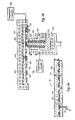
- the crystal growth apparatus comprises a melt reservoir 250 for melting a ceramic material to form a molten ceramic.
- the melt reservoir 250 is surrounded by ceramic fiber insulation 255 , and includes a conventional heater 205 , such as tungsten or NICHROME wire, wrapped around the melt reservoir.
- the melt reservoir 250 is typically made of a corrosion resistant material capable of withstanding the high melting temperatures of the ceramic material, such as molybdenum, which has a melting point of 2617°C. Typical melting temperatures for such ceramic materials often exceed 1000°C, for example, the melting or softening temperature of alumina being 2015°C, of silicon dioxide being from 1200°C to 1700°C, and of titanium dioxide being 1840°C.
- a rigid capillary tube 260 is positioned in the molten ceramic of the melt reservoir 250 .
- the diameter of the capillary tube 260 is selected based on the capillary surface tension forces of the particular ceramic material melted in the reservoir 250 .
- a typical diameter of the capillary tube 260 is from about 0.2 to about 2 mm.
- the rigid capillary tube 260 is self-filling due to the capillary forces operating in the capillary tube that draws molten ceramic material up the length of the capillary tube for feeding a molten ceramic layer onto a workpiece surface 265 , such as an exposed surface of one or more mesh electrodes 240 .
- the capillary tube 260 comprises an inlet 270 immersed in the molten ceramic in the reservoir, and an outlet 275 adjacent to the workpiece surface 265 , for example, the exposed surface of the electrode.
- the outlet 275 has (1) a leading edge 280 having a first height and a seeding surface 285 , and (2) a trailing edge 290 having a second height smaller than the first height.
- the thickness t of the monocrystalline ceramic layer 235 deposited on the workpiece surface 265 is controlled by the difference in height of the leading and trailing edges 280, 290 of the outlet 275 , i.e., the difference in first and second heights.
- the outlet 275 of the capillary tube 260 is moved across the workpiece surface 265 in a direction such that leading edge 280 of the capillary tube 260 moves ahead of the trailing edge 290 , to deposit on the workpiece surface a layer of molten ceramic layer.
- the molten ceramic layer is drawn through the capillary tube 260 by capillary forces and is seeded by the seeding surface 285 of the leading edge 280 to form a monocrystalline ceramic layer 235 on the workpiece surface 265 .
- the integral bonding interconnects 190 are formed during deposition of the molten ceramic layer on the exposed surface of the electrode of the electrostatic chuck 20 , the molten ceramic material flows thorough the apertures 195 in the mesh electrode 240 to bond directly to junction regions on the underlying dielectric layer 245 that lying immediately below the open apertures 195 of the mesh electrode.
- the resultant structure eliminates the use of adhesives for bonding the underlying dielectric layer 245 below the electrode to the monocrystalline ceramic layer 235 covering the electrode.
- the temperature of the capillary tube 260 and the workpiece surface 265 is maintained uniform by a temperature control system, which heats the capillary tube and workpiece surface during deposition of the monocrystalline ceramic layer 235 . Heating of the workpiece surface 265 allows the coplanar ceramic layers to merge and flow into one another to form a continuous ceramic layer covering the substantially the entire workpiece surface.
- the temperature control system comprises a heat shield, a heating and/or a cooling system, and a temperature controller 300 .
- the heat shield can comprise a cylinder of ceramic fiber insulation 255 surrounding the capillary tube 260 , and a box of ceramic fiber insulation 295 surrounding the workpiece surface 265 , suitable ceramic insulation including ZIRCAR fibers, commercially available from ZIRCAR Company.
- the heat coil in the ceramic insulator is connected to a closed loop temperature controller 300 to control the temperature of the tube and workpiece surface 265 .
- Cooling tubes 305 that contain a heat transfer fluid, such as water or helium gas, can also be provided around the capillary tube 260 and the workpiece surface 265 to provide a source of rapid heat dissipation (not shown).
- the rate of growth of the monocrystalline ceramic layer 235 is maximized by reducing heat loss and minimizing thermal shocking of the deposited layer through use of the temperature control system.
- the capillary tube 260 is preferably fabricated from a material that is chemically stable, has a high melting temperature, and uniformly wets the molten ceramic material with a contact angle of less than about 90°.
- a suitable high temperature material is molybdenum. Molybdenum also uniformly wets molten alumina, and has a low reactivity and high chemical compatibility with molten alumina.
- the maximum permissible height of the capillary tube 260 depends on the surface tension and density of the molten ceramic material in the capillary tube. Most ceramic materials have a high surface tension, a low contact angle, and low density, which provides relatively tall capillary rise.
- a suitable height of the capillary tube 260 for molten alumina in a molybdenum capillary tube is at least about 25 mm, and more preferably at least about 50 mm above the melt surface in the melt reservoir 250 .
- the outlet 275 of the capillary tube 260 comprises a leading edge 280 having a seeding surface 285 .
- the seeding surface 285 seeds or nucleates growth of a monocrystalline ceramic layer 235 from the molten ceramic material.
- the seeding surface 285 typically comprises a seeding crystal 215 of the same material as the monocrystalline ceramic material, and serves as a seeding or nucleating surface that initiates growth of a monocrystalline ceramic layer 235 on the workpiece surface 265 .
- the outlet 275 of the capillary tube 260 does not need to match the shape of the area to be covered by the monocrystalline ceramic layer 235 , because the outlet deposits a ribbon of molten ceramic material on the workpiece surface 265 as the outlet moves across the workpiece surface.
- the workpiece surface 265 is continuously heated during deposition of multiple ribbons of ceramic material, to a temperature close to the melting temperature of the ceramic material deposited thereon, causing the ribbons to flow into one another to form a ceramic layer that is continuous and uniform across the workpiece surface 265 .
- the width of each ribbon of molten ceramic corresponds to the width w of the outlet 275
- the height t of the ribbons corresponds to the difference in height of the leading and trailing edges 280, 290 , that define the outlet opening.
- the capillary tube 260 and workpiece surface 265 are moved relative to one another to deposit a uniform layer of molten ceramic material on the electrode.
- the rate of movement of the molten ceramic material through the capillary tube 260 is from about 10 to 100 cm/min; and the rate of movement of the outlet 275 of the capillary tube is adjusted accordingly to provide the desired thickness t of the monocrystalline ceramic material on the workpiece surface 265 .
- the workpiece surface 265 is moved across the outlet 275 of the capillary tube 260 at a rate sufficiently low to provide a melt interface that is mechanically stable.
- the capillary tube 260 Since the capillary tube 260 is fixed in the melt reservoir 250 , the top of the molten ceramic material in the tube and the crystal growth interface are both relatively stationary with respect to the melt reservoir. Alternatively, the outlet 275 of the capillary tube 260 along with the surrounding heat shield, is moved across the workpiece surface 265 . Multiple layers of monocrystalline ceramic material, stacked onto top of one another, can be deposited on the workpiece surface 265 .
- the monocrystalline ceramic can be fabricated by grain growth of polycrystalline ceramic material or by other suitable melt forming methods.
- the electrode and other shapes can be formed by other methods, for example, by drilling or machining a monocrystalline ceramic and inserting the desired shapes and forms. Therefore, the scope of the appended claims should not be limited to the description of the preferred versions contained herein.
Landscapes
- Container, Conveyance, Adherence, Positioning, Of Wafer (AREA)
- Jigs For Machine Tools (AREA)
Applications Claiming Priority (4)
| Application Number | Priority Date | Filing Date | Title |
|---|---|---|---|
| US08/812,194 US5737178A (en) | 1997-03-06 | 1997-03-06 | Monocrystalline ceramic coating having integral bonding interconnects for electrostatic chucks |
| US08/920,423 US6529362B2 (en) | 1997-03-06 | 1997-08-29 | Monocrystalline ceramic electrostatic chuck |
| US920423 | 1997-08-29 | ||
| US812194 | 2001-03-19 |
Publications (2)
| Publication Number | Publication Date |
|---|---|
| EP0863545A2 true EP0863545A2 (de) | 1998-09-09 |
| EP0863545A3 EP0863545A3 (de) | 2000-05-31 |
Family
ID=27123576
Family Applications (1)
| Application Number | Title | Priority Date | Filing Date |
|---|---|---|---|
| EP98301666A Withdrawn EP0863545A3 (de) | 1997-03-06 | 1998-03-06 | Elektrostatischer Scheibenhalter aus einkristalliger Keramik |
Country Status (5)
| Country | Link |
|---|---|
| US (1) | US6529362B2 (de) |
| EP (1) | EP0863545A3 (de) |
| JP (1) | JPH1126565A (de) |
| KR (1) | KR19980079963A (de) |
| TW (1) | TW416117B (de) |
Cited By (3)
| Publication number | Priority date | Publication date | Assignee | Title |
|---|---|---|---|---|
| DE10122036B4 (de) * | 2001-05-07 | 2009-12-24 | Karl Suss Dresden Gmbh | Substrathaltevorrichtung für Prober zum Testen von Schaltungsanordnungen auf scheibenförmigen Substraten |
| CN115315798A (zh) * | 2020-03-31 | 2022-11-08 | 应用材料公司 | 高温微区静电吸盘 |
| WO2025264619A1 (en) * | 2024-06-20 | 2025-12-26 | Applied Materials, Inc. | Fluorine plasma resistant dielectric compositions |
Families Citing this family (51)
| Publication number | Priority date | Publication date | Assignee | Title |
|---|---|---|---|---|
| JP3851489B2 (ja) * | 2000-04-27 | 2006-11-29 | 日本発条株式会社 | 静電チャック |
| JP4659300B2 (ja) | 2000-09-13 | 2011-03-30 | 浜松ホトニクス株式会社 | レーザ加工方法及び半導体チップの製造方法 |
| CN101335235B (zh) | 2002-03-12 | 2010-10-13 | 浜松光子学株式会社 | 基板的分割方法 |
| AU2003211581A1 (en) | 2002-03-12 | 2003-09-22 | Hamamatsu Photonics K.K. | Method of cutting processed object |
| TWI326626B (en) | 2002-03-12 | 2010-07-01 | Hamamatsu Photonics Kk | Laser processing method |
| US6796711B2 (en) * | 2002-03-29 | 2004-09-28 | Axcelis Technologies, Inc. | Contact temperature probe and process |
| TWI520269B (zh) | 2002-12-03 | 2016-02-01 | 濱松赫德尼古斯股份有限公司 | Cutting method of semiconductor substrate |
| FR2852250B1 (fr) | 2003-03-11 | 2009-07-24 | Jean Luc Jouvin | Fourreau de protection pour canule, un ensemble d'injection comportant un tel fourreau et aiguille equipee d'un tel fourreau |
| DE60315515T2 (de) | 2003-03-12 | 2007-12-13 | Hamamatsu Photonics K.K., Hamamatsu | Laserstrahlbearbeitungsverfahren |
| WO2004082007A1 (ja) * | 2003-03-12 | 2004-09-23 | Tokyo Electron Limited | 半導体処理用の基板保持構造及びプラズマ処理装置 |
| JP4565915B2 (ja) * | 2003-07-23 | 2010-10-20 | エーエスエムエル ネザーランズ ビー.ブイ. | リソグラフィ投影装置及び物品保持器 |
| JP4684222B2 (ja) * | 2004-03-19 | 2011-05-18 | 株式会社クリエイティブ テクノロジー | 双極型静電チャック |
| US20050235915A1 (en) * | 2004-04-27 | 2005-10-27 | Ho Yeu-Chuan S | Plasma surface treatment electrode assembly and arrangement |
| US8057633B2 (en) * | 2006-03-28 | 2011-11-15 | Tokyo Electron Limited | Post-etch treatment system for removing residue on a substrate |
| DE102006055618B4 (de) * | 2006-11-24 | 2011-05-12 | Fraunhofer-Gesellschaft zur Förderung der angewandten Forschung e.V. | Mobiler elektrostatischer Trägerwafer mit elektrisch isoliertem Ladungsspeicher, Anordnung zur Halterung und Verfahren zum Halten und Lösen eines scheibenförmigen Bauteils |
| JP2008146724A (ja) * | 2006-12-07 | 2008-06-26 | Toshiba Corp | ディスク記憶装置及びサーボテスト方法 |
| US20080151466A1 (en) * | 2006-12-26 | 2008-06-26 | Saint-Gobain Ceramics & Plastics, Inc. | Electrostatic chuck and method of forming |
| US7983017B2 (en) * | 2006-12-26 | 2011-07-19 | Saint-Gobain Ceramics & Plastics, Inc. | Electrostatic chuck and method of forming |
| JP4746003B2 (ja) * | 2007-05-07 | 2011-08-10 | リンテック株式会社 | 移載装置及び移載方法 |
| KR20090001091A (ko) * | 2007-06-29 | 2009-01-08 | (주)티티에스 | 외부발열부재가 구성된 반도체 제조장치 |
| US8022718B2 (en) * | 2008-02-29 | 2011-09-20 | Lam Research Corporation | Method for inspecting electrostatic chucks with Kelvin probe analysis |
| KR100997374B1 (ko) * | 2009-08-21 | 2010-11-30 | 주식회사 코미코 | 정전척 및 이의 제조 방법 |
| US8384269B2 (en) | 2010-10-20 | 2013-02-26 | Avago Technologies Wireless Ip (Singapore) Pte. Ltd. | Electrostatic bonding of a die substrate to a package substrate |
| US8546165B2 (en) * | 2010-11-02 | 2013-10-01 | Tsmc Solid State Lighting Ltd. | Forming light-emitting diodes using seed particles |
| WO2013051713A1 (ja) * | 2011-10-05 | 2013-04-11 | 京セラ株式会社 | 試料保持具 |
| TW201334213A (zh) * | 2011-11-01 | 2013-08-16 | 因特瓦克公司 | 處理太陽能電池晶圓的靜電吸盤 |
| US12558734B2 (en) * | 2011-11-30 | 2026-02-24 | Watlow Electric Manufacturing Company | Multi-layer ceramic plate device |
| CN104428271B (zh) * | 2012-07-05 | 2017-03-08 | 株式会社尼康 | 多晶CaF2构件、用于等离子体处理装置的构件、等离子体处理装置及聚焦环的制造方法 |
| JP6122323B2 (ja) * | 2013-03-26 | 2017-04-26 | 京セラ株式会社 | 試料保持具 |
| JP5633766B2 (ja) * | 2013-03-29 | 2014-12-03 | Toto株式会社 | 静電チャック |
| CN105408992B (zh) * | 2013-08-05 | 2019-01-29 | 应用材料公司 | 用于薄基板搬运的静电载体 |
| WO2015029575A1 (ja) * | 2013-08-26 | 2015-03-05 | 京セラ株式会社 | 試料保持具 |
| EP3098838B1 (de) * | 2014-01-22 | 2021-01-27 | ULVAC, Inc. | Plasmabehandlungsvorrichtung und wafertransportplatte |
| US10153190B2 (en) | 2014-02-05 | 2018-12-11 | Micron Technology, Inc. | Devices, systems and methods for electrostatic force enhanced semiconductor bonding |
| CN107207367A (zh) | 2014-05-07 | 2017-09-26 | 摩根先进陶瓷公司 | 用于制造大型共烧物件的改进的方法 |
| TWI665328B (zh) * | 2014-07-02 | 2019-07-11 | Applied Materials, Inc. | 用於電漿處理的多區域基座 |
| JP6349228B2 (ja) | 2014-10-22 | 2018-06-27 | 新光電気工業株式会社 | 静電チャック及びその静電チャックに使用されるベース部材 |
| US9608550B2 (en) * | 2015-05-29 | 2017-03-28 | Lam Research Corporation | Lightup prevention using multi-layer ceramic fabrication techniques |
| JP6674474B2 (ja) * | 2015-09-30 | 2020-04-01 | 日本碍子株式会社 | 静電チャック |
| JP6648253B2 (ja) | 2016-02-25 | 2020-02-14 | 日本碍子株式会社 | 多結晶窒化ガリウム自立基板及びそれを用いた発光素子 |
| US10113245B2 (en) | 2016-03-24 | 2018-10-30 | Applied Materials, Inc. | Electroplating contact ring with radially offset contact fingers |
| US10923379B2 (en) * | 2017-02-15 | 2021-02-16 | Lam Research Corporation | Methods for controlling clamping of insulator-type substrate on electrostatic-type substrate support structure |
| JP6506494B1 (ja) * | 2017-10-16 | 2019-04-24 | 日本碍子株式会社 | 静電チャック |
| KR102454462B1 (ko) * | 2017-11-09 | 2022-10-14 | 주식회사 미코세라믹스 | 척 플레이트, 상기 척 플레이트를 갖는 척 구조물 및 척 구조물을 갖는 본딩 장치 |
| US11848177B2 (en) | 2018-02-23 | 2023-12-19 | Lam Research Corporation | Multi-plate electrostatic chucks with ceramic baseplates |
| CN113439330A (zh) * | 2019-02-12 | 2021-09-24 | 朗姆研究公司 | 具有陶瓷单体的静电卡盘 |
| KR102787867B1 (ko) * | 2020-07-03 | 2025-04-01 | 삼성디스플레이 주식회사 | 표시 장치의 제조 장치 및 표시 장치의 제조 방법 |
| WO2022197536A1 (en) * | 2021-03-16 | 2022-09-22 | Lam Research Corporation | Tripolar electrode arrangement for electrostatic chucks |
| KR102677251B1 (ko) * | 2021-10-28 | 2024-06-20 | 세메스 주식회사 | 기판 테스트 장치 및 이를 이용하는 디척킹 포스 측정 방법 |
| US12476092B2 (en) | 2023-05-15 | 2025-11-18 | Applied Materials, Inc. | AFE (active far edge) heater/bipolar ESC with simplified and optimized structure for greater reliability, lower cost and better manufacturability |
| US20240387225A1 (en) * | 2023-05-17 | 2024-11-21 | Entegris, Inc. | Electrostatic chucks and related methods |
Family Cites Families (28)
| Publication number | Priority date | Publication date | Assignee | Title |
|---|---|---|---|---|
| US3701636A (en) | 1970-09-23 | 1972-10-31 | Tyco Laboratories Inc | Crystal growing apparatus |
| US3915662A (en) | 1971-05-19 | 1975-10-28 | Tyco Laboratories Inc | Method of growing mono crystalline tubular bodies from the melt |
| US4184188A (en) | 1978-01-16 | 1980-01-15 | Veeco Instruments Inc. | Substrate clamping technique in IC fabrication processes |
| US4384918A (en) | 1980-09-30 | 1983-05-24 | Fujitsu Limited | Method and apparatus for dry etching and electrostatic chucking device used therein |
| JPS57149734A (en) | 1981-03-12 | 1982-09-16 | Anelva Corp | Plasma applying working device |
| US4565600A (en) | 1981-04-27 | 1986-01-21 | Criceram | Processes for the continuous preparation of single crystals |
| GB2106325A (en) | 1981-09-14 | 1983-04-07 | Philips Electronic Associated | Electrostatic chuck |
| JPS6059104B2 (ja) | 1982-02-03 | 1985-12-23 | 株式会社東芝 | 静電チヤツク板 |
| JPS6131636U (ja) | 1984-07-31 | 1986-02-26 | 株式会社 徳田製作所 | 静電チヤツク |
| US5452177A (en) * | 1990-06-08 | 1995-09-19 | Varian Associates, Inc. | Electrostatic wafer clamp |
| US5055964A (en) | 1990-09-07 | 1991-10-08 | International Business Machines Corporation | Electrostatic chuck having tapered electrodes |
| US5155652A (en) | 1991-05-02 | 1992-10-13 | International Business Machines Corporation | Temperature cycling ceramic electrostatic chuck |
| US5207437A (en) | 1991-10-29 | 1993-05-04 | International Business Machines Corporation | Ceramic electrostatic wafer chuck |
| EP0734055B1 (de) * | 1991-11-07 | 2000-07-26 | Varian Semiconductor Equipment Associates Inc. | Verfahren zur Herstellung einer elektrostatischen Halteplatte |
| US5213349A (en) | 1991-12-18 | 1993-05-25 | Elliott Joe C | Electrostatic chuck |
| US5455062A (en) | 1992-05-28 | 1995-10-03 | Steag Microtech Gmbh Sternenfels | Capillary device for lacquering or coating plates or disks |
| US5413360A (en) * | 1992-12-01 | 1995-05-09 | Kyocera Corporation | Electrostatic chuck |
| US5557215A (en) | 1993-05-12 | 1996-09-17 | Tokyo Electron Limited | Self-bias measuring method, apparatus thereof and electrostatic chucking apparatus |
| US5883778A (en) | 1994-02-28 | 1999-03-16 | Applied Materials, Inc. | Electrostatic chuck with fluid flow regulator |
| US5535090A (en) * | 1994-03-03 | 1996-07-09 | Sherman; Arthur | Electrostatic chuck |
| US5595241A (en) | 1994-10-07 | 1997-01-21 | Sony Corporation | Wafer heating chuck with dual zone backplane heating and segmented clamping member |
| DE4445985A1 (de) | 1994-12-22 | 1996-06-27 | Steag Micro Tech Gmbh | Verfahren und Vorrichtung zur Belackung oder Beschichtung eines Substrats |
| US5671116A (en) * | 1995-03-10 | 1997-09-23 | Lam Research Corporation | Multilayered electrostatic chuck and method of manufacture thereof |
| EP0753494B1 (de) | 1995-07-14 | 2002-03-20 | Ngk Insulators, Ltd. | Verfahren zum Verbinden von Keramik |
| JP3426845B2 (ja) | 1996-04-26 | 2003-07-14 | 京セラ株式会社 | 静電チャック |
| US5754391A (en) | 1996-05-17 | 1998-05-19 | Saphikon Inc. | Electrostatic chuck |
| US5737178A (en) * | 1997-03-06 | 1998-04-07 | Applied Materials, Inc. | Monocrystalline ceramic coating having integral bonding interconnects for electrostatic chucks |
| JPH10293774A (ja) | 1997-04-18 | 1998-11-04 | Fujitsu General Ltd | Cadライブラリ登録システム |
-
1997
- 1997-08-29 US US08/920,423 patent/US6529362B2/en not_active Expired - Fee Related
-
1998
- 1998-03-04 TW TW087103130A patent/TW416117B/zh not_active IP Right Cessation
- 1998-03-06 JP JP10098078A patent/JPH1126565A/ja not_active Withdrawn
- 1998-03-06 KR KR1019980007418A patent/KR19980079963A/ko not_active Withdrawn
- 1998-03-06 EP EP98301666A patent/EP0863545A3/de not_active Withdrawn
Cited By (3)
| Publication number | Priority date | Publication date | Assignee | Title |
|---|---|---|---|---|
| DE10122036B4 (de) * | 2001-05-07 | 2009-12-24 | Karl Suss Dresden Gmbh | Substrathaltevorrichtung für Prober zum Testen von Schaltungsanordnungen auf scheibenförmigen Substraten |
| CN115315798A (zh) * | 2020-03-31 | 2022-11-08 | 应用材料公司 | 高温微区静电吸盘 |
| WO2025264619A1 (en) * | 2024-06-20 | 2025-12-26 | Applied Materials, Inc. | Fluorine plasma resistant dielectric compositions |
Also Published As
| Publication number | Publication date |
|---|---|
| US6529362B2 (en) | 2003-03-04 |
| JPH1126565A (ja) | 1999-01-29 |
| EP0863545A3 (de) | 2000-05-31 |
| TW416117B (en) | 2000-12-21 |
| US20010046112A1 (en) | 2001-11-29 |
| KR19980079963A (ko) | 1998-11-25 |
Similar Documents
| Publication | Publication Date | Title |
|---|---|---|
| EP0863545A2 (de) | Elektrostatischer Scheibenhalter aus einkristalliger Keramik | |
| US5737178A (en) | Monocrystalline ceramic coating having integral bonding interconnects for electrostatic chucks | |
| EP0541400B1 (de) | Elektrostatische antiklebe Halteplatte für eine Niederdruckumgebung | |
| TWI769351B (zh) | 用於清潔形成半導體裝置之工具之組件及系統以及相關方法 | |
| US6475336B1 (en) | Electrostatically clamped edge ring for plasma processing | |
| US6508911B1 (en) | Diamond coated parts in a plasma reactor | |
| US7364624B2 (en) | Wafer handling apparatus and method of manufacturing thereof | |
| US6905984B2 (en) | MEMS based contact conductivity electrostatic chuck | |
| KR20010111058A (ko) | 전체 영역 온도 제어 정전기 척 및 그 제조방법 | |
| US20020102858A1 (en) | Low contamination high density plasma etch chambers and methods for making the same | |
| US6770137B2 (en) | Manufacturing method for producing silicon carbide crystal using source gases and apparatus for the same | |
| CN1894788A (zh) | 制作mems静电夹具的方法 | |
| CN1945807A (zh) | 控制衬底温度的装置 | |
| JP2002502555A (ja) | 一体型イオンフォーカスリングを有する静電支持組立体 | |
| EP1376660B1 (de) | Wafer-Heizvorrichtung mit einer elektrostatischen Anziehungsfunktion | |
| US20030047283A1 (en) | Apparatus for supporting a substrate and method of fabricating same | |
| JP2001504160A (ja) | 基板ホルダ上へのポリマーの堆積を削減する装置 | |
| DE102006056812A1 (de) | Heizvorrichtung mit verbesserter thermischer Gleichförmigkeit und Verfahren zum Herstellen derselben | |
| TW202316559A (zh) | 陶瓷基座 | |
| EP4137618B1 (de) | Verfahren zum verbinden von siliziumbauteilen mit siliziumpulver und einer hochfrequenzheizvorrichtung | |
| JP2023546087A (ja) | 半導体基板支持体電力伝達部品 | |
| JP3976994B2 (ja) | シリコンヒータ | |
| CN120797197A (zh) | 基于Ir衬底异质外延与马赛克拼接的单晶金刚石制备方法 | |
| JPH116052A (ja) | 立方晶窒化ホウ素膜の製造方法 |
Legal Events
| Date | Code | Title | Description |
|---|---|---|---|
| PUAI | Public reference made under article 153(3) epc to a published international application that has entered the european phase |
Free format text: ORIGINAL CODE: 0009012 |
|
| AK | Designated contracting states |
Kind code of ref document: A2 Designated state(s): AT BE CH DE DK ES FI FR GB GR IE IT LI LU MC NL PT SE |
|
| AX | Request for extension of the european patent |
Free format text: AL;LT;LV;MK;RO;SI |
|
| RIC1 | Information provided on ipc code assigned before grant |
Free format text: 7H 01L 21/68 A, 7C 30B 15/34 B, 7H 01L 21/00 B |
|
| PUAL | Search report despatched |
Free format text: ORIGINAL CODE: 0009013 |
|
| AK | Designated contracting states |
Kind code of ref document: A3 Designated state(s): AT BE CH DE DK ES FI FR GB GR IE IT LI LU MC NL PT SE |
|
| AX | Request for extension of the european patent |
Free format text: AL;LT;LV;MK;RO;SI |
|
| STAA | Information on the status of an ep patent application or granted ep patent |
Free format text: STATUS: THE APPLICATION HAS BEEN WITHDRAWN |
|
| 17P | Request for examination filed |
Effective date: 20001128 |
|
| 18W | Application withdrawn |
Withdrawal date: 20001201 |
|
| AKX | Designation fees paid |
Free format text: AT BE CH DE ES FR GB GR IE IT LI NL SE |