EP0865071A2 - Lampe fluorescente à lumière blanche chaude - Google Patents
Lampe fluorescente à lumière blanche chaude Download PDFInfo
- Publication number
- EP0865071A2 EP0865071A2 EP98104481A EP98104481A EP0865071A2 EP 0865071 A2 EP0865071 A2 EP 0865071A2 EP 98104481 A EP98104481 A EP 98104481A EP 98104481 A EP98104481 A EP 98104481A EP 0865071 A2 EP0865071 A2 EP 0865071A2
- Authority
- EP
- European Patent Office
- Prior art keywords
- range
- inclusive
- fluorescent lamp
- warm white
- phosphor
- Prior art date
- Legal status (The legal status is an assumption and is not a legal conclusion. Google has not performed a legal analysis and makes no representation as to the accuracy of the status listed.)
- Withdrawn
Links
Images



Classifications
-
- H—ELECTRICITY
- H01—ELECTRIC ELEMENTS
- H01J—ELECTRIC DISCHARGE TUBES OR DISCHARGE LAMPS
- H01J61/00—Gas-discharge or vapour-discharge lamps
- H01J61/02—Details
- H01J61/38—Devices for influencing the colour or wavelength of the light
- H01J61/42—Devices for influencing the colour or wavelength of the light by transforming the wavelength of the light by luminescence
- H01J61/44—Devices characterised by the luminescent material
-
- F—MECHANICAL ENGINEERING; LIGHTING; HEATING; WEAPONS; BLASTING
- F21—LIGHTING
- F21V—FUNCTIONAL FEATURES OR DETAILS OF LIGHTING DEVICES OR SYSTEMS THEREOF; STRUCTURAL COMBINATIONS OF LIGHTING DEVICES WITH OTHER ARTICLES, NOT OTHERWISE PROVIDED FOR
- F21V3/00—Globes; Bowls; Cover glasses
- F21V3/04—Globes; Bowls; Cover glasses characterised by materials, surface treatments or coatings
- F21V3/10—Globes; Bowls; Cover glasses characterised by materials, surface treatments or coatings characterised by coatings
- F21V3/12—Globes; Bowls; Cover glasses characterised by materials, surface treatments or coatings characterised by coatings the coatings comprising photoluminescent substances
-
- H—ELECTRICITY
- H01—ELECTRIC ELEMENTS
- H01J—ELECTRIC DISCHARGE TUBES OR DISCHARGE LAMPS
- H01J61/00—Gas-discharge or vapour-discharge lamps
- H01J61/02—Details
- H01J61/30—Vessels; Containers
- H01J61/35—Vessels; Containers provided with coatings on the walls thereof; Selection of materials for the coatings
-
- H—ELECTRICITY
- H01—ELECTRIC ELEMENTS
- H01J—ELECTRIC DISCHARGE TUBES OR DISCHARGE LAMPS
- H01J61/00—Gas-discharge or vapour-discharge lamps
- H01J61/02—Details
- H01J61/38—Devices for influencing the colour or wavelength of the light
- H01J61/42—Devices for influencing the colour or wavelength of the light by transforming the wavelength of the light by luminescence
- H01J61/48—Separate coatings of different luminous materials
-
- H—ELECTRICITY
- H01—ELECTRIC ELEMENTS
- H01J—ELECTRIC DISCHARGE TUBES OR DISCHARGE LAMPS
- H01J61/00—Gas-discharge or vapour-discharge lamps
- H01J61/70—Lamps with low-pressure unconstricted discharge having a cold pressure < 400 Torr
Definitions
- the present invention relates to a warm white fluorescent lamp which produces light in the warm white region.
- the three band fluorescent lamp is one that produces light predominantly in three wavelength regions where the human eye is most sensitive to color, that is, blue at about 450 nm, green at about 540 nm, and red at about 610 nm, and thus achieves increased color rendition without reducing luminous flux.
- Three band fluorescent lamps with different light colors are produced by varying the energies in the three wavelength regions.
- three band fluorescent lamps designed to produce light that simulates the incandescent lamp color to create a warm and relaxed atmosphere have been drawing much attention and have been finding application for indoor lighting.
- the warm white resembles the light color of an incandescent lamp, and since the three band warm white fluorescent lamp is superior in efficacy to the incandescent lamp, this type of fluorescent lamp has the potential of replacing the incandescent lamp.
- the three band warm white fluorescent lamp is inferior in color rendition to the incandescent lamp in the following respect.
- the incandescent lamp has the color characteristic that not only enhances a warm and relaxed atmosphere but has the effect of brining out the beauty of colored objects and creating a high-quality atmosphere.
- the three band warm white fluorescent lamp is inferior to the incandescent lamp in terms of object color appearance, especially the appearance of red and reddish object colors.
- the previous three band warm white fluorescent lamp thus has had the problem that its color rendition is clearly inferior to that of the incandescent lamp when it comes to the high-quality atmosphere associated with the color appearance that the incandescent lamp can provide.
- the appearance of green and greenish object colors is comparable to or better than that of the incandescent lamp.
- a method known as the "method of evaluating the fidelity of color appearance” is used to quantitatively evaluate the color rendering properties of a light source.
- This method specified in JIS Z 8726-1990 "Method of Specifying Color Rendering Properties of Light Sources", is intended to quantitatively evaluate how faithfully the lamp under test is rendering the target color in comparison with the color rendered under a reference illuminant.
- JIS Z 8726-1990 “Method of Specifying Color Rendering Properties of Light Sources” is essentially regulated in accordance with the method set forth in the CIE Pub.13.2 Method of Measuring and Specifying Color Rendering Properties of Light Sources(1974) " .
- the value is expressed in terms of the General Color Rendering Index Ra.
- development of fluorescent lamps are directed toward increasing the General Color Rendering Index Ra and improving luminous efficacy.
- the most important issue is to determine the color characteristic range within which the color appearance of objects important for the visual clarity effect of the light source, i.e., the red of food and the green of tree leaves, is substantially comparable to or better than the color appearance of such objects under the incandescent lamp by using the method of evaluating the desirability of color appearance.
- the present invention provides a fluorescent lamp that has high lamp efficacy and, based on a visual clarity index M, provides a color characteristic substantially comparable to that of the incandescent lamp.
- a warm white fluorescent lamp of the present invention is that the visual clarity index of said lamp is in a range from 121 to 145 inclusive, the correlated color temperature of its light color is in a range from 2700 K to 3150 K inclusive, and the chromaticity point of said light color is located within a chromaticity range where distance of chromaticity point from the Planckian locus on the CIE 1960 uv chromaticity diagram is not less than -0.005 and not greater than +0.005.
- a warm white fluorescent lamp of the present invention is that the visual clarity index of said lamp is in a range from 123 to 145 inclusive, the correlated color temperature of its light color is in a range from 2700 K to 2900 K inclusive, and the chromaticity point of said light color is located within a chromaticity range where distance chromaticity point from the Planckian locus on the CIE 1960 uv chromaticity diagram is not less than -0.005 and not greater than +0.005.
- a warm white fluorescent lamp of the present invention is that the correlated color temperature of its light color is in a range from 2700 K to 3150 K inclusive, the chromaticity point of said light color is located within a chromaticity range where distance of chromaticity point from the Planckian locus on the CIE 1960 uv chromaticity diagram is not less than -0.005 and not greater than +0.005, and the visual clarity index of said lamp satisfies M ⁇ 75000/T + 97.0 and M ⁇ 75000/T + 118.5
- a warm white fluorescent lamp according to claim 1, 2, or 3 of the present invention is that said lamp is constructed using a blue phosphor whose peak wavelength is located within a range from 400 nm to 460 nm inclusive, a green phosphor whose peak wavelength is located within a range from 500 nm to 550 nm inclusive, a red phosphor whose peak wavelength is located within a range from 600 nm to 620 nm inclusive, and a deep red phosphor whose peak wavelength is located within a range from 625 nm to 670 nm inclusive.
- a warm white fluorescent lamp according to claim 4 of the present invention is that said blue phosphor is a blue phosphor activated with bivalent europium whose peak wavelength is located within a range from 400 nm to 460 nm inclusive, said green phosphor is a green phosphor activated with terbium whose peak wavelength is located within a range from 500 nm to 550 nm inclusive, said red phosphor is a red phosphor activated with trivalent europium whose peak wavelength is located within a range from 600 nm to 620 nm inclusive, and said deep red phosphor is a deep red phosphor activated with manganese whose peak wavelength is located within a range from 625 nm to 670 nm inclusive.
- a warm white fluorescent lamp according to claim 4 or 5 of the present invention is that in said warm white fluorescent lamp, said blue phosphor is in an range from 0% to 6% inclusive, said green phosphor is in a range from 20% to 25% inclusive, said red phosphor is in a range from 30% to 55% inclusive, and said deep red phosphor is in a range from 20% to 55% inclusive, by weight.
- a warm white fluorescent lamp according to claim 4 or 5 of the present invention is that in said warm white fluorescent lamp, said blue phosphor is in an range from 0% to 6% inclusive, said green phosphor is in a range from 20% to 25% inclusive, said red phosphor is in a range from 30% to 50% inclusive, and said deep red phosphor is in a range from 25% to 50% inclusive, by weight.
- a warm white fluorescent lamp according to claim 4 of the present invention is that said blue phosphor is a blue phosphor activated with bivalent europium whose peak wavelength is located within a range from 400 nm to 460 nm inclusive, said green phosphor is a green phosphor activated with terbium or terbium cerium whose peak wavelength is located within a range from 500 nm to 550 nm inclusive, said red phosphor is a red phosphor activated with trivalent europium whose peak wavelength is located within a range from 600 nm to 620 nm inclusive, and said deep red phosphor is a deep red phosphor activated with cerium manganese whose peak wavelength is located within a range from 625 nm to 670 nm inclusive.
- a warm white fluorescent lamp according to claim 1, 2, or 3 of the present invention is that said lamp is constructed primarily with a blue phosphor activated with bivalent europium, a green phosphor activated with terbium or terbium cerium, and a deep red phosphor activated with cerium manganese.
- visual clarity index M The degree of visual clarity of a colored object illuminated by a lighting lamp is expressed by the color area size of four test colors (red, yellow, green, and blue).
- the color area size of the four test colors is calculated based on a color system defining brightness (B) and colorfulness (Mr-g, My-b) in a nonlinear color appearance model proposed by Nayatani et al. (e.g., Nayatani et al., Color Research and Application, 20, 3, (1995)).
- Table 1 shows the spectral radiance factors of the four test colors.
- the red test color is taken as the reference and the sum of the area of the triangle enclosed by the red, blue, and green test colors and the area of the triangle enclosed by the red, yellow, and green test colors is defined as the color area of the four test colors (red, yellow, green, and blue).
- the visual clarity index M is expressed by equation 1.
- the visual clarity index M of the lamp is specified as 100 when the color area of the four test colors under the illumination of an arbitrary lighting lamp is substantially equal to the color area thereof under the standard illuminant D65, that is, when the visual clarity equivalent to that under the standard illuminant D65 is obtained.
- the higher the visual clarity index M the greater the lamp's effect of enhancing the visual clarity of object colors such as the red of flowers and the green of tree leaves.
- the most important issue is, as previously described, to determine the range of visual clarity indices within which the color appearance of objects important for the visual clarity effect of the light source, i.e., the red and green of food, flower, and tree leaves, is substantially comparable to or better than the color appearance of such objects under the incandescent lamp.
- Each of the warm white fluorescent lamps used in the experiment was produced by mixing three color phosphors, i.e., a green phosphor LaPO 4 : Ce 3+ ,Tb 3+ (designated LAP in Table 2), a blue phosphor Sr 10 (PO 4 ) 6 Cl 2 : Eu 2+ (designated SCA in Table 2), and red phosphors Y 2 O 3 : Eu 3+ (designated YOX in Table 2) and 3.5Mg0 ⁇ 0.5MgF 2 ⁇ GeO 2 : Mn 4+ (designated MFG in Table 2). Further, a warm white fluorescent lamp having a correlated color temperature of 2800 K equivalent to the color temperature of the incandescent lamp to be compared was also produced for comparison purposes.
- a green phosphor LaPO 4 : Ce 3+ ,Tb 3+ designated LAP in Table 2
- a blue phosphor Sr 10 (PO 4 ) 6 Cl 2 : Eu 2+ designated SCA in Table 2
- each fluorescent lamp and the incandescent lamp were installed on the ceiling of an observation booth which measured 170 cm deep, 150 cm wide, and 180 cm high.
- the Munsell values of the wall surface of the observation booth, the floor surface, and the desk were N8.5,N5,N7 respectively.
- foods such as a tomato, lemon, orange, and green pepper, various colorful flowers and plants such as a crimson rose, red, pink, and white carnations, a small yellow chrysanthemum, a statice with bluish purple and reddish purple flowers, and a white bellflower with purple and pink edges, and other items such as a glass, plaster work, hand mirror, small tatami mat, newspaper, and magazine, plus 15 kinds of color chips.
- the experiment was conducted under the fluorescent lamp lighting and incandescent lamp lighting alternately, and the appearance of the colors in the observation booth was evaluated by comparing the color appearance under the fluorescent lamp with the color appearance under the incandescent lamp as time elapsed.
- Table 2 shows the lamp sample number (No.), kinds of phosphors (SCA, LAP, YOX, and MFG) and their ratios in weight percent, correlated color temperature, the distance of the chromaticity point from the Planckian locus ( ⁇ u,v, which is positive when the distance is in the upper left side of the Planckian locus, and negative when it is in the lower right side of the Planckian locus), visual clarity index M, and result of observation evaluation, in this order.
- the circle in Table 2 indicates the result of the evaluation showing that the object colors were rendered almost as beautiful and vivid as when rendered under the incandescent lamp and were not rendered too vivid as compared with the object colors rendered under the incandescent lamp.
- the lamp had a color characteristic equivalent to the color appearance of the incandescent lamp when the value of the visual clarity index M is smaller than 150 but not smaller than 124, a value approximately equal to the visual clarity index M of the incandescent lamp.
- the relationship between the color temperature (TC) and visual clarity index (M) of an incandescent lamp is shown in Figure 3.
- the visual clarity index M of an incandescent lamp operating at 3150 K is 121.
- a warm white fluorescent lamp with a correlated color temperature 3150 K needs to have a visual clarity index M of 121 or larger in order to achieve color appearance comparable to or better than that of the incandescent lamp at 3150 K.
- the visual clarity index M of an incandescent lamp operating at 2900 K is 123. This means that a warm white fluorescent lamp with a correlated color temperature 2900 K needs to have a visual clarity index M of 123 or larger in order to achieve color appearance comparable to or better than that of the incandescent lamp at 2900 K.
- the relationship between the correlated color temperature T and visual clarity index M of the lamp color can be expressed numerically by the following simultaneous inequalities.
- the correlated color temperature of the lamp light color is in a range from 2700 K to 3150 K inclusive, and the chromaticity point of its light color is located within a chromaticity range where the distance of chromaticity point from the Planckian locus on the CIE 1960 uv chromaticity diagram is not less than -0.005 and not greater than +0.005.
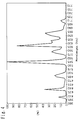
- Figure 4 shows the spectral distribution of the fluorescent lamp constructed by mixing the four phosphors, Sr 10 (PO 4 ) 6 Cl 2 : Eu 2+ , LaPO 4 : Ce 3+ ,Tb 3+ , Y 2 O 3 : Eu 3+ , and 3.5Mg0 ⁇ 0.5MgF 2 ⁇ GeO 2 : Mn 4+ , in proportions of about 2:21:46:31 by weight percent in this order.
- the visual clarity index M of the fluorescent lamp of Figure 4 is 133, and its lamp efficacy is about 72 lm/W.
- the distanve of chromaticity point is -0.0003 from the Planckian locus on the CIE 1960 uv chromaticity diagram.
- the visual clarity index M of an incandescent lamp at 3000 K is 122, and its lamp efficacy is about 12 lm/W.
- the fluorescent lamp of Figure 4 has a lamp efficacy about six times as high as that of the incandescent lamp, and a visual clarity index M higher than that of the incandescent lamp. This means that the warm white fluorescent lamp shown here can render colors, especially the red of flowers and the green of tree leaves, more beautiful and vivid than when the same colors are rendered under the incandescent lamp.
- incandescent lamps operate at around 2800 K.
- the fluorescent lamp of Figure 4 has a correlated color temperature of 3000 K and, therefore, its light looks somewhat whiter than incandescent lamp light of 2800 K.
- a correlated color temperature from 2700 K to 2900 K centered around 2800 K is thus considered optimum as a replacement for ordinary incandescent lamp light.
- One example of a fluorescent lamp constructed using four kinds of phosphors and having a correlated color temperature of 2800 K is shown below.
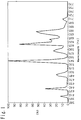
- Figure 1 shows the spectral distribution of the fluorescent lamp constructed by mixing the four phosphors, Sr 10 (PO 4 ) 6 Cl 2 : Eu 2+ , LaPO 4 : Ce 3+ ,Tb 3+ , Y 2 O 3 : Eu 3+ , and 3.5Mg0 ⁇ 0.5MgF 2 ⁇ GeO 2 : Mn 4+ , in proportions of about 2:22:38:38 by weight percent in this order.
- This fluorescent lamp corresponds to the fluorescent lamp No. 4 in Table 2.
- the visual clarity index M of the fluorescent lamp of Figure 1 is 144, and its lamp efficacy is about 66 lm/W.
- the distance of chromaticity point of its light color is 0.0004 from the Planckian locus on the CIE 1960 uv chromaticity diagram.
- the visual clarity index M of an incandescent lamp operating at 2800 K is 124, and its lamp efficacy is about 12 lm/W.
- the fluorescent lamp of Figure 1 has a lamp efficacy about 5.5 times as high as that of the incandescent lamp, and a visual clarity index M higher than that of the incandescent lamp. This means that the warm white fluorescent lamp shown here can render colors, especially the red of flowers and the green of tree leaves, more beautiful and vivid than when the same colors are rendered under the incandescent lamp.
- a third embodiment of the present invention is shown in Figure 6. This embodiment uses a deep red phosphor activated with cerium manganese as the deep red phosphor.
- Figure 6 shows the spectral distribution of a fluorescent lamp constructed by mixing three kinds of phosphors, BaMgAl 10 O 17 : Eu 2+ , LaPO 4 : Ce 3+ ,Tb 3+ , and GdMgB 5 O 10 : Ce 3+ ,Mn 2+ .
- the visual clarity index M is 145
- the color temperature is 2800 K
- the distance of chromaticity point of light color is 0 from the Planckian locus on the CIE 1960 uv chromaticity diagram.
- the fluorescent lamp of Figure 6 has a higher visual clarity index M than that of the incandescent lamp, which means that the warm white fluorescent lamp shown here can render colors, especially the red of flowers and the green of tree leaves, more beautiful and vivid than when the same colors are rendered under the incandescent lamp.
- phosphors producing light at 400 nm to 460 nm include Sr 2 P 2 O 7 : Eu 2+ , Sr 10 (PO 4 ) 6 Cl 2 : Eu 2+ , (Sr,Ca) 10 (PO 4 ) 6 Cl 2 : Eu 2+ , (Sr,Ca) 10 (PO 4 ) 6 Cl 2 ⁇ nB 2 O 3 : Eu 2+ , and BaMg 2 Al 16 O 27 : Eu 2+ ;
- phosphors producing light at 500 nm to 550 nm include LaPO 4 : Ce 3+ ,Tb 3+ , La 2 O 3 ⁇ 0.2SiO 2 ⁇ 0.9P 2 O 5 : Ce 3+ ,Tb 3+ , CeMgAl 11 O 19 : Tb 3+ , and GdMgB 5 O 10 : Ce
- a warm white fluorescent lamp having a color characteristic substantially equivalent to that of the incandescent lamp can also be produced if a phosphor having a peak emission at other wavelength is added in minute quantities, other than the blue phosphor having a peak emission at 400 nm to 460 nm, the green phosphor at 500 nm to 550 nm, the red phosphor at 600 nm to 620 nm, and the deep red phosphor at 625 nm to 670 nm.
- the above embodiments have each dealt with a warm white fluorescent lamp constructed with a 40 W straight tube, but it will be recognized that the fluorescent lamp of the present invention can be constructed at different lamp wattages and in different tube shapes.
- the fluorescent lamp light color becomes closer to the incandescent lamp color.
- the distance ⁇ u,v is kept within an acceptable range of plus or minus 0.005 relative to 0 in order to produce light color close to the incandescent lamp light color.
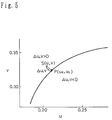
- the chromaticity distance ⁇ u,v is defined as distance SP between S(u,v) and P(u 0 ,v 0 ) on the CIE 1960 uv chromaticity diagram, where S(u,v) is the chromaticity point of the light color of the light source and P(u 0 ,v 0 ) is the point where a perpendicular dropped from the chromaticity point S to the Planckian locus intersects with the Planckian locus.
- the distance is positive ( ⁇ u,v > 0) when it is located in the upper left side (in the greenish light color side) of the Planckian locus, and negative ( ⁇ u,v ⁇ 0) when it is in the lower right side (in the reddish light color side).
- a warm white fluorescent lamp can be achieved that provides color appearance comparable to or better than the color appearance obtainable under the illumination with an incandescent lamp, and yet has high lamp efficacy compared with the incandescent lamp.
Landscapes
- Engineering & Computer Science (AREA)
- General Engineering & Computer Science (AREA)
- Vessels And Coating Films For Discharge Lamps (AREA)
- Luminescent Compositions (AREA)
Applications Claiming Priority (2)
| Application Number | Priority Date | Filing Date | Title |
|---|---|---|---|
| JP58925/97 | 1997-03-13 | ||
| JP5892597 | 1997-03-13 |
Publications (2)
| Publication Number | Publication Date |
|---|---|
| EP0865071A2 true EP0865071A2 (fr) | 1998-09-16 |
| EP0865071A3 EP0865071A3 (fr) | 1999-02-10 |
Family
ID=13098417
Family Applications (1)
| Application Number | Title | Priority Date | Filing Date |
|---|---|---|---|
| EP98104481A Withdrawn EP0865071A3 (fr) | 1997-03-13 | 1998-03-12 | Lampe fluorescente à lumière blanche chaude |
Country Status (6)
| Country | Link |
|---|---|
| US (1) | US6157126A (fr) |
| EP (1) | EP0865071A3 (fr) |
| KR (1) | KR19980080243A (fr) |
| CN (1) | CN1197910A (fr) |
| ID (1) | ID20044A (fr) |
| TW (1) | TW473604B (fr) |
Families Citing this family (15)
| Publication number | Priority date | Publication date | Assignee | Title |
|---|---|---|---|---|
| US6633110B2 (en) | 1994-03-22 | 2003-10-14 | Tailored Lighting Inc. | Underwater lamp |
| JP3424566B2 (ja) * | 1998-09-29 | 2003-07-07 | 松下電器産業株式会社 | 蛍光ランプおよび照明器具 |
| US6577073B2 (en) * | 2000-05-31 | 2003-06-10 | Matsushita Electric Industrial Co., Ltd. | Led lamp |
| US6525460B1 (en) * | 2000-08-30 | 2003-02-25 | General Electric Company | Very high color rendition fluorescent lamps |
| US20070052340A1 (en) * | 2003-09-29 | 2007-03-08 | Koninklijke Philips Electronics N.V. | Bakery fluorescent lamp |
| TWI306676B (en) | 2006-09-12 | 2009-02-21 | Univ Nat Chiao Tung | Highly saturated red-emitting mn(iv) activated phosphors and method of fabricating the same |
| US8247959B2 (en) * | 2007-10-17 | 2012-08-21 | General Electric Company | Solid state illumination system with improved color quality |
| US8994261B2 (en) * | 2007-10-17 | 2015-03-31 | General Electric Company | Enhanced color contrast light source |
| US8278814B2 (en) * | 2007-10-17 | 2012-10-02 | General Electric Company | Enhanced color contrast light source |
| JP4941370B2 (ja) * | 2008-03-18 | 2012-05-30 | 富士通株式会社 | 画像補正プログラム、画像補正装置および画像補正方法 |
| US7600882B1 (en) | 2009-01-20 | 2009-10-13 | Lednovation, Inc. | High efficiency incandescent bulb replacement lamp |
| JP5747023B2 (ja) * | 2010-03-18 | 2015-07-08 | 株式会社東芝 | 白色発光ランプおよびそれを用いた白色led照明装置 |
| US8754435B1 (en) | 2013-02-19 | 2014-06-17 | Cooledge Lighting Inc. | Engineered-phosphor LED package and related methods |
| US8933478B2 (en) | 2013-02-19 | 2015-01-13 | Cooledge Lighting Inc. | Engineered-phosphor LED packages and related methods |
| CN104103492A (zh) * | 2014-07-14 | 2014-10-15 | 苏州欧鹏光电科技有限公司 | 用于植物照明的无极荧光灯 |
Citations (2)
| Publication number | Priority date | Publication date | Assignee | Title |
|---|---|---|---|---|
| JPH04333919A (ja) | 1991-05-09 | 1992-11-20 | Sony Corp | ウインドウ表示位置制御装置およびウインドウ表示位置制御方法 |
| JPH06180248A (ja) | 1992-12-15 | 1994-06-28 | Matsushita Electric Ind Co Ltd | 演色性評価手法 |
Family Cites Families (32)
| Publication number | Priority date | Publication date | Assignee | Title |
|---|---|---|---|---|
| NL7502614A (nl) * | 1974-03-05 | 1975-09-09 | Thorn Electrical Ind Ltd | Luminescerend materiaal. |
| US4029983A (en) * | 1976-03-25 | 1977-06-14 | Westinghouse Electric Corporation | Metal-halide discharge lamp having a light output with incandescent characteristics |
| US4065688A (en) * | 1977-03-28 | 1977-12-27 | Westinghouse Electric Corporation | High-pressure mercury-vapor discharge lamp having a light output with incandescent characteristics |
| US4263530A (en) * | 1979-07-17 | 1981-04-21 | Westinghouse Electric Corp. | Warm white fluorescent lamp having good efficacy and color rendering |
| US4296353A (en) * | 1979-10-29 | 1981-10-20 | Gte Products Corporation | Fluorescent lamp having high color rendering index |
| US4305019A (en) * | 1979-12-31 | 1981-12-08 | Westinghouse Electric Corp. | Warm-white fluorescent lamp having good efficacy and color rendering and using special phosphor blend as separate undercoat |
| US4357559A (en) * | 1980-03-17 | 1982-11-02 | General Electric Company | Fluorescent lamp utilizing phosphor combination |
| JPS57128778A (en) * | 1981-02-02 | 1982-08-10 | Mitsubishi Electric Corp | Fluorescent lamp of high color-rendering property |
| NL8203040A (nl) * | 1982-07-30 | 1984-02-16 | Philips Nv | Lagedrukkwikdampontladingslamp. |
| JPS59226087A (ja) * | 1983-06-07 | 1984-12-19 | Toshiba Corp | 螢光ランプ |
| NL8502025A (nl) * | 1985-07-15 | 1987-02-02 | Philips Nv | Lagedrukkwikdampontladingslamp. |
| EP0239923B1 (fr) * | 1986-04-04 | 1995-01-25 | General Electric Company | Lampe fluorescente ayant un revêtement luminescent multicouche |
| JPH01186749A (ja) * | 1988-01-18 | 1989-07-26 | Matsushita Electron Corp | 高演色蛍光ランプ |
| JPH01186748A (ja) * | 1988-01-18 | 1989-07-26 | Matsushita Electron Corp | 高演色蛍光ランプ |
| JP2790673B2 (ja) * | 1989-09-20 | 1998-08-27 | 化成オプトニクス株式会社 | アルミン酸塩蛍光体 |
| JP2529476B2 (ja) * | 1991-03-05 | 1996-08-28 | 松下電器産業株式会社 | 照明装置 |
| EP0529098B1 (fr) * | 1991-03-14 | 1996-11-27 | Kasei Optonix, Ltd. | Tube cathodique couleur |
| JP2529477B2 (ja) * | 1991-03-20 | 1996-08-28 | 松下電器産業株式会社 | 屋内照明装置 |
| JPH0586364A (ja) * | 1991-09-27 | 1993-04-06 | Toshiba Lighting & Technol Corp | 蛍光ランプ |
| JPH0636746A (ja) * | 1992-07-21 | 1994-02-10 | Nec Home Electron Ltd | 蛍光ランプ |
| JPH0644947A (ja) * | 1992-07-27 | 1994-02-18 | Nec Home Electron Ltd | 蛍光ランプ |
| US5714836A (en) * | 1992-08-28 | 1998-02-03 | Gte Products Corporation | Fluorescent lamp with improved phosphor blend |
| DE69322607T2 (de) * | 1992-09-23 | 1999-06-17 | Koninklijke Philips Electronics N.V., Eindhoven | Quecksilberniederdruckentladungslampe |
| US5838101A (en) * | 1992-10-28 | 1998-11-17 | Gte Products Corporation | Fluorescent lamp with improved CRI and brightness |
| GB9310100D0 (en) * | 1993-05-17 | 1993-06-30 | Ge Lighting Ltd | Fluorescent lamp for use in aquaria |
| JPH0794146A (ja) * | 1993-09-24 | 1995-04-07 | Matsushita Electric Ind Co Ltd | 照明ランプ、照明器具およびそれらを備えた照明装置ならびに照明環境システム |
| JPH07105912A (ja) * | 1993-09-30 | 1995-04-21 | Toshiba Lighting & Technol Corp | 蛍光ランプ |
| JPH07258632A (ja) * | 1994-03-18 | 1995-10-09 | Toshiba Corp | 蛍光体およびそれを用いた蛍光ランプ |
| JP3575821B2 (ja) * | 1994-03-18 | 2004-10-13 | 株式会社東芝 | 蛍光体およびそれを用いた蛍光ランプ |
| US5418419A (en) * | 1994-03-22 | 1995-05-23 | Tailored Lighting Inc. | Lamp for producing a daylight spectrum |
| JP3040719B2 (ja) * | 1995-08-24 | 2000-05-15 | 松下電器産業株式会社 | 一般照明用放電ランプおよび一般照明用照明器具 |
| US5612590A (en) * | 1995-12-13 | 1997-03-18 | Philips Electronics North America Corporation | Electric lamp having fluorescent lamp colors containing a wide bandwidth emission red phosphor |
-
1998
- 1998-03-11 US US09/041,544 patent/US6157126A/en not_active Expired - Fee Related
- 1998-03-12 TW TW087103655A patent/TW473604B/zh not_active IP Right Cessation
- 1998-03-12 EP EP98104481A patent/EP0865071A3/fr not_active Withdrawn
- 1998-03-13 ID IDP980365A patent/ID20044A/id unknown
- 1998-03-13 KR KR1019980008495A patent/KR19980080243A/ko not_active Withdrawn
- 1998-03-13 CN CN98105468A patent/CN1197910A/zh active Pending
Patent Citations (2)
| Publication number | Priority date | Publication date | Assignee | Title |
|---|---|---|---|---|
| JPH04333919A (ja) | 1991-05-09 | 1992-11-20 | Sony Corp | ウインドウ表示位置制御装置およびウインドウ表示位置制御方法 |
| JPH06180248A (ja) | 1992-12-15 | 1994-06-28 | Matsushita Electric Ind Co Ltd | 演色性評価手法 |
Also Published As
| Publication number | Publication date |
|---|---|
| ID20044A (id) | 1998-09-17 |
| CN1197910A (zh) | 1998-11-04 |
| EP0865071A3 (fr) | 1999-02-10 |
| KR19980080243A (ko) | 1998-11-25 |
| US6157126A (en) | 2000-12-05 |
| TW473604B (en) | 2002-01-21 |
Similar Documents
| Publication | Publication Date | Title |
|---|---|---|
| EP0762474B1 (fr) | Lampe à décharge d'application générale et appareil d'éclairage d'application générale | |
| US6157126A (en) | Warm white fluorescent lamp | |
| JP3040719B2 (ja) | 一般照明用放電ランプおよび一般照明用照明器具 | |
| US8137586B2 (en) | Phosphor blend for a compact fluorescent lamp and lamp containing same | |
| EP0686997A2 (fr) | Lampe à décharge et dispositif d'éclairage pour un éclairage général | |
| US7098586B2 (en) | Method of evaluating whiteness, method of evaluating comparative whiteness, light source and luminaire | |
| JPWO1998036441A1 (ja) | 蛍光ランプとメタルハライドランプ | |
| KR20000042740A (ko) | 형광램프와 금속 할라이드 램프 | |
| EP0917182B1 (fr) | Lampe fluorescente | |
| JPH0855610A (ja) | 一般照明用放電ランプ及び一般照明用照明器具 | |
| JP3237562B2 (ja) | 蛍光ランプ | |
| JP3237533B2 (ja) | 一般照明用蛍光ランプ | |
| JPH1173923A (ja) | 照明ランプ | |
| JPWO1997011480A1 (ja) | 光 源 | |
| HK1010603A (en) | Warm white fluorescent lamp | |
| JPH10312775A (ja) | 電球色蛍光ランプ | |
| JP2004327329A (ja) | 蛍光ランプ及びそれを用いた照明器具 | |
| JP2001110360A (ja) | 蛍光ランプ | |
| WO2009036425A1 (fr) | Mélange luminophore pour une lampe fluorescente compacte et lampe le contenant | |
| JPH05190144A (ja) | 観賞用蛍光ランプ | |
| JPS5920958A (ja) | 「け」光ランプ | |
| JPH1055708A (ja) | 照明装置 | |
| JPWO1998040908A1 (ja) | 蛍光ランプ | |
| JPH0644947A (ja) | 蛍光ランプ | |
| JPS58121547A (ja) | けい光ランプ |
Legal Events
| Date | Code | Title | Description |
|---|---|---|---|
| PUAI | Public reference made under article 153(3) epc to a published international application that has entered the european phase |
Free format text: ORIGINAL CODE: 0009012 |
|
| AK | Designated contracting states |
Kind code of ref document: A2 Designated state(s): DE FR GB NL |
|
| AX | Request for extension of the european patent |
Free format text: AL;LT;LV;MK;RO;SI |
|
| PUAL | Search report despatched |
Free format text: ORIGINAL CODE: 0009013 |
|
| AK | Designated contracting states |
Kind code of ref document: A3 Designated state(s): AT BE CH DE DK ES FI FR GB GR IE IT LI LU MC NL PT SE |
|
| AX | Request for extension of the european patent |
Free format text: AL;LT;LV;MK;RO;SI |
|
| 17P | Request for examination filed |
Effective date: 19990308 |
|
| AKX | Designation fees paid |
Free format text: DE FR GB NL |
|
| 17Q | First examination report despatched |
Effective date: 20001228 |
|
| STAA | Information on the status of an ep patent application or granted ep patent |
Free format text: STATUS: THE APPLICATION IS DEEMED TO BE WITHDRAWN |
|
| 18D | Application deemed to be withdrawn |
Effective date: 20010508 |
|
| REG | Reference to a national code |
Ref country code: HK Ref legal event code: WD Ref document number: 1010603 Country of ref document: HK |