EP0872904A2 - Pile au nickel/hydrure de métal - Google Patents
Pile au nickel/hydrure de métal Download PDFInfo
- Publication number
- EP0872904A2 EP0872904A2 EP98106730A EP98106730A EP0872904A2 EP 0872904 A2 EP0872904 A2 EP 0872904A2 EP 98106730 A EP98106730 A EP 98106730A EP 98106730 A EP98106730 A EP 98106730A EP 0872904 A2 EP0872904 A2 EP 0872904A2
- Authority
- EP
- European Patent Office
- Prior art keywords
- nickel
- nickel hydroxide
- atomic
- hydroxide
- active material
- Prior art date
- Legal status (The legal status is an assumption and is not a legal conclusion. Google has not performed a legal analysis and makes no representation as to the accuracy of the status listed.)
- Granted
Links
Images
Classifications
-
- H—ELECTRICITY
- H01—ELECTRIC ELEMENTS
- H01M—PROCESSES OR MEANS, e.g. BATTERIES, FOR THE DIRECT CONVERSION OF CHEMICAL ENERGY INTO ELECTRICAL ENERGY
- H01M6/00—Primary cells; Manufacture thereof
- H01M6/04—Cells with aqueous electrolyte
- H01M6/045—Cells with aqueous electrolyte characterised by aqueous electrolyte
-
- H—ELECTRICITY
- H01—ELECTRIC ELEMENTS
- H01M—PROCESSES OR MEANS, e.g. BATTERIES, FOR THE DIRECT CONVERSION OF CHEMICAL ENERGY INTO ELECTRICAL ENERGY
- H01M10/00—Secondary cells; Manufacture thereof
- H01M10/34—Gastight accumulators
- H01M10/345—Gastight metal hydride accumulators
-
- H—ELECTRICITY
- H01—ELECTRIC ELEMENTS
- H01M—PROCESSES OR MEANS, e.g. BATTERIES, FOR THE DIRECT CONVERSION OF CHEMICAL ENERGY INTO ELECTRICAL ENERGY
- H01M4/00—Electrodes
- H01M4/02—Electrodes composed of, or comprising, active material
- H01M4/36—Selection of substances as active materials, active masses, active liquids
- H01M4/48—Selection of substances as active materials, active masses, active liquids of inorganic oxides or hydroxides
- H01M4/52—Selection of substances as active materials, active masses, active liquids of inorganic oxides or hydroxides of nickel, cobalt or iron
-
- Y—GENERAL TAGGING OF NEW TECHNOLOGICAL DEVELOPMENTS; GENERAL TAGGING OF CROSS-SECTIONAL TECHNOLOGIES SPANNING OVER SEVERAL SECTIONS OF THE IPC; TECHNICAL SUBJECTS COVERED BY FORMER USPC CROSS-REFERENCE ART COLLECTIONS [XRACs] AND DIGESTS
- Y02—TECHNOLOGIES OR APPLICATIONS FOR MITIGATION OR ADAPTATION AGAINST CLIMATE CHANGE
- Y02E—REDUCTION OF GREENHOUSE GAS [GHG] EMISSIONS, RELATED TO ENERGY GENERATION, TRANSMISSION OR DISTRIBUTION
- Y02E60/00—Enabling technologies; Technologies with a potential or indirect contribution to GHG emissions mitigation
- Y02E60/10—Energy storage using batteries
Definitions
- the present invention relates to a nickel/metal hydride storage battery which uses an improved nickel active material for positive electrode having an increased energy density and possesses improved characteristics of the positive electrode and hence improved characteristics of the battery.
- nickel hydroxide as the active material of the positive electrode is essentially subjected to reduction and oxidation, i.e., discharge and charge reactions, while essentially assuming ⁇ -phase.
- the discharge and charge reactions of nickel hydroxide are carried out at an average valence (average oxidation valence) of nickel of less than 3.5 and not less than 2.1.
- nickel/metal hydride storage batteries are secondary batteries comprising a positive electrode made of an active material composed mainly of nickel hydroxide and a negative electrode composed mainly of a hydrogen-absorbing alloy, and are being rapidly spread as secondary batteries having high capacity and reliability.
- Positive electrodes for alkaline storage batteries are roughly classified into sintered type and non-sintered type.
- the sintered type positive electrodes are produced by preparing a porous nickel sintered plaque with a porosity of about 80% by sintering nickel powder, impregnating the porous nickel sintered plaque with a nickel salt solution such as an aqueous nickel nitrate solution, and then forming a nickel hydroxide active material in the porous nickel sintered substrate, for example, by immersion in an aqueous alkali solution.
- the increase of the capacity of such electrodes is limited because the porosity of the plaque is difficult to increase further, so that the amount of the active material incorporated cannot be increased.
- non-sintered type positive electrodes is the electrode disclosed in USP 4,251,603 which is produced by filling nickel hydroxide as an active material in the pores of a sponge-like porous plaque with a porosity of more than 95% made of a nickel metal having a multiplicity of cells connected with each other three-dimensionally.
- This electrode is widely used at present as the positive electrode of an alkaline storage battery having a high capacity.
- spherical nickel particles be filled in the pores of the sponge-like nickel porous plaque in order to increase the capacity.
- the pore size of the sponge-like nickel porous plaque is approximately 200 - 500 ⁇ m and spherical nickel particles with a diameter of several micrometers to several ten micrometers are filled in the pores.
- an electroconductive agent is used in addition to the nickel hydroxide active material in order to increase the utilization of the nickel hydroxide filled, whereby spherical nickel hydroxide particles are electrically connected to form an electroconductive network.
- the electroconductive agent there are used cobalt compounds (e.g. cobalt hydroxide and cobalt monooxide), metallic cobalt, metallic nickel, etc.
- Nickel hydroxyde which has heretofore generally been known and are used as the active material of the non-sintered type positive electrode is one which is called active nickel hydroxide ( ⁇ -Ni(OH) 2 ) at discharged state.
- the average valence of the nickel is about 2.1.
- This active material becomes ⁇ -type nickel oxyhydroxide ( ⁇ -NiOOH) at charged state. In this case, the average valence of the nickel is said to be around 3.1.
- the utilization of nickel hydroxide becomes 100% in substantially one-electron reactions.
- the utilization is the percentage of an actually measured capacity value based on a theoretical capacity value per unit weight 289 mAh/g calculated by assuming the occurrence of the one-electron reactions. Consequently, when said active material is used, the energy density of the positive electrode becomes about 650 mAh/cc.
- ⁇ -NiOOH nickel hydroxide becomes ⁇ -type nickel oxyhydroxide ( ⁇ -NiOOH).
- the present invention solves the problems described above and is mainly intended to provide a nickel/metal hydride storage battery excellent in performance characteristics by improving nickel hydroxide itself as an active material for the positive electrode to increase the energy density of the active material and hence characteristics of the positive electrode.
- the nickel hydroxide as the main active material of the positive electrode used in the present invention contains as a solid solution at least one transition metal selected from the group consisting of Mn, Cr and Co, in a proportion of 2 to 20 atomic % based on the amount of the nickel hydroxide in terms of metallic nickel, and the crystal structure of the nickel hydroxide at charged state is a hexagonal or tetragonal system which has a diffraction peak of 2 ⁇ on (00l) plane of ⁇ -NiOOH at an angle of approximately 15° - 19° in X-ray diffraction using CuK ⁇ as a source and has a regular array with a NaCl type structure.
- the nickel hydroxide as the main active material of the positive electrode used in the present invention contains as a solid solution at least one transition metal selected from the group consisting of Mn, Cr and Co and at least one alkali metal selected from the group consisting of Li, Na, K, Rb and Cs, the proportion of the transition metal(s) being 2 to 20 atomic % based on the amount of the nickel hydroxide in terms of metallic nickel, and the proportion of the alkali metal(s) being 5 to 10 atomic % based on the amount of the nickel hydroxide in terms of metallic nickel, and the crystal structure of the nickel hydroxide at charged state is a hexagonal or tetragonal system which has a diffraction peak of 2 ⁇ on (00l) plane of ⁇ -NiOOH at an angle of approximately 15° - 19° in X-ray diffraction using CuK ⁇ as a source and has a regular array with a NaCl type structure.
- the nickel hydroxide as the main active material of the positive electrode used in the present invention contains as a solid solution at least one transition metal selected from the group consisting of Mn, Cr and Co and at least one alkaline earth metal selected from the group consisting of Mg, Ca, Sr and Ba, the proportion of the transition metal(s) being 2 to 20 atomic % based on the amount of the nickel hydroxide in terms of metallic nickel, and the proportion of the alkaline earth metal(s) being 5 to 10 atomic % based on the amount of the nickel hydroxide in terms of metallic nickel, and the crystal structure of the nickel hydroxide at charged state is a hexagonal or tetragonal system which has a diffraction peak of 2 ⁇ (00l) plane of ⁇ -NiOOH at an angle of approximately 15° - 19° in X-ray diffraction using CuK ⁇ as a source and has a regular array with a NaCl type structure.
- the nickel hydroxide as the main active material of the positive electrode used in the present invention contains as a solid solution at least one transition metal selected from the group consisting of Mn, Cr and Co, at least one alkali metal selected from the group consisting of Li, Na, K, Rb and Cs, and at least one alkaline earth metal selected from the group consisting of Mg, Ca, Sr and Ba, the proportion of the transition metal(s) being 2 to 20 atomic % based on the amount of the nickel hydroxide in terms of metallic nickel, and the total proportion of the alkali metal(s) and the alkaline earth metal(s) being 5 to 10 atomic % based on the amount of the nickel hydroxide in terms of metallic nickel, and the crystal structure of the nickel hydroxide at charged state is a hexagonal or tetragonal system which has a diffraction peak of 2 ⁇ on (00l) plane of ⁇ -NiOOH at an angle of approximately 15° - 19° in X-ray diffraction using CuK
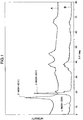
- Fig. 1 is a graph of X-ray diffraction curves showing the relationship between angle of diffraction 2 ⁇ and peak intensity.
- one aspect of the present invention is directed to a nickel/metal hydride storage battery comprising a positive electrode made of an active material composed mainly of nickel hydroxide, a negative electrode composed mainly of a hydrogen-absorbing alloy, an alkali electrolyte and a separator, wherein the nickel hydroxide as the main active material of said positive electrode contains as a solid solution at least one transition metal selected from the group consisting of Mn, Cr and Co, in a proportion of 2 to 20 atomic % based on the amount of the nickel hydroxide in terms of metallic nickel, and the crystal structure of the nickel hydroxide at charged state is a hexagonal or tetragonal system which has a diffraction peak of 2 ⁇ on (00l) plane of ⁇ -NiOOH at an angle of approximately 15° - 19° in X-ray diffraction using CuK ⁇ as a source and has a regular array with a NaCl type structure.
- the active material of the positive electrode which is composed of the nickel hydroxide has the crystal structure described above and becomes a ⁇ -phase hyperoxide called ⁇ -NiOOH in which the average nickel valence at charged state is as high as near 3.5 though less than 3.5, the number of reaction electrons is increased, the energy density of the active material is increased, and characteristics of the positive electrode can be improved.
- the crystal structure of the nickel hydroxide at charged state is a hexagonal or tetragonal system which has a diffraction peak of 2 ⁇ on (00l) plane of ⁇ -NiOOH at an angle of approximately 16° - 19° in X-ray diffraction using CuK ⁇ as a source and has a regular array with a NaCl type structure.
- the proportion of the transition metal(s) incorporated as a solid solution is suitably 2 to 20 atomic % based on the amount of the nickel hydroxide in terms of metallic nickel. If the proportion is less than 2 atomic %, the above-mentioned diffraction peak cannot be obtained because the proportion is not sufficient. If the proportion of the transition metal(s) is too high, the proportion of nickel hydroxide itself as an active material is decreased as much, so that the proportion of the active material incorporated into the positive electrode is decreased, resulting in a decreased capacity of the positive electrode.
- another aspect of the present invention is directed to a nickel/metal hydride storage battery comprising a positive electrode made of an active material composed mainly of nickel hydroxide, a negative electrode composed mainly of a hydrogen-absorbing alloy, an alkali electrolyte and a separator, wherein the nickel hydroxide as the main active material of said positive electrode contains as a solid solution at least one transition metal selected from the group consisting of Mn, Cr and Co and at least one alkali metal selected from the group consisting of Li, Na, K, Rb and Cs, the proportion of the transition metal(s) being 2 to 20 atomic % based on the amount of the nickel hydroxide in terms of metallic nickel, and the proportion of the alkali metal(s) being 5 to 10 atomic % based on the amount of the nickel hydroxide in terms of metallic nickel, and the crystal structure of the nickel hydroxide at charged state is a hexagonal or tetragonal system which has a diffraction peak of 2 ⁇ on (00l) plane
- a nickel/metal hydride storage battery comprising a positive electrode made of an active material composed mainly of nickel hydroxide, a negative electrode composed mainly of a hydrogen-absorbing alloy, an alkali electrolyte and a separator, wherein the nickel hydroxide as the main active material of said positive electrode contains as a solid solution at least one transition metal selected from the group consisting of Mn, Cr and Co and at least one alkaline earth metal selected from the group consisting of Mg, Ca, Sr and Ba, the proportion of the transition metal(s) being 2 to 20 atomic % based on the amount of the nickel hydroxide in terms of metallic nickel, and the proportion of the alkaline earth metal(s) being 5 to 10 atomic % based on the amount of the nickel hydroxide in terms of metallic nickel, and the crystal structure of the nickel hydroxide at charged state is a hexagonal or tetragonal system which has a diffraction peak of 2 ⁇ on (00l)
- still another aspect of the present invention is directed to a nickel/metal hydride storage battery comprising a positive electrode made of an active material composed mainly of nickel hydroxide, a negative electrode composed mainly of a hydrogen-absorbing alloy, an alkali electrolyte and a separator, wherein the nickel hydroxide as the main active material of said positive electrode contains as a solid solution at least one transition metal selected from the group consisting of Mn, Cr and Co, at least one alkali metal selected from the group consisting of Li, Na, K, Rb and Cs, and at least one alkaline earth metal selected from the group consisting of Mg, Ca, Sr and Ba, the proportion of the transition metal(s) being 2 to 20 atomic % based on the amount of the nickel hydroxide in terms of metallic nickel, and the total proportion of the alkali metal(s) and the alkaline earth metal(s) being 5 to 10 atomic % based on the amount of the nickel hydroxide in terms of metallic nickel, and the crystal structure of
- a positive electrode plate was prepared in the following manner. 0.5 Parts by weight of a polytetrafluoroethylene as a binder, 10 parts by weight of cobalt hydroxide as an electroconductive agent and a proper amount of water as a dispersion medium were added to 100 parts by weight of a material obtained by incorporating Mn as a solid solution into nickel hydroxide powder of spherical particles with an average diameter of 15 ⁇ m used as an active material, in a proportion of 18 atomic % based on the amount of the nickel hydroxide in terms of metallic nickel, to obtain paste. The paste was filled in pores of a sponge-like nickel porous plaque and dried, followed by rolling with a roller press.
- the dimensions of the positive electrode plate were adjusted as follows: width 35mm, length 120 mm and thickness 0.78 mm.
- the theoretical capacity of the positive electrode (calculated by taking the theoretical capacity of nickel hydroxide per unit weight as 289 mAh/g on the assumption that nickel hydroxide undergoes one-electron reaction) was 1,600 mAh.
- a negative electrode plate was prepared by adding 1 part by weight of carbon powder, 1 part by weight of a polytetrafluoroethylene and a proper amount of water to 100 parts by weight of AB 5 type hydrogen-absorbing alloy powder to obtain paste, and applying the paste on a punched metal, followed by drying and rolling.
- the dimensions of the negative electrode plate were adjusted as follows: width 35mm, length 145 mm and thickness 0.39 mm.
- the theoretical capacity of the negative electrode (calculated by taking the theoretical electrical quantity of the hydrogen-absorbing alloy per unit weight as 280 mAh/g) was 2,900 mAh.
- a separator made of polypropylene nonwoven fabric was held between the positive and negative electrode plates prepared above, and the whole of the resulting assembly was spirally wound to form a group of the plates, which were inserted into a battery case.
- a predetermined volume of an aqueous sodium hydroxide solution having a concentration of 10 mol/l was poured as an alkali electrolyte into the battery case, after which the battery case was sealed with a sheet capable of serving for a positive terminal, too.
- a nickel/metal hydride storage battery A of 4/5 A size having a nominal capacity of 1,600 mAh was produced.
- a battery B of Comparative Example there was used a battery having the same structure as above except that nickel hydroxide containing no Mn as a solid solution was used in place of the active material for positive electrode plate prepared above.
- Each of the batteries A and B was subjected twice to charge/discharge cycling consisting of charge at 160 mA for 15 hours, standing for 1 hour and discharge at 320 mA to a terminal voltage of 1V.
- the utilization of the active material of the positive electrode (the percentage of the actual discharge capacity based on the theoretical capacity of the positive electrode 289 mAh) was calculated to be 130% for the battery A and 100% for the battery B.
- each of the batteries A and B in charged state was disassembled, and the positive electrode plate was taken out and then analyzed by X-ray diffraction using CuK ⁇ as a source (wavelength ⁇ : 1.5405).
- the angle of diffraction 2 ⁇ was measured by the analysis.
- a diffraction peak of 2 ⁇ on (00l) plane of ⁇ -NiOOH could be confirmed at an angle of near 16° (15.9°) as shown in Fig. 1.
- the active material of the positive electrode assumed a state in which nickel had been highly oxidized, the nickel average valence was increased to about 3.5 though less than 3.5 since no peak due to ⁇ -NiOOH could be confirmed.
- the number of reaction electrons became larger than in the battery B, the energy density of the nickel hydroxide itself was increased, and hence the utilization of the active material of the positive electrode became 130% which was 30% higher than in the battery B. In addition, namely, no ⁇ -NiOOH was formed.
- Example 1 there was used the material obtained by incorporating Mn as a solid solution into the nickel hydroxide active material for the positive electrode in a proportion of 18 atomic % based on the amount of the nickel hydroxide in terms of metallic nickel, substantially the same effect as above could be obtained so long as the proportion of Mn was 2 to 20 atomic %.
- the most preferable range of the proportion of Mn was 8 to 20 atomic %.
- Mn was used as a metal to be incorporated as a solid solution into the nickel hydroxide active material for the positive electrode, substantially the same effect as in Example 1 could be obtained also by using either Cr or Co in place of Mn as a transition metal.
- the proportion of Cr or Co incorporated as a solid solution was preferably 5 to 20 atomic % or 15 to 20 atomic %, respectively, based on the amount of the nickel hydroxide active material in terms of metallic nickel.
- substantially the same effect as in Example 1 can be obtained not only by using, as described above, Mn, Cr or Co alone as a metal to be incorporated as a solid solution into the nickel hydroxide active material for the positive electrode, but also by using either a combination of Mn and Cr or a combination of Mn and Co.
- the proportions of the metals incorporated are preferably as follows: the proportions of Mn and Cr are 5 to 20 atomic % and 5 to 10 atomic %, respectively, based on the amount of the nickel hydroxide in terms of metallic nickel, or the proportions of Mn and Co are 5 to 20 atomic % and 2 to 5 atomic %, respectively, based on the amount of the nickel hydroxide in terms of metallic nickel.
- the concentration is not limited to 10 mol/l and ranges preferably from 8 to 12 mol/l.
- the alkali electrolyte is not limited thereto and substantially the same effect as in Example 1 could be obtained also by using, for example, any of an aqueous solution of potassium hydroxide alone, a mixed aqueous solution of sodium hydroxide and potassium hydroxide, and a mixed aqueous solution of at least one member selected from the group consisting of sodium hydroxide and potassium hydroxide and at least one member selected from the group consisting of lithium hydroxide, rubidium hydroxide and cesium hydroxide.
- a nickel/metal hydride storage battery C was produced in the same manner as in Example 1 except that as an active material for positive electrode plate, there was used 100 parts by weight of a material obtained by incorporating Mn and Na as a solid solution into nickel hydroxide powder of spherical particles with an average diameter of 15 ⁇ m in proportions of 18 atomic % and 8 atomic %, respectively, based on the amount of the nickel hydroxide in terms of metallic nickel.
- the utilization of the active material was determined in the same manner as in Example 1 and found to be 135% for the battery C and 100% for the battery B.
- each of the batteries C and B in charged state was disassembled, and the positive electrode plate was taken out and then analyzed by X-ray diffraction.
- the angle of diffraction 2 ⁇ was measured by the analysis.
- a diffraction peak of 2 ⁇ on (00l) plane of ⁇ -NiOOH could be confirmed at an angle of near 17° and no peak due to ⁇ -NiOOH could be confirmed.
- the diffraction peaks in the case of the positive electrode plate of the battery B were as described above.
- the active material of the positive electrode assumed a state in which nickel had been highly oxidized, the nickel average valence was increased to about 3.5 though less than 3.5, the number of reaction electrons became larger than in the battery B, the energy density of the nickel hydroxide itself was increased, and hence the utilization of the active material of the positive electrode became 135% which was 35% higher than in the battery B.
- Example 2 there was used the material obtained by incorporating Mn and Na as a solid solution into the nickel hydroxide active material for the positive electrode in proportions of 18 atomic % and 8 atomic %, respectively, based on the amount of the nickel hydroxide in terms of metallic nickel, substantially the same effect as above could be obtained so long as the proportions of Mn and Na are 2 to 20 atomic % and 5 to 10 atomic %, respectively.
- Preferable ranges of the proportions of Mn and Na were 5 to 20 atomic % and 5 to 10 atomic %, respectively.
- Example 2 the transition metal Mn and the alkali metal Na were used as metals to be incorporated as a solid solution into the nickel hydroxide active material for the positive electrode, substantially the same effect as in Example 2 could be obtained also by using either Cr or Co in place of Mn as a transition metal and any of Li, K, Rb and Cs in place of Na as an alkali metal.
- the proportion of the transition metal Cr or Co incorporated as a solid solution was preferably 8 to 20 atomic % based on the amount of the nickel hydroxide active material in terms of metallic nickel, and the proportion of the alkali metal Li, K, Rb or Cs incorporated as a solid solution, based on the amount of the nickel hydroxide active material in terms of metallic nickel was preferably as follows: Li 5 to 10 atomic %, K 6 to 10 atomic %, Rb 6 to 10 atomic %, or Cs 5 to 10 atomic %.
- substantially the same effect as above can be obtained not only by using a combination of a single transition metal and a single alkali metal as described above, as metals to be incorporated as a solid solution into the nickel hydroxide active material for the positive electrode, but also by using a combination of two or more transition metals (one of them being used as a main metal) selected from the group consisting of Mn, Cr and Co and a combination of two or more alkali metals selected from the group consisting of Li, Na, K, Rb and Cs, as metals to be incorporated as a solid solution into the nickel hydroxide active material for the positive electrode.
- the total proportion of the transition metals incorporated and the total proportion of the alkali metals incorporated are preferably 8 to 20 atomic % and 5 to 10 atomic %, respectively, based on the amount of the nickel hydroxide in terms of metallic nickel.
- the concentration is not limited to 10 mol/l and ranges preferably from 8 to 12 mol/l. Properties other than the concentration of the alkali electrolyte may be the same as in Example 1, and such an alkali electrolyte brings about substantially the same effect as in Example 1.
- a nickel/metal hydride storage battery D was produced in the same manner as in Example 1 except that as an active material for positive electrode plate, there was used 100 parts by weight of a material obtained by incorporating Mn and Ca as a solid solution into nickel hydroxide powder of spherical particles with an average diameter of 15 ⁇ m in proportions of 18 atomic % and 8 atomic %, respectively, based on the amount of the nickel hydroxide in terms of metallic nickel.
- the utilization of the active material was determined in the same manner as in Example 1 and found to be 133% for the battery D and 100% for the battery B.
- each of the batteries D and B in charged state was disassembled, and the positive electrode plate was taken out and then analyzed by X-ray diffraction.
- the angle of diffraction 2 ⁇ was measured by the analysis.
- a diffraction peak of 2 ⁇ on (00l) plane of ⁇ -NiOOH could be confirmed at an angle of near 17° and no peak due to ⁇ -NiOOH could be confirmed.
- the diffraction peaks in the case of the positive electrode plate of the battery B were as described above.
- the active material of the positive electrode assumed a state in which nickel had been highly oxidized, the nickel average valence was increased to about 3.5 though less than 3.5, the number of reaction electrons became larger than in the battery B, the energy density of the nickel hydroxide itself was increased, and hence the utilization of the active material of the positive electrode became 133% which was 33% higher than in the battery B.
- Example 3 there was used the material obtained by incorporating Mn and Ca as a solid solution into the nickel hydroxide active material for the positive electrode in proportions of 18 atomic % and 8 atomic %, respectively, based on the amount of the nickel hydroxide in terms of metallic nickel, substantially the same effect as above could be obtained so long as the proportions of Mn and Ca are 2 to 20 atomic % and 5 to 10 atomic %, respectively.
- Preferable ranges of the proportions of Mn and Ca were 5 to 20 atomic % and 5 to 10 atomic %, respectively.
- Example 3 the transition metal Mn and the alkaline earth metal Ca were used as metals to be incorporated as a solid solution into the nickel hydroxide active material for the positive electrode, substantially the same effect as in Example 3 could be obtained also by using either Cr or Co in place of Mn as a transition metal and any of Mg, Sr and Ba in place of Ca as an alkaline earth metal.
- the proportion of the transition metal Cr or Co incorporated as a solid solution was preferably 2 to 10 atomic % based on the amount of the nickel hydroxide active material in terms of metallic nickel, and the proportion of the alkaline earth metal Mg, Sr or Ba incorporated as a solid solution, based on the amount of the nickel hydroxide active material in terms of metallic nickel was preferably as follows: Mg 5 to 10 atomic %, Sr 6 to 10 atomic %, or Ba 6 to 10 atomic %.
- substantially the same effect as in Example 3 can be obtained not only by using a combination of a single transition metal and a single alkaline earth metal as described above, as metals to be incorporated as a solid solution into the nickel hydroxide active material for the positive electrode, but also by using a combination of two or more transition metals (one of them being used as a main metal) and a combination of two or more alkaline earth metals, as metals to be incorporated as a solid solution into the nickel hydroxide active material for the positive electrode.
- the total proportion of the transition metals incorporated and the total proportion of the alkaline earth metals incorporated are preferably 2 to 20 atomic % and 5 to 10 atomic %, respectively, based on the amount of the nickel hydroxide in terms of metallic nickel.
- a nickel/metal hydride storage battery E was produced in the same manner as in Example 1 except that as an active material for positive electrode plate, there was used 100 parts by weight of a material obtained by incorporating three metals Mn, Na and Ca as a solid solution into nickel hydroxide powder of spherical particles with an average diameter of 15 ⁇ m in proportions of 18 atomic %, 6 atomic % and 4 atomic % (the total proportion of Na and Ca being 10 atomic %), respectively, based on the amount of the nickel hydroxide in terms of metallic nickel.
- the utilization of the active material was determined in the same manner as in Example 1 and found to be 133% for the battery E and 100% for the battery B.
- the battery E in charged state was disassembled, and the positive electrode plate was taken out and then analyzed by X-ray diffraction.
- the angle of diffraction 28 was measured by the analysis.
- a diffraction peak of 2 ⁇ on (00l) plane of ⁇ -NiOOH could be confirmed at an angle of near 17° and no peak due to ⁇ -NiOOH could be confirmed.
- the diffraction peaks in the case of the positive electrode plate of the battery B were as described above.
- the active material of the positive electrode assumed a state in which nickel had been highly oxidized, the nickel average valence was increased to about 3.5 though less than 3.5, the number of reaction electrons became larger than in the battery B, the energy density of the nickel hydroxide itself was increased, and hence the utilization of the active material of the positive electrode became 133% which was 33% higher than in the battery B.
- Example 4 there was used the material obtained by incorporating Mn, Na and Ca as a solid solution into the nickel hydroxide active material for the positive electrode in proportions of 18 atomic %, 6 atomic % and 4 atomic %, respectively, based on the amount of the nickel hydroxide in terms of metallic nickel, substantially the same effect as above could be obtained so long as the proportions of Mn, Na and Ca are 2 to 20 atomic %, 2 to 6 atomic % and 2 to 6 atomic %, respectively, and the total proportion of Na and Ca is 5 to 10 atomic %.
- a preferable range of the proportion of Mn was 5 to 20 atomic %.
- the proportion of each of Na and Ca was important, the control of the total proportion of Na and Ca was more important.
- Example 4 the transition metal Mn, the alkali metal Na and the alkaline earth metal Ca were used as metals to be incorporated as a solid solution into the nickel hydroxide active material for the positive electrode, substantially the same effect as above could be obtained also by using either Cr or Co in place of Mn as a transition metal, any of Li, K, Rb and Cs in place of Na as an alkali metal, and any of Mg, Sr and Ba in place of Ca as an alkaline earth metal.
- the proportions of these metals incorporated as a solid solution, based on the amount of the nickel hydroxide active material in terms of metallic nickel were preferably as follows: the proportion of the transition metal Cr or Co was 8 to 20 atomic %, and both of the proportions of the alkali metal and the alkaline earth metal were 2 to 6 atomic % when a single metal was used as each of them, the total proportion of the alkali metal and the alkaline earth metal being 5 to 10 atomic %.
- substantially the same effect as in Example 4 can be obtained not only by using a combination of three metals, i.e., a single transition metal, a single alkali metal and a single alkaline earth metal as described above, as metals to be incorporated as a solid solution into the nickel hydroxide, but also by using a combination of four or more metals in all, for example, a combination of a transition metal Mn, two or more members selected from one of the families of the alkali metals and the alkaline earth metals, and one or more members selected from the other family, as metals to be incorporated as a solid solution into the nickel hydroxide.
- a combination of three metals i.e., a single transition metal, a single alkali metal and a single alkaline earth metal as described above, as metals to be incorporated as a solid solution into the nickel hydroxide, but also by using a combination of four or more metals in all, for example, a combination of a transition metal Mn, two or more members
- the proportion of the transition metal incorporated and the total proportion of the alkali metal(s) and the alkaline earth metal(s) incorporated should be 2 to 20 atomic % and 5 to 10 atomic %, respectively, based on the amount of the nickel hydroxide in terms of metallic nickel.
- nickel hydroxide as the main active material of the positive electrode should necessarily contain at least one transition metal selected from the group consisting of Mn, Cr and Co.
- the crystal structure of the nickel hydroxide is a hexagonal or tetragonal system which has a diffraction peak of 2 ⁇ on (00l) plane of ⁇ -NiOOH at an angle of approximately 15° - 19°, preferably 16° - 19°, more preferably 16° - 17°, and preferably no peak on (003) plane of ⁇ -NiOOH at an angle of near 12°, in X-ray diffraction using CuK ⁇ as a source and has a regular array with a NaCl type structure. Therefore, at charged state, the nickel average valence is as high as about 3.5 though less than 3.5, the number of reaction electrons is increased, the energy density of the active material is increased, and characteristics of the positive electrode can be improved.
Landscapes
- Chemical & Material Sciences (AREA)
- Chemical Kinetics & Catalysis (AREA)
- Electrochemistry (AREA)
- General Chemical & Material Sciences (AREA)
- Engineering & Computer Science (AREA)
- Manufacturing & Machinery (AREA)
- Inorganic Chemistry (AREA)
- Battery Electrode And Active Subsutance (AREA)
Applications Claiming Priority (12)
| Application Number | Priority Date | Filing Date | Title |
|---|---|---|---|
| JP9095482A JPH10289716A (ja) | 1997-04-14 | 1997-04-14 | ニッケル−水素蓄電池 |
| JP09548197A JP3436059B2 (ja) | 1997-04-14 | 1997-04-14 | ニッケル−水素蓄電池 |
| JP95481/97 | 1997-04-14 | ||
| JP95482/97 | 1997-04-14 | ||
| JP95480/97 | 1997-04-14 | ||
| JP9548097 | 1997-04-14 | ||
| JP9095480A JPH10289714A (ja) | 1997-04-14 | 1997-04-14 | ニッケル−水素蓄電池 |
| JP9548197 | 1997-04-14 | ||
| JP09548397A JP3436060B2 (ja) | 1997-04-14 | 1997-04-14 | ニッケル−水素蓄電池 |
| JP9548397 | 1997-04-14 | ||
| JP95483/97 | 1997-04-14 | ||
| JP9548297 | 1997-04-14 |
Publications (3)
| Publication Number | Publication Date |
|---|---|
| EP0872904A2 true EP0872904A2 (fr) | 1998-10-21 |
| EP0872904A3 EP0872904A3 (fr) | 2005-09-28 |
| EP0872904B1 EP0872904B1 (fr) | 2007-02-21 |
Family
ID=27468327
Family Applications (1)
| Application Number | Title | Priority Date | Filing Date |
|---|---|---|---|
| EP98106730A Expired - Lifetime EP0872904B1 (fr) | 1997-04-14 | 1998-04-14 | Pile au nickel/hydrure de métal |
Country Status (3)
| Country | Link |
|---|---|
| US (1) | US6074785A (fr) |
| EP (1) | EP0872904B1 (fr) |
| DE (1) | DE69837121T2 (fr) |
Cited By (7)
| Publication number | Priority date | Publication date | Assignee | Title |
|---|---|---|---|---|
| US6576205B2 (en) | 2001-09-04 | 2003-06-10 | Inco Limited | Method for reducing the crystallinity of nickel hydroxide powders |
| EP2000438A2 (fr) | 2000-04-21 | 2008-12-10 | Sony Corporation | Matériau d'électrode positive et batterie au zinc-nickel |
| CN100449848C (zh) * | 2000-06-16 | 2009-01-07 | 佳能株式会社 | 镍系列可再充电电池及其制备方法 |
| EP1681737A4 (fr) * | 2003-08-06 | 2010-08-25 | Panasonic Corp | Accumulateur alcalin |
| WO2016077303A1 (fr) * | 2014-11-13 | 2016-05-19 | Basf Corporation | Électrolytes et batteries à hydrure métallique |
| US10243240B2 (en) | 2014-11-13 | 2019-03-26 | Basf Corporation | Electrolytes and metal hydride batteries |
| US10547046B2 (en) | 2011-11-30 | 2020-01-28 | Lawrence Livermore National Security, Llc | High energy/power density nickel oxide/hydroxide materials and nickel cobalt oxide/hydroxide materials and production thereof |
Families Citing this family (6)
| Publication number | Priority date | Publication date | Assignee | Title |
|---|---|---|---|---|
| JP4252641B2 (ja) * | 1998-06-15 | 2009-04-08 | パナソニック株式会社 | アルカリ蓄電池用正極および正極活物質 |
| JP2001101926A (ja) * | 1999-09-30 | 2001-04-13 | Murata Mfg Co Ltd | 導電性ペースト、ならびに積層セラミックコンデンサおよびその製造方法 |
| JP4809592B2 (ja) * | 2004-06-02 | 2011-11-09 | 株式会社豊田中央研究所 | アルカリ電池用の正極活物質の製造方法 |
| JP2007103111A (ja) * | 2005-10-03 | 2007-04-19 | Matsushita Electric Ind Co Ltd | アルカリ一次電池およびオキシ水酸化ニッケルの製造方法 |
| JP4162096B2 (ja) * | 2006-05-12 | 2008-10-08 | 松下電器産業株式会社 | 蓄電デバイス |
| US10333177B2 (en) | 2014-11-13 | 2019-06-25 | Basf Corporation | Electrolytes and metal hydride batteries |
Family Cites Families (12)
| Publication number | Priority date | Publication date | Assignee | Title |
|---|---|---|---|---|
| US4251603A (en) * | 1980-02-13 | 1981-02-17 | Matsushita Electric Industrial Co., Ltd. | Battery electrode |
| US5366831A (en) * | 1991-06-14 | 1994-11-22 | Yuasa Corporation | Nickel electrode for alkaline battery |
| JPH06318455A (ja) * | 1991-09-13 | 1994-11-15 | Yuasa Corp | ニッケル−水素電池 |
| JP3239410B2 (ja) * | 1991-12-28 | 2001-12-17 | 株式会社ユアサコーポレーション | アルカリ蓄電池用ニッケル電極とこれを用いたアルカリ蓄電池 |
| JP3438142B2 (ja) * | 1992-09-18 | 2003-08-18 | 松下電器産業株式会社 | 中・大容量密閉式金属酸化物・水素蓄電池 |
| US5348822A (en) * | 1992-11-12 | 1994-09-20 | Ovonic Battery Company, Inc. | Chemically and compositionally modified solid solution disordered multiphase nickel hydroxide positive electrode for alkaline rechargeable electrochemical cells |
| US5506076A (en) * | 1993-06-30 | 1996-04-09 | Toshiba Battery Co., Ltd. | Alkali secondary battery |
| JPH08130010A (ja) * | 1994-10-28 | 1996-05-21 | Furukawa Battery Co Ltd:The | ニッケル・水素二次電池用ニッケル極の製造方法 |
| JP3338226B2 (ja) * | 1995-02-24 | 2002-10-28 | 三洋電機株式会社 | アルカリ蓄電池用非焼結式ニッケル極 |
| JPH0917429A (ja) * | 1995-06-29 | 1997-01-17 | Sumitomo Metal Mining Co Ltd | アルカリ蓄電池の非焼結式ニッケル正極用水酸化ニッケル |
| DE69626495T2 (de) * | 1995-11-22 | 2003-12-24 | Matsushita Electric Industrial Co., Ltd. | Elektrode mit aktivem material für positive platte eines akkus |
| JPH09237630A (ja) * | 1996-02-29 | 1997-09-09 | Matsushita Electric Ind Co Ltd | アルカリ蓄電池用活物質および正極 |
-
1998
- 1998-04-10 US US09/058,227 patent/US6074785A/en not_active Expired - Lifetime
- 1998-04-14 DE DE69837121T patent/DE69837121T2/de not_active Expired - Lifetime
- 1998-04-14 EP EP98106730A patent/EP0872904B1/fr not_active Expired - Lifetime
Cited By (8)
| Publication number | Priority date | Publication date | Assignee | Title |
|---|---|---|---|---|
| EP2000438A2 (fr) | 2000-04-21 | 2008-12-10 | Sony Corporation | Matériau d'électrode positive et batterie au zinc-nickel |
| EP2000438A3 (fr) * | 2000-04-21 | 2012-10-17 | Sony Corporation | Matériau d'électrode positive et batterie au zinc-nickel |
| CN100449848C (zh) * | 2000-06-16 | 2009-01-07 | 佳能株式会社 | 镍系列可再充电电池及其制备方法 |
| US6576205B2 (en) | 2001-09-04 | 2003-06-10 | Inco Limited | Method for reducing the crystallinity of nickel hydroxide powders |
| EP1681737A4 (fr) * | 2003-08-06 | 2010-08-25 | Panasonic Corp | Accumulateur alcalin |
| US10547046B2 (en) | 2011-11-30 | 2020-01-28 | Lawrence Livermore National Security, Llc | High energy/power density nickel oxide/hydroxide materials and nickel cobalt oxide/hydroxide materials and production thereof |
| WO2016077303A1 (fr) * | 2014-11-13 | 2016-05-19 | Basf Corporation | Électrolytes et batteries à hydrure métallique |
| US10243240B2 (en) | 2014-11-13 | 2019-03-26 | Basf Corporation | Electrolytes and metal hydride batteries |
Also Published As
| Publication number | Publication date |
|---|---|
| US6074785A (en) | 2000-06-13 |
| DE69837121D1 (de) | 2007-04-05 |
| DE69837121T2 (de) | 2007-05-31 |
| EP0872904B1 (fr) | 2007-02-21 |
| EP0872904A3 (fr) | 2005-09-28 |
Similar Documents
| Publication | Publication Date | Title |
|---|---|---|
| US5585142A (en) | Method for preparing conductive electrochemically active material | |
| EP0523284B1 (fr) | Poudre matière active d'hydroxide de nickel et électrode positive de nickel et pile de stockage alcaline les utilisant | |
| EP0869565B1 (fr) | Pile alcaline | |
| US5965295A (en) | Alkaline secondary battery, paste type positive electrode for alkaline secondary battery, method for manufacturing alkaline secondary battery | |
| EP0817291B1 (fr) | Electrode non-frittée de nickel pour pile alcaline, pile alcaline l'utilisant et méthode de fabrication d'une telle électrode | |
| US7201857B2 (en) | Performance enhancing additive material for the nickel hydroxide positive electrode in rechargeable alkaline cells | |
| EP0544011A1 (fr) | Electrode au nickel pour piles alcalines | |
| US20040209166A1 (en) | Nickel hydrogen secondary battery | |
| EP0872904B1 (fr) | Pile au nickel/hydrure de métal | |
| EP1176649A1 (fr) | Accumulateur secondaire alcalin avec une électrode positive au nickel améliorée et procédure pour son activation | |
| EP1624508B1 (fr) | Accumulateur au nickel-hydrogene | |
| US5989746A (en) | Pasted nickel electrode | |
| EP1137087B1 (fr) | Accumulateur alcalin et électrode positive pour accumulateur alcalin | |
| US7172710B2 (en) | Performance enhancing additive material for the nickel hydroxide positive electrode in rechargeable alkaline cells | |
| EP0886331A1 (fr) | Electrode de nickel non-frittée pour accumulateur alcalin | |
| EP0798801B1 (fr) | Cellule au nickel-hydrure métallique ayant une grande capacité et un caractéristique de cycle excellente et sa méthode de fabrication | |
| JP3436060B2 (ja) | ニッケル−水素蓄電池 | |
| JPH10289714A (ja) | ニッケル−水素蓄電池 | |
| JP4061048B2 (ja) | アルカリ蓄電池用正極およびそれを用いたアルカリ蓄電池 | |
| JP3436059B2 (ja) | ニッケル−水素蓄電池 | |
| JPH0714578A (ja) | アルカリ蓄電池用ニッケル正極および密閉型ニッケル−水素蓄電池 | |
| CA2173330C (fr) | Accumulateur electrochimique bipolaire forme par l'empilage d'elements a plaques | |
| JPH10289716A (ja) | ニッケル−水素蓄電池 | |
| JPH0582127A (ja) | 密閉形ニツケル−金属水素化物蓄電池 | |
| JPH0517659B2 (fr) |
Legal Events
| Date | Code | Title | Description |
|---|---|---|---|
| PUAI | Public reference made under article 153(3) epc to a published international application that has entered the european phase |
Free format text: ORIGINAL CODE: 0009012 |
|
| 17P | Request for examination filed |
Effective date: 19980414 |
|
| AK | Designated contracting states |
Kind code of ref document: A2 Designated state(s): AT BE CH CY DE DK ES FI FR GB GR IE IT LI LU MC NL PT SE |
|
| AX | Request for extension of the european patent |
Free format text: AL;LT;LV;MK;RO;SI |
|
| PUAL | Search report despatched |
Free format text: ORIGINAL CODE: 0009013 |
|
| AK | Designated contracting states |
Kind code of ref document: A3 Designated state(s): AT BE CH CY DE DK ES FI FR GB GR IE IT LI LU MC NL PT SE |
|
| AX | Request for extension of the european patent |
Extension state: AL LT LV MK RO SI |
|
| AKX | Designation fees paid |
Designated state(s): DE FR GB |
|
| GRAP | Despatch of communication of intention to grant a patent |
Free format text: ORIGINAL CODE: EPIDOSNIGR1 |
|
| GRAS | Grant fee paid |
Free format text: ORIGINAL CODE: EPIDOSNIGR3 |
|
| GRAA | (expected) grant |
Free format text: ORIGINAL CODE: 0009210 |
|
| AK | Designated contracting states |
Kind code of ref document: B1 Designated state(s): DE FR GB |
|
| REG | Reference to a national code |
Ref country code: GB Ref legal event code: FG4D |
|
| REF | Corresponds to: |
Ref document number: 69837121 Country of ref document: DE Date of ref document: 20070405 Kind code of ref document: P |
|
| ET | Fr: translation filed | ||
| PLBE | No opposition filed within time limit |
Free format text: ORIGINAL CODE: 0009261 |
|
| STAA | Information on the status of an ep patent application or granted ep patent |
Free format text: STATUS: NO OPPOSITION FILED WITHIN TIME LIMIT |
|
| 26N | No opposition filed |
Effective date: 20071122 |
|
| REG | Reference to a national code |
Ref country code: FR Ref legal event code: PLFP Year of fee payment: 19 |
|
| REG | Reference to a national code |
Ref country code: FR Ref legal event code: PLFP Year of fee payment: 20 |
|
| PGFP | Annual fee paid to national office [announced via postgrant information from national office to epo] |
Ref country code: FR Payment date: 20170313 Year of fee payment: 20 |
|
| PGFP | Annual fee paid to national office [announced via postgrant information from national office to epo] |
Ref country code: GB Payment date: 20170412 Year of fee payment: 20 Ref country code: DE Payment date: 20170411 Year of fee payment: 20 |
|
| REG | Reference to a national code |
Ref country code: DE Ref legal event code: R071 Ref document number: 69837121 Country of ref document: DE |
|
| REG | Reference to a national code |
Ref country code: GB Ref legal event code: PE20 Expiry date: 20180413 |
|
| PG25 | Lapsed in a contracting state [announced via postgrant information from national office to epo] |
Ref country code: GB Free format text: LAPSE BECAUSE OF EXPIRATION OF PROTECTION Effective date: 20180413 |