EP0873844A2 - Procédé pour la préparation d'une composition polyestère - Google Patents
Procédé pour la préparation d'une composition polyestère Download PDFInfo
- Publication number
- EP0873844A2 EP0873844A2 EP98107167A EP98107167A EP0873844A2 EP 0873844 A2 EP0873844 A2 EP 0873844A2 EP 98107167 A EP98107167 A EP 98107167A EP 98107167 A EP98107167 A EP 98107167A EP 0873844 A2 EP0873844 A2 EP 0873844A2
- Authority
- EP
- European Patent Office
- Prior art keywords
- polyester
- metal salt
- screw extruder
- pulverizer
- single screw
- Prior art date
- Legal status (The legal status is an assumption and is not a legal conclusion. Google has not performed a legal analysis and makes no representation as to the accuracy of the status listed.)
- Granted
Links
Images


Classifications
-
- B—PERFORMING OPERATIONS; TRANSPORTING
- B29—WORKING OF PLASTICS; WORKING OF SUBSTANCES IN A PLASTIC STATE IN GENERAL
- B29C—SHAPING OR JOINING OF PLASTICS; SHAPING OF MATERIAL IN A PLASTIC STATE, NOT OTHERWISE PROVIDED FOR; AFTER-TREATMENT OF THE SHAPED PRODUCTS, e.g. REPAIRING
- B29C48/00—Extrusion moulding, i.e. expressing the moulding material through a die or nozzle which imparts the desired form; Apparatus therefor
- B29C48/25—Component parts, details or accessories; Auxiliary operations
- B29C48/36—Means for plasticising or homogenising the moulding material or forcing it through the nozzle or die
- B29C48/50—Details of extruders
- B29C48/76—Venting, drying means; Degassing means
- B29C48/765—Venting, drying means; Degassing means in the extruder apparatus
- B29C48/766—Venting, drying means; Degassing means in the extruder apparatus in screw extruders
-
- B—PERFORMING OPERATIONS; TRANSPORTING
- B29—WORKING OF PLASTICS; WORKING OF SUBSTANCES IN A PLASTIC STATE IN GENERAL
- B29B—PREPARATION OR PRETREATMENT OF THE MATERIAL TO BE SHAPED; MAKING GRANULES OR PREFORMS; RECOVERY OF PLASTICS OR OTHER CONSTITUENTS OF WASTE MATERIAL CONTAINING PLASTICS
- B29B11/00—Making preforms
-
- B—PERFORMING OPERATIONS; TRANSPORTING
- B29—WORKING OF PLASTICS; WORKING OF SUBSTANCES IN A PLASTIC STATE IN GENERAL
- B29B—PREPARATION OR PRETREATMENT OF THE MATERIAL TO BE SHAPED; MAKING GRANULES OR PREFORMS; RECOVERY OF PLASTICS OR OTHER CONSTITUENTS OF WASTE MATERIAL CONTAINING PLASTICS
- B29B7/00—Mixing; Kneading
- B29B7/30—Mixing; Kneading continuous, with mechanical mixing or kneading devices
- B29B7/34—Mixing; Kneading continuous, with mechanical mixing or kneading devices with movable mixing or kneading devices
- B29B7/38—Mixing; Kneading continuous, with mechanical mixing or kneading devices with movable mixing or kneading devices rotary
-
- B—PERFORMING OPERATIONS; TRANSPORTING
- B29—WORKING OF PLASTICS; WORKING OF SUBSTANCES IN A PLASTIC STATE IN GENERAL
- B29B—PREPARATION OR PRETREATMENT OF THE MATERIAL TO BE SHAPED; MAKING GRANULES OR PREFORMS; RECOVERY OF PLASTICS OR OTHER CONSTITUENTS OF WASTE MATERIAL CONTAINING PLASTICS
- B29B9/00—Making granules
- B29B9/02—Making granules by dividing preformed material
- B29B9/06—Making granules by dividing preformed material in the form of filamentary material, e.g. combined with extrusion
-
- B—PERFORMING OPERATIONS; TRANSPORTING
- B29—WORKING OF PLASTICS; WORKING OF SUBSTANCES IN A PLASTIC STATE IN GENERAL
- B29C—SHAPING OR JOINING OF PLASTICS; SHAPING OF MATERIAL IN A PLASTIC STATE, NOT OTHERWISE PROVIDED FOR; AFTER-TREATMENT OF THE SHAPED PRODUCTS, e.g. REPAIRING
- B29C48/00—Extrusion moulding, i.e. expressing the moulding material through a die or nozzle which imparts the desired form; Apparatus therefor
- B29C48/03—Extrusion moulding, i.e. expressing the moulding material through a die or nozzle which imparts the desired form; Apparatus therefor characterised by the shape of the extruded material at extrusion
- B29C48/05—Filamentary, e.g. strands
-
- B—PERFORMING OPERATIONS; TRANSPORTING
- B29—WORKING OF PLASTICS; WORKING OF SUBSTANCES IN A PLASTIC STATE IN GENERAL
- B29C—SHAPING OR JOINING OF PLASTICS; SHAPING OF MATERIAL IN A PLASTIC STATE, NOT OTHERWISE PROVIDED FOR; AFTER-TREATMENT OF THE SHAPED PRODUCTS, e.g. REPAIRING
- B29C48/00—Extrusion moulding, i.e. expressing the moulding material through a die or nozzle which imparts the desired form; Apparatus therefor
- B29C48/03—Extrusion moulding, i.e. expressing the moulding material through a die or nozzle which imparts the desired form; Apparatus therefor characterised by the shape of the extruded material at extrusion
- B29C48/07—Flat, e.g. panels
- B29C48/08—Flat, e.g. panels flexible, e.g. films
-
- B—PERFORMING OPERATIONS; TRANSPORTING
- B29—WORKING OF PLASTICS; WORKING OF SUBSTANCES IN A PLASTIC STATE IN GENERAL
- B29C—SHAPING OR JOINING OF PLASTICS; SHAPING OF MATERIAL IN A PLASTIC STATE, NOT OTHERWISE PROVIDED FOR; AFTER-TREATMENT OF THE SHAPED PRODUCTS, e.g. REPAIRING
- B29C48/00—Extrusion moulding, i.e. expressing the moulding material through a die or nozzle which imparts the desired form; Apparatus therefor
- B29C48/25—Component parts, details or accessories; Auxiliary operations
- B29C48/285—Feeding the extrusion material to the extruder
- B29C48/29—Feeding the extrusion material to the extruder in liquid form
-
- B—PERFORMING OPERATIONS; TRANSPORTING
- B29—WORKING OF PLASTICS; WORKING OF SUBSTANCES IN A PLASTIC STATE IN GENERAL
- B29C—SHAPING OR JOINING OF PLASTICS; SHAPING OF MATERIAL IN A PLASTIC STATE, NOT OTHERWISE PROVIDED FOR; AFTER-TREATMENT OF THE SHAPED PRODUCTS, e.g. REPAIRING
- B29C48/00—Extrusion moulding, i.e. expressing the moulding material through a die or nozzle which imparts the desired form; Apparatus therefor
- B29C48/25—Component parts, details or accessories; Auxiliary operations
- B29C48/36—Means for plasticising or homogenising the moulding material or forcing it through the nozzle or die
- B29C48/395—Means for plasticising or homogenising the moulding material or forcing it through the nozzle or die using screws surrounded by a cooperating barrel, e.g. single screw extruders
- B29C48/397—Means for plasticising or homogenising the moulding material or forcing it through the nozzle or die using screws surrounded by a cooperating barrel, e.g. single screw extruders using a single screw
-
- B—PERFORMING OPERATIONS; TRANSPORTING
- B29—WORKING OF PLASTICS; WORKING OF SUBSTANCES IN A PLASTIC STATE IN GENERAL
- B29C—SHAPING OR JOINING OF PLASTICS; SHAPING OF MATERIAL IN A PLASTIC STATE, NOT OTHERWISE PROVIDED FOR; AFTER-TREATMENT OF THE SHAPED PRODUCTS, e.g. REPAIRING
- B29C48/00—Extrusion moulding, i.e. expressing the moulding material through a die or nozzle which imparts the desired form; Apparatus therefor
- B29C48/25—Component parts, details or accessories; Auxiliary operations
- B29C48/36—Means for plasticising or homogenising the moulding material or forcing it through the nozzle or die
- B29C48/395—Means for plasticising or homogenising the moulding material or forcing it through the nozzle or die using screws surrounded by a cooperating barrel, e.g. single screw extruders
- B29C48/40—Means for plasticising or homogenising the moulding material or forcing it through the nozzle or die using screws surrounded by a cooperating barrel, e.g. single screw extruders using two or more parallel screws or at least two parallel non-intermeshing screws, e.g. twin screw extruders
-
- B—PERFORMING OPERATIONS; TRANSPORTING
- B29—WORKING OF PLASTICS; WORKING OF SUBSTANCES IN A PLASTIC STATE IN GENERAL
- B29C—SHAPING OR JOINING OF PLASTICS; SHAPING OF MATERIAL IN A PLASTIC STATE, NOT OTHERWISE PROVIDED FOR; AFTER-TREATMENT OF THE SHAPED PRODUCTS, e.g. REPAIRING
- B29C48/00—Extrusion moulding, i.e. expressing the moulding material through a die or nozzle which imparts the desired form; Apparatus therefor
- B29C48/25—Component parts, details or accessories; Auxiliary operations
- B29C48/36—Means for plasticising or homogenising the moulding material or forcing it through the nozzle or die
- B29C48/50—Details of extruders
- B29C48/76—Venting, drying means; Degassing means
- B29C48/765—Venting, drying means; Degassing means in the extruder apparatus
- B29C48/766—Venting, drying means; Degassing means in the extruder apparatus in screw extruders
- B29C48/767—Venting, drying means; Degassing means in the extruder apparatus in screw extruders through a degassing opening of a barrel
-
- B—PERFORMING OPERATIONS; TRANSPORTING
- B29—WORKING OF PLASTICS; WORKING OF SUBSTANCES IN A PLASTIC STATE IN GENERAL
- B29C—SHAPING OR JOINING OF PLASTICS; SHAPING OF MATERIAL IN A PLASTIC STATE, NOT OTHERWISE PROVIDED FOR; AFTER-TREATMENT OF THE SHAPED PRODUCTS, e.g. REPAIRING
- B29C48/00—Extrusion moulding, i.e. expressing the moulding material through a die or nozzle which imparts the desired form; Apparatus therefor
- B29C48/25—Component parts, details or accessories; Auxiliary operations
- B29C48/88—Thermal treatment of the stream of extruded material, e.g. cooling
- B29C48/911—Cooling
- B29C48/9135—Cooling of flat articles, e.g. using specially adapted supporting means
- B29C48/914—Cooling drums
-
- B—PERFORMING OPERATIONS; TRANSPORTING
- B29—WORKING OF PLASTICS; WORKING OF SUBSTANCES IN A PLASTIC STATE IN GENERAL
- B29C—SHAPING OR JOINING OF PLASTICS; SHAPING OF MATERIAL IN A PLASTIC STATE, NOT OTHERWISE PROVIDED FOR; AFTER-TREATMENT OF THE SHAPED PRODUCTS, e.g. REPAIRING
- B29C48/00—Extrusion moulding, i.e. expressing the moulding material through a die or nozzle which imparts the desired form; Apparatus therefor
- B29C48/25—Component parts, details or accessories; Auxiliary operations
- B29C48/88—Thermal treatment of the stream of extruded material, e.g. cooling
- B29C48/911—Cooling
- B29C48/9135—Cooling of flat articles, e.g. using specially adapted supporting means
- B29C48/915—Cooling of flat articles, e.g. using specially adapted supporting means with means for improving the adhesion to the supporting means
- B29C48/9165—Electrostatic pinning
-
- B—PERFORMING OPERATIONS; TRANSPORTING
- B29—WORKING OF PLASTICS; WORKING OF SUBSTANCES IN A PLASTIC STATE IN GENERAL
- B29C—SHAPING OR JOINING OF PLASTICS; SHAPING OF MATERIAL IN A PLASTIC STATE, NOT OTHERWISE PROVIDED FOR; AFTER-TREATMENT OF THE SHAPED PRODUCTS, e.g. REPAIRING
- B29C48/00—Extrusion moulding, i.e. expressing the moulding material through a die or nozzle which imparts the desired form; Apparatus therefor
- B29C48/25—Component parts, details or accessories; Auxiliary operations
- B29C48/88—Thermal treatment of the stream of extruded material, e.g. cooling
- B29C48/919—Thermal treatment of the stream of extruded material, e.g. cooling using a bath, e.g. extruding into an open bath to coagulate or cool the material
-
- C—CHEMISTRY; METALLURGY
- C08—ORGANIC MACROMOLECULAR COMPOUNDS; THEIR PREPARATION OR CHEMICAL WORKING-UP; COMPOSITIONS BASED THEREON
- C08K—Use of inorganic or non-macromolecular organic substances as compounding ingredients
- C08K5/00—Use of organic ingredients
- C08K5/04—Oxygen-containing compounds
- C08K5/09—Carboxylic acids; Metal salts thereof; Anhydrides thereof
- C08K5/098—Metal salts of carboxylic acids
-
- C—CHEMISTRY; METALLURGY
- C08—ORGANIC MACROMOLECULAR COMPOUNDS; THEIR PREPARATION OR CHEMICAL WORKING-UP; COMPOSITIONS BASED THEREON
- C08K—Use of inorganic or non-macromolecular organic substances as compounding ingredients
- C08K5/00—Use of organic ingredients
- C08K5/04—Oxygen-containing compounds
- C08K5/14—Peroxides
-
- C—CHEMISTRY; METALLURGY
- C08—ORGANIC MACROMOLECULAR COMPOUNDS; THEIR PREPARATION OR CHEMICAL WORKING-UP; COMPOSITIONS BASED THEREON
- C08L—COMPOSITIONS OF MACROMOLECULAR COMPOUNDS
- C08L67/00—Compositions of polyesters obtained by reactions forming a carboxylic ester link in the main chain; Compositions of derivatives of such polymers
-
- B—PERFORMING OPERATIONS; TRANSPORTING
- B29—WORKING OF PLASTICS; WORKING OF SUBSTANCES IN A PLASTIC STATE IN GENERAL
- B29C—SHAPING OR JOINING OF PLASTICS; SHAPING OF MATERIAL IN A PLASTIC STATE, NOT OTHERWISE PROVIDED FOR; AFTER-TREATMENT OF THE SHAPED PRODUCTS, e.g. REPAIRING
- B29C2793/00—Shaping techniques involving a cutting or machining operation
- B29C2793/009—Shaping techniques involving a cutting or machining operation after shaping
-
- B—PERFORMING OPERATIONS; TRANSPORTING
- B29—WORKING OF PLASTICS; WORKING OF SUBSTANCES IN A PLASTIC STATE IN GENERAL
- B29C—SHAPING OR JOINING OF PLASTICS; SHAPING OF MATERIAL IN A PLASTIC STATE, NOT OTHERWISE PROVIDED FOR; AFTER-TREATMENT OF THE SHAPED PRODUCTS, e.g. REPAIRING
- B29C48/00—Extrusion moulding, i.e. expressing the moulding material through a die or nozzle which imparts the desired form; Apparatus therefor
- B29C48/25—Component parts, details or accessories; Auxiliary operations
- B29C48/285—Feeding the extrusion material to the extruder
- B29C48/288—Feeding the extrusion material to the extruder in solid form, e.g. powder or granules
-
- B—PERFORMING OPERATIONS; TRANSPORTING
- B29—WORKING OF PLASTICS; WORKING OF SUBSTANCES IN A PLASTIC STATE IN GENERAL
- B29K—INDEXING SCHEME ASSOCIATED WITH SUBCLASSES B29B, B29C OR B29D, RELATING TO MOULDING MATERIALS OR TO MATERIALS FOR MOULDS, REINFORCEMENTS, FILLERS OR PREFORMED PARTS, e.g. INSERTS
- B29K2067/00—Use of polyesters or derivatives thereof, as moulding material
-
- B—PERFORMING OPERATIONS; TRANSPORTING
- B29—WORKING OF PLASTICS; WORKING OF SUBSTANCES IN A PLASTIC STATE IN GENERAL
- B29K—INDEXING SCHEME ASSOCIATED WITH SUBCLASSES B29B, B29C OR B29D, RELATING TO MOULDING MATERIALS OR TO MATERIALS FOR MOULDS, REINFORCEMENTS, FILLERS OR PREFORMED PARTS, e.g. INSERTS
- B29K2105/00—Condition, form or state of moulded material or of the material to be shaped
- B29K2105/0005—Condition, form or state of moulded material or of the material to be shaped containing compounding ingredients
Definitions
- the present invention relates to a process for producing a polyester composition, and more particularly, to an industrially useful process for producing a polyester composition to which an electrostatic pinning method usually adopted for molding amorphous sheets can be suitably applied.
- Polyester films typically polyethylene terephthalate films have been used in various application fields as base materials for, e.g., information recording media, capacitor films, wrapping films, films for printing plates, electrical insulating films, photographic films or the like, because of their excellent mechanical properties, electrical properties, chemical resistance or dimensional stability.
- polyester has been melt-extruded, quenched and solidified to form an amorphous sheet. Further, the amorphous sheet has been subjected to an orientation process to form a stretched film.
- edge portions of extruded polyester sheets have a larger thickness than that of the remaining portion thereof due to so-called neck-in phenomenon, and the edge portions having a larger thickness is used as a clamping clearance for clips. Therefore, the edge portions of the polyester films are cut or trimmed off as edge films.
- the edge films are pulverized, melt-extruded into pellets for reuse thereof.
- the above-mentioned amorphous sheets have been generally formed by an electrostatic pinning method.
- the electrostatic pinning method comprises extruding a molten sheet over a rotary cooling drum and electrostatically charging the molten sheet by applying a D.C. voltage of about 5 to about 10 kV to an electrode arranged above the upper surface of the molten sheet perpendicularly to the delivery direction of the molten sheet, thereby enhancing the adhesion between the molten sheet and the rotary cooling drum (Japanese Patent Publication (KOKOKU) No. 37-6124(1962)).
- the present invention has been attained on the basis of the finding.
- a process for producing a polyester composition comprising polyester and a metal salt of aliphatic carboxylic acid, which process comprises providing a vented extruder; and feeding the metal salt together with polyester as a raw material having a specific resistance of not less than 1 x 10 7 ⁇ cm upon melting, to a vented extruder, in such an amount that the concentration of metal atom based on the polyester composition is 0.5 to 1,000 ppm.
- a process for producing a polyester composition comprising polyester and a metal salt of aliphatic carboxylic acid, which process comprises providing a regenerating apparatus comprising a pulverizer and a single screw extruder connected to the pulverizer; feeding recovered polyester having a specific resistance of not less than 1 x 10 7 ⁇ cm upon melting, to the pulverizer; pulverizing the recovered polyester in the pulverizer; and adding the metal salt to the pulverized recovered polyester in such an amount that the concentration of metal atom based on the polyester composition is 0.5 to 1,000 ppm, before the pulverized recovered polyester reaches the single screw extruder.
- a process for producing a polyester composition comprising polyester and a metal salt of aliphatic carboxylic acid, which process comprises providing a regenerating apparatus comprising a pulverizer and a single screw extruder connected to the pulverizer, the single screw extruder having a vent port and a powder feed port arranged sequentially along the extruding direction thereof; feeding recovered polyester having a specific resistance of not less than 1 x 10 7 ⁇ cm upon melting, to the pulverizer; pulverizing the recovered polyester in the pulverizer; and feeding the metal salt through the powder feed port into the single screw extruder to add the metal salt to the pulverized recovered polyester in such an amount that the concentration of metal atom based on the polyester composition is 0.5 to 1,000 ppm.
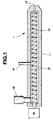
- Fig. 1 is a schematic side view of a vented twin screw extruder suitably used in the first embodiment of the present invention, in which reference numeral 1 denotes the vented twin screw extruder; 11 denotes a heating cylinder; 12 denotes screws; 13 denotes an extruder orifice; 14 denotes a vent port; 15 denotes an inverse screw; 16 denotes a feed opening for raw materials; and M denotes a screw driving unit.
- reference numeral 1 denotes the vented twin screw extruder
- 11 denotes a heating cylinder
- 12 denotes screws
- 13 denotes an extruder orifice
- 14 denotes a vent port
- 15 denotes an inverse screw
- 16 denotes a feed opening for raw materials
- M denotes a screw driving unit.
- Fig. 2 is a schematic side view of a regenerating apparatus comprising a pulverizer and a vented single screw extruder connected to the pulverizer, and suitably used in the second embodiment of the present invention, in which reference numeral 1 denotes the vented single screw extruder; 11 denotes a heating cylinder; 12 denotes a screw; 3 denotes a pulverizer; 31 denotes a feed opening for raw materials; 2 denotes a strand die; 4 denotes a strand; 5 denotes a strand bath; 6 denotes a pelletizer; 14a denotes a first vent port; 14b denotes a second vent port; D denotes a disc with cutting blades; and M denotes a driving unit.
- reference numeral 1 denotes the vented single screw extruder
- 11 denotes a heating cylinder
- 12 denotes a screw
- 3 denotes a pulverizer
- 31 denotes a
- Fig. 3 a schematic side view of a regenerating apparatus comprising a pulverizer and a vented single screw extruder connected to the pulverizer, and suitably used in the third preferred embodiment of the present invention, in which reference numeral 16 denotes a powder feed port; and the same reference numerals as shown in Fig. 2 denote the same parts.
- Fig. 4 is an explanatory sectional view of the pulverizer as shown in Figs. 2 and 3.
- the polyesters (including recovered or reclaimed polyesters) used in the present invention may include those formed of an aromatic dicarboxylic acid component and a glycol component.
- Especially suitable polyesters may have repeating units containing ethylene phthalate units, ethylene-2,6-naphthalate units or 1,4-cyclohexylene dimethylene terephthalate units in an amount of not less than 80 %.
- the polyesters used in the present invention may contain a third component copolymerized therewith.
- aromatic dicarboxylic acid components there may be exemplified terephthalic acid, 2,6-naphthalene dicarboxylic acid, isophthalic acid, phthalic acid, adipic acid, sebacic acid, 4,4'-diphenyl dicarboxylic acid, oxy-carboxylic acid (e.g., p-oxy-ethoxy benzoic acid) or the like.
- glycol components there may be exemplified ethylene glycol, 1,4-cyclohexane dimethanol, diethylene glycol, triethylene glycol, propylene glycol, butane diol, neopentyl glycol or the like.
- polyesters having repeating units containing ethylene phthalate units or ethylene-2,6-naphthalene units in an amount of not less than 80 % are more preferably used.
- the polyesters used in the present invention are not required to reduce the specific resistance by adding the metal salt thereto upon the polymerization.
- the specific resistance of the polyesters used in the present invention upon melting is usually not less than 1 x 10 7 ⁇ cm, preferably not less than 3 x 10 7 ⁇ cm, more preferably not less than 5 x 10 7 ⁇ cm.
- the electrostatic pinning property of the polyester becomes deteriorated, as the specific resistance of the polyester is increased.
- the polyesters used in the present invention may contain inorganic and/or organic particles as known in the arts, and may further contain fine particles resulting from catalyst residues generated upon the polymerization.
- the polyesters used in the present invention may be in the from of a dry product. However, the use of such dry polyesters is not essential to the present process. In view of advantages of omission of drying process and preceding crystallization process, undried polyester is preferably used. Further, the polyester used in the present invention may be in the form of a mixture of different two or more kinds of polyesters.
- the metal salts of aliphatic carboxylic acid used in the present invention there may be exemplified magnesium salts, lithium salts, sodium salts, potassium salts, manganese salts, zinc salts, calcium salts or aluminum salts of aliphatic monocarboxlic or dicarboxylic acid having about 4 to about 30 carbon atoms.
- magnesium salts, manganese salts, zinc salts or calcium salts are preferred.
- the magnesium salts are more preferred because the salts can exhibit an excellent thermal stability against the molten polyester and have less possibility to form fish eyes.
- metal salts of aliphatic carboxylic acid may include magnesium decane-dicarboxylate, magnesium palmitate, manganese palmitate, zinc palmitate, magnesium stearate, zinc stearate, potassium oleate, sodium oleate, magnesium oleate, zinc oleate, magnesium sebacate, manganese sebacate or the like.
- magnesium salts are exemplified.
- magnesium salts of aliphatic monocarboxylic acids having about 4 to about 30 carbon atoms.
- Specific examples of such magnesium salts may include magnesium palmitate, magnesium stearate, magnesium oleate, magnesium sebacate or the like.
- magnesium stearate can be used in extensive applications such as food packaging, cosmetics packaging or medicine packaging because of inexpensive and safe compound.
- magnesium decane-dicarboxylate is preferably used because the magnesium salt has a melting point as high as 275°C and a good heat resistance, and can maintain a high degree of polymerisation of polyester.
- metal salts of aliphatic carboxylic acids are in the form of powder, generally have a melting point lower than those of polyesters and are readily melted when supplied into the below-mentioned vented extruder.
- the feature of the first embodiment of the present invention lies in that by using a vented extruder and further by using a polyester having a specific resistance of not less than 1 x 10 7 ⁇ cm upon melting as a raw material, a metal salt is supplied together with the polyester into a vented extruder in such an amount that the concentration of the metal atom in the polyester is in the range of 05 to 1,000 ppm.
- the metal salt and at least a part of the above-mentioned polyester are independently supplied into the vented extruder through a common feed opening for raw materials.
- vented twin screw extruders as shown in Fig. 1 are preferred, and twin screw extruders whose twin screws are rotated in the same direction, are more preferred.
- twin screw extruders whose twin screws are rotated in opposite directions it is difficult to reduce a pressure of the vented portion, so that there may arise a disadvantage that the specific viscosity of polyester therein is considerably decreased.
- the ratio of a cylinder length (L) to a cylinder inner diameter (D) of the twin screw extruder is usually 20 to 60/1, preferably 22 to 50/1.
- the ratio L/D is less than 20/1, there is a tendency that melting of polyester and deaeration thereof by venting become unsatisfactory.
- the ratio L/D is more than 60/1, the residence time of the polyester in the twin screw extruder is considerably increased, so that the temperature of the polyester is inevitably raised and the degree of polymerization of the polyester tends to be decreased.
- the method of supplying the polyester and the metal salt into the twin screw extruder 1 is not particularly restricted.
- the metal salt in the form of powder may be supplied through a powder feed port formed at a downstream (slipstream) position of an inverse screw 15 described hereinafter, by ordinary methods.
- the polyester may also be supplied through a similar feed port into the twin screw extruder.
- the powder feed port is not shown in Fig. 1 illustrating the twin screw extruder, but the feed port is designated by reference numeral 16 in Fig. 3 illustrating a vented single screw extruder.
- the downstream (slipstream) position of the inverse screw 15 is generally called "transportation zone" kept under a relatively low pressure.
- the polyester and the metal salt be supplied into the twin screw extruder through a feed opening 16 for raw materials provided at a base portion of the twin screw extruder.
- the feed opening 16 for raw materials is of such a type opened to atmosphere, so that it is possible to supply these raw materials under ordinary pressure.
- the metal salt may be added in the form of a mixture prepared by preliminarily mixing the metal salt with the polyester.
- polyester and the metal salt are independently charged from separate feeders through the common feed opening 16 into the twin screw extruder.
- polyesters have a wide range of different bulk densities depending upon their properties. For this reason, in the first embodiment, it is preferred that polyester having a relatively small bulk density, specifically a bulk density of not more than 0.6, be selectively used as the polyester introduced through the feed opening 16.
- the volume occupied by the polyester within the feed opening conduit is increased as compared to that occupied by other polyesters having the same weight but a larger bulk density, so that the polyester falls while contacting with an inner surface of the feed opening conduit, resulting in such an advantage that if the metal salt is eventually attached to the inner surface of the feed opening conduit, the falling polyester can scrape off the attached metal salt.
- the above-mentioned low-bulk density polyester may be produced, for example, by pulverizing polyester sheets or the like.
- low-bulk density polyesters prepared by cutting or trimming off edge portions of polyester sheet quenched over a rotary cooling drum and then pulverizing the trimmed-off edge portions, or prepared by cutting or trimming off edge portions of a stretched polyester sheet obtained by further subjecting the polyester sheet to biaxial stretching process, and then pulverizing the trimmed-off edge portions.
- the low-density polyesters may contain inorganic and/or organic particles or fine particles resulting from catalyst residues generated upon the polymerization, and may be of any suitable shape such as pellet-like or fluff-like shape.
- the amount of the low-bulk density polyester based on the total weight of polyester supplied is not particularly restricted as long as the metal salt can be stably supplied into the heating cylinder 11.
- feeders for polyester there may be used belt-type feeders, loss-in-weight-type feeders or the like.
- these feeders have a weight control mechanism in order to assure the supply of a constant amount of polyester even when the bulk density of polyester supplied is fluctuated.
- a volumetric feeder constant-volume feeder
- feeders for the metal salts there may also be used belt-type feeders, loss-in-weight-type feeders or the like. These feeders may have a weight control mechanism similarly to those for polyester. If the amount of the metal salt discharged can be kept stable, there may also be used the volumetric feeder.
- a part of water contained in the polyester and the metal salt occasionally tends to be vaporized within the twin screw extruder 1 and to flow in reverse direction toward the feed opening 16 and further into delivery conduits connecting the feed opening to the respective feeders for the polyester and the metal salt, where the water vapor is condensed and attached to an inner surface thereof. More specifically, since upper portions of the delivery conduits have a lower temperature than that of the feed opening 16, there is a tendency that the condensed water adheres to inner surfaces of the upper portions of the delivery conduits. Accordingly, the respective feeders for the polyester and the metal salt are preferably disposed in the vicinity of the feed opening 16.
- the metal salt may be supplied by gravity from the feeders therefor disposed above the feeding opening 16 at a height usually not more than 30 times, preferably not more than 20 times, more preferably not more than 15 times the cylinder inner diameter D.
- the feed opening 16 is usually maintained at a temperature less than the melting point of the metal salt.
- the metal salt attached to the inner surface of the feed opening conduit is scraped off by polyester supplied therethrough, as described above.
- the temperature of polyester supplied is generally lower than that of the cylinder, it is possible to maintain the feed opening 16 at a low temperature by the mass flow of polyester, thereby preventing the metal salt from being attached to the inner surface of the feed opening conduit.
- the metal salt deposited on surfaces of screws can also be scraped off by polyester supplied, and the scraped-off metal salt is attached to the surface of polyester and stably transported in the form of a solid together with the polyester, so that problems such as deposition of the metal salt over the screws or too long residence of the metal salt in the cylinder can be avoided. Accordingly, in accordance with the present invention, the metal salt can be supplied and mixed with polyester with a high accuracy.
- the amount of the metal salt supplied into the twin screw extruder 1 is in the range of 0.5 to 1,000 ppm (calculated as concentration of metal atom in polyester composition).
- the amount of the metal salt supplied is preferably 10 to 800 ppm, more preferably 15 to 500 ppm (calculated as concentration of metal atom in polyester composition).
- the amount of the metal salt supplied is less than 0.5 ppm (calculated as concentration of metal atom in polyester composition)
- the specific resistance of polyester upon melting cannot be sufficiently reduced, so that polyester sheets obtained by an electrostatic pinning method disadvantageously contain a large amount of constrained air bubbles.
- polyester is hydrolyzed by the action of the metal salt, thereby causing the decrease in intrinsic viscosity (IV) thereof.
- the surface of polyester is successively renewed by kneading operation and removal of water by means of deaeration in the extruder, so that the metal salt can be prevented from staying locally, thereby suppressing the decomposition of polyester.
- the amount of the metal salt supplied is more than 1,000 ppm, it is not possible to exhibit a sufficient effect of suppressing the decomposition of polyester by the above-mentioned mechanism.
- the polyester and the metal salt supplied through the feed opening 16 into the heating cylinder 11 are transported by the screws 12 toward an extruder orifice 13.
- the obtained mixture reaches a region of a vent port 14 via the inverse screw section 15, the surface of polyester undergoes diffusive deaeration (hereinafter referred to merely as "deaeration"), so that water is removed from polyester.
- the region of the vent port 14 may be kept under reduced pressure, specifically at a pressure of usually not more than 40 HPa, preferably not more than 30 HPa, more preferably not more than 20 HPa.
- the vent port 14 is disposed at a position spaced by usually not more than 40 times (40D), preferably not more than 30 times (30D), more preferably not more than 25 times (25D), most preferably not more than 15 times (15D) the cylinder inner diameter D, apart from the feed opening 16.
- the opening area of the vent port 14 is not particularly restricted as long as the molten polyester can be prevented from overflowing the heating cylinder 2. However, a larger opening area of the vent port 14 is preferred because the deaeration from the surface of polyester can be promoted thereby.
- the direction of opening of the vent port 14 is not particularly restricted, but the vent port 14 may be opened in either upward or lateral direction.
- the above mentioned phenomenon of the deterioration in retention of IV is caused due to the fact that the resin undergoes promoted thermal degradation resulting from the increase in resin temperature. Accordingly, in the present invention, it is preferred that the amount of polyester extruded (extrusion output) and the rotating speed of the screws be appropriately selected to assure the retention of IV.
- the melt-extrusion is conducted so as to satisfy the retirement represented by the following formula (I), preferably the following formula (II), more preferably the following formula (III): 5.2x10 -6 x D 2.8 ⁇ Q/N ⁇ 15.8x10 -6 x D 2.8 6.0x10 -6 x D 2.8 ⁇ Q/N ⁇ 15.0x10 -6 x D 2.8 6.3x10 -6 x D 2.8 ⁇ Q/N ⁇ 14.7x10 -6 x D 2.8 wherein D represents a cylinder inner diameter (mm) of the twin screw extruder; Q represents an extrusion output per unit time (kg/hr); and N represents a rotating speed (rpm) of screws.
- formula (I) preferably the following formula (II), more preferably the following formula (III): 5.2x10 -6 x D 2.8 ⁇ Q/N ⁇ 15.8x10 -6 x D 2.8 6.0x10 -6 x D 2.8 ⁇ Q/N ⁇ 15.0x
- the polyester melted in the twin screw extruder is melt-extruded from the extruder orifice 13 through a slot die, into strands or sheets.
- the strands or sheets extruded may be introduced into a water-cooling tank to be cooled and solidified, and cut into pellets by a strand cutter.
- the molten polyester may be extruded over a rotary cooling drum into a sheet, and the extruded sheet is attached and retained onto the surface of the rotary cooling drum by an electrostatic pinning method to form a substantially amorphous sheet.
- a metering pump (so-called gear pump) may be disposed between the twin screw extruder and the slot die to enable the molten polyester to be introduced into the slot die at a uniform flow rate.
- the amorphous sheet may be further stretched to form a stretched film.
- the feature of the second embodiment of the present invention lies in that by using a regenerating apparatus comprising a pulverizer and a single screw extruder both connected with each other, recovered polyester having a specific resistance of not less than 1 x 10 7 ⁇ cm upon melting is charged into the pulverizer and pulverized therein, and a metal salt is added to the pulverized recovered polyester in an amount of 0.5 to 1,000 ppm calculated as the concentration of metal atom in the polyester composition, before the polyester reaches the single screw extruder.
- vented single screw extruders as shown in Fig. 2 are preferred.
- the ratio (L/D) of a cylinder length L to a cylinder inner diameter D of the single screw extruder is usually 18 to 60/1, preferably 20 to 50/1.
- the ratio L/D is less than 18/1, the melting of polyester and the deaeration by venting tends to be unsatisfactory.
- the ratio L/D is more than 60/1, the residence time of polyester in the single screw extruder is considerably increased, so that the temperature rise of polyester cannot be avoided and the degree of polymerization of polyester tends to be decreased.
- the recovered polyester (hereinafter referred to merely as “polyester”) used in the second embodiment of the present invention, may be in the form of films and/or amorphous pellets.
- the pulverizer 3 for pulverizing polyester there may be used a cylinder-shaped pulverizer as shown in Fig. 4, which is provided at a bottom thereof with a disc D with cutting blades.
- the rotating speed of the above-mentioned disc D may be varied depending upon the size of the pulverizer 3 used, and usually not more than 2,000 ppm, preferably not more than 1,800 ppm (calculated as concentration of metal atom in polyester composition).
- the temperature of polyester in the pulverizer 3 is raised due to frictional heat generated by the contact between polyester and the cutting blades, and between polyester and side walls of the pulverizer.
- the temperature of polyester in the pulverizer 3 is maintained at usually not less than 90°C, preferably not less than 100°C, more preferably 105°C.
- the pulverizer 3 may be of any type.
- the metal salt may be added to the pulverized recovered polyester at any stage before the polyester reaches the single screw extruder 1 by using the above-mentioned weigh feeder or volumetric feeder for raw materials.
- the metal salt may be supplied, for example, through a feed opening 31 for raw materials provided at an upper portion of the pulverizer 3 as shown in Fig. 2, so that water contained in the metal salt can be effectively removed by the above-mentioned frictional heat.
- the amount of the metal salt supplied may be identical to that used in the first embodiment of the present invention.
- polyester may be supplied through the feed opening 31 of the pulverizer 3, and mixed with the metal salt while being pulverized by the disc D with cutting blades provided at the bottom of the pulverizer 3. The obtained mixture is then fed into the extruder 1 connected to the pulverizer 3.
- polyester may be preliminarily mixed with a predetermined amount of the metal salt to form a mixture and supply the obtained mixture to the pulverizer 3. It is preferred that the amount of polyester supplied through the feed opening 31 be controlled such that the disc D having cutting blades and disposed at the bottom of the pulverizer 3 can retain a constant rotating force.
- the mixture of polyester and the metal salt supplied to the single screw extruder 1 is transported by the rotation of screw 12 in the heating cylinder 11 through regions of first and second vent ports 14a and 14b toward a strand die 2.
- the mixture undergoes diffusive deaeration (hereinafter referred to merely as "deaeration") to remove residual water from the surface of polyester.
- deaeration diffusive deaeration
- the region of the first vent port 14a is maintained under the same reduced pressure as used in the first embodiment of the present invention.
- the first vent port 14a is located at a similar position to that described in the first embodiment.
- the second vent port 14b may be optionally arranged.
- the second vent port 14b is useful to inhibit the decrease in molecular weight of the polyester composition and remove bubbles contained in the polyester composition.
- the region of the second vent port 14b may be maintained under the same reduced pressure as that at the region of the first vent port 14a.
- a mesh filter, a sintered metal filter, etc. may be fitted between the single screw extruder 1 and the strand die 2 in order to remove impurities or foreign materials contained in the polyester.
- a booster pump such as gear pump may be fitted between the single screw extruder 1 and the above-mentioned filter.
- a strand 4 melt-extruded from the strand die 2 is passed through a strand bath 5 so as to be cooled and solidified, and thereafter pelletized by a pelletizer 6.
- the feature of the third preferred embodiment of the present invention lies in that by using a regenerating apparatus comprising a pulverizer and a single screw extruder connected to the pulverizer and having a vent port and a powder feed port sequentially arranged along its extruding direction, recovered polyester having a specific resistance of not less than 1 x 10⁷ ⁇ cm upon melting is fed into the pulverizer and pulverized therein, and a metal salt is fed through the powder feed port in an amount of 0.5 to 1,000 ppm calculated as the concentration of metal atom in the polyester composition.
- the recovered polyester is fed into the pulverizer and pulverized therein, and the metal salt and polyester having a bulk density of 0.05 to 1.0 are fed through the powder feed port.
- a vented single screw extruder as shown in Fig. 3 (hereinafter referred to merely as "single screw extruder") is preferred.
- the single screw extruder shown in Fig. 3 differs from that shown in Fig. 2 in such a constitution that a powder feed port 16 is provided on a downstream (slipstream) side of a first vent port 14a, more specifically between the first vent port 14a and the second vent port 14b. Accordingly, the conditions described in the second embodiment can be applied to the third preferred embodiment except for those for the powder feed port 16.
- the powder feed port 16 as shown in Fig. 3 may be opened to atmosphere, or may be sealed, for example, with an inert gas, nitrogen gas, etc., to inhibit oxidative deterioration, inclusion of impurities, moisture absorption or the like.
- the opening area and shape of the powder feed port 16 are not particularly restricted as long as a constant supply of the metal salt can be assured.
- the powder feed port 16 may be opened in either upward or lateral direction. The upwardly opened powder feed port 16 is preferred because the metal salt can be supplied therethrough by gravity.
- such a metal salt is forced to be directly fed into the heating cylinder 11 of the extruder by using a transporting device (not shown) such as screws or coil-like screws.
- the metal salt may be added through the powder feed port 16 to the recovered polyester which has been transported into the extruder 1 and passed through the first vent port 14a.
- the metal salt is directly added to the molten recovered polyester and, therefore, can be more intimately and more readily dispersed in the recovered polyester.
- the addition of the metal salt may be usually performed by using a weigh feeder or a volumetric feeder (not shown). In the case where the bulk density of the metal salt is varied depending upon its powder level in the feeder, the weigh feeder is preferably used.
- the metal salt may be added in the same amount as used in the first embodiment.
- the metal salt and the recovered polyester having a bulk density of 0.05 to 1.0 are supplied through the powder feed port 16, it is possible to inhibit the molten metal salt from adhering to the powder feed port and peripheries thereof.
- the addition of the metal salt and the recovered polyester may also be usually performed by using a weigh feeder or a volumetric feeder (not shown).
- the weigh feeder is preferably used.
- the bulk density of the recovered polyester supplied together with the metal salt is preferably 0.08 to 0.9.
- the bulk density of the recovered polyester is less than 0.05, the amount of the recovered polyester transported is disadvantageously decreased.
- the bulk density of the recovered polyester is more than 1.0, the volume of the recovered polyester relative to that of the metal salt is reduced, so that it becomes difficult to transport the metal salt melted at a tip end of the transporting device, into the cylinder 11.
- the metal salt and the recovered polyester may be added, through the powder feed port 16, to the recovered polyester which has been transported from the pulverizer 3 into the extruder 1 and then passed through the first vent port 14a.
- the recovered polyester fed through the powder feed port 16 together with the metal salt may have a specific resistance of not more than 1 x 10 7 ⁇ cm upon melting, and may contain inorganic and/or organic particles or fine particles derived from catalyst residues generated upon the polymerization.
- the recovered polyester may be of either pellet-like or fluff-like shape.
- the amount of the recovered polyester supplied together with the metal salt based on the total amount of the recovered polyester supplied is not particularly restricted as long as stable supply of the metal salt into the heating cylinder 11 can be assured.
- the decrement percentage in intrinsic viscosity (IV) of the recovered polyester is usually not more than 20 %, preferably not more than 10 %, more preferably not more than 8 %.
- the decrement percentage in IV is too large, the obtained amorphous polyester sheet has a deteriorated strength and more frequently undergoes ruptures thereon when subjected to subsequent biaxial stretching process, so that the strength of the obtained film tends to be deteriorated.
- either wire electrode or blade electrode can be used.
- the D.C. voltage applied to the electrode is usually in the range of about 5 to about 10 kV.
- water film may be formed on the surface of the rotary cooling drum.
- the surface portion of the rotary cooling drum may be formed from metals or non-metals. From the standpoint of increase in electrostatic pinning force, the surface portion may be suitably formed of a conductive material.
- the temperature on the surface of the rotary cooling drum is usually 0 to 80°C, preferably 10 to 70°C, more preferably 15 to 60°C. When the temperature on the surface of the rotary cooling drum is less than 0°C, the adhesion between edge portions of the sheet and the rotary cooling drum is deteriorated, resulting in deterioration in flatness of the obtained sheet.
- the surface speed of the rotary cooling drum is not particularly restricted, and may be usually not less than 30 m/minute, preferably 40 m/minute.
- the metal salt can be added to polyester in an improved manner, the decrease in intrinsic viscosity of polyester is inhibited and the specific resistance thereof is reduced, there can be produced a polyester composition to which an electrostatic pinning method adopted for the shaping of an amorphous sheet can be suitably applied. Further, it is possible to add a specific amount of the metal salt to polyester having a high specific resistance upon melting, with a high accuracy.
- Magnesium stearate was added to polyester having a specific resistance of 167 x 10 7 ⁇ cm and an IV of 0.649 in such an amount that the concentration of magnesium atom in polyester was 45 ppm.
- the polyester composition was melted in the vented twin screw extruder having a cylinder inner diameter of 120 mm, successively transported through a gear pump and then extruded into a sheet from a slot die.
- the extruded sheet was electrostatically pinned onto the surface of a metallic rotary cooling drum using a wire electrode having a diameter of 0.04 mm to obtain a sheet having a thickness of 220 ⁇ m.
- the conditions used were as follows: screw rotating speed of the twin screw extruder: 167 rpm; extrusion output: 1,000 kg/hour; voltage applied to the electrode: 5.0 kV; current flowing through the electrode: 1.2 mA; and surface speed of the rotary cooling drum: 20 m/minute.
- the obtained sheet had a specific resistance of 1.7 x 10 7 ⁇ cm upon melting and an IV of 0.629, was free from defects such as constrained air bubbles and was uniform in thickness.
- the results concerning specific resistance, IV and total evaluation of the obtained sheet are shown in Table 1.
- Example 1 The same procedure as defined in Example 1 was conducted except that magnesium stearate was added in such an amount that the concentration of magnesium atom in polyester was 24 ppm, thereby producing an amorphous sheet.
- the obtained sheet had a specific resistance of 2.8 x 10 7 ⁇ cm upon melting and an IV of 0.632, was free from defects such as constrained air bubbles and was uniform in thickness.
- the results concerning specific resistance, IV and total evaluation of the obtained sheet are shown in Table 1.
- Example 1 The same procedure as defined in Example 1 was conducted except that magnesium stearate was added in such an amount that the concentration of magnesium atom in polyester was 120 ppm, thereby producing an amorphous sheet.
- a voltage of 7.0 kV was applied to the electrode, the current flowing through the electrode was 2.6 mA.
- the obtained sheet had a specific resistance of 3.7 x 10 7 ⁇ cm upon melting and an IV of 0.619, and showed the same good quality as that obtained in Example 1.
- the results concerning specific resistance, IV and total evaluation of the obtained sheet are shown in Table 1.
- Example 1 The same procedure as defined in Example 1 was conducted except that the surface speed of the rotary cooling drum was changed to 40 m/minute, 70 m/minute and 80 m/minute, respectively, thereby producing amorphous sheets.
- the obtained sheet showed the same good quality as that obtained in Example 1.
- the results concerning specific resistance, IV and total evaluation of the obtained sheets are shown in Table 1.
- Example 1 The same procedure as defined in Example 1 was conducted except that no magnesium stearate was added, thereby producing an amorphous sheet.
- the obtained sheet had many crater-shaped defects due to constrained air bubbles and, therefore, were unsatisfactory in quality.
- the results concerning specific resistance, IV and total evaluation of the obtained sheet are shown in Table 1.
- Example 1 The same procedure as defined in Example 1 was conducted except that no magnesium stearate was added and the surface speed of the rotary cooling drum was changed to 80 m/minute. Though trying to produce an amorphous sheet, the extruded sheet was unable to adhere onto the surface of the rotary cooling drum because of insufficient electrostatic pinning force, failing to obtain an amorphous sheet having a good quality.
- Table 1 The results concerning specific resistance, IV and total evaluation of the obtained sheet are shown in Table 1.
- Example 1 The same procedure as defined in Example 1 was conducted except that a non-vented single screw extruder having a cylinder inner diameter of 200 mm was used instead of the twin screw extruder, thereby producing an amorphous sheet.
- the obtained sheet had a specific resistance of 2.0 x 10 7 ⁇ cm upon melting and an IV of 0.495 and, therefore, were practically unusable because of its large decrease in IV.
- the results concerning specific resistance, IV and total evaluation of the obtained sheet are shown in Table 1.
- Example 1 The same procedure as defined in Example 1 was conducted except that magnesium stearate was added in such an amount that the concentration of magnesium atom in polyester was 2,000 ppm. Though trying to produce an amorphous sheet, the melt viscosity of the composition was considerably lowered, so that it was not possible to obtain an amorphous sheet in a stable manner. The results concerning specific resistance, IV and total evaluation of the obtained sheet are shown in Table 1.
- Polyester having a specific resistance of 200 x 10 7 ⁇ cm and an IV of 0.650 and magnesium stearate were fed into the vented twin screw extruder through a common feed opening 16 provided in a cylinder portion thereof such that the concentration of magnesium atom in polyester was 30 ppm.
- the mixture melt-extruded was introduced into water, quenched therein and shaped into a strand.
- the strand was then cut by a strand cutter to obtain pellets of the polyester composition.
- polyester composition The conditions used for the production of the polyester composition were as follows: cylinder inner diameter of the vented twin screw extruder: 120 mm; screw rotating speed: 167 rpm; extrusion output: 1,000 kg/hour; reduced pressure at vented portion: 1 HPa; temperature at the feed opening 16: 40°C; and temperature of adjacent heating cylinder: 270°C.
- Magnesium stearate and polyester were independently fed in predetermined amounts by using a loss-in-weight-type feeder for the magnesium stearate (manufactured by K. TRON CO., LTD.) and a loss-in-weight-type feeder for the polyester (manufactured by ACCURATE CO., LTD.), respectively.
- Magnesium stearate was supplied by gravity together with the polyester pellets having a bulk density of 0.8 through the feed opening 16 from the height spaced above the feed opening 16 by 5 times (600 mm) the cylinder inner diameter D.
- the polyester composition was successively sampled from a tip end of the twin screw extruder, ten times every 3 minutes.
- the ten samples of the polyester composition were measured with respect to intrinsic viscosity (IV) and specific resistance ( ⁇ v).
- IV intrinsic viscosity
- ⁇ v specific resistance
- Example 7 Using a vented twin screw extruder having a cylinder diameter of 120 mm, the polyester composition obtained in Example 7 was successively melt-extruded into a sheet through a gear pump and then a slot die fitted thereto. The extruded sheet was electrostatically pinned onto the surface of a metallic rotary cooling drum whose temperature was maintained at 30°C, using a wire electrode having a diameter of 0.04 mm, thereby producing a sheet having a thickness of 230 ⁇ m.
- the voltage applied to the wire electrode was 5.0 kV; the current flowing through the electrode was 1.2 mA; and the surface speed of the rotary cooling drum was 20 m/minute.
- the polyester sheet was sampled every 3 minutes, and the obtained samples were measured with respect to IV and ⁇ v.
- the results of the measurements concerning IV and ⁇ v are shown in Table 2. As a result, it was determined that the decrease in IV was small while the decrease in ⁇ v was large. Further, the polyester sheet was examined with respect to whether any constrained air bubbles existed, and the deviation of current values flowing through the wire electrode. As a result, it was determined that no defects due to constrained air bubbles existed, and the current flowing through the wire electrode was kept extremely stable. The results of evaluation for the obtained polyester sheet are shown in Table 2.
- Polyester having a specific resistance of 105 x 10 7 ⁇ cm and an IV of 0.610 and magnesium stearate were fed into the cylinder-shaped pulverizer 3 as shown in Fig. 2 such that the concentration of magnesium atom in polyester was 40 ppm.
- the conditions of the pulverizer 3 were as follows: inner diameter of the pulverizer 3: 800 mm; temperature of polyester within the pulverizer 3: 130°C; and rotating speed of a disc D with cutting blades: 1,100 rpm.
- the polyester composition was transported from the pulverizer 3 to the single screw extruder 1 connected to the pulverizer 3.
- the polyester composition was melted in the single screw extruder 1, successively transported through a gear pump and then extruded from a strand die.
- the extruded strand 4 was introduced into a strand bath 5 maintained at 40°C, where the strand 4 was quenched and solidified.
- the solidified strand was then transported to a pelletizer 6 where the strand was cut into pellets.
- the conditions of the single screw extruder 1 connected to the pulverizer 3 were as follows: inner diameter D of cylinder 11 of the single screw extruder 1: 80 mm; L/D: 36; and rotating speed of screw 12: 167 rpm.
- the intrinsic viscosity (IV) and specific resistance of the obtained polyester composition are shown in Table 3.
- the decrement percentage in intrinsic viscosity of the polyester composition was as small as 3 %.
- the specific resistance of the polyester composition after extrusion was favorably reduced to 5 x 10 7 ⁇ cm.
- the results of evaluation for the obtained polyester composition are also shown in Table 3.
- Example 9 The same procedure as defined in Example 9 was conducted except that magnesium stearate was added in such an amount that the concentration of magnesium atom in polyester was 20 ppm, thereby producing a polyester composition.
- the results of evaluation for the obtained polyester composition are also shown in Table 3.
- Example 9 The same procedure as defined in Example 9 was conducted except that magnesium decane-dicarboxylate was added in such an amount that the concentration of magnesium atom in polyester was 40 ppm, thereby producing a polyester composition.
- the results of evaluation of the obtained polyester composition are also shown in Table 3.
- Example 9 The same procedure as defined in Example 9 was conducted except that a vented single screw extruder as shown in Figs. 2 and 4 was used instead of the non-vented single screw extruder and the regions of vent ports 14a and 14b were maintained under a reduced pressure of 5 HPa, thereby producing a polyester composition.
- the results of evaluation of the obtained polyester composition are also shown in Table 3.
- Polyester having a specific resistance of 110 x 10 7 ⁇ cm and an IV of 0.610 was fed into the cylinder-shaped pulverizer 3 as shown in Fig. 3.
- the conditions of the pulverizer 3 were as follows: inner diameter of the pulverizer 3: 800 mm; temperature of polyester within the pulverizer 3: 130°C; and rotating speed of a disc D with cutting blades: 1,100 rpm.
- the polyester was transported from the pulverizer 3 to the vented single screw extruder 1 connected to the pulverizer 3.
- the polyester was melted in the vented single screw extruder 1, and then deaerated in the region of the first vent port 14a provided in the heating cylinder 11.
- magnesium stearate was added to the polyester through the powder feed port 16 in such an amount that the concentration of magnesium atom in polyester composition was 40 ppm.
- the polyester composition was further deaerated in the region of the second vent port 14b and then extruded from a strand die 2 fitted to a tip end of the extruder.
- the extruded strand 4 was introduced into a strand bath 5 maintained at 40°C, where the strand 4 was quenched and solidified.
- the solidified strand was then transported to a pelletizer 6 where the strand was cut into pellets.
- the conditions of the vented single screw extruder 1 were as follows: inner diameter D of a cylinder 11 of the vented single screw extruder 1: 80 mm; L/D: 36; and reduced pressure used at respective regions of the first and second vent ports 14a and 14b: 5 HPa.
- the intrinsic viscosity (IV) and specific resistance of the obtained polyester composition are shown in Table 4.
- the decrement percentage in intrinsic viscosity of the polyester composition was as small as 2 %.
- the specific resistance of the polyester composition after extrusion was favorably reduced to 5 x 10 7 ⁇ cm.
- the results of evaluation of the obtained polyester composition are also shown in Table 4.
- Example 13 The same procedure as defined in Example 13 was conducted except that magnesium stearate was added in such an amount that the concentration of magnesium atom in polyester was 250 ppm, thereby producing a polyester composition.
- the results of evaluations of the obtained polyester composition are also shown in Table 4.
- Example 13 The same procedure as defined in Example 13 was conducted except that magnesium decane-dicarboxylate was added in such an amount that the concentration of magnesium atom in polyester was 50 ppm, thereby producing a polyester composition.
- the results of evaluations of the obtained polyester composition are also shown in Table 4.
- Polyester having a specific resistance of 110 x 10 7 ⁇ cm and an IV of 0.610 was fed into the cylinder-shaped pulverizer 3 as shown in Fig. 3.
- the conditions of the pulverizer 3 were as follows: inner diameter of the pulverizer 3: 800 mm; temperature of polyester within the pulverizer 3: 190°C; and rotating speed of a disc D with cutting blades: 1,100 rpm.
- the polyester was transported from the pulverizer 3 to the vented single screw extruder 1 connected to the pulverizer 3.
- the polyester was melted in the vented single screw extruder 1, and then deaerated in the region of the first vent port 14a provided in the heating cylinder 11.
- magnesium stearate and polyester having a bulk density of 0.7, a specific resistance of 110 x 10 7 ⁇ cm and an IV of 0.610 were added to the polyester through the powder feed port 16 in such an amount that the concentration of magnesium atom in polyester composition was 40 ppm.
- the polyester composition was further deaerated in the region of the vent port 14b and then extruded from a strand die 2 fitted to a tip end of the extruder 1.
- the extruded strand 4 was introduced into a strand bath 5 maintained at 40°C, where the strand 4 was quenched and solidified.
- the solidified strand 4 was then transported to a pelletizer 6 where the strand 4 was cut into pellets.
- the conditions of the vented single screw extruder 1 were as follows: inner diameter D of the vented single screw extruder 1: 80 mm; L/D: 36; and reduced pressure used at respective regions of the first and second vent ports 14a and 14b: 5 HPa.
- the intrinsic viscosity (IV) and specific resistance of the obtained polyester composition are shown in Table 5.
- the decrement percentage in intrinsic viscosity of the polyester composition was as small as 2.5 %.
- the specific resistance of the polyester composition after extrusion was favorably reduced to 5 x 10 7 ⁇ cm.
- the results of evaluations of the obtained polyester composition are also shown in Table 5.
- Example 16 The same procedure as defined in Example 16 was conducted except that magnesium stearate was added in such an amount that the concentration of magnesium atom in polyester was 200 ppm, thereby producing a polyester composition.
- the results of evaluations of the obtained polyester composition are also shown in Table 5.
Landscapes
- Mechanical Engineering (AREA)
- Engineering & Computer Science (AREA)
- Chemical & Material Sciences (AREA)
- Polymers & Plastics (AREA)
- Chemical Kinetics & Catalysis (AREA)
- Medicinal Chemistry (AREA)
- Health & Medical Sciences (AREA)
- Organic Chemistry (AREA)
- Physics & Mathematics (AREA)
- Thermal Sciences (AREA)
- Extrusion Moulding Of Plastics Or The Like (AREA)
- Compositions Of Macromolecular Compounds (AREA)
- Processing And Handling Of Plastics And Other Materials For Molding In General (AREA)
- Processes Of Treating Macromolecular Substances (AREA)
Applications Claiming Priority (15)
| Application Number | Priority Date | Filing Date | Title |
|---|---|---|---|
| JP12016797 | 1997-04-23 | ||
| JP120167/97 | 1997-04-23 | ||
| JP9120167A JPH10296838A (ja) | 1997-04-23 | 1997-04-23 | ポリエステルシートの製造方法 |
| JP15161697A JPH10323831A (ja) | 1997-05-26 | 1997-05-26 | ポリエステル組成物の製造方法 |
| JP15161797A JPH10323832A (ja) | 1997-05-26 | 1997-05-26 | ポリエステル組成物の製造方法 |
| JP151618/97 | 1997-05-26 | ||
| JP151616/97 | 1997-05-26 | ||
| JP151617/97 | 1997-05-26 | ||
| JP15161897 | 1997-05-26 | ||
| JP15161797 | 1997-05-26 | ||
| JP15161897A JP3911069B2 (ja) | 1997-05-26 | 1997-05-26 | ポリエステル組成物の製造方法 |
| JP15161697 | 1997-05-26 | ||
| JP154585/97 | 1997-05-28 | ||
| JP9154585A JPH10329188A (ja) | 1997-05-28 | 1997-05-28 | ポリエステル組成物およびシート、フイルムの製造方法 |
| JP15458597 | 1997-05-28 |
Publications (3)
| Publication Number | Publication Date |
|---|---|
| EP0873844A2 true EP0873844A2 (fr) | 1998-10-28 |
| EP0873844A3 EP0873844A3 (fr) | 1999-01-27 |
| EP0873844B1 EP0873844B1 (fr) | 2003-08-13 |
Family
ID=27617860
Family Applications (1)
| Application Number | Title | Priority Date | Filing Date |
|---|---|---|---|
| EP98107167A Expired - Lifetime EP0873844B1 (fr) | 1997-04-23 | 1998-04-20 | Procédé pour la préparation d'une composition polyestère |
Country Status (3)
| Country | Link |
|---|---|
| EP (1) | EP0873844B1 (fr) |
| KR (1) | KR100450143B1 (fr) |
| DE (1) | DE69817063T2 (fr) |
Cited By (9)
| Publication number | Priority date | Publication date | Assignee | Title |
|---|---|---|---|---|
| WO2000032377A1 (fr) * | 1998-11-26 | 2000-06-08 | Bühler AG | Procede et dispositif pour le traitement d'un polycondensat thermoplastique |
| WO2000048817A1 (fr) * | 1999-02-16 | 2000-08-24 | The Dow Chemical Company | Procede et appareil d'extrusion d'un materiau polycarbonate de faible masse volumique apparente |
| EP1188557A3 (fr) * | 2000-09-15 | 2002-05-22 | Mitsubishi Polyester Film GmbH | Procédé de fabrication d'un film polyester orienté biaxialement aux grandes vitesses, film obtenu par ce procédé et son utilisation |
| EP1226922A1 (fr) * | 2001-01-29 | 2002-07-31 | COSTRUZIONI MECCANICHE LUIGI BANDERA S.p.A. | Appareil d'extrusion pour polyéthylènetéréphthalate |
| EP1440783B1 (fr) * | 2003-01-25 | 2007-04-18 | Motech GmbH Technology & Systems | Procédé de fabrication d'une bande d'emballage |
| US20210122086A1 (en) * | 2018-05-18 | 2021-04-29 | Ineos Styrolution Group Gmbh | Extrusion method for producing a thermoplastic molding compound, and device for carrying out the method |
| CN114211716A (zh) * | 2021-12-10 | 2022-03-22 | 浙江海利环保科技股份有限公司 | 低温摩擦熔融再生聚酯造粒装置及其造粒方法 |
| CN115139485A (zh) * | 2022-07-01 | 2022-10-04 | 孙鑫 | 一种塑料母粒连续加工方法 |
| WO2023150813A1 (fr) * | 2022-02-11 | 2023-08-17 | Erema Engineering Recycling Maschinen Und Anlagen Gesellschaft M.B.H. | Dispositif et méthode de traitement de matériaux |
Families Citing this family (1)
| Publication number | Priority date | Publication date | Assignee | Title |
|---|---|---|---|---|
| KR102508241B1 (ko) * | 2021-02-17 | 2023-03-10 | 하이테크필라 주식회사 | 재생 pet를 이용한 모노 필라멘트 원사의 제조방법 |
Family Cites Families (7)
| Publication number | Priority date | Publication date | Assignee | Title |
|---|---|---|---|---|
| JPS57185345A (en) * | 1981-05-08 | 1982-11-15 | Diafoil Co Ltd | Production of polyester film |
| JPS58177316A (ja) * | 1982-04-12 | 1983-10-18 | Teijin Ltd | ポリエステルフイルムの製造方法 |
| JPS59229314A (ja) * | 1984-05-16 | 1984-12-22 | Diafoil Co Ltd | ポリエステルフイルム |
| JPS62189133A (ja) * | 1985-05-02 | 1987-08-18 | Toyobo Co Ltd | ポリエステルフイルムの製造法 |
| JPH068026B2 (ja) * | 1985-12-27 | 1994-02-02 | 東レ株式会社 | ポリエチレンテレフタレ−トのキヤスト方法 |
| IT1215564B (it) * | 1987-06-16 | 1990-02-14 | Montefibre Spa | Composizioni poliestere a rapida cristallizzazione. |
| DE4118858A1 (de) * | 1991-06-07 | 1992-12-10 | Condux Maschinenbau Gmbh & Co | Verfahren und vorrichtung zum aufbereiten von thermoplastischen abfaellen |
-
1998
- 1998-04-20 DE DE1998617063 patent/DE69817063T2/de not_active Expired - Lifetime
- 1998-04-20 EP EP98107167A patent/EP0873844B1/fr not_active Expired - Lifetime
- 1998-04-22 KR KR10-1998-0014301A patent/KR100450143B1/ko not_active Expired - Lifetime
Cited By (13)
| Publication number | Priority date | Publication date | Assignee | Title |
|---|---|---|---|---|
| WO2000032377A1 (fr) * | 1998-11-26 | 2000-06-08 | Bühler AG | Procede et dispositif pour le traitement d'un polycondensat thermoplastique |
| US6838496B1 (en) * | 1998-11-26 | 2005-01-04 | Buehler Ag | Method and device for processing a thermoplastic condensation polymer |
| WO2000048817A1 (fr) * | 1999-02-16 | 2000-08-24 | The Dow Chemical Company | Procede et appareil d'extrusion d'un materiau polycarbonate de faible masse volumique apparente |
| US6328919B1 (en) | 1999-02-16 | 2001-12-11 | The Dow Chemical Company | Method for extruding polycarbonate of low bulk density |
| EP1188557A3 (fr) * | 2000-09-15 | 2002-05-22 | Mitsubishi Polyester Film GmbH | Procédé de fabrication d'un film polyester orienté biaxialement aux grandes vitesses, film obtenu par ce procédé et son utilisation |
| EP1226922A1 (fr) * | 2001-01-29 | 2002-07-31 | COSTRUZIONI MECCANICHE LUIGI BANDERA S.p.A. | Appareil d'extrusion pour polyéthylènetéréphthalate |
| EP1440783B1 (fr) * | 2003-01-25 | 2007-04-18 | Motech GmbH Technology & Systems | Procédé de fabrication d'une bande d'emballage |
| US20210122086A1 (en) * | 2018-05-18 | 2021-04-29 | Ineos Styrolution Group Gmbh | Extrusion method for producing a thermoplastic molding compound, and device for carrying out the method |
| CN114211716A (zh) * | 2021-12-10 | 2022-03-22 | 浙江海利环保科技股份有限公司 | 低温摩擦熔融再生聚酯造粒装置及其造粒方法 |
| WO2023150813A1 (fr) * | 2022-02-11 | 2023-08-17 | Erema Engineering Recycling Maschinen Und Anlagen Gesellschaft M.B.H. | Dispositif et méthode de traitement de matériaux |
| MA66916A1 (fr) * | 2022-02-11 | 2025-11-28 | Erema Engineering Recycling Maschinen Und Anlagen Gesellschaft M.B.H. | Dispositif et méthode de traitement de matériaux |
| CN115139485A (zh) * | 2022-07-01 | 2022-10-04 | 孙鑫 | 一种塑料母粒连续加工方法 |
| CN115139485B (zh) * | 2022-07-01 | 2023-10-10 | 上海鑫亮塑胶制品股份有限公司 | 一种塑料母粒连续加工方法 |
Also Published As
| Publication number | Publication date |
|---|---|
| EP0873844B1 (fr) | 2003-08-13 |
| KR19980081605A (ko) | 1998-11-25 |
| DE69817063T2 (de) | 2004-06-03 |
| KR100450143B1 (ko) | 2005-04-06 |
| DE69817063D1 (de) | 2003-09-18 |
| EP0873844A3 (fr) | 1999-01-27 |
Similar Documents
| Publication | Publication Date | Title |
|---|---|---|
| EP1213123B1 (fr) | Procédé pour la production d'une composition polyester | |
| US6361734B1 (en) | Process for producing polyester composition | |
| EP1424188B1 (fr) | Rouleau de film polyester thermoretractable | |
| EP0873844B1 (fr) | Procédé pour la préparation d'une composition polyestère | |
| CN114728723A (zh) | 热收缩性聚酯系薄膜卷 | |
| EP0967068B1 (fr) | Film en polyester étiré biaxialement | |
| JPH10329188A (ja) | ポリエステル組成物およびシート、フイルムの製造方法 | |
| JP3911069B2 (ja) | ポリエステル組成物の製造方法 | |
| JP4158775B2 (ja) | 熱収縮性ポリエステル系フィルムロールの製造方法 | |
| JP7139745B2 (ja) | 離型用二軸配向ポリエステルフィルム | |
| KR20120073244A (ko) | 폴리에스테르 시이트, 폴리에스테르 성형품, 폴리에스테르 수지 마스터 배치 | |
| JPH06859A (ja) | 積層フィルムの製造方法 | |
| JP7677844B2 (ja) | ポリカーボネート樹脂組成物ペレットの製造方法 | |
| JPH10296838A (ja) | ポリエステルシートの製造方法 | |
| JP3370195B2 (ja) | ポリエステルフィルムの製造方法 | |
| JP2008238449A (ja) | 白色ポリエステル樹脂組成物の製造方法 | |
| JPH10323831A (ja) | ポリエステル組成物の製造方法 | |
| JPH01172448A (ja) | フイルム用ポリエステル組成物 | |
| JPH1176716A (ja) | ポリエステルの濾過方法、ポリエステルフィルムの製造方法およびポリエステルフィルム | |
| JP3942380B2 (ja) | ポリエステル樹脂組成物の製造方法 | |
| JP5045078B2 (ja) | ポリエステル樹脂の製造方法 | |
| JPH10151661A (ja) | ポリエステルシートの製造方法 | |
| JPH1077393A (ja) | ポリエステル組成物の製造方法 | |
| JP2000256483A (ja) | ポリエステルフィルムの製造方法 | |
| KR20220144397A (ko) | 폴리머 필름 및 통신용 기판 |
Legal Events
| Date | Code | Title | Description |
|---|---|---|---|
| PUAI | Public reference made under article 153(3) epc to a published international application that has entered the european phase |
Free format text: ORIGINAL CODE: 0009012 |
|
| AK | Designated contracting states |
Kind code of ref document: A2 Designated state(s): DE FR GB IT LU NL |
|
| AX | Request for extension of the european patent |
Free format text: AL;LT;LV;MK;RO;SI |
|
| PUAL | Search report despatched |
Free format text: ORIGINAL CODE: 0009013 |
|
| RAP3 | Party data changed (applicant data changed or rights of an application transferred) |
Owner name: MITSUBISHI POLYESTER FILM CORPORATION |
|
| AK | Designated contracting states |
Kind code of ref document: A3 Designated state(s): AT BE CH CY DE DK ES FI FR GB GR IE IT LI LU MC NL PT SE |
|
| AX | Request for extension of the european patent |
Free format text: AL;LT;LV;MK;RO;SI |
|
| 17P | Request for examination filed |
Effective date: 19990412 |
|
| AKX | Designation fees paid |
Free format text: DE FR GB IT LU NL |
|
| 17Q | First examination report despatched |
Effective date: 20001009 |
|
| GRAG | Despatch of communication of intention to grant |
Free format text: ORIGINAL CODE: EPIDOS AGRA |
|
| GRAG | Despatch of communication of intention to grant |
Free format text: ORIGINAL CODE: EPIDOS AGRA |
|
| GRAH | Despatch of communication of intention to grant a patent |
Free format text: ORIGINAL CODE: EPIDOS IGRA |
|
| GRAH | Despatch of communication of intention to grant a patent |
Free format text: ORIGINAL CODE: EPIDOS IGRA |
|
| GRAA | (expected) grant |
Free format text: ORIGINAL CODE: 0009210 |
|
| AK | Designated contracting states |
Designated state(s): DE FR GB IT LU NL |
|
| REG | Reference to a national code |
Ref country code: GB Ref legal event code: FG4D |
|
| REF | Corresponds to: |
Ref document number: 69817063 Country of ref document: DE Date of ref document: 20030918 Kind code of ref document: P |
|
| PGFP | Annual fee paid to national office [announced via postgrant information from national office to epo] |
Ref country code: LU Payment date: 20040402 Year of fee payment: 7 |
|
| PGFP | Annual fee paid to national office [announced via postgrant information from national office to epo] |
Ref country code: NL Payment date: 20040429 Year of fee payment: 7 |
|
| ET | Fr: translation filed | ||
| PLBE | No opposition filed within time limit |
Free format text: ORIGINAL CODE: 0009261 |
|
| STAA | Information on the status of an ep patent application or granted ep patent |
Free format text: STATUS: NO OPPOSITION FILED WITHIN TIME LIMIT |
|
| 26N | No opposition filed |
Effective date: 20040514 |
|
| PG25 | Lapsed in a contracting state [announced via postgrant information from national office to epo] |
Ref country code: LU Free format text: LAPSE BECAUSE OF NON-PAYMENT OF DUE FEES Effective date: 20050420 Ref country code: IT Free format text: LAPSE BECAUSE OF NON-PAYMENT OF DUE FEES Effective date: 20050420 |
|
| PG25 | Lapsed in a contracting state [announced via postgrant information from national office to epo] |
Ref country code: NL Free format text: LAPSE BECAUSE OF NON-PAYMENT OF DUE FEES Effective date: 20051101 |
|
| NLV4 | Nl: lapsed or anulled due to non-payment of the annual fee |
Effective date: 20051101 |
|
| REG | Reference to a national code |
Ref country code: FR Ref legal event code: PLFP Year of fee payment: 19 |
|
| REG | Reference to a national code |
Ref country code: FR Ref legal event code: PLFP Year of fee payment: 20 |
|
| PGFP | Annual fee paid to national office [announced via postgrant information from national office to epo] |
Ref country code: DE Payment date: 20170419 Year of fee payment: 20 Ref country code: FR Payment date: 20170419 Year of fee payment: 20 Ref country code: GB Payment date: 20170419 Year of fee payment: 20 |
|
| REG | Reference to a national code |
Ref country code: DE Ref legal event code: R071 Ref document number: 69817063 Country of ref document: DE |
|
| REG | Reference to a national code |
Ref country code: GB Ref legal event code: PE20 Expiry date: 20180419 |
|
| PG25 | Lapsed in a contracting state [announced via postgrant information from national office to epo] |
Ref country code: GB Free format text: LAPSE BECAUSE OF EXPIRATION OF PROTECTION Effective date: 20180419 |