EP0881231A2 - HCV Peptidantigene und Verfahren zur Bestimmung von HCV - Google Patents
HCV Peptidantigene und Verfahren zur Bestimmung von HCV Download PDFInfo
- Publication number
- EP0881231A2 EP0881231A2 EP98104367A EP98104367A EP0881231A2 EP 0881231 A2 EP0881231 A2 EP 0881231A2 EP 98104367 A EP98104367 A EP 98104367A EP 98104367 A EP98104367 A EP 98104367A EP 0881231 A2 EP0881231 A2 EP 0881231A2
- Authority
- EP
- European Patent Office
- Prior art keywords
- peptide
- hcv
- arg
- pro
- thr
- Prior art date
- Legal status (The legal status is an assumption and is not a legal conclusion. Google has not performed a legal analysis and makes no representation as to the accuracy of the status listed.)
- Withdrawn
Links
Classifications
-
- C—CHEMISTRY; METALLURGY
- C07—ORGANIC CHEMISTRY
- C07K—PEPTIDES
- C07K7/00—Peptides having 5 to 20 amino acids in a fully defined sequence; Derivatives thereof
- C07K7/04—Linear peptides containing only normal peptide links
-
- C—CHEMISTRY; METALLURGY
- C07—ORGANIC CHEMISTRY
- C07K—PEPTIDES
- C07K14/00—Peptides having more than 20 amino acids; Gastrins; Somatostatins; Melanotropins; Derivatives thereof
- C07K14/005—Peptides having more than 20 amino acids; Gastrins; Somatostatins; Melanotropins; Derivatives thereof from viruses
-
- A—HUMAN NECESSITIES
- A61—MEDICAL OR VETERINARY SCIENCE; HYGIENE
- A61P—SPECIFIC THERAPEUTIC ACTIVITY OF CHEMICAL COMPOUNDS OR MEDICINAL PREPARATIONS
- A61P31/00—Antiinfectives, i.e. antibiotics, antiseptics, chemotherapeutics
- A61P31/12—Antivirals
-
- A—HUMAN NECESSITIES
- A61—MEDICAL OR VETERINARY SCIENCE; HYGIENE
- A61K—PREPARATIONS FOR MEDICAL, DENTAL OR TOILETRY PURPOSES
- A61K39/00—Medicinal preparations containing antigens or antibodies
-
- C—CHEMISTRY; METALLURGY
- C12—BIOCHEMISTRY; BEER; SPIRITS; WINE; VINEGAR; MICROBIOLOGY; ENZYMOLOGY; MUTATION OR GENETIC ENGINEERING
- C12N—MICROORGANISMS OR ENZYMES; COMPOSITIONS THEREOF; PROPAGATING, PRESERVING, OR MAINTAINING MICROORGANISMS; MUTATION OR GENETIC ENGINEERING; CULTURE MEDIA
- C12N2770/00—MICROORGANISMS OR ENZYMES; COMPOSITIONS THEREOF; PROPAGATING, PRESERVING, OR MAINTAINING MICROORGANISMS; MUTATION OR GENETIC ENGINEERING; CULTURE MEDIA ssRNA viruses positive-sense
- C12N2770/00011—Details
- C12N2770/24011—Flaviviridae
- C12N2770/24211—Hepacivirus, e.g. hepatitis C virus, hepatitis G virus
- C12N2770/24222—New viral proteins or individual genes, new structural or functional aspects of known viral proteins or genes
Definitions
- the invention relates to new HCV peptide antigens, a method for the production of these peptide antigens, and a method for the determination of HCV using the peptide antigens.
- NANB hepatitis The occurrence of viral hepatitis in the absence of serological Markers of hepatotropic agents known to date (e.g. Hepatitis A virus, hepatitis B virus, hepatitis ⁇ virus, Cytomegaly Virus and Epstein-Barr Virus) is called Non-A, Non-B hepatitis (NANB hepatitis).
- NANB hepatitis is again divided into parenteral and sporadically transmitted Non-A, Non-B hepatitis and enterally transmitted Non-A, Non-B hepatitis.
- HCV Hepatitis C virus isolated
- HCV is a major cause of NANB and hepatitis worldwide is caused by contaminated blood or blood products, blood transmission or transmitted through close personal contact.
- the amino acid sequence of the HCV virus proteins is out EP-A 0 318 216, EP-A 0 363 025, EPA 388 232 and EP-A 0 396 748 known.
- the HCV genome is 10.862 nt in length.
- the proteins resulting from translation have one Total length of approximately 3000 amino acids. Let the proteins divided into structural proteins (shell and core proteins) and non-structural proteins Divide (NS1 - NS5).
- HCV is expediently determined in that immunological tests against antibodies in body fluids HCV can be detected. For such immunological tests binding partners for anti-HCV antibodies are therefore required.
- Protein is used. Proteins are prone to denaturation and thus reduced solubility and Function difficult to handle in diagnostic tests. Also the size of the measurement signal is due to the low epitope density on a protein less than a test where a short-chain peptide antigen as a binding partner of the antibody is used. Can continue when using proteins or long chain peptides as antigens in one immunological test increases cross-reactivities and non-specific Antibody bindings occur. Reactions with Proteins are also often diffusion controlled, which is what is desired short times for immunological tests. It is also used for the manufacture of diagnostics usable protein in sufficient quantity and quality time consuming and costly. Peptides are by synthesis easily accessible and are defined molecules.
- the object of the present invention is therefore peptide antigens to provide that specific for anti-HCV antibodies are and for immunological tests for anti-HCV antibodies are suitable.
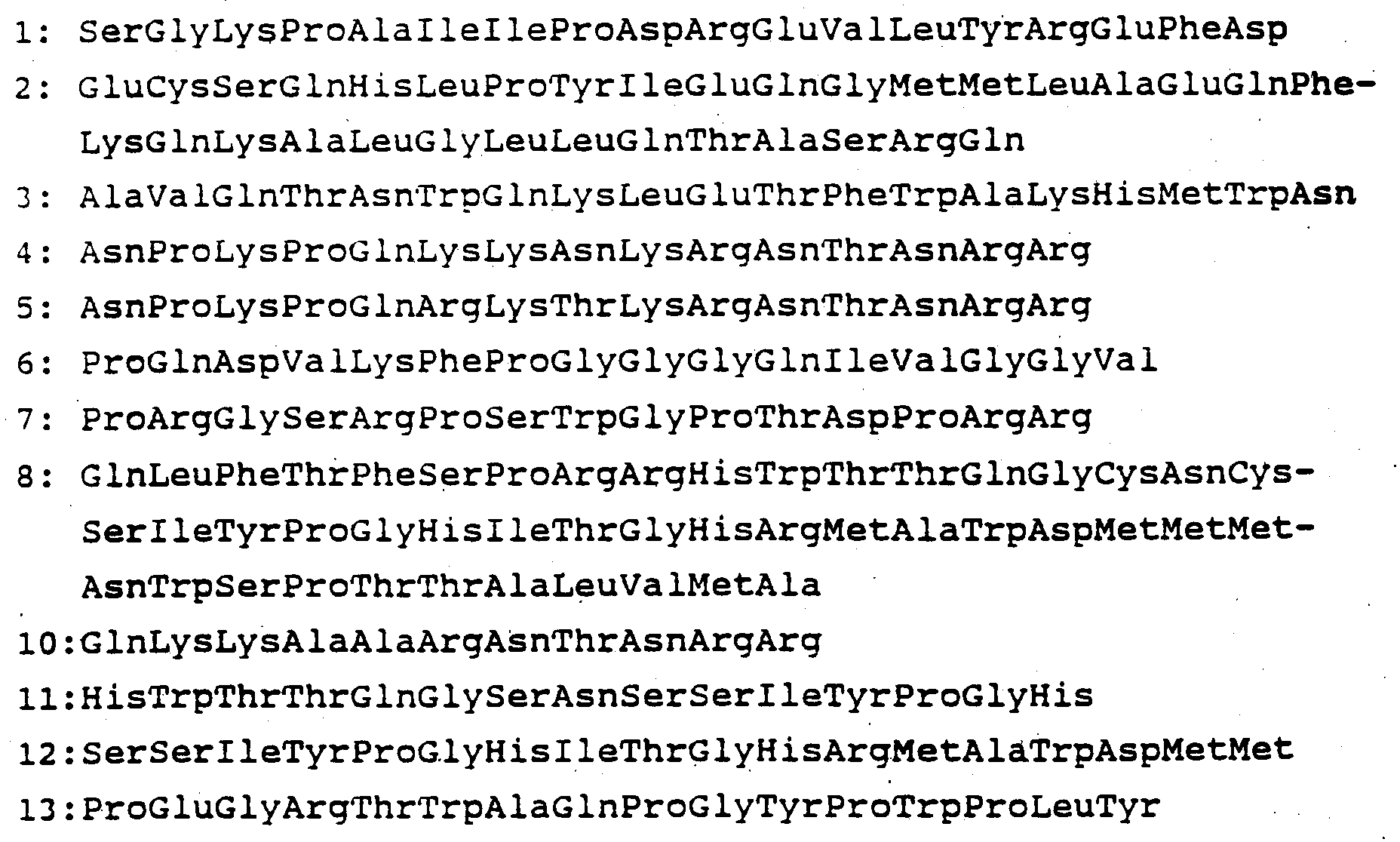
- peptide antigens of the sequences or peptide antigens which are partial sequences of these peptide antigens of at least four, preferably of at least seven, amino acids in length.
- Suitable partial sequences are shown in the sequence listing and with letter / number combinations (e.g. 6 a, 2 b) designated.
- Partial sequences with a maximum length are particularly preferred Is 9 amino acids.
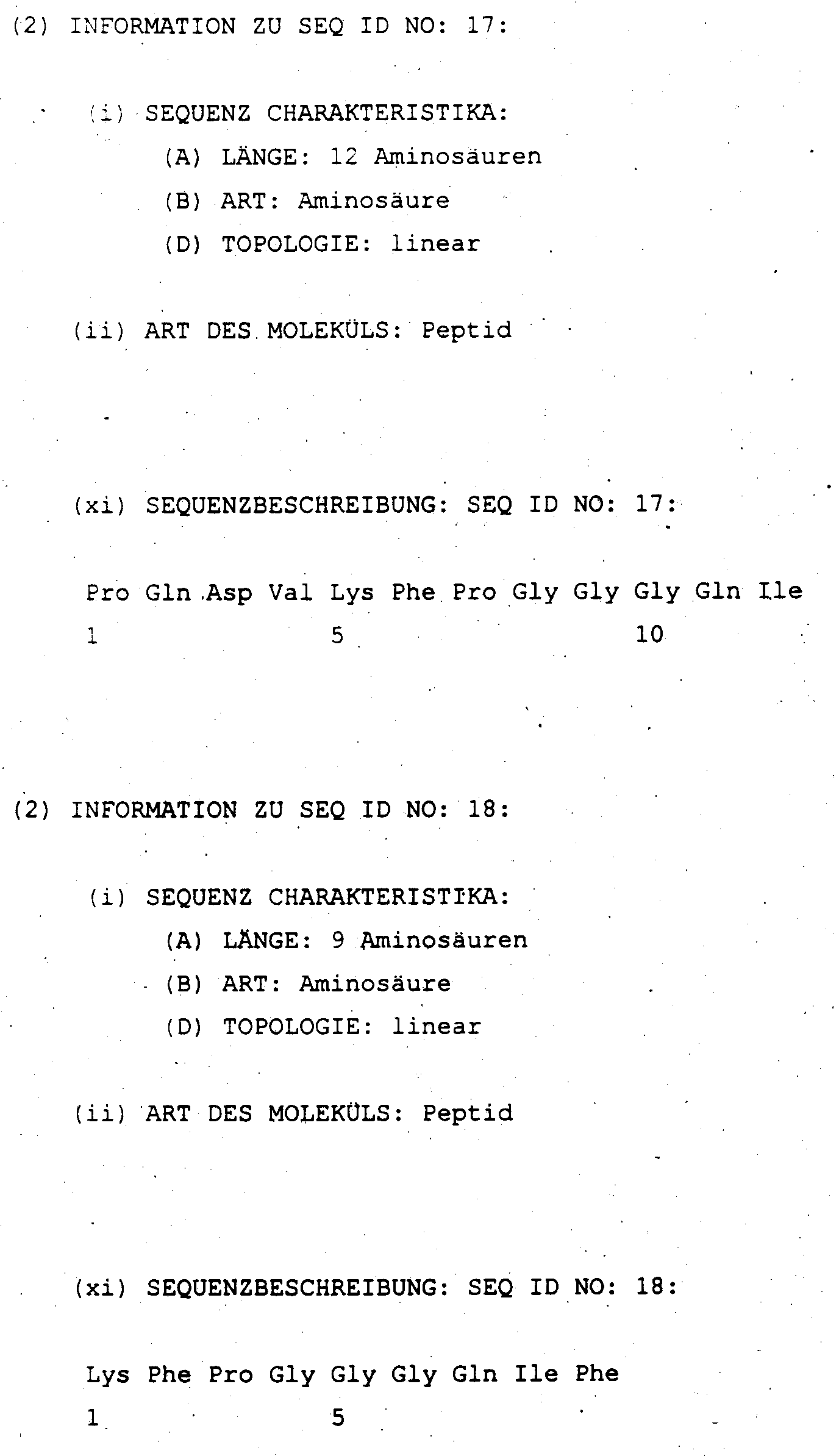
- these are the sequences 6b, 6d, 6e, 2e, 2f, 2d, 2g, 4a.
- the peptide antigens with the sequences 1-3 are contained in the C 100-3 region of the HCV proteins and the peptide antigens with the sequences 4-8, 10-13 in the env / core region of the HCV proteins.
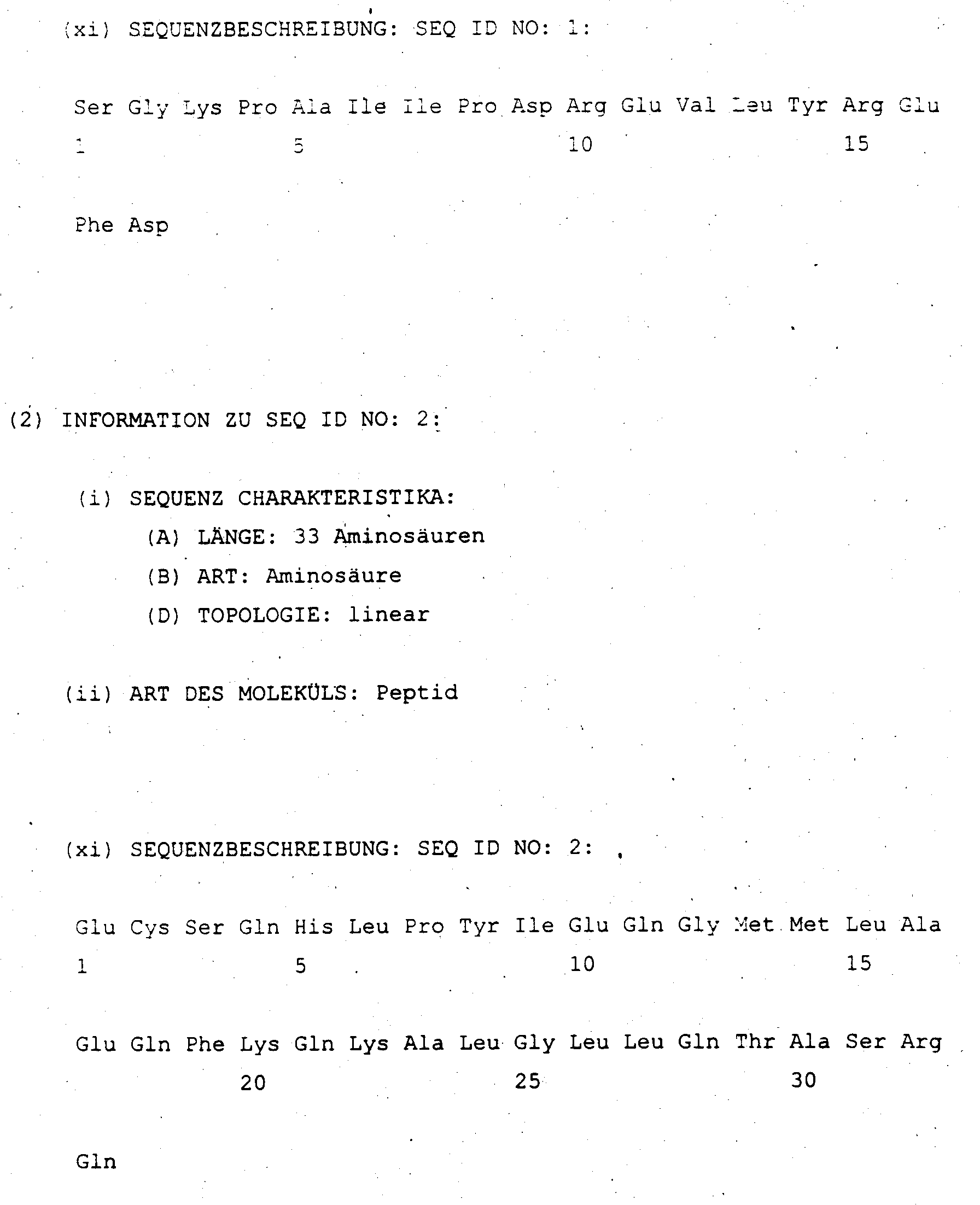
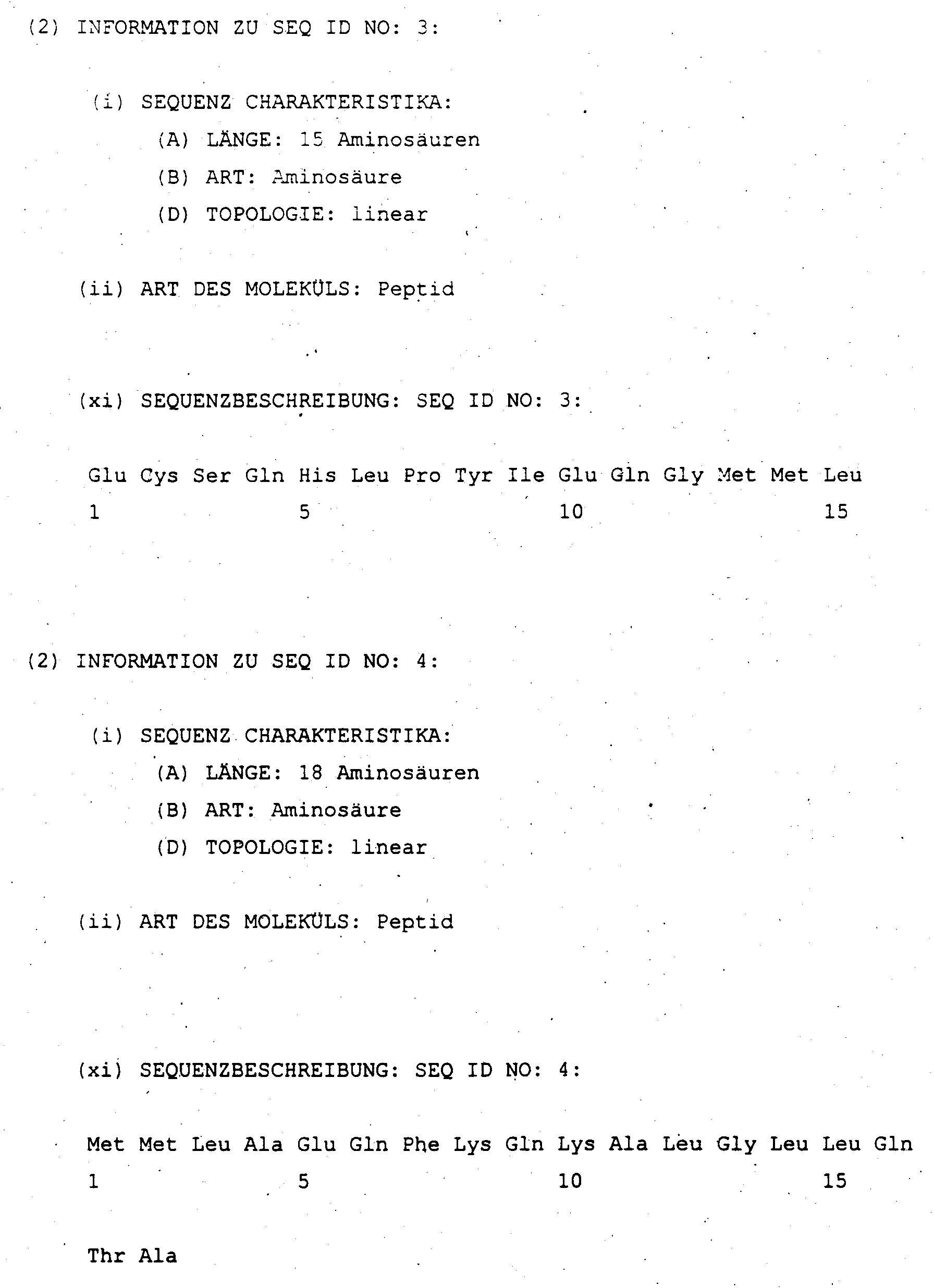
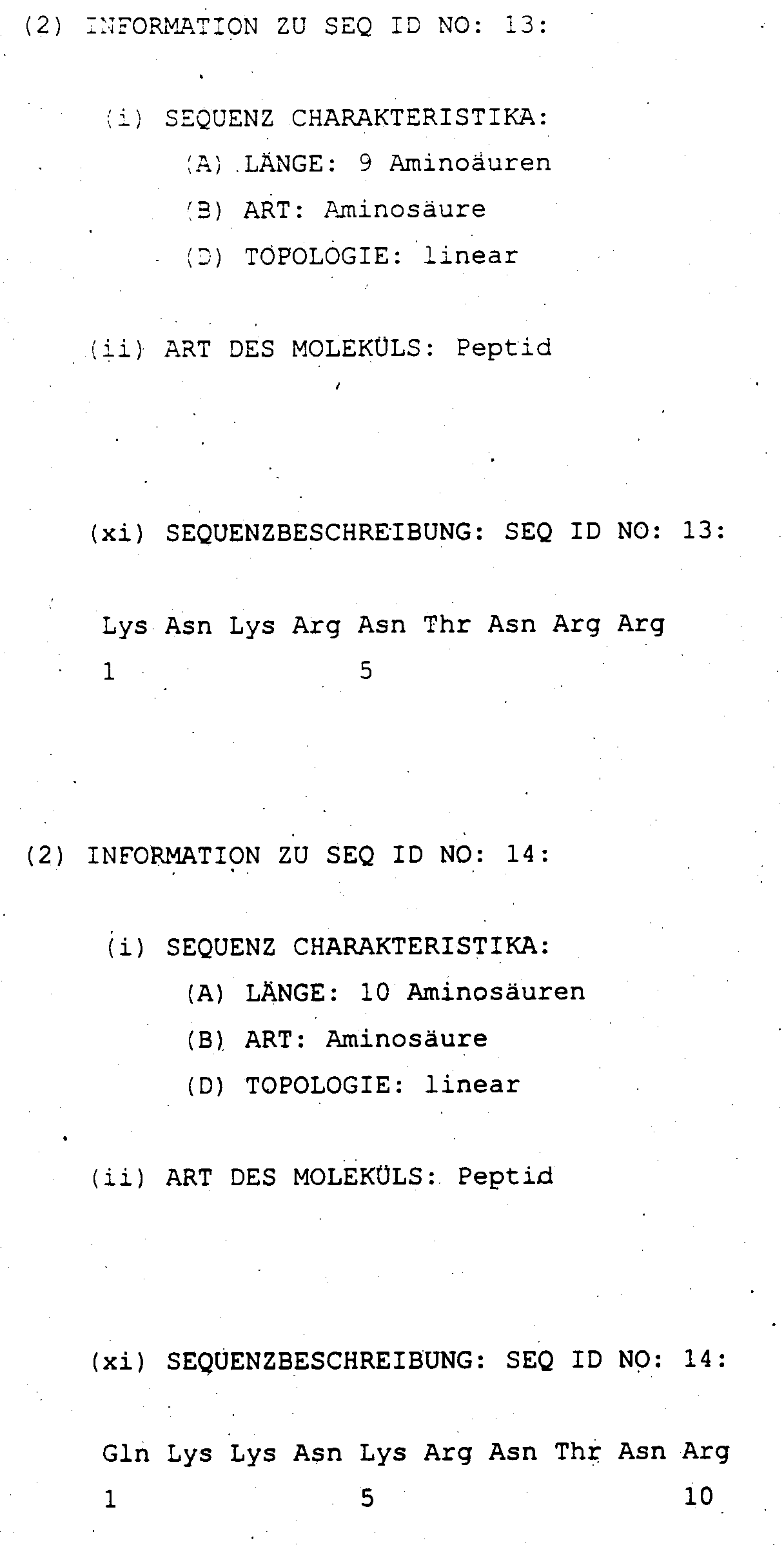
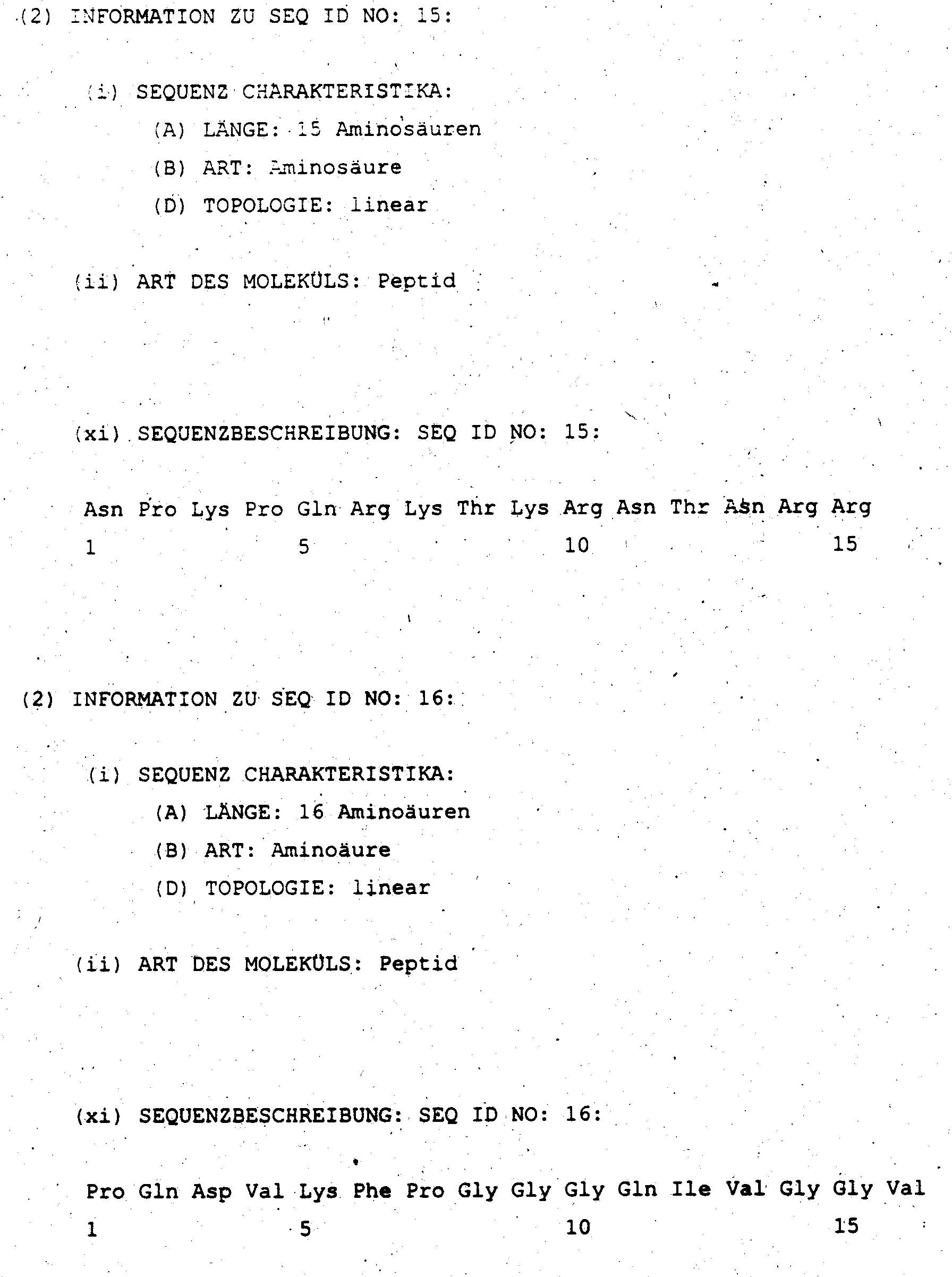
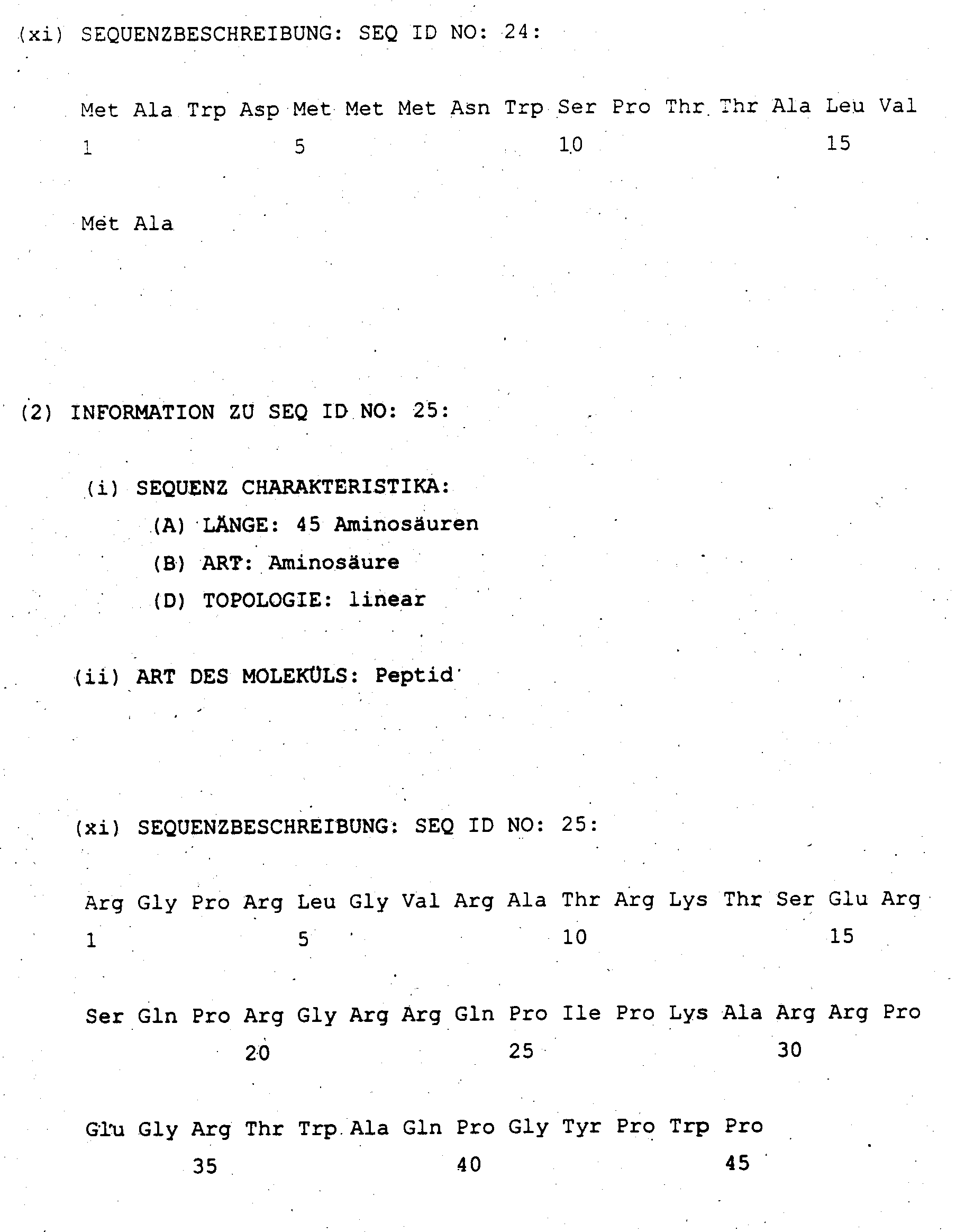
- the peptide antigens according to the invention with the sequences 1-8, 10-13 and the peptide antigen of the sequence 9 are described by the sequence protocols SEQ ID NO: 1-32.
- An anti-HCV antibody detection is carried out according to the methods familiar to the expert.
- Another The invention therefore relates to a method for determining of HCV antibodies, which is characterized is that the sample has a combination of at least two Peptide antigens from the group of sequences 1-13 or peptide antigens, the partial sequences of these peptide antigens from at least four, preferably at least 7, amino acids Represent length, incubated and under conditions that the Allow formation of an antibody-antigen complex that Amount of anti-HCV antibodies bound to the peptide antigen is determined.
- a combination of at least two of the Peptide antigens according to the invention or partial sequences thereof used It is particularly preferred to use the peptide antigens of sequences 1-3 or partial sequences thereof with at least a peptide antigen from the group of sequences 4-13 or To combine partial sequences of it.
- Suitable partial sequences of sequence 9 are: Lys Ala Arg Arg Pro Glu Gly Arg Thr Trp Ala Gln Pro Gly Tyr (Sequence 9c)
- the antigens can be combined, for example, by that multiple individual peptide antigens are used or that peptide antigens are covalent, expediently via an amino acid bridge, which is different from naturally occurring in HCV proteins distinguishes occurring amino acid sequence sequences or a peptide linker are bound together.
- the antigens are preferably approximately the same molar amounts used.
- the combination of the antigens with the sequences 11, 12, 8a is particularly suitable for the detection of sera from patients who have cured an HCV infection (convalescence sera).
- the antigens are single, without covalent binding to one another, or covalently bonded to one another using of a peptide linker used.
- the peptide antigen is usually immobilized for this purpose.
- the sample that is tested for anti-HCV antibodies should be added is added and those bound to the antigen Antibody via a labeled anti-human immunoglobulin antibody certainly.
- Immobilization of the invention Peptide antigen can be adsorbent, covalent or via a biological binding pair such as biotin / streptavidin, antibody / antigen, or sugar / lectin.
- the peptide antigen covalently bound to this partner.
- the peptide antigens according to the invention can be used for immunoassays preferably by methods familiar to the person skilled in the art, for example on balls, plastic tubes or microtiter plates (preferably polystyrene or copolymers of Polystyrene). This is preferably done in that the peptide antigen is non-specific on the surface adsorbed or covalently onto functionalized or activated Surfaces is bound.
- the non-specific adsorption can be improved by using the peptide antigen with linked a protein to a conjugate and this conjugate used for adsorption (see e.g. EP-A 0 269 092).
- the connection can also be done using an immobilized antibody. To do this, the peptide antigen should be changed so that the epitope is not due to the binding of the antibody is blocked e.g. by forming a peptide-protein conjugate.
- the conjugation of the peptide antigen to the binding partner preferably takes place via a spacer.
- This spacer contains expedient 10-50, preferably 10-30 atoms and is also preferably an essentially linear molecule. Examples for this are spacers made of alkyl, polyether or Polyamide chains.
- a peptide antigen with a length of 4 - 9 amino acids via a linear spacer of 10 - 30 atoms to the carrier bound. If an amino acid spacer is used should, this consists appropriately of amino acids that are not the sequence in the immediate vicinity of the peptide antigen in the HCV gene.
- the invention Peptide antigen covalently bound to biotin, the Immobilization takes place via an avidin / streptavidin solid phase.
- the preparation of the peptide antigens according to the invention is after the methods known to the person skilled in the art for peptide synthesis.
- Another object of the invention is therefore a Process for the preparation of the peptide antigen according to the invention, which is that the C-terminal end forming amino acid is bound to a carrier, from the C-terminal End the peptide antigen gradually built up and then is split off from the carrier.
- an amino acid is used for this purpose their carboxy group to an insoluble, easily filterable Polymer linked, and then the peptide chain from the C-terminal end built up gradually.
- an N-protected Amino acid with a reactive grouping of the Resin brought to reaction. From that on the carrier particle the N ⁇ protecting group is removed covalently anchored amino acid and the resulting aminoacyl polymer with the next N-protected amino acid implemented. Of that on the carrier resin covalently bound dipeptide, the N ⁇ protecting group is removed and the resulting aminoacyl polymer with the next N-protected amino acid implemented. Any excess Reagents and by-products are easily filtered removed.
- the peptide antigens according to the invention according to Merrifield, JACS 85 (1964) 2146.
- a biotinylation which may be required, for example according to PNAS USA 80 (1983) 4045.
- a preferred one Biotinylating agent for this is biotinylaminocaproic acid N-hydroxysuccinimide ester.
- a preferred method for producing biotinylated Peptide antigens are the introduction of the biotin residue at the N-terminus during a solid phase synthesis of the peptide antigen.
- This method is preferably used when the peptide antigen contains several ⁇ -lysine amino groups that do not to be biotinylated. This is the case, for example Case when you have N- ⁇ -Fmoc-N- ⁇ -biotinyl-aminocaproyl) lysine, N- ⁇ -Fmoc-N- ⁇ -biotinyilysin or in the case of biotinylation of the N-terminal Amino acids biotin, biotinylaminocaproic acid or dimethoxytritylbiotin with an activation reagent such as Example uses dicyclohexylcarbodiimide or as an active ester.
- a detection antibody for example against the Fc part of human IgG is directed, immobilized.
- a monoclonal antibody is used for this.
- the peptide antigen is then in solution.
- the antibody to be detected (Analyte) and all other antibodies of the Sample liquid is bound by the wall antibody.
- the bound Antibody can then bind the analyte with a suitable detection system, e.g. competitive with one Peptide antigen-enzyme conjugate can be detected.
- Another object of the invention is therefore a method for the production of antibodies, which is characterized is that a mammal with an inventive Peptide, which is optionally bound to a support, is immunized and the antibodies by known methods e.g. can be obtained from the serum or spleen.
- B lymphocytes are the immunized animals in the presence of transforming agents fused with a suitable cell line, the cell line, which produces, clones and cultivated and from the cells or the culture supernatant monoclonal antibody obtained.
- Another object of the invention is therefore a method for the determination of HCV viruses, which thereby is characterized in that the sample with an inventive Antibodies under conditions that require antigen-antibody complex formation allow, incubated, and the amount of formed Antibody-antigen complex is determined.
- Another object of the invention is a method for Production of vaccines using the invention Peptide antigens and a vaccine for the treatment of HCV infections, possibly containing an immunogen carrier-bound peptide antigen of sequences 1-8, 10-13 or partial sequences thereof or at least two peptide antigens of sequences 1-13 or partial sequences thereof in one pharmacologically effective dose and in a pharmaceutical acceptable wording.
- these vaccines can be done according to the known methods be performed. However, the peptide antigens are preferred first lyophilized and then, if necessary with the addition of auxiliaries.
- Vaccination with the vaccine or vaccine combinations according to the invention can by the methods familiar to the expert take place, for example intradermally, intramuscularly, intraperitoneally, intravenously, subcutaneously and intranasally.
- the vaccine can be used for intramuscular or subcutaneous administration suspended in physiological saline be.
- the vaccine for example in the form of a spray or a aqueous solution can be used.
- Oral administration is often required to temporarily remove the immunogens to protect against inactivation, for example against proteolytic enzymes in the oral cavity or in the stomach.
- a such temporary protection can be provided, for example, by Encapsulation of the immunogens takes place.
- This encapsulation can for example by covering it with a protective agent (Microencapsulation) or when embedding a variety of immunogens according to the invention in a protective carrier (Macroencapsulation).
- the encapsulation material can be semi-permeable or at Introducing semipermeable into the human or animal body will.
- a biodegradable substance as a carrier.
- sequence SEQ ID NO 1 1 2nd 2nd 2 a 3rd 2 B 4th 2 c 5 2 d 6 2 e 7 2 f 8th 2 g 9 2 h 10th 3rd 11 4th 12th 4 a 13 4 b 14 5 15 6 16 6 a 17th 6 b 18th 6 c 19th 6 d 20th 6 e 21 7 22 8th 23 8 a 24th 9 25th 9 a 26 9 b 27 9 c 28 10th 29 11 30th 12th 31 13 32
- the peptide was synthesized using Fmoc (fluorenyloxycarbonyl) solid phase synthesis produced.
- the reactions were on one Labortec (Switzerland) SP 640 peptide synthesizer performed.
- the Coupling reactions have been carried out regarding Fmoc-amino acid derivative with 2.4 equivalents of dicyclohexylcarbodiimide and 2.2 Equivalents of N-hydroxybenzotriazole for 90 minutes carried out.
- Dimethylformamide was used as the reaction medium Commitment.
- the Fmoc group was determined using 20% piperides in DMF split off in 10 and 20 minutes.
- the peptide was on 5 g Wang resin (polystyrene / 1% divinylbenzene) with one load of 0.50 mmol / g (JACS 95 (1973) 1328). After Synthesis, the degree of loading was still 0.39 mmol / g.
- the release of the peptide was treated with 200 ml of trifluoroacetic acid, 200 ml dichloromethane, 10 ml ethanedithiol, 10 ml m-cresol, 5 ml of ethyl methyl sulfide and 5 ml of water in 30 minutes Room temperature.
- the cleavage solution was washed several times with toluene concentrated, then the peptide precipitated with diethyl ether.
- reaction mixture was stirred for 2 hours at room temperature under argon under constant control by means of analytical RP-HPLC. If ⁇ 5% starting material was present, the reaction mixture was placed directly on a preparative RP-HPLC column and the product material using a 0.1% trifluoroacetic acid / water to 0.1% trifluoroacetic acid / acetonitrile gradient (Slope: 0% to 100% in 90 minutes). The product material was obtained by concentrating and lyophilizing the product fractions receive. The yields were between 40% and 90%.
- HPLC HPLC, HPCE and TLC, for identity FAB-MS (Molpeak) and TLC with specific Staining reagents (p-dimethylamino cinnamaldehyde on biotin) and content determination via microanalysis (nitrogen).
- HCV antibodies are tested in a 2-step sandwich immunoassay certainly.
- the reagents are labeled as follows
- Serum 1 was negative in the Ortho-HCV antibody ELISA test system by ORTHO DIAGNOSTIC SYSTEMS INC. however positive due of the clinical picture.
- Sera 2-5 were obtained after testing by Ortho Laboratories, which Sera 6 and 7 with the ABBOTT HCV EIA, Cat.No. 3 A53-24, ABBOTT LABORATORIES INC. identified as positive.
- the peptide antigens 1-6 were solid-phase biotinylated with dimethoxytrityl-biotin on the ⁇ -amino group of an additional N-terminal imported lysine.
- the peptide antigen mixtures 1 + 4 and 3 + 6 were in a molar Mixing ratio of 1: 1 used.
- One well of a streptavidin-coated microtiter plate per well Serum (1:10 diluted in 50 ul incubation buffer and 100 ul reagent 1 added. It will be an hour at room temperature incubated and then five times with 200 ul washing solution washed. 150 ul reagent 2 are added, one hour incubated at room temperature and three times with 200 ⁇ l washing solution each washed. 150 ⁇ l of color reagent are added, one Incubated for one hour at room temperature and the absorbance at 420 nm measured photometrically.
- the peptide mixtures each contained 50 ng of the individual peptides.
- the cutoff for a positive signal in the immunoassay as example 3 is defined as the mean absorbance at 420 nm plus 2 standard deviations of a collective of 6 negative control sera.
- the samples are diluted 1: 100 with incubation buffer).
Landscapes
- Chemical & Material Sciences (AREA)
- Health & Medical Sciences (AREA)
- Life Sciences & Earth Sciences (AREA)
- Organic Chemistry (AREA)
- Medicinal Chemistry (AREA)
- General Health & Medical Sciences (AREA)
- Biophysics (AREA)
- Biochemistry (AREA)
- Genetics & Genomics (AREA)
- Molecular Biology (AREA)
- Proteomics, Peptides & Aminoacids (AREA)
- Virology (AREA)
- Gastroenterology & Hepatology (AREA)
- Nuclear Medicine, Radiotherapy & Molecular Imaging (AREA)
- Public Health (AREA)
- Chemical Kinetics & Catalysis (AREA)
- General Chemical & Material Sciences (AREA)
- Communicable Diseases (AREA)
- Pharmacology & Pharmacy (AREA)
- Animal Behavior & Ethology (AREA)
- Oncology (AREA)
- Veterinary Medicine (AREA)
- Peptides Or Proteins (AREA)
- Medicines Containing Material From Animals Or Micro-Organisms (AREA)
- Medicines Containing Antibodies Or Antigens For Use As Internal Diagnostic Agents (AREA)
- Other Investigation Or Analysis Of Materials By Electrical Means (AREA)
- Investigating Or Analysing Biological Materials (AREA)
Abstract
Description
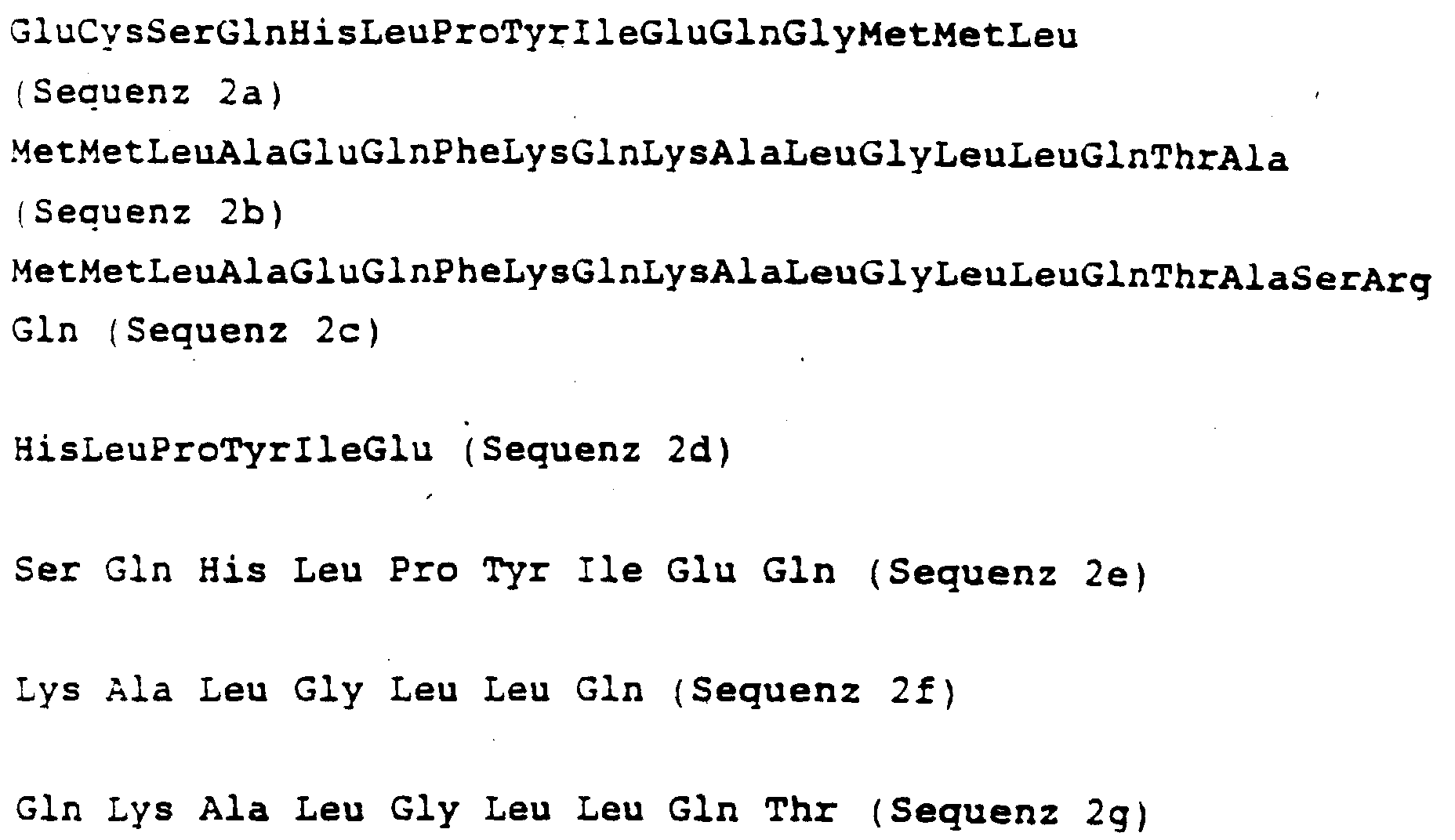
Lys Phe Pro Gly Gly Gly Gln Ile Phe (Sequenz 6b)
Lys Phe Pro Gly Gly Gly Gln Ile Val (Sequenz 6d)
Gln Asp Val Lys Phe Pro Gly Gly Gly (Sequenz 6e)


| Sequenz | SEQ ID NO |
| 1 | 1 |
| 2 | 2 |
| 2 a | 3 |
| 2 b | 4 |
| 2 c | 5 |
| 2 d | 6 |
| 2 e | 7 |
| 2 f | 8 |
| 2 g | 9 |
| 2 h | 10 |
| 3 | 11 |
| 4 | 12 |
| 4 a | 13 |
| 4 b | 14 |
| 5 | 15 |
| 6 | 16 |
| 6 a | 17 |
| 6 b | 18 |
| 6 c | 19 |
| 6 d | 20 |
| 6 e | 21 |
| 7 | 22 |
| 8 | 23 |
| 8 a | 24 |
| 9 | 25 |
| 9 a | 26 |
| 9 b | 27 |
| 9 c | 28 |
| 10 | 29 |
| 11 | 30 |
| 12 | 31 |
| 13 | 32 |
| Serum | Peptidantigene (Sequenz Nr.) | ||||||||||
| 9 | 1 | 2 | 3 | 4 | 5 | 6 | 7 | 8 | 1+4 | 3+6 | |
| 1 | + | - | + | + | + | + | + | - | + | + | + |
| 2 | - | - | - | - | + | + | + | - | - | + | + |
| 3 | - | + | - | - | - | - | + | - | - | + | + |
| 4 | + | - | + | + | + | - | + | + | + | + | + |
| 5 | - | - | + | - | + | - | - | - | + | + | + |
| 6 | + | - | + | + | + | + | + | - | + | + | + |
| 7 | + | + | + | - | + | - | + | + | + | + | + |
- -/+:
- negativ/positiv (Der Cutoff für ein positives Signal im ELISA ist definiert als die mittlere Extinktion bei 420 nm plus 3 Standardabweichungen eines Kollektivs von 10 negativen Kontrollseren. Die Proben wurden bei einer Probenverdünnung von 1:250 vermessen).
- Ortho:
- relative Größe des Meßsignals im Test von Ortho (vgl. Beispiel 3.
- leeres Feld:
- Meßwert kleiner als zweifacher Leerwert oder identisch mit Leerwert (bestimmt mit biotinyliertem, mit HCV-Antikörpern nicht reaktivem Peptid (nonsens-Sequenz)).
- voller Kreis:
- Meßwert dreifacher Leerwert oder größer bei 50 ng Peptid pro Napf.
- leerer Kreis:
- Meßwert zweifacher Leerwert bei 50 ng Peptid pro Napf
- volles Quadrat:
- Meßwert dreifacher Leerwert oder größer bei 250 ng Peptid pro Napf.
- leeres Quadrat:
- Meßwert zweifacher Leerwert oder größer bei 250 ng Peptid pro Napf.
- * :
- Negativkontrollen
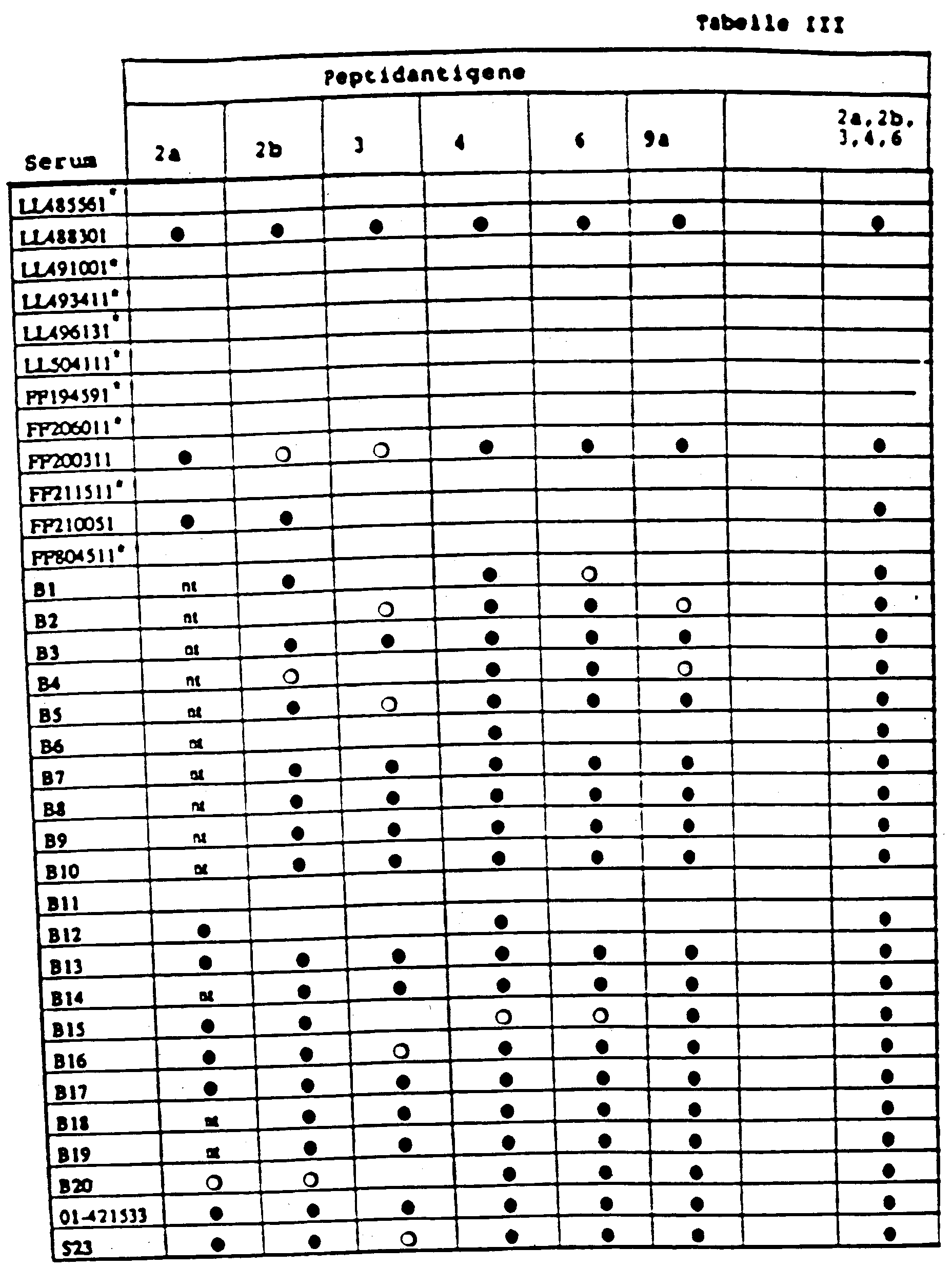
- leeres Feld:
- wie Tabelle II
- voller Kreis:
- Meßwert vierfacher Leerwert oder größer bei 50 ng Peptid pro Napf.
- leerer Kreis:
- Meßwert dreifacher Leerwert oder größer bei 50 ng Peptid pro Napf.
- n.t.:
- Messung nicht durchgeführt
- 2a, 2b, 3, 4, 6:
-
Anstelle eines einzelnen Peptidantigens wurde in Reagenz 1 eine Mischung aus je 10 ng der genannten Peptide verwendet. - *:
- Negativkontrollen
| Sequenz 2a | 50 µg/ml |
| Sequenz 2b | 50 µg/ml |
| Sequenz 2d | 100 µg/ml |
| Sequenz 2f | 100 µg/ml |
| Sequenz 2h | 100 µg/ml |
| Sequenz 4 | 400 µg/ml |
| Sequenz 4a | 350 µg/ml |
| Sequenz 4b | 250 µg/ml |
| Sequenz 4c | 300 µg/ml |
| Sequenz 6 | 350 µg/ml |
| Sequenz 6a | 350 µg/ml |
| Sequenz 6b | 350 µg/ml |
| Sequenz 6c | 250 µg/ml |
| Sequenz 6d | 300 µg/ml |
| Sequenz 8a | 900 µg/ml |
| Sequenz 9a | 350 µg/ml |
| Sequenz 9c | 350 µg/ml |
| Sequenz 11 | 300 µg/ml |
| Sequenz 12 | 550 µg/ml |









Claims (8)
- Peptidantigene aus dem core-Bereich von HCV mit den Aminosäuresequenzen SEQ ID NO 12-15, 16-21, 22, 25-29, 32 oder Teilsequenzen davon mit einer Länge von mindestens 4 Aminosäuren.
- Verfahren zur Herstellung von Peptidantigenen nach Anspruch 1, dadurch gekennzeichnet, daß die das C-terminale Ende bildende Aminosäure an einen Träger gebunden wird, vom C-terminalen das Peptidantigen schrittweise aufgebaut und anschließend vom Träger abgespalten wird.
- Verfahren zur Bestimmung von HCV-Antikörpern, dadurch gekennzeichnet, daß die Probe mit mindestens einem Peptidantigen gemäß Anspruch 1 inkubiert wird und unter Bedingungen, die die Bildung eines Antigen-Antikörper-Komplexes ermöglichen, die Menge der an das Peptidantigen gebundenen HCV-Antikörper bestimmt wird.
- Verwendung von Peptidantigenen aus dem core-Bereich von HCV gemäß Anspruch 1 zum immunologischen Nachweis von HCV-Antikörpern.
- Verfahren zur Herstellung von Antikörpern gegen HCV-Antigene, dadurch gekennzeichnet, daß ein Säugetier mit einem gegebenenfalls trägergebundenen Peptidantigen gemäß Anspruch 1 immunisiert wird, polyklonale Antikörper gewonnen werden oder Zellen dieser Tiere, die Antikörper produzieren, zu Zellinien immortalisiert werden und aus diesen Zellinien monoklonale Antikörper gewonnen werden.
- Verfahren zur Bestimmung von HCV-Viren, dadurch gekennzeichnet, daß die Probe mit einem Antikörper nach Anspruch 5 unter Bedingungen, die eine Antigen-Antikörper-Komplexbildung erlauben, inkubiert wird, und die Menge des gebildeten Antigen-Antikörper-Komplexes bestimmt wird.
- Vakzin zur Behandlung von HCV-Infektionen, enthaltend ein gegebenenfalls trägergebundenes Peptidantigen gemäß Anspruch 1 als Immunogen in einer pharmakologisch effektiven Dosis und in einer pharmakologisch akzeptablen Formulierung.
- Verfahren zur Herstellung von Impfstoffen unter Verwendung der Peptidantigene gemäß Anspruch 1.
Applications Claiming Priority (7)
| Application Number | Priority Date | Filing Date | Title |
|---|---|---|---|
| DE4122160 | 1991-07-04 | ||
| DE4122160 | 1991-07-04 | ||
| DE4141304 | 1991-12-14 | ||
| DE4141304 | 1991-12-14 | ||
| DE4209215A DE4209215A1 (de) | 1991-07-04 | 1992-03-21 | Hcv peptidantigene und verfahren zur bestimmung von hcv |
| DE4209215 | 1992-03-21 | ||
| EP92913343A EP0551460B2 (de) | 1991-07-04 | 1992-06-30 | Hcv peptidantigene und verfahren zur bestimmung von hcv |
Related Parent Applications (2)
| Application Number | Title | Priority Date | Filing Date |
|---|---|---|---|
| EP92913343A Division EP0551460B2 (de) | 1991-07-04 | 1992-06-30 | Hcv peptidantigene und verfahren zur bestimmung von hcv |
| EP92913343.7 Division | 1993-01-28 |
Publications (2)
| Publication Number | Publication Date |
|---|---|
| EP0881231A2 true EP0881231A2 (de) | 1998-12-02 |
| EP0881231A3 EP0881231A3 (de) | 2004-02-04 |
Family
ID=27202683
Family Applications (2)
| Application Number | Title | Priority Date | Filing Date |
|---|---|---|---|
| EP98104367A Withdrawn EP0881231A3 (de) | 1991-07-04 | 1992-06-30 | HCV Peptidantigene und Verfahren zur Bestimmung von HCV |
| EP92913343A Expired - Lifetime EP0551460B2 (de) | 1991-07-04 | 1992-06-30 | Hcv peptidantigene und verfahren zur bestimmung von hcv |
Family Applications After (1)
| Application Number | Title | Priority Date | Filing Date |
|---|---|---|---|
| EP92913343A Expired - Lifetime EP0551460B2 (de) | 1991-07-04 | 1992-06-30 | Hcv peptidantigene und verfahren zur bestimmung von hcv |
Country Status (10)
| Country | Link |
|---|---|
| US (3) | US6183949B1 (de) |
| EP (2) | EP0881231A3 (de) |
| JP (1) | JP2774872B2 (de) |
| KR (1) | KR970010925B1 (de) |
| AT (1) | ATE171710T1 (de) |
| AU (1) | AU652851B2 (de) |
| CA (1) | CA2089576A1 (de) |
| DE (2) | DE4209215A1 (de) |
| ES (1) | ES2123558T5 (de) |
| WO (1) | WO1993001210A2 (de) |
Families Citing this family (23)
| Publication number | Priority date | Publication date | Assignee | Title |
|---|---|---|---|---|
| CA2049679C (en) * | 1990-08-24 | 2005-06-21 | Sushil G. Devare | Hepatitis c assay utilizing recombinant antigens |
| DE4209215A1 (de) | 1991-07-04 | 1993-01-07 | Boehringer Mannheim Gmbh | Hcv peptidantigene und verfahren zur bestimmung von hcv |
| EP1878797B1 (de) * | 1992-07-16 | 2010-04-28 | Advanced Life Science Institute, Inc | Antigene Peptide zur Gruppierung des Hepatitis-C-Virus, Kit damit und Verfahren zur Gruppierung unter Verwendung dieses Kits |
| DE4240980A1 (de) * | 1992-08-07 | 1994-02-10 | Boehringer Mannheim Gmbh | HCV Peptidantigene und Verfahren zur Bestimmung von HCV |
| ES2231773T3 (es) | 1993-05-05 | 2005-05-16 | Common Services Agency | Virus de la hepatitis c de tipo 4, 5 y 6. |
| PT992580E (pt) * | 1993-11-04 | 2005-07-29 | Innogenetics Nv | Epitopos para celulas t humanas imunodominantes do virus da hepatite c |
| JPH10503473A (ja) * | 1994-04-08 | 1998-03-31 | アメリカ合衆国 | 細胞傷害性tリンパ球刺激およびhcv曝露診断用c型肝炎ウイルスコアペプチド |
| JP3217600B2 (ja) * | 1994-07-12 | 2001-10-09 | 株式会社先端生命科学研究所 | 非a非b型肝炎ウイルス関連抗原のイムノアッセイ、それに使用するモノクローナル抗体、およびこの抗体を産生するハイブリドーマ |
| WO1996004385A2 (en) | 1994-07-29 | 1996-02-15 | Innogenetics N.V. | Purified hepatitis c virus envelope proteins for diagnostic and therapeutic use |
| EP0829488A4 (de) * | 1995-04-28 | 1999-04-07 | Srl Inc | Antigene peptidsubstanz und immotestverfahren |
| EP0947525A1 (de) * | 1998-03-27 | 1999-10-06 | Innogenetics N.V. | Epitope in der viralen Hüllproteine und spezifische Antikörper gegen diese Epitope: Verwendung für die detektion von viralantigene im empfängergewebe |
| JP3514729B2 (ja) * | 1998-07-30 | 2004-03-31 | 株式会社先端生命科学研究所 | C型肝炎ウイルスの測定方法 |
| ES2260059T3 (es) * | 1999-09-29 | 2006-11-01 | Diagnocure Inc. | Rna mensajero del pca3 en tejidos benignos y malignos de prostata. |
| US7049060B2 (en) * | 2001-11-05 | 2006-05-23 | Ortho-Clinical Diagnostics, Inc. | HCV anti-core monoclonal antibodies |
| EP1357127A1 (de) * | 2002-04-10 | 2003-10-29 | Immusystems GmbH | CD4+ T-Lymphozyten spezifische Hepatitis C Virus-Epitope |
| WO2006058287A2 (en) * | 2004-11-26 | 2006-06-01 | The Texas A & M University System | Immunologic assay for detection of autoantibodies to folate binding protein |
| US8865398B2 (en) | 2006-09-01 | 2014-10-21 | Abbott Laboratories | Combination hepatitis C virus antigen and antibody detection method |
| WO2009034190A2 (en) * | 2007-09-14 | 2009-03-19 | Genimmune N.V. | Affinity tag |
| KR101701198B1 (ko) | 2008-06-19 | 2017-02-01 | 배리에이션 바이오테크놀로지스 아이엔씨. | 인플루엔자를 치료하기 위한 조성물 및 방법 |
| US20100104555A1 (en) * | 2008-10-24 | 2010-04-29 | The Scripps Research Institute | HCV neutralizing epitopes |
| CN103282375B (zh) | 2010-12-02 | 2017-01-11 | 比奥诺尔免疫有限公司 | 肽支架设计 |
| US20140328876A1 (en) | 2011-11-18 | 2014-11-06 | Variation Biotechnologies Inc. | Synthetic derivatives of mpl and uses thereof |
| FR2984328B1 (fr) | 2011-12-20 | 2016-12-30 | Bio-Rad Innovations | Procede de detection d'une infection par le virus de l'hepatite c |
Citations (1)
| Publication number | Priority date | Publication date | Assignee | Title |
|---|---|---|---|---|
| WO1999060131A2 (en) * | 1998-05-20 | 1999-11-25 | Abic Ltd. | Hemorrhagic enteritis virus dna sequences, proteins encoded thereby and various uses thereof |
Family Cites Families (21)
| Publication number | Priority date | Publication date | Assignee | Title |
|---|---|---|---|---|
| DE3640412A1 (de) | 1986-11-26 | 1988-06-09 | Boehringer Mannheim Gmbh | Verfahren zur bestimmung einer spezifisch bindefaehigen substanz |
| US5306620A (en) * | 1987-07-08 | 1994-04-26 | The Scripps Research Institute | Antibodies that bind to a ligand-induced binding site on integrin and induce integrin activation |
| BR8807310A (pt) | 1987-11-18 | 1990-03-13 | Chiron Corp | Polinucleotidio,polinucleotidio recombinante,vetor recombinante,celula hospedeira,sistema de expressao recombinante,celula transformada,polipeptidio,hcv,preparacao de polipeptidio,polipeptidio de hcv,polipeptidio purificado,polipeptidio recombinante,polipeptidio de fusao,anticorpo monoclonal,preparacao purificada de anticorpos policlonais,particula,sonda de polinucleotidio,kit anticorpo para epetopo de hcv,metodo para producao de polipeptidio,metodo para deteccao de acidos nucleicos de hcv,imunoensaio para detectar antigeno de hcv,imunoensaio para detectar anticorpos dirigidos contra antigeno de hcv,vacina para tratamento de infeccao de hcv,celula,celula infectada com hcv,metodo para producao de anticorpos para hcv e metodo para isolar cdna derivado do genoma de um agente infeccioso nao identificado |
| US5350671A (en) * | 1987-11-18 | 1994-09-27 | Chiron Corporation | HCV immunoassays employing C domain antigens |
| US5191064A (en) | 1988-09-30 | 1993-03-02 | The Research Foundation For Microbial Diseases (Osaka University) | Non-a, non-b hepatitis virus antigen peptide |
| US5106727A (en) * | 1989-04-27 | 1992-04-21 | Life Technologies, Inc. | Amplification of nucleic acid sequences using oligonucleotides of random sequences as primers |
| US6596476B1 (en) * | 1989-12-22 | 2003-07-22 | Abbott Laboratories | Hepatitis C assay |
| US5106726A (en) * | 1990-02-16 | 1992-04-21 | United Biomedical, Inc. | Synthetic peptides specific for the detection of antibodies to HCV |
| KR940000755B1 (ko) * | 1990-02-16 | 1994-01-29 | 유나이티드 바이오메디칼 인코오포레이티드 | Hcv에 대한 항체 검출, hcv 감염의 진단 및 백신으로서의 그 예방에 특히 적합한 합성 펩티드 |
| US5747239A (en) * | 1990-02-16 | 1998-05-05 | United Biomedical, Inc. | Synthetic peptides specific for the detection of antibodies to HCV, diagnosis of HCV infection and preventions thereof as vaccines |
| EP0445801A3 (en) * | 1990-03-08 | 1992-07-01 | Kuraray Co., Ltd. | Peptide and its use |
| ES2152922T3 (es) * | 1990-04-06 | 2001-02-16 | Genelabs Tech Inc | Epitopos del virus de la hepatitis c. |
| AU635124B2 (en) * | 1990-04-16 | 1993-03-11 | United Biomedical Inc. | Synthetic peptides specific for the detection of antibodies to HCV, diagnosis of HCV infection and prevention thereof as vaccines |
| EP0464287A1 (de) * | 1990-06-25 | 1992-01-08 | The Research Foundation for Microbial Diseases of Osaka University | Non-A, Non-B Hepatitis Virus genomisches DNS und Antigenpolypeptide |
| CA2047792C (en) * | 1990-07-26 | 2002-07-02 | Chang Y. Wang | Synthetic peptides specific for the detection of antibodies to hcv, diagnosis of hcv infection and prevention thereof as vaccines |
| US6172189B1 (en) * | 1990-08-24 | 2001-01-09 | Abbott Laboratories | Hepatitis C assay utilizing recombinant antigens |
| ES2161682T3 (es) * | 1990-11-03 | 2001-12-16 | Dade Behring Marburg Gmbh | Peptidos especificos a hcv, agentes adecuados para ellos y su utilizacion. |
| ATE144993T1 (de) * | 1990-12-14 | 1996-11-15 | Innogenetics Nv | Synthetische antigene zum nachweis von antikörpern gegen hepatitis c-virus |
| AU1459792A (en) * | 1991-01-14 | 1992-08-27 | James N. Gamble Institute Of Medical Research | Basic structural immunogenic polypeptides having epitopes for hcv, antibodies, polynucleotide sequences, vaccines and methods |
| US5574132A (en) * | 1991-04-05 | 1996-11-12 | Biochem Immunosystems Inc. | Peptides and mixtures thereof for detecting antibodies to hepatitis C virus (HCV) |
| DE4209215A1 (de) | 1991-07-04 | 1993-01-07 | Boehringer Mannheim Gmbh | Hcv peptidantigene und verfahren zur bestimmung von hcv |
-
1992
- 1992-03-21 DE DE4209215A patent/DE4209215A1/de not_active Withdrawn
- 1992-06-30 EP EP98104367A patent/EP0881231A3/de not_active Withdrawn
- 1992-06-30 ES ES92913343T patent/ES2123558T5/es not_active Expired - Lifetime
- 1992-06-30 DE DE59209512T patent/DE59209512D1/de not_active Expired - Fee Related
- 1992-06-30 CA CA002089576A patent/CA2089576A1/en not_active Abandoned
- 1992-06-30 EP EP92913343A patent/EP0551460B2/de not_active Expired - Lifetime
- 1992-06-30 WO PCT/EP1992/001468 patent/WO1993001210A2/de not_active Ceased
- 1992-06-30 KR KR1019930700654A patent/KR970010925B1/ko not_active Expired - Lifetime
- 1992-06-30 AU AU21973/92A patent/AU652851B2/en not_active Ceased
- 1992-06-30 AT AT92913343T patent/ATE171710T1/de not_active IP Right Cessation
- 1992-06-30 JP JP5501935A patent/JP2774872B2/ja not_active Expired - Lifetime
-
1996
- 1996-02-21 US US08/604,365 patent/US6183949B1/en not_active Expired - Fee Related
-
2000
- 2000-10-13 US US09/689,678 patent/US6592871B1/en not_active Expired - Fee Related
-
2003
- 2003-02-21 US US10/371,540 patent/US20030198644A1/en not_active Abandoned
Patent Citations (1)
| Publication number | Priority date | Publication date | Assignee | Title |
|---|---|---|---|---|
| WO1999060131A2 (en) * | 1998-05-20 | 1999-11-25 | Abic Ltd. | Hemorrhagic enteritis virus dna sequences, proteins encoded thereby and various uses thereof |
Non-Patent Citations (2)
| Title |
|---|
| CLAESON G. ET AL: "NEW METHODS ANAL. COAGULATION USING CHROMOGENIC substrates", PROC. SYMP. DTSCH. GES. KLIN. CHEM., 1977, BERLIN, pages 37 - 54 * |
| RYDON H.H. ET AL: "Polypeptides. IV. Self-condensation of the esters of peptides of glycine and proline", J. CHEM. SOC., 1956, pages 3642 - 3650, XP009073461, DOI: doi:10.1039/jr9560003642 * |
Also Published As
| Publication number | Publication date |
|---|---|
| JPH05506462A (ja) | 1993-09-22 |
| KR930702387A (ko) | 1993-09-08 |
| ES2123558T5 (es) | 2004-06-01 |
| DE59209512D1 (de) | 1998-11-05 |
| DE4209215A1 (de) | 1993-01-07 |
| EP0551460B2 (de) | 2003-10-08 |
| KR970010925B1 (ko) | 1997-07-02 |
| WO1993001210A3 (de) | 1993-04-15 |
| CA2089576A1 (en) | 1993-01-05 |
| AU2197392A (en) | 1993-02-11 |
| ES2123558T3 (es) | 1999-01-16 |
| AU652851B2 (en) | 1994-09-08 |
| US6592871B1 (en) | 2003-07-15 |
| US6183949B1 (en) | 2001-02-06 |
| EP0551460B1 (de) | 1998-09-30 |
| ATE171710T1 (de) | 1998-10-15 |
| JP2774872B2 (ja) | 1998-07-09 |
| US20030198644A1 (en) | 2003-10-23 |
| EP0551460A1 (de) | 1993-07-21 |
| WO1993001210A2 (de) | 1993-01-21 |
| EP0881231A3 (de) | 2004-02-04 |
Similar Documents
| Publication | Publication Date | Title |
|---|---|---|
| EP0551460B1 (de) | Hcv peptidantigene und verfahren zur bestimmung von hcv | |
| DE69324751T3 (de) | Verfahren zur bestimmung von peptiden, die immunologisch wichtigen epitopen von hcv zugehörig sind | |
| DE69233234T2 (de) | Genomische hcv-sequenzen für diagnostik und therapie | |
| DE69120138T2 (de) | Kombinationen Hepatitis-C-Virus(HCV)-Antigene zur Anwendung in Immunoassays für Anti-HCV-Antikörper | |
| DE69029092T2 (de) | Synthetische Antigene zum Nachweis von Antikörpern gegen Hepatitis C-Virus | |
| DE3876496T2 (de) | Synthetisches peptid-antigen fuer nachweis von hiv-2-infektionen. | |
| DE69022578T2 (de) | Test für Hepatitis-C. | |
| DE69434117T3 (de) | Verfahren zur typisierung von hepatitis c viren und dafür zu verwendende reagenzien | |
| EP0582243B1 (de) | HCV Peptidantigene und Verfahren zur Bestimmung von HCV | |
| DE69532062T2 (de) | Immuntests von nicht-A, nicht-B Hepatitisvirus-verwandten Antigenen, monoklonale Antikörper und diese synthetisierende Hybridome | |
| DE69230917T3 (de) | Verfahren zur detektion von hepatitis c | |
| DE69126577T2 (de) | Antigenes Peptid zum Nachweis von Anti-Hepatitis-C-Virus-Antikörpern und dessen Verwendung | |
| DE69531235T2 (de) | Säugetier - Expressionssysteme für Hüllenprotingene des Hepatitit - C - Virus | |
| DE60113139T2 (de) | Hcv mosaik antigen zusammensetzung | |
| DE4240056A1 (de) | Streptolysin O Peptidantigene und Verfahren zur Bestimmung von Streptolysin-Antikörper | |
| DE4430972A1 (de) | Bestimmung von spezifischem Immunglobulin unter Verwendung multipler Antigene | |
| DE69106141T2 (de) | Non-a non-b sequenzen. | |
| DE69837666T2 (de) | Synthetische antigene zum nachweis von antikörpern mit immunreaktivität gegen hiv-virus | |
| EP0564532B1 (de) | Von proteinen des hepatitis c-virus abgeleitete polypeptide und deren verwendung | |
| DE69200512T2 (de) | Mit Antikörper gegen Hepatitis non-A, non-B-Virus immunochemische reaktive Peptide. | |
| DE69106998T2 (de) | Mit Antikörper gegen Hepatitis-Virus non-A, non-B immunochemisch reagierende Peptide. | |
| DE69227776T2 (de) | Monoklonale antikörper gegen mutmassliche hepatitis c-virus ns5-proteine und ihre anwendungsmethoden | |
| DE60030443T2 (de) | Synthetische peptide die immunoreaktivität gegen den virus von hepatitis a zeigen | |
| EP0857731A2 (de) | Verfahren zur Herstellung eines Peptidgemisches | |
| DE69033316T2 (de) | Synthetische Antigene zum Nachweis von Antikörpern gegen Hepatitis C Virus |
Legal Events
| Date | Code | Title | Description |
|---|---|---|---|
| PUAI | Public reference made under article 153(3) epc to a published international application that has entered the european phase |
Free format text: ORIGINAL CODE: 0009012 |
|
| AC | Divisional application: reference to earlier application |
Ref document number: 551460 Country of ref document: EP |
|
| AK | Designated contracting states |
Kind code of ref document: A2 Designated state(s): AT BE CH DE DK ES FR GB GR IT LI LU NL SE |
|
| RHK1 | Main classification (correction) |
Ipc: C07K 14/18 |
|
| RTI1 | Title (correction) | ||
| RAP3 | Party data changed (applicant data changed or rights of an application transferred) |
Owner name: ROCHE DIAGNOSTICS GMBH |
|
| PUAL | Search report despatched |
Free format text: ORIGINAL CODE: 0009013 |
|
| AK | Designated contracting states |
Kind code of ref document: A3 Designated state(s): AT BE CH DE DK ES FR GB GR IT LI LU NL SE |
|
| RIC1 | Information provided on ipc code assigned before grant |
Ipc: 7A 61K 39/29 B Ipc: 7G 01N 33/569 B Ipc: 7C 07K 14/18 A |
|
| 17P | Request for examination filed |
Effective date: 20040804 |
|
| 17Q | First examination report despatched |
Effective date: 20051221 |
|
| STAA | Information on the status of an ep patent application or granted ep patent |
Free format text: STATUS: THE APPLICATION IS DEEMED TO BE WITHDRAWN |
|
| 18D | Application deemed to be withdrawn |
Effective date: 20070228 |