EP0885105B1 - Gegen hohe temperaturen und drücke beständiger mehrschichtiger behälter und verfahren zu seiner herstellung - Google Patents
Gegen hohe temperaturen und drücke beständiger mehrschichtiger behälter und verfahren zu seiner herstellung Download PDFInfo
- Publication number
- EP0885105B1 EP0885105B1 EP19970915914 EP97915914A EP0885105B1 EP 0885105 B1 EP0885105 B1 EP 0885105B1 EP 19970915914 EP19970915914 EP 19970915914 EP 97915914 A EP97915914 A EP 97915914A EP 0885105 B1 EP0885105 B1 EP 0885105B1
- Authority
- EP
- European Patent Office
- Prior art keywords
- container
- preform
- layer
- pet
- polymer
- Prior art date
- Legal status (The legal status is an assumption and is not a legal conclusion. Google has not performed a legal analysis and makes no representation as to the accuracy of the status listed.)
- Expired - Lifetime
Links
- 238000004519 manufacturing process Methods 0.000 title claims abstract description 8
- 239000010410 layer Substances 0.000 claims abstract description 93
- 239000007924 injection Substances 0.000 claims abstract description 28
- 238000002347 injection Methods 0.000 claims abstract description 28
- 238000009928 pasteurization Methods 0.000 claims abstract description 21
- 238000000926 separation method Methods 0.000 claims abstract description 12
- 239000012792 core layer Substances 0.000 claims abstract description 11
- 239000011229 interlayer Substances 0.000 claims abstract description 5
- 229920000139 polyethylene terephthalate Polymers 0.000 claims description 73
- 239000005020 polyethylene terephthalate Substances 0.000 claims description 73
- 238000000034 method Methods 0.000 claims description 42
- 239000000463 material Substances 0.000 claims description 38
- 229920000642 polymer Polymers 0.000 claims description 32
- 239000012815 thermoplastic material Substances 0.000 claims description 28
- 229920000728 polyester Polymers 0.000 claims description 22
- -1 polyethylene terephthalate Polymers 0.000 claims description 15
- 230000008569 process Effects 0.000 claims description 13
- 238000000071 blow moulding Methods 0.000 claims description 9
- 238000011049 filling Methods 0.000 claims description 4
- 239000007788 liquid Substances 0.000 claims description 4
- 230000005012 migration Effects 0.000 claims description 4
- 238000013508 migration Methods 0.000 claims description 4
- 230000008859 change Effects 0.000 claims description 3
- 239000011521 glass Substances 0.000 abstract description 10
- 229920003023 plastic Polymers 0.000 abstract description 6
- 239000004033 plastic Substances 0.000 abstract description 6
- 230000008901 benefit Effects 0.000 abstract description 4
- 235000014058 juice drink Nutrition 0.000 abstract description 4
- 239000011112 polyethylene naphthalate Substances 0.000 description 19
- 239000000155 melt Substances 0.000 description 16
- 229920003207 poly(ethylene-2,6-naphthalate) Polymers 0.000 description 16
- 229920005989 resin Polymers 0.000 description 12
- 239000011347 resin Substances 0.000 description 12
- LYCAIKOWRPUZTN-UHFFFAOYSA-N Ethylene glycol Chemical compound OCCO LYCAIKOWRPUZTN-UHFFFAOYSA-N 0.000 description 11
- 238000000465 moulding Methods 0.000 description 10
- CURLTUGMZLYLDI-UHFFFAOYSA-N Carbon dioxide Chemical compound O=C=O CURLTUGMZLYLDI-UHFFFAOYSA-N 0.000 description 7
- 235000012174 carbonated soft drink Nutrition 0.000 description 7
- 235000014171 carbonated beverage Nutrition 0.000 description 6
- 239000004677 Nylon Substances 0.000 description 5
- 229940123973 Oxygen scavenger Drugs 0.000 description 5
- 229920001519 homopolymer Polymers 0.000 description 5
- 238000007654 immersion Methods 0.000 description 5
- 238000001746 injection moulding Methods 0.000 description 5
- 239000000203 mixture Substances 0.000 description 5
- 229920001778 nylon Polymers 0.000 description 5
- VGGSQFUCUMXWEO-UHFFFAOYSA-N Ethene Chemical compound C=C VGGSQFUCUMXWEO-UHFFFAOYSA-N 0.000 description 4
- 239000004698 Polyethylene Substances 0.000 description 4
- 239000004743 Polypropylene Substances 0.000 description 4
- 230000004888 barrier function Effects 0.000 description 4
- KKEYFWRCBNTPAC-UHFFFAOYSA-N benzene-dicarboxylic acid Natural products OC(=O)C1=CC=C(C(O)=O)C=C1 KKEYFWRCBNTPAC-UHFFFAOYSA-N 0.000 description 4
- 229910002092 carbon dioxide Inorganic materials 0.000 description 4
- 239000001569 carbon dioxide Substances 0.000 description 4
- 229920001577 copolymer Polymers 0.000 description 4
- 230000009477 glass transition Effects 0.000 description 4
- QQVIHTHCMHWDBS-UHFFFAOYSA-N isophthalic acid Chemical compound OC(=O)C1=CC=CC(C(O)=O)=C1 QQVIHTHCMHWDBS-UHFFFAOYSA-N 0.000 description 4
- 239000001301 oxygen Substances 0.000 description 4
- 229910052760 oxygen Inorganic materials 0.000 description 4
- 229920002239 polyacrylonitrile Polymers 0.000 description 4
- 229920000573 polyethylene Polymers 0.000 description 4
- 229920001155 polypropylene Polymers 0.000 description 4
- 239000000047 product Substances 0.000 description 4
- 230000007704 transition Effects 0.000 description 4
- 229920008651 Crystalline Polyethylene terephthalate Polymers 0.000 description 3
- 239000005977 Ethylene Substances 0.000 description 3
- 239000004952 Polyamide Substances 0.000 description 3
- QVGXLLKOCUKJST-UHFFFAOYSA-N atomic oxygen Chemical compound [O] QVGXLLKOCUKJST-UHFFFAOYSA-N 0.000 description 3
- 238000002564 cardiac stress test Methods 0.000 description 3
- 239000000356 contaminant Substances 0.000 description 3
- 238000002425 crystallisation Methods 0.000 description 3
- 230000008025 crystallization Effects 0.000 description 3
- 239000007789 gas Substances 0.000 description 3
- 238000002844 melting Methods 0.000 description 3
- 230000008018 melting Effects 0.000 description 3
- 238000012856 packing Methods 0.000 description 3
- 229920002647 polyamide Polymers 0.000 description 3
- 239000004800 polyvinyl chloride Substances 0.000 description 3
- 230000002000 scavenging effect Effects 0.000 description 3
- 239000000243 solution Substances 0.000 description 3
- 230000001954 sterilising effect Effects 0.000 description 3
- 238000004659 sterilization and disinfection Methods 0.000 description 3
- 239000000126 substance Substances 0.000 description 3
- IMROMDMJAWUWLK-UHFFFAOYSA-N Ethenol Chemical compound OC=C IMROMDMJAWUWLK-UHFFFAOYSA-N 0.000 description 2
- 229920000106 Liquid crystal polymer Polymers 0.000 description 2
- 239000004977 Liquid-crystal polymers (LCPs) Substances 0.000 description 2
- 229920002292 Nylon 6 Polymers 0.000 description 2
- 239000004372 Polyvinyl alcohol Substances 0.000 description 2
- 230000004913 activation Effects 0.000 description 2
- 235000013361 beverage Nutrition 0.000 description 2
- 238000007664 blowing Methods 0.000 description 2
- 230000003247 decreasing effect Effects 0.000 description 2
- GYUVMLBYMPKZAZ-UHFFFAOYSA-N dimethyl naphthalene-2,6-dicarboxylate Chemical compound C1=C(C(=O)OC)C=CC2=CC(C(=O)OC)=CC=C21 GYUVMLBYMPKZAZ-UHFFFAOYSA-N 0.000 description 2
- 235000021581 juice product Nutrition 0.000 description 2
- XNGIFLGASWRNHJ-UHFFFAOYSA-L phthalate(2-) Chemical compound [O-]C(=O)C1=CC=CC=C1C([O-])=O XNGIFLGASWRNHJ-UHFFFAOYSA-L 0.000 description 2
- 229920001707 polybutylene terephthalate Polymers 0.000 description 2
- 229920001225 polyester resin Polymers 0.000 description 2
- 239000004645 polyester resin Substances 0.000 description 2
- 229920000098 polyolefin Polymers 0.000 description 2
- 229920002451 polyvinyl alcohol Polymers 0.000 description 2
- 229920000915 polyvinyl chloride Polymers 0.000 description 2
- 239000002516 radical scavenger Substances 0.000 description 2
- 239000002356 single layer Substances 0.000 description 2
- 239000002904 solvent Substances 0.000 description 2
- 239000012899 standard injection Substances 0.000 description 2
- 238000009966 trimming Methods 0.000 description 2
- ISPYQTSUDJAMAB-UHFFFAOYSA-N 2-chlorophenol Chemical compound OC1=CC=CC=C1Cl ISPYQTSUDJAMAB-UHFFFAOYSA-N 0.000 description 1
- 238000012371 Aseptic Filling Methods 0.000 description 1
- VEXZGXHMUGYJMC-UHFFFAOYSA-M Chloride anion Chemical compound [Cl-] VEXZGXHMUGYJMC-UHFFFAOYSA-M 0.000 description 1
- 229920001944 Plastisol Polymers 0.000 description 1
- 239000004793 Polystyrene Substances 0.000 description 1
- YIMQCDZDWXUDCA-UHFFFAOYSA-N [4-(hydroxymethyl)cyclohexyl]methanol Chemical compound OCC1CCC(CO)CC1 YIMQCDZDWXUDCA-UHFFFAOYSA-N 0.000 description 1
- NIXOWILDQLNWCW-UHFFFAOYSA-N acrylic acid group Chemical group C(C=C)(=O)O NIXOWILDQLNWCW-UHFFFAOYSA-N 0.000 description 1
- 125000001931 aliphatic group Chemical group 0.000 description 1
- XAGFODPZIPBFFR-UHFFFAOYSA-N aluminium Chemical compound [Al] XAGFODPZIPBFFR-UHFFFAOYSA-N 0.000 description 1
- 229910052782 aluminium Inorganic materials 0.000 description 1
- 150000001408 amides Chemical class 0.000 description 1
- 239000003963 antioxidant agent Substances 0.000 description 1
- 230000003078 antioxidant effect Effects 0.000 description 1
- 235000006708 antioxidants Nutrition 0.000 description 1
- 238000013459 approach Methods 0.000 description 1
- 239000012298 atmosphere Substances 0.000 description 1
- 230000005540 biological transmission Effects 0.000 description 1
- 239000006227 byproduct Substances 0.000 description 1
- 229920006026 co-polymeric resin Polymers 0.000 description 1
- 230000002860 competitive effect Effects 0.000 description 1
- 238000010276 construction Methods 0.000 description 1
- 239000013078 crystal Substances 0.000 description 1
- 238000005520 cutting process Methods 0.000 description 1
- VEIOBOXBGYWJIT-UHFFFAOYSA-N cyclohexane;methanol Chemical compound OC.OC.C1CCCCC1 VEIOBOXBGYWJIT-UHFFFAOYSA-N 0.000 description 1
- 230000007423 decrease Effects 0.000 description 1
- 230000000694 effects Effects 0.000 description 1
- 239000011888 foil Substances 0.000 description 1
- 235000013305 food Nutrition 0.000 description 1
- 235000015203 fruit juice Nutrition 0.000 description 1
- 150000002334 glycols Chemical class 0.000 description 1
- 238000009998 heat setting Methods 0.000 description 1
- 229920001903 high density polyethylene Polymers 0.000 description 1
- 239000004700 high-density polyethylene Substances 0.000 description 1
- 239000001257 hydrogen Substances 0.000 description 1
- 229910052739 hydrogen Inorganic materials 0.000 description 1
- 150000002440 hydroxy compounds Chemical class 0.000 description 1
- WGCNASOHLSPBMP-UHFFFAOYSA-N hydroxyacetaldehyde Natural products OCC=O WGCNASOHLSPBMP-UHFFFAOYSA-N 0.000 description 1
- 230000006872 improvement Effects 0.000 description 1
- 238000010102 injection blow moulding Methods 0.000 description 1
- 238000010103 injection stretch blow moulding Methods 0.000 description 1
- 229920001684 low density polyethylene Polymers 0.000 description 1
- 239000004702 low-density polyethylene Substances 0.000 description 1
- 238000012423 maintenance Methods 0.000 description 1
- 238000005259 measurement Methods 0.000 description 1
- 238000012986 modification Methods 0.000 description 1
- 230000004048 modification Effects 0.000 description 1
- 239000003607 modifier Substances 0.000 description 1
- 125000005487 naphthalate group Chemical group 0.000 description 1
- 239000002667 nucleating agent Substances 0.000 description 1
- 229920000620 organic polymer Polymers 0.000 description 1
- 230000003534 oscillatory effect Effects 0.000 description 1
- 239000005022 packaging material Substances 0.000 description 1
- 230000035515 penetration Effects 0.000 description 1
- 239000012466 permeate Substances 0.000 description 1
- ISWSIDIOOBJBQZ-UHFFFAOYSA-N phenol group Chemical group C1(=CC=CC=C1)O ISWSIDIOOBJBQZ-UHFFFAOYSA-N 0.000 description 1
- OJMIONKXNSYLSR-UHFFFAOYSA-N phosphorous acid Chemical compound OP(O)O OJMIONKXNSYLSR-UHFFFAOYSA-N 0.000 description 1
- 230000000704 physical effect Effects 0.000 description 1
- 239000004999 plastisol Substances 0.000 description 1
- 239000004417 polycarbonate Substances 0.000 description 1
- 229920000515 polycarbonate Polymers 0.000 description 1
- 229920005644 polyethylene terephthalate glycol copolymer Polymers 0.000 description 1
- 229920002223 polystyrene Polymers 0.000 description 1
- 239000002243 precursor Substances 0.000 description 1
- 230000002028 premature Effects 0.000 description 1
- 238000012545 processing Methods 0.000 description 1
- 238000010791 quenching Methods 0.000 description 1
- 238000004064 recycling Methods 0.000 description 1
- 230000009467 reduction Effects 0.000 description 1
- 238000009877 rendering Methods 0.000 description 1
- 239000012858 resilient material Substances 0.000 description 1
- 238000007789 sealing Methods 0.000 description 1
- 239000011145 styrene acrylonitrile resin Substances 0.000 description 1
- 238000012360 testing method Methods 0.000 description 1
- 229920001169 thermoplastic Polymers 0.000 description 1
- 229920002725 thermoplastic elastomer Polymers 0.000 description 1
- 230000000007 visual effect Effects 0.000 description 1
- 239000011800 void material Substances 0.000 description 1
Images




Classifications
-
- B—PERFORMING OPERATIONS; TRANSPORTING
- B65—CONVEYING; PACKING; STORING; HANDLING THIN OR FILAMENTARY MATERIAL
- B65D—CONTAINERS FOR STORAGE OR TRANSPORT OF ARTICLES OR MATERIALS, e.g. BAGS, BARRELS, BOTTLES, BOXES, CANS, CARTONS, CRATES, DRUMS, JARS, TANKS, HOPPERS, FORWARDING CONTAINERS; ACCESSORIES, CLOSURES, OR FITTINGS THEREFOR; PACKAGING ELEMENTS; PACKAGES
- B65D1/00—Rigid or semi-rigid containers having bodies formed in one piece, e.g. by casting metallic material, by moulding plastics, by blowing vitreous material, by throwing ceramic material, by moulding pulped fibrous material or by deep-drawing operations performed on sheet material
- B65D1/02—Bottles or similar containers with necks or like restricted apertures, designed for pouring contents
- B65D1/0223—Bottles or similar containers with necks or like restricted apertures, designed for pouring contents characterised by shape
- B65D1/0261—Bottom construction
- B65D1/0284—Bottom construction having a discontinuous contact surface, e.g. discrete feet
-
- B—PERFORMING OPERATIONS; TRANSPORTING
- B29—WORKING OF PLASTICS; WORKING OF SUBSTANCES IN A PLASTIC STATE IN GENERAL
- B29C—SHAPING OR JOINING OF PLASTICS; SHAPING OF MATERIAL IN A PLASTIC STATE, NOT OTHERWISE PROVIDED FOR; AFTER-TREATMENT OF THE SHAPED PRODUCTS, e.g. REPAIRING
- B29C45/00—Injection moulding, i.e. forcing the required volume of moulding material through a nozzle into a closed mould; Apparatus therefor
- B29C45/16—Making multilayered or multicoloured articles
- B29C45/1642—Making multilayered or multicoloured articles having a "sandwich" structure
- B29C45/1646—Injecting parison-like articles
-
- B—PERFORMING OPERATIONS; TRANSPORTING
- B65—CONVEYING; PACKING; STORING; HANDLING THIN OR FILAMENTARY MATERIAL
- B65D—CONTAINERS FOR STORAGE OR TRANSPORT OF ARTICLES OR MATERIALS, e.g. BAGS, BARRELS, BOTTLES, BOXES, CANS, CARTONS, CRATES, DRUMS, JARS, TANKS, HOPPERS, FORWARDING CONTAINERS; ACCESSORIES, CLOSURES, OR FITTINGS THEREFOR; PACKAGING ELEMENTS; PACKAGES
- B65D1/00—Rigid or semi-rigid containers having bodies formed in one piece, e.g. by casting metallic material, by moulding plastics, by blowing vitreous material, by throwing ceramic material, by moulding pulped fibrous material or by deep-drawing operations performed on sheet material
- B65D1/02—Bottles or similar containers with necks or like restricted apertures, designed for pouring contents
- B65D1/0207—Bottles or similar containers with necks or like restricted apertures, designed for pouring contents characterised by material, e.g. composition, physical features
- B65D1/0215—Bottles or similar containers with necks or like restricted apertures, designed for pouring contents characterised by material, e.g. composition, physical features multilayered
-
- B—PERFORMING OPERATIONS; TRANSPORTING
- B29—WORKING OF PLASTICS; WORKING OF SUBSTANCES IN A PLASTIC STATE IN GENERAL
- B29C—SHAPING OR JOINING OF PLASTICS; SHAPING OF MATERIAL IN A PLASTIC STATE, NOT OTHERWISE PROVIDED FOR; AFTER-TREATMENT OF THE SHAPED PRODUCTS, e.g. REPAIRING
- B29C43/00—Compression moulding, i.e. applying external pressure to flow the moulding material; Apparatus therefor
- B29C43/32—Component parts, details or accessories; Auxiliary operations
- B29C43/52—Heating or cooling
- B29C2043/527—Heating or cooling selectively cooling, e.g. locally, on the surface of the material
-
- B—PERFORMING OPERATIONS; TRANSPORTING
- B29—WORKING OF PLASTICS; WORKING OF SUBSTANCES IN A PLASTIC STATE IN GENERAL
- B29C—SHAPING OR JOINING OF PLASTICS; SHAPING OF MATERIAL IN A PLASTIC STATE, NOT OTHERWISE PROVIDED FOR; AFTER-TREATMENT OF THE SHAPED PRODUCTS, e.g. REPAIRING
- B29C45/00—Injection moulding, i.e. forcing the required volume of moulding material through a nozzle into a closed mould; Apparatus therefor
- B29C45/16—Making multilayered or multicoloured articles
- B29C45/1642—Making multilayered or multicoloured articles having a "sandwich" structure
- B29C45/1646—Injecting parison-like articles
- B29C2045/165—Injecting parison-like articles the parison core layer comprising recycled or scrap material
-
- B—PERFORMING OPERATIONS; TRANSPORTING
- B29—WORKING OF PLASTICS; WORKING OF SUBSTANCES IN A PLASTIC STATE IN GENERAL
- B29C—SHAPING OR JOINING OF PLASTICS; SHAPING OF MATERIAL IN A PLASTIC STATE, NOT OTHERWISE PROVIDED FOR; AFTER-TREATMENT OF THE SHAPED PRODUCTS, e.g. REPAIRING
- B29C49/00—Blow-moulding, i.e. blowing a preform or parison to a desired shape within a mould; Apparatus therefor
- B29C49/42—Component parts, details or accessories; Auxiliary operations
- B29C49/78—Measuring, controlling or regulating
- B29C2049/7879—Stretching, e.g. stretch rod
-
- B—PERFORMING OPERATIONS; TRANSPORTING
- B29—WORKING OF PLASTICS; WORKING OF SUBSTANCES IN A PLASTIC STATE IN GENERAL
- B29C—SHAPING OR JOINING OF PLASTICS; SHAPING OF MATERIAL IN A PLASTIC STATE, NOT OTHERWISE PROVIDED FOR; AFTER-TREATMENT OF THE SHAPED PRODUCTS, e.g. REPAIRING
- B29C2793/00—Shaping techniques involving a cutting or machining operation
- B29C2793/009—Shaping techniques involving a cutting or machining operation after shaping
-
- B—PERFORMING OPERATIONS; TRANSPORTING
- B29—WORKING OF PLASTICS; WORKING OF SUBSTANCES IN A PLASTIC STATE IN GENERAL
- B29C—SHAPING OR JOINING OF PLASTICS; SHAPING OF MATERIAL IN A PLASTIC STATE, NOT OTHERWISE PROVIDED FOR; AFTER-TREATMENT OF THE SHAPED PRODUCTS, e.g. REPAIRING
- B29C2949/00—Indexing scheme relating to blow-moulding
- B29C2949/07—Preforms or parisons characterised by their configuration
- B29C2949/0715—Preforms or parisons characterised by their configuration the preform having one end closed
-
- B—PERFORMING OPERATIONS; TRANSPORTING
- B29—WORKING OF PLASTICS; WORKING OF SUBSTANCES IN A PLASTIC STATE IN GENERAL
- B29C—SHAPING OR JOINING OF PLASTICS; SHAPING OF MATERIAL IN A PLASTIC STATE, NOT OTHERWISE PROVIDED FOR; AFTER-TREATMENT OF THE SHAPED PRODUCTS, e.g. REPAIRING
- B29C2949/00—Indexing scheme relating to blow-moulding
- B29C2949/07—Preforms or parisons characterised by their configuration
- B29C2949/072—Preforms or parisons characterised by their configuration having variable wall thickness
-
- B—PERFORMING OPERATIONS; TRANSPORTING
- B29—WORKING OF PLASTICS; WORKING OF SUBSTANCES IN A PLASTIC STATE IN GENERAL
- B29C—SHAPING OR JOINING OF PLASTICS; SHAPING OF MATERIAL IN A PLASTIC STATE, NOT OTHERWISE PROVIDED FOR; AFTER-TREATMENT OF THE SHAPED PRODUCTS, e.g. REPAIRING
- B29C2949/00—Indexing scheme relating to blow-moulding
- B29C2949/07—Preforms or parisons characterised by their configuration
- B29C2949/072—Preforms or parisons characterised by their configuration having variable wall thickness
- B29C2949/0722—Preforms or parisons characterised by their configuration having variable wall thickness at neck portion
-
- B—PERFORMING OPERATIONS; TRANSPORTING
- B29—WORKING OF PLASTICS; WORKING OF SUBSTANCES IN A PLASTIC STATE IN GENERAL
- B29C—SHAPING OR JOINING OF PLASTICS; SHAPING OF MATERIAL IN A PLASTIC STATE, NOT OTHERWISE PROVIDED FOR; AFTER-TREATMENT OF THE SHAPED PRODUCTS, e.g. REPAIRING
- B29C2949/00—Indexing scheme relating to blow-moulding
- B29C2949/07—Preforms or parisons characterised by their configuration
- B29C2949/072—Preforms or parisons characterised by their configuration having variable wall thickness
- B29C2949/0724—Preforms or parisons characterised by their configuration having variable wall thickness at body portion
-
- B—PERFORMING OPERATIONS; TRANSPORTING
- B29—WORKING OF PLASTICS; WORKING OF SUBSTANCES IN A PLASTIC STATE IN GENERAL
- B29C—SHAPING OR JOINING OF PLASTICS; SHAPING OF MATERIAL IN A PLASTIC STATE, NOT OTHERWISE PROVIDED FOR; AFTER-TREATMENT OF THE SHAPED PRODUCTS, e.g. REPAIRING
- B29C2949/00—Indexing scheme relating to blow-moulding
- B29C2949/07—Preforms or parisons characterised by their configuration
- B29C2949/073—Preforms or parisons characterised by their configuration having variable diameter
-
- B—PERFORMING OPERATIONS; TRANSPORTING
- B29—WORKING OF PLASTICS; WORKING OF SUBSTANCES IN A PLASTIC STATE IN GENERAL
- B29C—SHAPING OR JOINING OF PLASTICS; SHAPING OF MATERIAL IN A PLASTIC STATE, NOT OTHERWISE PROVIDED FOR; AFTER-TREATMENT OF THE SHAPED PRODUCTS, e.g. REPAIRING
- B29C2949/00—Indexing scheme relating to blow-moulding
- B29C2949/07—Preforms or parisons characterised by their configuration
- B29C2949/073—Preforms or parisons characterised by their configuration having variable diameter
- B29C2949/0731—Preforms or parisons characterised by their configuration having variable diameter at neck portion
-
- B—PERFORMING OPERATIONS; TRANSPORTING
- B29—WORKING OF PLASTICS; WORKING OF SUBSTANCES IN A PLASTIC STATE IN GENERAL
- B29C—SHAPING OR JOINING OF PLASTICS; SHAPING OF MATERIAL IN A PLASTIC STATE, NOT OTHERWISE PROVIDED FOR; AFTER-TREATMENT OF THE SHAPED PRODUCTS, e.g. REPAIRING
- B29C2949/00—Indexing scheme relating to blow-moulding
- B29C2949/07—Preforms or parisons characterised by their configuration
- B29C2949/073—Preforms or parisons characterised by their configuration having variable diameter
- B29C2949/0733—Preforms or parisons characterised by their configuration having variable diameter at body portion
-
- B—PERFORMING OPERATIONS; TRANSPORTING
- B29—WORKING OF PLASTICS; WORKING OF SUBSTANCES IN A PLASTIC STATE IN GENERAL
- B29C—SHAPING OR JOINING OF PLASTICS; SHAPING OF MATERIAL IN A PLASTIC STATE, NOT OTHERWISE PROVIDED FOR; AFTER-TREATMENT OF THE SHAPED PRODUCTS, e.g. REPAIRING
- B29C2949/00—Indexing scheme relating to blow-moulding
- B29C2949/07—Preforms or parisons characterised by their configuration
- B29C2949/076—Preforms or parisons characterised by their configuration characterised by the shape
- B29C2949/0768—Preforms or parisons characterised by their configuration characterised by the shape characterised by the shape of specific parts of preform
- B29C2949/077—Preforms or parisons characterised by their configuration characterised by the shape characterised by the shape of specific parts of preform characterised by the neck
-
- B—PERFORMING OPERATIONS; TRANSPORTING
- B29—WORKING OF PLASTICS; WORKING OF SUBSTANCES IN A PLASTIC STATE IN GENERAL
- B29C—SHAPING OR JOINING OF PLASTICS; SHAPING OF MATERIAL IN A PLASTIC STATE, NOT OTHERWISE PROVIDED FOR; AFTER-TREATMENT OF THE SHAPED PRODUCTS, e.g. REPAIRING
- B29C2949/00—Indexing scheme relating to blow-moulding
- B29C2949/07—Preforms or parisons characterised by their configuration
- B29C2949/076—Preforms or parisons characterised by their configuration characterised by the shape
- B29C2949/0768—Preforms or parisons characterised by their configuration characterised by the shape characterised by the shape of specific parts of preform
- B29C2949/077—Preforms or parisons characterised by their configuration characterised by the shape characterised by the shape of specific parts of preform characterised by the neck
- B29C2949/0772—Closure retaining means
- B29C2949/0773—Threads
-
- B—PERFORMING OPERATIONS; TRANSPORTING
- B29—WORKING OF PLASTICS; WORKING OF SUBSTANCES IN A PLASTIC STATE IN GENERAL
- B29C—SHAPING OR JOINING OF PLASTICS; SHAPING OF MATERIAL IN A PLASTIC STATE, NOT OTHERWISE PROVIDED FOR; AFTER-TREATMENT OF THE SHAPED PRODUCTS, e.g. REPAIRING
- B29C2949/00—Indexing scheme relating to blow-moulding
- B29C2949/07—Preforms or parisons characterised by their configuration
- B29C2949/076—Preforms or parisons characterised by their configuration characterised by the shape
- B29C2949/0768—Preforms or parisons characterised by their configuration characterised by the shape characterised by the shape of specific parts of preform
- B29C2949/077—Preforms or parisons characterised by their configuration characterised by the shape characterised by the shape of specific parts of preform characterised by the neck
- B29C2949/0772—Closure retaining means
- B29C2949/0773—Threads
- B29C2949/0774—Interrupted threads
-
- B—PERFORMING OPERATIONS; TRANSPORTING
- B29—WORKING OF PLASTICS; WORKING OF SUBSTANCES IN A PLASTIC STATE IN GENERAL
- B29C—SHAPING OR JOINING OF PLASTICS; SHAPING OF MATERIAL IN A PLASTIC STATE, NOT OTHERWISE PROVIDED FOR; AFTER-TREATMENT OF THE SHAPED PRODUCTS, e.g. REPAIRING
- B29C2949/00—Indexing scheme relating to blow-moulding
- B29C2949/07—Preforms or parisons characterised by their configuration
- B29C2949/076—Preforms or parisons characterised by their configuration characterised by the shape
- B29C2949/0768—Preforms or parisons characterised by their configuration characterised by the shape characterised by the shape of specific parts of preform
- B29C2949/077—Preforms or parisons characterised by their configuration characterised by the shape characterised by the shape of specific parts of preform characterised by the neck
- B29C2949/0777—Tamper-evident band retaining ring
-
- B—PERFORMING OPERATIONS; TRANSPORTING
- B29—WORKING OF PLASTICS; WORKING OF SUBSTANCES IN A PLASTIC STATE IN GENERAL
- B29C—SHAPING OR JOINING OF PLASTICS; SHAPING OF MATERIAL IN A PLASTIC STATE, NOT OTHERWISE PROVIDED FOR; AFTER-TREATMENT OF THE SHAPED PRODUCTS, e.g. REPAIRING
- B29C2949/00—Indexing scheme relating to blow-moulding
- B29C2949/07—Preforms or parisons characterised by their configuration
- B29C2949/079—Auxiliary parts or inserts
- B29C2949/08—Preforms made of several individual parts, e.g. by welding or gluing parts together
-
- B—PERFORMING OPERATIONS; TRANSPORTING
- B29—WORKING OF PLASTICS; WORKING OF SUBSTANCES IN A PLASTIC STATE IN GENERAL
- B29C—SHAPING OR JOINING OF PLASTICS; SHAPING OF MATERIAL IN A PLASTIC STATE, NOT OTHERWISE PROVIDED FOR; AFTER-TREATMENT OF THE SHAPED PRODUCTS, e.g. REPAIRING
- B29C2949/00—Indexing scheme relating to blow-moulding
- B29C2949/07—Preforms or parisons characterised by their configuration
- B29C2949/081—Specified dimensions, e.g. values or ranges
- B29C2949/0811—Wall thickness
-
- B—PERFORMING OPERATIONS; TRANSPORTING
- B29—WORKING OF PLASTICS; WORKING OF SUBSTANCES IN A PLASTIC STATE IN GENERAL
- B29C—SHAPING OR JOINING OF PLASTICS; SHAPING OF MATERIAL IN A PLASTIC STATE, NOT OTHERWISE PROVIDED FOR; AFTER-TREATMENT OF THE SHAPED PRODUCTS, e.g. REPAIRING
- B29C2949/00—Indexing scheme relating to blow-moulding
- B29C2949/07—Preforms or parisons characterised by their configuration
- B29C2949/081—Specified dimensions, e.g. values or ranges
- B29C2949/0811—Wall thickness
- B29C2949/0817—Wall thickness of the body
-
- B—PERFORMING OPERATIONS; TRANSPORTING
- B29—WORKING OF PLASTICS; WORKING OF SUBSTANCES IN A PLASTIC STATE IN GENERAL
- B29C—SHAPING OR JOINING OF PLASTICS; SHAPING OF MATERIAL IN A PLASTIC STATE, NOT OTHERWISE PROVIDED FOR; AFTER-TREATMENT OF THE SHAPED PRODUCTS, e.g. REPAIRING
- B29C2949/00—Indexing scheme relating to blow-moulding
- B29C2949/07—Preforms or parisons characterised by their configuration
- B29C2949/081—Specified dimensions, e.g. values or ranges
- B29C2949/0811—Wall thickness
- B29C2949/0819—Wall thickness of a layer
-
- B—PERFORMING OPERATIONS; TRANSPORTING
- B29—WORKING OF PLASTICS; WORKING OF SUBSTANCES IN A PLASTIC STATE IN GENERAL
- B29C—SHAPING OR JOINING OF PLASTICS; SHAPING OF MATERIAL IN A PLASTIC STATE, NOT OTHERWISE PROVIDED FOR; AFTER-TREATMENT OF THE SHAPED PRODUCTS, e.g. REPAIRING
- B29C2949/00—Indexing scheme relating to blow-moulding
- B29C2949/07—Preforms or parisons characterised by their configuration
- B29C2949/081—Specified dimensions, e.g. values or ranges
- B29C2949/082—Diameter
- B29C2949/0826—Diameter of the body
-
- B—PERFORMING OPERATIONS; TRANSPORTING
- B29—WORKING OF PLASTICS; WORKING OF SUBSTANCES IN A PLASTIC STATE IN GENERAL
- B29C—SHAPING OR JOINING OF PLASTICS; SHAPING OF MATERIAL IN A PLASTIC STATE, NOT OTHERWISE PROVIDED FOR; AFTER-TREATMENT OF THE SHAPED PRODUCTS, e.g. REPAIRING
- B29C2949/00—Indexing scheme relating to blow-moulding
- B29C2949/07—Preforms or parisons characterised by their configuration
- B29C2949/081—Specified dimensions, e.g. values or ranges
- B29C2949/0829—Height, length
-
- B—PERFORMING OPERATIONS; TRANSPORTING
- B29—WORKING OF PLASTICS; WORKING OF SUBSTANCES IN A PLASTIC STATE IN GENERAL
- B29C—SHAPING OR JOINING OF PLASTICS; SHAPING OF MATERIAL IN A PLASTIC STATE, NOT OTHERWISE PROVIDED FOR; AFTER-TREATMENT OF THE SHAPED PRODUCTS, e.g. REPAIRING
- B29C2949/00—Indexing scheme relating to blow-moulding
- B29C2949/07—Preforms or parisons characterised by their configuration
- B29C2949/0861—Other specified values, e.g. values or ranges
- B29C2949/0862—Crystallinity
-
- B—PERFORMING OPERATIONS; TRANSPORTING
- B29—WORKING OF PLASTICS; WORKING OF SUBSTANCES IN A PLASTIC STATE IN GENERAL
- B29C—SHAPING OR JOINING OF PLASTICS; SHAPING OF MATERIAL IN A PLASTIC STATE, NOT OTHERWISE PROVIDED FOR; AFTER-TREATMENT OF THE SHAPED PRODUCTS, e.g. REPAIRING
- B29C2949/00—Indexing scheme relating to blow-moulding
- B29C2949/07—Preforms or parisons characterised by their configuration
- B29C2949/0861—Other specified values, e.g. values or ranges
- B29C2949/0862—Crystallinity
- B29C2949/0866—Crystallinity at the bottom portion
-
- B—PERFORMING OPERATIONS; TRANSPORTING
- B29—WORKING OF PLASTICS; WORKING OF SUBSTANCES IN A PLASTIC STATE IN GENERAL
- B29C—SHAPING OR JOINING OF PLASTICS; SHAPING OF MATERIAL IN A PLASTIC STATE, NOT OTHERWISE PROVIDED FOR; AFTER-TREATMENT OF THE SHAPED PRODUCTS, e.g. REPAIRING
- B29C2949/00—Indexing scheme relating to blow-moulding
- B29C2949/20—Preforms or parisons whereby a specific part is made of only one component, e.g. only one layer
- B29C2949/22—Preforms or parisons whereby a specific part is made of only one component, e.g. only one layer at neck portion
-
- B—PERFORMING OPERATIONS; TRANSPORTING
- B29—WORKING OF PLASTICS; WORKING OF SUBSTANCES IN A PLASTIC STATE IN GENERAL
- B29C—SHAPING OR JOINING OF PLASTICS; SHAPING OF MATERIAL IN A PLASTIC STATE, NOT OTHERWISE PROVIDED FOR; AFTER-TREATMENT OF THE SHAPED PRODUCTS, e.g. REPAIRING
- B29C2949/00—Indexing scheme relating to blow-moulding
- B29C2949/20—Preforms or parisons whereby a specific part is made of only one component, e.g. only one layer
- B29C2949/24—Preforms or parisons whereby a specific part is made of only one component, e.g. only one layer at flange portion
-
- B—PERFORMING OPERATIONS; TRANSPORTING
- B29—WORKING OF PLASTICS; WORKING OF SUBSTANCES IN A PLASTIC STATE IN GENERAL
- B29C—SHAPING OR JOINING OF PLASTICS; SHAPING OF MATERIAL IN A PLASTIC STATE, NOT OTHERWISE PROVIDED FOR; AFTER-TREATMENT OF THE SHAPED PRODUCTS, e.g. REPAIRING
- B29C2949/00—Indexing scheme relating to blow-moulding
- B29C2949/20—Preforms or parisons whereby a specific part is made of only one component, e.g. only one layer
- B29C2949/26—Preforms or parisons whereby a specific part is made of only one component, e.g. only one layer at body portion
-
- B—PERFORMING OPERATIONS; TRANSPORTING
- B29—WORKING OF PLASTICS; WORKING OF SUBSTANCES IN A PLASTIC STATE IN GENERAL
- B29C—SHAPING OR JOINING OF PLASTICS; SHAPING OF MATERIAL IN A PLASTIC STATE, NOT OTHERWISE PROVIDED FOR; AFTER-TREATMENT OF THE SHAPED PRODUCTS, e.g. REPAIRING
- B29C2949/00—Indexing scheme relating to blow-moulding
- B29C2949/20—Preforms or parisons whereby a specific part is made of only one component, e.g. only one layer
- B29C2949/28—Preforms or parisons whereby a specific part is made of only one component, e.g. only one layer at bottom portion
-
- B—PERFORMING OPERATIONS; TRANSPORTING
- B29—WORKING OF PLASTICS; WORKING OF SUBSTANCES IN A PLASTIC STATE IN GENERAL
- B29C—SHAPING OR JOINING OF PLASTICS; SHAPING OF MATERIAL IN A PLASTIC STATE, NOT OTHERWISE PROVIDED FOR; AFTER-TREATMENT OF THE SHAPED PRODUCTS, e.g. REPAIRING
- B29C2949/00—Indexing scheme relating to blow-moulding
- B29C2949/30—Preforms or parisons made of several components
- B29C2949/3008—Preforms or parisons made of several components at neck portion
-
- B—PERFORMING OPERATIONS; TRANSPORTING
- B29—WORKING OF PLASTICS; WORKING OF SUBSTANCES IN A PLASTIC STATE IN GENERAL
- B29C—SHAPING OR JOINING OF PLASTICS; SHAPING OF MATERIAL IN A PLASTIC STATE, NOT OTHERWISE PROVIDED FOR; AFTER-TREATMENT OF THE SHAPED PRODUCTS, e.g. REPAIRING
- B29C2949/00—Indexing scheme relating to blow-moulding
- B29C2949/30—Preforms or parisons made of several components
- B29C2949/3008—Preforms or parisons made of several components at neck portion
- B29C2949/3009—Preforms or parisons made of several components at neck portion partially
-
- B—PERFORMING OPERATIONS; TRANSPORTING
- B29—WORKING OF PLASTICS; WORKING OF SUBSTANCES IN A PLASTIC STATE IN GENERAL
- B29C—SHAPING OR JOINING OF PLASTICS; SHAPING OF MATERIAL IN A PLASTIC STATE, NOT OTHERWISE PROVIDED FOR; AFTER-TREATMENT OF THE SHAPED PRODUCTS, e.g. REPAIRING
- B29C2949/00—Indexing scheme relating to blow-moulding
- B29C2949/30—Preforms or parisons made of several components
- B29C2949/3012—Preforms or parisons made of several components at flange portion
-
- B—PERFORMING OPERATIONS; TRANSPORTING
- B29—WORKING OF PLASTICS; WORKING OF SUBSTANCES IN A PLASTIC STATE IN GENERAL
- B29C—SHAPING OR JOINING OF PLASTICS; SHAPING OF MATERIAL IN A PLASTIC STATE, NOT OTHERWISE PROVIDED FOR; AFTER-TREATMENT OF THE SHAPED PRODUCTS, e.g. REPAIRING
- B29C2949/00—Indexing scheme relating to blow-moulding
- B29C2949/30—Preforms or parisons made of several components
- B29C2949/3016—Preforms or parisons made of several components at body portion
-
- B—PERFORMING OPERATIONS; TRANSPORTING
- B29—WORKING OF PLASTICS; WORKING OF SUBSTANCES IN A PLASTIC STATE IN GENERAL
- B29C—SHAPING OR JOINING OF PLASTICS; SHAPING OF MATERIAL IN A PLASTIC STATE, NOT OTHERWISE PROVIDED FOR; AFTER-TREATMENT OF THE SHAPED PRODUCTS, e.g. REPAIRING
- B29C2949/00—Indexing scheme relating to blow-moulding
- B29C2949/30—Preforms or parisons made of several components
- B29C2949/3016—Preforms or parisons made of several components at body portion
- B29C2949/3018—Preforms or parisons made of several components at body portion partially
-
- B—PERFORMING OPERATIONS; TRANSPORTING
- B29—WORKING OF PLASTICS; WORKING OF SUBSTANCES IN A PLASTIC STATE IN GENERAL
- B29C—SHAPING OR JOINING OF PLASTICS; SHAPING OF MATERIAL IN A PLASTIC STATE, NOT OTHERWISE PROVIDED FOR; AFTER-TREATMENT OF THE SHAPED PRODUCTS, e.g. REPAIRING
- B29C2949/00—Indexing scheme relating to blow-moulding
- B29C2949/30—Preforms or parisons made of several components
- B29C2949/302—Preforms or parisons made of several components at bottom portion
-
- B—PERFORMING OPERATIONS; TRANSPORTING
- B29—WORKING OF PLASTICS; WORKING OF SUBSTANCES IN A PLASTIC STATE IN GENERAL
- B29C—SHAPING OR JOINING OF PLASTICS; SHAPING OF MATERIAL IN A PLASTIC STATE, NOT OTHERWISE PROVIDED FOR; AFTER-TREATMENT OF THE SHAPED PRODUCTS, e.g. REPAIRING
- B29C2949/00—Indexing scheme relating to blow-moulding
- B29C2949/30—Preforms or parisons made of several components
- B29C2949/3024—Preforms or parisons made of several components characterised by the number of components or by the manufacturing technique
- B29C2949/3026—Preforms or parisons made of several components characterised by the number of components or by the manufacturing technique having two or more components
- B29C2949/3028—Preforms or parisons made of several components characterised by the number of components or by the manufacturing technique having two or more components having three or more components
-
- B—PERFORMING OPERATIONS; TRANSPORTING
- B29—WORKING OF PLASTICS; WORKING OF SUBSTANCES IN A PLASTIC STATE IN GENERAL
- B29C—SHAPING OR JOINING OF PLASTICS; SHAPING OF MATERIAL IN A PLASTIC STATE, NOT OTHERWISE PROVIDED FOR; AFTER-TREATMENT OF THE SHAPED PRODUCTS, e.g. REPAIRING
- B29C2949/00—Indexing scheme relating to blow-moulding
- B29C2949/30—Preforms or parisons made of several components
- B29C2949/3032—Preforms or parisons made of several components having components being injected
-
- B—PERFORMING OPERATIONS; TRANSPORTING
- B29—WORKING OF PLASTICS; WORKING OF SUBSTANCES IN A PLASTIC STATE IN GENERAL
- B29C—SHAPING OR JOINING OF PLASTICS; SHAPING OF MATERIAL IN A PLASTIC STATE, NOT OTHERWISE PROVIDED FOR; AFTER-TREATMENT OF THE SHAPED PRODUCTS, e.g. REPAIRING
- B29C2949/00—Indexing scheme relating to blow-moulding
- B29C2949/30—Preforms or parisons made of several components
- B29C2949/3032—Preforms or parisons made of several components having components being injected
- B29C2949/3034—Preforms or parisons made of several components having components being injected having two or more components being injected
- B29C2949/3036—Preforms or parisons made of several components having components being injected having two or more components being injected having three or more components being injected
-
- B—PERFORMING OPERATIONS; TRANSPORTING
- B29—WORKING OF PLASTICS; WORKING OF SUBSTANCES IN A PLASTIC STATE IN GENERAL
- B29C—SHAPING OR JOINING OF PLASTICS; SHAPING OF MATERIAL IN A PLASTIC STATE, NOT OTHERWISE PROVIDED FOR; AFTER-TREATMENT OF THE SHAPED PRODUCTS, e.g. REPAIRING
- B29C49/00—Blow-moulding, i.e. blowing a preform or parison to a desired shape within a mould; Apparatus therefor
- B29C49/02—Combined blow-moulding and manufacture of the preform or the parison
- B29C49/06—Injection blow-moulding
-
- B—PERFORMING OPERATIONS; TRANSPORTING
- B29—WORKING OF PLASTICS; WORKING OF SUBSTANCES IN A PLASTIC STATE IN GENERAL
- B29C—SHAPING OR JOINING OF PLASTICS; SHAPING OF MATERIAL IN A PLASTIC STATE, NOT OTHERWISE PROVIDED FOR; AFTER-TREATMENT OF THE SHAPED PRODUCTS, e.g. REPAIRING
- B29C49/00—Blow-moulding, i.e. blowing a preform or parison to a desired shape within a mould; Apparatus therefor
- B29C49/071—Preforms or parisons characterised by their configuration, e.g. geometry, dimensions or physical properties
-
- B—PERFORMING OPERATIONS; TRANSPORTING
- B29—WORKING OF PLASTICS; WORKING OF SUBSTANCES IN A PLASTIC STATE IN GENERAL
- B29C—SHAPING OR JOINING OF PLASTICS; SHAPING OF MATERIAL IN A PLASTIC STATE, NOT OTHERWISE PROVIDED FOR; AFTER-TREATMENT OF THE SHAPED PRODUCTS, e.g. REPAIRING
- B29C49/00—Blow-moulding, i.e. blowing a preform or parison to a desired shape within a mould; Apparatus therefor
- B29C49/08—Biaxial stretching during blow-moulding
- B29C49/087—Means for providing controlled or limited stretch ratio
-
- B—PERFORMING OPERATIONS; TRANSPORTING
- B29—WORKING OF PLASTICS; WORKING OF SUBSTANCES IN A PLASTIC STATE IN GENERAL
- B29C—SHAPING OR JOINING OF PLASTICS; SHAPING OF MATERIAL IN A PLASTIC STATE, NOT OTHERWISE PROVIDED FOR; AFTER-TREATMENT OF THE SHAPED PRODUCTS, e.g. REPAIRING
- B29C49/00—Blow-moulding, i.e. blowing a preform or parison to a desired shape within a mould; Apparatus therefor
- B29C49/42—Component parts, details or accessories; Auxiliary operations
- B29C49/42394—Providing specific wall thickness
-
- B—PERFORMING OPERATIONS; TRANSPORTING
- B29—WORKING OF PLASTICS; WORKING OF SUBSTANCES IN A PLASTIC STATE IN GENERAL
- B29C—SHAPING OR JOINING OF PLASTICS; SHAPING OF MATERIAL IN A PLASTIC STATE, NOT OTHERWISE PROVIDED FOR; AFTER-TREATMENT OF THE SHAPED PRODUCTS, e.g. REPAIRING
- B29C49/00—Blow-moulding, i.e. blowing a preform or parison to a desired shape within a mould; Apparatus therefor
- B29C49/42—Component parts, details or accessories; Auxiliary operations
- B29C49/64—Heating or cooling preforms, parisons or blown articles
- B29C49/6604—Thermal conditioning of the blown article
- B29C49/6605—Heating the article, e.g. for hot fill
-
- B—PERFORMING OPERATIONS; TRANSPORTING
- B29—WORKING OF PLASTICS; WORKING OF SUBSTANCES IN A PLASTIC STATE IN GENERAL
- B29K—INDEXING SCHEME ASSOCIATED WITH SUBCLASSES B29B, B29C OR B29D, RELATING TO MOULDING MATERIALS OR TO MATERIALS FOR MOULDS, REINFORCEMENTS, FILLERS OR PREFORMED PARTS, e.g. INSERTS
- B29K2067/00—Use of polyesters or derivatives thereof, as moulding material
-
- B—PERFORMING OPERATIONS; TRANSPORTING
- B29—WORKING OF PLASTICS; WORKING OF SUBSTANCES IN A PLASTIC STATE IN GENERAL
- B29K—INDEXING SCHEME ASSOCIATED WITH SUBCLASSES B29B, B29C OR B29D, RELATING TO MOULDING MATERIALS OR TO MATERIALS FOR MOULDS, REINFORCEMENTS, FILLERS OR PREFORMED PARTS, e.g. INSERTS
- B29K2077/00—Use of PA, i.e. polyamides, e.g. polyesteramides or derivatives thereof, as moulding material
-
- B—PERFORMING OPERATIONS; TRANSPORTING
- B29—WORKING OF PLASTICS; WORKING OF SUBSTANCES IN A PLASTIC STATE IN GENERAL
- B29K—INDEXING SCHEME ASSOCIATED WITH SUBCLASSES B29B, B29C OR B29D, RELATING TO MOULDING MATERIALS OR TO MATERIALS FOR MOULDS, REINFORCEMENTS, FILLERS OR PREFORMED PARTS, e.g. INSERTS
- B29K2105/00—Condition, form or state of moulded material or of the material to be shaped
- B29K2105/25—Solid
- B29K2105/253—Preform
-
- B—PERFORMING OPERATIONS; TRANSPORTING
- B29—WORKING OF PLASTICS; WORKING OF SUBSTANCES IN A PLASTIC STATE IN GENERAL
- B29K—INDEXING SCHEME ASSOCIATED WITH SUBCLASSES B29B, B29C OR B29D, RELATING TO MOULDING MATERIALS OR TO MATERIALS FOR MOULDS, REINFORCEMENTS, FILLERS OR PREFORMED PARTS, e.g. INSERTS
- B29K2105/00—Condition, form or state of moulded material or of the material to be shaped
- B29K2105/26—Scrap or recycled material
-
- B—PERFORMING OPERATIONS; TRANSPORTING
- B29—WORKING OF PLASTICS; WORKING OF SUBSTANCES IN A PLASTIC STATE IN GENERAL
- B29K—INDEXING SCHEME ASSOCIATED WITH SUBCLASSES B29B, B29C OR B29D, RELATING TO MOULDING MATERIALS OR TO MATERIALS FOR MOULDS, REINFORCEMENTS, FILLERS OR PREFORMED PARTS, e.g. INSERTS
- B29K2667/00—Use of polyesters or derivatives thereof for preformed parts, e.g. for inserts
-
- B—PERFORMING OPERATIONS; TRANSPORTING
- B29—WORKING OF PLASTICS; WORKING OF SUBSTANCES IN A PLASTIC STATE IN GENERAL
- B29K—INDEXING SCHEME ASSOCIATED WITH SUBCLASSES B29B, B29C OR B29D, RELATING TO MOULDING MATERIALS OR TO MATERIALS FOR MOULDS, REINFORCEMENTS, FILLERS OR PREFORMED PARTS, e.g. INSERTS
- B29K2995/00—Properties of moulding materials, reinforcements, fillers, preformed parts or moulds
- B29K2995/0037—Other properties
- B29K2995/004—Semi-crystalline
-
- B—PERFORMING OPERATIONS; TRANSPORTING
- B29—WORKING OF PLASTICS; WORKING OF SUBSTANCES IN A PLASTIC STATE IN GENERAL
- B29K—INDEXING SCHEME ASSOCIATED WITH SUBCLASSES B29B, B29C OR B29D, RELATING TO MOULDING MATERIALS OR TO MATERIALS FOR MOULDS, REINFORCEMENTS, FILLERS OR PREFORMED PARTS, e.g. INSERTS
- B29K2995/00—Properties of moulding materials, reinforcements, fillers, preformed parts or moulds
- B29K2995/0037—Other properties
- B29K2995/0068—Permeability to liquids; Adsorption
- B29K2995/0069—Permeability to liquids; Adsorption non-permeable
-
- B—PERFORMING OPERATIONS; TRANSPORTING
- B29—WORKING OF PLASTICS; WORKING OF SUBSTANCES IN A PLASTIC STATE IN GENERAL
- B29L—INDEXING SCHEME ASSOCIATED WITH SUBCLASS B29C, RELATING TO PARTICULAR ARTICLES
- B29L2031/00—Other particular articles
- B29L2031/712—Containers; Packaging elements or accessories, Packages
- B29L2031/7158—Bottles
- B29L2031/716—Bottles of the wide mouth type, i.e. the diameters of the bottle opening and its body are substantially identical
-
- Y—GENERAL TAGGING OF NEW TECHNOLOGICAL DEVELOPMENTS; GENERAL TAGGING OF CROSS-SECTIONAL TECHNOLOGIES SPANNING OVER SEVERAL SECTIONS OF THE IPC; TECHNICAL SUBJECTS COVERED BY FORMER USPC CROSS-REFERENCE ART COLLECTIONS [XRACs] AND DIGESTS
- Y10—TECHNICAL SUBJECTS COVERED BY FORMER USPC
- Y10T—TECHNICAL SUBJECTS COVERED BY FORMER US CLASSIFICATION
- Y10T428/00—Stock material or miscellaneous articles
- Y10T428/13—Hollow or container type article [e.g., tube, vase, etc.]
- Y10T428/1352—Polymer or resin containing [i.e., natural or synthetic]
-
- Y—GENERAL TAGGING OF NEW TECHNOLOGICAL DEVELOPMENTS; GENERAL TAGGING OF CROSS-SECTIONAL TECHNOLOGIES SPANNING OVER SEVERAL SECTIONS OF THE IPC; TECHNICAL SUBJECTS COVERED BY FORMER USPC CROSS-REFERENCE ART COLLECTIONS [XRACs] AND DIGESTS
- Y10—TECHNICAL SUBJECTS COVERED BY FORMER USPC
- Y10T—TECHNICAL SUBJECTS COVERED BY FORMER US CLASSIFICATION
- Y10T428/00—Stock material or miscellaneous articles
- Y10T428/13—Hollow or container type article [e.g., tube, vase, etc.]
- Y10T428/1352—Polymer or resin containing [i.e., natural or synthetic]
- Y10T428/139—Open-ended, self-supporting conduit, cylinder, or tube-type article
- Y10T428/1393—Multilayer [continuous layer]
Definitions
- the present invention relates to multilayer plastic containers for pressurized products which may be exposed to elevated temperatures and pressures, e.g., during pasteurization, and wherein the multiple layers are resistant to layer separation.
- Juice drinks are normally filled by one of three basic sterilization processes:
- Hot filling is not suitable for carbonated juice drinks due to the inability to maintain carbon dioxide (CO 2 ) in solution at elevated temperatures.
- Aseptic filling of carbonated drinks is possible, but has certain disadvantages which include requiring high levels of capital investment, operating maintenance, and expertise.
- pasteurization is the preferred sterilization approach for carbonated juice drinks.
- Fig. 1 illustrates graphically, as a function of time, the increasing internal temperature and pressure during a pasteurization cycle of a 16-ounce glass container, which has been filled with a juice product carbonated at 2.5 volumes; "2.5 volumes” means that the volume of carbon dioxide at 0°C under 1 atmosphere is 2.5 times the volume of the liquid.
- the typical pasteurization cycle as shown in Fig. 1, includes five steps:
- a conventional polyester carbonated soft drink (CSD) container made of polyethylene terephthalate (PET), and filled with a carbonated product would undergo significant volume expansion (creep) when exposed to the elevated temperatures and pressures of the pasteurization process.
- An exemplary curve 16 of modulus versus temperature for biaxially-oriented PET is shown in Fig. 2.
- the modulus an indicator of strength under pressure
- This data shows the tensile properties of a sample taken from a cylindrical panel section of a disposable CSD container made of PET (0.80 IV resin). The panel section was oriented at a planar stretch ratio of about 13:1; the testing was conducted on an Instron machine according to ASTM D638.
- the drop in strength at elevated temperatures would result in excessive volume expansion and physical distortion under normal pasteurization conditions, resulting in an unacceptable drop in the fill point and/or base roll out (instability).
- PET (homopolymer or copolymer) resin used for disposable CSD containers has a glass transition temperature (T g ) on the order of 65-70°C. It is known that increasing the molecular weight (i.e., chain length of PET molecules) of the resin, which effectively increases T g , can significantly strengthen the resulting biaxially-oriented container so as to resist or diminish creep at elevated temperatures. Intrinsic viscosity (IV) is used in the PET container industry as a standard measure of PET chain length.
- Known disposable CSD containers freestanding, monolayer PET containers
- Increasing the IV beyond 0.85, and preferably beyond 0.90 has produced a freestanding monolayer PET container that can be successfully pasteurized at 70-75°C for products carbonated at up to four volumes.
- Fig. 3 is a graph of modulus versus temperature, similar to Fig. 2, but with three curves 20, 22, 24 to illustrate the influence of IV on the modulus/temperature relationship.
- Biaxially-oriented PET samples were taken from the panel sections of containers oriented at a planar stretch ratio of 12.0-12.5 for three different resin IVs, namely, 0.74, 0.80, and 1.00.
- These curves show that for example, at a modulus of 3 X E 6 psi (20,690 x 10 6 N ⁇ m -2 ), there is a temperature difference of 40°F (22.2°C), i.e., 160-120, between the 0.74 IV sample and the 1.00 IV sample.
- increasing the IV produces a desirable increase in strength at elevated temperatures, but again at a cost premium.
- the present invention is directed to a multilayer container, which can withstand elevated temperatures and pressures (e.g., the pasteurization process) without significant creep and which is commercially cost-effective.
- the container undergoes an overall volume increase of no greater than about 3.0%, and more preferably no greater than about 2.0%, compared to the as-molded container volume.
- the invention is also directed to a method of making the container and to multilayer preforms which are expanded to form containers.
- the present invention provides a method of making a multilayer container having at least two thermoplastic materials, the method comprising the steps of: injecting a first thermoplastic material having a first intrinsic viscosity (IV) into a preform mold cavity at a first injection rate to form a first layer of a preform; injecting a second thermoplastic material having a second IV, which differs by at least about 0.10dl/g from the first IV, into the preform mold cavity at a second injection rate to form a second layer of the preform adjacent the first layer; applying a pressure to the first and second layers in the preform mold cavity, the injection rates and the pressure being selected to promote layer adhesion between the first and second layers; and blow molding a container from the preform in a blow mold, wherein the container can withstand a 1 meter drop onto a hard rigid surface without layer separation.
- IV intrinsic viscosity
- the present invention further provides a biaxially-oriented multilayer container made by expanding a preform and made from at least two thermoplastic materials, the container having a first layer of a first thermoplastic material having a first intrinsic viscosity (IV), and a second layer adjacent to the first layer of a second thermoplastic material having a second IV which differs by at least about 0.10dl/g from the first IV, which container can withstand a 1 meter drop onto a hard rigid surface without separation of the first and second layers.
- IV intrinsic viscosity
- the present invention yet further provides a multilayer preform for blow molding a container, the preform having a first layer of a first polyester material having a first intrinsic viscosity (IV), and a second layer adjacent the first layer of a second polyester material having a second intrinsic viscosity (IV) which differs by at least about 0.20dl/g from the first IV, the multilayer preform being injection molded without separation of the first and second layers.
- a first polyester material having a first intrinsic viscosity (IV)
- IV second intrinsic viscosity
- a two-material, three-layer (2M, 3L) container structure includes exterior inner and outer layers of virgin polyethylene terephthalate (PET-) homopolymer or copolymer, and an interior core layer of post-consumer PET (PC-PET).
- PET- polyethylene terephthalate
- PC-PET post-consumer PET
- This savings enables production of a container with 30-60% PC-PET by total container weight, and the remaining 70-40% of 0.85 (or higher) IV virgin PET, that is cost-competitive with existing glass containers for pasteurization.
- the higher IV outer layers have a higher T g for enhanced thermal resistance, while the lower IV core provides the necessary wall thickness for strength at a reduced cost.
- a difference (delta) of at least 0.10dl/g such as a multilayer structure of 0.73 IV PC-PET and 0.85 IV virgin PET.
- a difference (delta) of at least 0.10dl/g such as a multilayer structure of 0.73 IV PC-PET and 0.85 IV virgin PET.
- one or more layers may separate when the container is dropped from a height of one meter onto a hard rigid surface (e.g., concrete).
- a hard rigid surface e.g., concrete
- Carbon dioxide gas may permeate through the container sidewall into a delaminated layer region, creating a pressurized gas pocket; over time, the pocket may expand to a significant size, rendering the container visually unacceptable.
- the injection molding and/or blow molding process conditions can substantially diminish or completely eliminate the problem of layer separation for IV deltas on the order of 0.10 or more. More specifically, the rate of injection and amount of pressure applied in the preform mold are increased to insure higher levels of layer bonding.
- a standard injection molding process for low-IV PET i.e., 0.70 IV
- the injection rate for molding multilayer virgin PET/PC-PET preforms is increased to about 16-20 grams/second (a 50% or greater increase) and the mold pressure to about 9,000 psi (60 x 10 6 N ⁇ m -2 )(about a 30% increase).
- the virgin PET is injected at about 16-20 grams/second at a melt temperature of about 275-300°C
- the PC-PET is injected at the same rate at a melt temperature of about 265-290°C.
- the mold is then packed (to fill any void space created by shrinkage) at a pressure of about 9000-12,000 psi (60 x 10 6 to 85 x 10 6 N ⁇ m -2 ), for about 2-3 seconds, and then held (in the mold) at a pressure of about 6000 psi (40 x 10 6 N ⁇ m -2 ) for about 13-15 seconds before ejection.
- the blow molding temperature is preferably about 110°C, to minimize inter-layer stresses during blowing.
- the present invention includes multilayer preforms and other injection-molded articles, as well as various containers, including bottles and cans, made from such preforms.
- the neck finish of the container may be amorphous, biaxially oriented, an insert molded with a high T g polymer and/or crystallized, depending on the particular wall thickness and/or applications.
- Fig. 1 is a graph illustrating the changes in internal temperature and pressure over a typical pasteurization cycle, for a prior art 16-oz glass container, filled with a juice product carbonated at 2.5 volumes.
- Fig. 2 is a graph of modulus versus temperature for a 0.80 IV PET biaxially-oriented container sample.
- Fig. 3 is a graph similar to Fig. 2, illustrating the change in modulus with temperature for three different IVs.
- Fig. 4 is a vertical cross-section of a multilayer preform useful in making a container according to one embodiment of the present invention.
- Fig. 5 is a schematic illustration of a two-material, three-layer metered sequential co-injection apparatus for making the preform of Fig. 4.
- Fig. 6 is a graph of pressure versus time, illustrating by way of example the enhanced injection rate and pressure in a preform mold according to the present invention.
- Fig. 7 is a vertical cross-section of a blow-molding apparatus for making an exemplary container of the present invention.
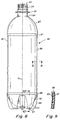
- Fig. 8 is a side elevational view of a multilayer pressurized polyester container made according to Fig. 7, which can withstand the elevated temperatures and pressures of the pasteurization process.
- Fig. 9 is a horizontal cross-section taken along line 9-9 of Fig. 8, showing the multilayer sidewall of the container.
- Fig. 10 is a vertical cross-section taken along line 10-10 of Fig. 8, showing one foot of the container base.
- Fig. 11 is an enlarged fragmentary cross-section of a crystallized neck finish and cap, according to one embodiment.
- Fig. 12 is an enlarged fragmentary cross-section of an amorphous neck finish and cap, according to another embodiment.
- Fig. 13 is a schematic sectional view through a preform used in an alternative embodiment to make a can.
- Fig. 14 is a schematic sectional view of an intermediate article made from the preform of Fig. 13, including as a lower portion a can which is biaxially-oriented up through the finish, and an upper portion which is removed and discarded.
- Fig. 15 is a schematic sectional view through a preform according to another embodiment having a neck finish insert and multilayer body- and base-forming portions.
- Fig. 16 is a graph of glass transition temperature (T g ) and melting temperature (T m ) for various "low-PEN" compositions of PET and PEN, useful in moderate-temperature applications.
- Fig. 17 is a graph of T g and M p for various "high-PEN" compositions of PET and PEN, useful in high-temperature applications.
- an injection-molded multilayer preform and method of making the same are illustrated in Figs. 4-6.
- the preform may be expanded to form a multilayer pasteurizable carbonated beverage container as illustrated in Figs. 7-10.
- Fig. 4 shows a substantially cylindrical preform 30 (defined by vertical center line 32) which includes an upper neck portion or finish 34 integral with a lower body-forming portion 36.
- the neck portion includes an upper sealing surface 31 which defines the open top end of the preform, and an exterior surface having threads 33 and a lowermost flange 35.
- Below the neck finish is the body-forming portion 36 which includes a flared shoulder-forming portion 37, increasing (radially inwardly) in wall thickness from top to bottom, a cylindrical panel-forming section 38, having a substantially uniform wall thickness, and a thickened base-forming section 39, which is thicker than the panel-forming section.
- the bottom end 40 of the preform is substantially hemispherical and may be thinner than the upper base-forming portion.
- This preform has a two-material, three-layer (2M, 3L) structure and is substantially amorphous and transparent.
- the multiple preform layers comprise, in serial order: outer layer 42 of virgin PET, core layer 43 of PC-PET, and inner layer 44 of virgin PET.
- the virgin PET is a homopolymer, or low copolymer with for example 2% isophthalic acid modifier, having an intrinsic viscosity of about 0.90dl/g.
- the PC-PET has an intrinsic viscosity of about 0.70.
- This particular preform is designed for making a 1.0 liter pasteurizable carbonated beverage container (as shown in Fig. 8).
- the preform 30 has a height of about 150 mm, and an outer diameter in the panel-forming section 38 of about 23.8 mm.
- the total wall thickness of the panel-forming section 38 is about 4.1 mm, and the thicknesses of the various preform sidewall layers are: outer layer 42 and inner layer 44 are each about 1.2 mm thick, and core layer 43 is about 1.7 mm thick.
- a preferred average planar stretch ratio for the panel section 38 is on the order of 13.0 to 14.5.
- the planar stretch ratio is the ratio of the average thickness of the preform panel-forming portion 38 to the average thickness of the container panel 86 (in Fig. 8), wherein the "average" is taken along the length of the respective preform and container portions.
- the average panel hoop stretch is preferably about 4.0 to 4.5 and the average panel axial stretch about 3.0 to 3.2. This produces a container panel 86 with the desired biaxial orientation and visual transparency.
- the specific panel thickness and stretch ratio selected depend on the dimensions of the bottle, the internal pressure, and the processing characteristics (as determined for example by the intrinsic viscosity of the particular materials employed).
- a suitable multilayer preform injection molding apparatus 50 is shown in Fig. 5.
- the apparatus provides a sequential introduction of two melt streams in a metered fashion and includes:
- the "A" extruder 51 is charged with 0.90 IV virgin PET resin which has been dried to below 50 ppm moisture content.
- the virgin PET resin is melted in a screw and barrel, at a barrel temperature of 285°C.
- the melt is plasticized at 300 psi (2.07 x 10 6 N ⁇ m -2 ) and 25 RPM.
- the "B" extruder 54 is charged with 0.70 IV PC-PET which has been dried down to 100-150 ppm.
- the PC-PET is melted in a screw and barrel, at a barrel temperature of 275°C.
- the melt is plasticized at 270 psi (1.86 x 10 6 N ⁇ m -2 ) and 35 RPM.
- the process sequence starts once the "A" extruder 51 is fully charged, and the shot pot 56 is fully charged with material from the "B" extruder 54.
- the "A" extruder 51 comes forward injecting virgin PET (for the inner and outer layers) until about 60% of the preform weight has been injected into the mold 58.
- the "A" injection is preprogramed to stop at this point, thus giving a predetermined metered virgin PET shot.
- the melt valve 55 extends fully to a position which provides clearance for the valve cam 53 to shift.
- the valve cam 53 then shifts to the "B" position and the melt valve 55 is retracted until it rests against the valve cam 53.
- melt channel 52A for the "A" extruder 51 to the preform mold 58 is blocked, but the melt channel 52B for the shot pot 56 to the preform mold 58 is opened.
- the shot pot 56 extends pushing the PC-PET melt (for the core layer) through the melt valve 55 filling the preform mold 58.
- the ball check 57 prevents the flow of melt back into the "B" extruder 54.
- the melt valve 55 again extends fully for enough time that the valve cam 53 can shift back to the "A" position. The melt valve 55 then pulls back until it rests again on the valve cam 53.
- melt channel 52B from the shot pot 56 to the preform mold is blocked, but the melt channel 52A from the "A" extruder 51 to the preform mold 58 is opened.
- the "A" extruder 51 again comes forward and packs the mold against shrinkage of the preform 59 and clears the PC-PET from the gate 60. After packing, the mold pressure is partially reduced and held while the preform cools.
- the "A" extruder 51 plasticizes material for the next shot, and the "B" extruder 54 plasticizes material for the next shot, pushing it through the melt channel 52B and into the shot pot 56. The machine is now ready for the next cycle.
- Fig. 6 is a graph of pressure versus time showing the difference between a standard injection cycle 64 and the enhanced injection cycle 66 of the present invention.
- the standard curve 64 is for a 2-material, 3-layer preform structure including a first shot of about 0.70 IV virgin PET resin, and a second shot of about 0.70 IV PC-PET resin.
- each of the polymer melts are injected into the mold at a rate of about 10-12 grams/second, a packing pressure of about 7500 psi (50 x 10 6 N ⁇ m -2 ) is applied for about four seconds, and the pressure is then dropped to about 4500 psi (30 x 10 6 N ⁇ m -2 ) for the next 15 seconds, after which the pressure is released and the preform is ejected from the mold.
- the second curve 66 shows the enhanced process of this invention.
- Both materials (0.90 virgin PET and 0.70 PC-PET) are injected at a rate of about 16-20 grams/second, the packing pressure is held at about 10,500 psi (70 x 10 6 N ⁇ m -2 ) for about three seconds, the pressure is dropped to about 6,000 psi (40 x 10 6 N ⁇ m -2 ) for the next 15 seconds, and then the pressure is released and the preform ejected from the mold.
- Increasing the pressures (above previous levels) is believed to force higher levels of interlayer bonding, which may include chain entanglement, hydrogen bonding, low-level interlayer crystallization and layer penetration.
- the increased pressure holds the preform against the cold mold wall to solidify the preform without haze (i.e., loss of transparency), at the minimum possible cycle time. Reduction of the hold time may be desirable to avoid pushing a solidified gate into a molten preform base, which would result in plastic deformation and weakness in the gate area. In addition, it is believed that faster injection rates yield higher melt temperatures within the injection cavity, resulting in increased polymer mobility which improves migration and entanglement during the enhanced pressure portion of the injection cycle.
- increasing the average preform temperature e.g., in this example to 115°C
- decreasing the temperature gradient through the preform wall e.g., in this example to less than 5°C temperature difference
- Fig. 7 illustrates a stretch blow-molding apparatus 70 for making a container from the preform 30. More specifically, the substantially amorphous and transparent preform body section 30 (of Fig. 4) is reheated to a temperature above the glass transition temperatures of the PET and PC-PET layers, and then positioned in a blow mold 71. A stretch rod 72 axially elongates (stretches) the preform within the blow mold to ensure complete axial elongation and centering of the preform. The thickened base-forming region 39 of the preform resists axial deformation compared to the panel- and shoulder-forming portions 38 and 37; this produces greater axial elongation in the resulting panel and shoulder portions of the container.
- a blowing gas (shown by arrows 73) is introduced to radially inflate the preform during axial stretching in a customary manner to match the configuration of an inner molding surface 74 of the blow mold.
- the formed container 80 is substantially transparent but has undergone strain-induced crystallization to provide increased strength (to withstand carbonation and the increased pressure during pasteurization).
- Fig. 8 shows a 1.0 liter pasteurizable multilayer beverage bottle 80 made from the preform of Fig. 4.
- the tubular body-forming portion 36 of the preform has been expanded to form a substantially transparent, biaxially-oriented container body 81.
- the upper thread finish 34 has not been expanded, but is of sufficient thickness or material construction to provide the required strength.
- the bottle has an open top end 82 and receives a screw-on cap (see Figs. 11-12).
- the expanded container body 81 includes:
- the panel-forming section 38 of the preform may be stretched at an average planar stretch ratio on the order of 13.0 to 14.5; the virgin PET layers of the resulting panel section 86 have an average crystallinity on the order of 20% to 30%, and preferably on the order of 25% to 29%.
- the shoulder 83 undergoes an average planar stretch ratio of about 10.0 to 12.0; the virgin PET layers of the resulting shoulder 83 have an average crystallinity of about 20% to 25%.
- the hemispherical bottom wall 92 in the base undergoes an average planar stretch of about 5.0 to 7.0 and the virgin PET layers have about 5% to 15% average crystallinity; the legs and feet undergo an average planar stretch of about 13.0 to 14.0, and the virgin PET layers have about 20% to 26% average crystallinity.
- the core PC-PET layer has somewhat less crystallinity in each respective region.
- Fig. 9 shows a cross-section of the panel wall 86, including inner layer 95 of virgin PET, core layer 96 of PC-PET, and outer layer 97 of virgin PET.
- the relative percent by total weight of the various layers in the panel section are about 30% for inner layer 95, about 40% for core layer 96, and about 30% for outer layer 97.
- a known five-foot PET disposable carbonated beverage container (non-pasteurizable) has a relatively low base profile ( ⁇ of about 45°).
- the present base preferably has a relatively high base profile on the order of 60° or better.
- the relative heights of the base are illustrated as H A for the full hemi, and H B for the truncated hemi. It is preferable to provide a base height between H B and H A , and more preferably where ⁇ is greater than 65°.
- the foot pad is preferably spaced a distance L F from the vertical centerline CL to a point G which is vertically aligned with a center point of radius R G .
- Radius R G forms the outer edge of the foot pad.
- the foot pad forms an angle ⁇ with a horizontal surface 102 on which the base rests.
- L F is on the order of 0.32R to 0.38R
- ⁇ is on the order of 5° to 10°, to allow each foot pad and leg to move out under creep, and yet remain within the diameter of the container.
- Fig. 11 is an enlarged cross-section of an opacified neck finish enclosure according to one embodiment. More specifically, the unoriented neck finish 110 has been thermally crystallized (opacified) by for example, high-temperature exposure; this increases the strength and enhances its resistance to the increased temperature and pressure of pasteurization. The heat-treated area may extend just below the flange 111.
- a cap 116 has an annular ring 117 of a resilient material (e.g., plastisol or other thermoplastic elastomer) which seals an upper surface 112 of the neck finish. If there is any deformation of the neck finish during pasteurization, the liner 117 deforms to ensure a tight seal and prevent leakage.
- a resilient material e.g., plastisol or other thermoplastic elastomer
- a substantially amorphous and unoriented neck finish 120 is provided, i.e., it has not been crystallized.
- the amorphous neck finish is provided with a laminated foil liner 124, which lies within an inner surface of a cap 126, and which may, for example, be heat sealed or adhesively sealed to an upper surface 122 of the neck finish. Again, if there is any deformation of the neck finish, the liner 124 ensures a tight seal to prevent leakage.
- a relatively wide mouth container such as a can is formed according to the present invention.
- the can may be formed from a preform according to the process described in U.S. Patent No. 4,496,064 to Beck et al., which issued January 29, 1985, and which is hereby incorporated by reference in its entirety.
- Fig. 13 shows a preform 142 (from the Beck patent) which includes a support flange 144, a thin upper body portion 145 which flares into a thick generally cylindrical main body portion 146, and a generally hemispherical bottom portion 148.
- the Beck process enables a high degree of biaxial orientation to be obtained in all portions of the resulting container, e.g., can, so that the container may have economical thin walls while having the desired strength characteristics.
- the preform is expanded to form an intermediate article 150, which includes a lower portion 152 in the form of the desired container, and an upper portion 154.
- the lower portion includes a cylindrical body 132, concave bottom 134, tapered shoulder 136, mouth 138, and annular flange 130.
- the upper portion is severed from the flange 130 at part 164 (as by cutting or laser trimming, and discarded or ground and the material reused). It is not necessary to thermally crystallize or otherwise reinforce the upper end of the container, because the biaxial orientation provides the necessary strength.
- a high T g amorphous or crystallized neck portion is formed on one set of cores, while in the other set of cavities (second molding station) a plurality of amorphous body-forming portions are formed on the other set of cores.
- the cores are sequentially positioned in each of the first and second molding stations.
- a polyester preform for making a hot-fillable container has a crystallized neck portion 180 of CPET, a terephthalic polyester with nucleating agents which render the polymer rapidly crystallizable during injection molding.
- CPET is sold by Eastman Chemical Company, Kingsport, Tennessee.
- the body-forming portion 181 is a two-material, three-layer (2M, 3L) structure, including inner and outer layers of virgin polyethylene terephthalate (PET), and a core layer of for example post-consumer PET (PC-PET).
- the base-forming portion 182 is similar to the body-forming portion, but may include a core layer 183 of virgin PET in at least the bottom part and possibly extending through to the exterior of the preform.
- the core layer 183 in the base may be of a higher T g polymer to enhance the thermal stability of the resulting container base; this is particularly useful with champagne-type container bases.
- the higher T g polymer may be injected via a third extruder.
- Numerous alternative high-glass transition (T g ) polymers may be used in place of CPET, such as arylate polymers, polyethylene naphthalate (PEN) homopolymers, copolymers or blends, polycarbonates, etc.
- PEN polyethylene naphthalate
- PEN polyethylene naphthalate
- copolymers or blends polycarbonates, etc.
- numerous alternative polymers and layer structures are possible, incorporating PEN, ethylene/vinyl alcohol (EVOH) or MXD-6 nylon barrier layers, oxygen scavenging polymers, etc.
- the container is useful in a variety of applications, including refillable, pasteurizable, and hot-fillable containers.
- one or more layers of the preform and container, or portions thereof can be made of various other polymers, such as polyolefins (e.g., polypropylene and polyethylene), polyvinyl chloride, polyarcylate, etc.
- Suitable polyesters include homopolymers, copolymers or blends of polyethylene terephthalate (PET), polybutylene terephthalate (PBT), polypropylene terephthalate (PPT), polyethylene napthalate (PEN), and a cyclohexane dimethanol/PET copolymer, known as PETG (available from Eastman Chemical Company, Kingsport, Tennessee). Polyesters based on terephthalic or isophthalic acid are commercially available and convenient.
- the hydroxy compounds are typically ethylene glycol and 1,4-di-(hydroxy methyl)-cyclohexane.
- the phthalate polyester may include polymer linkages, side chains, and end groups not related to the formal precursors of a simple phthalate polyester previously specified. Conveniently, at least 90 mole percent will be terephthalic acid and at least 90 mole percent an aliphatic glycol or glycols, especially ethylene glycol.
- PC-PET Post-consumer PET
- I.V. intrinsic viscosity
- moisture content a substance that is removed by consumers for a recycling operation
- contaminants a certain level of contaminants.
- typical PC-PET having a flake size of one-half inch maximum
- I.V. average about 0.66dl/g
- moisture content a moisture content of less than 0.25%
- PEN polyethylene naphthalate
- PEN provides a 3-5X improvement in barrier property and enhanced thermal resistance, at some additional expense.
- Polyethylene naphthalate (PEN) is a polyester produced when dimethyl 2,6-naphthalene dicarboxylate (NDC) is reacted with ethylene glycol.
- NDC dimethyl 2,6-naphthalene dicarboxylate
- the PEN polymer comprises repeating units of ethylene 2,6 naphthalate.
- PEN resin is available having an inherent viscosity of 0.67dl/g and a molecular weight of about 20,000 from Amoco Chemical Company, Chicago, Illinois.
- PEN has a glass transition temperature T g of about 123°C, and a melting temperature T m of about 267°C.
- PET and PEN may be blended or copolymerized in various amounts as shown in Figs. 16-17. In the ranges of about 0-20% PEN and 80-100% PEN, the material is crystalline, while from about 20-80% PEN the material is substantially amorphous.
- PET and PEN The structures of PET and PEN are shown below:
- Suitable polyamides include PA6, PA6,6, PA6,4, PA6,10, PA11, PA12, etc.
- Other options include acrylic/amide, amorphous nylon, polyacrylonitrile (PAN), polystyrene, crystallizable nylon (MXD-6), polyethylene (PE), polypropylene (PP), and polyvinyl chloride (PVC).
- the multilayer preform/container may also include one or more layers of an oxygen barrier material such as ethylene/vinyl alcohol (EVOH), PEN, polyvinyl alcohol (PVOH), polyvinyldene chloride (PVDC), nylon 6, crystallizable nylon (MXD-6), LCP (liquid crystal polymer), amorphous nylon, polyacrylonitrile (PAN) and styrene acrylonitrile (SAN).
- an oxygen barrier material such as ethylene/vinyl alcohol (EVOH), PEN, polyvinyl alcohol (PVOH), polyvinyldene chloride (PVDC), nylon 6, crystallizable nylon (MXD-6), LCP (liquid crystal polymer), amorphous nylon, polyacrylonitrile (PAN) and styrene acrylonitrile (SAN).
- EVOH ethylene/vinyl alcohol
- PEN polyvinyl alcohol
- PVDC polyvinyldene chloride
- MXD-6 crystallizable nylon
- LCP liquid crystal
- the intrinsic viscosity (I.V.) effects the processability of the resins.
- Polyethylene terephthalate having an intrinsic viscosity of about 0.8 is widely used in the carbonated soft drink (CSD) industry.
- Polyester resins for various applications may range from about 0.55 to about 1.04, and more particularly from about 0.65 to 0.85dl/g.
- Intrinsic viscosity measurements of polyester resins are made according to the procedure of ASTM D-2857, by employing 0.0050 ⁇ 0.0002 g/ml of the polymer in a solvent comprising o-chlorophenol (melting point 0°C), respectively, at 30°C.
- the blown container body should be substantially transparent.
- the diffuse and specular light transmission values are measured in accordance with ASTM Method D 1003, using any standard color difference meter such as model D25D3P manufactured by Hunterlab, Inc.
- the container body should have a percent haze (through the panel wall) of less than about 10%, and more preferably less than about 5%.
- the preform body-forming portion should also be substantially amorphous and transparent, having a percent haze across the wall of no more than about 10%, and more preferably no more than about 5%.
- the container will have varying levels of crystallinity at various positions along the height of the bottle from the neck finish to the base.
- the panel portion of the container is stretched the greatest and preferably has an average percent crystallinity of at least about 15%, and more preferably at least about 20%. For primarily PET polymers, a 25 to 29% crystallinity range is useful in the panel region.
- crystallinity can be achieved by heat setting to provide a combination of strain-induced and thermal-induced crystallization.
- Thermal-induced crystallinity is achieved at low temperatures to preserve transparency, e.g., holding the container in contact with a low temperature blow mold. In some applications, a high level of crystallinity at the surface of the sidewall alone is sufficient
- the preform may include one or more layers of an oxygen-scavenging material.
- suitable oxygen- scavenging materials are described in U.S. Serial No. 08/355,703 filed December 14, 1994 by Collette et al., entitled "Oxygen Scavenging Composition For Multilayer Preform And Container,” which is hereby incorporated by reference in its entirety.
- the oxygen scavenger may be a metal-catalyzed oxidizable organic polymer, such as a polyamide, or an anti-oxidant such as phosphite or phenolic.
- the oxygen scavenger may be mixed with PC-PET to accelerate activation of the scavenger.
- the oxygen scavenger may be advantageously combined with other thermoplastic polymers to provide the desired injection molding and stretch blow molding characteristics for making substantially amorphous injection molded preforms and substantially transparent biaxially-oriented polyester containers.
- the oxygen scavenger may be provided as an interior layer to retard migration of the oxygen scavenger or its byproducts, and to prevent premature activation of the scavenger.
Landscapes
- Engineering & Computer Science (AREA)
- Mechanical Engineering (AREA)
- Ceramic Engineering (AREA)
- Manufacturing & Machinery (AREA)
- Blow-Moulding Or Thermoforming Of Plastics Or The Like (AREA)
- Laminated Bodies (AREA)
- Processing And Handling Of Plastics And Other Materials For Molding In General (AREA)
- Casting Or Compression Moulding Of Plastics Or The Like (AREA)
Claims (55)
- Verfahren zum Herstellen eines mehrschichtigen Behälters (80) mit mindestens zwei thermoplastischen Materialien, wobei das Verfahren die folgenden Schritte umfaßt:Einspritzen eines ersten thermoplastischen Materials mit einer ersten Eigenviskosität (IV) in einen Vorformlings-Formhohlraum (58) bei einer ersten Einspritzrate, um eine erste Schicht eines Vorformlings (30) zu formen;Einspritzen eines zweiten thermoplastischen Materials mit einer zweiten IV, die sich um mindestens 0,10 dl/g von der ersten IV unterscheidet, in einen Vorformlings-Formhohlraum (58) bei einer zweiten Einspritzrate, um eine zweite Schicht (43) des Vorformlings (30) neben der ersten Schicht (42) zu formen;Ausüben eines Druckes auf die ersten und zweiten Schichten (42, 43) im Vorformlings-Formhohlraum (58), wobei die Einspritzraten und der Druck so gewählt werden, daß eine Schichthaftung zwischen den ersten und zweiten Schichten (42, 43) gefördert wird;Blasformen eines Behälters (80) aus dem Vorformling (30) in einer Blasform (71), wobei der Behälter (80) einen Fall aus einem Meter Höhe auf eine harte starre Fläche ohne Schichtablösung übersteht.
- Verfahren nach Anspruch 1, wobei sich die zweite IV um mindestens 0,20 dl/g von der ersten IV unterscheidet.
- Verfahren nach Anspruch 1, wobei die ersten und zweiten thermoplastischen Materialien Polyester sind.
- Verfahren nach Anspruch 1, wobei das erste thermoplastische Material ungebrauchtes Polyethylenterephthalat (PET) umfaßt und die erste IV mindestens ungefähr 0,85 dl/g beträgt.
- Verfahren nach Anspruch 5, wobei die erste IV mindestens ungefähr 9,90 dl/g beträgt.
- Verfahren nach Anspruch 4, wobei das zweite thermoplastische Material gebrauchtes PET (PC-PET) umfaßt und die zweite IV nicht größer ist als ungefähr 0,75 dl/g.
- Verfahren nach einem der Ansprüche 3-6, wobei der Druck mindestens ungefähr 60 x 106 N/m2 (9000 psi) beträgt.
- Verfahren nach Anspruch 7, wobei der Druck in der Größenordnung von 60 x 106 bis 80 x 106 N/m2 (9000 - 12000 psi) liegt.
- Verfahren nach Anspruch 8, wobei mindestens eine der ersten und zweiten Einspritzraten in der Größenordnung von 16 bis 20 g/s liegt.
- Verfahren nach Anspruch 9, wobei beide Einspritzraten in der Größenordnung von 16 bis 20 g/s liegen.
- Verfahren nach Anspruch 7, wobei die Temperatur beim Blasformen so gewählt ist, daß ein Zwischenschicht-Scheren während der Ausdehnung des mehrschichtigen Vorformlings verringert wird.
- Verfahren nach Anspruch 11, wobei die Blasformungstemperatur in der Größenordnung von 110 bis 118° C liegt.
- Verfahren nach Anspruch 1, wobei die erste IV höher ist als die zweite IV.
- Verfahren nach Anspruch 13, wobei das erste Material eine äußere Vorformlingsschicht (42) und das zweite Material eine innere Vorformlingsschicht (43) bildet.
- Verfahren nach Anspruch 1, weiterhin umfassend:Einspritzen eines dritten thermoplastischen Materials bei einer dritten Einspritzrate, um eine Schicht neben einer der ersten und zweiten Schichten (42, 43) zu bilden, wobei das dritte Material eine dritte IV hat, die sich um mindestens 0,10 dl/g von der IV des Materials derjenigen der ersten und zweiten Schichten unterscheidet, die daneben liegt.
- Verfahren nach Anspruch 15, wobei die ersten und zweiten Materialien mindestens einen die Seitenwand bildenden Abschnitt (181) des Vorformlings (30) bilden und das dritte Material in einem den Boden bildenden Abschnitt (183) des Vorformlings (30) enthalten ist.
- Verfahren nach Anspruch 16, wobei die ersten und dritten Materialien eine höhere IV haben als das zweite Material.
- Verfahren nach Anspruch 1, wobei der Behälter (80) ein mehrschichtiger wärmebeständiger Behälter (80) ist, der druckbeaufschlagt werden kann, wobei das erste thermoplastische Material ein erstes Polymer ist, um Wärmbeständigkeit und Kriechbeständigkeit zu erreichen, und wobei das zweite thermoplastische Material ein zweites Polymer mit einer geringeren Wärmebeständigkeit und Kriechbeständigkeit im Vergleich zum ersten Polymer ist, wobei das erste Polymer eine IV hat, die höher ist als diejenige des zweiten Polymers.
- Verfahren nach Anspruch 18, wobei die ausgewählten Einspritzraten zu einer erhöhten Polymer-Fließfähigkeit für eine verbesserte Migration und Verkettung führen, während der Druck auf den Vorformlings-Hohlraum (58) ausgeübt wird.
- Verfahren nach Anspruch 19, wobei die ausgewählte Einspritzrate um mindestens 50% größer ist als eine Standardrate für das Polymer mit der niedrigeren IV.
- Verfahren nach Anspruch 19, wobei der ausgewählte Druck im Vorformlings-Hohlraum um mindestens 30% größer ist als eine Standardrate für das Polymer mit der niedrigeren IV.
- Verfahren nach Anspruch 18, wobei der Behälter (80) einen im wesentlichen durchsichtigen geblasenen Behälterkörper (81) umfaßt.
- Verfahren nach Anspruch 22, wobei der Behälterkörper (81) einen Mantelabschnitt (86) mit einer prozentualen Trübung von weniger als ungefähr 10% umfaßt.
- Verfahren nach Anspruch 18, wobei der geformte Behälter (80), nachdem er mit einer druckbeaufschlagten Flüssigkeit vom 2,5-fachen Volumen befüllt worden ist, einen Pasteurisierungsprozeß bei 70°C für 10 Minuten mit einem Volumenanstieg übersteht, der nicht größer ist als 3%.
- Biaxial orientierter mehrschichtiger Behälter (80), der durch das Ausdehnen eines Vorformlings hergestellt worden ist und mindestens zwei thermoplastische Materialien umfaßt, wobei der Behälter eine erste Schicht (95) aus einem ersten thermoplastischen Material mit einer ersten Eigenviskosität (IV) aufweist sowie eine zweite Schicht neben der ersten Schicht (95) aus einem zweiten thermoplastischen Material mit einer zweiten IV, die sich um mindestens 0,10 dl/g von der ersten IV unterscheidet, wobei der Behälter einen Fall aus einem Meter Höhe auf eine harte starre Fläche ohne eine Ablösung der ersten und zweiten Schichten (95, 96) voneinander übersteht.
- Behälter nach Anspruch 25, wobei sich die zweite IV um mindestens 0,20 dl/g von der ersten IV unterscheidet.
- Behälter nach Anspruch 25, wobei die ersten und zweiten thermoplastischen Materialien Polyester sind.
- Behälter nach Anspruch 25, wobei das erste thermoplastische Material ungebrauchtes Polyethylenterephthalat (PET) umfaßt und die erste IV mindestens ungefähr 0,85 dl/g beträgt.
- Behälter nach Anspruch 28, wobei das zweite thermoplastische Material gebrauchtes PET (PC-PET) ist und die zweite IV nicht größer ist als ungefähr 0,75 dl/g.
- Behälter nach Anspruch 25, wobei der Behälter (80), nachdem er mit einer druckbeaufschlagten Flüssigkeit vom 2,5-fachen Volumen befüllt, abgedichtet und dann einer angehobenen Temperatur von 75°C ausgesetzt worden ist, einer Gesamtvolumen-Änderung von nicht mehr als ungefähr 3% unterliegt.
- Behälter nach Anspruch 30, wobei die Gesamtvolumen-Änderung nicht größer ist als ungefähr 2%.
- Behälter nach Anspruch 25, wobei die erste IV höher ist als die zweite IV.
- Behälter nach Anspruch 32, wobei das erste Material eine Außenschicht (95) bildet und das zweite Material eine Innenschicht (96).
- Behälter nach Anspruch 25, weiterhin umfassend:ein drittes thermoplastisches Material, das eine dritte Schicht neben einer der ersten und zweiten Schichten (95, 96) bildet, wobei das dritte Material eine dritte IV hat, die sich mindestens um 0,10 dl/g von der IV des Materials derjenigen der ersten und zweiten Schichten (90, 96) unterscheidet, die daneben liegt.
- Behälter nach Anspruch 34, wobei die ersten und zweiten Materialien mindestens eine Seitenwand des Behälters (80) bilden, und wobei das dritte Material in einem Boden (90) des Behälters (80) enthalten ist.
- Behälter nach Anspruch 35, wobei die ersten und dritten Materialien eine höhere IV haben als das zweite Material.
- Behälter nach Anspruch 27 mit einem allgemein zylindrischen Mantelabschnitt (86) mit einem Höhe-Durchmesser-Verhältnis in der Größenordnung von 2,0 bis 3,0, einer Mantelwanddicke in der Größenordnung von 0,25 bis 0,38 mm und einem mittleren planaren Streckungsverhältnis im Mantelabschnitt in der Größenordnung von 13,0 bis 14,5, und einem Boden (90) mit einer im wesentlichen halbkugelförmigen Bodenwand (92) und einer Mehrzahl von Beinen (91), wobei die Bodenwand (92) eine Dicke in der Größenordnung von 0,60 bis 2,5 mm hat.
- Behälter nach Anspruch 27, wobei sich die Bodenwand (92) von ungefähr = 60° bis = 90° von einer vertikalen Mittellinie des Behälters (80) erstreckt.
- Behälter nach Anspruch 38, wobei jedes Bein (91) einen schrägen Fuß (93) hat, der in einem Winkel von ungefähr 5 bis 10° zu der flachen Fläche angeordnet ist, auf der der Behälter (80) ruht.
- Behälter nach Anspruch 39, wobei die geformten schrägen Füße (93) bei ungefähr 60 bis 75% des Behälter-Durchmessers angeordnet sind.
- Behälter nach Anspruch 37, wobei der Behälter einen nach außen vorstehenden und im wesentlichen abgerundeten Schulterabschnitt (83) oberhalb des Mantelabschnittes (86) aufweist.
- Behälter nach Anspruch 37, wobei das erste thermoplastische Material ungebrauchtes PET ist und äußere Innen- und Außenschichten (95, 97) bildet, und das zweite thermoplastische Material gebrauchtes PET ist und eine innere Kernschicht zwischen den Innen- und Außenschichten (95, 97) bildet.
- Behälter nach Anspruch 42, wobei das zweite thermoplastische Material in der Größenordnung von 30 bis 60 Gewichts-% des Gesamtgewichts des Behälters (80) liegt.
- Behälter nach Anspruch 43, wobei das erste thermoplastische Material in der Größenordnung von 40 bis 70 Gewichts-% des Gesamtgewichtes des Behälters (80) liegt.
- Behälter nach Anspruch 25 mit einem Schulterabschnitt (83), einem Mantelabschnitt (86) mit einem Höhe-Durchmesser-Verhältnis in der Größenordnung von 2,0 bis 3,0 und mit einem mittleren planaren Streckungsverhältnis mindestens in der Größenordnung von 13,0 und einem mit Füßen versehenen Boden (90), der eine im wesentlichen halbkugelförmige Bodenwand (92) umfaßt, wobei die Bodenwand (92) eine Dicke hat, die größer ist als diejenige des Mantelabschnittes (86).
- Behälter nach Anspruch 45, wobei die Bodenwand (92) ein Bodenprofil von = 60° bis 90° hat, wobei ein Winkel ist, um den sich ein Radius, der die im wesentlichen halbkugelförmige Bodenwand (92) definiert, von einer vertikalen Mittellinie des Behälters (80) erstreckt.
- Behälter nach Anspruch 25, wobei der Behälter (80) ein mehrschichtiger, wärmebeständiger druckbeaufschlagter Behälter (80) ist und das erste thermoplastische Material ein Polymer mit relativ hoher IV ist, um Wärmebeständigkeit und Kriechbeständigkeit zu gewährleisten, und wobei das zweite thermoplastische Material ein Polymer mit relativ niedriger IV und dementsprechend geringerer Wärmebeständigkeit und Kriechbeständigkeit im Vergleich zum Polymer mit der höheren IV ist.
- Behälter nach Anspruch 47, wobei der Behälter (80) einen im wesentlichen durchsichtigen geblasenen Behälterkörper (81) umfaßt.
- Behälter nach Anspruch 48, wobei der Behälterkörper (81) einen Mantelabschnitt (86) mit einer prozentualen Trübung von weniger als ungefähr 10% aufweist.
- Behälter nach Anspruch 47, wobei der geformte Behälter (80), nachdem er mit einer druckbeaufschlagten Flüssigkeit vom 2,5-fachen Volumen befüllt worden ist, einen Pasteurisierungsprozeß bei 70°C für 10 Minuten mit einem Volumenzuwachs übersteht, der nicht größer ist als ungefähr 3%.
- Mehrschichtiger Vorformling (30) zum Blasformen eines Behälters (80), wobei der Vorformling (30) eine erste Schicht (42) aus einem ersten Polyestermaterial mit einer ersten Eigenviskosität (IV) hat und eine zweite Schicht (43) neben der ersten Schicht aus einem zweiten Polyestermaterial mit einer zweiten Eigenviskosität (IV), die sich um mindestens 0,20 dl/g von der ersten IV unterscheidet, wobei der mehrschichtige Vorformling (30) spritzgeformt ist ohne Trennung der ersten und zweiten Schichten (42, 43).
- Vorformling nach Anspruch 51, wobei der erste Polyester ein Polymer mit relativ hoher IV ist, um Wärmbeständigkeit und Kriechbeständigkeit zu erreichen, und der zweite Polyester ein Polymer mit relativ niedriger IV und dementsprechend geringerer Wärmebeständigkeit und Kriechbeständigkeit im Vergleich zum Polymer mit der höheren IV.
- Vorformling nach Anspruch 51, wobei der erste Polyester ungebrauchtes Polyethylenterephthalat (PET) umfaßt und die erste IV mindestens ungefähr 0,85 dl/g beträgt.
- Vorformling nach Anspruch 53, wobei der zweite Polyester gebrauchtes PET (PC-PET) ist und die zweite IV nicht größer ist als ungefähr 0,75 dl/g.
- Vorformling nach Anspruch 52, wobei der erste Polyester eine Außenschicht (42) bildet und der zweite Polyester eine Innenschicht (43).
Applications Claiming Priority (3)
| Application Number | Priority Date | Filing Date | Title |
|---|---|---|---|
| US08/610,810 US5804016A (en) | 1996-03-07 | 1996-03-07 | Multilayer container resistant to elevated temperatures and pressures, and method of making the same |
| US610810 | 1996-03-07 | ||
| PCT/US1997/003842 WO1997032708A1 (en) | 1996-03-07 | 1997-03-06 | Multilayer container resistant to elevated temperatures and pressures, and method of making the same |
Publications (2)
| Publication Number | Publication Date |
|---|---|
| EP0885105A1 EP0885105A1 (de) | 1998-12-23 |
| EP0885105B1 true EP0885105B1 (de) | 2002-07-24 |
Family
ID=24446502
Family Applications (1)
| Application Number | Title | Priority Date | Filing Date |
|---|---|---|---|
| EP19970915914 Expired - Lifetime EP0885105B1 (de) | 1996-03-07 | 1997-03-06 | Gegen hohe temperaturen und drücke beständiger mehrschichtiger behälter und verfahren zu seiner herstellung |
Country Status (11)
| Country | Link |
|---|---|
| US (3) | US5804016A (de) |
| EP (1) | EP0885105B1 (de) |
| AT (1) | ATE220979T1 (de) |
| AU (1) | AU2322197A (de) |
| BR (1) | BR9708088A (de) |
| CA (1) | CA2248106C (de) |
| DE (1) | DE69714219T2 (de) |
| DK (1) | DK0885105T3 (de) |
| ES (1) | ES2180963T3 (de) |
| PT (1) | PT885105E (de) |
| WO (1) | WO1997032708A1 (de) |
Cited By (1)
| Publication number | Priority date | Publication date | Assignee | Title |
|---|---|---|---|---|
| WO2017156384A1 (en) * | 2016-03-11 | 2017-09-14 | Ring Container Technologies | Method of manufacture of a container |
Families Citing this family (139)
| Publication number | Priority date | Publication date | Assignee | Title |
|---|---|---|---|---|
| AR002773A1 (es) * | 1995-07-07 | 1998-04-29 | Continental Pet Technologies | Metodo para el moldeado por inyeccion de un articulo plastico y aparato para llevarlo a cabo. |
| US5804016A (en) * | 1996-03-07 | 1998-09-08 | Continental Pet Technologies, Inc. | Multilayer container resistant to elevated temperatures and pressures, and method of making the same |
| US5851471A (en) * | 1996-05-16 | 1998-12-22 | The Coca-Cola Company | Method for injection molding a multi-layer preform for use in blow molding a plastic bottle |
| CA2494247C (en) * | 1997-04-16 | 2006-03-28 | Husky Injection Molding Systems Ltd. | Partial crystallization method and apparatus of amorphous plastic articles |
| US6090337A (en) | 1997-07-30 | 2000-07-18 | Plastipak Packaging, Inc. | Method for making multi-layer plastic preform for blow molding |
| US6123211A (en) * | 1997-10-14 | 2000-09-26 | American National Can Company | Multilayer plastic container and method of making the same |
| US6352426B1 (en) * | 1998-03-19 | 2002-03-05 | Advanced Plastics Technologies, Ltd. | Mold for injection molding multilayer preforms |
| TWI250934B (en) | 1997-10-17 | 2006-03-11 | Advancsd Plastics Technologies | Barrier-coated polyester articles and the fabrication method thereof |
| US6074668A (en) * | 1998-01-09 | 2000-06-13 | Abbott Laboratories | Container for an inhalation anesthetic |
| US6162443A (en) * | 1998-01-09 | 2000-12-19 | Abbott Laboratories | Container for an inhalation anesthetic |
| US20030200963A1 (en) * | 1998-01-09 | 2003-10-30 | Flament-Garcia Mary Jane | Container for an inhalation anesthetic |
| US6562276B1 (en) * | 1998-08-20 | 2003-05-13 | Eastman Chemical Company | Process for forming a multilayer, coinjected article |
| IT1305273B1 (it) | 1998-08-28 | 2001-04-19 | Sipa Spa | Impianto e procedimento perfezionati per la produzione dipreforme multistrato. |
| US6749785B2 (en) * | 1998-09-01 | 2004-06-15 | E. I. Du Pont De Nemours And Company | Multilayer structures of poly(1,3-propylene 2,6 napthalate) and poly (ethylene terephthalate) |
| US6524672B1 (en) * | 1999-02-12 | 2003-02-25 | Plastipak Packaging, Inc. | Multilayer preform and container with co-extruded liner |
| DE19907387A1 (de) * | 1999-02-20 | 2000-08-31 | Karl Hehl | Aus mehreren Werkstoffen bestehender Kunststoffartikel sowie Verfahren zu dessen Herstellung |
| US6475579B1 (en) * | 1999-08-06 | 2002-11-05 | Plastipak Packaging, Inc. | Multi-layer plastic container having a carbon-treated internal surface and method for making the same |
| US20040173565A1 (en) * | 1999-12-01 | 2004-09-09 | Frank Semersky | Pasteurizable wide-mouth container |
| ATE321645T1 (de) * | 2000-06-27 | 2006-04-15 | Graham Packaging Co | Verfahren zur herstellung eines mehrschichtigen blasgeformten behälters |
| ES2292611T3 (es) | 2000-08-08 | 2008-03-16 | Evergreen Packaging International B.V. | Procedimiento para la activacion de componentes secuestradores de oxigeno durante un proceso de llenado de cajas de carton con tapa de pico. |
| NZ521694A (en) | 2002-09-30 | 2005-05-27 | Co2 Pac Ltd | Container structure for removal of vacuum pressure |
| US7900425B2 (en) | 2005-10-14 | 2011-03-08 | Graham Packaging Company, L.P. | Method for handling a hot-filled container having a moveable portion to reduce a portion of a vacuum created therein |
| US8127955B2 (en) | 2000-08-31 | 2012-03-06 | John Denner | Container structure for removal of vacuum pressure |
| US8381940B2 (en) | 2002-09-30 | 2013-02-26 | Co2 Pac Limited | Pressure reinforced plastic container having a moveable pressure panel and related method of processing a plastic container |
| US7543713B2 (en) * | 2001-04-19 | 2009-06-09 | Graham Packaging Company L.P. | Multi-functional base for a plastic, wide-mouth, blow-molded container |
| US8584879B2 (en) | 2000-08-31 | 2013-11-19 | Co2Pac Limited | Plastic container having a deep-set invertible base and related methods |
| US10435223B2 (en) | 2000-08-31 | 2019-10-08 | Co2Pac Limited | Method of handling a plastic container having a moveable base |
| WO2005012091A2 (en) | 2003-07-30 | 2005-02-10 | Graham Packaging Company, L.P. | Container handling system |
| US20030196926A1 (en) * | 2001-04-19 | 2003-10-23 | Tobias John W. | Multi-functional base for a plastic, wide-mouth, blow-molded container |
| US10246238B2 (en) | 2000-08-31 | 2019-04-02 | Co2Pac Limited | Plastic container having a deep-set invertible base and related methods |
| CZ2003739A3 (cs) | 2000-09-05 | 2003-09-17 | Advanced Plastics Technologies, Ltd. | Vícevrstvé polotovary mající ochranné vlastnosti, využívající recyklovaný materiál, způsob jejich výroby a zařízení k provádění způsobu |
| CA2426276C (en) * | 2000-10-19 | 2008-02-19 | Teijin Limited | Multi-layered preform and production process therefor |
| WO2002085755A1 (en) | 2001-04-19 | 2002-10-31 | Graham Packaging Company, L.P. | Multi-functional base for a plastic wide-mouth, blow-molded container |
| WO2003032890A1 (en) * | 2001-10-18 | 2003-04-24 | Abbott Laboratories | Container for an inhalation anesthetic |
| CA2464434C (en) | 2001-10-24 | 2011-02-22 | Pechiney Emballage Flexible Europe | Polypropylene container and process for making it |
| EG23499A (en) * | 2002-07-03 | 2006-01-17 | Advanced Plastics Technologies | Dip, spray, and flow coating process for forming coated articles |
| JP2004067171A (ja) * | 2002-08-06 | 2004-03-04 | Yoshino Kogyosho Co Ltd | ブロー成形品 |
| US9969517B2 (en) | 2002-09-30 | 2018-05-15 | Co2Pac Limited | Systems and methods for handling plastic containers having a deep-set invertible base |
| DE60326995D1 (de) * | 2002-10-30 | 2009-05-14 | Toyo Seikan Kaisha Ltd | Vorformling und aus dem vorformling erhaltener biaxial gestreckter behälter |
| MXPA05004888A (es) | 2002-11-08 | 2005-08-18 | Advanced Plastics Technologies | Molde de inyeccion que tiene una porcion resistente al desgaste y una porcion de alta transferencia termica y un metodo para formar una preforma. |
| US20060237882A1 (en) * | 2002-12-26 | 2006-10-26 | Graham Packaging Company L.P. | Amorphous nylon container and method of manufacture |
| US7531125B2 (en) * | 2003-08-25 | 2009-05-12 | Ring Container Technologies | Blow molded wide mouth pet container and method of manufacture |
| US7150371B1 (en) * | 2003-10-02 | 2006-12-19 | Plastipak Packaging, Inc. | Extrusion blow molded container, apparatus and method |
| US20050136201A1 (en) * | 2003-12-22 | 2005-06-23 | Pepsico, Inc. | Method of improving the environmental stretch crack resistance of RPET without solid stating |
| US20050158495A1 (en) * | 2003-12-24 | 2005-07-21 | Nahill Thomas E. | Lightweight container and method of manufacture |
| EP1699710B1 (de) * | 2003-12-24 | 2012-07-11 | Cryovac, Inc. | Sauerstoff entfernende zusammensetzungen |
| JP4769791B2 (ja) | 2004-03-11 | 2011-09-07 | グラハム パッケージング カンパニー,エル ピー | プラスチック容器運搬方法 |
| US7481961B2 (en) * | 2004-04-01 | 2009-01-27 | Graham Packaging Pet Technologies, Inc. | Multilayer container trimming |
| WO2005102647A2 (en) * | 2004-04-16 | 2005-11-03 | Advanced Plastics Technologies, Ltd | Compression moulding multi-layered container-like articles |
| US7588808B2 (en) | 2004-04-16 | 2009-09-15 | Advanced Plastics Technologies Luxembourg S.A. | Mono and multi-layer articles and injection molding methods of making the same |
| US20050249902A1 (en) * | 2004-05-07 | 2005-11-10 | Lynch Brian A | Compression over-molding container preforms |
| US20050260370A1 (en) * | 2004-05-24 | 2005-11-24 | Graham Packaging Company, L.P. | Method for producing heat-set base of a plastic container |
| MXPA06014381A (es) * | 2004-06-10 | 2007-04-16 | Advanced Plastics Technologies | Metodos y sistemas para controlar temperaturas de moldeo. |
| US10611544B2 (en) | 2004-07-30 | 2020-04-07 | Co2Pac Limited | Method of handling a plastic container having a moveable base |
| WO2006012713A2 (en) | 2004-08-06 | 2006-02-09 | Resilux | Preform for blowing a container and process for manufacturing therof |
| BE1016289A3 (nl) * | 2004-08-06 | 2006-07-04 | Resilux | Preform voor het blaasvormen van een houder en werkwijze voor het vervaardigen hiervan. |
| US20060040581A1 (en) * | 2004-08-20 | 2006-02-23 | Davis Dennis L | Rotating ring graphics |
| US20060099306A1 (en) * | 2004-11-08 | 2006-05-11 | Hormel Foods, Llc | Packaging for use with high pressure pasteurization |
| US8017065B2 (en) | 2006-04-07 | 2011-09-13 | Graham Packaging Company L.P. | System and method for forming a container having a grip region |
| US8075833B2 (en) | 2005-04-15 | 2011-12-13 | Graham Packaging Company L.P. | Method and apparatus for manufacturing blow molded containers |
| US20060292323A1 (en) * | 2005-04-18 | 2006-12-28 | Hutchinson Gerald A | Water-resistant coated articles and methods of making same |
| US8397932B2 (en) | 2005-07-13 | 2013-03-19 | Toyo Seikan Kaisha, Ltd. | Plastic container having pearl-like appearance and process for producing the same |
| US7717697B2 (en) | 2005-08-30 | 2010-05-18 | Sharon Hutchinson | Methods and systems for controlling mold temperatures |
| BRPI0617873A2 (pt) * | 2005-10-14 | 2011-08-09 | Advanced Plastics Technologies Lux Sa | métodos de formar artigos de multicamadas por aplicações de tratamento superficial |
| US9777111B2 (en) * | 2005-10-20 | 2017-10-03 | Grupo Petrotemex, S.A. De C.V. | PET polymer with improved properties |
| US20070101681A1 (en) * | 2005-11-09 | 2007-05-10 | Toyo Seikan Kaisha, Ltd. | Method for manufacturing contents contained in a container |
| US20070232763A1 (en) * | 2006-01-30 | 2007-10-04 | Futura Polyesters Limited | Naphthalate based polyester resin compositions |
| FR2897292B1 (fr) * | 2006-02-16 | 2010-06-04 | Sidel Participations | Fond de moule pour moule de fabrication de recipients thermoplastiques, et dispositif de moulage equipe d'au moins un moule equipe d'un tel fond |
| US10457437B2 (en) | 2006-03-06 | 2019-10-29 | Plastipak Packaging, Inc. | Lightweight plastic container and preform |
| US8857637B2 (en) | 2006-03-06 | 2014-10-14 | Plastipak Packaging, Inc. | Lightweight plastic container and preform |
| US7799264B2 (en) | 2006-03-15 | 2010-09-21 | Graham Packaging Company, L.P. | Container and method for blowmolding a base in a partial vacuum pressure reduction setup |
| US20070232777A1 (en) * | 2006-04-04 | 2007-10-04 | Deardurff L Robert | Method for treating recycled polyethylene terephthalate for accelerated processing |
| US9707711B2 (en) | 2006-04-07 | 2017-07-18 | Graham Packaging Company, L.P. | Container having outwardly blown, invertible deep-set grips |
| US8747727B2 (en) | 2006-04-07 | 2014-06-10 | Graham Packaging Company L.P. | Method of forming container |
| US8124202B2 (en) * | 2006-09-15 | 2012-02-28 | The Coca-Cola Company | Multilayer container for enhanced gas barrier properties |
| US11731823B2 (en) | 2007-02-09 | 2023-08-22 | Co2Pac Limited | Method of handling a plastic container having a moveable base |
| US11897656B2 (en) | 2007-02-09 | 2024-02-13 | Co2Pac Limited | Plastic container having a movable base |
| US20080190924A1 (en) * | 2007-02-13 | 2008-08-14 | Sherwood Services, Ag | Medical sharps container |
| US8110261B2 (en) * | 2007-03-29 | 2012-02-07 | Multisorb Technologies, Inc. | Oxygen absorbing plastic structure |
| KR101509828B1 (ko) * | 2007-04-05 | 2015-04-06 | 도요세이칸 그룹 홀딩스 가부시키가이샤 | 다층 폴리에스테르 용기 및 그 제조 방법 |
| US8512783B2 (en) * | 2007-04-05 | 2013-08-20 | Graham Packaging Company Lp | Reduced pressure loss pasteurizable container and method of making the same |
| US20080257883A1 (en) | 2007-04-19 | 2008-10-23 | Inbev S.A. | Integrally blow-moulded bag-in-container having an inner layer and the outer layer made of the same material and preform for making it |
| US9919841B2 (en) | 2007-04-19 | 2018-03-20 | Anheuser-Busch Inbev S.A. | Integrally blow-moulded bag-in-container having interface vents opening to the atmosphere at location adjacent to bag's mouth, preform for making it; and processes for producing the preform and bag-in-container |
| US9849621B2 (en) | 2007-04-19 | 2017-12-26 | Anheuser-Busch Inbev S.A. | Integrally blow-moulded bag-in-container having a bag anchoring point; process for the production thereof; and tool thereof |
| US20080258356A1 (en) | 2007-04-19 | 2008-10-23 | Inbev S.A. | Integrally blow-moulded bag-in-container comprising an inner layer and an outer layer comprising energy absorbing additives, and preform for making it |
| US20110187028A1 (en) * | 2007-12-07 | 2011-08-04 | Joseph Menning | Blow Molded Liner for Overpack Container and Method of Manufacturing the Same |
| BE1018460A5 (nl) | 2008-02-12 | 2010-12-07 | Resilux | Kleurvoorvorm en werkwijze voor het vervaardigen hiervan tot een polychromatische kunststofbehouder. |
| US20090291174A1 (en) * | 2008-03-13 | 2009-11-26 | Portage Plastics Corporation | High pressure pasteurizable/ultra-high pressure sterilizable food processing container and method |
| US8627944B2 (en) | 2008-07-23 | 2014-01-14 | Graham Packaging Company L.P. | System, apparatus, and method for conveying a plurality of containers |
| US8636944B2 (en) | 2008-12-08 | 2014-01-28 | Graham Packaging Company L.P. | Method of making plastic container having a deep-inset base |
| US7926243B2 (en) | 2009-01-06 | 2011-04-19 | Graham Packaging Company, L.P. | Method and system for handling containers |
| US8756902B2 (en) * | 2009-02-06 | 2014-06-24 | Khs Gmbh | Method and apparatus for handling workpiece |
| US9522773B2 (en) | 2009-07-09 | 2016-12-20 | Entegris, Inc. | Substantially rigid collapsible liner and flexible gusseted or non-gusseted liners and methods of manufacturing the same and methods for limiting choke-off in liners |
| US9023446B2 (en) | 2009-09-22 | 2015-05-05 | Graham Packaging Lc, L.P. | PET containers with enhanced thermal properties and process for making same |
| US8507063B2 (en) * | 2009-09-22 | 2013-08-13 | Graham Packaging Lc, L.P. | Pet containers with enhanced thermal properties |
| US20110174765A1 (en) * | 2010-01-18 | 2011-07-21 | Graham Packaging Company, L.P. | Deformation-Resistant Plastic Aerosol Container |
| US20110174827A1 (en) * | 2010-01-18 | 2011-07-21 | Graham Packaging Company, L.P. | Plastic Aerosol Container With Footed Base |
| US8962114B2 (en) | 2010-10-30 | 2015-02-24 | Graham Packaging Company, L.P. | Compression molded preform for forming invertible base hot-fill container, and systems and methods thereof |
| US9133006B2 (en) | 2010-10-31 | 2015-09-15 | Graham Packaging Company, L.P. | Systems, methods, and apparatuses for cooling hot-filled containers |
| TW201242670A (en) | 2010-11-23 | 2012-11-01 | Advanced Tech Materials | Liner-based dispenser |
| CN103648920B (zh) | 2011-03-01 | 2016-10-05 | 高级技术材料公司 | 嵌套的吹塑内衬和外包装及其制造方法 |
| ES2642359T3 (es) * | 2011-08-01 | 2017-11-16 | Graham Packaging Company, L.P. | Recipiente de aerosol de plástico y método de fabricación |
| US9994378B2 (en) | 2011-08-15 | 2018-06-12 | Graham Packaging Company, L.P. | Plastic containers, base configurations for plastic containers, and systems, methods, and base molds thereof |
| US9150320B2 (en) | 2011-08-15 | 2015-10-06 | Graham Packaging Company, L.P. | Plastic containers having base configurations with up-stand walls having a plurality of rings, and systems, methods, and base molds thereof |
| JP2014527924A (ja) | 2011-08-25 | 2014-10-23 | プラスチパック パッケージング,インコーポレイテッド | 押出成形されたpetパリソン、容器、および方法 |
| US8919587B2 (en) | 2011-10-03 | 2014-12-30 | Graham Packaging Company, L.P. | Plastic container with angular vacuum panel and method of same |
| ES2689778T3 (es) * | 2012-01-25 | 2018-11-15 | Plastipak Packaging, Inc. | Parisón extrudida de PET y recipiente fabricado |
| US12577027B2 (en) | 2012-03-08 | 2026-03-17 | Co2Pac Limited | Method of processing a plastic container to increase internal pressure |
| US9758294B2 (en) * | 2013-01-25 | 2017-09-12 | The Procter & Gamble Company | Components for aerosol dispenser and aerosol dispenser made therewith |
| US9254937B2 (en) | 2013-03-15 | 2016-02-09 | Graham Packaging Company, L.P. | Deep grip mechanism for blow mold and related methods and bottles |
| US9022776B2 (en) | 2013-03-15 | 2015-05-05 | Graham Packaging Company, L.P. | Deep grip mechanism within blow mold hanger and related methods and bottles |
| ES2949107T3 (es) * | 2013-06-28 | 2023-09-25 | Dainippon Printing Co Ltd | Procedimiento de moldeo por soplado, preforma compuesta, recipiente compuesto, miembro de etiqueta interior y miembro hecho de plástico |
| US9725802B2 (en) | 2014-11-11 | 2017-08-08 | Graham Packaging Company, L.P. | Method for making pet containers with enhanced silicon dioxide barrier coating |
| US9821505B2 (en) | 2015-02-27 | 2017-11-21 | Dr Pepper/Seven Up, Inc. | High stretch ratio preforms and related containers and methods |
| JP6659248B2 (ja) * | 2015-06-18 | 2020-03-04 | ユニチカ株式会社 | 積層ボトル及び積層ボトルの製造方法 |
| EP3683169B1 (de) * | 2015-08-04 | 2024-05-01 | Coster Tecnologie Speciali S.p.A. | Verfahren zur montage eines ausgabesystems zur dosierung eines flüssigen mediums |
| US11801959B2 (en) | 2015-08-26 | 2023-10-31 | Commonwealth Scientific And Industrial Research Organisation | Container for use in food processing |
| US10882217B2 (en) * | 2016-04-06 | 2021-01-05 | Amcor Rigid Packaging Usa, Llc | Multi-layer preform and container |
| KR102137899B1 (ko) * | 2016-04-11 | 2020-07-24 | 닥 아메리카즈 엘엘씨 | 감소된 기체 투과율을 가지는 폴리에스터 용기 및 필름 |
| EP4177033B1 (de) | 2016-11-18 | 2025-10-01 | Husky Injection Molding Systems Ltd. | Formkörper, behälter und verfahren zu dessen formgebung und wiederverwertung |
| US10486891B2 (en) | 2016-12-02 | 2019-11-26 | S.C. Johnson & Son, Inc. | Plastic bottle for a pressurized dispensing system |
| CA3044807C (en) | 2016-12-08 | 2023-07-25 | Amcor Rigid Plastics Usa, Llc | Multi-layer barrier for a container |
| CA3066500C (en) * | 2017-06-23 | 2024-06-04 | Husky Injection Molding Systems Ltd. | Molded article with selectively varied core layer geometry and hot runner nozzles for producing same |
| US10981768B2 (en) * | 2017-12-08 | 2021-04-20 | S.C. Johnson & Son, Inc. | Pressurized dispensing system including a plastic bottle and process of minimizing the formation of stress cracks in a plastic bottle |
| CN112512777A (zh) * | 2018-06-21 | 2021-03-16 | 多彩公司 | 吹塑管件的整体装饰 |
| US11597556B2 (en) | 2018-07-30 | 2023-03-07 | Niagara Bottling, Llc | Container preform with tamper evidence finish portion |
| JP2021534015A (ja) * | 2018-07-30 | 2021-12-09 | ナイアガラ・ボトリング・エルエルシー | ねじ付きのタンパーエビデンスフィニッシュを有する容器プリフォーム |
| CH715582A1 (de) * | 2018-11-22 | 2020-05-29 | Alpla Werke Alwin Lehner Gmbh & Co Kg | Kunststoffbehälter mit wenigstens bereichsweise scharfkantig ausgebildeter Behältergeometrie und Verfahren zur Herstellung des Kunststoffbehälters. |
| EP4371732B1 (de) | 2019-02-26 | 2025-12-17 | Niagara Bottling, LLC | Düse zum blasformen einer vorform mit gestufter endbearbeitung |
| JP7408917B2 (ja) * | 2019-03-07 | 2024-01-09 | 東洋製罐株式会社 | ポリエステル製ボトル及びそのプリフォーム |
| EP4382270A3 (de) | 2019-03-18 | 2024-11-20 | Niagara Bottling, LLC | Düse zur reduzierung der aussenkraft auf eine vorform |
| EP3722219B1 (de) | 2019-04-12 | 2024-11-27 | Société Anonyme des Eaux Minérales d'Evian et en Abrégé "S.A.E.M.E" | Dünnwandiger behälter aus recyceltem material |
| US12290970B2 (en) * | 2019-06-28 | 2025-05-06 | Nissei Asb Machine Co., Ltd. | Apparatus for producing resin molded article, method for producing resin molded article, and resin molded article |
| US11738902B2 (en) | 2019-08-08 | 2023-08-29 | Niagara Bottling, Llc | Container preform with stepped interior finish |
| US11807413B2 (en) | 2019-10-03 | 2023-11-07 | Niagara Bottling, Llc | Container finish portion with polished buffer zone |
| US20250108549A1 (en) * | 2019-11-04 | 2025-04-03 | Ring Container Technologies, Llc | Container and method of manufacture |
| JP2022187771A (ja) * | 2021-06-08 | 2022-12-20 | 凸版印刷株式会社 | 押出ブロー成形容器、及び、その製造方法 |
| EP4566960A3 (de) * | 2021-07-13 | 2025-07-23 | Tetra Laval Holdings & Finance S.A. | Verpackung zum halten eines lebensmittelprodukts und form für eine verpackungsmaschine |
| DE102024112128A1 (de) * | 2024-04-30 | 2025-10-30 | Bayerische Motoren Werke Aktiengesellschaft | Spritzgussvorrichtung zur Herstellung eines Bauteils |
Family Cites Families (16)
| Publication number | Priority date | Publication date | Assignee | Title |
|---|---|---|---|---|
| US5261545A (en) * | 1978-06-29 | 1993-11-16 | Yoshino Kogyosho Co., Ltd. | Polyester container |
| AU549286B2 (en) * | 1981-01-22 | 1986-01-23 | Toyo Boseki K.K. | Blow moulded multiply vessel |
| US4496064A (en) | 1981-11-23 | 1985-01-29 | The Continental Group, Inc. | Blow molded container and method of forming the same |
| US4609516A (en) | 1984-02-17 | 1986-09-02 | Continental Pet Technologies, Inc. | Method of forming laminated preforms |
| JPH0813499B2 (ja) * | 1987-03-04 | 1996-02-14 | 三菱瓦斯化学株式会社 | 多層容器及びその製造法 |
| US4910054A (en) * | 1988-12-01 | 1990-03-20 | Continental Pet Technologies, Inc. | Plastic preform having reinforced container base forming portion and container formed therefrom |
| US5221507A (en) * | 1990-04-24 | 1993-06-22 | Devtech Labs, Inc. | Process for coinjection molding of preforms for multi-layer containers |
| US5040963A (en) * | 1990-04-24 | 1991-08-20 | Devtech Labs, Inc. | Apparatus for coinjection molding of preforms for multi-layer containers |
| US5628957A (en) * | 1992-07-07 | 1997-05-13 | Continental Pet Technologies, Inc. | Method of forming multilayer container with polyethylene naphthalalte (pen) |
| US5443766A (en) * | 1993-09-10 | 1995-08-22 | Plastipak Packaging, Inc. | Method of making multi-layer preform used for plastic blow molding |
| IT1269849B (it) * | 1994-05-27 | 1997-04-15 | Enichem Spa | Procedimento per la preparazione di bottiglie riutilizzabili a partire da pet modificati |
| US5582788A (en) * | 1994-12-28 | 1996-12-10 | Continental Pet Technologies, Inc. | Method of cooling multilayer preforms |
| US5595799A (en) * | 1995-12-14 | 1997-01-21 | Dtl Technology Limited Partnership | Coinjection molding of decorative preforms and containers produced from such preforms |
| US5804016A (en) * | 1996-03-07 | 1998-09-08 | Continental Pet Technologies, Inc. | Multilayer container resistant to elevated temperatures and pressures, and method of making the same |
| PL186333B1 (pl) * | 1997-05-22 | 2003-12-31 | Plastipak Packaging | Wielowarstwowa kształtka wstępna z tworzywa sztucznego |
| US6090337A (en) * | 1997-07-30 | 2000-07-18 | Plastipak Packaging, Inc. | Method for making multi-layer plastic preform for blow molding |
-
1996
- 1996-03-07 US US08/610,810 patent/US5804016A/en not_active Expired - Fee Related
-
1997
- 1997-03-06 WO PCT/US1997/003842 patent/WO1997032708A1/en not_active Ceased
- 1997-03-06 PT PT97915914T patent/PT885105E/pt unknown
- 1997-03-06 DK DK97915914T patent/DK0885105T3/da active
- 1997-03-06 AT AT97915914T patent/ATE220979T1/de not_active IP Right Cessation
- 1997-03-06 BR BR9708088A patent/BR9708088A/pt not_active IP Right Cessation
- 1997-03-06 AU AU23221/97A patent/AU2322197A/en not_active Abandoned
- 1997-03-06 EP EP19970915914 patent/EP0885105B1/de not_active Expired - Lifetime
- 1997-03-06 CA CA 2248106 patent/CA2248106C/en not_active Expired - Fee Related
- 1997-03-06 DE DE69714219T patent/DE69714219T2/de not_active Expired - Fee Related
- 1997-03-06 ES ES97915914T patent/ES2180963T3/es not_active Expired - Lifetime
-
1998
- 1998-05-05 US US09/072,886 patent/US6548133B2/en not_active Expired - Lifetime
-
2003
- 2003-03-24 US US10/394,264 patent/US20030186006A1/en not_active Abandoned
Cited By (6)
| Publication number | Priority date | Publication date | Assignee | Title |
|---|---|---|---|---|
| WO2017156384A1 (en) * | 2016-03-11 | 2017-09-14 | Ring Container Technologies | Method of manufacture of a container |
| US10583602B2 (en) | 2016-03-11 | 2020-03-10 | Ring Container Technologies, Llc | Container and method of manufacture |
| US11192287B2 (en) | 2016-03-11 | 2021-12-07 | Bank Of America, N.A. | Container and method of manufacture |
| US11207817B2 (en) | 2016-03-11 | 2021-12-28 | Ring Container Technologies, Llc | Container and method of manufacture |
| US12030233B2 (en) | 2016-03-11 | 2024-07-09 | Ring Container Technologies, Llc | Container and method of manufacture |
| US12472674B1 (en) | 2016-03-11 | 2025-11-18 | Ring Container Technologies, Llc | Container and method of manufacture |
Also Published As
| Publication number | Publication date |
|---|---|
| WO1997032708A1 (en) | 1997-09-12 |
| US5804016A (en) | 1998-09-08 |
| CA2248106C (en) | 2005-08-16 |
| ES2180963T3 (es) | 2003-02-16 |
| CA2248106A1 (en) | 1997-09-12 |
| AU2322197A (en) | 1997-09-22 |
| US20030186006A1 (en) | 2003-10-02 |
| PT885105E (pt) | 2002-12-31 |
| ATE220979T1 (de) | 2002-08-15 |
| US6548133B2 (en) | 2003-04-15 |
| BR9708088A (pt) | 1999-07-27 |
| DE69714219T2 (de) | 2003-03-27 |
| EP0885105A1 (de) | 1998-12-23 |
| US20020061371A1 (en) | 2002-05-23 |
| DE69714219D1 (de) | 2002-08-29 |
| DK0885105T3 (da) | 2002-11-18 |
Similar Documents
| Publication | Publication Date | Title |
|---|---|---|
| US5804016A (en) | Multilayer container resistant to elevated temperatures and pressures, and method of making the same | |
| AU727103B2 (en) | Method for preventing uncontrolled polymer flow in preform neck finish during packing and cooling stage | |
| EP0354255B1 (de) | Mehrschichtiger Behälter und Verfahren zu dessen Herstellung | |
| US6572812B2 (en) | Preform and container with crystallized neck finish and method of making the same | |
| US6217818B1 (en) | Method of making preform and container with crystallized neck finish | |
| CA2179174C (en) | Multilayer preform and container with polyethylene naphthalate (pen), and method of forming same | |
| EP0653981B1 (de) | Verfahren zum formen eines mehrlagigen vorformlings und behälter mit niedrig kristalliner innenschicht | |
| JPH01254539A (ja) | 耐熱圧性多層容器及びその製法 | |
| CA2436981A1 (en) | Sleeve molding | |
| JP2019072902A (ja) | プリフォーム、プラスチックボトル及びその製造方法 | |
| JPH01214423A (ja) | 延伸ブローポリエステル容器及びその製法 |
Legal Events
| Date | Code | Title | Description |
|---|---|---|---|
| PUAI | Public reference made under article 153(3) epc to a published international application that has entered the european phase |
Free format text: ORIGINAL CODE: 0009012 |
|
| 17P | Request for examination filed |
Effective date: 19981005 |
|
| AK | Designated contracting states |
Kind code of ref document: A1 Designated state(s): AT BE CH DE DK ES FI FR GB GR IE IT LI LU MC NL PT SE |
|
| 17Q | First examination report despatched |
Effective date: 20000403 |
|
| GRAG | Despatch of communication of intention to grant |
Free format text: ORIGINAL CODE: EPIDOS AGRA |
|
| GRAG | Despatch of communication of intention to grant |
Free format text: ORIGINAL CODE: EPIDOS AGRA |
|
| GRAH | Despatch of communication of intention to grant a patent |
Free format text: ORIGINAL CODE: EPIDOS IGRA |
|
| GRAH | Despatch of communication of intention to grant a patent |
Free format text: ORIGINAL CODE: EPIDOS IGRA |
|
| GRAA | (expected) grant |
Free format text: ORIGINAL CODE: 0009210 |
|
| AK | Designated contracting states |
Kind code of ref document: B1 Designated state(s): AT BE CH DE DK ES FI FR GB GR IE IT LI LU MC NL PT SE |
|
| REF | Corresponds to: |
Ref document number: 220979 Country of ref document: AT Date of ref document: 20020815 Kind code of ref document: T |
|
| REG | Reference to a national code |
Ref country code: GB Ref legal event code: FG4D |
|
| REG | Reference to a national code |
Ref country code: CH Ref legal event code: EP |
|
| RAP2 | Party data changed (patent owner data changed or rights of a patent transferred) |
Owner name: CONTINENTAL PET TECHNOLOGIES, INC. |
|
| REG | Reference to a national code |
Ref country code: IE Ref legal event code: FG4D |
|
| REF | Corresponds to: |
Ref document number: 69714219 Country of ref document: DE Date of ref document: 20020829 |
|
| REG | Reference to a national code |
Ref country code: CH Ref legal event code: NV Representative=s name: KIRKER & CIE SA |
|
| NLT2 | Nl: modifications (of names), taken from the european patent patent bulletin |
Owner name: CONTINENTAL PET TECHNOLOGIES, INC. |
|
| REG | Reference to a national code |
Ref country code: DK Ref legal event code: T3 |
|
| REG | Reference to a national code |
Ref country code: GR Ref legal event code: EP Ref document number: 20020403495 Country of ref document: GR |
|
| BECA | Be: change of holder's address |
Free format text: 20020724 *CONTINENTAL PET TECHNOLOGIES INC.:ONE SEAGATE, TOLEDO, OHIO 43666 |
|
| REG | Reference to a national code |
Ref country code: PT Ref legal event code: SC4A Free format text: AVAILABILITY OF NATIONAL TRANSLATION Effective date: 20021021 |
|
| ET | Fr: translation filed | ||
| REG | Reference to a national code |
Ref country code: ES Ref legal event code: FG2A Ref document number: 2180963 Country of ref document: ES Kind code of ref document: T3 |
|
| PG25 | Lapsed in a contracting state [announced via postgrant information from national office to epo] |
Ref country code: IE Free format text: LAPSE BECAUSE OF NON-PAYMENT OF DUE FEES Effective date: 20030306 |
|
| PG25 | Lapsed in a contracting state [announced via postgrant information from national office to epo] |
Ref country code: MC Free format text: LAPSE BECAUSE OF NON-PAYMENT OF DUE FEES Effective date: 20030331 |
|
| PLBE | No opposition filed within time limit |
Free format text: ORIGINAL CODE: 0009261 |
|
| STAA | Information on the status of an ep patent application or granted ep patent |
Free format text: STATUS: NO OPPOSITION FILED WITHIN TIME LIMIT |
|
| 26N | No opposition filed |
Effective date: 20030425 |
|
| REG | Reference to a national code |
Ref country code: IE Ref legal event code: MM4A |
|
| PGFP | Annual fee paid to national office [announced via postgrant information from national office to epo] |
Ref country code: SE Payment date: 20050107 Year of fee payment: 9 |
|
| PGFP | Annual fee paid to national office [announced via postgrant information from national office to epo] |
Ref country code: NL Payment date: 20050110 Year of fee payment: 9 Ref country code: AT Payment date: 20050110 Year of fee payment: 9 |
|
| PGFP | Annual fee paid to national office [announced via postgrant information from national office to epo] |
Ref country code: PT Payment date: 20050120 Year of fee payment: 9 |
|
| PGFP | Annual fee paid to national office [announced via postgrant information from national office to epo] |
Ref country code: GR Payment date: 20050128 Year of fee payment: 9 |
|
| PGFP | Annual fee paid to national office [announced via postgrant information from national office to epo] |
Ref country code: LU Payment date: 20050223 Year of fee payment: 9 |
|
| PGFP | Annual fee paid to national office [announced via postgrant information from national office to epo] |
Ref country code: CH Payment date: 20050228 Year of fee payment: 9 |
|
| PG25 | Lapsed in a contracting state [announced via postgrant information from national office to epo] |
Ref country code: AT Free format text: LAPSE BECAUSE OF NON-PAYMENT OF DUE FEES Effective date: 20060306 |
|
| PG25 | Lapsed in a contracting state [announced via postgrant information from national office to epo] |
Ref country code: SE Free format text: LAPSE BECAUSE OF NON-PAYMENT OF DUE FEES Effective date: 20060307 |
|
| PG25 | Lapsed in a contracting state [announced via postgrant information from national office to epo] |
Ref country code: LU Free format text: LAPSE BECAUSE OF NON-PAYMENT OF DUE FEES Effective date: 20060331 Ref country code: LI Free format text: LAPSE BECAUSE OF NON-PAYMENT OF DUE FEES Effective date: 20060331 Ref country code: DK Free format text: LAPSE BECAUSE OF NON-PAYMENT OF DUE FEES Effective date: 20060331 Ref country code: CH Free format text: LAPSE BECAUSE OF NON-PAYMENT OF DUE FEES Effective date: 20060331 |
|
| PG25 | Lapsed in a contracting state [announced via postgrant information from national office to epo] |
Ref country code: PT Free format text: LAPSE BECAUSE OF NON-PAYMENT OF DUE FEES Effective date: 20060906 |
|
| PG25 | Lapsed in a contracting state [announced via postgrant information from national office to epo] |
Ref country code: NL Free format text: LAPSE BECAUSE OF NON-PAYMENT OF DUE FEES Effective date: 20061001 |
|
| REG | Reference to a national code |
Ref country code: DK Ref legal event code: EBP |
|
| REG | Reference to a national code |
Ref country code: PT Ref legal event code: MM4A Effective date: 20060906 |
|
| REG | Reference to a national code |
Ref country code: CH Ref legal event code: PL |
|
| EUG | Se: european patent has lapsed | ||
| NLV4 | Nl: lapsed or anulled due to non-payment of the annual fee |
Effective date: 20061001 |
|
| PGFP | Annual fee paid to national office [announced via postgrant information from national office to epo] |
Ref country code: ES Payment date: 20070329 Year of fee payment: 11 |
|
| PGFP | Annual fee paid to national office [announced via postgrant information from national office to epo] |
Ref country code: FI Payment date: 20070629 Year of fee payment: 10 Ref country code: DK Payment date: 20070629 Year of fee payment: 11 |
|
| PGFP | Annual fee paid to national office [announced via postgrant information from national office to epo] |
Ref country code: BE Payment date: 20070419 Year of fee payment: 11 |
|
| PGFP | Annual fee paid to national office [announced via postgrant information from national office to epo] |
Ref country code: IT Payment date: 20070731 Year of fee payment: 11 |
|
| PGFP | Annual fee paid to national office [announced via postgrant information from national office to epo] |
Ref country code: FR Payment date: 20070319 Year of fee payment: 11 |
|
| PGFP | Annual fee paid to national office [announced via postgrant information from national office to epo] |
Ref country code: GB Payment date: 20080327 Year of fee payment: 12 |
|
| PGFP | Annual fee paid to national office [announced via postgrant information from national office to epo] |
Ref country code: DE Payment date: 20080430 Year of fee payment: 12 |
|
| BERE | Be: lapsed |
Owner name: *CONTINENTAL PET TECHNOLOGIES INC. Effective date: 20080331 |
|
| PG25 | Lapsed in a contracting state [announced via postgrant information from national office to epo] |
Ref country code: GR Free format text: LAPSE BECAUSE OF NON-PAYMENT OF DUE FEES Effective date: 20061002 |
|
| REG | Reference to a national code |
Ref country code: FR Ref legal event code: ST Effective date: 20081125 |
|
| PG25 | Lapsed in a contracting state [announced via postgrant information from national office to epo] |
Ref country code: BE Free format text: LAPSE BECAUSE OF NON-PAYMENT OF DUE FEES Effective date: 20080331 |
|
| PG25 | Lapsed in a contracting state [announced via postgrant information from national office to epo] |
Ref country code: FR Free format text: LAPSE BECAUSE OF NON-PAYMENT OF DUE FEES Effective date: 20080331 |
|
| REG | Reference to a national code |
Ref country code: ES Ref legal event code: FD2A Effective date: 20080307 |
|
| PG25 | Lapsed in a contracting state [announced via postgrant information from national office to epo] |
Ref country code: ES Free format text: LAPSE BECAUSE OF NON-PAYMENT OF DUE FEES Effective date: 20080307 |
|
| PG25 | Lapsed in a contracting state [announced via postgrant information from national office to epo] |
Ref country code: IT Free format text: LAPSE BECAUSE OF NON-PAYMENT OF DUE FEES Effective date: 20080306 Ref country code: FI Free format text: LAPSE BECAUSE OF NON-PAYMENT OF DUE FEES Effective date: 20060306 |
|
| GBPC | Gb: european patent ceased through non-payment of renewal fee |
Effective date: 20090306 |
|
| PG25 | Lapsed in a contracting state [announced via postgrant information from national office to epo] |
Ref country code: DE Free format text: LAPSE BECAUSE OF NON-PAYMENT OF DUE FEES Effective date: 20091001 |
|
| PG25 | Lapsed in a contracting state [announced via postgrant information from national office to epo] |
Ref country code: GB Free format text: LAPSE BECAUSE OF NON-PAYMENT OF DUE FEES Effective date: 20090306 |