EP0890772A2 - Joint d'étancheité avec de cavités - Google Patents
Joint d'étancheité avec de cavités Download PDFInfo
- Publication number
- EP0890772A2 EP0890772A2 EP98112552A EP98112552A EP0890772A2 EP 0890772 A2 EP0890772 A2 EP 0890772A2 EP 98112552 A EP98112552 A EP 98112552A EP 98112552 A EP98112552 A EP 98112552A EP 0890772 A2 EP0890772 A2 EP 0890772A2
- Authority
- EP
- European Patent Office
- Prior art keywords
- sealing
- seal
- pressure
- sealed
- seal according
- Prior art date
- Legal status (The legal status is an assumption and is not a legal conclusion. Google has not performed a legal analysis and makes no representation as to the accuracy of the status listed.)
- Granted
Links
- 238000007789 sealing Methods 0.000 title claims abstract description 96
- 229920001971 elastomer Polymers 0.000 claims abstract description 19
- 239000000806 elastomer Substances 0.000 claims abstract description 19
- 238000012360 testing method Methods 0.000 claims description 53
- 239000000463 material Substances 0.000 claims description 27
- 239000003566 sealing material Substances 0.000 claims description 15
- 239000004567 concrete Substances 0.000 claims description 11
- 238000003780 insertion Methods 0.000 claims description 9
- 230000037431 insertion Effects 0.000 claims description 9
- XLYOFNOQVPJJNP-UHFFFAOYSA-N water Substances O XLYOFNOQVPJJNP-UHFFFAOYSA-N 0.000 claims description 8
- 230000006835 compression Effects 0.000 claims description 7
- 238000007906 compression Methods 0.000 claims description 7
- 238000005461 lubrication Methods 0.000 claims description 6
- 239000000314 lubricant Substances 0.000 claims description 4
- 238000004873 anchoring Methods 0.000 claims description 3
- 238000006073 displacement reaction Methods 0.000 claims description 3
- 238000005266 casting Methods 0.000 claims description 2
- 239000004568 cement Substances 0.000 claims description 2
- 230000009969 flowable effect Effects 0.000 claims 7
- 230000010354 integration Effects 0.000 claims 1
- 239000000565 sealant Substances 0.000 claims 1
- 230000003746 surface roughness Effects 0.000 claims 1
- 238000009434 installation Methods 0.000 description 11
- 210000001503 joint Anatomy 0.000 description 10
- 238000009826 distribution Methods 0.000 description 6
- 239000011324 bead Substances 0.000 description 4
- 238000013461 design Methods 0.000 description 3
- 230000000694 effects Effects 0.000 description 3
- 239000007788 liquid Substances 0.000 description 3
- 238000004519 manufacturing process Methods 0.000 description 3
- 230000015572 biosynthetic process Effects 0.000 description 2
- 239000003795 chemical substances by application Substances 0.000 description 2
- 238000010276 construction Methods 0.000 description 2
- 239000013013 elastic material Substances 0.000 description 2
- 239000000945 filler Substances 0.000 description 2
- 239000000203 mixture Substances 0.000 description 2
- 238000009423 ventilation Methods 0.000 description 2
- 239000002023 wood Substances 0.000 description 2
- 238000013459 approach Methods 0.000 description 1
- 230000000712 assembly Effects 0.000 description 1
- 238000000429 assembly Methods 0.000 description 1
- 150000001875 compounds Chemical class 0.000 description 1
- 238000005336 cracking Methods 0.000 description 1
- 238000005520 cutting process Methods 0.000 description 1
- 239000013536 elastomeric material Substances 0.000 description 1
- 239000003292 glue Substances 0.000 description 1
- 239000011440 grout Substances 0.000 description 1
- 230000002706 hydrostatic effect Effects 0.000 description 1
- 238000002347 injection Methods 0.000 description 1
- 239000007924 injection Substances 0.000 description 1
- 230000001050 lubricating effect Effects 0.000 description 1
- 238000012986 modification Methods 0.000 description 1
- 230000004048 modification Effects 0.000 description 1
- 238000012856 packing Methods 0.000 description 1
- 229920000642 polymer Polymers 0.000 description 1
- 229920002635 polyurethane Polymers 0.000 description 1
- 239000004814 polyurethane Substances 0.000 description 1
- 229920000915 polyvinyl chloride Polymers 0.000 description 1
- 239000004800 polyvinyl chloride Substances 0.000 description 1
- 239000011178 precast concrete Substances 0.000 description 1
- 238000003825 pressing Methods 0.000 description 1
- 230000000630 rising effect Effects 0.000 description 1
- 238000000926 separation method Methods 0.000 description 1
- 239000002689 soil Substances 0.000 description 1
- 239000007787 solid Substances 0.000 description 1
- 239000007921 spray Substances 0.000 description 1
- 230000008093 supporting effect Effects 0.000 description 1
- 230000000007 visual effect Effects 0.000 description 1
- 238000011179 visual inspection Methods 0.000 description 1
- 230000003313 weakening effect Effects 0.000 description 1
- 238000003466 welding Methods 0.000 description 1
Images




Classifications
-
- F—MECHANICAL ENGINEERING; LIGHTING; HEATING; WEAPONS; BLASTING
- F16—ENGINEERING ELEMENTS AND UNITS; GENERAL MEASURES FOR PRODUCING AND MAINTAINING EFFECTIVE FUNCTIONING OF MACHINES OR INSTALLATIONS; THERMAL INSULATION IN GENERAL
- F16L—PIPES; JOINTS OR FITTINGS FOR PIPES; SUPPORTS FOR PIPES, CABLES OR PROTECTIVE TUBING; MEANS FOR THERMAL INSULATION IN GENERAL
- F16L21/00—Joints with sleeve or socket
- F16L21/02—Joints with sleeve or socket with elastic sealing rings between pipe and sleeve or between pipe and socket, e.g. with rolling or other prefabricated profiled rings
- F16L21/035—Joints with sleeve or socket with elastic sealing rings between pipe and sleeve or between pipe and socket, e.g. with rolling or other prefabricated profiled rings placed around the spigot end before connection
-
- F—MECHANICAL ENGINEERING; LIGHTING; HEATING; WEAPONS; BLASTING
- F16—ENGINEERING ELEMENTS AND UNITS; GENERAL MEASURES FOR PRODUCING AND MAINTAINING EFFECTIVE FUNCTIONING OF MACHINES OR INSTALLATIONS; THERMAL INSULATION IN GENERAL
- F16J—PISTONS; CYLINDERS; SEALINGS
- F16J15/00—Sealings
- F16J15/02—Sealings between relatively-stationary surfaces
- F16J15/021—Sealings between relatively-stationary surfaces with elastic packing
- F16J15/022—Sealings between relatively-stationary surfaces with elastic packing characterised by structure or material
- F16J15/024—Sealings between relatively-stationary surfaces with elastic packing characterised by structure or material the packing being locally weakened in order to increase elasticity
- F16J15/027—Sealings between relatively-stationary surfaces with elastic packing characterised by structure or material the packing being locally weakened in order to increase elasticity and with a hollow profile
Definitions
- the invention relates to a seal of Gaps between a higher pressure room and one lower pressure space on parts to be sealed and Structures, especially on channels made of concrete pipes and Shaft structures.
- a seal according to the generic term of Claim 1 (US-A-5 417 442) are a primary seal in Shape of a wedge slide ring and a secondary seal in the form an axially protruding ring bead with large Flexibility provided, which is sub-divided can be and air-filled cavities without an outlet opening having.
- the wedge slide ring sits on the front, cylindrical surface of the tip end of a pipe while the ring bead on the radial front of this tip end is appropriate.
- one Pipe slides the sleeve over the inclined surface of the Keilgleitrings and presses them together, so that a Pressure field with rising pressure edge arises.
- the Ring bead as a secondary seal is used when assembling the Pipes more or less compressed, the occurring pressures are low, because otherwise the pipes be pushed apart by this pressure. Accordingly the sealing effect with such annular bead seals is not very large, and you wouldn't get a bigger pressure drop can seal.
- With wedge sliding rings as the primary seal the sealing effect depends on the contact width and the Contact pressure, which in turn is very different from the Manufacturing tolerances of the interconnected pipes depend on the width of the joint to be sealed determine. If the joint width is large, then Sealing width and contact pressure small, while with a narrow gap the contact width and the contact pressure are high, but the risk of crushing the seal or the Cracking in the sleeve or the tip end can become large.
- Seals with a cavity as a pressing device are known per se (DE-A-38 15 142 and 42 36 368). Here becomes a cavity accommodated in the sealing body liquid, optionally hardening grout under high pressure, whereby through the precast concrete guided tubes can be used.
- the cavity can be Do not use it as a test room to ensure the seal is watertight to prove.
- a seal is intended of joints on parts and structures to be sealed be at which the contact width and the contact pressure Seal is selectable and the joints to be sealed or columns do not have excessive tolerance requirements have to suffice. Furthermore, there should be no relaxation after assembly the seal with the components to be sealed as a result Escaping air. The contact pressure of the seal should be increased proportionally if necessary due to internal pressure can be.
- Self-lubricating and / or self-sealing be resealable.
- the Sealing can be checked and activated (resealable).
- a sealing body which preferably has mutually parallel sides with which he considered in the joint of the building to be sealed Primary seal rests.
- the cavities between the struts are not like this blocked that trapped air bubbles are formed, which initially act as springs after the parts have been assembled, however lose their internal pressure over time, so that a such seal is less pressed and "relaxed". If the seal in the joint to be sealed is pressed together, certain areas act u. a. as Compression struts and others than tension struts.
- the struts can dodge and move towards the cavities expand, whereby the tension struts come under tension. This makes a - compared to a full body - better internal stress distribution of the seal created to to seal joints and gaps of different widths without that the contact pressure of the seal on the parts is one experiences excessive increase.
- the sealing body can made of different materials with different Hardness can be built up, namely the sealing body are made of softer material on the outside to Roughness and unevenness of parts or structures to be able to adapt better during the tension and compression struts in the core area made of stronger and harder material should ensure that the necessary pressure is applied to the seal parts or structures to be sealed to achieve the Ensure tightness.
- the pressure of the seal the parts to be sealed can be increased that the cavities of the seal with the higher pressure space are connected so that the pressure to be sealed at the sealing itself has a supporting effect.
- the sealing body can either on pipes Pointed end to be wound up or into the sleeve (bell) can be inserted or concreted.
- cavities must be accommodated in the sealing body, that can have a lubricating function.
- each pipe joint can be carried out individually or (at appropriate design) centrally for a whole Pipe string.
- an annular space which is arranged between two sealing bodies, be filled with gasket material. Direct access to this annulus (test and post-sealing room) can be designed so that no weakening through additional holes takes place in the interlocking tubes.
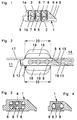
- Fig. 1 shows a cross section through a seal. It is a sealing body 1 made of a first elastomer 1a and a second elastomer 1b. Under a Elastomers are understood to be all elastic materials that come into consideration as sealing material. Count among them rubber-elastic materials, polyurethane and Polyvinylchloride.
- the sealing body results in cross section like a rhombus.
- a lower base side 2 and an upper one Cover page 3 run parallel to each other and serve as Sealing surfaces.
- An insertion section 4 has one Inclined surface as an assembly aid.
- a page with approach 5 serves as support after installation. Inside the Sealing body 1 are cavities 8 storey-like provided one above the other.
- the second elastomer 1b is stronger and harder than the first elastomer 1a and forms tension struts 6 as well as struts 7, which are quite relative to their length are fat.
- the tension and compression struts 6, 7 are Arranged axially and separate the cavities 8.
- the Cavities 8 are via channels 9 with the inclined surface of the Inserted portion 4 of the seal connected at compressed seal from the inclined surface as Blind holes have been drilled into the cavities 8, too continuous channels in the loaded state of the seal form.
- the channels 9 provide ventilation of the cavities 8, so that there are no air bubbles at high pressure assembled and compressed seal can form the relax over time and become relaxation one would lead such a seal with compressed air bubbles.
- the seal can be made by softer coextrusion (1a) and harder (1b) elastomer material.
- the extruded strand is cut into pieces of appropriate length cut and can immediately in the appropriate environment can be used as a seal. But it is also possible the cutting ends of such strand pieces to each other vulcanize to make sealing rings.
- Such Sealing rings can be directly on the tip end of a Concrete pipe are pulled up. It is also possible to get one such a ring seal in the sleeve of a concrete pipe anchor.
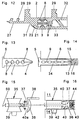
- FIG. 2 The application of such a sealing ring for Sealing the gap between parts to be sealed or Buildings are shown schematically in Fig. 2.
- the main area of application is sewer construction with concrete pipes.
- On first tube has a tip end 11, which by a radial shoulder surface 12 and an axially extending Surface 13 is formed.
- the other pipe has a sleeve 14, of which the axial surface 15 is indicated.
- the Surfaces 13 and 15 are arranged parallel to one another. If the tube ends 11 and 14 are pushed into each other, there remains a sleeve gap 16 and a shoulder gap 17. Between the higher pressure side of the sleeve gap 16 and the lower pressure side with the shoulder gap 17 is the Seal 1.
- the joint 16 is thinner than the thickness of the Sealing body 1 corresponds, but has the same shape. Therefore, when assembling the pipe ends 11 and 14, the Pipe sleeve 14 against the inclined surface of the insertion part 4 and squeezes the seal.
- the struts come here 7 under pressure and partially give way to the cavities 8, with part of the struts 6 coming under tension. Overall, the cavities 8 decrease, as in FIG. 2 shown.
- the struts 6, 7 develop one Restoring force, which is the contact pressure along the Contact surfaces 2, 3 of the seal 1 with those to be sealed Parts 11 and 14 noticeable, as by pressure fields 18th indicated.
- the hydrostatic pressure in the gap area 16 passes through the channels 9 into the cavities 8 and leads to a pressure increase, as by the pressure fields 19th indicated.
- the pressure fields 18, 19 act along the entire sealing portion 20 of the seal, which the Total width of the gasket in the deformed state minus the Areas 4 and 5.
- the harder elastomer 1b still has the advantage of one less relaxation compared to softer elastomer, so that by the strut structure the compressibility as in softer material can be achieved without the disadvantage of Have to put up with relaxation, which is softer Material enters after some time and then the Sealing effect reduced.
- the cavities 8 have a double function: Provision of alternative space for the struts and Attack surfaces for the print medium. Without channels 9 would Air is trapped in the cavities 8, which with the Time diffuses outwards and to relax the seal leads, whereby the restoring force and thus the effectiveness the sealing can be reduced.
- Fig. 3 shows an embodiment of the seal, at the harder elastomer 1b to a narrower one Contact area is limited, whereby the tension struts 6 only are provided in the middle between the cavities 8.
- the softer material 1a takes over above and below the cavities 8 next to the envelope function of Bumps and roughness such a function of Tension and compression struts.
- the struts 7 from harder Material also only extend between the Cavities 8, while the side of the cavities softer material 1a is present and in places reduced contact pressure acts as a strut.
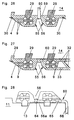
- Fig. 4 shows a simplified embodiment of the Seal 1 for smaller cross-sections, and there is only one a series of cavities 8 instead of the two that are stacked one above the other, as in the case of the Embodiment of FIGS. 1 and 3.
- the space between the Cavities 8 is filled with harder elastomer 1b, which the Function of struts 6 and 7 takes over.
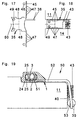
- Fig. 5 The insertion of pipes, as shown 2, is with considerable effort connected, and not just because of the seal must be pressed together, but also because the Relative displacement leads to large frictional forces. For Reduction of these frictional forces are common Lubricant applied, and this is the present one 5 comfortably possible. There are cavities 21 provided for the formation of lubrication pockets that have slots 22 or lead to the outside. When pressure on the Introductory section 4 enters the lubricant and facilitates the assembly of the parts. As Lubricant can also be used in liquid or post-sealing material Gel form can be used. For example, swellable Polymers active in connection with moisture or water and seal creep leaks.
- Fig. 7 shows a cross section similar to that of Fig. 5, but a part 24 of the cavities 8 with Post-sealing material filled, which over perforations 25 or breakable places can emerge. You can do it all Truss gaps with lubrication and / or Fill the resealing material, the channels 9 can be omitted because the rooms 8 are not vented more is needed.
- Fig. 8 shows another simplified Embodiment compared to Fig. 7, and there is only a cavity 8 with a channel 9 and a cavity 24 for Post-sealing material with outlet perforations 25.
- Fig. 9 shows a cross section similar to that of Fig. 5, however, is on the neck or shoulder rest 5th a flap 27 connected via two joints 26 to get in to extend the shoulder gap 17 (Fig. 2).
- the Tab 27 as a load distributor and also as a shear load limiter effective.
- Fig. 10 shows an embodiment in which a Sliding jacket 28 the function of reducing friction and the Load distribution takes over.
- the sliding jacket 28 is at Putting tubes together into the shoulder gap 17 and led away from the lead-in area so that the Channel openings 9 are uncovered after assembly and not be blocked.
- Fig. 11 shows a seal for integral installation in a pipe socket in their manufacture from concrete mix.
- anchoring parts 29 are provided.
- sealing lips 30 are attached.
- Insert direction at the front is a half-groove 31 Formation of a stop for a so-called sub-sleeve, the serves as a casting mold in the manufacture of the pipe sleeve, in which the seal is integrated.
- Between radial Pipe sleeve shoulder and seal is on annular maneuvering space for the tip end, that of one removable filler is ingested. The seal is shown without this packing.
- Fig. 12 shows a seal, also for integral Installation in a pipe socket, but with a flexible Filler body 32 and a load distribution element or Shear Load Limiter 27 attached to the actual seal are connected. Access to channels 9 is via Openings 33 secured. The seal is about the Anchoring parts 29 integrated into the pipe socket.
- Figures 13 and 14 show the use of the new Seal in one embodiment as a sealing strip.
- the Cross-sectional shape 34 of this seal is similar to a nail. Alternatively, a closed frame profile is also possible. 13 shows the seal in the undeformed state.
- the internal structure corresponds to that with reference to FIGS. 1 to 4 explained principles.
- the introduction part 4 has one Wedge shape with two slopes so that the seal in one existing parallel construction joints can be driven in, as shown in Fig. 14.
- Fig. 15 shows a cross section through a Secondary seal for use in, for example underground pipe jacking combined with a Primary seal according to one of the described Embodiments works.
- the secondary seal sits there in a radial branch 40 of the socket gap.
- the seal contains a sealing body 35 and a T-shaped extension 36, 37 from web 37 and crossbar 37.
- At one end of the Cross bar 37 is a tab 38 to Fastening purposes.
- A can also be used for fastening purposes Serve extension 39.
- a filling device 50 with hose and check valve leads through the sealing body 35 into rooms 40a of the radial sleeve gap 40 to post-sealing material to insert between sealing body 35 and extension 36, 37.
- Fig. 16 shows the secondary seal of Fig. 15 in installed condition between spigot 11 and sleeve 14, and on the inside of the radial gap 40, the latter form both pipes.
- Wood is used as pipe jacking Load distribution elements 43 and the seal 35, 36, 37 in inserted this radial gap 40, the extension 39 in a groove 42 of the pipe sleeve 14 engages to close the seal hold.
- the seal can be attached using Lobe 37 on the wood 43 via nails 44.
- the secondary seal 35 is compressed, because the flanks face each other when the pipes are assembled to move until the balancing and load distribution element 43 limits further compression.
- the seal consists of a Sealing body 35, the recesses or pockets 48 for Gasket material and cover flaps 45 with Perforations 47 and knotting cams 46 contains.
- the pockets 48 are by means of the cover flaps 45 and the knotting cams 46 closed, which in a groove 49 of the sealing body 35th click into place. This creates a uniform sealing body, at the sealing material from the pockets 48 Compression of the seal can escape.
- the Mounting the seal for example on the already wooden ring 43 fixed to the tube, can be over nails 44 or through Glue done (Fig. 18).
- the post-sealing material can also be installed at a later time after installation the filling device 50 are inserted.
- FIG. 19 shows a filling device 50 as Compound system between primary seal 1 and secondary seal 35, which can be activated with an injection agent, wherein via an additional generated in the filling device Contact pressure creates a better seal.
- the Primary seal 1 has one or more cavities 51, via a pressure hose 52 with the filling device 50 and the seal 35 and its cavity or cavities 53 are connected. In the or the cavities 51 and the or the cavities 53 becomes a curing agent under pressure injected and let harden.
- a test line 60 opens into both Test rooms 56 and 56a, in which shown Exemplary embodiment, the test line 60 perforations 61 having access to the test room 56a.
- the Test line 60 is through a bore 62 into the interior of the pipe and from there to a test facility, not shown guided.
- the test room 56 is from when the pipe string is installed the annular surface 15 of the pipe sleeve covered. Accordingly serves the test room 56 for leak testing on the Annular surface 15, while the test room 56a for checking the Tightness on the surface 13 is used. It becomes a print medium pressed into the test spaces 56 and 56a and the pressure drop observed. If the pressure drop under one is the specified value, the seal is given as assessed and documented.
- Air or a liquid can be used as the pressure medium. for example water.
- Test room 56 should use water as the test medium be vented, for example, what about a Double pipe system happen instead of a simple hose can.
- Such ventilation is also carried out if the test spaces 56 and 56a for re-sealing the Pipe socket connection should be used, what about the Test line 60 is possible.
- a modified sealing arrangement 55 is shown in Fig. 22 shown.
- the connecting web 59 consists of the soft elastomer material 1a.
- Each partial seal 1 has a holding extension 57 made of the hard elastomeric material 1b and engages in a corresponding groove 58 in the annular surface 13 at the end of the spray 11.
- the sealing arrangement 55 prevented from shifting when mounting the Pipe string the sleeve is pushed over the seal.
- FIG. 23 and 24 Other ways of holding the Sealing arrangement 55 against displacement are shown in FIG. 23 and 24.
- this holding extension 57a In addition to the holding extension 57 for one
- this holding extension 57a either engages in an edge recess of the tip end (Fig. 23) or on the front radial surface of the tip end is present (Fig. 24).
- FIG. 25 shows, the position securing of the Sealing arrangement 55 also via oblique grooves 63 in the Annular surface 13 of the tip end.
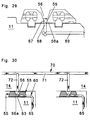
- the twin seal arrangement 55 can also be used in the Bell sleeve can be integrated, like FIGS. 26 and 27 demonstrate. For installation, refer to the description of FIGS. 11 and 12 Referenced.
- the test line 60 can radially outward (Fig. 26) or axially within the tubing to the Test device.
- test line 60 can via the Ring surface 13 of the tip end and a recess in the radial front of the tip end, and tubes 64, 65, 66 (FIG. 28) are used for this.
- Man can also work through holes in the spigot, namely a radial bore 68 and an axially parallel bore 69 (Fig. 29).
- the two test spaces 56 and 56a are over a hole in the connecting web of the partial seal with each other connected.
- the hole can also be made through a metallic Pipe socket 67 are formed, which in the connecting web 59 is vulcanized.
- test line 60 can also be used for Resealing of the sealing points can be used. It is but also possible for this purpose two separate systems 60 and 70 to use, as shown in Fig. 30.
- each of the systems 60, 70 includes Check valves, so that medium in the test rooms 56th and 56a, the emergence of this medium through the other system is blocked.
- System 70 includes a connecting line 71 from a central Issue, for example a test shaft in which Soil laid along the pipe string to be checked and the branch lines 72 with check valves contains that to be checked on the individual Lead seal assemblies 55. If there are leaks can be determined, can be re-sealed via the system 60 become.
Landscapes
- Engineering & Computer Science (AREA)
- General Engineering & Computer Science (AREA)
- Mechanical Engineering (AREA)
- Gasket Seals (AREA)
- Glass Compositions (AREA)
- Sealing Using Fluids, Sealing Without Contact, And Removal Of Oil (AREA)
- Pressure Vessels And Lids Thereof (AREA)
- Joints With Sleeves (AREA)
Applications Claiming Priority (2)
| Application Number | Priority Date | Filing Date | Title |
|---|---|---|---|
| DE29712235U | 1997-07-11 | ||
| DE29712235U DE29712235U1 (de) | 1997-07-11 | 1997-07-11 | Dichtung mit Hohlräumen |
Publications (3)
| Publication Number | Publication Date |
|---|---|
| EP0890772A2 true EP0890772A2 (fr) | 1999-01-13 |
| EP0890772A3 EP0890772A3 (fr) | 2001-01-10 |
| EP0890772B1 EP0890772B1 (fr) | 2003-09-17 |
Family
ID=8042967
Family Applications (1)
| Application Number | Title | Priority Date | Filing Date |
|---|---|---|---|
| EP98112552A Expired - Lifetime EP0890772B1 (fr) | 1997-07-11 | 1998-07-07 | Joint d'étancheité avec de cavités |
Country Status (4)
| Country | Link |
|---|---|
| US (1) | US6264207B1 (fr) |
| EP (1) | EP0890772B1 (fr) |
| AT (1) | ATE250195T1 (fr) |
| DE (2) | DE29712235U1 (fr) |
Families Citing this family (8)
| Publication number | Priority date | Publication date | Assignee | Title |
|---|---|---|---|---|
| GB2340111B (en) * | 1998-08-04 | 2002-09-11 | United Kingdom Nirex Ltd | Unitary double ring seal |
| JP4408389B2 (ja) * | 2004-05-10 | 2010-02-03 | サンデン株式会社 | 斜板式圧縮機 |
| JP4953841B2 (ja) * | 2006-03-31 | 2012-06-13 | 京セラ株式会社 | 熱電モジュール |
| CN104455420B (zh) * | 2014-11-19 | 2016-10-05 | 张家港市三利密封合金材料有限公司 | 一种复合结构的密封条 |
| DE202015101734U1 (de) | 2015-04-09 | 2015-05-13 | Theodor Cordes Gmbh & Co. Kg | Integrierte Dichtung mit Scherkraft-Stützschulter |
| DE102018101178A1 (de) * | 2018-01-19 | 2019-07-25 | J.H. & Wilhelm Finger Gmbh & Co Kg | Betonrohr mit einem einer Innenauskleidung bildenden Kunststoffrohr |
| DE102021204982A1 (de) | 2021-05-18 | 2022-11-24 | Robert Bosch Gesellschaft mit beschränkter Haftung | Vorrichtung zur Herstellung einer fluidischen Verbindung und deren Abdichtung |
| CN114623298B (zh) * | 2022-02-09 | 2024-01-26 | 华能济宁运河发电有限公司 | 一种用于输灰系统的管道之间防渗漏设备 |
Citations (6)
| Publication number | Priority date | Publication date | Assignee | Title |
|---|---|---|---|---|
| DE551816C (de) | 1928-05-26 | 1932-06-06 | Donald Hugh Baillie Reynolds | Stossfugendichtung fuer Rohre |
| US4522413A (en) | 1984-06-29 | 1985-06-11 | Elastomer Seals, Inc. | Pavement joint seal with chevron-shaped walls |
| DE3601757A1 (de) | 1986-01-22 | 1987-07-23 | Muecher Hermann Gmbh | Elastische gleitdichtung |
| DE3815142A1 (de) | 1988-05-04 | 1989-11-16 | Phoenix Ag | Akitiverbare dichtung, insbesondere tuebbing-dichtung |
| DE4236368A1 (de) | 1992-10-28 | 1994-05-05 | Thomas Dipl Ing Lammering | Gleitringdichtung mit integrierter Verpreßeinrichtung |
| US5417442A (en) | 1991-11-21 | 1995-05-23 | Forsheda Ab | Sealing device |
Family Cites Families (19)
| Publication number | Priority date | Publication date | Assignee | Title |
|---|---|---|---|---|
| US2615741A (en) * | 1949-07-11 | 1952-10-28 | Hamilton Kent Mfg Company | Sealing ring |
| GB759387A (en) * | 1953-12-04 | 1956-10-17 | Horace Denton Morgan | Improvements in and relating to pipe joints |
| US3058752A (en) * | 1959-06-30 | 1962-10-16 | Nat Coupling Co Inc | Gasket |
| US3173699A (en) * | 1962-08-24 | 1965-03-16 | Hamilton Kent Mfg Co | Annular gasket |
| GB1273136A (en) * | 1968-08-02 | 1972-05-03 | Corrugated Packing Sheet Metal | Improvements in or relating to sealing means |
| US3762826A (en) * | 1970-08-20 | 1973-10-02 | Watson Bowman Associates | Sealing strip |
| FR2148365B1 (fr) * | 1971-08-11 | 1973-08-10 | Hutchinson Cie Ets | |
| IT965354B (it) * | 1972-09-14 | 1974-01-31 | Vianini Spa | Dispositivo per il collaudo dall interno su giunti di tuba zioni e simili e per prove di impermeabilita o di assorbimento su pareti di tubazioni condotte o recipienti in genere |
| JPS60184794A (ja) * | 1984-03-02 | 1985-09-20 | 動力炉・核燃料開発事業団 | 遠隔着脱用継手 |
| DE3442653C1 (de) * | 1984-11-22 | 1986-06-19 | Daimler-Benz Ag, 7000 Stuttgart | Abdichtung fuer den Spalt zwischen einem starren Schiebedeckel und einem diesen umgebenden festen Dachbereich eines Kraftwagens |
| US4743036A (en) * | 1986-04-16 | 1988-05-10 | Mm Systems Corporation | Compression seal |
| DE9116780U1 (de) * | 1990-03-24 | 1993-10-14 | Albert Steinhoff GmbH, 48301 Nottuln | Steckmuffenverbindung |
| DE9017653U1 (de) * | 1990-11-02 | 1991-05-29 | Baustoffwerk Sehn GmbH & Co., 6670 St Ingbert | Dichtung zwischen aneinanderschließenden Betonrohren |
| DE4107994A1 (de) * | 1991-03-13 | 1992-09-17 | Cordes Theodor Gmbh & Co Kg | Dichtungsring zur abdichtung der fuge zwischen dem spitzende und der glockenmuffe einer verbindung rohrfoermiger bauteile |
| US5143381A (en) * | 1991-05-01 | 1992-09-01 | Pipe Gasket & Supply Co., Inc. | Pipe joint seal |
| CA2156054A1 (fr) * | 1993-12-15 | 1995-06-22 | Forsheda Ab | Dispositif d'etancheite, element de moulage et conduit |
| SE515033C2 (sv) * | 1995-12-27 | 2001-06-05 | Forsheda Ab | Tätningsanordning |
| DE19601652A1 (de) * | 1996-01-18 | 1997-07-24 | Sander Karl Heinz Gmbh & Co Kg | Beton-, Steinzeug- oder Gußrohr |
| NO305095B1 (no) * | 1997-06-06 | 1999-03-29 | Alsthom Cge Alcatel | FremgangsmÕte og anordning for forsegling |
-
1997
- 1997-07-11 DE DE29712235U patent/DE29712235U1/de not_active Expired - Lifetime
-
1998
- 1998-07-07 EP EP98112552A patent/EP0890772B1/fr not_active Expired - Lifetime
- 1998-07-07 DE DE59809618T patent/DE59809618D1/de not_active Expired - Lifetime
- 1998-07-07 AT AT98112552T patent/ATE250195T1/de not_active IP Right Cessation
- 1998-07-09 US US09/112,599 patent/US6264207B1/en not_active Expired - Fee Related
Patent Citations (6)
| Publication number | Priority date | Publication date | Assignee | Title |
|---|---|---|---|---|
| DE551816C (de) | 1928-05-26 | 1932-06-06 | Donald Hugh Baillie Reynolds | Stossfugendichtung fuer Rohre |
| US4522413A (en) | 1984-06-29 | 1985-06-11 | Elastomer Seals, Inc. | Pavement joint seal with chevron-shaped walls |
| DE3601757A1 (de) | 1986-01-22 | 1987-07-23 | Muecher Hermann Gmbh | Elastische gleitdichtung |
| DE3815142A1 (de) | 1988-05-04 | 1989-11-16 | Phoenix Ag | Akitiverbare dichtung, insbesondere tuebbing-dichtung |
| US5417442A (en) | 1991-11-21 | 1995-05-23 | Forsheda Ab | Sealing device |
| DE4236368A1 (de) | 1992-10-28 | 1994-05-05 | Thomas Dipl Ing Lammering | Gleitringdichtung mit integrierter Verpreßeinrichtung |
Also Published As
| Publication number | Publication date |
|---|---|
| EP0890772A3 (fr) | 2001-01-10 |
| EP0890772B1 (fr) | 2003-09-17 |
| DE59809618D1 (de) | 2003-10-23 |
| DE29712235U1 (de) | 1998-11-12 |
| ATE250195T1 (de) | 2003-10-15 |
| US6264207B1 (en) | 2001-07-24 |
Similar Documents
| Publication | Publication Date | Title |
|---|---|---|
| DE69600492T2 (de) | Dichtung und ihr herstellungsverfahren | |
| DE69219562T2 (de) | Dichtungsvorrichtung | |
| DE4229609C2 (de) | Abdichtung zwischen zwei ineinandersteckbaren Teilen | |
| WO1996023958A1 (fr) | Garniture d'etancheite pour segments de galeries de tunnel | |
| DE2658428A1 (de) | Dichtung zum abdichten zweier maschinenelemente und verwendung der dichtung | |
| DE3014797A1 (de) | Dichtungsanordnung | |
| WO2008125082A2 (fr) | Vérin hydraulique présentant des tubes extérieurs et intérieurs à parois minces | |
| EP0890772B1 (fr) | Joint d'étancheité avec de cavités | |
| EP0340659B1 (fr) | Joint pouvant être activé, en particulier pour anneaux de cuvelage | |
| DE68916213T2 (de) | Dichtungen. | |
| EP2414633B1 (fr) | Système d'étanchéité pour la construction de puits et de tunnels | |
| EP1165937A2 (fr) | Ensemble etanche | |
| DE69529964T2 (de) | Biegsame Röhrenfuge | |
| DE3543808A1 (de) | Verfahren zur abdichtung von tuebbingen und dichtungsrahmen zur durchfuehrung des verfahrens | |
| DE2948543A1 (de) | Fugenausbildung in betonschichten, insbesondere in betonauskleidungen von wasserkanaelen | |
| CH686383A5 (de) | Verfahren zur Herstellung einer nicht verschiebbaren Dichtungsprofilleiste und nach diesem Verfahren hergestellte Leiste. | |
| EP0758703A1 (fr) | Joint de bétonnage | |
| EP0859183B1 (fr) | Anneau d'étanchéité pour anneaux de puits d'accès | |
| EP0853209B1 (fr) | Dispositif d'étanchéité sur pièces préfabriquées en béton | |
| DE69004381T2 (de) | Profildichtung aus Elastomer für Tunnelgewölbe. | |
| EP0183208B1 (fr) | Appui de déplacement vertical pour transmettre et soulever ou baisser des charges lourdes, particulièrement des ponts | |
| DE3404074A1 (de) | Verfahren zum herstellen einer schlitzwand aus beton | |
| DE3218516C2 (fr) | ||
| EP0631034B1 (fr) | Palier de butée à compression contrÔlée pour anneaux de cuvelage de tunnels | |
| EP4069943B1 (fr) | Profile de joint pour voussoir en béton |
Legal Events
| Date | Code | Title | Description |
|---|---|---|---|
| PUAI | Public reference made under article 153(3) epc to a published international application that has entered the european phase |
Free format text: ORIGINAL CODE: 0009012 |
|
| AK | Designated contracting states |
Kind code of ref document: A2 Designated state(s): AT BE CH DE DK ES FR GB IT LI LU NL PT SE |
|
| AX | Request for extension of the european patent |
Free format text: AL;LT;LV;MK;RO;SI |
|
| RIC1 | Information provided on ipc code assigned before grant |
Free format text: 7F 16L 17/06 A, 7F 16L 21/035 B, 7E 04B 1/68 B, 7F 16J 15/02 B, 7F 16L 21/03 B, 7F 16L 17/10 B, 7E 03F 3/04 B |
|
| PUAL | Search report despatched |
Free format text: ORIGINAL CODE: 0009013 |
|
| AK | Designated contracting states |
Kind code of ref document: A3 Designated state(s): AT BE CH CY DE DK ES FI FR GB GR IE IT LI LU MC NL PT SE |
|
| AX | Request for extension of the european patent |
Free format text: AL;LT;LV;MK;RO;SI |
|
| RIC1 | Information provided on ipc code assigned before grant |
Free format text: 7F 16L 17/06 A, 7F 16L 21/035 B, 7E 04B 1/68 B, 7F 16J 15/02 B, 7F 16L 21/03 B, 7F 16L 17/10 B, 7E 03F 3/04 B, 7G 01M 3/28 B |
|
| 17P | Request for examination filed |
Effective date: 20010705 |
|
| AKX | Designation fees paid |
Free format text: AT BE CH DE DK ES FR GB IT LI LU NL PT SE |
|
| 17Q | First examination report despatched |
Effective date: 20011108 |
|
| GRAH | Despatch of communication of intention to grant a patent |
Free format text: ORIGINAL CODE: EPIDOS IGRA |
|
| GRAH | Despatch of communication of intention to grant a patent |
Free format text: ORIGINAL CODE: EPIDOS IGRA |
|
| GRAA | (expected) grant |
Free format text: ORIGINAL CODE: 0009210 |
|
| AK | Designated contracting states |
Kind code of ref document: B1 Designated state(s): AT BE CH DE DK ES FR GB IT LI LU NL PT SE |
|
| PG25 | Lapsed in a contracting state [announced via postgrant information from national office to epo] |
Ref country code: IT Free format text: LAPSE BECAUSE OF FAILURE TO SUBMIT A TRANSLATION OF THE DESCRIPTION OR TO PAY THE FEE WITHIN THE PRESCRIBED TIME-LIMIT;WARNING: LAPSES OF ITALIAN PATENTS WITH EFFECTIVE DATE BEFORE 2007 MAY HAVE OCCURRED AT ANY TIME BEFORE 2007. THE CORRECT EFFECTIVE DATE MAY BE DIFFERENT FROM THE ONE RECORDED. Effective date: 20030917 Ref country code: GB Free format text: LAPSE BECAUSE OF FAILURE TO SUBMIT A TRANSLATION OF THE DESCRIPTION OR TO PAY THE FEE WITHIN THE PRESCRIBED TIME-LIMIT Effective date: 20030917 |
|
| REG | Reference to a national code |
Ref country code: GB Ref legal event code: FG4D Free format text: NOT ENGLISH |
|
| REG | Reference to a national code |
Ref country code: SE Ref legal event code: TRGR |
|
| REG | Reference to a national code |
Ref country code: CH Ref legal event code: EP |
|
| REF | Corresponds to: |
Ref document number: 59809618 Country of ref document: DE Date of ref document: 20031023 Kind code of ref document: P |
|
| PG25 | Lapsed in a contracting state [announced via postgrant information from national office to epo] |
Ref country code: DK Free format text: LAPSE BECAUSE OF FAILURE TO SUBMIT A TRANSLATION OF THE DESCRIPTION OR TO PAY THE FEE WITHIN THE PRESCRIBED TIME-LIMIT Effective date: 20031217 |
|
| PG25 | Lapsed in a contracting state [announced via postgrant information from national office to epo] |
Ref country code: PT Free format text: LAPSE BECAUSE OF FAILURE TO SUBMIT A TRANSLATION OF THE DESCRIPTION OR TO PAY THE FEE WITHIN THE PRESCRIBED TIME-LIMIT Effective date: 20031226 |
|
| PG25 | Lapsed in a contracting state [announced via postgrant information from national office to epo] |
Ref country code: ES Free format text: LAPSE BECAUSE OF FAILURE TO SUBMIT A TRANSLATION OF THE DESCRIPTION OR TO PAY THE FEE WITHIN THE PRESCRIBED TIME-LIMIT Effective date: 20031228 |
|
| GBV | Gb: ep patent (uk) treated as always having been void in accordance with gb section 77(7)/1977 [no translation filed] |
Effective date: 20030917 |
|
| ET | Fr: translation filed | ||
| PG25 | Lapsed in a contracting state [announced via postgrant information from national office to epo] |
Ref country code: LU Free format text: LAPSE BECAUSE OF NON-PAYMENT OF DUE FEES Effective date: 20040707 Ref country code: AT Free format text: LAPSE BECAUSE OF NON-PAYMENT OF DUE FEES Effective date: 20040707 |
|
| PLBE | No opposition filed within time limit |
Free format text: ORIGINAL CODE: 0009261 |
|
| STAA | Information on the status of an ep patent application or granted ep patent |
Free format text: STATUS: NO OPPOSITION FILED WITHIN TIME LIMIT |
|
| PG25 | Lapsed in a contracting state [announced via postgrant information from national office to epo] |
Ref country code: LI Free format text: LAPSE BECAUSE OF NON-PAYMENT OF DUE FEES Effective date: 20040731 Ref country code: CH Free format text: LAPSE BECAUSE OF NON-PAYMENT OF DUE FEES Effective date: 20040731 |
|
| 26N | No opposition filed |
Effective date: 20040618 |
|
| REG | Reference to a national code |
Ref country code: CH Ref legal event code: PL |
|
| REG | Reference to a national code |
Ref country code: FR Ref legal event code: PLFP Year of fee payment: 19 |
|
| REG | Reference to a national code |
Ref country code: FR Ref legal event code: PLFP Year of fee payment: 20 |
|
| PGFP | Annual fee paid to national office [announced via postgrant information from national office to epo] |
Ref country code: NL Payment date: 20170720 Year of fee payment: 20 |
|
| PGFP | Annual fee paid to national office [announced via postgrant information from national office to epo] |
Ref country code: FR Payment date: 20170720 Year of fee payment: 20 Ref country code: DE Payment date: 20170731 Year of fee payment: 20 |
|
| PGFP | Annual fee paid to national office [announced via postgrant information from national office to epo] |
Ref country code: SE Payment date: 20170724 Year of fee payment: 20 Ref country code: BE Payment date: 20170720 Year of fee payment: 20 |
|
| REG | Reference to a national code |
Ref country code: DE Ref legal event code: R071 Ref document number: 59809618 Country of ref document: DE |
|
| REG | Reference to a national code |
Ref country code: NL Ref legal event code: MK Effective date: 20180706 |
|
| REG | Reference to a national code |
Ref country code: SE Ref legal event code: EUG |
|
| REG | Reference to a national code |
Ref country code: BE Ref legal event code: MK Effective date: 20180707 |