EP0892429A2 - Procédé de fabrication d'un dispositif semi-conducteur - Google Patents
Procédé de fabrication d'un dispositif semi-conducteur Download PDFInfo
- Publication number
- EP0892429A2 EP0892429A2 EP98305386A EP98305386A EP0892429A2 EP 0892429 A2 EP0892429 A2 EP 0892429A2 EP 98305386 A EP98305386 A EP 98305386A EP 98305386 A EP98305386 A EP 98305386A EP 0892429 A2 EP0892429 A2 EP 0892429A2
- Authority
- EP
- European Patent Office
- Prior art keywords
- amorphous silicon
- region
- silicon
- dopants
- polysilicon region
- Prior art date
- Legal status (The legal status is an assumption and is not a legal conclusion. Google has not performed a legal analysis and makes no representation as to the accuracy of the status listed.)
- Withdrawn
Links
Images


Classifications
-
- H—ELECTRICITY
- H10—SEMICONDUCTOR DEVICES; ELECTRIC SOLID-STATE DEVICES NOT OTHERWISE PROVIDED FOR
- H10D—INORGANIC ELECTRIC SEMICONDUCTOR DEVICES
- H10D64/00—Electrodes of devices having potential barriers
- H10D64/01—Manufacture or treatment
- H10D64/013—Manufacture or treatment of electrodes having a conductor capacitively coupled to a semiconductor by an insulator
- H10D64/01302—Manufacture or treatment of electrodes having a conductor capacitively coupled to a semiconductor by an insulator the insulator being formed after the semiconductor body, the semiconductor being silicon
- H10D64/01332—Making the insulator
- H10D64/01336—Making the insulator on single crystalline silicon, e.g. chemical oxidation using a liquid
- H10D64/01344—Making the insulator on single crystalline silicon, e.g. chemical oxidation using a liquid in a nitrogen-containing ambient, e.g. N2O oxidation
-
- H—ELECTRICITY
- H10—SEMICONDUCTOR DEVICES; ELECTRIC SOLID-STATE DEVICES NOT OTHERWISE PROVIDED FOR
- H10D—INORGANIC ELECTRIC SEMICONDUCTOR DEVICES
- H10D64/00—Electrodes of devices having potential barriers
- H10D64/01—Manufacture or treatment
- H10D64/013—Manufacture or treatment of electrodes having a conductor capacitively coupled to a semiconductor by an insulator
- H10D64/01302—Manufacture or treatment of electrodes having a conductor capacitively coupled to a semiconductor by an insulator the insulator being formed after the semiconductor body, the semiconductor being silicon
- H10D64/01304—Manufacture or treatment of electrodes having a conductor capacitively coupled to a semiconductor by an insulator the insulator being formed after the semiconductor body, the semiconductor being silicon characterised by the conductor
- H10D64/01306—Manufacture or treatment of electrodes having a conductor capacitively coupled to a semiconductor by an insulator the insulator being formed after the semiconductor body, the semiconductor being silicon characterised by the conductor the conductor comprising a layer of silicon contacting the insulator, e.g. polysilicon
- H10D64/01308—Manufacture or treatment of electrodes having a conductor capacitively coupled to a semiconductor by an insulator the insulator being formed after the semiconductor body, the semiconductor being silicon characterised by the conductor the conductor comprising a layer of silicon contacting the insulator, e.g. polysilicon the conductor further comprising a non-elemental silicon additional conductive layer, e.g. a metal silicide layer formed by the reaction of silicon with an implanted metal
- H10D64/01312—Manufacture or treatment of electrodes having a conductor capacitively coupled to a semiconductor by an insulator the insulator being formed after the semiconductor body, the semiconductor being silicon characterised by the conductor the conductor comprising a layer of silicon contacting the insulator, e.g. polysilicon the conductor further comprising a non-elemental silicon additional conductive layer, e.g. a metal silicide layer formed by the reaction of silicon with an implanted metal the additional layer comprising a metal or metal silicide formed by deposition, i.e. without a silicidation reaction, e.g. sputter deposition
-
- H—ELECTRICITY
- H10—SEMICONDUCTOR DEVICES; ELECTRIC SOLID-STATE DEVICES NOT OTHERWISE PROVIDED FOR
- H10D—INORGANIC ELECTRIC SEMICONDUCTOR DEVICES
- H10D64/00—Electrodes of devices having potential barriers
- H10D64/01—Manufacture or treatment
- H10D64/013—Manufacture or treatment of electrodes having a conductor capacitively coupled to a semiconductor by an insulator
- H10D64/01302—Manufacture or treatment of electrodes having a conductor capacitively coupled to a semiconductor by an insulator the insulator being formed after the semiconductor body, the semiconductor being silicon
- H10D64/01332—Making the insulator
- H10D64/01336—Making the insulator on single crystalline silicon, e.g. chemical oxidation using a liquid
- H10D64/01338—Making the insulator on single crystalline silicon, e.g. chemical oxidation using a liquid with a treatment, e.g. annealing, after the formation of the conductor
-
- H—ELECTRICITY
- H10—SEMICONDUCTOR DEVICES; ELECTRIC SOLID-STATE DEVICES NOT OTHERWISE PROVIDED FOR
- H10D—INORGANIC ELECTRIC SEMICONDUCTOR DEVICES
- H10D64/00—Electrodes of devices having potential barriers
- H10D64/60—Electrodes characterised by their materials
- H10D64/66—Electrodes having a conductor capacitively coupled to a semiconductor by an insulator, e.g. MIS electrodes
- H10D64/68—Electrodes having a conductor capacitively coupled to a semiconductor by an insulator, e.g. MIS electrodes characterised by the insulator, e.g. by the gate insulator
- H10D64/693—Electrodes having a conductor capacitively coupled to a semiconductor by an insulator, e.g. MIS electrodes characterised by the insulator, e.g. by the gate insulator the insulator comprising nitrogen, e.g. nitrides, oxynitrides or nitrogen-doped materials
-
- H—ELECTRICITY
- H10—SEMICONDUCTOR DEVICES; ELECTRIC SOLID-STATE DEVICES NOT OTHERWISE PROVIDED FOR
- H10D—INORGANIC ELECTRIC SEMICONDUCTOR DEVICES
- H10D84/00—Integrated devices formed in or on semiconductor substrates that comprise only semiconducting layers, e.g. on Si wafers or on GaAs-on-Si wafers
- H10D84/01—Manufacture or treatment
- H10D84/0123—Integrating together multiple components covered by H10D12/00 or H10D30/00, e.g. integrating multiple IGBTs
- H10D84/0126—Integrating together multiple components covered by H10D12/00 or H10D30/00, e.g. integrating multiple IGBTs the components including insulated gates, e.g. IGFETs
- H10D84/0165—Integrating together multiple components covered by H10D12/00 or H10D30/00, e.g. integrating multiple IGBTs the components including insulated gates, e.g. IGFETs the components including complementary IGFETs, e.g. CMOS devices
- H10D84/0172—Manufacturing their gate conductors
- H10D84/0177—Manufacturing their gate conductors the gate conductors having different materials or different implants
-
- H—ELECTRICITY
- H10—SEMICONDUCTOR DEVICES; ELECTRIC SOLID-STATE DEVICES NOT OTHERWISE PROVIDED FOR
- H10D—INORGANIC ELECTRIC SEMICONDUCTOR DEVICES
- H10D84/00—Integrated devices formed in or on semiconductor substrates that comprise only semiconducting layers, e.g. on Si wafers or on GaAs-on-Si wafers
- H10D84/01—Manufacture or treatment
- H10D84/02—Manufacture or treatment characterised by using material-based technologies
- H10D84/03—Manufacture or treatment characterised by using material-based technologies using Group IV technology, e.g. silicon technology or silicon-carbide [SiC] technology
- H10D84/038—Manufacture or treatment characterised by using material-based technologies using Group IV technology, e.g. silicon technology or silicon-carbide [SiC] technology using silicon technology, e.g. SiGe
Definitions
- the invention relates to fabrication of integrated circuits.
- CMOS Complementary Metal Oxide Semiconductor
- Many CMOS integrated circuits contain a dual-gate structure, illustrated in part by Fig. 7.
- formation of a dual-gate structure begins by forming a gate dielectric region 108 over a silicon substrate 100 having an n-doped region 102 and a p-doped region 104.
- a dielectric material is an electrically insulating material, i.e., a material having a resistivity of about 10 6 ohm-cm or greater.
- a field dielectric 106 is also formed to isolate the oppositely-doped regions of the device.
- a polysilicon region 110 is typically deposited over the gate dielectric 108 and field dielectric 106.
- the portion of the polysilicon 110 overlying the n-doped region 102 is provided with a p-type dopant such as boron or BF 2
- the portion of the polysilicon 110 overlying the p-doped region 104 is provided with an n-type dopant such as phosphorus or arsenic.
- CMOS configurations typically contain a refractory metal silicide layer 112 (or other metal layer) over the doped polysilicon, the refractory metal silicide acting to lower resistance in the gate structure and thereby improve device and circuit performance.
- n-type and p-type dopants tend to diffuse more readily in refractory metal silicides than in polysilicon. Dopants thus tend to diffuse, for example, from a region of the polysilicon 110 overlying doped silicon region 102 into the silicide layer 112, laterally in the silicide layer 112, and then back into the polysilicon 110 at a region overlying the oppositely-doped region 104. Thus, n-type dopants move into a p-doped polysilicon region and vice versa. The phenomenon is referred to herein as cross-doping.
- the implanted dopants in the final device are located near the underlying gate dielectric 108.
- the majority of dopants lie close to the top of the polysilicon 110, and an anneal is used to diffuse the dopants toward the gate dielectric 108.
- the anneal time and temperature required to diffuse the dopants across this distance will often undesirably allow diffusion of some of the dopants laterally within the polysilicon 110 into an oppositely-doped region of the polysilicon 110, causing cross-doping. This lateral diffusion within the polysilicon 110 is a problem regardless of whether a silicide layer is present.
- This mechanism of cross-doping is particularly problematic where half the distance between the active regions of adjacent devices becomes comparable to the thickness of the doped regions of the polysilicon 110.
- the use of thinner gate dielectric layers improves device performance, but only where a relatively large concentration of dopants, advantageously about 10 20 dopants/cm 3 or greater, is located adjacent to the gate dielectric (resulting in what is known in the art as low poly-depletion). If sufficient dopants are not located adjacent to the dielectric layer, the use of a thinner gate dielectric will at best only marginally improve device performance.
- a refractory metal is deposited after formation of a polysilicon gate structure, a source and drain, and silicon dioxide spacers. The device is heated to react the metal with the silicon, thereby forming a refractory metal silicide. Due to a low level of bonding between the refractory metal and the silicon dioxide spacers, the silicide typically does not form on the spacers, leading to what is conventionally known as self-alignment of the silicide structure.
- the silicide layer in such a salicide process is detrimentally affected if too many dopants, or dopant-based precipitates, are located in the top region of the polysilicon gate structure, where the silicide is formed.
- the polysilicon region is typically thicker when using a salicide process, the dopant diffusion distance to the gate dielectric is often increased, thereby allowing encroachment of the underlying channel region that often leads to shorts in the device.
- devices are prepared by forming a first, relatively thin (e.g., about 300-1000 ⁇ ) amorphous silicon region over a gate dielectric material region formed over n-type and p-type regions of a silicon substrate. It is also possible to use polysilicon. (The term amorphous indicates a lack of long-range order.)
- n-type dopant is implanted at a first portion of the first amorphous silicon region, typically over the p-type region of the substrate.
- the n-type dopant is advantageously implanted such that substantially all of the dopant remains in the first amorphous silicon region and does not penetrate into the underlying dielectric region or the substrate. "Substantially all” indicates that no more than about 0.001 % of the implanted dopant penetrates into the underlying dielectric layer or substrate during implantation. This result is attained, for example, by use of a low energy ion implantation method, e.g., implanting arsenic at 2-30 keV or phosphorus at 1-20 keV.
- a p-type dopant species is then implanted at a second portion of the first amorphous silicon region, typically over the n-type region of the substrate. Again, it is advantageous for substantially all of the p-type dopant species to remain in the first amorphous silicon region. It is possible for this result to be similarly attained by use of low energy ion implantation, e.g., implanting boron at 0.25-5 keV.
- a second amorphous silicon (or polysilicon) region is formed over the first silicon region, in essence burying the implanted dopants.
- a refractory metal silicide layer is formed over the second amorphous silicon region.
- Devices are then formed on the structure in accordance with conventional processing techniques known to one skilled in the art. The creation of the buried implant layer is significant in that the buried nature of the dopants hinders cross-doping that occurs through the silicide.
- the dopant in order for such detrimental cross-doping to occur, the dopant must diffuse from the p-doped region of the first amorphous silicon region into and through the second amorphous silicon region into the metal silicide layer, diffuse laterally within the silicide layer to the area over the oppositely-doped amorphous silicon region, diffuse back through the second amorphous silicon region into the opposite-doped region of the first amorphous silicon region, and move through the first amorphous silicon region to an area along the underlying gate dielectric.
- the dopants are implanted in a relatively thin layer formed on the gate dielectric, the diffusion distance to the gate dielectric is relatively low. Thus, dopants are able to diffuse to the area adjacent to the gate dielectric without substantial lateral diffusion in the silicon or substantial reduction in the channel.
- the process of the invention provides for a relatively high concentration of dopants at and near the gate dielectric, thereby allowing advantageous use of a thin gate dielectric. Furthermore, due to the buried nature of the dopants, there is typically little interference by dopants with a salicide process.
- the second silicon region instead forming the refractory metal silicide layer on the first silicon region and then implanting the silicide layer with nitrogen.
- the nitrogen traps boron, a typical p-type dopant, in the silicide region, thereby reducing cross-doping of boron in the device.
- Cross-doping by n-type dopants is much less of a problem than cross-doping by boron, because boron's small size allows it to diffuse quickly compared to most n-type dopants.
- the nitrogen is believed to trap only boron, and not n-type dopants, the nitrogen nonetheless provides a reduction in crosso-doping compared to conventional processes.
- the process of the invention also includes a subsequent rapid thermal anneal in which the wafer is heated to about 900 to about 1050°C for a time of about 2 to about 10 seconds.
- Rapid thermal anneal indicates a process that uses a heat source such as high-powered quartz filaments, which provide a fast increase in temperature, e.g., 100-200°C/sec, and in which the measured temperature is that of the silicon wafer.
- the rapid thermal anneal is useful in attaining a desirable distribution of dopants in the doped regions of the device and in helping to activate the dopants.
- the term activate indicates that the dopants become electrically active by moving to the proper sites in the silicon lattice (substituting for silicon atoms as opposed to being located interstitially within the silicon lattice).
- the short time of the rapid thermal anneal is desirable, particularly for short length devices, because lateral diffusion in both the gate and the channel region, as well as dopant diffusion through the gate dielectric, is reduced.
- the process of the invention due to the buried nature of the dopants, provides a relatively simple way of reducing detrimental cross-doping, as well as providing a desirable dopant distribution.
- Figs. 1(a) to 1(d) reflect process steps in an embodiment of the invention.
- Figs. 2-4 show dopant distribution profiles for arsenic, boron, and phosphorus, respectively, implanted in an amorphous silicon region in accordance with an embodiment of the process of the invention.
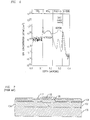
- Figs. 5 and 6 show dopant distribution profiles for arsenic, and boron and nitrogen, respectively, implanted in an amorphous silicon region in accordance with an embodiment of the process of the invention, where numerous processing steps were performed subsequent to dopant implantation.
- Fig. 7 illustrates a prior art process for forming a dual-gate structure.
- the invention relates to a process for fabricating devices, particularly dual-gate CMOS devices.
- General principles and standard procedures for device fabrication are found, for example, in Van Zant, "Microchip Fabrication,” 3d Ed., McGraw-Hill, 1997. It is expected that future processing technology will allow, for example, use of thinner layers and lower implantation energies in the process of the invention, and the concept of the invention is applicable to such future improvements.
- Figs. 1(a) through 1(d) The process of the invention is illustrated by the embodiment shown in Figs. 1(a) through 1(d).
- Devices are fabricated by obtaining or forming a semiconductor substrate 10 having an n-type region 12 and a p-type region 14, as shown in Fig. 1(a). It is possible for these regions to be formed in accordance with standard processing techniques well known to one skilled in the art, such as the twin tub process described in U.S. Patent No. 4,435,596 to Parillo et al., the disclosure of which is hereby incorporated by reference.
- a field dielectric 16 is formed on the substrate to separate the n-type region 12 and the p-type region 14, in accordance with standard processing techniques.
- Field dielectric 16 constitutes, for example, a surface isolation (e.g., LOCOS - localized oxidation of silicon) or a trench isolation (e.g., STI - shallow trench isolation).
- the field dielectric 16 is LOCOS isolation and has a thickness of about 2000 to about 3000 ⁇ .
- the gate dielectric 18 is formed in accordance with standard processing techniques and, when formed from silicon dioxide, is advantageously about 15 to about 100 ⁇ thick. It is possible to consider the combination of the field dielectric 16 and gate dielectric 18 as constituting a dielectric material region.
- a first region of amorphous silicon 20 is then formed on the field dielectric 16 and gate dielectric 18. It is also possible to use polysilicon.
- Amorphous silicon is advantageous in that it substantially reduces channeling and therefore allows use of thinner layers.
- the amorphous region 20 has a thickness of about 300 to about 1000 ⁇ .
- the region 20 is formed in accordance with standard processing techniques known to one skilled in the art, e.g., chemical vapor deposition, as discussed, for example in Van Zant, supra , Chapter 12.
- a mask 30 is then formed over the first amorphous silicon region 20, using standard lithographic techniques known to one skilled in the art.
- the mask 30 selectively exposes portions of the region 20 that overlay the p-type region 14 of the substrate 10.
- An n-type dopant 32 is implanted into the exposed portions of the region 20.
- Suitable n-type dopants include arsenic and phosphorus.
- the implantation is advantageously performed by ion implantation at an energy that reduces penetration.
- Advantageous implant energies for arsenic range from about 2 to about 30 keV, and for phosphorus from about 1 to about 20 keV.
- Useful dopant implant doses for arsenic range from about 1.5 X 10 15 to about 5 X 10 15 dopants/cm 2 , and for phosphorus from about 3 X 10 15 to about 8 X 10 15 dopants/cm 2 . At these energies and doses, implantation is typically performed for a time of a few seconds to a few minutes (e.g., 5 minutes).
- a second mask 40 is formed over the first amorphous silicon region 20.
- the mask 40 selectively exposes portions of the region 20 that overlay the n-type region 12 of the substrate 10.
- a p-type dopant 42 is implanted into the exposed portions of the region 20.
- Suitable p-type dopants include boron.
- the implantation of the p-type dopant is also advantageously performed by ion implantation at an implant energy that reduces penetration.
- the implantation of boron is performed at about 0.25 to about 5 keV, and at dopant implant doses of about 1.5 X 10 15 to about 4 X 10 15 dopants/cm 2 . At these energies and doses, implantation is typically performed for a time of a few seconds to a few minutes (e.g., 5 minutes). Boron typically requires more time for implantation than n-type dopants.
- the energy and dopant dose selected for both n-type and p-type dopants depend in part on the thickness of the amorphous silicon region 20. In general, it is possible to use higher implant energies and doses with thicker layers without resulting in unwanted penetration.
- a second amorphous silicon region 50 is formed over the now-implanted first amorphous silicon region 20. It is also possible to use polysilicon. Amorphous silicon is advantageous because diffusion of dopants is generally slower in recrystallized amorphous silicon than in deposited polysilicon.
- the second amorphous region 50 has a thickness of about 200 to about 1000 ⁇ .
- the second region 50 is formed in accordance with standard processing techniques known to one skilled in the art, e.g., chemical vapor deposition.
- a refractory metal silicide layer 52 is optionally formed on the second amorphous silicon region 50 by standard processing techniques known to one skilled in the art, e.g., sputtering or chemical vapor deposition.
- suitable refractory metal silicides include tungsten silicide, tantalum silicide, and cobalt silicide.
- the refractory metal silicide layer 52 has a thickness of about 800 to about 2000 ⁇ . It is also advantageous for the process of the invention to include a step of introducing nitrogen into the refractory metal silicide layer.
- the implantation advantageously is performed at an energy of about 10-50 keV (depending on the thickness), more advantageously 30 keV, and at a dopant implant dose of about 1 X 10 15 to about 2 X 10 15 atoms/cm 2 .
- the nitrogen appears to trap boron atoms in the silicide layer, and thus assists in reducing lateral diffusion and cross-doping of boron.
- the second silicon region As discussed previously, it is possible in some circumstances to omit the second silicon region, and instread form the refractory metal silicide layer on the first silicoln region (which will optionally be as thick as 1500 ⁇ when no second silicon region is present) and implant the silicide layer with nitrogen.
- the nitrogen introduced in the silicide layer will alolne reduce cross-doping toi an acceptable level.
- both the nitrogen in the silicide layer and a second silicon region will be desired to provide acceptable device properties.
- silicide layer by a salicide process.
- Metal layers other than refractory metal silicides are also possible.
- an anneal is performed after formation of the second amorphous silicon region 50 to recrystallize the second amorphous silicon region 50 and first amorphous silicon region 20, i.e., transform the regions 50, 20 into polysilicon. It is possible for the anneal to be performed after formation of the second silicon region 50, after formation of the silicide layer 52, or after a nitrogen implant of the silicide layer 52.
- the anneal is advantageously performed at a temperature of about 580 to about 650°C, for about 1 to about 5 hours, in a nitrogen atmosphere. More advantageously, the anneal is performed at about 650°C for about 3 hours in a nitrogen atmosphere.
- the resulting structure is then subjected to processing steps to form gate stacks over the n-regions and p-regions of the substrate, in accordance with standard procedures known to one skilled in the art.
- processing steps include a rapid thermal anneal after formation of gate stacks.
- the rapid thermal anneal is advantageously performed such that the wafer is raised to a temperature of about 900 to about 1050°C for a time of about 2 to about 10 seconds. More advantageously, the wafer is raised to a temperature of 1000°C for 5 seconds.
- the rapid thermal anneal is useful in attaining a desirable distribution of dopants in the doped regions of the device and in helping to activate the dopants.
- Typical processing steps subsequent to formation and implantation of refractory silicide layer 52 would include the following:
- the rapid thermal anneal is advantageously performed subsequent to implantation of the p-type source and drain. Where a salicide process is used, the process is typically performed subsequent to formation of the n-type and p-type source and drain, and the rapid thermal anneal is typically performed prior to depositing the refractory metal on the polysilicon gate structure.
- a silicon wafer was processed using conventional expedients, well known to one skilled in the art, to form a silicon substrate having lightly doped n-type and p-type regions.
- a 2000 ⁇ thick LOCOS field dielectric region was grown on a selected portion of the substrate by dry/wet/dry oxidation to electrically isolate the n-type and p-type regions.
- a 60 ⁇ gate dielectric layer of silicon oxynitride was formed on the portions of the substrate not covered by the LOCOS region by thermal oxidation in N 2 O at 850°C.
- a 500 ⁇ thick layer of amorphous silicon was formed over the field and gate dielectric layers by low pressure chemical vapor deposition.
- a layer of photoresist in accordance with standard practice, was formed on the silicon and structured to expose portions of the silicon overlying the lightly doped p-type region of the substrate. The exposed portions were then implanted with arsenic at 8 keV and a dosage of 2.5 X 10 15 atoms/cm 2 . The photoresist was removed, and a second photoresist layer was formed to expose portions of the silicon region overlying the lightly doped n-type region of the substrate. The exposed portions were then implanted with boron at 2 keV and a dosage of 2 X 10 15 atoms/cm 2 . The implant profile of arsenic, measured by SIMS (secondary ion mass spectroscopy), is shown in Fig. 2, and the SIMS implant profile of boron is shown in Fig. 3.
- SIMS secondary ion mass spectroscopy
- a silicon wafer was processed according to the steps of Example 1, using dopants of arsenic and boron. After implantation, a second amorphous silicon region having a thickness of 500 ⁇ was formed by low pressure chemical vapor deposition. An anneal was then performed at 650°C for 3 hours in nitrogen atmosphere to crystallize the amorphous silicon. After the anneal, a 1000 ⁇ tungsten silicide layer was formed on the second amorphous silicon region by sputtering, and nitrogen was implanted into the silicide at 30 keV and a dosage of 1 X 10 15 atoms/cm 2 . In accordance with the standard processing steps discussed above, gate stacks were formed.
- a 1500 ⁇ silicon dioxide hard mask was formed on the silicide layer by PETEOS; the hard mask was etched; the silicide and silicon regions were etched; a low-doped drain region of arsenic was implanted; a silicon dioxide layer was formed for gate spacers and the spacers were etched; an anneal was performed at 750°C for 30 minutes in oxygen to densify the silicon dioxide spacers; n-type drain and source were implanted; and p-type drain and source were implanted. Then, a rapid thermal anneal of the wafer was performed, the wafer being heated at 1000°C for 5 seconds by high-powered quartz filaments.
- Figs. 5 and 6 show the subsequent SIMS profiles for the arsenic and boron dopants. Fig. 6 also shows the nitrogen profile.
- the implant peak for arsenic is visible in the middle of the polysilicon region made up of both the first and second amorphous silicon regions (which were transformed to polysilicon during the 650°C anneal). Due to the relatively short diffusion distance from the implant peak to the polysilicon/gate oxide interface, the arsenic concentration at the interface is desirably high (about 2 X 10 20 atoms/cm 3 ). The arsenic concentration decreases toward the tungsten silicide (WSi x ) layer, in which the concentration is about one order of magnitude less than at the polysilicon/gate oxide interface. This lesser number of atoms in the silicide is desirable in that lateral diffusion and associated cross-doping by arsenic atoms will be reduced.
- WSi x tungsten silicide
- Fig. 6 shows a similar result.
- the boron concentration is desirably high at the polysilicon/gate oxide interface, and decreases toward the silicide layer.
- the boron concentration within the tungsten silicide layer also appears to be relatively high.
- the boron profile strongly corresponds to the nitrogen profile, however, indicating that the nitrogen atoms trapped the boron atoms in the silicide, thereby reducing lateral diffusion and cross-doping by boron atoms.
Landscapes
- Electrodes Of Semiconductors (AREA)
- Insulated Gate Type Field-Effect Transistor (AREA)
- Metal-Oxide And Bipolar Metal-Oxide Semiconductor Integrated Circuits (AREA)
Applications Claiming Priority (4)
| Application Number | Priority Date | Filing Date | Title |
|---|---|---|---|
| US5244097P | 1997-07-14 | 1997-07-14 | |
| US52440P | 1997-07-14 | ||
| US08/902,044 US6406952B2 (en) | 1997-07-14 | 1997-07-29 | Process for device fabrication |
| US902044 | 1997-07-29 |
Publications (2)
| Publication Number | Publication Date |
|---|---|
| EP0892429A2 true EP0892429A2 (fr) | 1999-01-20 |
| EP0892429A3 EP0892429A3 (fr) | 2000-07-12 |
Family
ID=26730601
Family Applications (1)
| Application Number | Title | Priority Date | Filing Date |
|---|---|---|---|
| EP98305386A Withdrawn EP0892429A3 (fr) | 1997-07-14 | 1998-07-07 | Procédé de fabrication d'un dispositif semi-conducteur |
Country Status (3)
| Country | Link |
|---|---|
| US (1) | US6406952B2 (fr) |
| EP (1) | EP0892429A3 (fr) |
| JP (1) | JP3529634B2 (fr) |
Families Citing this family (8)
| Publication number | Priority date | Publication date | Assignee | Title |
|---|---|---|---|---|
| TW557500B (en) * | 2002-01-23 | 2003-10-11 | Promos Technologies Inc | Method for producing semiconductor component |
| TW200614373A (en) * | 2004-10-28 | 2006-05-01 | Mosel Vitelic Inc | Method for forming field oxide |
| US20070052021A1 (en) * | 2005-08-23 | 2007-03-08 | Semiconductor Energy Laboratory Co., Ltd. | Transistor, and display device, electronic device, and semiconductor device using the same |
| KR100720484B1 (ko) * | 2005-12-16 | 2007-05-22 | 동부일렉트로닉스 주식회사 | 반도체 소자의 구조 및 그 제조 방법 |
| JP5195747B2 (ja) * | 2007-03-27 | 2013-05-15 | 富士通セミコンダクター株式会社 | 半導体装置の製造方法 |
| US8124515B2 (en) | 2009-05-20 | 2012-02-28 | Globalfoundries Inc. | Gate etch optimization through silicon dopant profile change |
| US8816473B2 (en) | 2012-04-05 | 2014-08-26 | International Business Machines Corporation | Planar polysilicon regions for precision resistors and electrical fuses and method of fabrication |
| JP2024044461A (ja) * | 2022-09-21 | 2024-04-02 | キオクシア株式会社 | 半導体装置の製造方法 |
Family Cites Families (19)
| Publication number | Priority date | Publication date | Assignee | Title |
|---|---|---|---|---|
| JPS607180A (ja) | 1983-06-25 | 1985-01-14 | Toshiba Corp | 半導体装置の製造方法 |
| US4816893A (en) | 1987-02-24 | 1989-03-28 | Hughes Aircraft Company | Low leakage CMOS/insulator substrate devices and method of forming the same |
| US4753895A (en) | 1987-02-24 | 1988-06-28 | Hughes Aircraft Company | Method of forming low leakage CMOS device on insulating substrate |
| KR920010062B1 (ko) * | 1989-04-03 | 1992-11-13 | 현대전자산업 주식회사 | 반도체 장치의 실리사이드 형성방법 |
| JPH0758701B2 (ja) * | 1989-06-08 | 1995-06-21 | 株式会社東芝 | 半導体装置の製造方法 |
| US5355010A (en) * | 1991-06-21 | 1994-10-11 | Matsushita Electric Industrial Co., Ltd. | Semiconductor device with a dual type polycide layer comprising a uniformly p-type doped silicide |
| US5147820A (en) * | 1991-08-26 | 1992-09-15 | At&T Bell Laboratories | Silicide formation on polysilicon |
| KR0135166B1 (ko) * | 1993-07-20 | 1998-04-25 | 문정환 | 반도체장치의 게이트 형성방법 |
| US5476800A (en) | 1994-01-31 | 1995-12-19 | Burton; Gregory N. | Method for formation of a buried layer for a semiconductor device |
| JPH0831931A (ja) | 1994-07-11 | 1996-02-02 | Nippon Telegr & Teleph Corp <Ntt> | 半導体装置およびその製造方法 |
| US5576579A (en) | 1995-01-12 | 1996-11-19 | International Business Machines Corporation | Tasin oxygen diffusion barrier in multilayer structures |
| US5541433A (en) | 1995-03-08 | 1996-07-30 | Integrated Device Technology, Inc. | High speed poly-emitter bipolar transistor |
| JPH08264660A (ja) * | 1995-03-24 | 1996-10-11 | Nec Corp | 半導体装置の製造方法 |
| US5550079A (en) | 1995-06-15 | 1996-08-27 | Top Team/Microelectronics Corp. | Method for fabricating silicide shunt of dual-gate CMOS device |
| JPH0922999A (ja) | 1995-07-07 | 1997-01-21 | Seiko Epson Corp | Mis型半導体装置及びその製造方法 |
| JPH0951040A (ja) | 1995-08-07 | 1997-02-18 | Sony Corp | 半導体装置の製造方法 |
| US5759886A (en) * | 1995-09-28 | 1998-06-02 | National Semiconductor Corporation | Method for forming a layer of metal silicide over the gates of a surface-channel CMOS device |
| JP3770954B2 (ja) * | 1995-11-13 | 2006-04-26 | エイ・ティ・アンド・ティ・コーポレーション | 装置の製造方法 |
| US5648287A (en) * | 1996-10-11 | 1997-07-15 | Taiwan Semiconductor Manufacturing Company, Ltd. | Method of salicidation for deep quarter micron LDD MOSFET devices |
-
1997
- 1997-07-29 US US08/902,044 patent/US6406952B2/en not_active Expired - Lifetime
-
1998
- 1998-07-07 EP EP98305386A patent/EP0892429A3/fr not_active Withdrawn
- 1998-07-13 JP JP19784698A patent/JP3529634B2/ja not_active Expired - Fee Related
Also Published As
| Publication number | Publication date |
|---|---|
| US20010055862A1 (en) | 2001-12-27 |
| US6406952B2 (en) | 2002-06-18 |
| EP0892429A3 (fr) | 2000-07-12 |
| JPH1197380A (ja) | 1999-04-09 |
| JP3529634B2 (ja) | 2004-05-24 |
Similar Documents
| Publication | Publication Date | Title |
|---|---|---|
| US6200865B1 (en) | Use of sacrificial dielectric structure to form semiconductor device with a self-aligned threshold adjust and overlying low-resistance gate | |
| US6258680B1 (en) | Integrated circuit gate conductor which uses layered spacers to produce a graded junction | |
| US5352631A (en) | Method for forming a transistor having silicided regions | |
| US4788160A (en) | Process for formation of shallow silicided junctions | |
| KR100612708B1 (ko) | 다마신 게이트 공정을 이용한 진성 듀얼 게이트 산화물mosfet | |
| US6004852A (en) | Manufacture of MOSFET having LDD source/drain region | |
| US4908327A (en) | Counter-doped transistor | |
| US5918130A (en) | Transistor fabrication employing formation of silicide across source and drain regions prior to formation of the gate conductor | |
| US6972222B2 (en) | Temporary self-aligned stop layer is applied on silicon sidewall | |
| US20090047757A1 (en) | Semiconductor device and method of manufacturing the same | |
| US6218251B1 (en) | Asymmetrical IGFET devices with spacers formed by HDP techniques | |
| US6403426B1 (en) | Method of manufacturing a semiconductor device | |
| KR100568077B1 (ko) | 반도체장치의 제조방법 | |
| EP1152470B1 (fr) | Dispositif semiconducteur avec structure LDD et son procédé de fabrication | |
| US6261885B1 (en) | Method for forming integrated circuit gate conductors from dual layers of polysilicon | |
| US6683356B2 (en) | Semiconductor device with oxygen doped regions | |
| US6406952B2 (en) | Process for device fabrication | |
| US6395606B1 (en) | MOSFET with metal in gate for reduced gate resistance | |
| US5879999A (en) | Method of manufacturing an insulated gate semiconductor device having a spacer extension | |
| US5851889A (en) | Semiconductor gate conductor with a substantially uniform doping profile having minimal susceptibility to dopant penetration into the underlying gate dielectric | |
| JP3524461B2 (ja) | Cmosデバイスのデュアル・ゲート構造を製造するプロセス | |
| US6624476B1 (en) | Semiconductor-on-insulator (SOI) substrate having selective dopant implant in insulator layer and method of fabricating | |
| US7015088B2 (en) | High-K gate dielectric defect gettering using dopants | |
| WO2002082503A2 (fr) | Dispositif a siliciure multi-epaisseur | |
| US6500740B1 (en) | Process for fabricating semiconductor devices in which the distribution of dopants is controlled |
Legal Events
| Date | Code | Title | Description |
|---|---|---|---|
| PUAI | Public reference made under article 153(3) epc to a published international application that has entered the european phase |
Free format text: ORIGINAL CODE: 0009012 |
|
| AK | Designated contracting states |
Kind code of ref document: A2 Designated state(s): DE ES FR GB IT |
|
| AX | Request for extension of the european patent |
Free format text: AL;LT;LV;MK;RO;SI |
|
| PUAL | Search report despatched |
Free format text: ORIGINAL CODE: 0009013 |
|
| AK | Designated contracting states |
Kind code of ref document: A3 Designated state(s): AT BE CH CY DE DK ES FI FR GB GR IE IT LI LU MC NL PT SE |
|
| AX | Request for extension of the european patent |
Free format text: AL;LT;LV;MK;RO;SI |
|
| RIC1 | Information provided on ipc code assigned before grant |
Free format text: 7H 01L 21/8238 A, 7H 01L 21/265 B, 7H 01L 21/28 B |
|
| 17P | Request for examination filed |
Effective date: 20001214 |
|
| AKX | Designation fees paid |
Free format text: DE ES FR GB IT |
|
| APBN | Date of receipt of notice of appeal recorded |
Free format text: ORIGINAL CODE: EPIDOSNNOA2E |
|
| APBR | Date of receipt of statement of grounds of appeal recorded |
Free format text: ORIGINAL CODE: EPIDOSNNOA3E |
|
| APAF | Appeal reference modified |
Free format text: ORIGINAL CODE: EPIDOSCREFNE |
|
| RAP3 | Party data changed (applicant data changed or rights of an application transferred) |
Owner name: LUCENT TECHNOLOGIES INC. |
|
| APBT | Appeal procedure closed |
Free format text: ORIGINAL CODE: EPIDOSNNOA9E |
|
| STAA | Information on the status of an ep patent application or granted ep patent |
Free format text: STATUS: THE APPLICATION HAS BEEN WITHDRAWN |
|
| 18W | Application withdrawn |
Effective date: 20110620 |