EP0902949B1 - Elektrisch lösch-und programmierbarer nichtflüchtiger speicher, geschützt gegen stromunterbrechungen - Google Patents
Elektrisch lösch-und programmierbarer nichtflüchtiger speicher, geschützt gegen stromunterbrechungen Download PDFInfo
- Publication number
- EP0902949B1 EP0902949B1 EP97926041A EP97926041A EP0902949B1 EP 0902949 B1 EP0902949 B1 EP 0902949B1 EP 97926041 A EP97926041 A EP 97926041A EP 97926041 A EP97926041 A EP 97926041A EP 0902949 B1 EP0902949 B1 EP 0902949B1
- Authority
- EP
- European Patent Office
- Prior art keywords
- memory
- vpp
- voltage
- high voltage
- vcc
- Prior art date
- Legal status (The legal status is an assumption and is not a legal conclusion. Google has not performed a legal analysis and makes no representation as to the accuracy of the status listed.)
- Expired - Lifetime
Links
Images


Classifications
-
- G—PHYSICS
- G06—COMPUTING OR CALCULATING; COUNTING
- G06K—GRAPHICAL DATA READING; PRESENTATION OF DATA; RECORD CARRIERS; HANDLING RECORD CARRIERS
- G06K19/00—Record carriers for use with machines and with at least a part designed to carry digital markings
- G06K19/06—Record carriers for use with machines and with at least a part designed to carry digital markings characterised by the kind of the digital marking, e.g. shape, nature, code
- G06K19/067—Record carriers with conductive marks, printed circuits or semiconductor circuit elements, e.g. credit or identity cards also with resonating or responding marks without active components
- G06K19/07—Record carriers with conductive marks, printed circuits or semiconductor circuit elements, e.g. credit or identity cards also with resonating or responding marks without active components with integrated circuit chips
- G06K19/0701—Record carriers with conductive marks, printed circuits or semiconductor circuit elements, e.g. credit or identity cards also with resonating or responding marks without active components with integrated circuit chips at least one of the integrated circuit chips comprising an arrangement for power management
-
- G—PHYSICS
- G11—INFORMATION STORAGE
- G11C—STATIC STORES
- G11C16/00—Erasable programmable read-only memories
- G11C16/02—Erasable programmable read-only memories electrically programmable
- G11C16/06—Auxiliary circuits, e.g. for writing into memory
- G11C16/10—Programming or data input circuits
- G11C16/12—Programming voltage switching circuits
-
- G—PHYSICS
- G11—INFORMATION STORAGE
- G11C—STATIC STORES
- G11C16/00—Erasable programmable read-only memories
- G11C16/02—Erasable programmable read-only memories electrically programmable
- G11C16/06—Auxiliary circuits, e.g. for writing into memory
- G11C16/22—Safety or protection circuits preventing unauthorised or accidental access to memory cells
- G11C16/225—Preventing erasure, programming or reading when power supply voltages are outside the required ranges
-
- G—PHYSICS
- G11—INFORMATION STORAGE
- G11C—STATIC STORES
- G11C5/00—Details of stores covered by group G11C11/00
- G11C5/14—Power supply arrangements, e.g. power down, chip selection or deselection, layout of wirings or power grids, or multiple supply levels
- G11C5/143—Detection of memory cassette insertion or removal; Continuity checks of supply or ground lines; Detection of supply variations, interruptions or levels ; Switching between alternative supplies
Definitions
- the present invention relates to EEPROM memories (Electricaly Erasable and Programmable Read Only Memory), that is to say the erasable non-volatile memories and electrically programmable.
- EEPROM memories Electrically Erasable and Programmable Read Only Memory
- EEPROM memories have known in recent years an important development due to their advantageous features. Indeed, these memories can be programmed and deleted at will by application of high voltage, commonly referred to Vpp. Once programmed, or erased, they keep information indefinitely without power supply. Due to these properties, EEPROM memories represent the preferred medium for recording transaction information or data in microcircuits mounted on portable supports do having no autonomous power source, such as smart cards and electronic labels, electrically powered only for periods of use.
- FIG. 1 schematically represents the structure of a microcircuit 1 of the aforementioned type, equipped with an EEPROM memory 10 comprising a plurality of memory cells C i, j arranged in rows and columns.
- the microcircuit further comprises a logic circuit 20 (with wired logic or with microprocessor) and a chain 30 of elements making it possible to produce, from a supply voltage Vcc of the microcircuit 1 of the order of 3 to 5V, the high voltage Vpp necessary for the erasing or programming operations of the memory 10.
- the chain 30 for producing the high voltage Vpp comprises, in series, a booster circuit, for example a charge pump 32 driven by a signal of clock H delivered by an oscillator 31, a stabilization capacity Chv, a voltage regulator 33 and a shaping circuit 34 of the voltage Vpp.
- a booster circuit for example a charge pump 32 driven by a signal of clock H delivered by an oscillator 31, a stabilization capacity Chv, a voltage regulator 33 and a shaping circuit 34 of the voltage Vpp.
- the logic circuit 20 applies an activation signal ACTVPP to the oscillator 31 and the charge pump 32 delivers, from the voltage Vcc, a high voltage Vhv of in the range of 22 to 25 volts.
- the voltage Vhv is applied to the stabilization capacity Chv and to the input of the regulator 33, the output of which delivers the voltage Vpp, of the order of 15 to 20 volts.
- the shaping circuit 34 progressively applies the voltage Vpp to the memory cells C i, j in the form of a ramp which can be seen in FIG. 2.
- cells C i, j are selected by means of a row decoder DWL and a column decoder DBL receiving respectively addresses ADRWL and ADRBL sent by logic circuit 20.
- the high voltage Vpp is routed to cells C i, j by means of a first group of switches SWWL controlled by the decoder DWL lines and a second group of SWBL switches controlled by the DBL column decoder.
- the voltage Vpp is also routed to other internal nodes of the memory 10 by an operation selection circuit COM controlled by the logic circuit 20, making it possible to choose between a programming or erasing operation.
- the high voltage Vpp is maintained for a certain time, of the order of 4 to 5 ms, necessary for the transfer of electrical charges in the memory cells C i, j .
- the problem posed by the use of EEPROM memories in microcircuits of smart cards or electronic labels is that the supply voltage Vcc, from which the high voltage Vpp is generated, is liable to be interrupted. at any time due to a user manipulation error (for example the fact of suddenly removing a smart card from the reader in which it is inserted) or poor energy transmission, especially when the voltage Vcc is transmitted by electromagnetic induction (contactless smart cards). If by coincidence or attempted fraud a cut in the supply voltage Vcc occurs during the few milliseconds of a write operation, data being recorded may not be recorded or may be recorded with anomalies. This problem is particularly troublesome when the data being recorded represents a monetary value.
- the objective of the present invention is to protect EEPROM memories against risk recording of erroneous data in the event of a break inadvertent supply voltage.
- the present invention is based first of all on the observation that, in a EEPROM memory, programming operations or memory cells are erased with a Insignificant current consumption.
- a EEPROM memory produced from MOS transistors floating gate
- the voltage Vpp is applied between the gate G and the drain D of the MOS transistors, these two electrodes being isolated from each other.
- a first idea of the present invention is to maintain the voltage Vpp for the duration necessary for a programming operation or of erasure. Such maintenance is technically achievable, for example by means of capacitive elements, due to the above finding.
- Another idea of the present invention is to maintain the routing of high voltage to memory cells when the supply voltage disappears. Indeed, the Applicant has found that in the EEPROM memories the disappearance of the supply voltage Vcc causes electrical paths to break driving the voltage Vpp to the cells being programming or erasing.
- the present invention provides programmable and erasable memory electrically, with the features of claim 1.
- the ability to maintain the high voltage includes stabilization capacity present in the means of production of the high voltage.
- the memory when the high voltage is applied via a generator circuit ramp, includes means for inhibiting the ramp generator circuit in the event of a supply voltage.
- the present invention also relates to a method to mitigate the risks of data registration errors in a programmable and erasable memory electrically when a power cut power supply occurs during a programming or erasing cells of the memory, with the features of claim 12.
- Provision A maintenance of the routing of the high voltage Vpp
- FIG. 3 shows in detail an embodiment according to the present invention of the EEPROM memory 10, the general architecture of which has already been presented in relation to FIG. 1.
- the memory 10 shown only has nine memory cells C i, j arranged in rows and columns, the indices i and j ranging from 1 to 3 and representing respectively the rank of the row and of the column to which each cell C i, j belongs.
- each memory cell C i, j comprises an access transistor TA i, j and a floating gate transistor TFG i, j connected by its drain D to the access transistor TA i, j .
- Each floating gate transistor TFG i, j is connected by its source S to a conductive line AG.
- the conductive line AG common to all the other floating gate transistors, is brought to a floating potential during the programming operations and to the potential 0 (ground) during the erasing operations.
- the gates G of the floating gate transistors TFG i, j of the same line are connected by a common conductive line WL i (WL 1 , WL 2 , WL 3 ) to the source S of a transistor TSWL i (TSWL 1 , TSWL 2 , TSWL 3 ) for line selection.
- the gates G of the access transistors TA i, j of the cells of the same line are connected via a common conductive line WLS i (WLS 1 , WLS 2 , WLS 3 ) to the gate of the transistor TSWL i line selection.
- the drains D of the line selection transistors TSWL i are all connected to the drain D of a programming transistor TPGR 1 and to the source S of an erasing transistor TDEL.
- the programming transistor TPGR 1 has its source S connected to ground and the erasing transistor TDEL receives the high voltage Vpp on its drain D when the chain 30 of FIG. 1 is activated.
- the drains D of the access transistors TA i, j of the same column are connected by a common conducting line BL i (BL 1 , BL 2 , BL 3 ) to the source S of a transistor TSBL i ( TSBL 1 , TSBL 2 , TSBL 3 ) for column selection.
- the drains D of the column selection transistors TSBL i (TSBL 1 , TSBL 2 , TSBL 3 ) are all connected to the source S of a programming transistor TPGR 2 whose drain D receives the high voltage Vpp.
- the gates G of the transistors allowing the routing in the memory 10 of the voltage Vpp, the selection of the cells C i, j and the connection to ground, here the line selection transistors TSWL 1 , TSWL 2 , TSWL 3 , programming TPGR 1 , TPGR 2 , clearing TDEL and selecting columns TSBL 1 , TSBL 2 , TSBL 3 , are controlled by memory switches, respectively SW 1 , SW 2 , SW 3 , SW 4 , SW S , SW 6 , SW 7 , SW 8 , SW 9 , which maintain the voltage Vpp or the voltage 0 (ground) on their outputs OUT even if the supply voltage Vcc disappears.
- Each switch SW i has an output OUT connected to the gate of one of the aforementioned transistors, a control input IN1 and a supply input IN2 receiving the high voltage Vpp.
- the control inputs IN1 of the switches SW 1 , SW 2 , SW 3 are controlled by outputs S1, S2, S3 of the line decoder DWL, by means of isolation transistors TI 1 , TI 2 , TI 3 .
- the control inputs IN1 of the switches SW 4 , SW 5 , SW 6 are controlled by outputs S1, S2, S3 of a DOP operation decoder, by means of isolation transistors TI 4 , TI 5 , TI 6 .
- control inputs IN1 of the switches SW 7 , SW 8 , SW 9 are controlled by outputs S1, S2, S3 of the column decoder DBL, by means of isolation transistors TI 7 , TI 8 , TI 9 (to establish the correspondence with the general architecture represented in FIG. 1, the groups of switches SWWL and SWBL and the selection circuit of operations COM are delimited by dashed lines in FIG. 3).
- the isolation transistors TI 1 to TI 9 are MOS transistors whose gate G is controlled by a signal Vx which will be described later.
- FIG. 4 represents an exemplary embodiment of a memory switch SW i according to the invention.
- the switch comprises two inverting doors INV 1 , INV 2 mounted head to tail and supplied by the high voltage Vpp.
- the output of the door INV 1 forms the output OUT of the switch SW i and is brought back to the input of the door INV2.
- the output of the door INV 2 forms the control input IN1 of the switch and is brought back to the input of the door INV1.
- the inverting gates INV1, INV2 are of the CMOS type and each comprise a PMOS transistor TSW 1 , respectively TSW 3 , and an NMOS transistor TSW 2 , respectively TSW 4 , the high voltage Vpp being applied to the sources S of the PMOS transistors.
- the closed loop structure of the switches SW i makes it possible to maintain the state of their output OUT indefinitely, as long as the voltage Vpp is present. Furthermore, the state of the output OUT can be modified by a reverse command on the input IN1, the switches here being reversers for reasons of simplicity of construction. Note however that the switches SW i could be made non-reversing, for example by means of four reversing doors in closed loop or by any other electronic arrangement within the reach of ordinary skill in the art.
- the transistors TSWL 1 , TA 1.1 , TPGR 1 , TPGR 2 and TSBL 1 receive the voltage Vpp on their gates G and are on.
- the voltage Vpp is sent to the drain D of the floating gate transistor TFG 1,1 via the transistors TSBL 1 and TPGR 2 .
- the gate G of TFG 1.1 is connected to ground via the transistors TPGR 1 and TSWL 1 .
- the conventional process of charge transfer by tunnel effect in the floating gate of the transistor TFG 1.1 begins and must be continued for a few milliseconds.
- the switches SW i keep their output state OUT as long as the voltage Vpp is present and the routing of the voltage Vpp is maintained.
- the transistor TPGR 1 which ensures the routing of the voltage 0 (ground) is controlled by the switch SW 4 and remains on as long as the voltage Vpp exists. In the prior art, such a transistor was controlled directly by the voltage Vcc, so that a disappearance of the voltage Vcc resulted in the breaking of the path leading to ground.
- the first objective of the invention being achieved, what must be done to guarantee the maintenance of the voltage Vpp during the duration of an operation of programming or erasing.
- a goal secondary of the present invention is not to prohibitively increase the area occupied by the capacity used for this purpose, nor resort to a external capacity, we will first of all do the necessary so that the current consumed in case of disappearance of the voltage Vcc is as low as possible (provision C).
- the only elements capable of discharging the Vpp voltage holding capacity are the regulator 33 and the ramp generator 34, the operation of which generally involves the consumption of a small current. Indeed, the oscillator 31 and the charge pump 32 (or any other booster circuit) stop working when the voltage Vcc disappears.
- FIG. 5 represents an exemplary embodiment particularly simple of a regulator assembly 33 and ramp generator 34 consuming no current when a cut in the supply voltage Vcc occurs, the ramp generator 34 can be inhibited by a STPRAMP signal.
- the regulator 33 conventionally comprises a MOS transistor 33-1 whose gate G is brought back to the drain via a resistor 33-2.
- the gate G of transistor 33-1 is polarized by a diode zener 33-3 delivering a reference voltage Vref.
- Vref reference voltage
- the voltage Vppreg is applied to the drain D of a transistor TR 1 and to the end of a resistor R.
- the other end of the resistor R is connected to the gate G of transistor TR 1 and at the anode of a capacitance CR 1 .
- the cathode of capacitance CR 1 is connected to the gate G of a transistor TR 2 and to a current source IR imposing on capacitance CR 1 a charge current Ic of low value.
- the transistor TR 2 has its drain D connected to the gate G of the transistor TR 1 .
- Its source S is connected to ground via a transistor TR 3 operating as a diode (gate brought back to the drain) in series with a transistor TR 4 .
- the gate G of the transistor TR 4 is controlled by a signal STPRAMP set to 0 when the supply voltage Vcc disappears.
- the output of the ramp generator circuit 34 is taken from the source S of the transistor TR 1 and is stabilized by a capacitor CR 2 .
- the voltage Vpp is equal to the voltage V2 from which the threshold voltage VT of the transistor TR 1 is subtracted.
- the curve of the voltage Vpp represented in FIG. 2, has a first part in the form of a ramp, followed by a plateau where Vpp is equal to its maximum value Vppmax: (1)
- Vppmax Vppreg - VT VT here designating the threshold voltage of transistor TR 1 .
- the current consumption during the generation of the ramp is mainly due to the transistors TR 2 , TR 3 , TR 4 and to the current passing through the zener diode 33-3 of the regulator 33.
- the signal STPRAMP is set to 0, the transistor TR 4 and therefore the transistors TR 2 and TR 3 are no longer conductive and no longer consume.
- the capacitance CR 1 is made floating and the voltage V2 of the gate of the transistor TR 1 rises rapidly to the voltage Vppreg.
- the electric charges stored in the capacitor Chv are transferred to the capacitor CR 2 , the zener diode 33-3 is blocked and the voltage Vpp reaches its maximum value Vppmax in a very brief instant, as shown in dotted lines in FIG. 2.
- an idea of the present invention is not to trigger the signal STPRAMP when the voltage Vpp presents a value lower than an efficiency threshold Vppmin from which the voltage Vpp begins to act on the cells C i, j of the memory .
- the threshold Vppmin is of the order of 15V for EEPROM memories using floating gate transistors.
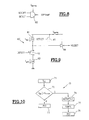
- Figures 6, 7 and 8 show circuits to produce the STPRAMP signal in the conditions which have just been mentioned.
- Circuit 40 of Figure 6 is a circuit for detecting cuts of the voltage Vcc, producing a cut-off signal VCCDET.
- the circuit 50 of FIG. 7 makes it possible to produce a DETECT signal when the voltage Vpp reaches the threshold Vppmin efficiency.
- Figure 8 shows a logic circuit which combines VCCDET and DETECT for produce the STPRAMP signal.
- most logic gates used for realize the circuits of figures 6, 7, 8 are supplied by the Vppreg voltage so as not to be affected by a cut in the voltage Vcc.
- these doors logic is achieved using CMOS technology so as not to consume current outside the switching periods.
- the circuit 40 of FIG. 6 comprises a transistor MOS 41 receiving on its grid G the supply voltage Vcc.
- the source S of transistor 41 is connected to the ground via two MOS transistors 42, 43 in series functioning as diodes.
- the drain D of transistor 41 is connected to the voltage Vppreg by via a current source 44, as well as the entry of a reversing door 45.
- the exit of the door 45 attacks the entrance to a second reversing door 46 which delivers the VCCDET signal.
- VCCDET signal goes to 1 when the voltage Vcc becomes less than a value of threshold Vccmin equal to the sum of the threshold voltages of the transistors 41, 42, 43. For example, choose Vccmin equal to 3V.
- the circuit 50 of FIG. 7 comprises a bridge voltage divider Vpp formed by two capacitors 51, 52.
- the midpoint 53 of the divider bridge is connected to the gate G of a MOS transistor 54.
- Capacities 51 and 52 are chosen so that the tension of the midpoint is equal to the threshold voltage VT of transistor 54 when the voltage Vpp reaches its efficiency value Vppmin.
- the source S of transistor 54 is grounded and its drain D is connected to the input of a reversing door 55 whose output delivers the DETECT signal.
- the logical state of the gate 55 is stabilized by a P type MOS transistor 56 powered by the Vppreg voltage.
- a MOS transistor 57 controlled by ACTVPP signal via an inverting door 58 connects the midpoint 53 of the divider bridge to ground.
- the VCCDET and DETECT are combined by a logic gate type 60 NAND (NAND) whose output delivers the STPRAMP signal. So that the STPRAMP signal goes to 0 and inhibits the circuit 34 ramp generator of figure 5, it is necessary that VCCDET and DETECT are both at 1.
- the DETECT signal can be used to produce the signal Vx for controlling the isolation transistors TI i of the memory 10 (FIG. 3).
- the signal Vx is delivered by an inverting gate 59 receiving the DETECT signal as an input and thus goes to 0 when the voltage Vpp reaches the efficiency threshold Vppmin.
- the advantage is that the signal Vx is automatically set to zero and the isolation switches T i definitively closed when the DETECT signal goes to 1. Thus, in the event of a subsequent cut in voltage Vcc, no reverse current likely to flow through the switches T i when the signal Vx is not at 0 cannot appear.
- Figure 9 shows a 40 'variant of the circuit 40 of FIG. 6.
- the circuit 40 ′ detects the cuts in the voltage Vcc by monitoring the voltage Vppreg at the regulator output 33, instead of monitoring the voltage Vcc itself.
- a first current source 61 delivering an Ivpp current is arranged between the outlet of regulator 33 and the drain D of an NMOS transistor 62 receiving on its gate G the DETECT signal.
- the source S of transistor 62 is connected to mass through a second source of current 63 delivering an Ignd current.
- the drain D of transistor 62 drives the input of an inverting gate 64 powered by the Vppreg voltage and delivering the signal VCCDET.
- an NMOS 65 transistor controlled by the DETECT signal is placed between the Vppreg voltage and the entrance to the reversing door 64.
- the sources of current 61 and 63 are set so that the current Ivpp is greater than the Ignd current when the voltage Vppreg is at its normal value Vregnom.
- the signal DETECT goes to 1, transistor 62 is on, the Ivpp current surpasses Ignd current and voltage at drain D of transistor 62 is close to Vppreg.
- the Vppreg voltage weakens, especially after a power cut the supply voltage Vcc, the current Ivpp decreases, the drain D voltage drops and causes switching of the reversing door 64 whose VCCDET output goes to 1.
- the circuit 40 when the DETECT signal is at 0, the circuit 40 'is blocked and transistor 65 forces the 0 to 0 VCCDET signal.
- the VCCDET signal cannot pass to 1 as long as the DETECT signal is not at 1.
- the NAND gate of figure 8 therefore becomes useless, the reverse signal / VCCDET of the VCCDET signal which can be used as STPRAMP signal.
- microcircuit 1 comprising various functionalities, symbolically represented by logic circuit 20.
- these functionalities are for example the management of transaction operations, performing encryption operations allowing fight against fraud, etc., the EEPROM memory being used by microcircuit 1 as a means data recording and storage.
- the present invention can apply to a microcircuit 1 not having the logic circuit 20, i.e. a simple memory microcircuit EEPROM, DWL, DOP, and DBL decoders that can be ordered from outside.
- the ramp generator circuit 34 may, depending on the type of EEPROM used, be useless. It should be remembered that the application of a Vpp voltage ramp to memory cells only intended to protect cells from a slow deterioration that could result from the application abrupt voltage Vpp at each operation of programming or erasing. This voltage ramp may be necessary with certain cell types, especially those that use gate transistors floating. However, such a voltage ramp is not not imperative to programming. In addition, the man of art will note that cutting this voltage ramp in exceptional cases where the present invention does not have a significant impact on the duration of cell life. Finally, the use of a charges is not imperative, one skilled in the art knowing various ways of making circuits boosters.
Landscapes
- Engineering & Computer Science (AREA)
- Computer Hardware Design (AREA)
- Microelectronics & Electronic Packaging (AREA)
- Computer Security & Cryptography (AREA)
- Physics & Mathematics (AREA)
- General Physics & Mathematics (AREA)
- Theoretical Computer Science (AREA)
- Power Engineering (AREA)
- Read Only Memory (AREA)
- Connection Of Batteries Or Terminals (AREA)
Claims (18)
- Elektrisch programmierbarer und löschbarer Speicher (10), welcher Mittel (30) umfaßt, um ausgehend von einer Versorgungsspannung (Vcc) eine Hochspannung (Vpp) für die Programmierung oder Löschung zu schaffen, dadurch gekennzeichnet, daß er umfaßt:eine elektrische Kapazität (Chv, CR2), welche geeignet ist, die Hochspannung (Vpp) im Falle der Unterbrechung der Versorgungsspannung (Vcc) zu halten,Speicherunterbrechungsmittel (SWi), welche von der Hochspannung (Vpp) versorgt werden und eingerichtet sind, im Falle der Unterbrechung der Versorgungsspannung (Vcc), die Zuführung der Hochspannung (Vpp) zu Zellen (Ci,j), welche im Begriff programmiert oder gelöscht zu werden, aufrecht zu erhalten.
- Speicher nach Anspruch 1, umfassend:Speicherunterbrechungsmittel (SWi), deren Ausgänge (OUT) Transistoren (TPGR1, TPGR2) zur Zuführung der Hochspannung (Vpp) ansteuern,Speicherunterbrechungsmittel (SWi), deren Ausgänge (OUT) Transistoren (TSWLi, TSBLi) zur Auswahl der Speicherzellen ansteuern, undSpeicherunterbrechungsmittel (SWi), deren Ausgänge (OUT) Transistoren (TPGR1) zur Verbindung mit der Erde ansteuern.
- Speicher nach Anspruch 2, bei welchem die Speicherunterbrechungsmittel (SWi) mindestens zwei invertierende Anschlüsse (INV1, INV2) in geschlossener Schleife umfassen, welche von der Hochspannung (Vpp) versorgt werden und durch Zwischenschaltung von Isoliertransistoren (TIi) angesteuert werden.
- Speicher nach einem der vorangegangenen Ansprüche, bei welchem die Kapazität, welche geeignet ist die Hochspannung (Vpp) zu halten, eine Stabilisationskapazität (Chv) umfaßt, die in den Mitteln (30) zur Erzeugung der Hochspannung gegeben ist.
- Speicher nach einem der Ansprüche 1 bis 4, bei welchem die Hochspannung (Vpp) durch Zwischenschaltung einer Rampenerzeugungs-Schaltung (34) angelegt wird, welche Mittel (TR4, 40, 40', 50, 60) umfaßt, um die Rampenerzeugungs-Schaltung (34) im Fall der Unterbrechung der Versorgungsspannung (Vcc) zu hemmen.
- Speicher nach Anspruch 5, bei welchem die Mittel (TR4, 40, 40', 50, 60) zur Hemmung der Rampenerzeugungs-Schaltung (34) umfassen:wobei die Rampenerzeugungs-Schaltung (34) gehemmt wird, wenn beide Schaltungen ausgelöst sind.eine Schaltung (40, 40') zur Erfassung von Unterbrechungen der Versorgungsspannung (Vcc), welche ausgelöst wird wenn die Unterbrechung der Versorgungsspannung erfaßt wird,eine Schaltung (50) zur Überwachung der Spannung (Vpp) am Ausgang der Rampenerzeugungs-Schaltung (34), welche ausgelöst wird (DETECT) wenn die Rampenspannung (Vpp) eine Effizienzschwelle (Vppmin) erreicht,
- Speicher nach Anspruch 6, bei welchem die Schaltung (40) zur Erfassung der Unterbrechungen der Versorgungsspannung (Vcc) eingerichtet ist, um die Versorgungsspannung zu überwachen und auszulösen, wenn die Versorgungsspannung kleiner als eine bestimmte Schwelle (Vccmin) ist.
- Speicher nach Anspruch 6, bei welchem die Schaltung (40') zur Erfassung von Unterbrechungen der Versorgungsspannung eingerichtet ist, um eine Hochspannung (Vppreg) zu überwachen, die angelegt wird an die Rampenerzeugungs-Schaltung (34), und auszulösen, wenn die Hochspannung (Vppreg) kleiner als ihr Normalwert (Vregnom) ist.
- Mikroschaltung (1) umfassend einen Speicher (10) nach einem der Ansprüche 1 bis 8, und eine Logikschaltung (20), welche den Speicher (10) als Datenspeichermittel verwendet.
- Mikroschaltung nach Anspruch 9, bei welcher beim Erscheinen der Versorgungsspannung (Vcc) das Einschalten der Logikschaltung (20) um ein Zeitintervall in der Größenordnung der Dauer eines Programmiervorgangs oder Löschungsvorgangs des Speichers (10) verzögert ist.
- Mikroschaltung nach Anspruch 10, bei welcher das Einschalten der Logikschaltung (20) verzögert wird unter der Bedingung, daß die Hochspannung (Vpp) am Ausgang der Mittel (30) zur Erzeugung der Hochspannung (Vpp) vorliegt.
- Verfahren zur Unterdrückung der Risiken des Einschreibens von fehlerhaften Daten in einen elektrisch programmierbaren und löschbaren Speicher (10), wenn eine Unterbrechung einer Versorgungsspannung (Vcc) des Speichers (10) im Verlauf eines Vorgangs der Programmierung und Löschung von Zellen (Ci,j) des Speichers auftritt, wobei der Speicher (10) Mittel (30) umfaßt zur Erzeugung einer Hochspannung (Vpp) für die Programmierung und Löschung, dadurch gekennzeichnet, daß es Vorgänge umfaßt, die darin bestehen:eine elektrische Kapazität (Chv, CR2) vorzusehen, welche geeignet ist im Fall der Unterbrechung der Versorgungsspannung (Vcc), während der Zeit, die notwendig ist für den Programmierungsvorgang oder Löschungsvorgang, die Hochspannung (Vpp) aufrecht zu erhalten,Speicherunterbrechungsmittel (SWi) vorzusehen, welche von der Hochspannung (Vpp) versorgt werden, um im Falle der Unterbrechung der Versorgungsspannung (Vcc) die Zuführung der Hochspannung (Vpp) zu Zellen (Ci,j) des Speichers, welche im Begriff programmiert oder gelöscht zu werden, aufrecht zu erhalten.
- Verfahren nach Anspruch 12, bei welchem die Kapazität mindestens eine Stabilisationskapazität (Chv, CR2) umfaßt, welche in den Mitteln (30) zur Erzeugung der Hochspannung (Vpp) vorliegt.
- Verfahren nach einem der Ansprüche 12 oder 13, bei welchem vorgesehen sind:Speicherunterbrechungsmittel (SWi), deren Ausgänge (OUT) Transistoren (TPGR1, TPGR2) zur Zuführung der Hochspannung (Vpp) ansteuern,Speicherunterbrechungsmittel (SWi), deren Ausgänge (OUT) Transistoren (TSWLi, TSBLi) zur Auswahl von Speicherzellen ansteuern, undSpeicherunterbrechungsmittel (SWi), deren Ausgänge (OUT) Transistoren (TPGR1) zur Verbindung mit der Erde ansteuern.
- Verfahren nach einem der Ansprüche 12 bis 14, umfassend den Vorgang, der darin besteht, Schaltungen (34) des Speichers, welche im Stande sind Strom zu verbrauchen, von der Spannung zu trennen oder zu hemmen.
- Verfahren nach einem der Ansprüche 12 bis 15, bei welchem die Zuführung der Hochspannung (Vpp) aufrecht erhalten wird unter der Bedingung, daß die Hochspannung (Vpp), welche am Speicher (10) in dem Moment anliegt als die Unterbrechung der Versorgungsspannung (Vcc) auftritt, einen Wert hat, der größer oder gleich einer Effizienzschwelle (Vppmin) ist.
- Verfahren nach einem der Ansprüche 12 bis 16, bei welchem eine Erfassung von Unterbrechungen der Versorgungsspannung (Vcc) darin besteht zu bestimmen, ob die Versorgungsspannung kleiner ist als eine vorbestimmte Schwelle (Vccmin).
- Verfahren nach einem der Ansprüche 12 bis 16, bei welchem eine Erfassung von Unterbrechungen der Versorgungsspannung (Vcc) darin besteht zu bestimmen, ob eine Spannung (Vppreg), die in den Mitteln (30) zur Erzeugung der Hochspannung (Vpp) auftritt, kleiner ist als ihr Normalwert (Vregnom).
Applications Claiming Priority (3)
| Application Number | Priority Date | Filing Date | Title |
|---|---|---|---|
| FR9607462A FR2749698B1 (fr) | 1996-06-07 | 1996-06-07 | Memoire remanente effacable et programmable electriquement, protegee contre les coupures d'alimentation |
| FR9607462 | 1996-06-07 | ||
| PCT/FR1997/000922 WO1997048100A1 (fr) | 1996-06-07 | 1997-05-27 | Memoire remanente effacable et programmable electriquement, protegee contre les coupures d'alimentation |
Publications (2)
| Publication Number | Publication Date |
|---|---|
| EP0902949A1 EP0902949A1 (de) | 1999-03-24 |
| EP0902949B1 true EP0902949B1 (de) | 2000-03-08 |
Family
ID=9493092
Family Applications (1)
| Application Number | Title | Priority Date | Filing Date |
|---|---|---|---|
| EP97926041A Expired - Lifetime EP0902949B1 (de) | 1996-06-07 | 1997-05-27 | Elektrisch lösch-und programmierbarer nichtflüchtiger speicher, geschützt gegen stromunterbrechungen |
Country Status (9)
| Country | Link |
|---|---|
| EP (1) | EP0902949B1 (de) |
| JP (1) | JP4129497B2 (de) |
| CN (1) | CN1132191C (de) |
| AT (1) | ATE190428T1 (de) |
| AU (1) | AU714734B2 (de) |
| CA (1) | CA2257339C (de) |
| DE (1) | DE69701395T2 (de) |
| FR (1) | FR2749698B1 (de) |
| WO (1) | WO1997048100A1 (de) |
Families Citing this family (18)
| Publication number | Priority date | Publication date | Assignee | Title |
|---|---|---|---|---|
| US5768208A (en) * | 1996-06-18 | 1998-06-16 | Microchip Technology Incorporated | Fail safe non-volatile memory programming system and method therefor |
| US5943263A (en) | 1997-01-08 | 1999-08-24 | Micron Technology, Inc. | Apparatus and method for programming voltage protection in a non-volatile memory system |
| FR2770325B1 (fr) * | 1997-10-29 | 2001-10-05 | Sgs Thomson Microelectronics | Circuit generateur de tension pour programmer ou effacer une memoire qui utilise des transistors a grille flottante |
| EP0953984B1 (de) * | 1998-04-30 | 2003-07-02 | STMicroelectronics S.r.l. | Verfahren zur Sicherung von Daten im Falle unerwünschter Unterbrechnungen während ein Programmzyklus eines nichtflüchtigen Speichers, und ein nichtflüchtiger Speicher |
| JP4248624B2 (ja) * | 1998-07-03 | 2009-04-02 | 株式会社デンソー | 内燃機関用電子制御装置。 |
| JP4231572B2 (ja) | 1998-07-07 | 2009-03-04 | 沖電気工業株式会社 | 電圧監視回路及びそれを内蔵したメモリカード |
| JP4133166B2 (ja) | 2002-09-25 | 2008-08-13 | 株式会社ルネサステクノロジ | 不揮発性半導体記憶装置 |
| EP1496468A1 (de) * | 2003-07-11 | 2005-01-12 | Axalto S.A. | Verfahren zur Speicherverwaltung in einem tragbaren Gegenstand, der für verschiedene Verbingungsarten geeignet ist |
| CN100428203C (zh) * | 2006-11-23 | 2008-10-22 | 北京飞天诚信科技有限公司 | 基于非易失性存储的便携式设备的实现掉电保护的方法 |
| KR100888842B1 (ko) * | 2007-06-28 | 2009-03-17 | 삼성전자주식회사 | 읽기 전압을 최적화할 수 있는 플래시 메모리 장치 및그것의 독출 전압 설정 방법 |
| CN101656108B (zh) * | 2008-08-19 | 2012-06-27 | 杭州士兰微电子股份有限公司 | 电源供电电路及应用方法 |
| CN103345942B (zh) * | 2013-07-03 | 2016-03-02 | 上海华力微电子有限公司 | 解析存储器操作类型错误的方法及其装置 |
| CN105631965B (zh) * | 2014-10-30 | 2018-03-16 | 中车大连电力牵引研发中心有限公司 | 车载wtb报文记录仪 |
| KR101745679B1 (ko) * | 2014-11-27 | 2017-06-09 | 주식회사 엘지화학 | 고흡수성 수지의 제조 방법 및 이를 통해 제조된 고흡수성 수지 |
| FR3039921B1 (fr) * | 2015-08-06 | 2018-02-16 | Stmicroelectronics (Rousset) Sas | Procede et systeme de controle d'une operation d'ecriture d'une donnee dans une cellule-memoire du type eeprom |
| FR3041807B1 (fr) * | 2015-09-24 | 2017-12-08 | Stmicroelectronics Rousset | Procede de controle d'un cycle d'ecriture de memoire de type eeprom et dispositif correspondant |
| CN105404346B (zh) * | 2015-12-22 | 2017-08-08 | 上海华虹宏力半导体制造有限公司 | 电压调整、高压产生和存储器电路 |
| CN107403644B (zh) * | 2017-05-22 | 2020-01-10 | 宜鼎国际股份有限公司 | 具备异常电源保护的闪存装置 |
Family Cites Families (5)
| Publication number | Priority date | Publication date | Assignee | Title |
|---|---|---|---|---|
| FR2604555B1 (fr) * | 1986-09-30 | 1988-11-10 | Eurotechnique Sa | Circuit integre du type circuit logique comportant une memoire non volatile programmable electriquement |
| JP2507576B2 (ja) * | 1988-12-28 | 1996-06-12 | 株式会社東芝 | 半導体不揮発性メモリ |
| EP0598475A3 (de) * | 1992-11-17 | 1995-03-22 | Advanced Micro Devices Inc | Vorrichtung und Verfahren zum Schutz einer Programmierbaren logischen Schaltung gegen Überspannungen. |
| US5371709A (en) * | 1993-04-01 | 1994-12-06 | Microchip Technology Incorporated | Power management system for serial EEPROM device |
| JPH07248977A (ja) * | 1994-03-10 | 1995-09-26 | Fuji Electric Co Ltd | 不揮発性メモリ回路 |
-
1996
- 1996-06-07 FR FR9607462A patent/FR2749698B1/fr not_active Expired - Fee Related
-
1997
- 1997-05-27 EP EP97926041A patent/EP0902949B1/de not_active Expired - Lifetime
- 1997-05-27 CN CN97196812A patent/CN1132191C/zh not_active Expired - Lifetime
- 1997-05-27 JP JP50127098A patent/JP4129497B2/ja not_active Expired - Lifetime
- 1997-05-27 DE DE69701395T patent/DE69701395T2/de not_active Expired - Lifetime
- 1997-05-27 CA CA002257339A patent/CA2257339C/fr not_active Expired - Lifetime
- 1997-05-27 AU AU30964/97A patent/AU714734B2/en not_active Ceased
- 1997-05-27 AT AT97926041T patent/ATE190428T1/de not_active IP Right Cessation
- 1997-05-27 WO PCT/FR1997/000922 patent/WO1997048100A1/fr not_active Ceased
Also Published As
| Publication number | Publication date |
|---|---|
| FR2749698A1 (fr) | 1997-12-12 |
| CA2257339C (fr) | 2006-09-19 |
| JP4129497B2 (ja) | 2008-08-06 |
| CA2257339A1 (fr) | 1997-12-18 |
| FR2749698B1 (fr) | 1998-09-04 |
| DE69701395T2 (de) | 2000-09-07 |
| DE69701395D1 (de) | 2000-04-13 |
| WO1997048100A1 (fr) | 1997-12-18 |
| ATE190428T1 (de) | 2000-03-15 |
| CN1226334A (zh) | 1999-08-18 |
| AU714734B2 (en) | 2000-01-13 |
| JP2000512054A (ja) | 2000-09-12 |
| EP0902949A1 (de) | 1999-03-24 |
| AU3096497A (en) | 1998-01-07 |
| CN1132191C (zh) | 2003-12-24 |
Similar Documents
| Publication | Publication Date | Title |
|---|---|---|
| EP0902949B1 (de) | Elektrisch lösch-und programmierbarer nichtflüchtiger speicher, geschützt gegen stromunterbrechungen | |
| EP1342244B1 (de) | Seitenlöschbarer flash-speicher | |
| EP0270410B1 (de) | Integrierte Logikschaltung mit EPROM | |
| EP1434237B1 (de) | Nichtflüchtige SRAM Speicherzelle | |
| EP2108163A1 (de) | Schutz von in einer elektronischen schaltung enthaltenen informationen | |
| EP0432049B1 (de) | MOS als Sicherung bei programmierbarer Durchbrennung eines Tunneloxydes | |
| EP0279712B1 (de) | Speicher-Leseschaltung | |
| FR2665973A1 (fr) | Circuit d'optimisation d'effacement automatique pour une memoire a semiconducteur programmable et effacable electriquement et procede s'y rapportant. | |
| EP3496101A1 (de) | Sram-speicher mit schneller löschfunktion | |
| US6038190A (en) | Electrically erasable and programmable non-volatile memory protected against power supply failure | |
| FR2598549A1 (fr) | Circuit de redondance pour utilisation dans un dispositif de memoire semi-conducteur | |
| EP0581639B1 (de) | Schutzschaltung gegen Stromunterbrechungen für eine integrierte Schaltung | |
| EP0278832B1 (de) | Leseschaltung für einen Speicher | |
| FR3106692A1 (fr) | Dispositif de mémoire vive statique non-volatile et procédé de commande correspondant. | |
| EP0703584B1 (de) | Adressen-Dekodierverfahren für einen integrierten Speicher und Speicherschaltung zur Anwendung eines solchen Verfahrens | |
| FR3007185A1 (fr) | Dispositif de memoire associant un plan-memoire du type sram et un plan-memoire du type non volatil, et procedes de fonctionnement | |
| EP1365418A1 (de) | Elektrisch lösch- und programmierbare Speicher mit interner Versorgungsspannungsregelungsvorrichtung | |
| FR3006491A1 (fr) | Procede d’ecriture dans une memoire de type eeprom incluant un rafraichissement de cellules memoire | |
| FR2770326A1 (fr) | Procede d'ecriture dans une memoire non volatile modifiable electriquement | |
| EP1295297B1 (de) | Verwendungserkennungsschaltung | |
| EP1012847B1 (de) | Verfahren zum schreiben von binären datenwörtern mittels elektrisch-programmierbarer und löschbarer speicherzellen | |
| EP0669622B1 (de) | Vorspannungsschaltung für einen Transistor in einer Speicherzelle | |
| KR100470947B1 (ko) | 전원공급불량에대해보호되는전기적으로삭제및프로그램가능한비휘발성메모리 | |
| FR2887364A1 (fr) | Circuit integre protege contre les courts-circuits et les erreurs de fonctionnement suite au passage d'une radiation ionisante | |
| JPH07226096A (ja) | 不揮発性半導体記憶装置 |
Legal Events
| Date | Code | Title | Description |
|---|---|---|---|
| PUAI | Public reference made under article 153(3) epc to a published international application that has entered the european phase |
Free format text: ORIGINAL CODE: 0009012 |
|
| 17P | Request for examination filed |
Effective date: 19981103 |
|
| AK | Designated contracting states |
Kind code of ref document: A1 Designated state(s): AT BE CH DE ES FR GB IT LI NL |
|
| GRAG | Despatch of communication of intention to grant |
Free format text: ORIGINAL CODE: EPIDOS AGRA |
|
| 17Q | First examination report despatched |
Effective date: 19990503 |
|
| GRAG | Despatch of communication of intention to grant |
Free format text: ORIGINAL CODE: EPIDOS AGRA |
|
| GRAH | Despatch of communication of intention to grant a patent |
Free format text: ORIGINAL CODE: EPIDOS IGRA |
|
| GRAH | Despatch of communication of intention to grant a patent |
Free format text: ORIGINAL CODE: EPIDOS IGRA |
|
| GRAA | (expected) grant |
Free format text: ORIGINAL CODE: 0009210 |
|
| AK | Designated contracting states |
Kind code of ref document: B1 Designated state(s): AT BE CH DE ES FR GB IT LI NL |
|
| PG25 | Lapsed in a contracting state [announced via postgrant information from national office to epo] |
Ref country code: NL Free format text: LAPSE BECAUSE OF FAILURE TO SUBMIT A TRANSLATION OF THE DESCRIPTION OR TO PAY THE FEE WITHIN THE PRESCRIBED TIME-LIMIT Effective date: 20000308 Ref country code: IT Free format text: LAPSE BECAUSE OF FAILURE TO SUBMIT A TRANSLATION OF THE DESCRIPTION OR TO PAY THE FEE WITHIN THE PRE;WARNING: LAPSES OF ITALIAN PATENTS WITH EFFECTIVE DATE BEFORE 2007 MAY HAVE OCCURRED AT ANY TIME BEFORE 2007. THE CORRECT EFFECTIVE DATE MAY BE DIFFERENT FROM THE ONE RECORDED.SCRIBED TIME-LIMIT Effective date: 20000308 Ref country code: ES Free format text: THE PATENT HAS BEEN ANNULLED BY A DECISION OF A NATIONAL AUTHORITY Effective date: 20000308 Ref country code: AT Free format text: LAPSE BECAUSE OF FAILURE TO SUBMIT A TRANSLATION OF THE DESCRIPTION OR TO PAY THE FEE WITHIN THE PRESCRIBED TIME-LIMIT Effective date: 20000308 |
|
| REF | Corresponds to: |
Ref document number: 190428 Country of ref document: AT Date of ref document: 20000315 Kind code of ref document: T |
|
| REG | Reference to a national code |
Ref country code: CH Ref legal event code: EP |
|
| REF | Corresponds to: |
Ref document number: 69701395 Country of ref document: DE Date of ref document: 20000413 |
|
| GBT | Gb: translation of ep patent filed (gb section 77(6)(a)/1977) |
Effective date: 20000505 |
|
| PG25 | Lapsed in a contracting state [announced via postgrant information from national office to epo] |
Ref country code: BE Free format text: LAPSE BECAUSE OF NON-PAYMENT OF DUE FEES Effective date: 20000531 |
|
| NLV1 | Nl: lapsed or annulled due to failure to fulfill the requirements of art. 29p and 29m of the patents act | ||
| BERE | Be: lapsed |
Owner name: INSIDE TECHNOLOGIES Effective date: 20000531 |
|
| PLBE | No opposition filed within time limit |
Free format text: ORIGINAL CODE: 0009261 |
|
| STAA | Information on the status of an ep patent application or granted ep patent |
Free format text: STATUS: NO OPPOSITION FILED WITHIN TIME LIMIT |
|
| 26N | No opposition filed | ||
| REG | Reference to a national code |
Ref country code: GB Ref legal event code: IF02 |
|
| REG | Reference to a national code |
Ref country code: FR Ref legal event code: CD Ref country code: FR Ref legal event code: CA |
|
| REG | Reference to a national code |
Ref country code: CH Ref legal event code: PFA Owner name: INSIDE CONTACTLESS Free format text: INSIDE TECHNOLOGIES#PEPINIERE AXONE#69930 SAINT-CLEMENT-LES-PLACES (FR) -TRANSFER TO- INSIDE CONTACTLESS#BAT. 11 A - PARC CLUB DU GOLF#13856 AIX-EN-PROVENCE CEDEX 3 (FR) |
|
| PGFP | Annual fee paid to national office [announced via postgrant information from national office to epo] |
Ref country code: CH Payment date: 20090429 Year of fee payment: 13 |
|
| REG | Reference to a national code |
Ref country code: CH Ref legal event code: PL |
|
| PG25 | Lapsed in a contracting state [announced via postgrant information from national office to epo] |
Ref country code: LI Free format text: LAPSE BECAUSE OF NON-PAYMENT OF DUE FEES Effective date: 20100531 Ref country code: CH Free format text: LAPSE BECAUSE OF NON-PAYMENT OF DUE FEES Effective date: 20100531 |
|
| REG | Reference to a national code |
Ref country code: DE Ref legal event code: R082 Ref document number: 69701395 Country of ref document: DE Representative=s name: HOFFMANN - EITLE, DE |
|
| REG | Reference to a national code |
Ref country code: DE Ref legal event code: R082 Ref document number: 69701395 Country of ref document: DE Representative=s name: HOFFMANN - EITLE PATENT- UND RECHTSANWAELTE PA, DE Effective date: 20131111 Ref country code: DE Ref legal event code: R082 Ref document number: 69701395 Country of ref document: DE Representative=s name: HOFFMANN - EITLE, DE Effective date: 20131111 Ref country code: DE Ref legal event code: R081 Ref document number: 69701395 Country of ref document: DE Owner name: INSIDE SECURE, FR Free format text: FORMER OWNER: INSIDE TECHNOLOGIES, SAINT-CLEMENT-LES-PLACES, FR Effective date: 20131111 |
|
| REG | Reference to a national code |
Ref country code: FR Ref legal event code: CD Owner name: INSIDE SECURE Effective date: 20140129 Ref country code: FR Ref legal event code: CA Effective date: 20140129 |
|
| REG | Reference to a national code |
Ref country code: FR Ref legal event code: PLFP Year of fee payment: 20 |
|
| PGFP | Annual fee paid to national office [announced via postgrant information from national office to epo] |
Ref country code: GB Payment date: 20160426 Year of fee payment: 20 Ref country code: DE Payment date: 20160421 Year of fee payment: 20 |
|
| PGFP | Annual fee paid to national office [announced via postgrant information from national office to epo] |
Ref country code: FR Payment date: 20160518 Year of fee payment: 20 |
|
| REG | Reference to a national code |
Ref country code: DE Ref legal event code: R071 Ref document number: 69701395 Country of ref document: DE |
|
| REG | Reference to a national code |
Ref country code: GB Ref legal event code: PE20 Expiry date: 20170526 |
|
| PG25 | Lapsed in a contracting state [announced via postgrant information from national office to epo] |
Ref country code: GB Free format text: LAPSE BECAUSE OF EXPIRATION OF PROTECTION Effective date: 20170526 |
|
| REG | Reference to a national code |
Ref country code: FR Ref legal event code: TP Owner name: WISEKEY SEMICONDUCTORS, FR Effective date: 20170727 Ref country code: FR Ref legal event code: CD Owner name: WISEKEY SEMICONDUCTORS, FR Effective date: 20170727 |