EP0905195B1 - Compositions à un seul composant de silicone vulcanisables à température ambiente par réticulation - Google Patents
Compositions à un seul composant de silicone vulcanisables à température ambiente par réticulation Download PDFInfo
- Publication number
- EP0905195B1 EP0905195B1 EP98307959A EP98307959A EP0905195B1 EP 0905195 B1 EP0905195 B1 EP 0905195B1 EP 98307959 A EP98307959 A EP 98307959A EP 98307959 A EP98307959 A EP 98307959A EP 0905195 B1 EP0905195 B1 EP 0905195B1
- Authority
- EP
- European Patent Office
- Prior art keywords
- mole percent
- zero
- parts
- weight
- organosiloxy units
- Prior art date
- Legal status (The legal status is an assumption and is not a legal conclusion. Google has not performed a legal analysis and makes no representation as to the accuracy of the status listed.)
- Expired - Lifetime
Links
Classifications
-
- C—CHEMISTRY; METALLURGY
- C08—ORGANIC MACROMOLECULAR COMPOUNDS; THEIR PREPARATION OR CHEMICAL WORKING-UP; COMPOSITIONS BASED THEREON
- C08L—COMPOSITIONS OF MACROMOLECULAR COMPOUNDS
- C08L83/00—Compositions of macromolecular compounds obtained by reactions forming in the main chain of the macromolecule a linkage containing silicon with or without sulfur, nitrogen, oxygen or carbon only; Compositions of derivatives of such polymers
- C08L83/04—Polysiloxanes
-
- C—CHEMISTRY; METALLURGY
- C08—ORGANIC MACROMOLECULAR COMPOUNDS; THEIR PREPARATION OR CHEMICAL WORKING-UP; COMPOSITIONS BASED THEREON
- C08G—MACROMOLECULAR COMPOUNDS OBTAINED OTHERWISE THAN BY REACTIONS ONLY INVOLVING UNSATURATED CARBON-TO-CARBON BONDS
- C08G77/00—Macromolecular compounds obtained by reactions forming a linkage containing silicon with or without sulfur, nitrogen, oxygen or carbon in the main chain of the macromolecule
- C08G77/04—Polysiloxanes
- C08G77/38—Polysiloxanes modified by chemical after-treatment
- C08G77/382—Polysiloxanes modified by chemical after-treatment containing atoms other than carbon, hydrogen, oxygen or silicon
- C08G77/388—Polysiloxanes modified by chemical after-treatment containing atoms other than carbon, hydrogen, oxygen or silicon containing nitrogen
-
- C—CHEMISTRY; METALLURGY
- C08—ORGANIC MACROMOLECULAR COMPOUNDS; THEIR PREPARATION OR CHEMICAL WORKING-UP; COMPOSITIONS BASED THEREON
- C08G—MACROMOLECULAR COMPOUNDS OBTAINED OTHERWISE THAN BY REACTIONS ONLY INVOLVING UNSATURATED CARBON-TO-CARBON BONDS
- C08G77/00—Macromolecular compounds obtained by reactions forming a linkage containing silicon with or without sulfur, nitrogen, oxygen or carbon in the main chain of the macromolecule
- C08G77/48—Macromolecular compounds obtained by reactions forming a linkage containing silicon with or without sulfur, nitrogen, oxygen or carbon in the main chain of the macromolecule in which at least two but not all the silicon atoms are connected by linkages other than oxygen atoms
- C08G77/54—Nitrogen-containing linkages
-
- C—CHEMISTRY; METALLURGY
- C08—ORGANIC MACROMOLECULAR COMPOUNDS; THEIR PREPARATION OR CHEMICAL WORKING-UP; COMPOSITIONS BASED THEREON
- C08K—Use of inorganic or non-macromolecular organic substances as compounding ingredients
- C08K5/00—Use of organic ingredients
- C08K5/54—Silicon-containing compounds
- C08K5/544—Silicon-containing compounds containing nitrogen
- C08K5/5477—Silicon-containing compounds containing nitrogen containing nitrogen in a heterocyclic ring
-
- C—CHEMISTRY; METALLURGY
- C08—ORGANIC MACROMOLECULAR COMPOUNDS; THEIR PREPARATION OR CHEMICAL WORKING-UP; COMPOSITIONS BASED THEREON
- C08K—Use of inorganic or non-macromolecular organic substances as compounding ingredients
- C08K5/00—Use of organic ingredients
- C08K5/54—Silicon-containing compounds
- C08K5/549—Silicon-containing compounds containing silicon in a ring
-
- C—CHEMISTRY; METALLURGY
- C08—ORGANIC MACROMOLECULAR COMPOUNDS; THEIR PREPARATION OR CHEMICAL WORKING-UP; COMPOSITIONS BASED THEREON
- C08G—MACROMOLECULAR COMPOUNDS OBTAINED OTHERWISE THAN BY REACTIONS ONLY INVOLVING UNSATURATED CARBON-TO-CARBON BONDS
- C08G77/00—Macromolecular compounds obtained by reactions forming a linkage containing silicon with or without sulfur, nitrogen, oxygen or carbon in the main chain of the macromolecule
- C08G77/04—Polysiloxanes
- C08G77/14—Polysiloxanes containing silicon bound to oxygen-containing groups
-
- C—CHEMISTRY; METALLURGY
- C08—ORGANIC MACROMOLECULAR COMPOUNDS; THEIR PREPARATION OR CHEMICAL WORKING-UP; COMPOSITIONS BASED THEREON
- C08G—MACROMOLECULAR COMPOUNDS OBTAINED OTHERWISE THAN BY REACTIONS ONLY INVOLVING UNSATURATED CARBON-TO-CARBON BONDS
- C08G77/00—Macromolecular compounds obtained by reactions forming a linkage containing silicon with or without sulfur, nitrogen, oxygen or carbon in the main chain of the macromolecule
- C08G77/04—Polysiloxanes
- C08G77/14—Polysiloxanes containing silicon bound to oxygen-containing groups
- C08G77/16—Polysiloxanes containing silicon bound to oxygen-containing groups to hydroxy groups
-
- C—CHEMISTRY; METALLURGY
- C08—ORGANIC MACROMOLECULAR COMPOUNDS; THEIR PREPARATION OR CHEMICAL WORKING-UP; COMPOSITIONS BASED THEREON
- C08G—MACROMOLECULAR COMPOUNDS OBTAINED OTHERWISE THAN BY REACTIONS ONLY INVOLVING UNSATURATED CARBON-TO-CARBON BONDS
- C08G77/00—Macromolecular compounds obtained by reactions forming a linkage containing silicon with or without sulfur, nitrogen, oxygen or carbon in the main chain of the macromolecule
- C08G77/04—Polysiloxanes
- C08G77/14—Polysiloxanes containing silicon bound to oxygen-containing groups
- C08G77/18—Polysiloxanes containing silicon bound to oxygen-containing groups to alkoxy or aryloxy groups
-
- C—CHEMISTRY; METALLURGY
- C08—ORGANIC MACROMOLECULAR COMPOUNDS; THEIR PREPARATION OR CHEMICAL WORKING-UP; COMPOSITIONS BASED THEREON
- C08G—MACROMOLECULAR COMPOUNDS OBTAINED OTHERWISE THAN BY REACTIONS ONLY INVOLVING UNSATURATED CARBON-TO-CARBON BONDS
- C08G77/00—Macromolecular compounds obtained by reactions forming a linkage containing silicon with or without sulfur, nitrogen, oxygen or carbon in the main chain of the macromolecule
- C08G77/70—Siloxanes defined by use of the MDTQ nomenclature
-
- C—CHEMISTRY; METALLURGY
- C08—ORGANIC MACROMOLECULAR COMPOUNDS; THEIR PREPARATION OR CHEMICAL WORKING-UP; COMPOSITIONS BASED THEREON
- C08G—MACROMOLECULAR COMPOUNDS OBTAINED OTHERWISE THAN BY REACTIONS ONLY INVOLVING UNSATURATED CARBON-TO-CARBON BONDS
- C08G77/00—Macromolecular compounds obtained by reactions forming a linkage containing silicon with or without sulfur, nitrogen, oxygen or carbon in the main chain of the macromolecule
- C08G77/80—Siloxanes having aromatic substituents, e.g. phenyl side groups
Definitions
- the present invention relates to new one-part or one-component room temperature vulcanizable silicone sealant compositions that utilize new siloxane compositions of matter wherein the siloxane composition functions both as an alcohol scavenger and as an adhesion promoter in room temperature vulcanizable silicone formulations.
- the present invention relates to a polyorganosiloxane composition. More particularly the present invention relates to room temperature curable polyorganosiloxane compositions that are rendered stable under moisture free hermetically sealed closed conditions and which cure upon contact with water present in ambient air at room temperature to form an elastomeric composition.
- compositions that cure at room temperature to form elastomers have been widely used as elastic adhesives or coating agents in the electrical and electronic industries.
- compositions have been used as sealants in the construction industry since they necessitate none of the troublesome steps involving the measuring and weighing of the quantities of silicones, cross-linking agents, catalysts and mixing and preparing the sealant. Because one-part compositions avoid these steps, the materials are convenient to use and reproducible in their properties.
- compositions comprise a silanol terminated polydiorganosiloxane and a cross-linking agent having more than two hydrolyzable groups per molecule.
- a silanol terminated polydiorganosiloxane and a cross-linking agent having more than two hydrolyzable groups per molecule.
- they Upon curing, they generally release acetic acid, a long chain carboxylic acid, an organic amine, an organic amide, an organic hydroxylamine, an organic oxime, an alcohol or acetone depending on the chemical structure of the cross-linking agent employed.
- Compositions that cure by means of releasing an amine present toxicity issues as well as causing odor.
- Compositions that cure through the release of hydroxylamine, oximes or amides still corrode metals because these types of compounds are known metal ligands and form complexes with susceptible transition metals such as copper, which is one mechanism of corrosion. Compositions that cure by releasing acetone suffer from yellowing and the cross-linking agents are not convenient to prepare.
- Room temperature vulcanizable compositions that cure by releasing alcohols offer a certain convenience because alkoxysilanes are used as the cross-linking agents.
- the compounds released by curing are alcohols and these generally present no odor or toxicity problems.
- Alkoxy curing compositions (alcohol releasing RTV compositions) do suffer from a slow cure rate and are very easy to hydrolyze, that is very small amounts of water trigger the curing reaction. This leads to problems with storage of the compositions.
- Non-corrosive, alkoxy functional, one-component RTV silicone sealants can be made from polyalkoxy terminated polydiorganosiloxane polymers, alkoxysilane crosslinking agents and Sn(IV) catalysts. As disclosed in U.S. patents 4,517,352 ('352) and 4,395,526 ('526), such compositions do not exhibit long term storage stability, i.e. they are not shelf stable.
- shelf-stability as applied to one-component alkoxy curing RTV compositions means a moisture curable mixture wherein the uncured and cured properties are substantially unchanged relative to a freshly prepared mixture after being stored in a moisture resistant and moisture free container after accelerated aging for 24 hours at 100 °C.
- shelf stability means a moisture curable mixture wherein the uncured and cured properties are substantially unchanged relative to a freshly prepared mixture after being stored in a moisture resistant and moisture free container for an extended period of time at ambient conditions, e.g. one year or two years.
- methylaminosilanes, ethylaminosilanes, propylaminosilanes, butylaminosilanes, hexylaminosilanes and hexamethyldisilazane are corrosive to copper bearing alloys.
- the low molecular weight amino by-products of the alcohol scavenging reaction cause contact and vapor corrosion when copper (or another susceptible transition metal) is present in the substrate alloy.
- Other one-component formulations that cure by release of acetic acid also cause corrosion, primarily because of acid attack on the metal. While titanium catalyzed one component formulations curing by release of an alcohol, (alkoxy based formulations), such as disclosed in U.S.
- U.S. patents 4,537,944 ('944) and 4, 760,123 ('123) disclose the use of certain compounds as alcohol scavengers that mitigate some of the problems associated with alkoxy based formulations.
- These patents disclose alcohol scavenging compounds that contain a silicon-nitrogen bond and when reacted with alcohol form a non-volatile nitrogen containing compound.
- these types of compounds also tend to reduce the amount of corrosion observed when room temperature vulcanizable sealants are used to seal metals because vapor corrosion is correspondingly reduced.
- the silicon nitrogen compounds that have been found to be particularly useful are those containing a silicon nitrogen bond wherein the nitrogen is bonded indirectly to the same or another silicon by or through one or more carbon atoms.
- 1,1-dimethoxy-2-trimethylsilyl-1-sila-azacyclopentane is highly toxic.
- These compounds are typically prepared by the following reaction scheme: which reacts further to generate the active oligomeric species: albeit in yields significantly below 50 mole % based on the starting aminoalkoxysilane.
- a significant problem associated with these compounds is the very toxic nature of the 1,1-dimethoxy-2-trimethylsilyl-1-sila-azacyclopentane:
- polymeric siloxane compounds containing the 1-sila-azacyclopentane moiety not only initially function as alcohol scavengers in one-part alkoxy curing room temperature vulcanizable silicone compositions but also after reaction with alcohol the reaction products also function as adhesion promoters.
- the present invention provides for a neutral cure one component (one-part) room temperature vulcanizable silicone composition that is non-corrosive to copper bearing alloys. Such compositions are useful as sealants
- a room temperature vulcanizable silicone composition comprising:
- the room temperature vulcanizable compositions of the present invention further provide for compositions whereby the 1-sila-azacyclopentane functionalized silicone reacts with an alcohol to scavenge the alcohol and whereby the reaction product of the alcohol with the 1-sila-azacyclopentane functionalized silicone is an adhesion promoter.
- the present invention provides for a neutral cure one-component room temperature vulcanizable silicone composition comprising:
- Barrels 1-9 of a Werner-Pfleiderer twin-screw extruder were heated to 75 °C.
- Barrels 10-14 were cooled to 263 °K (-10 °C) with a glycol heat exchanging fluid.
- 65.4 wt.% of the methyldimethoxy terminated PDMS polymer of example 1 13 wt. % of D4 (octamethycyclotetrasiloxane) treated fumed silica filler and 0.07 wt. % cyanoethyltrimethoxysilane were continuously added to barrel 1. 10.
- 3 wt.% of a trimethylsilyl terminated PDMS fluid having a viscosity of 100 mPa.s (cPs) at 25 °C and 4.5 wt.% of an M,D,T silanol fluid having a viscosity of 50 mPa.s (cPs) at 25 °C were continuously added to barrel 6.
- a de-airing vacuum was applied to barrel 11.
- 1 wt.% methyltrimethoxysilane, 0.025 wt.% glycidoxy propyltrimethoxysilane and 0.24 wt.% dibutyltindiacetate were continuously added to barrel 13.
- the sealant was tested for tack free time (TFT), Shore A hardness, tensile strength (psi) (kPa) and ultimate elongation (%), accelerated shelf age after aging uncured sealant for 24 hours at 100 °C, primerless peel adhesion (ppi) (kg/m) against glass, anodized (anod.) Al, bare Al, and polyvinylchloride (PVC), vapor phase corrosion (Vapor, x), and contact corrosion (Contact, x). Test results are presented in Table 2 and demonstrate the poor shelf stability of an alkoxy curing Sn +4 catalyzed room temperature vulcanizable composition when such a composition does not possess an alcohol scavenger compound.
- Example 4 is a repeat of example 3 with the addition of a continuous addition of 2.0 wt.% hexamethyldisilazane methanol scavenging compound to barrel 13 of the Werner-Pfleiderer extruder. The composition was tested and the results are presented in Table 2.
- Example 4 demonstrates that alkoxy curing room temperature vulcanizable silicone compositions that contain a disilazane alcohol scavenging compound are corrosive because of the presence of one of the disilazane decomposition products, ammonia.
- Example 4 is also characterized by poor primerless adhesion.
- Example 5 is a repeat of example 3 with the addition of a continuous addition of 4.0 wt.% of compound 55 (Table 1), methanol scavenging compound, to barrel 13 of the Werner-Pfleiderer extruder. The composition was tested and the results are presented in Table 2.
- Example 5 demonstrates the effectiveness of compound 55 as an alcohol scavenger that affords a fast curing, alkoxy room temperature vulcanizable silicone composition that is non-corrosive to copper and brass, has excellent primerless adhesion and is shelf stable.
- Example 6 is a repeat of example 3 with the addition of a continuous addition of 4.0 wt.% of compound 60 (Table 1), methanol scavenging compound, to barrel 13 of the Werner-Pfleiderer extruder. The composition was tested and the results are presented in Table 2.
- Example 6 demonstrates the effectiveness of compound 60 as an alcohol scavenger that affords a fast curing, alkoxy room temperature vulcanizable silicone composition that is non-corrosive to copper and brass, has excellent primerless adhesion and is shelf stable.
- Example 7 is a repeat of example 3 with the addition of a continuous addition of 4.0 wt.% of compound 65 (Table 1), methanol scavenging compound, to barrel 13 of the Werner-Pfleiderer extruder. The composition was tested and the results are presented in Table 2.
- Example 7 demonstrates the effectiveness of compound 65 as an alcohol scavenger that affords a fast curing, alkoxy room temperature vulcanizable silicone composition that is non-corrosive to copper and brass, has excellent primerless adhesion and is shelf stable.
- Example 8 is a repeat of example 3 with the addition of a continuous addition of 4.0 wt.% of compound 130 (Table 1), methanol scavenging compound, to barrel 13 of the Werner-Pfleiderer extruder. The composition was tested and the results are presented in Table 2.
- Example 8 demonstrates the effectiveness of compound 130 as an alcohol scavenger that affords a fast curing, alkoxy room temperature vulcanizable silicone composition that is non-corrosive to copper and brass, has excellent primerless adhesion and is shelf stable.
- Example 9 is a repeat of example 3 with the addition of a continuous addition of 2.0 wt.% of compound 55 (Table 1), methanol scavenging compound, to barrel 13 of the Werner-Pfleiderer extruder.
- the composition was tested and the results are presented in Table 2 which demonstrates that at the 2 wt.% level the composition is not shelf stable.
- Example 10 is a repeat of example 5 with the glycidoxypropyltrimethoxysilane removed from the composition and the amount of the methyldimethoxy terminated PDMS polymer increased slightly to 65.64 wt.%. Test results are presented in Table 2. The results demonstrate that example 10 has excellent primerless adhesion. The excellent primerless adhesion demonstrates that the alcohol reaction product of compound 55 is acting as the sole adhesion promoter in the composition because the glycidoxypropyltrimethoxysilane was removed from the composition.
- Example 11 is a repeat of example 6 with the glycidoxypropyltrimethoxysilane removed from the composition and the amount of the methyldimethoxy terminated PDMS polymer increased slightly to 65.64 wt.%. Test results are presented in Table 2. The results demonstrate that example 11 has excellent primerless adhesion. The excellent primerless adhesion demonstrates that the alcohol reaction product of compound 60 is acting as the sole adhesion promoter in the composition because the glycidoxypropyltrimethoxysilane was removed from the composition.
- Example 12 is a repeat of example 5 with the glycidoxypropyltrimethoxysilane removed from the composition and the amount of the methyldimethoxy terminated PDMS polymer increased slightly to 65.64 wt.%. Test results are presented in Table 2. The results demonstrate that example 12 has excellent primerless adhesion. The excellent primerless adhesion demonstrates that the alcohol reaction product of compound 65 is acting as the sole adhesion promoter in the composition because the glycidoxypropyltrimethoxysilane was removed from the composition.
- Example 13 is a repeat of example 8 with the glycidoxypropyltrimethoxysilane removed from the composition and the amount of the methyldimethoxy terminated PDMS polymer increased slightly to 65.64 wt.%. Test results are presented in Table 2. The results demonstrate that example 13 has excellent primerless adhesion. The excellent primerless adhesion demonstrates that the alcohol reaction product of compound 130 is acting as the sole adhesion promoter in the composition because the glycidoxypropyltrimethoxysilane was removed from the composition.
- Example 14 is a repeat of example 5 replacing the dibutyltinacetate catalyst with dibutyltinacetylacetonate. As shown in Table 2, the resulting composition is stable, fast curing, non-corrosive to copper bearing alloys and has excellent primerless adhesion. Properties of Cured One Part Alkoxy Curing Room Temperature Vulcanizable Silicone Compositions Tests Ex.3 Ex.4 Ex.5 Ex.6 Ex. 7 Ex. 8 Ex.9 Ex.10 Ex.11 Ex.12 E-63 TFT, min.
Landscapes
- Chemical & Material Sciences (AREA)
- Health & Medical Sciences (AREA)
- Chemical Kinetics & Catalysis (AREA)
- Medicinal Chemistry (AREA)
- Polymers & Plastics (AREA)
- Organic Chemistry (AREA)
- General Chemical & Material Sciences (AREA)
- Compositions Of Macromolecular Compounds (AREA)
Claims (10)
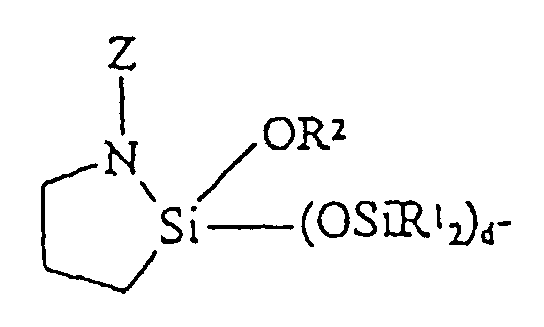
- Composition à base de silicone, vulcanisable à la température ordinaire, qui comprend :dans laquelle l'indice d est un nombre compris dans l'intervalle allant de 1 à 1 000, R1, R2 et R" représentent chacun un groupe hydrocarboné monovalent, ayant un à quarante atomes de carbone, et Z représente un groupe monovalent choisi parmi les groupes -SiR"3, -(CH2)p(CR1R2)m-p NHt(SiR"3)2-t et -(CH2)p(CR1R2)m-pHN(CH2)q(CR1R2)r-q NHt(SiR"3)2-t où m et r représentent chacun indépendamment un nombre compris dans l'intervalle allant de 1 à 8, chaque p représente indépendamment un nombre compris dans l'intervalle allant de zéro à m, chaque q représente indépendamment un nombre compris dans l'intervalle allant de zéro à r, et t est égal à 0, 1 ou 2.a) 100 parties en poids d'un polydiorganosiloxane à terminaisons polyalcoxy, de formule :b) 5 à 40 parties en poids pour 100 parties en poids de polymère (a), d'une charge renforçante constituée de silice fumée ou de silice pyrogénée,c) zéro à 40 parties en poids pour cent parties en poids de polymère (a), d'un polydiorganosiloxane stoppé en bout de chaíne par des groupes triorganosilyle, de formule :d) zéro à 5 parties en poids pour 100 parties en poids de polymère (a), d'un agent réticulant constitué d'un polyalcoxysilane de formule :e) zéro à 2 parties en poids pour cent parties en poids de polymère (a), d'un silane à groupe fonctionnel cyano, de formule :f) zéro à 25 parties en poids pour cent parties en poids de polymère (a), d'un silanol MDT liquide comprenant :chaque R10 représentant indépendamment dans chaque motif mono-organosiloxy, chaque motif diorganosiloxy et chaque motif triorganosiloxy un groupe organique monovalent, ayant un à dix atomes de carbone,i) 1 à 80 % en moles, de préférence 10 à 70 % en moles, encore mieux 20 à 70 % en moles et en particulier 20 à 60 % en moles de motifs mono-organosiloxy de formule R10SiO3/2,ii) 0,5 à 50 % en moles, de préférence 5 à 40 % en moles, encore mieux 5 à 30 % en moles et en particulier 10 à 30 % en moles de motifs triorganosiloxy de formule R10 3SiO1/2,iii) 1 à 80 % en moles, de préférence 10 à 70 % en moles, encore mieux 20 à 70 % en moles et en particulier 20 à 60 % en moles de motifs diorganosiloxy de formule R10 2SiO2/2, etiv) zéro à 25 % en moles, de préférence zéro à 10 % en moles, encore mieux zéro à 5 % en moles et en particulier 0 % en moles de motifs siloxy de formule SiO4/2,g) 0,1 à 1,0 partie en poids pour cent parties en poids de polymère (a), d'un catalyseur de durcissement par condensation à l'étain, eth) 2,5 à 10 parties en poids pour cent parties en poids de polymère (a), d'une silicone à groupe fonctionnel 1-sila-azacyclopentane, comprenant un fragment monovalent 1-sila-azacyclopentane de structure :
- Composition selon la revendication 1, pour laquelle R1, R2 et R" sont choisis parmi les groupes hydrocarbonés monovalents méthyle, éthyle, propyle, isopropyle, trifluoro-propyle, n-butyle, sec-butyle, t-butyle, phényle et tolyle.
- Composition selon la revendication 2, dans laquelle R1 est un groupe méthyle.
- Composition selon l'une quelconque des revendications précédentes, dans laquelle R2 est un groupe méthyle.
- Composition selon l'une quelconque des revendications précédentes, dans laquelle R3 est un groupe méthyle.
- Composition selon l'une quelconque des revendications précédentes, pour laquelle l'indice d est un nombre compris dans l'intervalle allant de 1 à 100.
- Composition selon l'une quelconque des revendications précédentes, pour laquelle l'indice d est un nombre compris dans l'intervalle allant de 1 à 50.
- Composition selon l'une quelconque des revendications précédentes, pour laquelle l'indice d est un nombre compris dans l'intervalle allant de 2 à 15.
- Composition selon l'une quelconque des revendications précédentes, dans laquelle le catalyseur de durcissement par condensation à l'étain est un catalyseur choisi parmi les biscétonates de diorganoétain, les dicarboxylates de diorganoétain et les carboxylates d'étain.
- Composition à base de silicone, vulcanisable à la température ordinaire, selon la revendication 1, qui comprend :dans laquelle l'indice d est un nombre compris dans l'intervalle allant de 1 à 1 000, R1, R2 et R" représentent chacun un groupe hydrocarboné monovalent, ayant un à quarante atomes de carbone, et Z représente un groupe monovalent choisi parmi les groupes -SiR"3, -(CH2)p(CR1R2)m-p NHt(SiR"3)2-t et -(CH2)p(CR1R2)m-pHN(CH2)q(CR1R2)r-q NHt(SiR"3)2-t où m et r représentent chacun indépendamment un nombre compris dans l'intervalle allant de 1 à 8, chaque p représente indépendamment un nombre compris dans l'intervalle allant de zéro à m, chaque q représente indépendamment un nombre compris dans l'intervalle allant de zéro à r, et t est égal à 0, 1 ou 2, grâce à quoi la silicone à groupe fonctionnel 1-sila-azacyclopentane réagit avec un alcool en le fixant, le produit de réaction de l'alcool avec la silicone à groupe fonctionnel 1-sila-azacyclopentane étant un agent favorisant l'adhérence.a) 100 parties en poids d'un polydiorganosiloxane à terminaisons polyalcoxy, de formule :b) 5 à 40 parties en poids pour 100 parties en poids de polymère (a), d'une charge renforçante constituée de silice fumée ou de silice pyrogénée,c) zéro à 40 parties en poids pour cent parties en poids de polymère (a), d'un polydiorganosiloxane stoppé en bout de chaíne par des groupes triorganosilyle, de formule :d) zéro à 5 parties en poids pour 100 parties en poids de polymère (a), d'un agent réticulant constitué d'un polyalcoxysilane de formule :e) zéro à 2 parties en poids pour cent parties en poids de polymère (a), d'un silane à groupe fonctionnel cyano, de formule :f) zéro à 25 parties en poids pour cent parties en poids de polymère (a), d'un silanol MDT liquide comprenant :chaque R10 représentant indépendamment dans chaque motif mono-organosiloxy, chaque motif diorganosiloxy et chaque motif triorganosiloxy un groupe organique monovalent, ayant un à dix atomes de carbone,i) 1 à 80 % en moles, de préférence 10 à 70 % en moles, encore mieux 20 à 70 % en moles et en particulier 20 à 60 % en moles de motifs mono-organosiloxy de formule R10SiO3/2,ii) 0,5 à 50 % en moles, de préférence 5 à 40 % en moles, encore mieux 5 à 30 % en moles et en particulier 10 à 30 % en moles de motifs triorganosiloxy de formule R10 3SiO1/2,iii) 1 à 80 % en moles, de préférence 10 à 70 % en moles, encore mieux 20 à 70 % en moles et en particulier 20 à 60 % en moles de motifs diorganosiloxy de formule R10 2SiO2/2, etiv) zéro à 25 % en moles, de préférence zéro à 10 % en moles, encore mieux zéro à 5 % en moles et en particulier 0 % en moles de motifs siloxy de formule SiO4/2,g) 0,1 à 1,0 partie en poids pour cent parties en poids de polymère (a), d'un catalyseur de durcissement par condention à l'étain, eth) 2,5 à 10 parties en poids pour cent parties en poids de polymère (a), d'une silicone à groupe fonctionnel 1-sila-azacyclopentane, comprenant un fragment monovalent 1-sila-azacyclopentane de structure :

Applications Claiming Priority (2)
| Application Number | Priority Date | Filing Date | Title |
|---|---|---|---|
| US08/940,787 US5962559A (en) | 1997-09-30 | 1997-09-30 | Neutral cure one component room temperature vulcanizable silicone compositions |
| US940787 | 1997-09-30 |
Publications (2)
| Publication Number | Publication Date |
|---|---|
| EP0905195A1 EP0905195A1 (fr) | 1999-03-31 |
| EP0905195B1 true EP0905195B1 (fr) | 2002-03-27 |
Family
ID=25475418
Family Applications (1)
| Application Number | Title | Priority Date | Filing Date |
|---|---|---|---|
| EP98307959A Expired - Lifetime EP0905195B1 (fr) | 1997-09-30 | 1998-09-30 | Compositions à un seul composant de silicone vulcanisables à température ambiente par réticulation |
Country Status (4)
| Country | Link |
|---|---|
| US (1) | US5962559A (fr) |
| EP (1) | EP0905195B1 (fr) |
| JP (1) | JPH11193348A (fr) |
| DE (1) | DE69804398D1 (fr) |
Families Citing this family (8)
| Publication number | Priority date | Publication date | Assignee | Title |
|---|---|---|---|---|
| DE10103421A1 (de) * | 2001-01-26 | 2002-08-14 | Ge Bayer Silicones Gmbh & Co | Polyorganosiloxan-Zusammensetzung |
| GB2444255A (en) * | 2006-11-30 | 2008-06-04 | Formerol Ltd | Mouldable one-part RTV silicone elastomer |
| EP2160414B1 (fr) | 2007-06-18 | 2017-05-10 | Bridgestone Corporation | Polymères fonctionnalisés par des halosilanes contenant un groupe amino |
| CN109796926B (zh) * | 2019-01-25 | 2021-06-01 | 杭州福斯特应用材料股份有限公司 | 一种光伏组件用耐湿热硅酮结构胶 |
| KR102315376B1 (ko) | 2021-03-16 | 2021-10-20 | 모멘티브퍼포먼스머티리얼스코리아 주식회사 | 실리콘계 조성물 및 이의 경화물 |
| WO2023102314A1 (fr) | 2021-12-03 | 2023-06-08 | Dow Silicones Corporation | Procédé de préparation de cyanoéthyltriméthoxysilane |
| CN121079305A (zh) | 2023-05-16 | 2025-12-05 | 美国陶氏有机硅公司 | 用于制备氰乙基三甲氧基硅烷及二聚体的方法 |
| WO2024253756A1 (fr) | 2023-06-07 | 2024-12-12 | Dow Silicones Corporation | Procédé de décoloration de cyanoéthyltriméthoxysilane |
Family Cites Families (18)
| Publication number | Priority date | Publication date | Assignee | Title |
|---|---|---|---|---|
| US3294739A (en) * | 1964-11-19 | 1966-12-27 | Dow Corning | Method of making one component room temperature curing siloxane rubbers |
| US3334067A (en) * | 1966-04-08 | 1967-08-01 | Dow Corning | Method of making one component room temperature curing siloxane rubbers |
| US3708467A (en) * | 1971-06-16 | 1973-01-02 | Gen Electric | Curable compositions |
| US4517352A (en) * | 1981-06-26 | 1985-05-14 | General Electric Company | One package, stable, moisture curable, polyalkoxy-terminated _organopolysiloxane compositions and method for making |
| US4395526A (en) * | 1981-06-26 | 1983-07-26 | General Electric Company | One package, stable, moisture curable, polyalkoxy-terminated organopolysiloxane compositions and method for making |
| US4417042A (en) * | 1982-02-17 | 1983-11-22 | General Electric Company | Scavengers for one-component alkoxy-functional RTV compositions and processes |
| US4720531A (en) * | 1982-09-29 | 1988-01-19 | General Electric Company | Novel scavengers for one-component RTV compositions |
| US4593085A (en) * | 1982-12-13 | 1986-06-03 | General Electric Company | Alkoxy-functional one component RTV silicone rubber compositions |
| JPS6018544A (ja) * | 1983-07-11 | 1985-01-30 | Toshiba Silicone Co Ltd | 室温硬化性ポリオルガノシロキサン組成物 |
| US4578492A (en) * | 1983-10-14 | 1986-03-25 | General Electric Company | Non-corrosive silicone RTV compositions |
| US4499234A (en) * | 1983-10-14 | 1985-02-12 | General Electric Company | Non-corrosive silicone RTV compositions |
| JPH0627267B2 (ja) * | 1985-09-11 | 1994-04-13 | 東芝シリコ−ン株式会社 | 室温硬化性ポリオルガノシロキサン組成物 |
| DE3624206C1 (de) * | 1986-07-17 | 1988-02-11 | Wacker Chemie Gmbh | Unter Ausschluss von Wasser lagerfaehige,bei Zutritt von Wasser bei Raumtemperatur zu Elastomeren vernetzende Massen |
| US4863992A (en) * | 1987-08-27 | 1989-09-05 | General Electric Company | Polyalkoxysilyl-terminated polydiorganosiloxanes, methods for their preparation, and room temperature vulcanizable compositions containing them |
| JP3500168B2 (ja) * | 1992-07-02 | 2004-02-23 | ジーイー東芝シリコーン株式会社 | 室温硬化性ポリオルガノシロキサン組成物 |
| US5239099A (en) * | 1992-09-03 | 1993-08-24 | Dow Corning Corporation | Azasilacycloalkyl functional alkoxysilanes and azasilacycloalkyl functional tetramethyldisiloxanes |
| US5276123A (en) * | 1992-09-03 | 1994-01-04 | Dow Corning Corporation | Alkoxy endblocked polydiorganosiloxane and room temperature vulcanizable silicone elastomers made therefrom |
| US5777144A (en) * | 1997-09-30 | 1998-07-07 | General Electric Company | Bi-functional siloxane compounds |
-
1997
- 1997-09-30 US US08/940,787 patent/US5962559A/en not_active Expired - Lifetime
-
1998
- 1998-09-30 JP JP10276859A patent/JPH11193348A/ja active Pending
- 1998-09-30 DE DE69804398T patent/DE69804398D1/de not_active Expired - Lifetime
- 1998-09-30 EP EP98307959A patent/EP0905195B1/fr not_active Expired - Lifetime
Also Published As
| Publication number | Publication date |
|---|---|
| EP0905195A1 (fr) | 1999-03-31 |
| US5962559A (en) | 1999-10-05 |
| JPH11193348A (ja) | 1999-07-21 |
| DE69804398D1 (de) | 2002-05-02 |
Similar Documents
| Publication | Publication Date | Title |
|---|---|---|
| US5378734A (en) | UV and moisture-curable organopolysiloxane compositions, cured products therof, and method for making | |
| KR100194305B1 (ko) | 개선된 실온 경화성 실리콘 조성물 | |
| EP0138154B1 (fr) | Compositions RTV de silicone, non corrosives | |
| JPH0413382B2 (fr) | ||
| EP0036262A2 (fr) | Compositions d'organopolysiloxanes durcissables à température ambiante, procédé de préparation desdites compositions | |
| US5254657A (en) | RTV silicone rubber compositions and cured products thereof | |
| JPH1087993A (ja) | 良好なレオロジーをもつ無腐食性半透明rtv組成物 | |
| EP1176173A2 (fr) | Agents de réticulation à base de fluorosilicone, méthode pour la préparation et usage | |
| KR100844253B1 (ko) | 실온 경화성 오르가노폴리실록산 조성물 | |
| US5777144A (en) | Bi-functional siloxane compounds | |
| US4731411A (en) | Process for producing alkoxy-terminated polysiloxanes | |
| US5371164A (en) | Room-temperature curable polyorganosiloxane composition | |
| US4764577A (en) | Curable polymeric composition | |
| US5962559A (en) | Neutral cure one component room temperature vulcanizable silicone compositions | |
| HK1006027B (en) | Room-temperature curable polyorganosiloxane composition | |
| KR920004197B1 (ko) | 경화성 폴리오르가노 실록산 조성물 | |
| US5698653A (en) | Non-corrosive translucent RTV compositions | |
| EP0110251A2 (fr) | Procédé pour produire des polysiloxanes à terminaisons alkoxy | |
| JP3418262B2 (ja) | 室温硬化性ポリオルガノシロキサン組成物 | |
| JP4149030B2 (ja) | 室温硬化性ポリオルガノシロキサン組成物 | |
| JP2574080B2 (ja) | 室温硬化性オルガノポリシロキサン組成物およびその硬化物 | |
| CA2274030A1 (fr) | Composes organosiliciques comportant des groupes uree, leur procede de preparation et leur utilisation | |
| JP3835914B2 (ja) | 室温硬化性ポリオルガノシロキサン組成物 | |
| JP7800552B2 (ja) | オルガノポリシロキサン化合物、室温硬化性オルガノポリシロキサン組成物、及び物品 | |
| JPH0553835B2 (fr) |
Legal Events
| Date | Code | Title | Description |
|---|---|---|---|
| PUAI | Public reference made under article 153(3) epc to a published international application that has entered the european phase |
Free format text: ORIGINAL CODE: 0009012 |
|
| AK | Designated contracting states |
Kind code of ref document: A1 Designated state(s): DE FR GB |
|
| AX | Request for extension of the european patent |
Free format text: AL;LT;LV;MK;RO;SI |
|
| RIN1 | Information on inventor provided before grant (corrected) |
Inventor name: RUBINSZTAJN, SLAWOMIR Inventor name: BAYLY, BRIAN PATRICK Inventor name: LUCAS, GARY MORGAN |
|
| 17P | Request for examination filed |
Effective date: 19990930 |
|
| AKX | Designation fees paid |
Free format text: DE FR GB |
|
| 17Q | First examination report despatched |
Effective date: 20000125 |
|
| GRAG | Despatch of communication of intention to grant |
Free format text: ORIGINAL CODE: EPIDOS AGRA |
|
| GRAG | Despatch of communication of intention to grant |
Free format text: ORIGINAL CODE: EPIDOS AGRA |
|
| GRAH | Despatch of communication of intention to grant a patent |
Free format text: ORIGINAL CODE: EPIDOS IGRA |
|
| GRAH | Despatch of communication of intention to grant a patent |
Free format text: ORIGINAL CODE: EPIDOS IGRA |
|
| REG | Reference to a national code |
Ref country code: GB Ref legal event code: IF02 |
|
| GRAA | (expected) grant |
Free format text: ORIGINAL CODE: 0009210 |
|
| AK | Designated contracting states |
Kind code of ref document: B1 Designated state(s): DE FR GB |
|
| PG25 | Lapsed in a contracting state [announced via postgrant information from national office to epo] |
Ref country code: FR Free format text: LAPSE BECAUSE OF FAILURE TO SUBMIT A TRANSLATION OF THE DESCRIPTION OR TO PAY THE FEE WITHIN THE PRESCRIBED TIME-LIMIT Effective date: 20020327 |
|
| REF | Corresponds to: |
Ref document number: 69804398 Country of ref document: DE Date of ref document: 20020502 |
|
| PG25 | Lapsed in a contracting state [announced via postgrant information from national office to epo] |
Ref country code: DE Free format text: LAPSE BECAUSE OF FAILURE TO SUBMIT A TRANSLATION OF THE DESCRIPTION OR TO PAY THE FEE WITHIN THE PRESCRIBED TIME-LIMIT Effective date: 20020628 |
|
| PG25 | Lapsed in a contracting state [announced via postgrant information from national office to epo] |
Ref country code: GB Free format text: LAPSE BECAUSE OF NON-PAYMENT OF DUE FEES Effective date: 20020930 |
|
| EN | Fr: translation not filed | ||
| PLBE | No opposition filed within time limit |
Free format text: ORIGINAL CODE: 0009261 |
|
| STAA | Information on the status of an ep patent application or granted ep patent |
Free format text: STATUS: NO OPPOSITION FILED WITHIN TIME LIMIT |
|
| 26N | No opposition filed |
Effective date: 20021230 |
|
| GBPC | Gb: european patent ceased through non-payment of renewal fee |
Effective date: 20020930 |