EP0909773B1 - Compositions stabilisées à durcissement cationique - Google Patents
Compositions stabilisées à durcissement cationique Download PDFInfo
- Publication number
- EP0909773B1 EP0909773B1 EP98121860A EP98121860A EP0909773B1 EP 0909773 B1 EP0909773 B1 EP 0909773B1 EP 98121860 A EP98121860 A EP 98121860A EP 98121860 A EP98121860 A EP 98121860A EP 0909773 B1 EP0909773 B1 EP 0909773B1
- Authority
- EP
- European Patent Office
- Prior art keywords
- composition
- cure
- eta
- composition according
- epoxy
- Prior art date
- Legal status (The legal status is an assumption and is not a legal conclusion. Google has not performed a legal analysis and makes no representation as to the accuracy of the status listed.)
- Expired - Lifetime
Links
- 239000000203 mixture Substances 0.000 title claims description 123
- -1 sulfonate anions Chemical class 0.000 claims description 46
- 239000004593 Epoxy Substances 0.000 claims description 39
- 150000003839 salts Chemical class 0.000 claims description 27
- 239000000654 additive Substances 0.000 claims description 26
- XEEYBQQBJWHFJM-UHFFFAOYSA-N iron Substances [Fe] XEEYBQQBJWHFJM-UHFFFAOYSA-N 0.000 claims description 26
- 125000002524 organometallic group Chemical group 0.000 claims description 23
- 230000000996 additive effect Effects 0.000 claims description 21
- 239000000178 monomer Substances 0.000 claims description 21
- 150000001768 cations Chemical class 0.000 claims description 20
- 239000003999 initiator Substances 0.000 claims description 20
- 150000001450 anions Chemical group 0.000 claims description 18
- 238000000034 method Methods 0.000 claims description 17
- 230000000087 stabilizing effect Effects 0.000 claims description 17
- 239000003446 ligand Substances 0.000 claims description 16
- QYKIQEUNHZKYBP-UHFFFAOYSA-N Vinyl ether Chemical compound C=COC=C QYKIQEUNHZKYBP-UHFFFAOYSA-N 0.000 claims description 13
- 239000000853 adhesive Substances 0.000 claims description 13
- 230000001070 adhesive effect Effects 0.000 claims description 13
- 150000001875 compounds Chemical class 0.000 claims description 9
- 229910052742 iron Inorganic materials 0.000 claims description 9
- 229910052751 metal Inorganic materials 0.000 claims description 9
- 239000002184 metal Substances 0.000 claims description 9
- 125000004432 carbon atom Chemical group C* 0.000 claims description 8
- 239000000758 substrate Substances 0.000 claims description 8
- 239000002245 particle Substances 0.000 claims description 7
- 125000000217 alkyl group Chemical group 0.000 claims description 6
- 229910052760 oxygen Inorganic materials 0.000 claims description 6
- 125000003118 aryl group Chemical group 0.000 claims description 5
- ZSWFCLXCOIISFI-UHFFFAOYSA-N endo-cyclopentadiene Natural products C1C=CC=C1 ZSWFCLXCOIISFI-UHFFFAOYSA-N 0.000 claims description 5
- 150000001491 aromatic compounds Chemical class 0.000 claims description 4
- 239000011248 coating agent Substances 0.000 claims description 4
- 238000000576 coating method Methods 0.000 claims description 4
- 125000000058 cyclopentadienyl group Chemical group C1(=CC=CC1)* 0.000 claims description 4
- 229910052752 metalloid Inorganic materials 0.000 claims description 4
- 150000002738 metalloids Chemical class 0.000 claims description 4
- 229910052759 nickel Inorganic materials 0.000 claims description 4
- 230000008569 process Effects 0.000 claims description 4
- 125000006615 aromatic heterocyclic group Chemical group 0.000 claims description 3
- 239000011230 binding agent Substances 0.000 claims description 3
- 229910052804 chromium Inorganic materials 0.000 claims description 3
- 125000005842 heteroatom Chemical group 0.000 claims description 3
- 229910052757 nitrogen Inorganic materials 0.000 claims description 3
- 229910052717 sulfur Inorganic materials 0.000 claims description 3
- 125000000008 (C1-C10) alkyl group Chemical group 0.000 claims description 2
- YBYIRNPNPLQARY-UHFFFAOYSA-N 1H-indene Natural products C1=CC=C2CC=CC2=C1 YBYIRNPNPLQARY-UHFFFAOYSA-N 0.000 claims description 2
- UFHFLCQGNIYNRP-UHFFFAOYSA-N Hydrogen Chemical compound [H][H] UFHFLCQGNIYNRP-UHFFFAOYSA-N 0.000 claims description 2
- 125000003342 alkenyl group Chemical group 0.000 claims description 2
- 125000000304 alkynyl group Chemical group 0.000 claims description 2
- 229910052799 carbon Inorganic materials 0.000 claims description 2
- 229910052736 halogen Inorganic materials 0.000 claims description 2
- 150000002367 halogens Chemical class 0.000 claims description 2
- 125000000623 heterocyclic group Chemical group 0.000 claims description 2
- 229910052739 hydrogen Inorganic materials 0.000 claims description 2
- 239000001257 hydrogen Substances 0.000 claims description 2
- 125000003454 indenyl group Chemical group C1(C=CC2=CC=CC=C12)* 0.000 claims description 2
- 229910052741 iridium Inorganic materials 0.000 claims description 2
- 229910052748 manganese Inorganic materials 0.000 claims description 2
- 229910052750 molybdenum Inorganic materials 0.000 claims description 2
- 125000000962 organic group Chemical group 0.000 claims description 2
- 229910052762 osmium Inorganic materials 0.000 claims description 2
- 239000011253 protective coating Substances 0.000 claims description 2
- 229910052702 rhenium Inorganic materials 0.000 claims description 2
- 229910052703 rhodium Inorganic materials 0.000 claims description 2
- 125000006413 ring segment Chemical group 0.000 claims description 2
- 229910052707 ruthenium Inorganic materials 0.000 claims description 2
- 229920006395 saturated elastomer Polymers 0.000 claims description 2
- 229910052713 technetium Inorganic materials 0.000 claims description 2
- 150000003624 transition metals Chemical group 0.000 claims description 2
- 229910052721 tungsten Inorganic materials 0.000 claims description 2
- 150000005846 sugar alcohols Polymers 0.000 claims 1
- 239000000463 material Substances 0.000 description 22
- 229920000647 polyepoxide Polymers 0.000 description 16
- 239000003054 catalyst Substances 0.000 description 15
- 238000006116 polymerization reaction Methods 0.000 description 14
- 229920005862 polyol Polymers 0.000 description 14
- 150000003077 polyols Chemical class 0.000 description 13
- LFQSCWFLJHTTHZ-UHFFFAOYSA-N Ethanol Chemical compound CCO LFQSCWFLJHTTHZ-UHFFFAOYSA-N 0.000 description 12
- 150000002118 epoxides Chemical class 0.000 description 12
- 239000003822 epoxy resin Substances 0.000 description 12
- 230000000052 comparative effect Effects 0.000 description 11
- 229960000834 vinyl ether Drugs 0.000 description 11
- VYPSYNLAJGMNEJ-UHFFFAOYSA-N Silicium dioxide Chemical compound O=[Si]=O VYPSYNLAJGMNEJ-UHFFFAOYSA-N 0.000 description 10
- 229920005989 resin Polymers 0.000 description 10
- 239000011347 resin Substances 0.000 description 10
- DGEZNRSVGBDHLK-UHFFFAOYSA-N [1,10]phenanthroline Chemical compound C1=CN=C2C3=NC=CC=C3C=CC2=C1 DGEZNRSVGBDHLK-UHFFFAOYSA-N 0.000 description 9
- 229910052782 aluminium Inorganic materials 0.000 description 9
- XAGFODPZIPBFFR-UHFFFAOYSA-N aluminium Chemical compound [Al] XAGFODPZIPBFFR-UHFFFAOYSA-N 0.000 description 9
- 239000003795 chemical substances by application Substances 0.000 description 9
- KUBDPQJOLOUJRM-UHFFFAOYSA-N 2-(chloromethyl)oxirane;4-[2-(4-hydroxyphenyl)propan-2-yl]phenol Chemical compound ClCC1CO1.C=1C=C(O)C=CC=1C(C)(C)C1=CC=C(O)C=C1 KUBDPQJOLOUJRM-UHFFFAOYSA-N 0.000 description 8
- YEJRWHAVMIAJKC-UHFFFAOYSA-N 4-Butyrolactone Chemical compound O=C1CCCO1 YEJRWHAVMIAJKC-UHFFFAOYSA-N 0.000 description 8
- LNEPOXFFQSENCJ-UHFFFAOYSA-N haloperidol Chemical compound C1CC(O)(C=2C=CC(Cl)=CC=2)CCN1CCCC(=O)C1=CC=C(F)C=C1 LNEPOXFFQSENCJ-UHFFFAOYSA-N 0.000 description 8
- AUHZEENZYGFFBQ-UHFFFAOYSA-N mesitylene Substances CC1=CC(C)=CC(C)=C1 AUHZEENZYGFFBQ-UHFFFAOYSA-N 0.000 description 8
- 229920000642 polymer Polymers 0.000 description 7
- 238000002360 preparation method Methods 0.000 description 7
- 238000000113 differential scanning calorimetry Methods 0.000 description 6
- 230000000694 effects Effects 0.000 description 6
- 239000002904 solvent Substances 0.000 description 6
- 239000011550 stock solution Substances 0.000 description 6
- 238000009864 tensile test Methods 0.000 description 6
- 229910021630 Antimony pentafluoride Inorganic materials 0.000 description 5
- CWYNVVGOOAEACU-UHFFFAOYSA-N Fe2+ Chemical compound [Fe+2] CWYNVVGOOAEACU-UHFFFAOYSA-N 0.000 description 5
- 239000002671 adjuvant Substances 0.000 description 5
- 238000009472 formulation Methods 0.000 description 5
- 230000000977 initiatory effect Effects 0.000 description 5
- 125000001827 mesitylenyl group Chemical group [H]C1=C(C(*)=C(C([H])=C1C([H])([H])[H])C([H])([H])[H])C([H])([H])[H] 0.000 description 5
- 238000002156 mixing Methods 0.000 description 5
- PXHVJJICTQNCMI-UHFFFAOYSA-N nickel Substances [Ni] PXHVJJICTQNCMI-UHFFFAOYSA-N 0.000 description 5
- 238000012360 testing method Methods 0.000 description 5
- CSCPPACGZOOCGX-UHFFFAOYSA-N Acetone Chemical compound CC(C)=O CSCPPACGZOOCGX-UHFFFAOYSA-N 0.000 description 4
- 239000002253 acid Substances 0.000 description 4
- QVGXLLKOCUKJST-UHFFFAOYSA-N atomic oxygen Chemical compound [O] QVGXLLKOCUKJST-UHFFFAOYSA-N 0.000 description 4
- IISBACLAFKSPIT-UHFFFAOYSA-N bisphenol A Chemical compound C=1C=C(O)C=CC=1C(C)(C)C1=CC=C(O)C=C1 IISBACLAFKSPIT-UHFFFAOYSA-N 0.000 description 4
- 238000006243 chemical reaction Methods 0.000 description 4
- 238000004090 dissolution Methods 0.000 description 4
- 239000011521 glass Substances 0.000 description 4
- 238000010438 heat treatment Methods 0.000 description 4
- 125000002887 hydroxy group Chemical group [H]O* 0.000 description 4
- 239000001301 oxygen Substances 0.000 description 4
- 125000001997 phenyl group Chemical group [H]C1=C([H])C([H])=C(*)C([H])=C1[H] 0.000 description 4
- 229920000728 polyester Polymers 0.000 description 4
- 239000000377 silicon dioxide Substances 0.000 description 4
- 239000003381 stabilizer Substances 0.000 description 4
- 239000000126 substance Substances 0.000 description 4
- ZWEHNKRNPOVVGH-UHFFFAOYSA-N 2-Butanone Chemical compound CCC(C)=O ZWEHNKRNPOVVGH-UHFFFAOYSA-N 0.000 description 3
- CMJLMPKFQPJDKP-UHFFFAOYSA-N 3-methylthiolane 1,1-dioxide Chemical compound CC1CCS(=O)(=O)C1 CMJLMPKFQPJDKP-UHFFFAOYSA-N 0.000 description 3
- YXALYBMHAYZKAP-UHFFFAOYSA-N 7-oxabicyclo[4.1.0]heptan-4-ylmethyl 7-oxabicyclo[4.1.0]heptane-4-carboxylate Chemical compound C1CC2OC2CC1C(=O)OCC1CC2OC2CC1 YXALYBMHAYZKAP-UHFFFAOYSA-N 0.000 description 3
- 229910017048 AsF6 Inorganic materials 0.000 description 3
- UHOVQNZJYSORNB-UHFFFAOYSA-N Benzene Chemical compound C1=CC=CC=C1 UHOVQNZJYSORNB-UHFFFAOYSA-N 0.000 description 3
- YMWUJEATGCHHMB-UHFFFAOYSA-N Dichloromethane Chemical compound ClCCl YMWUJEATGCHHMB-UHFFFAOYSA-N 0.000 description 3
- XTHFKEDIFFGKHM-UHFFFAOYSA-N Dimethoxyethane Chemical compound COCCOC XTHFKEDIFFGKHM-UHFFFAOYSA-N 0.000 description 3
- MUBZPKHOEPUJKR-UHFFFAOYSA-N Oxalic acid Chemical compound OC(=O)C(O)=O MUBZPKHOEPUJKR-UHFFFAOYSA-N 0.000 description 3
- YIMQCDZDWXUDCA-UHFFFAOYSA-N [4-(hydroxymethyl)cyclohexyl]methanol Chemical compound OCC1CCC(CO)CC1 YIMQCDZDWXUDCA-UHFFFAOYSA-N 0.000 description 3
- 239000000370 acceptor Substances 0.000 description 3
- 150000001298 alcohols Chemical class 0.000 description 3
- 238000010538 cationic polymerization reaction Methods 0.000 description 3
- 229920001577 copolymer Polymers 0.000 description 3
- GYZLOYUZLJXAJU-UHFFFAOYSA-N diglycidyl ether Chemical compound C1OC1COCC1CO1 GYZLOYUZLJXAJU-UHFFFAOYSA-N 0.000 description 3
- 239000003623 enhancer Substances 0.000 description 3
- 125000003700 epoxy group Chemical group 0.000 description 3
- 150000002148 esters Chemical class 0.000 description 3
- 125000005843 halogen group Chemical group 0.000 description 3
- 150000002596 lactones Chemical class 0.000 description 3
- 230000000704 physical effect Effects 0.000 description 3
- 230000035484 reaction time Effects 0.000 description 3
- 230000000717 retained effect Effects 0.000 description 3
- 125000001424 substituent group Chemical group 0.000 description 3
- ITMCEJHCFYSIIV-UHFFFAOYSA-M triflate Chemical compound [O-]S(=O)(=O)C(F)(F)F ITMCEJHCFYSIIV-UHFFFAOYSA-M 0.000 description 3
- AZQWKYJCGOJGHM-UHFFFAOYSA-N 1,4-benzoquinone Chemical compound O=C1C=CC(=O)C=C1 AZQWKYJCGOJGHM-UHFFFAOYSA-N 0.000 description 2
- MSXVEPNJUHWQHW-UHFFFAOYSA-N 2-methylbutan-2-ol Chemical compound CCC(C)(C)O MSXVEPNJUHWQHW-UHFFFAOYSA-N 0.000 description 2
- ROFVEXUMMXZLPA-UHFFFAOYSA-N Bipyridyl Chemical group N1=CC=CC=C1C1=CC=CC=N1 ROFVEXUMMXZLPA-UHFFFAOYSA-N 0.000 description 2
- ZOXJGFHDIHLPTG-UHFFFAOYSA-N Boron Chemical compound [B] ZOXJGFHDIHLPTG-UHFFFAOYSA-N 0.000 description 2
- KAKZBPTYRLMSJV-UHFFFAOYSA-N Butadiene Chemical compound C=CC=C KAKZBPTYRLMSJV-UHFFFAOYSA-N 0.000 description 2
- RYGMFSIKBFXOCR-UHFFFAOYSA-N Copper Chemical compound [Cu] RYGMFSIKBFXOCR-UHFFFAOYSA-N 0.000 description 2
- 229910001335 Galvanized steel Inorganic materials 0.000 description 2
- 239000002841 Lewis acid Substances 0.000 description 2
- OAICVXFJPJFONN-UHFFFAOYSA-N Phosphorus Chemical compound [P] OAICVXFJPJFONN-UHFFFAOYSA-N 0.000 description 2
- 229920003171 Poly (ethylene oxide) Polymers 0.000 description 2
- 239000004698 Polyethylene Substances 0.000 description 2
- KAESVJOAVNADME-UHFFFAOYSA-N Pyrrole Chemical compound C=1C=CNC=1 KAESVJOAVNADME-UHFFFAOYSA-N 0.000 description 2
- 229910000831 Steel Inorganic materials 0.000 description 2
- DKGAVHZHDRPRBM-UHFFFAOYSA-N Tert-Butanol Chemical compound CC(C)(C)O DKGAVHZHDRPRBM-UHFFFAOYSA-N 0.000 description 2
- ATJFFYVFTNAWJD-UHFFFAOYSA-N Tin Chemical compound [Sn] ATJFFYVFTNAWJD-UHFFFAOYSA-N 0.000 description 2
- HCHKCACWOHOZIP-UHFFFAOYSA-N Zinc Chemical compound [Zn] HCHKCACWOHOZIP-UHFFFAOYSA-N 0.000 description 2
- 230000004913 activation Effects 0.000 description 2
- 150000001412 amines Chemical class 0.000 description 2
- 229910052787 antimony Inorganic materials 0.000 description 2
- WATWJIUSRGPENY-UHFFFAOYSA-N antimony atom Chemical compound [Sb] WATWJIUSRGPENY-UHFFFAOYSA-N 0.000 description 2
- VBVBHWZYQGJZLR-UHFFFAOYSA-I antimony pentafluoride Chemical compound F[Sb](F)(F)(F)F VBVBHWZYQGJZLR-UHFFFAOYSA-I 0.000 description 2
- 229910052785 arsenic Inorganic materials 0.000 description 2
- RQNWIZPPADIBDY-UHFFFAOYSA-N arsenic atom Chemical compound [As] RQNWIZPPADIBDY-UHFFFAOYSA-N 0.000 description 2
- 125000004429 atom Chemical group 0.000 description 2
- 230000008901 benefit Effects 0.000 description 2
- 229910052796 boron Inorganic materials 0.000 description 2
- WERYXYBDKMZEQL-UHFFFAOYSA-N butane-1,4-diol Chemical compound OCCCCO WERYXYBDKMZEQL-UHFFFAOYSA-N 0.000 description 2
- 125000002091 cationic group Chemical group 0.000 description 2
- 239000012952 cationic photoinitiator Substances 0.000 description 2
- 239000000460 chlorine Substances 0.000 description 2
- 229910052801 chlorine Inorganic materials 0.000 description 2
- 239000011651 chromium Substances 0.000 description 2
- 229910052802 copper Inorganic materials 0.000 description 2
- 239000010949 copper Substances 0.000 description 2
- 229920001971 elastomer Polymers 0.000 description 2
- 230000005670 electromagnetic radiation Effects 0.000 description 2
- 238000005516 engineering process Methods 0.000 description 2
- FJKIXWOMBXYWOQ-UHFFFAOYSA-N ethenoxyethane Chemical compound CCOC=C FJKIXWOMBXYWOQ-UHFFFAOYSA-N 0.000 description 2
- 238000011156 evaluation Methods 0.000 description 2
- 239000004744 fabric Substances 0.000 description 2
- KTWOOEGAPBSYNW-UHFFFAOYSA-N ferrocene Chemical class [Fe+2].C=1C=C[CH-]C=1.C=1C=C[CH-]C=1 KTWOOEGAPBSYNW-UHFFFAOYSA-N 0.000 description 2
- 239000000945 filler Substances 0.000 description 2
- 239000012530 fluid Substances 0.000 description 2
- 229910052731 fluorine Inorganic materials 0.000 description 2
- 239000008397 galvanized steel Substances 0.000 description 2
- 125000004435 hydrogen atom Chemical group [H]* 0.000 description 2
- 150000002432 hydroperoxides Chemical class 0.000 description 2
- 239000002198 insoluble material Substances 0.000 description 2
- 229910052740 iodine Inorganic materials 0.000 description 2
- 239000011968 lewis acid catalyst Substances 0.000 description 2
- 150000007517 lewis acids Chemical class 0.000 description 2
- 150000002739 metals Chemical class 0.000 description 2
- 239000000123 paper Substances 0.000 description 2
- 230000000737 periodic effect Effects 0.000 description 2
- 150000002978 peroxides Chemical class 0.000 description 2
- 229910052698 phosphorus Inorganic materials 0.000 description 2
- 239000011574 phosphorus Substances 0.000 description 2
- ODLMAHJVESYWTB-UHFFFAOYSA-N propylbenzene Chemical compound CCCC1=CC=CC=C1 ODLMAHJVESYWTB-UHFFFAOYSA-N 0.000 description 2
- 239000005060 rubber Substances 0.000 description 2
- 229920002379 silicone rubber Polymers 0.000 description 2
- 239000004945 silicone rubber Substances 0.000 description 2
- 239000000243 solution Substances 0.000 description 2
- 230000006641 stabilisation Effects 0.000 description 2
- 238000011105 stabilization Methods 0.000 description 2
- 239000010959 steel Substances 0.000 description 2
- BDHFUVZGWQCTTF-UHFFFAOYSA-M sulfonate Chemical compound [O-]S(=O)=O BDHFUVZGWQCTTF-UHFFFAOYSA-M 0.000 description 2
- 150000003457 sulfones Chemical class 0.000 description 2
- 238000010998 test method Methods 0.000 description 2
- 229910052718 tin Inorganic materials 0.000 description 2
- 229910052723 transition metal Inorganic materials 0.000 description 2
- 229910052725 zinc Inorganic materials 0.000 description 2
- 239000011701 zinc Substances 0.000 description 2
- CYIGRWUIQAVBFG-UHFFFAOYSA-N 1,2-bis(2-ethenoxyethoxy)ethane Chemical compound C=COCCOCCOCCOC=C CYIGRWUIQAVBFG-UHFFFAOYSA-N 0.000 description 1
- WDXYVJKNSMILOQ-UHFFFAOYSA-N 1,3,2-dioxathiolane 2-oxide Chemical compound O=S1OCCO1 WDXYVJKNSMILOQ-UHFFFAOYSA-N 0.000 description 1
- DQNSRQYYCSXZDF-UHFFFAOYSA-N 1,4-bis(ethenoxymethyl)cyclohexane Chemical compound C=COCC1CCC(COC=C)CC1 DQNSRQYYCSXZDF-UHFFFAOYSA-N 0.000 description 1
- OZCMOJQQLBXBKI-UHFFFAOYSA-N 1-ethenoxy-2-methylpropane Chemical compound CC(C)COC=C OZCMOJQQLBXBKI-UHFFFAOYSA-N 0.000 description 1
- FJERMCQUSONQAU-UHFFFAOYSA-N 2,4,6-tripyridin-2-yl-1h-triazine Chemical compound N1N(C=2N=CC=CC=2)N=C(C=2N=CC=CC=2)C=C1C1=CC=CC=N1 FJERMCQUSONQAU-UHFFFAOYSA-N 0.000 description 1
- WVXLLHWEQSZBLW-UHFFFAOYSA-N 2-(4-acetyl-2-methoxyphenoxy)acetic acid Chemical compound COC1=CC(C(C)=O)=CC=C1OCC(O)=O WVXLLHWEQSZBLW-UHFFFAOYSA-N 0.000 description 1
- PGYJSURPYAAOMM-UHFFFAOYSA-N 2-ethenoxy-2-methylpropane Chemical compound CC(C)(C)OC=C PGYJSURPYAAOMM-UHFFFAOYSA-N 0.000 description 1
- FRIBMENBGGCKPD-UHFFFAOYSA-N 3-(2,3-dimethoxyphenyl)prop-2-enal Chemical compound COC1=CC=CC(C=CC=O)=C1OC FRIBMENBGGCKPD-UHFFFAOYSA-N 0.000 description 1
- RJWBTWIBUIGANW-UHFFFAOYSA-N 4-chlorobenzenesulfonic acid Chemical compound OS(=O)(=O)C1=CC=C(Cl)C=C1 RJWBTWIBUIGANW-UHFFFAOYSA-N 0.000 description 1
- NHJIDZUQMHKGRE-UHFFFAOYSA-N 7-oxabicyclo[4.1.0]heptan-4-yl 2-(7-oxabicyclo[4.1.0]heptan-4-yl)acetate Chemical compound C1CC2OC2CC1OC(=O)CC1CC2OC2CC1 NHJIDZUQMHKGRE-UHFFFAOYSA-N 0.000 description 1
- NIXOWILDQLNWCW-UHFFFAOYSA-M Acrylate Chemical compound [O-]C(=O)C=C NIXOWILDQLNWCW-UHFFFAOYSA-M 0.000 description 1
- 239000004604 Blowing Agent Substances 0.000 description 1
- ZAMOUSCENKQFHK-UHFFFAOYSA-N Chlorine atom Chemical compound [Cl] ZAMOUSCENKQFHK-UHFFFAOYSA-N 0.000 description 1
- VYZAMTAEIAYCRO-UHFFFAOYSA-N Chromium Chemical compound [Cr] VYZAMTAEIAYCRO-UHFFFAOYSA-N 0.000 description 1
- IAYPIBMASNFSPL-UHFFFAOYSA-N Ethylene oxide Chemical compound C1CO1 IAYPIBMASNFSPL-UHFFFAOYSA-N 0.000 description 1
- VTLYFUHAOXGGBS-UHFFFAOYSA-N Fe3+ Chemical compound [Fe+3] VTLYFUHAOXGGBS-UHFFFAOYSA-N 0.000 description 1
- PXGOKWXKJXAPGV-UHFFFAOYSA-N Fluorine Chemical compound FF PXGOKWXKJXAPGV-UHFFFAOYSA-N 0.000 description 1
- 244000299507 Gossypium hirsutum Species 0.000 description 1
- MHAJPDPJQMAIIY-UHFFFAOYSA-N Hydrogen peroxide Chemical compound OO MHAJPDPJQMAIIY-UHFFFAOYSA-N 0.000 description 1
- 229920002121 Hydroxyl-terminated polybutadiene Polymers 0.000 description 1
- VVQNEPGJFQJSBK-UHFFFAOYSA-N Methyl methacrylate Chemical compound COC(=O)C(C)=C VVQNEPGJFQJSBK-UHFFFAOYSA-N 0.000 description 1
- 239000006057 Non-nutritive feed additive Substances 0.000 description 1
- CTQNGGLPUBDAKN-UHFFFAOYSA-N O-Xylene Chemical class CC1=CC=CC=C1C CTQNGGLPUBDAKN-UHFFFAOYSA-N 0.000 description 1
- 229920012485 Plasticized Polyvinyl chloride Polymers 0.000 description 1
- 239000004743 Polypropylene Substances 0.000 description 1
- 239000004793 Polystyrene Substances 0.000 description 1
- BUGBHKTXTAQXES-UHFFFAOYSA-N Selenium Chemical compound [Se] BUGBHKTXTAQXES-UHFFFAOYSA-N 0.000 description 1
- XUIMIQQOPSSXEZ-UHFFFAOYSA-N Silicon Chemical compound [Si] XUIMIQQOPSSXEZ-UHFFFAOYSA-N 0.000 description 1
- PPBRXRYQALVLMV-UHFFFAOYSA-N Styrene Natural products C=CC1=CC=CC=C1 PPBRXRYQALVLMV-UHFFFAOYSA-N 0.000 description 1
- NINIDFKCEFEMDL-UHFFFAOYSA-N Sulfur Chemical group [S] NINIDFKCEFEMDL-UHFFFAOYSA-N 0.000 description 1
- RTAQQCXQSZGOHL-UHFFFAOYSA-N Titanium Chemical compound [Ti] RTAQQCXQSZGOHL-UHFFFAOYSA-N 0.000 description 1
- WZGNVVUXVXNNOX-UHFFFAOYSA-N [Fe+] Chemical class [Fe+] WZGNVVUXVXNNOX-UHFFFAOYSA-N 0.000 description 1
- 238000005299 abrasion Methods 0.000 description 1
- 239000003082 abrasive agent Substances 0.000 description 1
- 230000032683 aging Effects 0.000 description 1
- 125000003545 alkoxy group Chemical group 0.000 description 1
- 150000008051 alkyl sulfates Chemical class 0.000 description 1
- 125000005233 alkylalcohol group Chemical group 0.000 description 1
- 230000004075 alteration Effects 0.000 description 1
- PNEYBMLMFCGWSK-UHFFFAOYSA-N aluminium oxide Inorganic materials [O-2].[O-2].[O-2].[Al+3].[Al+3] PNEYBMLMFCGWSK-UHFFFAOYSA-N 0.000 description 1
- 150000001408 amides Chemical class 0.000 description 1
- 238000004458 analytical method Methods 0.000 description 1
- 150000008064 anhydrides Chemical class 0.000 description 1
- 230000000844 anti-bacterial effect Effects 0.000 description 1
- 239000003963 antioxidant agent Substances 0.000 description 1
- 150000004982 aromatic amines Chemical class 0.000 description 1
- 125000005228 aryl sulfonate group Chemical group 0.000 description 1
- 239000012298 atmosphere Substances 0.000 description 1
- 239000003899 bactericide agent Substances 0.000 description 1
- 239000011324 bead Substances 0.000 description 1
- 230000015572 biosynthetic process Effects 0.000 description 1
- IDSLNGDJQFVDPQ-UHFFFAOYSA-N bis(7-oxabicyclo[4.1.0]heptan-4-yl) hexanedioate Chemical compound C1CC2OC2CC1OC(=O)CCCCC(=O)OC1CC2OC2CC1 IDSLNGDJQFVDPQ-UHFFFAOYSA-N 0.000 description 1
- 235000008429 bread Nutrition 0.000 description 1
- 229910052794 bromium Inorganic materials 0.000 description 1
- 230000001680 brushing effect Effects 0.000 description 1
- 125000000484 butyl group Chemical group [H]C([*])([H])C([H])([H])C([H])([H])C([H])([H])[H] 0.000 description 1
- 229910052793 cadmium Inorganic materials 0.000 description 1
- BDOSMKKIYDKNTQ-UHFFFAOYSA-N cadmium atom Chemical compound [Cd] BDOSMKKIYDKNTQ-UHFFFAOYSA-N 0.000 description 1
- 125000002837 carbocyclic group Chemical group 0.000 description 1
- 150000007942 carboxylates Chemical class 0.000 description 1
- 238000005266 casting Methods 0.000 description 1
- 230000003197 catalytic effect Effects 0.000 description 1
- 229920002301 cellulose acetate Polymers 0.000 description 1
- 239000000919 ceramic Substances 0.000 description 1
- 230000008859 change Effects 0.000 description 1
- 239000013626 chemical specie Substances 0.000 description 1
- 239000008199 coating composition Substances 0.000 description 1
- 229910017052 cobalt Inorganic materials 0.000 description 1
- 239000010941 cobalt Substances 0.000 description 1
- GUTLYIVDDKVIGB-UHFFFAOYSA-N cobalt atom Chemical compound [Co] GUTLYIVDDKVIGB-UHFFFAOYSA-N 0.000 description 1
- 239000003086 colorant Substances 0.000 description 1
- 230000000536 complexating effect Effects 0.000 description 1
- 238000010276 construction Methods 0.000 description 1
- 238000007334 copolymerization reaction Methods 0.000 description 1
- 238000004132 cross linking Methods 0.000 description 1
- 125000004093 cyano group Chemical group *C#N 0.000 description 1
- 150000005676 cyclic carbonates Chemical class 0.000 description 1
- 150000004292 cyclic ethers Chemical class 0.000 description 1
- JBMRNAZLWQDZFJ-UHFFFAOYSA-N cyclohexene 1,3-dioxane Chemical compound C1CCC=CC1.C1COCOC1 JBMRNAZLWQDZFJ-UHFFFAOYSA-N 0.000 description 1
- ZWAJLVLEBYIOTI-UHFFFAOYSA-N cyclohexene oxide Chemical compound C1CCCC2OC21 ZWAJLVLEBYIOTI-UHFFFAOYSA-N 0.000 description 1
- FWFSEYBSWVRWGL-UHFFFAOYSA-N cyclohexene oxide Natural products O=C1CCCC=C1 FWFSEYBSWVRWGL-UHFFFAOYSA-N 0.000 description 1
- BOXSCYUXSBYGRD-UHFFFAOYSA-N cyclopenta-1,3-diene;iron(3+) Chemical class [Fe+3].C=1C=C[CH-]C=1.C=1C=C[CH-]C=1 BOXSCYUXSBYGRD-UHFFFAOYSA-N 0.000 description 1
- LSXWFXONGKSEMY-UHFFFAOYSA-N di-tert-butyl peroxide Chemical compound CC(C)(C)OOC(C)(C)C LSXWFXONGKSEMY-UHFFFAOYSA-N 0.000 description 1
- 239000003085 diluting agent Substances 0.000 description 1
- 239000006185 dispersion Substances 0.000 description 1
- 238000010894 electron beam technology Methods 0.000 description 1
- 238000005886 esterification reaction Methods 0.000 description 1
- 125000001495 ethyl group Chemical group [H]C([H])([H])C([H])([H])* 0.000 description 1
- 238000001125 extrusion Methods 0.000 description 1
- 239000011737 fluorine Substances 0.000 description 1
- 229910021485 fumed silica Inorganic materials 0.000 description 1
- 239000000417 fungicide Substances 0.000 description 1
- 239000007863 gel particle Substances 0.000 description 1
- 229910052732 germanium Inorganic materials 0.000 description 1
- GNPVGFCGXDBREM-UHFFFAOYSA-N germanium atom Chemical compound [Ge] GNPVGFCGXDBREM-UHFFFAOYSA-N 0.000 description 1
- 239000008187 granular material Substances 0.000 description 1
- XXMIOPMDWAUFGU-UHFFFAOYSA-N hexane-1,6-diol Chemical compound OCCCCCCO XXMIOPMDWAUFGU-UHFFFAOYSA-N 0.000 description 1
- 125000004051 hexyl group Chemical group [H]C([H])([H])C([H])([H])C([H])([H])C([H])([H])C([H])([H])C([H])([H])* 0.000 description 1
- 239000012943 hotmelt Substances 0.000 description 1
- 230000006698 induction Effects 0.000 description 1
- 239000003112 inhibitor Substances 0.000 description 1
- 150000002505 iron Chemical class 0.000 description 1
- CEKOIXNRPIGRFF-UHFFFAOYSA-J iron(2+) trifluoromethanesulfonate Chemical compound [O-]S(=O)(=O)C(F)(F)F.[Fe+2].[Fe+2].[O-]S(=O)(=O)C(F)(F)F.[O-]S(=O)(=O)C(F)(F)F.[O-]S(=O)(=O)C(F)(F)F CEKOIXNRPIGRFF-UHFFFAOYSA-J 0.000 description 1
- 150000002576 ketones Chemical class 0.000 description 1
- 239000004611 light stabiliser Substances 0.000 description 1
- 239000007788 liquid Substances 0.000 description 1
- 239000011572 manganese Substances 0.000 description 1
- WPBNNNQJVZRUHP-UHFFFAOYSA-L manganese(2+);methyl n-[[2-(methoxycarbonylcarbamothioylamino)phenyl]carbamothioyl]carbamate;n-[2-(sulfidocarbothioylamino)ethyl]carbamodithioate Chemical compound [Mn+2].[S-]C(=S)NCCNC([S-])=S.COC(=O)NC(=S)NC1=CC=CC=C1NC(=S)NC(=O)OC WPBNNNQJVZRUHP-UHFFFAOYSA-L 0.000 description 1
- 238000004519 manufacturing process Methods 0.000 description 1
- 150000001457 metallic cations Chemical class 0.000 description 1
- 125000002496 methyl group Chemical group [H]C([H])([H])* 0.000 description 1
- XJRBAMWJDBPFIM-UHFFFAOYSA-N methyl vinyl ether Chemical compound COC=C XJRBAMWJDBPFIM-UHFFFAOYSA-N 0.000 description 1
- 239000011325 microbead Substances 0.000 description 1
- 238000005065 mining Methods 0.000 description 1
- 230000004048 modification Effects 0.000 description 1
- 238000012986 modification Methods 0.000 description 1
- SLCVBVWXLSEKPL-UHFFFAOYSA-N neopentyl glycol Chemical compound OCC(C)(C)CO SLCVBVWXLSEKPL-UHFFFAOYSA-N 0.000 description 1
- 150000002825 nitriles Chemical class 0.000 description 1
- 125000000449 nitro group Chemical group [O-][N+](*)=O 0.000 description 1
- IJGRMHOSHXDMSA-UHFFFAOYSA-N nitrogen Substances N#N IJGRMHOSHXDMSA-UHFFFAOYSA-N 0.000 description 1
- QJGQUHMNIGDVPM-UHFFFAOYSA-N nitrogen group Chemical group [N] QJGQUHMNIGDVPM-UHFFFAOYSA-N 0.000 description 1
- LYGJENNIWJXYER-UHFFFAOYSA-N nitromethane Chemical compound C[N+]([O-])=O LYGJENNIWJXYER-UHFFFAOYSA-N 0.000 description 1
- 230000000269 nucleophilic effect Effects 0.000 description 1
- 150000007530 organic bases Chemical class 0.000 description 1
- 150000002894 organic compounds Chemical class 0.000 description 1
- 239000011368 organic material Substances 0.000 description 1
- 150000004967 organic peroxy acids Chemical class 0.000 description 1
- 239000003960 organic solvent Substances 0.000 description 1
- 235000006408 oxalic acid Nutrition 0.000 description 1
- VLTRZXGMWDSKGL-UHFFFAOYSA-M perchlorate Inorganic materials [O-]Cl(=O)(=O)=O VLTRZXGMWDSKGL-UHFFFAOYSA-M 0.000 description 1
- VLTRZXGMWDSKGL-UHFFFAOYSA-N perchloric acid Chemical compound OCl(=O)(=O)=O VLTRZXGMWDSKGL-UHFFFAOYSA-N 0.000 description 1
- 125000002081 peroxide group Chemical group 0.000 description 1
- 150000005041 phenanthrolines Chemical class 0.000 description 1
- 230000002186 photoactivation Effects 0.000 description 1
- 239000004014 plasticizer Substances 0.000 description 1
- 229920000573 polyethylene Polymers 0.000 description 1
- 229920000139 polyethylene terephthalate Polymers 0.000 description 1
- 239000005020 polyethylene terephthalate Substances 0.000 description 1
- 229920001228 polyisocyanate Polymers 0.000 description 1
- 239000005056 polyisocyanate Substances 0.000 description 1
- 230000000379 polymerizing effect Effects 0.000 description 1
- 229920001155 polypropylene Polymers 0.000 description 1
- 229920001451 polypropylene glycol Polymers 0.000 description 1
- 229920001296 polysiloxane Polymers 0.000 description 1
- 229920002223 polystyrene Polymers 0.000 description 1
- 229920000909 polytetrahydrofuran Polymers 0.000 description 1
- 150000003141 primary amines Chemical class 0.000 description 1
- 125000001436 propyl group Chemical group [H]C([*])([H])C([H])([H])C([H])([H])[H] 0.000 description 1
- RUOJZAUFBMNUDX-UHFFFAOYSA-N propylene carbonate Chemical compound CC1COC(=O)O1 RUOJZAUFBMNUDX-UHFFFAOYSA-N 0.000 description 1
- 238000010526 radical polymerization reaction Methods 0.000 description 1
- 150000003254 radicals Chemical class 0.000 description 1
- 238000010107 reaction injection moulding Methods 0.000 description 1
- 239000011342 resin composition Substances 0.000 description 1
- 230000002441 reversible effect Effects 0.000 description 1
- 238000005096 rolling process Methods 0.000 description 1
- 229910052711 selenium Inorganic materials 0.000 description 1
- 239000011669 selenium Substances 0.000 description 1
- 230000035945 sensitivity Effects 0.000 description 1
- 229910052710 silicon Inorganic materials 0.000 description 1
- 239000010703 silicon Substances 0.000 description 1
- 235000012239 silicon dioxide Nutrition 0.000 description 1
- 229910052709 silver Inorganic materials 0.000 description 1
- 239000004332 silver Substances 0.000 description 1
- 238000004528 spin coating Methods 0.000 description 1
- 238000005507 spraying Methods 0.000 description 1
- 238000006467 substitution reaction Methods 0.000 description 1
- HXJUTPCZVOIRIF-UHFFFAOYSA-N sulfolane Chemical compound O=S1(=O)CCCC1 HXJUTPCZVOIRIF-UHFFFAOYSA-N 0.000 description 1
- 150000003462 sulfoxides Chemical class 0.000 description 1
- 239000011593 sulfur Chemical group 0.000 description 1
- 239000004094 surface-active agent Substances 0.000 description 1
- 229910052714 tellurium Inorganic materials 0.000 description 1
- PORWMNRCUJJQNO-UHFFFAOYSA-N tellurium atom Chemical compound [Te] PORWMNRCUJJQNO-UHFFFAOYSA-N 0.000 description 1
- 229920001169 thermoplastic Polymers 0.000 description 1
- 229920001187 thermosetting polymer Polymers 0.000 description 1
- 239000004416 thermosoftening plastic Substances 0.000 description 1
- 229910052719 titanium Inorganic materials 0.000 description 1
- 239000010936 titanium Substances 0.000 description 1
- YXFVVABEGXRONW-UHFFFAOYSA-N toluene Substances CC1=CC=CC=C1 YXFVVABEGXRONW-UHFFFAOYSA-N 0.000 description 1
- JOXIMZWYDAKGHI-UHFFFAOYSA-N toluene-4-sulfonic acid Chemical compound CC1=CC=C(S(O)(=O)=O)C=C1 JOXIMZWYDAKGHI-UHFFFAOYSA-N 0.000 description 1
- 150000003672 ureas Chemical class 0.000 description 1
- 238000009849 vacuum degassing Methods 0.000 description 1
- 229910052720 vanadium Inorganic materials 0.000 description 1
- GPPXJZIENCGNKB-UHFFFAOYSA-N vanadium Chemical compound [V]#[V] GPPXJZIENCGNKB-UHFFFAOYSA-N 0.000 description 1
- XLYOFNOQVPJJNP-UHFFFAOYSA-N water Chemical compound O XLYOFNOQVPJJNP-UHFFFAOYSA-N 0.000 description 1
- 239000002023 wood Substances 0.000 description 1
Classifications
-
- G—PHYSICS
- G03—PHOTOGRAPHY; CINEMATOGRAPHY; ANALOGOUS TECHNIQUES USING WAVES OTHER THAN OPTICAL WAVES; ELECTROGRAPHY; HOLOGRAPHY
- G03F—PHOTOMECHANICAL PRODUCTION OF TEXTURED OR PATTERNED SURFACES, e.g. FOR PRINTING, FOR PROCESSING OF SEMICONDUCTOR DEVICES; MATERIALS THEREFOR; ORIGINALS THEREFOR; APPARATUS SPECIALLY ADAPTED THEREFOR
- G03F7/00—Photomechanical, e.g. photolithographic, production of textured or patterned surfaces, e.g. printing surfaces; Materials therefor, e.g. comprising photoresists; Apparatus specially adapted therefor
- G03F7/004—Photosensitive materials
- G03F7/0042—Photosensitive materials with inorganic or organometallic light-sensitive compounds not otherwise provided for, e.g. inorganic resists
- G03F7/0043—Chalcogenides; Silicon, germanium, arsenic or derivatives thereof; Metals, oxides or alloys thereof
-
- C—CHEMISTRY; METALLURGY
- C08—ORGANIC MACROMOLECULAR COMPOUNDS; THEIR PREPARATION OR CHEMICAL WORKING-UP; COMPOSITIONS BASED THEREON
- C08G—MACROMOLECULAR COMPOUNDS OBTAINED OTHERWISE THAN BY REACTIONS ONLY INVOLVING UNSATURATED CARBON-TO-CARBON BONDS
- C08G59/00—Polycondensates containing more than one epoxy group per molecule; Macromolecules obtained by polymerising compounds containing more than one epoxy group per molecule using curing agents or catalysts which react with the epoxy groups
- C08G59/18—Macromolecules obtained by polymerising compounds containing more than one epoxy group per molecule using curing agents or catalysts which react with the epoxy groups ; e.g. general methods of curing
- C08G59/68—Macromolecules obtained by polymerising compounds containing more than one epoxy group per molecule using curing agents or catalysts which react with the epoxy groups ; e.g. general methods of curing characterised by the catalysts used
-
- C—CHEMISTRY; METALLURGY
- C08—ORGANIC MACROMOLECULAR COMPOUNDS; THEIR PREPARATION OR CHEMICAL WORKING-UP; COMPOSITIONS BASED THEREON
- C08G—MACROMOLECULAR COMPOUNDS OBTAINED OTHERWISE THAN BY REACTIONS ONLY INVOLVING UNSATURATED CARBON-TO-CARBON BONDS
- C08G65/00—Macromolecular compounds obtained by reactions forming an ether link in the main chain of the macromolecule
- C08G65/02—Macromolecular compounds obtained by reactions forming an ether link in the main chain of the macromolecule from cyclic ethers by opening of the heterocyclic ring
- C08G65/04—Macromolecular compounds obtained by reactions forming an ether link in the main chain of the macromolecule from cyclic ethers by opening of the heterocyclic ring from cyclic ethers only
- C08G65/06—Cyclic ethers having no atoms other than carbon and hydrogen outside the ring
- C08G65/08—Saturated oxiranes
- C08G65/10—Saturated oxiranes characterised by the catalysts used
- C08G65/105—Onium compounds
-
- C—CHEMISTRY; METALLURGY
- C08—ORGANIC MACROMOLECULAR COMPOUNDS; THEIR PREPARATION OR CHEMICAL WORKING-UP; COMPOSITIONS BASED THEREON
- C08G—MACROMOLECULAR COMPOUNDS OBTAINED OTHERWISE THAN BY REACTIONS ONLY INVOLVING UNSATURATED CARBON-TO-CARBON BONDS
- C08G65/00—Macromolecular compounds obtained by reactions forming an ether link in the main chain of the macromolecule
- C08G65/02—Macromolecular compounds obtained by reactions forming an ether link in the main chain of the macromolecule from cyclic ethers by opening of the heterocyclic ring
- C08G65/04—Macromolecular compounds obtained by reactions forming an ether link in the main chain of the macromolecule from cyclic ethers by opening of the heterocyclic ring from cyclic ethers only
- C08G65/06—Cyclic ethers having no atoms other than carbon and hydrogen outside the ring
- C08G65/08—Saturated oxiranes
- C08G65/10—Saturated oxiranes characterised by the catalysts used
- C08G65/12—Saturated oxiranes characterised by the catalysts used containing organo-metallic compounds or metal hydrides
-
- G—PHYSICS
- G03—PHOTOGRAPHY; CINEMATOGRAPHY; ANALOGOUS TECHNIQUES USING WAVES OTHER THAN OPTICAL WAVES; ELECTROGRAPHY; HOLOGRAPHY
- G03F—PHOTOMECHANICAL PRODUCTION OF TEXTURED OR PATTERNED SURFACES, e.g. FOR PRINTING, FOR PROCESSING OF SEMICONDUCTOR DEVICES; MATERIALS THEREFOR; ORIGINALS THEREFOR; APPARATUS SPECIALLY ADAPTED THEREFOR
- G03F7/00—Photomechanical, e.g. photolithographic, production of textured or patterned surfaces, e.g. printing surfaces; Materials therefor, e.g. comprising photoresists; Apparatus specially adapted therefor
- G03F7/004—Photosensitive materials
- G03F7/0045—Photosensitive materials with organic non-macromolecular light-sensitive compounds not otherwise provided for, e.g. dissolution inhibitors
-
- G—PHYSICS
- G03—PHOTOGRAPHY; CINEMATOGRAPHY; ANALOGOUS TECHNIQUES USING WAVES OTHER THAN OPTICAL WAVES; ELECTROGRAPHY; HOLOGRAPHY
- G03F—PHOTOMECHANICAL PRODUCTION OF TEXTURED OR PATTERNED SURFACES, e.g. FOR PRINTING, FOR PROCESSING OF SEMICONDUCTOR DEVICES; MATERIALS THEREFOR; ORIGINALS THEREFOR; APPARATUS SPECIALLY ADAPTED THEREFOR
- G03F7/00—Photomechanical, e.g. photolithographic, production of textured or patterned surfaces, e.g. printing surfaces; Materials therefor, e.g. comprising photoresists; Apparatus specially adapted therefor
- G03F7/004—Photosensitive materials
- G03F7/027—Non-macromolecular photopolymerisable compounds having carbon-to-carbon double bonds, e.g. ethylenic compounds
- G03F7/028—Non-macromolecular photopolymerisable compounds having carbon-to-carbon double bonds, e.g. ethylenic compounds with photosensitivity-increasing substances, e.g. photoinitiators
- G03F7/029—Inorganic compounds; Onium compounds; Organic compounds having hetero atoms other than oxygen, nitrogen or sulfur
-
- G—PHYSICS
- G03—PHOTOGRAPHY; CINEMATOGRAPHY; ANALOGOUS TECHNIQUES USING WAVES OTHER THAN OPTICAL WAVES; ELECTROGRAPHY; HOLOGRAPHY
- G03F—PHOTOMECHANICAL PRODUCTION OF TEXTURED OR PATTERNED SURFACES, e.g. FOR PRINTING, FOR PROCESSING OF SEMICONDUCTOR DEVICES; MATERIALS THEREFOR; ORIGINALS THEREFOR; APPARATUS SPECIALLY ADAPTED THEREFOR
- G03F7/00—Photomechanical, e.g. photolithographic, production of textured or patterned surfaces, e.g. printing surfaces; Materials therefor, e.g. comprising photoresists; Apparatus specially adapted therefor
- G03F7/004—Photosensitive materials
- G03F7/027—Non-macromolecular photopolymerisable compounds having carbon-to-carbon double bonds, e.g. ethylenic compounds
- G03F7/028—Non-macromolecular photopolymerisable compounds having carbon-to-carbon double bonds, e.g. ethylenic compounds with photosensitivity-increasing substances, e.g. photoinitiators
- G03F7/031—Organic compounds not covered by group G03F7/029
-
- G—PHYSICS
- G03—PHOTOGRAPHY; CINEMATOGRAPHY; ANALOGOUS TECHNIQUES USING WAVES OTHER THAN OPTICAL WAVES; ELECTROGRAPHY; HOLOGRAPHY
- G03F—PHOTOMECHANICAL PRODUCTION OF TEXTURED OR PATTERNED SURFACES, e.g. FOR PRINTING, FOR PROCESSING OF SEMICONDUCTOR DEVICES; MATERIALS THEREFOR; ORIGINALS THEREFOR; APPARATUS SPECIALLY ADAPTED THEREFOR
- G03F7/00—Photomechanical, e.g. photolithographic, production of textured or patterned surfaces, e.g. printing surfaces; Materials therefor, e.g. comprising photoresists; Apparatus specially adapted therefor
- G03F7/004—Photosensitive materials
- G03F7/038—Macromolecular compounds which are rendered insoluble or differentially wettable
-
- C—CHEMISTRY; METALLURGY
- C08—ORGANIC MACROMOLECULAR COMPOUNDS; THEIR PREPARATION OR CHEMICAL WORKING-UP; COMPOSITIONS BASED THEREON
- C08G—MACROMOLECULAR COMPOUNDS OBTAINED OTHERWISE THAN BY REACTIONS ONLY INVOLVING UNSATURATED CARBON-TO-CARBON BONDS
- C08G2650/00—Macromolecular compounds obtained by reactions forming an ether link in the main chain of the macromolecule
- C08G2650/02—Macromolecular compounds obtained by reactions forming an ether link in the main chain of the macromolecule characterized by the type of post-polymerisation functionalisation
- C08G2650/16—Photopolymerisation
-
- Y—GENERAL TAGGING OF NEW TECHNOLOGICAL DEVELOPMENTS; GENERAL TAGGING OF CROSS-SECTIONAL TECHNOLOGIES SPANNING OVER SEVERAL SECTIONS OF THE IPC; TECHNICAL SUBJECTS COVERED BY FORMER USPC CROSS-REFERENCE ART COLLECTIONS [XRACs] AND DIGESTS
- Y10—TECHNICAL SUBJECTS COVERED BY FORMER USPC
- Y10T—TECHNICAL SUBJECTS COVERED BY FORMER US CLASSIFICATION
- Y10T428/00—Stock material or miscellaneous articles
- Y10T428/28—Web or sheet containing structurally defined element or component and having an adhesive outermost layer
- Y10T428/2809—Web or sheet containing structurally defined element or component and having an adhesive outermost layer including irradiated or wave energy treated component
-
- Y—GENERAL TAGGING OF NEW TECHNOLOGICAL DEVELOPMENTS; GENERAL TAGGING OF CROSS-SECTIONAL TECHNOLOGIES SPANNING OVER SEVERAL SECTIONS OF THE IPC; TECHNICAL SUBJECTS COVERED BY FORMER USPC CROSS-REFERENCE ART COLLECTIONS [XRACs] AND DIGESTS
- Y10—TECHNICAL SUBJECTS COVERED BY FORMER USPC
- Y10T—TECHNICAL SUBJECTS COVERED BY FORMER US CLASSIFICATION
- Y10T428/00—Stock material or miscellaneous articles
- Y10T428/28—Web or sheet containing structurally defined element or component and having an adhesive outermost layer
- Y10T428/2852—Adhesive compositions
-
- Y—GENERAL TAGGING OF NEW TECHNOLOGICAL DEVELOPMENTS; GENERAL TAGGING OF CROSS-SECTIONAL TECHNOLOGIES SPANNING OVER SEVERAL SECTIONS OF THE IPC; TECHNICAL SUBJECTS COVERED BY FORMER USPC CROSS-REFERENCE ART COLLECTIONS [XRACs] AND DIGESTS
- Y10—TECHNICAL SUBJECTS COVERED BY FORMER USPC
- Y10T—TECHNICAL SUBJECTS COVERED BY FORMER US CLASSIFICATION
- Y10T428/00—Stock material or miscellaneous articles
- Y10T428/31504—Composite [nonstructural laminate]
- Y10T428/31511—Of epoxy ether
Definitions
- This invention relates to energy-polymerizable compositions comprising a cationically curable monomer and, a two-component initiator, at least one organometallic complex salt, at least one stabilizing additive, and abrasive particles, and a method for curing the compositions.
- This invention also relates to preparing articles comprising the cured compositions.
- Epoxides i.e., organic compounds having one or more terminal or pendant oxirane (epoxy) groups
- adhesive compositions These compounds are commonly cured, or caused to harden, by the addition of a curing or hardening agent.
- Many epoxy compositions use curing agents that begin to act immediately, or after a short period of time, even at room temperature or lower.
- curing agents that begin to act immediately, or after a short period of time, even at room temperature or lower.
- a one-part composition has inherent shelf-life stability problems.
- a mixed two-part composition In many applications, it is desirable for a mixed two-part composition to be stable for a period of days, weeks, or months so that large batches can be prepared to be used as needed.
- European Patent Application 0 511 405A1 teaches the use of onium salts having a nucleophilic pair anion, such as halogenide, perchlorate, alkylsulfate, arylsulfonate, as stabilizers for the polymerization of cationically polymerizable organic compositions, catalyzed by (n 6 -arene) (n 5 -cyclopentadienyl) iron(+1) salt cationic photoinitiators.
- the pair anion of the onium salt attacks a growing terminal of the polymerization reaction during the curing of the composition leading to rapid termination.
- U.S. Patent Nos. 5,130,406 and 5,179,179 disclose cationic initiators containing oxygenated sigma-donor ligands. Such initiators suffer from their high hygroscopicity (moisture sensitivity); additionally, these initiators provide very little work time because they must be mixed with the epoxide at low temperatures.
- Iron-arene salt cationic photoinitiators have been shown to effect the polymerization of pyrrole in the presence of oxygen. (Rabek, et al. Polymer 1992, 33 , 4838-4844.) This polymerization proceeds through proton and hydrogen atom abstraction catalyzed by Fe(III). The polymerization was completely inhibited in the presence of 1,10-phenanthroline.
- U.S. Patent No. 4,920,182 discloses the use of a photoactivated bis-arene Fe complex that initiates copolymerization of epoxy- and carboxyl-terminated polyesters after exposure to light and subsequent heating. There is, however, no indication of the degree of either pot-life before, or latency, after, photoactivation as well as the speed of cure and its relation to pot-life and latency.
- U.S. Pat. No. 4,846,905 describes the use of an acid/amine complex as a catalyst for copolymerizing epoxides and polyols. While excellent utility as a structural adhesive for bonding oily galvanized steel is shown, this particular catalyst system sacrifices pot-life to achieve rapid cure at low to moderate temperatures.
- U.S. Patent No. 4,751,138 teaches a coated abrasive article prepared by polymerizing a combination of epoxy and acrylate monomers using a combination of photoinitiators which can be cationic organometallic salts, onium salts, or thermally active Lewis acids such as antimony pentafluoride. Stabilization of the Lewis acids by the addition of amines is taught.
- Australian Patent Application 38551/85 describes a hardenable composition consisting of a) a material polymerizable by cationic or free radical polymerization b) an iron (II)- ⁇ 6 -benzene- ⁇ 5 -cyclopentadienyl complex salt, c) a sensitizer, and with certain monomers d) an electron acceptor.
- the electron acceptors are preferably an organic hydroperoxide, an organic peracid or a quinone.
- U.S. Patent No. 5,073,476 teaches the combination of iron(II) aromatic complexes mixed with electron acceptors for the polymerization by irradiation of organic materials which can be polymerized cationically and/or by free radicals.
- Nonspecific reference is made to methods to increase the capacity of the compositions to be stored in the dark by the addition of weak organic bases which are broadly stated to be nitriles, amides, lactones or urea derivatives.
- U.S. Patent No. 5,089,536 disclose curable compositions comprising an ionic salt of an organometallic complex cation and a cationically curable monomer. Novel compounds disclosed therein are claimed in U.S. Patent No. 5,191,101. There is no teaching as to how to increase the shelf life or pot-life of a cationically curable composition.
- Canadian Patent Application 2,040,010 relates to epoxy resin compositions comprising iron-arene complexes and specific primary amines or bipyridines as inhibitors.
- the epoxy containing compositions require light activation to cure.
- U.S. Patent No. 4,503,211 teaches that a latently curable epoxy resin composition including a novel curing agent comprising the liquid salt of a substituted pentafluoroantimonic acid and an aromatic amine has long pot life yet cures rapidly when heated.
- U.S. Patent No. 5,047,376 teaches the activation of organic cationically polymerizable materials through the use of a dispersion or a solution of an iron/arene salt and a polycarboxylic acid, an anhydride based on a polycarboxylic acid, or a polyisocyanate, by heating or with actinic irradiation. They teach increased shelf life using these compositions.
- a conductive metal-containing adhesive is disclosed in Canadian Patent No. 1,277,070.
- Organic solvents useful to make coatable compositions are disclosed and include certain sulfoxides, sulfones, carboxylates, and lactones.
- this invention provides an energy polymerizable composition according to claim 1 comprising:
- the invention provides a process for controlling the cure of a composition comprising the steps of:
- this invention provides an article comprising a substrate having on at least one surface thereof a layer of the composition of the invention.
- the article can be provided by a method comprising the steps:
- thermally-curable epoxy or vinyl ether-containing resin composition which has an extended pot life, preferably does not have to be activated by lights yet will cure rapidly over a bread temperature range (50°-200°C) and will retain the desired physical properties as required by its intended use.
- the present invention provides an energy polymerizable composition comprising at least one epexy monomer or at least one vinyl ether monomer and an initiation system therefor, the initiation system comprising at least one organometallic complex salt and at least one stabilizing additive.
- the cured composition provides useful articles or coated articles.
- Epoxy compounds that can be cured or polymerized by the processes of this invention, using a catalytically effective amount of an initiator system comprising an organometallic cation salt and a stabilizing additive are those known to undergo cationic polymerization and include 1,2-, 1,3-, and 1,4-cyclic ethers (also designated as 1,2-, 1,3-, and 1,4-epoxides) and vinyl ethers.
- cyclic ethers that are useful include the cycloaliphatic epoxies such as cyclohexene oxide and the ERLTM series type of resins available from Union Carbide, New York, NY, also included are the glycidyl ether type epoxy resins such as the EponTM series type of epoxy resins available from Shell Chemical Co., Houston, TX, or their equivalent from other manufacturers.
- the preferred epoxy resins include the ERLTM type of resins especially 3,4-epoxycyclohexylmethyl-3,4-epoxycyclohexanecarboxylate, bis- (3,4-epoxycyclohexyl) adipate and 2-(3,4-epoxycylclohexyl-5,5-spiro-3,4-epoxy) cyclohexene-meta-dioxane and the bisphenol A EponTM type resins including 2,2-bis-[p-(2,3-epoxypropoxy)phenylpropane and chain extended versions of this material. It is also within the scope of this invention to use a blend of more than one epoxy resin.
- the vinyl ether containing monomers can be methyl vinyl ether, ethyl vinyl ether, tert-butyl vinyl ether, isobutyl vinyl ether, triethylene glycol divinyl ether (RapicureTM DVE-3, available from GAF, Wayne, NJ), 1,4-cyclohexanedimethanol divinyl ether (RapicureTM CHVE, GAF), and the VEctomerTM resins from Allied Signal, such as VEctomer 2010, VEctomer 2020, VEctomer 4010, and VEctomer 4020, or their equivalent from other manufacturers. It is within the scope of this invention to use a blend of more than one vinyl ether resin.
- Suitable salts of organometallic complex cations include, but are not limited to, those salts disclosed in U.S. Patent No. 5,089,536, col. 2, line 48, to col. 16, line 10.
- the organometallic complex salt of the initiator system is represented by the following formula: [(L 1 ) y (L 2 ) z M] +q X n wherein
- Ligands L 1 and L 2 are well known in the art of transition metal organometallic compounds.
- Ligand L 1 is provided by any monomeric or polymeric compound having an accessible aromatic group regardless of the total molecular weight of the compound.
- ligand L 1 Illustrative of ligand L 1 are substituted and unsubstituted carbocyclic and heterocyclic aromatic ligands having up to 25 rings and up to 100 carbon atoms and up to 10 heteroatoms selected from nitrogen, sulfur, non-peroxidic oxygen, phosphorus, arsenic, selenium, boron, antimony, tellurium, silicon, germanium, and tin, such as, for example, eta 6 -mesitylene, eta 6 -toluene, eta 6 -p-xylene, eta 6 -cumene, eta 6 -hexamethylbenzene, eta 6 -fluorene, and eta 6 -naphthalene.
- Other suitable aromatic compounds can be found by consulting any of many chemical handbooks.
- ligand L 2 Illustrative of ligand L 2 are ligands derived from the substituted and unsubstituted eta 5 -cyclopentadienyl anion, for example, eta 5 -cyclopentadienyl anion, eta 5 -methylcyclopentadienyl anion, eta 5 -pentamethylcyclopentadienyl anion, eta 5 -trimethyltincyclopentadienyl anion, eta 5 -triphenylsilylcyclopentadienyl anion, and eta 5 -indenyl anion.
- eta 5 -cyclopentadienyl anion for example, eta 5 -cyclopentadienyl anion, eta 5 -methylcyclopentadienyl anion, eta 5 -pentamethylcyclopentadienyl ani
- Each of the ligands L 1 and L 2 can be substituted by groups that do not interfere with the complexing action of the ligand to the metal atom.
- Ligands L 1 and L 2 independently can be a unit of a polymer.
- L 1 for example, can be the phenyl group in polystyrene.
- L 2 for example, can be the cyclopentadiene group in poly(vinylcyclopentadiene). It is preferable that 5 to 50% of the aromatic groups present in the polymer be complexed with metallic cations.
- Suitable anions, X, in formula I, for use as the counterion in the ionic salts of the organometallic complex cation in the coating compositions are those in which X can be represented by the formula DQ r wherein
- the metals are copper, zinc, titanium, vanadium, chromium, manganese, iron, cobalt, or nickel and the metalloids preferably are boron, aluminum, antimony, tin, arsenic, and phosphorus.
- the halogen atom, Q is chlorine or fluorine.
- Illustrative of suitable anions are B(phenyl) 4 - , B(phenyl) 3 (alkyl) - , where alkyl can be ethyl, propyl, butyl, hexyl and the like, BF 4 - , PF 6 - , AsF 6 - , SbF 6 - , FeCl 4 - , SnCl 5 - , SbF 5 OH - , AlCl 4 - , AlF 6 - , GaCl 4 - , InF 4 - , TiF 6 - , ZrF 6 - , etc.
- Suitable anions, X, in formula I, of use as the counterion in the ionic salts of the organometallic complex cations include those in which X is an organic sulfonate.
- X is an organic sulfonate.
- suitable sulfonate-containing anions are CH 3 SO 3 - , CF 3 SO 3 - , C 6 H 5 SO 3 - , p-toluenesulfonate, p-chlorobenzenesulfonate and related isomers.
- the anions are BF 4 - , PF 6 - , SbF 6 - , SbF 5 OH - , AsF 6 - , SbCl 6 - , and CF 3 SO 3 - .
- Organometallic salts are known in the art and can be prepared as disclosed in, for example, EPO Nos. 094,914, 094,915, 126,712, and U.S. Patent Nos. 5,089,536, 5,059,701, 5,191,101.
- disubstituted ferrocene derivatives can be prepared by the general procedure described in J. Amer. Chem. Soc. , 1978, 100 , 7264. Ferrocene derivatives can be oxidized to prepare the corresponding ferrocenium salts by the procedure described in Inorg. Chem. , 1971, 10 , 1559.
- the preferred salts of organometallic complex cations useful in the compositions of the invention are derived from formula I where L 1 is chosen from the class of aromatic compounds, preferably based on benzene, and L 2 is chosen from the class of compounds containing a cyclopentadienyl anion group, M is Fe and X is selected from the group consisting of BF 4 - , PF 6 - , AsF 6 - , SbF 6 - , SbF 5 OH - or trifluoromethanesulfonate.
- the most preferred salts of the organometallic complex cations useful in the invention are included in formula I where only L 1 or only L 2 is present, M is Fe and X is selected from the group named above.
- the organometallic complex cations can be used as mixtures and isomeric mixtures.
- salts of the organometallic complex cation include those disclosed in U.S. Patent No. 5,089,536.
- compositions of the invention examples include the following:
- Stabilizing additives of the present invention can be selected from a class of materials represented by compounds of formulae (V) and (VI).
- the active portions of these materials can be part of a polymer or included as part of any component in the compositions of the invention.
- Stabilizing additives are selected from a class represented by formulae V and VI: wherein each R 2 independently can be hydrogen or is a group selected from C 1 to C 10 alkyl groups and groups having 1 to 4 fused or unfused aromatic rings, and the R 2 s together can form a heterocyclic ring having 5 to 7 ring atoms, or two R 2 s together can form at least one ring which is saturated or unsaturated and the ring can be substituted or unsubstituted with alkyl, alkenyl or alkynyl groups containing from 1 to 30 carbon atoms; the carbon atoms can be interrupted with up to 10 individual, non-catenated heteroatoms selected from O, S, and N.
- this class of stabilizer examples include unsubstituted and substituted phenanthroline compounds, the most common substituents being alkyl groups having 1 to 20 carbon atoms, the preferred phenanthroline being 1,10-phenanthroline; oxygen is not required in this stabilization; and a class of tripyridyltriazines, wherein each R 2 has the same definition as in formula V, with the preferred being 2,4,6-tripyridyltriazine.
- the initiator system is present in a catalytically effective amount.
- the initiator system (two components) can be present in the range of 0.01 to 20% by weight, preferably 0.1 to 5% by weight of the total polymerizable composition.
- the mole ratio of the organometallic complex salt to the stabilizing additive is generally in the range of 1:10 to 10:1, preferably 1:5 to 5:1.
- a cure rate enhancer such as a peroxide group, hydroperoxide (-OOH group), or acid-generating esters.
- a cure rate enhancer such as a peroxide group, hydroperoxide (-OOH group), or acid-generating esters.
- Preferred esters can be prepared by an esterification reaction between oxalic acid and tertiary alkyl alcohols such as t-butanol and 1,1-dimethylpropanol.
- the cure rate enhancers can be present in the range of 0.01 to 2.0 percent by weight, preferably 0.1 to 5 percent by weight of the total polymerizable composition.
- the resin captains an epoxy it can also be preferred and within the scope of this invention to add mono- or poly-functional alcohols as tougheners to the epoxy curable composition.
- the alcohol or polyol aids in chain extension and preventing over-crosslinking of the epoxide during curing.
- Higher molecular weight polyols include the polyethylene and polypropylene oxide polymers in the molecular weight range of 200 to 20,000 such as the CarbowaxTM polyethyleneoxide materials supplied by Union Carbide, caprolactone polyols in the molecular weight range of 200 to 5,000, such as the ToneTM polyol materials supplied by Union Carbide, polytetramethylene ether glycol in the molecular weight range of 200 to 4,000, such as the TerathaneTM materials supplied by Dupont (Wilmington, DE), hydroxyl terminated polybutadiene resins such as the Poly bdTM supplied by Elf Atochem, or equivalent materials supplied by other manufacturers.
- the CarbowaxTM polyethyleneoxide materials supplied by Union Carbide such as the CarbowaxTM polyethyleneoxide materials supplied by Union Carbide, caprolactone polyols in the molecular weight range of 200 to 5,000, such as the ToneTM polyol materials supplied by Union Carbide, polytetram
- the alcohol functional component can be present as a mixture of materials and can contain mono- and polyhydroxyl containing materials.
- the alcohol is preferably present in an amount sufficient to provide an epoxy to hydroxy ratio in the composition between about 1:0.1 and 1:1, more preferably between about 1:0.2 and 1:0.8, and most preferably between about 1:0.3 and 1:0.6.
- a suitable initiation system that includes organometallic complex ionic salts described by formula I, and at least one stabilizing additive contains those combinations that, upon application of sufficient energy generally in the form of heat and/or light will catalyze the polymerization of the compositions of the invention.
- the level of catalytic activity depends on various factors such as the choice of ligands and counterions in the organometallic salt and the selection of the at least one stabilizing additive.
- Temperature of polymerization and amount of initiator system used will vary depending on the particular polymerizable composition used and the desired application of the polymerized product.
- Solvents preferably organic, can be used to assist in dissolution of the initiator system in the cationically polymerizable monomers, and as a processing aid. It may be advantageous to prepare a concentrated solution of the organometallic complex salt in a small amount solvent to simplify the preparation of the polymerizable composition.
- Useful solvents are lactones, such as gamma-butyrolactone, ketones such as acetone, methyl ethyl ketone; sulfones, such as tetramethylene sulfone, 3-methylsulfolane; cyclic carbonates such as propylene carbonate; and other solvents such as methylene chloride, nitromethane, glycol sulfite and 1,2-dimethoxyethane (glyme).
- lactones such as gamma-butyrolactone
- ketones such as acetone, methyl ethyl ketone
- sulfones such as tetramethylene sulfone, 3-methylsulfolane
- cyclic carbonates such as propylene carbonate
- other solvents such as methylene chloride, nitromethane, glycol sulfite and 1,2-dimethoxyethane (glyme).
- Suitable sources of heat to cure the compositions of the invention include induction heating coils, ovens, hot plates, heat guns, IR sources including lasers, microwave sources, etc.
- Suitable substrates useful to provide articles of the invention include, for example, metals (for example, aluminum, copper, cadmium, zinc, nickel, steel, iron, silver), glass, paper, wood, various thermoplastic or thermoset films (for example, polyethylene terephthalate, plasticized polyvinyl chloride, polypropylene, polyethylene), cloth, ceramics and cellulosics, such as cellulose acetate.
- metals for example, aluminum, copper, cadmium, zinc, nickel, steel, iron, silver
- glass paper, wood
- various thermoplastic or thermoset films for example, polyethylene terephthalate, plasticized polyvinyl chloride, polypropylene, polyethylene
- cloth for example, ceramics and cellulosics, such as cellulose acetate.
- Adjuvants may optionally be added to the compositions such as colorants, abrasive granules, stabilizers, light stabilizers, antioxidants, flow agents, bodying agents, flatting agents, inert fillers, binders, blowing agents, fungicides, bactericides, surfactants, plasticizers, rubber tougheners and other additives known to those skilled in the art. They also can be substantially unreactive, such as fillers both inorganic and organic. These adjuvants, if present are added in an amount effective for their intended purpose.
- compositions of this invention are useful to provide abrasion-resistant or protective coatings to articles, as molded articles, as adhesives, including hot melt and structural adhesives, and as binders for abrasives.
- a composition's physical properties i.e., hardness, stiffness, modulus, elongation, strength, etc.
- the ratio of epoxy to alcohol and the nature of the alcohol is determined by the choice of the epoxy resin, and if an alcohol containing material is used, the ratio of epoxy to alcohol and the nature of the alcohol.
- each one of these physical properties of the system will have a particular optimum value.
- the cured material from a higher epoxy/alcohol ratio is stiffer than from a lower epoxy/alcohol ratio.
- a shorter chain polyol yields a cured composition that is stiffer than when using a longer chain polyol.
- the stiffness of a composition can also be increased by using a shorter chain monofunctional alcohol to replace a polyol.
- the speed of cure can be controlled by the choice of initiator system, its level, and the particular curable materials.
- Epoxy/alcohol mixtures generally cure faster than epoxy only compositions.
- cycloaliphatic epoxies cure more rapidly than glycidyl ether epoxies. Mixtures of these two types of epoxies can be used to adjust the cure rate to a desired level.
- abrasive particles must be added to the curable composition.
- the general procedure is to select a suitable substrate such as paper, cloth, polyester, etc., coat this substrate with the make coat which consists of the curable composition containing the abrasive particles, and then curing by the application of a source of energy.
- a size coat which cures to a harder material than the make coat, is then coated over the make coat and cured. The size coat serves to lock the abrasive particles in place.
- Molded articles are made by means known to those skilled in the art, as, for example, by reaction injection molding, casting, etc.
- the general sample preparation procedure was as follows: the desired amount of stabilizing additive was mixed with the epoxy or vinyl ether containing composition; the composition was warmed if necessary to insure complete mixing or the components; the mixture was allowed to cool to room temperature (23°C) before use. Curable mixtures were prepared by measuring out the desired amount of the cationic organometallic catalyst, and, if needed, adding the desired amount of solvent to dissolve the catalyst, then adding the epoxy or vinyl ether containing mixture and mixing thoroughly.
- Tensile test samples were prepared by using an ASTM 628-87 Type IV die to cut a mold out of 0.91 millimeter (mm) thick silicone rubber mold.
- a sandwich construction was prepared by first laying down on an aluminum panel a 0.025 micrometer ( ⁇ m) polyester sheet coated with a conventional silicone release layer, release side up. The silicone rubber mold was placed on this layer. The polymerizable composition to be cured was applied to the mold. A second piece of release layer coated polyester, release side down, was placed over the mold and a rubber roller was used to smooth out the sample and eliminate air bubbles.
- the samples were cured with various temperature cycles as stated in the particular example. Using this procedure, reproducible samples were made for tensile tests.
- Tensile tests were conducted following the method described in ASTM 628-87 Tensile Testing Methods standard. The samples were tested at a strain rate of 5 mm/min. An Instron Model 1122 tensile tester was used for the tests. Ultimate tensile strength is reported in MPa and is the strength at break, percent elongation is reported in % using the crosshead movement as a measure of elongation, energy at break is reported in Newton-meters (N-m) and is the area under the stress-strain curve and modulus is reported in MPa and is the modulus at 3% elongation.
- Sheets of 0.76 mm thick G60 hot-dipped extra smooth galvanized steel obtained from National Steel Corporation, Livonia, MI, were cut into 25.4 mm by 76.2 mm test coupons and degreased with acetone. Both coupons are allowed to dry for 30 minutes at about 22°C.
- the adhesive composition was spread over one end of the first coupon. The spacing distance, 0.254 mm, was maintained by the presence of glass microbeads in the adhesive mix.
- the other coupon was placed over the adhesive such that there was a 12.7 mm overlap of the coupons and with the uncoated ends of the coupons aligned in opposite directions from each other.
- the coupons were clamped together and cured at 170°C for 30 minutes.
- the prepared samples were cooled for at least 1 hour at about 22°C before testing. That lap shear was determined using a tensile tester according to ASTM Test Method D1002-72 with a crosshead speed of 5 cm/min. The lap shear strength was reported in megaPascals (MPa).
- Differential Scanning Calorimetry was used to measure the exothermie heat of reaction associated with the cure of the cationically polymerizable monomer. This energy is measured in Joule/gram (J/g).
- the exotherm profile, i.e. peak temperature, onset temperature, etc., of the exotherm provided information on conditions that are needed to cure the material.
- the integrated energy under an exothermic peak is related to the extent of cure. For a stable composition, more of that exotherm energy should remain with time indicating that the composition is not curing prematurely. For an unstable composition, the exotherm energy will decrease more rapidly with time indicating that the composition has undergone some degree of cure prematurely.
- ERLTM-4221 3,4-epoxycyclohexylmethyl-3,4-epoxy cyclohexanecarboxylate (ERL-4221 available from Union Carbide)
- EponTM 828 diglycidyl ether of bisphenol A EPON 828 available from Shell Chemical Co.
- a stock solution of epoxide/additive was prepared by adding 0.10g of finely dispersed bipyridyl to 100g of Epon 828. This mixture was heated to 80°C for approximately 20 minutes with vigorous shaking to ensure complete dissolution of the additive in the epoxide.
- Example C7 (Mesitylene) 2 Fe(SbF 6 ) 2 (0.01 g) was added to an aluminum dish and 0.04 g of 3-methylsulfolane was added to completely dissolve the catalyst. Two g of the stock solution was added and mixed in thoroughly. Several DSC sample pans were prepared and analyzed as in Example C7. The data of Table 4 illustrate the stabilizing effect the addition of 1,10-phenanthroline had on the room temperature cure of the composition. The data in Table 4 for Example 1 show that for this formulation 95% of the maximum cure energy was retained after a six-week period at room temperature.
- the epoxy based composition was prepared by combining 59.40 parts Epon 828, 5.87 parts WC68TM, 8.88 parts Paraloid BTA IIIN2 copolymer. The mixture was stirred with a high shear mixer at about 115°C for two hours, then cooled to room temperature. To this cooled mixture was added 20.59 parts GP-7I, 1.38 parts B37/2000, 2.58 parts TS-720, and 1.30 parts 0.254 mm (0.01 inch) glass beads (Cataphote, Inc., Jackson, MS) to make 100 parts of composition. High shear mixing was continued for 30 minutes at room temperature (23°C), followed by vacuum degassing at room temperature. This mixture constituted the adhesive premix used in Examples C15-C16 and Examples 35-40.
- a stock solution of 1,10-phenanthroline and epoxy was prepared by mixing 0.12 g of 1,10-phenanthroline with 100 g of an Epon 828/1,6-hexanediol/CHDM (78:11:11 w/w) mixture and mixed in thoroughly.
- Example 2 In an aluminum dish, 0.06 g of SbF 5 ⁇ DEG was added to 2.01 g of the stock solution and mixed in thoroughly at room temperature. Gel particles formed upon mixing and a rapid exotherm occurred within 2 minutes.
- the data of Example 2 show that an analogous resin mixture containing (mesitylene) 2 Fe(SbF 6 ) 2 was stable at room temperature for at least five weeks before slow cure started.
- Comparative Example C14 show that conventional Lewis acid catalysts must be used in higher concentrations than the organometallic salts disclosed in this invention. Additionally, epoxy mixtures containing this conventional Lewis acid catalyst were not stabilized by the additives in this invention under equivalent conditions used for the cationic organometallic salts.
Landscapes
- Physics & Mathematics (AREA)
- Chemical & Material Sciences (AREA)
- General Physics & Mathematics (AREA)
- Spectroscopy & Molecular Physics (AREA)
- Organic Chemistry (AREA)
- Chemical Kinetics & Catalysis (AREA)
- Polymers & Plastics (AREA)
- Medicinal Chemistry (AREA)
- Health & Medical Sciences (AREA)
- Engineering & Computer Science (AREA)
- Metallurgy (AREA)
- Inorganic Chemistry (AREA)
- Epoxy Resins (AREA)
- Addition Polymer Or Copolymer, Post-Treatments, Or Chemical Modifications (AREA)
- Compositions Of Macromolecular Compounds (AREA)
- Paints Or Removers (AREA)
- Adhesives Or Adhesive Processes (AREA)
- Laminated Bodies (AREA)
- Polymerisation Methods In General (AREA)
- Transition And Organic Metals Composition Catalysts For Addition Polymerization (AREA)
- Magnetic Record Carriers (AREA)
Claims (9)
- Composition polymérisable par apport d'énergie, comprenant :a) au moins un monomère à durcissement cationique sélectionné dans le groupe constitué des monomères époxydes et des monomères contenant de l'éther vinylique,b) un initiateur à deux composants, comprenant :dans laquelle chaque R2 peut être indépendamment de l'hydrogène ou est un groupe sélectionné dans les groupes alkyle C1 à C10 et les groupes possédant de 1 à 4 anneaux aromatiques condensés ou non condensés, et les R2 peuvent ensemble former un anneau hétérocyclique possédant de 5 à 7 atomes constitutifs, ou deux R2 peuvent ensemble former au moins un anneau saturé ou insaturé et l'anneau peut être substitué ou non substitué par des groupes alkyle, alcényle ou alcynyle contenant de 1 à 30 atomes de carbone ; les atomes de carbone peuvent être interrompus par un maximum de 10 hétéroatomes individuels, non enchaínés, sélectionnés parmi O, S et N ; et une classe de tripyridyltriazines possédant la formule (VI)(1) au moins un sel d'un cation complexe organométallique comprenant au moins un atome de carbone d'un groupe organique lié à un atome de métal de transition, et(2) au moins un additif de stabilisation, ou une partie active de celui-ci, sélectionné dans le groupe représenté par les composés possédant la formule (V)
 dans laquelle chaque R2 est indépendamment ce qui a été défini précédemment, et
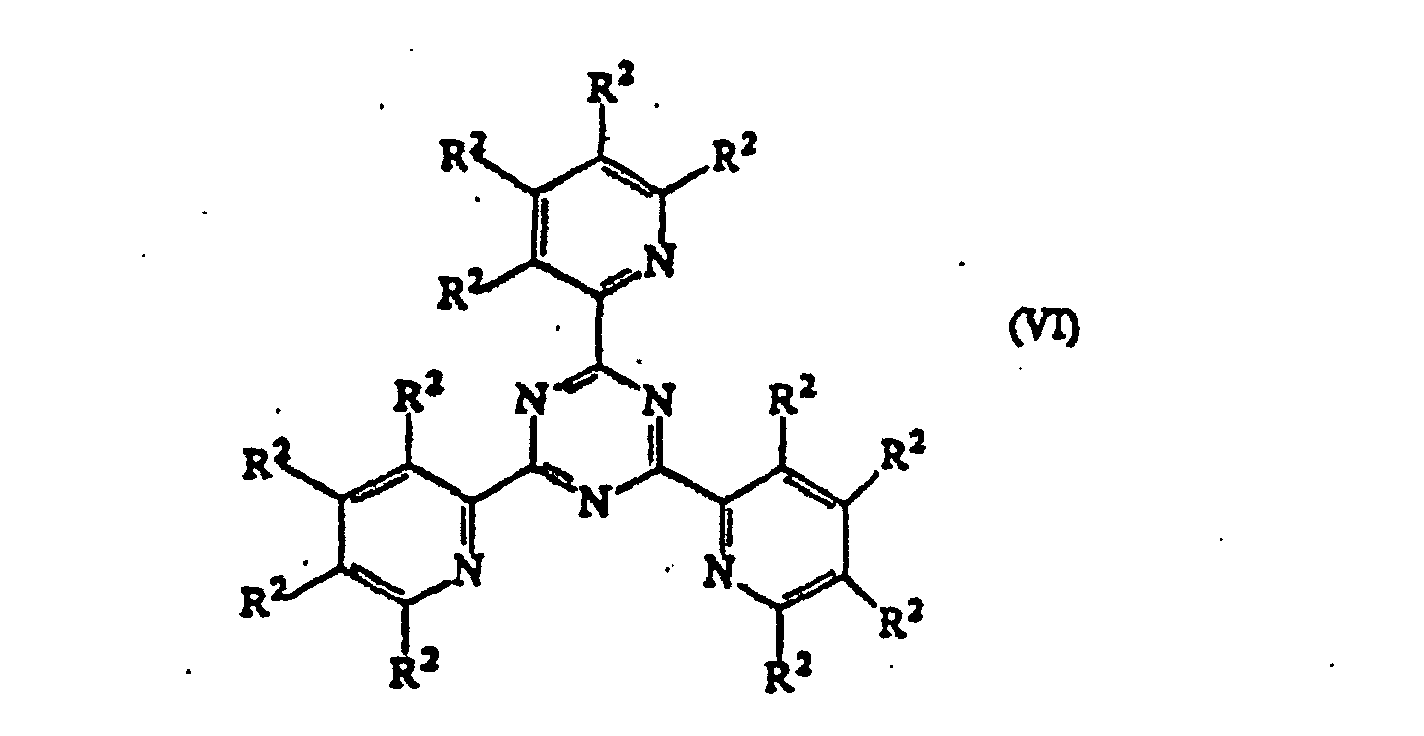 (c) des particules abrasives ;
ladite composition comprenant en outre facultativement au moins un monoalcool ou polyalcool ou au moins un additif pour augmenter la vitesse de durcissement. - Composition selon la revendication 1, dans laquelle ledit sel d'un cation complexe organométallique possède la formuleM est sélectionné dans le groupe contenant Cr, Ni, Mo, W, Mn, Tc, Re, Fe, Ru, Os, Co, Rh, et Ir ;L1 représente aucun, ou un, ou deux ligands pouvant être identiques ou différents apportant des électrons pi qui peuvent être sélectionnés parmi les composés aromatiques et les composés aromatiques hétérocycliques, et capables d'apporter six électrons pi à la couche de valence de M ;L2 représente aucun, ou un, ou deux ligands pouvant être identiques ou différents apportant des électrons pi qui peuvent être sélectionnés parmi les groupes d'anions cyclopentadiényle et indényle, et capables d'apporter six électrons pi à la couche de valence de M ;q est un nombre entier ayant une valeur de 1 ou 2, la charge résiduelle du cation complexe ;y et z sont des nombres entiers ayant une valeur de 0, 1 ou 2, à condition que la somme de y et z soit égale à 2 ;X est un anion sélectionné parmi des anions sulfonates organiques et des anions complexes contenant des halogènes d'un métal ou d'un métalloïde ; etn est un nombre entier ayant une valeur de 1 ou 2, le nombre d'anions complexes requis pour neutraliser la charge q sur le cation complexe.
- Composition selon les revendications 1 ou 2, dans laquelle ledit sel est sélectionné dans le groupe constitué des cations complexes bis-(êta6-arène)fer et des cations complexes bis-(êta5-cyclopentadiényl)fer.
- Composition selon la revendication 3, dans laquelle ledit additif de stabilisation est utilisé avec des cations complexes bis-(êta6-arène)fer.
- Composition durcie selon l'une quelconque des revendications 1 à 4.
- Procédé comprenant les étapes qui consistent à :a) fournir la composition durcissable selon l'une quelconque des revendications 1 à 4, etb) ajouter suffisamment d'énergie à la composition sous la forme d'au moins l'une de la chaleur et de la lumière, dans n'importe quelle combinaison et dans n'importe quel ordre, pour durcir ladite composition.
- Produit comprenant un substrat possédant sur au moins une de ses surfaces une couche de la composition selon l'une quelconque des revendications 1 à 5.
- Produit selon la revendication 7, dans lequel ladite composition est un adhésif, un revêtement protecteur, ou un liant pour un revêtement abrasif ou un support magnétique.
- Procédé comprenant les étapes qui consistent à :a) revêtir au moins une surface d'un substrat d'une couche de la composition polymérisable par apport d'énergie selon l'une quelconque des revendications 1 à 4, etb) apporter suffisamment d'énergie à la composition sous la forme d'au moins l'une de la chaleur et de la lumière, dans n'importe quelle combinaison et dans n'importe quel ordre, pendant un temps suffisant pour durcir ladite composition.
Applications Claiming Priority (3)
| Application Number | Priority Date | Filing Date | Title |
|---|---|---|---|
| US78738 | 1993-06-16 | ||
| US08/078,738 US5494943A (en) | 1993-06-16 | 1993-06-16 | Stabilized cationically-curable compositions |
| EP94916072A EP0703937A1 (fr) | 1993-06-16 | 1994-05-12 | Composition stabilisee a polymerisation cationique |
Related Parent Applications (1)
| Application Number | Title | Priority Date | Filing Date |
|---|---|---|---|
| EP94916072A Division EP0703937A1 (fr) | 1993-06-16 | 1994-05-12 | Composition stabilisee a polymerisation cationique |
Publications (3)
| Publication Number | Publication Date |
|---|---|
| EP0909773A2 EP0909773A2 (fr) | 1999-04-21 |
| EP0909773A3 EP0909773A3 (fr) | 1999-05-06 |
| EP0909773B1 true EP0909773B1 (fr) | 2004-09-22 |
Family
ID=22145930
Family Applications (5)
| Application Number | Title | Priority Date | Filing Date |
|---|---|---|---|
| EP02020090A Withdrawn EP1277777A3 (fr) | 1993-06-16 | 1994-05-12 | Composition stabilisée à polymérisation cationique |
| EP94916072A Ceased EP0703937A1 (fr) | 1993-06-16 | 1994-05-12 | Composition stabilisee a polymerisation cationique |
| EP02020091A Expired - Lifetime EP1277778B1 (fr) | 1993-06-16 | 1994-05-12 | Composition stabilisée à polymérisation cationique |
| EP98121861A Expired - Lifetime EP0896974B1 (fr) | 1993-06-16 | 1994-05-12 | Compositions stabilisées à durcissement cationique |
| EP98121860A Expired - Lifetime EP0909773B1 (fr) | 1993-06-16 | 1994-05-12 | Compositions stabilisées à durcissement cationique |
Family Applications Before (4)
| Application Number | Title | Priority Date | Filing Date |
|---|---|---|---|
| EP02020090A Withdrawn EP1277777A3 (fr) | 1993-06-16 | 1994-05-12 | Composition stabilisée à polymérisation cationique |
| EP94916072A Ceased EP0703937A1 (fr) | 1993-06-16 | 1994-05-12 | Composition stabilisee a polymerisation cationique |
| EP02020091A Expired - Lifetime EP1277778B1 (fr) | 1993-06-16 | 1994-05-12 | Composition stabilisée à polymérisation cationique |
| EP98121861A Expired - Lifetime EP0896974B1 (fr) | 1993-06-16 | 1994-05-12 | Compositions stabilisées à durcissement cationique |
Country Status (9)
| Country | Link |
|---|---|
| US (2) | US5494943A (fr) |
| EP (5) | EP1277777A3 (fr) |
| JP (2) | JPH08511572A (fr) |
| KR (1) | KR100381949B1 (fr) |
| CN (1) | CN1125456A (fr) |
| CA (1) | CA2162883A1 (fr) |
| DE (3) | DE69434027T2 (fr) |
| ES (2) | ES2227757T3 (fr) |
| WO (1) | WO1994029364A1 (fr) |
Families Citing this family (49)
| Publication number | Priority date | Publication date | Assignee | Title |
|---|---|---|---|---|
| US5744557A (en) * | 1993-06-16 | 1998-04-28 | Minnesota Mining And Manufacturing Company | Energy-curable cyanate/ethylenically unsaturated compositions |
| KR0172779B1 (ko) * | 1995-03-29 | 1999-03-20 | 김주용 | 감광막 제거 방법 |
| DE19629082A1 (de) * | 1996-07-18 | 1998-01-22 | Siemens Ag | Thermisch härtbares einkomponentiges Low viskosity Adhesive-Klebstoffsystem für Verklebungen im Mikrobereich |
| FR2752582B1 (fr) * | 1996-08-21 | 2003-06-13 | Rhone Poulenc Chimie | Compositions a base de polyorganosiloxanes a groupements fonctionnels reticulables et leur utilisation pour la realisation de revetements anti-adherents |
| US5982271A (en) * | 1996-11-28 | 1999-11-09 | Tdk Corporation | Organic positive temperature coefficient thermistor |
| US6174932B1 (en) * | 1998-05-20 | 2001-01-16 | Denovus Llc | Curable sealant composition |
| US6277898B1 (en) * | 1997-05-21 | 2001-08-21 | Denovus Llc | Curable sealant composition |
| US6858260B2 (en) | 1997-05-21 | 2005-02-22 | Denovus Llc | Curable sealant composition |
| US5973020A (en) * | 1998-01-06 | 1999-10-26 | Rhodia Inc. | Photoinitiator composition including hindered amine stabilizer |
| US6187836B1 (en) | 1998-06-05 | 2001-02-13 | 3M Innovative Properties Company | Compositions featuring cationically active and free radically active functional groups, and methods for polymerizing such compositions |
| JP3737285B2 (ja) * | 1998-08-28 | 2006-01-18 | 積水化学工業株式会社 | 光硬化性組成物、光硬化性接着シート、及び接合方法 |
| JP3739211B2 (ja) * | 1998-08-28 | 2006-01-25 | 積水化学工業株式会社 | 光硬化型粘接着シート、光硬化型粘接着シートの製造方法及び接合方法 |
| US6306926B1 (en) * | 1998-10-07 | 2001-10-23 | 3M Innovative Properties Company | Radiopaque cationically polymerizable compositions comprising a radiopacifying filler, and method for polymerizing same |
| US6482868B1 (en) | 1998-12-31 | 2002-11-19 | 3M Innovative Properties Company | Accelerators useful for energy polymerizable compositions |
| US6133335A (en) * | 1998-12-31 | 2000-10-17 | 3M Innovative Properties Company | Photo-polymerizable compositions and articles made therefrom |
| US6265459B1 (en) | 1998-12-31 | 2001-07-24 | 3M Innovative Properties Company | Accelerators useful for energy polymerizable compositions |
| DE19912251A1 (de) * | 1999-03-18 | 2000-09-21 | Espe Dental Ag | Zweikomponentige Zubereitungen zur Herstellung von zahntechnischen Modellen |
| US6413699B1 (en) * | 1999-10-11 | 2002-07-02 | Macdermid Graphic Arts, Inc. | UV-absorbing support layers and flexographic printing elements comprising same |
| US6635689B1 (en) * | 2000-06-26 | 2003-10-21 | 3M Innovative Properties Company | Accelerators for cationic polymerization catalyzed by iron-based catalysts |
| US6391523B1 (en) * | 2000-09-15 | 2002-05-21 | Microchem Corp. | Fast drying thick film negative photoresist |
| WO2002057321A1 (fr) * | 2001-01-16 | 2002-07-25 | Henkel Loctite Corporation | Compositions adhesives en tole a activation a l'huile |
| US20040094264A1 (en) * | 2001-01-30 | 2004-05-20 | Hiroaki Yamaguchi | Method for adhering substrates using light activatable adhesive film |
| JP3627011B2 (ja) | 2001-02-13 | 2005-03-09 | インターナショナル・ビジネス・マシーンズ・コーポレーション | 接合方法 |
| US6592801B2 (en) * | 2001-04-30 | 2003-07-15 | Essilor International Compagnie Generale D'optique | Photopolymerization of episulfides using metal complexes and its use for making ophthalmic lenses |
| US7053133B2 (en) * | 2001-05-29 | 2006-05-30 | Hiroaki Yamaguchi | Ultraviolet activatable adhesive film |
| US6955739B2 (en) * | 2001-06-19 | 2005-10-18 | 3M Innovative Properties Company | Method for adhering substrates using ultraviolet activatable adhesive film and an ultraviolet irradiation apparatus |
| US20040266913A1 (en) * | 2001-09-13 | 2004-12-30 | Hiroaki Yamaguchi | Cationic polymerizable adhesive composition and anisotropically electroconductive adhesive composition |
| US20050256230A1 (en) * | 2002-04-01 | 2005-11-17 | Hiroaki Yamaguchi | Cationic polymerizable adhesive composition and anisotropically electroconductive adhesive composition |
| US6773474B2 (en) | 2002-04-19 | 2004-08-10 | 3M Innovative Properties Company | Coated abrasive article |
| GB0212977D0 (en) * | 2002-06-06 | 2002-07-17 | Vantico Ag | Actinic radiation curable compositions and their use |
| DE10241165B4 (de) * | 2002-09-05 | 2005-08-11 | Kodak Polychrome Graphics Gmbh | Stabilisierte infrarotempfindliche Elemente |
| JP4093938B2 (ja) * | 2003-08-26 | 2008-06-04 | 松下電器産業株式会社 | 光情報記録媒体の原盤製造方法、パターン形成方法およびレジスト |
| US7192991B2 (en) | 2003-11-26 | 2007-03-20 | 3M Innovative Properties Company | Cationically curable composition |
| US20050250929A1 (en) * | 2004-05-10 | 2005-11-10 | 3M Innovative Properties Company | Ferrocenium-derived catalyst for cationically polymerizable monomers |
| US7449280B2 (en) * | 2004-05-26 | 2008-11-11 | Microchem Corp. | Photoimageable coating composition and composite article thereof |
| US7294048B2 (en) * | 2004-06-18 | 2007-11-13 | 3M Innovative Properties Company | Abrasive article |
| US20060088674A1 (en) * | 2004-10-27 | 2006-04-27 | Hladik Molly L | Ultraviolet curable barrier layers |
| US20080003420A1 (en) * | 2006-06-29 | 2008-01-03 | 3M Innovative Properties Company | Transfer hardcoat films for graphic substrates |
| EP2066497B1 (fr) * | 2006-08-07 | 2018-11-07 | Inktec Co., Ltd. | Procédés de fabrication de stratifiés revêtus de métal |
| US20090004478A1 (en) * | 2007-06-29 | 2009-01-01 | 3M Innovative Properties Company | Flexible hardcoat compositions, articles, and methods |
| US20090000727A1 (en) * | 2007-06-29 | 2009-01-01 | Kanta Kumar | Hardcoat layers on release liners |
| EP2428199A1 (fr) | 2010-09-09 | 2012-03-14 | 3M Innovative Properties Company | Composition durcissable, son procédé de production et son utilisation |
| KR20120036454A (ko) * | 2010-10-08 | 2012-04-18 | 동우 화인켐 주식회사 | 점착제 조성물, 이를 포함하는 편광판 및 액정표시장치 |
| US8816211B2 (en) * | 2011-02-14 | 2014-08-26 | Eastman Kodak Company | Articles with photocurable and photocured compositions |
| SG11201404548QA (en) | 2012-02-03 | 2014-08-28 | 3M Innovative Properties Co | Primer compositions for optical films |
| JP5403175B2 (ja) * | 2012-04-23 | 2014-01-29 | 大日本印刷株式会社 | カラーフィルタ用色材分散液、カラーフィルタ用着色樹脂組成物、カラーフィルタ、並びに、液晶表示装置及び有機発光表示装置 |
| JP6102219B2 (ja) * | 2012-11-28 | 2017-03-29 | 凸版印刷株式会社 | 横電界を印加する表示方式の液晶表示装置用カラーフィルタ |
| EP2938652B1 (fr) | 2012-12-27 | 2021-03-31 | 3M Innovative Properties Company | Composition polymérisable comprenant une benzoxazine et un catalyseur peroxyde de formation d'acide, article et procédé correspondants |
| CN116554052B (zh) * | 2023-04-28 | 2025-12-05 | 北京东方雨虹防水技术股份有限公司 | 一种缺电子型芳香醛亚胺类化合物及其制备方法和应用 |
Family Cites Families (23)
| Publication number | Priority date | Publication date | Assignee | Title |
|---|---|---|---|---|
| US3711391A (en) * | 1971-05-18 | 1973-01-16 | American Can Co | Photopolymerizable epoxy systems containing sulfoxide gelation inhibitors |
| US3816280A (en) * | 1971-05-18 | 1974-06-11 | American Can Co | Photopolymerizable epoxy systems containing cyclic amide gelation inhibitors |
| GB1404242A (en) * | 1973-01-15 | 1975-08-28 | American Can Co | Controlled polymerization process and stabilized polymerizable compositions |
| US5191101A (en) * | 1982-11-22 | 1993-03-02 | Minnesota Mining And Manufacturing Company | Energy polymerizable compositions containing organometallic initiators |
| US5089536A (en) * | 1982-11-22 | 1992-02-18 | Minnesota Mining And Manufacturing Company | Energy polmerizable compositions containing organometallic initiators |
| US5073476A (en) * | 1983-05-18 | 1991-12-17 | Ciba-Geigy Corporation | Curable composition and the use thereof |
| DE3561155D1 (fr) * | 1984-02-10 | 1988-01-21 | Ciba-Geigy Ag | |
| US4503211A (en) * | 1984-05-31 | 1985-03-05 | Minnesota Mining And Manufacturing Co. | Epoxy resin curing agent, process and composition |
| DE3586485D1 (de) * | 1984-11-14 | 1992-09-17 | Ciba Geigy Ag | Photohaertbare gefuellte expoxidharz-zusammensetzungen und deren verwendung. |
| US4707432A (en) * | 1985-09-23 | 1987-11-17 | Ciba-Geigy Corporation | Ferrocenium/alpha-cleavage photoinitiator systems for free radical polymerizable compositions |
| US4751138A (en) * | 1986-08-11 | 1988-06-14 | Minnesota Mining And Manufacturing Company | Coated abrasive having radiation curable binder |
| US4920182A (en) * | 1987-12-18 | 1990-04-24 | Ciba-Geigy Corporation | Epoxy resin compositions containing polyester flexibilizer and metallocene complex initiator |
| US4846905A (en) * | 1988-04-06 | 1989-07-11 | Minnesota Mining And Manufacturing Company | Acid catalyzed, toughened epoxy adhesives |
| US4985340A (en) * | 1988-06-01 | 1991-01-15 | Minnesota Mining And Manufacturing Company | Energy curable compositions: two component curing agents |
| EP0354181B1 (fr) * | 1988-08-04 | 1995-01-25 | Ciba-Geigy Ag | Combinaison de durcisseur pour matériaux polymérisables par voie cationique |
| ES2085294T3 (es) * | 1989-03-21 | 1996-06-01 | Ciba Geigy Ag | Iniciadores para materiales de polimerizacion cationica. |
| US5179179A (en) * | 1989-03-21 | 1993-01-12 | Ciba-Geigy Corporation | Initiators for materials which can be polymerized cationically |
| DE59106000D1 (de) * | 1990-04-10 | 1995-08-24 | Ciba Geigy Ag | Epoxidharz-Stoffgemische enthaltend Eisen-Aren-Komplexe und bestimmte Amine. |
| WO1992008745A1 (fr) * | 1990-11-16 | 1992-05-29 | Nippon Kayaku Kabushiki Kaisha | Composition a base de matiere organique polymerisable par voie cationique et stabilisation de cette composition |
| EP0508951B1 (fr) * | 1991-04-08 | 1996-08-21 | Ciba-Geigy Ag | Composition thermodurcissable |
| US5252694A (en) * | 1992-01-22 | 1993-10-12 | Minnesota Mining And Manufacturing Company | Energy-polymerization adhesive, coating, film and process for making the same |
| US5362421A (en) * | 1993-06-16 | 1994-11-08 | Minnesota Mining And Manufacturing Company | Electrically conductive adhesive compositions |
| US5453450A (en) * | 1993-06-16 | 1995-09-26 | Minnesota Mining And Manufacturing Company | Stabilized curable adhesives |
-
1993
- 1993-06-16 US US08/078,738 patent/US5494943A/en not_active Expired - Lifetime
-
1994
- 1994-05-12 KR KR1019950705722A patent/KR100381949B1/ko not_active Expired - Fee Related
- 1994-05-12 EP EP02020090A patent/EP1277777A3/fr not_active Withdrawn
- 1994-05-12 ES ES98121860T patent/ES2227757T3/es not_active Expired - Lifetime
- 1994-05-12 EP EP94916072A patent/EP0703937A1/fr not_active Ceased
- 1994-05-12 CA CA002162883A patent/CA2162883A1/fr not_active Abandoned
- 1994-05-12 DE DE69434027T patent/DE69434027T2/de not_active Expired - Fee Related
- 1994-05-12 DE DE69433493T patent/DE69433493T2/de not_active Expired - Fee Related
- 1994-05-12 EP EP02020091A patent/EP1277778B1/fr not_active Expired - Lifetime
- 1994-05-12 EP EP98121861A patent/EP0896974B1/fr not_active Expired - Lifetime
- 1994-05-12 EP EP98121860A patent/EP0909773B1/fr not_active Expired - Lifetime
- 1994-05-12 CN CN94192452.1A patent/CN1125456A/zh active Pending
- 1994-05-12 WO PCT/US1994/005243 patent/WO1994029364A1/fr not_active Ceased
- 1994-05-12 ES ES98121861T patent/ES2210647T3/es not_active Expired - Lifetime
- 1994-05-12 JP JP7501785A patent/JPH08511572A/ja not_active Withdrawn
- 1994-05-12 DE DE69435343T patent/DE69435343D1/de not_active Expired - Lifetime
-
1995
- 1995-11-03 US US08/552,632 patent/US5672637A/en not_active Expired - Lifetime
-
2007
- 2007-05-16 JP JP2007130946A patent/JP4662963B2/ja not_active Expired - Lifetime
Also Published As
| Publication number | Publication date |
|---|---|
| DE69435343D1 (de) | 2011-05-26 |
| ES2227757T3 (es) | 2005-04-01 |
| JPH08511572A (ja) | 1996-12-03 |
| EP1277778A2 (fr) | 2003-01-22 |
| DE69434027T2 (de) | 2005-09-08 |
| ES2210647T3 (es) | 2004-07-01 |
| DE69433493D1 (de) | 2004-02-19 |
| EP0896974A2 (fr) | 1999-02-17 |
| WO1994029364A1 (fr) | 1994-12-22 |
| EP1277778A3 (fr) | 2003-11-26 |
| CA2162883A1 (fr) | 1994-12-22 |
| EP0909773A2 (fr) | 1999-04-21 |
| EP0909773A3 (fr) | 1999-05-06 |
| KR100381949B1 (ko) | 2003-08-21 |
| EP0703937A1 (fr) | 1996-04-03 |
| EP1277778B1 (fr) | 2011-04-13 |
| JP4662963B2 (ja) | 2011-03-30 |
| EP0896974A3 (fr) | 1999-05-06 |
| CN1125456A (zh) | 1996-06-26 |
| EP1277777A3 (fr) | 2003-11-26 |
| DE69434027D1 (de) | 2004-10-28 |
| EP0896974B1 (fr) | 2004-01-14 |
| EP1277777A2 (fr) | 2003-01-22 |
| US5494943A (en) | 1996-02-27 |
| US5672637A (en) | 1997-09-30 |
| DE69433493T2 (de) | 2004-12-02 |
| JP2007217709A (ja) | 2007-08-30 |
Similar Documents
| Publication | Publication Date | Title |
|---|---|---|
| EP0909773B1 (fr) | Compositions stabilisées à durcissement cationique | |
| EP1157057B1 (fr) | Accelerateurs utiles pour des compositions polymerisables par energie | |
| EP0703952B1 (fr) | Adhesifs durcissables stabilises | |
| EP0623152B1 (fr) | Feuille, revetement et adhesif polymerisables par une source d'energie et procede de fabrication | |
| US6153302A (en) | Epoxy/thermoplastic photocurable adhesive composition | |
| JPH0794537B2 (ja) | 研磨材製品およびその製造方法 | |
| EP1299448B1 (fr) | Accelerateurs pouvant etre utilises pour des compositions polymerisables par energie | |
| US6906156B2 (en) | Accelerators for cationic polymerization catalyzed by iron-based catalyst | |
| JP3268532B2 (ja) | 光活性化可能な熱硬化性エポキシ組成物 | |
| EP0758351B1 (fr) | Compositions polymerisables par l'energie, homopolymeres et copolymeres d'oxazolines | |
| US6274643B1 (en) | Epoxy/thermoplastic photocurable adhesive composition | |
| JPH0482017B2 (fr) | ||
| JPH0931292A (ja) | 硬化性樹脂組成物 |
Legal Events
| Date | Code | Title | Description |
|---|---|---|---|
| PUAI | Public reference made under article 153(3) epc to a published international application that has entered the european phase |
Free format text: ORIGINAL CODE: 0009012 |
|
| PUAL | Search report despatched |
Free format text: ORIGINAL CODE: 0009013 |
|
| AC | Divisional application: reference to earlier application |
Ref document number: 703937 Country of ref document: EP |
|
| AK | Designated contracting states |
Kind code of ref document: A2 Designated state(s): DE ES FR GB IT |
|
| AK | Designated contracting states |
Kind code of ref document: A3 Designated state(s): DE ES FR GB IT |
|
| 17P | Request for examination filed |
Effective date: 19991027 |
|
| 17Q | First examination report despatched |
Effective date: 20021204 |
|
| GRAP | Despatch of communication of intention to grant a patent |
Free format text: ORIGINAL CODE: EPIDOSNIGR1 |
|
| GRAS | Grant fee paid |
Free format text: ORIGINAL CODE: EPIDOSNIGR3 |
|
| GRAA | (expected) grant |
Free format text: ORIGINAL CODE: 0009210 |
|
| AC | Divisional application: reference to earlier application |
Ref document number: 0703937 Country of ref document: EP Kind code of ref document: P |
|
| AK | Designated contracting states |
Kind code of ref document: B1 Designated state(s): DE ES FR GB IT |
|
| REG | Reference to a national code |
Ref country code: GB Ref legal event code: FG4D |
|
| REF | Corresponds to: |
Ref document number: 69434027 Country of ref document: DE Date of ref document: 20041028 Kind code of ref document: P |
|
| REG | Reference to a national code |
Ref country code: ES Ref legal event code: FG2A Ref document number: 2227757 Country of ref document: ES Kind code of ref document: T3 |
|
| ET | Fr: translation filed | ||
| PLBE | No opposition filed within time limit |
Free format text: ORIGINAL CODE: 0009261 |
|
| STAA | Information on the status of an ep patent application or granted ep patent |
Free format text: STATUS: NO OPPOSITION FILED WITHIN TIME LIMIT |
|
| 26N | No opposition filed |
Effective date: 20050623 |
|
| PGFP | Annual fee paid to national office [announced via postgrant information from national office to epo] |
Ref country code: ES Payment date: 20070528 Year of fee payment: 14 |
|
| PGFP | Annual fee paid to national office [announced via postgrant information from national office to epo] |
Ref country code: GB Payment date: 20070525 Year of fee payment: 14 |
|
| PGFP | Annual fee paid to national office [announced via postgrant information from national office to epo] |
Ref country code: IT Payment date: 20070526 Year of fee payment: 14 |
|
| PGFP | Annual fee paid to national office [announced via postgrant information from national office to epo] |
Ref country code: FR Payment date: 20070517 Year of fee payment: 14 |
|
| GBPC | Gb: european patent ceased through non-payment of renewal fee |
Effective date: 20080512 |
|
| REG | Reference to a national code |
Ref country code: FR Ref legal event code: ST Effective date: 20090119 |
|
| PG25 | Lapsed in a contracting state [announced via postgrant information from national office to epo] |
Ref country code: FR Free format text: LAPSE BECAUSE OF NON-PAYMENT OF DUE FEES Effective date: 20080602 |
|
| PG25 | Lapsed in a contracting state [announced via postgrant information from national office to epo] |
Ref country code: GB Free format text: LAPSE BECAUSE OF NON-PAYMENT OF DUE FEES Effective date: 20080512 |
|
| REG | Reference to a national code |
Ref country code: ES Ref legal event code: FD2A Effective date: 20080513 |
|
| PG25 | Lapsed in a contracting state [announced via postgrant information from national office to epo] |
Ref country code: IT Free format text: LAPSE BECAUSE OF NON-PAYMENT OF DUE FEES Effective date: 20080512 |
|
| PGFP | Annual fee paid to national office [announced via postgrant information from national office to epo] |
Ref country code: DE Payment date: 20090528 Year of fee payment: 16 |
|
| PG25 | Lapsed in a contracting state [announced via postgrant information from national office to epo] |
Ref country code: ES Free format text: LAPSE BECAUSE OF NON-PAYMENT OF DUE FEES Effective date: 20080513 |
|
| PG25 | Lapsed in a contracting state [announced via postgrant information from national office to epo] |
Ref country code: DE Free format text: LAPSE BECAUSE OF NON-PAYMENT OF DUE FEES Effective date: 20101201 |