EP0917403B1 - Fehlerausgleich für eine Temperaturerfassung in einem Mikrowellenofen - Google Patents
Fehlerausgleich für eine Temperaturerfassung in einem Mikrowellenofen Download PDFInfo
- Publication number
- EP0917403B1 EP0917403B1 EP98121224A EP98121224A EP0917403B1 EP 0917403 B1 EP0917403 B1 EP 0917403B1 EP 98121224 A EP98121224 A EP 98121224A EP 98121224 A EP98121224 A EP 98121224A EP 0917403 B1 EP0917403 B1 EP 0917403B1
- Authority
- EP
- European Patent Office
- Prior art keywords
- temperature
- cooking
- predetermined
- microwave oven
- food
- Prior art date
- Legal status (The legal status is an assumption and is not a legal conclusion. Google has not performed a legal analysis and makes no representation as to the accuracy of the status listed.)
- Expired - Lifetime
Links
- 238000001514 detection method Methods 0.000 title description 2
- 238000010411 cooking Methods 0.000 claims description 128
- 238000010438 heat treatment Methods 0.000 claims description 61
- 238000000034 method Methods 0.000 claims description 26
- 238000010586 diagram Methods 0.000 description 4
- 230000010355 oscillation Effects 0.000 description 2
- 230000001419 dependent effect Effects 0.000 description 1
- 239000004973 liquid crystal related substance Substances 0.000 description 1
Images


Classifications
-
- F—MECHANICAL ENGINEERING; LIGHTING; HEATING; WEAPONS; BLASTING
- F24—HEATING; RANGES; VENTILATING
- F24C—DOMESTIC STOVES OR RANGES ; DETAILS OF DOMESTIC STOVES OR RANGES, OF GENERAL APPLICATION
- F24C7/00—Stoves or ranges heated by electric energy
- F24C7/02—Stoves or ranges heated by electric energy using microwaves
-
- H—ELECTRICITY
- H05—ELECTRIC TECHNIQUES NOT OTHERWISE PROVIDED FOR
- H05B—ELECTRIC HEATING; ELECTRIC LIGHT SOURCES NOT OTHERWISE PROVIDED FOR; CIRCUIT ARRANGEMENTS FOR ELECTRIC LIGHT SOURCES, IN GENERAL
- H05B6/00—Heating by electric, magnetic or electromagnetic fields
- H05B6/64—Heating using microwaves
- H05B6/6447—Method of operation or details of the microwave heating apparatus related to the use of detectors or sensors
- H05B6/645—Method of operation or details of the microwave heating apparatus related to the use of detectors or sensors using temperature sensors
- H05B6/6455—Method of operation or details of the microwave heating apparatus related to the use of detectors or sensors using temperature sensors the sensors being infrared detectors
Definitions
- the present invention relates to a cooking temperature compensation method for a microwave oven, and more particularly to the method capable of compensating for the detected temperature error of food caused by electromagnetic wave noise when heating operation of microwave oven is controlled by an infrared sensor.
- a conventional microwave oven finishes cooking by stopping heating operation when a detected temperature from an infrared sensor reaches cooking temperature after heating operation starts.
- MWO microwave oven
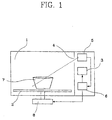
- Fig. 1 illustrates a block diagram showing a hardware system of a MWO in general.
- the MWO comprises an opening 4 at the upper part of a cooking chamber 1 and an infrared sensor 5 for detecting the temperature of the food 7 placed in the cooking chamber 1 through the opening. Also, the MWO comprises a heating part 3 for generating microwave based on the temperature detected from the infrared sensor 5 and a controlling part 6 for controlling all the operation of the system.
- a turntable driving motor 8 being driven under control of the controlling part 6 is installed at the lower part of the cooking chamber 1.
- a turntable 2 is installed inside of the cooking chamber 1 and the turntable 2 turned by the rotation of the motor is mounted at the upper part of the motor 8 axis. Cooking stuff is placed thereon.
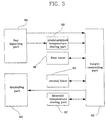
- the controlling part 6 controls the heating part 3 and the driving of motor 8 after a heating start key is operated. As shown in Fig.2, the controlling part 6 comprises:
- the controlling part 6 discriminates the detected temperature by a signal detected from the sensor 5, and then operates the heating part 3 to the extent that the detected temperature comes up to the predetermined temperature and controls the heating part 3 until cooking is completed.
- Food 7 is heated by microwave emitted from the heating part 3.
- the turntable 2 rotates to have the microwave emit widely to the food 7 when the heating part is operated.
- the predetermined cooking temperature is stored in the predetermined temperature storing part 6b.
- the output controlling part 6e operates the heating part 3 and the turntable driving motor 8. In this way, microwave is emitted from the heating part 3, and the microwave heats food 7. As the heating part 3 is operated continually, the temperature of food 7 rises.
- the infrared sensor 5 detects through an opening 4 the food temperature placed in the cooking chamber 1.
- the detected temperature is temporarily stored in the detected temperature storing part 6c.
- the output controlling part 6e reads the temperatures stored in the detected temperature storing part 6c and the cooking temperature stored in the predetermined temperature storing part 6b, and compares both of them. Then, the output controlling part 6e heats food 7 by continuously operating the heating part 3 to the degree that the detected temperature comes up to the cooking temperature. And, as the temperature detected from the sensor 5 reaches the cooking temperature, the output controlling part 6e stops the operation of the heating part 3 and cooking is finished therein.
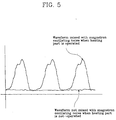
- the temperature controlling method for conventional the MWO there was a slight difference between the detected temperature value of food detected from the sensor 5 and the real temperature value of food caused by high frequency while the heating part oscillates. That is, the detected value of the infrared sensor 5 does not coincide with the value of the predetermined cooking temperature due to high frequency, which is generated by the oscillation of the heating part 3, even if the real temperature of food 7 does not reach the predetermined cooking temperature.
- a prior art method for compensating a cooking temperature in a microwave oven with the steps recited in the preamble portion of claim 1 is disclosed in US-4 553 011 A.
- the oscillations in the microwave oven are repeatedly started and stopped to determine the temperature of the food stuff via the infrared sensor during a non-operation state and these temperature sensing cycles are repeated until a desired temperature is reached.
- the object of the present invention is to provide a method for compensating a cooking temperature in a microwave oven which can compensate for the detected temperature error of food stuff caused by electromagnetic wave noise when the heating operation of the microwave oven is controlled by an infrared sensor.
- the present invention provides a method for compensating a cooking temperature in a microwave oven as recited in claim 1. This method comprises the steps of:
- the method of the present invention provides advantages in that it reduces the error in a detected temperature that can be caused by electromagnetic wave noise and which is likely to occur when a small quantity of food is to be cooked. Thereby, the method prevents that the cooking process is terminated due to this error before the food stuff has actually reached the desired, i.e. a predetermined temperature.
- the device to which the present invention is applicable comprises a turntable 2 located in the center of a cooking chamber 1, a heating part 3 for generating microwave to heat food 7, a temperature sensor 5 of a kind of noncontacting type such as thermopile sensor for detecting temperature of food 7 through an opening 4 placed in the upper part of the cooking chamber 1 and a controlling part 6 for controlling all the operations of each part.
- the controlling part 6 comprises a key inputting part 6A for predetermining cooking temperature appropriate for desired cooking and inputting a heating start key, a predetermined cooking temperature storing part 6B for storing a predetermined cooking temperature, a detected temperature storing part 6C for storing the temperature detected from said sensor 5, and a displaying part 6D for displaying the predetermined cooking temperature or the detected temperature, etc. Also, the controlling part 6 comprises a output controlling part 6E for controlling the operation of the heating part 3 by comparing the cooking temperature with the detected temperature, a first timer 6F for counting cooking time, and a second timer 6G for counting a rotational cycle of the turntable 2.
- the temperature control of the present invention discriminates whether the temperature detected from a sensor 5 reaches the real temperature of food or not.
- the detected temperature is re-calculated.
- the detected temperature is re-calculated by adding a value being a product of a predetermined variable and the re-heating time TI of the heating part 3 to the maximum value CMAX of real temperature of food 7 and discriminates whether the re-calculated temperature reaches the predetermined cooking temperature or not.
- the user puts food 7 on the turntable 2 in the cooking chamber 1 and selects the heating start key through the key inputting part 6A.
- the output controlling part 6E when the heating start key is input, operates the driving motor 8 for the turntable and the heating part 3.
- the heating part 3 generates microwave and increases temperature of food in the cooking chamber 1.
- the turntable 2 is rotated by motor 8.
- the predetermined cooking temperature CS is set through the key inputting part 6A by the user before the heating start key is inputted.
- the predetermined cooking temperature CS is stored in the predetermined cooking temperature storing part 6B.
- the predetermined cooking temperature CS can be set directly by the user or the cooking temperature CS already stored in the predetermined cooking temperature storing part 6B may be read by the output control part 6E by selecting an auto cooking mode. In any case, the output controlling part 6E recognizes the predetermined cooking temperature CS.
- cooking time TS can be set directly by the user through the key inputting part 6A before the heating start key is inputted or the predetermined cooking time TS may be read by the output controlling part 6E by selecting an auto cooking mode.
- the output controlling part 6E recognizes the cooking temperature CS and the cooking time TS, and controls the operation of the heating part 3. And the first timer 6F counts the cooking time under the control of the output controlling part 6E since the start of operation of the heating part 3.
- temperature of food 7 is increased gradually, as time goes by, in relation to the oscillating operation of the heating part 3.
- the infrared sensor 5 detects the temperature of food 7 through the opening 4 and this detected temperature is temporarily stored in the detected temperature storing part 6C.
- the output controlling part 6E continually reads the detected temperature CC, which is stored in the detected temperature storing part 6C. And the heating part 3 continues to oscillate until the detected temperature reaches the cooking temperature comparing the detected temperature CC with the predetermined cooking temperature CS(The 101 step).
- the output controlling part 6E discriminates whether the detected temperature CC detected from the sensor 5 has reached the predetermined cooking temperature CS during the predetermined cooking time TS or not (The 103 step).
- the output controlling part 6E reads a counted present time TC since the first timer 6F started and compares the counted present time TC with the predetermined cooking time TS (The 113 step). In the 113 step, when the output controlling part 6E discriminates that the real temperature of food 7 reaches the predetermined cooking temperature when the value of the counted present time TC is greater than the value of the cooking time TS and then stops the cooking operation (The 115 step).
- the finishing of cooking means that the heating operation of the heating part 3 and the rotation of turntable driving motor 8 stop.
- the output controlling part 6E discriminates, in the 113 step, that the value of the counted present time TC is not greater than the value of the cooking time TS, it is recognized that there are the temperature errors, which is detected from said sensor, caused by electromagnetic wave noise. And the output controlling part 6E temporarily stops the heating operation of the heating part 3 and substitutes the present time TC for a time variable TN. Also, it sets flagl as logical "1" in order to express that the detected temperature CC has come to the predetermined cooking temperature CS within the cooking time TS (The 117 step).
- operating process returns to the 101 step and performs the 101 step and the 103 step repeatedly.
- the output controlling part 6E discriminates whether the detected temperature CC caused by electromagnetic wave noise and detected from the sensor 5 has reached the predetermined cooking temperature CS (The 105 step).
- a decision in the 105 step is made in the state of stopping the heating operation of the heating part 3 under the control of the output controlling part 6E.
- the output controlling part 6E discriminates that there is no influence by noise when the cooking temperature CS hardly differs from the real temperature of food 7 detected from the sensor 5 during a revolution of the turntable 2.
- the output controlling part 6E continually counts the revolution time of the turntable 2 by means of the second timer 6G. At the same time, the output controlling part 6E continuously recognizes the value counted by the first timer 6F while the turntable 2 rotates.
- the output controlling part 6E discriminates that if the present time TC which is counted by the first timer 6F is greater than the time (TN + 1 second), which adds 1 second to the time variable TN gained from the 117 step, and if it is within the value [TN + TT + 1 second], which adds the revolution cycle TT of the turntable which is counted by the second timer 6G plus 1 second to the time variable TN (The 119 step).
- the temperature detected from the sensor 5 becomes the real temperature of food 7. That is, the output controlling part 6E substitutes higher value for a maximum temperature CMAX of food 7, by continually comparing the present detected temperature with previous detected temperature (The 121 step and the 123 step).
- the present time TC is counted until a revolution of turntable 2 terminates for detecting of the maximum temperature CMAX of food 7(The 125 step). Therefore, when the operation of the 125 step ends, the present time TC becomes the value (TN+TT+1second) which adds the revolution cycle TT of the turntable 2 and 1 second to the time variable TN set in the 117 step.
- the output controlling part 6E discriminates whether the error of temperature detection caused by noise or the termination of normal cooking operation by comparing the maximum temperature CMAX of food with the cooking temperature CS.
- the output controlling part 6E allocates a certain of the error temperature CM to the cooking temperature CS in consideration of an error occurred in cooking actually.
- the error temperature can be set differently depending on MWO and food that is to be cooked.
- the output controlling part 6E completes cooking by discriminating if the real temperature of food 7 has reached the cooking temperature, in case that the maximum temperature CMAX of food gained from carrying out up to the 125 step is greater than the value (CS-CM) subtracted the error temperature CM from the cooking temperature CS (The 133 step).
- the output controlling part 6E discriminates if the present detected temperature has reached the cooking temperature by noise and sets Flag2 as logical "1" (The 131 step). And again, the output controlling part 6E enables the process to return to the first step 101.
- the output controlling part 6E performs the 103 step if the detected temperature CC is greater than the cooking temperature CS in the 101 step and performs the 105 step if the detected temperature (the result gained after carrying out the 117 step) ever reaches the cooking temperature within the cooking time TS in the 103 step.
- the output controlling part 6E recognizes that the detected temperature has reached the cooking temperature by noise in the 105 step (the result gained from carrying out up to the 131 step) and re-operates the heating part 3. And, regardless of temperature detected from the sensor 5, by adding the temperature (0.05 ⁇ re-operation time TI of the heating part3) gained in proportion to the heating time to the maximum temperature CMAX of food gained in the 125 step, the output controlling part 6E calculates the detected temperature CC (The 107 step).
- the output controlling part 6E recognizes that the food temperature has reached the cooking temperature, and stops the operation of the heating part 3 (The 111 step).
- the present invention compares the detected temperature CC of food detected from sensor 5 in cooking with the predetermined cooking temperature CS and stops the operation of the heating part 3 when the detected temperature has reached the cooking temperature, and measures the maximum temperature CMAX of food 7 by the sensor 5 during one or more revolution cycle of the turntable 2 and discriminates that the real temperature of food has reached the cooking temperature when the measured temperature is approximately the same as the cooking temperature.
- the present invention discriminates that the detected temperature has reached the cooking temperature due to noise and re-operates the heating part 3. And regardless of the temperature detected from the sensor 5, the present invention compares the re-calculated temperature, which is the sum of the temperature (0.05 ⁇ re-operation time TI of the heating part3) gained in proportion to the heating time and the maximum temperature CMAX of food, with the cooking temperatures and discriminates whether the real temperature of food 7 has reached the cooking temperature and stops cooking.
- the present invention has advantages to reduce the error temperature value caused by electromagnetic wave noise which is likely to occur in cooking a small quantity of food especially, so that it can be prevented from finishing earlier.
Landscapes
- Physics & Mathematics (AREA)
- Electromagnetism (AREA)
- Engineering & Computer Science (AREA)
- Chemical & Material Sciences (AREA)
- Combustion & Propulsion (AREA)
- Mechanical Engineering (AREA)
- General Engineering & Computer Science (AREA)
- Electric Ovens (AREA)
- Control Of High-Frequency Heating Circuits (AREA)
Claims (8)
- Verfahren zum Kompensieren einer Kochtemperatur in einem Mikrowellenherd, wobei das Verfahren die folgenden Schritte umfaßt:gekennzeichnet durch den Schritt desErwärmen eines Nahrungsmittels (7) in einer Kochkammer (1) eines Mikrowellenherds,Vergleichen einer von einem Infrarotsensor (5) erfaßten Temperatur (CC) des Nahrungsmittels mit einer vorbestimmten Kochtemperatur (CS),Erfassen einer anderen Temperatur des Nahrungsmittels (7) während eines Nicht-Heizbetriebs des Mikrowellenherds, wenn die erfaßte Temperatur (CC) höher ist als die vorbestimmte Kochtemperatur (CS),Vergleichen der anderen Temperatur des Nahrungsmittels mit der vorbestimmten Kochtemperatur (CS), undKompensieren bzw. Ausgleichen der anderen Temperatur des Nahrungsmittels durch Wiederaufnehmen des Heizbetriebs des Mikrowellenherds, wenn die ändere Temperatur des Nahrungsmittels niedriger ist als die vorbestimmte Kochtemperatur (CS),
Wiederberechnens der anderen Temperatur und Benutzen der wiederberechneten Temperatur zum Vergleich mit der vorbestimmten Temperatur des Nahrungsmittels, wenn ermittelt wird, daß die andere Temperatur die vorbestimmte Kochtemperatur (CS) infolge eines elektromagnetischen Wellenrauschens erreicht hat. - Verfahren zum Kompensieren einer Kochtemperatur in einem Mikrowellenherd nach Anspruch 1, wobei der Nicht-Heizbetrieb erfolgt, wenn eine kumulierte augenblickliche Kochzeit (TC) kürzer ist als eine voreingestellte Zeitdauer (TS) zum Erreichen der vorbestimmten Kochtemperatur (CS).
- Verfahren zum Kompensieren einer Kochtemperatur in einem Mikrowellenherd nach Anspruch 1 oder 2, wobei die Erfassung der anderen Temperatur des Nahrungsmittels während einer Drehperiode eines Drehtischs (2) erfolgt.
- Verfahren zum Kompensieren einer Kochtemperatur in einem Mikrowellenherd nach einem der Ansprüche 1 bis 3, ferner mit dem Schritt des Einstellens der anderen Temperatur des Nahrungsmittels auf einen Maximalwert (CMAX) der Temperatur.
- Verfahren zum Kompensieren einer Kochtemperatur in einem Mikrowellenherd nach einem der Ansprüche 1 bis 4, wobei der Schritt des Wiederberechnens den Schritt des Berechnens der Temperatur des Nahrungsmittels als Summe eines Maximums der Temperatur (CMAX) und eines Produkts aus einer vorbestimmten Variablen und einer Zeit der Wiederinbetriebnahme (TI) eines Heizteils (3) des Mikrowellenherds umfaßt.
- Verfahren zum Kompensieren einer Kochtemperatur in einem Mikrowellenherd nach einem der Ansprüche 1 bis 5, ferner mit dem Schritt des Bestimmens, ob die Temperatur einen Temperaturpegel der vorbestimmten Kochtemperatur innerhalb einer vorbestimmten Zeit erreicht.
- Verfahren zum Kompensieren einer Kochtemperatur in einem Mikrowellenherd nach Anspruch 6, wobei der Schritt des Bestimmens den Schritt des Berichtigens umfaßt, falls eine kumulierte aktuelle Zeit größer ist als die vorbestimmte Zeit, wodurch, falls die kumulierte aktuelle Zeit größer als die vorbestimmte Zeit ist, bestimmt wird, daß die andere Temperatur erreicht worden ist, und ein Betrieb des Mikrowellenherds beendet wird.
- Verfahren zum Kompensieren einer Kochtemperatur in einem Mikrowellenherd nach Anspruch 7, wobei in dem Schritt des Berichtigens, falls ermittelt wird, daß die kumulierte aktuelle Zeit weniger ist als die vorbestimmte Zeit, ein Betrieb eines Heizteils (3) zumindest zeitweilig abgeschaltet wird.
Applications Claiming Priority (2)
| Application Number | Priority Date | Filing Date | Title |
|---|---|---|---|
| KR1019970060143A KR100275887B1 (ko) | 1997-11-14 | 1997-11-14 | 전자레인지의 온도보상방법 |
| KR9760143 | 1997-11-14 |
Publications (3)
| Publication Number | Publication Date |
|---|---|
| EP0917403A2 EP0917403A2 (de) | 1999-05-19 |
| EP0917403A3 EP0917403A3 (de) | 1999-09-22 |
| EP0917403B1 true EP0917403B1 (de) | 2004-02-04 |
Family
ID=19524771
Family Applications (1)
| Application Number | Title | Priority Date | Filing Date |
|---|---|---|---|
| EP98121224A Expired - Lifetime EP0917403B1 (de) | 1997-11-14 | 1998-11-06 | Fehlerausgleich für eine Temperaturerfassung in einem Mikrowellenofen |
Country Status (5)
| Country | Link |
|---|---|
| US (1) | US6066839A (de) |
| EP (1) | EP0917403B1 (de) |
| KR (1) | KR100275887B1 (de) |
| CN (1) | CN100343581C (de) |
| DE (1) | DE69821449T2 (de) |
Families Citing this family (11)
| Publication number | Priority date | Publication date | Assignee | Title |
|---|---|---|---|---|
| KR20010003862A (ko) * | 1999-06-25 | 2001-01-15 | 구자홍 | 전자레인지의 요리시간 보상장치 및 방법 |
| KR100420324B1 (ko) * | 2001-07-24 | 2004-03-04 | 주식회사 엘지이아이 | 후드 겸용 전자레인지의 온도보상방법 |
| US6862494B2 (en) * | 2001-12-13 | 2005-03-01 | General Electric Company | Automated cooking system for food accompanied by machine readable indicia |
| CN1299052C (zh) * | 2001-12-25 | 2007-02-07 | 乐金电子(天津)电器有限公司 | 微波炉的解冻控制装置 |
| KR20040047079A (ko) * | 2002-11-29 | 2004-06-05 | 삼성전자주식회사 | 가열조리장치 및 그 제어방법 |
| TW201123293A (en) | 2009-10-26 | 2011-07-01 | Solvay Fluor Gmbh | Etching process for producing a TFT matrix |
| WO2015031500A1 (en) | 2013-08-27 | 2015-03-05 | Duke Manufacturing Co. | Food management system |
| EP3184978B1 (de) * | 2015-12-22 | 2020-02-12 | Electrolux Appliances Aktiebolag | Nahrungsmittelsonde zur ermittlung der temperatur im innern von nahrungsmitteln |
| CN105628213B (zh) * | 2015-12-29 | 2019-03-29 | 广东美的厨房电器制造有限公司 | 加热烹调器的食品温度检测方法、食品加热方法及其系统 |
| CN106562685B (zh) * | 2016-10-19 | 2019-03-29 | 广东美的厨房电器制造有限公司 | 烹饪电器的烹饪方法 |
| KR102078058B1 (ko) * | 2018-12-07 | 2020-02-17 | 주식회사 만도 | 전자파 간섭에 의한 온도 오류에 대응하는 전동식 파워 스티어링 시스템 및 그 제어 방법 |
Family Cites Families (8)
| Publication number | Priority date | Publication date | Assignee | Title |
|---|---|---|---|---|
| JPS58220385A (ja) * | 1982-06-16 | 1983-12-21 | 三洋電機株式会社 | 電子制御式調理器 |
| JPS60143589A (ja) * | 1983-12-29 | 1985-07-29 | 三洋電機株式会社 | 電子レンジ |
| JPS6338825A (ja) * | 1986-07-31 | 1988-02-19 | Sanyo Electric Co Ltd | 電子レンジ |
| JPS6349635A (ja) * | 1986-08-18 | 1988-03-02 | Sanyo Electric Co Ltd | 電子レンジ |
| JPS63201430A (ja) * | 1987-02-17 | 1988-08-19 | Sanyo Electric Co Ltd | 電子制御式調理器 |
| KR0129228B1 (ko) * | 1994-04-01 | 1998-04-09 | 구자홍 | 마이크로웨이브오븐의 자동조리 제어방법 및 장치 |
| KR0129239B1 (ko) * | 1994-06-11 | 1998-04-09 | 구자홍 | 마이크로웨이브 오븐의 조리상태 검출장치 |
| KR960024041A (ko) * | 1994-12-14 | 1996-07-20 | 구자홍 | 조리기의 자동 조리 제어장치 및 그 방법 |
-
1997
- 1997-11-14 KR KR1019970060143A patent/KR100275887B1/ko not_active Expired - Fee Related
-
1998
- 1998-11-06 DE DE69821449T patent/DE69821449T2/de not_active Expired - Lifetime
- 1998-11-06 EP EP98121224A patent/EP0917403B1/de not_active Expired - Lifetime
- 1998-11-13 US US09/191,346 patent/US6066839A/en not_active Expired - Fee Related
- 1998-11-13 CN CNB981249159A patent/CN100343581C/zh not_active Expired - Fee Related
Also Published As
| Publication number | Publication date |
|---|---|
| KR19990039900A (ko) | 1999-06-05 |
| DE69821449T2 (de) | 2004-12-02 |
| EP0917403A2 (de) | 1999-05-19 |
| US6066839A (en) | 2000-05-23 |
| KR100275887B1 (ko) | 2001-02-01 |
| CN100343581C (zh) | 2007-10-17 |
| EP0917403A3 (de) | 1999-09-22 |
| CN1218169A (zh) | 1999-06-02 |
| DE69821449D1 (de) | 2004-03-11 |
Similar Documents
| Publication | Publication Date | Title |
|---|---|---|
| US4591684A (en) | Cooking completion detection in a cooking appliance | |
| US4553011A (en) | Temperature control for microwave oven | |
| US6066839A (en) | Temperature compensation method for a microwave oven | |
| EP1021067A2 (de) | Verfahren zum Betrieben von Mikrowellenofen | |
| EP0717582B1 (de) | Heizzeit-Kontrollvorrichtung und Verwendung dieser in einem Mikrowellenofen | |
| EP0917402B1 (de) | Mikrowellenofen zur Erhitzung eines Gefässinhalts | |
| US5702626A (en) | Automatic cooking controlling apparatus and method employing a narrow viewing angle of an infrared absorptive thermopile sensor | |
| KR20050031903A (ko) | 전자레인지 | |
| EP0928125B1 (de) | Verfahren und Vorrichtung zum Kompensieren der Temperatur in einem Mikrowellenherd | |
| US5558799A (en) | Apparatus and method for controlling turntable of microwave oven | |
| JP3103252B2 (ja) | 加熱調理器 | |
| EP0615400B1 (de) | Mikrowellenofen und Verfahren zur Bestimmung des Lebenmittelproduktes | |
| US6791070B2 (en) | Simmering control method in microwave oven | |
| KR940008525B1 (ko) | 습도센서를 가진 전자레인지의 자동 조리 제어방법 | |
| KR100259376B1 (ko) | 전자렌지의조리제어장치및방법 | |
| JPS6333050Y2 (de) | ||
| KR100276028B1 (ko) | 전자렌지의 조리메뉴및 조리시간 표시방법 | |
| KR940008526B1 (ko) | 전자레인지의 중량감지장치 및 그 감지방법. | |
| JP3017897B2 (ja) | 加熱調理器の被加熱調理物量判定装置 | |
| JP3332716B2 (ja) | 加熱調理器 | |
| KR0146468B1 (ko) | 중량센서를 이용한 전자렌지의 과잉가열 방지방법 | |
| KR100191504B1 (ko) | 전자렌지의 회전접시 중량 판별장치 | |
| JPS6330891Y2 (de) | ||
| KR19980017796U (ko) | 전자렌지의 무부하감지장치 | |
| JPH05322171A (ja) | 加熱調理器 |
Legal Events
| Date | Code | Title | Description |
|---|---|---|---|
| PUAI | Public reference made under article 153(3) epc to a published international application that has entered the european phase |
Free format text: ORIGINAL CODE: 0009012 |
|
| AK | Designated contracting states |
Kind code of ref document: A2 Designated state(s): DE FR GB IT |
|
| AX | Request for extension of the european patent |
Free format text: AL;LT;LV;MK;RO;SI |
|
| PUAL | Search report despatched |
Free format text: ORIGINAL CODE: 0009013 |
|
| AK | Designated contracting states |
Kind code of ref document: A3 Designated state(s): AT BE CH CY DE DK ES FI FR GB GR IE IT LI LU MC NL PT SE |
|
| AX | Request for extension of the european patent |
Free format text: AL;LT;LV;MK;RO;SI |
|
| 17P | Request for examination filed |
Effective date: 20000320 |
|
| AKX | Designation fees paid |
Free format text: DE FR GB IT |
|
| 17Q | First examination report despatched |
Effective date: 20010522 |
|
| GRAP | Despatch of communication of intention to grant a patent |
Free format text: ORIGINAL CODE: EPIDOSNIGR1 |
|
| GRAS | Grant fee paid |
Free format text: ORIGINAL CODE: EPIDOSNIGR3 |
|
| GRAA | (expected) grant |
Free format text: ORIGINAL CODE: 0009210 |
|
| AK | Designated contracting states |
Kind code of ref document: B1 Designated state(s): DE FR GB IT |
|
| REG | Reference to a national code |
Ref country code: GB Ref legal event code: FG4D |
|
| REF | Corresponds to: |
Ref document number: 69821449 Country of ref document: DE Date of ref document: 20040311 Kind code of ref document: P |
|
| ET | Fr: translation filed | ||
| PLBE | No opposition filed within time limit |
Free format text: ORIGINAL CODE: 0009261 |
|
| STAA | Information on the status of an ep patent application or granted ep patent |
Free format text: STATUS: NO OPPOSITION FILED WITHIN TIME LIMIT |
|
| 26N | No opposition filed |
Effective date: 20041105 |
|
| PGFP | Annual fee paid to national office [announced via postgrant information from national office to epo] |
Ref country code: DE Payment date: 20091029 Year of fee payment: 12 |
|
| PGFP | Annual fee paid to national office [announced via postgrant information from national office to epo] |
Ref country code: IT Payment date: 20091114 Year of fee payment: 12 Ref country code: GB Payment date: 20091104 Year of fee payment: 12 Ref country code: FR Payment date: 20091123 Year of fee payment: 12 |
|
| GBPC | Gb: european patent ceased through non-payment of renewal fee |
Effective date: 20101106 |
|
| REG | Reference to a national code |
Ref country code: FR Ref legal event code: ST Effective date: 20110801 |
|
| REG | Reference to a national code |
Ref country code: DE Ref legal event code: R119 Ref document number: 69821449 Country of ref document: DE Effective date: 20110601 Ref country code: DE Ref legal event code: R119 Ref document number: 69821449 Country of ref document: DE Effective date: 20110531 |
|
| PG25 | Lapsed in a contracting state [announced via postgrant information from national office to epo] |
Ref country code: DE Free format text: LAPSE BECAUSE OF NON-PAYMENT OF DUE FEES Effective date: 20110531 |
|
| PG25 | Lapsed in a contracting state [announced via postgrant information from national office to epo] |
Ref country code: FR Free format text: LAPSE BECAUSE OF NON-PAYMENT OF DUE FEES Effective date: 20101130 |
|
| PG25 | Lapsed in a contracting state [announced via postgrant information from national office to epo] |
Ref country code: GB Free format text: LAPSE BECAUSE OF NON-PAYMENT OF DUE FEES Effective date: 20101106 |
|
| PG25 | Lapsed in a contracting state [announced via postgrant information from national office to epo] |
Ref country code: IT Free format text: LAPSE BECAUSE OF NON-PAYMENT OF DUE FEES Effective date: 20101106 |