EP0919623A2 - Verfahren und Kit zur Klonierung von Fragmenten - Google Patents
Verfahren und Kit zur Klonierung von Fragmenten Download PDFInfo
- Publication number
- EP0919623A2 EP0919623A2 EP98121736A EP98121736A EP0919623A2 EP 0919623 A2 EP0919623 A2 EP 0919623A2 EP 98121736 A EP98121736 A EP 98121736A EP 98121736 A EP98121736 A EP 98121736A EP 0919623 A2 EP0919623 A2 EP 0919623A2
- Authority
- EP
- European Patent Office
- Prior art keywords
- cosmid
- dna
- fragments
- vector
- cloning
- Prior art date
- Legal status (The legal status is an assumption and is not a legal conclusion. Google has not performed a legal analysis and makes no representation as to the accuracy of the status listed.)
- Withdrawn
Links
Images


Classifications
-
- C—CHEMISTRY; METALLURGY
- C12—BIOCHEMISTRY; BEER; SPIRITS; WINE; VINEGAR; MICROBIOLOGY; ENZYMOLOGY; MUTATION OR GENETIC ENGINEERING
- C12N—MICROORGANISMS OR ENZYMES; COMPOSITIONS THEREOF; PROPAGATING, PRESERVING, OR MAINTAINING MICROORGANISMS; MUTATION OR GENETIC ENGINEERING; CULTURE MEDIA
- C12N15/00—Mutation or genetic engineering; DNA or RNA concerning genetic engineering, vectors, e.g. plasmids, or their isolation, preparation or purification; Use of hosts therefor
- C12N15/09—Recombinant DNA-technology
- C12N15/63—Introduction of foreign genetic material using vectors; Vectors; Use of hosts therefor; Regulation of expression
- C12N15/70—Vectors or expression systems specially adapted for E. coli
-
- C—CHEMISTRY; METALLURGY
- C12—BIOCHEMISTRY; BEER; SPIRITS; WINE; VINEGAR; MICROBIOLOGY; ENZYMOLOGY; MUTATION OR GENETIC ENGINEERING
- C12N—MICROORGANISMS OR ENZYMES; COMPOSITIONS THEREOF; PROPAGATING, PRESERVING, OR MAINTAINING MICROORGANISMS; MUTATION OR GENETIC ENGINEERING; CULTURE MEDIA
- C12N1/00—Microorganisms; Compositions thereof; Processes of propagating, maintaining or preserving microorganisms or compositions thereof; Processes of preparing or isolating a composition containing a microorganism; Culture media therefor
- C12N1/04—Preserving or maintaining viable microorganisms
Definitions
- the invention relates to a method and a kit for cloning DNA fragments, for example PCR amplification products, which due to their size cannot be used with the help of Plasmids can be cloned, but at the same time are too small to be cloned in cosmids to be able to.
- modified cosmid vectors were constructed, which for cloning DNA amplification products and DNA fragments with a corresponding Size are suitable.
- heterologous DNA there are various methods for cloning heterologous DNA known.
- the simplest method is the use of plasmid vectors, which a suitable origin of replication, an antibiotic resistance gene as a selection marker and contain at least one suitable restriction interface.
- plasmid vectors which a suitable origin of replication, an antibiotic resistance gene as a selection marker and contain at least one suitable restriction interface.
- heterologous DNA Fragments the size of which exceeds 10 kb, but in conventional plasmids such as pUC or other pBR derivatives, experience has shown that this leads to such constructs cannot be cloned without deletions even in recombination-deficient host cells.
- the disadvantage of this method is that only DNA fragments with a limited number are available A maximum size of about 10 kb can be cloned efficiently.
- the disadvantage of the method is that the DNA cloned in this way is always in the The genome of the lambda phage remains inserted.
- the lambda genome itself contains genes that are responsible for encode lytic functions and thus lead to lysis of the bacterial cells, so that due to so-called plaques are always formed after a corresponding infection.
- a multiplication or preparation of Lambda DNA is therefore much more time and cost intensive. For this reason In practice, lambda vectors are used exclusively for the creation of gene banks, but not for Cloning of special DNA fragments used.
- cosmid vectors with which particularly large DNA are also known Fragments can be cloned.
- This cos region originates from the terminal sequences of the genome of the bacteriophage lambda and has an essential function in this Multiplication cycle:
- the replication of phage DNA leads to the formation of concatamers.
- the concatamers on the cos regions cleaved by the A protein of the lambda phage. This creates individual linear ones Phage genomes with cohesive ends, which are then packaged in phage particles.
- the DNA fragments to be cloned are ligated together with the linearized cosmid vectors under conditions in which multimeric concatamers are formed in vitro . These concatamers then give rise to monomeric molecules by incubation with a packaging extract, each of which contains the fragment to be cloned between 2 cos regions and is consequently packed into the phage particles of the extract.
- An infection also known as transduction
- suitable host bacteria In the host, circular cosmids are finally formed by the cohesive ends (created by the described cleavage of the cos regions by protein A) of the terminal cos sequences, which contain the fragment to be cloned and can be easily propagated and prepared due to their plasmid properties .
- Fragments of this size class result from PCR amplification reactions, for example with the Expand TM Long Template PCR System (Boehringer Mannheim Catalog No. 1681834).
- This kit contains reagents for a PCR method that uses genomic fragments can be amplified up to a length of about 30 kb.
- a direct cloning corresponding amplification products were with those known from the prior art
- plasmid or cosmid vectors were not possible until the time of the invention. For example, you would try to convert a 27 kb PCR product into a 6.5 kb cosmid clone, a 33.5 kb molecule would result; however, this would be for lambda packaging too small.
- the invention therefore relates to cosmid vectors which are at least 15 kb, but at most 35 kb in size.
- the cosmid vectors according to the invention preferably have sizes between 15 kb and 32.6 kb.
- Such vectors are used for cloning DNA fragments a size between 5 kb and 40 kb.
- such vectors are efficient Cloning of DNA fragments with a size between 5 kb and 37 kb is suitable.
- the vectors necessarily contain cos sequences of the bacteriophage lambda, a prokaryotic origin of replication, preferably a ColE1 replicon and a gene for selection in antibiotic-containing nutrient medium, preferably an ampicillin resistance gene.
- these vectors can contain a cloning cassette.
- This cassette contains one or more interfaces for any restriction enzymes, as well as optional flanking sequences, which can serve as binding sites for universal sequencing primers.
- these flanking sequences can contain bacteriophage promoters, such as SP6, T7 or T3 promoters, which are used for in vitro transcription of the fragment to be cloned.
- the invention therefore relates in particular to a cosmid of the order of magnitude mentioned, part of which is identical to the complete sequence of pHC 79.
- heterologous DNA fragments are inserted into plasmids of this size, this often leads to to deletion events and / or recombination events between the vector DNA - especially between the spacer DNA cloned into the plasmid / cosmid - and the fragment to be inserted so that cloning becomes impossible or very inefficient.
- An embodiment for the cloning of DNA fragments of eukaryotic origin are cosmids with spacers, the sequence of which is not of eukaryotic origin.
- a preferred embodiment of the novel vectors are those cosmids which, in addition to the Cos sequences as spacers an additional DNA fragment from the genome of the Contain bacteriophage lambda. This can be the case, for example, for structural proteins of the bacteriophage encode. Since these cosmids according to the invention also for cloning PCR fragments are suitable, as generated using the Expand TM Long Template PCR System these cosmids are referred to below as expand vectors.
- a particularly preferred embodiment is cosmid vectors, in which DNA fragment additionally contained either from the 8.5 kb BamHI / BclI fragment (expand vector III), the 16.8 kb BamHI fragment (expand vector II) or the 25th , 9 kb BbrI / BspLU1I fragment (Expand-VectorI) of the bacteriophage lambda cI857Sam7 (Weigle, J. et al. (1966); Proc. Nat. Acad. Sci., USA 55 , 1462-1466).
- the presence of such lambda sequences in the cosmid does not lead to interactions with the packaging system during in vitro packaging. Lytic lambda functions are also completely switched off.
- the invention also relates to Escherichia coli host cells which are one of the described Contain vectors and are therefore suitable for its replication.
- the invention also relates to the use of the cosmid vectors described for cloning DNA fragments with a size between 5 kb and 40 kb, preferably fragments with a size between 7 kb and 36 kb and in particular with a size between 16.5 kb and 25 kb .
- fragments of these size classes to be cloned are PCR amplification products. These can preferably be produced using the Expand TM PCR system (Boehringer Mannheim, Catalog No. 1681834; 681842; 1759060; 1811002).
- the size range of DNA fragments to be cloned depends directly on the size of the cosmid according to the invention.
- Table 1 below gives an overview of the cloning capacity of three vectors constructed according to the invention.
- the three E.coli strains BMTU 7337 (DSM 11839), BMTU 7338 (DSM 11840) and BMTU 7339 (DSM 11841), which contain the Expand vectors I, II, and III, are available from the German Collection of Microorganisms and Cell Cultures GmbH ( DSM), Marschroder Weg 1b, 38124 Braunschweig.
- Expand vector data size Spacers Cloning capacity Vector i 32.6 kb 25.9 kb 7.0 - 16.5 kb
- Vector II 23.5 kb 16.8 kb 16.5 - 25.0 kb
- Vector III 15.2 kb 8.5 kb 25.0 - 36.0 kb
- the invention also relates to methods for cloning DNA fragments in Cosmid vectors with the features already disclosed, in which fragments with a Size between 5 kb and 40 kb, preferably with a size between 7 kb and 36 kb and in particular with a size between 16.5 kb and 25 kb.
- fragments with a Size between 5 kb and 40 kb preferably with a size between 7 kb and 36 kb and in particular with a size between 16.5 kb and 25 kb.
- PCR amplification products such as those with the Expand TM PCR system (Boehringer Mannheim) can be produced.
- the invention further relates to a method for preserving an Escherichia coli suspension in a 5-20 mM MgSO 4 solution, preferably a suspension of the strain DH5alpha, in which the suspension has a temperature which is lower than 30 ° C. but higher than 4 ° C is cooled to -70 ° C over a period of more than 30 minutes.
- the suspension is preferably cooled from room temperature to -70 ° C. over a period of more than 30 minutes.
- Bacteria treated in this way can be used without further pretreatment as host organisms for replication of in vitro packaged cosmid DNA.
- the invention also relates to a kit for cloning heterologous DNA, which contains at least one of the cosmid vectors described.
- the vector can be in linearized and dephosphorylated form.
- the kit can contain one or more enzymes such as DNA ligase, polynucleotide kinase, or T4 DNA polymerase.
- the kit can contain a lambda in vitro DNA packaging extract and a suspension of E. coli DH5alpha in 5-20 mM MgSO 4 solution.
- the cosmid pHC 79 was linearized with Bam HI. The resulting 5 'overhanging ends were filled with T4 DNA polymerase.
- a DNA section from the genome of the bacteriophage Lambda cI 857 Sam7 was cloned as a spacer fragment into the linearized, blunt-end cosmid.
- the lambda DNA was cleaved with the restriction enzymes Bbr I and Bsp LU11 I.
- the resulting 25903 bp fragment was separated from the other fragments by agarose gel electrophoresis and isolated from the gel.
- the overhanging ends produced by the above cleavage were filled in with T4 DNA polymerase.
- the lambda DNA fragment (spacer) thus obtained was ligated into the filled BamHI site of the cosmid described above.
- the cosmid DNA was isolated and linearized with Sma I.
- a cloning cassette ( Figure 1, SEQ. ID. NO. 1) with a length of 129 base pairs (obtained by ligation from 4 synthetic oligonucleotides) was ligated into this cosmid.
- This contains restriction enzyme interfaces for the rare cutter restriction enzymes NotI, SwaI, SfiI and SpeI, sequencing primer sequences and Sp6 / T7 promoters ( Figure 2).
- the SmaI interface (position 1) in the middle of the cloning cassette is unique to the expand vectors, since the SmaI interfaces used to clone the cassette into the starting plasmid are not regenerated. The fragments to be cloned are therefore inserted into this SmaI interface.
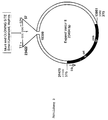
- the expand vector I has a size of 32.5 Kb, a lambda 25.9 Kb spacers and a cloning capacity (for Lambda Packaging System) from 7.0 - 16.5 Kb. This gives a total of 39.5-49 kb and corresponds to that Size range that can be packaged in the Lambda Packaging System ( Figure 2).
- Expand Vectors II and III were constructed in principle in the same way as Expand Vector I.
- a 16841 bp BamHI fragment was made Lambda isolated and inserted directly into the Bam HI site of the cosmid pHC 79.
- An 8526 bp fragment was then isolated and inserted directly into the Bam HI site of the cosmid pHC 79.
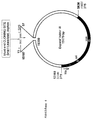
- the insertion of the cloning cassette into expand vectors II and III was done exactly as in the construction of Expand vector I performed ( Figures 3, 4).
- one of the expand vectors I, II, or III enables the cloning of Fragments in the order of 7 to 36 kb. This allows DNA fragments of a certain size class that were previously too large for one Cloning in conventional plasmids and on the other hand too small for cloning with Help from cosmids.
- a 23.3 Kb PCR fragment from the ⁇ -globin gene region was amplified from human genomic DNA by specific primers.
- a commercially available kit (Expand TM 20 Kb plus PCR system Boehringer Mannheim, catalog no. 1681 834) was used. This kit contains a special enzyme mixture of Taq DNA polymerase, Pwo DNA polymerase and another heat-stable enzyme.
- the PCR fragments were analyzed by gel electrophoresis after amplification and then with the High Pure PCR Template Preparation Kit (Boehringer Mannheim catalog No. 1796828) cleaned. The PCR fragments were then subjected to a polishing reaction (Generation of blunt ends) and a phosphorylation reaction (addition of 5'phosphates, since unphosphorylated primers were used) modified: For the modification reaction 1 ⁇ g of purified 23.3 Kb PCR fragment (corresponding to the yield a 50 ⁇ l PCR reaction).
- the polishing and phosphorylation reaction was carried out in a "one tube" reaction as follows: 8 ⁇ l of 5 ⁇ T4 DNA are added to the PCR fragment Polymerase buffer + dNTP, 4 ⁇ l 10 x phosphorylation buffer + ATP, 1 U T4 DNA polymerase (Boehringer Mannheim catalog No1004786) and 10 U T4 polynucleotide kinase (Boehringer Mannheim Catalog No. 174645) added. The reaction mixture is distilled with Water made up to 40 ⁇ l and then at 37 ° C for 20 min. incubated. The modified PCR fragments are after the reaction with the High Pure PCR template Preparation Kit (Boehringer Mannheim Catalog No. 1796828) cleaned.
- the Expand Vector II was linearized with SmaI and then dephosphorylated with alkaline phosphatase.
- 100 ng of Expand Vector II 200 ng linearized 23.3 kb Expand PCR fragment was used (two-fold molar excess).
- 10 ⁇ l 2 x ligation buffer plus and 5 U T4 DNA ligase (Boehringer Mannheim Catalog No 799009), the mixture was made up to 20 ⁇ l with bidist. Filled water and for 30 min. at room temperature (22 ° C) and for at least 5 min. incubated at - 70 ° C. This freezing reaction at - 70 ° C leads to an increase in the number of bacterial colonies by 2-4 times compared to the non-frozen ligation reaction.
- SM buffer 50 mmol of Tris / HCl, pH 7.5 / 22 ° C.; 10 mmol of MgSO 4 ; 100 mM NaCl; 0.01% gelatin
- 20 ⁇ l of chloroform 50 ⁇ l of SM buffer (50 mmol of Tris / HCl, pH 7.5 / 22 ° C.; 10 mmol of MgSO 4 ; 100 mM NaCl; 0.01% gelatin) and 20 ⁇ l of chloroform.
- E. coli magnesium culture in 10 mM magnesium sulfate was prepared for the infection of the bacterial cells with the phage supernatant (Hohn, T. Gene 11, 291-298, 1980).
- the strain E. coli DH5 ⁇ was grown up to an OD 600 of 1.0 in LB medium with the addition of maltose and magnesium sulfate (0.2% maltose; 10 mM MgSO 4 ). After centrifugation, the bacterial pellet was resuspended in a corresponding volume of 10 mM MgSO 4 , so that an OD 600 of 1.0 was obtained. 50 ⁇ l of this E.
- coli magnesium culture were mixed with 25 ⁇ l phage supernatant (2 volumes of magnesium cold, 1 volume of phage supernatants) for 30 min. incubated at room temperature (22 ° C). In principle, however, it is also possible to incubate up to 500 ⁇ l of the magnesium culture with up to 250 ⁇ l of phage supernatant, as long as the volume ratio is 2: 1. After adding 100 - 1000 ⁇ l LB medium and incubating for 60 min. at 37 ° C the infected bacterial cells were plated on LB tarps with ampicillin (100 ⁇ g / ml) and incubated at 37 ° C overnight.
- a 8576 base pair fragment from the phage generated by cleavage with Eco RI SPP I was separated from the gel after separation by agarose gel electrophoresis and isolation (Concentration: 500 ng in 20 ⁇ l) by adding 8 ⁇ l 5 x T4 DNA polymerase buffer and 1 U T4 DNA polymerase in a final volume of 40 ⁇ l (fill with bidistilled water) Incubate at 37 ° C for 20 min. polished (creation of smooth ends). The DNA fragment was then carried out using the High Pure PCR Template Preparation Kit (Boehringer Mannheim) cleaned and then in the linearized with SmaI and with alkaline phosphatase dephosphorylated expand vector I (two-fold molar excess of insert versus Vector).
- Example 2 Analogously to Example 1, 5 ul (a quarter) of the ligation reaction were added 25 ⁇ l DNA packaging extract (Single Tube System, Boehringer Mannheim Catalog No 1758 772) and after incubation at room temperature (22 ° C) for 2 hours and incubation with a magnesium culture of the strain E. coli DH5 ⁇ on LB plates with ampicillin (150 ⁇ g / ml) and incubated overnight at 37 ° C. The clones (230) obtained were in 10 ml LB medium with ampicillin (150 ⁇ g / ml) grown overnight at 37 ° C. The cosmid DNA was isolated by standard methods (Maniatis et. al. 1982) and by restriction cleavage analyzed with Not I and Not I / Eco RI. Contained from 30 examined clones 27 the insert (90%) with the correct size and expected restriction pattern.
- DNA packaging extract Single Tube System, Boehringer Mannheim Catalog No 1758 772
- the high cloning frequency of 90% and 92% achieved in both examples proves that the expand vectors according to the invention are suitable for cloning particularly large fragments, since recombination events with the comparatively large vector DNA and deletion events in the cloned inserts or the vectors obviously do not or only very much rarely occur.
Landscapes
- Health & Medical Sciences (AREA)
- Genetics & Genomics (AREA)
- Life Sciences & Earth Sciences (AREA)
- Engineering & Computer Science (AREA)
- Chemical & Material Sciences (AREA)
- Biotechnology (AREA)
- Organic Chemistry (AREA)
- Zoology (AREA)
- Bioinformatics & Cheminformatics (AREA)
- Wood Science & Technology (AREA)
- General Engineering & Computer Science (AREA)
- Biomedical Technology (AREA)
- Microbiology (AREA)
- Biochemistry (AREA)
- General Health & Medical Sciences (AREA)
- Virology (AREA)
- Tropical Medicine & Parasitology (AREA)
- Medicinal Chemistry (AREA)
- Physics & Mathematics (AREA)
- Biophysics (AREA)
- Molecular Biology (AREA)
- Plant Pathology (AREA)
- Measuring Or Testing Involving Enzymes Or Micro-Organisms (AREA)
Abstract
Description
| Expand Vektor Daten | |||
| Größe | Abstandshalter | Klonierungskapazität | |
| Vektor I | 32,6 kb | 25,9 kb | 7,0 - 16,5 kb |
| Vektor II | 23,5 kb | 16,8 kb | 16,5 - 25,0 kb |
| Vektor III | 15,2 kb | 8,5 kb | 25,0 - 36,0 kb |
Die SmaI Schnittstelle (Position 1) in der Mitte der Klonierungskassette ist singulär auf den Expand Vektoren vorhanden, da die zur Klonierung der Kassette in das Ausgangsplasmid verwendeten Sma I-Schnittstellen nicht regeneriert werden. Daher werden die zu klonierenden Fragmente in diese SmaI Schnittstelle inseriert.
- Abbildung 1:
- Klonierungskassette, die in die Expand Vektoren inseriert wurde. Zu klonierende Fragmente werden in die singuläre SmaI Schnittstelle inseriert (SEQ. ID. No. 1).
- Abbildung 2:
- Expand Vektor I, 32,6 kb, zur Klonierung von Fragmenten zwischen 7,0 und 16,5 kb
- Abbildung 3:
- Expand Vektor II, 23,5 kb, zur Klonierung von Fragmenten zwischen 16,5 und 25,0 kb
- Abbildung 4:
- Expand Vektor III, 15;2 kb, zur Klonierung von Fragmenten zwischen 25,0 und 36,0 kb
- Abbildung 2-4:
- Fettgedrückte Zahlen entsprechen den Koordinaten der Expand-Vektoren, kursiv gedruckte Zahlen entsprechen den Koordinaten des Lambda-Genoms, alle weiteren Zahlen entsprechen den Koordinaten des pHC79 Cosmids.
- PCR-Bedingungen:
- 250 ng human genomic DNA
400 nmol Primer (Forward; Reverse)
0,5 mmol dNTPs
10 µl 5x Expand™ 20 Kbplus Puffer
0,75 µl Expand™ 20 Kbplus Enzymmix
auf 50 µl mit bidest. Wasser aufgefüllt.
- Zyklusbedingungen:
- 2 min. bei 92°C
10 Zyklen mit: 10 sec. bei 92°C
30 sec. bei 62°C
18 min. bei 68°C - 20 Zyklen mit:
- 10 sec. bei 92°C
30 sec. bei 62°C
18 min. bei 68°C;
+ Zyklusverlängerung von 20 sec. für jeden Zyklus 7 min. bei 68°C


Claims (18)
- Cosmidvektor, dadurch gekennzeichnet, daß der Vektor mindestens 15 kb und maximal 35 kb groß ist
- Cosmidvektor gemäß Auspruch 1, dadurch gekennzeichnet, daß ein Teil des Vektors identisch mit der vollständigen Sequenz von pHC 79 ist
- Cosmidvektor gemäß Anspruch 1-2, dadurch gekennzeichnet, daß er als Abstandshalter ein DNA Fragment nicht-eukaryotischen Ursprungs enthält
- Cosmidvektor gemäß Anspruch 1-3, dadurch gekennzeichnet, daß er außer den COS Sequenzen ein zusätzliches DNA Fragment aus dem Genom des Bakteriophagen Lambda enthält
- Cosmidvektor gemäß Anspruch 4, dadurch gekennzeichnet,
daß das zusätzliche DNA Fragment ausgewählt wird aus einer Gruppe von Fragmenten bestehend aus dem 8,5 kb großem BamHI/BclI Fragment, dem 16,8 kb großem BamHI Fragment und dem 25,9 kb großen BbrI/BspLu11 Fragment des Bakteriophagen Lambda cI857Sam7 - Escherichia coli Wirtszelle, enthaltend ein Cosmid gemäß Anspruch 1-5
- Verwendung von Cosmidvektoren gemäß Anspruch 1-5 zur Klonierung von DNA Fragmenten mit einer Größe zwischen 5 kb und 40 kb
- Verwendung von Cosmidvektoren gemäß Anspruch 7 zur Klonierung von DNA Fragmenten mit einer Größe zwischen 7 kb und 36 kb
- Verwendung von Cosmidvektoren gemäß Anspruch 7 zur Klonierung von DNA Fragmenten mit einer Größe, ausgewählt aus einer Gruppe von Bereichen bestehend aus den Intervallen 7 kb - 16,5 kb, 16,5 kb - 25 kb, und 25 kb - 36 kb
- Verwendung von Cosmidvektoren gemäß Anspruch 7-9, wobei die zu klonierenden DNA Fragmente PCR-Amplifikationsprodukte darstellen
- Verfahren zur Klonierung von DNA Fragmenten mit einer Größe zwischen 5 kb und 40 kb, wobei Cosmidvektoren gemäß Anspruch 1-5 verwendet werden
- Verfahren gemäß Anspruch 11,
wobei DNA Fragmente mit einer Größe, ausgewählt aus einer Gruppe von Bereichen bestehendaus den Intervallen 7 kb - 16,5 kb, 16,5 kb - 25 kb, und 25 kb - 36 kb kloniert werden - Verfahren gemäß Anspruch 11-12, dadurch gekennzeichnet,
daß PCR Fragmente kloniert werden - Verfahren zur Konservierung einer Escherichia coli Suspension in 5-20 mM MgSO4-Lösung, dadurch gekennzeichnet,
daß die Suspension von einer Temperatur, die niedriger als 30°C, aber höher als 4°C ist, über einen Zeitraum von mindestens 30 Minuten auf -70°C abgekühlt wird - Verwendung einer Population von Bakterien, die gemäß Anspruch 14 behandelt wurde, als Wirtsorganismen zur Replikation von in vitro verpackter Cosmid-DNA
- Kit, enthaltend mindestens einen Vektor gemäß Anspruch 1-5
- Kit gemäß Anspruch 16, zusätzlich enthaltend Lambda DNA packaging Extrakt
- Kit gemäß Anspruch 17, zusätzlich enthaltend eine Suspension von DH5alpha in MgSO4-Lösung
Priority Applications (1)
| Application Number | Priority Date | Filing Date | Title |
|---|---|---|---|
| EP98121736A EP0919623A3 (de) | 1997-11-17 | 1998-11-14 | Verfahren und Kit zur Klonierung von Fragmenten |
Applications Claiming Priority (3)
| Application Number | Priority Date | Filing Date | Title |
|---|---|---|---|
| EP97120089 | 1997-11-17 | ||
| EP97120089A EP0916733A1 (de) | 1997-11-17 | 1997-11-17 | Verfahren und Kit zur Klonierung von Fragmenten |
| EP98121736A EP0919623A3 (de) | 1997-11-17 | 1998-11-14 | Verfahren und Kit zur Klonierung von Fragmenten |
Publications (2)
| Publication Number | Publication Date |
|---|---|
| EP0919623A2 true EP0919623A2 (de) | 1999-06-02 |
| EP0919623A3 EP0919623A3 (de) | 1999-07-14 |
Family
ID=26145898
Family Applications (1)
| Application Number | Title | Priority Date | Filing Date |
|---|---|---|---|
| EP98121736A Withdrawn EP0919623A3 (de) | 1997-11-17 | 1998-11-14 | Verfahren und Kit zur Klonierung von Fragmenten |
Country Status (1)
| Country | Link |
|---|---|
| EP (1) | EP0919623A3 (de) |
Cited By (2)
| Publication number | Priority date | Publication date | Assignee | Title |
|---|---|---|---|---|
| WO2000040735A1 (fr) * | 1999-01-08 | 2000-07-13 | Centre National De La Recherche Scientifique (Cnrs) | Construction d'acides nucleiques recombinants circularises au moyen d'agents compactant l'adn |
| WO2002038755A1 (en) * | 2000-11-07 | 2002-05-16 | Jefferies Wilfred A | Circular extra-chromosomal dna elements |
Family Cites Families (3)
| Publication number | Priority date | Publication date | Assignee | Title |
|---|---|---|---|---|
| JPS6058074A (ja) * | 1983-09-09 | 1985-04-04 | Juzo Udaka | バチルス・ブレビスを形質転換する方法 |
| JPH05503626A (ja) * | 1989-08-22 | 1993-06-17 | イー・アイ・デュポン・ドゥ・ヌムール・アンド・カンパニー | 95kbの大きさのdna断片をクローニングするための生体外ヘッドフルパッケージング系 |
| EP0620280A1 (de) * | 1993-04-16 | 1994-10-19 | Pfizer Inc. | Cosmid-Vektoren für die Klonierung der DNS des Genoms von Streptomyzeten |
-
1998
- 1998-11-14 EP EP98121736A patent/EP0919623A3/de not_active Withdrawn
Cited By (2)
| Publication number | Priority date | Publication date | Assignee | Title |
|---|---|---|---|---|
| WO2000040735A1 (fr) * | 1999-01-08 | 2000-07-13 | Centre National De La Recherche Scientifique (Cnrs) | Construction d'acides nucleiques recombinants circularises au moyen d'agents compactant l'adn |
| WO2002038755A1 (en) * | 2000-11-07 | 2002-05-16 | Jefferies Wilfred A | Circular extra-chromosomal dna elements |
Also Published As
| Publication number | Publication date |
|---|---|
| EP0919623A3 (de) | 1999-07-14 |
Similar Documents
| Publication | Publication Date | Title |
|---|---|---|
| DE69836092T2 (de) | Rekombinatorisches klonieren unter verwendung von nukleinsaüren mit rekombinationsstellen | |
| DE69623057T2 (de) | Rekombinatorische klonierung in vitro unter verwendung genmanipulierter rekombinationsorte | |
| DE69920113T2 (de) | Escherichia coli Wirt/Vektorsystem basierend auf einer antibiotikafreien Selektion durch Komplementation einer Auxotrophie | |
| EP0759997B1 (de) | Verwendung des tetracyclinpromotors zur stringent regulierten produktion von rekombinanten proteinen in prokaryontischen zellen | |
| DE3750378T2 (de) | Sekretionssignal-Selektionsvektoren für extrazelluläre Proteinsynthese in Bazillen. | |
| DE69721282T2 (de) | In vitro transpositionsystem unter verwendung einer modifizierten tn5 transposase | |
| DE69838510T2 (de) | Mutationen in atp-abhängigen transpositionsproteinen die die zielortspezifität reduzieren | |
| DD209476A5 (de) | Verfahren zur stabilisierung und selektierung von wirtszellen, die rekombinierende dna enthalten | |
| DE19812103A1 (de) | Verfahren zur Synthese von Nucleinsäuremolekülen | |
| DD212532A5 (de) | Verfahren zur stabilisierung und selektion von wirtszellen, die rekombinierende dna enthalten | |
| DD203746A5 (de) | Verfahren zur herstellung eines expressionsplasmids | |
| DE4018441A1 (de) | Rekombinantes restriktionsenzym sau3ai | |
| WO1998053056A2 (de) | Herstellungsverfahren für lange dna-konstrukte | |
| DE3122216A1 (de) | Verfahren zur herstellung eines mikroorganismus, welcher (alpha)-galactosidase, aber keine invertase bildet, so erhaltener mikroorganismus und seine verwendung | |
| CH640268A5 (en) | Process for the preparation of filamentous hybrid phages, novel hybrid phages and their use | |
| DE69829240T2 (de) | Für temperaturstabile Diaphorase kodierendes Gen | |
| EP0916733A1 (de) | Verfahren und Kit zur Klonierung von Fragmenten | |
| EP0220714B1 (de) | DNA-Fragment mit dem Cyclodextrin-Glycosyl-Transferase-Strukturgen, Expressionsvektor, Mikroorganismen zur Expression und Herstellungsverfahren | |
| EP0935664B1 (de) | Neue systeme zur regulation der genexpression | |
| DE60202196T2 (de) | Orientationsgerichtete konstruktion von plasmiden | |
| DE19630617A1 (de) | Positiver Selektionsvektor auf Basis des caps-Gens, pCAPs-Vektor und seine Verwendung | |
| DE19633427C2 (de) | Verfahren zur Synthese von Nukleinsäuremolekülen mit zumindest teilweise vorbestimmter Nukleotidsequenz | |
| DE3412093A1 (de) | Hybridplasmide mit einem streptomyceten- und einem escherichia coli-replicon | |
| DE3121815A1 (de) | Hybridvektor, verfahren zu seiner herstellung und seine verwendung | |
| DE69434072T2 (de) | Regulierende nukleinsaeuresequenzen und verwendungen |
Legal Events
| Date | Code | Title | Description |
|---|---|---|---|
| PUAI | Public reference made under article 153(3) epc to a published international application that has entered the european phase |
Free format text: ORIGINAL CODE: 0009012 |
|
| PUAL | Search report despatched |
Free format text: ORIGINAL CODE: 0009013 |
|
| AK | Designated contracting states |
Kind code of ref document: A2 Designated state(s): AT CH DE ES FR GB IT LI NL |
|
| AX | Request for extension of the european patent |
Free format text: AL;LT;LV;MK;RO;SI |
|
| AK | Designated contracting states |
Kind code of ref document: A3 Designated state(s): AT BE CH CY DE DK ES FI FR GB GR IE IT LI LU MC NL PT SE |
|
| AX | Request for extension of the european patent |
Free format text: AL;LT;LV;MK;RO;SI |
|
| 17P | Request for examination filed |
Effective date: 20000114 |
|
| AKX | Designation fees paid |
Free format text: AT CH DE ES FR GB IT LI NL |
|
| 17Q | First examination report despatched |
Effective date: 20020806 |
|
| STAA | Information on the status of an ep patent application or granted ep patent |
Free format text: STATUS: THE APPLICATION IS DEEMED TO BE WITHDRAWN |
|
| 18D | Application deemed to be withdrawn |
Effective date: 20030218 |