EP0930367B1 - Champignons du genre Ashbya pour la préparation de riboflavine - Google Patents
Champignons du genre Ashbya pour la préparation de riboflavine Download PDFInfo
- Publication number
- EP0930367B1 EP0930367B1 EP98124402A EP98124402A EP0930367B1 EP 0930367 B1 EP0930367 B1 EP 0930367B1 EP 98124402 A EP98124402 A EP 98124402A EP 98124402 A EP98124402 A EP 98124402A EP 0930367 B1 EP0930367 B1 EP 0930367B1
- Authority
- EP
- European Patent Office
- Prior art keywords
- riboflavin
- gene
- glycine
- genetically modified
- seq
- Prior art date
- Legal status (The legal status is an assumption and is not a legal conclusion. Google has not performed a legal analysis and makes no representation as to the accuracy of the status listed.)
- Expired - Lifetime
Links
Images


Classifications
-
- C—CHEMISTRY; METALLURGY
- C12—BIOCHEMISTRY; BEER; SPIRITS; WINE; VINEGAR; MICROBIOLOGY; ENZYMOLOGY; MUTATION OR GENETIC ENGINEERING
- C12N—MICROORGANISMS OR ENZYMES; COMPOSITIONS THEREOF; PROPAGATING, PRESERVING, OR MAINTAINING MICROORGANISMS; MUTATION OR GENETIC ENGINEERING; CULTURE MEDIA
- C12N9/00—Enzymes; Proenzymes; Compositions thereof; Processes for preparing, activating, inhibiting, separating or purifying enzymes
- C12N9/10—Transferases (2.)
- C12N9/1003—Transferases (2.) transferring one-carbon groups (2.1)
- C12N9/1014—Hydroxymethyl-, formyl-transferases (2.1.2)
-
- C—CHEMISTRY; METALLURGY
- C12—BIOCHEMISTRY; BEER; SPIRITS; WINE; VINEGAR; MICROBIOLOGY; ENZYMOLOGY; MUTATION OR GENETIC ENGINEERING
- C12N—MICROORGANISMS OR ENZYMES; COMPOSITIONS THEREOF; PROPAGATING, PRESERVING, OR MAINTAINING MICROORGANISMS; MUTATION OR GENETIC ENGINEERING; CULTURE MEDIA
- C12N1/00—Microorganisms; Compositions thereof; Processes of propagating, maintaining or preserving microorganisms or compositions thereof; Processes of preparing or isolating a composition containing a microorganism; Culture media therefor
- C12N1/14—Fungi; Culture media therefor
- C12N1/145—Fungi isolates
-
- C—CHEMISTRY; METALLURGY
- C12—BIOCHEMISTRY; BEER; SPIRITS; WINE; VINEGAR; MICROBIOLOGY; ENZYMOLOGY; MUTATION OR GENETIC ENGINEERING
- C12N—MICROORGANISMS OR ENZYMES; COMPOSITIONS THEREOF; PROPAGATING, PRESERVING, OR MAINTAINING MICROORGANISMS; MUTATION OR GENETIC ENGINEERING; CULTURE MEDIA
- C12N15/00—Mutation or genetic engineering; DNA or RNA concerning genetic engineering, vectors, e.g. plasmids, or their isolation, preparation or purification; Use of hosts therefor
- C12N15/09—Recombinant DNA-technology
- C12N15/63—Introduction of foreign genetic material using vectors; Vectors; Use of hosts therefor; Regulation of expression
- C12N15/79—Vectors or expression systems specially adapted for eukaryotic hosts
- C12N15/80—Vectors or expression systems specially adapted for eukaryotic hosts for fungi
-
- C—CHEMISTRY; METALLURGY
- C12—BIOCHEMISTRY; BEER; SPIRITS; WINE; VINEGAR; MICROBIOLOGY; ENZYMOLOGY; MUTATION OR GENETIC ENGINEERING
- C12N—MICROORGANISMS OR ENZYMES; COMPOSITIONS THEREOF; PROPAGATING, PRESERVING, OR MAINTAINING MICROORGANISMS; MUTATION OR GENETIC ENGINEERING; CULTURE MEDIA
- C12N9/00—Enzymes; Proenzymes; Compositions thereof; Processes for preparing, activating, inhibiting, separating or purifying enzymes
- C12N9/88—Lyases (4.)
-
- C—CHEMISTRY; METALLURGY
- C12—BIOCHEMISTRY; BEER; SPIRITS; WINE; VINEGAR; MICROBIOLOGY; ENZYMOLOGY; MUTATION OR GENETIC ENGINEERING
- C12P—FERMENTATION OR ENZYME-USING PROCESSES TO SYNTHESISE A DESIRED CHEMICAL COMPOUND OR COMPOSITION OR TO SEPARATE OPTICAL ISOMERS FROM A RACEMIC MIXTURE
- C12P25/00—Preparation of compounds containing alloxazine or isoalloxazine nucleus, e.g. riboflavin
-
- C—CHEMISTRY; METALLURGY
- C12—BIOCHEMISTRY; BEER; SPIRITS; WINE; VINEGAR; MICROBIOLOGY; ENZYMOLOGY; MUTATION OR GENETIC ENGINEERING
- C12R—INDEXING SCHEME ASSOCIATED WITH SUBCLASSES C12C - C12Q, RELATING TO MICROORGANISMS
- C12R2001/00—Microorganisms ; Processes using microorganisms
- C12R2001/645—Fungi ; Processes using fungi
- C12R2001/65—Absidia
Definitions
- the present invention relates to a genetically modified Mushroom of the genus Ashbya for the production of riboflavin.
- Vitamin B 2 also called riboflavin, is essential for humans and animals. With vitamin B 2 deficiency, inflammation of the mucous membranes of the mouth and throat, cracks in the corners of the mouth, itching and inflammation in the skin folds, among other things, skin damage, conjunctivitis, reduced visual acuity and clouding of the cornea. In babies and children growth stagnation and weight loss can occur. Vitamin B 2 is therefore of economic importance, in particular as a vitainin preparation for vitamin deficiency and as a feed additive. It is also used as a food coloring, for example in mayonnaise, ice cream, pudding, etc.
- Riboflavin is produced either chemically or microbially. at Riboflavin is usually used in chemical production processes multi-stage processes as a pure end product, but also relatively expensive raw materials - such as D-Ribose - used Need to become. Hence the chemical synthesis of riboflavin comes only for those applications for which pure riboflavin is necessary, such as. in human medicine.
- riboflavin An alternative to the chemical production of riboflavin is the Manufacture of this substance by microorganisms.
- Microbial production Riboflavin is particularly suitable for cases in which a high Purity of this substance is not required. This is the case, for example Case when the riboflavin is used as an additive to feed products should.
- the microbial production of riboflavin has Advantage that this substance can be obtained in a one-step process. Can too as starting products for microbial synthesis renewable Raw materials, such as vegetable oils, are used.
- processes with the yeast Candida famata are for example in the US 05231007.
- Riboflavin overproducing bacterial strains are for example in the EP 405370, GB 1434299, DE 3420310 and EP0821063, the Strains by transforming the riboflavin biosynthesis genes from Bacillus subtilis were obtained. However, these prokaryotic genes were for one recombinant riboflavin production process with eukaryotes such as Saccharomyces cerevisiae or Ashbya gossypii unsuitable.
- the object of the present invention is accordingly a one or multicellular organism, preferably a fungus, for biotechnical Production of riboflavin to provide another one Optimization of riboflavin formation enables.
- a Organism are made available by saving raw materials is suitable for the production of riboflavin and thus a production enables, which is more economical compared to the prior art.
- the organism should be one in comparison to previous organisms allow increased riboflavin formation without the addition of glycine.
- This task is accomplished by a genetically modified single or multi-cell Fungus of the genus Ashbya, which is encoded by an increased synthesis of threonine aldolase a nucleotide sequence according to SEQ ID No. 1 or their allele variations one increased catalytic compared to its endogenous threonine aldolase activity Exhibits activity of this enzyme.
- the invention relates to a genetically modified fungus of the aforementioned type, which is characterized in that its Riboflavin synthesis performance without external supply of glycine at least equal is that of a wild type of Ashbya ATCC 10895 species, which under Standard conditions with the addition of 6 g / l external glycine is grown.
- Cultivation under standard conditions means cultivation in 500 ml shake flasks with two baffles at 120 rpm and 30 ° C.
- the medium used for each flask is 50 ml of a solution of 10 g / l yeast extract with either 10 g / l glucose or 10 g / l soybean oil.
- the inoculation is carried out with 1% of a 16 h culture under the same conditions.
- the goal of this desired change in the intracellular glycine metabolism can be achieved with the known methods of strain improvement of fungi.
- corresponding strains can be produced by screening according to the selection that is customary in microbiology.
- the mutation with subsequent selection can also be used.
- the mutation can be carried out using chemical as well as physical mutagenesis. Another method is selection and mutation with subsequent recombination.
- the fungi according to the invention can be produced by means of genetic engineering
- the genetically modified one or multicellular mushroom to the genus Ashbya is Ashbya gossypii.
- glycine production can preferably be achieved in that a genetically modified fungus is produced in which the enzyme activity of the Threonine aldolase is increased.
- An increased enzyme activity of threonine aldolase can be achieved by increasing the Enzyme synthesis, for example by gene amplification or by switching off of factors that repress enzyme biosynthesis.
- Threonine aldolase gene expression can be achieved by incorporation of threonine aldolase gene copies and / or by strengthening regulatory factors that affect the Affect threonine aldolase gene expression positively. So can a strengthening of regulatory elements, preferably at the transcription level take place, in particular by increasing the transcription signals. Besides it is also possible to increase the translation, for example by Stability of m-RNA is improved.
- the threonine aldolase gene can be used to increase the number of gene copies be built into a gene construct or into a vector that preferably regulatory associated with the threonine aldolase gene Contains gene sequences, especially those that increase gene expression. Then a riboflavin-producing microorganism with which the Transformed gene construct containing threonine aldolase gene.
- the overexpression of the threonine aldolase can also be caused by Exchange of the promoter can be achieved. It is possible to choose the higher one alternatively by incorporation of gene copies or by enzymatic activity Exchange of the promoter. Equally, however, it is also possible by simultaneously exchanging the promoter and incorporating gene copies to achieve the desired change in enzyme activity.
- the threonine has a limiting effect in such a genetically modified fungus when using the cell according to the invention the feeding of threonine required.
- the better reception and almost quantitative implementation of the Threonins to glycine lead to a surprisingly high increase in Riboflavin formation, as was previously not possible by adding glycine was.
- the endogenous threonine formation can be genetically modified Mushrooms e.g. by eliminating the feedback resistance of the aspartate kinase become.
- the threonine aldolase gene is preferably made up of microorganisms, Ashbya gossypii species.
- the gene can be isolated by homologous or heterologous complementation of one in the threonine aldolase gene defective mutant or by heterologous probing or PCR with heterologous Primers. For subcloning, the insert of the complementing Plasmids then by appropriate steps with restriction enzymes in the Size can be minimized. After sequencing and identifying the putative The gene is subcloned by fusion PCR. Plasmids that the fragments thus obtained carry as an insert into the threonine aldolase gene defects Mutant introduced on functionality of the threonine aldolase gene Is tested. Functional constructs ultimately become a transformation of a riboflavin producer.
- the threonine adolase genes are included Nucleotide sequences available for the given amino acid sequence.
- the present invention relates to a threonine aldolase with one for those in SEQ ID No. 2 given amino acid sequence.
- a nucleotide according to SEQ ID No. 1 encoding a threonine aldolase.
- the invention Nucleotide sequence has a coding region for a threonine aldolase gene from nucleotide 1 to 1149 according to SEQ ID No. 1 on.
- the threonine aldolase gene is in particular a promoter of the nucleotide sequence from nucleotide -1231 to -1 acc. the SEQ ID No. 1 upstream. So can for example, the gene may be preceded by a promoter that differs from that Promoter with the specified nucleotide sequence by one or more Nucleotide exchanges, distinguished by insertion and / or deletion without but the functionality or the effectiveness of the promoter is impaired. Furthermore, the promoter can be changed by changing its sequence Effectiveness increased or completely replaced by effective promoters become.
- the threonine aldolase gene according to SEQ ID No. 1 can further regulatory gene sequences or regulatory genes can be assigned to the especially increase threonine adolase gene activity. So can that Threonine aldolase gene can be assigned, for example, so-called “enhancers", which via an improved interaction between RNA polymerase and DNA cause increased threonine aldolase gene expression.
- the threonine aldolase gene according to SEQ ID No. 1 with or without upstream promoter or with or without a regulator gene can one or several DNA sequences upstream and / or downstream, so that the gene in a gene structure is included.
- plasmids or vectors which contain the threonine aldolase gene or a Contain gene structure of the type mentioned above and to transform a Riboflavin producers are suitable.
- the present invention includes the use of the nucleotide sequence according to SEQ ID No. 1 coding for one Threonine aldolase gene or my gene structure of the type mentioned above Production of a genetically modified fungus according to the invention.
- the cells obtainable by transformation contain the gene in replicable form, i.e. in additional copies on the Chromosome, the gene copies by homologous recombination at any Locations of the genome are integrated.
- the present invention furthermore relates to a transformed fungus of the genus Ashbya for the production of riboflavin containing, in replicable form, a nucleotide sequence according to SEQ ID No. 1 of the aforementioned type or a gene structure as described above.
- This also includes a transformed mushroom of the genus Ashbya containing a vector of the aforementioned type. It is preferably Ashbya gossypii.
- the present invention also includes a method of making Riboflavin, which is characterized in that an inventive genetic modified mushroom of the genus Ashbya is grown without the addition of glycine to the culture medium and the riboflavin formed is processed.
- the aim of a partial or complete intracellular Glycine formation can also be achieved by using genetically modified fungi are produced in which the intracellular degradation of the glycine at least is partially blocked.
- Such mutations can - as already described above - According to classic methods through physical or chemical mutagenesis generated in a non-directional manner, such as by UV radiation or mutation-triggering chemicals, or specifically using genetic engineering Methods.
- the goal of increased intracellular glycine formation preferably by changing the gene of the serine hydroxymethyl transferase can be achieved.
- Subject of the present Invention is also a genetically modified single or multi-cell fungus in which the intracellular breakdown of glycine by inhibiting the Serine hydroxymethyltransferase activity by selection of mutants that are resistant to glycine antimetabolites, is inhibited.
- acts it is a genetically modified fungus of the genus Ashbya opposite Alpha-aminomethylphosphonic acid or alpha-aminosulphonic acid is resistant.
- mutants which can be used according to the invention can also be produced by appropriate selection.
- the production of such resistant genetically modified single or multicellular fungi can therefore be achieved using classic screening methods, as are common in microbiology.
- the object according to the invention preferably by increasing the intracellular synthesis of glycine, at least partially blocking the breakdown of glycine can be solved.
- riboflavin formation can be achieved by adding Achieve glycine to the nutrient medium.
- Process for the production of riboflavin is a genetically modified fungus previously mentioned species with the addition of glycine to the culture medium. The Riboflavin formed is then processed.
- Fungi are transformed cells from fungi, of the genus Ashbya.
- Ashbya gossypii is particularly preferred.
- the present invention thus also includes the use of a Genetically modified fungus of the genus Ashbya according to the invention for the production of riboflavin.
- Ashbya gossypii spores were mutagenized by UV light. This were placed on plates mixed with 70 mM alpha-aminomethylphosphonic acid given. The inhibition of riboflavin formation can be seen in that the Fungus forms yellow colonies without inhibitor and white with inhibitor. Accordingly, the yellow, i.e. isolated organisms resistant to inhibitors. In this way, i.a. the resistant strain AMPS-NM-01 obtained.
- the minimum medium used in Table 1 is composed as follows: Solution A: KH 2 PO 4 200 g / l pH 6.7 with KOH (100 times)
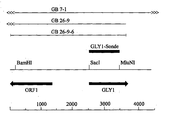
- the glycine auxotroph was used to isolate the gene for the threonine aldolase Mutant of Saccharomyces cerevisiae YM 13F (SHM1:: HIS3 shm2:: LEU2 gly1:: URA3) after selection for fluororotic acid resistance with a gene bank of Ashbya gossypii transformed.
- the gene bank consisted partially of Sau3A digested genomic DNA, from that via density gradient centrifugation 8-16 kb large fragments isolated and in the vector cut with BamH1 Yep352 had been ligated.
- the transformants were applied to uracil prototrophy selected.
- a selection was made after replica plating for glycine prototrophy.
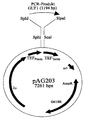
- the GLY1 gene was inserted into the expression vector pAG203 cloned (see WO9200379).
- the gene is under the control of the TEF promoter and the TEF terminator ( Figure 3).
- Figure 3 As a selection marker in Ashbya gossypii works a G418 resistance gene. After transforming Ashbya gossypii with this plasmid and subsequent isolation of Single-spore cloning, because the spores are mononuclear and haploid, became the activity the threonine aldolase measured in the crude extract.
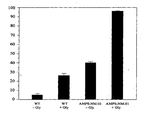
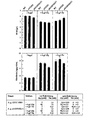
- pAG203 transformed strain could be found at A.g.p.AG203GLY1 both when growing on glucose and when growing on soybean oil at least 10-fold overexpression can be measured (FIG. 4).
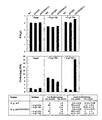
- the threoninal dolase was overexpressing strain A. g.pAG203GLY1 Soybean oil, instead of being grown on glucose as in Example 4, did not result in any Increase in riboflavin formation when feeding threonine that with glycine surpassed (Fig. 6).
- the analysis of the medium showed, however, that the threonine except for about 13 mM was mined. A limitation in threonine cannot have been present.
- the extracellular glycine had increased from 2 to about 44 mM. So it was all glycine from Mushroom has been exported to the medium.
- Riboflavin formation increased by selection of ⁇ -hydroxy-norvaline resistant mutants.
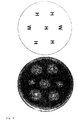
- the threonine analogue ⁇ -hydroxy-norvaline was used to find resistant mutants. Radial growth was significantly inhibited on minimal medium agar plates containing 2.5 mM ⁇ -hydroxy-norvaline. Mutants spontaneously formed on the edges of the colonies and grew better. Isolation of spores and re-selection made it possible to generate stable mutants which grew significantly better on the minimal medium ⁇ -hydroxy-norvaline than the parent strains (FIG. 8). An examination of riboflavin formation showed a significant increase in productivity.
- the HNV-TB-25 strain formed 41 ⁇ 11 mg / l riboflavin in minimal medium with soybean oil, while its parent strain produced only 18 ⁇ 3 mg / l.
- the descendant HNV-TB-29 also shows a clear increase with 116 ⁇ 4 mg / l compared to its original strain Ita-GS-01, which only formed 62 ⁇ 10 mg / l. 13 C-enrichment in the C-atoms of serine, threonine and glycine after growth of A. gossypii ATC10895 on the specified media and subsequent total hydrolysis of the resulting biomass.
Landscapes
- Life Sciences & Earth Sciences (AREA)
- Chemical & Material Sciences (AREA)
- Health & Medical Sciences (AREA)
- Engineering & Computer Science (AREA)
- Organic Chemistry (AREA)
- Genetics & Genomics (AREA)
- Wood Science & Technology (AREA)
- Zoology (AREA)
- Bioinformatics & Cheminformatics (AREA)
- Biotechnology (AREA)
- General Engineering & Computer Science (AREA)
- Biomedical Technology (AREA)
- Microbiology (AREA)
- Biochemistry (AREA)
- General Health & Medical Sciences (AREA)
- Molecular Biology (AREA)
- Medicinal Chemistry (AREA)
- Mycology (AREA)
- Plant Pathology (AREA)
- Biophysics (AREA)
- Physics & Mathematics (AREA)
- Botany (AREA)
- Tropical Medicine & Parasitology (AREA)
- Virology (AREA)
- Chemical Kinetics & Catalysis (AREA)
- General Chemical & Material Sciences (AREA)
- Preparation Of Compounds By Using Micro-Organisms (AREA)
- Micro-Organisms Or Cultivation Processes Thereof (AREA)
Claims (20)
- Champignon génétiquement modifié du type Ashbya pour la production de riboflavine par biotechnologie, caractérisé en ce qu'il présente suite à sa transformation la séquence de nucléotides selon SEQ ID N° 1 qui code une thréonine aldolase qui présente une forme apte à être répliquée et dont le nombre de copies est supérieur à 1 et en ce qu'il présente par expression de ladite séquence de nucléotides une activité catalytique de cette enzyme qui est plus forte que l'activité de la thréonine aldolase endogène.
- Champignon génétiquement modifié selon la revendication 1, caractérisé en ce que sa capacité à synthétiser la riboflavine sans apport externe de glycine est au moins égale à celle d'un type sauvage de l'espèce Ashbya ATCC10895 qui est élevée en conditions normalisées en y ajoutant 6 g/l de glycine externe.
- Champignon génétiquement modifié selon la revendication 1 ou la revendication 2, caractérisé en ce que, dans ce champignon, la décomposition intracellulaire de la glycine est inhibée par l'inhibition de l'activité de la sérinhydroxyméthyle-transférase par la sélection de mutants qui résistent aux antimétabolites de la glycine.
- Champignon génétiquement modifié selon la revendication 3, caractérisé en ce qu'il résiste à l'acide alpha-aminométhylphosphonique ou à l'acide alpha-aminosulfonique, à la β-hydroxynorvaline et/ou à d'autres composants analogues à la thréonine et/ou à la lysine.
- Champignon génétiquement modifié selon l'une quelconque des revendications 1 à 4, caractérisé en ce qu'il s'agit d'un Ashbya gossypii.
- Thréonine aldolase dont la séquence d'acides aminés est donnée par SEQ ID n° 2.
- Séquence de nucléotides selon SEQ ID n° 1 qui code une thréonine aldolase.
- Séquence de nucléotides selon la revendication 7, qui présente une région qui code un gène de thréonine aldolase et qui s'étend des nucléotides 1232 à 2377 selon SEQ ID n° 1.
- Séquence de nucléotides selon la revendication 7 ou 8, qui présente un promoteur des nucléotides 1 à 1231 placé en amont du gène de l'aldolase de SEQ ID n° 1.
- Structure de gène qui comprend un gène de la thréonine aldolase qui présente une séquence de nucléotides selon l'une quelconque des revendications 7 à 9 et les séquences de gènes de régulation qui lui sont associées.
- Vecteur qui comprend un gène de la thréonine aldolase qui présente une séquence de nucléotides selon l'une quelconque des revendications 7 à 9 ou une structure de gène selon la revendication 10.
- Champignon transformé du type Ashbya, destiné à la production de riboflavine et qui comprend une séquence de nucléotides qui présente une forme apte à être répliquée selon l'une quelconque des revendications 7 à 9 ou une structure de gène selon la revendication 10.
- Champignon transformé selon la revendication 12, qui. comprend un vecteur selon la revendication 11.
- Champignon transformé selon la revendication 12 ou la revendication 13, qui est un champignon de l'espèce Ashbya gossypii.
- Procédé pour produire un champignon génétiquement modifié qui produit de la riboflavine selon la revendication 1 au moyen d'un mode opératoire qui consiste à :a). augmenter le nombre de copies de gènes chromosomiques ou codés par plasmide de la séquence d'acides nucléiques selon SEQ ID n° 1, de préférence dans le domaine des nucléotides 1 à 1149 selon SEQ ID n° 1 et/ou àb) remplacer le promoteur par les nucléotides - 1231 à -1 selon SEQ ID n° 1 à l'aide de procédés du génie génétique, ce qui permet d'obtenir un amorçage renforcé de la transcription.
- Procédé pour produire de la riboflavine, caractérisé en ce qu'un champignon génétiquement modifié selon l'une quelconque des revendications 1 à 5 ou 12 à 14 est élevé sans ajout de glycine dans le milieu de culture et en ce que la riboflavine formée est traitée.
- Procédé selon la revendication 16, caractérisé en ce que le champignon génétiquement modifié selon l'une quelconque des revendications 1 à 5 ou 12 à 14 est élevé en ajoutant de la glycine dans le milieu de culture.
- Utilisation du champignon génétiquement modifié selon l'une quelconque des revendications 1 à 5 ou 12 à 14 pour produire de la riboflavine.
- Utilisation de la séquence de nucléotides selon SEQ ID n° 1 qui code un gène de thréonine aldolase selon l'une quelconque des revendications 7 à 9 ou de la structure de gène selon la revendication 10 pour produire un champignon génétiquement modifié selon l'une quelconque des revendications 1 à 5 ou 12 à 14.
- Utilisation du vecteur selon la revendication 11 pour produire un champignon génétiquement modifié selon l'une quelconque des revendications 1 à 5 ou 12 à 14.
Applications Claiming Priority (4)
| Application Number | Priority Date | Filing Date | Title |
|---|---|---|---|
| DE19757180 | 1997-12-22 | ||
| DE19757180 | 1997-12-22 | ||
| DE19840709A DE19840709A1 (de) | 1997-12-22 | 1998-09-07 | Ein- oder mehrzellige Organismen zur Herstellung von Riboflavin |
| DE19840709 | 1998-09-07 |
Publications (3)
| Publication Number | Publication Date |
|---|---|
| EP0930367A2 EP0930367A2 (fr) | 1999-07-21 |
| EP0930367A3 EP0930367A3 (fr) | 1999-12-15 |
| EP0930367B1 true EP0930367B1 (fr) | 2004-12-15 |
Family
ID=26042733
Family Applications (1)
| Application Number | Title | Priority Date | Filing Date |
|---|---|---|---|
| EP98124402A Expired - Lifetime EP0930367B1 (fr) | 1997-12-22 | 1998-12-21 | Champignons du genre Ashbya pour la préparation de riboflavine |
Country Status (6)
| Country | Link |
|---|---|
| EP (1) | EP0930367B1 (fr) |
| JP (1) | JPH11243976A (fr) |
| CN (1) | CN1225944A (fr) |
| AT (1) | ATE284967T1 (fr) |
| CA (1) | CA2255284A1 (fr) |
| DE (1) | DE59812382D1 (fr) |
Families Citing this family (3)
| Publication number | Priority date | Publication date | Assignee | Title |
|---|---|---|---|---|
| GB9725782D0 (en) * | 1997-12-05 | 1998-02-04 | Pfizer Ltd | Therapeutic agents |
| KR100422307B1 (ko) | 2002-12-05 | 2004-03-10 | 씨제이 주식회사 | 리보플라빈을 생산하는 미생물 및 이를 이용한리보플라빈의 생산방법 |
| CN100552030C (zh) * | 2002-12-20 | 2009-10-21 | 梅坦诺米克斯有限及两合公司 | 制备氨基酸的方法 |
Family Cites Families (2)
| Publication number | Priority date | Publication date | Assignee | Title |
|---|---|---|---|---|
| US2876169A (en) * | 1956-03-26 | 1959-03-03 | Grain Processing Corp | Riboflavin process |
| EP0337502B1 (fr) * | 1983-09-09 | 1994-02-16 | Daicel Chemical Industries, Ltd. | Procédé de préparation de riboflavine |
-
1998
- 1998-12-17 CA CA002255284A patent/CA2255284A1/fr not_active Abandoned
- 1998-12-21 DE DE59812382T patent/DE59812382D1/de not_active Expired - Fee Related
- 1998-12-21 AT AT98124402T patent/ATE284967T1/de not_active IP Right Cessation
- 1998-12-21 EP EP98124402A patent/EP0930367B1/fr not_active Expired - Lifetime
- 1998-12-22 JP JP10365780A patent/JPH11243976A/ja not_active Withdrawn
- 1998-12-22 CN CN98127145A patent/CN1225944A/zh active Pending
Also Published As
| Publication number | Publication date |
|---|---|
| CN1225944A (zh) | 1999-08-18 |
| EP0930367A2 (fr) | 1999-07-21 |
| JPH11243976A (ja) | 1999-09-14 |
| CA2255284A1 (fr) | 1999-06-22 |
| EP0930367A3 (fr) | 1999-12-15 |
| ATE284967T1 (de) | 2005-01-15 |
| DE59812382D1 (de) | 2005-01-20 |
Similar Documents
| Publication | Publication Date | Title |
|---|---|---|
| DE69033616T3 (de) | Riboflavin überproduzierende Bakterienstämme | |
| DE3650749T2 (de) | DNA Fragment kodierend für eine AOX | |
| DE69432543T2 (de) | Selektionmarker-genfreie rekombinante Stämme: Verfahren zur ihrer Herstellung und die Verwendung dieser Stämme | |
| EP0751995B1 (fr) | Biosynthese de la riboflavine dans des champignons | |
| DE69530242T2 (de) | Verfahren zur Herstellung von Glutaminsäure durch Fermentation | |
| DD265426A5 (de) | Verfahren zur Erhöhung der Geschwindigkeit der Kohlendioxid- und Ethanolerzeugung von Hefe | |
| EP0722500B1 (fr) | Genes permettant le metabolisme de la butyrobetaine/crotonobetaine-l-carnitine et leur utilisation pour la production microbiologique de l-carnitine | |
| DE112019000467T5 (de) | Rekombinanter Mikroorganismus, Verfahren zu dessen Herstellung und seine Anwendung bei der Herstellung von Coenzym Q10 | |
| EP0839211B1 (fr) | Procede de production de riboflavine au moyen de micro-organismes a activite d'isocitratlyase modifiee | |
| EP0953044A2 (fr) | Gene de l'adenylate cyclase et son utilisation | |
| EP0930367A2 (fr) | Microorganismes uni- ou multicellulaires pour la préparation de riboflavine | |
| DE19840709A1 (de) | Ein- oder mehrzellige Organismen zur Herstellung von Riboflavin | |
| EP1066393B1 (fr) | Systeme d'expression pour la production de proteines | |
| DE69328757T2 (de) | Intersexuelle Heterozygote Phycomyces | |
| DE4420785A1 (de) | Riboflavin-Biosynthese in Pilzen | |
| EP0569806B1 (fr) | Composés ADN et vecteurs d'expression contenant ADN recombinant codant pour l'activité de riboflavine synthétase | |
| DE10333144B4 (de) | Verfahren zur biotechnologischen Herstellung von Citronensäure mit einer genetisch veränderten Hefe Yarrowia lipolytica | |
| EP0427035B1 (fr) | Surexpression de protéines dans des cellules hôtes recombinantes | |
| EP0285949B1 (fr) | Unité d'expression génétique, et système de clonage et d'expression | |
| DE19937548A1 (de) | Ein- oder mehrzellige Organismen zur Herstellung von Riboflavin | |
| DE60126767T2 (de) | Neuartige (r)-2-hydroxy-3-phenylpropionat (d-phenyllaktat) dehydrogenase und für diese kodierendes gen | |
| WO2006136311A1 (fr) | Genie metabolique de la production de q10 dans des levures de l'espece sporidiobolus | |
| DE102013209950A1 (de) | Hefestamm und Verfahren zur Produktion von Lycopin | |
| DE19545468A1 (de) | Verfahren zur Herstellung von Riboflavin mittels Mikroorganismen mit erhöhter Isocitratlyase-Aktivität | |
| DE19839567A1 (de) | Organismen zur extrazellulären Herstellung von Riboflavin |
Legal Events
| Date | Code | Title | Description |
|---|---|---|---|
| PUAI | Public reference made under article 153(3) epc to a published international application that has entered the european phase |
Free format text: ORIGINAL CODE: 0009012 |
|
| AK | Designated contracting states |
Kind code of ref document: A2 Designated state(s): AT BE CH CY DE DK ES FI FR GB GR IE IT LI LU MC NL PT SE |
|
| AX | Request for extension of the european patent |
Free format text: AL;LT;LV;MK;RO;SI |
|
| PUAL | Search report despatched |
Free format text: ORIGINAL CODE: 0009013 |
|
| AK | Designated contracting states |
Kind code of ref document: A3 Designated state(s): AT BE CH CY DE DK ES FI FR GB GR IE IT LI LU MC NL PT SE |
|
| AX | Request for extension of the european patent |
Free format text: AL;LT;LV;MK;RO;SI |
|
| 17P | Request for examination filed |
Effective date: 20000203 |
|
| AKX | Designation fees paid |
Free format text: AT BE CH DE DK ES FI FR GB GR IE IT LI LU MC NL PT SE |
|
| RAX | Requested extension states of the european patent have changed |
Free format text: RO PAYMENT 20000726;SI PAYMENT 20000726 |
|
| RBV | Designated contracting states (corrected) |
Designated state(s): AT BE CH CY DE DK ES FI FR GB GR IE IT LI LU MC NL PT SE |
|
| 17Q | First examination report despatched |
Effective date: 20011108 |
|
| RTI1 | Title (correction) |
Free format text: UNI- OR MULTICELLULAR FUNGI FOR THE PRODUCTION OF RIBOFLAVIN |
|
| RTI1 | Title (correction) |
Free format text: UNI- OR MULTICELLULAR FUNGI FOR THE PRODUCTION OF RIBOFLAVIN |
|
| GRAP | Despatch of communication of intention to grant a patent |
Free format text: ORIGINAL CODE: EPIDOSNIGR1 |
|
| RTI1 | Title (correction) |
Free format text: FUNGI OF THE GENUS ASHBYA FOR THE PRODUCTION OF RIBOFLAVIN |
|
| RTI1 | Title (correction) |
Free format text: FUNGI OF THE GENUS ASHBYA FOR THE PRODUCTION OF RIBOFLAVIN |
|
| RTI1 | Title (correction) |
Free format text: FUNGI OF THE GENUS ASHBYA FOR THE PRODUCTION OF RIBOFLAVIN |
|
| GRAS | Grant fee paid |
Free format text: ORIGINAL CODE: EPIDOSNIGR3 |
|
| GRAA | (expected) grant |
Free format text: ORIGINAL CODE: 0009210 |
|
| AK | Designated contracting states |
Kind code of ref document: B1 Designated state(s): AT BE CH CY DE DK ES FI FR GB GR IE IT LI LU MC NL PT SE |
|
| AX | Request for extension of the european patent |
Extension state: RO SI |
|
| PG25 | Lapsed in a contracting state [announced via postgrant information from national office to epo] |
Ref country code: SE Free format text: LAPSE BECAUSE OF FAILURE TO SUBMIT A TRANSLATION OF THE DESCRIPTION OR TO PAY THE FEE WITHIN THE PRESCRIBED TIME-LIMIT Effective date: 20041215 Ref country code: FI Free format text: LAPSE BECAUSE OF FAILURE TO SUBMIT A TRANSLATION OF THE DESCRIPTION OR TO PAY THE FEE WITHIN THE PRESCRIBED TIME-LIMIT Effective date: 20041215 Ref country code: ES Free format text: LAPSE BECAUSE OF FAILURE TO SUBMIT A TRANSLATION OF THE DESCRIPTION OR TO PAY THE FEE WITHIN THE PRESCRIBED TIME-LIMIT Effective date: 20041215 Ref country code: CY Free format text: LAPSE BECAUSE OF FAILURE TO SUBMIT A TRANSLATION OF THE DESCRIPTION OR TO PAY THE FEE WITHIN THE PRESCRIBED TIME-LIMIT Effective date: 20041215 |
|
| REG | Reference to a national code |
Ref country code: GB Ref legal event code: FG4D Free format text: NOT ENGLISH Ref country code: CH Ref legal event code: EP |
|
| PG25 | Lapsed in a contracting state [announced via postgrant information from national office to epo] |
Ref country code: AT Free format text: LAPSE BECAUSE OF NON-PAYMENT OF DUE FEES Effective date: 20041221 |
|
| PGFP | Annual fee paid to national office [announced via postgrant information from national office to epo] |
Ref country code: GB Payment date: 20041222 Year of fee payment: 7 |
|
| PGFP | Annual fee paid to national office [announced via postgrant information from national office to epo] |
Ref country code: FR Payment date: 20041223 Year of fee payment: 7 Ref country code: DE Payment date: 20041223 Year of fee payment: 7 |
|
| PGFP | Annual fee paid to national office [announced via postgrant information from national office to epo] |
Ref country code: NL Payment date: 20041229 Year of fee payment: 7 Ref country code: CH Payment date: 20041229 Year of fee payment: 7 |
|
| PG25 | Lapsed in a contracting state [announced via postgrant information from national office to epo] |
Ref country code: MC Free format text: LAPSE BECAUSE OF NON-PAYMENT OF DUE FEES Effective date: 20041231 |
|
| PGFP | Annual fee paid to national office [announced via postgrant information from national office to epo] |
Ref country code: IE Payment date: 20050104 Year of fee payment: 7 |
|
| REG | Reference to a national code |
Ref country code: IE Ref legal event code: FG4D Free format text: GERMAN |
|
| REF | Corresponds to: |
Ref document number: 59812382 Country of ref document: DE Date of ref document: 20050120 Kind code of ref document: P Owner name: BRUMMENAES, IRVING |
|
| PG25 | Lapsed in a contracting state [announced via postgrant information from national office to epo] |
Ref country code: LU Free format text: LAPSE BECAUSE OF NON-PAYMENT OF DUE FEES Effective date: 20050215 |
|
| REG | Reference to a national code |
Ref country code: CH Ref legal event code: NV Representative=s name: SCHMAUDER & PARTNER AG PATENTANWALTSBUERO |
|
| PG25 | Lapsed in a contracting state [announced via postgrant information from national office to epo] |
Ref country code: GR Free format text: LAPSE BECAUSE OF FAILURE TO SUBMIT A TRANSLATION OF THE DESCRIPTION OR TO PAY THE FEE WITHIN THE PRESCRIBED TIME-LIMIT Effective date: 20050315 Ref country code: DK Free format text: LAPSE BECAUSE OF FAILURE TO SUBMIT A TRANSLATION OF THE DESCRIPTION OR TO PAY THE FEE WITHIN THE PRESCRIBED TIME-LIMIT Effective date: 20050315 |
|
| GBT | Gb: translation of ep patent filed (gb section 77(6)(a)/1977) |
Effective date: 20050319 |
|
| PGFP | Annual fee paid to national office [announced via postgrant information from national office to epo] |
Ref country code: BE Payment date: 20050629 Year of fee payment: 7 |
|
| PLBE | No opposition filed within time limit |
Free format text: ORIGINAL CODE: 0009261 |
|
| STAA | Information on the status of an ep patent application or granted ep patent |
Free format text: STATUS: NO OPPOSITION FILED WITHIN TIME LIMIT |
|
| 26N | No opposition filed |
Effective date: 20050916 |
|
| ET | Fr: translation filed | ||
| PG25 | Lapsed in a contracting state [announced via postgrant information from national office to epo] |
Ref country code: IT Free format text: LAPSE BECAUSE OF NON-PAYMENT OF DUE FEES Effective date: 20051221 Ref country code: GB Free format text: LAPSE BECAUSE OF NON-PAYMENT OF DUE FEES Effective date: 20051221 |
|
| PG25 | Lapsed in a contracting state [announced via postgrant information from national office to epo] |
Ref country code: LI Free format text: LAPSE BECAUSE OF NON-PAYMENT OF DUE FEES Effective date: 20051231 Ref country code: CH Free format text: LAPSE BECAUSE OF NON-PAYMENT OF DUE FEES Effective date: 20051231 Ref country code: BE Free format text: LAPSE BECAUSE OF NON-PAYMENT OF DUE FEES Effective date: 20051231 |
|
| PG25 | Lapsed in a contracting state [announced via postgrant information from national office to epo] |
Ref country code: NL Free format text: LAPSE BECAUSE OF NON-PAYMENT OF DUE FEES Effective date: 20060701 Ref country code: DE Free format text: LAPSE BECAUSE OF NON-PAYMENT OF DUE FEES Effective date: 20060701 |
|
| REG | Reference to a national code |
Ref country code: CH Ref legal event code: PL |
|
| GBPC | Gb: european patent ceased through non-payment of renewal fee |
Effective date: 20051221 |
|
| PG25 | Lapsed in a contracting state [announced via postgrant information from national office to epo] |
Ref country code: FR Free format text: LAPSE BECAUSE OF NON-PAYMENT OF DUE FEES Effective date: 20060831 |
|
| NLV4 | Nl: lapsed or anulled due to non-payment of the annual fee |
Effective date: 20060701 |
|
| REG | Reference to a national code |
Ref country code: IE Ref legal event code: MM4A |
|
| REG | Reference to a national code |
Ref country code: FR Ref legal event code: ST Effective date: 20060831 |
|
| BERE | Be: lapsed |
Owner name: FORSCHUNGSZENTRUM *JULICH G.M.B.H. Effective date: 20051231 Owner name: *BASF A.G. Effective date: 20051231 |
|
| PG25 | Lapsed in a contracting state [announced via postgrant information from national office to epo] |
Ref country code: PT Free format text: LAPSE BECAUSE OF NON-PAYMENT OF DUE FEES Effective date: 20050515 |