EP0751995B1 - Biosynthese de la riboflavine dans des champignons - Google Patents
Biosynthese de la riboflavine dans des champignons Download PDFInfo
- Publication number
- EP0751995B1 EP0751995B1 EP95913119A EP95913119A EP0751995B1 EP 0751995 B1 EP0751995 B1 EP 0751995B1 EP 95913119 A EP95913119 A EP 95913119A EP 95913119 A EP95913119 A EP 95913119A EP 0751995 B1 EP0751995 B1 EP 0751995B1
- Authority
- EP
- European Patent Office
- Prior art keywords
- seq
- polypeptide
- amino acids
- analog
- derivative
- Prior art date
- Legal status (The legal status is an assumption and is not a legal conclusion. Google has not performed a legal analysis and makes no representation as to the accuracy of the status listed.)
- Expired - Lifetime
Links
- AUNGANRZJHBGPY-SCRDCRAPSA-N Riboflavin Chemical compound OC[C@@H](O)[C@@H](O)[C@@H](O)CN1C=2C=C(C)C(C)=CC=2N=C2C1=NC(=O)NC2=O AUNGANRZJHBGPY-SCRDCRAPSA-N 0.000 title claims description 52
- AUNGANRZJHBGPY-UHFFFAOYSA-N D-Lyxoflavin Natural products OCC(O)C(O)C(O)CN1C=2C=C(C)C(C)=CC=2N=C2C1=NC(=O)NC2=O AUNGANRZJHBGPY-UHFFFAOYSA-N 0.000 title claims description 26
- 229960002477 riboflavin Drugs 0.000 title claims description 26
- 235000019192 riboflavin Nutrition 0.000 title claims description 26
- 239000002151 riboflavin Substances 0.000 title claims description 26
- 230000015572 biosynthetic process Effects 0.000 title description 15
- 241000233866 Fungi Species 0.000 title description 3
- 238000003786 synthesis reaction Methods 0.000 title 1
- 102000004196 processed proteins & peptides Human genes 0.000 claims description 54
- 108090000765 processed proteins & peptides Proteins 0.000 claims description 54
- 229920001184 polypeptide Polymers 0.000 claims description 53
- 108091028043 Nucleic acid sequence Proteins 0.000 claims description 42
- 150000001413 amino acids Chemical class 0.000 claims description 39
- 101710131710 5-amino-6-(5-phosphoribosylamino)uracil reductase Proteins 0.000 claims description 16
- 101710184915 Inactive 5-amino-6-(5-phosphoribosylamino)uracil reductase Proteins 0.000 claims description 16
- 101710170350 Riboflavin biosynthesis intermediates N-glycosidase Proteins 0.000 claims description 16
- 230000002255 enzymatic effect Effects 0.000 claims description 13
- 125000003275 alpha amino acid group Chemical group 0.000 claims description 12
- 102000036509 GTP Cyclohydrolase Human genes 0.000 claims description 11
- 108010023555 GTP Cyclohydrolase Proteins 0.000 claims description 11
- FWMNVWWHGCHHJJ-SKKKGAJSSA-N 4-amino-1-[(2r)-6-amino-2-[[(2r)-2-[[(2r)-2-[[(2r)-2-amino-3-phenylpropanoyl]amino]-3-phenylpropanoyl]amino]-4-methylpentanoyl]amino]hexanoyl]piperidine-4-carboxylic acid Chemical compound C([C@H](C(=O)N[C@H](CC(C)C)C(=O)N[C@H](CCCCN)C(=O)N1CCC(N)(CC1)C(O)=O)NC(=O)[C@H](N)CC=1C=CC=CC=1)C1=CC=CC=C1 FWMNVWWHGCHHJJ-SKKKGAJSSA-N 0.000 claims description 8
- 101710143817 Diaminohydroxyphosphoribosylaminopyrimidine deaminase Proteins 0.000 claims description 8
- 108010045940 L-3,4-dihydroxy-2-butanone-4-phosphate synthase Proteins 0.000 claims description 8
- 108010086211 Riboflavin synthase Proteins 0.000 claims description 8
- 108010068996 6,7-dimethyl-8-ribityllumazine synthase Proteins 0.000 claims description 7
- 238000004519 manufacturing process Methods 0.000 claims description 7
- 239000013604 expression vector Substances 0.000 claims description 6
- 230000014509 gene expression Effects 0.000 claims description 6
- 108090000623 proteins and genes Proteins 0.000 description 49
- 241001465328 Eremothecium gossypii Species 0.000 description 45
- 239000013612 plasmid Substances 0.000 description 20
- 102000004169 proteins and genes Human genes 0.000 description 17
- 239000012634 fragment Substances 0.000 description 16
- 101150076131 rib-1 gene Proteins 0.000 description 14
- 239000002299 complementary DNA Substances 0.000 description 13
- 239000002773 nucleotide Substances 0.000 description 13
- 125000003729 nucleotide group Chemical group 0.000 description 13
- 230000001105 regulatory effect Effects 0.000 description 13
- 108020005345 3' Untranslated Regions Proteins 0.000 description 12
- 108020003589 5' Untranslated Regions Proteins 0.000 description 12
- 101150098638 RNASE1 gene Proteins 0.000 description 11
- 101150021392 rib-2 gene Proteins 0.000 description 11
- 230000000694 effects Effects 0.000 description 10
- 101150087675 RIB5 gene Proteins 0.000 description 9
- 101150059964 RIB7 gene Proteins 0.000 description 9
- 108020004414 DNA Proteins 0.000 description 8
- 101100034382 Meyerozyma guilliermondii (strain ATCC 6260 / CBS 566 / DSM 6381 / JCM 1539 / NBRC 10279 / NRRL Y-324) RIB5 gene Proteins 0.000 description 8
- 101150078370 RIB3 gene Proteins 0.000 description 8
- 101150023562 RIB4 gene Proteins 0.000 description 8
- 102100039832 Ribonuclease pancreatic Human genes 0.000 description 8
- 240000004808 Saccharomyces cerevisiae Species 0.000 description 8
- 238000000034 method Methods 0.000 description 8
- 101100334009 Caenorhabditis elegans rib-2 gene Proteins 0.000 description 7
- 102000004190 Enzymes Human genes 0.000 description 7
- 108090000790 Enzymes Proteins 0.000 description 7
- 235000014680 Saccharomyces cerevisiae Nutrition 0.000 description 7
- 108020004707 nucleic acids Proteins 0.000 description 7
- 102000039446 nucleic acids Human genes 0.000 description 7
- 150000007523 nucleic acids Chemical class 0.000 description 7
- XDIYNQZUNSSENW-NUVHGKSTSA-N (2r,3s,4s,5r)-2,3,4,5,6-pentahydroxyhexanal;(2r,3s,4r,5r)-2,3,4,5,6-pentahydroxyhexanal Chemical compound OC[C@@H](O)[C@H](O)[C@H](O)[C@@H](O)C=O.OC[C@@H](O)[C@@H](O)[C@H](O)[C@@H](O)C=O XDIYNQZUNSSENW-NUVHGKSTSA-N 0.000 description 6
- 241001465321 Eremothecium Species 0.000 description 6
- 230000000692 anti-sense effect Effects 0.000 description 6
- 239000002609 medium Substances 0.000 description 6
- 101100334001 Caenorhabditis elegans rib-1 gene Proteins 0.000 description 5
- 108091036066 Three prime untranslated region Proteins 0.000 description 5
- 238000010367 cloning Methods 0.000 description 5
- 238000009396 hybridization Methods 0.000 description 5
- 108091032973 (ribonucleotides)n+m Proteins 0.000 description 4
- 101150090724 3 gene Proteins 0.000 description 4
- 101150033839 4 gene Proteins 0.000 description 4
- 101150096316 5 gene Proteins 0.000 description 4
- 101150101112 7 gene Proteins 0.000 description 4
- 101150038242 GAL10 gene Proteins 0.000 description 4
- 102100024637 Galectin-10 Human genes 0.000 description 4
- 108091026898 Leader sequence (mRNA) Proteins 0.000 description 4
- 238000000855 fermentation Methods 0.000 description 4
- 230000004151 fermentation Effects 0.000 description 4
- 229930182830 galactose Natural products 0.000 description 4
- 241000206602 Eukaryota Species 0.000 description 3
- XKMLYUALXHKNFT-UUOKFMHZSA-N Guanosine-5'-triphosphate Chemical compound C1=2NC(N)=NC(=O)C=2N=CN1[C@@H]1O[C@H](COP(O)(=O)OP(O)(=O)OP(O)(O)=O)[C@@H](O)[C@H]1O XKMLYUALXHKNFT-UUOKFMHZSA-N 0.000 description 3
- 241000235070 Saccharomyces Species 0.000 description 3
- 230000004071 biological effect Effects 0.000 description 3
- 210000004027 cell Anatomy 0.000 description 3
- 238000002955 isolation Methods 0.000 description 3
- 235000001674 Agaricus brunnescens Nutrition 0.000 description 2
- 244000063299 Bacillus subtilis Species 0.000 description 2
- 235000014469 Bacillus subtilis Nutrition 0.000 description 2
- 241000222120 Candida <Saccharomycetales> Species 0.000 description 2
- 241000588724 Escherichia coli Species 0.000 description 2
- ZHNUHDYFZUAESO-UHFFFAOYSA-N Formamide Chemical compound NC=O ZHNUHDYFZUAESO-UHFFFAOYSA-N 0.000 description 2
- 108091092724 Noncoding DNA Proteins 0.000 description 2
- 239000004677 Nylon Substances 0.000 description 2
- 229910019142 PO4 Inorganic materials 0.000 description 2
- FAPWRFPIFSIZLT-UHFFFAOYSA-M Sodium chloride Chemical compound [Na+].[Cl-] FAPWRFPIFSIZLT-UHFFFAOYSA-M 0.000 description 2
- AVKUERGKIZMTKX-NJBDSQKTSA-N ampicillin Chemical compound C1([C@@H](N)C(=O)N[C@H]2[C@H]3SC([C@@H](N3C2=O)C(O)=O)(C)C)=CC=CC=C1 AVKUERGKIZMTKX-NJBDSQKTSA-N 0.000 description 2
- 229960000723 ampicillin Drugs 0.000 description 2
- 238000006243 chemical reaction Methods 0.000 description 2
- 239000000284 extract Substances 0.000 description 2
- 238000010353 genetic engineering Methods 0.000 description 2
- 239000012528 membrane Substances 0.000 description 2
- 229920001778 nylon Polymers 0.000 description 2
- 239000010452 phosphate Substances 0.000 description 2
- 239000000523 sample Substances 0.000 description 2
- 230000009466 transformation Effects 0.000 description 2
- SXDXRJZUAJBNFL-UHFFFAOYSA-N 1-Deoxy-1-(6,7-dimethyl-2,4-dioxo-2,3,4,8-tetrahydropteridin-8-yl)-D-ribitol Natural products OCC(O)C(O)C(O)CN1C(C)=C(C)N=C2C1=NC(=O)NC2=O SXDXRJZUAJBNFL-UHFFFAOYSA-N 0.000 description 1
- YUHQONKVKQCZRU-UHFFFAOYSA-N 1-phenylethanesulfonyl fluoride Chemical compound FS(=O)(=O)C(C)C1=CC=CC=C1 YUHQONKVKQCZRU-UHFFFAOYSA-N 0.000 description 1
- QKNYBSVHEMOAJP-UHFFFAOYSA-N 2-amino-2-(hydroxymethyl)propane-1,3-diol;hydron;chloride Chemical compound Cl.OCC(N)(CO)CO QKNYBSVHEMOAJP-UHFFFAOYSA-N 0.000 description 1
- XKQZIXVJVUPORE-RPDRRWSUSA-N 5-amino-6-(D-ribitylamino)uracil Chemical compound NC1=C(NC[C@H](O)[C@H](O)[C@H](O)CO)NC(=O)NC1=O XKQZIXVJVUPORE-RPDRRWSUSA-N 0.000 description 1
- 101100163849 Arabidopsis thaliana ARS1 gene Proteins 0.000 description 1
- 241000894006 Bacteria Species 0.000 description 1
- FNZLKVNUWIIPSJ-UHNVWZDZSA-N D-ribulose 5-phosphate Chemical compound OCC(=O)[C@H](O)[C@H](O)COP(O)(O)=O FNZLKVNUWIIPSJ-UHNVWZDZSA-N 0.000 description 1
- 241000235036 Debaryomyces hansenii Species 0.000 description 1
- 101150094690 GAL1 gene Proteins 0.000 description 1
- 102100028501 Galanin peptides Human genes 0.000 description 1
- 101150009006 HIS3 gene Proteins 0.000 description 1
- 101100121078 Homo sapiens GAL gene Proteins 0.000 description 1
- 101100059658 Mus musculus Cetn4 gene Proteins 0.000 description 1
- 101100080265 Mus musculus Nos2 gene Proteins 0.000 description 1
- 108700026244 Open Reading Frames Proteins 0.000 description 1
- 241000235648 Pichia Species 0.000 description 1
- 108010021757 Polynucleotide 5'-Hydroxyl-Kinase Proteins 0.000 description 1
- 102000008422 Polynucleotide 5'-hydroxyl-kinase Human genes 0.000 description 1
- 108091034057 RNA (poly(A)) Proteins 0.000 description 1
- 239000013614 RNA sample Substances 0.000 description 1
- FNZLKVNUWIIPSJ-UHFFFAOYSA-N Rbl5P Natural products OCC(=O)C(O)C(O)COP(O)(O)=O FNZLKVNUWIIPSJ-UHFFFAOYSA-N 0.000 description 1
- 108020004511 Recombinant DNA Proteins 0.000 description 1
- 101100394989 Rhodopseudomonas palustris (strain ATCC BAA-98 / CGA009) hisI gene Proteins 0.000 description 1
- 101100301943 Saccharomyces cerevisiae (strain ATCC 204508 / S288c) RIB2 gene Proteins 0.000 description 1
- 101100356699 Saccharomyces cerevisiae (strain ATCC 204508 / S288c) RIB4 gene Proteins 0.000 description 1
- 101100097319 Schizosaccharomyces pombe (strain 972 / ATCC 24843) ala1 gene Proteins 0.000 description 1
- 239000011543 agarose gel Substances 0.000 description 1
- 230000003698 anagen phase Effects 0.000 description 1
- 238000004458 analytical method Methods 0.000 description 1
- 239000012062 aqueous buffer Substances 0.000 description 1
- 230000001580 bacterial effect Effects 0.000 description 1
- 239000000872 buffer Substances 0.000 description 1
- 238000006555 catalytic reaction Methods 0.000 description 1
- 239000013592 cell lysate Substances 0.000 description 1
- 239000001913 cellulose Substances 0.000 description 1
- 229920002678 cellulose Polymers 0.000 description 1
- 238000005119 centrifugation Methods 0.000 description 1
- 230000000295 complement effect Effects 0.000 description 1
- 238000010276 construction Methods 0.000 description 1
- 230000002950 deficient Effects 0.000 description 1
- 230000007850 degeneration Effects 0.000 description 1
- 238000012217 deletion Methods 0.000 description 1
- 230000037430 deletion Effects 0.000 description 1
- 238000010828 elution Methods 0.000 description 1
- 239000003623 enhancer Substances 0.000 description 1
- 239000013613 expression plasmid Substances 0.000 description 1
- WSFSSNUMVMOOMR-UHFFFAOYSA-N formaldehyde Substances O=C WSFSSNUMVMOOMR-UHFFFAOYSA-N 0.000 description 1
- 239000000499 gel Substances 0.000 description 1
- 230000002068 genetic effect Effects 0.000 description 1
- 239000011521 glass Substances 0.000 description 1
- 239000006481 glucose medium Substances 0.000 description 1
- 230000012010 growth Effects 0.000 description 1
- 239000001963 growth medium Substances 0.000 description 1
- XKQZIXVJVUPORE-UHFFFAOYSA-N hyoscyamilactol Natural products NC1=C(NCC(O)C(O)C(O)CO)NC(=O)NC1=O XKQZIXVJVUPORE-UHFFFAOYSA-N 0.000 description 1
- 230000001939 inductive effect Effects 0.000 description 1
- 238000003780 insertion Methods 0.000 description 1
- 230000037431 insertion Effects 0.000 description 1
- 239000007788 liquid Substances 0.000 description 1
- 108020004999 messenger RNA Proteins 0.000 description 1
- 238000010369 molecular cloning Methods 0.000 description 1
- 238000002703 mutagenesis Methods 0.000 description 1
- 231100000350 mutagenesis Toxicity 0.000 description 1
- 230000003287 optical effect Effects 0.000 description 1
- 230000002018 overexpression Effects 0.000 description 1
- 230000006798 recombination Effects 0.000 description 1
- 238000005215 recombination Methods 0.000 description 1
- 230000010076 replication Effects 0.000 description 1
- 210000003705 ribosome Anatomy 0.000 description 1
- 238000012163 sequencing technique Methods 0.000 description 1
- 239000011780 sodium chloride Substances 0.000 description 1
- 239000001509 sodium citrate Substances 0.000 description 1
- NLJMYIDDQXHKNR-UHFFFAOYSA-K sodium citrate Chemical compound O.O.[Na+].[Na+].[Na+].[O-]C(=O)CC(O)(CC([O-])=O)C([O-])=O NLJMYIDDQXHKNR-UHFFFAOYSA-K 0.000 description 1
- 239000007787 solid Substances 0.000 description 1
- 239000000243 solution Substances 0.000 description 1
- 238000001179 sorption measurement Methods 0.000 description 1
- 241000894007 species Species 0.000 description 1
- 230000001131 transforming effect Effects 0.000 description 1
- 239000013598 vector Substances 0.000 description 1
- 210000005253 yeast cell Anatomy 0.000 description 1
Images




Classifications
-
- C—CHEMISTRY; METALLURGY
- C12—BIOCHEMISTRY; BEER; SPIRITS; WINE; VINEGAR; MICROBIOLOGY; ENZYMOLOGY; MUTATION OR GENETIC ENGINEERING
- C12N—MICROORGANISMS OR ENZYMES; COMPOSITIONS THEREOF; PROPAGATING, PRESERVING, OR MAINTAINING MICROORGANISMS; MUTATION OR GENETIC ENGINEERING; CULTURE MEDIA
- C12N15/00—Mutation or genetic engineering; DNA or RNA concerning genetic engineering, vectors, e.g. plasmids, or their isolation, preparation or purification; Use of hosts therefor
- C12N15/09—Recombinant DNA-technology
- C12N15/11—DNA or RNA fragments; Modified forms thereof; Non-coding nucleic acids having a biological activity
- C12N15/52—Genes encoding for enzymes or proenzymes
-
- C—CHEMISTRY; METALLURGY
- C12—BIOCHEMISTRY; BEER; SPIRITS; WINE; VINEGAR; MICROBIOLOGY; ENZYMOLOGY; MUTATION OR GENETIC ENGINEERING
- C12N—MICROORGANISMS OR ENZYMES; COMPOSITIONS THEREOF; PROPAGATING, PRESERVING, OR MAINTAINING MICROORGANISMS; MUTATION OR GENETIC ENGINEERING; CULTURE MEDIA
- C12N15/00—Mutation or genetic engineering; DNA or RNA concerning genetic engineering, vectors, e.g. plasmids, or their isolation, preparation or purification; Use of hosts therefor
- C12N15/09—Recombinant DNA-technology
- C12N15/63—Introduction of foreign genetic material using vectors; Vectors; Use of hosts therefor; Regulation of expression
- C12N15/79—Vectors or expression systems specially adapted for eukaryotic hosts
- C12N15/80—Vectors or expression systems specially adapted for eukaryotic hosts for fungi
-
- C—CHEMISTRY; METALLURGY
- C12—BIOCHEMISTRY; BEER; SPIRITS; WINE; VINEGAR; MICROBIOLOGY; ENZYMOLOGY; MUTATION OR GENETIC ENGINEERING
- C12P—FERMENTATION OR ENZYME-USING PROCESSES TO SYNTHESISE A DESIRED CHEMICAL COMPOUND OR COMPOSITION OR TO SEPARATE OPTICAL ISOMERS FROM A RACEMIC MIXTURE
- C12P25/00—Preparation of compounds containing alloxazine or isoalloxazine nucleus, e.g. riboflavin
Definitions
- the present invention relates to the genes for riboflavin biosynthesis in mushrooms, the proteins encoded with them and genetic engineering Process for making riboflavin using of these genes and gene products.
- EP 405370 are riboflavin overproducing bacterial strains described by transforming the riboflavin biosynthesis genes from Bacillus subtilis.
- rib genes which are based on enzymes of riboflavin biosynthesis encode by GTP, found and isolated.
- the invention relates to the following DNA sequences:
- DNA sequences for a polypeptide with the in SEQ ID NO: 2 encode amino acid sequence shown or for an analog or derivative of the polypeptide according to SEQ ID NO: 2, wherein one or multiple amino acids deleted, added or by other amino acids have been substituted without the enzymatic effect to reduce the polypeptide significantly, with the proviso that the DNA sequences for the analog or derivative of the polypeptide are at least 80% homologous to SEQ ID NO: 1 ..
- DNA sequences for a polypeptide with the in SEQ ID NO: 4 encode amino acid sequence shown or for an analog or derivative of the polypeptide according to SEQ ID NO: 4, wherein one or multiple amino acids deleted, added or by other amino acids have been substituted without the enzymatic effect to reduce the polypeptide significantly, with the proviso that the DNA sequences for the analog or derivative of the polypeptide are at least 80% homologous to SEQ ID NO: 3.
- DNA sequences which are for a polypeptide with the in SEQ ID NO: 6 encode amino acid sequence shown or for an analog or derivative of the polypeptide according to SEQ ID NO: 6, wherein one or multiple amino acids deleted, added or by other amino acids have been substituted without the enzymatic effect to reduce the polypeptide significantly, with the proviso that the DNA sequences for the analog or derivative of the polypeptide are at least 80% homologous to SEQ ID NO: 5.
- DNA sequences for a polypeptide with the in SEQ ID NO: 8 encode amino acid sequence shown or for an analog or derivative of the polypeptide according to SEQ ID NO: 8, wherein one or multiple amino acids deleted, added or by other amino acids have been substituted without the enzymatic effect to reduce the polypeptide significantly, with the proviso that the DNA sequences for the analog or derivative of the polypeptide are at least 80% homologous to SEQ ID NO: 7.
- DNA sequences for a polypeptide with the in SEQ ID NO: 10 encode amino acid sequence shown or for an analog or derivative of the polypeptide according to SEQ ID NO: 10, wherein one or multiple amino acids deleted, added or by other amino acids have been substituted without the enzymatic effect to reduce the polypeptide significantly, with the proviso that the DNA sequences for the analog or derivative of the polypeptide are at least 80% homologous to SEQ ID NO: 9.
- DNA sequences for a polypeptide with that in SEQ ID NO: 12 encode amino acid sequence shown or for an analog or derivative of the polypeptide according to SEQ ID NO: 12, wherein one or multiple amino acids deleted, added or by other amino acids have been substituted without the enzymatic effect to reduce the polypeptide significantly, with the proviso that the DNA sequences for the analog or derivative of the polypeptide are at least 80% homologous to SEQ ID NO: 11.
- Guanosine triphosphate is by GTP-Cyclohydrolase II (rib 1 gene product) to 2,5-diamino-6-ribosylamino-4- (3H) -pyrimidinone-5-phosphate converted. This connection is then through rib 7 gene product to 2,5-diamino-ribitylamino-2,4 (1H, 3H) -pyrimidine-5-phosphate reduced and then by rib 2 gene product deaminated to 5-amino-6-ribitylamino-2,4 (1H, 3H) pyrimidinedione.
- the C4 connection DBP (L-3,4-dihydroxy-2-butanone-4-phosphate) is made from D-Ribulose-5-phosphate catalyzed in a rib 3 gene product Reaction formed.
- the invention furthermore also relates to such DNA sequences, that for a gene product (polypeptide) with other than that in Code the primary structure listed as long as the gene product still has essentially the same biological properties like the gene product mentioned in the sequence listing.
- biological properties are above all those Biosynthesis of riboflavin-causing enzymatic activities to understand.
- modified gene products with essentially the same biological Properties are by deletion or adding one or more amino acids or peptides or by exchange of amino acids available through other amino acids or can be isolated from organisms other than Ashbya gossypii.
- DNA sequences that code for the modified gene products are usually added to the DNA sequences according to the sequence listing 80 or more percent homologous.
- Such DNA sequences can be starting from those described in SEQ ID NO: 1, 3, 5, 7, 9, 11 DNA sequences, for example using conventional hybridization methods or the PCR technique from eukaryotes other than Ashbya gossypii isolate. These DNA sequences hybridize under standard conditions with those described in SEQ ID NO: 1, 3, 5, 7, 9, 11 DNA sequences.
- temperatures are under standard conditions between 42 and 58 ° C in an aqueous buffer solution with a Concentration between 0.1 and 1 x SSC (1 x SSC: 0.15M NaCl, 15mM Sodium citrate pH 7.2).
- concentration between 0.1 and 1 x SSC (1 x SSC: 0.15M NaCl, 15mM Sodium citrate pH 7.2).
- the experimental conditions for DNA hybridizations are in textbooks of genetic engineering, for example in Sambrook et al., "Molecular Cloning", Cold Spring Harbor Laboratory, 1989.
- the invention further relates to regulatory sequences, especially promoter sequences that are in the 5 'direction before the for the corresponding polypeptide coding DNA sequences are located.
- the regulatory sequences are listed in the sequence listing and explained in more detail below.
- the regulatory sequences can also be in 5 'and / or 3 'direction can be shortened without their function significantly subsides.
- Fragments are generally essential for the regulatory effect from 30 to 100, preferably 40 to 70 nucleotides from the above Sequence regions.
- regulatory sequences can also be directed Mutagenesis compared to the natural sequences in their Function can be optimized.
- the regulatory sequences according to the invention are suitable for the Overexpression of genes in Ashbya, especially genes that are responsible for the riboflavin biosynthesis.
- the invention furthermore relates to expression vectors which contain one or more of the DNA sequences according to the invention.
- expression vectors are obtained by using the DNA sequences with suitable functional regulation signals provides.
- regulatory signals are DNA sequences responsible for expression, for example Promoters, operators, enhancers, ribosomal binding sites, and that are recognized and operated by the host organism.
- those with the DNA sequences of the invention or Expression vectors transformed host organisms into objects the invention are preferred as host organisms eukaryotic organisms, particularly preferably those of the genus Saccharomyces, Candida, Pichia, Eremothecium or Ashbya used. Saccharomyces are particularly preferred species cerevisiae, Candida flaveri, Candida famata, Eremothecium ashbyii and Ashbya gossypii.
- the invention also includes a recombinant production process for riboflavin in which the transformed according to the invention Host organisms in a manner known per se Fermentation are grown and that during the fermentation Riboflavin formed is isolated from the fermentation medium and is cleaned if necessary.
- the rib genes and gene products can be as in the example and in Isolate and characterize the sequence listing.
- RNA was overproducing from the mycelium of riboflavin Strain Ashbya gossypii ATCC 10195 after cultivation on YEPD medium (Sherman et al., "Methods in yeast genetics,” Cold Spring Harbor, New York, 1989) extracted in the late logarithmic growth phase.
- RNA was purified by double adsorption and elution on oligo (dT) cellulose (Aviv and Leder, Proc. Natl. Acad. Sci. USA 69, 1972, 1408-1412).
- the cDNA was isolated according to the general procedure of Gubler and Hoffmann (Gene 25, 1983, 263) and synthetic EcoRI adapters were added to the ends of the blinding cDNA molecules.
- the EcoRI-cut cDNA fragments were then phosphorylated using T4 polynucleotide kinase and cloned into the dephosphorylated EcoRI-cut vector pYEura3 (FIG. 1).
- pYEura3 (Clonetech Laboratories, Inc., California) is a yeast expression vector that contains the galactose-inducible GAL1 and GAL10 promoters and URA, CEN4 and ARS1. These yeast elements allow the transformation and expression of cloned DNA fragments in yeast cells.
- Ashbya gossypii cDNA clones for riboflavin-forming enzymes were encoded by functional complementation of Saccharomyces cerevisiae mutants affected in riboflavin biosynthesis are isolated.
- the strains AJ88 (Mata leu2 his3 rib1 :: URA3 ura3-52), AJ115 (Matalpha leu2 inos1 rib2 :: URA3 ura3-52), AJ71 (Matalpha leu2 inosl rib3 :: URA3 ura3-52), AJ106 (Matalpha leu2 inos1 rib4 :: URA3 ura3-52), AJ66 (Mata canR inos1 rib5 :: URA3 ura3-52) and AJ121 (Matalpha leu2 inos1 rib7 :: URA3 ura3-52) are mutated strains, by destroying one of the six genes (RIB1 to RIB5 and RIB7) involved in riboflavin biosynthesis at Saccharomyces cerevisiae are involved.
- strains were each with 25 ⁇ g cDNA from Ashbya gossypii cDNA library transformed and on solid galactose-containing medium plated without riboflavin. After about a week of growth Rib + transformants were isolated from the culture dishes.
- Plasmid DNA was derived from the Rib1 +, Rib2 +, Rib3 +, Rib4 +, Rib5 + and Rib7 + transformants isolated by transformation of E. coli and called pJR715, pJR669, pJR788, pJR733, pJR681 and pJR827.
- Ashbya gossypii ATCC 10195 genomic library was created in the Cosmid superCosl (Stratagene Cloning Systems, California) and with 32 P-labeled samples derived from the cDNA copies of RIB1, RIB2 , RIB3, RIB4, RIB5 and RIB7 genes derived from Ashbya gossypii were screened.
- Cosmid clones with RIB1, RIB2, RIB3, RIB4, RIB5 and RIB7 DNA were isolated by colony hybridization (Grunstein and Hogness, Proc. Natl. Acad. Sci. USA 72, 1975, 3961-3965). More Southern Analyzes of enzymatically cleaved cosmid DNA using the same RIB-specific cDNA samples allowed identification defined restriction fragments that the RIB1, RIB2, RIB3, RIB4, RIB5 and RIB7 genes from Ashbya gossypii contained.
- a 3.1 kb BamHI-ClaI DNA fragment was found that the entire Ashbya gossypii RIB1 gene coding for GTP cyclohydrolase II contained. This fragment was made from an agarose gel isolated and in the BamHI and ClaI cut pBluescript KS (+) phagemid (Stratagene Cloning Systems) cloned and delivered so the plasmid pJR765 (Fig. 2).
- a 1329 bp DNA sequence was obtained (SEQ ID NO: 1), which the RIB1 open reading frame of 906 bp, 242 bp from the 5 'non-coding Region and 181 bp from the 3 'non-coding region contained.
- Ashbya gossypii RIB2 gene which is for the DRAP deaminase encoded, was found on a 3.0 kb EcoRI-PstI fragment, that cloned in pBluescript KS (+) gave the plasmid PJR758 (Fig.3).
- a 2627 bp region of the EcoRI-PstI insert with the open RIB2 reading frame of 1830 bp, 450 bp of the 5'-untranslated Region and 347 bp of the 3 'untranslated region was sequenced (SEQ ID NO: 3).
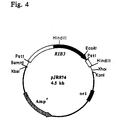
- a 1082 bp region of the PstI-HindIII insert with the open RIB3 reading frame of 639 bp, 314 bp of the 5'-untranslated Region and 129 bp of the 3'-untranslated region sequenced (SEQ ID NO: 5).
- the Ashbya gossypii RIB4 gene which codes for the DMRL synthase, was found on a 3.2 kb PstI-PstI fragment that cloned in pBluescript KS (-) gave the plasmid PJR762 (Fig. 5).
- a 996 bp region of the PstI-PstI insert with the open RIB4 reading frame of 519 bp, 270 bp of the 5'-untranslated) Region and 207 bp of the 3 'untranslated region were sequenced (SEQ ID NO: 7).
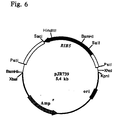
- a 1511 bp region of the PstI-PstI insertion with the open RIB5 reading frame of 708 bp, 524 bp of the 5'-untranslated Region and 279 bp of the 3 'untranslated region was sequenced (SEQ ID NO: 9).
- Ashbya gossypii RIB7 gene which is responsible for the HTP reductase encoded, on a 4.1 kb EcoRI-EcoRI fragment found that cloned plasmid PJR845 in pBluescript KS (+) resulted (Fig. 7).
- a 1596 bp region of the EcoRI-EcoRI insert with the open RIB7 reading frame of 741 bp, 352 bp of the 5'-untranslated Region and 503 bp of the 3 'untranslated region was sequenced (SEQ ID NO: 11).
- RNA samples of the strain (5 ⁇ g) were electrophoresed separated on 0.8% agarose-formaldehyde gels together with RNA size markers and blotted under vacuum on nylon membrane (Thomas, Proc. Natl. Acad. Sci. USA, 77, 1980, 5201-5205).
- the nylon membranes were independently hybridized with 32 P-labeled RIB-specific DNA samples at 42 ° C in 5xSSC and in the presence of 50% formamide.
- the Ashbya gossypii RIB1 gene is expressed as a unique message of approximately 1150 nucleotides, which was detected in both strains by a 0.7 kbp SmaI-SacI sample from the plasmid pJR765 (FIG. 8).
- nucleotides were RIB2, 900 nucleotides long RIB3, 800 nucleotides long RIB4, 1050 nucleotides long RIB5 and 1000 nucleotide long RIB7 transcripts in the blots Using a 0.5 kbp SmaI-SmaI fragment from pJR758, one 0.6 kbp HindIII-KpnI fragment from pJR790, a 0.5 kbp long ScaI-HindIII fragment from pJR739 and a 0.3 kbp long PstI-PstI fragments from pJR845 detected as a specific sample.
- mutants can be well studied of Saccharomyces cerevisiae, which is in a stage of riboflavin biosynthesis are defective, grow on culture media without riboflavin, if they carry a plasmid that is complementary Enzymes encoded by Ashbya.
- Ashbya gossypii RIB gene products were used to test flavin-forming enzyme activities measured in cell-free extracts of S. cerevisiae mutants which one of the expression plasmids pJR715, pJR669, pJR788, pJR733, pJR681 and pJR827 wore.
- pYEura3-derived plasmids described in Example 1 contain Ashbya gossypii RIB-specific cDNA fragments under the control of the galactose inducible GAL10 promoter.
- Cell-free protein extracts from S. cerevisiae were obtained from cultures obtained in liquid medium up to an optical density of about 2 OD had grown.
- the cells were harvested with cold 20 mM Tris HCl, pH 7.5 washed and in the same buffer containing 1 mM phenylethylsulfonyl fluoride was supplemented, resuspended.
- GTP cyclohydrolase II, DRAP deaminase, DBP synthase, DMRL synthase, Riboflavin synthase and HTP reductase enzyme activities were determined as described in the literature (Shavlovsky et al, Arch. Microbiol. 124 1980, 255-259; Richter et al., J. Baceriol. 175, 1993, 4045-4051; Klein and Bacher, Z. Naturforsch. 35b, 1980, 482-484; Richter et al. J. Bacteriol. 174, 1992, 4050-4056; Nielsen et al. J. Biol. Chem. 261, 1986, 3661; Plaut and Harvey, Methods Enzymol.
- Protein was quantified using the Peterson method (Anal. Biochem. 83, 1977, 346-356). As can be seen from Table 1, causes , the plasmid pJR715 the expression of GTP cyclohydrolase II Activity in the S. cerevisiae mutant AJ88. Furthermore, this is Activity only present in cells grown on galactose medium , indicating that the RIB1 cDNA expression from Ashbya gossypii under the control of the galactose-inducible GAL10 promoter takes place.
- RIB1 codes for GTP cyclohydrolase II in Ashbya gossypii.
- RIB2 codes for DRAP deaminase
- RIB3 for DBP synthase
- RIB4 for DMRL synthase
- RIB5 for riboflavin synthase
- RIB7 for HTP reductase in this fungus.
- tribe plasmid GTP cyclohydrolase II U / mg protein glucose galactose X 2180-1A - 0.48 0.34 AJ 88 - nd AJ 88 pIR715 21.60 DRAP deaminase activity of the S. cerevisiae RIB2 mutant AJ115 and its transformants.
- tribe plasmid DRAP deaminase U / mg protein glucose galactose X 2180-1A - 0.45 0.38 AJ 115 - nd AJ 115 pIR669 53.22 DBP synthase activity of the S. cerevisiae RIB3 mutant AJ71 and its transformants.
- tribe plasmid DBP synthase U / mg protein glucose galactose X 2180-1A - 0.80 0.75 AJ 71 - nd AJ 71 pIR788 25.19 GTP-Cyclohydrolase II activity of the S. cerevisiae RIB4 mutant AJ106 and its transformants. tribe plasmid DMRL synthase U / mg protein ) glucose galactose X 2180-1A - 2.04 1.73 AJ 106 - nd AJ 106 pIR733 86.54 Riboflavin synthase activity of the S. cerevisiae RIB5 mutant AJ66 and its transformants.
- tribe plasmid Riboflavin synthase U / mg protein glucose galactose X 2180-1A - 4.41 3.80 AJ 66 - nd AJ 66 pIR681 164.20 HTP reductase activity of the S. cerevisiae RIB7 mutant AJ121 and its transformants. tribe plasmid HTP reductase U / mg protein ) glucose galactose X 2180-1A - 1.86 2.54 AJ 121 - nd AJ 121 pIR827 46.21
Landscapes
- Health & Medical Sciences (AREA)
- Genetics & Genomics (AREA)
- Life Sciences & Earth Sciences (AREA)
- Engineering & Computer Science (AREA)
- Organic Chemistry (AREA)
- Chemical & Material Sciences (AREA)
- Zoology (AREA)
- Wood Science & Technology (AREA)
- Biomedical Technology (AREA)
- Biotechnology (AREA)
- General Engineering & Computer Science (AREA)
- Bioinformatics & Cheminformatics (AREA)
- Microbiology (AREA)
- Biochemistry (AREA)
- General Health & Medical Sciences (AREA)
- Molecular Biology (AREA)
- Plant Pathology (AREA)
- Biophysics (AREA)
- Physics & Mathematics (AREA)
- Mycology (AREA)
- Chemical Kinetics & Catalysis (AREA)
- General Chemical & Material Sciences (AREA)
- Micro-Organisms Or Cultivation Processes Thereof (AREA)
- Preparation Of Compounds By Using Micro-Organisms (AREA)
- Enzymes And Modification Thereof (AREA)
- Measuring Or Testing Involving Enzymes Or Micro-Organisms (AREA)
Claims (9)
- Séquences d'ADN, qui codent pour un polypeptide ayant la séquence d'acides aminés représentée dans SEQ ID NO: 2 (GTP-cyclohydrolase II) ou pour un analogue ou dérivé du polypeptide selon SEQ ID NO: 2, tandis qu'un ou plusieurs acides aminés ont été délétés, ajoutés ou substitués par d'autres acides aminés, sans réduire substantiellement l'activité enzymatique du polypeptide, avec pour condition que les séquences d'ADN sont homologues de SEQ ID NO: 1 pour au moins 80 % pour l'analogue ou le dérivé du polypeptide.
- Séquences d'ADN, qui codent pour un polypeptide ayant la séquence d'acides aminés représentée dans SEQ ID NO: 4 (DRAP-déaminase) ou pour un analogue ou dérivé du polypeptide selon SEQ ID NO: 4, tandis qu'un ou plusieurs acides aminés ont été délétés, ajoutés ou substitués par d'autres acides aminés, sans réduire substantiellement l'activité enzymatique du polypeptide, avec pour condition que les séquences d'ADN sont homologues de SEQ ID NO: 3 pour au moins 80 % pour l'analogue ou le dérivé du polypeptide.'
- Séquences d'ADN, qui codent pour un polypeptide ayant la séquence d'acides aminés représentée dans SEQ ID NO: 6 (DBP-synthase) ou pour un analogue ou dérivé du polypeptide selon SEQ ID NO: 6, tandis qu'un ou plusieurs acides aminés ont été délétés, ajoutés ou substitués par d'autres acides aminés, sans réduire substantiellement l'activité enzymatique du polypeptide, avec pour condition que les séquences d'ADN sont homologues de SEQ ID NO: 5 pour au moins 80 % pour l'analogue ou le dérivé du polypeptide.
- Séquences d'ADN, qui codent pour un polypeptide ayant la séquence d'acides aminés représentée dans SEQ ID NO: 8 (DMRL-synthase) ou pour un analogue ou dérivé du polypeptide selon SEQ ID NO: 8, tandis qu'un ou plusieurs acides aminés ont été délétés, ajoutés ou substitués par d'autres acides aminés, sans réduire substantiellement l'activité enzymatique du polypeptide, avec pour condition que les séquences d'ADN sont homologues de SEQ ID NO: 7 pour au moins 80 % pour l'analogue ou le dérivé du polypeptide.
- Séquences d'ADN, qui codent pour un polypeptide ayant la séquence d'acides aminés représentée dans SEQ ID NO: 10 (riboflavine-synthase) ou pour un analogue ou dérivé du polypeptide selon SEQ ID NO: 10, tandis qu'un ou plusieurs acides aminés ont été délétés, ajoutés ou substitués par d'autres acides aminés, sans réduire substantiellement l'activité enzymatique du polypeptide, avec pour condition que les séquences d'ADN sont homologues de SEQ ID NO: 9 pour au moins 80 % pour l'analogue ou le dérivé du polypeptide.
- Séquences d'ADN, qui codent pour un polypeptide ayant la séquence d'acides aminés représentée dans SEQ ID NO: 12 (HTP-réductase) ou pour un analogue ou dérivé du polypeptide selon SEQ ID NO: 12, tandis qu'un ou plusieurs acides aminés ont été délétés, ajoutés ou substitués par d'autres acides aminés, sans réduire substantiellement l'activité enzymatique du polypeptide, avec pour condition que les séquences d'ADN sont homologues de SEQ ID NO: 11 pour au moins 80 % pour l'analogue ou le dérivé du polypeptide.
- Vecteur d'expression, contenant une ou plusieurs séquences d'ADN selon la revendication 1 à 6.
- Organisme hôte non-humain qui a été transformé avec un système d'expression selon la revendication 7.
- Procédé pour la préparation de riboflavine par recombinaison, caractérisé par le fait qu'on utilise un organisme hôte selon la revendication 8.
Applications Claiming Priority (5)
| Application Number | Priority Date | Filing Date | Title |
|---|---|---|---|
| DE4410382 | 1994-03-25 | ||
| DE4410382 | 1994-03-25 | ||
| DE4420785A DE4420785A1 (de) | 1994-03-25 | 1994-06-15 | Riboflavin-Biosynthese in Pilzen |
| DE4420785 | 1994-06-15 | ||
| PCT/EP1995/000958 WO1995026406A2 (fr) | 1994-03-25 | 1995-03-15 | Biosynthese de la riboflavine dans des champignons |
Publications (2)
| Publication Number | Publication Date |
|---|---|
| EP0751995A1 EP0751995A1 (fr) | 1997-01-08 |
| EP0751995B1 true EP0751995B1 (fr) | 2004-02-18 |
Family
ID=25935071
Family Applications (1)
| Application Number | Title | Priority Date | Filing Date |
|---|---|---|---|
| EP95913119A Expired - Lifetime EP0751995B1 (fr) | 1994-03-25 | 1995-03-15 | Biosynthese de la riboflavine dans des champignons |
Country Status (8)
| Country | Link |
|---|---|
| US (1) | US5821090A (fr) |
| EP (1) | EP0751995B1 (fr) |
| JP (1) | JP3756180B2 (fr) |
| CN (1) | CN1117151C (fr) |
| CA (1) | CA2186403C (fr) |
| DK (1) | DK0751995T3 (fr) |
| ES (1) | ES2216010T3 (fr) |
| WO (1) | WO1995026406A2 (fr) |
Families Citing this family (26)
| Publication number | Priority date | Publication date | Assignee | Title |
|---|---|---|---|---|
| US6350597B1 (en) | 1994-01-13 | 2002-02-26 | E. I. Du Pont De Nemours & Company | Riboflavin synthase genes and enzymes and methods of use |
| KR100414490B1 (ko) * | 1995-07-13 | 2004-04-30 | 바스프 악티엔게젤샤프트 | 이소시트레이트리아제활성이변성된미생물에의한리보플라빈의제조방법 |
| EP0866129A2 (fr) | 1996-12-31 | 1998-09-23 | Novartis AG | Séquences d'ADN génomiques de Ashbya gossypii et leurs utilisations |
| US6323013B1 (en) | 1998-10-28 | 2001-11-27 | E. I. Du Pont De Nemours And Company | Lumazine synthase and riboflavin synthase |
| US6682891B2 (en) | 1997-08-15 | 2004-01-27 | E. I. Du Pont De Nemours And Company | Methods of identifying nucleic acid sequences encoding plant riboflavin synthase enzymes |
| US6146866A (en) * | 1997-08-15 | 2000-11-14 | E.I. Du Pont De Nemours And Company | Lumazine synthase and riboflavin synthase |
| DE19840709A1 (de) * | 1997-12-22 | 1999-06-24 | Forschungszentrum Juelich Gmbh | Ein- oder mehrzellige Organismen zur Herstellung von Riboflavin |
| EP0927761A3 (fr) * | 1997-12-23 | 2001-09-05 | Basf Aktiengesellschaft | Gènes de la synthèse de purine et utilisation pour la production microbienne de riboflavine |
| DE19801120A1 (de) | 1998-01-15 | 1999-07-22 | Basf Ag | Orotidin-5'-Phosphatdecarboxylase-Gen, Genkonstrukt enthaltend dieses Gen und seine Verwendung |
| ID23301A (id) * | 1998-04-23 | 2000-04-05 | Hoffmann La Roche | Produksi yang berlebihan dari riboflavin di dalam ragi |
| US6074830A (en) * | 1998-06-09 | 2000-06-13 | E. I. Du Pont De Nemours & Company | 3,4-dihydroxy-2-butanone 4-phosphate synthase |
| US6291660B1 (en) | 1998-10-08 | 2001-09-18 | Syngenta Participations Ag | Fungal genes required for normal growth and development |
| US7009045B2 (en) * | 2000-07-14 | 2006-03-07 | Archer-Daniels-Midland Company | Transformation systems for flavinogenic yeast |
| AU2002327839A1 (en) * | 2001-08-22 | 2003-03-10 | Basf Aktiengesellschaft | Novel genetic products from ashbya gossypii, associated with the structure of the cell wall or the cytoskeleton |
| JP2005506065A (ja) * | 2001-08-29 | 2005-03-03 | ビーエーエスエフ アクチェンゲゼルシャフト | 転写機構、RNAプロセシングおよび/または翻訳に関連したアッシビヤ・ゴシッピー(Ashbyagossypii)由来の新規遺伝子産物 |
| DE10159396A1 (de) * | 2001-12-04 | 2003-06-12 | Basf Ag | Genetische Stammoptimierung zur verbesserten Herstellung von Riboflavin |
| DE10209363A1 (de) * | 2002-03-02 | 2003-09-11 | Basf Ag | Verfahren zur Herstellung von Riboflavin |
| EP1537233B1 (fr) * | 2002-09-06 | 2007-06-06 | Basf Aktiengesellschaft | Gtp cyclohydrolase ii servant de cible pour des fongicides |
| KR100422307B1 (ko) | 2002-12-05 | 2004-03-10 | 씨제이 주식회사 | 리보플라빈을 생산하는 미생물 및 이를 이용한리보플라빈의 생산방법 |
| KR100422305B1 (ko) | 2002-12-05 | 2004-03-10 | 씨제이 주식회사 | 리보플라빈을 생산하는 미생물 및 이를 이용한리보플라빈의 생산방법 |
| BRPI0513061B8 (pt) * | 2004-07-07 | 2021-05-25 | Dsm Ip Assests Bv | gtp ciclohidrolase ii modificada selecionada de bacillus, polinucleotídeo, célula hospedeira, processo para a produção de riboflavina, um precursor de riboflavina, fmn, fad ou um derivado destes e uso de uma gtp ciclohidrolase ii modificada ou de um polinucleotídeo |
| US8968093B2 (en) | 2004-07-15 | 2015-03-03 | Intel Corporation | Dynamic insertion of personalized content in online game scenes |
| KR101335853B1 (ko) | 2011-12-01 | 2013-12-02 | 씨제이제일제당 (주) | L-아미노산 및 리보플라빈을 동시에 생산하는 미생물 및 이를 이용한 l-아미노산 및 리보플라빈을 생산하는 방법 |
| KR102561863B1 (ko) * | 2014-11-19 | 2023-08-01 | 바스프 에스이 | Imp 데히드로게나아제 활성을 증가시키기 위한 에레모테시움의 유전적 변형 |
| CN114592000B (zh) * | 2020-12-03 | 2023-07-21 | 上海市农业科学院 | 一种六基因组合在水稻种子中提高vb2含量的应用及方法 |
| CN120173760B (zh) * | 2025-05-20 | 2025-08-05 | 云南省林业和草原科学院 | 一种高产苔色酸工程菌yafwy001的制备及培养方法 |
Family Cites Families (3)
| Publication number | Priority date | Publication date | Assignee | Title |
|---|---|---|---|---|
| CN1066486C (zh) * | 1989-06-22 | 2001-05-30 | 霍夫曼-拉罗奇有限公司 | 高产核黄素的细菌菌株 |
| DK0569806T3 (da) * | 1992-05-11 | 2001-12-31 | Basf Ag | DNA-forbindelser og rekombinante DNA-ekspressionsvektorer, der koder for riboflavinsyntetaseaktivitet af S. cerevisiae |
| DE4238904A1 (de) * | 1992-11-19 | 1994-05-26 | Basf Ag | Riboflavin-Synthese in Hefen |
-
1995
- 1995-03-15 US US08/716,301 patent/US5821090A/en not_active Expired - Lifetime
- 1995-03-15 DK DK95913119T patent/DK0751995T3/da active
- 1995-03-15 CA CA002186403A patent/CA2186403C/fr not_active Expired - Lifetime
- 1995-03-15 JP JP52493295A patent/JP3756180B2/ja not_active Expired - Fee Related
- 1995-03-15 ES ES95913119T patent/ES2216010T3/es not_active Expired - Lifetime
- 1995-03-15 CN CN95192767A patent/CN1117151C/zh not_active Expired - Lifetime
- 1995-03-15 EP EP95913119A patent/EP0751995B1/fr not_active Expired - Lifetime
- 1995-03-15 WO PCT/EP1995/000958 patent/WO1995026406A2/fr not_active Ceased
Also Published As
| Publication number | Publication date |
|---|---|
| WO1995026406A2 (fr) | 1995-10-05 |
| EP0751995A1 (fr) | 1997-01-08 |
| CA2186403A1 (fr) | 1995-10-05 |
| WO1995026406A3 (fr) | 2001-12-20 |
| ES2216010T3 (es) | 2004-10-16 |
| JP3756180B2 (ja) | 2006-03-15 |
| DK0751995T3 (da) | 2004-03-08 |
| CN1117151C (zh) | 2003-08-06 |
| US5821090A (en) | 1998-10-13 |
| CA2186403C (fr) | 2006-01-24 |
| JPH09510618A (ja) | 1997-10-28 |
| CN1146781A (zh) | 1997-04-02 |
Similar Documents
| Publication | Publication Date | Title |
|---|---|---|
| EP0751995B1 (fr) | Biosynthese de la riboflavine dans des champignons | |
| DE69333112T2 (de) | Modifizierte pilzzellen und methode zur herstelllung rekombinanter produkte | |
| DE3888381T2 (de) | Hefevektor. | |
| DE69227116T2 (de) | Hochstabile rekombinante hefen für die herstellung von rekombinanten proteinen | |
| DE69326559T2 (de) | Rekombinante methode und wirt zur herstellung von xylitol | |
| DE68924745T2 (de) | Methode zur Erhöhung der Produktion von sekundären Metaboliten mittels geclusterter biosynthetischer Gene. | |
| DE69923628T2 (de) | 3,4-Dihydroxy-2-butanone 4-Phosphate Synthase | |
| EP0668917B1 (fr) | Synthese de riboflavine dans des levures | |
| DE69333249T2 (de) | Neue Schimmel-Protease | |
| DE3751100T2 (de) | Erhöhte Produktion von Proteinen in Bakterien durch Verwendung einer neuen Ribosombindungsstelle. | |
| EP0839211B1 (fr) | Procede de production de riboflavine au moyen de micro-organismes a activite d'isocitratlyase modifiee | |
| DE4420785A1 (de) | Riboflavin-Biosynthese in Pilzen | |
| DE19713572A1 (de) | Verfahren zum Screening von antimykotisch wirkenden Substanzen | |
| DE69432699T2 (de) | Pilze Widerstandsfähig gegenüber Soraphen A | |
| DE69329540T2 (de) | Verfahren zur Herstellung von Proteaseinhibitoren | |
| DE69920470T2 (de) | Neuartiges gen und transformant, welcher dieses beinhaltet | |
| EP0285949B1 (fr) | Unité d'expression génétique, et système de clonage et d'expression | |
| DE10333144B4 (de) | Verfahren zur biotechnologischen Herstellung von Citronensäure mit einer genetisch veränderten Hefe Yarrowia lipolytica | |
| EP0930367B1 (fr) | Champignons du genre Ashbya pour la préparation de riboflavine | |
| DE19919124A1 (de) | Nukleinsäuremolekül, umfassend eine für ein Polypeptid mit Chorismatmutase-Aktivität kodierende Nukleinsäure | |
| EP0569806B1 (fr) | Composés ADN et vecteurs d'expression contenant ADN recombinant codant pour l'activité de riboflavine synthétase | |
| DE69122940T2 (de) | Von E-coli abgeleitete stromaufwärts gelegene, in Hefe wirksame, regulatorische Sequenzen | |
| DE60032162T2 (de) | Regulatorische sequenzen von funktioneller bedeutung in filamentösen pilzen | |
| EP1918379B1 (fr) | Vecteurs d'expression pour l'intégration multiple de gène et l'expression des protéines homologues et hétérologues en levures de l'espèce Arxula | |
| WO2000023604A1 (fr) | Vecteurs d'expression renfermant des sequences regulatrices de stylonychia lemnae pour l'expression de proteine heterologue dans des protistes eucariotiques, et procede d'identification de telles sequences regulatrices |
Legal Events
| Date | Code | Title | Description |
|---|---|---|---|
| PUAI | Public reference made under article 153(3) epc to a published international application that has entered the european phase |
Free format text: ORIGINAL CODE: 0009012 |
|
| AK | Designated contracting states |
Kind code of ref document: A1 Designated state(s): BE CH DE DK ES FR GB IT LI NL |
|
| 17P | Request for examination filed |
Effective date: 19961008 |
|
| RBV | Designated contracting states (corrected) |
Designated state(s): BE CH DE DK ES FR GB IT LI NL |
|
| D17D | Deferred search report published (deleted) | ||
| 17Q | First examination report despatched |
Effective date: 20020926 |
|
| GRAP | Despatch of communication of intention to grant a patent |
Free format text: ORIGINAL CODE: EPIDOSNIGR1 |
|
| GRAS | Grant fee paid |
Free format text: ORIGINAL CODE: EPIDOSNIGR3 |
|
| GRAA | (expected) grant |
Free format text: ORIGINAL CODE: 0009210 |
|
| AK | Designated contracting states |
Kind code of ref document: B1 Designated state(s): BE CH DE DK ES FR GB IT LI NL |
|
| REG | Reference to a national code |
Ref country code: GB Ref legal event code: FG4D Free format text: NOT ENGLISH |
|
| REG | Reference to a national code |
Ref country code: CH Ref legal event code: EP |
|
| REG | Reference to a national code |
Ref country code: DK Ref legal event code: T3 |
|
| REF | Corresponds to: |
Ref document number: 59510863 Country of ref document: DE Date of ref document: 20040325 Kind code of ref document: P |
|
| GBT | Gb: translation of ep patent filed (gb section 77(6)(a)/1977) |
Effective date: 20040317 |
|
| REG | Reference to a national code |
Ref country code: ES Ref legal event code: FG2A Ref document number: 2216010 Country of ref document: ES Kind code of ref document: T3 |
|
| ET | Fr: translation filed | ||
| PLBE | No opposition filed within time limit |
Free format text: ORIGINAL CODE: 0009261 |
|
| STAA | Information on the status of an ep patent application or granted ep patent |
Free format text: STATUS: NO OPPOSITION FILED WITHIN TIME LIMIT |
|
| 26N | No opposition filed |
Effective date: 20041119 |
|
| PGFP | Annual fee paid to national office [announced via postgrant information from national office to epo] |
Ref country code: DK Payment date: 20140327 Year of fee payment: 20 Ref country code: CH Payment date: 20140326 Year of fee payment: 20 Ref country code: NL Payment date: 20140324 Year of fee payment: 20 |
|
| PGFP | Annual fee paid to national office [announced via postgrant information from national office to epo] |
Ref country code: IT Payment date: 20140325 Year of fee payment: 20 |
|
| PGFP | Annual fee paid to national office [announced via postgrant information from national office to epo] |
Ref country code: GB Payment date: 20140331 Year of fee payment: 20 |
|
| PGFP | Annual fee paid to national office [announced via postgrant information from national office to epo] |
Ref country code: DE Payment date: 20140530 Year of fee payment: 20 Ref country code: FR Payment date: 20140328 Year of fee payment: 20 Ref country code: ES Payment date: 20140423 Year of fee payment: 20 |
|
| PGFP | Annual fee paid to national office [announced via postgrant information from national office to epo] |
Ref country code: BE Payment date: 20140429 Year of fee payment: 20 |
|
| REG | Reference to a national code |
Ref country code: DE Ref legal event code: R071 Ref document number: 59510863 Country of ref document: DE Ref country code: DK Ref legal event code: EUP Effective date: 20150315 |
|
| REG | Reference to a national code |
Ref country code: NL Ref legal event code: V4 Effective date: 20150315 |
|
| REG | Reference to a national code |
Ref country code: CH Ref legal event code: PL |
|
| REG | Reference to a national code |
Ref country code: GB Ref legal event code: PE20 Expiry date: 20150314 |
|
| PG25 | Lapsed in a contracting state [announced via postgrant information from national office to epo] |
Ref country code: GB Free format text: LAPSE BECAUSE OF EXPIRATION OF PROTECTION Effective date: 20150314 |
|
| REG | Reference to a national code |
Ref country code: ES Ref legal event code: FD2A Effective date: 20150826 |
|
| PG25 | Lapsed in a contracting state [announced via postgrant information from national office to epo] |
Ref country code: ES Free format text: LAPSE BECAUSE OF EXPIRATION OF PROTECTION Effective date: 20150316 |