EP0932325A2 - Vorrichtung und Verfahren zur Schallbildlocalisierung - Google Patents
Vorrichtung und Verfahren zur Schallbildlocalisierung Download PDFInfo
- Publication number
- EP0932325A2 EP0932325A2 EP99300468A EP99300468A EP0932325A2 EP 0932325 A2 EP0932325 A2 EP 0932325A2 EP 99300468 A EP99300468 A EP 99300468A EP 99300468 A EP99300468 A EP 99300468A EP 0932325 A2 EP0932325 A2 EP 0932325A2
- Authority
- EP
- European Patent Office
- Prior art keywords
- signal
- sound image
- listener
- coefficient
- audio signal
- Prior art date
- Legal status (The legal status is an assumption and is not a legal conclusion. Google has not performed a legal analysis and makes no representation as to the accuracy of the status listed.)
- Granted
Links
- 238000000034 method Methods 0.000 title claims description 40
- 230000004807 localization Effects 0.000 claims abstract description 54
- 230000005236 sound signal Effects 0.000 claims description 66
- 238000012545 processing Methods 0.000 claims description 20
- 230000003247 decreasing effect Effects 0.000 claims description 18
- 230000000694 effects Effects 0.000 claims description 11
- 230000010354 integration Effects 0.000 claims description 7
- 238000004519 manufacturing process Methods 0.000 claims description 5
- 238000001228 spectrum Methods 0.000 claims description 4
- 238000001914 filtration Methods 0.000 description 30
- 230000006870 function Effects 0.000 description 25
- 238000012546 transfer Methods 0.000 description 23
- 238000010586 diagram Methods 0.000 description 20
- 239000003990 capacitor Substances 0.000 description 15
- 101000931660 Malus baccata var. xiaojinensis Ferritin, chloroplastic Proteins 0.000 description 14
- 101150092692 apf2 gene Proteins 0.000 description 14
- 230000007306 turnover Effects 0.000 description 8
- 101710170230 Antimicrobial peptide 1 Proteins 0.000 description 4
- 101710170231 Antimicrobial peptide 2 Proteins 0.000 description 4
- 230000007423 decrease Effects 0.000 description 4
- 230000003111 delayed effect Effects 0.000 description 3
- 239000011159 matrix material Substances 0.000 description 3
- 238000005070 sampling Methods 0.000 description 3
- 101100184148 Xenopus laevis mix-a gene Proteins 0.000 description 2
- 101100345673 Xenopus laevis mix-b gene Proteins 0.000 description 2
- 230000003321 amplification Effects 0.000 description 2
- 210000005069 ears Anatomy 0.000 description 2
- 238000003199 nucleic acid amplification method Methods 0.000 description 2
- 101100381996 Saccharomyces cerevisiae (strain ATCC 204508 / S288c) BRO1 gene Proteins 0.000 description 1
- 238000007796 conventional method Methods 0.000 description 1
- 230000001934 delay Effects 0.000 description 1
- 238000004880 explosion Methods 0.000 description 1
- 230000005669 field effect Effects 0.000 description 1
- 230000003924 mental process Effects 0.000 description 1
- 238000012986 modification Methods 0.000 description 1
- 230000004048 modification Effects 0.000 description 1
- 230000003068 static effect Effects 0.000 description 1
- 230000000007 visual effect Effects 0.000 description 1
Images





Classifications
-
- H—ELECTRICITY
- H04—ELECTRIC COMMUNICATION TECHNIQUE
- H04S—STEREOPHONIC SYSTEMS
- H04S1/00—Two-channel systems
- H04S1/007—Two-channel systems in which the audio signals are in digital form
Definitions
- the present invention relates to an apparatus and a method for localizing sound image.
- a home television (TV) set capable of performing a stereophonic audio reproduction includes a pair of speakers (i.e., a left speaker and a right speaker).
- a TV set has a limited width for installing the speakers therein, it is not possible to enjoy stereophonic audio reproduction at satisfactory level.
- a TV set employs a "surround system", it is often difficult to provide surround speakers.
- audio signals are subjected to a localization treatment of sound image (e.g., by using a head-related transfer function (HRTF)) and the treated signals are supplied to the speakers, so as to localize sound image (i.e., virtual speakers) at positions where speakers are not actually arranged.
- HRTF head-related transfer function
- the virtual speakers make a listener to feel that the distance between the actually arranged speakers is widen, or to feel that the listener hears reproduced sound from sideward or rearward of the listener although only two frontal speakers are actually arranged in front of the listener.
- the technique includes producing (i) a first processed signal for localizing sound image at a first localization position located away at an angle ⁇ 1 in a circumferential direction from the front of the listener wherein ⁇ 1 ⁇ ⁇ , and (ii) a second processed signal for localizing sound image at a second localization position located away at an angle ⁇ 2 in a circumferential direction from the front of the listener wherein ⁇ 2 > ⁇ ; and alternately supplying the first and the second processed signals to the speakers, so as to alternately localize sound image at the first and the second localization position for making the listener to recognize sound image at the predetermined position.
- An apparatus wherein a pair of speakers are arranged at positions left and right front sides of a listener and wherein a single audio signal is divided into two branched signals to be supplied to the respective speakers, is capable of moving sound image in a left or right direction between the speakers.
- the sound image movement is accomplished by, for example, continuously increasing an amplitude (a level) of one of the branched signals as well as continuously decreasing an amplitude of another branched signal.
- the below-indicated technique has been proposed.
- a listener 214 feels that sound image 213 is located at the position 220 rearwards of the middle between the speakers 211 and 212; when the phase difference between the branched signals is 90 degrees (i.e., the correlation is zero), a listener 214 feels that sound image 213 is widen in an area 221 between the speakers 211 and 212; when the phase difference between the branched signals is 180 degrees (i.e., the correlation is -1 ), a listener 214 feels that sound image 213 is located at an area 222 rearwards to the listener 214 .
- the technique includes moving sound image 213 forward and backward with respect to the listener by varying the phase difference between the branched signals (i.e., by using a relationship shown in Figure 26 ).
- the present invention includes the steps of providing a left speaker and a right speaker in front of a listener; subjecting an audio signal to a sound image localization treatment, so as to produce a processed signal; and supplying the processed signal to the left and the right speakers, so as to localize sound image at a predetermined position.
- the method further includes: producing a first processed signal which localizes sound image at a first localization position and a second processed signal which localizes sound image at a second localization position; multiplying one of the first and the second processed signals by a coefficient k which varies in the range of 0 to 1; multiplying the other signal by a coefficient 1-k; and adding the processed signal multiplied by the coefficient k and the processed signal multiplied by the coefficient 1-k.
- the first localization position is in the vicinity of the predetermined position and located away at an angle ⁇ 1 in a circumferential direction from the front of the listener wherein ⁇ 1 ⁇ ⁇
- the second localization position is in the vicinity of the predetermined position and located away at an angle ⁇ 2 in a circumferential direction from the front of the listener wherein ⁇ 2 > ⁇ .
- a spectrum of the coefficient k has 1/f characteristics.
- a production of the coefficient k includes outputting a random signal having rectangular pulse shape, height of 1, and random pulse width and pitch, and integrating the random signal in an integration circuit.
- a production of the coefficient k includes squaring the audio signal by a squaring circuit, and processing the squared signal through a low pass filter.
- the audio signal is a 2-channel stereophonic signal
- a signal for producing the coefficient is selected from a signal of one of the channels, an added signal of the both channel, or a differential signal of the both channel.
- an apparatus for localizing sound image includes: a left and a right speakers to be provided in front of a listener; a means for subjecting an audio signal to a sound image localization treatment so as to produce a processed signal; and a means for supplying the processed signal to the left and the right speakers so as to localize sound image at a predetermined position.
- the apparatus further includes: a means for producing a first processed signal which localizes sound image at a first localization position; a means for producing a second processed signal which localizes sound image at a second localization position; a means for producing a coefficient k which varies in the range of 0 to 1; a means for multiplying one of the first and the second processed signals by the coefficient k; a means for multiplying the other signal by a coefficient 1-k; and a means for adding the processed signal multiplied by the coefficient k and the processed signal multiplied by the coefficient 1-k and supplying the added signal to the left and the right speakers.
- the first localization position is in the vicinity of the predetermined position and located away at an angle ⁇ 1 in a circumferential direction from the front of the listener wherein ⁇ 1 ⁇ ⁇
- the second localization position is in the vicinity of the predetermined position and located away at an angle ⁇ 2 in a circumferential direction from the front of the listener wherein ⁇ 2 > ⁇ .
- a method for moving sound image includes the steps of: producing a single audio signal; dividing the single audio signal into two branched signals; shifting a frequency component of the audio signal or the branched signals; amplifying an amplitude of the audio signal or the branched signal; varying a phase difference between the branched signals; and supplying the branched signals to a left and a right speakers.
- the combination of the shift of the frequency component, the variation of the amplitude and the variation of the phase difference makes a listener to feel that sound image is moving forward and backward with respect to the listener.
- the combination comprises the steps of: increasing the amplitude of the branched signals; increasing the phase difference between the branched signals from zero degree to 180 degrees; decreasing the amplitude of the branched signals to approximately zero while keeping the phase difference approximately at 180 degrees; and shifting the frequency component of the branched signals to low frequency side.
- the combination comprises the steps of: keeping the phase difference between the branched signals approximately at 180 degrees while keeping the amplitude of the branched signals identical to each other; decreasing the amplitude and the phase difference to approximately zero; and shifting the frequency component of the branched signals to low frequency side.
- an apparatus for moving sound image includes: a source which produces a single audio signal; a means for dividing the single audio signal into two branched signal; a means for shifting a frequency component of the audio signal or the branched signals; a means for amplifying an amplitude of the audio signal or the branched signal; a means for varying a phase difference between the branched signals; and a left and a right speakers to which the branched signals are respectively supplied.
- the combination of the shifting means, the amplifying means and the phase difference varying means makes a listener to feel that sound image is moving forward and backward with respect to the listener.
- the invention described herein makes the possible the advantages of: (1) providing an apparatus for localizing sound image which provides a natural feeling of hearing; and (2) a method for localizing sound image which provides a natural feeling of hearing.
- the phrase "localizing sound image” includes not only forming sound image at prescribed positions but also moving sound image.
- FIG. 1 is a block diagram illustrating an apparatus according to this embodiment.
- the sound image localization apparatus (the virtual speaker treatment apparatus) includes a first and a second input terminals 1 and 2 to which an audio signal is input, a first output terminal 3 connected to a left speaker SPL and a second output terminal 4 connected to a right speaker SPR .
- 2-channel stereophonic signal as an audio signal is exemplarily shown in Figure 1
- an audio signal may also be a monophonic signal.
- Figure 2 shows an arrangement of the speakers SPL and SPR .
- a pair of speakers i.e., a left speaker SPL and a right speaker SPR .
- the sound image localization apparatus makes a listener M to recognize sound image at the predetermined position P .
- the position P is located away at an angle ⁇ in a circumferential direction (i.e., counter-clockwise) from the front F of the listener M
- this embodiment of the present invention includes (1) localizing sound image (a virtual speaker) at a first localization position P1 which is in the vicinity of the predetermined position P and located away at an angle ⁇ 1 in the circumferential direction from the front F of the listener wherein ⁇ 1 ⁇ ⁇ ; and (2) localizing sound image (a virtual speaker) at a second localization position P2 which is in the vicinity of the predetermined position P and located away at an angle ⁇ 2 in the circumferential direction from the front F of the listener wherein ⁇ 2 > ⁇ .
- this embodiment of the present invention when the position P is located away at an angle - ⁇ in another circumferential direction (i.e., clockwise) from the front F of the listener, this embodiment of the present invention includes (1) localizing sound image (a virtual speaker) at a first localization position P1 which is in the vicinity of the predetermined position P and located away at an angle - ⁇ 1 in the circumferential direction from the front F of the listener; and (2) localizing sound image (a virtual speaker) at a second localization position P2 which is in the vicinity of the predetermined position P and located away at an angle - ⁇ 2 in the circumferential direction from the front F of the listener.
- the difference between ⁇ and ⁇ 1 and the difference between ⁇ and ⁇ 2 may be the same or different.
- the difference between ⁇ and ⁇ 1 or between ⁇ and ⁇ 2 may be any suitable amount of angle, and typically, it may be about 30 degrees or less.
- the sound image localization apparatus includes a first signal-processing means (a first virtual speaker treatment means) 11 and a second signal-processing means (a second virtual speaker treatment means) 12 .
- the first and the second means are connected to input terminals 1 and 2 .
- the first signal-processing means 11 is used for localizing sound image at a first localization position P1 and outputs a first L-signal for a left speaker SPL and a first R-signal for a right speaker SPR .
- the second signal-processing means 12 is used for localizing sound image at a second localization position P2 and outputs a second L-signal for a left speaker SPL and a second R-signal for a right speaker SPR .
- the first and the second signal-processing means 11 and 12 are typically signal-processing circuits.
- the means 11 and 12 may be a "lattice type” filter or a "shuffler type” filter.
- the sound image localization apparatus may include a pair of lattice type filters or a pair of shuffler type filters.
- a lattice type filter includes: (i) a first L-filtering portion (a first L-signal-processing portion) F1L , which is connected to a first input terminal 1 and outputs an output signal for a left speaker SPL; (ii) a first R-filtering portion (a first R-signal-processing portion) F1R, which is connected to a first input terminal 1 and outputs an output signal for a right speaker SPR; (iii) a second L-filtering portion (a second L-signal-processing portion) F2L, which is connected to a second input terminal 2 and outputs an output signal for a left speaker SPL; (iv) a second R-filtering portion (a second R-signal-processing portion) F2R, which is connected to a second input terminal 2 and outputs an output signal for a right speaker SPR; (v) an adding means M8 which adds output signals of a first and a second L-filtering portions F1L
- a transfer function of a first L-filtering portion F1L, a first R-filtering portion F1R, a second L-filtering portion F2L and a second R-filtering portion F2R is defined as H 11 , H 12 , H 21 and H 22 , respectively. The details of the transfer function are described below.
- transfer functions H 11 , H 12 , H 21 and H 22 of the first L-filtering portion F1L, the first R-filtering portion F1R, the second L-filtering portion F2L and the second R-filtering portion F2R are obtained by using head-related transfer functions h LL , h LR , h RL , h RR , h L'L , h L'R , h R'L and h R'R .
- h LL is a head-related transfer function from the left speaker SPL to a left ear of the listener M
- h LR is a head-related transfer function from the left speaker SPL to a right ear of the listener M
- h RL is a head-related transfer function from the right speaker SPR to a left ear of the listener M
- h RR is a head-related transfer function from the right speaker SPR to a right ear of the listener M
- h L'L is a head-related transfer function from the virtual left speaker ZL to a left ear of the listener M
- h L'R is a head-related transfer function from the virtual left speaker ZL to a right ear of the listener M
- h R'L is a head-related transfer function from the virtual right speaker ZR to a left ear of the listener M
- h R'R is a head-related transfer function from the virtual right speaker ZR to a right ear of the listener M
- a shuffler type filter includes: a first filtering portion (a first signal-processing portion) F1 ; a second filtering portion (a second signal-processing portion) F2 ; an adding means M1 which adds audio signals input to the first and second terminals 1 and 2 and inputs the added signal to the first filtering portion F1 ; a subtract means M2 which calculates a differential signal of the audio signals input to the first and second terminals 1 and 2 and inputs the differential signal to the second filtering portion F2 ; an adding means M10 which adds output signals of the first and the second filtering portions F1 and F2 so as to produce a first L-processed signal or a second L-processed signal; a subtract means M11 which subtracts output signal of the second filtering portion F2 from that of the first filtering portion F1 so as to produce a first R-processed signal or a second R-processed signal.
- the shuffler type filter is used in the case where the left and the right speakers SPL and SPR and the left and the right sound image (virtual speakers) ZL and ZR are symmetrically arranged with respect to the listener M.
- transfer functions H SUM and H DIF of the first and the second filtering portions F1 and F2 will be described.
- the transfer functions H SUM and H DIF can be obtained by using the above-mentioned head-related transfer functions h LL , h LR , h RL , h RR , h L'L , h L'R , h R'L and h R'R as follows:
- H SUM (h a' +h b' ) / (h a +h b )
- H DIF (h a' -h b' ) / (h a -h b )
- K1L and K1R respectively denotes a first L-coefficient multiplying means and a first R-coefficient multiplying means.
- the first L- and R-coefficient multiplying means K1L and K1R respectively multiplies the first L-processed signal and the first R-processed signal (which signals are from the first signal-processing means 11 ) by a coefficient k.
- the coefficient k arbitrarily varies in the range of 0 to 1.
- K2L and K2R respectively denotes a second L-coefficient multiplying means and a second R-coefficient multiplying means.
- the second L- and R-coefficient multiplying means K2L and K2R respectively multiplies the second L-processed signal and the second R-processed signal (which signals are from the second signal-processing means 12 ) by a coefficient 1-k.
- a spectrum of the coefficient k has 1/f characteristics. Since the 1/f characteristics provides a physiological nature, an unnatural feeling of a listener can he eliminated by using the coefficient having 1/f characteristics. A method for producing the coefficient having 1/f characteristics will be described below.
- the method includes outputting as a random signal an M-sequence signal from a random signal generator (e.g., a digital signal processor) PR.
- the signal is formed to be a pulse having rectangular shape, height of 1, and random width and pitch.
- the M-sequence signal is multiplied by a coefficient a 0 in a scaling portion SC1 so as to reduce a possibility that an output value in the succeeding step exceeds 1, and then, as shown in Figure 6B , integrated with respect to time in an integration circuit SK .
- the integration circuit SK includes: a delay circuit J which delays an input signal by one sampling period; a coefficient multiplying means K4 which multiplies an output of the circuit J by a coefficient b 1 ; an adding means (e.g., mixer) M4 which adds an output of the coefficient multiplying means K4 to the input signal to the integration circuit SK .
- the output signal from the integration circuit SK is supplied to an overflow limiter L having a maximum limit value of 1, so as to produce a coefficient k.
- the scaling portion SC1 and the overflow limiter L can be omitted.
- the method includes supplying an audio signal (2-channel stereophonic signal in Figure 7 ) to a signal-selecting circuit (e.g., an adding and subtracting circuit) SE and selecting a signal for producing a coefficient from a signal of one of the channels, an added signal of the both channel, or a differential signal of the both channel. Then, the selected signal (shown in Figure 8A ) is squared by a squaring circuit SQ as shown in Figure 8B.
- a signal-selecting circuit e.g., an adding and subtracting circuit
- the squared signal is multiplied by an appropriate coefficient in a scaling portion SC2 so as to reduce a possibility that an output value in the succeeding step exceeds 1. Then, an output signal from the scaling portion SC2 is processed through a low pass filter LPF having a cut-off frequency of about 10 Hz so as to produce a coefficient k ( Figure 8C ).
- M6 and M7 respectively denotes an adding means (e.g., a mixer).
- the adding means M6 adds the first L-processed signal and the second L-processed signal both of which have been multiplied by the coefficient, and supplies the added signal to the left speaker SPL.
- the adding means M7 adds the first R-processed signal and the second R-processed signal both of which have been multiplied by the coefficient, and supplies the added signal to the right speaker SPR.
- this embodiment of the present invention includes producing, by the first signal-processing means 11, the first L-processed signal and the first R-processed signal for localizing sound image at the first localization position P1 which is in the vicinity of the predetermined position P and located away at an angle ⁇ 1 (e.g., 90 degrees) counter-clockwise from the front F of the listener; and producing, by the second signal-processing means 12, the second L-processed signal and the second R-processed signal for localizing sound image at the second localization position P2 which is in the vicinity of the predetermined position P and located away at an angle ⁇ 2 (e.g., 150 degrees) counter-clockwise from the front F of the listener.
- ⁇ 1 e.g. 90 degrees
- the first L-processed signal and the first R-processed signal are multiplied by a coefficient k (which arbitrarily varies in the range of 0 to 1), and simultaneously the second L-processed signal and the second R-processed signal are multiplied by a coefficient 1-k.
- the multiplied first L-processed signal and the multiplied second L-processed signal are added by the adding means M6 so as to be supplied to the left speaker SPL, and simultaneously the multiplied first R-processed signal and the multiplied second R-processed signal are added by the adding means M7 so as to be supplied to the right speaker SPR.
- the first and the second L-processed signals added in a random ratio are supplied to the left speaker SPL
- the first and the second R-processed signals added in a random ratio are supplied to the right speaker SPR
- the speakers SPL and SPR output a sound wave.
- sound image is localized at a first and a second localization positions P1 and P2.
- a sound volume from the first and the second localization positions P1 and P2 is arbitrarily varied.
- an apparatus and a method for localizing sound image which make a listener to clearly recognize that sound image is at the predetermined position and provide a listener with a natural feeling, can be obtained.
- FIG 10 is a block diagram illustrating an apparatus according to this embodiment.
- the sound image localization apparatus includes: an audio signal source 101 (which also functions as a shifting means); an amplitude control means 102 (also referred to as an audio signal level control portion or a sound pressure control portion) connected to the audio signal source 101; a phase difference control means 103 (also referred to as a phase difference generating portion) connected to the amplitude control means 102; a controller (e.g., microcomputer) 104 which controls the respective means 101 to 103; a left and a right speakers SPL and SPR both of which are connected to the phase difference control means 103.
- the speakers SPL and SPR are arranged in front of a listener (an audience in the case where a picture is accompanied).
- the shifting means 101 produces a single audio signal and also shifts a frequency component (frequency band) of the audio signal by using the controller 104.
- the amplitude control means 102 increases and decreases an amplitude of the audio signal by using the controller 104.
- the phase difference control means 103 divides the audio signal into two branched signals, and increases and decreases a phase difference between the branched signals by using the controller 104.
- this type of apparatus includes a voltage control oscillator VCO as the shifting means.
- Control voltage V1 is applied to the voltage control oscillator VCO.
- a frequency component of the audio signal S1 oscillated from the oscillator VCO is shifted by varying the voltage V1 using the controller 104.
- a single oscillator is exemplified in Figure 11, plural oscillators may be employed (in such a case, output of the respective oscillators is added to produce a single audio signal S1 ).
- a voltage control amplifier VCA is used as the amplitude control means 102.
- the amplifier VCA amplifies the audio signal S1 from the oscillator VCO so as to output the branched signals S2.
- Control voltage V2 is applied to the amplifier VCA.
- the voltage V2 is varied by the controller 104 so as to vary an amplification of the amplifier, as a result, an amplitude of the branched signals S2 is varied.
- a first and a second all pass filters APF1 and APF2 are used as the phase difference control means 103.
- the branched signals S2 are supplied to the filters APF1 and APF2 so as to output branched signals S3 and S4, respectively.
- Control voltage or current applied to the filters APF1 and APF2 is varied by the controller 104, thereby a turnover frequency of at least one of the filters APF1 and APF2 is changed (delayed) continuously or stepwise (at an appropriate step).
- a phase of at least one of the branched signals S3 and S4 is varied so as to vary the phase difference (relative phase difference) of the branched signals S3 and S4 in the range of about 0 degree to about 180 degrees.
- phase of the branched signals S3 and S4 and the phase difference therebetween will be described with reference to Figures 12 and 13.
- f1 and f2 for the respective turnover frequency of the filters APF1 and APF2 and if f1>f2
- the phase of the branched signal S4 is delayed to that of the branched signal S3 ( Figure 12 ).
- the phase difference ⁇ between the branched signals S3 and S4 is small in a high and a low frequency regions and large in a middle frequency region which is a frequency band for reproduction.
- the maximum delay amount of the respective branched signals S3 and S4 depends on the order n of the filters APF1 and APF2.
- the order of the all pass filters is usually set to be second.
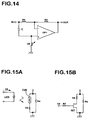
- Examples of the all pass filter wherein the turnover frequency is controlled by the applied voltage or current includes the following:
- the all pass filter includes resistance R1 and R2, capacitor C , variable resistance VR, and operating amplifier OP1.
- the resistance R1 and the capacitor C are connected to the voltage control amplifier VCA.
- the resistance R1 is connected to a negative input terminal of the operating amplifier OP1
- the capacitor C is connected to a positive input terminal of the operating amplifier OP1.
- the grounded variable resistance VR is connected to the middle point of the connection between the operating amplifier OP1 and the capacitor C .
- An output terminal of the operating amplifier OP1 is connected via a resistance R2 to the middle point of the connection between the resistance R1 and the operating amplifier OP1.
- variable resistance VR examples of the variable resistance VR are shown in Figures 15A and 15B.
- the variable resistance shown in Figure 15A includes: a light emitting diode (LED) whose strength of light varies depending on control current applied thereto; a CdS whose conductivity varies depending on the received strength of light; resistance R3 connected to the CdS in series; and resistance R4 connected to the CdS and the resistance R3 in parallel.
- the variable resistance shown in Figure 15B includes: resistance R5; a field effect transistor (FET) wherein one of a drain and a source is connected to the resistance R5 and the other is grounded; resistance R6 connected to the resistance R5 and the FET in parallel; resistance R7 connected to a gate of the FET.
- FET field effect transistor
- Control voltage V3 is applied to the gate of the FET via the resistance R7.
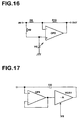
- the all pass filter includes: resistance R8, R9 and R10; a variable capacitor VC; an operating amplifier OP2.
- the voltage control amplifier VCA is connected to a negative input terminal of the operating amplifier OP2 via the resistance R8 and is connected to a positive input terminal of the operating amplifier OP2 via the resistance R9.
- the grounded variable capacitor VC is connected to the middle point of the connection between the operating amplifier OP2 and the resistance R9.
- An output terminal of the operating amplifier OP2 is connected via a resistance R10 to the middle point of the connection between the resistance R8 and the operating amplifier OP2.
- variable capacitor VC An example of the variable capacitor VC is shown in Figures 17.
- the variable capacitor shown in Figure 17 includes an operating amplifier OP3, a voltage control amplifier VCA1, and a capacitor C0.
- the middle point of the connection between the resistance R9 and the operating amplifier OP2 is connected to a positive input terminal of the operating amplifier OP3 and the capacitor C0.
- An output terminal of the operating amplifier OP3 is connected to a negative input terminal thereof and an input terminal of the voltage control amplifier VCA1.
- An output terminal of the voltage control amplifier VCA1 is connected to the capacitor C0 .
- An amplification -A of the voltage control amplifier VCA1 is controlled by the control voltage V3 applied thereto.
- all pass filter having the first order is exemplified in Figures 14 and 16
- an all pass filter having any suitable order may be employed.
- An all pass filter having higher order may include all pass filters having the first order connected in cascade.
- a first and a second power amplifier AMP1 and AMP2 are connected to the first and the second all pass filters APF1 and APF2, respectively.
- the power amplifiers AMP1 and AMP2 amplify the branched signals S3 and S4 and supply the amplified signals to the left and the right speakers SPL and SPR.
- the audio signal S1 produced from the voltage control oscillator VCO is amplified by the voltage control amplifier VCA to produce the amplified and branched signals S2.
- the amplified and branched signals S2 are supplied to the first and the second all pass filter APF1 and APF2, respectively, so as to produce the phase-controlled and branched signals S3 and S4.
- the phase-controlled and branched signals S3 and S4 are amplified by the first and the second power amplifiers AMP1 and AMP2 and supplied to the left and the right speakers SPL and SPR.
- the speakers SPL and SPR output a sound wave so as to form sound image.
- This technique includes performing a signal control for prescribed period of time in two steps. The details are as follows.
- the signal control is performed for a first period of time T1 (usually, T1 is in the range of approximately 0.5 to several seconds). T1 is appropriately set in consideration of a sound image movement speed and the like.
- the signal control in the first step includes keeping substantially constant the control voltage V1 applied to the voltage control oscillator VCO, so as to keep substantially constant a frequency of the output audio signal S1.
- the signal control includes gradually increasing the control voltage V2 applied to the voltage control amplifier VCA, so as to gradually increase an amplitude of the branched signals S2 to be output.
- VCA voltage control amplifier
- the phase difference ⁇ between the branched signals S3 and S4 i.e., a declination arg(S3/S4)
- the turnover frequency of the first and the second all pass filters APF1 and APF2 would be gradually varied from about 0 degree to about -180 degrees, as shown in Figure 20 .
- the below-indicated control procedure is carried out for a prescribed period of time T2 (usually, T2 is in the range of about 0.1 to about 2 seconds).
- T2 is appropriately set in consideration of a sound image movement speed and the like.
- the signal control in the second step includes decreasing the control voltage V1 applied to the voltage control oscillator VCO.
- a frequency of the output audio signal S1 is shifted to low frequency side, so as to provide the Doppler effect.
- the shift of the frequency may be performed gradually or at once.
- the signal control in the second step includes drastically decreasing the control voltage V2 applied to the voltage control amplifier VCA to substantially zero, so as to drastically decrease an amplitude of the branched signals to be output to substantially zero.
- the signal control in the second step includes drastically decreasing the control voltage V2 applied to the voltage control amplifier VCA to substantially zero, so as to drastically decrease an amplitude of the branched signals to be output to substantially zero.
- the phase difference ⁇ between the branched signals S3 and S4 i.e., a declination arg(S3/S4)
- the phase difference between the reproduced sound of the left and the right speakers would be kept at approximately -180 degrees, as shown in Figure 20 .
- a frequency of the reproduced sound from the speakers SPL and SPR is shifted to low frequency side to provide the Doppler effect. Furthermore, sound pressure level of the listener is drastically decreased to substantially zero. As a result, it is possible to make a listener to clearly feel that sound image is moving from the vicinity of the back of the listener's head to further rearward of the listener.
- the signal control realizes the Doppler effect due to the shift of the frequency component, the feeling of a sound image movement due to the variation of sound pressure level, and the feeling of a sound image movement due to the phase difference.
- the above-mentioned combination makes a listener to clearly feel that sound image is moving from rearward of the middle between the left and the right speakers SPL and SPR to rearward of the listener.
- This technique also includes performing a signal control for prescribed period of time in two steps. The details are as follows.
- the signal control is performed for a first period of time T3 (usually, T3 is in the range of approximately 0.1 to 0.5 seconds). T3 is appropriately set in consideration of a sound image movement speed and the like.
- the signal control in the first step includes keeping substantially constant the control voltage V1 applied to the voltage control oscillator VCO, so as to keep substantially constant a frequency of the output audio signal S1 .
- the signal control includes keeping substantially constant the control voltage V2 applied to the voltage control amplifier VCA , so as to keep substantially constant an amplitude of the branched signals S2 to be output As a result, sound pressure level of the listener with respect to the reproduced sound of the speakers SPL and SPR would be kept substantially constant.
- the phase difference ⁇ between the branched signals S3 and S4 i.e., a declination arg(S3/S4)
- the phase difference between the reproduced sound of the left and the right speakers SPL and SPR would be kept at approximately -180 degrees, so as to localize sound image in the vicinity of the back of the listener's head or rearwards thereto.
- the below-indicated control procedure is carried out for a prescribed period of time T4 (usually, T4 is in the range of about 0.5 to several seconds).
- T4 is appropriately set in consideration of a sound image movement speed and the like.
- the signal control in the second step includes decreasing the control voltage V1 applied to the voltage control oscillator VCO .
- the signal control in the second step includes gradually decreasing the control voltage V2 applied to the voltage control amplifier VCA to substantially zero, so as to drastically decrease an amplitude of the branched signals S2 to be output to substantially zero. As a result, sound pressure level of the listener with respect to the reproduced sound would be gradually decreased to substantially zero.
- the phase difference ⁇ between the branched signals S3 and S4 i.e., a declination arg(S3/S4)
- the phase difference between the reproduced sound of the left and the right speakers SPL and SPR would be gradually decreased to substantially zero, as shown in Figure 23 .
- a frequency of the reproduced sound from the speakers SPL and SPR is shifted to low frequency side to provide the Doppler effect. Furthermore, the phase difference of the reproduced sound is gradually decreased to substantially zero. As a result, it is possible to make a listener to clearly feel that sound image is moving from the vicinity of the back of the listener's head or rearwards thereto to rearward of the middle between the left and the right speakers SPL and SPR .
- the signal control realizes the Doppler effect due to the shift of the frequency component, the feeling of a sound image movement due to the variation of sound pressure level, and the feeling of a sound image movement due to the phase difference.
- the above-mentioned combination makes a listener to clearly feel that sound image is moving from the vicinity of the back of the listener's head or rearwards thereto to rearward of the middle between the left and the right speakers SPL and SPR .
- the present invention it is possible to make a listener to clearly feel that sound image is moving forward and backward.
- the feeling would be emphasized in combination with a mental process.
- a game player can be provided with a realistic feeling by combining a picture and a sound image movement.
- the present invention is applied to sound of explosion in a shooting game, reality of the game would be drastically improved.
- This embodiment relates to a digital type sound image localization apparatus.
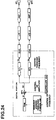
- Figure 24 is a block diagram illustrating an apparatus according to this embodiment.
- the portion enclosed with a chain line shows a "digital" portion.
- read-only memory ROM
- a read-out address producing portion 106 is used as a shifting means.
- an audio data (an audio signal data) including one or more period of sound effect is sequentially stored from the address $00 to the address $FF in the memory.
- the audio data is read-out so as to produce an audio signal S1.
- a frequency component of the audio signal S1 is appropriately shifted by controlling a read-out speed.
- dADD ⁇ $101 since the audio data is read-out at a higher speed than that when the data is stored, a frequency component of the audio signal S1 is shifted to high frequency side. Furthermore, if dADD ⁇ $0FF, since the audio data is read-out at a lower speed than that when the data is stored, a frequency component of the audio signal S1 is shifted to low frequency side. Accordingly, by controlling the dADD value with the controller 104, it is possible to shift a frequency component of the audio signal S1 .
- a coefficient multiplying means MPY is used as an amplitude control means.
- the amplitude of the audio signal S1 is varied by multiplying the audio signal S1 by a coefficient k which is controlled by the controller 104, so as to produce the branched signals S2.
- a first and a second IIR type digital all pass filters DF1 and DF2 are used as a phase difference control means.
- An example of the filters DF1 and DF2 is as shown in Figure 25 .
- An input signal x i is processed with an adding means MIX1 to produce a signal p i .
- the signal p i is multiplied by a filtering coefficient a with a coefficient multiplying means K1 and supplied to a second adding means MIX2 .
- the signal p i is delayed as much as a unit sampling cycle (a sampling interval) with a delaying circuit D so as to produce a signal p i-1 .
- the signal p i-1 is multiplied by a filtering coefficient a with a coefficient multiplying means K2 and added to the signal p i with the adding means MIX1 .
- the signal p i-1 is also multiplied by -1 with a coefficient multiplying means K3 and input to the second adding means MIX2 .
- an output signal y i is produced.
- the filtering coefficient a is in the range of -1 ⁇ a ⁇ 1.
- the upper limit of the filtering coefficient a contributes to control a turnover frequency of the digital all pass filters DF1 and DF2 .
- all pass filter having the first order is exemplified in Figure 25
- an all pass filter having any suitable order may be employed.
- An all pass filter having higher order may include all pass filters having the first order connected in cascade.
- the first all pass filter DF1 is connected to the first power amplifier AMP1 via a first digital/analog converter DA1 and the first low pass filter LPF1.
- the second all pass filter DF2 is connected to the second power amplifier AMP2 via a second digital/analog converter DA2 and the second low pass filter LPF2.
- a digital signal processor may also be used in place of the memory, the read-out address producing portion 106, the coefficient multiplying means MPY, the digital all pass filters DF1 and DF2, and the controller 104.
- the branched signal may be output from any of the shifting means, the phase difference, the voltage control oscillator and the all pass filter.
- the present invention makes a listener to clearly feel that sound image is moving forward and backward with respect to the listener by the combination of the Doppler effect due to the shift of the frequency component, the feeling of a sound image movement due to the variation of sound pressure level, and the feeling of a sound image movement due to the phase difference.
- the present invention is preferably applicable to, for example, a home audio/visual (A/V) system, a surround audio reproduction apparatus, and sound effect reproduction in an amusement equipment.
- A/V home audio/visual
Landscapes
- Engineering & Computer Science (AREA)
- Multimedia (AREA)
- Physics & Mathematics (AREA)
- Acoustics & Sound (AREA)
- Signal Processing (AREA)
- Stereophonic System (AREA)
Applications Claiming Priority (4)
| Application Number | Priority Date | Filing Date | Title |
|---|---|---|---|
| JP2651298 | 1998-01-23 | ||
| JP02651298A JP3233275B2 (ja) | 1998-01-23 | 1998-01-23 | 音像定位処理方法及びその装置 |
| JP3430198 | 1998-01-30 | ||
| JP10034301A JPH11220800A (ja) | 1998-01-30 | 1998-01-30 | 音像移動方法及びその装置 |
Publications (3)
| Publication Number | Publication Date |
|---|---|
| EP0932325A2 true EP0932325A2 (de) | 1999-07-28 |
| EP0932325A3 EP0932325A3 (de) | 2000-11-29 |
| EP0932325B1 EP0932325B1 (de) | 2005-04-27 |
Family
ID=26364297
Family Applications (1)
| Application Number | Title | Priority Date | Filing Date |
|---|---|---|---|
| EP99300468A Expired - Lifetime EP0932325B1 (de) | 1998-01-23 | 1999-01-22 | Vorrichtung und Verfahren zur Schallbildlokalisierung |
Country Status (4)
| Country | Link |
|---|---|
| US (1) | US6504934B1 (de) |
| EP (1) | EP0932325B1 (de) |
| CN (1) | CN1151704C (de) |
| DE (1) | DE69924896T2 (de) |
Cited By (1)
| Publication number | Priority date | Publication date | Assignee | Title |
|---|---|---|---|---|
| GB2370480A (en) * | 2000-07-21 | 2002-06-26 | Yamaha Corp | Sound image localization |
Families Citing this family (44)
| Publication number | Priority date | Publication date | Assignee | Title |
|---|---|---|---|---|
| US7242782B1 (en) * | 1998-07-31 | 2007-07-10 | Onkyo Kk | Audio signal processing circuit |
| CN1993002B (zh) * | 2005-12-28 | 2010-06-16 | 雅马哈株式会社 | 声像定位设备 |
| US8041057B2 (en) * | 2006-06-07 | 2011-10-18 | Qualcomm Incorporated | Mixing techniques for mixing audio |
| JP5214920B2 (ja) * | 2007-07-24 | 2013-06-19 | 株式会社東芝 | 超音波診断装置及び超音波診断装置の音響出力方法 |
| US8498667B2 (en) * | 2007-11-21 | 2013-07-30 | Qualcomm Incorporated | System and method for mixing audio with ringtone data |
| US8660280B2 (en) * | 2007-11-28 | 2014-02-25 | Qualcomm Incorporated | Methods and apparatus for providing a distinct perceptual location for an audio source within an audio mixture |
| US8515106B2 (en) * | 2007-11-28 | 2013-08-20 | Qualcomm Incorporated | Methods and apparatus for providing an interface to a processing engine that utilizes intelligent audio mixing techniques |
| US8572513B2 (en) | 2009-03-16 | 2013-10-29 | Apple Inc. | Device, method, and graphical user interface for moving a current position in content at a variable scrubbing rate |
| JP2011010276A (ja) * | 2009-05-22 | 2011-01-13 | Sanyo Electric Co Ltd | 画像再生装置及び撮像装置 |
| US9100766B2 (en) * | 2009-10-05 | 2015-08-04 | Harman International Industries, Inc. | Multichannel audio system having audio channel compensation |
| KR101844511B1 (ko) | 2010-03-19 | 2018-05-18 | 삼성전자주식회사 | 입체 음향 재생 방법 및 장치 |
| KR101764175B1 (ko) | 2010-05-04 | 2017-08-14 | 삼성전자주식회사 | 입체 음향 재생 방법 및 장치 |
| US10706096B2 (en) | 2011-08-18 | 2020-07-07 | Apple Inc. | Management of local and remote media items |
| US9002322B2 (en) | 2011-09-29 | 2015-04-07 | Apple Inc. | Authentication with secondary approver |
| WO2013103256A1 (ko) * | 2012-01-05 | 2013-07-11 | 삼성전자 주식회사 | 다채널 음향 신호의 정위 방법 및 장치 |
| BR112015013154B1 (pt) | 2012-12-04 | 2022-04-26 | Samsung Electronics Co., Ltd | Aparelho fornecedor de áudio, e método fornecedor de áudio |
| WO2014143776A2 (en) | 2013-03-15 | 2014-09-18 | Bodhi Technology Ventures Llc | Providing remote interactions with host device using a wireless device |
| WO2015183366A1 (en) | 2014-05-30 | 2015-12-03 | Apple, Inc. | Continuity |
| US10339293B2 (en) | 2014-08-15 | 2019-07-02 | Apple Inc. | Authenticated device used to unlock another device |
| WO2016036510A1 (en) | 2014-09-02 | 2016-03-10 | Apple Inc. | Music user interface |
| US20170257721A1 (en) * | 2014-09-12 | 2017-09-07 | Sony Semiconductor Solutions Corporation | Audio processing device and method |
| CN107251578B (zh) * | 2015-02-25 | 2018-11-06 | 株式会社索思未来 | 信号处理装置 |
| DK179186B1 (en) | 2016-05-19 | 2018-01-15 | Apple Inc | REMOTE AUTHORIZATION TO CONTINUE WITH AN ACTION |
| DK201670622A1 (en) | 2016-06-12 | 2018-02-12 | Apple Inc | User interfaces for transactions |
| US10992795B2 (en) | 2017-05-16 | 2021-04-27 | Apple Inc. | Methods and interfaces for home media control |
| US11431836B2 (en) | 2017-05-02 | 2022-08-30 | Apple Inc. | Methods and interfaces for initiating media playback |
| US10928980B2 (en) | 2017-05-12 | 2021-02-23 | Apple Inc. | User interfaces for playing and managing audio items |
| CN111343060B (zh) | 2017-05-16 | 2022-02-11 | 苹果公司 | 用于家庭媒体控制的方法和界面 |
| US12526361B2 (en) | 2017-05-16 | 2026-01-13 | Apple Inc. | Methods for outputting an audio output in accordance with a user being within a range of a device |
| CN109065010A (zh) * | 2018-08-23 | 2018-12-21 | 张德明 | 一种具同台联唱模式的k歌系统和k歌方法 |
| CA3131489A1 (en) | 2019-02-27 | 2020-09-03 | Louisiana-Pacific Corporation | Fire-resistant manufactured-wood based siding |
| US11010121B2 (en) | 2019-05-31 | 2021-05-18 | Apple Inc. | User interfaces for audio media control |
| KR102436985B1 (ko) | 2019-05-31 | 2022-08-29 | 애플 인크. | 오디오 미디어 제어를 위한 사용자 인터페이스 |
| US10904029B2 (en) | 2019-05-31 | 2021-01-26 | Apple Inc. | User interfaces for managing controllable external devices |
| DK201970533A1 (en) | 2019-05-31 | 2021-02-15 | Apple Inc | Methods and user interfaces for sharing audio |
| US11079913B1 (en) | 2020-05-11 | 2021-08-03 | Apple Inc. | User interface for status indicators |
| US11392291B2 (en) | 2020-09-25 | 2022-07-19 | Apple Inc. | Methods and interfaces for media control with dynamic feedback |
| EP4334811B1 (de) | 2021-06-06 | 2025-11-19 | Apple Inc. | Benutzerschnittstellen für audiorouting |
| US11847378B2 (en) | 2021-06-06 | 2023-12-19 | Apple Inc. | User interfaces for audio routing |
| US12596520B2 (en) | 2021-09-24 | 2026-04-07 | Apple Inc. | Media controls user interface |
| US12563299B2 (en) | 2022-04-04 | 2026-02-24 | Apple Inc. | User interfaces for camera sharing |
| US12379827B2 (en) | 2022-06-03 | 2025-08-05 | Apple Inc. | User interfaces for managing accessories |
| US12321574B2 (en) | 2022-09-02 | 2025-06-03 | Apple Inc. | Content output devices and user interfaces |
| US12615491B2 (en) | 2022-09-06 | 2026-04-28 | Apple Inc. | Interfaces for device interactions |
Family Cites Families (6)
| Publication number | Priority date | Publication date | Assignee | Title |
|---|---|---|---|---|
| JP3059191B2 (ja) | 1990-05-24 | 2000-07-04 | ローランド株式会社 | 音像定位装置 |
| US5274708A (en) * | 1992-06-01 | 1993-12-28 | Fusan Labs, Inc. | Digital stereo sound enhancement unit and method |
| DE69433258T2 (de) | 1993-07-30 | 2004-07-01 | Victor Company of Japan, Ltd., Yokohama | Raumklangsignalverarbeitungsvorrichtung |
| US5440638A (en) * | 1993-09-03 | 1995-08-08 | Q Sound Ltd. | Stereo enhancement system |
| BE1008027A3 (nl) * | 1994-01-17 | 1995-12-12 | Philips Electronics Nv | Signaalcombinatieschakeling, signaalbewerkingsschakeling voorzien van de signaalcombinatieschakeling, stereofonische audioweergave-inrichting voorzien de signaalbewerkingsschakeling, alsmede een audio-visuele weergave-inrichting voorzien van de stereofonische audioweergave-inrichting. |
| JP3367625B2 (ja) | 1995-01-26 | 2003-01-14 | 日本ビクター株式会社 | 音像定位制御装置 |
-
1999
- 1999-01-22 DE DE69924896T patent/DE69924896T2/de not_active Expired - Lifetime
- 1999-01-22 CN CNB991013662A patent/CN1151704C/zh not_active Expired - Fee Related
- 1999-01-22 US US09/235,483 patent/US6504934B1/en not_active Expired - Fee Related
- 1999-01-22 EP EP99300468A patent/EP0932325B1/de not_active Expired - Lifetime
Cited By (2)
| Publication number | Priority date | Publication date | Assignee | Title |
|---|---|---|---|---|
| GB2370480A (en) * | 2000-07-21 | 2002-06-26 | Yamaha Corp | Sound image localization |
| GB2370480B (en) * | 2000-07-21 | 2002-12-11 | Yamaha Corp | Sound image localization apparatus and method |
Also Published As
| Publication number | Publication date |
|---|---|
| CN1235505A (zh) | 1999-11-17 |
| DE69924896T2 (de) | 2005-09-29 |
| EP0932325A3 (de) | 2000-11-29 |
| DE69924896D1 (de) | 2005-06-02 |
| CN1151704C (zh) | 2004-05-26 |
| US6504934B1 (en) | 2003-01-07 |
| EP0932325B1 (de) | 2005-04-27 |
Similar Documents
| Publication | Publication Date | Title |
|---|---|---|
| EP0932325A2 (de) | Vorrichtung und Verfahren zur Schallbildlocalisierung | |
| NL1013313C2 (nl) | Werkwijze voor het nabootsen van een driedimensionaal geluidsveld. | |
| US7440575B2 (en) | Equalization of the output in a stereo widening network | |
| KR100458021B1 (ko) | 기록/재생용 다중 채널 오디오 강화 시스템 및 그 제공 방법 | |
| JP2897586B2 (ja) | 音場制御装置 | |
| EP0699012A2 (de) | Schallbildverbesserungsvorrichtung | |
| JPH06319199A (ja) | 多次元音響回路及びその方法 | |
| US5844993A (en) | Surround signal processing apparatus | |
| EP0917400B1 (de) | Vorrichtung und Verfahren zur Schallbildlokalisierung | |
| US5339363A (en) | Apparatus for enhancing monophonic audio signals using phase shifters | |
| JP3547813B2 (ja) | 音場生成装置 | |
| JP2956545B2 (ja) | 音場制御装置 | |
| US5543579A (en) | Effector | |
| US5751817A (en) | Simplified analog virtual externalization for stereophonic audio | |
| JP2966181B2 (ja) | 音場信号再生装置 | |
| US5822437A (en) | Signal modification circuit | |
| JP4371622B2 (ja) | 疑似ステレオ回路 | |
| JP3233275B2 (ja) | 音像定位処理方法及びその装置 | |
| US20090122994A1 (en) | Localization control device, localization control method, localization control program, and computer-readable recording medium | |
| JP2953347B2 (ja) | サラウンド信号処理装置 | |
| JP3368835B2 (ja) | 音響信号処理回路 | |
| JPH1118199A (ja) | 音響処理装置 | |
| JP3258844B2 (ja) | 音声出力装置 | |
| KR100566115B1 (ko) | 입체 음향을 생성하는 장치 및 방법 | |
| JPH07231497A (ja) | オーディオ信号処理装置 |
Legal Events
| Date | Code | Title | Description |
|---|---|---|---|
| PUAI | Public reference made under article 153(3) epc to a published international application that has entered the european phase |
Free format text: ORIGINAL CODE: 0009012 |
|
| AK | Designated contracting states |
Kind code of ref document: A2 Designated state(s): DE FR GB |
|
| AX | Request for extension of the european patent |
Free format text: AL;LT;LV;MK;RO;SI |
|
| PUAL | Search report despatched |
Free format text: ORIGINAL CODE: 0009013 |
|
| AK | Designated contracting states |
Kind code of ref document: A3 Designated state(s): AT BE CH CY DE DK ES FI FR GB GR IE IT LI LU MC NL PT SE |
|
| AX | Request for extension of the european patent |
Free format text: AL;LT;LV;MK;RO;SI |
|
| 17P | Request for examination filed |
Effective date: 20001204 |
|
| AKX | Designation fees paid |
Free format text: DE FR GB NL |
|
| RBV | Designated contracting states (corrected) |
Designated state(s): DE FR GB |
|
| 17Q | First examination report despatched |
Effective date: 20031229 |
|
| GRAP | Despatch of communication of intention to grant a patent |
Free format text: ORIGINAL CODE: EPIDOSNIGR1 |
|
| RBV | Designated contracting states (corrected) |
Designated state(s): DE FR GB NL |
|
| GRAS | Grant fee paid |
Free format text: ORIGINAL CODE: EPIDOSNIGR3 |
|
| GRAA | (expected) grant |
Free format text: ORIGINAL CODE: 0009210 |
|
| AK | Designated contracting states |
Kind code of ref document: B1 Designated state(s): DE FR GB NL |
|
| PG25 | Lapsed in a contracting state [announced via postgrant information from national office to epo] |
Ref country code: NL Free format text: LAPSE BECAUSE OF FAILURE TO SUBMIT A TRANSLATION OF THE DESCRIPTION OR TO PAY THE FEE WITHIN THE PRESCRIBED TIME-LIMIT Effective date: 20050427 |
|
| REG | Reference to a national code |
Ref country code: GB Ref legal event code: FG4D |
|
| REF | Corresponds to: |
Ref document number: 69924896 Country of ref document: DE Date of ref document: 20050602 Kind code of ref document: P |
|
| NLV1 | Nl: lapsed or annulled due to failure to fulfill the requirements of art. 29p and 29m of the patents act | ||
| PLBE | No opposition filed within time limit |
Free format text: ORIGINAL CODE: 0009261 |
|
| STAA | Information on the status of an ep patent application or granted ep patent |
Free format text: STATUS: NO OPPOSITION FILED WITHIN TIME LIMIT |
|
| 26N | No opposition filed |
Effective date: 20060130 |
|
| EN | Fr: translation not filed | ||
| PG25 | Lapsed in a contracting state [announced via postgrant information from national office to epo] |
Ref country code: FR Free format text: LAPSE BECAUSE OF FAILURE TO SUBMIT A TRANSLATION OF THE DESCRIPTION OR TO PAY THE FEE WITHIN THE PRESCRIBED TIME-LIMIT Effective date: 20050427 |
|
| REG | Reference to a national code |
Ref country code: DE Ref legal event code: R081 Ref document number: 69924896 Country of ref document: DE Owner name: ONKYO CORP., NEYAGAWA-SHI, JP Free format text: FORMER OWNER: ONKYO CORP., NEYAGAWA, OSAKA, JP Effective date: 20110302 |
|
| REG | Reference to a national code |
Ref country code: DE Ref legal event code: R082 Ref document number: 69924896 Country of ref document: DE |
|
| PGFP | Annual fee paid to national office [announced via postgrant information from national office to epo] |
Ref country code: GB Payment date: 20121228 Year of fee payment: 15 |
|
| PGFP | Annual fee paid to national office [announced via postgrant information from national office to epo] |
Ref country code: DE Payment date: 20130131 Year of fee payment: 15 |
|
| REG | Reference to a national code |
Ref country code: DE Ref legal event code: R119 Ref document number: 69924896 Country of ref document: DE |
|
| GBPC | Gb: european patent ceased through non-payment of renewal fee |
Effective date: 20140122 |
|
| REG | Reference to a national code |
Ref country code: DE Ref legal event code: R119 Ref document number: 69924896 Country of ref document: DE Effective date: 20140801 |
|
| PG25 | Lapsed in a contracting state [announced via postgrant information from national office to epo] |
Ref country code: DE Free format text: LAPSE BECAUSE OF NON-PAYMENT OF DUE FEES Effective date: 20140801 |
|
| PG25 | Lapsed in a contracting state [announced via postgrant information from national office to epo] |
Ref country code: GB Free format text: LAPSE BECAUSE OF NON-PAYMENT OF DUE FEES Effective date: 20140122 |