EP0933872A1 - Optische digitale Speichervorrichtung - Google Patents
Optische digitale Speichervorrichtung Download PDFInfo
- Publication number
- EP0933872A1 EP0933872A1 EP99107155A EP99107155A EP0933872A1 EP 0933872 A1 EP0933872 A1 EP 0933872A1 EP 99107155 A EP99107155 A EP 99107155A EP 99107155 A EP99107155 A EP 99107155A EP 0933872 A1 EP0933872 A1 EP 0933872A1
- Authority
- EP
- European Patent Office
- Prior art keywords
- optical
- signal
- light
- input
- selector
- Prior art date
- Legal status (The legal status is an assumption and is not a legal conclusion. Google has not performed a legal analysis and makes no representation as to the accuracy of the status listed.)
- Ceased
Links
Images




Classifications
-
- H—ELECTRICITY
- H03—ELECTRONIC CIRCUITRY
- H03K—PULSE TECHNIQUE
- H03K3/00—Circuits for generating electric pulses; Monostable, bistable or multistable circuits
- H03K3/02—Generators characterised by the type of circuit or by the means used for producing pulses
- H03K3/42—Generators characterised by the type of circuit or by the means used for producing pulses by the use, as active elements, of opto-electronic devices, i.e. light-emitting and photoelectric devices electrically- or optically-coupled
Definitions
- the present invention relates to an optical digital holding apparatus for holding instantaneous digital information borne by an optical signal.
- An optical digital holding apparatus of the present invention carries out functions of a flip-flop apparatus (RS flip-flop, D-type flip-flop etc.) which is a kind of the electrical digital holding apparatus, and can be achieved by placing an optical connecting wiring having a direct or indirect feedback circuit which is the essence of the flip-flop circuit between the multistage optical selectors having the selector function.
- a flip-flop apparatus RS flip-flop, D-type flip-flop etc.
- the optical digital holding apparatus of the present invention comprises (a) a set of selectors for receiving an aggregation of spatially distributed optical digital information signals propagating in a predetermined direction and bearing binary digital information and an optical control signal bearing binary digital information and selectively outputting one of a portion of an aggregation of the digital information signals which are received in accordance with a value of the digital information borne by the optical control signal, having a delay function and an integration function, placed in multistage, and (b) an optical connection wiring for connecting the selectors each other, including optical feedback connection for making an output optical signal of one of the selectors into an input optical signal of one of the other selectors and making an output optical signal of one of the other selectors into its input signal or an input signal of a selector in a stage prior to said one of the other selectors.
- the number of optical digital information signals inputting to the selection is two and the number of said optical control signal is one.
- aforesaid selector outputs a third optical information signal bearing the binary digital information borne by either a first optical information signal received in a first area or a second optical information signal received in a second area in accordance with the value of the binary digital information borne by the optical control information.
- Such a selector is constructed in one of three ways hereunder in order to attain a high speed response.
- a first type of the selector comprises (1) a first variable transmittance (or reflectance) device and a second variable transmittance (or reflectance) device driven independently for controlling either the transmission (or reflection) of an input light or non-transmission (or non-reflection) of the light in accordance with an electric drive manner, (2) a first electric charge injecting device and a first electric charge discharging device, which are connected to the first variable transmittance (or reflectance) device, (3) a second electric charge injecting device and a second electric charge discharging device, which are connected to the second variable transmittance (or reflectance) device, and (4) an optical detection circuit for receiving the optical control signal, issuing an activation direction to either a first pair of the first electric charge injecting device and the second electric charge discharging device or a second pair of the second electric charge injecting device and the first electric charge discharging device, and issuing a deactivation direction to the other pairs in accordance with the value of the binary digital information carried by the optical control signal.
- a second type of the selector comprises (1) a first polarization plane rotation device for selectively conducting either non-rotation or 90 degrees rotation of a polarization direction of an input linearly polarized light having a predetermined direction of polarization, (2) a double refraction plate for changing an optical path in accordance with the direction of polarization of the input linearly polarized light received through the first polarization plane rotation device, (3) a second polarization plane rotation device for selectively conduction either the non-rotation or the 90 degrees rotation of the direction of polarization of the linearly polarized light outputted from the double refraction plate, (4) a polarization plane rotation controller for setting the first polarization plane rotation device and the second polarization plane rotation device into one of a non-rotation mode and a 90 degrees rotation mode in accordance with the value of the binary digital information carried by the optical control signal, and (5) an output light selector for selecting only the light outputted from a predetermined area of the second polarization plane rotation device.
- a third type of the selector comprises (1) a variable refractive index device for electrically changing a refractive index, (2) a refractive index controller for receiving the optical control signal and changing a refractive index of the variable refractive index device in accordance with the value of information carried by the optical control signal, and (3) a light selection slit for transmitting only a light outputted from a specified position of the variable refractive index device.
- the variable refractive index device is made of material what is called electro optical crystal.
- the holding function is achieved by a way such that an output optical signal of the optical selector in a preceding stage is made into an light selection signal or an input optical data signal, of the optical selector in a succeeding stage, and an output optical signal of the optical selector in the succeeding stage is made into an input optical data information or an light selection signal, of the optical selector itself in the succeeding stage or the optical selector placed in the stage prior to the selector in the succeeding stage.
- the optical selectors capable of being cascade-connected are placed in multistage and optically connected each other, so that the optical digital holding apparatus itself can also be cascade-connected. Further, by combining these with another optical digital processor, a large scale optical digital apparatus such as a counter, a shift register can be achieved.
- variable transmittance devices or variable reflectance devices having the quantum confined Stark effect or the Wannier-Stark localization effect are combined and driving transistors are prepared for the injection/discharge of the electric charges of the devices controlling the transmission/non-transmission of the light in the respective devices such that one is in the electric charge injection mode while the other is in the electric charge discharge mode in accordance with the value of information of the input optical signal carrying the selection direction information.
- the optical digital holding device which can switch the control at a high speed so that only one is exclusively controlled to the transmission state, and facilitates the cascade connection is provided.
- the non-rotation and the 90 degrees rotation of the direction of polarization to the input light polarized in the specific direction in the first polarization plane rotation device are controlled in accordance with the value of the information of the input signal light carrying the selection direction signal to switch the ordinary/extraordinary light of the input light in the double refraction device to change the optical path, so that the light received in the second specified area is outputted from a light selection slit for the ordinary light and the light received in the second specified area is outputted from the light selection slit for the extraordinary light. Then, the direction of polarization of the output light assured to be same as the direction of polarization of the input light by the second polarization plane rotation device. Accordingly, an optical digital holding apparatus which can select the output light at a high speed and facilitates the cascade connection is provided.
- the optical digital holding apparatus which can select the output light at a high speed and facilitates the cascade connection is provided.
- An apparatus of this embodiment is a transparency latch (hereinafter called L latch) which outputs a logical value equal to a logical value of an input data signal when an input clock signal is "1", and holds and then outputs a logical value that is the logical value of the input data signal right before the input clock signal changes from "1" to "0" when the input clock signal is "0".
- L latch transparency latch
- Fig. 1 shows a block diagram of the apparatus of this embodiment.
- Fig. 2 shows an operation chart of this embodiment.
- the apparatus comprises a light source (not shown) for a predetermined value, an optical selector 111 for receiving an input data signal (I D ) at one of input terminals thereof to be selected as an output (hereinafter called side “1" input terminal) when an light selection signal is “1” and inputting an input clock signal (I C ) at an light selection signal terminal thereof, and an optical selector 112 with no light input applied to the side "0" input terminal and a constant light input (I l ) from the light source for a predetermined value applied to one of the input terminals thereof to be selected as the output (hereinafter called side "0" input terminal) when the light selection signal is "0".
- the output signal of the optical selector 111 is divided into two optical signals by a half-mirror 201.
- One of the divided signals is applied to the light selection signal terminal of the optical selector 112, and at the same time the other of the divided signals is the output optical signal of the apparatus.
- the output signal of the optical selector 112 is applied to the side "0" input terminal of the optical selector 111.
- the input signal applied to the side "1" input terminal that is, the input data signal is selected to be the output of the optical selector 111 and outputted to the outside of the apparatus. Further, the input data signal is also applied to the light selection signal terminal of the optical selector 112, so that the output signal of the optical selector 112 is the signal having the same logical value as the input data signal.
- the input clock signal changes from “1” to "0” the input signal applied to the side "0" input terminal, that is, the value of the input data signal right before the input clock signal changes to "0” is selected to be the output of the optical selector 111.
- This value is applied to the light selection signal terminal of the optical selector 112, so that the output of the optical selector 111 is maintained with this value, and the output optical signal is also maintained with this value.
- the output optical signal is the same logical value as the input data signal as described above.
- optical selector involves both suitable signal delay and integration of signal waveform, so that oscillation in a feedback loop can be avoided.
- Fig. 3 shows the first block diagram of the optical selector for selectively outputting lights received in a specified area, which is required for constituting such an optical digital holding apparatus and can be cascade-connected.
- This apparatus comprises variable transmittance devices 510 and 520 having either a quantum confined Stark effect or a Wannier-Stark localization effect, and a transmittance control circuit 530 electrically connected to those devices as shown in Fig. 3.
- the transmittance control circuit 530 comprises a photo-transistor 531 for receiving an input light I, transistors 532 and 533 and resistors connected as shown in Fig. 3.
- the transistor 532 When the input light I is not applied, the transistor 532 is conductive and the transistor 533 is non-conductive and a voltage is applied to only the variable transmittance device 520, which does not substantially transmit the light because an electric field is established therein. Since no electric field is established in the variable transmittance device 510, it transmits the light at substantially full transmission. On the other hand, when the input light I is applied, the transistor 532 is non-conductive and the transistor 533 is conductive, so that the voltage is applied to only the variable transmittance device 510 which does not substantially transmit the light because an electric field is established therein. Since no electric field is established in the variable transmittance device 520, substantially all lights are transmitted therethrough.
- the optical digital selector which can be cascade-connected and selectively outputs the light received in the specified area is constructed.
- the transistor 532 is provided for the variable transmittance device 510 and the transistor 533 is provided for the variable transmittance device 520 for discharging the electric charges accumulated in the device to which the voltage has been applied before switching. Accordingly, high speed switching of the transmittance is attained. While the variable transmittance device is used in the present apparatus, a variable reflectance device may be used.
- Fig. 4 shows the second block diagram of the optical selector.
- This apparatus comprises the first polarization plane rotation device 610 made of 90 degrees TN liquid crystal, a double refraction device 620 made of calcite for receiving the light outputted from the first polarization plane rotation device 610, the second polarization plane rotation device 630 made of 90 degrees TN liquid crystal for receiving the light outputted from the double refraction device 620, a light selection slit 640 for transmitting a portion of the light outputted from the second polarization plane rotation device 630, and a deflection controller 650 for controlling the first and second polarization plane rotation devices 610 and 630 to a non-rotation mode or a 90 degrees rotation mode of the direction of polarization to the input light.
- the deflection controller is in ON state when the input light I is not applied, and in OFF state when the input light I is applied to rotate the polarization plane by 90 degrees.
- linearly polarized lights A and B are applied.
- the deflection controller 650 does not receive the input light I, the deflection controller 650 is in the ON state so that the first and second polarization plane rotation devices 610 and 630 are the non-rotation mode of the polarization plane.
- the input linearly polarized light A and B are applied to the double refraction device 620 without the change in the polarization plane so that an ordinary light is applied to the double refraction device 620 and it goes straight and passes through the double refraction device 620.
- only the light B among the lights transmitted through the second polarization plane rotation device passes through the light selection slit and it is outputted as shown.
- the deflection controller 650 When the deflection controller 650 receives the input light I, the deflection controller 650 is in the OFF state and the first and second polarization plane rotation devices 610 and 630 are in the 90 degrees rotation mode of the polarization plane. In this case, since the input linearly polarized lights A and B are applied to the double refraction device 620 with the polarization plane changed, they are extraordinary rays to the double refraction device 620 with the modified optical path. As a result, only the light A among the lights transmitted through the second polarization plane rotation device and having the polarization direction thereof returned to the original direction passes through the light selection slit and it is outputted as shown.
- optical selectors with the above-described construction are used in the following embodiments.
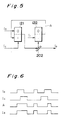
- An apparatus of this embodiment is a transparency latch (hereinafter called H latch) which outputs a logical value equal to a logical value of an input data signal when an input clock signal is "0", and holds and then outputs a logical value that is the logical value of the input data signal right before the input clock signal changes from "0" to "1" when the input clock signal is "1".
- H latch transparency latch
- Fig. 5 shows a block diagram of the apparatus of this embodiment.
- Fig. 6 shows an operation chart of this embodiment.
- the apparatus comprises a light source (not shown) for a predetermined value, an optical selector 121 for receiving an input data signal (I D ) at a side "0" input terminal thereof and inputting an input clock signal (I C ) at an light selection signal terminal thereof, and an optical selector 122 with no light input applied to the side "0" input terminal and a constant light input (I l ) from the light source for a predetermined value applied to a side "1" input terminal thereof.
- the output signal of the optical selector 121 is divided into two optical signals by a half-mirror 202.
- One of the divided signals is applied to the light selection signal terminal of the optical selector 122, and at the same time the other of the divided signals is the output optical signal of the apparatus.
- the output signal of the optical selector 122 is applied to the side "1" input terminal of the optical selector 121.
- the input signal applied to the side "0" input terminal that is, the input data signal is selected to be the output of the optical selector 121 and outputted to the outside of the apparatus. Further, the input data signal is also applied to the light selection signal terminal of the optical selector 122, so that the output signal of the optical selector 122 is the signal having the same logical value as the input data signal.
- the input clock signal changes from “0" to "1” the input signal applied to the side "1" input terminal, that is, the value of the input data signal just before the input clock signal changes to "1” is selected to be the output of the optical selector 121.
- This value is applied to the light selection signal terminal of the optical selector 122, so that the output of the optical selector 121 is maintained with this value and the output optical signal is also maintained with this value.
- the optical signal output is the same logical value as the input data signal as described above.
- the operation of the optical selector involves both suitable signal delay and integration of signal waveform, so that oscillation in a feedback loop can be avoided.
- An apparatus of this embodiment is what is called an edge trigger latch which holds and then outputs a logical value of an input data signal when an input clock signal rises from "0" to "1".
- Fig. 7 shows a block diagram of the apparatus of this embodiment.
- Fig. 8 shows an operation chart of this embodiment.
- the apparatus has a structure that an H-latch unit described in the above embodiment is connected with an L-latch unit also described in the above embodiment in series and either a feedback signal in the H-latch unit or a feedback signal in the L-latch unit is selected to be an output of the apparatus.
- the H-latch unit comprises a light source (not shown) for a predetermined value, an optical selector 131 for receiving an input data signal (I D ) at a a side "0" input terminal and inputting one of optical signals divided by a half-mirror 207 at an light selection signal terminal, and an optical selector 132 with no light input applied to a side "0" input terminal thereof and constant light input (I l ) from the light source for a predetermined value applied to the side "1" input terminal thereof.
- the output signal of the optical selector 131 is applied to the light selection signal terminal of the optical selector 132.
- the output signal of the optical selector 132 is divided into two optical signals by a half-mirror 203. One of signals divided by the half-mirror 203 is applied to the side "1" input terminal of the optical selector 131.
- the L-latch unit comprises a light source (not shown) for a predetermined value, an optical selector 133 for receiving one of signals divided by a half-mirror 204 at the side "1" input terminal thereof and inputting one of signals divided by a half-mirror 206 at a light selection signal terminal thereof, and an optical selector 134 with no light input applied to the side "0" input terminal and a constant light input (I l ) from the light source for a predetermined value applied to a "1" side input terminal thereof.
- the output signal of the optical selector 134 is divided into two signals by a half-mirror 205. One of the signals divided by the half-mirror 205 is applied to the light selection signal terminal of the optical selector 133, and the output signal of the optical selector 134 is applied to the side "0" input terminal of the optical selector 135.
- the other of the signals divided by the half-mirror 204 is applied to the side "1" input terminal of the optical selector 135, and the other of signals divided by the half-mirror 205 is applied to the side "0" input terminal of the optical selector 135, and the other of signals divided by the half-mirror 206 is applied to the light selection signal terminal of the optical selector 133, and then the output of the optical selector 135 is an output optical signal (I O ).
- the H-latch unit When the input clock signal is "0", the H-latch unit outputs the same logical value as the input data signal to the L-latch unit and the side "1" input terminal of the optical selector 135 at the same time. At this time, the L-latch unit outputs the signal having the logical value held therein to the side "0" input terminal of the optical selector 135.
- the optical selector 135 selects the input signal applied to the side "0" input terminal as the output, that is, the L-latch unit selects the signal having the logical value held therein as the output.
- the H-latch unit holds and then outputs the value of the input data signal right before this change.
- the L-latch unit outputs the same logical value as the output of the H-latch unit.
- the optical selector 135 selectively outputs the input signal from the H-latch unit.
- the H-latch unit outputs the signal having the same logical value as the input data signal to the L-latch unit and output to the side "1" input terminal of the optical selector 135.
- the L-latch unit holds and then outputs the output signal of the H-latch unit just before the input clock signal changes, that is, the logical value held by the H-latch unit when the input clock signal changes from "0" to "1".
- the optical selector 135 selects the input signal applied to the side "0" input terminal to be the output, that is, the L-latch unit selects a signal having the logical value held therein.
- this apparatus achieves the function of the edge trigger latch that is holding and then outputting the logical value of the input data signal when the input clock signal rises from "0" to "1".
- the operation of the optical selector involves both suitable signal delay and integration of signal waveform, so that oscillation in a feedback loop can be avoided.
- An apparatus of this embodiment is an RS flip-flop which outputs an output signal "1" when an input set signal is “1” and outputs an output signal "0" when an input reset signal is “1".
- Fig. 9 shows a block diagram of this embodiment.
- Fig. 10 shows an operation chart of this embodiment.
- This apparatus comprises a light source (not shown) for a predetermined value, an optical selector 141 for receiving an input data signal (I D ) as an optical input (I l ) at a side "1" input terminal thereof and inputting a reset signal (I R ) at an light selection signal terminal thereof, and an optical selector 142 for inputting an output signal of an optical adder 301, which add the set signal (I S ) and one of signals divided by a half-mirror 208, at a light selection signal terminal and inputting an output signal of the optical selector 141 at a side "1" input terminal with no light input applied to the side "0" input terminal.
- the output optical signal is the other of signals divided by a half-mirror 208.
- this apparatus achieves the function of the RS flip-flop which when the set signal is “1", the output is "1", and when the reset signal is “1", the output is "0" and when the set signal and reset signal are both "0", the output is the data previously held.
- the operation of the optical selector involves both suitable signal delay and integration of signal waveform, so that oscillation in a feedback loop can be avoided.
- the optical feedback circuit formation and the optical path setting for the optical logical connection is provided by edging a glass plate. In this way, a large scale circuit can be formed at the same time. Further, if a silicon substrate or a GaAs substrate is used with selecting a transmission wavelength, a current edging technic can be used, and at the same time devices to which quantum confined Stark effect or a Wannier-Stark localization effect is applied can be manufactured.
- the optical selector may comprise (1) a variable refractive index device for receiving an optical data signal and electrically changing a refractive index, (2) a refractive index controller for receiving a light selection signal carrying binary digital information, and changing a refractive index of said variable refractive index device in accordance with the value of information carried by the light selection signal, and (3) a light selection slit for transmitting only a light outputted from a specified position of said variable refractive index device, and selectively outputs a light inputted to a specified area of the variable refractive index device in accordance with a value of information carried by the light selection signal.
- the simple 1 bit latch and 1 bit flip-flop are mentioned, but combining these, a multi-bit optical digital holding device may be used.
Landscapes
- Optical Communication System (AREA)
Applications Claiming Priority (3)
| Application Number | Priority Date | Filing Date | Title |
|---|---|---|---|
| JP5068687A JPH06281987A (ja) | 1993-03-26 | 1993-03-26 | 光デジタル記憶装置 |
| JP6868793 | 1993-03-26 | ||
| EP94302174A EP0617511A3 (en) | 1993-03-26 | 1994-03-25 | Optical digital holding apparatus. |
Related Parent Applications (1)
| Application Number | Title | Priority Date | Filing Date |
|---|---|---|---|
| EP94302174A Division EP0617511A3 (en) | 1993-03-26 | 1994-03-25 | Optical digital holding apparatus. |
Publications (1)
| Publication Number | Publication Date |
|---|---|
| EP0933872A1 true EP0933872A1 (de) | 1999-08-04 |
Family
ID=13380911
Family Applications (2)
| Application Number | Title | Priority Date | Filing Date |
|---|---|---|---|
| EP94302174A Withdrawn EP0617511A3 (en) | 1993-03-26 | 1994-03-25 | Optical digital holding apparatus. |
| EP99107155A Ceased EP0933872A1 (de) | 1993-03-26 | 1994-03-25 | Optische digitale Speichervorrichtung |
Family Applications Before (1)
| Application Number | Title | Priority Date | Filing Date |
|---|---|---|---|
| EP94302174A Withdrawn EP0617511A3 (en) | 1993-03-26 | 1994-03-25 | Optical digital holding apparatus. |
Country Status (3)
| Country | Link |
|---|---|
| US (1) | US5617232A (de) |
| EP (2) | EP0617511A3 (de) |
| JP (1) | JPH06281987A (de) |
Families Citing this family (10)
| Publication number | Priority date | Publication date | Assignee | Title |
|---|---|---|---|---|
| US5999284A (en) * | 1997-06-05 | 1999-12-07 | Northern Telecom Limited | Optical detection and logic devices with latching function |
| EP1035428A3 (de) * | 1999-03-02 | 2005-07-27 | Fuji Photo Film Co., Ltd. | Optische logische Vorrichtung und optische Speichervorrichtung |
| US6516106B2 (en) | 2001-02-09 | 2003-02-04 | Nortel Networks Limited | Subtracting analog noise from an optical communication channel using stable, non-absorbing optical hard limiters |
| US6674559B2 (en) | 2001-02-09 | 2004-01-06 | Nortel Networks Limited | Optical automatic gain control based on stable, non-absorbing optical hard limiters |
| US6693732B2 (en) | 2001-02-09 | 2004-02-17 | Nortel Networks Limited | Optical sampler based on stable, non-absorbing optical hard limiters |
| AU2002240281A1 (en) * | 2001-02-09 | 2002-08-28 | Nortel Networks Limited | Optical device having nonmonotonic transfer function and applications using same |
| US6636337B2 (en) | 2001-02-09 | 2003-10-21 | Nortel Networks Limited | Optical switching device based on stable, non-absorbing optical hard limiters |
| US20020154350A1 (en) * | 2001-02-09 | 2002-10-24 | Johnson Erik V. | Optical logic devices based on stable, non-absorbing optical hard limiters |
| US7110154B2 (en) | 2004-06-10 | 2006-09-19 | Clemson University | Plasmon-photon coupled optical devices |
| KR102239084B1 (ko) * | 2019-09-26 | 2021-04-12 | 인하대학교 산학협력단 | 광전소자 기반 아날로그-디지털 인터페이스 정적 램 |
Citations (5)
| Publication number | Priority date | Publication date | Assignee | Title |
|---|---|---|---|---|
| JPS6064521A (ja) * | 1983-09-19 | 1985-04-13 | Matsushita Electric Ind Co Ltd | 光フリップフロップ回路 |
| US4761060A (en) * | 1984-11-07 | 1988-08-02 | Nec Corporation | Optical delay type flipflop and shift register using it |
| US4802175A (en) * | 1983-09-06 | 1989-01-31 | Nec Corporation | Opto-electric logic elements |
| US4900115A (en) * | 1989-01-31 | 1990-02-13 | University Of Colorado Foundation, Inc. | Optical logic circuit useful for bit serial optic computing |
| EP0517441A1 (de) * | 1991-06-06 | 1992-12-09 | AT&T Corp. | Dynamische optische Logik |
Family Cites Families (14)
| Publication number | Priority date | Publication date | Assignee | Title |
|---|---|---|---|---|
| JPS5889887A (ja) * | 1981-11-25 | 1983-05-28 | Univ Tohoku | 半導体光機能デバイス |
| US4675518A (en) * | 1982-03-05 | 1987-06-23 | Omron Tateisi Electronics Co. | Optical bistable device |
| JPS59223015A (ja) * | 1983-06-02 | 1984-12-14 | Nec Corp | 光jkフリツプフロツプ回路 |
| JPH01245231A (ja) * | 1988-03-28 | 1989-09-29 | Nippon Hoso Kyokai <Nhk> | 並列光論理演算器 |
| SU1603334A1 (ru) * | 1988-04-20 | 1990-10-30 | Винницкий политехнический институт | Оптическое устройство дл логической обработки изображений |
| JP2653468B2 (ja) * | 1988-05-16 | 1997-09-17 | 日本電信電話株式会社 | 光並列演算処理方法及び装置 |
| JPH0220037A (ja) * | 1988-07-07 | 1990-01-23 | Matsushita Electron Corp | 半導体装置検査方法 |
| JPH0297922A (ja) * | 1988-10-04 | 1990-04-10 | Nec Corp | 光フリップフロップ |
| JPH02230224A (ja) * | 1989-03-03 | 1990-09-12 | Nippon Telegr & Teleph Corp <Ntt> | 光フリップフロップ |
| US4978842A (en) * | 1989-04-21 | 1990-12-18 | At&T Bell Laboratories | Programmable optical logic device with complementary inputs |
| US4964687A (en) * | 1989-09-29 | 1990-10-23 | The Boeing Company | Optical latch and method of latching data using same |
| US5528702A (en) * | 1991-05-31 | 1996-06-18 | Seiko Instruments Inc. | Optical pattern recognition apparatus with coordinate conversion function |
| JP2855985B2 (ja) * | 1992-08-19 | 1999-02-10 | 三菱自動車工業株式会社 | アンチスキッドブレーキ装置 |
| JPH06148710A (ja) * | 1992-09-18 | 1994-05-27 | Hamamatsu Photonics Kk | 光デジタル装置 |
-
1993
- 1993-03-26 JP JP5068687A patent/JPH06281987A/ja active Pending
-
1994
- 1994-03-25 EP EP94302174A patent/EP0617511A3/en not_active Withdrawn
- 1994-03-25 US US08/217,652 patent/US5617232A/en not_active Expired - Fee Related
- 1994-03-25 EP EP99107155A patent/EP0933872A1/de not_active Ceased
Patent Citations (5)
| Publication number | Priority date | Publication date | Assignee | Title |
|---|---|---|---|---|
| US4802175A (en) * | 1983-09-06 | 1989-01-31 | Nec Corporation | Opto-electric logic elements |
| JPS6064521A (ja) * | 1983-09-19 | 1985-04-13 | Matsushita Electric Ind Co Ltd | 光フリップフロップ回路 |
| US4761060A (en) * | 1984-11-07 | 1988-08-02 | Nec Corporation | Optical delay type flipflop and shift register using it |
| US4900115A (en) * | 1989-01-31 | 1990-02-13 | University Of Colorado Foundation, Inc. | Optical logic circuit useful for bit serial optic computing |
| EP0517441A1 (de) * | 1991-06-06 | 1992-12-09 | AT&T Corp. | Dynamische optische Logik |
Non-Patent Citations (1)
| Title |
|---|
| PATENT ABSTRACTS OF JAPAN vol. 009, no. 197 (E - 335) 14 August 1985 (1985-08-14) * |
Also Published As
| Publication number | Publication date |
|---|---|
| EP0617511A2 (de) | 1994-09-28 |
| JPH06281987A (ja) | 1994-10-07 |
| EP0617511A3 (en) | 1995-11-29 |
| US5617232A (en) | 1997-04-01 |
Similar Documents
| Publication | Publication Date | Title |
|---|---|---|
| US4754132A (en) | Symmetric optical device with quantum well absorption | |
| US5617232A (en) | Optical digital holding apparatus | |
| JPH02503719A (ja) | 光学デバイス | |
| JPH02276285A (ja) | フォトトランジスタ | |
| US4967068A (en) | Single-ended optical logic arrangement | |
| EP0468669B1 (de) | Optisches Schieberegister | |
| US4577189A (en) | Circuits with electro-optical feedback for display and a digitizer application | |
| EP0364162B1 (de) | Opischer Apparat | |
| US5185831A (en) | Optical waveguide device | |
| EP0415617B1 (de) | Differentielle optisch logische Anordnung | |
| JPH0625836B2 (ja) | プログラマブル光学論理装置 | |
| EP0224542A1 (de) | Optische logische vorrichtung und anordnung. | |
| JPH04280522A (ja) | 光接続装置とその駆動方法 | |
| US4802175A (en) | Opto-electric logic elements | |
| JPS60254991A (ja) | 時分割光交換機 | |
| US5442471A (en) | Optical digital apparatus | |
| US3093477A (en) | Electro-optical bistable light switch | |
| JPH07106548A (ja) | 半導体光源装置とその駆動方法 | |
| WO1988006828A1 (en) | Signal switching processor | |
| KR100198936B1 (ko) | 자체광전효과소자를 이용한 다단구조의 광 패킷 스위칭장치 | |
| Ichikawa et al. | An all optical programmable logic gate | |
| Delville et al. | Optical hysteresis, memory, and avalanche events in laser-induced liquid-liquid phase separation | |
| JPH07107591B2 (ja) | 光情報記憶回路 | |
| JPS62233939A (ja) | Pcm光送信器 | |
| JPH04160916A (ja) | デューティ比可変回路 |
Legal Events
| Date | Code | Title | Description |
|---|---|---|---|
| PUAI | Public reference made under article 153(3) epc to a published international application that has entered the european phase |
Free format text: ORIGINAL CODE: 0009012 |
|
| AC | Divisional application: reference to earlier application |
Ref document number: 617511 Country of ref document: EP |
|
| AK | Designated contracting states |
Kind code of ref document: A1 Designated state(s): DE FR GB |
|
| RIC1 | Information provided on ipc code assigned before grant |
Free format text: 6H 03K 3/42 A, 6G 02F 3/02 B |
|
| 17P | Request for examination filed |
Effective date: 20000112 |
|
| 17Q | First examination report despatched |
Effective date: 20000925 |
|
| GRAG | Despatch of communication of intention to grant |
Free format text: ORIGINAL CODE: EPIDOS AGRA |
|
| STAA | Information on the status of an ep patent application or granted ep patent |
Free format text: STATUS: THE APPLICATION HAS BEEN REFUSED |
|
| 18R | Application refused |
Effective date: 20011110 |