EP0934947A2 - Verfahren zur Herstellung von 3-Glycidyloxypropyltrialkoxysilanen - Google Patents
Verfahren zur Herstellung von 3-Glycidyloxypropyltrialkoxysilanen Download PDFInfo
- Publication number
- EP0934947A2 EP0934947A2 EP98124625A EP98124625A EP0934947A2 EP 0934947 A2 EP0934947 A2 EP 0934947A2 EP 98124625 A EP98124625 A EP 98124625A EP 98124625 A EP98124625 A EP 98124625A EP 0934947 A2 EP0934947 A2 EP 0934947A2
- Authority
- EP
- European Patent Office
- Prior art keywords
- catalyst
- platinum
- reaction
- glycidyl ether
- alkyl radical
- Prior art date
- Legal status (The legal status is an assumption and is not a legal conclusion. Google has not performed a legal analysis and makes no representation as to the accuracy of the status listed.)
- Granted
Links
Classifications
-
- C—CHEMISTRY; METALLURGY
- C07—ORGANIC CHEMISTRY
- C07F—ACYCLIC, CARBOCYCLIC OR HETEROCYCLIC COMPOUNDS CONTAINING ELEMENTS OTHER THAN CARBON, HYDROGEN, HALOGEN, OXYGEN, NITROGEN, SULFUR, SELENIUM OR TELLURIUM
- C07F7/00—Compounds containing elements of Groups 4 or 14 of the Periodic Table
- C07F7/02—Silicon compounds
- C07F7/08—Compounds having one or more C—Si linkages
- C07F7/18—Compounds having one or more C—Si linkages as well as one or more C—O—Si linkages
- C07F7/1804—Compounds having Si-O-C linkages
- C07F7/1872—Preparation; Treatments not provided for in C07F7/20
- C07F7/1876—Preparation; Treatments not provided for in C07F7/20 by reactions involving the formation of Si-C linkages
Definitions
- the invention relates to a process for the preparation of 3-glycidyloxypropyltrialkoxysilanes of the general formula CH 2 (O) CHCH 2 -O- (CH 2 ) 3 Si (OR) 3 .
- 3-Glycidyloxypropyltrialkoxysilane (I) are important technical Intermediate or end products in organosilane chemistry you will i.a. used as an adhesion promoter in composite materials. e.g. in the paint and glass fiber industry. in foundry technology and in Adhesive industry.
- the 3-glycidyloxypropyltrialkoxysilanes play an important role (I) also in the coating of optical Glaziers.
- EP 0548974 describes heterogeneous noble metal catalysts. namely rhodium and platinum as metals or in the form of compounds. which contain metals as a carrier material and For the preparation of 3-glycidyloxypropyltrialkoxysilanes (I) can be used are. Furthermore, also on non-metallic supports immobilized precious metal complexes are also described Production of 3-glycidyloxypropyltrialkoxysilanes (I) by hydrosilylation be used.
- EP 0262642 describes catalysts based on rhodium for the Preparation of 3-glycidyloxypropyltrialkoxysilanes (I) described. namely both catalysts for homogeneous and those for heterogeneous catalysis.
- the rhodium catalysts for the homogeneous Catalysis gives yields of 3-glycidyloxypropyltrialkoxysilanes (I) of about 70%. those for heterogeneous catalysis. which contain 5% rhodium on activated carbon as a carrier, yields of 70 to 80%.
- US-A 4736049 generally describes hydrosilylation reactions. which are catalyzed homogeneously or heterogeneously with compounds of platinum or metallic platinum and take place in the presence of a carboxamide of the general formula RCONR 1 R 2 . Only supported platinum on carbon is mentioned. The presence of the carboxylic acid amide is said to generally promote the formation of the desired ⁇ -adduct. According to EP 0262642, however, nitrogen compounds for the special case of the production of 3-glycidylpropyltrialkoxysilanes (I) with platinum catalysts reduce the quality and are therefore considered to be unfavorable.
- this object is achieved by a process for the preparation of 3-glycidyloxypropyltrialkoxysilanes of the general formula CH 2 (O) CHCH 2 -O- (CH 2 ) 3 Si (OR) 3 . in which R represents an alkyl radical.
- R represents an alkyl radical.
- Platinum-catalyzed hydrosilylation reaction a platinum (0) catalyst on a non-metallic support being used as the catalyst.
- alkyl residues in the trialkoxysilanes (III) are advantageous alkyl radicals with 1 to 4 carbon atoms and in particular methyl or Ethyl residues. Trimethoxy and triethoxysilane are. as well as allyl glycidyl ether (II). commercially available or by reaction from Trichlorosilane can be produced with methanol or ethanol.
- any suitable starting materials for the Pt (O) component of the supported catalyst are suitable. preferably platinum (II) or platinum (IV) compounds soluble in water or in other solvents. like platinum (II) nitrate. Platinum (II) acetylacetonate. Platinum (IV) chloride. Platinum (IV) acetate. Hexachloroplatinic acid and its complexes. eg with symm-divinyltetramethyldisiloxane. Suitable carriers are, for example, activated carbon. Alumina, precipitated or fumed silica. Silicates. Magnesium oxide and natural or synthetic zeolites. Large-area carriers are preferred.
- the finished catalyst has a specific surface area of 10 to 400 m 2 / g. measured according to the Brunauer method. Emmett and Teller ("BET"method; PWAtkins. Physical Chemistry. 4th edition. Pp. 779 ff. Oxford University Press [1986]) with N 2 adsorption.
- BET Brunauer method. Emmett and Teller
- the carrier soak or spray the carrier with a preferably aqueous. usually 0.1 to 10 percent by mass Solution of the platinum (II) or platinum (IV) compound.
- the amount and or or the concentration of the solution are advantageously measured in this way. that the platinum (0) content of the finished catalyst 0.01 to 1 Mass percent. advantageously 0.02 to 0.2 mass percent. Bigger Platinum shares do no harm. but bring no corresponding Advantage.
- the catalyst precursor becomes with the platinum compound dried. e.g. in an air stream at 80 ° C. and by passing hydrogen at 80 to 140 ° C, the platinum compound reduced to elemental platinum (O) and thereby the Catalyst produced. The reduction will be advantageous on site and Site, that is carried out in the reactor for the hydrosilylation reaction.
- the hydrosilylation reaction is advantageous without being used an inert solvent and at temperatures from 20 to 200 ° C. performed in particular from 60 to 160 ° C. At lower temperatures is the reaction rate for a practical process too low. by-products form at higher temperatures considerable measure.
- the process can be carried out at atmospheric pressure (1 bar abs.). Especially with finely divided carriers can however promote the flow through the catalyst zone. by increasing pressure. for example up to 20 bar abs. applies.
- the residence time is at the temperatures mentioned generally 1 to 100 minutes, especially 10 to 30 minutes.
- the molar ratio of the starting materials (II) and (III) can vary widely Limits vary and are generally in the range of 0.1 to 10. in particular from 0.25 to 4.
- the hydrosilylation according to the invention is advantageously carried out on one fixed catalyst (fixed bed) performed.
- reactors are e.g. a tubular reactor with or without a circuit Tube bundle reactor, a tray reactor or a cross-flow reactor.
- Of Process can e.g. be carried out continuously. by one arranges the catalyst in a vertical tubular reactor and the raw materials. individually or as a mixture over the Catalyst trickles through external heating to the reaction temperature is held. With a discontinuous variation of the process, the reaction mixture is passed after passing through of the fixed catalyst bed via an external circuit on the Catalyst back and let the fixed bed trickle again. This The procedure is repeated until the desired degree of turnover is reached.
- the total dwell time is in this way in one the number of part-times broken down into the number of round trips Regardless of the type of reaction, the reaction mixture in any case by continuous or discontinuous Distillation broken down into its components.
- the 3-glycidyloxypropyltrialkoxasilanes (I) are obtained in the manner according to the invention with conversions of up to 100% with space-time yields of up to 1,000 mol / h ⁇ gPt and selectivities of up to 95%.
- the following examples are given. to further explain the method according to the invention. but not to limit its scope. as set out in the claims.
- a circulating pump ensures this. that the catalyst bed is flowed through from top to bottom.
- activated carbon with 0.1% by mass of platinum are used as the catalyst.
- allyl glycidyl ether (II) (AGE) and trimethoxysilane (III) (TMOS) at 120 ° C and under a pressure of 3 bar to 3-glycidyloxypropyltrimethoxysilane (I) (GLYMO ) implemented.
- the fixed bed reactor is filled with 70 g of activated carbon with 0.02% by mass of platinum, prepared in a manner analogous to the catalyst of Example 1, as the catalyst. 2,326 mol / h trimethoxysilane (TMOS) and 2,561 mol / h allyl glycidyl ether (AGE) are fed into the fixed bed reactor.
- the molar ratio of AGE to TMOS is 1.1: 1.
- the starting materials were fed in the liquid phase via metering pumps.
- the following table shows the composition of the reaction mixture (starting stream) determined by gas chromatography: material Quantity (g / h) Trimethoxysilane (III) April 28 Allyl glycidyl ether (II) 8.5 3-glycidyloxypropyltrimethoxysilane (I) 454.7 1-methyl vinyl glycidyl ether 59.8 iso-3-glycidyloxypropyltrimethoxysilane (IV) 9.1 Tetramethoxysilane 19.3
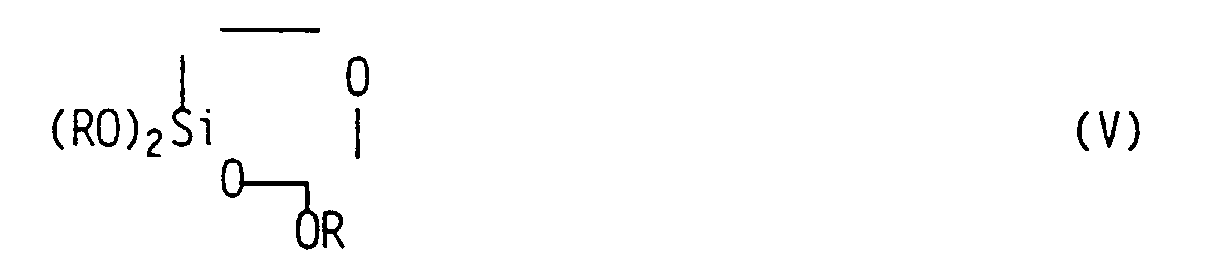
- trimethoxysilane The conversion of trimethoxysilane is 90%. the selectivity for the desired GLYMO (I) 91.9%. The selectivity for iso-GLYMO is 1.83%. that with tetramethoxysilane 6.05%. High-boiling components are not formed, and no heterocyclic isomeric GLYMO (V) is formed.
- the residence time on the catalyst is 16.8 min. the space-time yield of GLYMO 137.4 mol / (h ⁇ g Pt ).
- the reaction mixture is worked up either batchwise or continuously by distillation. unreacted TMOS and AGE are returned to the reactor.
Landscapes
- Chemical & Material Sciences (AREA)
- Organic Chemistry (AREA)
- Chemical Kinetics & Catalysis (AREA)
- Low-Molecular Organic Synthesis Reactions Using Catalysts (AREA)
- Catalysts (AREA)
Abstract
Description
- Im Gegensatz zur homogen katalysierten Hydrosilylierung treten keine Verluste an Katalysator ein. muß der Katalysator nicht über entsprechende Dosiersysteme in die Reaktion eingeführt und nicht vom Reaktionsgemisch abgetrennt werden
- Infolge einer minimierten Bildung von Nebenprodukten liegt die Selektivität der Bildung der 3-Glycidylpropyltrialkoxysilane (I) bei >90%.
- Der Katalysator und alle Komponenten sind chloridfrei. wodurch die Zersetzung von Trialkoxysilanen (III) zu Tetraalkoxysilanen minimiert wird.
- Die Temperaturführung kann gut kontrolliert werden. was zur Selektivitätsoptimierung beiträgt. Bei Temperaturen bis zu etwa 140°C werden hochsiedende lineare sowie niedrigsiedende cyclische Nebenprodukte nur in sehr geringen Mengen gebildet.
- Das Platin braucht auf dem Trägerstoff nur in sehr kleinen Konzentrationen von 0.01 bis 1 Masse-% vorhanden zu sein.
- Zudem ist der Preis für Platin deutlich niedriger als der für Rhodium.
- Der Katalysator läßt sich in einfacher Weise durch Tränken oder Besprühen des Trägerstoffs mit einer Lösung einer Platin(II)-oder Platin(IV)-Verbindung, Trocknen und anschließende Reduktion der Platin(II)- oder Platin(IV)-Verbindung zum Pt(O) in Wasserstoffatmosphäre herstellen.
- Die Bildung der heterocyclischen Verbindung (V) wird sicher verhindert. weil kein homogen geloster Katalysator in die Destillation gelangen kann.
- Infolgedessen ist das Reaktionsgemisch leichter auftrennbar. weil keine heterocyclische Verbindung (V) abgetrennt werden muß.
- Die Isomerisierung des Allylglycidylethers (II) zum 1-Methylvinylglycidylether. die in einem homogenen Reaktionssystem begünstigt wird. wird minimiert. so daß man mit weniger Allylglycidylether (II) auskommt.
- Das Verfahren wird ohne ein Carbonsäureamid durchgeführt. was die Gewinnung von reinem Hydrosilylierungsprodukt erleichtert.
Die folgenden Beispiele werden gegeben. um das Verfahren nach der Erfindung weiter zu erläutern. nicht jedoch um seinen Anwendungsberereich zu begrenzen. wie er in den Patentansprüchen dargelegt ist.
| Stoff | Menge (g) |
| Trimethoxysilan (III) | 49.0 |
| Allylglycidylether (II) | 12.2 |
| 3-Glycidyloxypropyltrimethoxysilan (I) | 522.3 |
| 1-Methylvinylglycidylether | 80.45 |
| iso-3-Glycidyloxypropyltrimethoxysilan (IV) | 8.25 |
| Tetramethoxysilan | 17.8 |
| Stoff | Menge (g/h) |
| Trimethoxysilan (III) | 28.4 |
| Allylglycidylether (II) | 8.5 |
| 3-Glycidyloxypropyltrimethoxysilan (I) | 454.7 |
| 1-Methylvinylglycidylether | 59.8 |
| iso-3-Glycidyloxypropyltrimethoxysilan (IV) | 9.1 |
| Tetramethoxysilan | 19.3 |
Claims (11)
- Verfahren zur Herstellung von 3-Glycidyloxypropyltrialkoxysilanen der allgemeinen Formel
- Verfahren nach Anspruch 1. dadurch gekennzeichnet. daß R für einen Alkylrest mit 1 bis 4 Kohlenstoffatomen steht.
- Verfahren nach Anspruch 1, dadurch gekennzeichnet. daß R für einen Methyl- oder Ethylrest steht.
- Verfahren nach einem der Ansprüche 1 bis 4. dadurch daß der Allylglycidylether (II) und das Trialkoxysilan (III) in einem molaren Verhältnis von 0.1 bis 10 eingesetzt werden.
- Verfahren nach Anspruch 1, dadurch gekennzeichnet, daß das molare Verhältnis 0.25 bis 4 beträgt.
- Verfahren nach einem der Ansprüche 1 bis 5, dadurch gekennzeichnet. daß der Massenanteil des Platins am Katalysator 0.01 bis 1.0% beträgt. der Trägerstoff aus Aktivkohle, Aluminiumoxid oder Siliciumdioxid besteht und die spezifische Oberfläche des Katalysators zwischen 10 und 400 m2/g liegt.
- Verfahren nach Anspruch 6. dadurch gekennzeichnet. daß der Massenanteil des Platins an dem Katalysator 0.02 bis 0.1% beträgt.
- Verfahren nach Anspruch 6 oder 7. dadurch gekennzeichnet, daß der Katalysator halogenidfrei ist.
- Verfahren nach einem der Ansprüche 1 bis 8, dadurch gekennzeichnet, daß die Reaktion bei einer Temperatur zwischen 20 und 200°C und unter einem Druck von 1 bis 20 bar abs, durchgeführt wird.
- Verfahren nach Anspruch 9, dadurch gekennzeichnet. daß die Temperatur zwischen 60 und 160°C liegt.
- Verfahren nach einem der Ansprüche 1 bis 10, dadurch gekennzeichnet, daß die Reaktion an einem Katalysatorfestbett in einem Rohrreaktor mit oder ohne Kreislauf. einem Rohrbündelreaktor. einem Hordenraktor oder einem Kreuzstromreaktor durchgeführt wird.
Applications Claiming Priority (2)
| Application Number | Priority Date | Filing Date | Title |
|---|---|---|---|
| DE19805083A DE19805083A1 (de) | 1998-02-09 | 1998-02-09 | Verfahren zur Herstellung von 3-Glycidyloxypropyltrialkoxysilanen |
| DE19805083 | 1998-02-09 |
Publications (3)
| Publication Number | Publication Date |
|---|---|
| EP0934947A2 true EP0934947A2 (de) | 1999-08-11 |
| EP0934947A3 EP0934947A3 (de) | 2000-11-22 |
| EP0934947B1 EP0934947B1 (de) | 2003-05-28 |
Family
ID=7857071
Family Applications (1)
| Application Number | Title | Priority Date | Filing Date |
|---|---|---|---|
| EP98124625A Expired - Lifetime EP0934947B1 (de) | 1998-02-09 | 1998-12-23 | Verfahren zur Herstellung von 3-Glycidyloxypropyltrialkoxysilanen |
Country Status (4)
| Country | Link |
|---|---|
| US (1) | US6100408A (de) |
| EP (1) | EP0934947B1 (de) |
| JP (1) | JPH11315083A (de) |
| DE (2) | DE19805083A1 (de) |
Cited By (4)
| Publication number | Priority date | Publication date | Assignee | Title |
|---|---|---|---|---|
| EP1669363A1 (de) * | 2004-12-01 | 2006-06-14 | Wacker Chemie AG | Verfahren zur kontinuierlichen Hydrosilylierung |
| WO2008017561A1 (de) * | 2006-08-10 | 2008-02-14 | Evonik Degussa Gmbh | Anlage und verfahren zur kontinuierlichen industriellen herstellung von 3-glycidyloxypropylalkoxysilanen |
| EP1783131A4 (de) * | 2004-08-24 | 2009-03-11 | Toagosei Co Ltd | Verfahren zur herstellung einer siliciumorganischen verbindung |
| WO2013066983A1 (en) * | 2011-10-31 | 2013-05-10 | Momentive Performance Materials Inc. | Process of manufacturing organosilicon products with improved quality using heterogeneous precious metal catalysts |
Families Citing this family (12)
| Publication number | Priority date | Publication date | Assignee | Title |
|---|---|---|---|---|
| DE19934576C2 (de) * | 1999-07-23 | 2003-12-18 | Degussa | Verfahren zur Herstellung von Epoxysilanen |
| WO2001074927A1 (en) | 2000-03-31 | 2001-10-11 | Hitachi Chemical Co., Ltd. | Process for producing novel silicone polymer, silicone polymer produced by the process, thermosetting resin composition, resin film, metal foil with insulating material, insulating film with metal foil on each side, metal-clad laminate, multilayered metal-clad laminate, and multilayered printed circuit board |
| GB0118858D0 (en) * | 2001-08-02 | 2001-09-26 | Dow Corning | Hydrosilylation process |
| JP5550118B2 (ja) * | 2002-09-26 | 2014-07-16 | 日立化成株式会社 | ボラジン系樹脂組成物、絶縁被膜及びその形成方法 |
| US7625642B2 (en) * | 2002-09-26 | 2009-12-01 | Hitachi Chemical Co., Ltd | Borazine-based resin, and method for production thereof, borazine based resin composition, insulating coating and method for formation thereof, and electronic parts having the insulating coating |
| JP4730724B2 (ja) * | 2002-09-26 | 2011-07-20 | 日立化成工業株式会社 | ボラジン系樹脂の製造方法 |
| DE102007007185A1 (de) * | 2007-02-09 | 2008-08-14 | Evonik Degussa Gmbh | Verfahren zur Herstellung von Glycidyloxyalkyltrialkoxysilanen |
| CN101307070A (zh) * | 2007-05-15 | 2008-11-19 | 德古萨有限责任公司 | 制备环氧硅烷的方法 |
| DE102007050199A1 (de) * | 2007-10-20 | 2009-04-23 | Evonik Degussa Gmbh | Entfernung von Fremdmetallen aus anorganischen Silanen |
| US11219892B2 (en) * | 2017-10-06 | 2022-01-11 | Virginia Commonwealth University | Carbon based materials as solid-state ligands for metal nanoparticle catalysts |
| DE102018210886A1 (de) | 2018-07-03 | 2020-01-09 | Evonik Degussa Gmbh | Verfahren zur Herstellung von Alkylalkoxysilanen |
| CN115722247B (zh) * | 2022-11-17 | 2024-06-04 | 山东阳谷华泰化工股份有限公司 | 一种用于合成硅烷偶联剂kh-560的非均相催化剂及其制备方法与应用 |
Family Cites Families (6)
| Publication number | Priority date | Publication date | Assignee | Title |
|---|---|---|---|---|
| JPH0633288B2 (ja) * | 1986-10-06 | 1994-05-02 | 東レ・ダウコ−ニング・シリコ−ン株式会社 | 付加反応方法 |
| JPH0788394B2 (ja) * | 1987-04-22 | 1995-09-27 | 東燃株式会社 | エポキシ基含有シラン化合物の製造方法 |
| JPH02255689A (ja) * | 1989-03-29 | 1990-10-16 | Toshiba Silicone Co Ltd | グリシドキシ基含有有機ケイ素化合物 |
| US5250490A (en) * | 1991-12-24 | 1993-10-05 | Union Carbide Chemicals & Plastics Technology Corporation | Noble metal supported on a base metal catalyst |
| KR940005716A (ko) * | 1992-06-11 | 1994-03-22 | 아더 엠. 킹 | 에폭시실리콘 단량체 및 중합체의 합성을 위한 선택적 촉매 |
| KR0141464B1 (ko) * | 1993-12-01 | 1998-07-01 | 김은영 | 알릴알킬실란 화합물 및 그의 제조방법 |
-
1998
- 1998-02-09 DE DE19805083A patent/DE19805083A1/de not_active Withdrawn
- 1998-12-23 EP EP98124625A patent/EP0934947B1/de not_active Expired - Lifetime
- 1998-12-23 DE DE59808528T patent/DE59808528D1/de not_active Expired - Lifetime
-
1999
- 1999-02-08 JP JP11030128A patent/JPH11315083A/ja active Pending
- 1999-02-09 US US09/246,953 patent/US6100408A/en not_active Expired - Lifetime
Cited By (10)
| Publication number | Priority date | Publication date | Assignee | Title |
|---|---|---|---|---|
| EP1783131A4 (de) * | 2004-08-24 | 2009-03-11 | Toagosei Co Ltd | Verfahren zur herstellung einer siliciumorganischen verbindung |
| EP1669363A1 (de) * | 2004-12-01 | 2006-06-14 | Wacker Chemie AG | Verfahren zur kontinuierlichen Hydrosilylierung |
| US7145028B2 (en) | 2004-12-01 | 2006-12-05 | Wacker Chemie Ag | Continuous hydrosilylation process |
| KR100715465B1 (ko) * | 2004-12-01 | 2007-05-07 | 와커 헤미 아게 | 연속 히드로실릴화 방법 |
| CN100393728C (zh) * | 2004-12-01 | 2008-06-11 | 瓦克化学股份公司 | 连续氢化硅烷化的方法 |
| WO2008017561A1 (de) * | 2006-08-10 | 2008-02-14 | Evonik Degussa Gmbh | Anlage und verfahren zur kontinuierlichen industriellen herstellung von 3-glycidyloxypropylalkoxysilanen |
| WO2013066983A1 (en) * | 2011-10-31 | 2013-05-10 | Momentive Performance Materials Inc. | Process of manufacturing organosilicon products with improved quality using heterogeneous precious metal catalysts |
| US8497338B2 (en) | 2011-10-31 | 2013-07-30 | Momentive Performance Materials Inc. | Process of manufacturing organosilicon products with improved quality using heterogeneous precious metal catalysts |
| CN103987759A (zh) * | 2011-10-31 | 2014-08-13 | 莫门蒂夫性能材料股份有限公司 | 使用非均相贵金属催化剂制备具有改善品质的有机硅产品的方法 |
| CN103987759B (zh) * | 2011-10-31 | 2016-11-02 | 莫门蒂夫性能材料股份有限公司 | 使用非均相贵金属催化剂制备具有改善品质的有机硅产品的方法 |
Also Published As
| Publication number | Publication date |
|---|---|
| JPH11315083A (ja) | 1999-11-16 |
| EP0934947B1 (de) | 2003-05-28 |
| US6100408A (en) | 2000-08-08 |
| DE19805083A1 (de) | 1999-08-12 |
| DE59808528D1 (de) | 2003-07-03 |
| EP0934947A3 (de) | 2000-11-22 |
Similar Documents
| Publication | Publication Date | Title |
|---|---|---|
| EP0934947B1 (de) | Verfahren zur Herstellung von 3-Glycidyloxypropyltrialkoxysilanen | |
| DE69130599T2 (de) | Verfahren zur Herstellung von Vinylalkoxysilanen | |
| EP2114963B1 (de) | Verfahren zur herstellung von glycidyloxyalkyltrialkoxysilanen | |
| EP1245271A2 (de) | Vorrichtung und Verfahren zur Herstellung von im Wesentlichen halogenfreien Trialkoxysilanen | |
| EP1191017B1 (de) | Verfahren zur Herstellung von Oximen | |
| EP0638575A2 (de) | Verfahren zur Herstellung von Diorganodialkoxysilanen | |
| EP1306381B1 (de) | Verfahren zur Hydrosilylierung ungesättigter aliphatischer Verbindungen | |
| DE3404703C2 (de) | ||
| DE60203900T2 (de) | Direktsynthese von wasserstoffperoxid in einem mehrkomponenten-lösungsmittelsystem | |
| EP3372609B1 (de) | Verfahren zur herstellung von tris[3-(alkoxysilyl)propyl]isocyanuraten | |
| EP3441397B1 (de) | Verfahren zur herstellung von 3-glycidyloxypropyltrialkoxysilanen | |
| EP3372608B1 (de) | Verfahren zur herstellung von tris[3-(alkoxysilyl)propyl]isocyanuraten | |
| DE1165028B (de) | Verfahren zur Herstellung von siliciumhaltigen Kohlenwasserstoffen durch Addition von Hydrogensilanen an ungesaettigte Kohlenwasserstoffe | |
| EP0823434A1 (de) | Verfahren zur kontinuierlichen Herstellung von 3-Halogen-Propyl-Organosilanen | |
| DE69130433T2 (de) | Verfahren zur Herstellung von Cyclopentyl-trichlorosilan | |
| DE69107164T2 (de) | Synthesis von Ethylamine. | |
| EP0806427A2 (de) | Verfahren zur Herstellung von vinylierten Silicium-organischen Verbindungen | |
| EP0709392B1 (de) | Verfahren zur Herstellung von 3-Halogen- bzw. -Pseudohalogen-alkylsilanestern | |
| EP1174433A2 (de) | Verfahren zur Herstellung von Vinylsilanen | |
| WO2006108748A1 (de) | Verfahren zur herstellung von wasserstoffperoxid | |
| EP1063217A1 (de) | Verfahren zur Herstellung von Oxoisophoron in Gegenwart eines oder mehrerer Azetatsalze | |
| DE2061538C3 (de) | Verfahren zur Herstellung von Kobalt (III)-bis-salicylaldehydäthylendiiminat -Komplexen | |
| DE2936652C2 (de) | Verfahren zur Herstellung von Gluconsäure- delta -lacton | |
| DE69011244T2 (de) | Verfahren zur Herstellung von alpha-beta-ungesättigten Carbonylverbindungen. | |
| DE3507424C2 (de) | Verfahren zur Herstellung von Dialkyldichlorsilanen hoher Reinheit |
Legal Events
| Date | Code | Title | Description |
|---|---|---|---|
| PUAI | Public reference made under article 153(3) epc to a published international application that has entered the european phase |
Free format text: ORIGINAL CODE: 0009012 |
|
| AK | Designated contracting states |
Kind code of ref document: A2 Designated state(s): BE DE ES FR GB IT NL |
|
| AX | Request for extension of the european patent |
Free format text: AL;LT;LV;MK;RO;SI |
|
| RAP1 | Party data changed (applicant data changed or rights of an application transferred) |
Owner name: DEGUSSA-HUELS AKTIENGESELLSCHAFT |
|
| PUAL | Search report despatched |
Free format text: ORIGINAL CODE: 0009013 |
|
| AK | Designated contracting states |
Kind code of ref document: A3 Designated state(s): AT BE CH CY DE DK ES FI FR GB GR IE IT LI LU MC NL PT SE |
|
| AX | Request for extension of the european patent |
Free format text: AL;LT;LV;MK;RO;SI |
|
| RAP1 | Party data changed (applicant data changed or rights of an application transferred) |
Owner name: DEGUSSA AG |
|
| 17P | Request for examination filed |
Effective date: 20010430 |
|
| AKX | Designation fees paid |
Free format text: BE DE ES FR GB IT NL |
|
| 17Q | First examination report despatched |
Effective date: 20020328 |
|
| GRAH | Despatch of communication of intention to grant a patent |
Free format text: ORIGINAL CODE: EPIDOS IGRA |
|
| RTI1 | Title (correction) |
Free format text: PROCESS FOR PREPARING 3-GLYCIDYLOXYPROPYLTRIALKOXYSILANES |
|
| GRAH | Despatch of communication of intention to grant a patent |
Free format text: ORIGINAL CODE: EPIDOS IGRA |
|
| GRAA | (expected) grant |
Free format text: ORIGINAL CODE: 0009210 |
|
| AK | Designated contracting states |
Designated state(s): BE DE ES FR GB IT NL |
|
| PG25 | Lapsed in a contracting state [announced via postgrant information from national office to epo] |
Ref country code: NL Free format text: LAPSE BECAUSE OF FAILURE TO SUBMIT A TRANSLATION OF THE DESCRIPTION OR TO PAY THE FEE WITHIN THE PRESCRIBED TIME-LIMIT Effective date: 20030528 |
|
| REG | Reference to a national code |
Ref country code: GB Ref legal event code: FG4D Free format text: NOT ENGLISH |
|
| REF | Corresponds to: |
Ref document number: 59808528 Country of ref document: DE Date of ref document: 20030703 Kind code of ref document: P |
|
| GBT | Gb: translation of ep patent filed (gb section 77(6)(a)/1977) | ||
| PG25 | Lapsed in a contracting state [announced via postgrant information from national office to epo] |
Ref country code: ES Free format text: LAPSE BECAUSE OF FAILURE TO SUBMIT A TRANSLATION OF THE DESCRIPTION OR TO PAY THE FEE WITHIN THE PRESCRIBED TIME-LIMIT Effective date: 20030908 |
|
| NLV1 | Nl: lapsed or annulled due to failure to fulfill the requirements of art. 29p and 29m of the patents act | ||
| ET | Fr: translation filed | ||
| PLBE | No opposition filed within time limit |
Free format text: ORIGINAL CODE: 0009261 |
|
| STAA | Information on the status of an ep patent application or granted ep patent |
Free format text: STATUS: NO OPPOSITION FILED WITHIN TIME LIMIT |
|
| 26N | No opposition filed |
Effective date: 20040302 |
|
| PGFP | Annual fee paid to national office [announced via postgrant information from national office to epo] |
Ref country code: FR Payment date: 20041213 Year of fee payment: 7 |
|
| PG25 | Lapsed in a contracting state [announced via postgrant information from national office to epo] |
Ref country code: FR Free format text: LAPSE BECAUSE OF NON-PAYMENT OF DUE FEES Effective date: 20060831 |
|
| REG | Reference to a national code |
Ref country code: FR Ref legal event code: ST Effective date: 20060831 |
|
| PGFP | Annual fee paid to national office [announced via postgrant information from national office to epo] |
Ref country code: GB Payment date: 20121220 Year of fee payment: 15 |
|
| GBPC | Gb: european patent ceased through non-payment of renewal fee |
Effective date: 20131223 |
|
| PG25 | Lapsed in a contracting state [announced via postgrant information from national office to epo] |
Ref country code: GB Free format text: LAPSE BECAUSE OF NON-PAYMENT OF DUE FEES Effective date: 20131223 |
|
| PGFP | Annual fee paid to national office [announced via postgrant information from national office to epo] |
Ref country code: DE Payment date: 20141211 Year of fee payment: 17 |
|
| PGFP | Annual fee paid to national office [announced via postgrant information from national office to epo] |
Ref country code: IT Payment date: 20141219 Year of fee payment: 17 |
|
| PGFP | Annual fee paid to national office [announced via postgrant information from national office to epo] |
Ref country code: BE Payment date: 20141219 Year of fee payment: 17 |
|
| PG25 | Lapsed in a contracting state [announced via postgrant information from national office to epo] |
Ref country code: BE Free format text: LAPSE BECAUSE OF NON-PAYMENT OF DUE FEES Effective date: 20151231 |
|
| REG | Reference to a national code |
Ref country code: DE Ref legal event code: R119 Ref document number: 59808528 Country of ref document: DE |
|
| PG25 | Lapsed in a contracting state [announced via postgrant information from national office to epo] |
Ref country code: DE Free format text: LAPSE BECAUSE OF NON-PAYMENT OF DUE FEES Effective date: 20160701 |
|
| PG25 | Lapsed in a contracting state [announced via postgrant information from national office to epo] |
Ref country code: IT Free format text: LAPSE BECAUSE OF NON-PAYMENT OF DUE FEES Effective date: 20151223 |