EP0939671B2 - Absorbant de dioxyde de carbone utilise en anesthesiologie - Google Patents
Absorbant de dioxyde de carbone utilise en anesthesiologie Download PDFInfo
- Publication number
- EP0939671B2 EP0939671B2 EP97952832.0A EP97952832A EP0939671B2 EP 0939671 B2 EP0939671 B2 EP 0939671B2 EP 97952832 A EP97952832 A EP 97952832A EP 0939671 B2 EP0939671 B2 EP 0939671B2
- Authority
- EP
- European Patent Office
- Prior art keywords
- carbon dioxide
- absorbent
- humectant
- dioxide absorbent
- hydroxide
- Prior art date
- Legal status (The legal status is an assumption and is not a legal conclusion. Google has not performed a legal analysis and makes no representation as to the accuracy of the status listed.)
- Expired - Lifetime
Links
- CURLTUGMZLYLDI-UHFFFAOYSA-N Carbon dioxide Chemical compound O=C=O CURLTUGMZLYLDI-UHFFFAOYSA-N 0.000 title claims abstract description 133
- 239000002250 absorbent Substances 0.000 title claims abstract description 91
- 230000002745 absorbent Effects 0.000 title claims abstract description 91
- 229910002092 carbon dioxide Inorganic materials 0.000 title claims abstract description 71
- 239000001569 carbon dioxide Substances 0.000 title claims abstract description 62
- KWYUFKZDYYNOTN-UHFFFAOYSA-M Potassium hydroxide Chemical compound [OH-].[K+] KWYUFKZDYYNOTN-UHFFFAOYSA-M 0.000 claims abstract description 25
- AXCZMVOFGPJBDE-UHFFFAOYSA-L calcium dihydroxide Chemical compound [OH-].[OH-].[Ca+2] AXCZMVOFGPJBDE-UHFFFAOYSA-L 0.000 claims abstract description 25
- 239000000920 calcium hydroxide Substances 0.000 claims abstract description 25
- 229910001861 calcium hydroxide Inorganic materials 0.000 claims abstract description 25
- 239000003906 humectant Substances 0.000 claims abstract description 24
- 239000000843 powder Substances 0.000 claims abstract description 23
- 239000003795 chemical substances by application Substances 0.000 claims abstract description 13
- HEMHJVSKTPXQMS-UHFFFAOYSA-M sodium hydroxide Inorganic materials [OH-].[Na+] HEMHJVSKTPXQMS-UHFFFAOYSA-M 0.000 claims abstract description 13
- 239000004411 aluminium Substances 0.000 claims abstract description 11
- 229910052782 aluminium Inorganic materials 0.000 claims abstract description 11
- XAGFODPZIPBFFR-UHFFFAOYSA-N aluminium Chemical compound [Al] XAGFODPZIPBFFR-UHFFFAOYSA-N 0.000 claims abstract description 11
- ZOMBKNNSYQHRCA-UHFFFAOYSA-J calcium sulfate hemihydrate Chemical compound O.[Ca+2].[Ca+2].[O-]S([O-])(=O)=O.[O-]S([O-])(=O)=O ZOMBKNNSYQHRCA-UHFFFAOYSA-J 0.000 claims abstract description 10
- 239000002184 metal Substances 0.000 claims abstract description 10
- 229910052751 metal Inorganic materials 0.000 claims abstract description 9
- DGAQECJNVWCQMB-PUAWFVPOSA-M Ilexoside XXIX Chemical compound C[C@@H]1CC[C@@]2(CC[C@@]3(C(=CC[C@H]4[C@]3(CC[C@@H]5[C@@]4(CC[C@@H](C5(C)C)OS(=O)(=O)[O-])C)C)[C@@H]2[C@]1(C)O)C)C(=O)O[C@H]6[C@@H]([C@H]([C@@H]([C@H](O6)CO)O)O)O.[Na+] DGAQECJNVWCQMB-PUAWFVPOSA-M 0.000 claims abstract description 7
- 239000001257 hydrogen Substances 0.000 claims abstract description 4
- 229910052739 hydrogen Inorganic materials 0.000 claims abstract description 4
- PEDCQBHIVMGVHV-UHFFFAOYSA-N Glycerine Chemical compound OCC(O)CO PEDCQBHIVMGVHV-UHFFFAOYSA-N 0.000 claims description 54
- XLYOFNOQVPJJNP-UHFFFAOYSA-N water Substances O XLYOFNOQVPJJNP-UHFFFAOYSA-N 0.000 claims description 33
- 239000000203 mixture Substances 0.000 claims description 26
- QHFQAJHNDKBRBO-UHFFFAOYSA-L calcium chloride hexahydrate Chemical compound O.O.O.O.O.O.[Cl-].[Cl-].[Ca+2] QHFQAJHNDKBRBO-UHFFFAOYSA-L 0.000 claims description 10
- 238000003109 Karl Fischer titration Methods 0.000 claims description 8
- 239000000126 substance Substances 0.000 claims description 7
- DNIAPMSPPWPWGF-UHFFFAOYSA-N Propylene glycol Chemical compound CC(O)CO DNIAPMSPPWPWGF-UHFFFAOYSA-N 0.000 claims description 6
- 229920001223 polyethylene glycol Polymers 0.000 claims description 6
- UFHFLCQGNIYNRP-UHFFFAOYSA-N Hydrogen Chemical compound [H][H] UFHFLCQGNIYNRP-UHFFFAOYSA-N 0.000 claims description 3
- 229940050906 magnesium chloride hexahydrate Drugs 0.000 claims description 3
- DHRRIBDTHFBPNG-UHFFFAOYSA-L magnesium dichloride hexahydrate Chemical compound O.O.O.O.O.O.[Mg+2].[Cl-].[Cl-] DHRRIBDTHFBPNG-UHFFFAOYSA-L 0.000 claims description 3
- ZWVMLYRJXORSEP-UHFFFAOYSA-N 1,2,6-Hexanetriol Chemical compound OCCCCC(O)CO ZWVMLYRJXORSEP-UHFFFAOYSA-N 0.000 claims description 2
- 229940113115 polyethylene glycol 200 Drugs 0.000 claims description 2
- 239000002202 Polyethylene glycol Substances 0.000 claims 1
- 229960005150 glycerol Drugs 0.000 claims 1
- 229940068886 polyethylene glycol 300 Drugs 0.000 claims 1
- 230000003444 anaesthetic effect Effects 0.000 abstract description 12
- 229940124326 anaesthetic agent Drugs 0.000 abstract description 6
- PIWKPBJCKXDKJR-UHFFFAOYSA-N Isoflurane Chemical compound FC(F)OC(Cl)C(F)(F)F PIWKPBJCKXDKJR-UHFFFAOYSA-N 0.000 abstract description 5
- 229960003537 desflurane Drugs 0.000 abstract description 5
- DPYMFVXJLLWWEU-UHFFFAOYSA-N desflurane Chemical compound FC(F)OC(F)C(F)(F)F DPYMFVXJLLWWEU-UHFFFAOYSA-N 0.000 abstract description 5
- 229960000305 enflurane Drugs 0.000 abstract description 5
- JPGQOUSTVILISH-UHFFFAOYSA-N enflurane Chemical compound FC(F)OC(F)(F)C(F)Cl JPGQOUSTVILISH-UHFFFAOYSA-N 0.000 abstract description 5
- 229960002725 isoflurane Drugs 0.000 abstract description 5
- XLYOFNOQVPJJNP-UHFFFAOYSA-M hydroxide Chemical compound [OH-] XLYOFNOQVPJJNP-UHFFFAOYSA-M 0.000 abstract description 3
- 229960002078 sevoflurane Drugs 0.000 abstract description 3
- DFEYYRMXOJXZRJ-UHFFFAOYSA-N sevoflurane Chemical compound FCOC(C(F)(F)F)C(F)(F)F DFEYYRMXOJXZRJ-UHFFFAOYSA-N 0.000 abstract description 3
- 125000004435 hydrogen atom Chemical class [H]* 0.000 abstract 1
- 235000011116 calcium hydroxide Nutrition 0.000 description 22
- 239000008187 granular material Substances 0.000 description 22
- HUAUNKAZQWMVFY-UHFFFAOYSA-M sodium;oxocalcium;hydroxide Chemical compound [OH-].[Na+].[Ca]=O HUAUNKAZQWMVFY-UHFFFAOYSA-M 0.000 description 19
- 238000010521 absorption reaction Methods 0.000 description 15
- UGFAIRIUMAVXCW-UHFFFAOYSA-N Carbon monoxide Chemical compound [O+]#[C-] UGFAIRIUMAVXCW-UHFFFAOYSA-N 0.000 description 11
- 229910002091 carbon monoxide Inorganic materials 0.000 description 11
- UXVMQQNJUSDDNG-UHFFFAOYSA-L Calcium chloride Chemical compound [Cl-].[Cl-].[Ca+2] UXVMQQNJUSDDNG-UHFFFAOYSA-L 0.000 description 9
- 239000001110 calcium chloride Substances 0.000 description 9
- 229910001628 calcium chloride Inorganic materials 0.000 description 9
- 239000007789 gas Substances 0.000 description 8
- 239000007787 solid Substances 0.000 description 8
- OSGAYBCDTDRGGQ-UHFFFAOYSA-L calcium sulfate Inorganic materials [Ca+2].[O-]S([O-])(=O)=O OSGAYBCDTDRGGQ-UHFFFAOYSA-L 0.000 description 7
- 239000011507 gypsum plaster Substances 0.000 description 7
- 235000011118 potassium hydroxide Nutrition 0.000 description 7
- 229940126062 Compound A Drugs 0.000 description 6
- NLDMNSXOCDLTTB-UHFFFAOYSA-N Heterophylliin A Natural products O1C2COC(=O)C3=CC(O)=C(O)C(O)=C3C3=C(O)C(O)=C(O)C=C3C(=O)OC2C(OC(=O)C=2C=C(O)C(O)=C(O)C=2)C(O)C1OC(=O)C1=CC(O)=C(O)C(O)=C1 NLDMNSXOCDLTTB-UHFFFAOYSA-N 0.000 description 6
- 238000000034 method Methods 0.000 description 6
- XPDWGBQVDMORPB-UHFFFAOYSA-N Fluoroform Chemical compound FC(F)F XPDWGBQVDMORPB-UHFFFAOYSA-N 0.000 description 5
- 239000006096 absorbing agent Substances 0.000 description 5
- 206010002091 Anaesthesia Diseases 0.000 description 4
- HEDRZPFGACZZDS-UHFFFAOYSA-N Chloroform Chemical compound ClC(Cl)Cl HEDRZPFGACZZDS-UHFFFAOYSA-N 0.000 description 4
- TWRXJAOTZQYOKJ-UHFFFAOYSA-L Magnesium chloride Chemical compound [Mg+2].[Cl-].[Cl-] TWRXJAOTZQYOKJ-UHFFFAOYSA-L 0.000 description 4
- GQPLMRYTRLFLPF-UHFFFAOYSA-N Nitrous Oxide Chemical compound [O-][N+]#N GQPLMRYTRLFLPF-UHFFFAOYSA-N 0.000 description 4
- 238000001949 anaesthesia Methods 0.000 description 4
- 230000037005 anaesthesia Effects 0.000 description 4
- 238000006243 chemical reaction Methods 0.000 description 4
- 230000003111 delayed effect Effects 0.000 description 4
- 238000001035 drying Methods 0.000 description 4
- 150000004687 hexahydrates Chemical class 0.000 description 4
- VTYYLEPIZMXCLO-UHFFFAOYSA-L Calcium carbonate Chemical compound [Ca+2].[O-]C([O-])=O VTYYLEPIZMXCLO-UHFFFAOYSA-L 0.000 description 3
- 241001465754 Metazoa Species 0.000 description 3
- XSTXAVWGXDQKEL-UHFFFAOYSA-N Trichloroethylene Chemical group ClC=C(Cl)Cl XSTXAVWGXDQKEL-UHFFFAOYSA-N 0.000 description 3
- 230000015572 biosynthetic process Effects 0.000 description 3
- 238000002474 experimental method Methods 0.000 description 3
- 150000002681 magnesium compounds Chemical class 0.000 description 3
- VTHJTEIRLNZDEV-UHFFFAOYSA-L magnesium dihydroxide Chemical compound [OH-].[OH-].[Mg+2] VTHJTEIRLNZDEV-UHFFFAOYSA-L 0.000 description 3
- 235000012254 magnesium hydroxide Nutrition 0.000 description 3
- 239000000463 material Substances 0.000 description 3
- 239000011159 matrix material Substances 0.000 description 3
- 239000008188 pellet Substances 0.000 description 3
- 239000000047 product Substances 0.000 description 3
- 239000000243 solution Substances 0.000 description 3
- 231100000331 toxic Toxicity 0.000 description 3
- 230000002588 toxic effect Effects 0.000 description 3
- LYCAIKOWRPUZTN-UHFFFAOYSA-N Ethylene glycol Chemical compound OCCO LYCAIKOWRPUZTN-UHFFFAOYSA-N 0.000 description 2
- 229920000604 Polyethylene Glycol 200 Polymers 0.000 description 2
- CDBYLPFSWZWCQE-UHFFFAOYSA-L Sodium Carbonate Chemical compound [Na+].[Na+].[O-]C([O-])=O CDBYLPFSWZWCQE-UHFFFAOYSA-L 0.000 description 2
- 238000005904 alkaline hydrolysis reaction Methods 0.000 description 2
- 150000001336 alkenes Chemical class 0.000 description 2
- 239000007864 aqueous solution Substances 0.000 description 2
- QVGXLLKOCUKJST-UHFFFAOYSA-N atomic oxygen Chemical compound [O] QVGXLLKOCUKJST-UHFFFAOYSA-N 0.000 description 2
- 239000006227 byproduct Substances 0.000 description 2
- 229910000019 calcium carbonate Inorganic materials 0.000 description 2
- 150000001875 compounds Chemical class 0.000 description 2
- 239000013078 crystal Substances 0.000 description 2
- 238000000354 decomposition reaction Methods 0.000 description 2
- 239000000428 dust Substances 0.000 description 2
- 230000000694 effects Effects 0.000 description 2
- 150000004677 hydrates Chemical class 0.000 description 2
- 230000036571 hydration Effects 0.000 description 2
- 238000006703 hydration reaction Methods 0.000 description 2
- 238000010348 incorporation Methods 0.000 description 2
- 229960002337 magnesium chloride Drugs 0.000 description 2
- 229910001629 magnesium chloride Inorganic materials 0.000 description 2
- 239000000347 magnesium hydroxide Substances 0.000 description 2
- 229910001862 magnesium hydroxide Inorganic materials 0.000 description 2
- 238000004519 manufacturing process Methods 0.000 description 2
- 239000001272 nitrous oxide Substances 0.000 description 2
- JRZJOMJEPLMPRA-UHFFFAOYSA-N olefin Natural products CCCCCCCC=C JRZJOMJEPLMPRA-UHFFFAOYSA-N 0.000 description 2
- 239000001301 oxygen Substances 0.000 description 2
- 229910052760 oxygen Inorganic materials 0.000 description 2
- 230000002035 prolonged effect Effects 0.000 description 2
- 239000011734 sodium Substances 0.000 description 2
- 229910052708 sodium Inorganic materials 0.000 description 2
- 235000011121 sodium hydroxide Nutrition 0.000 description 2
- UBOXGVDOUJQMTN-UHFFFAOYSA-N trichloroethylene Natural products ClCC(Cl)Cl UBOXGVDOUJQMTN-UHFFFAOYSA-N 0.000 description 2
- OYPRJOBELJOOCE-UHFFFAOYSA-N Calcium Chemical compound [Ca] OYPRJOBELJOOCE-UHFFFAOYSA-N 0.000 description 1
- 208000001408 Carbon monoxide poisoning Diseases 0.000 description 1
- 235000008733 Citrus aurantifolia Nutrition 0.000 description 1
- 208000019736 Cranial nerve disease Diseases 0.000 description 1
- ZMJOVJSTYLQINE-UHFFFAOYSA-N Dichloroacetylene Chemical group ClC#CCl ZMJOVJSTYLQINE-UHFFFAOYSA-N 0.000 description 1
- VEXZGXHMUGYJMC-UHFFFAOYSA-N Hydrochloric acid Chemical group Cl VEXZGXHMUGYJMC-UHFFFAOYSA-N 0.000 description 1
- FYYHWMGAXLPEAU-UHFFFAOYSA-N Magnesium Chemical group [Mg] FYYHWMGAXLPEAU-UHFFFAOYSA-N 0.000 description 1
- 229920002556 Polyethylene Glycol 300 Polymers 0.000 description 1
- 241000700159 Rattus Species 0.000 description 1
- 235000011941 Tilia x europaea Nutrition 0.000 description 1
- 239000002253 acid Substances 0.000 description 1
- 239000003513 alkali Substances 0.000 description 1
- 229910001860 alkaline earth metal hydroxide Inorganic materials 0.000 description 1
- 238000004458 analytical method Methods 0.000 description 1
- RQPZNWPYLFFXCP-UHFFFAOYSA-L barium dihydroxide Chemical compound [OH-].[OH-].[Ba+2] RQPZNWPYLFFXCP-UHFFFAOYSA-L 0.000 description 1
- 229910001863 barium hydroxide Inorganic materials 0.000 description 1
- 230000000903 blocking effect Effects 0.000 description 1
- 239000011575 calcium Substances 0.000 description 1
- 229910052791 calcium Inorganic materials 0.000 description 1
- BRPQOXSCLDDYGP-UHFFFAOYSA-N calcium oxide Chemical compound [O-2].[Ca+2] BRPQOXSCLDDYGP-UHFFFAOYSA-N 0.000 description 1
- 230000015556 catabolic process Effects 0.000 description 1
- 239000007795 chemical reaction product Substances 0.000 description 1
- 239000000470 constituent Substances 0.000 description 1
- 238000006731 degradation reaction Methods 0.000 description 1
- 238000006704 dehydrohalogenation reaction Methods 0.000 description 1
- 230000001419 dependent effect Effects 0.000 description 1
- 150000004683 dihydrates Chemical class 0.000 description 1
- 229940079593 drug Drugs 0.000 description 1
- 239000003814 drug Substances 0.000 description 1
- 238000006253 efflorescence Methods 0.000 description 1
- 238000001704 evaporation Methods 0.000 description 1
- 230000008020 evaporation Effects 0.000 description 1
- 125000004785 fluoromethoxy group Chemical group [H]C([H])(F)O* 0.000 description 1
- 235000013305 food Nutrition 0.000 description 1
- 150000004675 formic acid derivatives Chemical class 0.000 description 1
- 238000009472 formulation Methods 0.000 description 1
- 239000003193 general anesthetic agent Substances 0.000 description 1
- 229910052736 halogen Inorganic materials 0.000 description 1
- 238000010438 heat treatment Methods 0.000 description 1
- 150000002431 hydrogen Chemical class 0.000 description 1
- 230000003301 hydrolyzing effect Effects 0.000 description 1
- WGCNASOHLSPBMP-UHFFFAOYSA-N hydroxyacetaldehyde Natural products OCC=O WGCNASOHLSPBMP-UHFFFAOYSA-N 0.000 description 1
- 230000003993 interaction Effects 0.000 description 1
- 231100000518 lethal Toxicity 0.000 description 1
- 230000001665 lethal effect Effects 0.000 description 1
- 239000004571 lime Substances 0.000 description 1
- 239000007788 liquid Substances 0.000 description 1
- 239000007791 liquid phase Substances 0.000 description 1
- 230000014759 maintenance of location Effects 0.000 description 1
- 229910000000 metal hydroxide Inorganic materials 0.000 description 1
- FJQXCDYVZAHXNS-UHFFFAOYSA-N methadone hydrochloride Chemical compound Cl.C=1C=CC=CC=1C(CC(C)N(C)C)(C(=O)CC)C1=CC=CC=C1 FJQXCDYVZAHXNS-UHFFFAOYSA-N 0.000 description 1
- 230000003589 nefrotoxic effect Effects 0.000 description 1
- 231100000381 nephrotoxic Toxicity 0.000 description 1
- 230000003472 neutralizing effect Effects 0.000 description 1
- 150000002894 organic compounds Chemical class 0.000 description 1
- 230000000704 physical effect Effects 0.000 description 1
- 239000002243 precursor Substances 0.000 description 1
- 230000009467 reduction Effects 0.000 description 1
- 238000007493 shaping process Methods 0.000 description 1
- 229910000029 sodium carbonate Inorganic materials 0.000 description 1
- 239000007790 solid phase Substances 0.000 description 1
- 239000002904 solvent Substances 0.000 description 1
- 238000006467 substitution reaction Methods 0.000 description 1
- ZIBGPFATKBEMQZ-UHFFFAOYSA-N triethylene glycol Chemical compound OCCOCCOCCO ZIBGPFATKBEMQZ-UHFFFAOYSA-N 0.000 description 1
- 238000009736 wetting Methods 0.000 description 1
Images




Classifications
-
- A—HUMAN NECESSITIES
- A61—MEDICAL OR VETERINARY SCIENCE; HYGIENE
- A61M—DEVICES FOR INTRODUCING MEDIA INTO, OR ONTO, THE BODY; DEVICES FOR TRANSDUCING BODY MEDIA OR FOR TAKING MEDIA FROM THE BODY; DEVICES FOR PRODUCING OR ENDING SLEEP OR STUPOR
- A61M16/00—Devices for influencing the respiratory system of patients by gas treatment, e.g. ventilators; Tracheal tubes
- A61M16/22—Carbon dioxide-absorbing devices ; Other means for removing carbon dioxide
-
- B—PERFORMING OPERATIONS; TRANSPORTING
- B01—PHYSICAL OR CHEMICAL PROCESSES OR APPARATUS IN GENERAL
- B01D—SEPARATION
- B01D53/00—Separation of gases or vapours; Recovering vapours of volatile solvents from gases; Chemical or biological purification of waste gases, e.g. engine exhaust gases, smoke, fumes, flue gases, aerosols
- B01D53/34—Chemical or biological purification of waste gases
- B01D53/46—Removing components of defined structure
- B01D53/62—Carbon oxides
-
- B—PERFORMING OPERATIONS; TRANSPORTING
- B01—PHYSICAL OR CHEMICAL PROCESSES OR APPARATUS IN GENERAL
- B01J—CHEMICAL OR PHYSICAL PROCESSES, e.g. CATALYSIS OR COLLOID CHEMISTRY; THEIR RELEVANT APPARATUS
- B01J20/00—Solid sorbent compositions or filter aid compositions; Sorbents for chromatography; Processes for preparing, regenerating or reactivating thereof
- B01J20/02—Solid sorbent compositions or filter aid compositions; Sorbents for chromatography; Processes for preparing, regenerating or reactivating thereof comprising inorganic material
- B01J20/0203—Solid sorbent compositions or filter aid compositions; Sorbents for chromatography; Processes for preparing, regenerating or reactivating thereof comprising inorganic material comprising compounds of metals not provided for in B01J20/04
- B01J20/0248—Compounds of B, Al, Ga, In, Tl
-
- B—PERFORMING OPERATIONS; TRANSPORTING
- B01—PHYSICAL OR CHEMICAL PROCESSES OR APPARATUS IN GENERAL
- B01J—CHEMICAL OR PHYSICAL PROCESSES, e.g. CATALYSIS OR COLLOID CHEMISTRY; THEIR RELEVANT APPARATUS
- B01J20/00—Solid sorbent compositions or filter aid compositions; Sorbents for chromatography; Processes for preparing, regenerating or reactivating thereof
- B01J20/02—Solid sorbent compositions or filter aid compositions; Sorbents for chromatography; Processes for preparing, regenerating or reactivating thereof comprising inorganic material
- B01J20/04—Solid sorbent compositions or filter aid compositions; Sorbents for chromatography; Processes for preparing, regenerating or reactivating thereof comprising inorganic material comprising compounds of alkali metals, alkaline earth metals or magnesium
- B01J20/041—Oxides or hydroxides
-
- B—PERFORMING OPERATIONS; TRANSPORTING
- B01—PHYSICAL OR CHEMICAL PROCESSES OR APPARATUS IN GENERAL
- B01J—CHEMICAL OR PHYSICAL PROCESSES, e.g. CATALYSIS OR COLLOID CHEMISTRY; THEIR RELEVANT APPARATUS
- B01J20/00—Solid sorbent compositions or filter aid compositions; Sorbents for chromatography; Processes for preparing, regenerating or reactivating thereof
- B01J20/02—Solid sorbent compositions or filter aid compositions; Sorbents for chromatography; Processes for preparing, regenerating or reactivating thereof comprising inorganic material
- B01J20/04—Solid sorbent compositions or filter aid compositions; Sorbents for chromatography; Processes for preparing, regenerating or reactivating thereof comprising inorganic material comprising compounds of alkali metals, alkaline earth metals or magnesium
- B01J20/045—Solid sorbent compositions or filter aid compositions; Sorbents for chromatography; Processes for preparing, regenerating or reactivating thereof comprising inorganic material comprising compounds of alkali metals, alkaline earth metals or magnesium containing sulfur, e.g. sulfates, thiosulfates, gypsum
-
- B—PERFORMING OPERATIONS; TRANSPORTING
- B01—PHYSICAL OR CHEMICAL PROCESSES OR APPARATUS IN GENERAL
- B01J—CHEMICAL OR PHYSICAL PROCESSES, e.g. CATALYSIS OR COLLOID CHEMISTRY; THEIR RELEVANT APPARATUS
- B01J20/00—Solid sorbent compositions or filter aid compositions; Sorbents for chromatography; Processes for preparing, regenerating or reactivating thereof
- B01J20/02—Solid sorbent compositions or filter aid compositions; Sorbents for chromatography; Processes for preparing, regenerating or reactivating thereof comprising inorganic material
- B01J20/04—Solid sorbent compositions or filter aid compositions; Sorbents for chromatography; Processes for preparing, regenerating or reactivating thereof comprising inorganic material comprising compounds of alkali metals, alkaline earth metals or magnesium
- B01J20/046—Solid sorbent compositions or filter aid compositions; Sorbents for chromatography; Processes for preparing, regenerating or reactivating thereof comprising inorganic material comprising compounds of alkali metals, alkaline earth metals or magnesium containing halogens, e.g. halides
-
- B—PERFORMING OPERATIONS; TRANSPORTING
- B01—PHYSICAL OR CHEMICAL PROCESSES OR APPARATUS IN GENERAL
- B01J—CHEMICAL OR PHYSICAL PROCESSES, e.g. CATALYSIS OR COLLOID CHEMISTRY; THEIR RELEVANT APPARATUS
- B01J20/00—Solid sorbent compositions or filter aid compositions; Sorbents for chromatography; Processes for preparing, regenerating or reactivating thereof
- B01J20/22—Solid sorbent compositions or filter aid compositions; Sorbents for chromatography; Processes for preparing, regenerating or reactivating thereof comprising organic material
- B01J20/26—Synthetic macromolecular compounds
- B01J20/262—Synthetic macromolecular compounds obtained otherwise than by reactions only involving carbon to carbon unsaturated bonds, e.g. obtained by polycondensation
-
- B—PERFORMING OPERATIONS; TRANSPORTING
- B01—PHYSICAL OR CHEMICAL PROCESSES OR APPARATUS IN GENERAL
- B01J—CHEMICAL OR PHYSICAL PROCESSES, e.g. CATALYSIS OR COLLOID CHEMISTRY; THEIR RELEVANT APPARATUS
- B01J20/00—Solid sorbent compositions or filter aid compositions; Sorbents for chromatography; Processes for preparing, regenerating or reactivating thereof
- B01J20/30—Processes for preparing, regenerating, or reactivating
- B01J20/3007—Moulding, shaping or extruding
-
- B—PERFORMING OPERATIONS; TRANSPORTING
- B01—PHYSICAL OR CHEMICAL PROCESSES OR APPARATUS IN GENERAL
- B01D—SEPARATION
- B01D2251/00—Reactants
- B01D2251/40—Alkaline earth metal or magnesium compounds
- B01D2251/404—Alkaline earth metal or magnesium compounds of calcium
-
- B—PERFORMING OPERATIONS; TRANSPORTING
- B01—PHYSICAL OR CHEMICAL PROCESSES OR APPARATUS IN GENERAL
- B01D—SEPARATION
- B01D2251/00—Reactants
- B01D2251/60—Inorganic bases or salts
- B01D2251/604—Hydroxides
-
- B—PERFORMING OPERATIONS; TRANSPORTING
- B01—PHYSICAL OR CHEMICAL PROCESSES OR APPARATUS IN GENERAL
- B01D—SEPARATION
- B01D2257/00—Components to be removed
- B01D2257/50—Carbon oxides
- B01D2257/504—Carbon dioxide
-
- B—PERFORMING OPERATIONS; TRANSPORTING
- B01—PHYSICAL OR CHEMICAL PROCESSES OR APPARATUS IN GENERAL
- B01J—CHEMICAL OR PHYSICAL PROCESSES, e.g. CATALYSIS OR COLLOID CHEMISTRY; THEIR RELEVANT APPARATUS
- B01J2220/00—Aspects relating to sorbent materials
- B01J2220/40—Aspects relating to the composition of sorbent or filter aid materials
- B01J2220/42—Materials comprising a mixture of inorganic materials
-
- B—PERFORMING OPERATIONS; TRANSPORTING
- B01—PHYSICAL OR CHEMICAL PROCESSES OR APPARATUS IN GENERAL
- B01J—CHEMICAL OR PHYSICAL PROCESSES, e.g. CATALYSIS OR COLLOID CHEMISTRY; THEIR RELEVANT APPARATUS
- B01J2220/00—Aspects relating to sorbent materials
- B01J2220/40—Aspects relating to the composition of sorbent or filter aid materials
- B01J2220/46—Materials comprising a mixture of inorganic and organic materials
-
- Y—GENERAL TAGGING OF NEW TECHNOLOGICAL DEVELOPMENTS; GENERAL TAGGING OF CROSS-SECTIONAL TECHNOLOGIES SPANNING OVER SEVERAL SECTIONS OF THE IPC; TECHNICAL SUBJECTS COVERED BY FORMER USPC CROSS-REFERENCE ART COLLECTIONS [XRACs] AND DIGESTS
- Y02—TECHNOLOGIES OR APPLICATIONS FOR MITIGATION OR ADAPTATION AGAINST CLIMATE CHANGE
- Y02A—TECHNOLOGIES FOR ADAPTATION TO CLIMATE CHANGE
- Y02A50/00—TECHNOLOGIES FOR ADAPTATION TO CLIMATE CHANGE in human health protection, e.g. against extreme weather
- Y02A50/20—Air quality improvement or preservation, e.g. vehicle emission control or emission reduction by using catalytic converters
-
- Y—GENERAL TAGGING OF NEW TECHNOLOGICAL DEVELOPMENTS; GENERAL TAGGING OF CROSS-SECTIONAL TECHNOLOGIES SPANNING OVER SEVERAL SECTIONS OF THE IPC; TECHNICAL SUBJECTS COVERED BY FORMER USPC CROSS-REFERENCE ART COLLECTIONS [XRACs] AND DIGESTS
- Y02—TECHNOLOGIES OR APPLICATIONS FOR MITIGATION OR ADAPTATION AGAINST CLIMATE CHANGE
- Y02C—CAPTURE, STORAGE, SEQUESTRATION OR DISPOSAL OF GREENHOUSE GASES [GHG]
- Y02C20/00—Capture or disposal of greenhouse gases
- Y02C20/40—Capture or disposal of greenhouse gases of CO2
-
- Y—GENERAL TAGGING OF NEW TECHNOLOGICAL DEVELOPMENTS; GENERAL TAGGING OF CROSS-SECTIONAL TECHNOLOGIES SPANNING OVER SEVERAL SECTIONS OF THE IPC; TECHNICAL SUBJECTS COVERED BY FORMER USPC CROSS-REFERENCE ART COLLECTIONS [XRACs] AND DIGESTS
- Y10—TECHNICAL SUBJECTS COVERED BY FORMER USPC
- Y10S—TECHNICAL SUBJECTS COVERED BY FORMER USPC CROSS-REFERENCE ART COLLECTIONS [XRACs] AND DIGESTS
- Y10S95/00—Gas separation: processes
- Y10S95/90—Solid sorbent
Definitions
- This invention relates to a carbon dioxide absorbent which is intended to be used during low flow or closed circuit anaesthesia.
- Soda lime still remains the carbon dioxide absorbent of choice but it is far from ideal.
- circuits containing organo-halogen anaesthetic vapours tend to chemically react with the sodium and/or potassium hydroxides in the soda lime granules by alkaline hydrolysis, or dehydrohalogenation, with the production of by-products which are very much more toxic than the anaesthetic itself.
- Trilene (TM) trichloroethylene
- US-A-2,322,206 (published on June 23, 1943 ) concerns a carbon dioxide absorbent bonded mixture, containing lime and barium hydroxide. The stability of the bonded mixture is ascribed to its non-hygroscopicity.
- EP-A-0 530 731 (published on March 10, 1993 ) concerns a carbon dioxide absorbent containing a magnesium compound. When the magnesium compound is magnesium hydroxide, water is present.
- EP-A-0 530 731 discloses that, in contrast to calcium hydroxide, magnesium compounds hardly decompose certain anaesthetic gases.
- DE-A-2316214 (published on December 20, 1973 ) concerns granular carbon dioxide absorbents comprising a travertine porous support, calcium hydroxide, water and a glycol.
- JP-A-58177137 (published on October 17, 1983 ) concerns a carbon dioxide absorbent powder mixture for absorbing carbon dioxide generated by foods.
- the powder mixture may include an alkaline metal or alkaline earth metal hydroxide with an inorganic deliquescent material.
- the example includes sodium hydroxide and the dihydrate or hexahydrate of calcium chloride.
- the described carbon dioxide absorbent is physically improved in terms of granule strength by incorporating in the mixture an effective amount of a compatible setting agent, preferably Plaster of Paris (calcium sulphate hemihydrate), to increase the granule crushing strength.
- a compatible setting agent preferably Plaster of Paris (calcium sulphate hemihydrate)
- any suitable setting agent may be used in the absorbent of the invention. It will also be appreciated that, as the amount of setting agent is increased, the absorbent's crushing strength is increased but the absorbent's absorptive efficiency is reduced. The amount of setting agent should, therefore, be kept as low as possible, so as to improve the absorbent's crushing strength whilst not significantly reducing the absorbent's absorptive efficiency. Thus, for plaster of paris, it is preferred to incorporate 4-5.5% (w/w), 4.5-5% (w/w) being more preferred.
- the carbon dioxide absorbent comprises a compatible agent for internal generation of hydrogen, for example, a suitable amount of aluminium metal powder, to swell or "aerate" the granules before hardening, thereby improving the reactive surface area of the granules or pellets.
- Aluminium metal powder is preferred at 0.5-1% (w/w).
- the basic concept in the present invention is the use of calcium hydroxide, which is only soluble in water to the extent of 1 part in 900 of water which nevertheless has a high capacity (reserve of acid neutralising power) for carbon dioxide absorption provided it can remain damp at all times. If such a permanent intrinsic moisture content can be achieved within the matrix of the calcium hydroxide-containing absorbent, without resorting to the hygroscopic property of the sodium or potassium hydroxide of soda lime, then carbon dioxide absorption can take place in low flow or closed circuit anaesthesiology without the production of either "Compound A" or carbon monoxide.
- Such permanent intrinsic moisture contents of the described absorbents are achieved by the incorporation of hygroscopic or deliquescent substances in the mix as humectants - these can be either inorganic or organic in nature.
- the inorganic humectants must be hygroscopic (absorb atmospheric water) or deliquescent (absorb atmospheric water and dissolve in the water thus absorbed).
- the preferred inorganic humectants are hygroscopic or deliquescent hydrates. Suitable hydrates can be readily obtained by evaporation of an aqueous solution of a hydrate-forming compound.
- a preferred inorganic humectant is calcium chloride hexahydrate but a hydrate of magnesium chloride is also suitable.
- magnesium chloride hexahydrate reacts with calcium hydroxide to give magnesium hydroxide
- the by-product of the reaction is calcium chloride, so that the matrix of the absorbent becomes a mixture of calcium and magnesium hydroxides kept permanently moist by the calcium chloride of the reaction.
- the preferred inorganic humectant is calcium chloride hexahydrate which should preferably be present in an amount to yield, based on molecular weight, 7.5-20% (w/w), preferably about 10% (w/w) water.
- the organic humectant is a dihydric or polyhydric substance.
- Glycerol is preferred but other dihydric and polyhydric compounds can also be used with equal success including, but not limited to, propylene glycol, triethylene glycol, hexan-1,2,6-triol, polyethylene glycol 200 (PEG 200), PEG 300 and PEG 1540.
- PEG's polyethylene glycols
- Martindale The Extra Pharmacopoeia compares their hygroscopicity to that of glycerol (taken as 100) and, on this scale, PEG 200 is rated at 90 and PEG 1540 is rated at 30.
- the lower molecular weight (liquid) PEG's are preferred to their solid class members.
- glycerol it is preferred to incorporate 2.5-25% (v/w), more preferably 2.5-10% (v/w), even more preferably about 5% (v/w).
- the - absorbents of this invention need not be restricted to the individually cited inorganic and organic humectants and, in the case of the former, a deliquescent substance such as magnesium chloride can be employed to endow the mix with humectant properties even though its incorporation leads to a double decomposition reaction where the magnesium moiety becomes the hydroxide and the chloride moiety becomes calcium chloride, the eventual humectant.
- a deliquescent substance such as magnesium chloride can be employed to endow the mix with humectant properties even though its incorporation leads to a double decomposition reaction where the magnesium moiety becomes the hydroxide and the chloride moiety becomes calcium chloride, the eventual humectant.
- the organic humectants where any alkali resistant non-reactive hygroscopic or deliquescent organic substance can be employed in aqueous solution as the powder's gauging medium.
- the carbon dioxide absorbent has a water content of 17.5-30%, preferably 20-30% as measured by the Karl Fischer titration method described in Quantitative Chemical Analysis (pp485-6; Second Edition; Daniel C. Harris; W.H. Freeman and Company, New York ).
- the carbon dioxide absorbent of the invention should be in the form of granules or pellets of 1-8 mm diameter, more preferably 1-4 mm diameter.
- the above mixture of dry solids (1 kg) is gauged into a homogeneous paste with 11 water and, as soon as possible thereafter, extruded or shaped into granules and dried in an oven or hot air chamber at 70°C for 1 hour, to a Karl Fischer moisture content of within the range 22-25%.
- the alkalinity of the calcium hydroxide-containing paste reacts with the aluminium metal powder, to internally generate hydrogen gas but the alkalinity of the paste retards the setting of the Plaster of Paris thereby allowing sufficient time to extrude or shape the mix into granules (1-4 mm diameter) before hydration and setting of the Plaster of Paris takes place.
- Example 1 After the solids mixture of Example 1 is gauged with water, the calcium chloride flakes, which are classed commercially as anhydrous, dissolve in the water with evolution of heat and, on drying the granules, convert to calcium chloride hexahydrate.
- the hexahydrate is roughly 50% by weight CaCl 2 and 50% by weight water (molecular weight of CaCl 2 is 111 and molecular weight of the hexahydrate is 219.1).
- the hexahydrate has the convenient physical property of being efflorescent when the environment has a relative humidity (R.H.) below 20% and deliquescent when R.H. is above 30%.
- the basic inventive step of creating the highly active carbon dioxide absorbent of the present invention, essentially free of sodium or/and potassium hydroxide, can be observed from the absorption curves of, for example, Figure 1 where the carbon dioxide breakthrough times of similar granular amounts by weight of calcium hydroxide and those of Example 1 are about 300 minutes apart.
- the granules of Example 1 do not behave as hydrolytic agents - in closed circuit with the anaesthetic Sevoflurane (TM), negligible amounts of Compound A are observed when compared with soda lime granules under identical conditions (see Figure 2 ).
- the traces of Figure 2 have been computed from gas chromatograms of the gas stream circulating in the closed circuit of each experiment.
- the baseline Compound A levels observed with the absorbent of Example 1 are due to the small amounts of Compound A which are always present in the parent drug, SevofluraneTM.
- Soda lime also suffers from the disadvantage that it progressively becomes coated with a layer of sodium carbonate, produced by interaction with the absorbed carbon dioxide, so that its activity falls off rapidly.
- the compositions of the present Examples produce calcium carbonate as the end product of the carbon dioxide absorption process - calcium carbonate is insoluble in water and non-crystalline and, therefore, does not form surface blocking masses of interstitial crystals.
- the humectant properties of calcium chloride hexahydrate mean that, when used in closed circuit anaesthesiology, the prepared granules of Example 1 are consistently damp and this is the state in which the calcium hydroxide content is most active as a carbon dioxide gas absorber.
- the optimum range of moisture content (as calculated from CaCl 2 .6H 2 O content) in the absorbent granules is in the range 5 to 20% (w/w), preferably 7.5% to 17.5% (w/w), most preferably 10-15% (w/w).
- the glycerol (5 ml) is dissolved in 95 ml water and the solution (100 ml) is used to gauge the 95g dry solids of the mix into a thick paste which can be extruded or shaped into granules (1-4 mm diameter). The granules are then dried at 70°C for 1 hour, to a Karl Fischer moisture content of about 24-28%. Further water can be added, if desired, beyond the glycerol solution to gauge the 95 grams of powders.
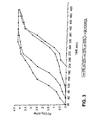
- the carbon dioxide absorbent of Example 2 can be further modified to contain 10ml, 15ml and 20ml glycerol, per 90, 85 and 80g dry solids, by corresponding reductions in the respective calcium hydroxide contents - these absorbents are hereinafter denoted as containing 5%, (w/w), 10% (w/w), 15% (w/w) and 20% (w/w) glycerol based on original constituents (excluding water).
- glycerol is a preferred humectant. Glycerol is favoured for two reasons - firstly, the high absorption efficiency of the products (see Figure 3 ) and, secondly, the fact that calcium hydroxide is more soluble in glycerol than in water, leading to higher absorbent absorption efficiencies because gas absorption can take place in both the solid and liquid phases of the granule's matrix.
- Carbon dioxide absorbents A-E were prepared by mixing 100g of the dry solids.
- a control absorbent was prepared by using 100g of the dry Ca(OH) 2 powder.
- Absorbents A-E contain, based on molecular weight, approximately 5, 10, 15, 20 and 10% (w/w) water, respectively.
- a 50/50 mixture of oxygen and nitrous oxide was passed at a flow rate of 1 litre a minute through a canister containing 100g of the absorbent to be tested. Carbon dioxide was added to the gas at between 55-60 ml/min, to maintain an end-tidal value of about 4.5 kPa. Samples were serially taken for carbon dioxide estimation, immediately downstream of the absorbent-containing canister.
- the carbon dioxide absorbent is taken as being inefficient if a FE'CO 2 of 0.5 kPa is observed. This is defined as carbon dioxide breakthrough.
- Table 1 shows the carbon dioxide breakthrough values for a control absorbent (containing only dry calcium hydroxide) and for absorbents A-E of the invention.
- Table 1 Carbon Dioxide breakthrough (minutes) Control 10 A 20 B 340 C 165 D 30 E 880
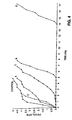
- Figure 4 shows the carbon dioxide absorption capacity over time in minutes, for the control absorbent and for absorbents A-E of the invention.
- the absorptive capacity of the respective materials is represented by the areas over the respective curves.
- Absorbent A shows a relatively early breakthrough whilst the area over the curve (absorptive capacity) was slightly improved, compared to the control absorbent.
- Absorbent B shows a remarkable improvement in absorptive capacity - the area over the curve is greatly increased; breakthrough does not occur for over 5 hours.
- Absorbent C shows, in comparison to control absorbent, an improved absorptive capacity, as well as, a delayed breakthrough at over 21 ⁇ 2 hours.
- Absorbent b shows, in comparison to control absorbent, an improved absorptive capacity and a delayed breakthrough at about 30 minutes.
- Absorbent E which contains, in addition, aluminium powder, shows a remarkable increase in absorptive capacity and remarkably prolonged breakthrough at well over 14 hours.
- the carbon dioxide absorbent was prepared by gauging the dry solids (1 kg) into a homogeneous paste with 11 water and immediately extruding or shaping the paste into pellets or granules (1-4 mm diameter), which are dried in an oven or hot air chamber at 70°C for 1 hour to a moisture content (Karl Fischer titration method) of 20-25%.
- a carbon dioxide absorbent in the form of granules prevents, or at least substantially reduces, release of dust into the test rig and, also, minimises resistance to flow.
- Figure 5 hows the absorptive capacity over time for the absorbent of Example 4. Breakthrough occurs after about 100 minutes and the area over the curve shows good absorptive capacity. Assuming a CO 2 flow rate of 55 ml/min, the absorptive capacity may be estimated as flow rate multiplied by time before breakthrough or 5.5 1 CO 2 .
- Figure 5 also shows the absorptive capacity of 100 g of a commercially available absorbent, namely, supplied by Drager under the Trade Mark Dragersorb.
- the absorbent of the invention shows a better absorptive capacity and delayed breakthrough, when compared under identical conditions.
- Example 2 The ability of the absorbent of Example 2 (containing 5% (v/w) glycerol) to react with the anaesthetics Enflurane (TM), Isoflurane (TM) and Desflurane (TM), forming carbon monoxide, is assessed in the following manner.
- Example 3 100g "dried out” soda lime was exposed to a 50/50 (v/v) nitrous oxide/oxygen mixture in the presence of 1 MAC of each anaesthetic agent. Carbon monoxide levels were measured with a CO meter immediately downstream of the canister outlet. Under these conditions, carbon monoxide was formed by enflurane, isoflurane and desflurane with "dried out” soda lime, as shown in Figure 6 . In contrast, when the absorbent of Example 2 is substituted for the "dried out” soda lime, there is no detectable formation of carbon monoxide, as shown in Figure 6 . Similar results (not shown) were observed when the absorbent of Example 1 is substituted for the absorbent of Example 2. Specifically, there was, also, no detectable formation of carbon monoxide in the presence of enflurane, isoflurane or desflurane.
- the carbon dioxide absorbent is prepared by mixing the dry solids, to a water content (based on molecular weights) of 10% (w/w) water.
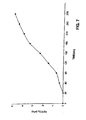
- Figure 7 shows the absorptive capacity over time for the absorbent of Example 6 when assessed under the experimental conditions of Example 3. Breakthrough occurs after about 70 minutes and the area over the curve shows good absorptive capacity.
- the glycerol (5ml) is dissolved in 95ml water and the glycerol solution is mixed with 95g calcium hydroxide powder.
- the mixture has a water content of 35%, by the Karl Fischer titration method, which is a sensitive method which can be used for measuring residual water in purified solvents and water of hydration in crystals.
- Karl Fischer titration method which is a sensitive method which can be used for measuring residual water in purified solvents and water of hydration in crystals.
- Such a freshly made mixture does not exhibit any CO 2 absorption under the experimental conditions of Example 3. Following drying for one hour at 70°C, the water content of the mixture falls to 28% (Karl Fischer titration) and the period of time before CO 2 breakthrough is extended to 3 hours (identified as A on Figure 8 ).
Landscapes
- Chemical & Material Sciences (AREA)
- Analytical Chemistry (AREA)
- Chemical Kinetics & Catalysis (AREA)
- Organic Chemistry (AREA)
- Inorganic Chemistry (AREA)
- Health & Medical Sciences (AREA)
- Engineering & Computer Science (AREA)
- Biomedical Technology (AREA)
- Pulmonology (AREA)
- Animal Behavior & Ethology (AREA)
- Oil, Petroleum & Natural Gas (AREA)
- Emergency Medicine (AREA)
- Environmental & Geological Engineering (AREA)
- Anesthesiology (AREA)
- Heart & Thoracic Surgery (AREA)
- Hematology (AREA)
- Life Sciences & Earth Sciences (AREA)
- General Chemical & Material Sciences (AREA)
- General Health & Medical Sciences (AREA)
- Public Health (AREA)
- Veterinary Medicine (AREA)
- Solid-Sorbent Or Filter-Aiding Compositions (AREA)
- Pharmaceuticals Containing Other Organic And Inorganic Compounds (AREA)
- Gas Separation By Absorption (AREA)
- Medicinal Preparation (AREA)
Claims (8)
- Absorbant de dioxyde de carbone destiné à être utilisé en anesthésiologie, l'absorbant comprenant de l'hydroxyde de calcium, l'hydroxyde de calcium étant essentiellement dépourvu d'hydroxyde de sodium et de potassium ; et une quantité d'un humectant hygroscopique ou déliquescent absorbant efficacement le dioxyde de carbone, la teneur en eau de l'absorbant, telle que mesurée par titrage de Karl Fischer, étant de 17,5 à 30 %, dans lequel l'absorbant comprend de plus une quantité efficace d'un agent de fixage compatible et un agent compatible pour la génération interne d'hydrogène.
- Absorbant de dioxyde de carbone selon la revendication 1, dans lequel l'humectant est un humectant inorganique ou un mélange de celui-ci, de préférence un hydrate hygroscopique ou déliquescent ou un mélange de celui-ci, d'une manière davantage préférée sélectionné parmi le chlorure de calcium hexahydraté ou le chlorure de magnésium hexahydraté, ou un mélange de ceux-ci, de la manière la plus préférée le chlorure de calcium hexahydraté, le chlorure de calcium hexahydraté étant présent en une quantité suffisante pour produire, en poids moléculaire, de 7,5 à 20 % (en poids), de préférence environ 10 % (en poids) d'eau.
- Absorbant de dioxyde de carbone selon la revendication 1 ou 2, dans lequel l'humectant est un humectant organique.
- Absorbant de dioxyde de carbone selon la revendication 3, dans lequel l'humectant organique est une substance dihydrique ou polyhydrique, l'humectant organique étant de préférence sélectionné parmi le glycérol, le polyéthylène glycol 200, le polyéthylène glycol 300, le polyéthylène glycol 1540, le propylène glycol ou l'hexan-1,2,6-triol.
- Absorbant de dioxyde de carbone selon la revendication 4, dans lequel l'humectant organique est le glycérol qui est de préférence présent à raison de 2,5 à 25 (en V/P%), d'une manière davantage préférée de 2,5 à 10 (en V/P%), de la manière la plus préférée environ 5 (en V/P%).
- Absorbant de dioxyde de carbone selon l'une quelconque des revendications 1 à 5, dans lequel la teneur en eau, telle que mesurée par titrage de Karl Fisher, est de 20 à 30%.
- Absorbant de dioxyde de carbone selon l'une quelconque des revendications 1 à 6, dans lequel la quantité efficace d'un agent de fixage compatible est de 4 à 5,5 % (en poids), d'une manière préférée de 4,5 à 5 % (en poids) de sulfate de calcium semi-hydraté.
- Absorbant de dioxyde de carbone selon l'une quelconque des revendications 1 à 7, dans lequel l'agent compatible pour la génération interne d'hydrogène est de la poudre métallique d'aluminium, la poudre d'aluminium étant présente à raison de 0,5 à 1 % (en poids).
Priority Applications (1)
| Application Number | Priority Date | Filing Date | Title |
|---|---|---|---|
| DE69733896T DE69733896T3 (de) | 1996-11-25 | 1997-11-25 | Kohlendioxid-absorptionsmittel für die anästhesie |
Applications Claiming Priority (5)
| Application Number | Priority Date | Filing Date | Title |
|---|---|---|---|
| GB9624549 | 1996-11-25 | ||
| GBGB9624549.3A GB9624549D0 (en) | 1996-11-25 | 1996-11-25 | Carbon dioxide absorbent in anaesthesiology |
| GBGB9723990.9A GB9723990D0 (en) | 1997-11-14 | 1997-11-14 | Carbon dioxide absorbent in anaesthesiology |
| GB9723990 | 1997-11-14 | ||
| PCT/EP1997/006698 WO1998023370A1 (fr) | 1996-11-25 | 1997-11-25 | Absorbant de dioxyde de carbone utilise en anesthesiologie |
Publications (3)
| Publication Number | Publication Date |
|---|---|
| EP0939671A1 EP0939671A1 (fr) | 1999-09-08 |
| EP0939671B1 EP0939671B1 (fr) | 2005-08-03 |
| EP0939671B2 true EP0939671B2 (fr) | 2013-06-19 |
Family
ID=26310486
Family Applications (1)
| Application Number | Title | Priority Date | Filing Date |
|---|---|---|---|
| EP97952832.0A Expired - Lifetime EP0939671B2 (fr) | 1996-11-25 | 1997-11-25 | Absorbant de dioxyde de carbone utilise en anesthesiologie |
Country Status (12)
| Country | Link |
|---|---|
| US (1) | US6228150B1 (fr) |
| EP (1) | EP0939671B2 (fr) |
| JP (1) | JP2001509042A (fr) |
| CN (1) | CN1155438C (fr) |
| AT (1) | ATE300998T1 (fr) |
| AU (1) | AU734272B2 (fr) |
| BR (1) | BR9713138A (fr) |
| CA (1) | CA2272933C (fr) |
| DE (1) | DE69733896T3 (fr) |
| ES (1) | ES2248859T5 (fr) |
| NZ (1) | NZ336406A (fr) |
| WO (1) | WO1998023370A1 (fr) |
Families Citing this family (25)
| Publication number | Priority date | Publication date | Assignee | Title |
|---|---|---|---|---|
| WO2000016894A1 (fr) * | 1998-09-18 | 2000-03-30 | Foerster Harald | Chaux pour appareil respiratoire |
| EP1212113B1 (fr) * | 1999-08-28 | 2005-04-20 | Koninklijke Philips Electronics N.V. | Elimination des effets d'empoisonnement pendant une anesthesie |
| DE19962141A1 (de) * | 1999-12-22 | 2001-07-12 | Chemetall Gmbh | Trockenabsorptionsverfahren von CO¶2¶ in Narkosegeräten |
| GB0020656D0 (en) * | 2000-08-23 | 2000-10-11 | Molecular Products Ltd | Improvements in or relating to carbon dioxide absorbent formulations |
| GB0025624D0 (en) * | 2000-10-19 | 2000-12-06 | Intersurgical Ltd | Chemical absorbent |
| US6867165B2 (en) | 2002-09-09 | 2005-03-15 | W. R. Grace & Co. -Conn. | Calcium hydroxide absorbent with rheology modifier and process involving same |
| US7267811B2 (en) | 2003-11-26 | 2007-09-11 | Cabot Corporation | Fuel reformer catalyst and absorbent materials |
| EP1697258A4 (fr) * | 2003-11-26 | 2010-03-10 | Cabot Corp | Matieres absorbantes particulaires et procedes de production de ces dernieres |
| US7264788B2 (en) * | 2003-11-26 | 2007-09-04 | Cabot Corporation | Fuel reformer catalyst and absorbent materials |
| MX2007001580A (es) * | 2004-08-16 | 2007-04-20 | Honeywell Int Inc | Metodo para prevenir formacion de escarcha y facilitar la remocion de precipitacion invernal en relacion a un parabrisas y composiciones para usarse en el mismo. |
| JP4689417B2 (ja) * | 2004-09-17 | 2011-05-25 | 矢橋工業株式会社 | 炭酸ガス吸収剤 |
| CN1733675A (zh) * | 2005-08-26 | 2006-02-15 | 山东新时代药业有限公司 | 一氟代甲基醚的制备方法 |
| CA2672228C (fr) * | 2006-12-26 | 2015-02-03 | Allied Healthcare Products, Inc. | Absorbant de dioxyde de carbone |
| EP2033680A1 (fr) * | 2007-09-10 | 2009-03-11 | Hargasser, Stefan, Prof. Dr. med. Dr. med. habil. | Système de respiration sous anesthésie à xénon |
| DE102009032895B4 (de) * | 2009-07-10 | 2016-06-23 | Chevita Tierarzneimittel-Gesellschaft M.B.H. | Zusammensetzung und Verfahren zur Prävention und Behandlung von Feuerbrand |
| CN102258938B (zh) * | 2010-05-31 | 2015-02-04 | 上海医药工业研究院 | 医用二氧化碳吸收剂钠石灰及其制备方法 |
| EP2418010A1 (fr) | 2010-08-11 | 2012-02-15 | Dräger Safety AG & Co. KGaA | Dispositif et procédé d'enrichissement de gaz acides à partir de mélanges de gaz |
| CN102489147B (zh) * | 2011-12-14 | 2013-12-04 | 浙江大学 | 一种有机无机复合溶胶及其制备方法和应用 |
| KR101451112B1 (ko) * | 2012-07-09 | 2014-10-15 | 서강대학교산학협력단 | 이산화탄소 고체 흡수제 및 흡수 방법 |
| CN104801172A (zh) * | 2015-03-29 | 2015-07-29 | 安徽养和医疗器械设备有限公司 | 一种二氧化碳吸收剂及其制备方法 |
| CN107243249A (zh) * | 2017-06-22 | 2017-10-13 | 党银喜 | 高效医用碱石灰及其制备方法 |
| CN109395227B (zh) * | 2018-12-17 | 2024-11-19 | 无锡华纳医疗科技有限公司 | 外置式二氧化碳吸收装置 |
| CN109569263A (zh) * | 2018-12-26 | 2019-04-05 | 江苏立峰生物科技有限公司 | 一种新型医用二氧化碳吸收剂的制备方法 |
| WO2022050506A1 (fr) * | 2020-09-02 | 2022-03-10 | 한국기술교육대학교 산학협력단 | Composition déshydratante à hautes performances empêchant les fuites et son procédé de préparation |
| CN117101376A (zh) * | 2023-10-16 | 2023-11-24 | 江苏交竹能源环境科技有限公司 | 一种高效稳定的二氧化碳吸收剂颗粒及制备方法和应用 |
Citations (1)
| Publication number | Priority date | Publication date | Assignee | Title |
|---|---|---|---|---|
| JPH07185319A (ja) † | 1993-12-24 | 1995-07-25 | Wako Pure Chem Ind Ltd | 酸性ガス吸収剤 |
Family Cites Families (19)
| Publication number | Priority date | Publication date | Assignee | Title |
|---|---|---|---|---|
| US2322206A (en) * | 1942-12-16 | 1943-06-22 | Edison Inc Thomas A | Gas absorbent and method for preparing the same |
| US2848309A (en) * | 1956-10-23 | 1958-08-19 | Air Reduction | Carbon dioxide absorber |
| US3847837A (en) * | 1972-04-25 | 1974-11-12 | Foote Mineral Co | Carbon dioxide absorbent granules |
| DD96839A1 (fr) * | 1972-06-02 | 1973-04-12 | ||
| US4029483A (en) * | 1975-05-05 | 1977-06-14 | Richard William Long | Diving bell heater and absorbent system |
| DE2705533A1 (de) * | 1977-02-10 | 1978-08-17 | Heinz Hoelter | Absorptionsmasse zur beseitigung von geruechen und schadstoffen in abluftanlagen |
| US4433981A (en) * | 1981-02-18 | 1984-02-28 | Shell Oil Company | CO2 Removal from gaseous streams |
| CA1151633A (fr) | 1981-05-27 | 1983-08-09 | Clive D. R. Macgregor | Absorption de bioxyde de carbone |
| DE3123064A1 (de) * | 1981-06-11 | 1983-01-05 | Hölter, Heinz, Dipl.-Ing., 4390 Gladbeck | "verfahren zur besseren nutzung von chemisorptionsmitteln in gasreinigungsanlagen" |
| US4492649A (en) * | 1982-01-15 | 1985-01-08 | Cheh Christopher H | Carbon dioxide removal method employing packed solid calcium hydroxide |
| JPS58177137A (ja) * | 1982-04-13 | 1983-10-17 | Toppan Printing Co Ltd | 食品の包装方法 |
| US4552767A (en) * | 1984-09-27 | 1985-11-12 | General Foods Corporation | Method of packaging coffee with carbon dioxide sorbent |
| JPH0698262B2 (ja) * | 1987-11-06 | 1994-12-07 | 株式会社日本触媒 | 酸性ガス吸収剤組成物 |
| JPH03219912A (ja) * | 1990-01-25 | 1991-09-27 | Matsushita Electric Works Ltd | 無機質板の表面模様付方法 |
| JPH0557182A (ja) | 1991-09-03 | 1993-03-09 | Central Glass Co Ltd | 二酸化炭素吸収剤 |
| US5214019A (en) * | 1992-02-24 | 1993-05-25 | United Technologies Corporation | Enhancing carbon dioxide sorption rates using hygroscopic additives |
| US5376614A (en) * | 1992-12-11 | 1994-12-27 | United Technologies Corporation | Regenerable supported amine-polyol sorbent |
| JPH0710654A (ja) * | 1993-06-23 | 1995-01-13 | Narumi China Corp | 多孔質セラミック体及びその製造方法 |
| US5595949A (en) * | 1994-03-18 | 1997-01-21 | Electric Fuel (E.F.L.) Ltd., | Scrubber system for removing carbon dioxide from a metal-air or fuel cell battery |
-
1997
- 1997-11-25 CA CA002272933A patent/CA2272933C/fr not_active Expired - Fee Related
- 1997-11-25 AU AU56571/98A patent/AU734272B2/en not_active Ceased
- 1997-11-25 ES ES97952832T patent/ES2248859T5/es not_active Expired - Lifetime
- 1997-11-25 EP EP97952832.0A patent/EP0939671B2/fr not_active Expired - Lifetime
- 1997-11-25 US US09/308,774 patent/US6228150B1/en not_active Expired - Lifetime
- 1997-11-25 WO PCT/EP1997/006698 patent/WO1998023370A1/fr not_active Ceased
- 1997-11-25 BR BR9713138-5A patent/BR9713138A/pt unknown
- 1997-11-25 DE DE69733896T patent/DE69733896T3/de not_active Expired - Lifetime
- 1997-11-25 AT AT97952832T patent/ATE300998T1/de active
- 1997-11-25 NZ NZ336406A patent/NZ336406A/en not_active IP Right Cessation
- 1997-11-25 CN CNB97181466XA patent/CN1155438C/zh not_active Expired - Fee Related
- 1997-11-25 JP JP52430298A patent/JP2001509042A/ja not_active Ceased
Patent Citations (1)
| Publication number | Priority date | Publication date | Assignee | Title |
|---|---|---|---|---|
| JPH07185319A (ja) † | 1993-12-24 | 1995-07-25 | Wako Pure Chem Ind Ltd | 酸性ガス吸収剤 |
Non-Patent Citations (5)
| Title |
|---|
| EUGEN SCHOLZ: "Wasserbestimmung durch Karl-Fischer-Titration", vol. 7, June 2003, SPRINGER-VERLAG, BERLIN HEIDELBERG, NEW YORK, TOKYO, article BRUTTEL, P. ET AL., pages: 19 † |
| NEUMÜLLER, O.-A.: "Römpps Chemie-Lexikon", vol. 2, 1981, FRANCKH'SCHE VERLAGSHANDLUNG, STUTTGART, article "Feuchthaltemittel", pages: 1275 † |
| NEUMÜLLER, O.-A.: "Römpps Chemie-Lexikon", vol. 5, 1987, FRANCKH'SCHE VERLAGSHANDLUNG, STUTTGART, article "Relative Luftfeuchtigkeit", pages: 3550 † |
| NEUMÜLLER, O.-A.: "Römpps Chemie-Lexikon", vol. 6, 1988, FRANCKH'SCHE VERLAGSHANDLUNG, STUTTGART, article "Trockenmittel", pages: 4370 - 4371 † |
| SCHOLZ, E.: "Karl-Fischer-Titration - Methoden zur Wasserbestimmung", 1984, SPRINGER-VERLAG, BERLIN HEIDELBERG, pages: 61 - 63 † |
Also Published As
| Publication number | Publication date |
|---|---|
| ES2248859T3 (es) | 2006-03-16 |
| AU734272B2 (en) | 2001-06-07 |
| CA2272933A1 (fr) | 1998-06-04 |
| DE69733896T3 (de) | 2013-10-31 |
| WO1998023370A1 (fr) | 1998-06-04 |
| CN1244817A (zh) | 2000-02-16 |
| DE69733896D1 (de) | 2005-09-08 |
| AU5657198A (en) | 1998-06-22 |
| NZ336406A (en) | 2001-06-29 |
| CN1155438C (zh) | 2004-06-30 |
| US6228150B1 (en) | 2001-05-08 |
| EP0939671A1 (fr) | 1999-09-08 |
| BR9713138A (pt) | 2000-02-08 |
| EP0939671B1 (fr) | 2005-08-03 |
| DE69733896T2 (de) | 2006-06-01 |
| CA2272933C (fr) | 2007-07-03 |
| ATE300998T1 (de) | 2005-08-15 |
| ES2248859T5 (es) | 2013-11-04 |
| JP2001509042A (ja) | 2001-07-10 |
Similar Documents
| Publication | Publication Date | Title |
|---|---|---|
| EP0939671B1 (fr) | Absorbant de dioxyde de carbone utilise en anesthesiologie | |
| EP0417478B2 (fr) | Composé contenant du bicarbonate de sodium permettant de réaliser une solution de dialyse | |
| JP2003517493A (ja) | リグノセルロース物質用の難燃剤膨張性コーティング | |
| KR20120005043A (ko) | 흡연 물품용 에어로졸 생성 물질 | |
| EP2099560B1 (fr) | Absorbant de dioxyde de carbone, procede de preparation et procede d'adsorption de dioxyde de carbone dans les gaz d'anesthésie | |
| JPH09508855A (ja) | 吸収剤 | |
| CN101636225A (zh) | 二氧化碳吸收剂 | |
| Kobayashi et al. | Amsorb Plus and Drägersorb Free, two new-generation carbon dioxide absorbents that produce a low compound A concentration while providing sufficient CO2 absorption capacity in simulated sevoflurane anesthesia | |
| EP1313555B1 (fr) | Ameliorations apportees a des formulations absorbant le dioxyde de carbone | |
| US2322206A (en) | Gas absorbent and method for preparing the same | |
| WO2025213720A1 (fr) | Agent d'extinction d'incendie en aérosol ayant une capacité d'extinction d'incendie élevée, et son procédé de préparation | |
| JPS58177137A (ja) | 食品の包装方法 | |
| JP3701741B2 (ja) | 有害ガスの浄化剤 | |
| JP4015223B2 (ja) | 脱酸素剤 | |
| JPS61234930A (ja) | 脱臭剤組成物 | |
| JPS58128145A (ja) | 酸素吸収剤 | |
| JP3076051B2 (ja) | 重曹透析用剤 | |
| JP2023140485A (ja) | 添着活性炭及びその製造方法、並びに添着活性炭の製造設備 | |
| JP2008110278A (ja) | 炭酸ガス吸収剤の製造方法 | |
| KR810000926B1 (ko) | 산소 흡수제 | |
| JPS61157343A (ja) | 酸素吸収剤 | |
| JP2001293365A (ja) | 乾燥剤 |
Legal Events
| Date | Code | Title | Description |
|---|---|---|---|
| PUAI | Public reference made under article 153(3) epc to a published international application that has entered the european phase |
Free format text: ORIGINAL CODE: 0009012 |
|
| 17P | Request for examination filed |
Effective date: 19990625 |
|
| AK | Designated contracting states |
Kind code of ref document: A1 Designated state(s): AT BE CH DE DK ES FI FR GB GR IE IT LI LU MC NL PT SE |
|
| AX | Request for extension of the european patent |
Free format text: RO PAYMENT 19990625 |
|
| 17Q | First examination report despatched |
Effective date: 19991209 |
|
| GRAG | Despatch of communication of intention to grant |
Free format text: ORIGINAL CODE: EPIDOS AGRA |
|
| TPAD | Observations filed by third parties |
Free format text: ORIGINAL CODE: EPIDOS TIPA |
|
| GRAG | Despatch of communication of intention to grant |
Free format text: ORIGINAL CODE: EPIDOS AGRA |
|
| TPAD | Observations filed by third parties |
Free format text: ORIGINAL CODE: EPIDOS TIPA |
|
| TPAC | Observations filed by third parties |
Free format text: ORIGINAL CODE: EPIDOSNTIPA |
|
| GRAJ | Information related to disapproval of communication of intention to grant by the applicant or resumption of examination proceedings by the epo deleted |
Free format text: ORIGINAL CODE: EPIDOSDIGR1 |
|
| GRAP | Despatch of communication of intention to grant a patent |
Free format text: ORIGINAL CODE: EPIDOSNIGR1 |
|
| GRAU | Approval following communication of intention to grant |
Free format text: ORIGINAL CODE: EPIDOSNAGR4 |
|
| GRAN | Information related to approval following communication of intention to grant deleted |
Free format text: ORIGINAL CODE: EPIDOSDAGR4 |
|
| GRAJ | Information related to disapproval of communication of intention to grant by the applicant or resumption of examination proceedings by the epo deleted |
Free format text: ORIGINAL CODE: EPIDOSDIGR1 |
|
| GRAP | Despatch of communication of intention to grant a patent |
Free format text: ORIGINAL CODE: EPIDOSNIGR1 |
|
| GRAU | Approval following communication of intention to grant |
Free format text: ORIGINAL CODE: EPIDOSNAGR4 |
|
| GRAS | Grant fee paid |
Free format text: ORIGINAL CODE: EPIDOSNIGR3 |
|
| GRAA | (expected) grant |
Free format text: ORIGINAL CODE: 0009210 |
|
| AK | Designated contracting states |
Kind code of ref document: B1 Designated state(s): AT BE CH DE DK ES FI FR GB GR IE IT LI LU MC NL PT SE |
|
| AX | Request for extension of the european patent |
Extension state: RO |
|
| PG25 | Lapsed in a contracting state [announced via postgrant information from national office to epo] |
Ref country code: NL Free format text: LAPSE BECAUSE OF FAILURE TO SUBMIT A TRANSLATION OF THE DESCRIPTION OR TO PAY THE FEE WITHIN THE PRESCRIBED TIME-LIMIT Effective date: 20050803 Ref country code: LI Free format text: LAPSE BECAUSE OF FAILURE TO SUBMIT A TRANSLATION OF THE DESCRIPTION OR TO PAY THE FEE WITHIN THE PRESCRIBED TIME-LIMIT Effective date: 20050803 Ref country code: FI Free format text: LAPSE BECAUSE OF FAILURE TO SUBMIT A TRANSLATION OF THE DESCRIPTION OR TO PAY THE FEE WITHIN THE PRESCRIBED TIME-LIMIT Effective date: 20050803 Ref country code: CH Free format text: LAPSE BECAUSE OF FAILURE TO SUBMIT A TRANSLATION OF THE DESCRIPTION OR TO PAY THE FEE WITHIN THE PRESCRIBED TIME-LIMIT Effective date: 20050803 |
|
| REG | Reference to a national code |
Ref country code: GB Ref legal event code: FG4D |
|
| REG | Reference to a national code |
Ref country code: CH Ref legal event code: EP |
|
| REG | Reference to a national code |
Ref country code: IE Ref legal event code: FG4D |
|
| REF | Corresponds to: |
Ref document number: 69733896 Country of ref document: DE Date of ref document: 20050908 Kind code of ref document: P |
|
| PG25 | Lapsed in a contracting state [announced via postgrant information from national office to epo] |
Ref country code: SE Free format text: LAPSE BECAUSE OF FAILURE TO SUBMIT A TRANSLATION OF THE DESCRIPTION OR TO PAY THE FEE WITHIN THE PRESCRIBED TIME-LIMIT Effective date: 20051103 Ref country code: DK Free format text: LAPSE BECAUSE OF FAILURE TO SUBMIT A TRANSLATION OF THE DESCRIPTION OR TO PAY THE FEE WITHIN THE PRESCRIBED TIME-LIMIT Effective date: 20051103 |
|
| PG25 | Lapsed in a contracting state [announced via postgrant information from national office to epo] |
Ref country code: MC Free format text: LAPSE BECAUSE OF NON-PAYMENT OF DUE FEES Effective date: 20051130 Ref country code: LU Free format text: LAPSE BECAUSE OF NON-PAYMENT OF DUE FEES Effective date: 20051130 |
|
| REG | Reference to a national code |
Ref country code: GR Ref legal event code: EP Ref document number: 20050403353 Country of ref document: GR |
|
| PG25 | Lapsed in a contracting state [announced via postgrant information from national office to epo] |
Ref country code: PT Free format text: LAPSE BECAUSE OF FAILURE TO SUBMIT A TRANSLATION OF THE DESCRIPTION OR TO PAY THE FEE WITHIN THE PRESCRIBED TIME-LIMIT Effective date: 20060103 |
|
| NLV1 | Nl: lapsed or annulled due to failure to fulfill the requirements of art. 29p and 29m of the patents act | ||
| REG | Reference to a national code |
Ref country code: CH Ref legal event code: PL |
|
| REG | Reference to a national code |
Ref country code: ES Ref legal event code: FG2A Ref document number: 2248859 Country of ref document: ES Kind code of ref document: T3 |
|
| ET | Fr: translation filed | ||
| PLBI | Opposition filed |
Free format text: ORIGINAL CODE: 0009260 |
|
| PLAX | Notice of opposition and request to file observation + time limit sent |
Free format text: ORIGINAL CODE: EPIDOSNOBS2 |
|
| 26 | Opposition filed |
Opponent name: DRAEGERWERK AKTIENGESELLSCHAFT Effective date: 20060502 |
|
| PLAF | Information modified related to communication of a notice of opposition and request to file observations + time limit |
Free format text: ORIGINAL CODE: EPIDOSCOBS2 |
|
| PLBB | Reply of patent proprietor to notice(s) of opposition received |
Free format text: ORIGINAL CODE: EPIDOSNOBS3 |
|
| PLAB | Opposition data, opponent's data or that of the opponent's representative modified |
Free format text: ORIGINAL CODE: 0009299OPPO |
|
| R26 | Opposition filed (corrected) |
Opponent name: DRAEGERWERK AG & CO. KGAA Effective date: 20060502 |
|
| APAH | Appeal reference modified |
Free format text: ORIGINAL CODE: EPIDOSCREFNO |
|
| APBM | Appeal reference recorded |
Free format text: ORIGINAL CODE: EPIDOSNREFNO |
|
| APBP | Date of receipt of notice of appeal recorded |
Free format text: ORIGINAL CODE: EPIDOSNNOA2O |
|
| APBQ | Date of receipt of statement of grounds of appeal recorded |
Free format text: ORIGINAL CODE: EPIDOSNNOA3O |
|
| APBU | Appeal procedure closed |
Free format text: ORIGINAL CODE: EPIDOSNNOA9O |
|
| PGFP | Annual fee paid to national office [announced via postgrant information from national office to epo] |
Ref country code: GR Payment date: 20121130 Year of fee payment: 16 |
|
| PGFP | Annual fee paid to national office [announced via postgrant information from national office to epo] |
Ref country code: AT Payment date: 20121130 Year of fee payment: 16 |
|
| PUAH | Patent maintained in amended form |
Free format text: ORIGINAL CODE: 0009272 |
|
| STAA | Information on the status of an ep patent application or granted ep patent |
Free format text: STATUS: PATENT MAINTAINED AS AMENDED |
|
| 27A | Patent maintained in amended form |
Effective date: 20130619 |
|
| AK | Designated contracting states |
Kind code of ref document: B2 Designated state(s): AT BE CH DE DK ES FI FR GB GR IE IT LI LU MC NL PT SE |
|
| AX | Request for extension of the european patent |
Extension state: RO |
|
| REG | Reference to a national code |
Ref country code: DE Ref legal event code: R102 Ref document number: 69733896 Country of ref document: DE Effective date: 20130619 |
|
| REG | Reference to a national code |
Ref country code: ES Ref legal event code: DC2A Ref document number: 2248859 Country of ref document: ES Kind code of ref document: T5 Effective date: 20131104 |
|
| REG | Reference to a national code |
Ref country code: GR Ref legal event code: EP Ref document number: 20130401929 Country of ref document: GR Effective date: 20131015 |
|
| PGFP | Annual fee paid to national office [announced via postgrant information from national office to epo] |
Ref country code: FR Payment date: 20131120 Year of fee payment: 17 |
|
| PGFP | Annual fee paid to national office [announced via postgrant information from national office to epo] |
Ref country code: BE Payment date: 20131121 Year of fee payment: 17 Ref country code: ES Payment date: 20131126 Year of fee payment: 17 |
|
| REG | Reference to a national code |
Ref country code: AT Ref legal event code: MM01 Ref document number: 300998 Country of ref document: AT Kind code of ref document: T Effective date: 20131125 |
|
| REG | Reference to a national code |
Ref country code: GR Ref legal event code: ML Ref document number: 20130401929 Country of ref document: GR Effective date: 20140603 |
|
| PG25 | Lapsed in a contracting state [announced via postgrant information from national office to epo] |
Ref country code: GR Free format text: LAPSE BECAUSE OF NON-PAYMENT OF DUE FEES Effective date: 20140603 Ref country code: AT Free format text: LAPSE BECAUSE OF NON-PAYMENT OF DUE FEES Effective date: 20131125 |
|
| PGFP | Annual fee paid to national office [announced via postgrant information from national office to epo] |
Ref country code: IE Payment date: 20141029 Year of fee payment: 18 Ref country code: DE Payment date: 20141119 Year of fee payment: 18 |
|
| PGFP | Annual fee paid to national office [announced via postgrant information from national office to epo] |
Ref country code: IT Payment date: 20141126 Year of fee payment: 18 |
|
| PG25 | Lapsed in a contracting state [announced via postgrant information from national office to epo] |
Ref country code: BE Free format text: LAPSE BECAUSE OF NON-PAYMENT OF DUE FEES Effective date: 20141130 |
|
| REG | Reference to a national code |
Ref country code: FR Ref legal event code: ST Effective date: 20150731 |
|
| PG25 | Lapsed in a contracting state [announced via postgrant information from national office to epo] |
Ref country code: FR Free format text: LAPSE BECAUSE OF NON-PAYMENT OF DUE FEES Effective date: 20141201 |
|
| REG | Reference to a national code |
Ref country code: ES Ref legal event code: FD2A Effective date: 20151229 |
|
| PG25 | Lapsed in a contracting state [announced via postgrant information from national office to epo] |
Ref country code: ES Free format text: LAPSE BECAUSE OF NON-PAYMENT OF DUE FEES Effective date: 20141126 |
|
| REG | Reference to a national code |
Ref country code: DE Ref legal event code: R119 Ref document number: 69733896 Country of ref document: DE |
|
| PG25 | Lapsed in a contracting state [announced via postgrant information from national office to epo] |
Ref country code: IT Free format text: LAPSE BECAUSE OF NON-PAYMENT OF DUE FEES Effective date: 20151125 |
|
| REG | Reference to a national code |
Ref country code: IE Ref legal event code: MM4A |
|
| PG25 | Lapsed in a contracting state [announced via postgrant information from national office to epo] |
Ref country code: DE Free format text: LAPSE BECAUSE OF NON-PAYMENT OF DUE FEES Effective date: 20160601 Ref country code: IE Free format text: LAPSE BECAUSE OF NON-PAYMENT OF DUE FEES Effective date: 20151125 |
|
| PGFP | Annual fee paid to national office [announced via postgrant information from national office to epo] |
Ref country code: GB Payment date: 20161013 Year of fee payment: 20 |
|
| REG | Reference to a national code |
Ref country code: GB Ref legal event code: PE20 Expiry date: 20171124 |
|
| PG25 | Lapsed in a contracting state [announced via postgrant information from national office to epo] |
Ref country code: GB Free format text: LAPSE BECAUSE OF EXPIRATION OF PROTECTION Effective date: 20171124 |